last edited Dec 11, 2019
Health and Safety in Réunion
Location Map of Réunion
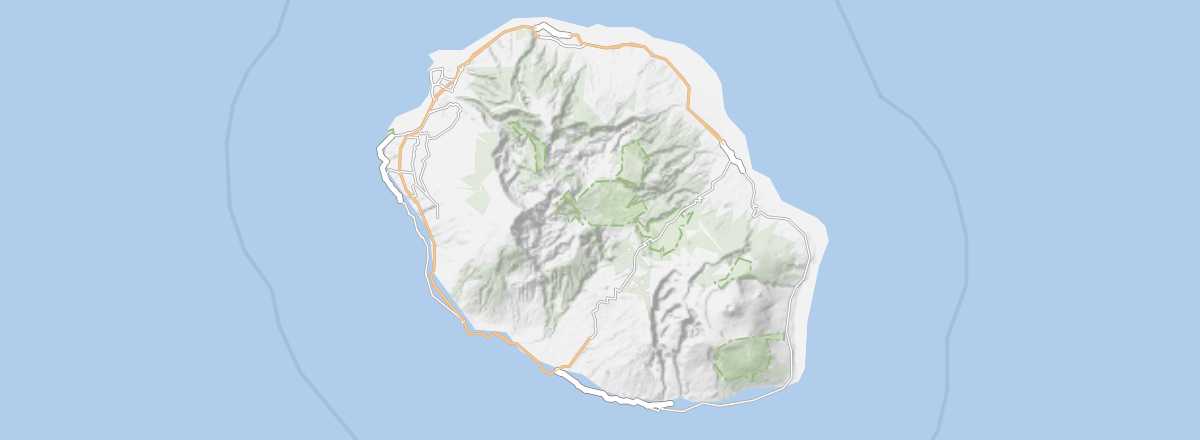 Réunion
Open the interactive map
Official Recommendations
In France, both for individuals and professionals, the "travel advice" from the Ministry of Foreign Affairs regarding precautions for each country has legal value. A similar online travel advice system exists in several countries:
Health
Diseases
Réunion does not pose any real health problems except for chikungunya and, secondarily, dengue fever (no malaria, however), which are carried by certain mosquitoes. In 2005-2006, the island experienced an epidemic of "chik" that affected around 40% of the population. However, since then, except for very localized cases in 2010, no further cases have been reported, and there is no need to "overreact." To protect yourself, the simplest solution is to use a good repellent and cover your arms and legs properly.
Hygiene
Here too, there are no real risks, and the water is drinkable everywhere. Just remember to stay hydrated and protect yourself from the sun during the hottest periods.
Local Healthcare Facilities
Réunion has a very good healthcare system, in fact, the best in the Indian Ocean. As for how it works—reimbursement for care, etc.—everything functions as it does in mainland France.
Safety
Crime and Delinquency
While not very high, delinquency has been increasing in Réunion in recent years. However, as in many places, with a minimum of precautions and common sense, you will have no problems during your stay. That said, to avoid theft, it is best not to leave your vehicle in parking lots at the start of hiking trails for several days.
Scams and "Tourist" Harassment
Nothing to report.
Socio-Political Issues and Terrorism
No particular problems.
Climate and Nature
Of all the risks, the weather is perhaps the most significant. Réunion’s climate can be challenging, and it is always necessary to check the conditions you might encounter while hiking, especially since microclimates are numerous on the island. Conversely, it is also important to protect yourself from the sun, which can be intense in the middle of the day.
At sea, certain ocean currents may locally prohibit swimming. The austral summer, from January to March, is cyclone season. Although these cyclones are less "spectacular" than, for example, those in the Caribbean, they can still cause significant damage.
Lastly, Réunion is home to one of the most active volcanoes on the planet, the Piton de la Fournaise.
Animals
Apart from mosquitoes or the occasional scorpion sting, there are hardly any "problematic" animals on land. However, in the sea, divers should be cautious of corals and some fish that can cause cuts or stings.
As for sharks, without being paranoid, their presence and accidents involving surfers on the west coast are very real. This is why local authorities occasionally ban certain activities (surfing, snorkeling, or even swimming) in areas outside the lagoon and secured zones. On this topic, the prefecture has set up an information website (Shark Info).
Foreign Consulates on Site
Around a dozen countries (but not Canada) have consular representations in Réunion. Among them:
- Belgium: c/o Société Chatel, ZAC Aéroportuaire de Gillot, 80 rue Adolphe Pegoud, 97438 Sainte-Marie. Tel.: 0 262 97 99 10.
- [[http://reunion-sdn.china-consulate.org/fra/|China]]: 50 rue du Général de Gaulle, 97400 Saint-Denis. Tel.: 0 262 98 92 98.
- India: 266 rue du Maréchal Leclerc, 97400 Saint-Denis. Tel.: 0 262 41 75 47.
- Madagascar: 29 rue St Joseph Ouvrier, 97400 Saint-Denis. Tel.: 0 262 72 07 30.
- Mauritius: 377 rue du Maréchal Leclerc, 97400 Saint-Denis. Tel.: 0 262 90 40 28.
- Seychelles: Villa Bel Air, 67 rue de Kervéguen, 97430 Le Tampon. Tel.: 0 262 57 26 38.
- Switzerland: 3 bis Impasse Tapioca, Bois Rouge, 97460 Saint-Paul. Tel.: 0 262 52 56 41.