last edited Dec 11, 2019
Health and Safety in Honduras
Location Map of Honduras
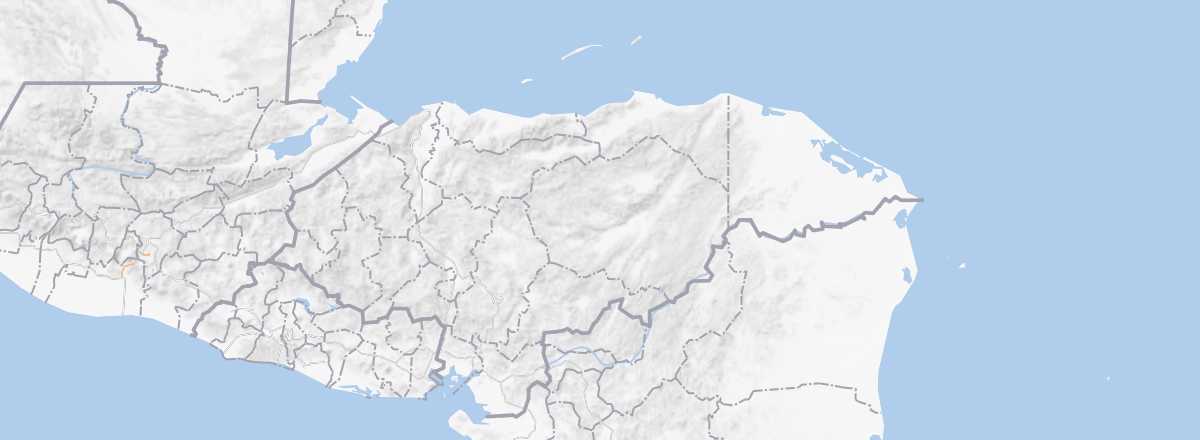 Honduras
Open the interactive map
Official Recommendations
In France, both for individuals and professionals, the "travel advice" from the Ministry of Foreign Affairs regarding precautions for each country has legal value. A similar online travel advice system exists in several countries:
Health
As always, it's best to be up to date with your vaccinations, even if nothing is officially required to enter the country.
Diseases
While not necessarily alarming compared to many other countries, Honduras' health situation is fairly average—much more so on the mainland than on its Caribbean islands, where problems are fewer.
Dengue and chikungunya, transmitted by certain mosquitoes, are present as in many places in this part of the world. Cases of Chagas disease (transmitted by bug bites) are also regularly reported. As for malaria, it is only found very locally (below 1,500 m) or occasionally during the rainy season, to the point that few travelers use treatment, preferring prevention. To protect yourself against all this, the best approach is to use a good repellent, cover your arms and legs at dusk when mosquitoes are most active, and bring an impregnated mosquito net if you sleep in a place without air conditioning or airflow.
Hygiene
Good personal and especially food hygiene is essential if you want to "eat local." So avoid tap water, which is not potable, and dishes or foods that do not seem completely fresh—if only to avoid traveler’s diarrhea.
Healthcare Facilities on Site
Medical facilities are fairly average and primarily found in large cities or tourist areas along the coast. The few rare private "quality" establishments can be expensive. Good travel insurance is therefore recommended.
Safety
Crime and Delinquency
Statistically, outside conflict zones, Honduras has the highest crime and delinquency rate in the world. This primarily affects Hondurans and is largely due to gangs engaged in constant warfare (the infamous "maras"), but tourists or foreigners may also occasionally be targeted.
In short, it's best to take all precautions and be careful, especially if traveling solo. On this topic, the French Ministry of Foreign Affairs (like several of its foreign counterparts) offers a range of useful advice and updates on the situation in different regions of the country. Ultimately, most of the territory is not highly recommended, except for a small area on the Pacific coast, the Bay Islands (Roatan and others), as well as the pre-Columbian site of Copan near Guatemala. These, along with the latter locations, are the country’s most tourist-friendly areas.
Scams and "Tourist" Harassment
Socio-Political Risks
Climate, Nature, Animals
Foreign Consulates on Site
If you encounter problems while traveling abroad, your country’s consular services can assist you. It’s also worth noting that if you are a citizen of the European Union and your country is not represented, you can contact any other EU member state’s representation.
France
Embassy: Colonia Altos Lomas del Guijarro Sur, 4ta. Avenida, 2da Calle, Bloque B, Lote 7, Fte. al BID AP 3441, Tegucigalpa. Tel.: (504) 22 32 54 44. Note that all consular services, such as passport issuance, are now handled by the consular section of the French Embassy in Guatemala, not by the one in Honduras.
France also has three honorary consulates in the country: in Copan (tel.: +504. 3293 7004), Roatan (tel.: +504. 2454 7050), and San Pedro Sula (tel.: +504. 2558 6536).
Other Countries
- Belgium: Honorary Consulate, Edificio Banco Atlántida, 3er piso, Plaza Bancatlan, Boulevard Centro América, Apartado Postal n° 2188, Tegucigalpa. Tel.: (+504) 223 239 542.
- Canada: Consulate General, Centro Financiero CITI, 3d Floor, San Juan Bosco, Colonia Payaqui, PO. Box 3552, Tegucigalpa. Tel.: (+504) 223 24 551.
- Switzerland: Consulate General, Colonia Palmira, Avenida República de México, Casa No. 2402, Apartado Postal 3202, Tegucigalpa. Tel.: (+504) 223 69 098.