last edited Dec 11, 2019
What to See in Marrakech
Contributionsversion #1created Dec 11, 2019Report this pageLatest contributions in this guideContributors to this guide
Location Map of Marrakech
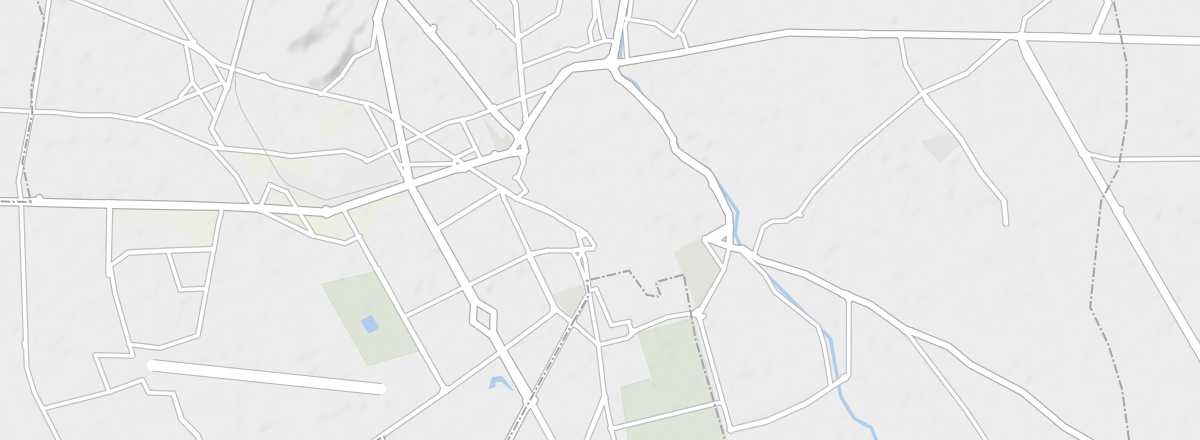 Marrakech
Open the interactive map
Marrakech
Open the interactive map
Overview
Marrakech is a must-visit on any trip to Morocco. With its vibrant atmosphere and rich cultural heritage, it deserves at least two days of exploration on its own. You could also add another two or three days to visit the surrounding areas, which are full of interesting places like the Toubkal National Park or the Ourika Valley.
Districts
Marrakech is divided into two main parts: the medina, which is the historic city, and the "new town," which is more modern and built in a European style.
The Medina
The medina of Marrakech has been a UNESCO World Heritage site since 1985. Most of the city's points of interest are located here. At its heart is Jemaa el-Fna Square, the city's unmissable hub. To the north of the square are the souks and the tanners' district, while to the south lies the kasbah with its palaces and the Saadian Tombs.
The medina's walls, built as early as the 12th century, earned Marrakech the nickname "the red city." These walls stretch for 19 km, feature 200 towers, and are pierced by around fifteen gates providing access to the medina. You can tour the ramparts by horse-drawn carriage.
The New Town
The new town emerged during the French protectorate and is located west of the medina. It is divided between the administrative district of Guéliz in the north and the residential area of Hivernage to the south/southwest. For tourists, aside from the large hotels, the area is home to several parks and gardens, the most famous of which is the Majorelle Garden.
Always lively, Guéliz is centered around Mohammed V Avenue. Along this busy commercial street, as well as in the surrounding roads, hotels, shopping centers, and administrative buildings give the impression of a major metropolis.
South of Hassan II Avenue and Liberty Square, Hivernage is quieter. The former diplomatic quarter now houses numerous residences, the city's major hotels, and its main public facilities (Opera, stadium, Congress Palace, etc.).
Sites, Monuments, and Architectural Ensembles
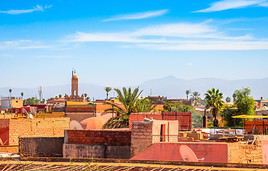
Marrakech Medina
It is the historic heart of the city and one of the largest medinas in Morocco. A UNESCO World Heritage site, it alone justifies a trip to Marrakech.
It is the historic heart of the city and one of the largest medinas in Morocco. A UNESCO World Heritage site, it alone justifies a trip to Marrakech.
In the Center of the Medina
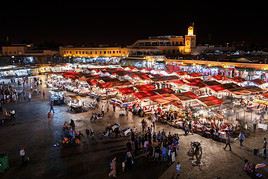
Jemaa el-Fna Square
Located in the medina, between the souks and the kasbah, Jemaa el-Fna Square embodies the soul of the city. It takes its name from the public executions that took place here until the 19th century. Throughout the day, the surrounding area buzzes with increasing activity, and in the evening, the square transforms into an open-air restaurant with grilled skewer stands and other local specialties.
Located in the medina, between the souks and the kasbah, Jemaa el-Fna Square embodies the soul of the city. It takes its name from the public executions that took place here until the 19th century. Throughout the day, the surrounding area buzzes with increasing activity, and in the evening, the square transforms into an open-air restaurant with grilled skewer stands and other local specialties.
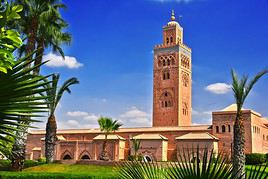
Koutoubia Mosque
The largest mosque in the city. It is nicknamed the "Golden Apples Mosque" in reference to the fine gold spheres crowning the minaret. The 77-metre-high pink sandstone minaret is visible from everywhere. Built between 1184 and 1189, the mosque is off-limits to non-Muslims.
The largest mosque in the city. It is nicknamed the "Golden Apples Mosque" in reference to the fine gold spheres crowning the minaret. The 77-metre-high pink sandstone minaret is visible from everywhere. Built between 1184 and 1189, the mosque is off-limits to non-Muslims.
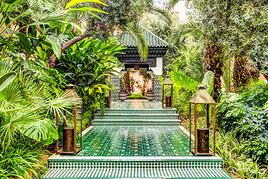
The Mamounia
Beside the Koutoubia, Hoummane el-Fetouaki Avenue leads to Bâb Jdid, one of the main gates of the medina. Right against the ramparts stands the Mamounia Hotel, famous for its splendid gardens and its very upscale clientele.
Beside the Koutoubia, Hoummane el-Fetouaki Avenue leads to Bâb Jdid, one of the main gates of the medina. Right against the ramparts stands the Mamounia Hotel, famous for its splendid gardens and its very upscale clientele.
North of the Medina
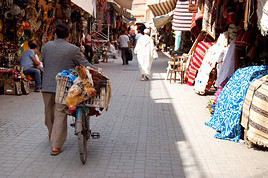
Marrakech Souks
They start at Jemaa el-Fna. This is the most popular part of the old city, where you can happily get lost. The souks are home to several religious monuments in Marrakech.
They start at Jemaa el-Fna. This is the most popular part of the old city, where you can happily get lost. The souks are home to several religious monuments in Marrakech.
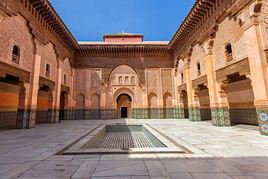
Ben Youssef Mosque and Madrasa
With its 40-metre minaret, the mosque was built in the 12th century and has been remodelled several times. It is recognisable by its minaret and its roof covered with green tiles. The Ben Youssef Madrasa (Koranic school) adjoins the mosque and is one of the most beautiful in the country.
With its 40-metre minaret, the mosque was built in the 12th century and has been remodelled several times. It is recognisable by its minaret and its roof covered with green tiles. The Ben Youssef Madrasa (Koranic school) adjoins the mosque and is one of the most beautiful in the country.
Chrob Fountain
The Chrob (or Chouf) fountain is located near the Ben Youssef Mosque on Amsafah Street. It dates back to the late 16th century. This public fountain is set against a pink wall and topped with a finely carved cedar wood canopy.
The Chrob (or Chouf) fountain is located near the Ben Youssef Mosque on Amsafah Street. It dates back to the late 16th century. This public fountain is set against a pink wall and topped with a finely carved cedar wood canopy.
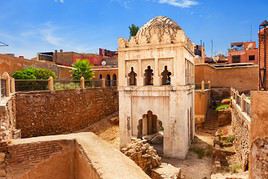
Almoravid Qubba
Located opposite the Ben Youssef Mosque, next to the Marrakech Museum, this splendid 12th-century building is both the oldest in the city and the last surviving example of Almoravid art in Marrakech. Long buried, it was only uncovered in 1948, revealing an ablutions basin topped with a magnificent dome.
Located opposite the Ben Youssef Mosque, next to the Marrakech Museum, this splendid 12th-century building is both the oldest in the city and the last surviving example of Almoravid art in Marrakech. Long buried, it was only uncovered in 1948, revealing an ablutions basin topped with a magnificent dome.
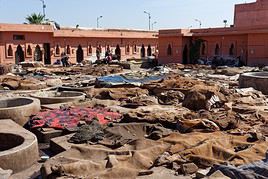
Tanners' District of Marrakech
The district is located at the eastern end of the medina, next to the Bâb ed Debbagh gate. It still has several artisan workshops consisting of round vats where hides are soaked. As you might expect, there’s a distinct smell in the area.
The district is located at the eastern end of the medina, next to the Bâb ed Debbagh gate. It still has several artisan workshops consisting of round vats where hides are soaked. As you might expect, there’s a distinct smell in the area.
South of the Medina
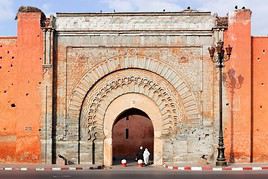
Bab Agnaou
Located at the entrance to the kasbah, near the Saadian Tombs, it is the most beautiful of Marrakech's gates, dating back to the 12th century. It also serves as a stork nest.
Located at the entrance to the kasbah, near the Saadian Tombs, it is the most beautiful of Marrakech's gates, dating back to the 12th century. It also serves as a stork nest.
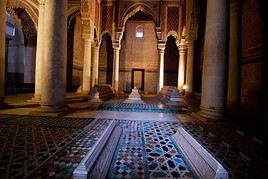
Saadian Tombs
Access to the Saadian princes' mausoleums is through a narrow, winding passage. This royal necropolis, dating back to the 16th century, was only rediscovered in 1917 after being walled up by their successors. The site houses two adjacent mausoleums.
Access to the Saadian princes' mausoleums is through a narrow, winding passage. This royal necropolis, dating back to the 16th century, was only rediscovered in 1917 after being walled up by their successors. The site houses two adjacent mausoleums.
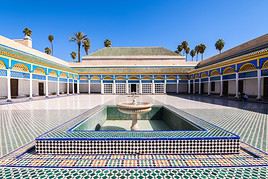
Bahia Palace
With its 150 richly decorated rooms, Bahia Palace dates back to the late 19th century. It features an Arab-Andalusian style and boasts beautiful patios and gardens. It is often used as a venue for events or exhibitions.
With its 150 richly decorated rooms, Bahia Palace dates back to the late 19th century. It features an Arab-Andalusian style and boasts beautiful patios and gardens. It is often used as a venue for events or exhibitions.
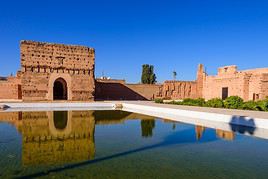
El Badi Palace
Sultan Ahmed el-Mansour built this palace in the late 16th century. Of the original 360 rooms, only a vast esplanade surrounded by high walls remains today, sheltering gardens and orange trees. In 1696, Sultan Moulay Ismaïl destroyed the palace to salvage materials for constructing the imperial city of Meknès.
Sultan Ahmed el-Mansour built this palace in the late 16th century. Of the original 360 rooms, only a vast esplanade surrounded by high walls remains today, sheltering gardens and orange trees. In 1696, Sultan Moulay Ismaïl destroyed the palace to salvage materials for constructing the imperial city of Meknès.
Museums
Dar Bellarj
Located next to the Ben Youssef Madrasa and the Marrakech Museum, this palace-museum houses the headquarters of the Foundation for Culture in Morocco. Temporary exhibitions are held in the rooms surrounding the lovely central patio, and local craft workshops are also offered here.
Located next to the Ben Youssef Madrasa and the Marrakech Museum, this palace-museum houses the headquarters of the Foundation for Culture in Morocco. Temporary exhibitions are held in the rooms surrounding the lovely central patio, and local craft workshops are also offered here.
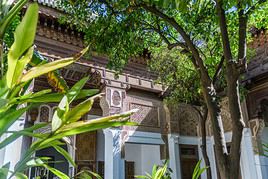
Dar Si Said Museum
This large house, built in the late 19th century, houses a small museum dedicated to traditional Moroccan arts. It features collections of woodwork, jewelry, pottery, ceramics, weapons, carpets, costumes, and archaeology.
This large house, built in the late 19th century, houses a small museum dedicated to traditional Moroccan arts. It features collections of woodwork, jewelry, pottery, ceramics, weapons, carpets, costumes, and archaeology.
Dar Tiskiwin Museum
Near Bahia, the small Dar Tiskiwin Museum occupies a beautiful century-old residence. It was converted to house the collections of a Dutch ethnologist who loved the Sahara. This museum is also known as the Bert Flint Museum.
Near Bahia, the small Dar Tiskiwin Museum occupies a beautiful century-old residence. It was converted to house the collections of a Dutch ethnologist who loved the Sahara. This museum is also known as the Bert Flint Museum.
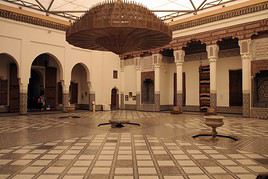
Marrakech Museum (Dar Mneb)
Housed in the Dar Mneb palace built in the late 19th century, it features permanent collections (archaeology, ethnology, history) and hosts temporary exhibitions of both contemporary and traditional art.
Housed in the Dar Mneb palace built in the late 19th century, it features permanent collections (archaeology, ethnology, history) and hosts temporary exhibitions of both contemporary and traditional art.
Parks and Gardens
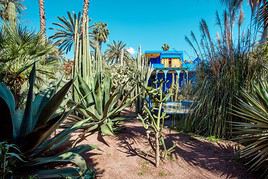
Majorelle Garden
In the northern part of the Guéliz district, this garden, designed by the painter Jacques Majorelle, who set up his studio there in 1924, offers a romantic and highly personal vision of Morocco. Opened to the public by the painter, the garden fell into obscurity for a time before being restored under the auspices of the fashion designer Yves Saint-Laurent, whose ashes now rest at the heart of the garden.
In the northern part of the Guéliz district, this garden, designed by the painter Jacques Majorelle, who set up his studio there in 1924, offers a romantic and highly personal vision of Morocco. Opened to the public by the painter, the garden fell into obscurity for a time before being restored under the auspices of the fashion designer Yves Saint-Laurent, whose ashes now rest at the heart of the garden.
Agdal Gardens
These are the oldest gardens in Marrakech. Created in the 12th century and later expanded by the Saadian princes, the site on the edge of the medina covers 400 hectares. Thousands of olive and fruit trees, hidden behind kilometers of walls and ramparts, are irrigated by a network of channels from the Atlas Mountains.
These are the oldest gardens in Marrakech. Created in the 12th century and later expanded by the Saadian princes, the site on the edge of the medina covers 400 hectares. Thousands of olive and fruit trees, hidden behind kilometers of walls and ramparts, are irrigated by a network of channels from the Atlas Mountains.
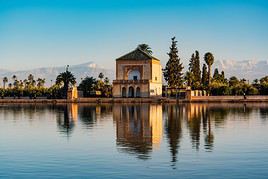
The Menara
West of the Hivernage district, not far from the airport, this garden is a classic image of Marrakech. It features a small pavilion with a green-tiled roof by a pool, with the snow-capped peaks of the High Atlas in the background. Sound-and-light shows recounting Marrakech’s history are held here year-round.
West of the Hivernage district, not far from the airport, this garden is a classic image of Marrakech. It features a small pavilion with a green-tiled roof by a pool, with the snow-capped peaks of the High Atlas in the background. Sound-and-light shows recounting Marrakech’s history are held here year-round.
Marrakech Palm Grove
Located to the north of the city, a circuit lets you discover the remnants of the vast palm grove that once stretched here, on the road to Casablanca. While part of the 100,000 trees has given way to hotels and golf courses, entire sections of the palm grove remain, with their earthen walls and irrigation channels.
Located to the north of the city, a circuit lets you discover the remnants of the vast palm grove that once stretched here, on the road to Casablanca. While part of the 100,000 trees has given way to hotels and golf courses, entire sections of the palm grove remain, with their earthen walls and irrigation channels.
Additional Information
Must-see & highly recommended
Marrakech Medina
★★★★ It is the historic heart of the city and one of the largest medinas in Morocco. A UNESCO World Heritage site, it alone justifies a trip to…
Marrakech Souks
★★★★ They start at Jemaa el-Fna. This is the most popular part of the old city, where you can happily get lost. The souks are home to several…
Recommended
Jemaa el-Fna Square
★★★ Located in the medina, between the souks and the kasbah, Jemaa el-Fna Square embodies the soul of the city. It takes its name from the…
Saadian Tombs
★★★ Access to the Saadian princes' mausoleums is through a narrow, winding passage. This royal necropolis, dating back to the 16th century, was…
Worth a look / Other
Bab Agnaou
★★ Located at the entrance to the kasbah, near the Saadian Tombs, it is the most beautiful of Marrakech's gates, dating back to the 12th…
Majorelle Garden
★★ In the northern part of the Guéliz district, this garden, designed by the painter Jacques Majorelle, who set up his studio there in 1924…
Agdal Gardens
★★ These are the oldest gardens in Marrakech. Created in the 12th century and later expanded by the Saadian princes, the site on the edge of…
Koutoubia Mosque
★★ The largest mosque in the city. It is nicknamed the "Golden Apples Mosque" in reference to the fine gold spheres crowning the minaret. The…
The Mamounia
★★ Beside the Koutoubia, Hoummane el-Fetouaki Avenue leads to Bâb Jdid, one of the main gates of the medina. Right against the ramparts stands…
The Menara
★★ West of the Hivernage district, not far from the airport, this garden is a classic image of Marrakech. It features a small pavilion with a…
Marrakech Museum
★★ Housed in the Dar Mneb palace built in the late 19th century, it features permanent collections (archaeology, ethnology, history) and hosts…
Bahia Palace
★★ With its 150 richly decorated rooms, Bahia Palace dates back to the late 19th century. It features an Arab-Andalusian style and boasts…
El Badi Palace
★★ Sultan Ahmed el-Mansour built this palace in the late 16th century. Of the original 360 rooms, only a vast esplanade surrounded by high…
Almoravid Qubba
★★ Located opposite the Ben Youssef Mosque, next to the Marrakech Museum, this splendid 12th-century building is both the oldest in the city…
Tanners' District of Marrakech
★★ The district is located at the eastern end of the medina, next to the Bâb ed Debbagh gate. It still has several artisan workshops…
Dar Bellarj
★ Located next to the Ben Youssef Madrasa and the Marrakech Museum, this palace-museum houses the headquarters of the Foundation for Culture…
Chrob Fountain
★ The Chrob (or Chouf) fountain is located near the Ben Youssef Mosque on Amsafah Street. It dates back to the late 16th century. This public…
Ben Youssef Mosque and Madrasa
★ With its 40-metre minaret, the mosque was built in the 12th century and has been remodelled several times. It is recognisable by its…
Dar Si Said Museum
★ This large house, built in the late 19th century, houses a small museum dedicated to traditional Moroccan arts. It features collections of…
Dar Tiskiwin Museum
★ Near Bahia, the small Dar Tiskiwin Museum occupies a beautiful century-old residence. It was converted to house the collections of a Dutch…
Marrakech Palm Grove
★ Located to the north of the city, a circuit lets you discover the remnants of the vast palm grove that once stretched here, on the road to…
- Marrakech Museum
- Jemaa el-Fna Square
- Koutoubia Mosque
- The Mamounia
- Marrakech Souks
- Ben Youssef Mosque and Madrasa
- Chrob Fountain
- Almoravid Qubba
- Tanners' District of Marrakech
- Dar Bellarj
- Bab Agnaou
- Saadian Tombs
- El Badi Palace
- Bahia Palace
- Dar Si Said Museum
- Dar Tiskiwin Museum
- Majorelle Garden
- Agdal Gardens
- Marrakech Palm Grove
- Marrakech Medina
- The Menara