

Re: Tuscany: Arezzo province and the area around Siena
The beautiful weather is drawing me back to the mountains for a hike. Today’s climb to yesterday’s endpoint (Prati della Penna) takes a different route that passes through Camaldoli. Camaldoli is a monastery in the forest (about 800 meters altitude) and a hermitage in the forest (about 1,100 meters altitude). The forest is part of the Casentino Forests, Monte Falterona, and Campigna National Park, established about thirty years ago (Parco Nazionale delle Foreste Casentinesi).
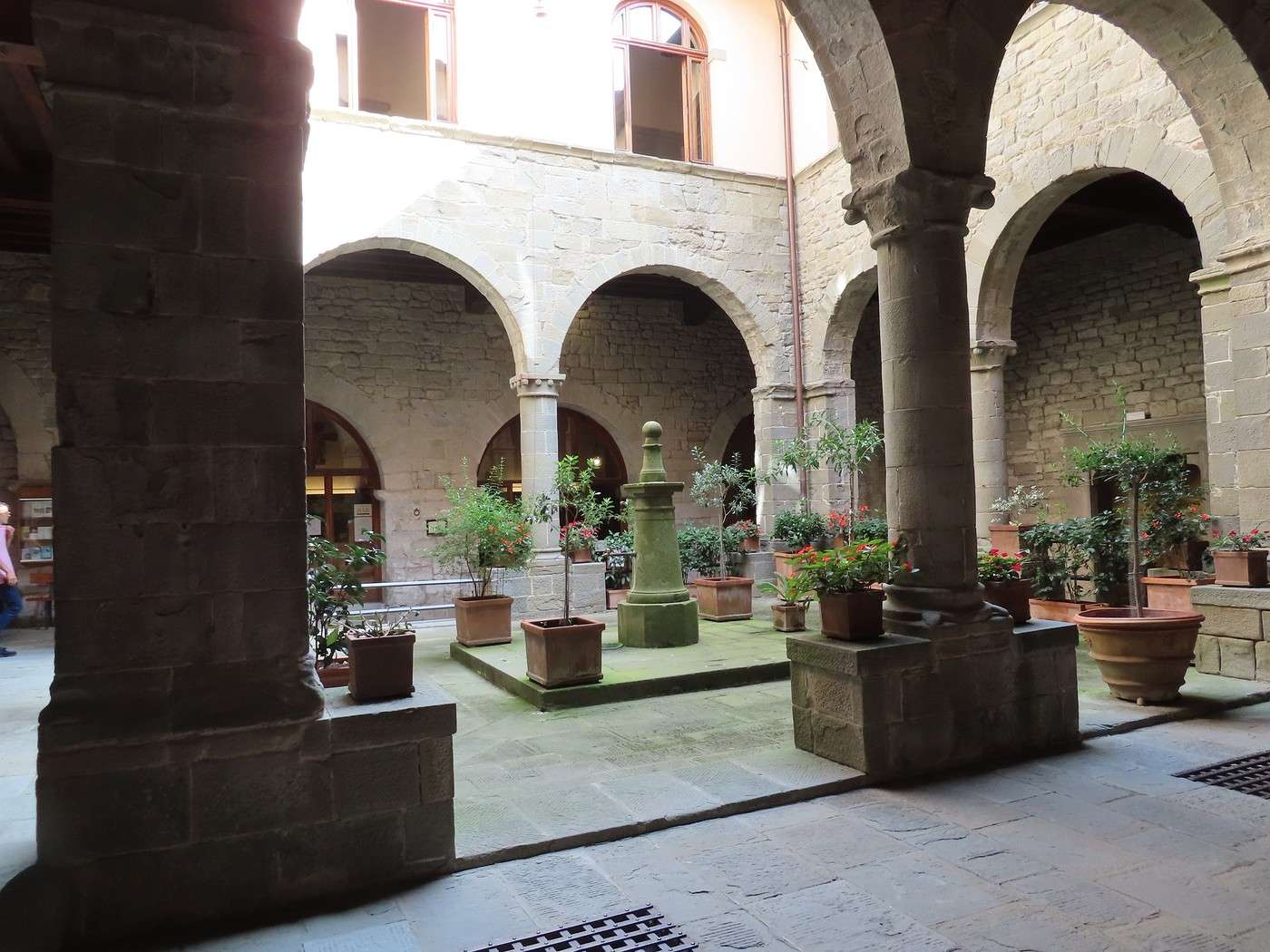
Since I’m coming up from the valley, I reach the monastery first. There are so few people that the tours before the 11:15 AM one were canceled today... so I join the late-morning guided tour. While waiting, the foresteria (monastery guesthouse) is open to explore, with its two cloisters.
The guided tour takes us through the cloister, the church (dei Santi Donato e Ilariano), and the convent buildings (Chapel of the "Madonna del conforto" (Virgin of Comfort), ante-sacristy, sacristy, monks’ choir, refectory, etc.). Giorgio Vasari stayed at the monastery starting in 1537, at the age of 26. He came here (to the countryside) during a period of depression following the assassination of Alessandro de’ Medici by his cousin Lorenzo de’ Medici (Lorenzaccio). Introduced to court life in Firenze, he knew both of them. The monks commissioned works from him during his stay. Between 1539 and 1540, he painted the "Deposition of the Cross," the central panel of the main altar’s altarpiece. During the church’s 18th-century restructuring, the painting retained its prominent place.
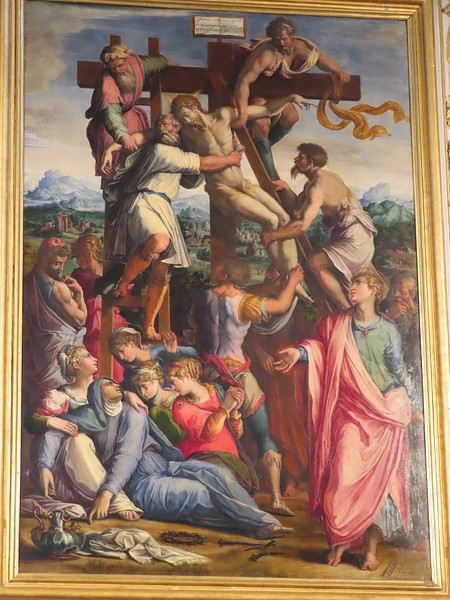
A close-up of the Virgin Mary’s group at the foot of the Cross.

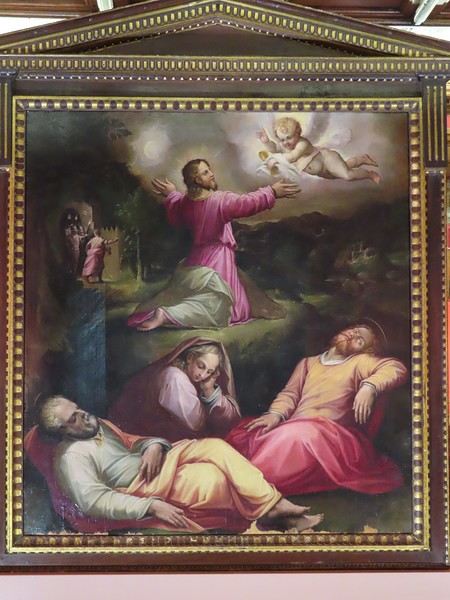
The pharmacy has a separate entrance. Inside, besides the shop, you’ll find beautiful cabinets, many utensils, and in the chapel, another Vasari painting, "The Agony in the Garden."
The forest area around the monastery—and the hermitage—is a fir plantation established and maintained by the monks. It’s the only part of the forest where I saw a large area wooded with a species other than beech. I have a picnic near the hermitage but don’t visit it, mistakenly thinking it wasn’t open to the public. I set off on a short hiking loop starting at "Prati della Penna" (yesterday’s endpoint). I descend through the forest to the hermitage, then the trail climbs back up to the ridge separating the two slopes (Tuscan and Romagnol). When I reach the ridge, the weather changes quickly, and it starts raining. I find shelter—a poor one under the beech trees (no nearby cabin)—until the shower passes. I get pretty wet but not soaked to the bone. After the rain stops, I decide not to go further and return to the starting point by following the ridge, descending back to "Prati della Penna."
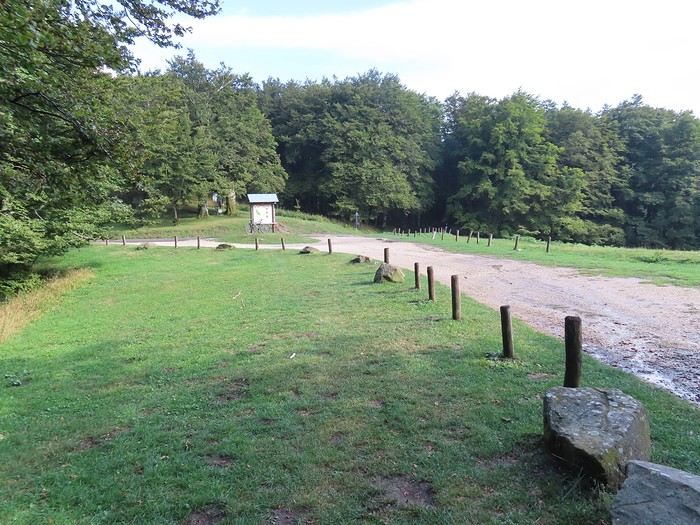
This pass is a large clearing in the forest, but it’s not enough to open up the landscape to more distant horizons.
The guided tour takes us through the cloister, the church (dei Santi Donato e Ilariano), and the convent buildings (Chapel of the "Madonna del conforto" (Virgin of Comfort), ante-sacristy, sacristy, monks’ choir, refectory, etc.). Giorgio Vasari stayed at the monastery starting in 1537, at the age of 26. He came here (to the countryside) during a period of depression following the assassination of Alessandro de’ Medici by his cousin Lorenzo de’ Medici (Lorenzaccio). Introduced to court life in Firenze, he knew both of them. The monks commissioned works from him during his stay. Between 1539 and 1540, he painted the "Deposition of the Cross," the central panel of the main altar’s altarpiece. During the church’s 18th-century restructuring, the painting retained its prominent place.
A close-up of the Virgin Mary’s group at the foot of the Cross.
The pharmacy has a separate entrance. Inside, besides the shop, you’ll find beautiful cabinets, many utensils, and in the chapel, another Vasari painting, "The Agony in the Garden."
The forest area around the monastery—and the hermitage—is a fir plantation established and maintained by the monks. It’s the only part of the forest where I saw a large area wooded with a species other than beech. I have a picnic near the hermitage but don’t visit it, mistakenly thinking it wasn’t open to the public. I set off on a short hiking loop starting at "Prati della Penna" (yesterday’s endpoint). I descend through the forest to the hermitage, then the trail climbs back up to the ridge separating the two slopes (Tuscan and Romagnol). When I reach the ridge, the weather changes quickly, and it starts raining. I find shelter—a poor one under the beech trees (no nearby cabin)—until the shower passes. I get pretty wet but not soaked to the bone. After the rain stops, I decide not to go further and return to the starting point by following the ridge, descending back to "Prati della Penna."
This pass is a large clearing in the forest, but it’s not enough to open up the landscape to more distant horizons.