



This morning, we head to Yangshuo train station. We could’ve taken the bus—it’s just at the end of the street—but Didi is really cheap, 14 yuan (1.67 €). Even though we’re only 8 km away, we’ve seen what the traffic jams are like around here, so we decide to leave early. Not early enough for D., though, who insists we’ll leave at 10:45 for our 12:39 train. By the time we wait for the Didi stuck in traffic at the entrance of Xingping, we don’t actually leave until 11:00, but we’re the only ones on the road in that direction, and we arrive at the station in 10 minutes.
The train is on time, too, and in an hour, we reach Sanjiangnan, the south station of Sanjiang, in the Dong autonomous district. From there, we’ll be improvising for a few days. I don’t know where to buy tickets for the scenic area. I don’t know how to get to the hotel. I don’t even know where the hotel is on a map.
We ask someone how to get to Pingyan village, but I must be mispronouncing it, or maybe the guy doesn’t know, and the translator is clearly messing up again. We ditch his translator. He checks his map and offers to take us for $100. LOL, no thanks! 😂 Hopefully, that was another translator glitch, and he meant yuan, not dollars. We drop the bus idea and order a Didi, pasting the hotel’s Chinese coordinates from trip.com. The ride costs 61 yuan. However, the Didi driver drops us at the entrance of the scenic area and says he won’t go any further. Again, we paid for the full ride—this app isn’t great in that regard. It’s not about the few yuan but the principle; I think it’s just wrong. Our driver comes with us to talk to the ticket area guard to explain. Sure enough, the setup is designed so you can’t go any further with your Didi. We say goodbye to our driver a few kilometers before our destination. We buy our entry tickets for the scenic area, which include a bus ride to continue the journey (another kind of big golf cart, like in Xingping). 95 yuan per person. The receptionist doesn’t speak a word of English, but when we show her our hotel’s name, she points it out on a paper map she gives us, circling other points of interest.
The ticket area already sets the mood with these typical regional buildings:
The "bus" drops us off 300 meters from the hotel. The village interior is a pedestrian zone. We check the hotel’s exterior photos on trip.com to try to recognize it. We head in the direction indicated on our paper map and walk into what seems to be a restaurant (only two tables). I show the hotel’s name in Chinese. The guy doesn’t nod. There’s an awkward moment where we just stand there in silence, then we get the impression he’s asking us to follow him, and he takes us upstairs to the room without taking our passports or anything. Looks like we found the hotel!
Pingyan Dong village is gorgeous. The hotel is typical, like all the other buildings around here, all wood. We’re surrounded by terraced tea fields. We have an amazing view from the room—over the river, the tea terraces, the village’s drum tower, and the mountains. Stunning!
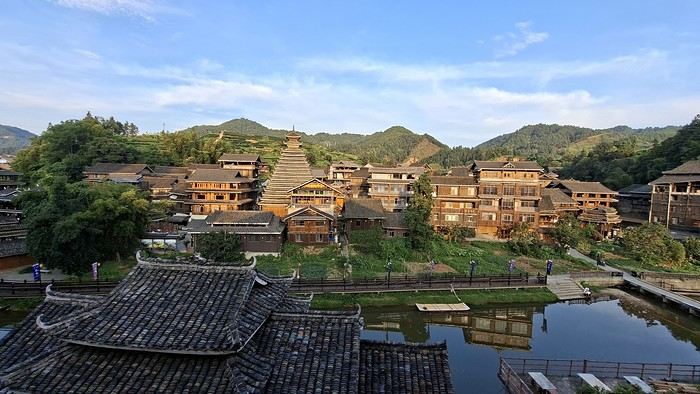
We go out to eat; it’s already 4 PM. The villagers are adorable and super smiley. We get tofu, eggplant, and fried rice at a small restaurant. Prices are a bit higher here—our three dishes cost 75 yuan. Then we wander through the alleys until 7 PM. It’s beautiful, peaceful, and less hot. Though we notice with the new constructions that the base is all concrete, just covered with wood.
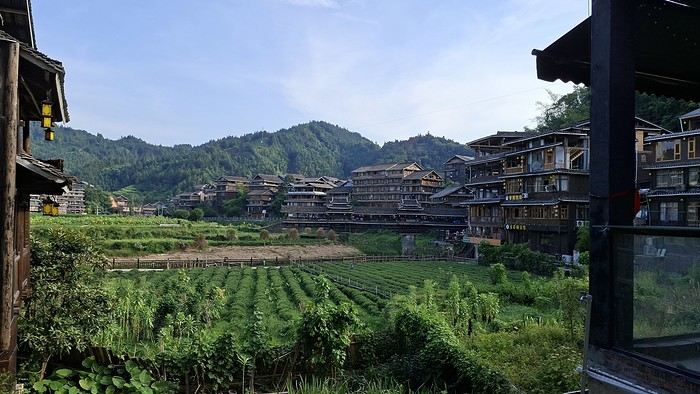
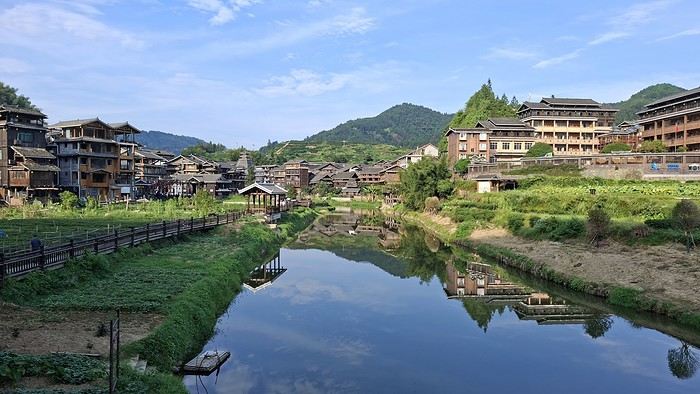
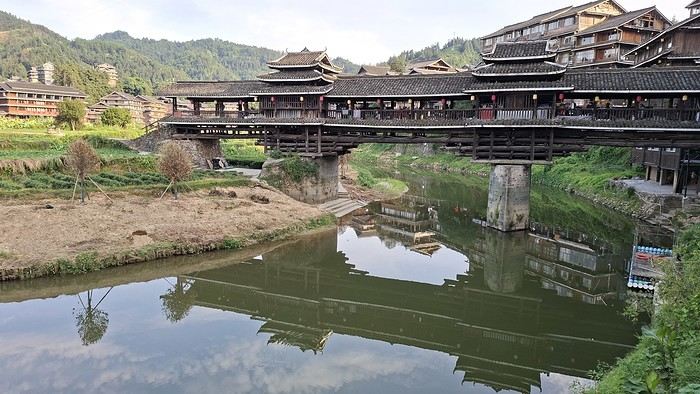
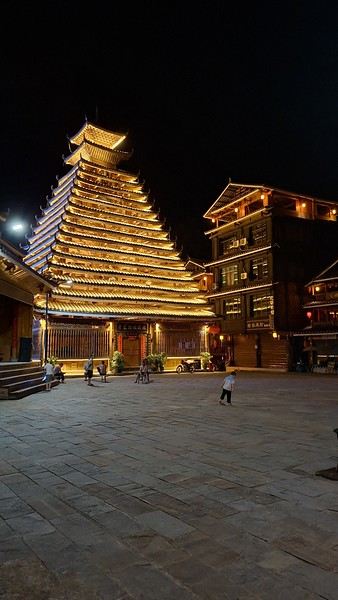
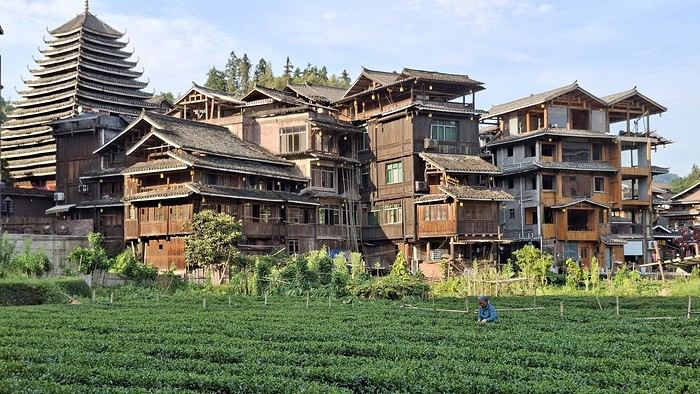 The Dong are renowned carpenters, and you can tell right away from their covered bridges and drum towers. The Chengyang Bridge, just a little further away, which we’ll see tomorrow, is considered one of China’s most exceptional architectural structures, built in 1912 without a single nail.
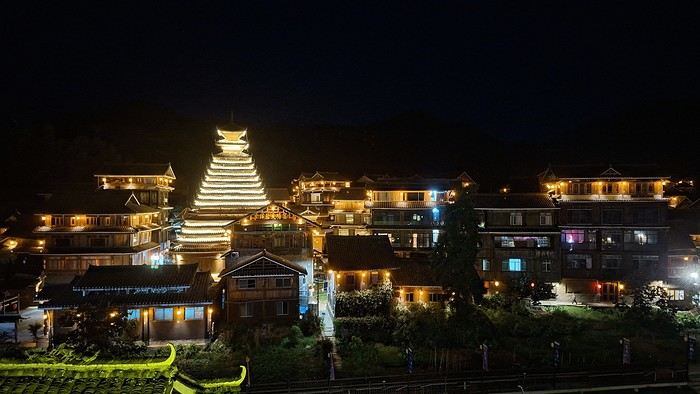
Night starts to fall as we head back. The view from the room is just as beautiful when the village lights are on. We go out to eat again even though we’re not hungry. When it’s time to pay, neither Alipay nor WeChat works on either of our phones. Always handy to have a bit of cash on you at some point!

The train is on time, too, and in an hour, we reach Sanjiangnan, the south station of Sanjiang, in the Dong autonomous district. From there, we’ll be improvising for a few days. I don’t know where to buy tickets for the scenic area. I don’t know how to get to the hotel. I don’t even know where the hotel is on a map.
We ask someone how to get to Pingyan village, but I must be mispronouncing it, or maybe the guy doesn’t know, and the translator is clearly messing up again. We ditch his translator. He checks his map and offers to take us for $100. LOL, no thanks! 😂 Hopefully, that was another translator glitch, and he meant yuan, not dollars. We drop the bus idea and order a Didi, pasting the hotel’s Chinese coordinates from trip.com. The ride costs 61 yuan. However, the Didi driver drops us at the entrance of the scenic area and says he won’t go any further. Again, we paid for the full ride—this app isn’t great in that regard. It’s not about the few yuan but the principle; I think it’s just wrong. Our driver comes with us to talk to the ticket area guard to explain. Sure enough, the setup is designed so you can’t go any further with your Didi. We say goodbye to our driver a few kilometers before our destination. We buy our entry tickets for the scenic area, which include a bus ride to continue the journey (another kind of big golf cart, like in Xingping). 95 yuan per person. The receptionist doesn’t speak a word of English, but when we show her our hotel’s name, she points it out on a paper map she gives us, circling other points of interest.
The ticket area already sets the mood with these typical regional buildings:
The "bus" drops us off 300 meters from the hotel. The village interior is a pedestrian zone. We check the hotel’s exterior photos on trip.com to try to recognize it. We head in the direction indicated on our paper map and walk into what seems to be a restaurant (only two tables). I show the hotel’s name in Chinese. The guy doesn’t nod. There’s an awkward moment where we just stand there in silence, then we get the impression he’s asking us to follow him, and he takes us upstairs to the room without taking our passports or anything. Looks like we found the hotel!
Pingyan Dong village is gorgeous. The hotel is typical, like all the other buildings around here, all wood. We’re surrounded by terraced tea fields. We have an amazing view from the room—over the river, the tea terraces, the village’s drum tower, and the mountains. Stunning!
We go out to eat; it’s already 4 PM. The villagers are adorable and super smiley. We get tofu, eggplant, and fried rice at a small restaurant. Prices are a bit higher here—our three dishes cost 75 yuan. Then we wander through the alleys until 7 PM. It’s beautiful, peaceful, and less hot. Though we notice with the new constructions that the base is all concrete, just covered with wood.
Night starts to fall as we head back. The view from the room is just as beautiful when the village lights are on. We go out to eat again even though we’re not hungry. When it’s time to pay, neither Alipay nor WeChat works on either of our phones. Always handy to have a bit of cash on you at some point!