

Day 8, Tuesday, August 4th, Valle Gran Rey, Garajonay Natural Park (Reventón Oscuro-El Cedro trail), Hermigua/El Corralete
So today we’re heading to Hermigua, which marks the second part of our stay. We don’t get up too late so we have time to enjoy a 100% Gomeran warrior breakfast—that is, once again, my gofio mousse with banana and palm honey, which is a hit and gives us the energy we need to finish packing, clean up the place, and leave a little before 11 AM. Well, Valle Gran Rey, that’s it for now… though not entirely, since we’ll have to come back in two days for the whale-watching boat trip. Off we go for an hour and ten minutes of winding roads for just forty kilometers.
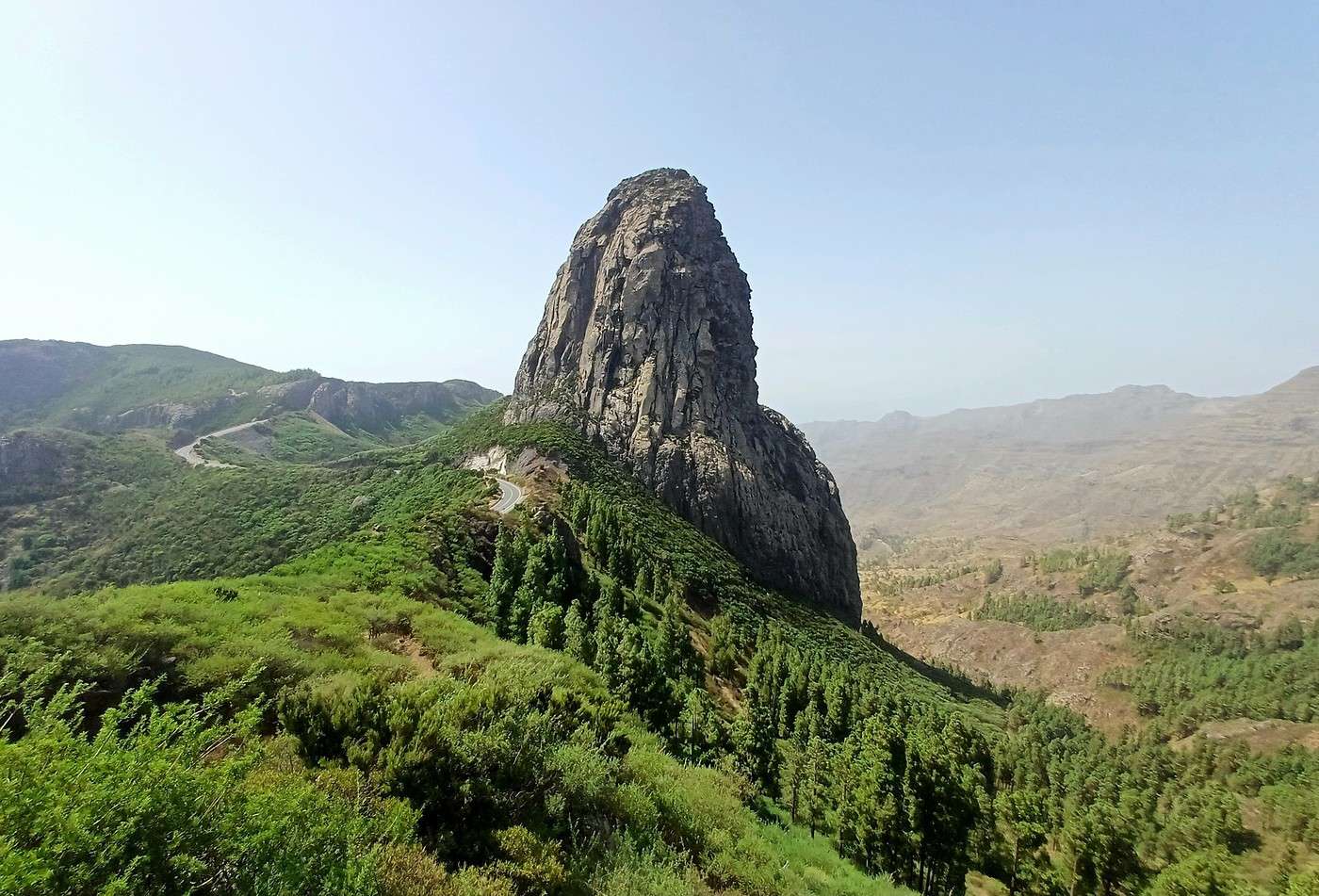
We take the GM-1 road, which holds no more secrets for us as we climb through the villages, hamlets, and viewpoints of Valle Gran Rey before turning off at Las Hayas toward Garajonay Park, where it becomes the GM-2. As usual on this road, the kids get a little carsick. Luckily, we’ve done the hardest part once we reach that familiar forest, where we stop for a long break since we can’t check into our place in Hermigua before 3 PM. First, we stop at the Mirador de los Roques, which, as the name suggests, offers a view of a landscape of massive lava-rock formations, especially Zarcita and Agando, standing proudly against the sky.
Then, since we’re just a few hundred meters from the hamlet of El Cedro, we decide to do a short hike in the forest—and, most importantly, to return to the Bar Restaurante Camping La Vista, in the heart of the forest, which we loved so much two days ago. We’re surprised to see that compared to the first days of our trip, there are more people parked at every viewpoint or notable spot in Garajonay Park. You can even occasionally spot those rare tourist buses that visit La Gomera on a (half-)day trip from Tenerife. Still, we’re far from overtourism.
This time, we turn off at Reventón Oscuro, the starting point of a much shorter trail than the one from the day before yesterday to reach El Cedro. We take the small paved forest track used by both cars and hikers, park in a pull-off, and from there, it’s just a kilometer and a half downhill (which, of course, we’ll have to climb back up later…). What’s great about La Gomera is that even the tiniest stretch of the island’s 600 kilometers of hiking trails is marked with little wooden signs. That lets us eventually leave the paved track for a more pleasant dirt path. It’s a joy to walk through this laurel forest again, with its gnarled shapes, branches hanging like vines, and heather. Finally, this trail joins the end of yesterday’s route, between the Chapel of Our Lady of Lourdes and the first farmhouses of El Cedro, surrounded by gardens and palm trees. In the distance, we spot the terrace with blue umbrellas nestled in the greenery, and we know our favorite restaurant is just a ten-minute walk away.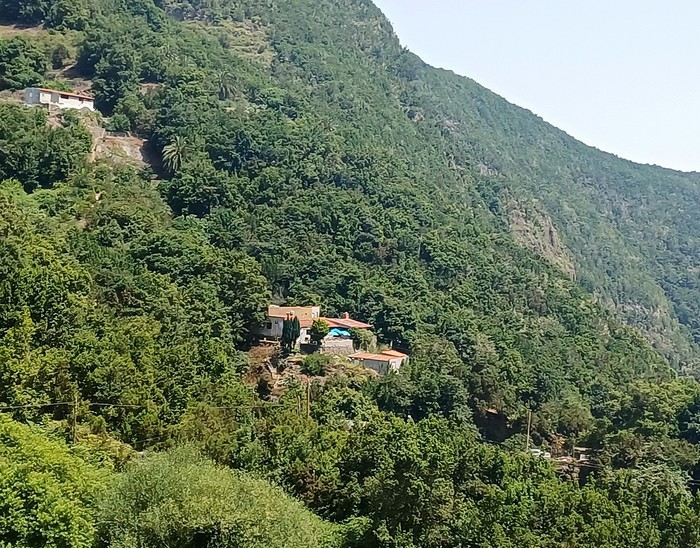
Thanks to this little forest walk, the nausea has vanished like magic, and we’re ready to fill our bellies. We sit down, and the owner greets us, letting us know she remembers us. A French family approaches to ask how we got here because, like us, they started from Reventón Oscuro but were disappointed not to find a forest trail. We point them to the long hike we did the day before yesterday from the Pajarito starting point and mention there are also other, easier dirt paths. But they didn’t find them and are now thinking of sticking to the trail near the Hermitage of Our Lady of Lourdes. All that effort to put on their adventurer gear for nothing! Meanwhile, Théo is still the center of attention, drawing admiration from a Madrid family who speaks great French and whose son is studying in Lyon. They’re impressed he can handle such hikes at just 4 years old. We don’t tell them it’s not always easy and that we have to carry him sometimes… But for his age, he’s already doing a lot.
We feast again on the famous potaje de berros, the restaurant’s pride and joy, along with bocadillos with sausage, rustic beef in sauce, the famous papas arrugadas, and the ever-present mojos rojo y verde, spicier this time (which we don’t mind at all), all washed down with a nice cold Dorada beer. The restaurant is packed today, and the owner, with her grumpy but funny demeanor that amuses the customers, bends over backward to help. She’s actually very kind. Since we’ll have to climb back up that kilometer and a half in the heat, we don’t forget dessert for everyone, including a wonderful gofio mousse—light as air, made with roasted cereal flour mixed with whipped cream and topped with chocolate sauce. Simply divine. All in all, with dishes, sides, drinks, desserts, and coffee, it comes to exactly 50 € for the four of us.
Full and happy, we start walking back to the car, this time taking the paved track, which is a little less tough for the climb. Then, just a fifteen-minute drive later, the Hermigua Valley finally comes into view. From up here, it doesn’t look all that different from Valle Gran Rey, with its terraced fields and exotic plants, its main village surrounded by mountain hamlets, and its coastline between two massive mountain arms. But it quickly appears much greener, and it’s noticeably cooler—29°C compared to the 35°C we’d already reached by late morning just a few kilometers away as the crow flies. On this island, every valley and natural park has its own ecosystem, something we’ll keep noticing. We make a quick stop in Hermigua’s center to fill up the car with gas for the first time since we picked it up, then grab some Spanish and Canarian products at the Spar. Now, we need to find the little hamlet of El Corralete, much farther upstream, where our new place is.
A steep, narrow road of 2 or 3 kilometers with a panoramic hairpin turn over the valley leads us to Casa Yaya, a bright white house in a bend at the bottom of the hamlet, surrounded by terraced fields of banana trees, palm trees, rice paddies, corn, vineyards, and plenty of other crops I can’t identify. The view down over Hermigua and the ridges stretching back to Garajonay Park is absolutely spectacular. The place can sleep up to seven people, with the main house on the ground floor and stairs leading to two large terraces above, which have two extra bedrooms and even a laundry room with a washing machine. For just 99 € a night! You can tell the house has been renovated, though it still has a rustic feel despite the Airbnb-style updates. The view from the windows and terraces is stunning. The valley is much greener, more mountainous, and maybe even more beautiful than Valle Gran Rey, though I did love its drier, rockier landscape. Hermigua below looks both close and far away. If we could jump off one of the terraces with a paraglider or zip line, we’d land in the village square in seconds. We can even spot a bit of ocean toward the beach on one side and, on the other, the ridges stretching toward the island’s green heart.
The hosts (okay, fine, a local agency managing the place remotely from Gran Canaria) have thought of everything to make a good impression. A tray with a variety of teas, infusions, and coffees, a bottle of Spanish wine, and two glasses are nicely arranged on the table. The cupboards are stocked with food probably left by previous travelers. We settle in… and the power goes out after just a few minutes! Luckily, the agency is very responsive on WhatsApp and guides us step by step to try to restore it. Turns out it’s a regional outage that’s supposed to last two hours. But no sooner do they tell us that than the power comes back on.
To wrap up the day, we hesitate between a few outings but opt for the closest: Hermigua Beach and its pier. A quick drive, and we’re there. More precisely, it’s Playa de Santa Catalina, protected by a small altar carved into the cliff facing the ocean. Hmm… this isn’t quite what we expected, and some online reviews confirm it: the seafront is lined with abandoned buildings, an empty municipal pool, and a small food truck along a dusty path. Behind the sea wall, there’s no real beach—just a pile of big rocks facing a rough ocean and a red flag made from what looks like an old T-shirt, planted there forever… It’s a far cry from Valle Gran Rey, and it’s definitely not for swimming. In the distance, we see more people near the old Hermigua pier.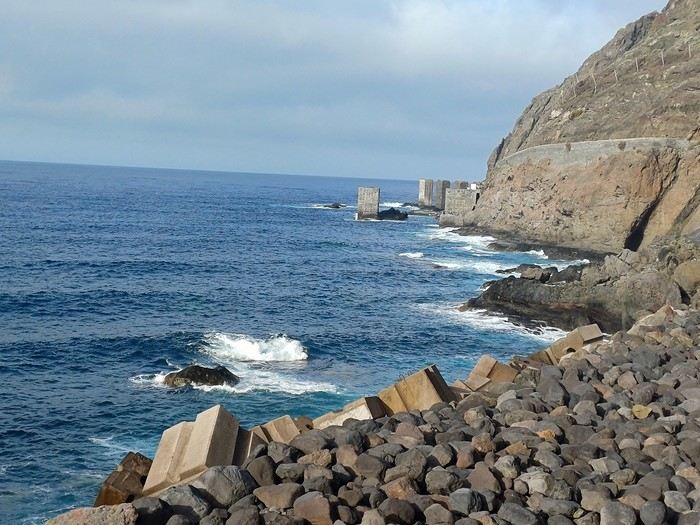
From where we are, we have to walk along the pebble and rock beach to avoid going all the way around. Powerful waves crash every five seconds, licking our feet and spraying us with mist that softens the cliffside landscape in the fading late-afternoon light.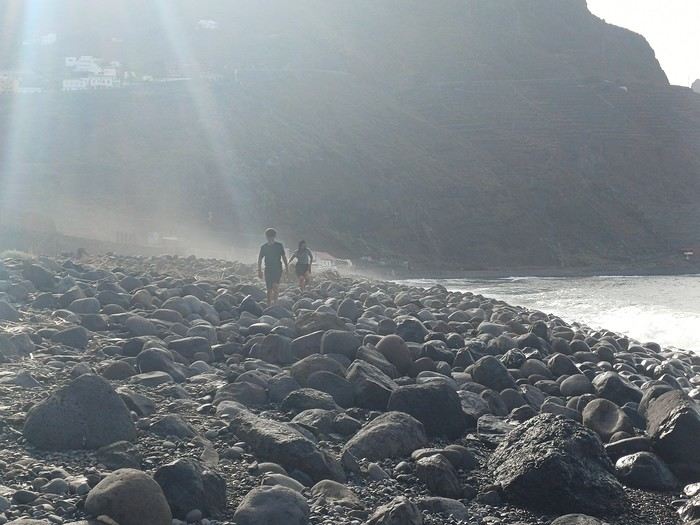
At the end, the pebble beach gives way to a path leading to the pier along the cliffs.
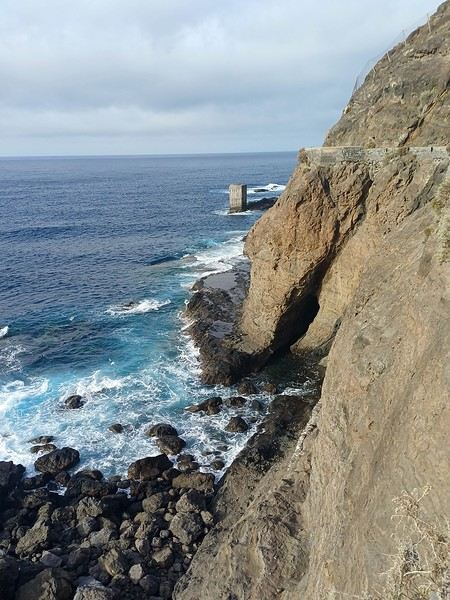
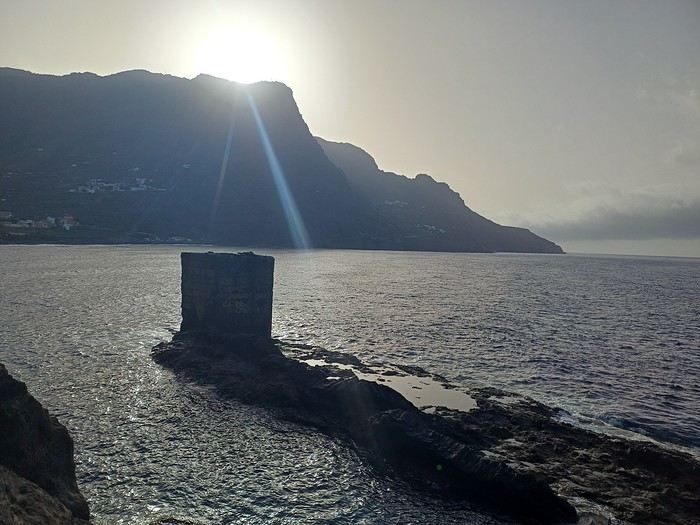
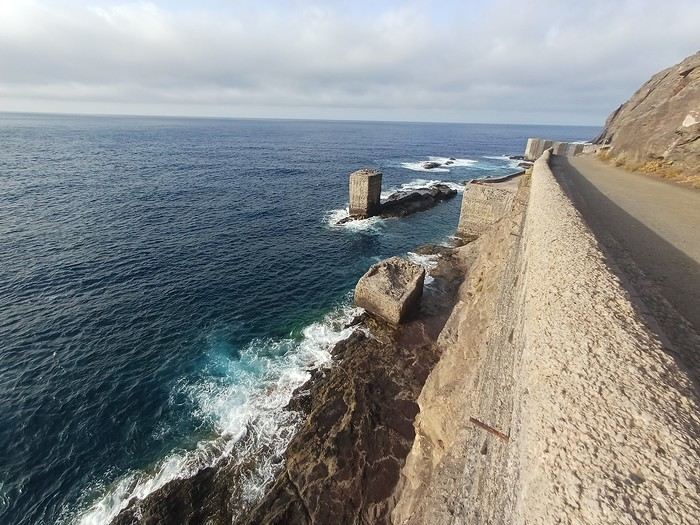 A large sign warns that the path is closed due to rockfall risks. Which makes sense, since small—and sometimes large—rocks have fallen onto the path despite the metal nets filled with debris covering the cliffs. And yet, workers are still there, working on safety improvements. Despite the warning and the obvious danger, we see people hurrying toward the ruins of the pier, while others are coming back. The site seems to attract quite a few visitors. As we get closer, we understand why. Swimmers are in the water among the half-submerged ruins of the pier, because it’s actually the famous natural pool of Hermigua! It’s amazing—we’ve never seen anything like it! In front of the four large pillars standing in the ocean, an old structure with only its foundation left has become a literal pool filled with seawater. Just a low wall separates it from another, wilder area between the rocks and old walls, forming a deeper, crystal-clear basin sheltered from the crazy currents raging just beyond.
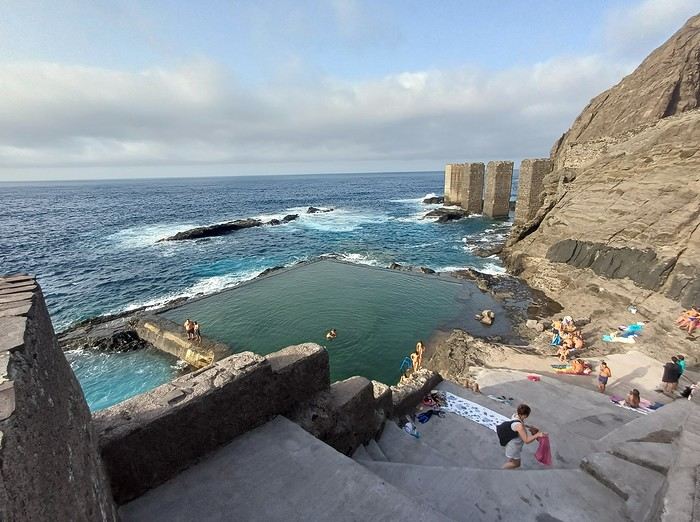
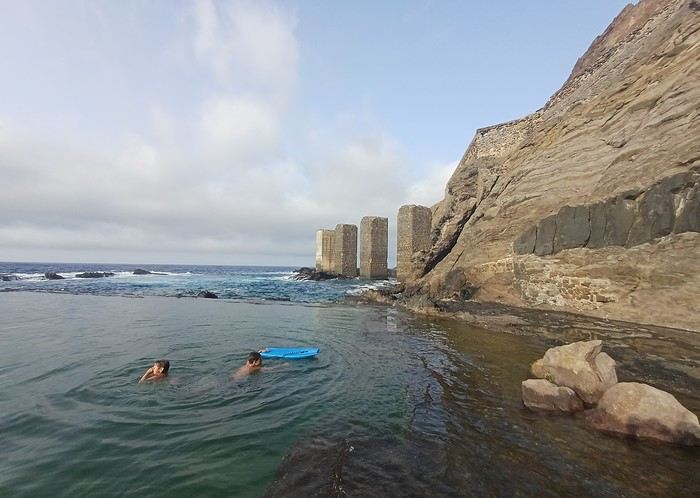
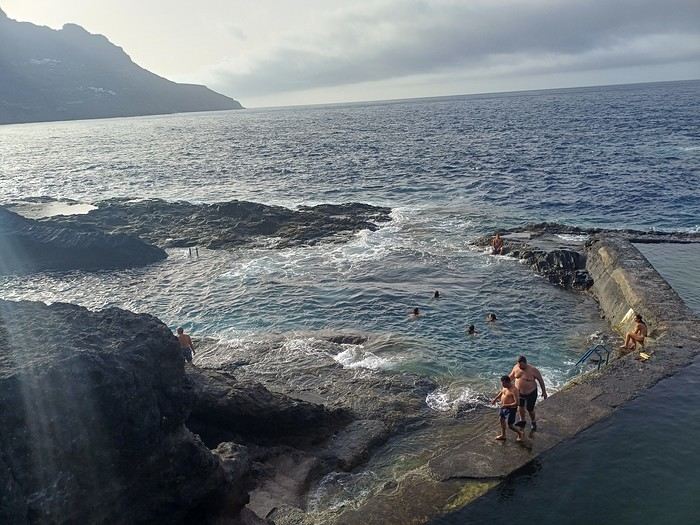 This is nothing like the little Charco del Conde wading pool in Valle Gran Rey—this is what you’d call a real natural pool! Another sign warns against swimming due to dangerous currents, but the swimmers don’t care and seem to be having a blast. We regret not bringing our swimsuits because we’d love to join them. Well, the kids and I would—Magali isn’t at all reassured by the rockfall risks on the path above or the current dangers we’d read about, which led to the site’s closure even though it was allowed not long ago. But clearly, no one’s paying attention, and everyone’s swimming, sunbathing on a rocky corner, or diving carefree from the ledges by the wild basin. It doesn’t seem that dangerous. But since we didn’t plan to go for a dip tonight, we head back, trying to convince Magali to come back tomorrow morning. To which she replies, “Yeah, why not…,” without much enthusiasm. We return along the same wave-lapped path and are surprised to see surfers braving the choppy waters as the sun starts to set behind the cliff near the village of Agulo.
So today we’re heading to Hermigua, which marks the second part of our stay. We don’t get up too late so we have time to enjoy a 100% Gomeran warrior breakfast—that is, once again, my gofio mousse with banana and palm honey, which is a hit and gives us the energy we need to finish packing, clean up the place, and leave a little before 11 AM. Well, Valle Gran Rey, that’s it for now… though not entirely, since we’ll have to come back in two days for the whale-watching boat trip. Off we go for an hour and ten minutes of winding roads for just forty kilometers.
We take the GM-1 road, which holds no more secrets for us as we climb through the villages, hamlets, and viewpoints of Valle Gran Rey before turning off at Las Hayas toward Garajonay Park, where it becomes the GM-2. As usual on this road, the kids get a little carsick. Luckily, we’ve done the hardest part once we reach that familiar forest, where we stop for a long break since we can’t check into our place in Hermigua before 3 PM. First, we stop at the Mirador de los Roques, which, as the name suggests, offers a view of a landscape of massive lava-rock formations, especially Zarcita and Agando, standing proudly against the sky.
Then, since we’re just a few hundred meters from the hamlet of El Cedro, we decide to do a short hike in the forest—and, most importantly, to return to the Bar Restaurante Camping La Vista, in the heart of the forest, which we loved so much two days ago. We’re surprised to see that compared to the first days of our trip, there are more people parked at every viewpoint or notable spot in Garajonay Park. You can even occasionally spot those rare tourist buses that visit La Gomera on a (half-)day trip from Tenerife. Still, we’re far from overtourism.
This time, we turn off at Reventón Oscuro, the starting point of a much shorter trail than the one from the day before yesterday to reach El Cedro. We take the small paved forest track used by both cars and hikers, park in a pull-off, and from there, it’s just a kilometer and a half downhill (which, of course, we’ll have to climb back up later…). What’s great about La Gomera is that even the tiniest stretch of the island’s 600 kilometers of hiking trails is marked with little wooden signs. That lets us eventually leave the paved track for a more pleasant dirt path. It’s a joy to walk through this laurel forest again, with its gnarled shapes, branches hanging like vines, and heather. Finally, this trail joins the end of yesterday’s route, between the Chapel of Our Lady of Lourdes and the first farmhouses of El Cedro, surrounded by gardens and palm trees. In the distance, we spot the terrace with blue umbrellas nestled in the greenery, and we know our favorite restaurant is just a ten-minute walk away.
Thanks to this little forest walk, the nausea has vanished like magic, and we’re ready to fill our bellies. We sit down, and the owner greets us, letting us know she remembers us. A French family approaches to ask how we got here because, like us, they started from Reventón Oscuro but were disappointed not to find a forest trail. We point them to the long hike we did the day before yesterday from the Pajarito starting point and mention there are also other, easier dirt paths. But they didn’t find them and are now thinking of sticking to the trail near the Hermitage of Our Lady of Lourdes. All that effort to put on their adventurer gear for nothing! Meanwhile, Théo is still the center of attention, drawing admiration from a Madrid family who speaks great French and whose son is studying in Lyon. They’re impressed he can handle such hikes at just 4 years old. We don’t tell them it’s not always easy and that we have to carry him sometimes… But for his age, he’s already doing a lot.
We feast again on the famous potaje de berros, the restaurant’s pride and joy, along with bocadillos with sausage, rustic beef in sauce, the famous papas arrugadas, and the ever-present mojos rojo y verde, spicier this time (which we don’t mind at all), all washed down with a nice cold Dorada beer. The restaurant is packed today, and the owner, with her grumpy but funny demeanor that amuses the customers, bends over backward to help. She’s actually very kind. Since we’ll have to climb back up that kilometer and a half in the heat, we don’t forget dessert for everyone, including a wonderful gofio mousse—light as air, made with roasted cereal flour mixed with whipped cream and topped with chocolate sauce. Simply divine. All in all, with dishes, sides, drinks, desserts, and coffee, it comes to exactly 50 € for the four of us.
Full and happy, we start walking back to the car, this time taking the paved track, which is a little less tough for the climb. Then, just a fifteen-minute drive later, the Hermigua Valley finally comes into view. From up here, it doesn’t look all that different from Valle Gran Rey, with its terraced fields and exotic plants, its main village surrounded by mountain hamlets, and its coastline between two massive mountain arms. But it quickly appears much greener, and it’s noticeably cooler—29°C compared to the 35°C we’d already reached by late morning just a few kilometers away as the crow flies. On this island, every valley and natural park has its own ecosystem, something we’ll keep noticing. We make a quick stop in Hermigua’s center to fill up the car with gas for the first time since we picked it up, then grab some Spanish and Canarian products at the Spar. Now, we need to find the little hamlet of El Corralete, much farther upstream, where our new place is.
A steep, narrow road of 2 or 3 kilometers with a panoramic hairpin turn over the valley leads us to Casa Yaya, a bright white house in a bend at the bottom of the hamlet, surrounded by terraced fields of banana trees, palm trees, rice paddies, corn, vineyards, and plenty of other crops I can’t identify. The view down over Hermigua and the ridges stretching back to Garajonay Park is absolutely spectacular. The place can sleep up to seven people, with the main house on the ground floor and stairs leading to two large terraces above, which have two extra bedrooms and even a laundry room with a washing machine. For just 99 € a night! You can tell the house has been renovated, though it still has a rustic feel despite the Airbnb-style updates. The view from the windows and terraces is stunning. The valley is much greener, more mountainous, and maybe even more beautiful than Valle Gran Rey, though I did love its drier, rockier landscape. Hermigua below looks both close and far away. If we could jump off one of the terraces with a paraglider or zip line, we’d land in the village square in seconds. We can even spot a bit of ocean toward the beach on one side and, on the other, the ridges stretching toward the island’s green heart.
The hosts (okay, fine, a local agency managing the place remotely from Gran Canaria) have thought of everything to make a good impression. A tray with a variety of teas, infusions, and coffees, a bottle of Spanish wine, and two glasses are nicely arranged on the table. The cupboards are stocked with food probably left by previous travelers. We settle in… and the power goes out after just a few minutes! Luckily, the agency is very responsive on WhatsApp and guides us step by step to try to restore it. Turns out it’s a regional outage that’s supposed to last two hours. But no sooner do they tell us that than the power comes back on.
To wrap up the day, we hesitate between a few outings but opt for the closest: Hermigua Beach and its pier. A quick drive, and we’re there. More precisely, it’s Playa de Santa Catalina, protected by a small altar carved into the cliff facing the ocean. Hmm… this isn’t quite what we expected, and some online reviews confirm it: the seafront is lined with abandoned buildings, an empty municipal pool, and a small food truck along a dusty path. Behind the sea wall, there’s no real beach—just a pile of big rocks facing a rough ocean and a red flag made from what looks like an old T-shirt, planted there forever… It’s a far cry from Valle Gran Rey, and it’s definitely not for swimming. In the distance, we see more people near the old Hermigua pier.
From where we are, we have to walk along the pebble and rock beach to avoid going all the way around. Powerful waves crash every five seconds, licking our feet and spraying us with mist that softens the cliffside landscape in the fading late-afternoon light.
At the end, the pebble beach gives way to a path leading to the pier along the cliffs.