
rato Park
First night at Casa Yaya, and what we love right away is the much cooler climate in Hermigua Valley compared to Valle Gran Rey, and the lush greenery—natural or agricultural—all around us, since this side of Garajonay is also more humid.
Since the majority rules, we’ll brave the double ban—rockfall risks and dangerous currents—to spend a great morning at the natural pool by the Hermigua fishing pier! On one side, the pool seemed well protected from the currents, and on the other, the cliff is covered with nets while road workers are busy smoothing out the dangerous spots. Then Magali whipped up some fluffy pancakes with gofio flour and palm honey to face any peril. We take the semi-circular road that passes by the house—we can go either way to head down to Hermigua. We realize it actually serves all the hamlets overlooking the village. It’s pretty narrow, and sometimes you have to reverse quite a bit when two cars meet.
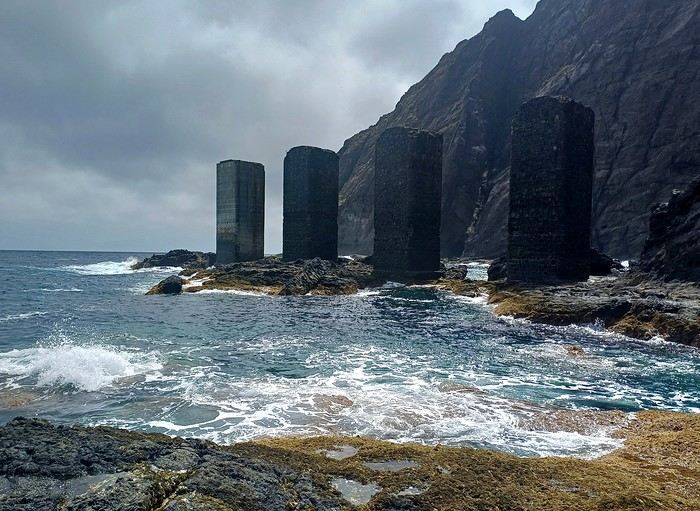
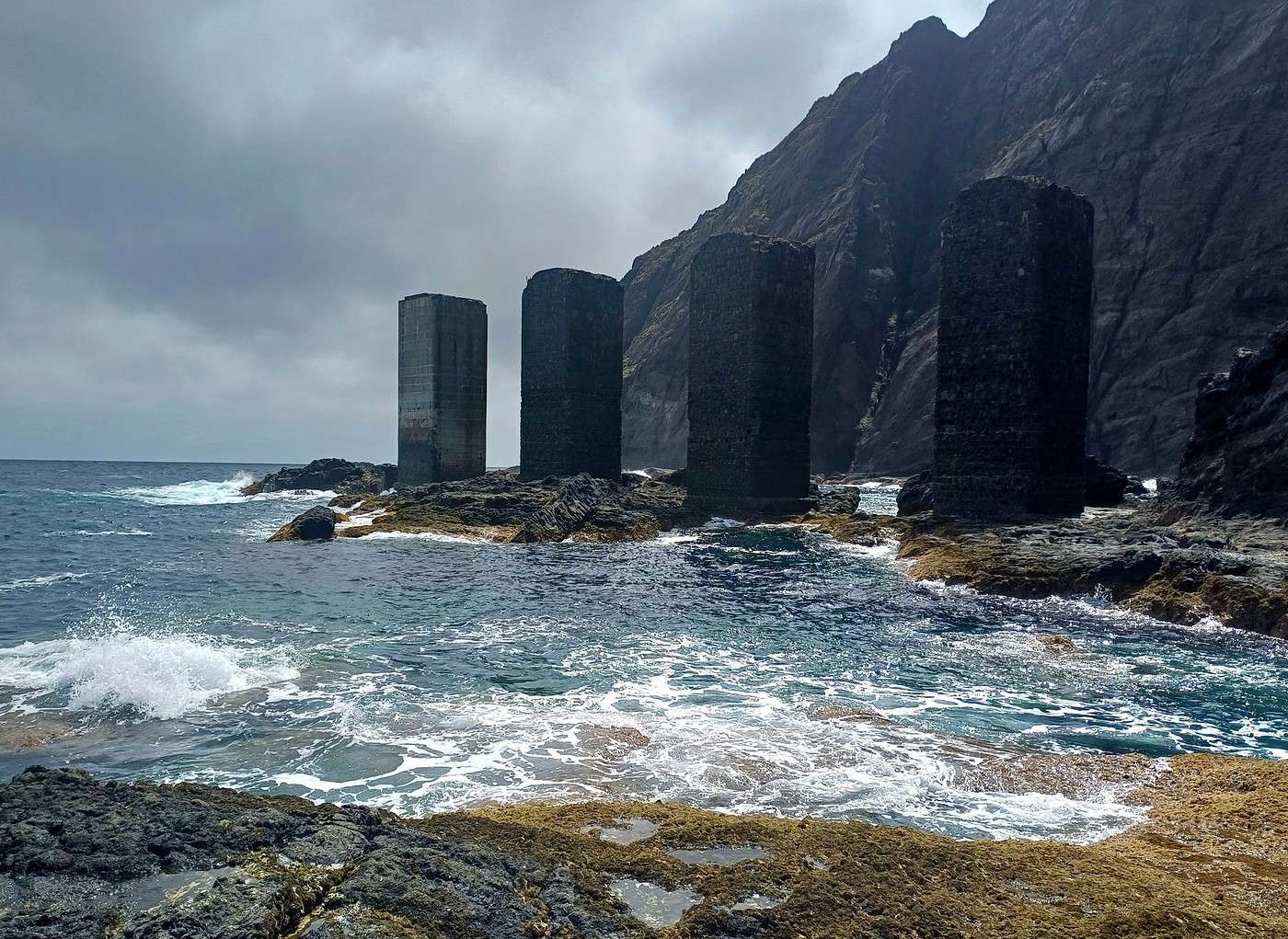
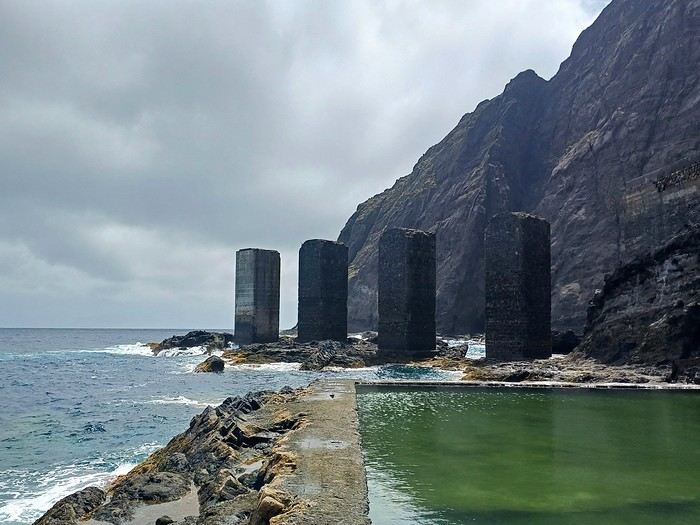
Here’s Santa Catalina Beach. This time, we don’t walk the pebble path and park the car like everyone else on the roadside, where it’s less than 500 meters to the natural pool. At the end of the pedestrian path stand the four pillars of the old pier, planted firmly in the ocean, unshaken. Built in 1907 and partly funded by Gomeran families returning from Cuba, where they’d migrated for better living conditions, it served as the island’s main port infrastructure for about forty years. This pescante (fishing pier) boosted transport and trade on La Gomera, making intra-island exchanges easier, since agricultural products used to be carried on foot along rough trails for miles—you really needed gofio for that! Its construction also paved the way for imports and exports, especially bananas. But it fell into disuse in the 1950s with the building of San Sebastián de La Gomera port and the road connecting the two towns. Still, these four pillars—once crane supports—are the only ones left standing on the island, unlike those in nearby Agulo and Vallehermoso, a testament to La Gomera’s early 20th-century development.
Since Spaniards aren’t early risers, there’s almost no one around at 10 AM except a chatty, friendly group of Italians (how’s that for a pleonasm?) and a handful of others. I notice the vibe here isn’t the hippie/nudist beach scene of Valle Gran Rey. Hermigua isn’t really a beach resort, despite its shores. We start with the semi-natural pool, the most accessible one—a basin formed by the old port’s quadrilateral structure, with greenish water. Like a real pool, there’s a ladder to get in. No waves here since they don’t reach the basin (at least not now), and adults can easily touch the bottom despite the rocky spots that sometimes form holes. You can swim peacefully with the fish and the idyllic ocean backdrop. Théo tests his armbands, though he’s still a bit scared and clings to us.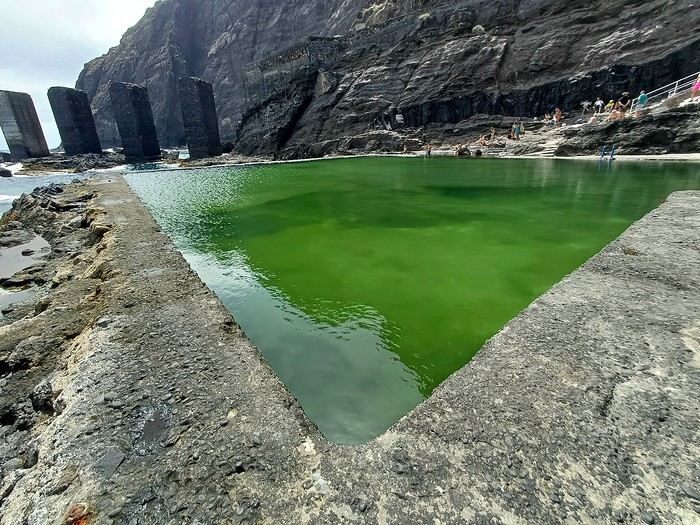
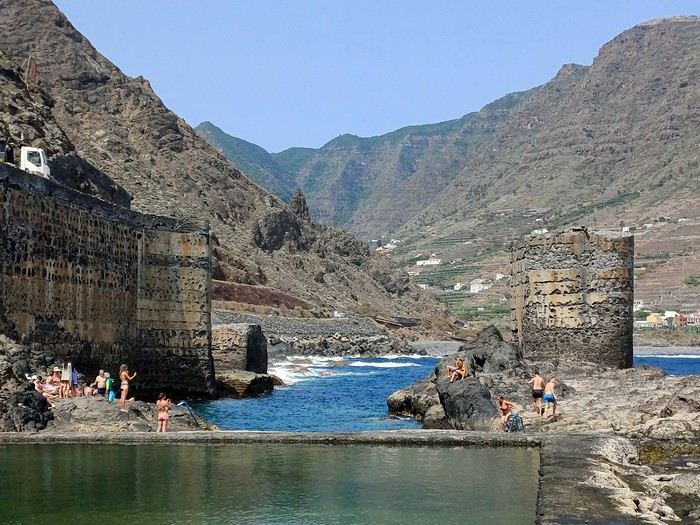
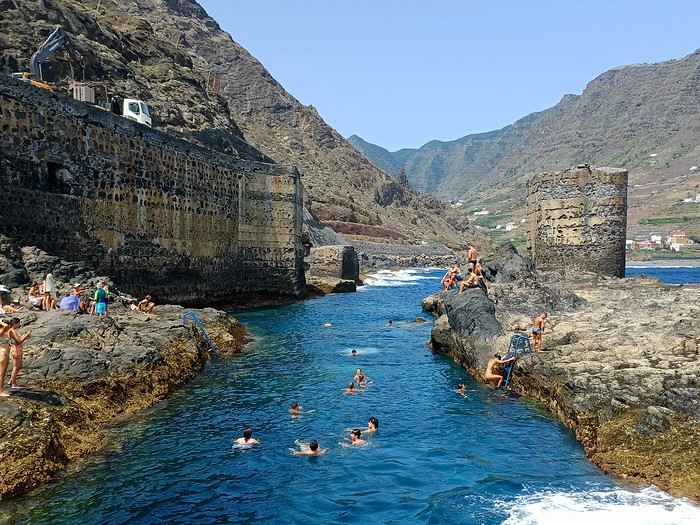
 It’s lovely, but encouraged by the swimmers nearby, Kelyandre and I want to step it up: the real natural pool, which looks way more fun! Just below the first basin, reefs and other remnants of the old port have formed a tiny cove with crystal-clear water about 3 meters deep. Here too, pool ladders are fixed to the rocks, though some folks skip the details and dive from low rocky ledges. The water’s perfect, and the ocean swell seeps in at regular intervals through a channel between two rocks, creating nice little waves. But watch out—sometimes the water’s force creates a washing-machine effect when it meets an opposing current from the cove’s entrance. No risk of being swept out to sea, though, at least not this season when the ocean’s calmest on the island’s north side. I almost wipe out joining this pool since the edges are slippery in spots. More fear than harm—I regain my balance just in time. Magali finally takes the plunge, and we take turns watching Théo, who’s found a little puddle near the first pool for his delight. A standout moment in this magical, unusual spot.
 Back at Casa Yaya for a tapas lunch: squid in ink, mussels and fish in sauce, chorizo, Iberian mortadella, mojo. Then a failed siesta attempt, and we drive back down to Hermigua’s center to check out El Curato Park, a small park with a fountain, a few geese, and kids’ games. Théo has a blast, and despite the language barrier, Kelyandre finds a playmate around his age for a soccer game. I follow them to Hermigua’s pretty soccer field next to the park (which I later learned would host a Real Madrid summer camp a few days later) for some free kicks and penalties under the mid-afternoon sun. A few errands at the village Spar, and we’re tempted to visit the La Gomera Ethnographic Park-Museum right in Hermigua’s center. Unfortunately, it’s closed, so we’ll have to come back another day. Across the street, the village square is getting ready for the party, with a band doing soundchecks on a small outdoor stage facing neatly arranged chairs.
Another trip back home via the narrow road up to our place, where Magali sometimes has to maneuver when we meet other cars. To switch things up from tapas, I fall back into old habits and cook a pretty decent vegetable curry with whatever’s on hand. Down below, the music starts—time to party! We don’t go back down to Hermigua since, despite the three kilometers of road, we have a bird’s-eye view of the little square from our windows, and we can see what’s happening. The music—first a bal musette group, then a set of Canarian and Spanish dance songs—is so loud it echoes through all the hamlets perched in the valley, reaching our open windows like our neighbors are throwing a huge party. At night, we can see the lit-up square clearly from home. Doesn’t seem crowded, but the band’s playing like they’re in front of 10,000 people. The noise is real, but the Canarian music with its Iberian and Caribbean vibes has such a good energy that it eventually lulls us to sleep in the warm Gomeran night.
First night at Casa Yaya, and what we love right away is the much cooler climate in Hermigua Valley compared to Valle Gran Rey, and the lush greenery—natural or agricultural—all around us, since this side of Garajonay is also more humid.
Since the majority rules, we’ll brave the double ban—rockfall risks and dangerous currents—to spend a great morning at the natural pool by the Hermigua fishing pier! On one side, the pool seemed well protected from the currents, and on the other, the cliff is covered with nets while road workers are busy smoothing out the dangerous spots. Then Magali whipped up some fluffy pancakes with gofio flour and palm honey to face any peril. We take the semi-circular road that passes by the house—we can go either way to head down to Hermigua. We realize it actually serves all the hamlets overlooking the village. It’s pretty narrow, and sometimes you have to reverse quite a bit when two cars meet.
Here’s Santa Catalina Beach. This time, we don’t walk the pebble path and park the car like everyone else on the roadside, where it’s less than 500 meters to the natural pool. At the end of the pedestrian path stand the four pillars of the old pier, planted firmly in the ocean, unshaken. Built in 1907 and partly funded by Gomeran families returning from Cuba, where they’d migrated for better living conditions, it served as the island’s main port infrastructure for about forty years. This pescante (fishing pier) boosted transport and trade on La Gomera, making intra-island exchanges easier, since agricultural products used to be carried on foot along rough trails for miles—you really needed gofio for that! Its construction also paved the way for imports and exports, especially bananas. But it fell into disuse in the 1950s with the building of San Sebastián de La Gomera port and the road connecting the two towns. Still, these four pillars—once crane supports—are the only ones left standing on the island, unlike those in nearby Agulo and Vallehermoso, a testament to La Gomera’s early 20th-century development.
Since Spaniards aren’t early risers, there’s almost no one around at 10 AM except a chatty, friendly group of Italians (how’s that for a pleonasm?) and a handful of others. I notice the vibe here isn’t the hippie/nudist beach scene of Valle Gran Rey. Hermigua isn’t really a beach resort, despite its shores. We start with the semi-natural pool, the most accessible one—a basin formed by the old port’s quadrilateral structure, with greenish water. Like a real pool, there’s a ladder to get in. No waves here since they don’t reach the basin (at least not now), and adults can easily touch the bottom despite the rocky spots that sometimes form holes. You can swim peacefully with the fish and the idyllic ocean backdrop. Théo tests his armbands, though he’s still a bit scared and clings to us.
Another trip back home via the narrow road up to our place, where Magali sometimes has to maneuver when we meet other cars. To switch things up from tapas, I fall back into old habits and cook a pretty decent vegetable curry with whatever’s on hand. Down below, the music starts—time to party! We don’t go back down to Hermigua since, despite the three kilometers of road, we have a bird’s-eye view of the little square from our windows, and we can see what’s happening. The music—first a bal musette group, then a set of Canarian and Spanish dance songs—is so loud it echoes through all the hamlets perched in the valley, reaching our open windows like our neighbors are throwing a huge party. At night, we can see the lit-up square clearly from home. Doesn’t seem crowded, but the band’s playing like they’re in front of 10,000 people. The noise is real, but the Canarian music with its Iberian and Caribbean vibes has such a good energy that it eventually lulls us to sleep in the warm Gomeran night.