



Re: Mexico: The Magic of the Yucatan
Before wrapping up the trip (Bacalar, Sian Ka’an, and Tulum), here’s some practical info about Calakmul:
- Yaax’ Che Campground
Operating since 2003, it’s run by a family from a local community. The initial goal was to establish a camp with low-impact environmental infrastructure. Twenty years later, this camp is a success, welcoming tourists while helping preserve the reserve’s environment.
One of the 9 tents at the campground
Contact: serveursturisticos@yahoo.com.mx
Phone: +52.983.101.1921
Address: Campamento Yaax Che in Calakmul, Carretera 186 Escacega – Chetumal KM 98 Entronque a Calakmul KM 7, 24640 Conhuas
To book a tent (or several), the best option is to go through the excellent website of the community tourism association this campground belongs to: Peninsular Alliance for Community Tourism.
Don’t hesitate to check it out—you might find something perfect, as it also lists other interesting, community-based, off-the-beaten-path spots in the Yucatán.
Alternatively, you can also book through the usual platforms: Booking, Agoda, Tripadvisor...
Price: It might seem surprising, but here, the price is inversely proportional to the comfort level! We paid 78 € for a tent for four people (in July). Some might find this rate too high for the amenities, but we don’t—it’s worth it to step off the beaten path in this ultra-touristy Yucatán.
Meals included: A light breakfast (not very filling) is included in the price. You can swap it for a small sandwich for your day visiting Calakmul, since there’s nowhere to buy food in the area.
Note that there are two short nature observation trails around the campground, including a bird-watching tower in the middle of the jungle.
- Admission fees for the Calakmul archaeological site
Here’s how the total access fee breaks down (2023 rates):
1/ At the exit of the small village of Conhuas, you pay a road maintenance fee (104 pesos per person).
2/ 20 km later, you pay the entrance fee for the biosphere reserve (150 pesos per person).
3/ And upon arrival (another 40 km), you pay the access fee for the Mayan archaeological site (90 pesos per person).
The total cost is 344 pesos per person (about 19 € at the 2023 exchange rate).
With all these successive payments, it feels a bit like we’re being milked, but in the end, it’s a small price to pay for such an exceptional site as Calakmul.
Warning: Don’t run out of gas, water, or food!
Calakmul is completely isolated in the jungle—there’s nothing nearby, and it’s far from everything. That’s part of its charm, but it also comes with some drawbacks: you need to plan ahead for gas, water, and food.
For gas:
Fill up well before reaching Conhuas, as gas stations are nearly nonexistent on Highway 186.
Coming from the west, the last gas station we found before Conhuas was in Silvituc (45 km from Conhuas and 105 km from Calakmul).
If you’re coming from the east (Bacalar, Chetumal, etc.), it’s best to fill up in Bacalar, especially if you’re making the round trip from Bacalar to Calakmul (470 km).
For water and food:
Stock up well before reaching Calakmul, or you might go hungry! Not having water while walking in this usually scorching-hot site can ruin your visit.
The best option is to buy food and drinks either in a town you pass through on the way (whether coming from Campeche, Bacalar, or elsewhere) or at a typical roadside shop—but in any case, do it well before reaching Conhuas.
Otherwise, you can still find supplies in Conhuas, but with limited choices, as the stores are small and not well-stocked.
And finally, if you pass the first checkpoint 1 km after Conhuas, at the entrance to the road heading south to Calakmul, your last chance is 6 km further at the Oxte’ Tun restaurant on the right side of the road. There, you can buy small sandwiches. They don’t sell bottled water, but you can refill your empty bottles (don’t make the same mistake we did—keep your empty bottles instead of throwing them away!). They also sell sodas.
9/ Bacalar
I admit we didn’t stay long enough or make the most of it. It’s a shame because the area is stunning—the colors, especially of the water, are breathtaking and perfect for swimming. The temperature is delightful.
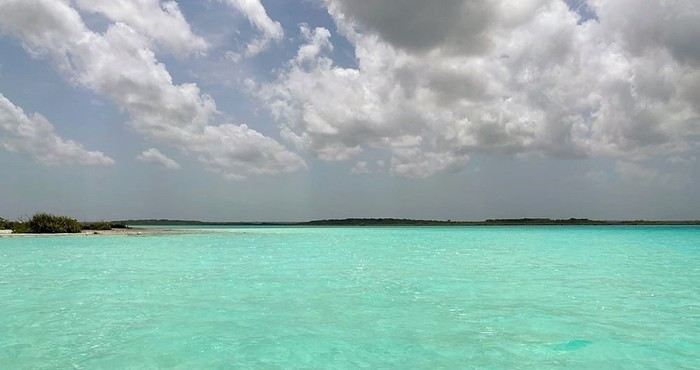
Bacalar Lagoon is nicknamed the “Lagoon of Seven Colors” because of—or rather, thanks to—its different shades of blue, turquoise, and green.
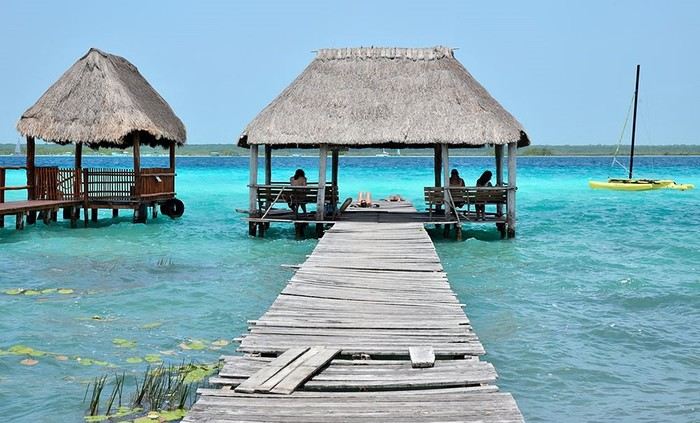
We went to the famous Pirates’ Channel by canoe. First, you have to paddle for a good twenty minutes or more (we had to fight the wind).
Then you arrive at a spot where there’s not much to do except swim and enjoy the scenery.
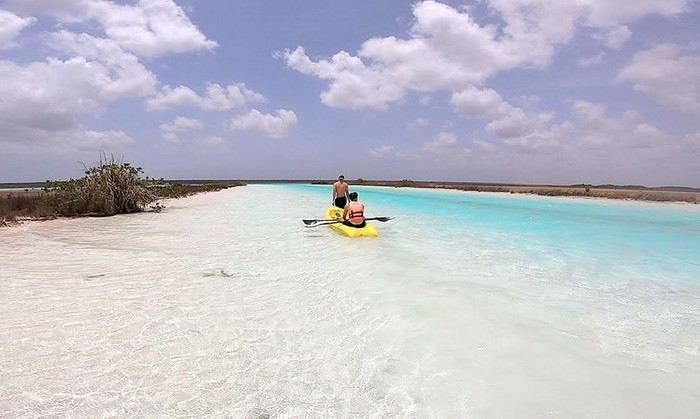
On the way back, we thought we could swim along the shore, but it seems nearly impossible: hotels have taken over the waterfront, and access to the water is privatized. There might be a few public spots, but if so, we didn’t see them.
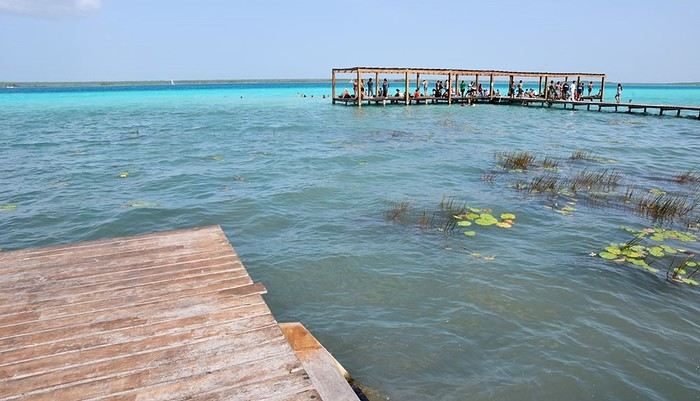
When we thought about heading to a public balneario (a free but usually overcrowded small beach area), we found a small, nearly deserted dock nearby:
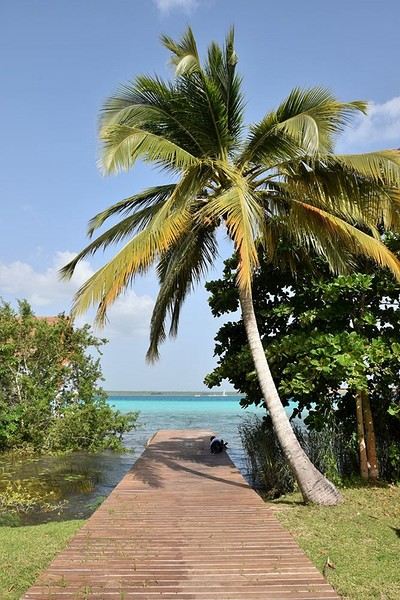
Here’s what the public balneario looks like (in the background):
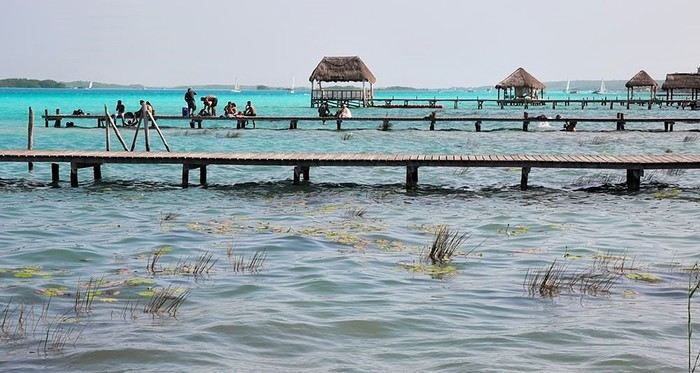
...and the private docks right next to it:
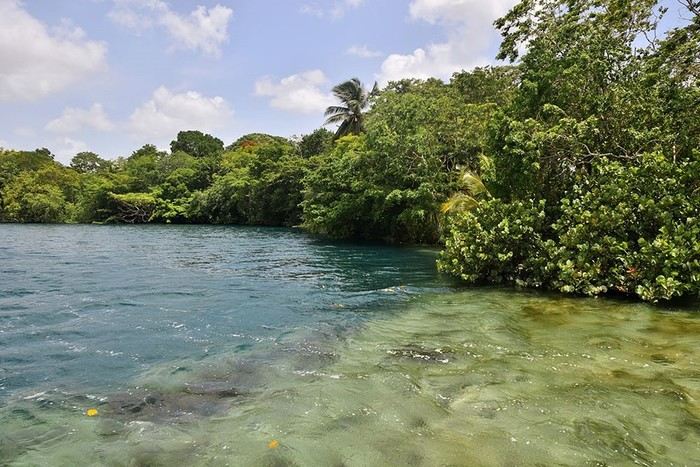
We also took a short boat tour of the lagoon. We briefly saw a submerged cenote, its circular shape clearly visible.
Then we headed to a new swimming area.
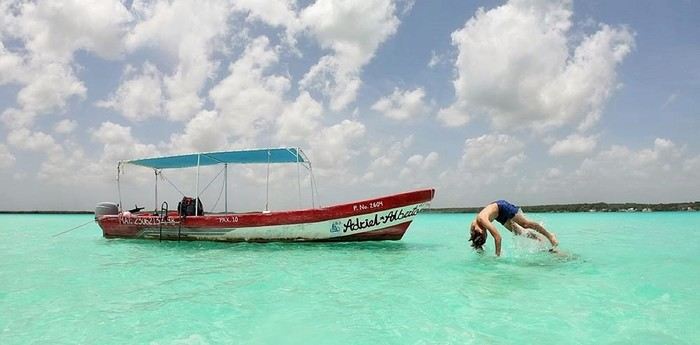
There’s nothing to do there—just savor and enjoy. At that moment, the daily grind of work back in France felt so far away.
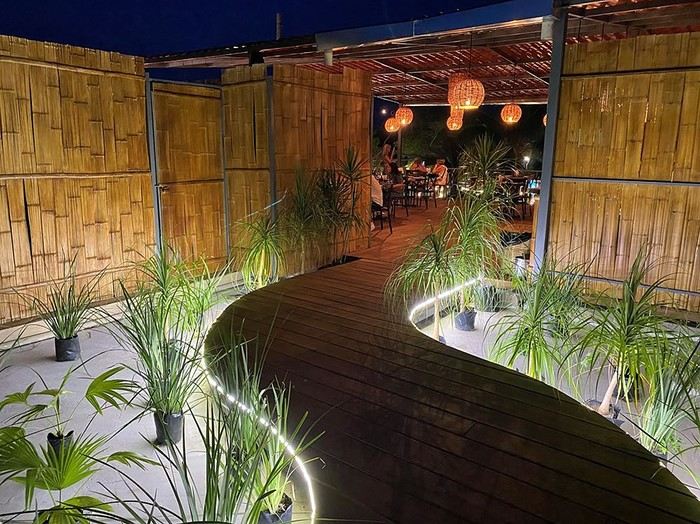
One place we loved was a small, friendly restaurant, Baluartes Marina Laguna Azul (Avenida Costera 1, por Calles 20 y 22, Bacalar, 77930). The food and cocktails are good and filling, and ideally, you should go in the evening and ask for the upstairs area—it’s much nicer than the ground floor:
- Yaax’ Che Campground
Operating since 2003, it’s run by a family from a local community. The initial goal was to establish a camp with low-impact environmental infrastructure. Twenty years later, this camp is a success, welcoming tourists while helping preserve the reserve’s environment.
One of the 9 tents at the campground
Contact: serveursturisticos@yahoo.com.mx
Phone: +52.983.101.1921
Address: Campamento Yaax Che in Calakmul, Carretera 186 Escacega – Chetumal KM 98 Entronque a Calakmul KM 7, 24640 Conhuas
To book a tent (or several), the best option is to go through the excellent website of the community tourism association this campground belongs to: Peninsular Alliance for Community Tourism.
Don’t hesitate to check it out—you might find something perfect, as it also lists other interesting, community-based, off-the-beaten-path spots in the Yucatán.
Alternatively, you can also book through the usual platforms: Booking, Agoda, Tripadvisor...
Price: It might seem surprising, but here, the price is inversely proportional to the comfort level! We paid 78 € for a tent for four people (in July). Some might find this rate too high for the amenities, but we don’t—it’s worth it to step off the beaten path in this ultra-touristy Yucatán.
Meals included: A light breakfast (not very filling) is included in the price. You can swap it for a small sandwich for your day visiting Calakmul, since there’s nowhere to buy food in the area.
Note that there are two short nature observation trails around the campground, including a bird-watching tower in the middle of the jungle.
- Admission fees for the Calakmul archaeological site
Here’s how the total access fee breaks down (2023 rates):
1/ At the exit of the small village of Conhuas, you pay a road maintenance fee (104 pesos per person).
2/ 20 km later, you pay the entrance fee for the biosphere reserve (150 pesos per person).
3/ And upon arrival (another 40 km), you pay the access fee for the Mayan archaeological site (90 pesos per person).
The total cost is 344 pesos per person (about 19 € at the 2023 exchange rate).
With all these successive payments, it feels a bit like we’re being milked, but in the end, it’s a small price to pay for such an exceptional site as Calakmul.
Warning: Don’t run out of gas, water, or food!
Calakmul is completely isolated in the jungle—there’s nothing nearby, and it’s far from everything. That’s part of its charm, but it also comes with some drawbacks: you need to plan ahead for gas, water, and food.
For gas:
Fill up well before reaching Conhuas, as gas stations are nearly nonexistent on Highway 186.
Coming from the west, the last gas station we found before Conhuas was in Silvituc (45 km from Conhuas and 105 km from Calakmul).
If you’re coming from the east (Bacalar, Chetumal, etc.), it’s best to fill up in Bacalar, especially if you’re making the round trip from Bacalar to Calakmul (470 km).
For water and food:
Stock up well before reaching Calakmul, or you might go hungry! Not having water while walking in this usually scorching-hot site can ruin your visit.
The best option is to buy food and drinks either in a town you pass through on the way (whether coming from Campeche, Bacalar, or elsewhere) or at a typical roadside shop—but in any case, do it well before reaching Conhuas.
Otherwise, you can still find supplies in Conhuas, but with limited choices, as the stores are small and not well-stocked.
And finally, if you pass the first checkpoint 1 km after Conhuas, at the entrance to the road heading south to Calakmul, your last chance is 6 km further at the Oxte’ Tun restaurant on the right side of the road. There, you can buy small sandwiches. They don’t sell bottled water, but you can refill your empty bottles (don’t make the same mistake we did—keep your empty bottles instead of throwing them away!). They also sell sodas.
9/ Bacalar
I admit we didn’t stay long enough or make the most of it. It’s a shame because the area is stunning—the colors, especially of the water, are breathtaking and perfect for swimming. The temperature is delightful.
Bacalar Lagoon is nicknamed the “Lagoon of Seven Colors” because of—or rather, thanks to—its different shades of blue, turquoise, and green.
We went to the famous Pirates’ Channel by canoe. First, you have to paddle for a good twenty minutes or more (we had to fight the wind).
Then you arrive at a spot where there’s not much to do except swim and enjoy the scenery.
On the way back, we thought we could swim along the shore, but it seems nearly impossible: hotels have taken over the waterfront, and access to the water is privatized. There might be a few public spots, but if so, we didn’t see them.
When we thought about heading to a public balneario (a free but usually overcrowded small beach area), we found a small, nearly deserted dock nearby:
Here’s what the public balneario looks like (in the background):
...and the private docks right next to it:
We also took a short boat tour of the lagoon. We briefly saw a submerged cenote, its circular shape clearly visible.
Then we headed to a new swimming area.
There’s nothing to do there—just savor and enjoy. At that moment, the daily grind of work back in France felt so far away.
One place we loved was a small, friendly restaurant, Baluartes Marina Laguna Azul (Avenida Costera 1, por Calles 20 y 22, Bacalar, 77930). The food and cocktails are good and filling, and ideally, you should go in the evening and ask for the upstairs area—it’s much nicer than the ground floor: