

Re: Tuscany: Arezzo Province and the Sienese Area
The weather is gorgeous this morning, so I’m heading out for a day of hiking in the Apennines. It’s my last hiking day, and the only one that’s an out-and-back route. The start and finish point is "Passo La Calla" (the red dot on Day 11’s map), a pass at 1,300 meters above Pratovecchio-Stia.
The route is simple: the trail follows the Apennine ridge. It’s a series of climbs and descents (sometimes on one side, sometimes on the other, sometimes right on the ridge) with a clear viewpoint at Poggio Scali and miles of beech forest. I hike as far as the spot where I got caught in the rain three days ago (above the Camaldoli hermitage).
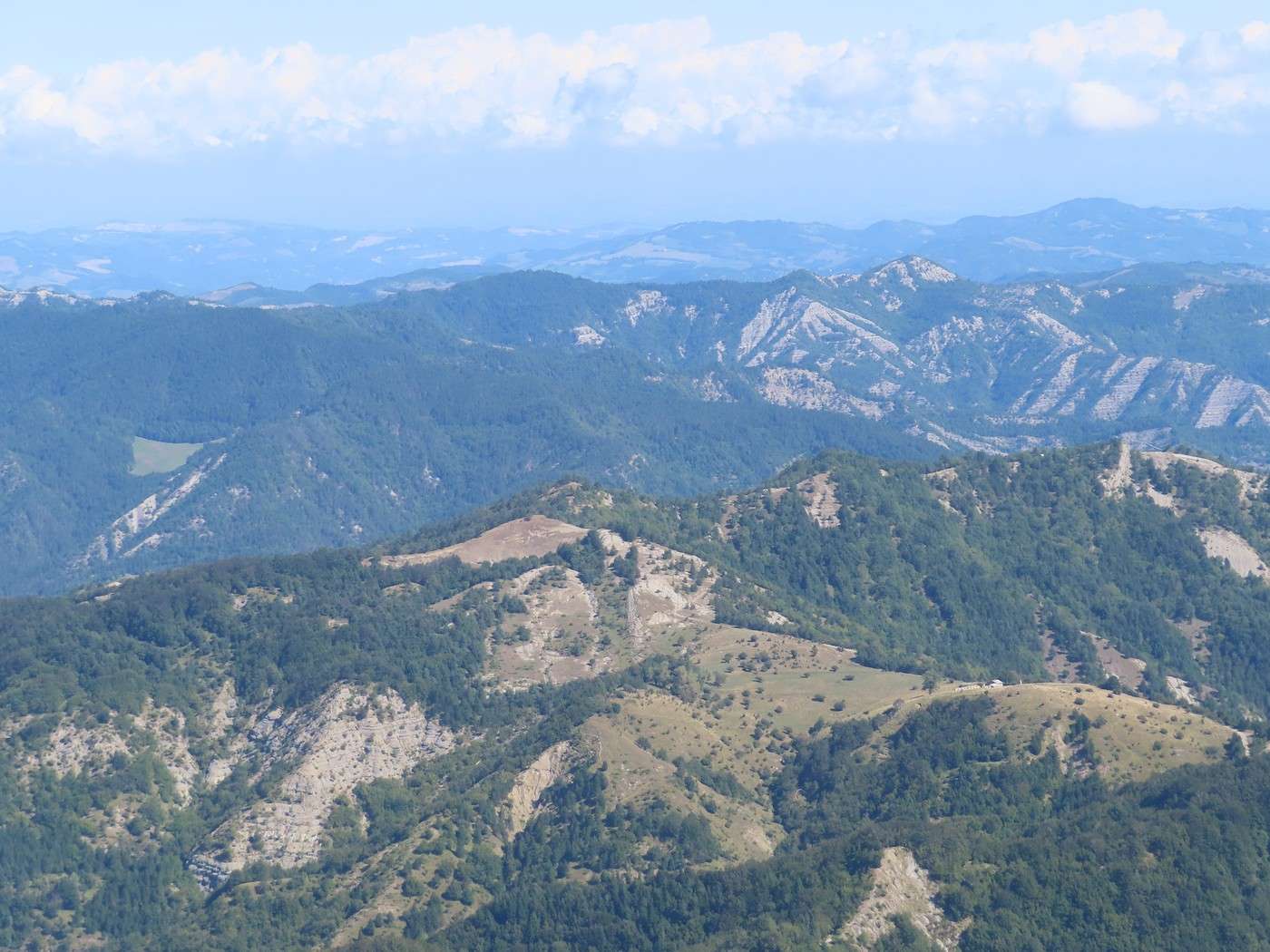
The view from Poggio Scali faces the Romagna side.
The beech forest along the trail.
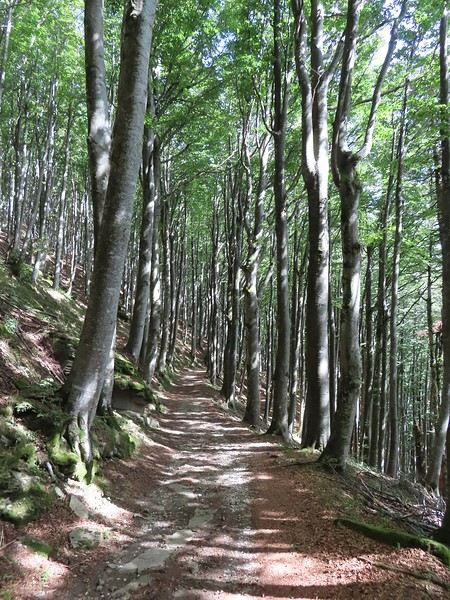
We’re right in the Casentino Forests National Park (parco nazionale delle foreste casentinesi). These beech forests are a UNESCO World Heritage Site as "Ancient and Primeval Beech Forests." I’d love to come back here in the fall (the colors change, then the leaves fall).
The round trip is pretty long but not difficult, and I got back to "Passo della Calla" early enough to visit the Wool Art Museum in Stia.
Before that, though, I’m reflecting on all the hikes I’ve done. Wanting to hike in the Apennines, I chose a tiny section of the "Sentiero Italia": a trail that runs the entire length of the Alps, then along the Apennine ridge (from Trieste all the way to the tip of Calabria).
More info at sentieroitalia.cai.it
Here are the four stages I did (I’d downloaded a GPX track): SI L02N Passo di Viamaggio - Balze SI L03N Balze - Verghereto SI L04N Verghereto - Badia Prataglia SI L05 Badia Prataglia - Passo della Calla
Since I wasn’t hiking from hotel to hotel with a backpack, I split it differently: shorter stages with bike rides along the road from the endpoint back to the start to pick up my car.
Another site with info on the "Sentiero Italia" is vasentiero.org It seems more recent and better for descriptions, maps, and accommodations. The route is in the opposite direction, with stages numbered 166, 167, 168, and 169.
The Wool Art Museum in Stia is housed in the former wool mill that operated from the mid-19th century to the second half of the 20th century. That’s what makes it so interesting—while the millennia-old craft of wool work is on display, it’s also an industrial archaeology site. I photographed machines I’d never seen anywhere else, like carding machines.
First carding machine.
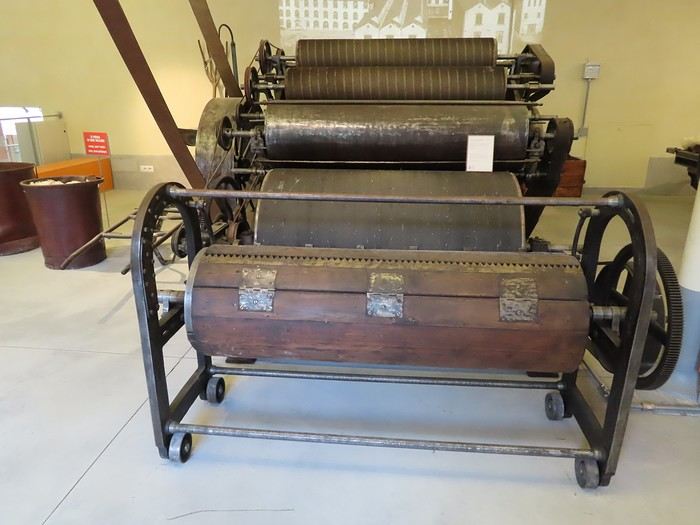
Second carding machine.
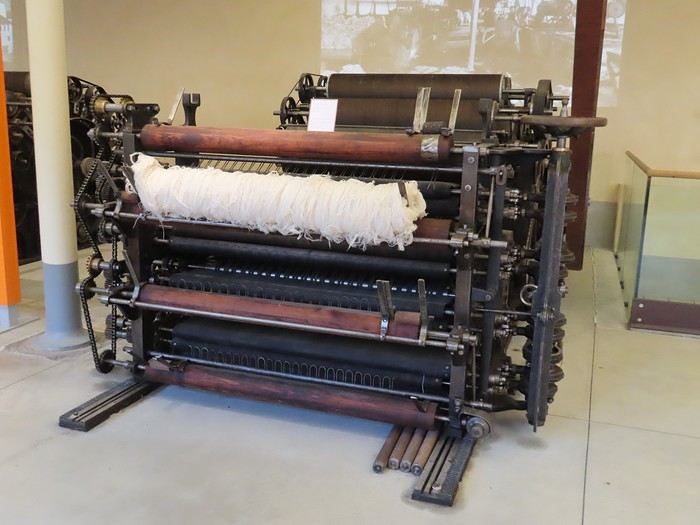
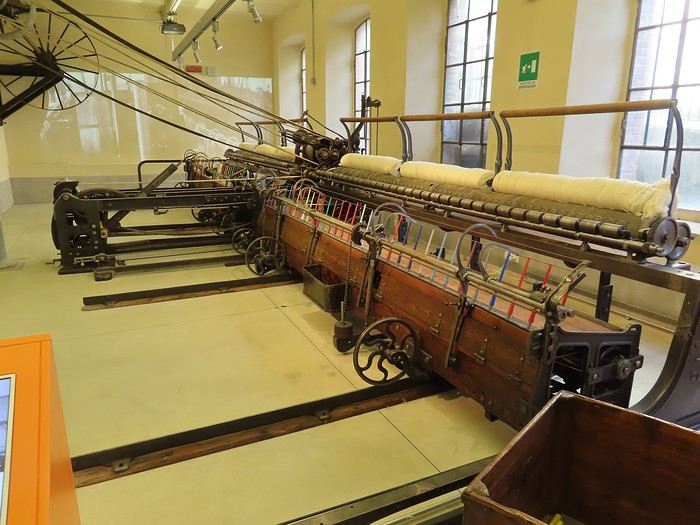
These two carding machines were used one after the other in the industrial carding process. The next step in wool processing is spinning. The machine below is probably a wool-spinning machine (to be confirmed, since I didn’t find the info in my notes). The fixed frame is on the right, and the wool there looks like what comes out of the second carding machine. The mobile part (on the left) moves back and forth, guided by wheels on a rail. I didn’t see it in action and can’t quite picture what happens in the upper part.
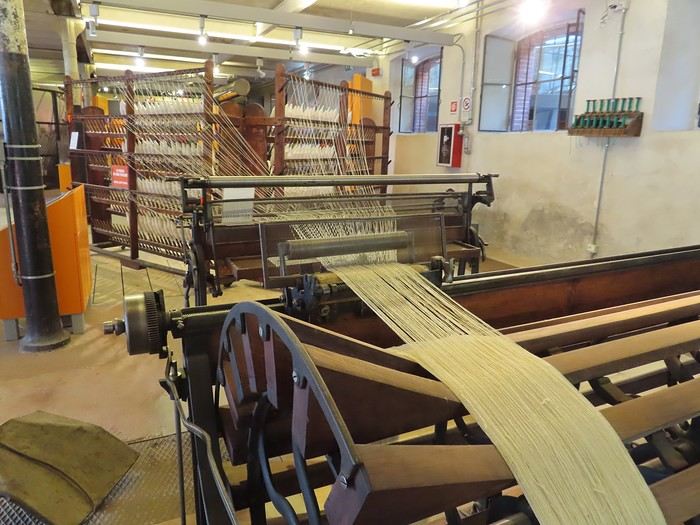
This last machine is a warping machine. It unwinds bobbins to arrange the threads side by side and create the warp—just before weaving.
The fabric produced is "panno casentino." Its production was revived for high-end clothing (there’s a shop on-site). It has a "brushed" or "fuzzy" look, achieved with a machine called a finisher (or finishing machine) that rubs the fabric.
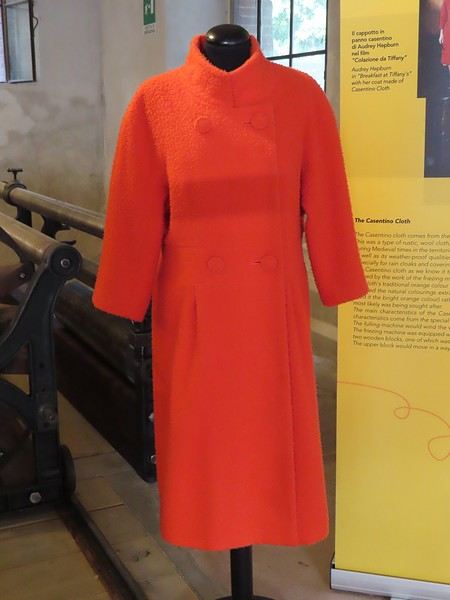
Oh! What a coat made of "panno casentino"! It’s the model Audrey Hepburn wore in the film "Breakfast at Tiffany’s" (1961), adapted from Truman Capote’s work. This fabric had its moment of glory.
The view from Poggio Scali faces the Romagna side.
The beech forest along the trail.
We’re right in the Casentino Forests National Park (parco nazionale delle foreste casentinesi). These beech forests are a UNESCO World Heritage Site as "Ancient and Primeval Beech Forests." I’d love to come back here in the fall (the colors change, then the leaves fall).
The round trip is pretty long but not difficult, and I got back to "Passo della Calla" early enough to visit the Wool Art Museum in Stia.
Before that, though, I’m reflecting on all the hikes I’ve done. Wanting to hike in the Apennines, I chose a tiny section of the "Sentiero Italia": a trail that runs the entire length of the Alps, then along the Apennine ridge (from Trieste all the way to the tip of Calabria).
More info at sentieroitalia.cai.it
Here are the four stages I did (I’d downloaded a GPX track): SI L02N Passo di Viamaggio - Balze SI L03N Balze - Verghereto SI L04N Verghereto - Badia Prataglia SI L05 Badia Prataglia - Passo della Calla
Since I wasn’t hiking from hotel to hotel with a backpack, I split it differently: shorter stages with bike rides along the road from the endpoint back to the start to pick up my car.
Another site with info on the "Sentiero Italia" is vasentiero.org It seems more recent and better for descriptions, maps, and accommodations. The route is in the opposite direction, with stages numbered 166, 167, 168, and 169.
The Wool Art Museum in Stia is housed in the former wool mill that operated from the mid-19th century to the second half of the 20th century. That’s what makes it so interesting—while the millennia-old craft of wool work is on display, it’s also an industrial archaeology site. I photographed machines I’d never seen anywhere else, like carding machines.
First carding machine.
Second carding machine.
These two carding machines were used one after the other in the industrial carding process. The next step in wool processing is spinning. The machine below is probably a wool-spinning machine (to be confirmed, since I didn’t find the info in my notes). The fixed frame is on the right, and the wool there looks like what comes out of the second carding machine. The mobile part (on the left) moves back and forth, guided by wheels on a rail. I didn’t see it in action and can’t quite picture what happens in the upper part.
This last machine is a warping machine. It unwinds bobbins to arrange the threads side by side and create the warp—just before weaving.
The fabric produced is "panno casentino." Its production was revived for high-end clothing (there’s a shop on-site). It has a "brushed" or "fuzzy" look, achieved with a machine called a finisher (or finishing machine) that rubs the fabric.
Oh! What a coat made of "panno casentino"! It’s the model Audrey Hepburn wore in the film "Breakfast at Tiffany’s" (1961), adapted from Truman Capote’s work. This fabric had its moment of glory.