
Skip to content
Autumn trip from Puglia to Naples via Basilicata...Chapter 16 of 28

Chapter 16 · Nov 17, 2019

Hi Sissi, I have to say I’m really surprised by your reply

Brigitte42 · 2 min read
Hi Sissi, I have to say I’m really surprised by your reply—maybe we didn’t visit the same place? I’m coming back to this house (just so you know, they were ALL like that, except the one I saw was spacious enough to fit a millstone or a press in the common room, turned by a donkey all day long). The HUGE difference between my childhood in the countryside and what the Sassi inhabitants lived through was the overcrowding among family members (just one bed, sometimes 10 kids of all ages...) and the animals that spent the night in the SAME room to share warmth... Above all, it was the extreme poverty they had to endure, and it got even worse when they were displaced. For example, kids were required to go to school, BUT there was no money at all to clothe them, no transportation, etc. Did you know that because of the extreme poverty and appalling sanitary conditions, the child mortality rate (ages 3, 4, etc.) was over 50%? In one family, from what I’ve read and seen on-site, the father and older boys would go cultivate a small plot of land on the outskirts of town and only come home once a week... You mention that conditions in the Sassi weren’t worse than those in non-troglodyte dwellings in the 19th century, for example, and earlier. I totally agree with you there—they lived like other peasants, but 100 years behind!

Back to the living conditions we experienced in MP! It’s not unpleasant to chat about this...

Have a good evening, best wishes.
11 replies to this chapter

See all
Brigitte42OPGlobetrotter3,333 posts· 7 years ago
Thanks for your message, and I’m glad you liked the photos!

It was pretty tough to write the historical summary about the city of Matera, but it was necessary for understanding the visit!

I’m resting until tomorrow—have a good night. Hugs. Brigitte.
Sissi57Globetrotter6,674 posts· 7 years ago
I think we saw the same place, with a room where the bed is. The loom was at the back, there was a second room, and to the side an alcove where the kitchen is? I completely agree that their living conditions were very harsh, and indeed, 100 years behind. Even in London’s East End at the start of the 20th century, it wasn’t paradise, and the conditions shown in Italian films like Bitter Rice weren’t exactly enviable. Unfortunately, these are still the conditions in some less fortunate countries today.
JourdesRegular280 posts· 7 years ago
Good evening Sissi,

I live near a fortified town that "has history." And indeed, when visiting some houses on the plateau, you can still see tiny rooms built outside the house, on kinds of stilts attached to the walls, on the upper floor. These tiny rooms were the first bathrooms for the wealthiest people.

My husband, who spent part of his youth in the countryside, told me that his grandparents' bathroom was set up in part of one of the bedrooms. But before this renovation, each bedroom had its own sink. Before having a bathtub, "baths" were taken in what they called "tubes": a sort of huge basin placed in front of the sink...

I must admit I never experienced any of that...
Sissi57Globetrotter6,674 posts· 7 years ago
My parents also told me about taking their weekly bath in the kitchen in a big tub before they converted a room in the apartment into a bathroom. For my mother’s family, this also meant a loss of space since three families were living in what we’d now call a two-bedroom apartment in France...
JourdesRegular280 posts· 7 years ago
Maybe you know Claude Michelet, the writer and son of one of de Gaulle’s ministers. He’s a former farmer who tells the saga of a Corrèze family throughout the 20th century. The story begins in 1895...

It’s fascinating.
JourdesRegular280 posts· 7 years ago
Yes, but let's admit that a weekly bath is not much...

But, you should know that I experienced this as a child when I arrived in the Southwest. Nine kids, two grandmothers under the same roof—I remember that weekly bath and shampoo... No running water, just water from a spring, so we had to be careful.

Today, we hear that a daily shower or bath might be "too much"...

I mention it, but it didn’t really traumatize me!!!
JourdesRegular280 posts· 7 years ago
Sorry Brigitte, but we’re kinda going off-topic here!!!!!!!!!!!!!!!!
JourdesRegular280 posts· 7 years ago
But there was running water!!! But it was spring water or from a stream flowing into a well.

I can assure you that at my parents' place, a property sold in 2011, there was running water, but no utility connection.

A spring, a well, a pump, and... water.

So, water had to be "managed" carefully, especially in summer and during droughts...
Brigitte42OPGlobetrotter3,333 posts· 7 years ago
Thanks Josiane! I’m still going, but we’re about two-thirds done—it’s taking quite a bit of time... but I’d do the trip all over again!

Have a great day.
HiacintheGlobetrotter7,684 posts· 7 years ago
Hi Brigitte,

To make it quick, here’s a summary of the key milestones in Matera’s history! *** It’s important to know that cave dwellings carved into the soft limestone appeared in the region 250,000 years ago, as far back as the Paleolithic era. *** The city boasts numerous rock-hewn churches beautifully decorated with Byzantine frescoes: hidden places of prayer for immigrants, particularly from Turkey, Armenia, and Asia Minor. *** In the 14th and 15th centuries, the city was enriched with many churches and monuments within the fortified walls surrounding the Center... *** Unfortunately, in the last century (the 20th century!), living conditions—both sanitary and economic—became increasingly precarious for the growing population, which reached 16,000 inhabitants after World War II.

In 1950, following a visit by A. Gasperi, a prominent minister at the time, La Gazzetta del Mezzogiorno published a front-page article on Matera with the bold headline: "NATIONAL SHAME." In 1945, Carlo Levi’s autobiographical book Christ Stopped at Eboli was published. I’ll talk more about it later: it recounts the miserable living conditions of the peasant world under fascist Italy. Politicians, having researched and been shocked by the reality described in the book, sought a solution to the problem. They decided to build public housing (HLM) around the Sassi to relocate the peasants who lived there—these are the buildings we saw at the entrance. In 1952, the forced transfers of inhabitants began, and a law mandated the complete isolation of the Sassi: the districts were left in total ruin, caves were walled up, and access was blocked. It was Carlo Levi, once again, who advocated for the need to preserve and enhance the historical and social treasure we can see today.

In 1993, the Sassi were recognized as a UNESCO World Heritage Site, and in 2014, Matera was named European Capital of Culture for 2019. From then on, the Sassi became symbols of the development and valorization of an Italian territory, in the eyes of the whole world!


That’s really interesting.

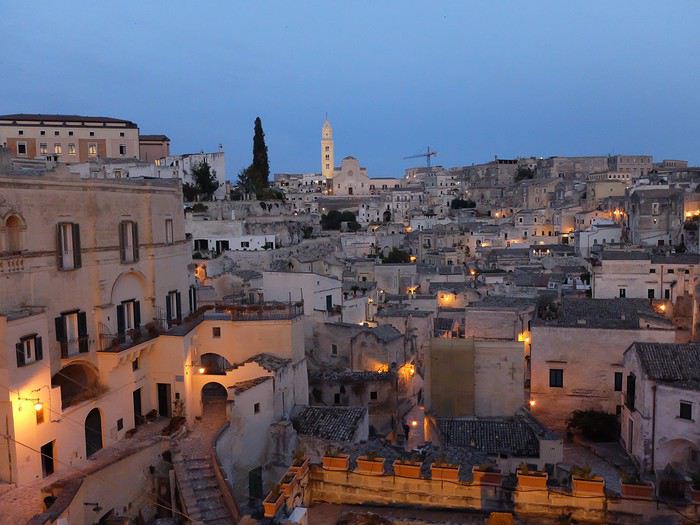
I love this photo:

If you’re still with me, we were on our way to the hotel, and the luggage was supposed to follow—they almost beat us there!


Was there a hotel employee at the garage to whom you entrusted the luggage so they could take it to the hotel?

Cheers,

Christine