

Re: Tuscany: Arezzo province and the area around Siena
A beautiful day, not too hot, in Arezzo.
I park near Pescaiola station and then get around by bike and on foot.
The most famous and influential personality from Arezzo is Giorgio Vasari (1511-1574)—painter, architect, and the man who "invented" art history. He regularly returned to stay in his hometown and bought a house there, which he decorated himself (likely with some help, as was common at the time). "Casa Vasari" is therefore an artist’s home from the Renaissance, a rather rare testament to that era.
My photo choices (for the rest of the post) will be very selective and arbitrary; I’ll skip parts of monuments, or even entire monuments, to show only what remains most vivid in my memory when I write with several months of hindsight.
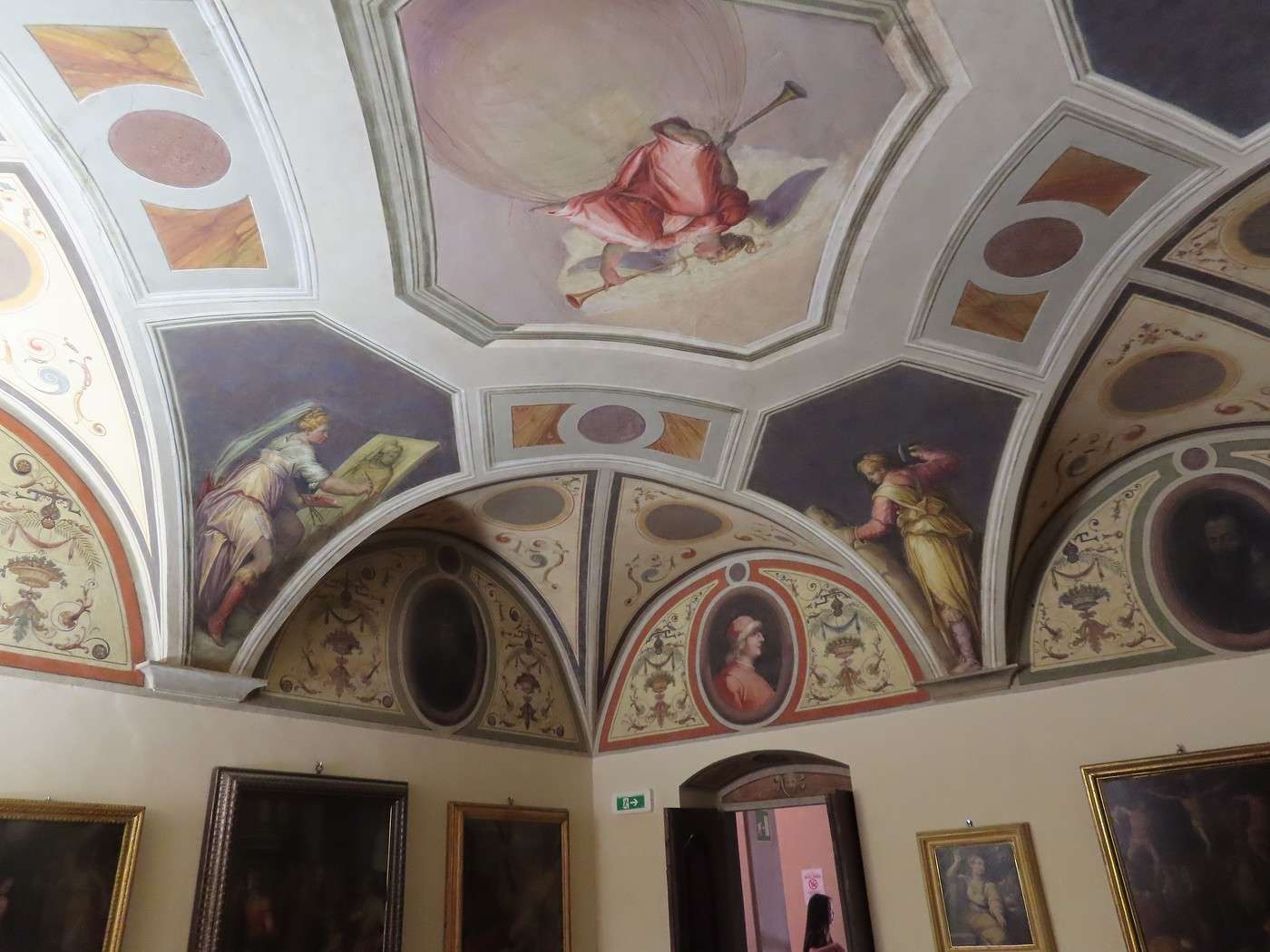
The Chamber of Fame and the Arts is worth seeing for its architecture and paintings (overview below).
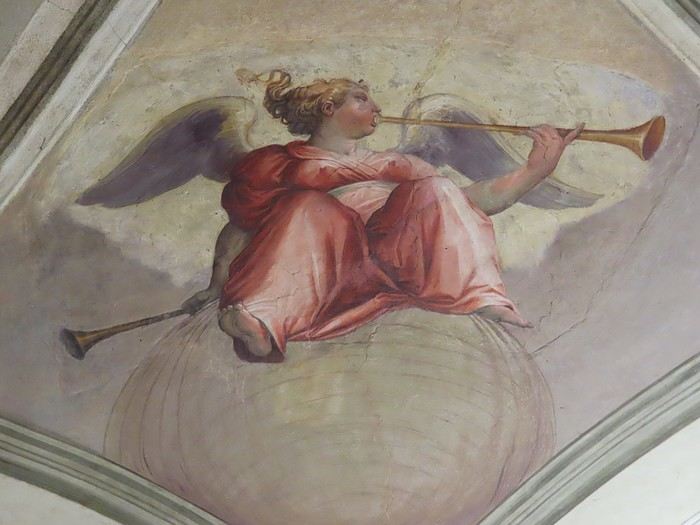
On the ceiling, Fame, seated on a globe, blows a trumpet.
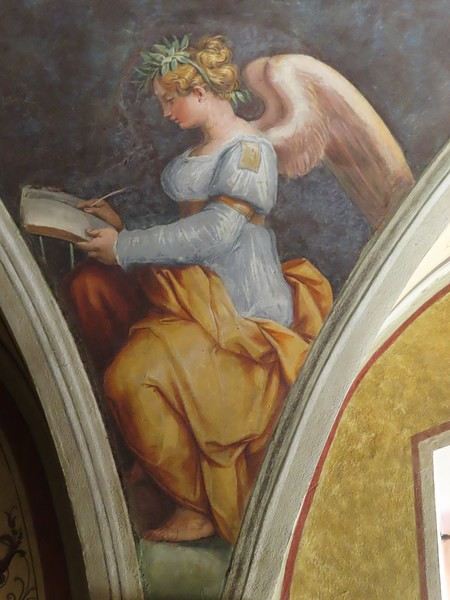
Between two lunettes decorated with portraits of painters, Poetry is absorbed in her creation.
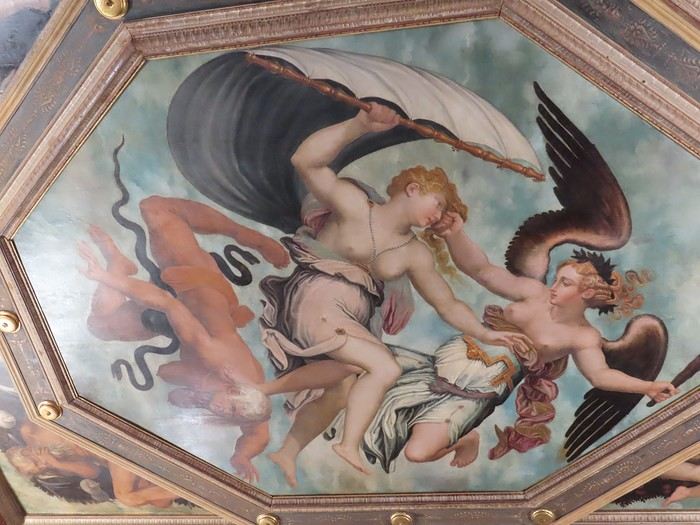
The largest room, entirely decorated with frescoes, is the Hall of the Triumph of Virtue. At the center of the coffered ceiling, allegories of Virtue, Fortune, and Envy.
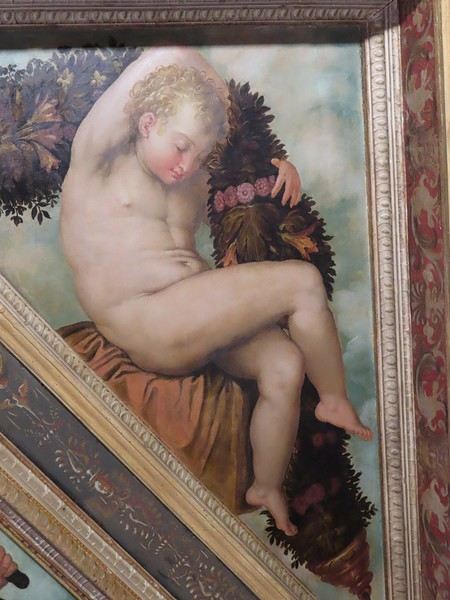
Surrounding the fresco above to complete the ceiling’s decoration, four paintings represent the four ages of life, including childhood.
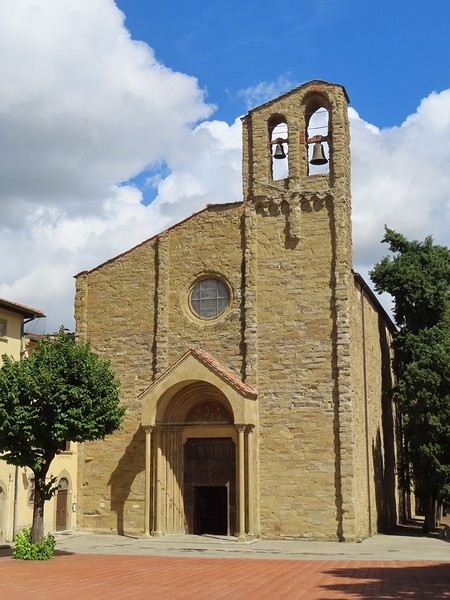
Leaving "Casa Vasari," I head up toward the cathedral and quickly arrive at a square where the Church of Saint Dominic (Chiesa di San Domenico) stands. Gothic in style, it has an elegant façade, with the bell tower adding an asymmetrical touch. Inside, besides numerous frescoes, there’s a large painted crucifix by Cimabue.
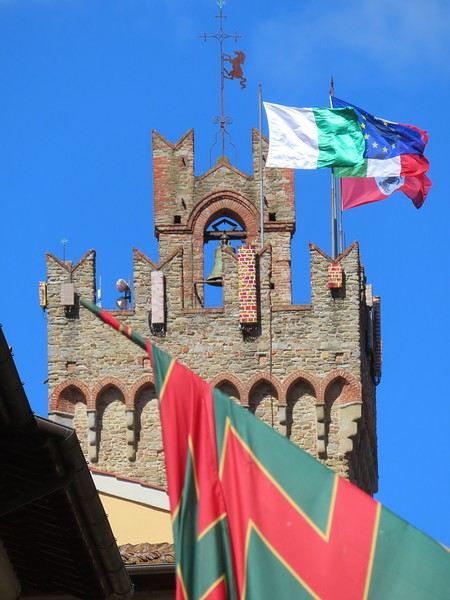
In the afternoon, the flags on the tower of the Palazzo dei Priori (now the town hall) flutter in the wind (photo taken on Via Andrea Cesalpino).
More from the day in the next message.
My photo choices (for the rest of the post) will be very selective and arbitrary; I’ll skip parts of monuments, or even entire monuments, to show only what remains most vivid in my memory when I write with several months of hindsight.
The Chamber of Fame and the Arts is worth seeing for its architecture and paintings (overview below).
On the ceiling, Fame, seated on a globe, blows a trumpet.
Between two lunettes decorated with portraits of painters, Poetry is absorbed in her creation.
The largest room, entirely decorated with frescoes, is the Hall of the Triumph of Virtue. At the center of the coffered ceiling, allegories of Virtue, Fortune, and Envy.
Surrounding the fresco above to complete the ceiling’s decoration, four paintings represent the four ages of life, including childhood.
Leaving "Casa Vasari," I head up toward the cathedral and quickly arrive at a square where the Church of Saint Dominic (Chiesa di San Domenico) stands. Gothic in style, it has an elegant façade, with the bell tower adding an asymmetrical touch. Inside, besides numerous frescoes, there’s a large painted crucifix by Cimabue.
In the afternoon, the flags on the tower of the Palazzo dei Priori (now the town hall) flutter in the wind (photo taken on Via Andrea Cesalpino).
More from the day in the next message.