
After a short night, the long-awaited day has finally arrived! We’re up very early because our Paris-Tenerife flight takes off at 10 AM. We’d planned to take the metro—super convenient since it now serves our Parisian suburb and Line 14 was extended to Orly Airport. But we got a nice surprise the night before: our transit cards no longer give us a discount on the premium airport fares. That’s 14 € per person, which we find way too expensive! So, we did the math quickly: an Uber costs 32 € for all four of us, and we won’t have to lug our bags. At Orly, everything goes smoothly. Transavia is very efficient, and we take off on time. Off we go for a 4-hour flight to reach the famous Atlantic archipelago.
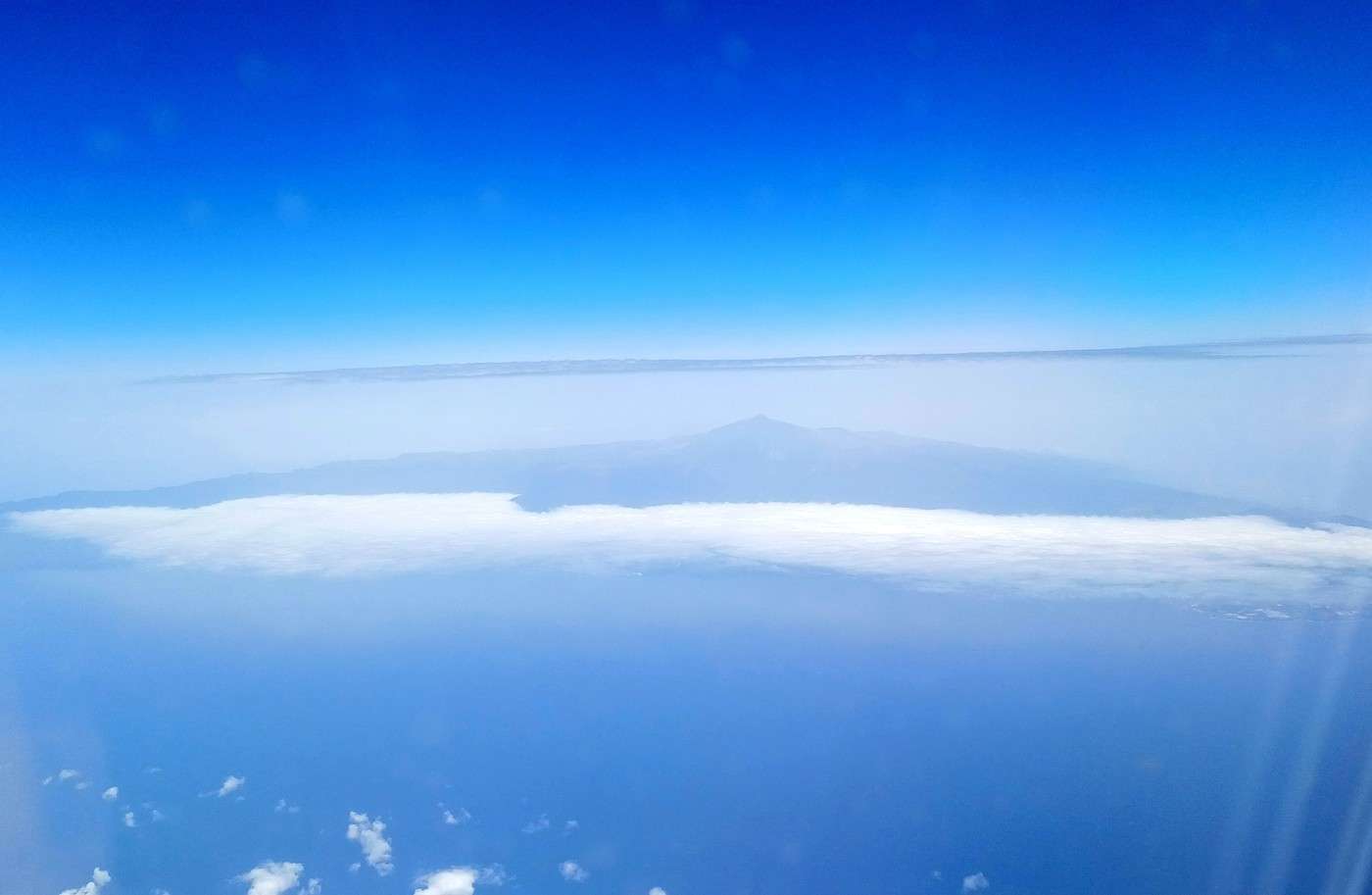
I’m traveling separately from Magali and the kids to avoid another seat-selection fee. The clear, sunny weather lets me admire the Nantes coast, Île de Ré, and Île d’Oléron from the window. A little later, after the Bay of Biscay, I spot the parched lands of Galicia, Portugal, and Lisbon before heading back over the Atlantic, far from the Moroccan coast. Then, out of nowhere, like a misty maritime mirage, the majestic Teide appears, encircled by clouds and its rugged coastline. Landing on Tenerife is quite the sight!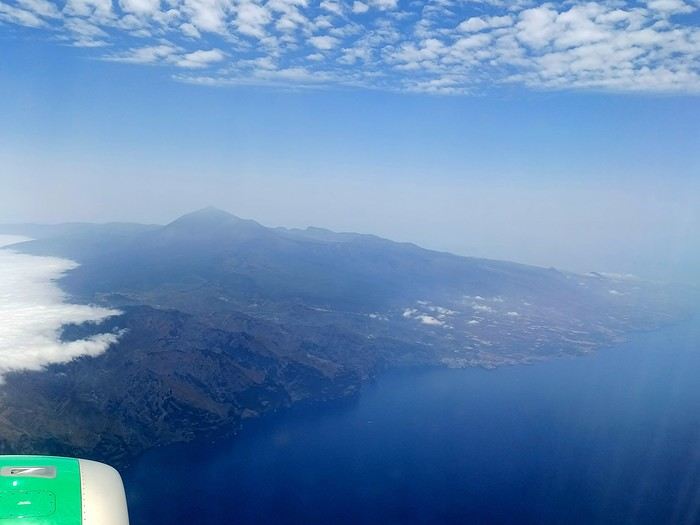
We’re on time, and if our suitcase doesn’t take too long to arrive, we can catch the 2 PM bus 40 to Los Cristianos, where the ferries to the western islands depart. The suspense ends—our suitcase shows up pretty quickly on the conveyor belt. We’re really happy with Transavia on this flight: affordable prices, great organization, punctual, and friendly but strict on safety. We rush out of the small Tenerife South Airport. The bus stops are right across from the exit, and with almost no wait, we hop on the number 40 (3.20 € per person, free for our 4-year-old). After a quick half-hour watching the coastline roll by—concrete buildings, red and rocky landscapes, banana trees, cacti, billboards—and always, Teide in the background, the bus drops us off at a roundabout in a somewhat artificial-looking modern neighborhood. We’ve got about a 20-minute relaxed walk under a bright, gentle sun through vacation rentals, the little touristy center packed with restaurants and shops, and the Los Cristianos beach, covered in sunbeds and packed to the brim. We finally reach the ferry terminal. Our ferry leaves at 3:30 PM, and since we’re half an hour early, we stop at Casa Playa Tenerife, a big beachside bar-restaurant where international tourists (mostly Germans) and girls in thong bikinis with everything on display parade by. It’s clear that presentation is everything here. The sight of this industrial beach in such a stunning natural setting feels like a real waste… and it confirms our choice of La Gomera even more.
We hurry the friendly servers a bit because our order is taking too long, and time’s running out. We just manage to enjoy a nice, cold Dorada (the iconic Canary Islands beer brand) and a peach juice for the kids before we have to head to the nearby ferry terminal. We scan our e-tickets and board the Pepita Castellvi, a massive ferry from Baleària Canarias (which recently acquired Naviera Armas), one of the two historic companies—along with Fred Olsen—that connect the eight Canary Islands. We weren’t expecting such a giant! And yet, there are hardly any people on board—about 80% of the seats are empty. It’s probably not peak time: many tourists visit La Gomera on a day trip from Tenerife and likely take the morning ferries. The inside is super comfortable, with an affordable bar-restaurant, a play area for kids, and even the option to spend the trip on deck. Just minutes after departure, we spot dolphins jumping right by our window! I’d read that you can easily see them on this stretch between Tenerife and La Gomera, as well as whales, but we didn’t expect to see them so soon. For those of us planning a whale-watching excursion, this is a great sign. We end up spending most of the trip on deck, where the strong wind and the powerful waves the boat kicks up behind it make for a perfect attraction for the kids. With Teide now fading behind us, the Gomeran shore starts to take shape in the distance, and finally, the port of San Sebastián de La Gomera, the island’s capital, comes into view, watched over by a small statue of Christ the Redeemer atop one of the cliffs overlooking it.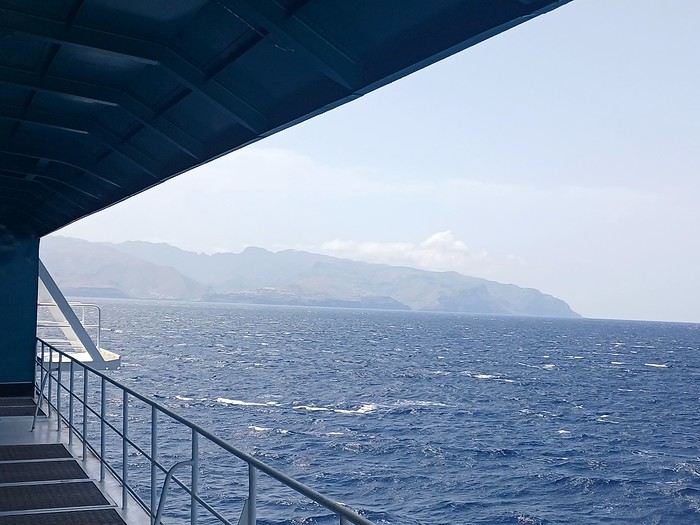
The ship docks, and we rush to the Cicar agency—the most popular in the Canaries (thanks, Attila and Muriel18!), probably because it’s the cheapest with the best terms. Paperwork done in five minutes, a 40 € deposit paid, and we’re assigned a red Opel Corsa in the parking lot. Nice surprise: they told us the tank was three-quarters full, but it’s actually full—bonus! Magali takes the wheel since she’s an experienced driver, and declaring only one driver saves us money. Off we go to Valle Gran Rey, all the way on the other side of the island to the west, where our Airbnb awaits. The destination is 25 kilometers as the crow flies, which makes it seem like a half-hour trip. But this is La Gomera—so it’s 50 kilometers of winding roads avoiding the most mountainous part, meaning a 1 hour 15-minute drive. There are two routes that take about the same time. Of course, we take a wrong turn at a poorly marked hairpin bend and end up following the northern coastal route. It’s not a big deal—it only adds about 20 minutes and gives us our first taste of La Gomera’s incredible variety of landscapes.
We wind our way upward between the massive ridges and are instantly struck by the beauty of these dry, rocky landscapes in terracotta tones, the result of ancient volcanic activity. They’re covered in terraced fields and dotted with palm trees, banana trees, aloe vera, prickly pears, and more, surrounding us on all sides. Toward the north of the island, the roads get narrower and twistier, sometimes dizzyingly so, with one tight hairpin after another. You’ve got to have a strong stomach! The kids start feeling queasy, and they’re not the only ones… But the breathtaking scenery helps take the edge off, especially the viewpoints along the road that offer jaw-dropping views of the deep valleys. We’re already amazed by this little preview of La Gomera from the safety of our Opel Corsa, which Magali finds perfectly suited to these kinds of roads. We finally get a glimpse of the places we’d imagined while planning this trip and will visit in the coming days: the lush Hermigua Valley with its plunging sea views, the village of Agulo between cliffs and ocean, and even a small part of Garajonay National Park. We get held up for a few minutes because we have our first encounter with real Gomeros, busy clearing branches from the road. This sign of civilization surprises us because we’ve been driving alone for a while and haven’t seen anyone. There’s something very welcoming about these small, stocky road workers with their uniquely weathered skin—they signal for us to wait and wave as we pass. Then the road finally starts to descend, and from a high viewpoint, we spot a valley nestled between two massive mountain slopes, revealing a wide strip of ocean on the horizon: our destination, Valle Gran Rey. The view from above is just as stunning as Hermigua’s.
Now we’re looking for our lodging in the little village of La Calera, which, further down, still overlooks the coastline. Actually, the municipality of Valle Gran Rey isn’t a single town but a collection of coastal and mountain villages clustered in the valley. La Calera is one of them. It seems perfectly situated—neither too deep in the mountains nor right by the ocean, with a fantastic view and just a 20-minute walk to the shore. Valle Gran Rey is, along with San Sebastián de La Gomera, the most touristy spot on the island—but that’s relative since La Gomera is still a hidden gem. La Calera feels like an authentic village, mostly home to native Gomeros, but it’s also quite popular with Germans. They’re big fans of La Gomera, especially Valle Gran Rey—so much so that many have invested in properties or vacation homes here, and German has become the island’s unofficial second language. Coincidentally, our Airbnb is owned by a German, and we struggle to find it despite the precise location provided. Magali parks the car on the village’s main street because the lodging is in one of the many callejónes clinging to the mountainside—more like steep paths accessible only on foot than actual streets.
We finally run into a man sipping a beer on a low wall, who we mistake for a Gomero because he looks just like the road workers we met earlier. He hears us talking and approaches in perfect French. Turns out he’s Belgian but seems to know the village like he’s lived there his whole life. He easily points us to our lodging, the aptly named Buena Vista, which is even higher up than we thought. We’d searched in vain in the neighboring path, but it was actually the next one with the same name—probably because they meet up higher up. You’d have to know! The stone-step trail winds through prickly pears, mango trees, and banana plants growing like weeds, with houses stacked in terraces like the surrounding fields. The climb is pretty tough, especially after such a long day with a 20-kilo suitcase. We end up at a metal walkway—without it, a crevasse would block access to the house… and there we are. We didn’t think we’d start our first hike so soon: La Gomera is full immersion from the get-go!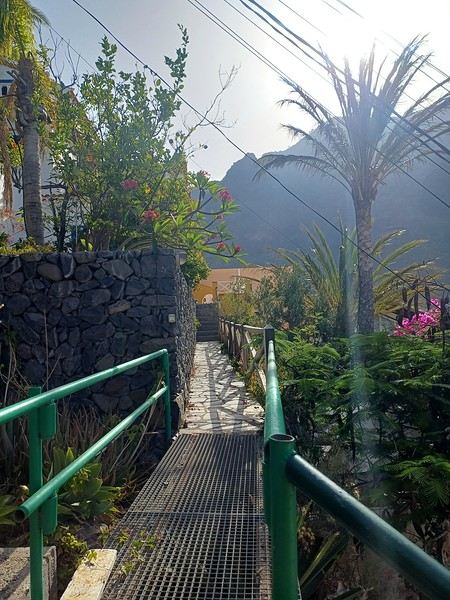
Our German landlord’s German neighbor welcomes us warmly but discreetly. It’s a lovely vacation home with everything we need: a big living room-kitchen, a terrace with an amazing view of the mountains and sea, two upstairs bedrooms, a bathroom, and a balcony above the terrace. We’ll stay here for seven days before moving to Hermigua for the second week.
After unpacking and taking much-needed showers, we head down to the village grocery store, just a two- or three-minute walk away, to stock up and have something to eat tonight. El Chorro Grocery seems to be the main social hub of La Calera, with locals treating it like a bar, beer in hand, chatting with the owner on the doorstep. We’re surprised to see our Belgian friend there, laughing and speaking Spanish with some villagers. The guy seems to have fully blended into the scenery and completed his physical and cultural transformation into a true Gomero! We pick out some Spanish and local products to get into the spirit. Prices are a bit high, but the owner is super welcoming, and we’ve got what we need for tonight and the start of our stay.
I get cooking and whip up a homemade Canarian garbanza with local ingredients, which we enjoy on the terrace with pasta and some improvised tapas—chorizo, squid in sauce—and the obligatory cold Dorada, as the sun casts its last rays over the valley before slowly disappearing behind the ocean. Everything is peaceful, the weather is mild, and there’s almost no noise—just the occasional sound of a car passing on the main road far below. We couldn’t have made a better choice.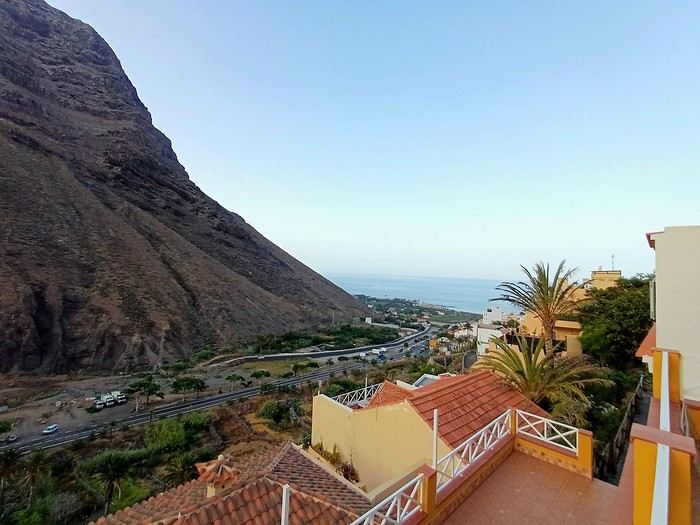
That evening, I start to take a real interest in the colossal mountainside facing ours, meeting up there in a V-shape to give the valley its vast, open feel. This monumental volcanic formation, with its mix of brick red, anthracite, and sparse green vegetation, looms over our terrace like a giant shadow stretching from the mountainous hinterland to the coast. It feels like a wave frozen in time, about to crash over the village.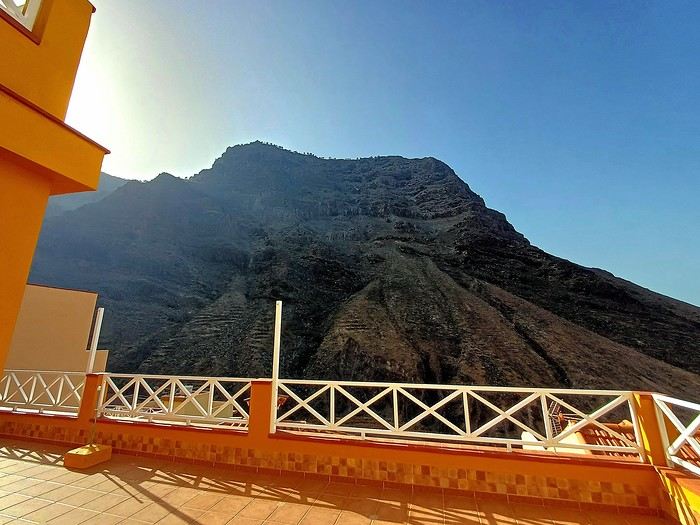 Night falls, turning it into a dark, imposing mass that amplifies the sense of immensity and impending submersion. At the same time, strange noises—like cats fighting—echo through the valley… It catches my attention for a moment, but it doesn’t matter. After 13 hours of nonstop travel—Uber, plane, bus, ferry, and car—it’s time for some well-deserved rest before we start exploring the area tomorrow.
I’m traveling separately from Magali and the kids to avoid another seat-selection fee. The clear, sunny weather lets me admire the Nantes coast, Île de Ré, and Île d’Oléron from the window. A little later, after the Bay of Biscay, I spot the parched lands of Galicia, Portugal, and Lisbon before heading back over the Atlantic, far from the Moroccan coast. Then, out of nowhere, like a misty maritime mirage, the majestic Teide appears, encircled by clouds and its rugged coastline. Landing on Tenerife is quite the sight!
We’re on time, and if our suitcase doesn’t take too long to arrive, we can catch the 2 PM bus 40 to Los Cristianos, where the ferries to the western islands depart. The suspense ends—our suitcase shows up pretty quickly on the conveyor belt. We’re really happy with Transavia on this flight: affordable prices, great organization, punctual, and friendly but strict on safety. We rush out of the small Tenerife South Airport. The bus stops are right across from the exit, and with almost no wait, we hop on the number 40 (3.20 € per person, free for our 4-year-old). After a quick half-hour watching the coastline roll by—concrete buildings, red and rocky landscapes, banana trees, cacti, billboards—and always, Teide in the background, the bus drops us off at a roundabout in a somewhat artificial-looking modern neighborhood. We’ve got about a 20-minute relaxed walk under a bright, gentle sun through vacation rentals, the little touristy center packed with restaurants and shops, and the Los Cristianos beach, covered in sunbeds and packed to the brim. We finally reach the ferry terminal. Our ferry leaves at 3:30 PM, and since we’re half an hour early, we stop at Casa Playa Tenerife, a big beachside bar-restaurant where international tourists (mostly Germans) and girls in thong bikinis with everything on display parade by. It’s clear that presentation is everything here. The sight of this industrial beach in such a stunning natural setting feels like a real waste… and it confirms our choice of La Gomera even more.
We hurry the friendly servers a bit because our order is taking too long, and time’s running out. We just manage to enjoy a nice, cold Dorada (the iconic Canary Islands beer brand) and a peach juice for the kids before we have to head to the nearby ferry terminal. We scan our e-tickets and board the Pepita Castellvi, a massive ferry from Baleària Canarias (which recently acquired Naviera Armas), one of the two historic companies—along with Fred Olsen—that connect the eight Canary Islands. We weren’t expecting such a giant! And yet, there are hardly any people on board—about 80% of the seats are empty. It’s probably not peak time: many tourists visit La Gomera on a day trip from Tenerife and likely take the morning ferries. The inside is super comfortable, with an affordable bar-restaurant, a play area for kids, and even the option to spend the trip on deck. Just minutes after departure, we spot dolphins jumping right by our window! I’d read that you can easily see them on this stretch between Tenerife and La Gomera, as well as whales, but we didn’t expect to see them so soon. For those of us planning a whale-watching excursion, this is a great sign. We end up spending most of the trip on deck, where the strong wind and the powerful waves the boat kicks up behind it make for a perfect attraction for the kids. With Teide now fading behind us, the Gomeran shore starts to take shape in the distance, and finally, the port of San Sebastián de La Gomera, the island’s capital, comes into view, watched over by a small statue of Christ the Redeemer atop one of the cliffs overlooking it.
The ship docks, and we rush to the Cicar agency—the most popular in the Canaries (thanks, Attila and Muriel18!), probably because it’s the cheapest with the best terms. Paperwork done in five minutes, a 40 € deposit paid, and we’re assigned a red Opel Corsa in the parking lot. Nice surprise: they told us the tank was three-quarters full, but it’s actually full—bonus! Magali takes the wheel since she’s an experienced driver, and declaring only one driver saves us money. Off we go to Valle Gran Rey, all the way on the other side of the island to the west, where our Airbnb awaits. The destination is 25 kilometers as the crow flies, which makes it seem like a half-hour trip. But this is La Gomera—so it’s 50 kilometers of winding roads avoiding the most mountainous part, meaning a 1 hour 15-minute drive. There are two routes that take about the same time. Of course, we take a wrong turn at a poorly marked hairpin bend and end up following the northern coastal route. It’s not a big deal—it only adds about 20 minutes and gives us our first taste of La Gomera’s incredible variety of landscapes.
We wind our way upward between the massive ridges and are instantly struck by the beauty of these dry, rocky landscapes in terracotta tones, the result of ancient volcanic activity. They’re covered in terraced fields and dotted with palm trees, banana trees, aloe vera, prickly pears, and more, surrounding us on all sides. Toward the north of the island, the roads get narrower and twistier, sometimes dizzyingly so, with one tight hairpin after another. You’ve got to have a strong stomach! The kids start feeling queasy, and they’re not the only ones… But the breathtaking scenery helps take the edge off, especially the viewpoints along the road that offer jaw-dropping views of the deep valleys. We’re already amazed by this little preview of La Gomera from the safety of our Opel Corsa, which Magali finds perfectly suited to these kinds of roads. We finally get a glimpse of the places we’d imagined while planning this trip and will visit in the coming days: the lush Hermigua Valley with its plunging sea views, the village of Agulo between cliffs and ocean, and even a small part of Garajonay National Park. We get held up for a few minutes because we have our first encounter with real Gomeros, busy clearing branches from the road. This sign of civilization surprises us because we’ve been driving alone for a while and haven’t seen anyone. There’s something very welcoming about these small, stocky road workers with their uniquely weathered skin—they signal for us to wait and wave as we pass. Then the road finally starts to descend, and from a high viewpoint, we spot a valley nestled between two massive mountain slopes, revealing a wide strip of ocean on the horizon: our destination, Valle Gran Rey. The view from above is just as stunning as Hermigua’s.
Now we’re looking for our lodging in the little village of La Calera, which, further down, still overlooks the coastline. Actually, the municipality of Valle Gran Rey isn’t a single town but a collection of coastal and mountain villages clustered in the valley. La Calera is one of them. It seems perfectly situated—neither too deep in the mountains nor right by the ocean, with a fantastic view and just a 20-minute walk to the shore. Valle Gran Rey is, along with San Sebastián de La Gomera, the most touristy spot on the island—but that’s relative since La Gomera is still a hidden gem. La Calera feels like an authentic village, mostly home to native Gomeros, but it’s also quite popular with Germans. They’re big fans of La Gomera, especially Valle Gran Rey—so much so that many have invested in properties or vacation homes here, and German has become the island’s unofficial second language. Coincidentally, our Airbnb is owned by a German, and we struggle to find it despite the precise location provided. Magali parks the car on the village’s main street because the lodging is in one of the many callejónes clinging to the mountainside—more like steep paths accessible only on foot than actual streets.
We finally run into a man sipping a beer on a low wall, who we mistake for a Gomero because he looks just like the road workers we met earlier. He hears us talking and approaches in perfect French. Turns out he’s Belgian but seems to know the village like he’s lived there his whole life. He easily points us to our lodging, the aptly named Buena Vista, which is even higher up than we thought. We’d searched in vain in the neighboring path, but it was actually the next one with the same name—probably because they meet up higher up. You’d have to know! The stone-step trail winds through prickly pears, mango trees, and banana plants growing like weeds, with houses stacked in terraces like the surrounding fields. The climb is pretty tough, especially after such a long day with a 20-kilo suitcase. We end up at a metal walkway—without it, a crevasse would block access to the house… and there we are. We didn’t think we’d start our first hike so soon: La Gomera is full immersion from the get-go!
Our German landlord’s German neighbor welcomes us warmly but discreetly. It’s a lovely vacation home with everything we need: a big living room-kitchen, a terrace with an amazing view of the mountains and sea, two upstairs bedrooms, a bathroom, and a balcony above the terrace. We’ll stay here for seven days before moving to Hermigua for the second week.
After unpacking and taking much-needed showers, we head down to the village grocery store, just a two- or three-minute walk away, to stock up and have something to eat tonight. El Chorro Grocery seems to be the main social hub of La Calera, with locals treating it like a bar, beer in hand, chatting with the owner on the doorstep. We’re surprised to see our Belgian friend there, laughing and speaking Spanish with some villagers. The guy seems to have fully blended into the scenery and completed his physical and cultural transformation into a true Gomero! We pick out some Spanish and local products to get into the spirit. Prices are a bit high, but the owner is super welcoming, and we’ve got what we need for tonight and the start of our stay.
I get cooking and whip up a homemade Canarian garbanza with local ingredients, which we enjoy on the terrace with pasta and some improvised tapas—chorizo, squid in sauce—and the obligatory cold Dorada, as the sun casts its last rays over the valley before slowly disappearing behind the ocean. Everything is peaceful, the weather is mild, and there’s almost no noise—just the occasional sound of a car passing on the main road far below. We couldn’t have made a better choice.
That evening, I start to take a real interest in the colossal mountainside facing ours, meeting up there in a V-shape to give the valley its vast, open feel. This monumental volcanic formation, with its mix of brick red, anthracite, and sparse green vegetation, looms over our terrace like a giant shadow stretching from the mountainous hinterland to the coast. It feels like a wave frozen in time, about to crash over the village.
Night falls, turning it into a dark, imposing mass that amplifies the sense of immensity and impending submersion. At the same time, strange noises—like cats fighting—echo through the valley… It catches my attention for a moment, but it doesn’t matter. After 13 hours of nonstop travel—Uber, plane, bus, ferry, and car—it’s time for some well-deserved rest before we start exploring the area tomorrow.