

Re: Tuscany: Arezzo province and Siena surroundings
At the highest point of the hike, on a flat area, a stone artwork by French artist Jean-Paul Philippe (1993) is installed; it’s called "transit site." A slab, a chair, and a window (all made of stone) evoke the lying-sitting-standing positions and relate to the sun’s position at sunset during the summer solstice.
I arrived here following a "strada bianca" (white road) between two rows of cypress trees, passing near the Leonina castle, now transformed into a luxury accommodation.
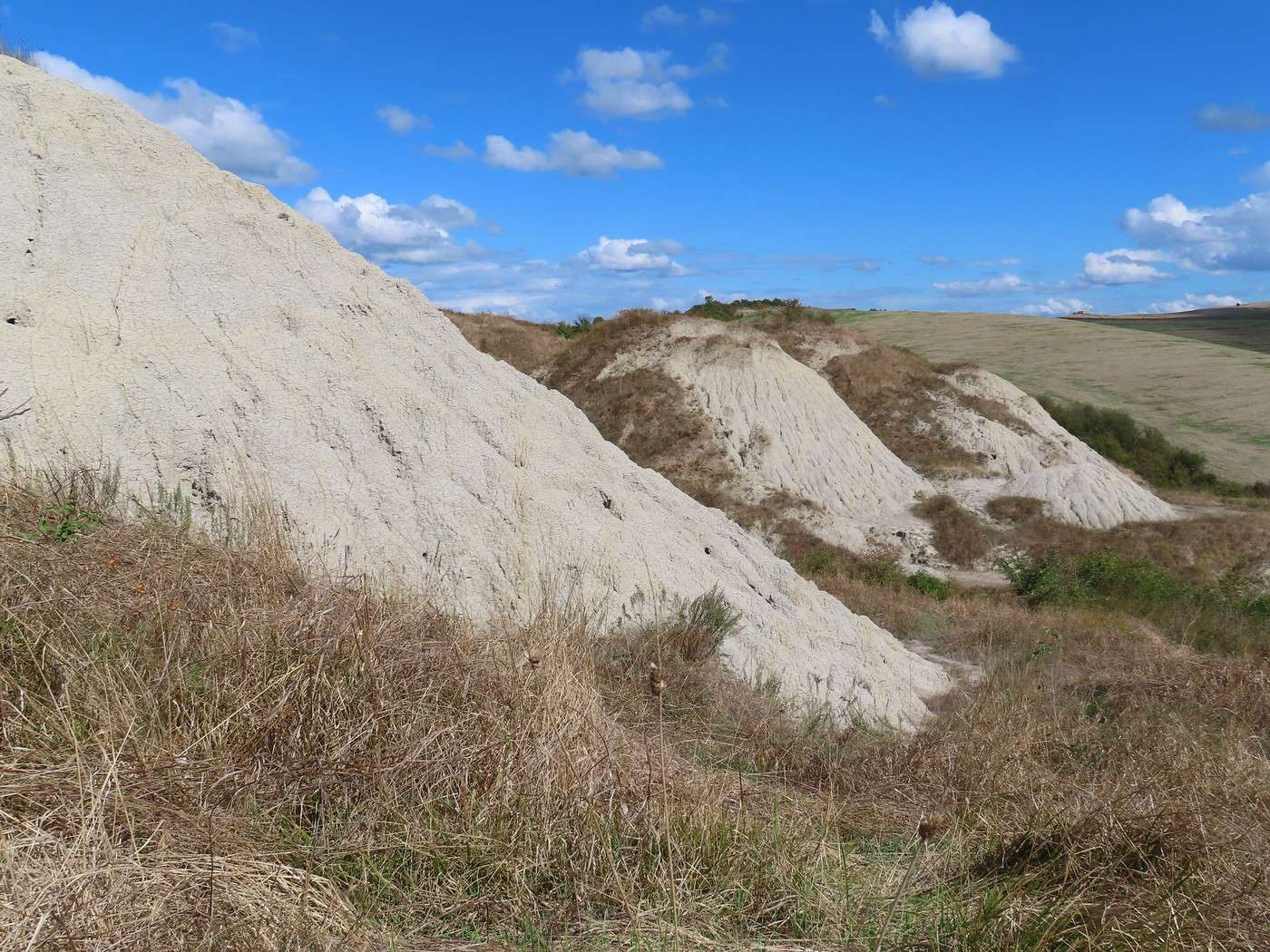
The return (the hike is a loop) crosses the area of the "biancane."
From the "biancane," you can see, in a line, the small pond and the village of Mucigliani.
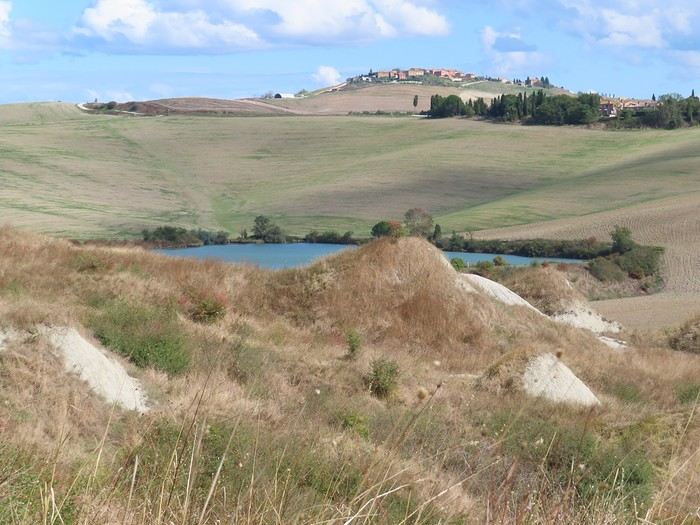
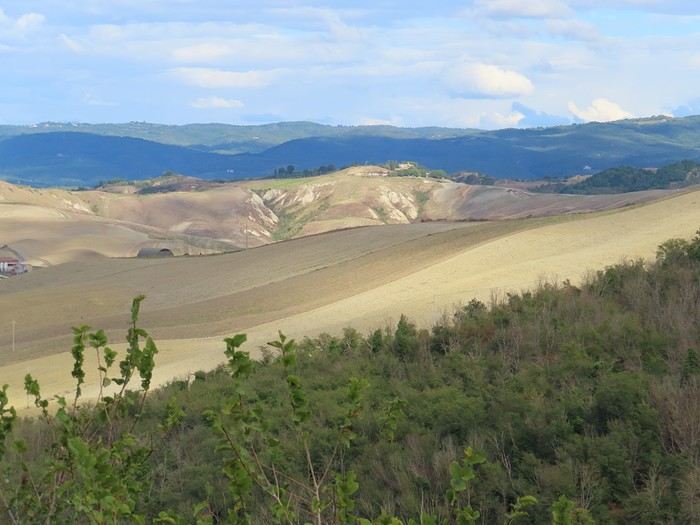
Once the hike was over, as soon as I drove off, the road climbed, and the panorama included the "strada bianca" leading to Leonina as well as the "biancane." Looking at the line of hills in the distance, you can immediately tell that this background isn’t part of the "crete senesi" (Sienese clay hills).
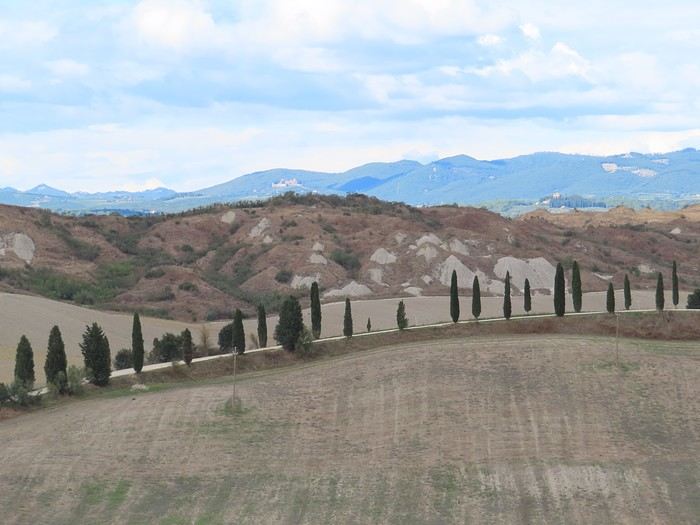
A little further on, from the roadside, a ray of sunshine on the "crete senesi."
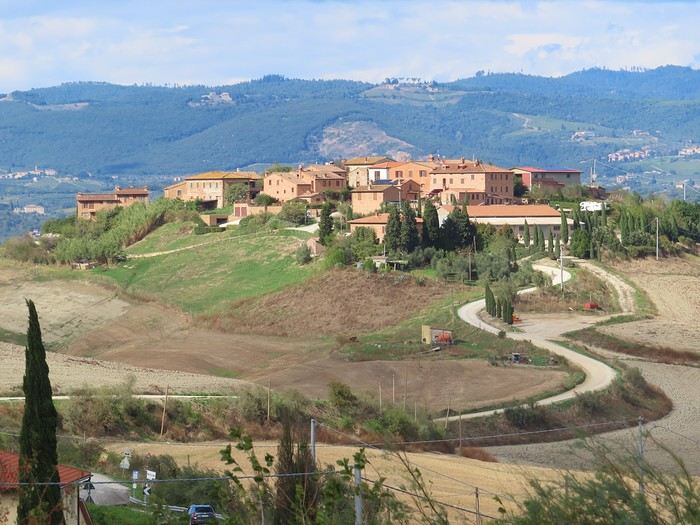
A few more kilometers, and a small road leads to Mucigliani from the SP438 (road access to the village).
I arrived on the map at the point marked SP438. From there, I head toward Monteroni d'Arbia: the route is on a dirt road (strada bianca) passing through the village of San Martino in Grania. On this dirt road, I’ll cross paths with several cyclists (there are more here than on a regular road), which leads me to the following digression after doing some research. An annual cyclotourist event takes place near Siena called EROICA (start in Gaiole in Chianti). It’s a "vintage" race with several routes (distances) using as many "strade bianche" as possible. Associations have been created to preserve these roads, which have heritage value (keeping them unpaved). There are such dirt sections in Chianti, in the "Crete Senesi," in the Val di Merse, and in the Val d'Orcia. The approach is reminiscent of preserving cobblestone sectors in northern France. Early in the cycling season (before Milan-San Remo), the "Strade Bianche" race takes place on these roads around Siena, finishing in Piazza del Campo. It’s a road race where part of it (the decisive part) doesn’t take place on asphalt... which brings to mind Paris-Roubaix. The rest is different: no cobblestones but "strade bianche" (over 70 km), no flat terrain but continuous elevation changes with constant ups and downs. The San Martino in Grania section is one of the longest and toughest in the race. End of digression.
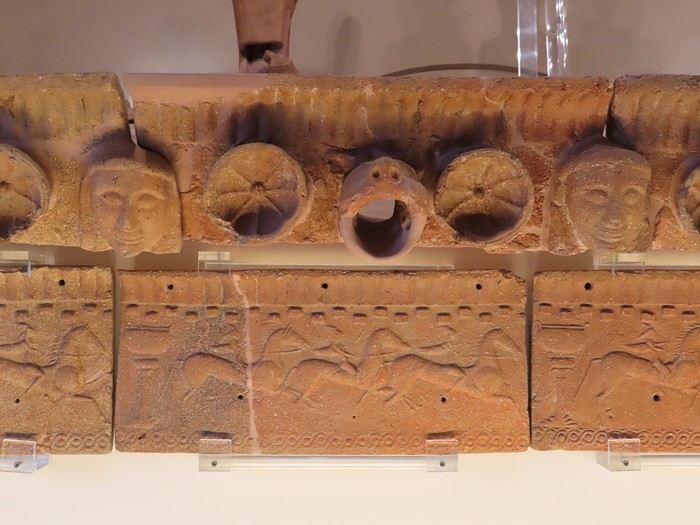
After Monteroni d'Arbia, I go to Murlo. Many Etruscan remains (archaeological site) have been found there and gathered in an antiquarium-museum housed in the former episcopal palace. Here’s the reconstruction of a roof edge. The pieces at the top, with gargoyles and human-headed antefixes, protect the wooden beams from water. The terracotta pieces at the bottom serve a decorative function; they’re arranged repetitively to form a frieze. There are several models, including a horse race (below).
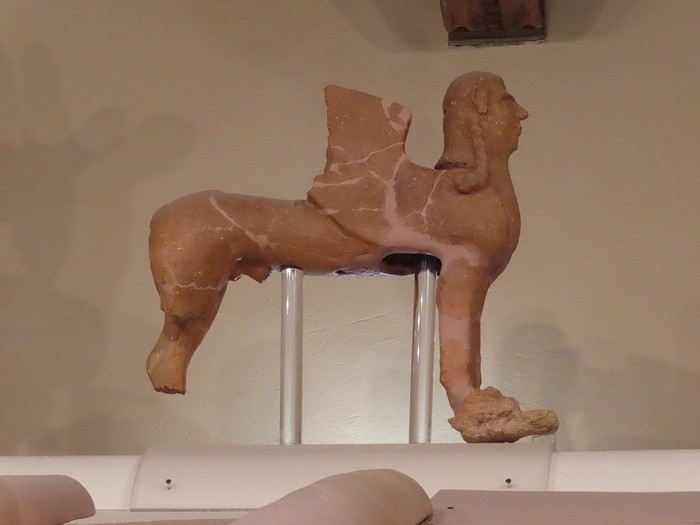
You can also find terracotta statues, like this sphinx placed on the reconstruction where it would have been in ancient times—on the roof ridge.
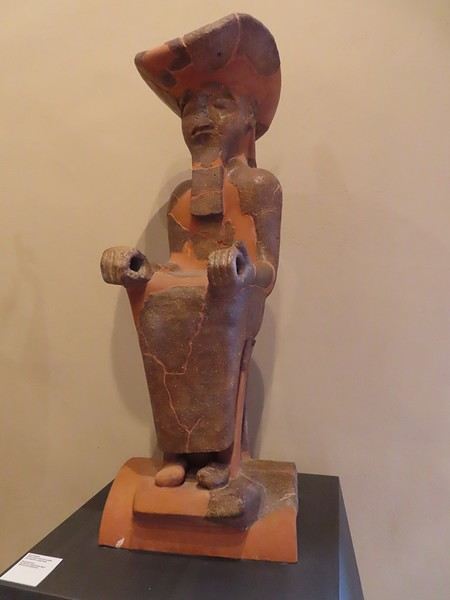
And to finish, here’s Murlo’s most famous statue: the "Cappellone," a seated man with a trimmed beard and a wide-brimmed hat. Imagination has led some to call him the "Cowboy of Murlo," while others see a sombrero in his hat. His position was likely on the roof ridge, like the sphinx.
The return to Sovicille is partly on "strade bianche" this time located in the Val di Merse (section Murlo-Radi, then another after Ville di Corsano). Google didn’t let me return (virtually) to Sovicille—the maximum number of intermediate stops for the route had been reached.
From the "biancane," you can see, in a line, the small pond and the village of Mucigliani.
Once the hike was over, as soon as I drove off, the road climbed, and the panorama included the "strada bianca" leading to Leonina as well as the "biancane." Looking at the line of hills in the distance, you can immediately tell that this background isn’t part of the "crete senesi" (Sienese clay hills).
A little further on, from the roadside, a ray of sunshine on the "crete senesi."
A few more kilometers, and a small road leads to Mucigliani from the SP438 (road access to the village).
I arrived on the map at the point marked SP438. From there, I head toward Monteroni d'Arbia: the route is on a dirt road (strada bianca) passing through the village of San Martino in Grania. On this dirt road, I’ll cross paths with several cyclists (there are more here than on a regular road), which leads me to the following digression after doing some research. An annual cyclotourist event takes place near Siena called EROICA (start in Gaiole in Chianti). It’s a "vintage" race with several routes (distances) using as many "strade bianche" as possible. Associations have been created to preserve these roads, which have heritage value (keeping them unpaved). There are such dirt sections in Chianti, in the "Crete Senesi," in the Val di Merse, and in the Val d'Orcia. The approach is reminiscent of preserving cobblestone sectors in northern France. Early in the cycling season (before Milan-San Remo), the "Strade Bianche" race takes place on these roads around Siena, finishing in Piazza del Campo. It’s a road race where part of it (the decisive part) doesn’t take place on asphalt... which brings to mind Paris-Roubaix. The rest is different: no cobblestones but "strade bianche" (over 70 km), no flat terrain but continuous elevation changes with constant ups and downs. The San Martino in Grania section is one of the longest and toughest in the race. End of digression.
After Monteroni d'Arbia, I go to Murlo. Many Etruscan remains (archaeological site) have been found there and gathered in an antiquarium-museum housed in the former episcopal palace. Here’s the reconstruction of a roof edge. The pieces at the top, with gargoyles and human-headed antefixes, protect the wooden beams from water. The terracotta pieces at the bottom serve a decorative function; they’re arranged repetitively to form a frieze. There are several models, including a horse race (below).
You can also find terracotta statues, like this sphinx placed on the reconstruction where it would have been in ancient times—on the roof ridge.
And to finish, here’s Murlo’s most famous statue: the "Cappellone," a seated man with a trimmed beard and a wide-brimmed hat. Imagination has led some to call him the "Cowboy of Murlo," while others see a sombrero in his hat. His position was likely on the roof ridge, like the sphinx.
The return to Sovicille is partly on "strade bianche" this time located in the Val di Merse (section Murlo-Radi, then another after Ville di Corsano). Google didn’t let me return (virtually) to Sovicille—the maximum number of intermediate stops for the route had been reached.