

Re: From Southern Shikoku, between land and sea, to the blue waters of Miyakojima and finally the megalopolis T
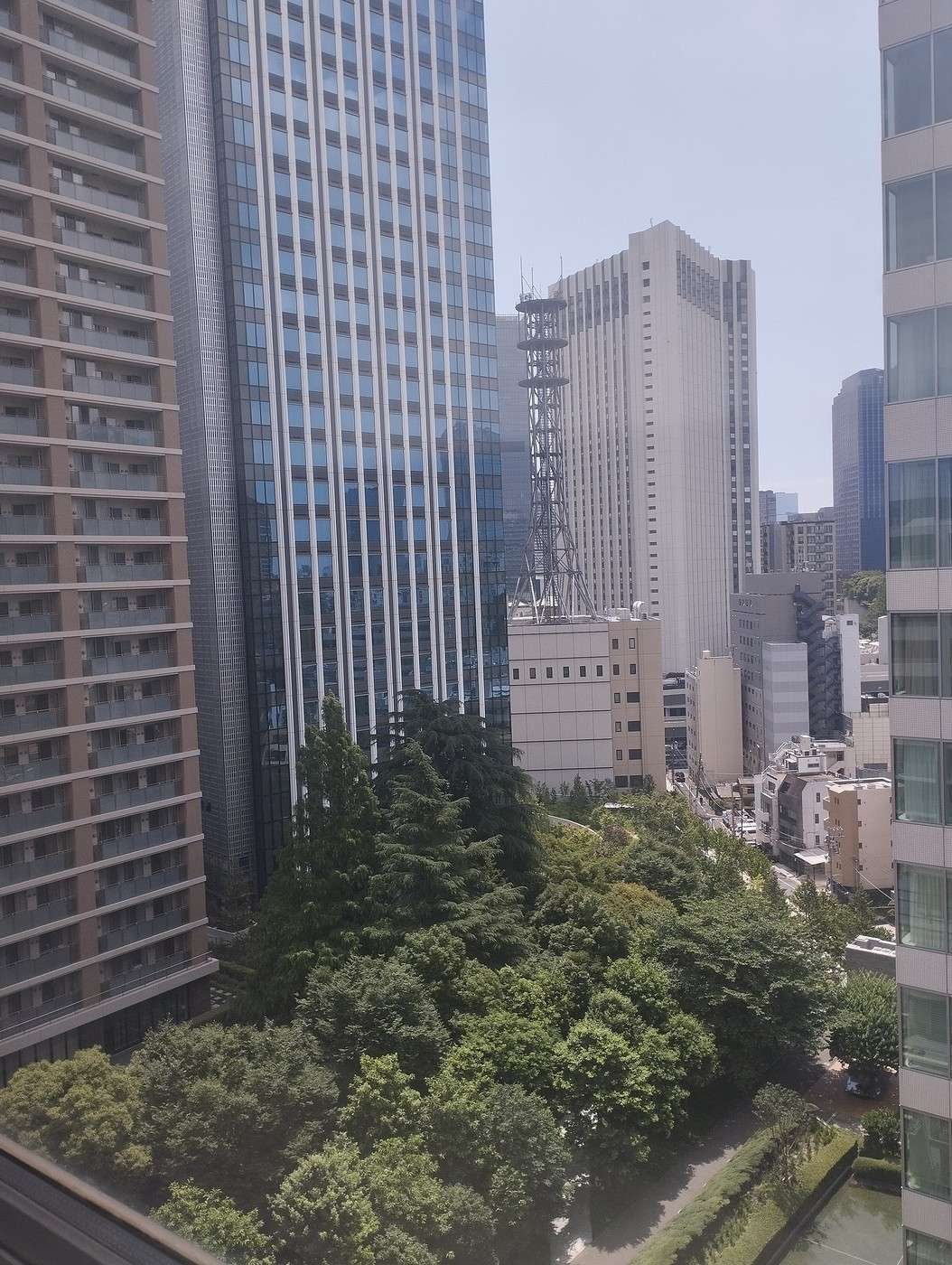
One of the pleasures of starting the day is opening the curtains to discover the environment surrounding our hotel room. Today, it’s a bright sun illuminating the tall Tokyo buildings in the neighborhood, with a small green park at their feet.
The day’s plan revolves around fixing my phone. The repair shop from yesterday pointed us to a store in Shimbashi, so we decide to take a stroll through the area before walking there. But first, Mr. is eager to return to a sushi restaurant that’s part of a chain—meaning there are several locations in the capital, but they’re all well-made. For those who haven’t read the previous travel journals, we learned about this place from a chance encounter with people from Osaka during our trip two years ago. This will be our brunch. The long-awaited return to Sushi no Midori!
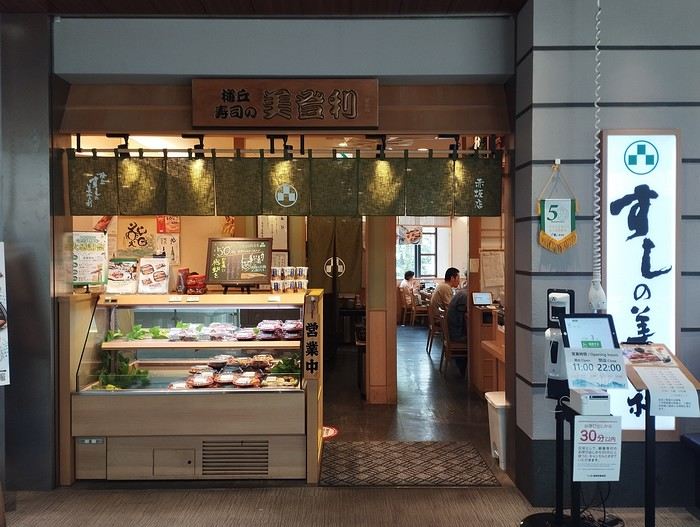
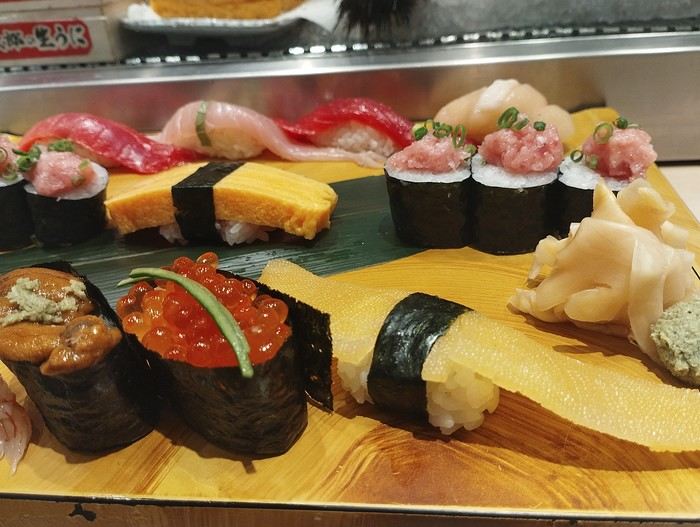
When we arrive, we notice the queue management system has changed. Now, you have to take a ticket with a number. It’s early, so there aren’t many numbers ahead of ours. Our turn comes, and we’re seated at the bar. It’s a different vibe from the dining room. In a sushi restaurant, eating at the bar feels much more immersive, even though here, the chefs are elevated above the customers, and we don’t see all the food prep in detail. For this meal, I try the tuna chirashi with their delicious chawanmushi—a savory egg custard with a light, eggy flavor, topped here with a small shrimp and a mushroom. I really love theirs because it’s rich and subtle while still being comforting. The chirashi is a bowl of rice topped with different types of raw tuna (lean and fatty) prepared in various ways. I really enjoyed the "whipped" tuna—it was very flavorful.
As for my partner, their excitement about returning here leads to ordering several dishes. The only issue is that the service is so efficient and quick that the dishes pile up on the small bar space. It gets to the point where it makes our Japanese neighbor and the chef serving us (there are several) smile. The chef even pats his stomach—I imagine to say "eat well!"
Well-fed, we start our walk toward a famous shrine in Akasaka, just a few minutes away on foot. We stroll through the sunlit buildings, some reflecting off others. Combined with the shrine and the many umbrellas being used as parasols, it feels like a welcome to modern Japan—a blend of tradition and modernity.
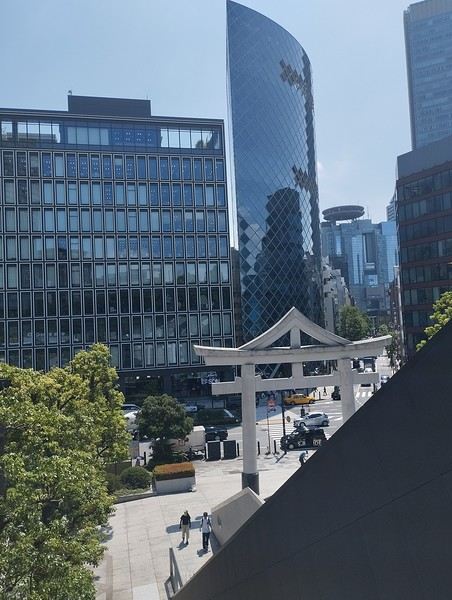
From the southern entrance of the shrine, under a large torii, we take the escalator up the hill to enjoy the view of the neighborhood. A sense of harmony emerges.
The shrine grounds aren’t particularly remarkable. You’ll find symbols of monkeys, as they’re considered divine messengers and guardians of the mountain—this shrine is linked to Mount Hiei near Kyoto. A ceremony is being prepared.
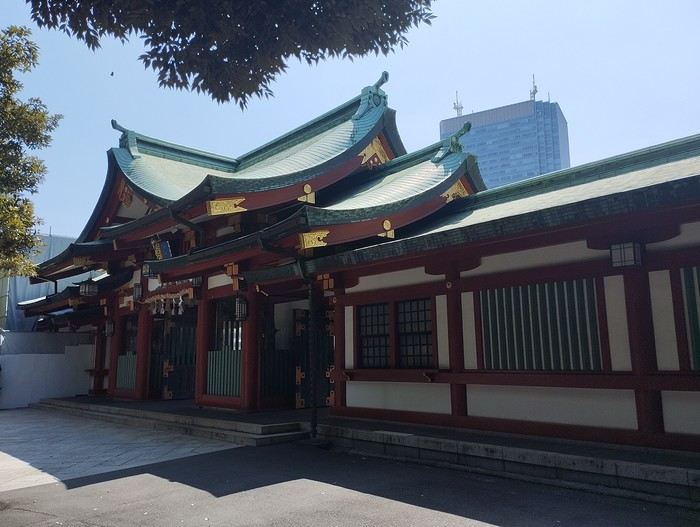
At the Yasaka Shrine within the grounds, worshippers quietly line up to pray for a happy marriage, a smooth birth, or to bless their children, while crows caw in the background.
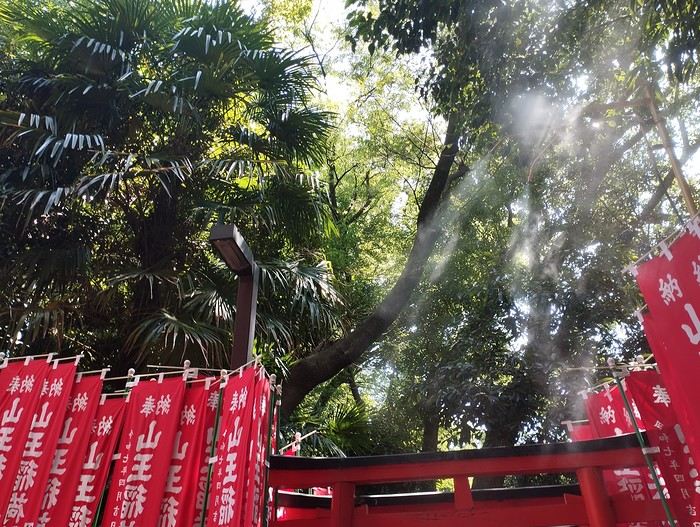
We end the visit by exiting on the west side, descending a narrow, charming alley of torii gates surrounded by greenery. It feels like a misty, exotic oasis.
With the heat bearing down on us, we decide to take the subway to Shimbashi.
The repair shop is in the New Shinbashi Building, a shopping center at the subway station. It’s a multi-story building filled with shops, bars, and restaurants, with a retro vibe. Some stores seem to have been there for ages. The building buzzes with as much life as the streets outside. What’s nice about retro places is that you can catch glimpses of life from the past, and there’s something reassuring about seeing things that stand the test of time. The store we’re looking for is on an upper floor. We take one of the elevators, but as usual, it doesn’t go to the exact floor we want. We have to stop at a lower floor but can’t find the next elevator, so we opt for the escalators—only to find that’s complicated too. That said, it gives us the chance to be invited into a massage parlor that seems to offer more than just massages. We decline and try to navigate this modern labyrinth. Eventually, somehow, we find a staircase and make it to the right floor, which is mostly empty, with a few scattered shops here and there in the hallways. We’re greeted by a young man who’s anything but welcoming. His voice is barely audible, and the exchange is as brief as can be. Still, I hand over my phone, and we’re told to come back in three hours to see if it’s fixable.
On our way down, before heading back outside, we stop at a fresh fruit juice shop we’d spotted earlier. It’s so hot that we’re craving cold drinks, so we each have two juices. We try kiwi, watermelon, and Japanese plum. So refreshing! You have to drink them standing at the tiny counter in the shop, making sure not to block the aisle.
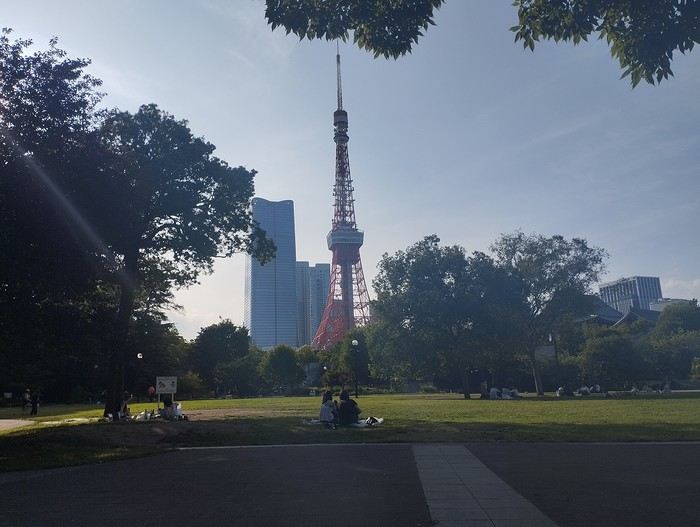
Since we have to come back in three hours, we decide to walk to Tokyo Tower. We cross through Shimbashi and reach Shiba Park, stopping at a konbini to buy cold water—the heat is making us thirsty. Shiba Park isn’t extraordinary, except for the great view of Tokyo Tower. It’s also a local hangout spot—residents relax with family or friends, have picnics, or take photos of the tower.
There are several spiritual sites in the park that we don’t visit, except for what’s visible while walking around. There’s the Tosho-gu Shrine and Zojo-ji Temple.
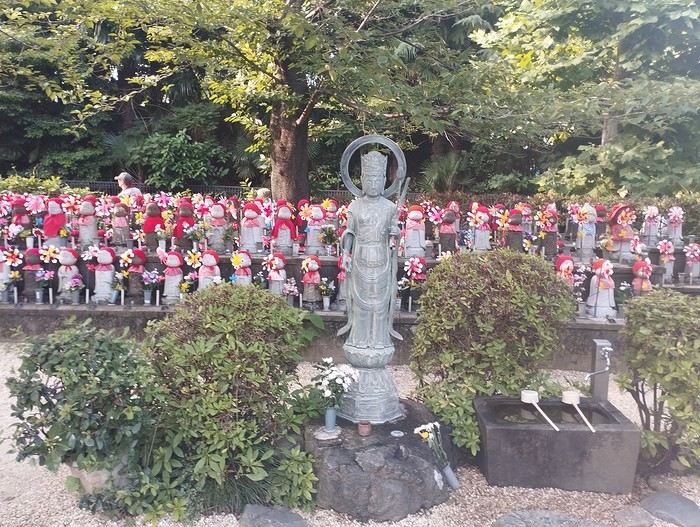
At the temple, there are over 400 small statues of Jizo, a bodhisattva who protects travelers, women, and children. He safeguards the souls of unborn children and those who died too young. Some of these statues are dressed in knitted clothes by grieving parents.
We then head back toward Shimbashi, stopping occasionally at konbinis to connect to the internet. We’re supposed to meet a French couple we met during our second trip, when we were in the wilds of northern Tohoku. They’re traveling in Japan around the same time as us for their honeymoon. Internet access is necessary for the logistics of this meet-up—where and when. Back at the phone repair shop, the lack of acknowledgment from the person who helped us three hours earlier is a bit shocking (not really, given their lack of engagement, but it’s not the usual Japanese service). He sees us but doesn’t assist us, leaving his colleague to handle us. In the end, nothing could be done, so we have to pay 3800 yen even though I’m not sure he spent more than five minutes on the phone. I’m disappointed and worried because the phone is new, and I wonder if it’ll still be fixable when I get back to France. The answer will be yes, and even the repair shop in France didn’t believe it—apparently, seawater usually doesn’t forgive. We leave the building again. The square is crowded. I get the impression there’s a political rally.
We decide to walk back to the hotel, which lets us cross another part of the city. This area is mostly made up of very tall buildings. Though it’s nice, the urban walk, the crowds, and the heat are tiring us out—especially since we’re walking briskly. We have a meet-up at 9 PM in Shibuya and want to drop off our things at the hotel first.
Back at the hotel, we freshen up, and then tonight’s meet-up gets canceled. She’s feeling sick and tired. They’re taking an early flight tomorrow. We still chat a bit on the phone, quickly catching up on our respective trips. We don’t feel like going far, so we decide to try a Vietnamese restaurant (we’re craving a change from Japanese food), but we have to hurry because it’s already 8 PM, and things get tricky at this hour. The Vietnamese place closes at 10 PM. The restaurant is in Roppongi, which we reach on foot.
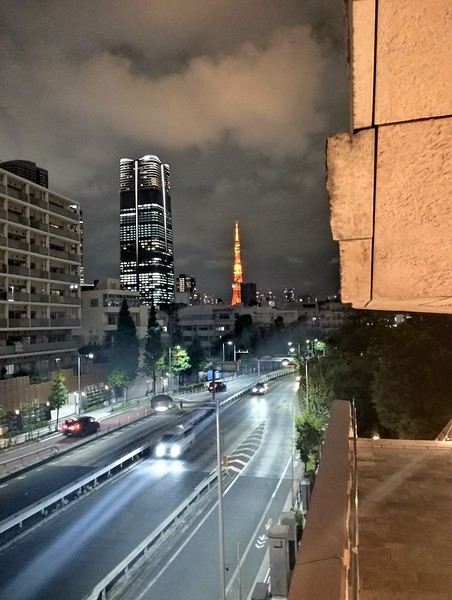
A little night view of Tokyo Tower as we arrive at Roppongi Hills.
We arrive at 8:40 PM, but they refuse to let us in because the kitchen closes at 8:30 PM—no negotiation possible. The other restaurants in the mall are also closing. The surrounding area is full of party bars, which aren’t really our scene. We try several restaurants, but they all turn us away unless we’re just there to drink. We eventually give up and head back to the hotel, stopping at a konbini for fried chicken and cherry tomatoes. We eat in the room. End of this first day in Tokyo.
The day’s plan revolves around fixing my phone. The repair shop from yesterday pointed us to a store in Shimbashi, so we decide to take a stroll through the area before walking there. But first, Mr. is eager to return to a sushi restaurant that’s part of a chain—meaning there are several locations in the capital, but they’re all well-made. For those who haven’t read the previous travel journals, we learned about this place from a chance encounter with people from Osaka during our trip two years ago. This will be our brunch. The long-awaited return to Sushi no Midori!
When we arrive, we notice the queue management system has changed. Now, you have to take a ticket with a number. It’s early, so there aren’t many numbers ahead of ours. Our turn comes, and we’re seated at the bar. It’s a different vibe from the dining room. In a sushi restaurant, eating at the bar feels much more immersive, even though here, the chefs are elevated above the customers, and we don’t see all the food prep in detail. For this meal, I try the tuna chirashi with their delicious chawanmushi—a savory egg custard with a light, eggy flavor, topped here with a small shrimp and a mushroom. I really love theirs because it’s rich and subtle while still being comforting. The chirashi is a bowl of rice topped with different types of raw tuna (lean and fatty) prepared in various ways. I really enjoyed the "whipped" tuna—it was very flavorful.
As for my partner, their excitement about returning here leads to ordering several dishes. The only issue is that the service is so efficient and quick that the dishes pile up on the small bar space. It gets to the point where it makes our Japanese neighbor and the chef serving us (there are several) smile. The chef even pats his stomach—I imagine to say "eat well!"
Well-fed, we start our walk toward a famous shrine in Akasaka, just a few minutes away on foot. We stroll through the sunlit buildings, some reflecting off others. Combined with the shrine and the many umbrellas being used as parasols, it feels like a welcome to modern Japan—a blend of tradition and modernity.
From the southern entrance of the shrine, under a large torii, we take the escalator up the hill to enjoy the view of the neighborhood. A sense of harmony emerges.
The shrine grounds aren’t particularly remarkable. You’ll find symbols of monkeys, as they’re considered divine messengers and guardians of the mountain—this shrine is linked to Mount Hiei near Kyoto. A ceremony is being prepared.
At the Yasaka Shrine within the grounds, worshippers quietly line up to pray for a happy marriage, a smooth birth, or to bless their children, while crows caw in the background.
We end the visit by exiting on the west side, descending a narrow, charming alley of torii gates surrounded by greenery. It feels like a misty, exotic oasis.
With the heat bearing down on us, we decide to take the subway to Shimbashi.
The repair shop is in the New Shinbashi Building, a shopping center at the subway station. It’s a multi-story building filled with shops, bars, and restaurants, with a retro vibe. Some stores seem to have been there for ages. The building buzzes with as much life as the streets outside. What’s nice about retro places is that you can catch glimpses of life from the past, and there’s something reassuring about seeing things that stand the test of time. The store we’re looking for is on an upper floor. We take one of the elevators, but as usual, it doesn’t go to the exact floor we want. We have to stop at a lower floor but can’t find the next elevator, so we opt for the escalators—only to find that’s complicated too. That said, it gives us the chance to be invited into a massage parlor that seems to offer more than just massages. We decline and try to navigate this modern labyrinth. Eventually, somehow, we find a staircase and make it to the right floor, which is mostly empty, with a few scattered shops here and there in the hallways. We’re greeted by a young man who’s anything but welcoming. His voice is barely audible, and the exchange is as brief as can be. Still, I hand over my phone, and we’re told to come back in three hours to see if it’s fixable.
On our way down, before heading back outside, we stop at a fresh fruit juice shop we’d spotted earlier. It’s so hot that we’re craving cold drinks, so we each have two juices. We try kiwi, watermelon, and Japanese plum. So refreshing! You have to drink them standing at the tiny counter in the shop, making sure not to block the aisle.
Since we have to come back in three hours, we decide to walk to Tokyo Tower. We cross through Shimbashi and reach Shiba Park, stopping at a konbini to buy cold water—the heat is making us thirsty. Shiba Park isn’t extraordinary, except for the great view of Tokyo Tower. It’s also a local hangout spot—residents relax with family or friends, have picnics, or take photos of the tower.
There are several spiritual sites in the park that we don’t visit, except for what’s visible while walking around. There’s the Tosho-gu Shrine and Zojo-ji Temple.
At the temple, there are over 400 small statues of Jizo, a bodhisattva who protects travelers, women, and children. He safeguards the souls of unborn children and those who died too young. Some of these statues are dressed in knitted clothes by grieving parents.
We then head back toward Shimbashi, stopping occasionally at konbinis to connect to the internet. We’re supposed to meet a French couple we met during our second trip, when we were in the wilds of northern Tohoku. They’re traveling in Japan around the same time as us for their honeymoon. Internet access is necessary for the logistics of this meet-up—where and when. Back at the phone repair shop, the lack of acknowledgment from the person who helped us three hours earlier is a bit shocking (not really, given their lack of engagement, but it’s not the usual Japanese service). He sees us but doesn’t assist us, leaving his colleague to handle us. In the end, nothing could be done, so we have to pay 3800 yen even though I’m not sure he spent more than five minutes on the phone. I’m disappointed and worried because the phone is new, and I wonder if it’ll still be fixable when I get back to France. The answer will be yes, and even the repair shop in France didn’t believe it—apparently, seawater usually doesn’t forgive. We leave the building again. The square is crowded. I get the impression there’s a political rally.
We decide to walk back to the hotel, which lets us cross another part of the city. This area is mostly made up of very tall buildings. Though it’s nice, the urban walk, the crowds, and the heat are tiring us out—especially since we’re walking briskly. We have a meet-up at 9 PM in Shibuya and want to drop off our things at the hotel first.
Back at the hotel, we freshen up, and then tonight’s meet-up gets canceled. She’s feeling sick and tired. They’re taking an early flight tomorrow. We still chat a bit on the phone, quickly catching up on our respective trips. We don’t feel like going far, so we decide to try a Vietnamese restaurant (we’re craving a change from Japanese food), but we have to hurry because it’s already 8 PM, and things get tricky at this hour. The Vietnamese place closes at 10 PM. The restaurant is in Roppongi, which we reach on foot.
A little night view of Tokyo Tower as we arrive at Roppongi Hills.
We arrive at 8:40 PM, but they refuse to let us in because the kitchen closes at 8:30 PM—no negotiation possible. The other restaurants in the mall are also closing. The surrounding area is full of party bars, which aren’t really our scene. We try several restaurants, but they all turn us away unless we’re just there to drink. We eventually give up and head back to the hotel, stopping at a konbini for fried chicken and cherry tomatoes. We eat in the room. End of this first day in Tokyo.