

Early in the evening, we’re still not hungry at all, and Magali really fancies a little hike while it’s still light out. She’d spotted one near the neighboring hamlet, just a kilometer above La Calera, El Guro. The site La Gomera Travel also tells me there’s a short walk through the terraced gardens that fill the middle of the valley. So we take the car, and on the way, we run into our Belgian friend again, still chatting with the villagers, all with a can of Dorada in hand. They ask if we’re enjoying La Gomera and recommend places to visit. The Belgian insists that the natural pool in Hermigua is a must-see, but one of his friends warns us it’s been closed for a while because it’s too dangerous.
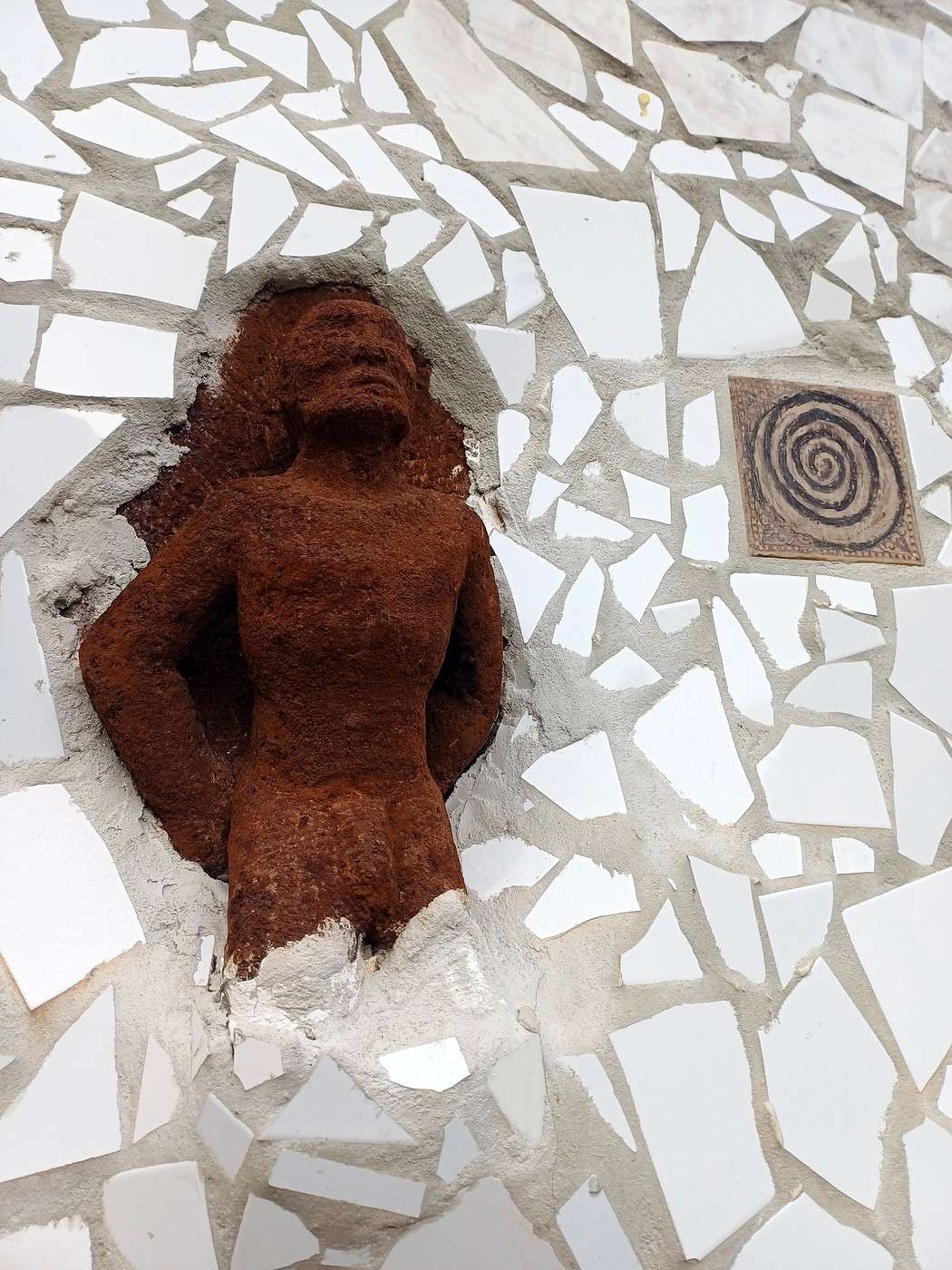
We park in El Guro five minutes later and look for the trail. They’re usually well-marked in La Gomera, and Magali finds one we start even though I’m not convinced it’s the one we’re looking for. It begins on a small path climbing toward the northern cliff, the one where our lodging is clinging below, the risco de la Mérica. We cross a strange little neighborhood in the middle of nature, seemingly completely deserted as we pass, made up of houses and surreal artworks partly crafted from natural elements of La Gomera. The names on the mailboxes and naturopathy signs leave no doubt: it’s a German hippie enclave! Totally unexpected in this somewhat wild spot.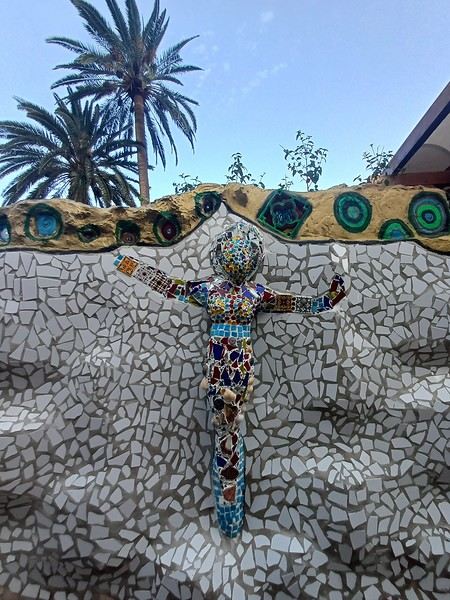
The path is discreetly marked and continues above terraced fields, along the base of the cliff dotted with caves where prickly pears, aloe vera, legions of palm trees, and many plants I can’t identify grow like weeds on prodigious basalt columns.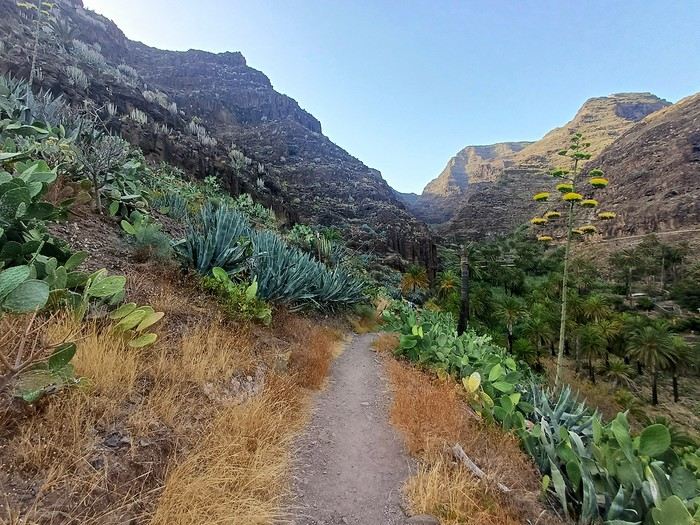
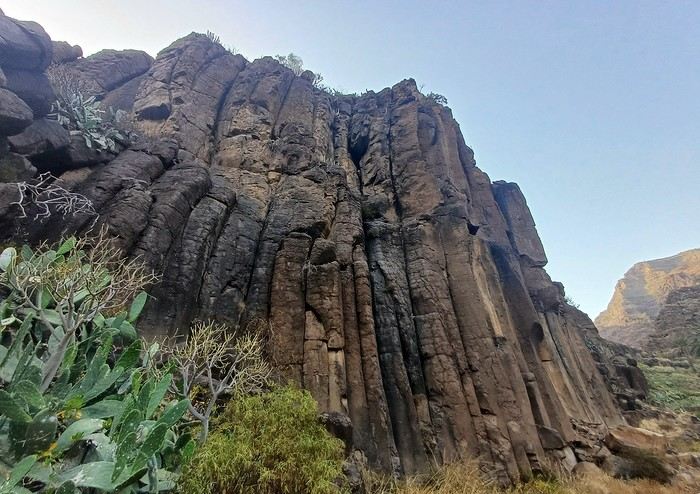 The colors of this vegetation and mineral environment create a truly unique harmony in the late afternoon light.
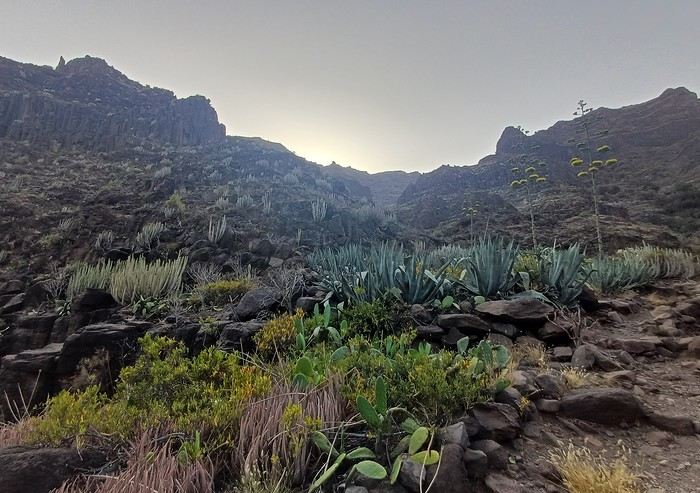
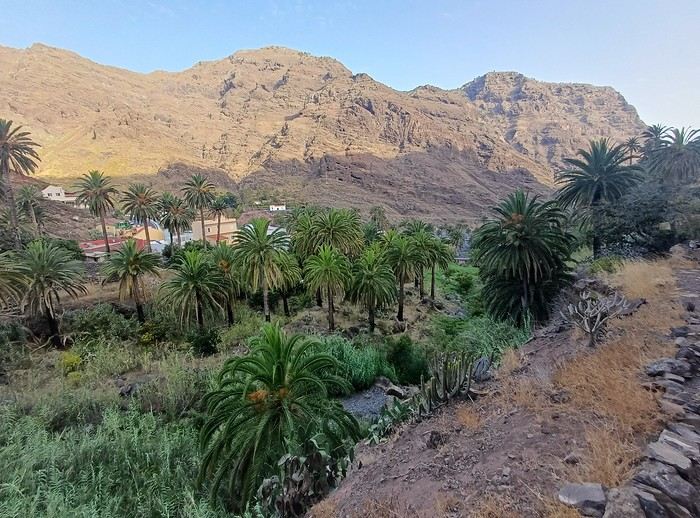 The trail then splits into what looks like a dried-up riverbed, which gives me a hunch—confirmed by Google Maps. While it had become clear we weren’t on the path to the jardines de los Reyes, we’re actually on the main hike through the barranco de Arure, this steep river we’re climbing in reverse since hikers usually start from the top! I’d read that it’s known to be quite difficult and not recommended with kids... and we’ve already covered more than half the walk. It seems pretty easy to us, though—maybe because at this time of year, there’s no river or waterfall. No matter, the nature is stunning, and we keep going until the light starts to fade, then turn back.
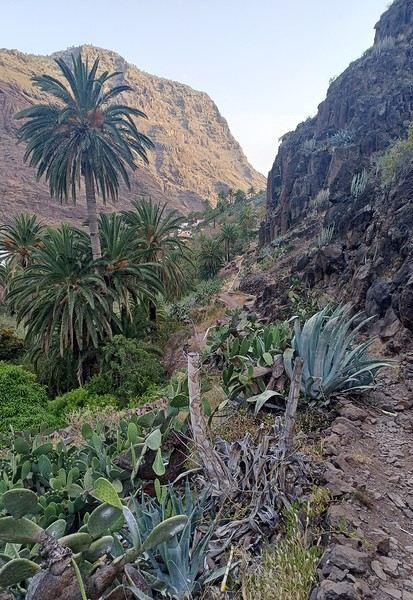
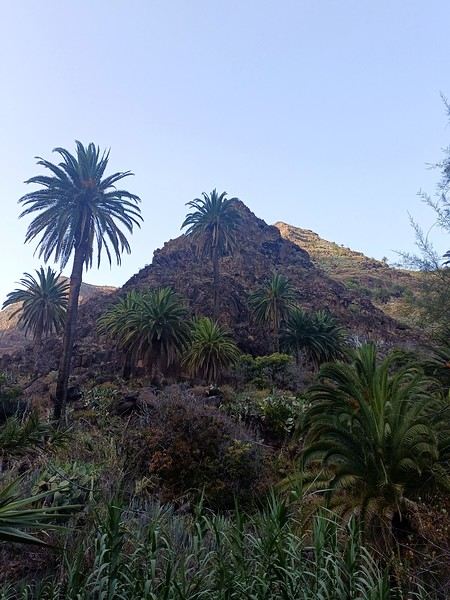 The sunset blows us away, lighting up a pyramid-shaped peak above the higher village of Arure with a golden glow, apparently along the impressive ridge of Lomo del Carretón.
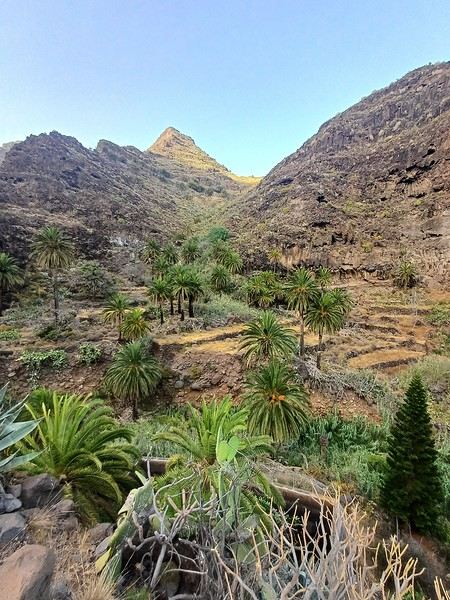
Later, we cross back through the quirky hippie enclave and reach the car after about an hour of walking total—pretty good for a 4-year-old!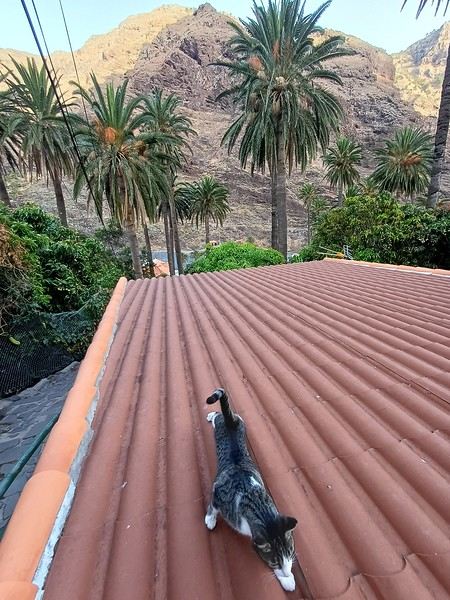
That evening, we’re back on the terrace for another feast of tapas and a variation of my garbanza with white beans. One great thing about La Gomera is there are no mosquitoes (at least not this season), so you can enjoy the outdoors freely or sleep without worrying about swatting your head or listening for the buzz of those vicious bloodsuckers.
Night has fallen, and under a beautiful full moon, I gaze again from the balcony at the mountain that’s been calling to me since we arrived yesterday. At one point, I hear that noise again—the one I’d mistaken for fighting cats the night before—but this time, it’s not subtle: there are lots of them, and they’re definitely not cats. I’ve never heard anything like it—a sound like a goblin at peak hysteria after eating magic mushrooms, screaming insults in a sped-up, high-pitched voice that multiplies! I try to figure out what it could be and where it’s coming from. It’s so inhuman that I first think it’s coming from a window below, someone playing a fantasy video game or mixing electronic sounds. It sets all the goats and dogs in the valley bleating and barking in a thunderous chorus. Is this normal? Then it gradually stops. I go inside to tell Magali. She heard the cries too, finding them at least strange, though less impressive from indoors. We agree it might be birds, but what weird birds! I type something like “scary bird calls La Gomera” into Google. A suspect emerges—I read a description, click on a photo, then a short video—it’s the culprit: the Calonectris diomedea. Behind this scientific name hides... the Cory’s shearwater. My god, what kind of bird makes such an awful noise!
Good night...
We park in El Guro five minutes later and look for the trail. They’re usually well-marked in La Gomera, and Magali finds one we start even though I’m not convinced it’s the one we’re looking for. It begins on a small path climbing toward the northern cliff, the one where our lodging is clinging below, the risco de la Mérica. We cross a strange little neighborhood in the middle of nature, seemingly completely deserted as we pass, made up of houses and surreal artworks partly crafted from natural elements of La Gomera. The names on the mailboxes and naturopathy signs leave no doubt: it’s a German hippie enclave! Totally unexpected in this somewhat wild spot.
The path is discreetly marked and continues above terraced fields, along the base of the cliff dotted with caves where prickly pears, aloe vera, legions of palm trees, and many plants I can’t identify grow like weeds on prodigious basalt columns.
Later, we cross back through the quirky hippie enclave and reach the car after about an hour of walking total—pretty good for a 4-year-old!
That evening, we’re back on the terrace for another feast of tapas and a variation of my garbanza with white beans. One great thing about La Gomera is there are no mosquitoes (at least not this season), so you can enjoy the outdoors freely or sleep without worrying about swatting your head or listening for the buzz of those vicious bloodsuckers.
Night has fallen, and under a beautiful full moon, I gaze again from the balcony at the mountain that’s been calling to me since we arrived yesterday. At one point, I hear that noise again—the one I’d mistaken for fighting cats the night before—but this time, it’s not subtle: there are lots of them, and they’re definitely not cats. I’ve never heard anything like it—a sound like a goblin at peak hysteria after eating magic mushrooms, screaming insults in a sped-up, high-pitched voice that multiplies! I try to figure out what it could be and where it’s coming from. It’s so inhuman that I first think it’s coming from a window below, someone playing a fantasy video game or mixing electronic sounds. It sets all the goats and dogs in the valley bleating and barking in a thunderous chorus. Is this normal? Then it gradually stops. I go inside to tell Magali. She heard the cries too, finding them at least strange, though less impressive from indoors. We agree it might be birds, but what weird birds! I type something like “scary bird calls La Gomera” into Google. A suspect emerges—I read a description, click on a photo, then a short video—it’s the culprit: the Calonectris diomedea. Behind this scientific name hides... the Cory’s shearwater. My god, what kind of bird makes such an awful noise!
Good night...