


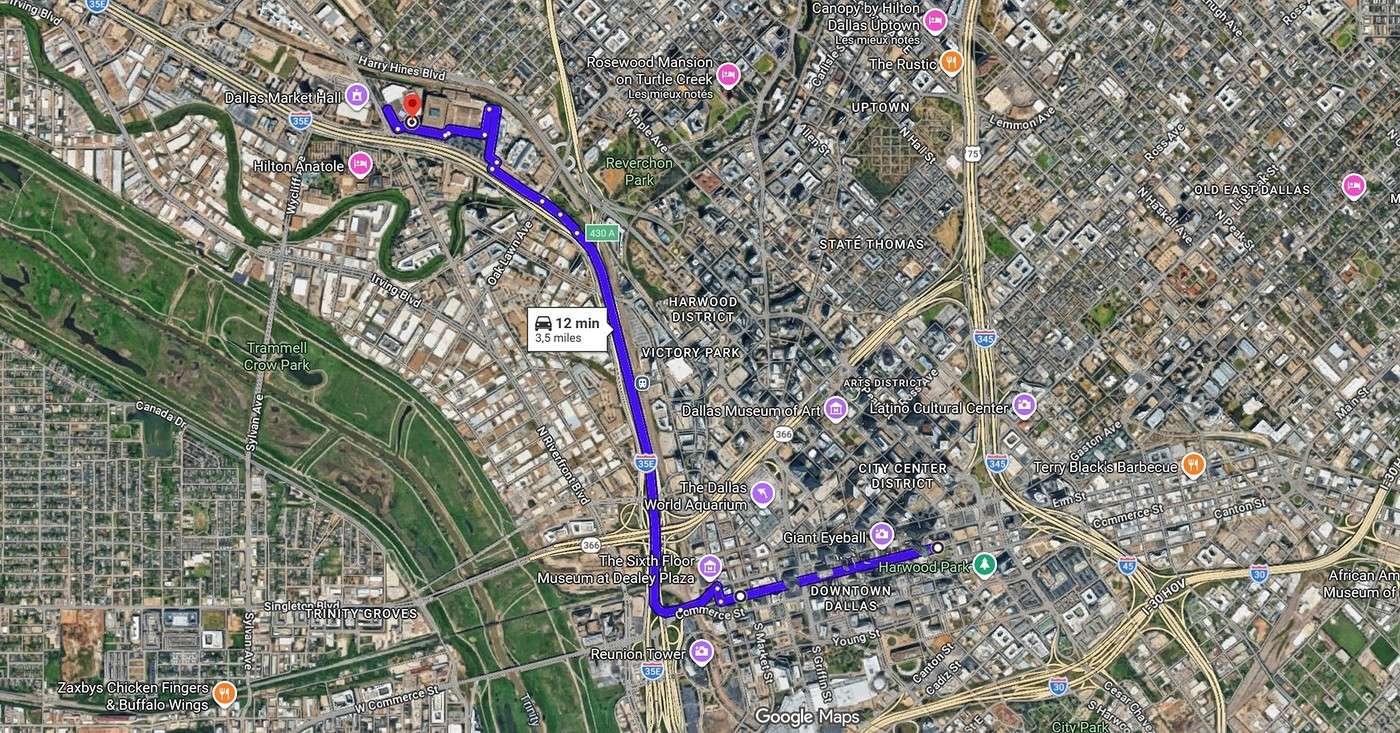
Second image: from Dealey Plaza to the Dallas Trade Mart
This second aerial photograph gives us a bit of perspective and helps better understand the geography of the area.
In the lower part of the image, you can see Dealey Plaza and the famous Sixth Floor Museum. Further to the northwest is the Dallas Market Center area, where President Kennedy was expected for an official luncheon and a speech at the Dallas Trade Mart.
Only a few kilometers separate the two locations. And yet!
To reach the Stemmons Freeway from Main Street, the presidential motorcade had to take a particularly restrictive route.
It was impossible to simply continue straight on Main Street to access the highway directly.
Instead, the motorcade had to turn right onto Houston Street, then make that infamous sharp left turn onto Elm Street.
And it was precisely at this spot that the motorcade would find itself in a highly vulnerable situation. An open-top limousine, a considerably reduced speed, and a building directly overlooking the president’s path.
A setup that, even today, leaves me baffled. Of course, it’s easy to rewrite history sixty years after the events. But having personally worked on security and risk management issues, I can’t help but look at this situation from that angle.
A route can perfectly meet traffic requirements while still presenting significant vulnerabilities in terms of protection.
And that’s exactly what strikes me here.
Was this route simply the most convenient, or had the risks it posed to the President of the United States truly been assessed? I don’t claim to rewrite the conclusions of the official investigations.
But one thing seems clear: the layout of the area and the slowdown imposed on the motorcade created particularly unfavorable conditions for its security.
And unfortunately, just a few seconds were enough to make Dealey Plaza go down in history.