

a Calera
This morning, we got up earlier because we planned to visit two coastal villages: Taguluche and Alojera. Though they’re only about ten kilometers north of Valle Gran Rey, they’re in the neighboring valley, Vallehermoso. And in Guanche language, “not in the same valley” means “a winding road three times longer.” So, the 10 kilometers turn into 30 kilometers and about an hour’s drive. The Guanche aborigines used to take shorter paths, cutting through the mountains via trails that still exist today, but they were on foot.
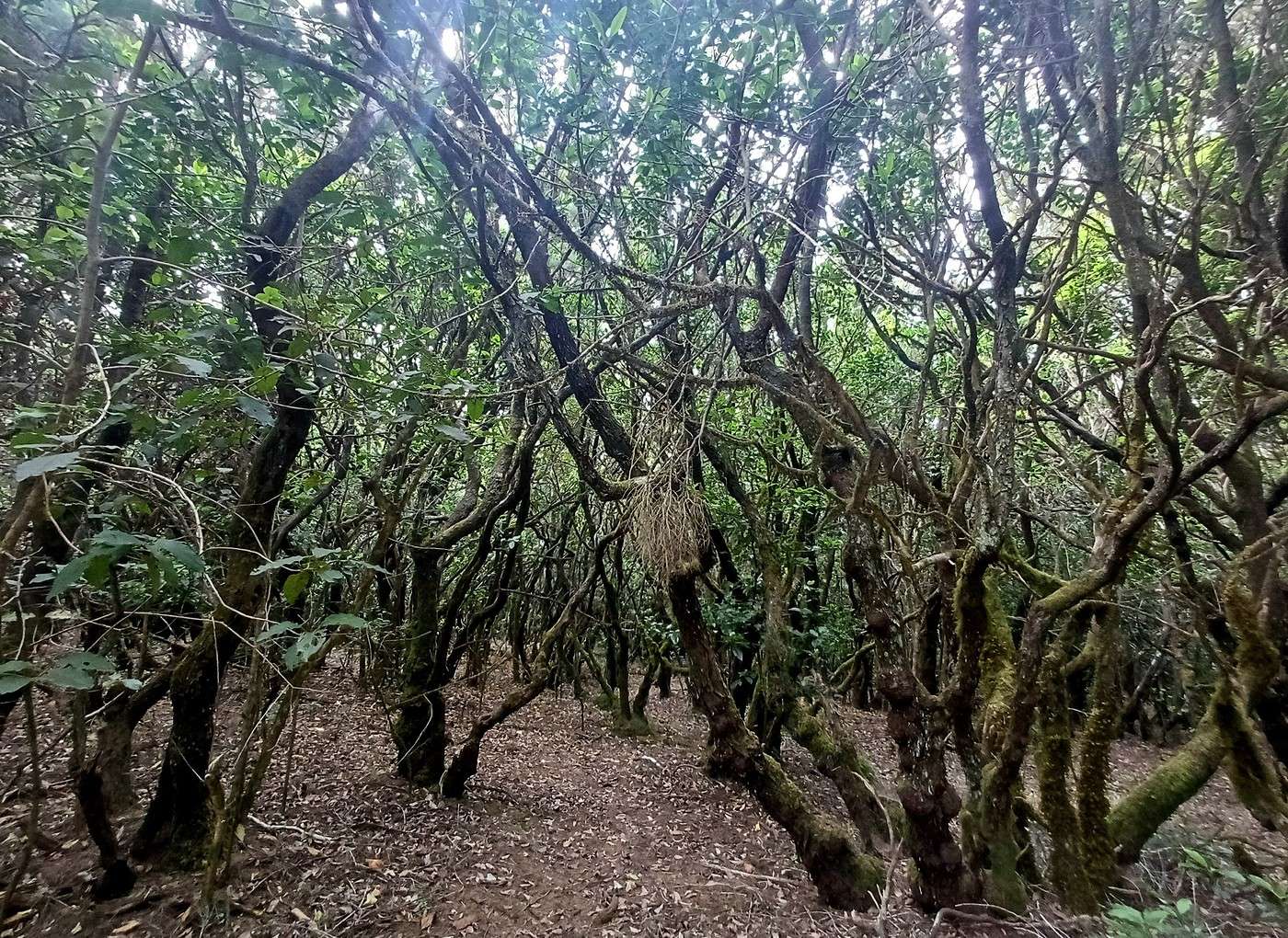
At 9:30 AM, we hit the road. The first part of the drive up to Arure, which sits high above the Valley of the Great King, is tough—even harder going up than coming down—and it’s becoming a habit. We’re starting to feel dizzy and nauseous, especially the kids. Luckily, the roadsides in La Gomera are dotted with trailheads, and we stop at one, the Los Baranquillos trail ("little ravines"). It’s very short, only about half an hour, but it’s just enough to stretch our legs and settle our stomachs. It stays close to the road but passes through a small patch of forest so typical of La Gomera. Then it leads to the Alojera viewpoint, where we’re greeted by a stunning, unobstructed view of Taguluche, Alojera, and the vast ocean.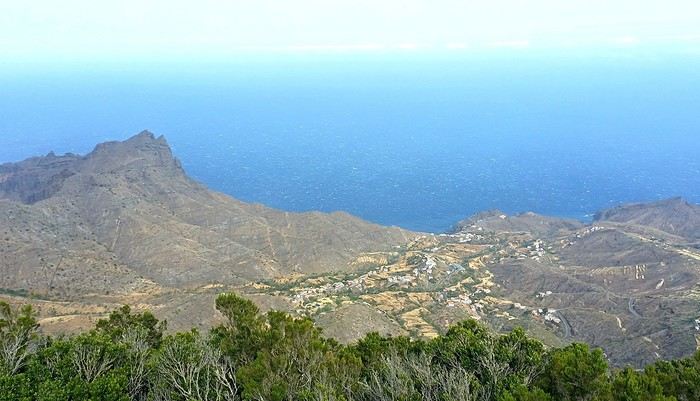
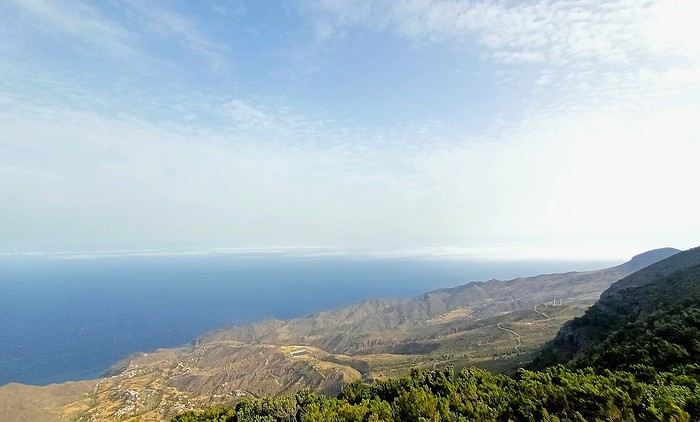 Back on the road, where we still barely see anyone. Before reaching Alojera, we have to turn onto a smaller road that winds steeply down toward Taguluche. Théo is still feeling sick, so we take another break at a breathtaking spot—a crevice in a canyon landscape with red peaks plunging down to Taguluche and the ocean: the Risco de Tejeleche. We recognize the peak from yesterday’s sunset hike in the Barranco de Arure, but from the other side. And to think it took us an hour when we’re just a few kilometers away! Anyway, there are so many jaw-dropping viewpoints that we could stop every five minutes. These necessary little breaks are always welcome.
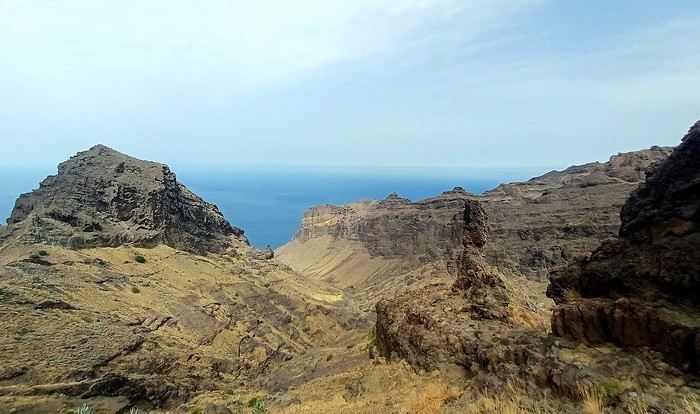
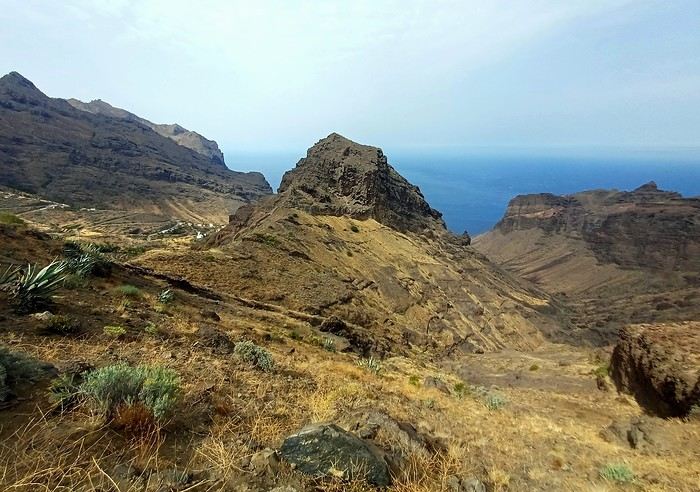 This time, we only have a few hundred meters left before finishing our descent into Taguluche. It’s not that there’s much to do here, but it’s described as a beautiful rural village full of palm trees where they produce La Gomera’s famous palm honey. There are also trails leading down to secluded beaches. The road splits into several paths, each leading to different parts of the village. We take one at random… which dead-ends. There’s no road left, just a dead end. But we don’t turn back because there’s a footpath leading down to the village. A group of Gomeran workers is repainting the village’s electrical cabin. We ask if we can park behind their truck. They remind us of the workers we saw when we first arrived on the island—with that mix of North African, Latin American, and Spanish features so common here—and they’re smiling, radiating a particularly welcoming vibe. After stopping a few meters later at a fig tree to stuff ourselves with its ripe fruit, we descend past a cluster of houses and small farms, passing chicken coops and hearing goats, but there’s not a single person in this village that looks abandoned—more like a hamlet clinging to the slope, with terraced fields that seem to cascade like lava into the ocean.
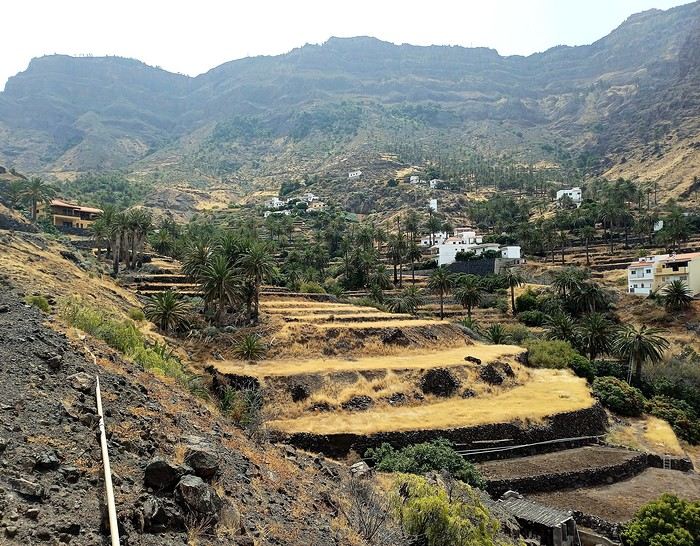
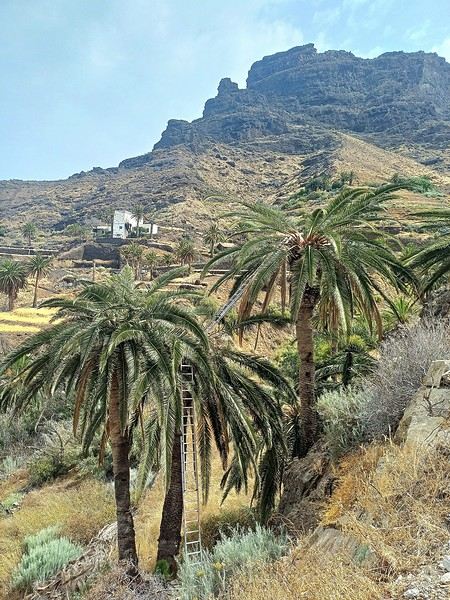
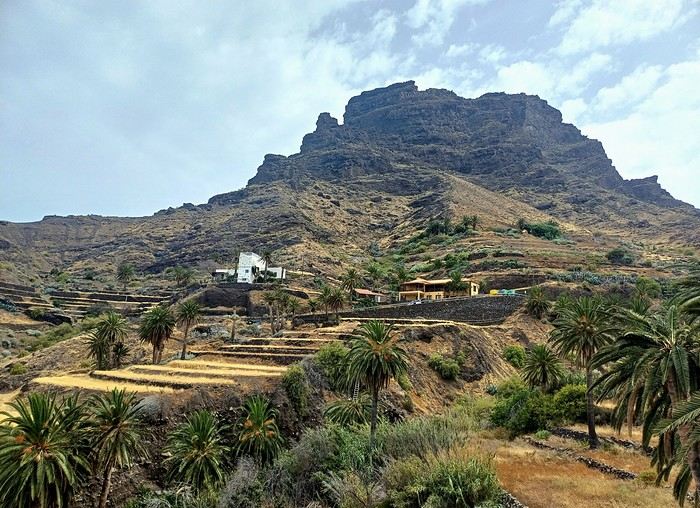 Sometimes, there are ladders leaning against palm trunks, a sign that people must be extracting sap from them.
 We also notice the irrigation pipes, ubiquitous in La Gomera, which channel water from upstream storage basins to the terraces—essential in summer when all the springs dry up.
We reach a point where several hikes are possible around the village. But at a bend in the road above, we spot the only bar-restaurant in Taguluche, aptly and simply named Bar Restaurante Taguluche. It’s not lunchtime yet, but a coffee and some refreshments wouldn’t hurt since it’s starting to get hot. Despite its isolation, it has a great reputation, and there’s never a fixed menu—you eat (very well) based on the owner’s inspiration, and the bill is calculated roughly. It’s the owner herself who welcomes us warmly, the first sign of human life in Taguluche. She’s sorry because there was just a power outage, and she doesn’t have much to offer. And there won’t be anything for lunch. The terrace has a magnificent view of the village and the ocean—it’s the perfect spot to enjoy the scenery while sipping our drinks. We pay the modest bill, and she tells us about the paved path that descends along the side of the village toward the secluded beach of Guariñén. We choose that over the Taguluche waterfall trail, which is dry like all the island’s waterfalls this season.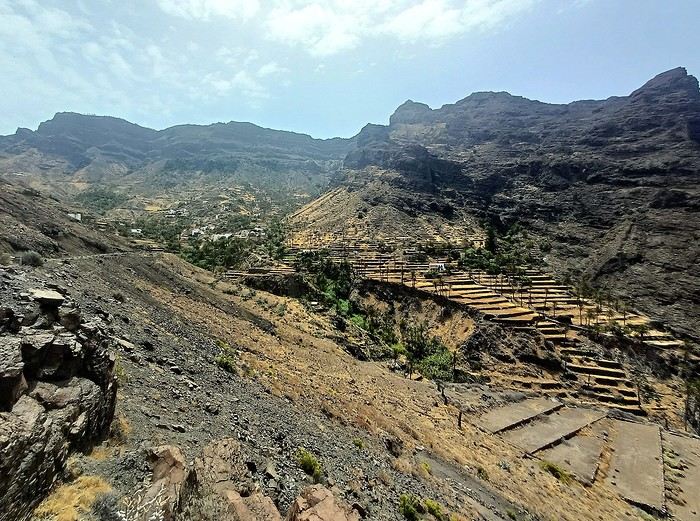
This morning, we got up earlier because we planned to visit two coastal villages: Taguluche and Alojera. Though they’re only about ten kilometers north of Valle Gran Rey, they’re in the neighboring valley, Vallehermoso. And in Guanche language, “not in the same valley” means “a winding road three times longer.” So, the 10 kilometers turn into 30 kilometers and about an hour’s drive. The Guanche aborigines used to take shorter paths, cutting through the mountains via trails that still exist today, but they were on foot.
At 9:30 AM, we hit the road. The first part of the drive up to Arure, which sits high above the Valley of the Great King, is tough—even harder going up than coming down—and it’s becoming a habit. We’re starting to feel dizzy and nauseous, especially the kids. Luckily, the roadsides in La Gomera are dotted with trailheads, and we stop at one, the Los Baranquillos trail ("little ravines"). It’s very short, only about half an hour, but it’s just enough to stretch our legs and settle our stomachs. It stays close to the road but passes through a small patch of forest so typical of La Gomera. Then it leads to the Alojera viewpoint, where we’re greeted by a stunning, unobstructed view of Taguluche, Alojera, and the vast ocean.
We also notice the irrigation pipes, ubiquitous in La Gomera, which channel water from upstream storage basins to the terraces—essential in summer when all the springs dry up.We reach a point where several hikes are possible around the village. But at a bend in the road above, we spot the only bar-restaurant in Taguluche, aptly and simply named Bar Restaurante Taguluche. It’s not lunchtime yet, but a coffee and some refreshments wouldn’t hurt since it’s starting to get hot. Despite its isolation, it has a great reputation, and there’s never a fixed menu—you eat (very well) based on the owner’s inspiration, and the bill is calculated roughly. It’s the owner herself who welcomes us warmly, the first sign of human life in Taguluche. She’s sorry because there was just a power outage, and she doesn’t have much to offer. And there won’t be anything for lunch. The terrace has a magnificent view of the village and the ocean—it’s the perfect spot to enjoy the scenery while sipping our drinks. We pay the modest bill, and she tells us about the paved path that descends along the side of the village toward the secluded beach of Guariñén. We choose that over the Taguluche waterfall trail, which is dry like all the island’s waterfalls this season.