

Re: From Southern Shikoku, between land and sea, to the blue waters of Miyakojima and finally the megalopolis T
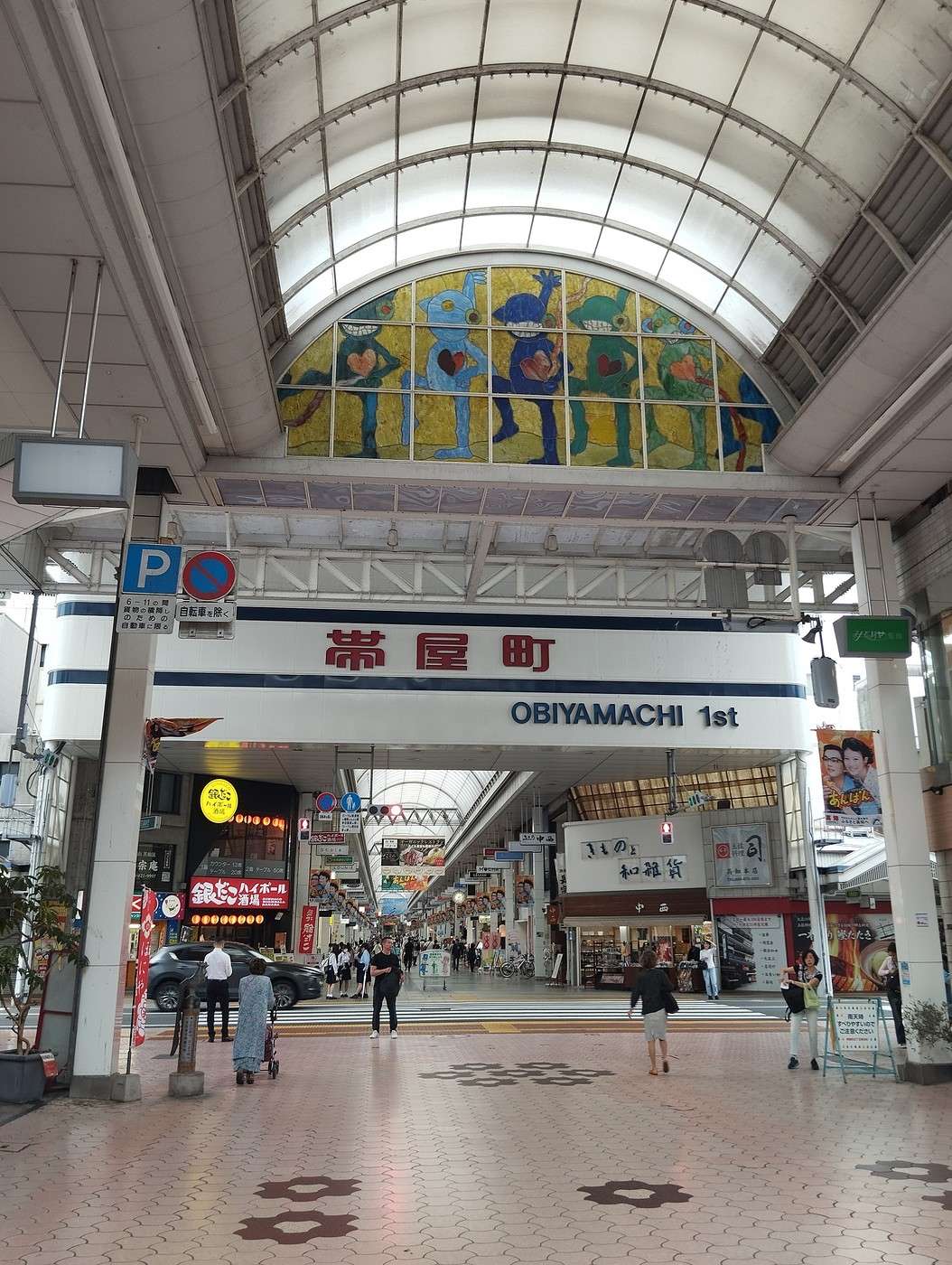
With our taste buds delighted and our bellies full from that simple but delicious meal, we continue our stroll by taking the shotengai (covered shopping arcade) Obiyamachi, located at the foot of Hirome Market. This is the longest shotengai in Kochi, stretching 650 meters. Wandering through it is really pleasant because the alley is wide, and above all, we’re charmed by its retro style and atmosphere. There are places where you instantly feel at ease—this shotengai is one of them.
Many of the shops have an "old-school" vibe, like the numerous clothing stores with styles geared toward "older folks." The same goes for the bridal shop selling kimonos. Despite that, you see all generations strolling around. The atmosphere is very laid-back.
Our senses are stimulated here—sight with the eye-catching, sometimes futuristic storefronts, or the deep violet flowers that catch my eye; smell with the sweet, warm scent wafting from the Mister Donut sign, which almost makes me want to try one even though I’m not a donut fan; and hearing with the music playing from the speakers or the special tunes at pedestrian crossings.
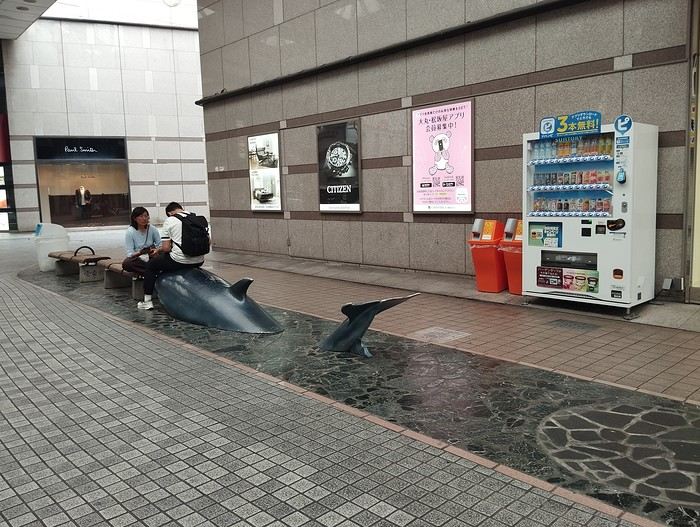
We even spotted a bench shaped like a whale—cetaceans that swim in the Pacific Ocean, both admired and fished here. There are restaurants serving whale meat and moray eel, but we didn’t have time to try them.
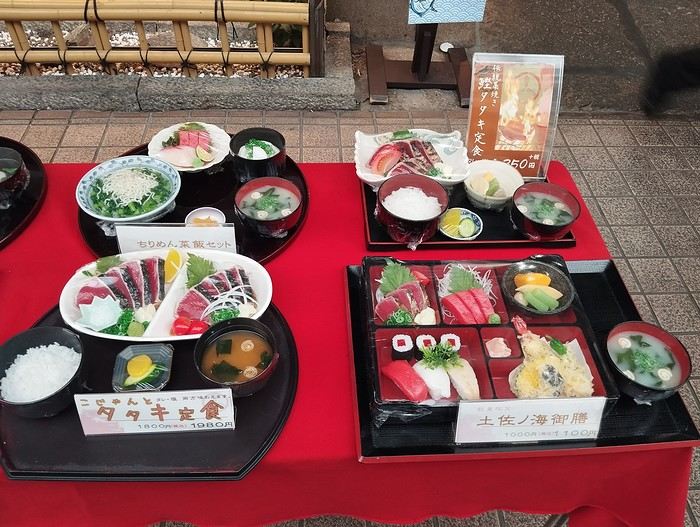
The space is so wide that one restaurant set up a table outside with several sampuru—fake food displays.
A square in the middle of this shopping arcade seems to be a local hangout spot. Artists, elderly folks on bikes grabbing coffee and chatting occupy the benches or the ground. In Kochi, it’s retro, as I mentioned—no flashiness like in Tokyo, but a mixed population where some signs of hardship seem to show, like the older men on bikes we pass by. Kochi feels like a place where life is good, human-scale, more rural, more working-class—the unfiltered side of Japanese life. At the end of the shotengai, almost opposite, there’s another shorter arcade with a beautiful wooden framework. Its aesthetic really draws the eye.
We would’ve liked to keep exploring, but we prefer to arrive a little early at the bus stop. Except we struggle to find the right one, so we walk from one stop to another, try asking a young teenager who doesn’t know, then a sign enlightens me—we’re not in the right place at all, and the bus is about to pass. Sure enough, we spot it, wave it down, but it doesn’t stop. If we miss this bus, we’re done for, so we start running as fast as we can. Luckily, a red light buys us some time, but it’s not over yet. I’m a bit out of breath, Mr. is ahead of me, and I tell him, "Don’t stop, keep going, I’m coming!" I run, and somehow—miraculously—we manage to hop on the bus just before it pulls away! That was a close one!! The seats are a welcome relief after that unexpected sprint. A little cardio never hurt anyone! We took the MY YU Bus line, which serves Kochi’s main tourist spots.
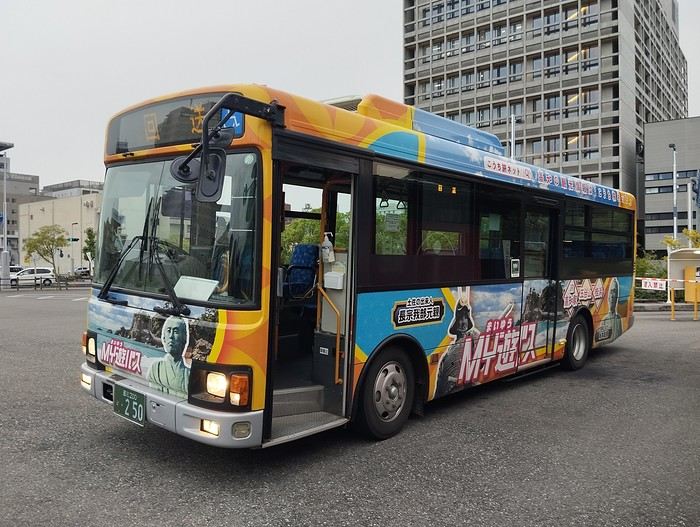
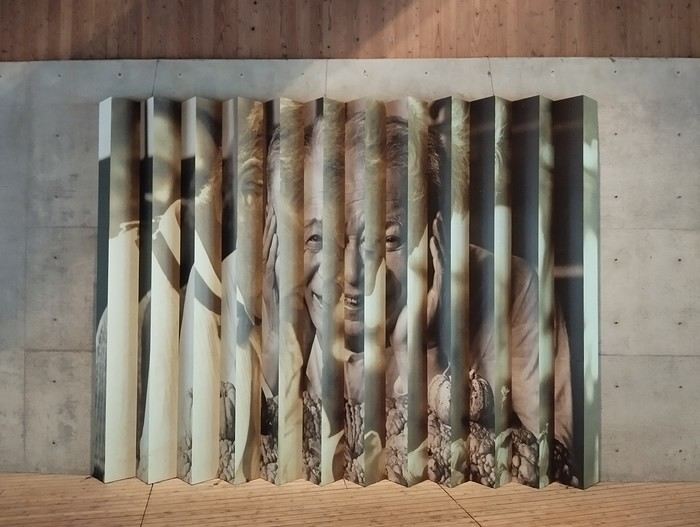
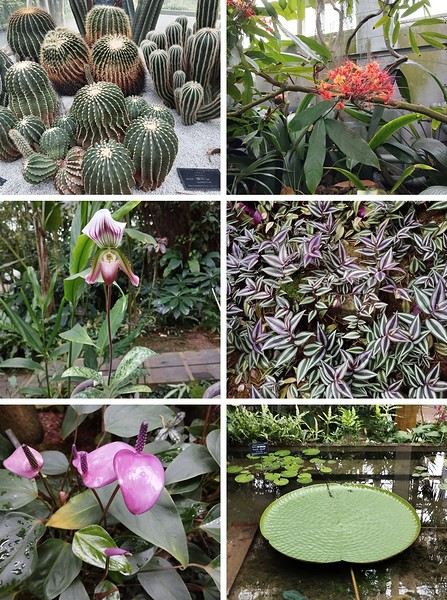
The bus crosses the city and quickly reaches a narrow, winding mountain road that plunges us into the heart of the forest. The road is flanked by mountains on both sides. For the latter, we only catch glimpses of the valley now and then since we’re climbing higher. Bathed in the green light of the trees, the bus takes us to our destination—the Makino Botanical Garden, located on Mount Godai. The site is vast, nearly 8 hectares, where you wander from path to path, leading sometimes to the medicinal plant area, sometimes to the glass tropical greenhouse. The species are well-labeled, and the place is really pleasant—especially since there aren’t many people left. The scientist, Dr. Makino, was the first Japanese person to give a scientific name to a new plant species.
During our self-guided tour, a young woman approaches us in Japanese to ask if there’s anything worth seeing where we came from. We answer as best we can, point her in the right direction, and part ways. A second later, she turns around and asks to take a photo with us to commemorate her solo trip—all with a sweet smile and contagious laughter.
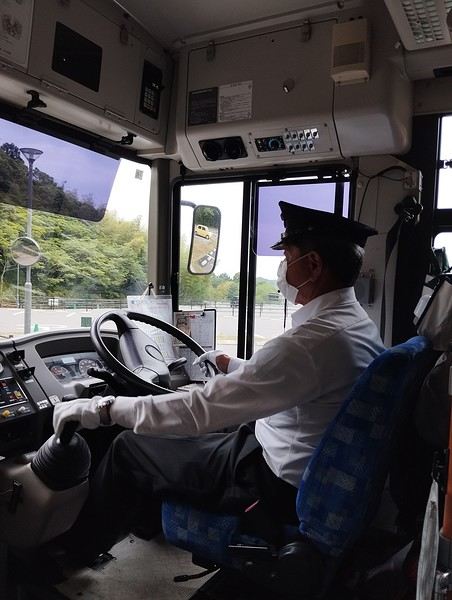
The garden is so big that we don’t have time to visit the café overlooking it because the garden closes. In Japan, many places close at 4:00 PM, 4:30 PM, or 5:00 PM—even in summer when it doesn’t get dark until 7:00 PM or 7:30 PM. We also don’t have time to visit Chikurinji Temple, right across from the garden. We just pass by while waiting for the bus—about 30 minutes. We won’t make it to Katsurahama Beach either because there wouldn’t be a bus back to the city center. I hesitated about renting a car starting today, and if I had to do it over, I’d rent one from the first day—it’s much less restrictive, I think. That said, I should mention that all these visits are doable by public transport, and they’re well-served, but having to watch the clock and wonder how much time you have to visit a place so you don’t miss your bus or the right connection is, for me, a source of stress on vacation. The bus arrives, and while the driver indicates his stop—there’s a sign for that—we get on.
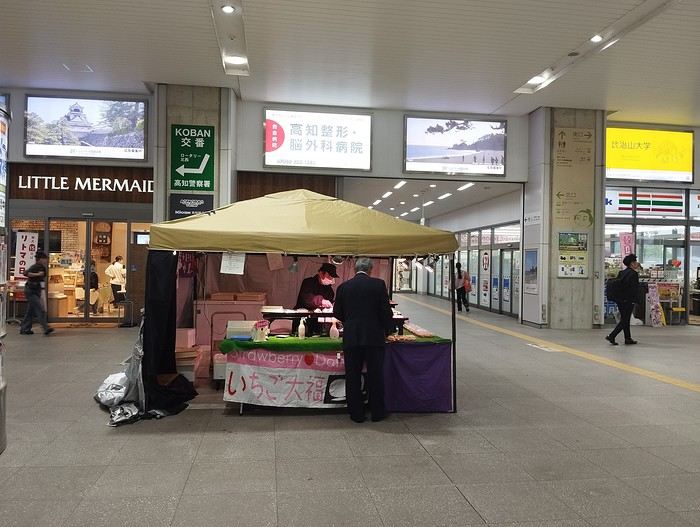
The return trip is the same in reverse. We get off at the terminus—Kochi Station. It’s a chance to see a bit more of the inside. There’s a konbini and food stalls, including Japanese pastries. The elderly man running the stall was already there this morning—you could say he works long hours.
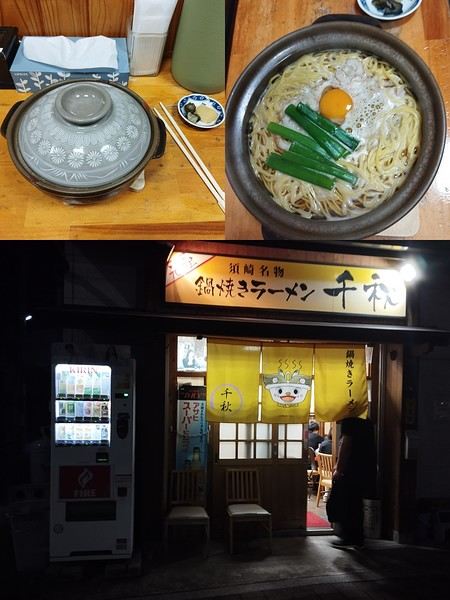
We have a ritual when we arrive in Japan—those who’ve read our previous travel journals know it—buying Japanese liposomal vitamin C. Usually, we find it in medical or dental clinics. But this time, the closest place is a beauty salon. We find it without trouble and spot the car rental agency for tomorrow morning. Arriving at the beauty salon called "La Chambre," located in a house, the esthetician is a bit surprised to see us. We explain why we’re there, and we’re allowed in. After the explanations and confirming our purchase, the owner arrives. Her employee introduces us, and we chat with the owner. The conversation then drifts to a few French words she knows (she’d been once) and the places we’re visiting on this trip. We even get a little gift—a storage box for the vitamins. Warm goodbyes, and we continue our quest for hydrogen water, spotting a drugstore—a huge pharmacy-like store. For the first time, we find water that might fit the bill, thanks to asking the staff. There are only 4 bottles left, and she apologizes because satisfying the customer is an unconditional rule. After these purchases, we head back to the hotel to relax a bit. We go out again to eat nearby at a restaurant serving another local specialty—nabeyaki ramen. It’s a ramen with a light chicken broth, egg, and raw onions, served in a clay pot to keep it hot. The restaurant was pretty basic, so the taste didn’t wow us. We should try another place next time. On the bright side, it was cheap—1500 yen for two, about 9.50 € for both of us.
Afterward, we take a walk to a supermarket—here, Food & Drug—which is often open until 9:00 PM or 10:00 PM, to grab some fresh fruit, water bottles, and cold green tea—essential for staying hydrated. On our way back to the hotel, while waiting at a pedestrian crossing, a woman who looked Japanese but apparently hadn’t lived in Japan approached us for directions. The exchange was a bit strange, even surreal—the lady was a bit peculiar, maybe even a little eccentric. We couldn’t help her since we weren’t from the area. We end the evening watching a bit of Japanese TV. I stumble upon a movie and catch a few words here and there.
To be continued, Day 2.
We even spotted a bench shaped like a whale—cetaceans that swim in the Pacific Ocean, both admired and fished here. There are restaurants serving whale meat and moray eel, but we didn’t have time to try them.
The space is so wide that one restaurant set up a table outside with several sampuru—fake food displays.
A square in the middle of this shopping arcade seems to be a local hangout spot. Artists, elderly folks on bikes grabbing coffee and chatting occupy the benches or the ground. In Kochi, it’s retro, as I mentioned—no flashiness like in Tokyo, but a mixed population where some signs of hardship seem to show, like the older men on bikes we pass by. Kochi feels like a place where life is good, human-scale, more rural, more working-class—the unfiltered side of Japanese life. At the end of the shotengai, almost opposite, there’s another shorter arcade with a beautiful wooden framework. Its aesthetic really draws the eye.
We would’ve liked to keep exploring, but we prefer to arrive a little early at the bus stop. Except we struggle to find the right one, so we walk from one stop to another, try asking a young teenager who doesn’t know, then a sign enlightens me—we’re not in the right place at all, and the bus is about to pass. Sure enough, we spot it, wave it down, but it doesn’t stop. If we miss this bus, we’re done for, so we start running as fast as we can. Luckily, a red light buys us some time, but it’s not over yet. I’m a bit out of breath, Mr. is ahead of me, and I tell him, "Don’t stop, keep going, I’m coming!" I run, and somehow—miraculously—we manage to hop on the bus just before it pulls away! That was a close one!! The seats are a welcome relief after that unexpected sprint. A little cardio never hurt anyone! We took the MY YU Bus line, which serves Kochi’s main tourist spots.
The bus crosses the city and quickly reaches a narrow, winding mountain road that plunges us into the heart of the forest. The road is flanked by mountains on both sides. For the latter, we only catch glimpses of the valley now and then since we’re climbing higher. Bathed in the green light of the trees, the bus takes us to our destination—the Makino Botanical Garden, located on Mount Godai. The site is vast, nearly 8 hectares, where you wander from path to path, leading sometimes to the medicinal plant area, sometimes to the glass tropical greenhouse. The species are well-labeled, and the place is really pleasant—especially since there aren’t many people left. The scientist, Dr. Makino, was the first Japanese person to give a scientific name to a new plant species.
During our self-guided tour, a young woman approaches us in Japanese to ask if there’s anything worth seeing where we came from. We answer as best we can, point her in the right direction, and part ways. A second later, she turns around and asks to take a photo with us to commemorate her solo trip—all with a sweet smile and contagious laughter.
The garden is so big that we don’t have time to visit the café overlooking it because the garden closes. In Japan, many places close at 4:00 PM, 4:30 PM, or 5:00 PM—even in summer when it doesn’t get dark until 7:00 PM or 7:30 PM. We also don’t have time to visit Chikurinji Temple, right across from the garden. We just pass by while waiting for the bus—about 30 minutes. We won’t make it to Katsurahama Beach either because there wouldn’t be a bus back to the city center. I hesitated about renting a car starting today, and if I had to do it over, I’d rent one from the first day—it’s much less restrictive, I think. That said, I should mention that all these visits are doable by public transport, and they’re well-served, but having to watch the clock and wonder how much time you have to visit a place so you don’t miss your bus or the right connection is, for me, a source of stress on vacation. The bus arrives, and while the driver indicates his stop—there’s a sign for that—we get on.
The return trip is the same in reverse. We get off at the terminus—Kochi Station. It’s a chance to see a bit more of the inside. There’s a konbini and food stalls, including Japanese pastries. The elderly man running the stall was already there this morning—you could say he works long hours.
We have a ritual when we arrive in Japan—those who’ve read our previous travel journals know it—buying Japanese liposomal vitamin C. Usually, we find it in medical or dental clinics. But this time, the closest place is a beauty salon. We find it without trouble and spot the car rental agency for tomorrow morning. Arriving at the beauty salon called "La Chambre," located in a house, the esthetician is a bit surprised to see us. We explain why we’re there, and we’re allowed in. After the explanations and confirming our purchase, the owner arrives. Her employee introduces us, and we chat with the owner. The conversation then drifts to a few French words she knows (she’d been once) and the places we’re visiting on this trip. We even get a little gift—a storage box for the vitamins. Warm goodbyes, and we continue our quest for hydrogen water, spotting a drugstore—a huge pharmacy-like store. For the first time, we find water that might fit the bill, thanks to asking the staff. There are only 4 bottles left, and she apologizes because satisfying the customer is an unconditional rule. After these purchases, we head back to the hotel to relax a bit. We go out again to eat nearby at a restaurant serving another local specialty—nabeyaki ramen. It’s a ramen with a light chicken broth, egg, and raw onions, served in a clay pot to keep it hot. The restaurant was pretty basic, so the taste didn’t wow us. We should try another place next time. On the bright side, it was cheap—1500 yen for two, about 9.50 € for both of us.
Afterward, we take a walk to a supermarket—here, Food & Drug—which is often open until 9:00 PM or 10:00 PM, to grab some fresh fruit, water bottles, and cold green tea—essential for staying hydrated. On our way back to the hotel, while waiting at a pedestrian crossing, a woman who looked Japanese but apparently hadn’t lived in Japan approached us for directions. The exchange was a bit strange, even surreal—the lady was a bit peculiar, maybe even a little eccentric. We couldn’t help her since we weren’t from the area. We end the evening watching a bit of Japanese TV. I stumble upon a movie and catch a few words here and there.
To be continued, Day 2.