

Hotel Finca Amistad Cacao Lodge: Unique, the rooms are nice, but since the sun isn’t cooperating, the showers in the evening are freezing!!!! Yep, it’s eco-mode, so heating is thanks to the sun. Say what?
After breakfast, a chocolate workshop where we find our mixture at 27°C. We heat it up to 32°C and make our own chocolate bars in plastic molds. We can add hazelnuts, chocolate chips, and all sorts of other stuff. Then it needs a few hours in the cold. Next, we head to Tenorio Park. By the way, it rained all night, and now it’s drizzling. The park is 20 minutes away by 4x4—18 minutes to reach the road and 2 minutes to get to the parking lot.
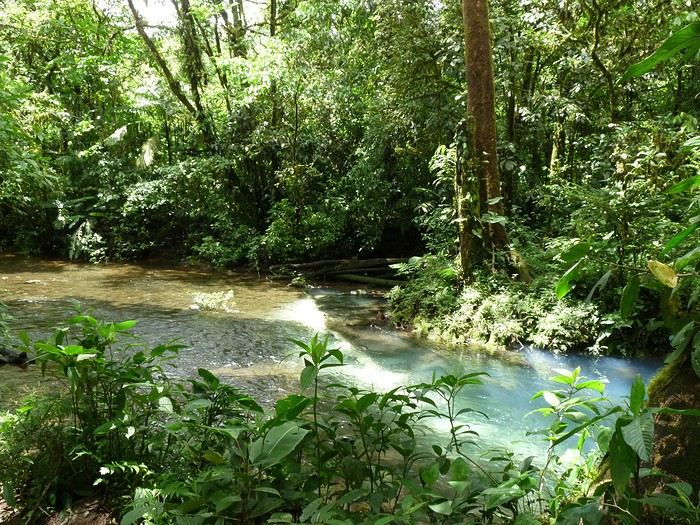
Again, we had to book tickets in advance on the SINAC website. And the parking is paid on top of that! We start the hike to see the famous waterfall. Meh, it’s all foggy, which doesn’t bode well. We keep walking, and it’s a steep climb (what do you expect when it’s pouring?). At an intersection, there’s a path that descends pretty sharply toward the famous waterfall you see in all the guidebooks. The trail is closed halfway—too dangerous with all the rain. So we see the waterfall from a distance, but not with the promised colors. We head back up, and the climb continues. We reach a viewpoint where, luckily, we see nothing on one side and nothing on the other side too! The trail continues downhill toward the pool. The spot is quite pretty because, despite the lack of light, the water has a beautiful turquoise color. We keep going on flat ground this time and finally reach the spot where two rivers meet. The phenomenon is pretty strange because the waters of these two rivers are clear, “normal,” but when they mix, the water turns a unique turquoise color. It’s a bit like pastis—when you add water, it changes color. A curious phenomenon that must be stunning in the sun. Back to the car, and it’s raining. A quick casado at a soda (Tapirus Paradise Rio Celeste), some bananas, and we head back to the Finca to pick up our chocolate bars. We take the opportunity to do the guided tour of the farm, a visit we couldn’t do the night before (1:00 PM). From a distance, we spot a sloth moving at least 30 cm!!! I take the chance to cancel our reservation for Monteverde because they’re forecasting a lot of rain, and I’ve had enough! I find a last-minute hotel in Jaco (we’ll see how it goes) as a replacement. On the road to Rincon de la Vieja. We leave in the rain, but at some point, the sun comes out, and through a crazy road (4x4 mandatory), we get some nice distant views. That hasn’t happened to us yet!! The road is paved, but the 4x4 really does seem essential. In fact, on a climb, I see a small 9-seater tourist van reversing in front of me. Once side by side, I ask the driver if there’s a problem. Turns out it was so steep that he was trying to gain momentum. No luck—he had to turn around and find another way. At the exit of a village, we even see the Rincon Volcano almost in its entirety—our first volcano. So happy! We arrive at our next accommodation, and despite the howling wind, we head straight for the pool (the jacuzzi for me), and finally, we get a real moment of relaxation. When it starts raining again (Ah! Just what we needed!), we go inside and wait quietly for dinner, which we’ll have at the hotel. Not great!
The plus: The first rays of sunshine The minus: There’s still a lot of rain for the dry season. In fact, all the Costa Ricans say it’s exceptional.


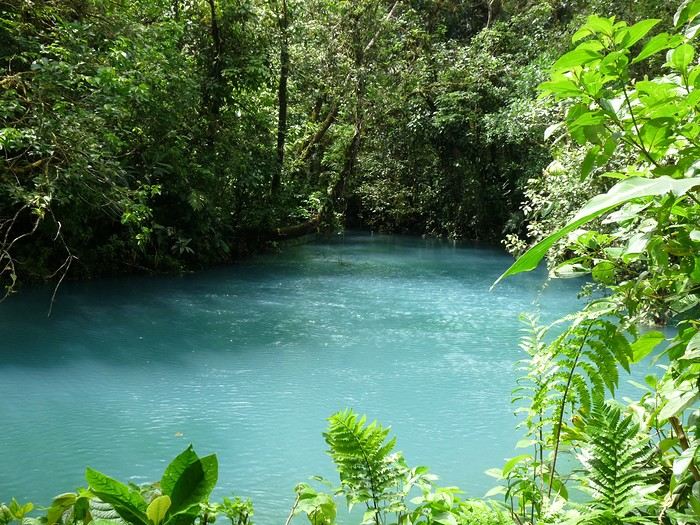 It had rained non-stop the day before, but the water stayed blue :)
And the meeting of the two rivers (blue water on the right, "normal" water on the left):