


Re: Mexico: The Magic of the Yucatan
The second dive of the day will be at Casa Cenote. It’s a kind of small lagoon with waters of an unreal, enchanting green. It’s surrounded by lush mangroves.
Its peculiarity is that a wild crocodile has made it home for several years now. Yet, every day, people swim there! And regularly, the reptile even swims among them in the most peaceful way possible. This has been going on for years, and it has never attacked anyone.
At this point in the story, it’s time to debunk a myth: crocodiles aren’t necessarily all man-eaters, far from it. It depends on the species and their geographical distribution. Freshwater crocodiles are generally little to not aggressive at all, unlike saltwater crocodiles.
The crocodile at Casa Cenote is a Morelet’s crocodile. It’s a species of freshwater crocodile that rarely approaches humans, though you should obviously always stay cautious. If threatened or approached too closely, it can become aggressive in self-defense.
Its diet mainly consists of fish, mammals, and birds. No humans.
The Morelet’s crocodile rarely exceeds three meters in adulthood. The one at Casa Cenote, still young, is about two meters long now.
This crocodile has been known to locals for years—so much so that they’ve given it a first name, Pancho, and even an affectionate nickname: Panchito! The creature has become the star of the place, and while swimmers might not be lining up, there are still a few every day who come to swim here. Some even travel from far away just to see it up close! That’s exactly what we did.
The dive begins in what is often crocodile territory: the mangrove.
Swimming along this beautiful vegetation with your head underwater while keeping an eye out for a crocodile is a unique experience. The mangrove seen from below is stunning—its many shades of green reflect on the surface, shimmering in the sunlight. I really wish I had a camera that could capture these magnificent images faithfully. Luckily, they’re etched in my memory.
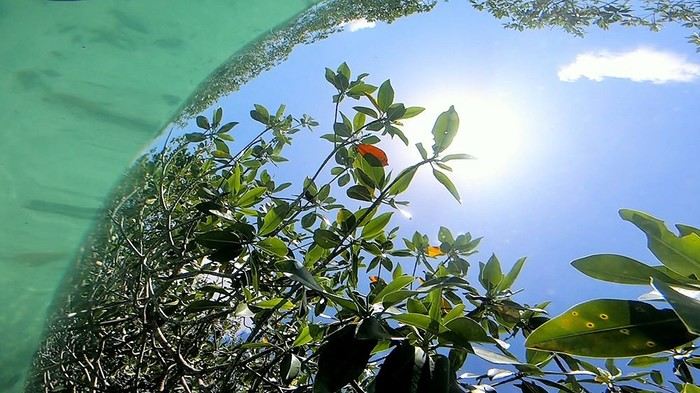
After swimming along the mangrove for a few minutes at very shallow depths (one to three meters), we actually go underneath it! That’s how we end up paddling through an unexpected network of tunnels and galleries, even passing through one or two small underwater caves.
This kind of cave diving has its own particularities:
- It’s obviously very dark (which definitely doesn’t help the quality of my photos!).
- Especially in these fully submerged underwater tunnels, it’s impossible to surface for air since there is no surface! You even have to sign a waiver (stating you’ve been properly informed) before the dive.
- It’s mandatory to follow the guide line, which our experienced dive guide, Isella, unrolls meter by meter.
- The guide, of course, must have specific certification for cave diving, in addition to the usual scuba instructor qualifications.
- Finally, this cenote connects to the sea through the underwater galleries. A bit of salty seawater seeps into the cenote, but it doesn’t mix with the freshwater. This separation between saltwater and freshwater is called a halocline. Since saltwater is naturally denser than freshwater, it settles at the bottom, where—surprisingly—you can still visually distinguish it from the freshwater. It looks like a large oil slick. As soon as you swim into it, everything becomes murky, a bit like when you open your eyes underwater without a mask. This lack of visibility isn’t the most reassuring when you’re on the lookout for a wild crocodile, but this unsettling experience is worth it.
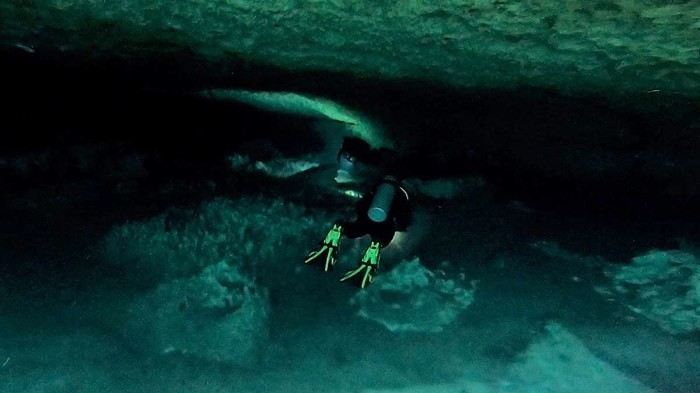
That’s the setting for this surreal dive.
Along this network of underwater galleries, a few gaps in the mangrove above our heads let the sun’s rays through, creating a visually stunning effect.
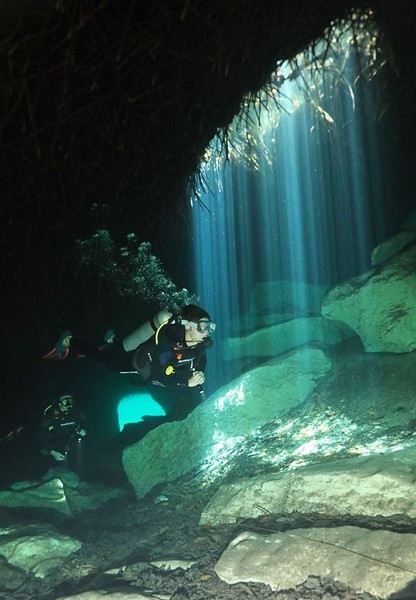
Oh, and a pro photographer with top-notch underwater gear came to take our picture down there, which explains the much better quality of the images above.
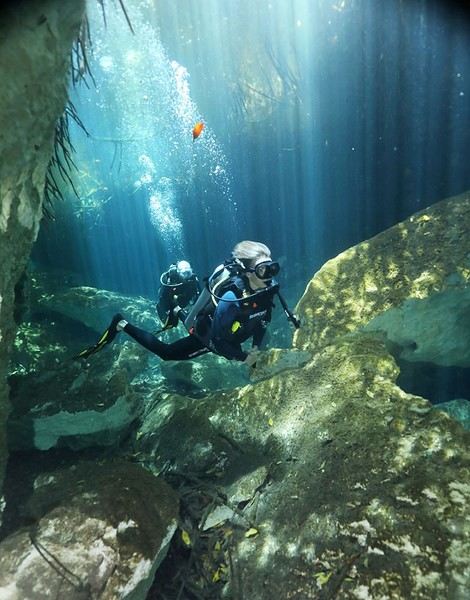
When we exit the tunnel, we know that this is precisely where Panchito’s territory begins. During her pre-dive briefing, Isella explained that our big toothy friend mainly lives in this part of the cenote, right after the galleries.
And sure enough, as soon as we emerge from the tunnels, she immediately waves at us, pointing to the water’s surface. At first, we don’t spot any crocodile. Seeing our hesitation, Isella joins her elbows to form a big V with her forearms and claps her hands together, mimicking a jaw snapping shut!
No doubt about it—Panchito is somewhere around here.
And indeed, we eventually spot his webbed foot just below the surface, gently resting on the mangrove amid the sunlight. The rest of the creature is above the surface, out of sight for now.
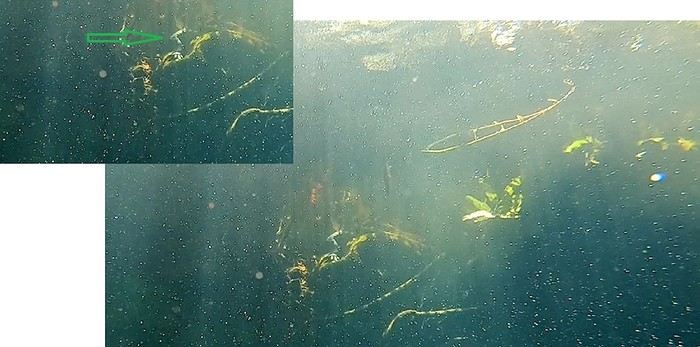
Apart from a few root ends, everything is dark around this foot, and the water is full of particles, but the moment is fascinating.
Isella signals that we’re going to surface to see him up close and in full. Naturally, the adrenaline kicks in a little, but not too much—we all feel surprisingly calm.
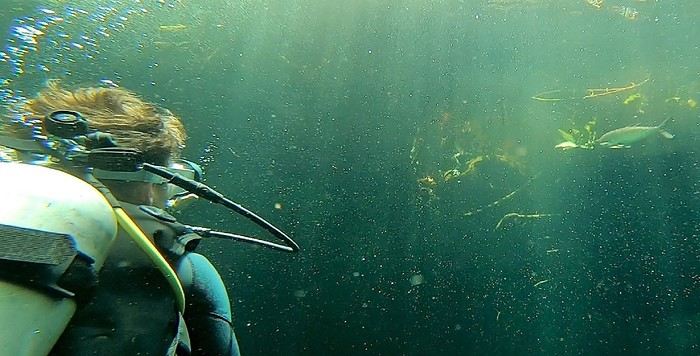
We wonder what pose we’ll find him in on the other side: Will he be watching us? On the defensive? Mouth open? Well, as it turns out, once we surface, he’s taking a nap!
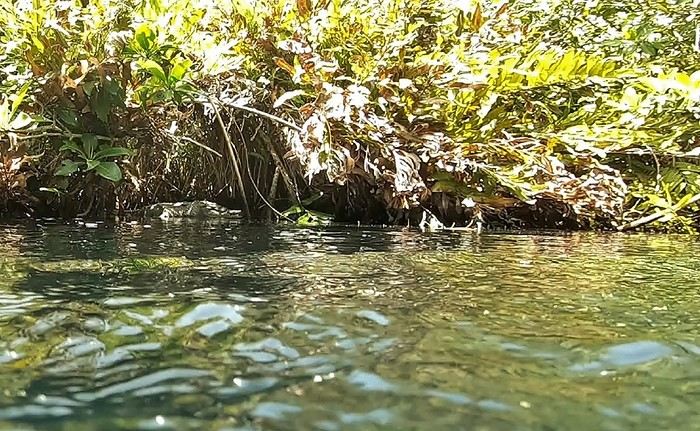
He’s about four or five meters away from us, lazily sprawled on the mangrove in the shade of the vegetation, dozing off. Or so it seems—we can tell he’s still keeping an eye on us with his half-open eye. But he’s obviously no more aggressive than he’s ever been with anyone and rests peacefully, likely used to visitors like us.
It’s impossible to take a decent photo of him because of the ultra-wide-angle lens on my GoPro, which makes Panchito look small and distant. Plus, he’s hidden in the mangrove’s shade, and the strong contrast between the dark shadows of the vegetation and the bright sunlight on the leaves doesn’t help either.
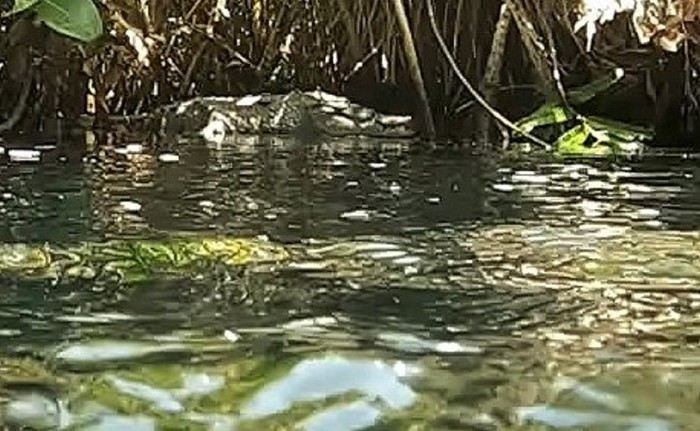
But never mind—the moment is intense for my two sons and me. They take turns asking me to take their picture in front of the creature.
We soak up these two short minutes with this unique companion, who didn’t even flick a scale in the end!
But it’s already time to leave. We put our heads back underwater, hoping he’ll do the same, because apparently, watching a crocodile waddle in the water is worth its weight in gold.
No such luck: Panchito prefers to keep napping, despite the fish below the surface teasing him relentlessly right in front of his teeth. Maybe he’s just digesting his last meal…
Its peculiarity is that a wild crocodile has made it home for several years now. Yet, every day, people swim there! And regularly, the reptile even swims among them in the most peaceful way possible. This has been going on for years, and it has never attacked anyone.
At this point in the story, it’s time to debunk a myth: crocodiles aren’t necessarily all man-eaters, far from it. It depends on the species and their geographical distribution. Freshwater crocodiles are generally little to not aggressive at all, unlike saltwater crocodiles.
The crocodile at Casa Cenote is a Morelet’s crocodile. It’s a species of freshwater crocodile that rarely approaches humans, though you should obviously always stay cautious. If threatened or approached too closely, it can become aggressive in self-defense.
Its diet mainly consists of fish, mammals, and birds. No humans.
The Morelet’s crocodile rarely exceeds three meters in adulthood. The one at Casa Cenote, still young, is about two meters long now.
This crocodile has been known to locals for years—so much so that they’ve given it a first name, Pancho, and even an affectionate nickname: Panchito! The creature has become the star of the place, and while swimmers might not be lining up, there are still a few every day who come to swim here. Some even travel from far away just to see it up close! That’s exactly what we did.
The dive begins in what is often crocodile territory: the mangrove.
Swimming along this beautiful vegetation with your head underwater while keeping an eye out for a crocodile is a unique experience. The mangrove seen from below is stunning—its many shades of green reflect on the surface, shimmering in the sunlight. I really wish I had a camera that could capture these magnificent images faithfully. Luckily, they’re etched in my memory.
After swimming along the mangrove for a few minutes at very shallow depths (one to three meters), we actually go underneath it! That’s how we end up paddling through an unexpected network of tunnels and galleries, even passing through one or two small underwater caves.
This kind of cave diving has its own particularities:
- It’s obviously very dark (which definitely doesn’t help the quality of my photos!).
- Especially in these fully submerged underwater tunnels, it’s impossible to surface for air since there is no surface! You even have to sign a waiver (stating you’ve been properly informed) before the dive.
- It’s mandatory to follow the guide line, which our experienced dive guide, Isella, unrolls meter by meter.
- The guide, of course, must have specific certification for cave diving, in addition to the usual scuba instructor qualifications.
- Finally, this cenote connects to the sea through the underwater galleries. A bit of salty seawater seeps into the cenote, but it doesn’t mix with the freshwater. This separation between saltwater and freshwater is called a halocline. Since saltwater is naturally denser than freshwater, it settles at the bottom, where—surprisingly—you can still visually distinguish it from the freshwater. It looks like a large oil slick. As soon as you swim into it, everything becomes murky, a bit like when you open your eyes underwater without a mask. This lack of visibility isn’t the most reassuring when you’re on the lookout for a wild crocodile, but this unsettling experience is worth it.
That’s the setting for this surreal dive.
Along this network of underwater galleries, a few gaps in the mangrove above our heads let the sun’s rays through, creating a visually stunning effect.
Oh, and a pro photographer with top-notch underwater gear came to take our picture down there, which explains the much better quality of the images above.
When we exit the tunnel, we know that this is precisely where Panchito’s territory begins. During her pre-dive briefing, Isella explained that our big toothy friend mainly lives in this part of the cenote, right after the galleries.
And sure enough, as soon as we emerge from the tunnels, she immediately waves at us, pointing to the water’s surface. At first, we don’t spot any crocodile. Seeing our hesitation, Isella joins her elbows to form a big V with her forearms and claps her hands together, mimicking a jaw snapping shut!
No doubt about it—Panchito is somewhere around here.
And indeed, we eventually spot his webbed foot just below the surface, gently resting on the mangrove amid the sunlight. The rest of the creature is above the surface, out of sight for now.
Apart from a few root ends, everything is dark around this foot, and the water is full of particles, but the moment is fascinating.
Isella signals that we’re going to surface to see him up close and in full. Naturally, the adrenaline kicks in a little, but not too much—we all feel surprisingly calm.
We wonder what pose we’ll find him in on the other side: Will he be watching us? On the defensive? Mouth open? Well, as it turns out, once we surface, he’s taking a nap!
He’s about four or five meters away from us, lazily sprawled on the mangrove in the shade of the vegetation, dozing off. Or so it seems—we can tell he’s still keeping an eye on us with his half-open eye. But he’s obviously no more aggressive than he’s ever been with anyone and rests peacefully, likely used to visitors like us.
It’s impossible to take a decent photo of him because of the ultra-wide-angle lens on my GoPro, which makes Panchito look small and distant. Plus, he’s hidden in the mangrove’s shade, and the strong contrast between the dark shadows of the vegetation and the bright sunlight on the leaves doesn’t help either.
But never mind—the moment is intense for my two sons and me. They take turns asking me to take their picture in front of the creature.
We soak up these two short minutes with this unique companion, who didn’t even flick a scale in the end!
But it’s already time to leave. We put our heads back underwater, hoping he’ll do the same, because apparently, watching a crocodile waddle in the water is worth its weight in gold.
No such luck: Panchito prefers to keep napping, despite the fish below the surface teasing him relentlessly right in front of his teeth. Maybe he’s just digesting his last meal…