

Re: Tuscany: Arezzo province and the area around Siena
The self-portraits of Piero della Francesca.
In "The Resurrection of Christ," you can see the faces of two of the four soldiers guarding the tomb. I’ve zoomed in on the one on the left, bareheaded. If we look closely at his face and then move to the central panel of the Polyptych of Mercy, under the Virgin’s mantle on the left side, we find the male figures. Only one has his face turned toward the viewer (almost full-on), and his features match those of the bareheaded soldier asleep in front of Christ’s tomb. Here are Piero della Francesca’s two self-portraits.
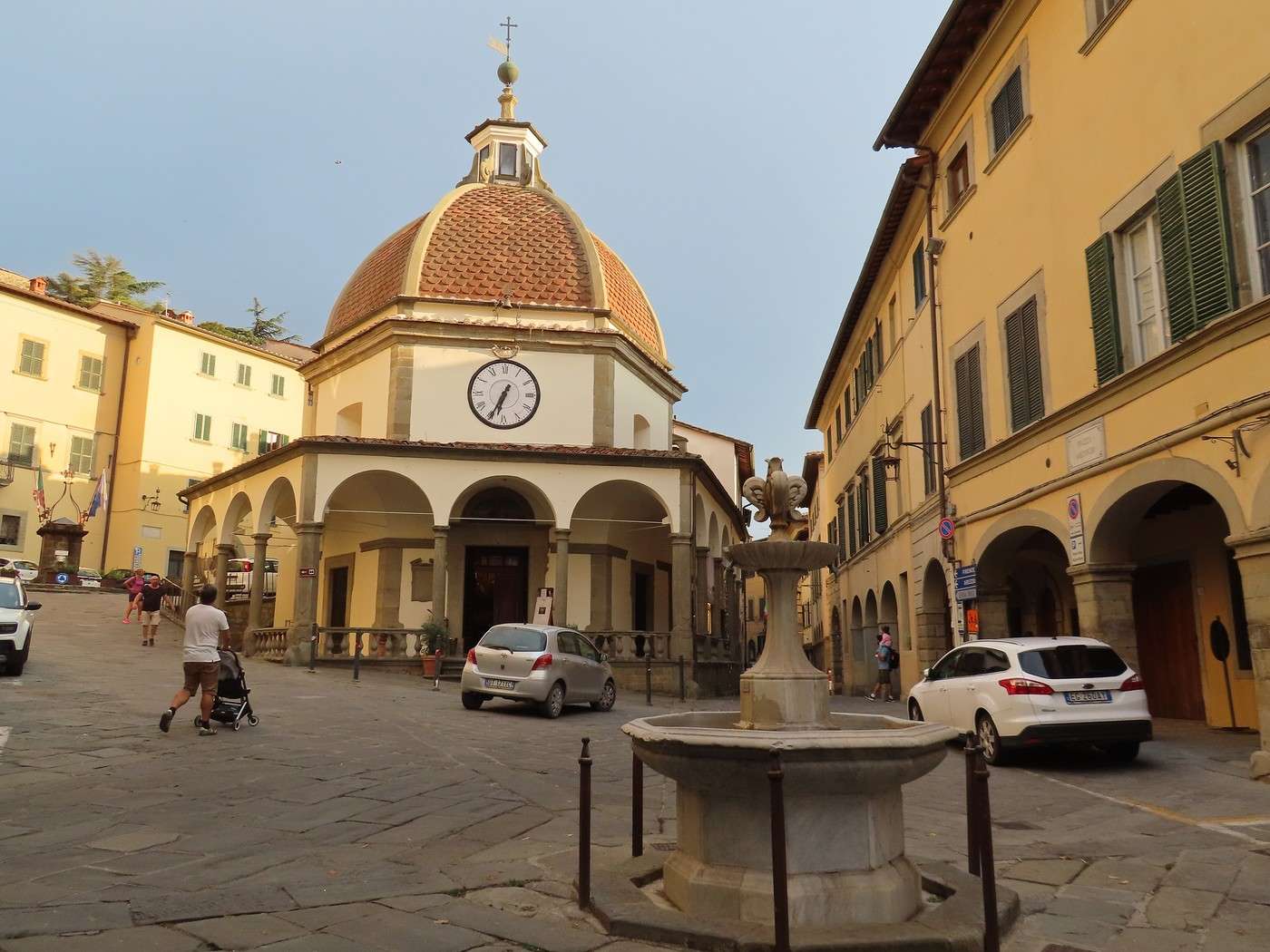
Today, I’m changing campsites. I’m heading to the Casentino (upper Arno Valley) via Pieve Santo Stefano, Chiusi della Verna, and Bibbiena. Since I’ll be doing more sightseeing than hiking in the Casentino, staying at a campsite in the valley seems better than one up in the hills. I find a spot in Pianacci, on the edge of Bibbiena and Soci. I try to head up into the hills in the afternoon, but it’s raining, so I don’t push it. Instead, I head down to the valley to Poppi, where the Castle of the Counts Guidi is located. The village is built on a hill near the Arno River. As soon as I enter the old part of town, I find myself in the main square, occupied by the Oratory of the Madonna del Morbo (protection against the plague).
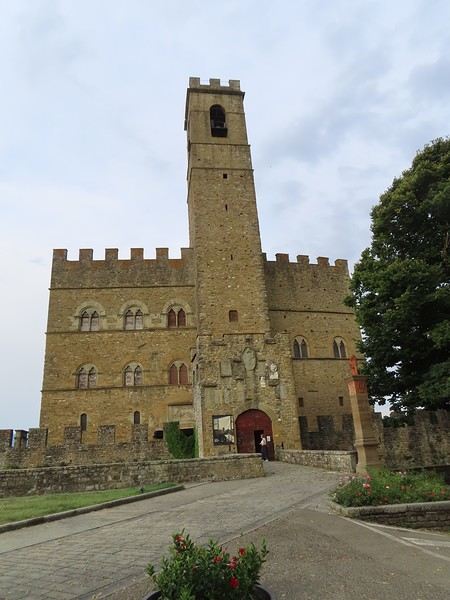
A street leads up to the top of the hill in front of the castle, a large quadrangle with a tower (rebuilt in the 19th century) and a protruding entrance. This façade has a slight resemblance to the Palazzo Vecchio: Arnolfo di Cambio worked here before designing the palace in Firenze.
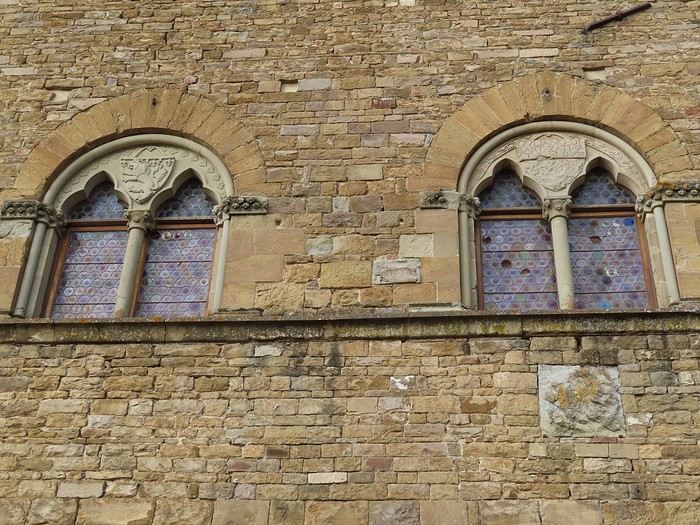
Elegant bifora windows.
A grand staircase—or rather, a set of staircases and 15th-century galleries—connects the different levels from the courtyard.
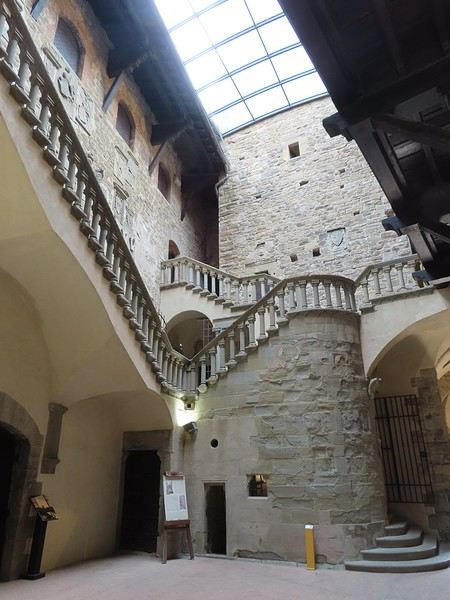
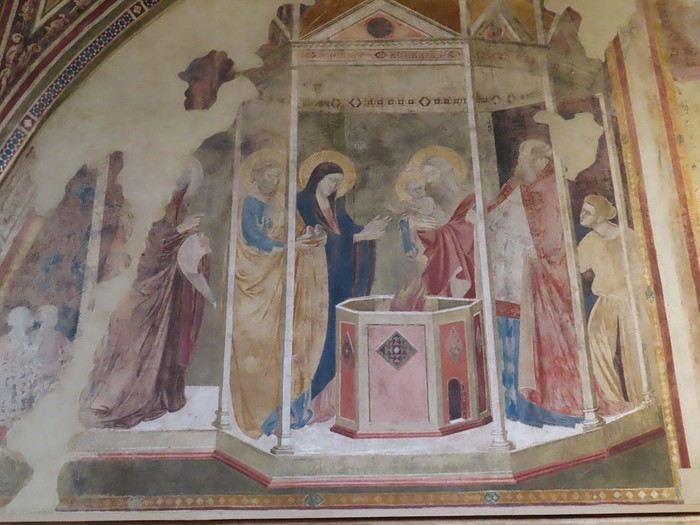
The upper floor houses a beautiful reception hall, the festival salon. A significant library, created in the 19th century, contains many old books. Its display cases feature an original edition of Diderot and d’Alembert’s Encyclopédie (is this a rotating exhibit?). The Chapel of the Counts Guidi was frescoed by Taddeo Gaddi. He painted "The Presentation of Jesus at the Temple" (mid-14th century) on this wall.
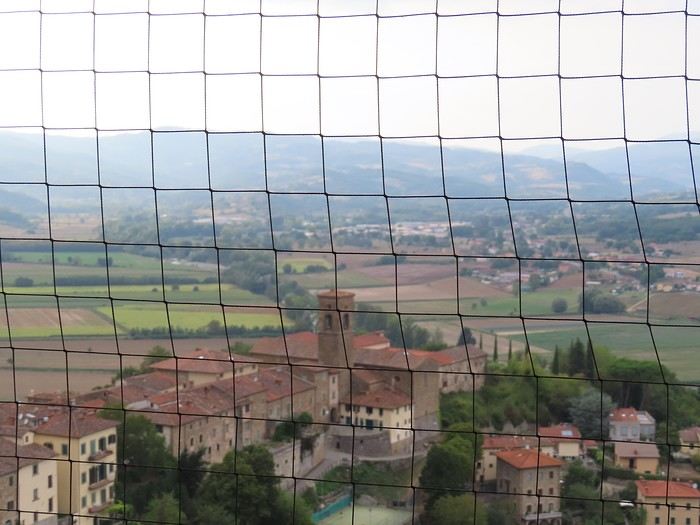
I finish the visit by climbing to the top of the tower. Downstream, about 5 km away, is Bibbiena; upstream (photo), at the same distance, is Pratovecchio. Closer, at the foot of Poppi’s hill, lies a small plain: the site of the Battle of Campaldino (1289), where the Florentines (Guelphs) faced the Aretines (Ghibellines) and emerged victorious.
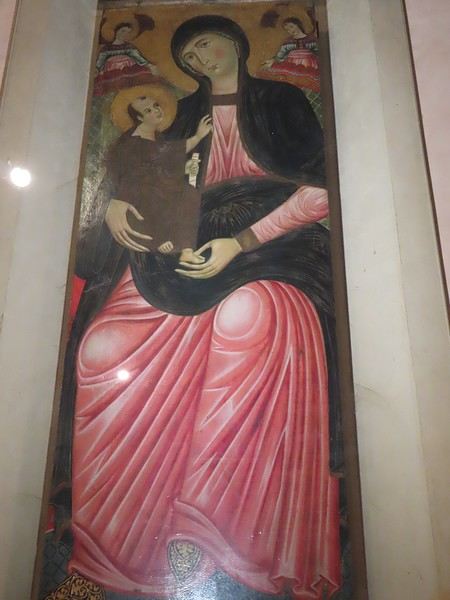
Leaving the castle, I stay on Poppi’s hill and follow Via Cavour (with its arcades) to the abbatial church of San Fedele, visible in the photo above. The interior has a Romanesque appearance, achieved by removing Baroque additions to restore its presumed original look (20th-century restoration). Among the notable artworks (poor photo quality), there’s a "Madonna and Child Enthroned" (circa 1280) by an anonymous painter known as the "Maestro della Maddalena." Jesus is depicted as an adult, not a child—a symbolic choice I’ve never seen before, and I’m not sure what it means.
Back to Pianacci.
Today, I’m changing campsites. I’m heading to the Casentino (upper Arno Valley) via Pieve Santo Stefano, Chiusi della Verna, and Bibbiena. Since I’ll be doing more sightseeing than hiking in the Casentino, staying at a campsite in the valley seems better than one up in the hills. I find a spot in Pianacci, on the edge of Bibbiena and Soci. I try to head up into the hills in the afternoon, but it’s raining, so I don’t push it. Instead, I head down to the valley to Poppi, where the Castle of the Counts Guidi is located. The village is built on a hill near the Arno River. As soon as I enter the old part of town, I find myself in the main square, occupied by the Oratory of the Madonna del Morbo (protection against the plague).
A street leads up to the top of the hill in front of the castle, a large quadrangle with a tower (rebuilt in the 19th century) and a protruding entrance. This façade has a slight resemblance to the Palazzo Vecchio: Arnolfo di Cambio worked here before designing the palace in Firenze.
Elegant bifora windows.
A grand staircase—or rather, a set of staircases and 15th-century galleries—connects the different levels from the courtyard.
The upper floor houses a beautiful reception hall, the festival salon. A significant library, created in the 19th century, contains many old books. Its display cases feature an original edition of Diderot and d’Alembert’s Encyclopédie (is this a rotating exhibit?). The Chapel of the Counts Guidi was frescoed by Taddeo Gaddi. He painted "The Presentation of Jesus at the Temple" (mid-14th century) on this wall.
I finish the visit by climbing to the top of the tower. Downstream, about 5 km away, is Bibbiena; upstream (photo), at the same distance, is Pratovecchio. Closer, at the foot of Poppi’s hill, lies a small plain: the site of the Battle of Campaldino (1289), where the Florentines (Guelphs) faced the Aretines (Ghibellines) and emerged victorious.
Leaving the castle, I stay on Poppi’s hill and follow Via Cavour (with its arcades) to the abbatial church of San Fedele, visible in the photo above. The interior has a Romanesque appearance, achieved by removing Baroque additions to restore its presumed original look (20th-century restoration). Among the notable artworks (poor photo quality), there’s a "Madonna and Child Enthroned" (circa 1280) by an anonymous painter known as the "Maestro della Maddalena." Jesus is depicted as an adult, not a child—a symbolic choice I’ve never seen before, and I’m not sure what it means.
Back to Pianacci.