

Re: Southern Shikoku: Between Land and Sea, the Blue Waters of Miyakojima, and Ending in the Megacity T
After stopping by a 7-Eleven, we take the car to head into the center of Kochi Prefecture.
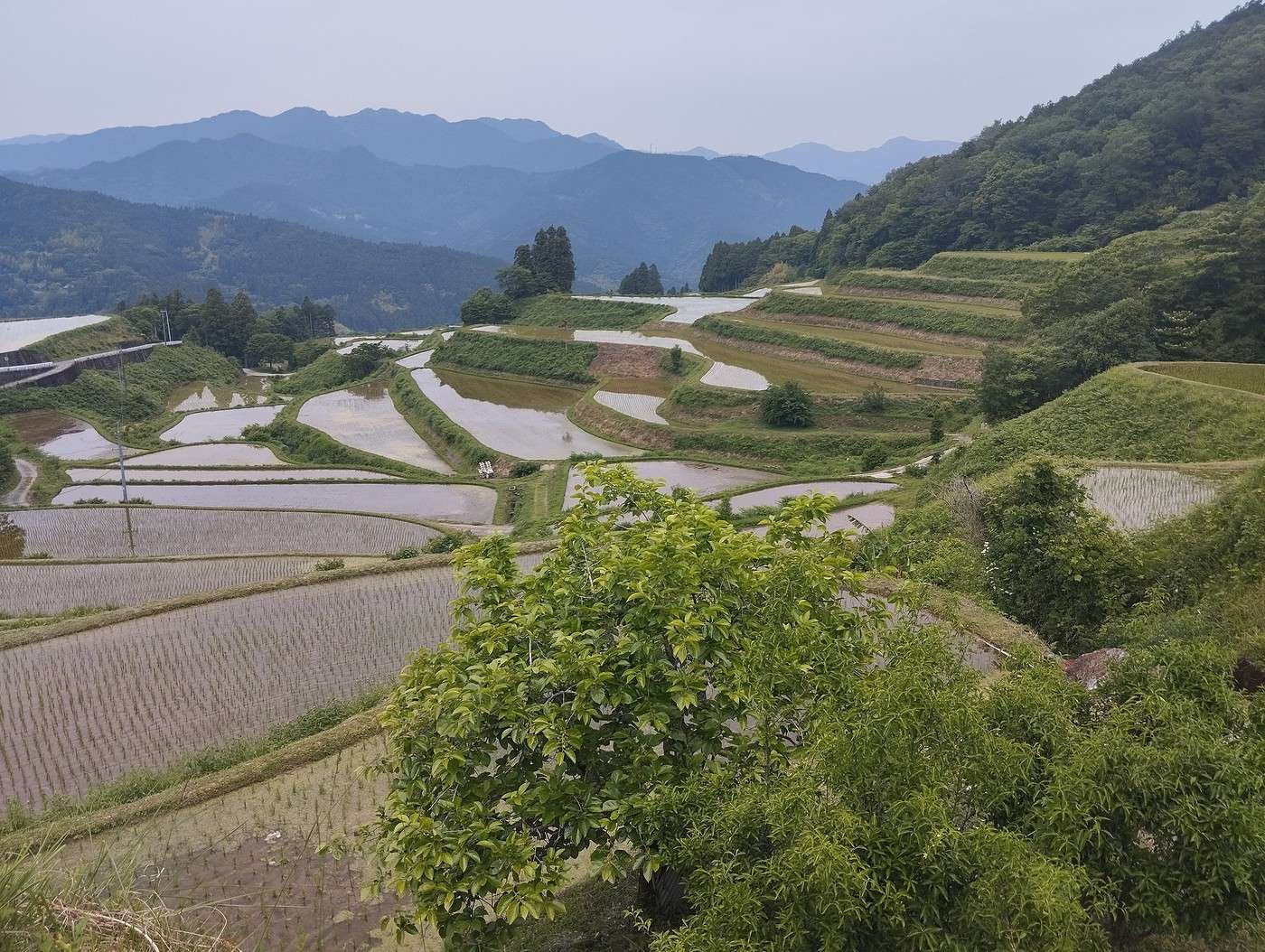
Not much driving time, and we find ourselves in a completely rural and mountainous environment. We intended to visit some waterfalls, but a sign pointing to rice terraces leads us to make an unplanned stop. We take a narrow road winding through tiny villages, climbing higher and higher in altitude until we reach the viewpoint overlooking the Takasu rice terraces. There’s absolutely no one around. We get to enjoy a spectacular view of the terraces. The sky is gray, but it’s not raining. We settle at the picnic tables and just take in the landscape, savoring the silence.
Every now and then, a car passes. But mostly, a van drives by—once, twice, three times—I always notice it’s the same van. It’s a local guy, I’m sure of it; he watches us as he passes. Then suddenly, the van speeds up and parks. Out steps a burly guy wearing only a sleeveless, slightly worn black vest. He’s got muscular arms and a thick, dark mustache. He’s got a cowboy vibe, but the Japanese version. He comes over to ask who we are and where we’re from. He speaks a little English. Eager to chat and clearly happy to speak English, even when I switch to Japanese.
We learn he owns 20 plots of the rice terraces spread out before us. He tells us he uses very little fertilizer and that organic farming is tricky here because of the wind and how close the plots are to each other. He’s married with three kids aged 30 to 37. He doesn’t seem worried about passing the terraces down to his children. He says it’s a lot of work and not very profitable, but his wife is a teacher, and she’s the one who ensures the family’s financial security. Given the type of terraces and the costs, he works manually but has five horses to help harvest the rice. He warns us to be careful because there are a lot of snakes and pretty dangerous spiders. He also makes sake.
We ask if we can buy some rice from him, but he says he can’t sell us any because of the price. He only sells in 3-kilogram parcels for 20,000 yen, about 130 euros—so 40 euros per kilo. We’re talking white gold here! He mainly works with luxury hotels. We also learn he lived in the U.S. for two years, which explains his cowboy look and his eagerness to speak English!
One of his friends stops by. He introduces us. This friend grows flowers higher up in the mountains. Today, he’s taking part in a TV show that’s already on-site. They’re on a break.
Usually, this place is packed with tourists, especially in the summer when the rice is golden. We’re thrilled to enjoy this setting in absolute tranquility.
He gives us advice for the rest of our day, warning us about the poisonous creatures near the waterfall. We take a souvenir photo and leave this colorful character after chatting for a good part of the morning.
The waterfall isn’t supposed to be far—just 30 minutes by car. After driving through a lifeless hamlet, we turn at an intersection where a vague sign points to different routes for different waterfalls.
We think we’re close. But we hadn’t counted on the complete lack of signs, people, or anything to help us find our way. We stop several times as we venture deeper into the mountains, sometimes following a stream with the forest covering the road, other times climbing higher with the car, watching the paved road turn into a dirt path covered in leaves or a rocky trail—all while praying we don’t get a flat or damage the car. The GPS insists we’re right there, and according to the vague map we saw earlier, we’re heading in the right direction, but there’s no sign of the waterfall.
Driving slowly because of the road, we still enjoy the exceptional natural surroundings. After driving for over an hour without spotting the waterfall and seeing how rough the path has become, we reluctantly decide to turn back. Plus, it starts raining.
We carefully make our way back down the mountain, still scanning for any clue, but nothing. Suddenly, a van passes us and pulls over. I stop next to it. The elderly driver doesn’t understand me trying to talk to him from my window. I have to get out, but even then, I have to insist for him to roll down his window. He doesn’t seem to know about the waterfall and doesn’t seem eager to help. Oh well, we hit the road again when I spot a woman working. I go talk to her, but she doesn’t seem to speak Japanese. Total bust. We drove for hours and got nothing. Knowing we’d already done a fair bit of driving for the rice terraces, the day is already well underway because the winding roads and slow speeds mean getting inland takes time. We give up on the second waterfall we’d planned to visit and continue toward our next goal: Lake Sameura.
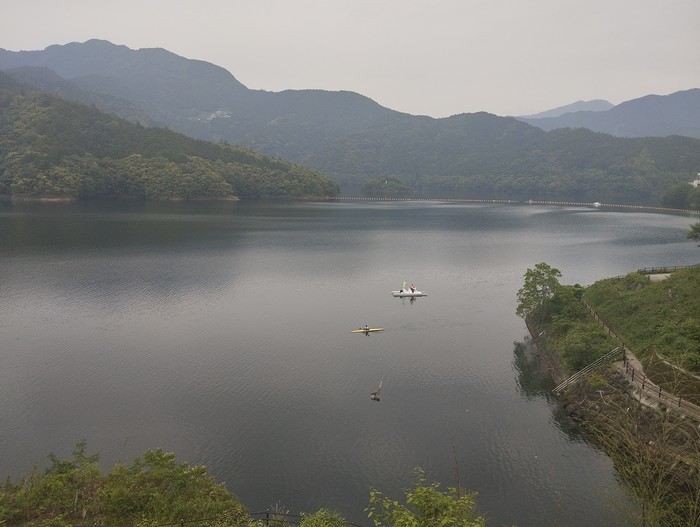
Despite the misty sky, we enjoy the lake’s scenery and the surrounding forests, especially while having a drink on the terrace of the nautical center overlooking the lake. We watch the kayakers on the water and when they return to the center.
We then head to the city center to grab an ice cream before the shop closes. Many stores in Japan close early, so you have to plan accordingly. We arrive just in time—five minutes before closing. The woman working was already tidying up, but she agrees to sell us some ice cream, though we’ll have to eat it outside. We try a delicious matcha ice cream and a shiso sorbet. It’s super refreshing and has a beautiful pomegranate color. We enjoy these treats on the bench in front of the shop, whose curtains have been drawn since we left. We’re on the main street of Motoyama, and it’s very quiet. The woman comes out afterward to tell us to go around back to throw away our cups, which we do. We even get to use the restroom. In the end, I think we could’ve eaten inside since she wasn’t completely done cleaning and tidying up, but rules are rules.
Then we think about what to do next. Given the time—late afternoon—and the drive back, we decide to eat early. We’d spotted a sushi restaurant online. We park in front of what looks like a house. We’d barely parked when a woman comes out to tell us we can’t park there, but when we say we’re here to eat, suddenly there’s no problem. In Japan, parking isn’t like in France. You have to be in the right spot, or you can quickly run into trouble, as we’ve experienced on previous trips.
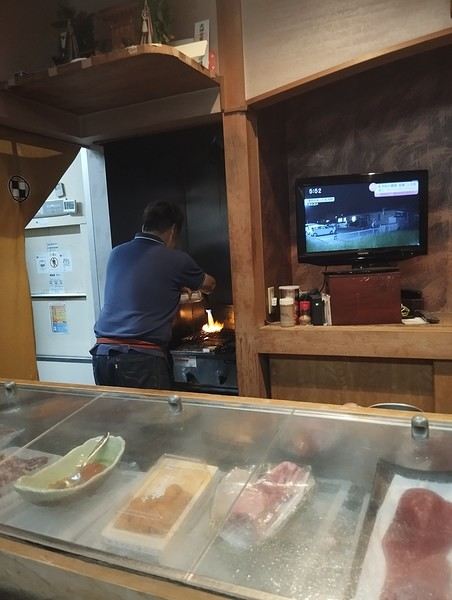
We sit at the counter. The restaurant is run by a man and his lively mother. We quickly start chatting with the sushi master and then his mother, who handles the service. A few words of Japanese work their usual magic, especially with grandma, who ends up giving me several gifts throughout the evening: a sake serving dish, a naruko (a Yosakoi dance instrument), tea bags, and above all, lots of laughter, warmth, and an invitation to come back and see them the next time we’re in the area.
We learn the sushi master trained under a master in Shizuoka for 15 years before opening this restaurant 23 years ago. His mother is from Motoyama, which is why they’re here. His father was a salaryman in Osaka. Mr. works a lot and is single. Meeting women is complicated. However, he has five dogs, whose photos are displayed in the restaurant. He practices Yosakoi dance, which is why his mother wanted to give me an instrument. He buys the fish for the sushi in Kochi every three days or so—about an hour’s drive away.
In addition to sushi, we try a bowl of local beef in gyudon—that’s beef over rice with an egg.
We have an amazing evening and leave only after taking a souvenir photo at grandma’s request—she’s got incredible energy. Of course, they stay in front of the restaurant until we leave, making sure to remind us to drive safely on the way back.
The evening ends quietly at the hotel. While this day wasn’t rich in sightseeing due to the travel times and the places we couldn’t find, it was filled with two wonderful human encounters and the stunning mountain landscapes we drove through.
Not much driving time, and we find ourselves in a completely rural and mountainous environment. We intended to visit some waterfalls, but a sign pointing to rice terraces leads us to make an unplanned stop. We take a narrow road winding through tiny villages, climbing higher and higher in altitude until we reach the viewpoint overlooking the Takasu rice terraces. There’s absolutely no one around. We get to enjoy a spectacular view of the terraces. The sky is gray, but it’s not raining. We settle at the picnic tables and just take in the landscape, savoring the silence.
Every now and then, a car passes. But mostly, a van drives by—once, twice, three times—I always notice it’s the same van. It’s a local guy, I’m sure of it; he watches us as he passes. Then suddenly, the van speeds up and parks. Out steps a burly guy wearing only a sleeveless, slightly worn black vest. He’s got muscular arms and a thick, dark mustache. He’s got a cowboy vibe, but the Japanese version. He comes over to ask who we are and where we’re from. He speaks a little English. Eager to chat and clearly happy to speak English, even when I switch to Japanese.
We learn he owns 20 plots of the rice terraces spread out before us. He tells us he uses very little fertilizer and that organic farming is tricky here because of the wind and how close the plots are to each other. He’s married with three kids aged 30 to 37. He doesn’t seem worried about passing the terraces down to his children. He says it’s a lot of work and not very profitable, but his wife is a teacher, and she’s the one who ensures the family’s financial security. Given the type of terraces and the costs, he works manually but has five horses to help harvest the rice. He warns us to be careful because there are a lot of snakes and pretty dangerous spiders. He also makes sake.
We ask if we can buy some rice from him, but he says he can’t sell us any because of the price. He only sells in 3-kilogram parcels for 20,000 yen, about 130 euros—so 40 euros per kilo. We’re talking white gold here! He mainly works with luxury hotels. We also learn he lived in the U.S. for two years, which explains his cowboy look and his eagerness to speak English!
One of his friends stops by. He introduces us. This friend grows flowers higher up in the mountains. Today, he’s taking part in a TV show that’s already on-site. They’re on a break.
Usually, this place is packed with tourists, especially in the summer when the rice is golden. We’re thrilled to enjoy this setting in absolute tranquility.
He gives us advice for the rest of our day, warning us about the poisonous creatures near the waterfall. We take a souvenir photo and leave this colorful character after chatting for a good part of the morning.
The waterfall isn’t supposed to be far—just 30 minutes by car. After driving through a lifeless hamlet, we turn at an intersection where a vague sign points to different routes for different waterfalls.
We think we’re close. But we hadn’t counted on the complete lack of signs, people, or anything to help us find our way. We stop several times as we venture deeper into the mountains, sometimes following a stream with the forest covering the road, other times climbing higher with the car, watching the paved road turn into a dirt path covered in leaves or a rocky trail—all while praying we don’t get a flat or damage the car. The GPS insists we’re right there, and according to the vague map we saw earlier, we’re heading in the right direction, but there’s no sign of the waterfall.
Driving slowly because of the road, we still enjoy the exceptional natural surroundings. After driving for over an hour without spotting the waterfall and seeing how rough the path has become, we reluctantly decide to turn back. Plus, it starts raining.
We carefully make our way back down the mountain, still scanning for any clue, but nothing. Suddenly, a van passes us and pulls over. I stop next to it. The elderly driver doesn’t understand me trying to talk to him from my window. I have to get out, but even then, I have to insist for him to roll down his window. He doesn’t seem to know about the waterfall and doesn’t seem eager to help. Oh well, we hit the road again when I spot a woman working. I go talk to her, but she doesn’t seem to speak Japanese. Total bust. We drove for hours and got nothing. Knowing we’d already done a fair bit of driving for the rice terraces, the day is already well underway because the winding roads and slow speeds mean getting inland takes time. We give up on the second waterfall we’d planned to visit and continue toward our next goal: Lake Sameura.
Despite the misty sky, we enjoy the lake’s scenery and the surrounding forests, especially while having a drink on the terrace of the nautical center overlooking the lake. We watch the kayakers on the water and when they return to the center.
We then head to the city center to grab an ice cream before the shop closes. Many stores in Japan close early, so you have to plan accordingly. We arrive just in time—five minutes before closing. The woman working was already tidying up, but she agrees to sell us some ice cream, though we’ll have to eat it outside. We try a delicious matcha ice cream and a shiso sorbet. It’s super refreshing and has a beautiful pomegranate color. We enjoy these treats on the bench in front of the shop, whose curtains have been drawn since we left. We’re on the main street of Motoyama, and it’s very quiet. The woman comes out afterward to tell us to go around back to throw away our cups, which we do. We even get to use the restroom. In the end, I think we could’ve eaten inside since she wasn’t completely done cleaning and tidying up, but rules are rules.
Then we think about what to do next. Given the time—late afternoon—and the drive back, we decide to eat early. We’d spotted a sushi restaurant online. We park in front of what looks like a house. We’d barely parked when a woman comes out to tell us we can’t park there, but when we say we’re here to eat, suddenly there’s no problem. In Japan, parking isn’t like in France. You have to be in the right spot, or you can quickly run into trouble, as we’ve experienced on previous trips.
We sit at the counter. The restaurant is run by a man and his lively mother. We quickly start chatting with the sushi master and then his mother, who handles the service. A few words of Japanese work their usual magic, especially with grandma, who ends up giving me several gifts throughout the evening: a sake serving dish, a naruko (a Yosakoi dance instrument), tea bags, and above all, lots of laughter, warmth, and an invitation to come back and see them the next time we’re in the area.
We learn the sushi master trained under a master in Shizuoka for 15 years before opening this restaurant 23 years ago. His mother is from Motoyama, which is why they’re here. His father was a salaryman in Osaka. Mr. works a lot and is single. Meeting women is complicated. However, he has five dogs, whose photos are displayed in the restaurant. He practices Yosakoi dance, which is why his mother wanted to give me an instrument. He buys the fish for the sushi in Kochi every three days or so—about an hour’s drive away.
In addition to sushi, we try a bowl of local beef in gyudon—that’s beef over rice with an egg.
We have an amazing evening and leave only after taking a souvenir photo at grandma’s request—she’s got incredible energy. Of course, they stay in front of the restaurant until we leave, making sure to remind us to drive safely on the way back.
The evening ends quietly at the hotel. While this day wasn’t rich in sightseeing due to the travel times and the places we couldn’t find, it was filled with two wonderful human encounters and the stunning mountain landscapes we drove through.