


Re: Mexico: The Magic of the Yucatan
The dive is over, we're heading back to debrief.
Before coming to Mexico, I’d read a lot of varied info online about Panchito. So before and after this dive, I asked Isella to help me sort through all that info, since some of it really intrigued me. For example, I’d read that Panchito was only a meter long and wasn’t growing anymore, or that the cenote was closed off and therefore inaccessible to other crocodiles, etc.
With a smile, Isella diplomatically debunked these fake news stories. She explained that this crocodile is regularly monitored by the authorities, who recently measured and weighed him again. He’s grown a bit and put on some weight since the last measurements, which is normal. According to the experts, he’s still at the "adolescent" stage and, at two meters long, currently poses no danger to humans.
She also told us that, like most cenotes, this one is indeed connected to the sea through a network of underwater tunnels. And contrary to what I’d read online, other crocodiles do occasionally enter—though it’s rare.
But this big reptile is territorial by nature: he defends his nest, his feeding areas, etc. That’s why any other crocodiles that wander in don’t stick around for long on his turf.
To wrap up—and without further ado—I should mention that the site is generally quite fish-rich overall, which makes this already unique dive even more beautiful.
I only have two small regrets from meeting Panchito: not seeing him swim, and not being able to get a proper photo of him.
Of course, we would’ve loved to see him swim around us, but on the other hand, we could’ve easily not spotted him at all.
In fact, Panchito sometimes leaves the cenote when visitors come to see him, or he might be so well hidden in the mangroves that you can’t detect his presence. Those visitors leave empty-handed, which is why we’re savoring the luck we had to see and approach him—we won’t forget this moment anytime soon.
One important point to emphasize: crocodiles are animals that many people find frightening. And understandably so, given their teeth and the phenomenal power of their jaws. But not all crocodiles are man-eaters, and some—like the Morelet’s crocodile, which is Panchito’s species—aren’t aggressive toward humans.
For comparison, an adult Morelet’s crocodile measures 3 meters and weighs 200 kg. The two most dangerous crocodile species in the world (the Nile crocodile in Africa and the saltwater crocodile in Southeast Asia and Australia) measure up to 6 meters and weigh as much as a ton!
In the end, meeting Panchito was a highlight for us. This unique dive turned out to be one of the most memorable we’ve ever done, thanks to Panchito the croc, of course, but also the underwater tunnels and the beauty of the mangroves—so stunning to observe from below.
Finally, for those interested, I highly recommend Scuba Tulum. They welcomed and guided us wonderfully, especially thanks to Isella, our dive guide, and her colleague on land, Guadalupe. Don’t hesitate to contact them, whether you want to dive with Panchito or elsewhere.
Practical info for those interested in diving in Tulum, with or without Panchito.
1/ First, about Panchito’s cenote: be careful, there are two cenotes named Casa Cenote just a few kilometers apart!
The one we’re talking about in this post is also called Cenote Manatee (or Manatí). That’s where Panchito lives.
Don’t confuse it with the other Casa Cenote, more commonly called Cenote Xpuha, located about twenty kilometers further north.
You can also meet Panchito just by swimming, not necessarily diving. There’s a map of the cenote displayed at the entrance.
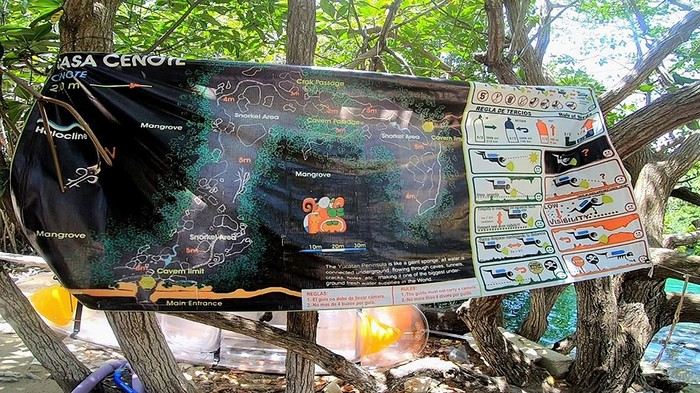
On the map above, the entry point is at the bottom left (main entrance), and Panchito is most often found in the area at the top right (between Crack Passage and Cavern limit).
Otherwise, for more details, just ask the locals on-site.
2/ We dove with Scuba Tulum – Address: Calle Sagitario Ote. 8, Tulum, QR 77780 – Phone: 01.984.115.2336 – Email: scubatulum@gmail.com
It’s the kind of dive shop we love: simple and friendly welcome, safety standards respected without the usual fuss, some clients but not too many—unlike some places that feel like a factory.
Our two main contacts, Guadalupe and Isella, were always straightforward and open. They patiently answered our many questions and taught us a ton of fascinating things about crocodiles, the nature of the Yucatán, the locals, and their way of life.
Like all dives in Mexico, the price isn’t cheap, but it’s in line with what other dive shops in Tulum charge: 2 dives for 150 € per person (but what dives!). For all cenotes, you also have to add the entrance fee: for Casa Cenote, it’s 200 pesos per person (about 10-11 €).
In conclusion, we have a wonderful memory of the diving experience we had with this shop.
Note that, in addition to dives in the various cenotes in the area, Scuba Tulum also organizes dives in the nearby ocean.
Of course, you can also reach out to the many other dive shops in Tulum, all of which regularly visit this spot.
That’s all for today, see you next time for more...
Before coming to Mexico, I’d read a lot of varied info online about Panchito. So before and after this dive, I asked Isella to help me sort through all that info, since some of it really intrigued me. For example, I’d read that Panchito was only a meter long and wasn’t growing anymore, or that the cenote was closed off and therefore inaccessible to other crocodiles, etc.
With a smile, Isella diplomatically debunked these fake news stories. She explained that this crocodile is regularly monitored by the authorities, who recently measured and weighed him again. He’s grown a bit and put on some weight since the last measurements, which is normal. According to the experts, he’s still at the "adolescent" stage and, at two meters long, currently poses no danger to humans.
She also told us that, like most cenotes, this one is indeed connected to the sea through a network of underwater tunnels. And contrary to what I’d read online, other crocodiles do occasionally enter—though it’s rare.
But this big reptile is territorial by nature: he defends his nest, his feeding areas, etc. That’s why any other crocodiles that wander in don’t stick around for long on his turf.
To wrap up—and without further ado—I should mention that the site is generally quite fish-rich overall, which makes this already unique dive even more beautiful.
I only have two small regrets from meeting Panchito: not seeing him swim, and not being able to get a proper photo of him.
Of course, we would’ve loved to see him swim around us, but on the other hand, we could’ve easily not spotted him at all.
In fact, Panchito sometimes leaves the cenote when visitors come to see him, or he might be so well hidden in the mangroves that you can’t detect his presence. Those visitors leave empty-handed, which is why we’re savoring the luck we had to see and approach him—we won’t forget this moment anytime soon.
One important point to emphasize: crocodiles are animals that many people find frightening. And understandably so, given their teeth and the phenomenal power of their jaws. But not all crocodiles are man-eaters, and some—like the Morelet’s crocodile, which is Panchito’s species—aren’t aggressive toward humans.
For comparison, an adult Morelet’s crocodile measures 3 meters and weighs 200 kg. The two most dangerous crocodile species in the world (the Nile crocodile in Africa and the saltwater crocodile in Southeast Asia and Australia) measure up to 6 meters and weigh as much as a ton!
In the end, meeting Panchito was a highlight for us. This unique dive turned out to be one of the most memorable we’ve ever done, thanks to Panchito the croc, of course, but also the underwater tunnels and the beauty of the mangroves—so stunning to observe from below.
Finally, for those interested, I highly recommend Scuba Tulum. They welcomed and guided us wonderfully, especially thanks to Isella, our dive guide, and her colleague on land, Guadalupe. Don’t hesitate to contact them, whether you want to dive with Panchito or elsewhere.
Practical info for those interested in diving in Tulum, with or without Panchito.
1/ First, about Panchito’s cenote: be careful, there are two cenotes named Casa Cenote just a few kilometers apart!
The one we’re talking about in this post is also called Cenote Manatee (or Manatí). That’s where Panchito lives.
Don’t confuse it with the other Casa Cenote, more commonly called Cenote Xpuha, located about twenty kilometers further north.
You can also meet Panchito just by swimming, not necessarily diving. There’s a map of the cenote displayed at the entrance.
On the map above, the entry point is at the bottom left (main entrance), and Panchito is most often found in the area at the top right (between Crack Passage and Cavern limit).
Otherwise, for more details, just ask the locals on-site.
2/ We dove with Scuba Tulum – Address: Calle Sagitario Ote. 8, Tulum, QR 77780 – Phone: 01.984.115.2336 – Email: scubatulum@gmail.com
It’s the kind of dive shop we love: simple and friendly welcome, safety standards respected without the usual fuss, some clients but not too many—unlike some places that feel like a factory.
Our two main contacts, Guadalupe and Isella, were always straightforward and open. They patiently answered our many questions and taught us a ton of fascinating things about crocodiles, the nature of the Yucatán, the locals, and their way of life.
Like all dives in Mexico, the price isn’t cheap, but it’s in line with what other dive shops in Tulum charge: 2 dives for 150 € per person (but what dives!). For all cenotes, you also have to add the entrance fee: for Casa Cenote, it’s 200 pesos per person (about 10-11 €).
In conclusion, we have a wonderful memory of the diving experience we had with this shop.
Note that, in addition to dives in the various cenotes in the area, Scuba Tulum also organizes dives in the nearby ocean.
Of course, you can also reach out to the many other dive shops in Tulum, all of which regularly visit this spot.
That’s all for today, see you next time for more...