

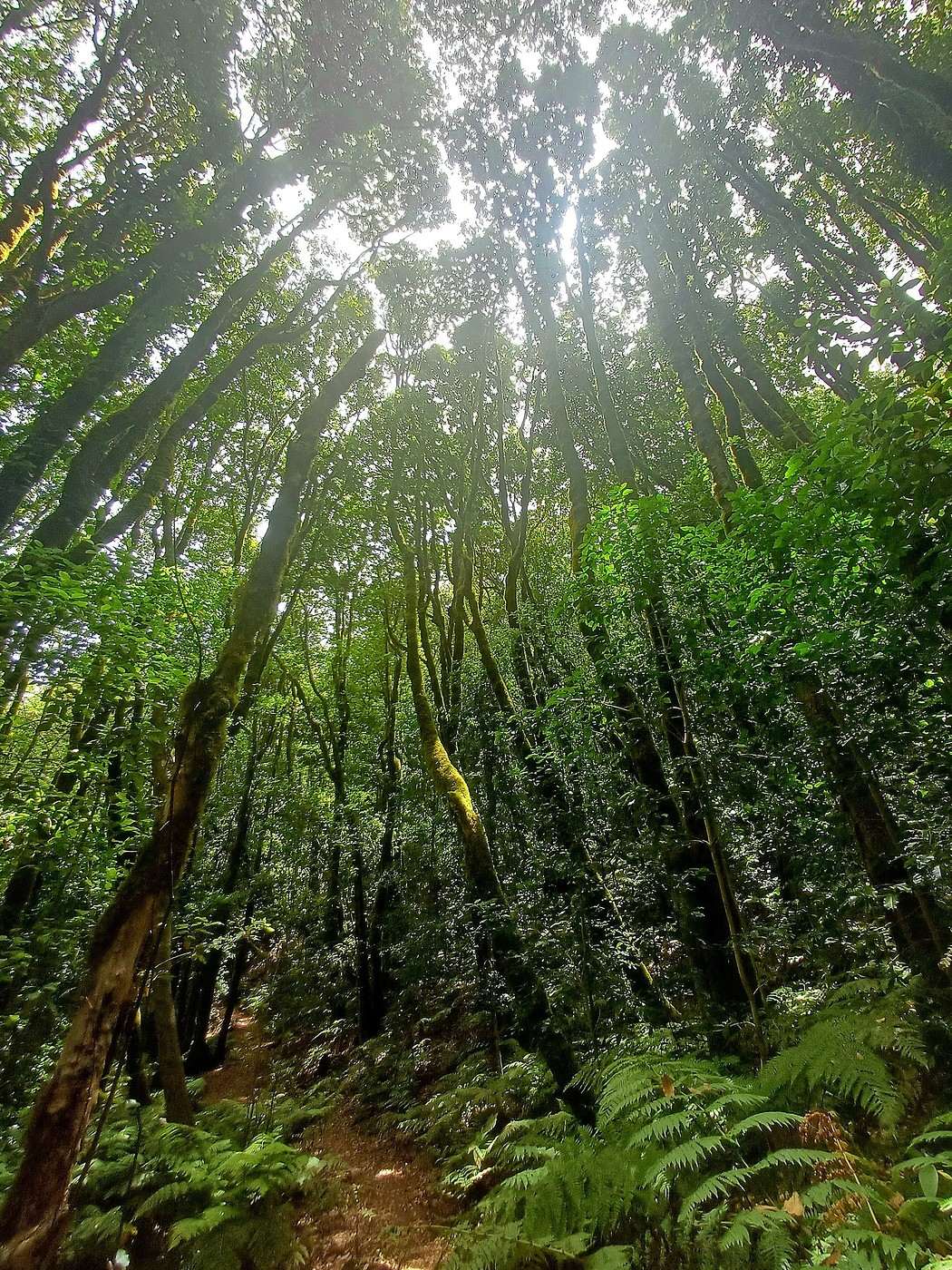
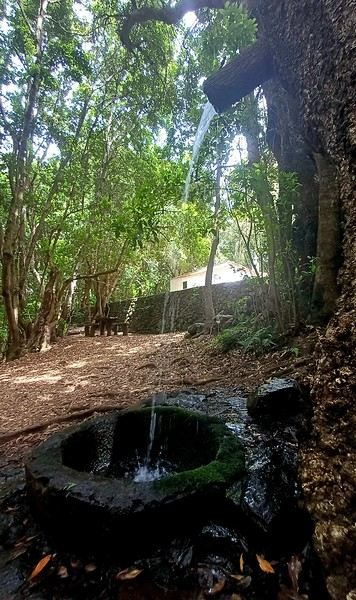
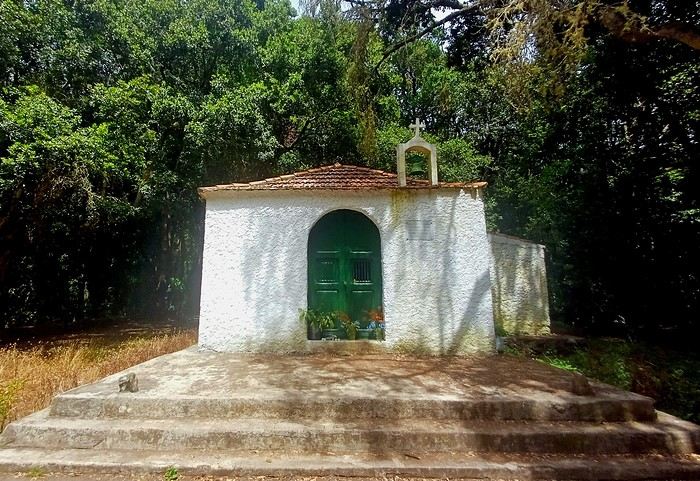
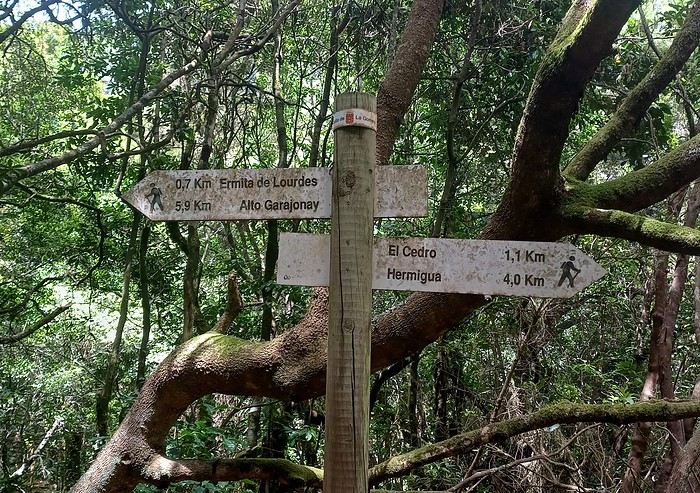
Afterwards, the path becomes increasingly flat, and we come across more small bridges like the first one, then finally, small wooden signs indicating we’re near the chapel of Notre-Dame-de-Lourdes. From there, there are a few more hikers, and we feel like we’re returning to civilization. Indeed, after two hours of walking, we emerge into a sort of clearing. A small fountain flows from a tree, and behind it stands the pretty little white chapel—though it’s closed. It seems many visitors don’t do the full route and arrive here from closer points. Either way, we’re now less than two kilometers from our destination.
 The trail leaves the forest slightly, and we spot the first houses in the middle of nature on the edge of El Cedro and some abandoned farms.
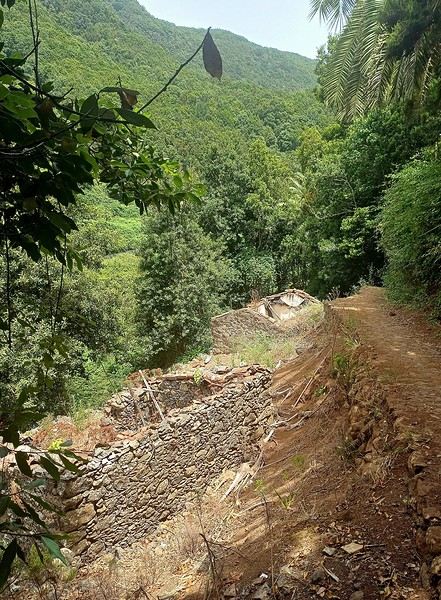
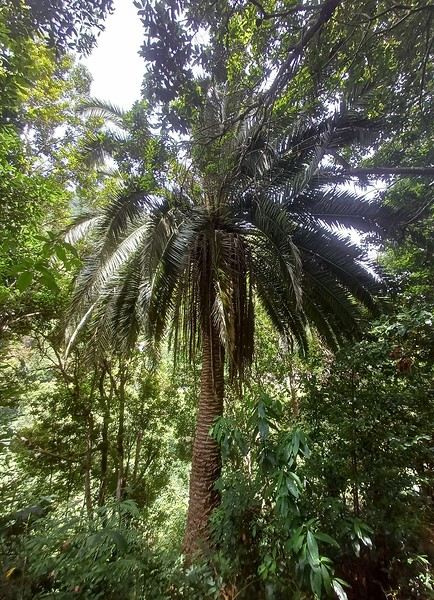
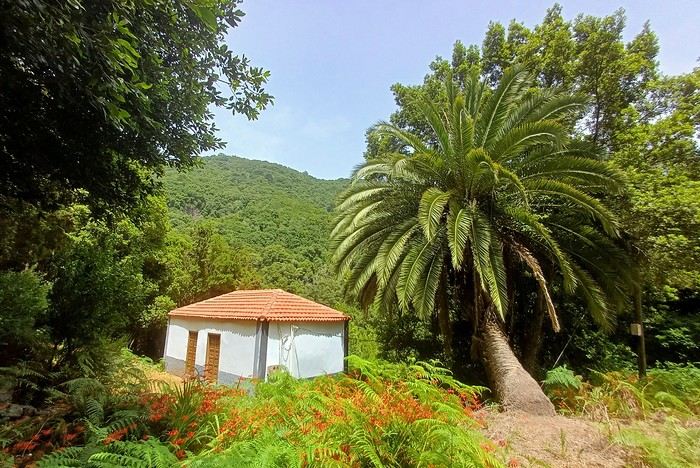 The vegetation clearly marks this boundary: palm trees reappear among the laurels.
Finally, the hamlet, at the entrance of which workers (we see them everywhere here) are building a ditch alongside the track leading up to the main road above. We scan the horizon for the famed Bar Restaurante Camping La Vista, the only restaurant in Garajonay Park, known for its authentic Canarian cuisine. El Cedro appears as a cluster of a few houses in a slightly open spot in the heart of the forest, and just a few more minutes’ walk away, a terrace on a plateau with blue umbrellas in the distance leaves no doubt about our imminent destination. The sun has been beating down since we left the heart of the forest, we’re sweating like pigs, and we’re happy at the thought of sitting down and recharging. It’s still surprising to find such a restaurant on a hiking trail in the middle of a natural park.
The Bar Restaurante Camping La Vista makes its intentions clear at the entrance: "Here, you’ll eat food you may not find anywhere else." It has a large dining room and a big terrace, and contrary to what we imagined, it’s nearly full! There are Spaniards, Germans, and a French family sitting at the large wooden tables—more like picnic benches. It’s actually a very rustic restaurant with deliberately old-fashioned decor, a bit like a big chalet, clearly run by a farming family, judging by the gardens and the sheep and goat pen down below near the camping area. You could compare it to a truck stop if it weren’t in the middle of the forest. Either way, its name isn’t misleading: it offers a beautiful view of the forest and, in the distance, the Hermigua Valley, where we’ll be staying in a few days.
We settle at the last available table inside. It’s too hot outside anyway. The menu is displayed on the wall, listing the house’s Canarian specialties without categorization. The owner and her daughter—whose family resemblance is obvious at first glance—run the place with a firm hand. With a stern demeanor, they juggle between the dining room, the counter, and the kitchen, barking orders at customers in their path in a sharp, authoritative tone. The dishes are really cheap, and they all look tempting. The daughter points out that our order is too big, as the portions are generous. The platters passing by our neighbors confirm this and make our mouths water! We insist on keeping our order anyway because we’re starving and want to taste this delicious traditional cuisine, and the waitress gives in. A few minutes later, we’re presented with a gargantuan Gomeran feast, as authentic as can be: pan y mojo (red and green mojo sauce with half a baguette), carne de cabra (slow-cooked goat meat), garbanzas (chickpea and potato stew), papas arrugadas (wrinkled salted potatoes), potaje de berros (a thick watercress soup typical of La Gomera) served in a traditional wooden mortar with a small bowl of gofio, fries, and of course, fresh blonde Dorada fish...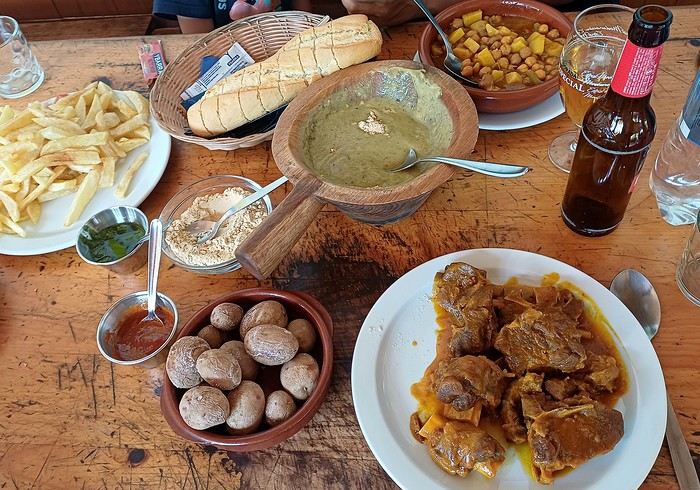
The divine carne de cabra, served in generous portions, melts in your mouth—almost bringing a tear to my eye—and the watercress soup sprinkled with gofio is pure delight. And guess what? We finished it all! Far from being impressed, the owner’s daughter clears our table without missing a beat. Still, we get a few fleeting smiles at the end of service, surely in recognition of having appreciated and finished every last bite. “What are these French people eating?” they seem to think for a second before getting back to work. And to top it all off, with drinks, desserts (yes, we even had dessert—we had to try the tarta de queso!), and coffees, our bill barely reaches 57 €.
We’re feeling heavy and stay at the table a little longer to enjoy the place, which has emptied out a bit in the meantime. It’s also a chance to rest after 6 kilometers of steep downhill hiking, tough on the knees, and to gather the strength to finish the loop on the uphill path. Suddenly, powerful drumming and singing jolt us out of our daze. Without warning, the four people at the next table—two men and two women in their sixties, having just finished their meal—pull out drums and start singing. The four drums play a hypnotic rhythm while the chants are incantations that respond to each other. The haunting sounds evoke a very ritualistic and mystical feeling. Not at all European, the music suggests something both Berber, Sub-Saharan, and pre-Columbian American. We smile, imagining them performing a sacrifice at the summit of the fearsome Teguerguenche, which rises opposite our house. We move closer to their table to listen.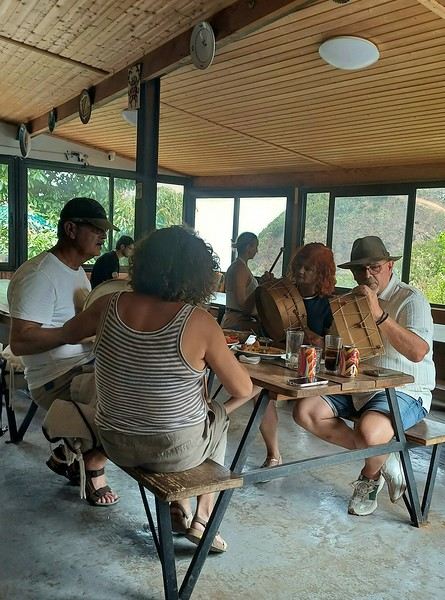
The owner approaches, dancing, and accompanies them with chácaras, Gomeran wooden castanets. I’d read on La Gomera Travel that tambores y chácaras are the emblematic percussion instruments of La Gomera, accompanying all the patron saint processions. It sounds incredibly pagan for a Catholic ritual! A table of Spaniards, annoyed by this impromptu performance, asks the owner’s daughter to make them stop. She finds a compromise and moves them to the back of the room. This doesn’t stop the young Spaniards from showing their displeasure by moving to the terrace with slightly disdainful looks toward the musicians, who couldn’t care less and continue their trance, ignoring them completely. When they pause, I ask if it’s traditional Canarian music. “No, from the Canary Islands, only from La Gomera! We live in Tenerife but are originally from La Gomera.” Indeed, I’d also read that there are more Gomerans in Tenerife than in La Gomera itself, likely seeking more dynamism and jobs other than road maintenance... Clearly, their sense of identity remains strong. They’re thrilled that some French people are interested in their music. There’s an immediate connection between one of them and Théo, a redhead I’d whispered to him was “the witch.” She plays at scaring him, running between the tables, while sensing my interest in the music, she hands me her drum and teaches me the rhythmic pattern (ternary in six beats: three sharp hits, a rest, and two muted ones) so I can join the quartet and take part in the trance. An experience as beautiful as it was unexpected. The owners have traded their grumpy expressions for delighted faces as they watch the scene while clearing tables.
They didn’t explain it to me, but I later read that pilgrims heading to the nearby chapel of Notre-Dame-de-Lourdes walk toward the sanctuary while playing these rhythms, associated with a dance, el baile del tambor, and songs of legends, love, and devotion that survive as a syncretism between Guanche and Castilian traditions. One of the pilgrims even gives us a little demonstration of silbo gomero, the famous whistled language of La Gomera, recognized as UNESCO Intangible Cultural Heritage. It was developed by Gomeran shepherds to communicate over long distances but has its origins among the Guanches: Norman and Spanish navigators described the Canarian natives communicating with articulated whistles. The Castilians later adopted it, adapting it to Spanish. Silbo can adapt to any language because words are whistled to reduce vowels and consonants.
This beautiful musical, cultural, and human exchange is one of the key moments of our trip. But they have to leave, and so do we. After warm goodbyes, we return to reality: it’s already 4 PM, it’s very hot, we’re weighed down by our Canarian feast, and we can hardly imagine Théo hiking the 6 kilometers uphill. There’s no minibus leaving El Cedro right now—maybe not even today. We consider continuing the 4-kilometer hiking trail to Hermigua, where we can find a taxi to take us back to the Pajarito parking lot.
So we have no choice but to ask for a taxi. We make our request to the owner, who picks up her phone: there’s one leaving Hermigua and arriving in 40 minutes. We have no idea how much it’ll cost, but it’s a done deal. We take the opportunity to explore the property and the sheep pen down below.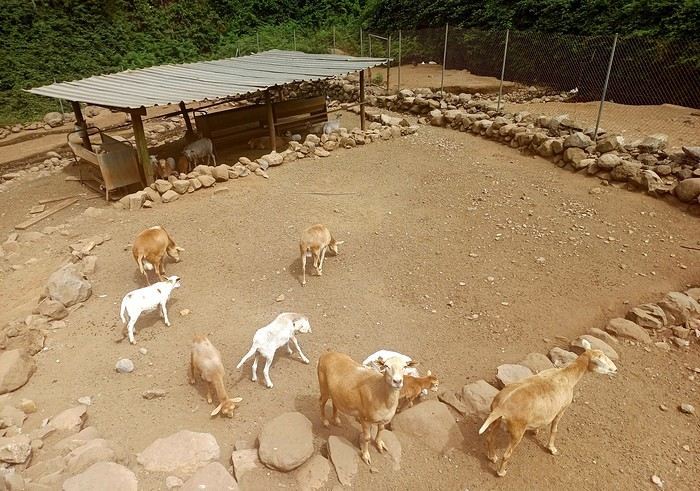
Then our taxi arrives. It takes the only partially paved track connecting El Cedro to the road above, which we reach in a few minutes at Reventón Oscuro, another very popular hiking starting point in Garajonay, then drives the last few kilometers to Pajarito, where our trusty Opel Corsa is waiting. We head back to Valle Gran Rey via the usual route, passing through the beautiful village of La Hayas and its plateau overlooking the misty ocean, then descend the slope with viewpoints starting from Arure down to the coast. Tonight, it’s obviously light snacks and rest. When night falls, the Cory’s shearwaters can be heard in the valley, but they’ve quieted down. Could it be because of the waning moon?
Finally, the hamlet, at the entrance of which workers (we see them everywhere here) are building a ditch alongside the track leading up to the main road above. We scan the horizon for the famed Bar Restaurante Camping La Vista, the only restaurant in Garajonay Park, known for its authentic Canarian cuisine. El Cedro appears as a cluster of a few houses in a slightly open spot in the heart of the forest, and just a few more minutes’ walk away, a terrace on a plateau with blue umbrellas in the distance leaves no doubt about our imminent destination. The sun has been beating down since we left the heart of the forest, we’re sweating like pigs, and we’re happy at the thought of sitting down and recharging. It’s still surprising to find such a restaurant on a hiking trail in the middle of a natural park.
The Bar Restaurante Camping La Vista makes its intentions clear at the entrance: "Here, you’ll eat food you may not find anywhere else." It has a large dining room and a big terrace, and contrary to what we imagined, it’s nearly full! There are Spaniards, Germans, and a French family sitting at the large wooden tables—more like picnic benches. It’s actually a very rustic restaurant with deliberately old-fashioned decor, a bit like a big chalet, clearly run by a farming family, judging by the gardens and the sheep and goat pen down below near the camping area. You could compare it to a truck stop if it weren’t in the middle of the forest. Either way, its name isn’t misleading: it offers a beautiful view of the forest and, in the distance, the Hermigua Valley, where we’ll be staying in a few days.
We settle at the last available table inside. It’s too hot outside anyway. The menu is displayed on the wall, listing the house’s Canarian specialties without categorization. The owner and her daughter—whose family resemblance is obvious at first glance—run the place with a firm hand. With a stern demeanor, they juggle between the dining room, the counter, and the kitchen, barking orders at customers in their path in a sharp, authoritative tone. The dishes are really cheap, and they all look tempting. The daughter points out that our order is too big, as the portions are generous. The platters passing by our neighbors confirm this and make our mouths water! We insist on keeping our order anyway because we’re starving and want to taste this delicious traditional cuisine, and the waitress gives in. A few minutes later, we’re presented with a gargantuan Gomeran feast, as authentic as can be: pan y mojo (red and green mojo sauce with half a baguette), carne de cabra (slow-cooked goat meat), garbanzas (chickpea and potato stew), papas arrugadas (wrinkled salted potatoes), potaje de berros (a thick watercress soup typical of La Gomera) served in a traditional wooden mortar with a small bowl of gofio, fries, and of course, fresh blonde Dorada fish...
The divine carne de cabra, served in generous portions, melts in your mouth—almost bringing a tear to my eye—and the watercress soup sprinkled with gofio is pure delight. And guess what? We finished it all! Far from being impressed, the owner’s daughter clears our table without missing a beat. Still, we get a few fleeting smiles at the end of service, surely in recognition of having appreciated and finished every last bite. “What are these French people eating?” they seem to think for a second before getting back to work. And to top it all off, with drinks, desserts (yes, we even had dessert—we had to try the tarta de queso!), and coffees, our bill barely reaches 57 €.
We’re feeling heavy and stay at the table a little longer to enjoy the place, which has emptied out a bit in the meantime. It’s also a chance to rest after 6 kilometers of steep downhill hiking, tough on the knees, and to gather the strength to finish the loop on the uphill path. Suddenly, powerful drumming and singing jolt us out of our daze. Without warning, the four people at the next table—two men and two women in their sixties, having just finished their meal—pull out drums and start singing. The four drums play a hypnotic rhythm while the chants are incantations that respond to each other. The haunting sounds evoke a very ritualistic and mystical feeling. Not at all European, the music suggests something both Berber, Sub-Saharan, and pre-Columbian American. We smile, imagining them performing a sacrifice at the summit of the fearsome Teguerguenche, which rises opposite our house. We move closer to their table to listen.
The owner approaches, dancing, and accompanies them with chácaras, Gomeran wooden castanets. I’d read on La Gomera Travel that tambores y chácaras are the emblematic percussion instruments of La Gomera, accompanying all the patron saint processions. It sounds incredibly pagan for a Catholic ritual! A table of Spaniards, annoyed by this impromptu performance, asks the owner’s daughter to make them stop. She finds a compromise and moves them to the back of the room. This doesn’t stop the young Spaniards from showing their displeasure by moving to the terrace with slightly disdainful looks toward the musicians, who couldn’t care less and continue their trance, ignoring them completely. When they pause, I ask if it’s traditional Canarian music. “No, from the Canary Islands, only from La Gomera! We live in Tenerife but are originally from La Gomera.” Indeed, I’d also read that there are more Gomerans in Tenerife than in La Gomera itself, likely seeking more dynamism and jobs other than road maintenance... Clearly, their sense of identity remains strong. They’re thrilled that some French people are interested in their music. There’s an immediate connection between one of them and Théo, a redhead I’d whispered to him was “the witch.” She plays at scaring him, running between the tables, while sensing my interest in the music, she hands me her drum and teaches me the rhythmic pattern (ternary in six beats: three sharp hits, a rest, and two muted ones) so I can join the quartet and take part in the trance. An experience as beautiful as it was unexpected. The owners have traded their grumpy expressions for delighted faces as they watch the scene while clearing tables.
They didn’t explain it to me, but I later read that pilgrims heading to the nearby chapel of Notre-Dame-de-Lourdes walk toward the sanctuary while playing these rhythms, associated with a dance, el baile del tambor, and songs of legends, love, and devotion that survive as a syncretism between Guanche and Castilian traditions. One of the pilgrims even gives us a little demonstration of silbo gomero, the famous whistled language of La Gomera, recognized as UNESCO Intangible Cultural Heritage. It was developed by Gomeran shepherds to communicate over long distances but has its origins among the Guanches: Norman and Spanish navigators described the Canarian natives communicating with articulated whistles. The Castilians later adopted it, adapting it to Spanish. Silbo can adapt to any language because words are whistled to reduce vowels and consonants.
This beautiful musical, cultural, and human exchange is one of the key moments of our trip. But they have to leave, and so do we. After warm goodbyes, we return to reality: it’s already 4 PM, it’s very hot, we’re weighed down by our Canarian feast, and we can hardly imagine Théo hiking the 6 kilometers uphill. There’s no minibus leaving El Cedro right now—maybe not even today. We consider continuing the 4-kilometer hiking trail to Hermigua, where we can find a taxi to take us back to the Pajarito parking lot.
So we have no choice but to ask for a taxi. We make our request to the owner, who picks up her phone: there’s one leaving Hermigua and arriving in 40 minutes. We have no idea how much it’ll cost, but it’s a done deal. We take the opportunity to explore the property and the sheep pen down below.
Then our taxi arrives. It takes the only partially paved track connecting El Cedro to the road above, which we reach in a few minutes at Reventón Oscuro, another very popular hiking starting point in Garajonay, then drives the last few kilometers to Pajarito, where our trusty Opel Corsa is waiting. We head back to Valle Gran Rey via the usual route, passing through the beautiful village of La Hayas and its plateau overlooking the misty ocean, then descend the slope with viewpoints starting from Arure down to the coast. Tonight, it’s obviously light snacks and rest. When night falls, the Cory’s shearwaters can be heard in the valley, but they’ve quieted down. Could it be because of the waning moon?