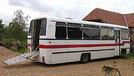
So many people think what gasmobil wrote, but he probably said it out loud to avoid the comments...
Anyway, I think I can speak for him by saying he’s totally comfortable with his profession—otherwise, he wouldn’t have mentioned it! He could’ve just said he was a bus driver in Marseille, for example!
As the song goes, "to each their own life, to each their own path, and the cows will be well looked after!" (!)
For your door and emergency exits, only trust the post I shared on page 19 of this thread. All the mine documents talking about driver doors concern motorhomes under 3.5 tons or less than 12 m²—so that doesn’t apply to us.
Don’t forget that the best way to handle the mine regulations is to work with the current standards, bring your vehicle and the rules, and ask the inspector to do their job: INSPECT IF YOUR WORK MEETS THE STANDARDS.
One point, one hole!
There isn’t a single department where the mine engineer speaks the same language as their neighbor. As advice goes, they’re clueless—it’s way too specific!
Alright, here’s a little brain-teaser gift!
This is the regulation about seats and seatbelts. I’m not including the annexes.
Check out Article 9, paragraph 2. It means that if you take a coach, convert it into a camper, and use seats and seatbelts that have already been approved as seats and seatbelts in a previously approved vehicle and they’re installed correctly (so you can bolt a 5-seat Neoplan lounge into a Heuliez without needing a crash test), as referenced in paragraph 5 of Directive 76/115/EEC! Happy reading.....
Shall we chat about this (and the rest?) on the 16th/17th? Does it make you want to come? Don’t be shy—sign up for the weekend in Drôme for converted vehicles!
PATRICK26
Art. 1. - The following international category vehicles must comply with the provisions of Directive 74/408/EEC as last amended by Directive 96/37/EEC, Directive 76/115/EEC as last amended by Directive 96/38/EEC, and Directive 77/541/EEC as last amended by Directive 96/36/EEC, within their respective scopes and under the conditions set out in the table below:...................................................
You can consult the table in the Official Journal no. 0294 of 18/12/96, pages 18622 to 18623.....................................................
Art. 2. - Second-hand seats intended for vehicles approved under Annex III of Directive 74/408/EEC as last amended by Directive 96/37/EEC and sold from 1 October 1999 must comply with the provisions of said directive.
Art. 3. - For the application of Articles 1 and 2 of this order, it shall be considered that: the provisions of Regulation No. 14 are equivalent to those of Directive 76/115/EEC, except for its provisions on the minimum number and location of anchorage points in M2 and M3 category vehicles; the provisions of Regulation No. 16 are equivalent to those of Directive 77/541/EEC, except for its provisions on the installation of seatbelts; the provisions of Regulation No. 17 are equivalent to those of Annex II of Directive 74/408/EEC, except, where applicable, for its paragraph 3.3.3 and headrest heights for rear seats; the provisions of Regulation No. 80 are equivalent to those of test 1 of Appendix 1 and Appendices 2 to 5 of Annex III of Directive 74/408/EEC.
Art. 4. - In accordance with the provisions of Annex XI of Directive 70/156/EEC, the provisions of Article 1 of this order apply, for motor vehicles converted into motor caravans, only to seats intended for normal use when the vehicle is traveling on the road.
Rear seats of motor vehicles converted into motor caravans with a maximum authorized weight exceeding 2.5 tons may in all cases be equipped with only two anchorage points and lap belts. Furthermore, if these vehicles are built in several stages, they may only comply with the provisions of Directives 74/408/EEC, 76/115/EEC, and 77/541/EEC applicable to N category vehicles of the same maximum authorized weight.
Separate headrests installed above the rear seats of motor vehicles converted into motor caravans are exempt from the requirements of Annex II of Directive 74/408/EEC and those of Directive 78/932/EEC.
Art. 5. - The seatbelt anchorages of the rear seats of N category motor vehicles built in several stages and converted into double cabins or extended cabins may, given the specific design and construction characteristics of these vehicles, not comply with certain provisions of Directive 76/115/EEC, particularly regarding their strength and location,
provided that the minimum number of required anchorages is respected.
Art. 6. - For the purposes of national type-approval and individual approval of M3 category vehicles, seat anchorages shall be considered as complying with the provisions of paragraphs 4.1 and 4.2 of Annex III of Directive 74/408/EEC if the seatbelt anchorages are placed directly on the seats and these seatbelt anchorages meet the requirements of Directive 76/115/EEC, where applicable with the derogation provided for in point 5.5.4 of Annex I of this directive.
Art. 7. - For M2 category vehicles with a maximum authorized weight exceeding 3.5 tons and M3 category vehicles type-approved before 1 October 1998, compliance with the provisions of Article 1 of this order shall be presumed, under the manufacturer’s responsibility, if the seats and their anchorages comply with the provisions of Regulation No. 80 and are equipped with two- or three-point seatbelts approved in accordance with Regulation No. 16, without verification, during the approval of seatbelt anchorages, of the compatibility between seats and seatbelts (determination of the number of points and requirements for seat installation), nor, where applicable, of the restraint system itself.
Art. 8. - For the purposes of individual approval of used vehicles without a registration certificate, the requirements applicable to seatbelt anchorages, seat strength and anchorage, and seatbelts and restraint systems are as follows: requirements applicable to vehicles first put into circulation at the date of approval, in the case of coaches; requirements applicable at the presumed or proven date of first circulation of the vehicle to be approved, for other vehicles.
Art. 9. - For the approvals provided for in Articles R. 106 to R. 109-9 of the Highway Code, the documents usable for assessing vehicle compliance with the provisions of Articles 1 to 8 of this order are as follows:
1. Complete or incomplete vehicles: for EC type-approval: EC type-approval certificates or ECE homologation certificates; for national type-approval: the documents mentioned above, or test reports issued by laboratories approved by EU Member States or parties to the agreement establishing the European Economic Area under Article 14 and Annex IV, points 15, 19, 31, and 38 of Directive 70/156/EEC, or direct verification by the approval officer in cases under Annex IV of Directive 74/408/EEC not requiring testing; for individual approval: the documents mentioned above, or a manufacturer’s statement comparing the vehicle with an already approved type.
2. Completed vehicles (converted in several stages): documents relating to the approval of the base incomplete vehicle insofar as its compliance with the provisions of Articles 1 to 8 is preserved, in whole or in part, during its conversion; additional documents to the above, relating to the completed vehicle, taken from the list in point 1 above.
Art. 10. - The following provisions are repealed as of 1 October 1999: Order of 17 May 1977 on the strength of foldable or removable rear seats in passenger cars; Order of 23 September 1982 on seatbelt anchorages for adult occupants of motor vehicles; Order of 24 September 1982 on seatbelts for adult-sized occupants of motor vehicles.
Art. 11. - The Director of Road Safety and Traffic is responsible for the execution of this order, which shall be published in the Official Journal of the French Republic.
Done in Paris, 5 December 1996.