Converting a heavy-duty bus/coach/truck into a motorhome
FR

Translated into English.

GX GX47 Regular ·
HAPPY NEW YEAR AND GOOD HEALTH TO ALL😛

😮I think there's confusion about the heating question: in bypass or in series—actually, in relation to what? The engine cooling circuit or in relation to another cabin heating radiator?🤪

So to start the year off right, here's a response addressing both assumptions (please try to be clear and precise in your questions—it avoids confusion, off-the-mark answers, and contradictions, thanks everyone!)😇

Water-circulation heating on any vehicle with a thermal engine and water cooling IS IN BYPASS relative to the engine cooling circuit; however, all the cabin heating radiators on a coach can be arranged to follow one after the other (in series) BUT NOT in series with the engine circuit.🏴‍☠️

Follow the hoses and you'll understand (you start from the water pump in bypass via a much smaller hose than those in the engine cooling system, then go to a kind of regulator valve controlled by the heating lever, then to the first cabin radiator, you exit it, go to the second cabin radiator, etc... and from the last one you return to the engine via a second bypass placed on the engine block, the cylinder head, or the engine radiator)

There you have it.😛 GX47

A little New Year hello to Patrick who had the great idea of starting this POST thanks to which lots of things are getting clarified😉
GX47

ex transformation, homologation et utilisation d'un car en CC 9places route en utilisation pro. Plus un CC 6pl VL, plus un fourgon en cabine approfondie 6 pl VL. si je peu aider...
S4 S4rpierrot ·
Best wishes to everyone, Okay, I get it—forget the bus, long live the coach 😉. Plus I've got two good opportunities up my sleeve. But in a coach, when I'm not doing passenger transport, if for example I want to take a family trip for a week, can I remove some seats to make space, like to put a mattress or whatever? (I can't remember who did it anymore, but someone flipped some seats around and removed others to put tables in their place—is that allowed?) On the other hand, I can't find anything online about insurance for that. If anyone has any information... And can you tell me how much the annual technical inspection costs? (to make an amortization schedule for the club) I saw photos of a 1957 Saviem ZR20, it's really beautiful—it must be nice to restore something like that. Has anyone come across one when looking for used buses? Thanks for everything and have a good day. pierrot
TH Thmou ·
Hi,

I also live in an S53 registered motorhome. For the heating radiators on my S53, all the radiators are in series, and the series of radiators is in parallel on the cooling circuit. In summer you can close the 2 valves on the right of the engine compartment next to the air filter.

Also, on my S53 the framework is corroded by rust on the part under the rear trunk (the last meter of the bus). Is this serious for the annual inspection? How do I repair it? Should I consider replacing some sections with new welded square tubes?

Happy New Year to everyone and good health to your buses.
BE Benhurd ·
You can change your vehicle's layout and add tables (the tables need to be well secured and rounded on the corridor side!). But after the modifications you'll have to update your registration document - all commercial trucks have one, but not VASP vehicles (the technical inspection centers handle that, I think!!).

But if it's just for occasional use, obviously it gets more complicated.

For insurance, I'm with AXA (they handle heavy trucks normally). I pay 500 euros for my bus which will be reclassified as VASP (it's the same price for me, but I think the insurer gave me the VASP rate directly without going through the bus rate even though the registration is still listed as a bus (not for much longer, I'm waiting for the paperwork any day now).

Reply to thmou:

Thanks for the info about the tap. For the grille you'd be better off having it repaired.

To repair or modify a grille, only specialized companies are authorized to do it. There are 2 solutions: Either have a transport company do it (like a regional transport one that's used to doing it) - in that case you get an invoice!

Or do it yourself or with a friend (but it has to be done well) and if anyone asks you (unlikely if it's done well) you say you bought it like that!!
BE Benhurd ·
So it's January 7, 2004 at 11:55 AM and I just received my official reception document as an individual case!

I don't know how to express my joy here

Yay!

In a beautiful S53 classified as VASP!!

Well, champagne at noon!!!

And I thank everyone here whose messages helped me accomplish my project: albator, patrick, sptnick, ... and everyone else

Thanks to all!!!
FA Fanou56 ·
Hey everyone! It's been a while since I've been online — I was busy setting up a new camper truck. It's now for sale: a 1989 Renault M140 with 603,000 km, fully converted (I live in it full-time). The truck body is 6.5m × 2.4m × 2.2m, and the tires are good. I'm selling it for €4,000 as-is, or €5,000 completely finished (interior and exterior paint plus some finishing touches). It can be viewed in Lorient, and I'll send you photos soon! Talk soon!
PA Patrick26 Veteran ·
A proverb says that perseverance and patience are the key words to assured success!

You'll find below the new directive from the Ministry concerning converted heavy-duty vehicles.

I went all the way to the Ministry so that a directive harmonizing the approvals of vehicles like ours would be made at the top level. Finally it came out after more than a year of fighting! (I'm very proud to have made them back down at the national level! I don't like people messing with me and pushing me around, PATRICK26!)

Here's the document.

Notably, see section 3.6.2.2.2 for doors, where a nice "or" has been added compared to the previous directive I had posted online. For furniture, the 3.2 mm radius is no longer mandatory if absorbent materials are used. The only point where we lose a bit is the water tanks. Indeed, on heavy-duty vehicles, some authorities accepted 1000 liters without baffles — that's over. Everything else is great!

Good reading to all. (In parentheses, you'll find my annotations)

Ministry of Infrastructure, Transport and Housing

Road Safety and Traffic Department

Circular No. 27790

Note to Mr. Regional Directors of Industry, Research and Environment

SUBJECT: Approval of motor vehicles converted into motorhomes

The evolution of European regulations, in particular those of Directive 70/156/CEE as amended, relating to the approval of vehicles and CEN standards concerning motor vehicles converted into motorhomes, requires me to modify the circulars relating to motorhome approval.

Therefore, when approving motor vehicles converted into motorhomes, I ask you to apply, effective immediately, the provisions attached to this note, which incorporate these changes and repeal and replace those of my note No. 4419 of July 22, 1981 and those dealing with the same subject.

The Chief Mining Engineer in charge of the sub-directorate B. GAUVIN

APPENDIX Technical Prescriptions

I - Definitions For the purposes of this circular, the following terms are understood to mean:

1.1. Motor vehicle converted into a motorhome: (See: definition of "motor caravan" given at point 5.1. section A annex II of Directive 70/156/CEE as amended by 98/14/CEE).

"Motor-home" means a special-purpose vehicle of category M, designed to be usable as living quarters and whose living compartment comprises at least the following equipment: (motorhome for light vehicles, motor-home for heavy vehicles, category M)

- seats and a table, - bunks obtained by converting the seats, - a kitchenette and - storage space.

This equipment must be permanently installed; however, the table may be designed to be easily retractable.

1.2. Driving cabin: The space where the driver and possibly one or more passengers are located during vehicle movement.

1.3. Living area: Living space located behind the rear partition of the driving cabin. When it is not possible to define the position of this partition, the living area is defined by the vertical plane located 5 cm behind the driver's seat back.

1.4. Empty weight and useful load: Empty weight in operating condition: see definition in Directive 70/156/CEE as amended by 98/14/CEE Useful load: see definition in Directive 95/48/CEE

1.5. Cab-over Possible space defined by the body above the driving cabin.

2 - General Provisions:

2.1. Motor vehicles equipped permanently with a living area are classified as "VASP" type and body "Motorhome". Motor vehicles equipped with a removable living area must be approved with the dual type: "Van (or Truck) / VASP" and dual body "Flat-bed (or...) / Motorhome".

2.2. In all cases, motor vehicles converted into motorhomes must comply with articles R 54 to R 61, R 69 to R 94, R 97 to R 104.1 of the Road Code and the regulations implementing them.

3 - Prescriptions

3.1. The motor motorhome, although classified as category M, may have a light-duty base; however, this must comply with the provisions of annex 11 of Directive 70/156/CEE as amended by 98/14/CEE. (N = light-duty, M = heavy-duty)

3.2. Load distribution: The load distribution must be such that none of the vehicle's axles bears a weight greater than that indicated by the chassis manufacturer, except with authorization obtained from the motor vehicle manufacturer. In this case, the corresponding regulatory test reports must be provided.

3.3. Seat belts See article 4 of the decree of December 5, 1996. However, for a transitional period set until March 1, 1999, the provisions of article 5 of this decree shall apply. (no seat belts for heavy vehicles before March 1, 1999)

3.4. Driving cabin cutting New test reports for seat belt anchors are not necessary when the cabin cutting has been carried out in accordance with the plan(s) provided or approved by the base vehicle manufacturer and/or its requirements, or when it has been carried out in accordance with the conversion company's plan approved by the base vehicle manufacturer.

3.5. Seating 3.5.1. - The transport of persons is not authorized in semi-trailers converted into motorhomes.

3.5.2. The number of seats in the vehicle will be modified if necessary on the registration document. However, the number of seats mentioned on the registration document of a vehicle with a removable living area must be that of the vehicle not converted into a motorhome. In this case and subject to compliance with motorhome provisions, the note "number of seats in VASP/Motorhome: X" defining the number of seats in the vehicle converted into a motorhome must be specified as a special note on the registration document. (future return to light-duty classification finally possible)

3.5.3. Seats to be used while the vehicle is traveling on the road must be designated by a pictogram or label, or their location must be specified on a plan in the user's manual. Lateral benches of max 2 adjacent seats don't need to be made with approved seats—a sofa can serve that purpose)

3.6. Doors and emergency exits

3.6.1. General case Motor motorhomes must have visual and audio communication between the driving cabin and the living area. A bathroom door with an emergency exit is not considered to obstruct the emergency exit.

3.6.2. Motor motorhome built from a cab chassis, cab floor, bare chassis, or motor motorhome whose body is that of the base vehicle approved:

3.6.2.1. The door providing access to the living area must have the following minimum dimensions:

3.6.2.1.1. Motor motorhome of more than 12 m² overall area: height: 1590 mm, width: 480 mm.

3.6.2.1.1. Motor motorhome of 12 m² or less overall area: height: 1140 mm, the clear opening free of any obstruction must be equal to or greater than 0.65 m².

3.6.2.2. - Vehicles must have access doors and emergency exits according to one or the other of the following configurations, namely:

3.6.2.2.1. : - one access door to the driving position on each side; - and one access door to the living area located on the right side or at the rear; - and an emergency exit on another face having no access door to the living area with an area of 2,500 cm² with a minimum dimension of 450 mm.

3.6.2.2.2. : - One access door to the cabin on the driver side and an emergency exit located on the opposite side with an area of 2,500 cm² with a minimum dimension of 450 mm, or an emergency exit on each side of the driving position with an area of 2,500 cm² with a minimum dimension of 450 mm; - and one access door to the living area, located on the right side or at the rear; - and a clear passage of 2,500 cm² with a minimum width dimension of 450 mm between the front cabin and the living area; - and an emergency exit of 2,500 cm² with a minimum dimension of 450 mm located on a face having no access door to the living area.

3.6.3. Motor motorhome of 12 m² or less overall area whose body is that of the base vehicle approved The driving cabin access doors, the lateral access door to the living area, the rear door or tailgate are considered satisfactory emergency exits if there is no partition between the cabin and the living area.

If only the lateral door or rear door provides access to the living area, an emergency exit, with an area of 2,500 cm² with a minimum dimension of 450 mm, located on a face having no access door to the living area is necessary; otherwise the number of seats is limited to that of the driving cabin.

3.6.4. The hinges of lateral pivoting doors, located on the side of the vehicle, must be fixed toward the front in the direction of travel. In the case of a double-door, only the leaf that opens first has hinges complying with this requirement; the other leaf may be locked.

3.6.5. The locks of the original doors of the base vehicle already approved by type whose body has not been modified at these openings are considered satisfactory. In this case, there may be no immediate opening possibility or intermediate locking position.

3.6.6. External doors must not open inward. The closing of external doors must allow them to be opened instantly from the inside, even when locked.

3.6.7. The closing of a lateral door whose access is facilitated by a step extending beyond the vehicle's overall dimensions must cause automatic retraction of that step within the overall dimensions. Otherwise, a warning system with a visual or audible indicator on the dashboard indicates that the step retraction was not performed.

3.7. Windows and glazing

3.7.1. The windshield must be approved laminated glass; other glazing must be approved glass or plastic. Non-approved glazing is tolerated only for the equipment of a skylight or a sanitary compartment. For plastic glazing, information must be provided to the user to not use solvent-type cleaning products (such as alcohol, etc).

3.7.2. Windows may be of the sliding, projection opening, or lowering type. For glazing with permanent opening, information, in the form of a label for example, must be posted near the driver.

3.8. Interior fittings

3.8.1. Interior fittings must comply with the decree of 19/12/58 relating to vehicle fittings.

3.8.2. The parts located near seats used while traveling must not have sharp points or sharp edges. The edges of elements surrounding seating during vehicle movement must have a radius of curvature of at least 3.2 mm or must be covered with energy-absorbing materials.

3.8.3. Kitchen shelves as well as bases and upper shelves of cabinets must be equipped with means to prevent their contents from sliding outward.

External storage doors must not be capable of opening accidentally during normal vehicle movement, including in case of hard braking; moreover, the open locking position is only possible when the door is held parallel to the body.

3.8.4. Each liquid reserve, other than the fuel tank, of 100 liters or more, must be equipped with a baffle on at least 50% of the tank's cross-section, limiting each compartment to a maximum of 100 liters.

3.8.5. At least a 1 kg fire extinguisher, of the multipurpose powder type, bearing the conformity mark with standards (NF - MIH or NF - MIC or equivalent), must be installed on board the vehicle.

3.8.6. The fittings of the living area of the vehicle must comply with standard NF S 56 200 insofar as its provisions are not replaced by one or more CEN standards that cover the same field of application. In this case, these latter constitute the normative reference. The manufacturer or converter certifies compliance with standards by a declaration and for this purpose affixes a label in the living area. (the manufacturer can be a private individual, no certification required)
DO Doubledeck ·
Hello everyone,

I'm brand new to the site.

I'M LOOKING FOR A MOTORHOME BUS OWNER IN THE AIX-MARSEILLE REGION FOR A BURLESQUE FILM SHOOT, if possible an English double-decker bus, a Routemaster, double-deck.

THE BUS WILL NOT RUN!

If I can't find an English bus, a coach will do, but I'm not giving up...I'm going to get my English bus!

This is a serious announcement—a bus already immobilized in a field would be PERFECT! Reimbursement provided. HAVE A GREAT DAY EVERYONE......and THANK YOU for being CRAZY!
GX GX47 Regular ·
Thanks a lot, master😎 (patrick26)

By the way, did you finish your original project?
GX47

ex transformation, homologation et utilisation d'un car en CC 9places route en utilisation pro. Plus un CC 6pl VL, plus un fourgon en cabine approfondie 6 pl VL. si je peu aider...
PA Patrick26 Veteran ·
For your search for English buses, there's a company that rents them and has old ones in their fleet. They're located north of Clermont-Ferrand and have a website.

You should be able to find their address by searching online with "double-deck" "double-decker bus" ...

Good luck

PATRICK26
LA Langeblanc ·
Hello, first and foremost, I wish you a wonderful year 2006 filled with health, success in all your projects, love, and great happiness.

I'm writing to you because I'm planning to buy a double-decker bus that I'd like to convert into an office + living space...

Could you help me with the following: * What are the legal requirements to drive a bus converted into living quarters?

* The bus is coming from England - what do I need to do about the vehicle registration documents?

* I only have a 19-tonne heavy goods license - will I be able to drive the bus without problems?

Thank you very much for any information you could provide about my project. You can easily reach me at this email address: eden.angel@freesurf.fr

Thanks in advance, looking forward to hearing from you.

Didier
UN ANGE PASSE....
PA Patrick26 Veteran ·
I've already given a detailed take on English double-deckers in another forum thread!

All the mechanics are in inches and whatnot, so you throw away your toolbox and order a specific one from Facom (minimum 2000 euros)

For parts it's Leyland or DAF (easy, right!)

These vehicles are dead weight and they don't move (city gearbox, 70km/h)

It guzzles fuel like a ship

Most are in terrible condition

It weighs 14 tons empty, so once converted, be careful to stay below 19 tons

Anyway, it looks quirky, but nothing but trouble ahead!

But some people love it! And for registration, you're not done... and me? I wouldn't attempt it!

For a double-decker, look more at Volvo or VanHool.

PATRICK26
DO Doubledeck ·
Thanks Patrick for your response, I'm going to check Clermont-Ferrand online... thanks again! Have a good day
FU Funbus ·
Hi Patrick,

I also work in setting up and taking down stands, events, and large screens throughout Europe, and I own several equipped vehicles (www.promologe.be) and I'm looking to combine the two.

Also, if you need qualified personnel or special equipment, don't hesitate to contact me;

raphael (e-mail:info@promologe.be)
PA Patrick26 Veteran ·
Hi GX (I learned above that's your first name!...)

our bus is moving along, the metalwork is done (metal sheets welded where the windows were, reinforcements installed to frame the raised sleeping areas and bathroom, steel 40x40 load-bearing partition x2 in place, mechanical overhaul complete, the 6 new tires mounted, ......)

I was waiting to be sure about the door; we had 2 interior layouts planned and whether it was required determined which one we'd go with.

so we're moving on to the storage compartments and onboard equipment. generator, Webasto for heating and hot water production, 60L water heater (virtually instantaneous for 40-degree output), additional batteries (2 x 450 Ah), grey water (600L) and black water (120L) tanks, gas cabinet for 2 Twinnys (we ditched LPG since gas will only be used for cooking from now on), .....

most of the equipment is already here, just waiting to be installed...

interior fitout comes last. it's true, it's the simplest part for my team (just to remind you we work in exhibitions and custom stands). to reduce risks, the electrics don't run through the storage (keeping water and electrical systems separate). 1000 liters of fresh water, 7 seats for driving and sleeping, U-shaped lounge, compressor fridge on a 400Ah battery and solar panel, 19-inch flat screen with remote connection at seat level for connecting a PC or gaming console, bathroom with 80x100 cm shower, marine toilet, etc....

being a customer with an account at Trigano Motors' purchasing center (Euro Accessoires) which is 10 km from my place, it makes it that much easier to progress step by step.

hope I've answered your question...

PATRICK26
SK Skylarck ·
I'm looking for plans and photos of camper conversions. Any suggestions for setting up a truck bed camper?

Thanks in advance!!
sky
GX GX47 Regular ·
Hi Patrick, 🙂

Thanks for your reply—big project and especially a unique model; you'll be the first to have it officially certified as such. I had the same project in mind (a limited living section and a rear equipment area, which is why I got a GX47 because of the door that acts as a rear wing and sits completely on the back face). But given the troubles from DRIRE (unique model, never yet done in France, etc...problem with the 2nd exit), and based on advice from the person we probably both know (the great guru at Heuliez), I ended up settling for a simple "motorhome" with lots of shelf storage. I'd wanted the designation "truck lodging and equipment," but now that I have my registration, I'm gently reworking my plans at my own pace, and I plan to go back to DRIRE in about 3 years. I'll get in touch with you in about a month. Take care GX (I'll explain to you why for now it remains my first name on the site) 😉
GX47

ex transformation, homologation et utilisation d'un car en CC 9places route en utilisation pro. Plus un CC 6pl VL, plus un fourgon en cabine approfondie 6 pl VL. si je peu aider...
TR Trompt ·
Hi Patrik! I'm new to this site, and thanks to everyone for all the questions and answers here. I've decided that in June, after 3 years of daily camper van life, I'm going to treat myself to something I've wanted since I was 17 — a SAVIEM! Mine's an S53R. And I have a question... about the driver's door, of course haha... would window stickers and their adhesive markings be acceptable under DRIR tolerance if everything else is perfect? I have to admit, hihi, all that's left is the woodwork finishing, getting a certified electrician's inspection for a compliance certificate, and the plumber for the labor (I don't have the skills for that), plus his certificate. Do you know any lenient DRIR addresses? (But don't worry, my project should be done by end of May anyway.) And what would it cost? Let's say there's a failure... rejected at VASP caravan, say; is there a re-inspection? If yes, great; if not, who can I turn to for an initial assessment, and what standard documents do I need and where can I get them? Sure, lots of questions all at once, but you seem really knowledgeable on this subject... anyway, here I am registered now and I'll try to be useful to everyone I can help. See you later and thanks!
TR Trompt ·
Hey kalifamily! Here's my advice on floor heating — try to keep them in your setup, they'll definitely be useful. And what a pleasure, after thousands of hours driving in winter, to get back to your living space already heated before you have to relight the gas! But if you're keeping them, remember (you don't really have a choice anyway) not to block their air intake. If you're building them into a closed structure like under a sofa, bunk bed, or cupboard, it's better to seal it airtight with a ventilation grille opening outside. If you remove them all, no problem — just connect the hoses from the heating unit and run the power cables back to where they started, then remove them. And if you're keeping some, connect the hoses under the floor — it's a series circuit. Quick tip: if your setup isn't finalized yet, take them out and store them carefully. You'll figure out what to do with them later. Leave the hose sections sticking out on the floor but protect them from dust, etc.
TR Trompt ·
Hey gx47, I read in your profile that you're really into old vehicles. What's your take on SAVIEM? I have a photo I'd like to know more about — exact type and another shot from the same series. Can you help me out? Thanks
GX GX47 Regular ·
Hey trompt, I'm not an expert on Saviem🤪, but go ahead and send your photo—I'll try to help you out as best I can. For the model type, I'll need the serial number. cheers
GX47

ex transformation, homologation et utilisation d'un car en CC 9places route en utilisation pro. Plus un CC 6pl VL, plus un fourgon en cabine approfondie 6 pl VL. si je peu aider...
TR Trompt ·
Hi gx47, that'd be really awesome if you could check this out—I'll send it your way ASAP. It's at my place (in the bus) and I'm borrowing internet from a friend at the moment. But anyway: when are we gonna get internet in a truck?!! Does anyone have a solution?
FR François57 Regular ·
so for internet in a truck: 2 solutions.

look around for someone who hasn't secured their WiFi, or try near universities on campuses—WiFi is available in some spots, or there's a pricier option if you've got a phone subscription at home: Bouygtel's EDGE PCmcia card. EDGE is also available on mobile phones but I don't know how to get it working on the computer.
DO Dominique30 ·
Great info!

I've learned a lot on this site, but this time I have a more specific project and I'd like to know if I'm on the right track (since I live on a boat and I'm not used to buses...).

I founded an association of about 50 artists and Rhône enthusiasts, and we're being invited further and further away (Belgium, Holland)... at our own expense. We thought about buying a tour coach. Luckily, our president worked in this sector and has his license.

We could transport about forty people and keep maximum space for setting up an exhibition (documents, paintings, small objects in display cases).

I'm considering a SETRA S228 (single deck). Planned budget: €50,000 with conversion, which we're trying to get subsidized and sponsored locally... Apparently we'd stay in TCP, with a category D license and inspections every 6 months? Who should we contact besides DRIRE? Is it possible to put the application together without a professional converter? What would roughly be the annual budget excluding fuel costs?

Any answer or remark is welcome, thanks in advance 😄
l'union fait la force !
FR François57 Regular ·
I now have my SAVIEM S53R. I haven't paid for it yet but I want to transport it.

I need to insure it. First problem: I haven't found insurance covering heavy vehicles for private individuals. Second problem: heavy vehicle insurers only cover professionals.

How do I insure my 1984 S53 (TCP category) at the lowest cost? Given that I can convert it to an unspecified VASP within about two months, if you have any contacts, I'd appreciate them.

I'm asking for help from anyone who's tried this. Given that I'm 25 years old with a 25% bonus (coefficient 0.75) and am already insured for my vehicle, I've met campervan owners who are insured for 60 to 150 euros per year and I'd like to know if that's realistic.

Furthermore, I'm turning to patrick 26 (aka the sage) to understand the pitfalls of the double conversion. My campervan conversion will take me more than a year, but with a Class C license I need to reclassify it ASAP—first to an unspecified VASP and not a motorhome VASP. The DRIRE tells me "a box truck," "don't worry, there'll always be a solution"... but they're asking me to bring the bus to their site, and I don't want to make 50 pointless trips back.

Given that my goal is simply to remove what's unnecessary—keep 1 or 2 rows of seats (which originally have no seat belts, plus the driver's seat) without installing a load-stop partition—do you have references to text similar to motorhome regulations, namely the same kind of circular you posted above?

Given that on the S53 there's a wall behind the driver that could serve as a load stop, I could also remove all the passenger seats, but as a last resort, since I plan to transport a few passengers during my trips.

Thanks
GX GX47 Regular ·
Don't do this. Before anything, make absolutely sure with your DRIRE that they'll approve it twice. It's easier to convert a motorhome into a commercial vehicle than the other way around because of seating capacity issues, and watch out for seatbelt requirements for passenger seats on a commercial vehicle (you'd be in an extended-cab category).

Plus, insurance-wise, you'll have much more trouble with a commercial vehicle than with a motorhome. While waiting for official approval, I'd suggest trying classic insurance.

WARNING: if you get TYPE: ORIGINAL on your registration document, you won't be able to change the category anymore!
GX47

ex transformation, homologation et utilisation d'un car en CC 9places route en utilisation pro. Plus un CC 6pl VL, plus un fourgon en cabine approfondie 6 pl VL. si je peu aider...
SY Sythi ·
Hi,

I have a livestock truck (heavy-duty vehicle) that I'd like to convert into a motorhome. If I want to get it done by a professional, how much will it cost me? Do you have any contact details for professionals in the Rhône-Alpes region?

I really want something nice to live in for a good part of the year.

Also, I need to replace the air suspension tanks on it this year. Can you tell me where I can get that done and what it would cost?

Best, Sylvain
JS Js59 ·
You're crazy! Don't go to a pro! First off, it'll cost you a fortune. Plus, nothing beats the satisfaction (and the hassle!) of doing it yourself, the way you want it. And you'll end up with something truly personal, not some mass-produced generic thing with no character or originality. What's your rig? About the bottles, don't worry—it's dead simple: do it yourself!!! All you do is unscrew the clamps, unscrew the fittings, and reverse the process with your new bottles. If you put rubber between your clamps and bottles (in the garage we used pieces of inner tube), your bottles are good for 10 years, otherwise just 5. You can find bottles at an HGV breaker's yard (like from a recent damaged truck). No need for the truck to be the same as yours. Just get bottles with the same capacity and inlet/outlet ports in the same spots. For sealing the fittings, Loctite makes a gel in a small bottle (like thread locker) specifically for air-circuit sealing—you can find it at an HGV garage or at AD PL. There you go. Keep us posted and good luck! Drop a photo of your rig!

js59

P.S.: I opened a new discussion to get a rough idea of how many of us are on HGVs or buses and interested in this kind of thing, not the shiny new sterile motorhomes that dominate 95% of the discussions on this site.
JS Js59 ·
Hi. I've got a heavy truck, VASP type unspecified. I'm insured with FILIA-MAIF (you need to know someone insured with MAIF who sponsors you) and it costs me (0.8 coefficient - 20% bonus) about 400 euros a year. I didn't tell them it was a camper van, otherwise you get tons of regulations blah blah blah and special insurance. I told them I was an artist and that it was used to transport my artwork, but that I wasn't selling it (otherwise it's professional insurance, way too expensive). But anyway, I reckon other insurers could offer similar deals at the same price.

Otherwise, the best option (I didn't do it because back then I only had one vehicle and you need a second vehicle insured with normal insurance for that) is collection insurance. Something like MASCOTTE. Even with normal registration!! (not just collection registration!!) and you'd get away with 60 euros a year!! It works for all vehicles over 20 years old (as long as you don't use them for work).

There you go. I hope that helps!

Leave a message on my new discussion I started this afternoon about camper vans and buses.

js59

X X X
JS Js59 ·
So what exactly are your headaches with the water and gas hookups?
JS Js59 ·
SAVIEM = *** !!!

Mark of quality!

Apart from a few quirks (like the SB2-SB3, which are actually SG2s but with front-wheel drive instead of rear-wheel drive, which have legendary driveshaft problems), SAVIEMs are known for their reliability and sturdiness!

I spent some time in Mercedes (406D from '72), but now I'm in a heavy truck (Renault S130 with a SAVIEM engine). I was initially nervous about leaving the brand with the 3-pointed star, but I don't regret it! Same sturdiness and durability, but on the other hand, much easier to find parts—they're everywhere! (and cheaper too!)

Share the photo so we can see it + !!!
JS Js59 ·
80° is OK, but up to 95° at normal temperature for some vehicles.

The ideal is for the oil and water to be at the same temperatures. It's not always straightforward, especially without a temperature exchanger. That's why the cooling liquid circuit is under pressure. The higher the pressure, the higher the temperature can be without boiling (at 2 bars – that's the pressure in a cooling circuit – water will boil at more than 110°). This allows bringing the "water" closer to the oil's temperature without ending up with air bubbles in the circuit.
PA Patrick26 Veteran ·
Hi sythi,

For the conversion, a professional will definitely charge you a lot, but in the end it'll still cost you less than buying a brand new heavy-duty motorhome!

And if you can afford it, go for it.

You have Polycomposit which does custom units for light and heavy vehicles in Valence. You have smaller converters that advertise in Camping-Car Magazine (usually in the back pages)

In my opinion, the simplest approach is to build a new body to replace the livestock truck, or find a used van body to put in its place. The next challenge will be the connection between the body and cab, which is quite difficult to get certified. After that, the rest of the conversion is standard...

That's the basic info for you.

As for your bottles, are you sure they need to be changed?

Did anyone mention re-testing to you? If that's what it is, you don't need to change the bottles. Just get a pressure test done at any heavy-duty garage (inexpensive).

Have a good evening,

PATRICK26
FR François57 Regular ·
Do you have Mascotte's exact contact details? Is that the company name?

Because I already have a second vehicle. Thanks in advance, catch you later!
LA Lahoule ·
Hi Patrick (and everyone). I'm finally jumping in after all this time reading this really interesting forum.

Of course, I'm also thinking about converting a bus – it's still just in the research phase for now.

I'm trying to research as much as I can before I get started, because I'll have a modest budget and I want to avoid making big rookie mistakes (like installing things in the wrong order).

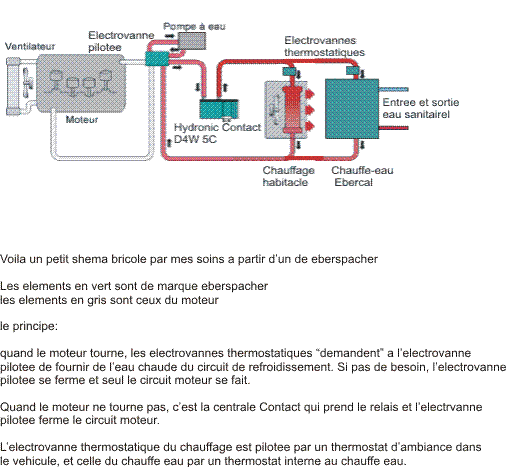
My question today is about the Webasto (the French brand website isn't very detailed): how exactly does the system work that handles both heating and hot water? I think that's what you installed in your bus.

See you soon,

Eric
UN NOMADE AVERTI EN VAUT DEUX !
PA Patrick26 Veteran ·
Hi everyone,

In the attached file, you'll find a schematic I just put together to answer several requests about additional diesel heaters with integrated hot water.

I hope it'll help some of you move forward with your projects!

Happy tinkering to all,

PATRICK26
LA Lahoule ·
Thanks for your reply. To be honest, I haven't fully grasped it all yet... What exactly is this "Hydronic Contact"?
UN NOMADE AVERTI EN VAUT DEUX !
PA Patrick26 Veteran ·
THAT'S THE EBERSPACHER BOILER MODEL NAME!

PATRICK26
GX GX47 Regular ·
😮😉wow what a beautiful drawing😎
GX47

ex transformation, homologation et utilisation d'un car en CC 9places route en utilisation pro. Plus un CC 6pl VL, plus un fourgon en cabine approfondie 6 pl VL. si je peu aider...
NL Nlu413f Regular ·
Hello everyone. I'm jumping on the moving train, so to speak! I've been an owner and user of British double-deckers for over twenty years. They have their advantages, of course, ...and drawbacks as Patrick mentioned. But they have so much charm... 🙂 I had as many as eight at the same time at one point, when it was quite easy to rent them out for events and entertainment... Today the French market is largely served by our Belgian friends who don't have all the same administrative and legal constraints. Sigh!! 😐 So I've reduced my fleet to two vehicles, and they're potentially for sale. I've also imported quite a few of these vehicles in recent years, and I'm here to help anyone who wants to get into this adventure with advice, research, services, etc... See you soon
Double Decker -ement vôtre !!
JS Js59 ·
4 route de Carpentras 84210 Venasque Phone: 04.90.34.16.00 Fax: 04.90.34.05.27

http://www.mascotte-assurances.com/

there you go. good luck.

ciao
DE DebetdimFE ·
Hi, I'm urgently looking for a bus – something like a Saviem or old Renault. I heard you sell buses – what models do you have and at what prices...?
NL Nlu413f Regular ·
🙂 Hi there, I do indeed have two buses potentially for sale. I say potentially because I'm not in a hurry. As long as I have them, I use them... They are two British double-deckers. All the details are on my website: www.busanglais.com in the "for sale" section. For any additional information or more photos feel free to contact me. Best regards
Double Decker -ement vôtre !!
SP Sputnick Regular ·
hey,

to connect to the web while on the road: I'm with Orange, and I just need a mobile phone and the 'PC Suite' software to use my phone as a modem. to connect, either via infrared, USB cable, or maybe Bluetooth or Wi-Fi.

http://europe.nokia.com/support/tutorials/5100/french/modem_setup.html
DE DebetdimFE ·
Hey there, yeah I actually already found your site (you know, when you really want something, you do what you can!). But unfortunately I didn't find what I was looking for. I'm hunting for French brands (for the parts!). I'm willing to put in the work, but I'm hoping I don't have to cross the ocean to find a bus. Thanks again for the info!
NL Nlu413f Regular ·
Hi, Sorry, I don't have anything better... They're Leyland engines. But no need to cross the Channel — the buses are already in France. I'll admit I don't know anything about French buses and coaches, I've only ever had British ones. Good luck with the rest... 😉
Double Decker -ement vôtre !!
DE DebetdimFE ·
yes, I sent you a private message not long ago, so there's an answer. thanks and safe travels to you😎
KA Kalifamily ·
Hi, I'm the proud owner of an S53 from 1987. If you're interested, I can share an address in Charente-Maritime where I got mine. kalifamily
http://merco.aceboard.fr/88678-444-6196-0-commence-transformation.htm
DE DebetdimFE ·
Yes, hey Kali, sure you can give me the address—with pleasure! How much did you buy yours for, if you don't mind me asking? I found one for €2,000 before tax, I think that's a bit pricey. It's an S53, apparently it's been on the road recently, good for road use through June, it looks really good, it's what we're looking for! More to follow, that doesn't stop us from continuing....:)
PA Patrick26 Veteran ·
An S53 for 2000 euros, still in decent shape—if it doesn't have too much mileage and is in good condition, that's not a bad price!

And if it also has good tires (you know how much wheels cost for these rigs), the bodywork doesn't need much work, it's close to you and you avoid a long haul... well, you really need to check everything carefully.

PATRICK26

Similar discussions

You might also like