Day 16, August 8: Udaipur
“Deliverance and regression at the top of the City of Lakes”
Lying on my narrow bunk in the hospital room for the second consecutive night, I’m woken up around 3:30 AM by a message from Magali asking if Théo is okay. She mainly tells me that things have gone from bad to worse for her during the night: after vomiting a lot the day before, she got up, felt dizzy in the hotel bathroom, collapsed, and lost consciousness for a few seconds... It seems she’s also caught a really bad food poisoning. I advise her to get it checked out quickly because her body’s reaction seems to have been severe. She jokes in reply that she’ll ask for a consultation with our “Dr. Jain,” who, as I’ve mentioned before, isn’t his real name but the one we gave him—I haven’t explained why yet, but it’s coming. Joking aside, I think it wouldn’t be a bad idea to take these symptoms seriously and take advantage of the fact that we’re still in one of the best hospitals in Rajasthan for a few more hours, if everything goes as planned, to get a reliable diagnosis and appropriate treatment. In the end, she doesn’t think it’s necessary... It also occurs to me that the anxiety she’s been feeling for several days might have something to do with her condition.
Around 8:30 AM, Magali and Kelyandre join me at the hospital, perhaps for the last few hours or minutes there. We’re eagerly waiting for the final verdict and the grand finale—the entrance of Dr. Jain and his dancers... uh, nurses. Magali is really counting on it because she’s started imagining that, given the price we’ve already paid, we’d be entitled to expect the staff to have prepared a little Bollywood-style farewell dance to celebrate our happy ending, *Slumdog Millionaire* style: “Jai ho! Jai ho!”
But why on earth did we nickname this Dr. Janged “Dr. Jain”? Here’s the exclusive story at last! When I was studying Hindi at the *Langues Orientales*, we watched the Hindi film *Vivah* (“Marriage”), released in 2006, with our oral comprehension teacher. Even though I didn’t particularly like it, it left a strong impression on me and made me smile. Under the guise of a rather classic Bollywood film, with the never-ending plot thread (or rather, the heavy-handed tropes) of a complicated marriage arrangement between two lovers and all the ensuing twists, those unfamiliar with Indian sociology might not notice the undertones of Hindu fundamentalism woven into this very long (inevitably) film, though presented in a more relaxed and respectable way. Still, the script deserves some credit for originality: for once, the stars align so that the marriage goes off without a hitch. A major point is that the hero and heroine are both from the *brāhmaṇ* caste, making the union perfectly viable—no obstacles there. True, the bride was adopted by her uncle and aunt after her parents’ death, which isn’t ideal in terms of purity, but hey... Moreover, even though they don’t know each other because the marriage is still arranged by their families (let’s not get carried away), they luck out and fall in love at first sight. And even though the bride’s family is much less wealthy, the groom’s father, a very rich businessman from New Delhi, generously offers to waive the dowry—now that’s something! After all, he’s already loaded, and he’s just happy that caste endogamy (and thus the cosmic order) is being respected in this topsy-turvy era. The essence of tradition is preserved, and if it makes Hindu conservatism a bit more palatable to a global audience, then why not? Everything’s going great—no one objects to the union, and things proceed more or less by the book. The lovebirds get engaged and are even allowed to meet two or three times before the wedding. Their families give them some freedom and turn a blind eye during these encounters because, after all, you’ve got to live a little with the times and accept the effects of this era of degeneration and value inversion that is the *Kaliyuga*. Progressive fundamentalism, in short.
But of course, everything was too good to last until the end (otherwise, the film would have had very little interest...). The twist is that two days before the wedding, the bride is burned in the face and disfigured in a house fire. Is this *karma* because she’s an impure adopted daughter? Or because of her fake sister and fake mother, who are a little jealous? Or because of that primordial tradition of the dowry, which they tried to skip a little too quickly? In any case, the beauty, ironically badly injured by the accident, is in very bad shape and needs to be taken care of immediately by the local doctor, Dr. Rasheed. Though he’s Muslim (as his name clearly suggests), he does everything he can to successfully provide first aid. But this country doctor eventually admits that, having done his best, he now needs to pass the baton to a more competent colleague—namely, Dr. Jain, a Jain (as his name even more clearly suggests), a community considered by Hindus themselves to be among the most learned and pious, on par with their highest *brāhmaṇ*. Behind this fruitful but unequal professional cooperation, you’ll now understand the message—subliminal, of course, since no religion or community was explicitly mentioned, just vaguely suggestive names... In the end, thanks to Dr. Jain’s expertise, whose inevitably costly care is covered by the rich and virtuous fiancé who wants to save the marriage at all costs (even though tradition would have allowed him to call it off without any trouble given the unfortunate last-minute damage to the “merchandise”), the girl’s face is partly saved, and the ceremony can take place in a moment of grace that reconciles everyone. And who’s the real hero of the film? No one says it, but it’s Dr. Jain, of course!
That’s how the presence of a Dr. Jain on the pediatric team at GBH American Hospital (not to mention that its director is also named Dr. Jain), confirming the idea that sociological clichés don’t come out of nowhere (especially in India), reminded me of this film I saw 15 years earlier. At first, Magali accidentally mixed up the names of the two pediatricians, but in the end, she permanently stuck our Dr. Janged with the nickname—the real star of the story. Yep, that’s how it happened...

(The famous Dr. Jain! The image is from GBH American Hospital’s website, but it’s so true to my impressions that one of the heroes of this trip deserved a physical appearance.)
And as we’re talking about it, later that morning, our Dr. Jain (Janged, actually, for those who still haven’t caught on) knocks on the door with a big smile. After asking the usual questions (“No vomiting? No diarrhea? No fever?”) just for show since he already knows the answers this time, and playing with the little one for a few seconds for form’s sake, he announces that after carefully reviewing the latest tests, he considers Théo officially cured. We can finally leave! His team is lined up behind him in a very cinematic professional pose, but to Magali’s disappointment, there’s no other choreography than this... The team members warmly say goodbye, their expressions reflecting the satisfaction of a job well done, then leave the room. And just like that, it’s over. This chapter is now behind us. Well, almost... Because before we go, we have to settle the final discharge formalities. Once again, everything seems perfectly orchestrated, and I’m told that the accounting department is waiting for me in the basement. Despite the polite smiles, Dr. Jain doesn’t lose sight of the goal—we’ll only get his official green light to return to civilian life once we’ve finalized the paperwork. Since we’ve already paid a flat sum of 40,000 rupees, we think we might even get a refund, which would be great because—unlike the heroine in *Vivah*—we don’t have anyone to cover our expenses, and we’re still not sure if the insurance will...
So I take the elevator down to the dimly lit basement once again. I find the poorly lit hallway and the counter where I greet the two friendly employees. They check their computer, print some documents, and point to the bottom of the page. Well, no—it’s not a refund: the total amount is 77,380 rupees, so we’ll need to add another 37,380 rupees... That said, the two men do everything they can to give me a complete file to make our insurance claim easier. They even take the time to staple as many prescription receipts as they can find—additional expenses that bring the total to nearly 80,000 rupees, or around 900 € at today’s exchange rate, including bank fees. Since Magali made the first advance and Théo is covered under her *Carte Vitale*, it’s up to her to pay the rest if we want our reimbursement claim to be considered. I go back up in the elevator, continuing the back-and-forth I’ve been doing like a robot for four days now, and when I return to the room, I answer Magali’s “So?” with the triple good news: no refund, but the amount has doubled, and it’s her turn to go downstairs and “heat up the card.” She heads to the basement and comes back a little later with the precious discharge papers. Our file is complete, Théo is finally allowed to leave the room, and we’ll see what happens when we get back. For now, the priority is to get out of here and continue our trip!
I realize at this moment why most Indians have no choice but to go to public hospitals. Even though we weren’t expecting such an expense, 900 € isn’t the end of the world for Western tourists who took the risk knowingly, and it’s actually quite reasonable given the rather honest quality of the care and follow-up. But for a modest Indian family, that could represent a year’s income! The families around us are either privileged or willing to do anything to save a loved one and avoid a run-down public hospital with less competent staff... After nearly a year of relentlessly hounding our insurance company, which either didn’t respond or assured us the claim was being processed without ever updating us, we’d started to think we’d get nothing—without giving up. But one fine morning, Magali was surprised to discover she’d received a reimbursement of 550 €, or 60% of the expenses. Since we weren’t expecting anything, this partial reimbursement is actually quite satisfying in the end.
We gather all our things, take the elevator one last time, cross the vast bright lobby, and say goodbye to GBH American Hospital, not without a little pang in our hearts as we briefly relive all the moments of this unexpected experience, which is now an integral part of our trip and our learning about India. It will undoubtedly remain the most memorable moment. After all, it’s here that we simultaneously experienced the depth of the *Indian hospital* and, thanks to Sukhdeo and his family, *Indian hospitality*—a coincidence as etymological as it was temporal. Finally, we turn toward our destiny without regret.
It’s already early afternoon before we know it because all these formalities took time, and we haven’t eaten yet. We decide to visit the elderly couple who run the Santoṣh Restaurant, that little *ḍhābā*/grocery store on the main avenue in front of the hospital. Over these three days, it’s been our main supply point and, above all, our refuge when we needed to get some air, decompress from the long hours in the hospital environment, or take our minds off things with a *chāy*, an ice cream, or some *chāṭ*, sitting on the shop steps or at the little table by the road, with the white noise of traffic passing just centimeters away and the constant honking—perfect for meditation and letting go. The ultimate authentic Indian experience! So, to thank them for all that, we wanted to say goodbye and grab a few *samosā* and other snacks—comfort food, if not exactly diet-friendly—that Kelyandre is growing fonder of by the day. The elderly couple makes room for us at a table, full of enthusiasm and eagerness. The only thing Magali’s upset stomach can handle is a simple *pohā*: no risk with these rice flakes sautéed in a little oil and turmeric. But she regrets the unnecessary addition of *farsāṇ*, those little pieces of fried dough and dried fruits that people in northwest India love so much they put them almost everywhere to decorate their snacks, and the addition of *chāṭ masālā*, a condiment that not all Western palates appreciate because of its strong smell, which some say reminds them of... a faint whiff of diarrheal flatulence... Anyway, the couple seems happy we thought of them and are glad everything’s over, even if—*business is business*—they would’ve preferred to have us around a few more days... One last *chāy* for me, and we hail a rickshaw to the hotel for a simple plan: freshen up, nap, and relax. Kelyandre and I even put on our swimsuits to finally test the pool, a bit overgrown in the middle of the courtyard, just behind our windows, giving the impression of swimming in a fake tropical pond in the middle of a *haveli*. Very pleasant and refreshing!
By mid-afternoon, we feel refreshed and free enough to resume our explorations. Since I need to buy the spices I spotted the day before near Sindhi Bazar and we still have some clothes to get mended at the tailor I befriended in the same area, it gives Magali, Kelyandre, and Théo a good opportunity for a quiet stroll through the old city to reconnect with the Indian street, where there’s always a thousand things happening that amaze us—just walk and let yourself be carried away!
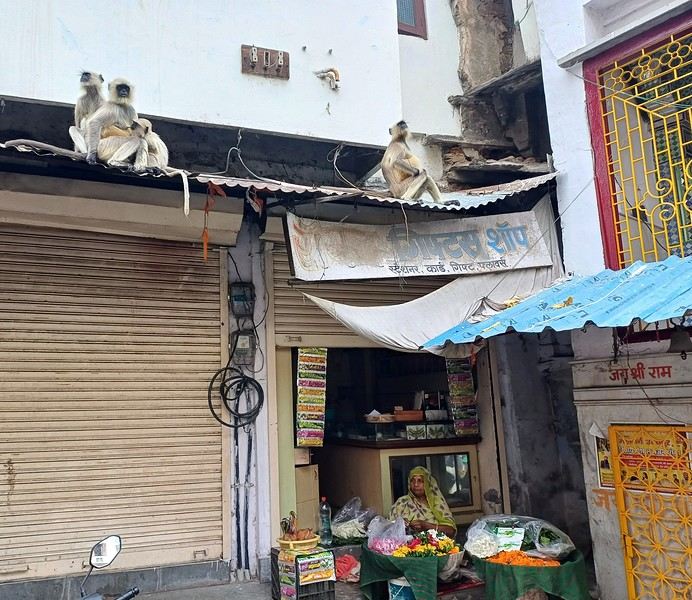
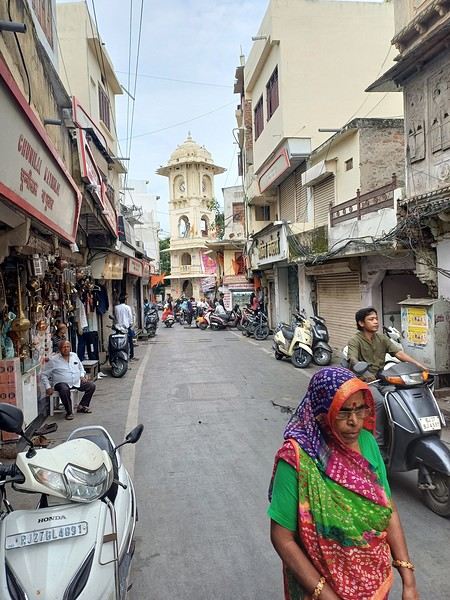
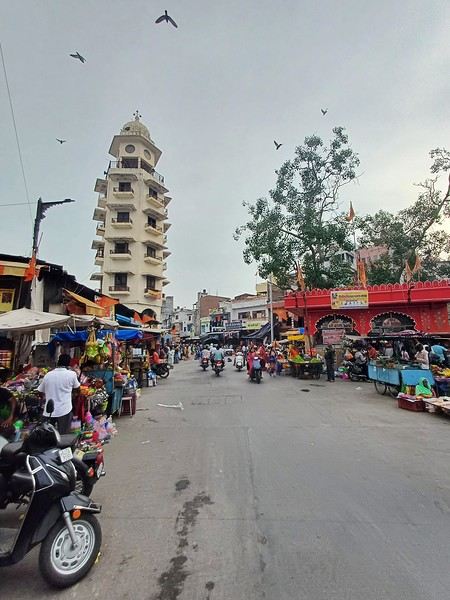
After descending Jagdish Temple Road and passing Ghantaghar, the Clock Tower, to continue on Sidhi Bazar Road, the frenetic sounds of a harmonium and fiery singing tickle my music-loving, India-obsessed ears. We follow the sound and, at the edge of the street, pass through a gate set back between two shops, leading to a small courtyard dominated by ornate minarets, a dome, and what seems to be a mausoleum. In the back, a group of *qawwālī* musicians is playing poems in praise of Sufi saints in front of a small group of Muslim devotees sitting on a large carpet. I find the *qawwālī* genre particularly moving, and at this moment, it blends perfectly with the late-afternoon atmosphere, where the light and mood grow softer, and the feeling of travel is reborn in a light tranquility. We stay for a few minutes to enjoy this enchanting moment as the faithful come and go. After some research, the place seems to be an old mosque in the heart of Sindhi Bazar called Chillah kī masjid, apparently closed since...
We continue down Sindhi Bazar Road, where I spot the tiny shop of my tailor, Manmohan, whose sign with a Gandhi drawing specifies that he’s a “specialist in *kurtā-pajāmā*.” Surrounded by a group of friends, he’s happy I came back as promised to introduce my family and entrust him with our clothes to mend. He offers us *chāy*, asks lots of questions about our life in France, notes that Magali and Kelyandre are of African origin, and inquires about Théo’s health, who’s already bouncing back.
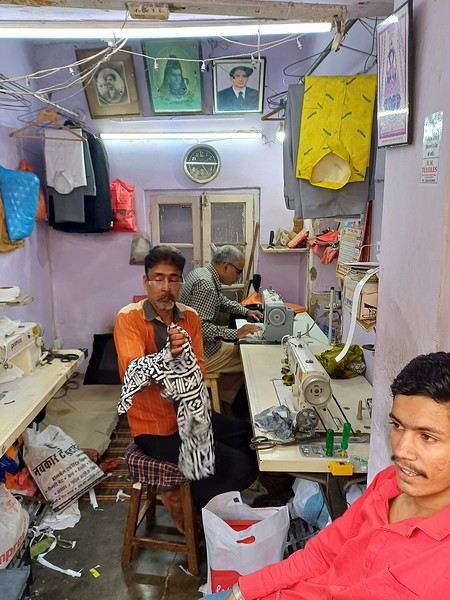
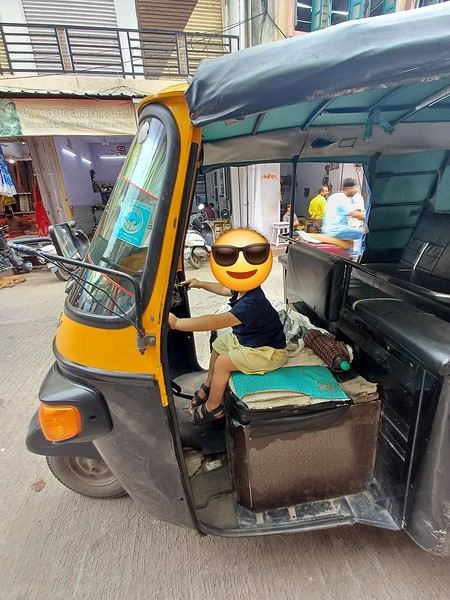
While the tailor works on mending Kelyandre’s African shirt, Magali’s *kurtī*, and a backpack strap, a *rikshāwālā* drinking *chāy* with us makes Théo’s dream come true—obsessed with motor vehicles—by letting him sit in the driver’s seat of his rickshaw (which is, of course, parked). Hands glued to the handlebars, he’s absorbed in his new life-sized toy, imagining himself speeding through the crowded street, making engine noises with his mouth.
Manmohan shows me the work he’s done, insisting that he doubled the stitches so they’ll last a long time. He asks for 200 rupees, which seems a bit steep, but I don’t haggle—I’m happy with the moment we shared, the tailor’s friendliness, and the quality of his work.
We finish up at Sindhi Bazar, where I find my spice shop.
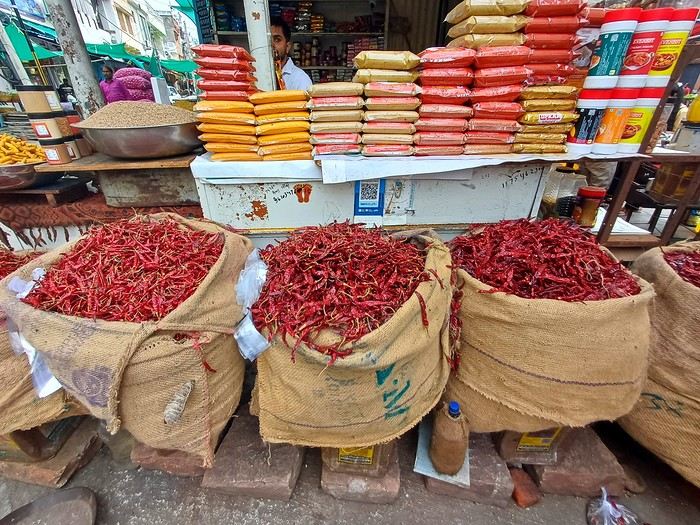
I buy a packet of *biryānī masālā* for a Martinican colleague with distant Indian roots and, most importantly, the famous Mathaniya chilies for my Indian friends living in Paris who’ve long dreamed of cooking *lāl māns* (“red meat”), the iconic meat dish of Rajasthan, named for its vibrant color and the unique round, sweet heat of this chili variety. A bag is so light that at 300 rupees per kilo, it’s not expensive, and I grab some for myself too! We also stock up on incense at a neighboring shop for a ridiculous price.


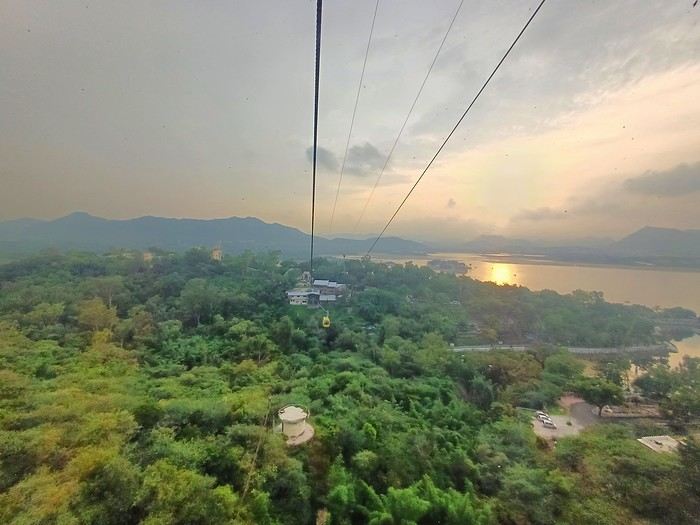
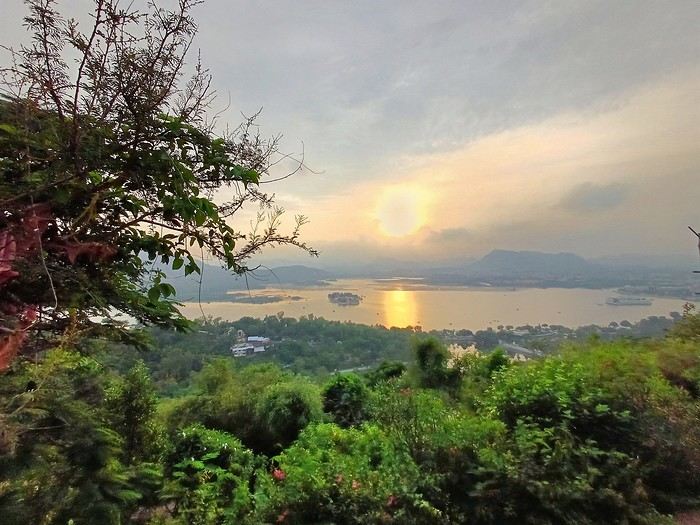
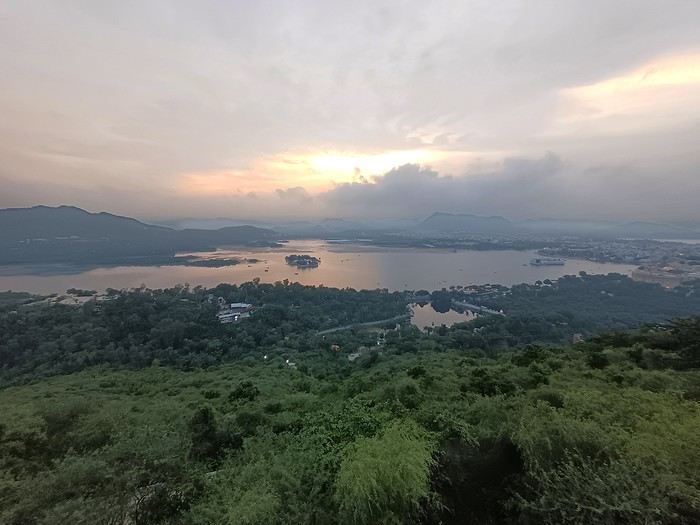
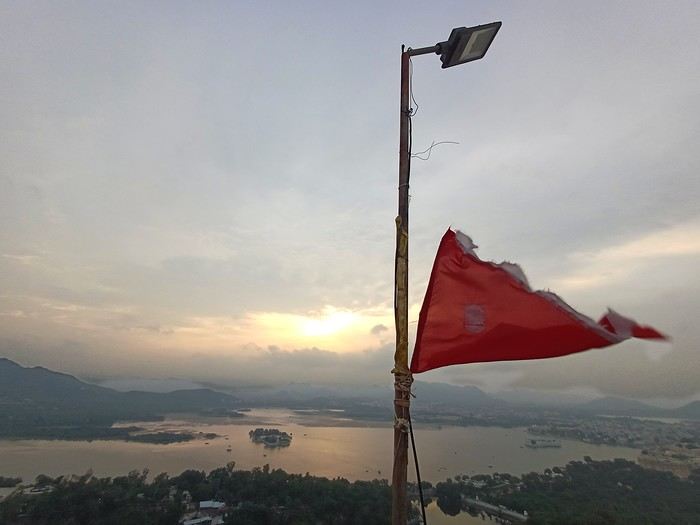
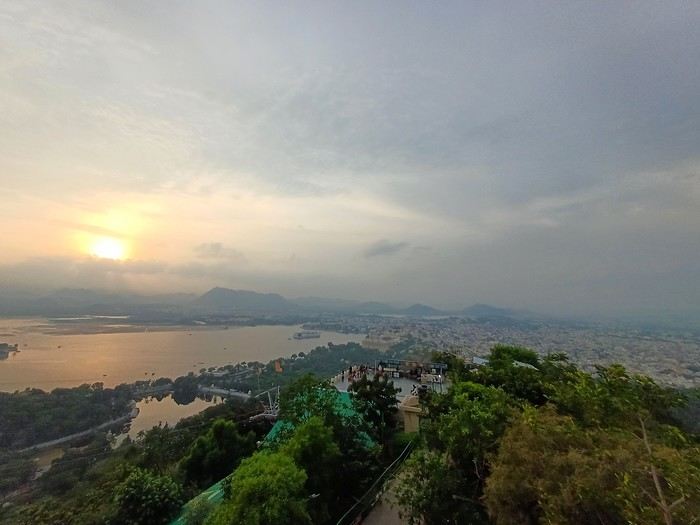
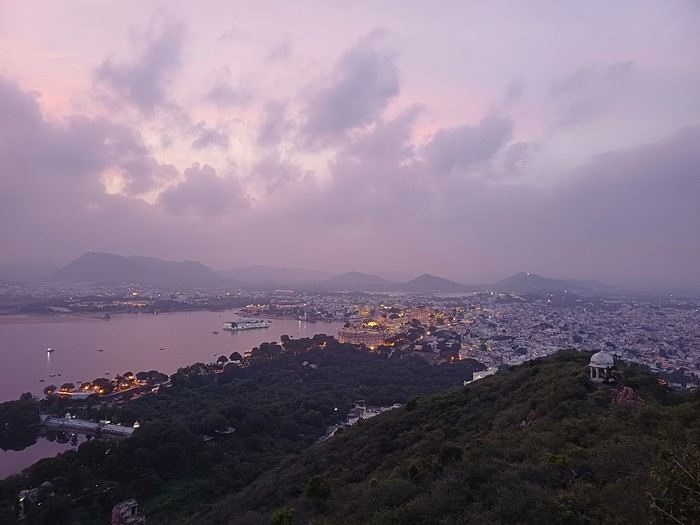
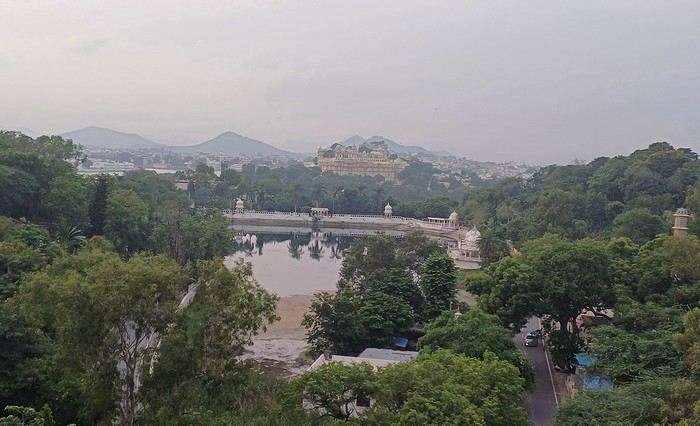 We buy the tickets at the counter: 300 rupees round-trip for us, 150 for Kelyandre, and free for Théo if I remember correctly. While waiting for our departure time, we treat ourselves to grilled corn, juice, and creamy coconut flesh from the vendor across the street for 25 rupees. Then we hop into the "egg" for a splendid ascent up Machla Magra, the "Fish Hill," as the sun begins its descent behind the Milk Pond and Lake Pichola.