in Entre deux voyages › Carnets de voyage
Langtang – Trekking in the Rain (page 2 of 6)
Discussion started by GeorgesOZ on 2025-09-28
108 replies
This thread has been translated into English.
Langtang – Trekking in the Rain
Djalma · 2025-10-01 · Message 21 of 109
I know I can be a pain for some with all my digressions. I’ll admit I take a bit of mischievous pleasure in it!
We can sum up everything I’ve said about rivers and Hinduism in a few simple words:
For Hindus, rivers aren’t just rivers. They’re also divine manifestations.
Personally, that’s partly why I follow your "travel journal." Traveling isn’t just about taking beautiful photos—it’s about trying to understand a bit of the culture of the country you’re visiting.
Since you mentioned Hinduism, I wanted to add a few cultural insights about the people of Langtang.
This Langtang Valley where you did your trek, along with the Rasuwa district north of Syabru Besi up to the Tibetan border and to the west (Gatlang) the southern slopes of Ganesh Himal, are regions inhabited by Tamangs. A rather poor ethnic group.
The Tamangs ("horse traders" in Tibetan) are one of the largest minority ethnic groups in Nepal, alongside the Sherpas. Unlike the Indo-Nepalese ethnic groups, who are mostly Hindu and speak "Indo-European" languages (Brahmins, Chhetris), the Tamangs originate from Tibet and still speak (in addition to Nepali) Tamang, a Tibeto-Burman language. They are mostly Lamaist Buddhists. They have always been considered by the high Indo-Nepalese castes (Brahmins, Chhetris, etc.) as an inferior caste and have therefore been employed for physically demanding jobs such as rickshaw drivers but especially (like the Sherpas) as porters (transporting food supplies). Physically robust, many were also recruited as mercenaries by the British (Gurkha battalions).
Just a few years ago in the Ganesh Himal region, there were still typical Tamang houses with beautifully carved balconies and roofs made entirely of wood. Now, like almost everywhere in Nepal, you only see roofs covered with corrugated iron!
It’s too bad you didn’t do the "Tamang Heritage Trail" trek (no harder than the one you did), which passes through Gatlang (west of Syabru Besi). The village still seems timeless, and the Tamangs there, like those in some parts of Ganesh Himal, still wear their traditional costumes every day...
Langtang – Trekking in the Rain
GeorgesOZ · 2025-10-01 · Message 22 of 109
I know I can be a pain for some with all my digressions. I’ll admit I take a bit of mischievous pleasure in it!
We can sum up everything I’ve said about rivers and Hinduism in a few simple words:
For Hindus, rivers aren’t just rivers. They’re also divine manifestations.
For my part, that’s partly why I follow your "travel journal." Travel isn’t just about taking beautiful photos—it’s about trying to understand a bit of the culture of the country you’re visiting.
Since you mentioned Hinduism, I wanted to add some cultural insights about the people of Langtang.
This Langtang Valley where you did your trek, along with the Rasuwa district north of Syabru Besi up to the Tibetan border and to the west (Gatlang), the southern slopes of the Ganesh Himal are regions inhabited by Tamangs. A rather poor ethnic group.
The Tamang ("horse traders" in Tibetan) are one of the largest minority ethnic groups in Nepal, along with the Sherpas. Unlike the Indo-Nepalese ethnic groups, who are mostly Hindu and speak "Indo-European" languages (Brahmins, Chhetris), the Tamangs originate from Tibet and still speak (in addition to Nepali) Tamang, a Tibeto-Burman language. They are mostly Lamaist Buddhists. They have always been considered by the high Indo-Nepalese castes (Brahmins, Chhetris, etc.) as a lower caste and have therefore been employed for physically demanding jobs such as rickshaw drivers but especially (like the Sherpas) as porters (transporting food supplies). Physically robust, many were also recruited as mercenaries by the British (Gurkha battalions).
A few years ago, in the Ganesh Himal region, there were still typical Tamang houses with beautifully carved balconies and roofs made entirely of wood. Now, like almost everywhere in Nepal, you only see roofs covered with corrugated iron!
Too bad you didn’t do the "Tamang Heritage Trail" trek (no harder than the one you did), which passes through Gatlang (west of Syabru Besi). The village still seems timeless, and the Tamangs there, like those in some parts of the Ganesh Himal, still wear their traditional costumes daily...
Thanks, Jean-Michel, for this information—it’s really appreciated. Indeed, as you get closer to Syapru Besi (coming from KTM), you start to see Tamangs, who are Tibetan. You notice them by the women wearing a typically Tibetan apron with those horizontal multicolored stripes... but they wear it at the back, unlike all the other Tibetan women I’ve seen so far!
I’m not familiar with the region, so I don’t easily tell the difference between Tamangs and other Nepalis based on their appearance (I’m talking about the men).
It was in Langtang, at the next stop after Lama Hotel, that I really realized we were in "Tibetan territory." The woman at our guesthouse wore that apron and was burning incense in the morning for the figures of various Taras and other bodhisattvas on the altar in a corner of the common room, all while murmuring Buddhist prayers in Tibetan (yes, I recognize that immediately—I practiced with the Nyingmas for two years a long time ago).
You mentioned another trek in the same region—I’ll keep it in mind for another time.
Langtang – Trekking in the Rain
Djalma · 2025-10-01 · Message 23 of 109
There are several treks in the Langtang region, including those that first cross Helambu (Sherpa country) and those that go to the sacred lakes of Gosainkund, among others.
There’s one that starts from Syabru Besi toward Gatlang in the west (instead of the east, like you did). It passes through Gatlang, a typical village, then heads north to Tato Pani ("hot water" in Nepali). Here, instead of a hot shower (a setup made for tourists ), there are outdoor hot baths fed by natural hot springs.
Then it continues to Briddim and Rasuwagadi, a border post with old fortifications.
Afterward, it descends back south... When I was there, the Chinese were building a road—or rather, a track—and local residents were already flooded with low-quality Chinese products like sweets, chips, and plastic-wrapped food, along with all the negative consequences: litter scattered everywhere in nature.
You then rejoin the Langtang Valley at Sherpa Gaon, around Lama Hotel if I remember correctly. The whole trek takes about 5 or 6 days, but it’s a loop, not an out-and-back.
PS: The Tamangs, like the Sherpas and Gurungs, aren’t really Tibetan—they migrated to Nepal several centuries ago. They’ve preserved some of their culture, a language close to Tibetan, and their Buddhist religion.
Langtang – Trekking in the Rain
GeorgesOZ · 2025-10-02 · Message 24 of 109
Day 3 – Lama Hotel to Langtang
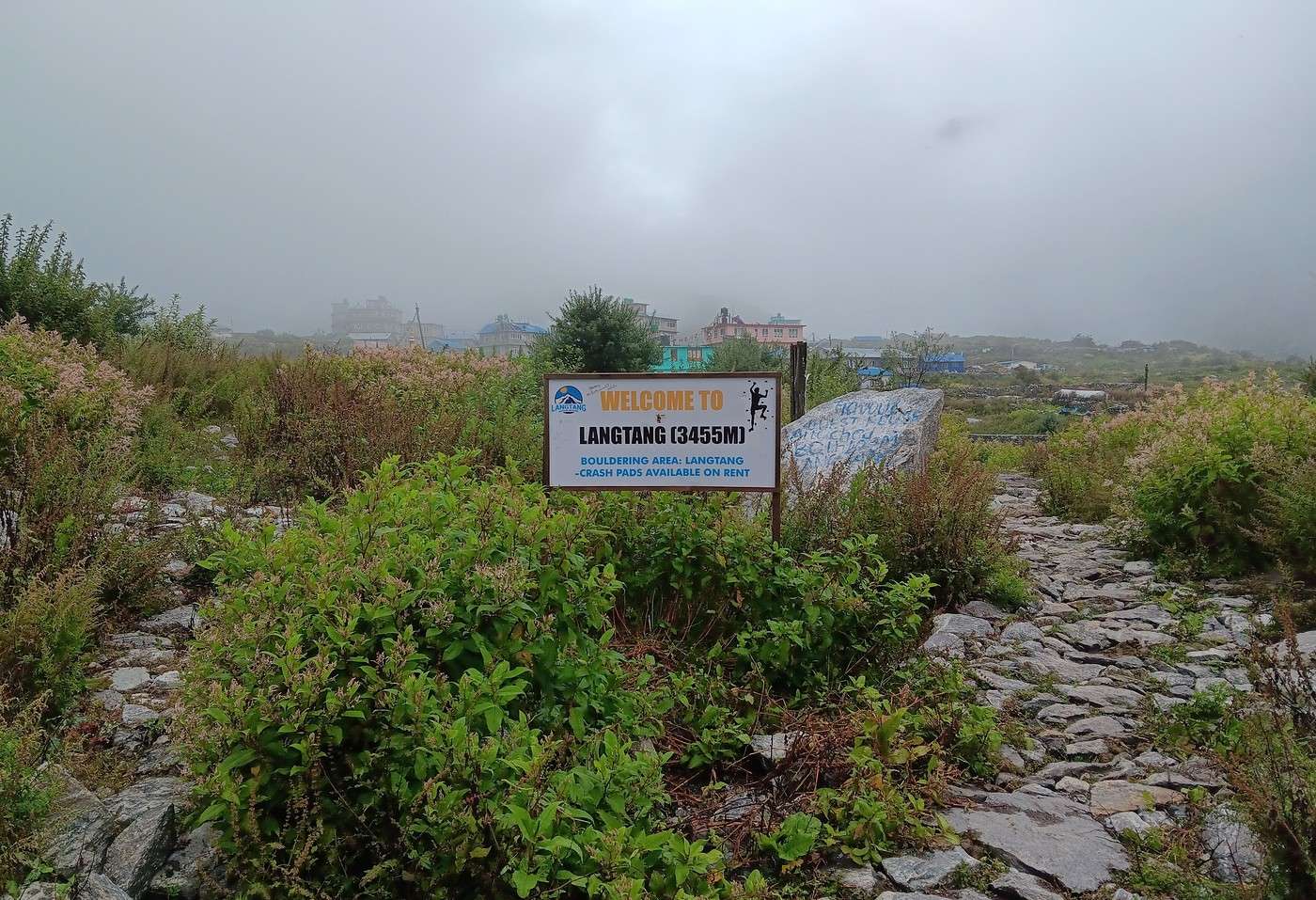
I forgot to share the altitudes: Syapru Besi = +/- 1,500 meters, Lama Hotel = 2,470 meters, and before I forget, today’s destination Langtang = 3,455 meters. That’s a 1,000-meter elevation gain per day, over straight-line distances of 10-12 km, covered in 5-6 hours of hiking. Let’s just say it’d be tough for a lot of people!
Last night, the couple from Melbourne we’d met in Syapru Besi was in the room next to ours. We could hear them talking. The walls were just thin wooden planks with gaps, letting in slivers of light. Luxury hotels aren’t exactly common (or existent) in this area! They were probably in the common room last night too, but we avoided them. Non solum I struggle to understand them, set etiam the guy never cracks a smile—we have no idea what his deal is…
Breakfast: honey-lime-ginger tea, porridge, and a crepe. None of the crepes we’ve had in Langtang actually deserve the name “crepe.” The local food is mediocre, just so you know! I made myself a thermos of cowboy coffee—that is, pouring hot water over ground coffee and calling it a day. I didn’t forget to pack coffee before flying to KTM, since I wasn’t sure I’d find good stuff there. Turns out Nepal has great coffee—I just didn’t know! My “thermos” isn’t really one, but I love sipping coffee on the trail, even when it’s cold.
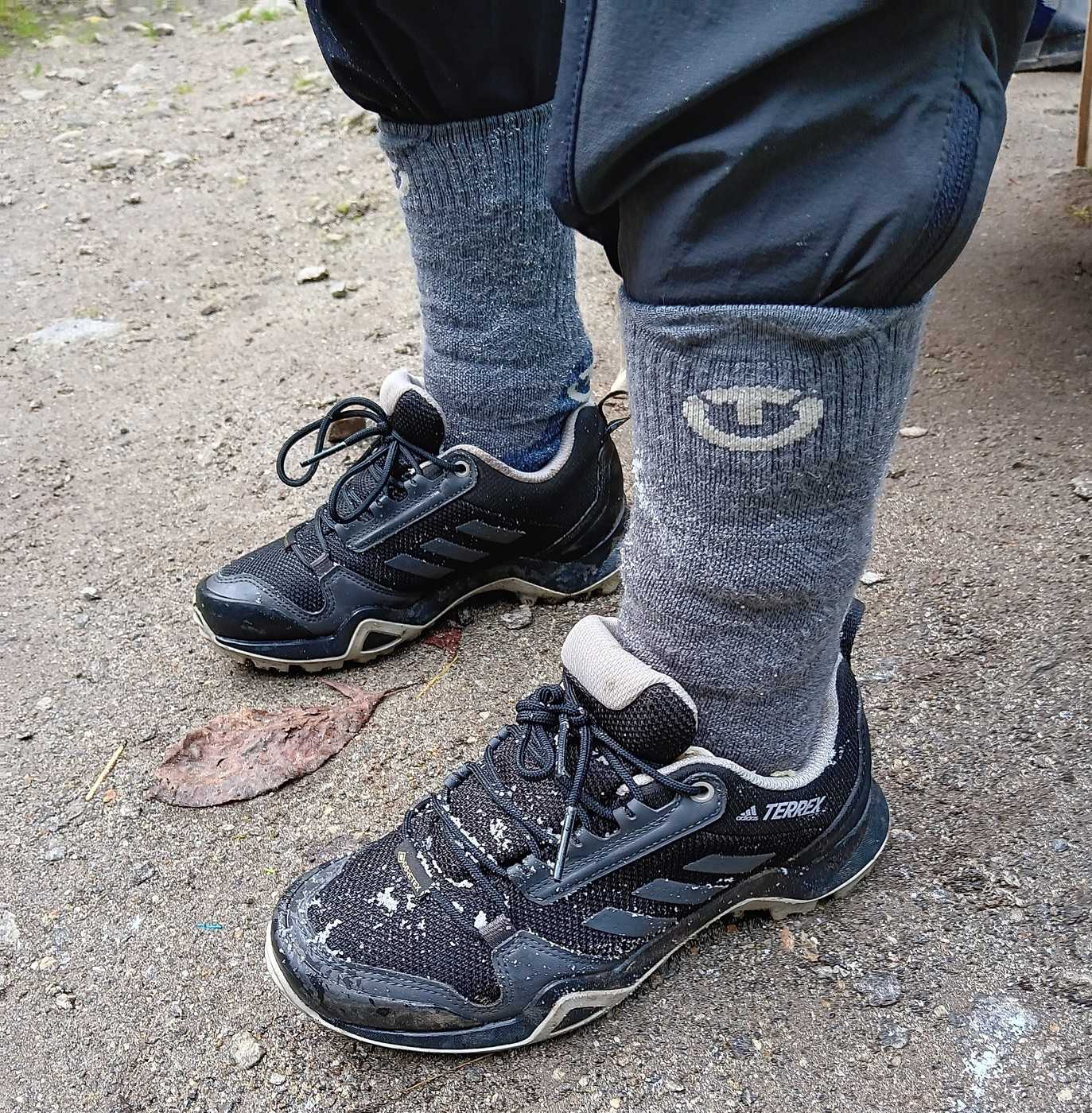
Y put on tall socks, carefully pulling them over her pant legs. She also sprayed herself generously with one of her anti-mosquito remedies—she’s got several little bottles in her bag. They’re plant-based essences, easy to find in Thailand, and they work great. H rubbed salt on her feet to ward off the “djouka” attacks (1st photo). Y barely slept—she kept replaying a horror movie in her head all night, starring the “djouka”s!
Around 8 a.m., it was “zam zam!” = “let’s go!” My Nepali vocabulary is pretty limited—just “bistaré” = “slowly,” “dhanyavad” = “thank you,” and of course “djouka” = “leech.” That’s about it!
To keep it short, we arrived in Langtang, today’s destination, just before 6 p.m.—almost 10 hours later! Of course, we took breaks along the way. Once to drink tea on a terrace (the rain had stopped). We ran into our Israeli friends there, still cheerful and up for a chat. They’re young, fresh out of military service. I only remember one of their names, Johnny—a tall blond with blue eyes, Ukrainian heritage. What a genetic mix! Aside from one guy of Moroccan descent, they’re all Ashkenazi. Either way, they’re the friendliest Israelis I’ve ever met.
We also stopped to eat, though I don’t remember exactly where. I think we hiked a solid 8 hours, covering maybe 10-12 km? The trail was just as tough as the first day. Y is struggling—she hasn’t recovered from yesterday’s fatigue, which slows us down.
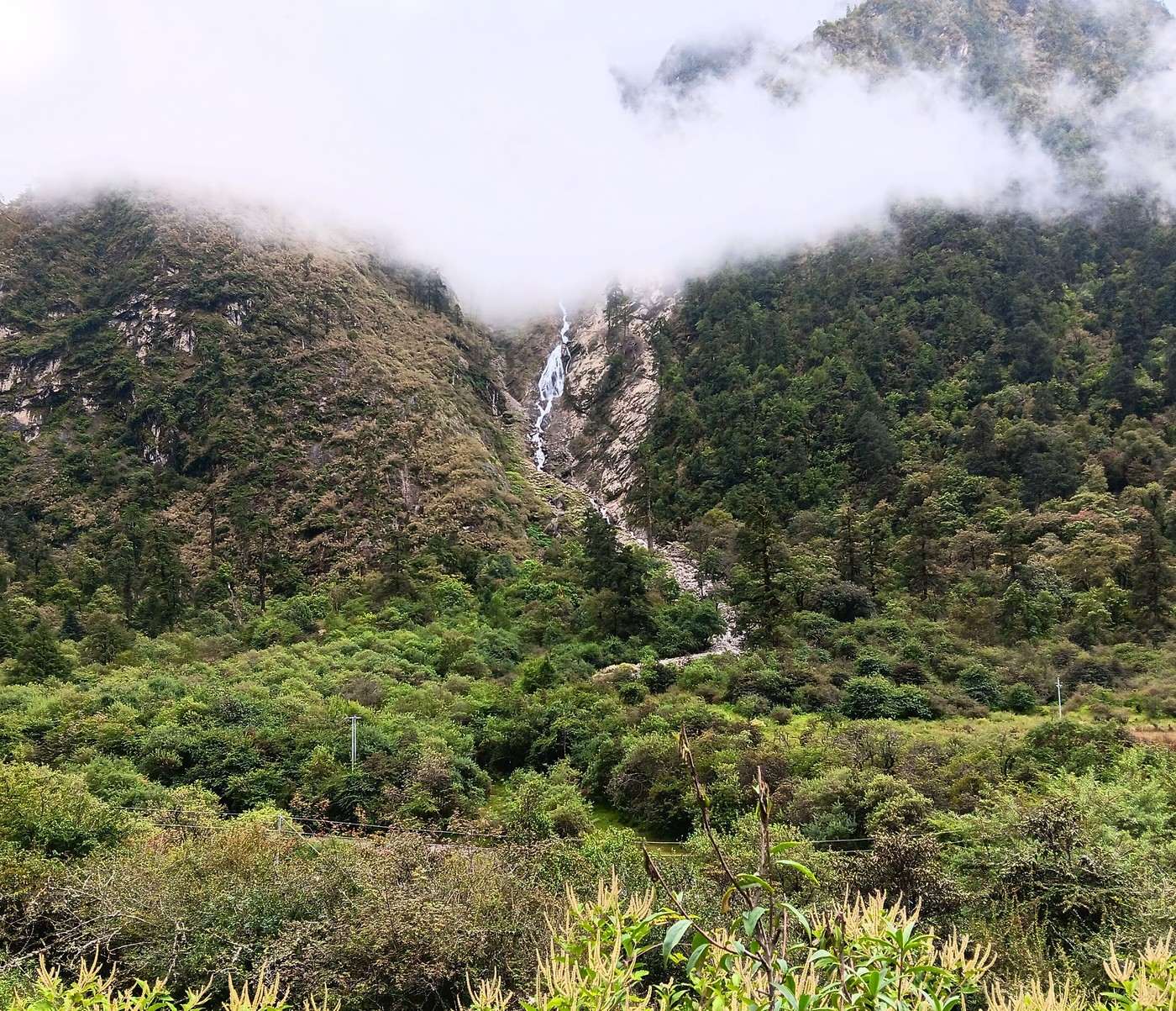
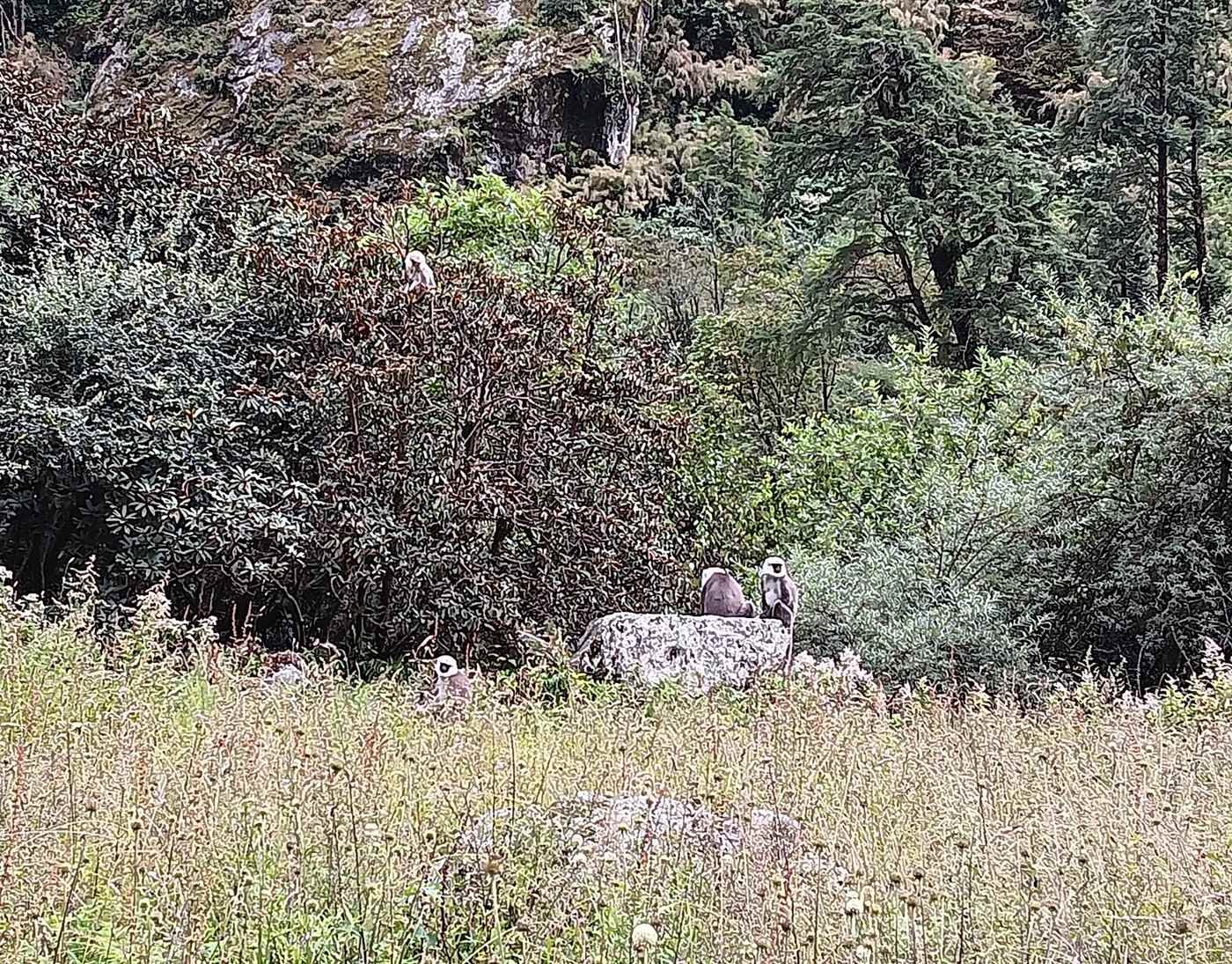
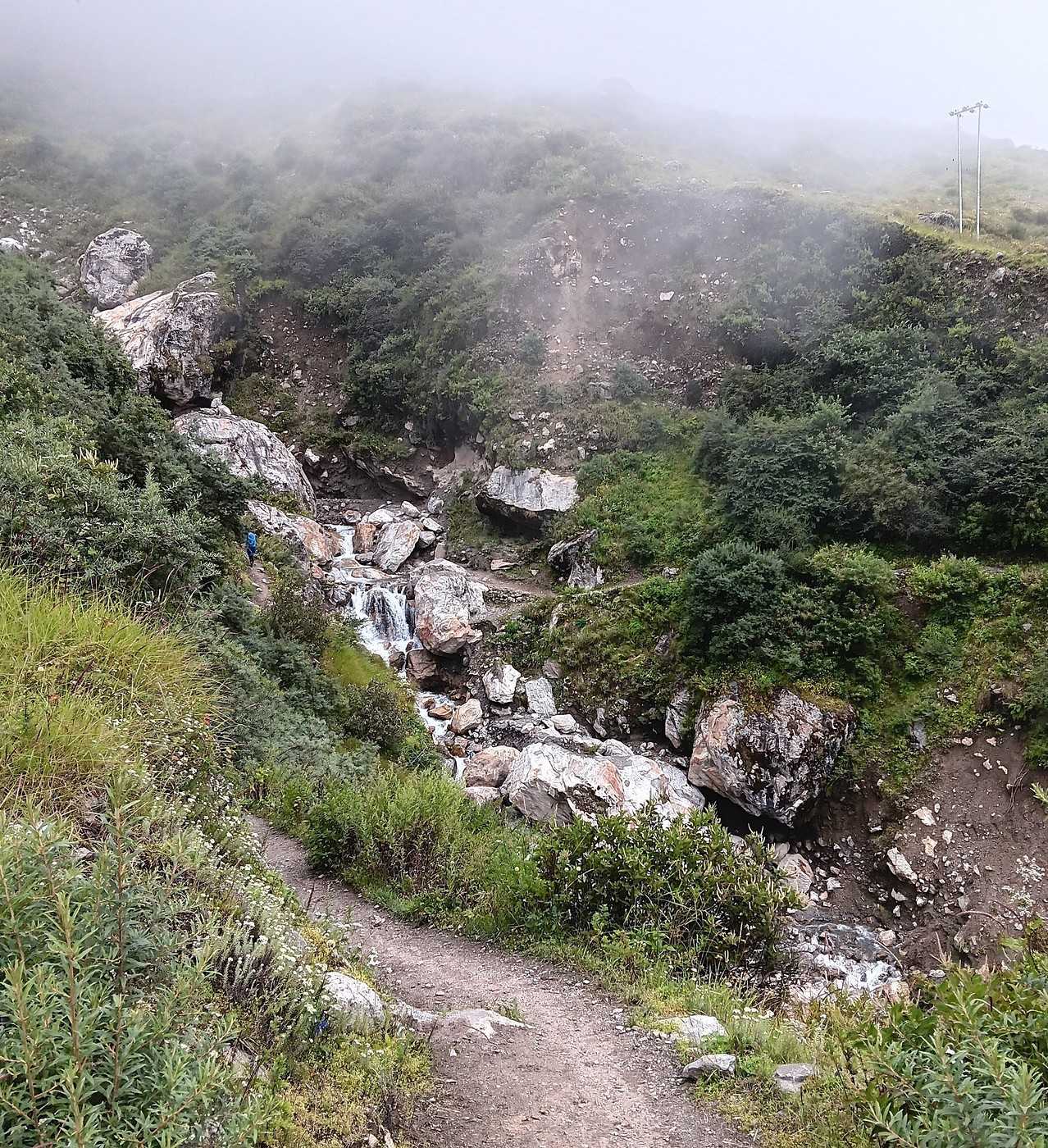
The landscape is lush and wild. 2nd photo (noon): waterfalls hundreds of meters high, their tops lost in the mist. On a plateau, we spotted a troop of gray langurs. These monkeys are often called “Hanuman’s monkeys” in India and Nepal because they’re said to have been part of the monkey army that helped Rama—an incarnation of Vishnu and king of Ayodhya—fight Ravana, the king of Sri Lanka who kidnapped his wife, Sita. The monkey general was the famous Hanuman. So even in the middle of nowhere, we get a dose of the Hindu epic *Ramayana*!
My 3rd photo isn’t great—I only had my phone, and it was from far away. I had to zoom in to center on the monkeys.
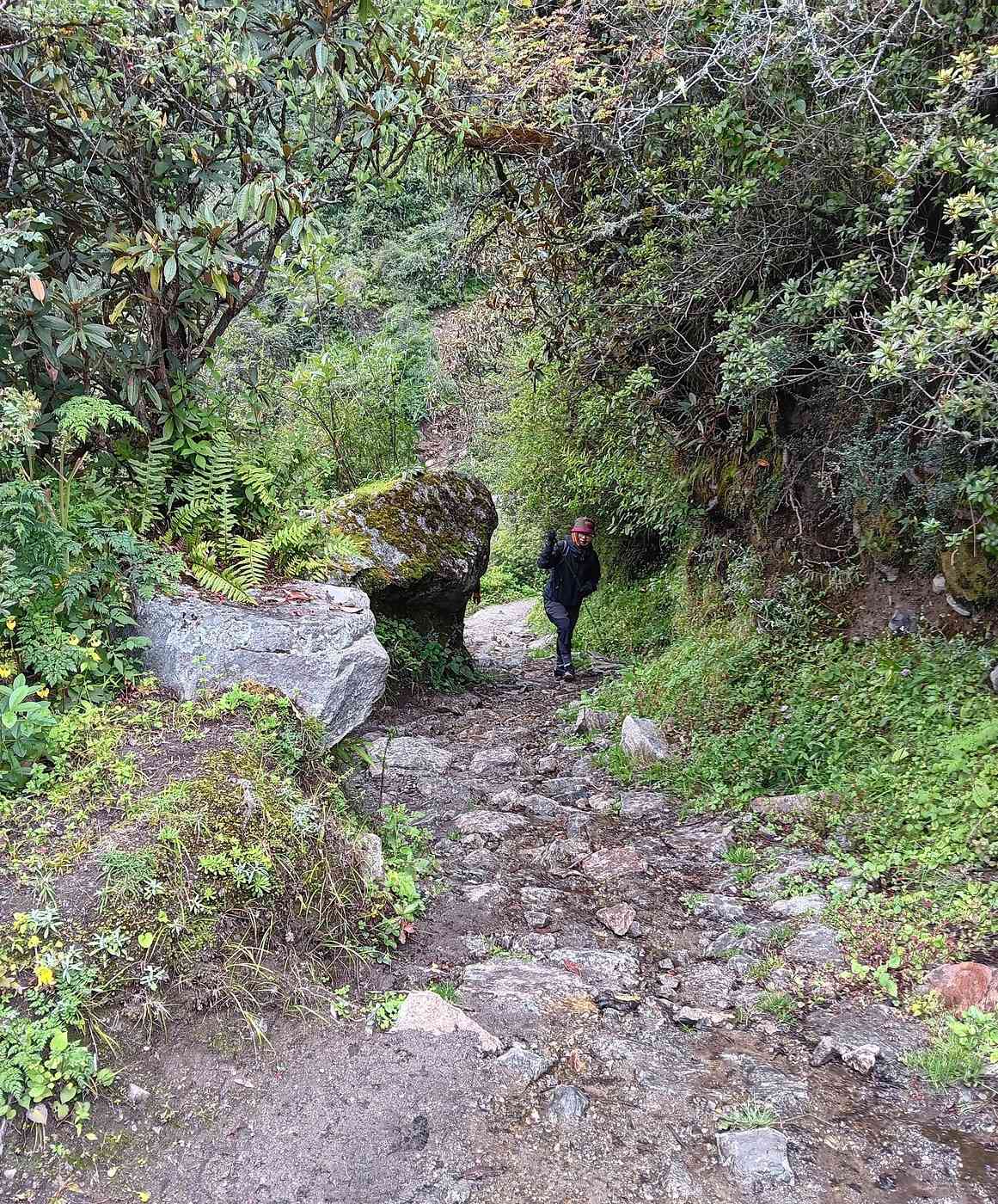
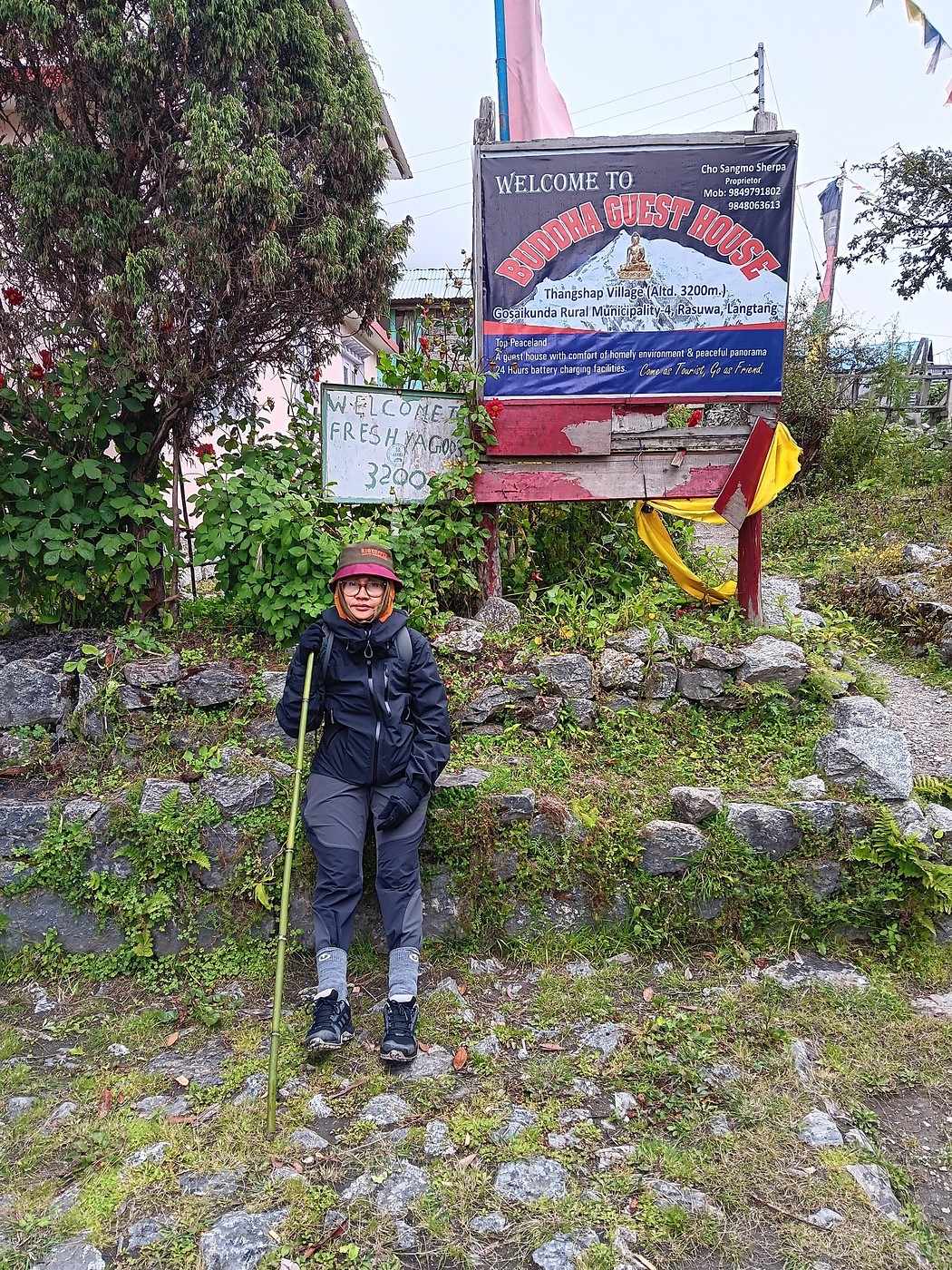
4th photo (3 p.m.): Y struggling on the trail. It’s just to show the path in a relatively easy section, right before Buddha Guesthouse, where she rests for a few minutes (5th photo). You can tell she’s exhausted… Check out the walking stick H made her from a bamboo stalk. He made one for me too, and trust me, it helps a ton!
Around 3:30 p.m., we reached another intimidating spot: crossing a raging stream (6th photo) . You have to jump from rock to rock, hoping not to slip. A fall would send you tumbling into chaotic rubble churned by violent waters. You’d get seriously hurt, and it’d be a whole ordeal to get rescued. 🏴☠️ Let’s be real—keeping your feet dry is impossible, and flip-flops are a no-go unless you’re Nepali!
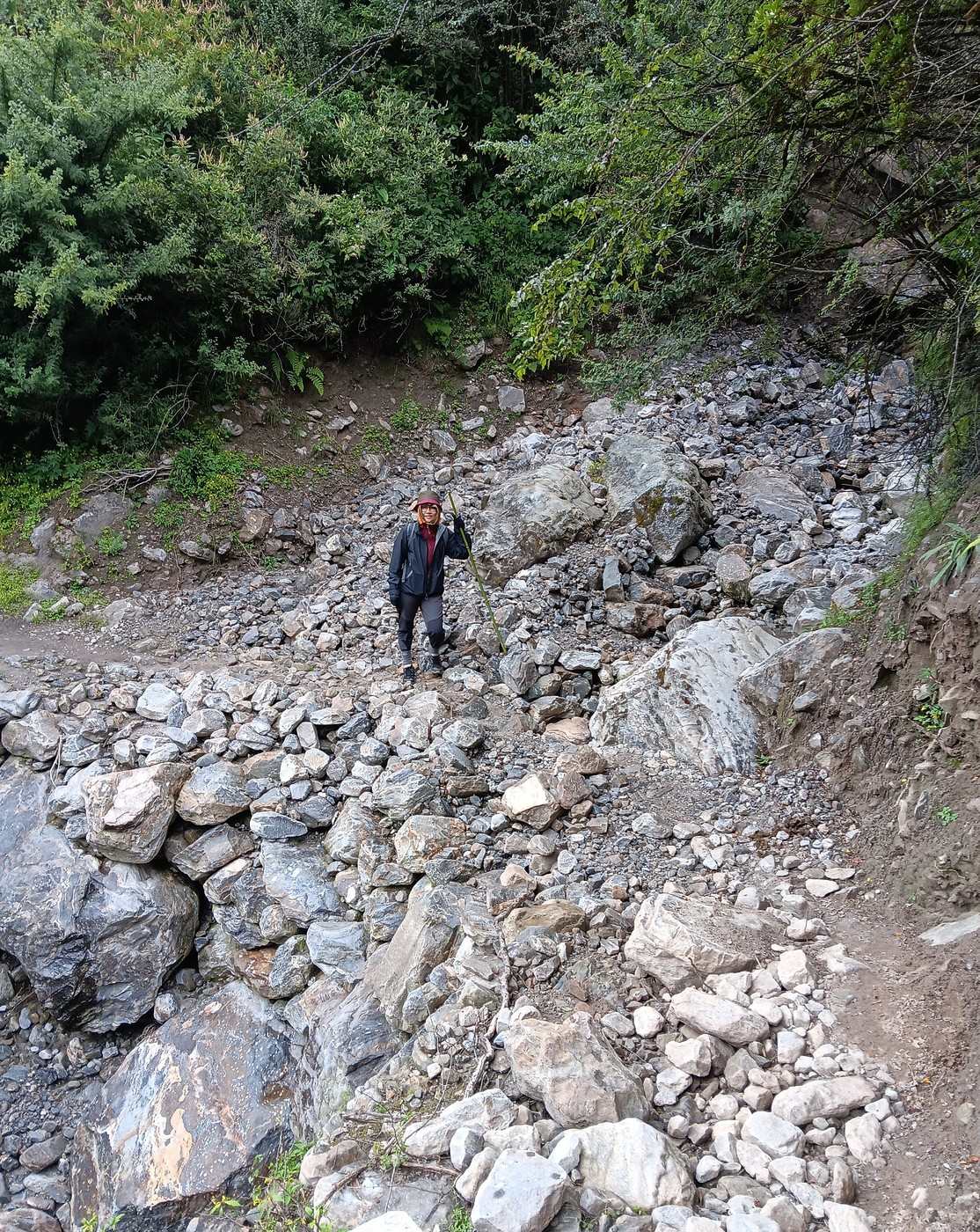
4 p.m. – 7th photo: Y in the middle of another landslide. No stream this time!
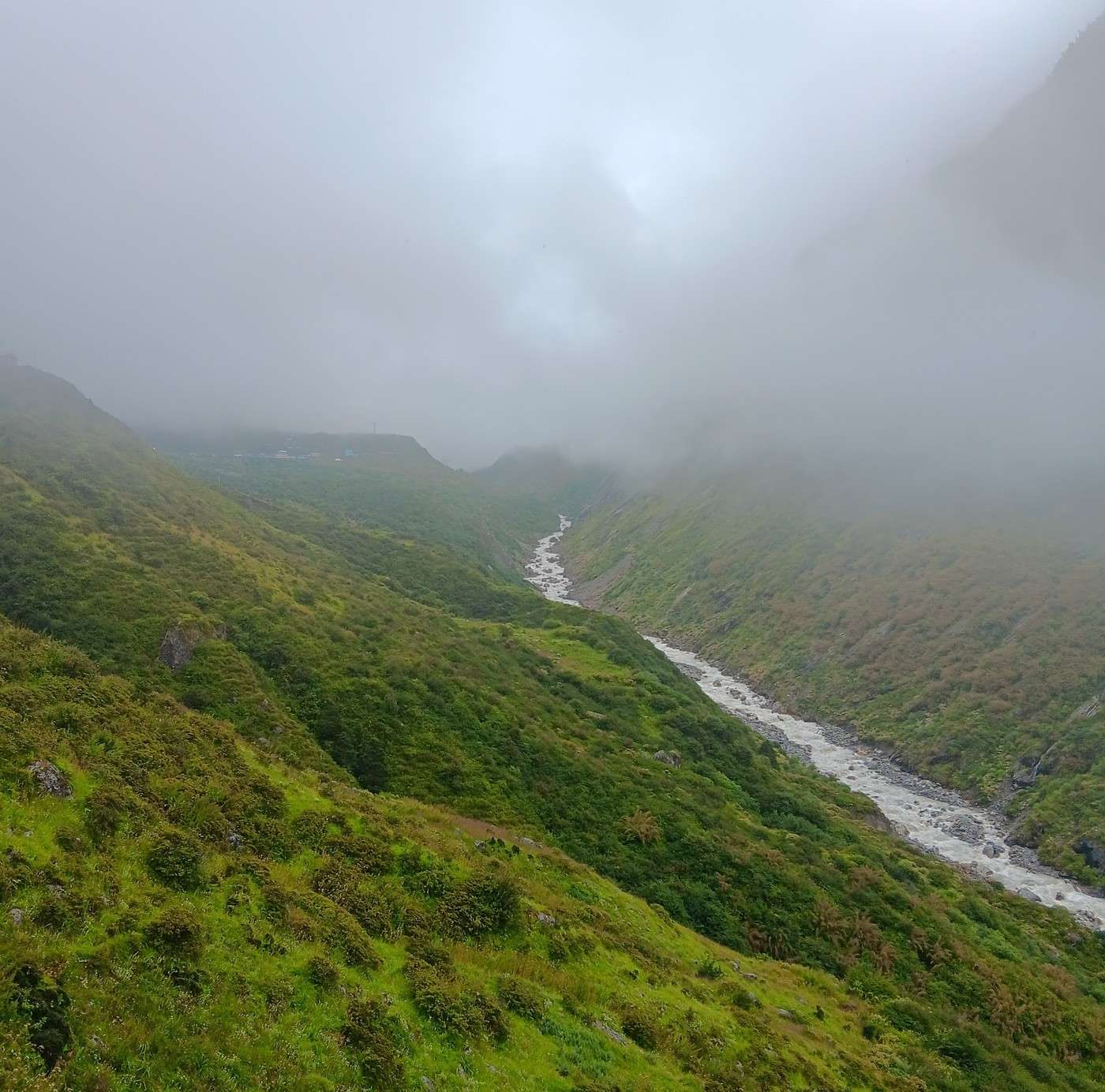
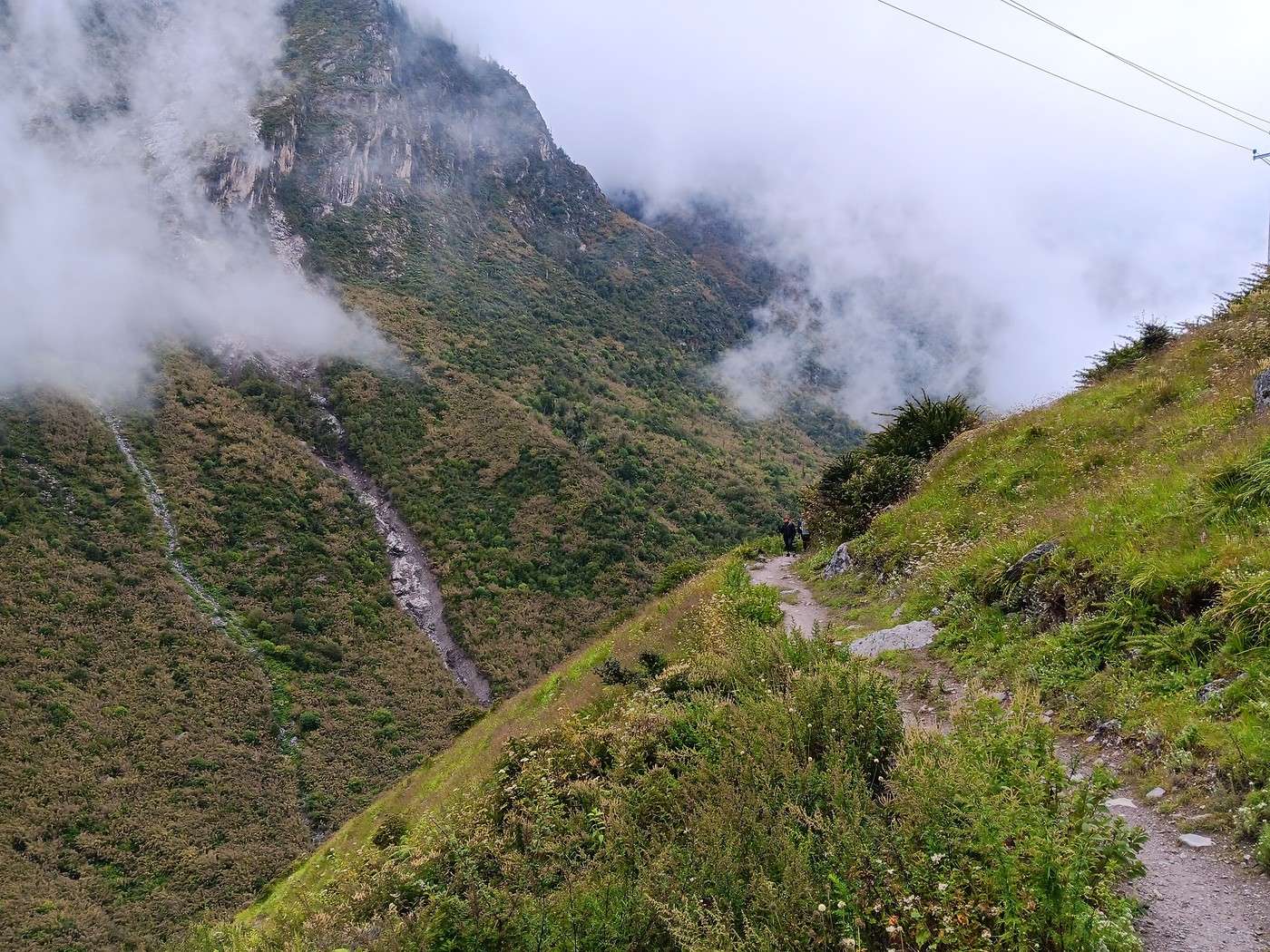
4:20 p.m. – 8th photo: The Langtang River in the mist. We start to see Langtang (left side). 9th photo: A view of our trail.
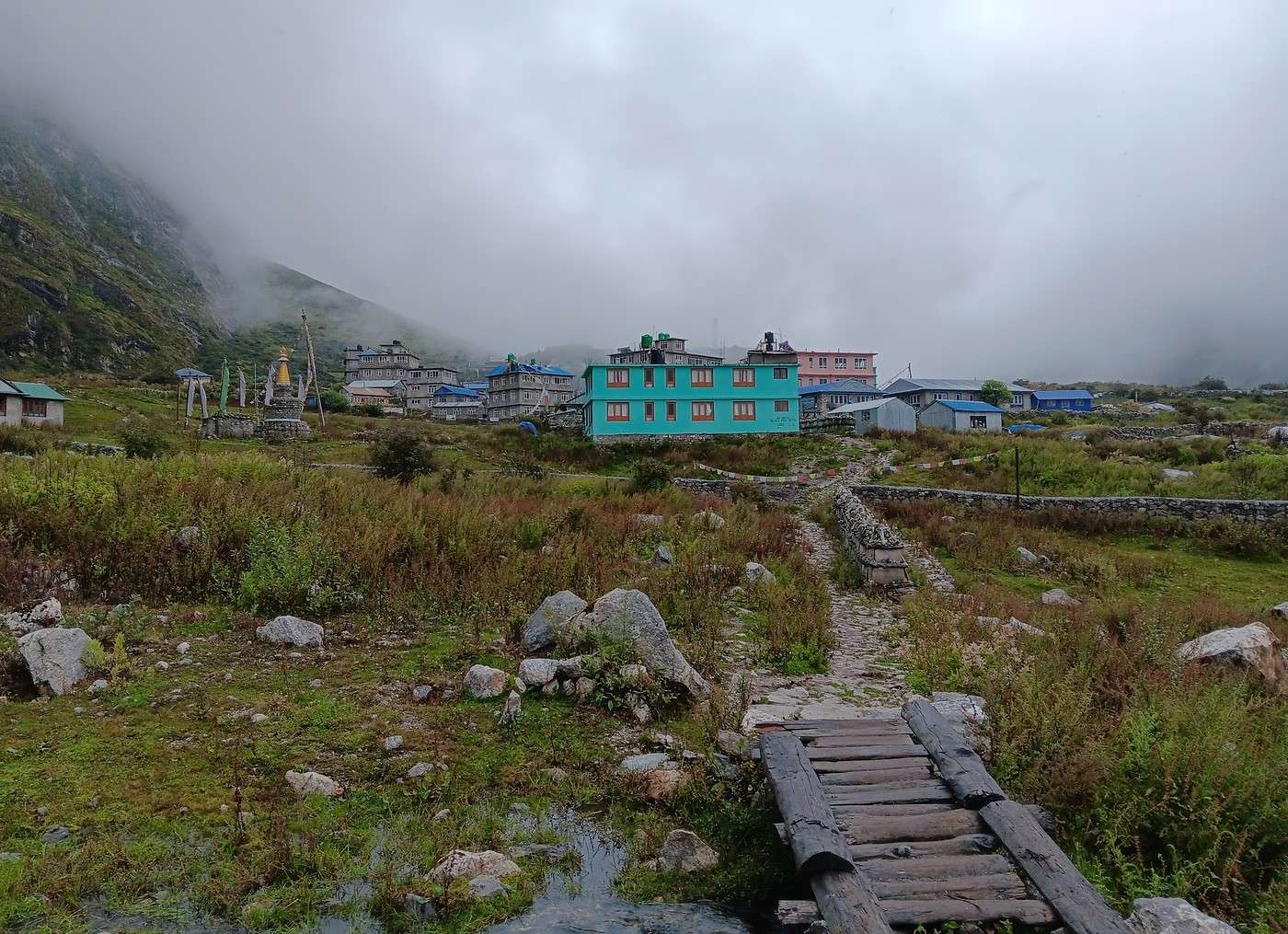
5:45 p.m. – 10th and 11th photos: Arrival in Langtang at 3,455 meters.
I’ll come back later to talk about the 2015 earthquake and the devastation it caused in Langtang. Patience!
Along the way, we crossed paths with the only Frenchman on the whole trek—a guy from the Vosges region heading back down to Syapru Besi. Maybe he’s the one who told us he’d glimpsed the highest peaks of Kyanjing Ri when the clouds parted for a whopping 5 seconds!
We also met a cheerful South Korean guy heading down. At first, I thought he was Japanese. He didn’t take offense—just pointed to the Korean writing on his shirt, and I apologized for the mistake. Still smiling, he told me he was 69, then asked how old I was (72). His smile widened. He shook my hand warmly. No doubt, we were the oldest trekkers out here! As Corneille put it 😉 : “To a well-born soul, vigor defies the weight of years.” Just saying, our South Korean friend was spry and lean, and I’m not exactly out of shape either.
We “checked into” a guesthouse in Langtang that’s a *little* more comfortable than Lama Hotel’s. I took the only hot shower of the week. In the common room, we saw the Australians again but avoided them—they might’ve been avoiding us too! I already mentioned the owner earlier, with her apron worn in the back (yes, on her butt), and her Buddhist prayers at her altar with Tara statues and other bodhisattvas.
Langtang – Trekking in the Rain
GeorgesOZ · 2025-10-02 · Message 25 of 109
Day 3 – Lama Hotel to Langtang (last photo)
And here’s the 11th photo. Arrival in Langtang after crossing a massive landslide.
Langtang – Trekking in the Rain
Djalma · 2025-10-02 · Message 26 of 109
Breakfast: "honey-lime-ginger" tea, porridge, and a crepe. None of the crepes eaten in Langtang actually deserve the name "crepe," by the way. The local cuisine is mediocre—let’s just say it! I’m making myself a little thermos of coffee using the so-called "cowboy method," meaning I just pour hot water over ground coffee and that’s it! I didn’t forget to pack coffee before my flight to KTM; I wasn’t sure I’d find good coffee in KT.
You’re taking precautions, I see ;)
Local cuisine has improved a lot in variety (trekkers have become picky ;)) but not in quality. Before, we’d practically only eat dal bhat, and occasionally "fried rice with vegetables." For breakfast, it was chapatis at "Indo-Nepali" places and Tibetan bread and tsampa with Tibetan communities.
Did you try tsampa? The taste is unforgettable when the butter is really rancid!
As for drinks, I’d say everything’s gone downhill in Nepal! I’m more used to tea than coffee, and in the past, you could get real tea in Nepal. They grow it in the east near Ilam... Yet now, they only serve "tea" in bags that tastes like hay—except maybe in KTM hotels I don’t frequent. You can still find real tea in India, though. One super good thing for breakfast, but not available year-round, is dahi—the yak milk yogurt (the female yak, or "nak," doesn’t produce milk, of course).
These are monkeys often called "Hanuman’s monkeys" in India and Nepal because they’re said to have formed the monkey army that helped Rama, an incarnation of Vishnu and king of Ayodhya, fight against Ravana, the king of Sri Lanka who had kidnapped his wife Sita. The general of the monkeys was the famous Hanuman. So even in the middle of nowhere, we get echoes of the Hindu epic Ramayana!
These monkeys are protected in Nepal (national parks), like many animal species, and they thrive where there are fields (corn, millet, barley, etc.) and orchards, causing major damage to crops. And farmers are already so poor...
Maybe it was him who told us he’d managed to catch a glimpse of the highest peaks from Kyanjing Ri,
You must be mixing it up with Langtang Lirung (7,200m), which is clearly visible in good weather (not during monsoon ;)). Kyanjing Ri isn’t very high (everything’s relative), barely over 5,000m, maybe less, and it’s not very snowy. I climbed it in half a day from Kyanjing Gompa. The pass (Ganja La, 5,200m) facing north, which leads to Helambu, is much more challenging!
Langtang – Trek in the Rain
GeorgesOZ · 2025-10-02 · Message 27 of 109
...Local cuisine has improved a lot in terms of diversity (trekkers have become picky😉) but not in quality. Before, we pretty much only ate Dal Bhat and occasionally "fried rice with vegetables," and for breakfast, chapatis at the "Indo-Nepalese" places and Tibetan bread and tsampa with the "Tibetan" folks.
Have you tried tsampa? A taste you don’t forget when the butter is nice and rancid!🤪
.....
One really good thing for breakfast, but you can’t find it certain months of the year, is dahi—the yogurt from a nak (female yak), which, of course, doesn’t produce milk itself.
There’s more variety these days, that’s true. The menus (still the same ones!) offer chow mein (a noodle dish), fried potatoes, etc. And also dishes with meat—I won’t go into details, since we stuck to vegetarian meals—safer for hygiene!
Never tried tsampa.
As for dahi, yeah, it’s always really good. "Dahi" = "yogurt" in Hindi, and as far as I know, it’s not only made with yak milk.
By the way, a lot of Nepali vocabulary is very similar to Hindi. They’re related languages...
...
You must be confusing it with Langtang Lirung (7,200m), which you can see clearly in good weather (not during the monsoon😉). Kyangin Ri isn’t very high (everything’s relative), barely over 5,000m, maybe less, and it’s not very snowy. I climbed it in half a day from Kyangjin Gompa. The pass (Ganja La, 5,200m), facing north, that leads back to Helambu is way more challenging!
I didn’t express myself clearly—I meant ".....catch a glimpse of the highest peaks, starting from Kyanjing Ri." It’s definitely Langtang Lirung, as you said!
Langtang – Trekking in the Rain
Djalma · 2025-10-03 · Message 28 of 109
I’ve never tried Indian dahi. The times I’ve seen it, it was sitting in the sun with a bunch of flies on it... but in Nepal, especially in the lower regions, it’s also made from buffalo milk.
In the Annapurnas, where you can also find honey, mixing dahi with a few chapatis makes for a decent breakfast.
Otherwise, it’s hard to put on weight anywhere in Nepal with the dhal bhat/chow mein diet, especially when you’re trekking! 😏
One thing that’s pretty unique in Nepal if you’re not vegetarian: you see chickens everywhere, but if you want to buy one, it’s super expensive—more expensive than any other meat like buffalo, yak, or mutton.
In the city, in KTM, I bet you’ve tried momos? They’re delicious. You can find them stuffed with veggies, of course, or with beef (usually buffalo) at the same price, but if you get chicken momos, they’ll be pricier! !
Langtang – Trekking in the Rain
GeorgesOZ · 2025-10-03 · Message 29 of 109
I’ve never tried Indian dahi. The times I saw it, it was sitting in the sun with a bunch of flies on it... but in Nepal, especially in the lower regions, it’s also made from buffalo milk.
In the Annapurnas, where you can also find honey, mixing dahi with a few chapatis makes for a decent breakfast.
Otherwise, in pretty much any region of Nepal, it’s hard to gain weight on a diet of dal bhat/chow mein, especially when you’re trekking.
One thing that’s pretty unique to Nepal if you’re not vegetarian: you see chickens everywhere, but if you want to buy one, they’re crazy expensive—more expensive than any other meat like buffalo, yak, or mutton.
In the city, in KTM, I bet you’ve tried momos? They’re delicious. You can find them stuffed with veggies, of course, and others with beef (actually buffalo) at the same price, but if you get chicken momos, they’ll cost more!
I get your reservations about India! I’ll just chime in on the Nepal vs. India topic. Generally, I’d say Nepal is a "softer" continuation of India. People are way calmer, I find. I love India for a ton of reasons, but sometimes you deal with people who are super pushy, and the dirt/poverty is way more shocking than in Nepal.
We also mix honey into dahi, as well as in porridge, "crepes," and of course in the miracle drink that is lemon-ginger-honey... hoping it’s real honey and not flavored sugar syrup!
I lost 3 or 4 kg in 3 weeks in Nepal, probably due to the physical effort and the lean food during a week of trekking. Y lost about 1 or 2 kg. We weren’t exactly heavy to begin with! 😉
We tried momos in KTM several times, prepared in different ways (but always veggie). Honestly, they didn’t really blow us away!
Funny and interesting what you said about chicken. 🙂
Langtang – Trekking in the Rain
Djalma · 2025-10-03 · Message 30 of 109
Yeah, there’s no pressure in Nepal—people are peaceful and discreet. No one comes up to hassle you to buy this or show you that. It’s been a long time since I’ve been to India, and I think I couldn’t handle it now. I already avoid noisy, polluted cities pretty much everywhere.
The quiet side of India is still the Himalayan one: Himachal Pradesh, Uttarakhand, Uttar Pradesh, Darjeeling...
For those who need to lose a few kgs, the most effective diet is trekking in Nepal! !😉
Langtang – Trek in the Rain
GeorgesOZ · 2025-10-05 · Message 31 of 109
Day 4 – Langtang to Kyanjing Gompa (1)
Last night, in the common room, there were 2 Englishwomen. Since they were sitting next to the Australians, whom we’re avoiding, we only caught snippets of their conversation. At breakfast, though, they sat right next to us and were clearly in a hurry to leave. They’ve got a flight to catch! They’re heading straight down to Syapru Besi—wow, that’ll be a long day of hiking for them! But they’re in their early thirties and in great shape. Plus, it’s probably easier going down than up, even if the path is pretty tricky.
Since we’re heading to Kyanjing Gompa today, which is at around 3,865 meters above sea level, we’re now entering a "subalpine" climate zone, supposedly just below the tree line. In reality, what we’ll see are mostly shrubs—trees clearly don’t grow easily on the higher sections of the trek. I think we could already call this tundra. Though I’ll admit I don’t know much about biomes, vegetation, and all that.
Anyway, I put on long underwear just in case my pants are too thin. So far, it hasn’t been cold—just pleasantly cool. Y and I have everything we need (or almost) in terms of clothing: base, mid, and outer layers, and they’re decent quality. After 2 days of trekking, we’re starting to figure out how to manage temperature, humidity, and wind—opening and closing zippers to the millimeter! It’s a bit like skiing…
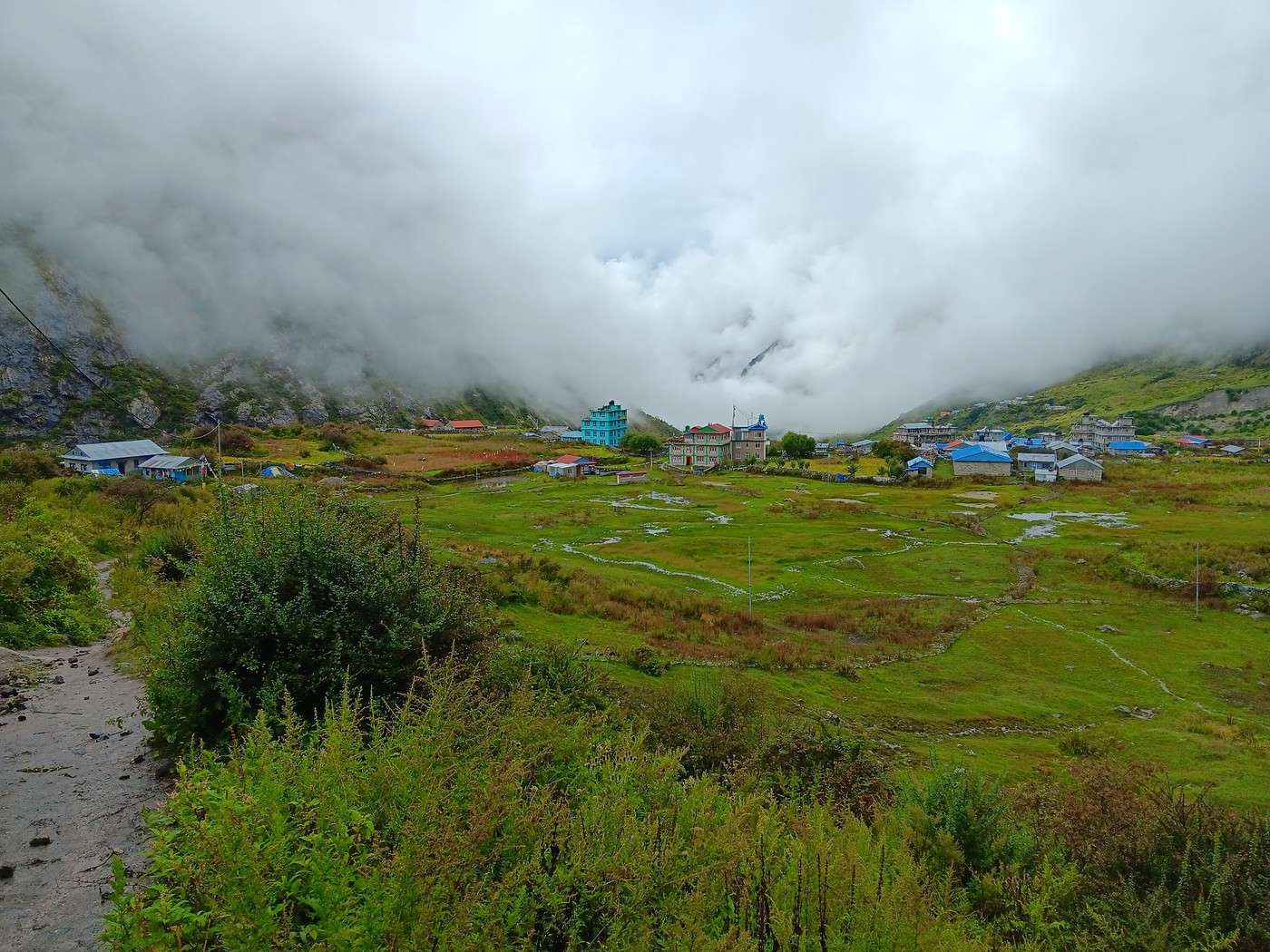
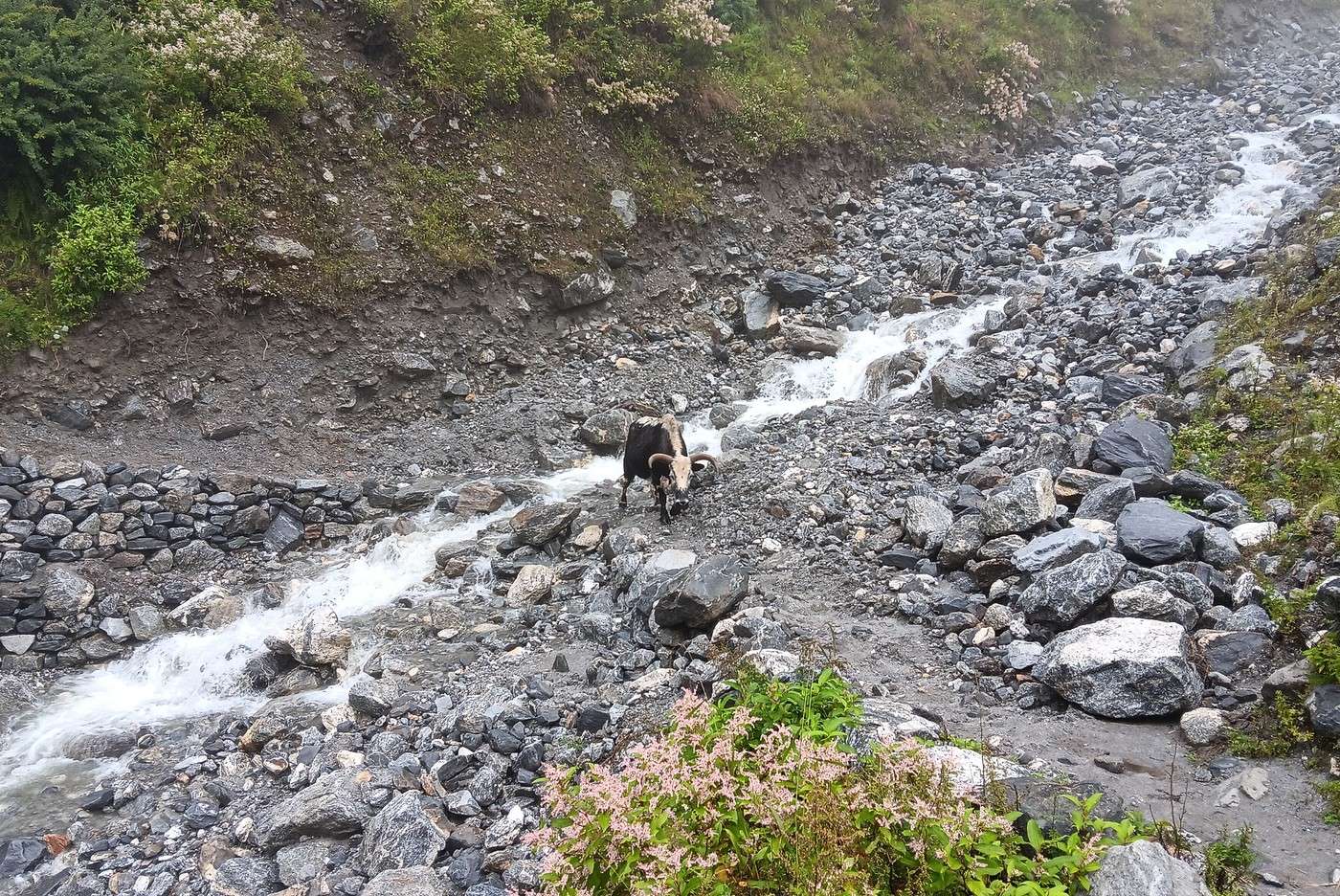
Around 8:30 AM, “zam zam” – let’s go! First photo: the metropolis of Langtang and all its suburbs sprawling below us! 😉 A little later, we cross a pretty stream—nothing dangerous this time! Second photo: a yak crossing the stream.
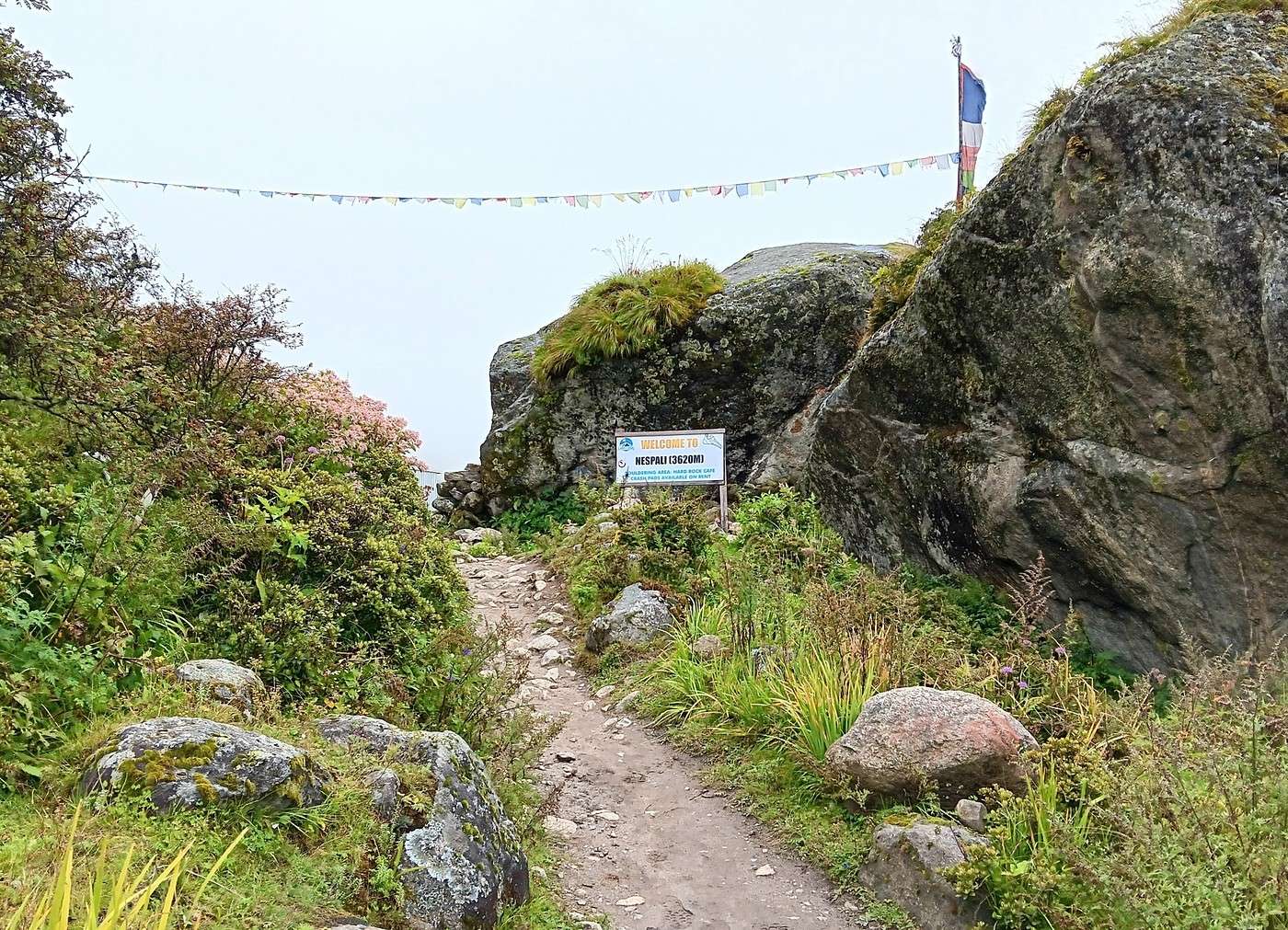
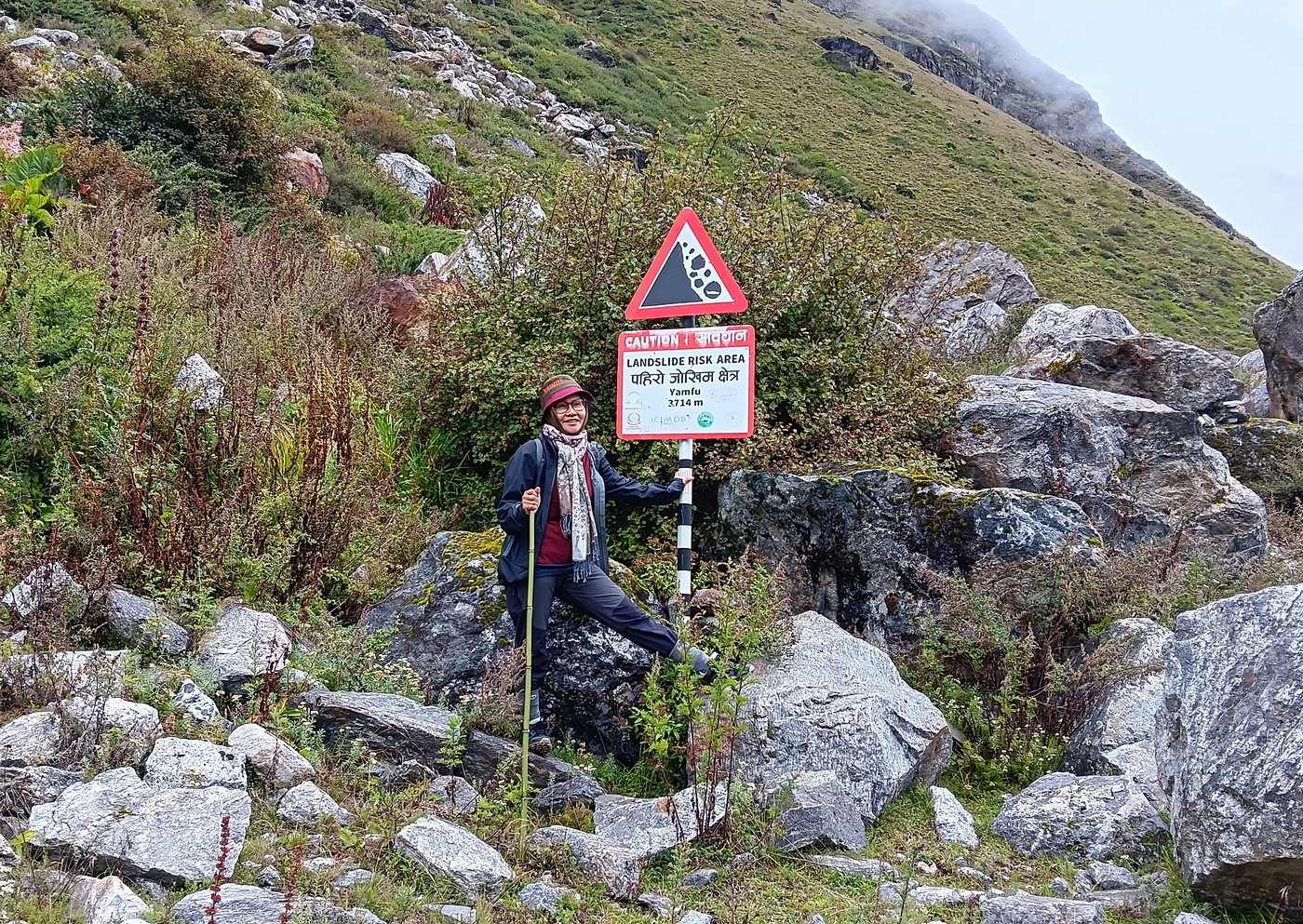
Two hours of fairly easy walking and we arrive at the spot called Nespali—3,620m above sea level (3rd photo). Around 11 AM, a photo break is in order: Y strikes a proud pose in front of the landslide warning sign at Yamfu, 3,714 meters (4th photo). She looks like she’s in great shape today! 🙂 Since Langtang is at 3,455 meters, we’ve gained about 250 meters in 3 hours of hiking—piece of cake! Especially since there were fewer ups and downs than the first few days!
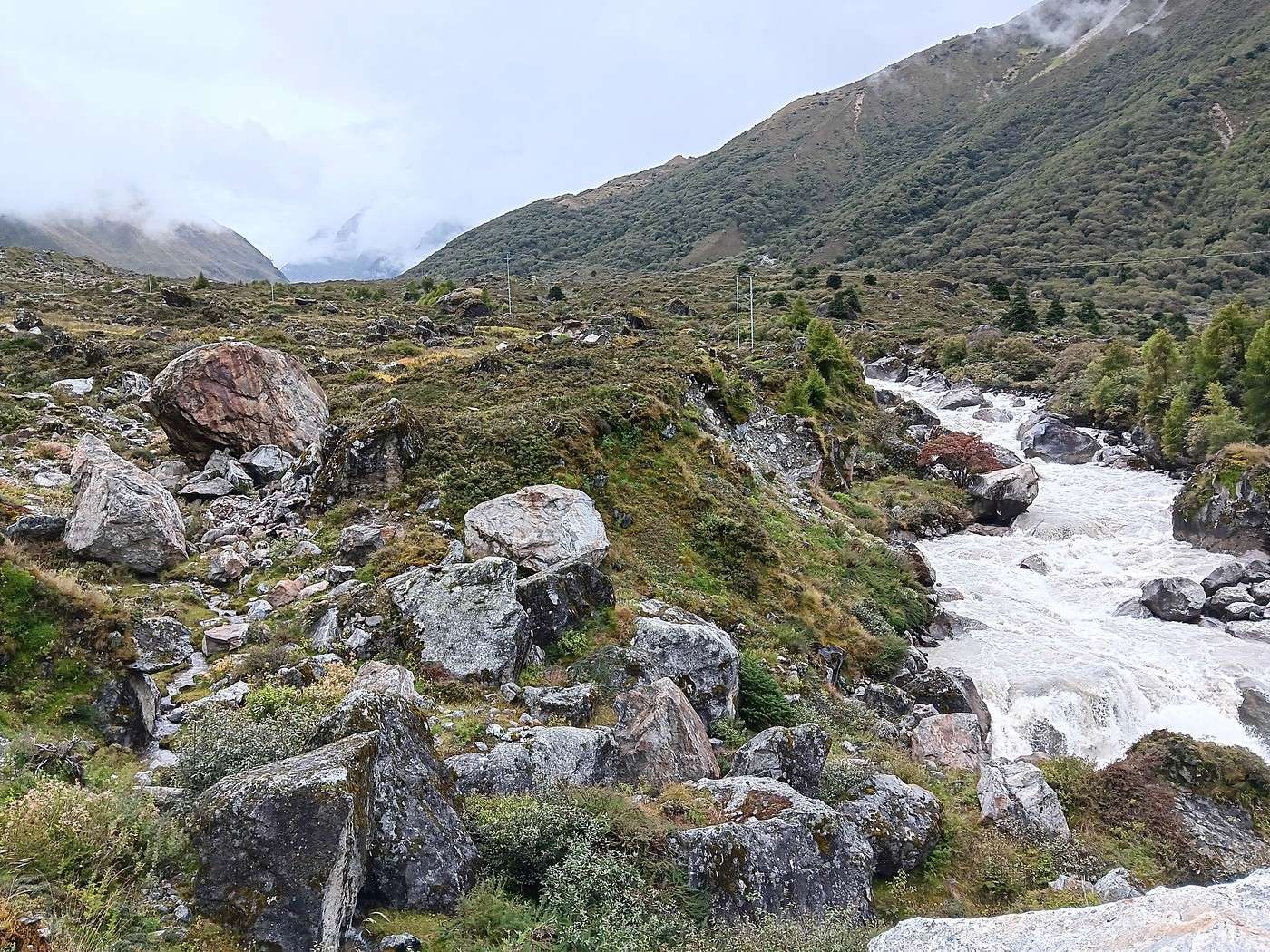
Just a little farther, we cross another pretty stream (5th photo).
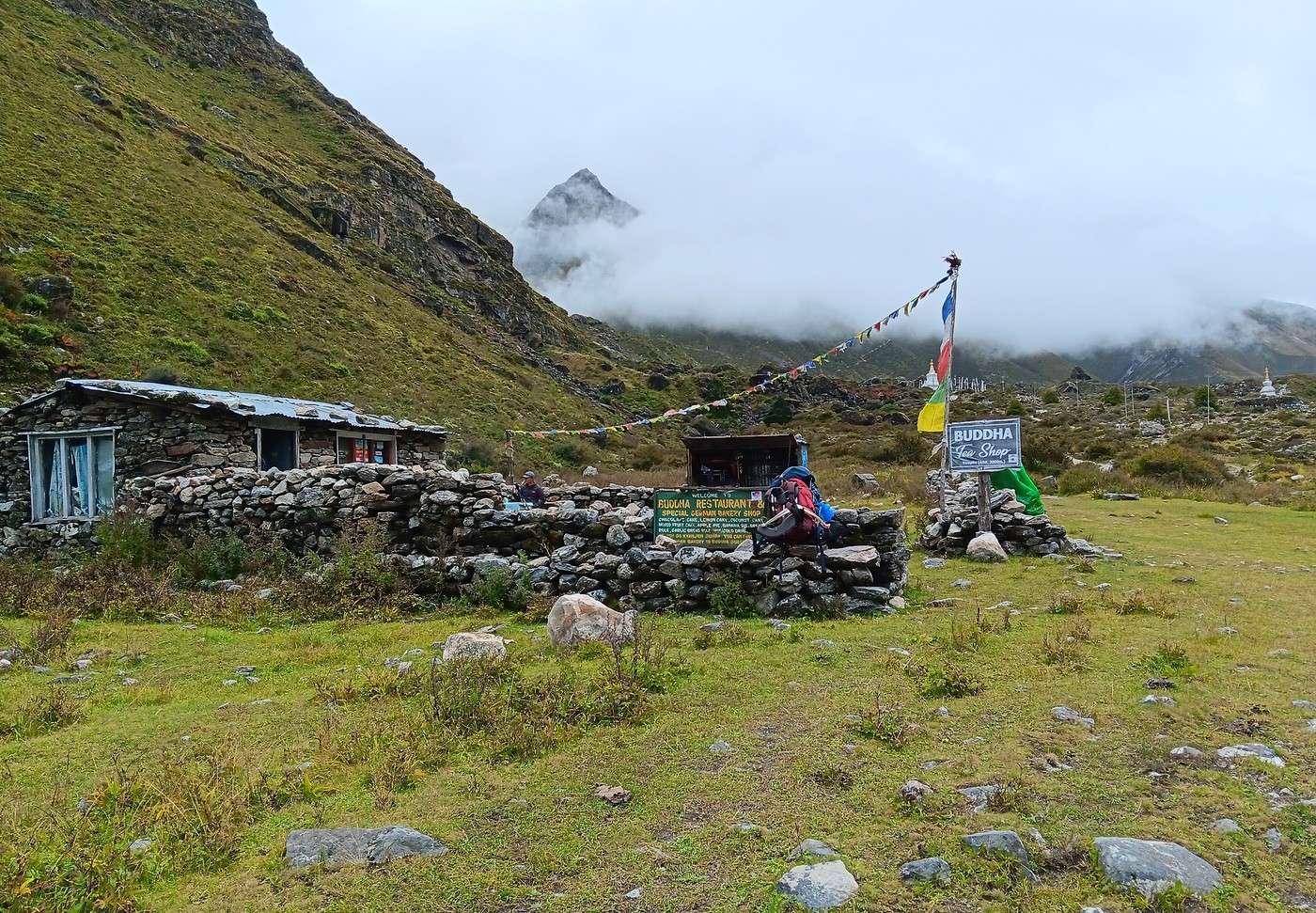
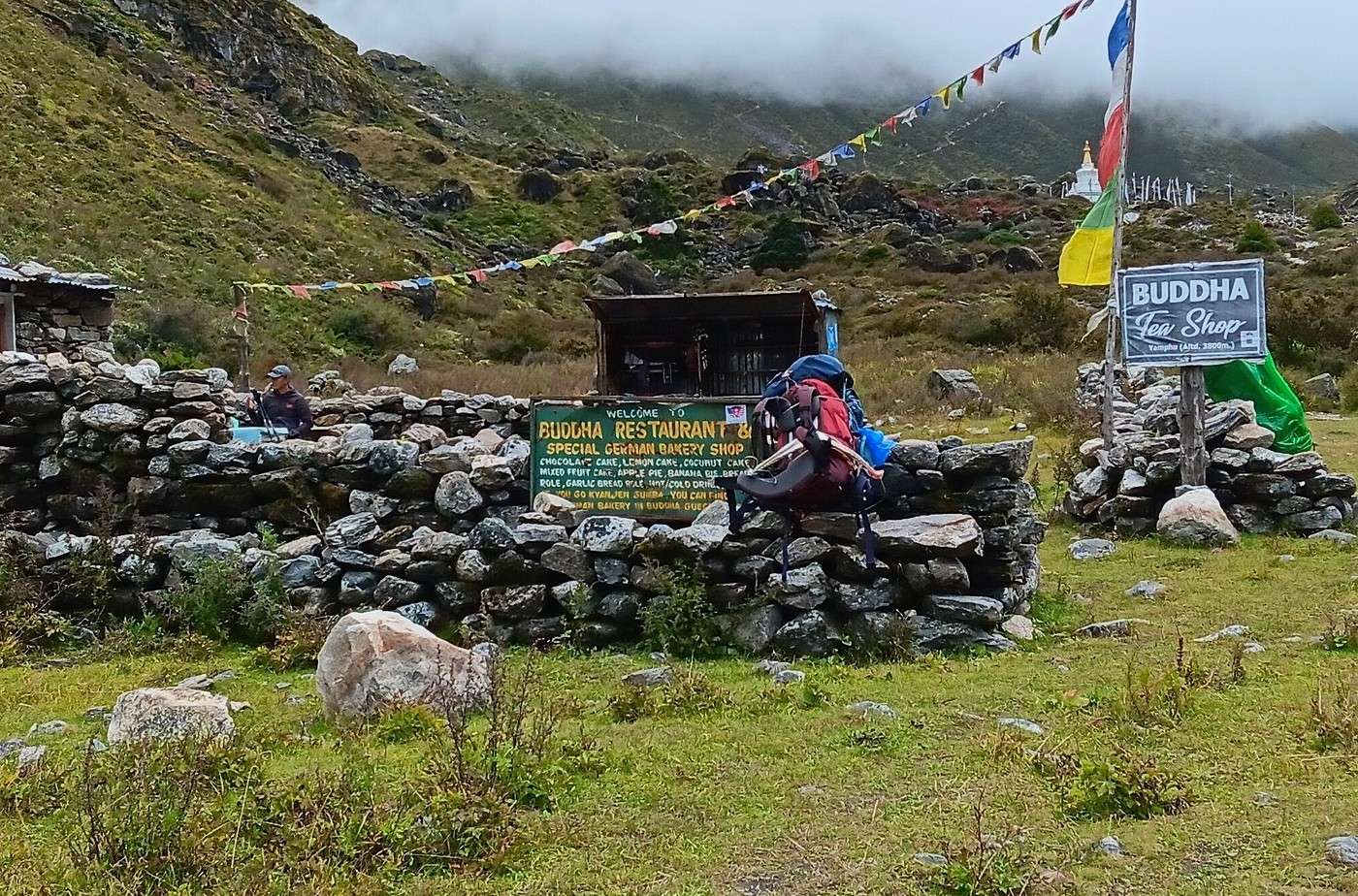
We pass the Buddha Restaurant at 11:15 AM (6th photo). It proudly advertises its specialty: German bakery and pastries (7th photo)! There’s not a single customer… 😕 Which makes me realize we haven’t met a single German on the whole trek.
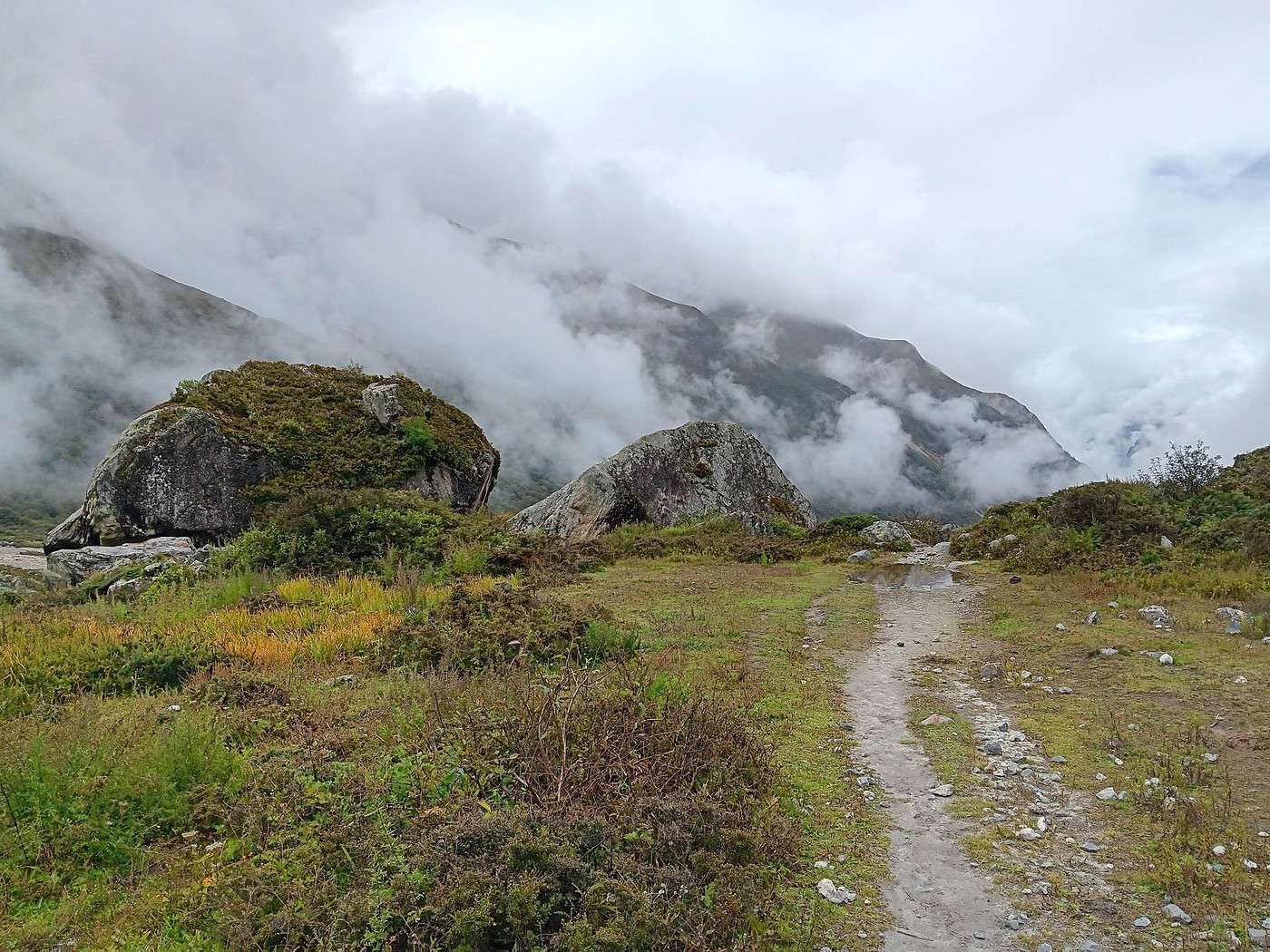
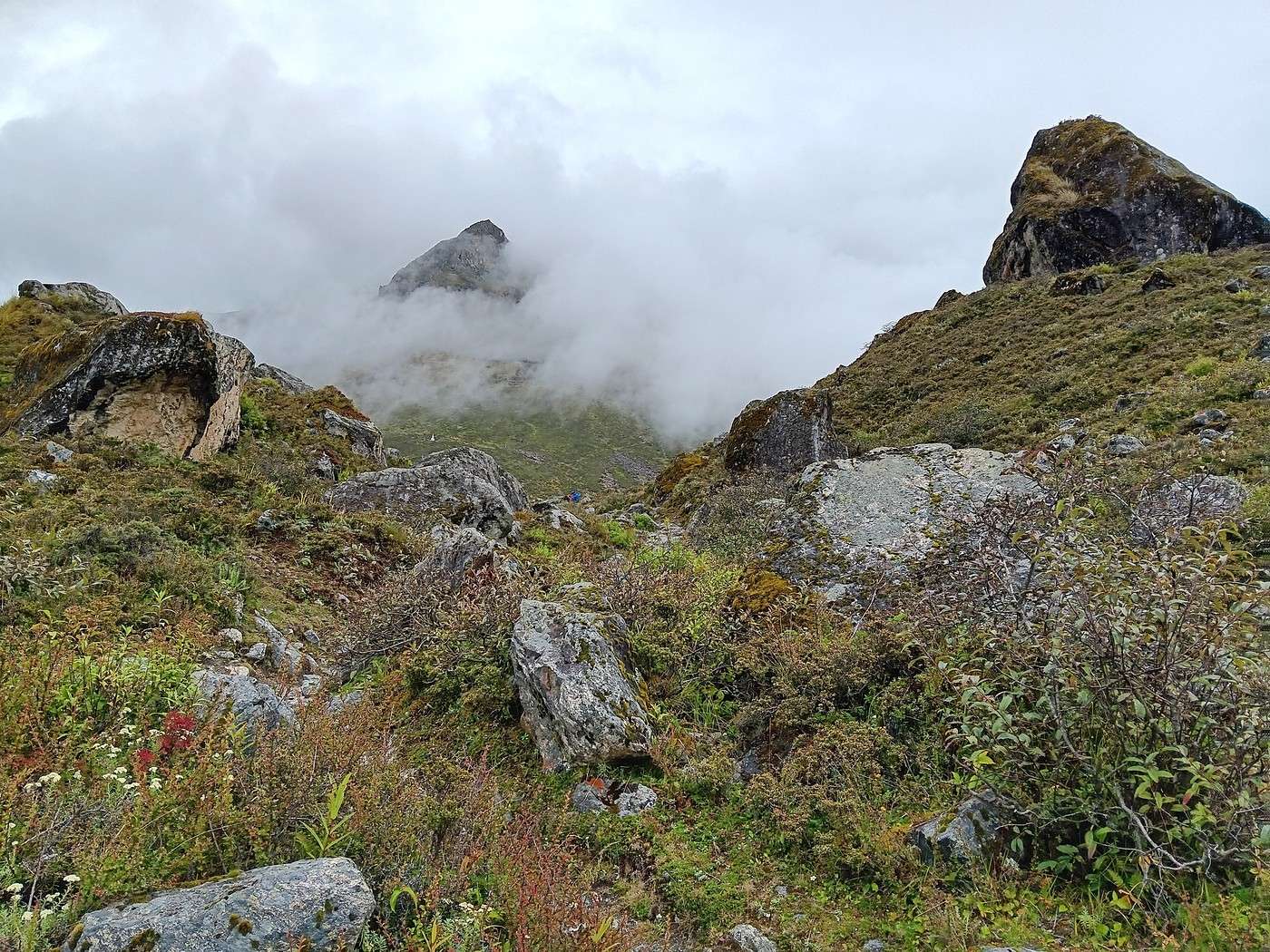
The path might be easier than the first two days, but the surrounding terrain is still rugged: 8th and 9th photos. Even before reaching Langtang, we were skirting the southern flank of Luri Himal, a massif about ten kilometers long that rises above 6,000 meters. The highest peak is Langtang Lirung at 7,227 meters—that’s no small feat. We’re actually only about 5 kilometers away from it. Glaciers descend from it, likely dumping tons of rocks of all sizes, reshaped by landslides, rockfalls, and earthquakes.
Langtang – Trek in the Rain
GeorgesOZ · 2025-10-06 · Message 32 of 109
Day 4 – Langtang to Kyanjing Gompa (2)
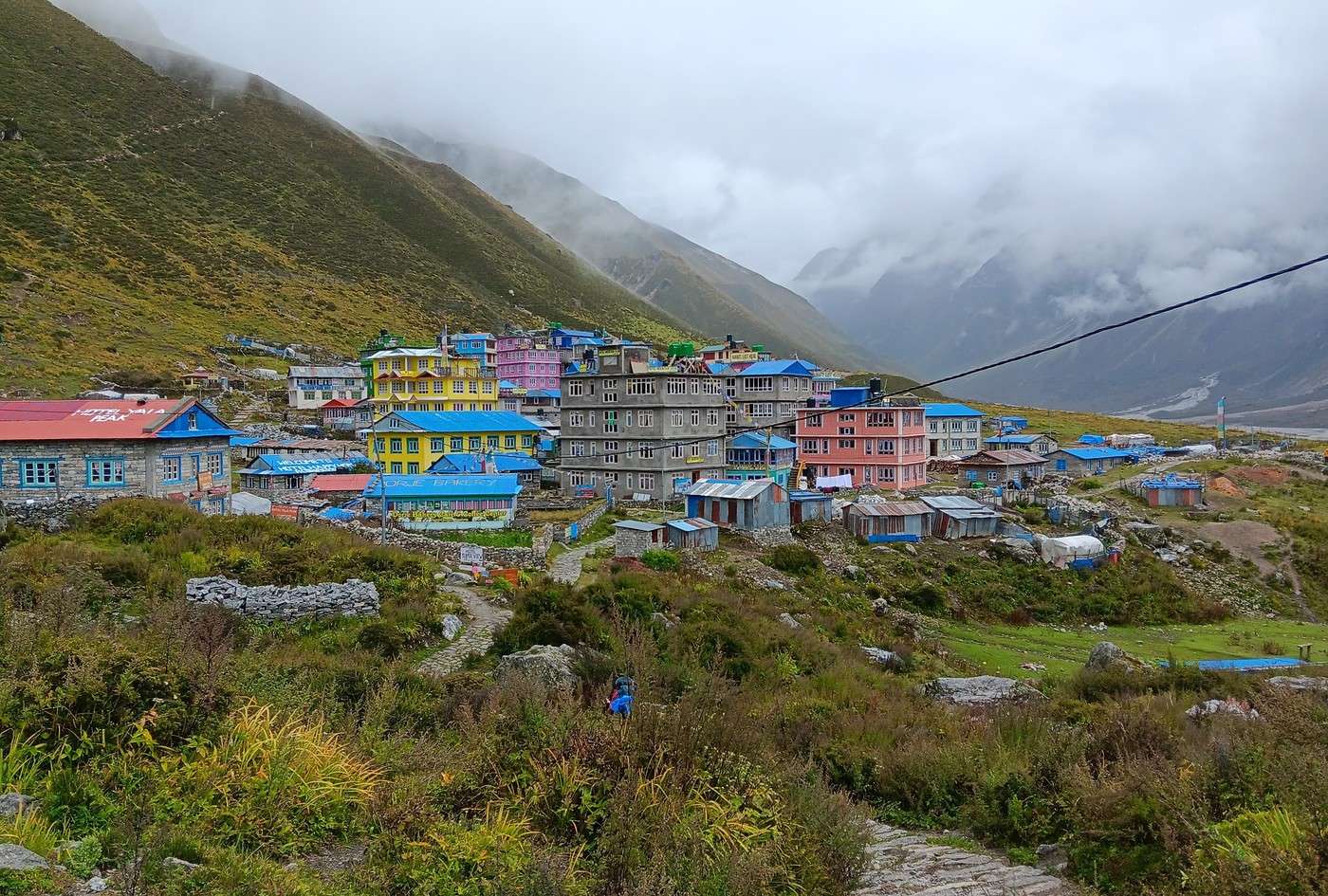
We arrive at Kyanjing Gompa at half past noon: first photo. Only 4 hours of walking today, and the path was significantly easier than the first two days!
What’s remarkable is that several buildings have multiple stories. It’s surprising, given there’s no way to bring construction materials by road—it makes you wonder how they built all this! H told me helicopters are used, but I really doubt it, considering the costs involved.
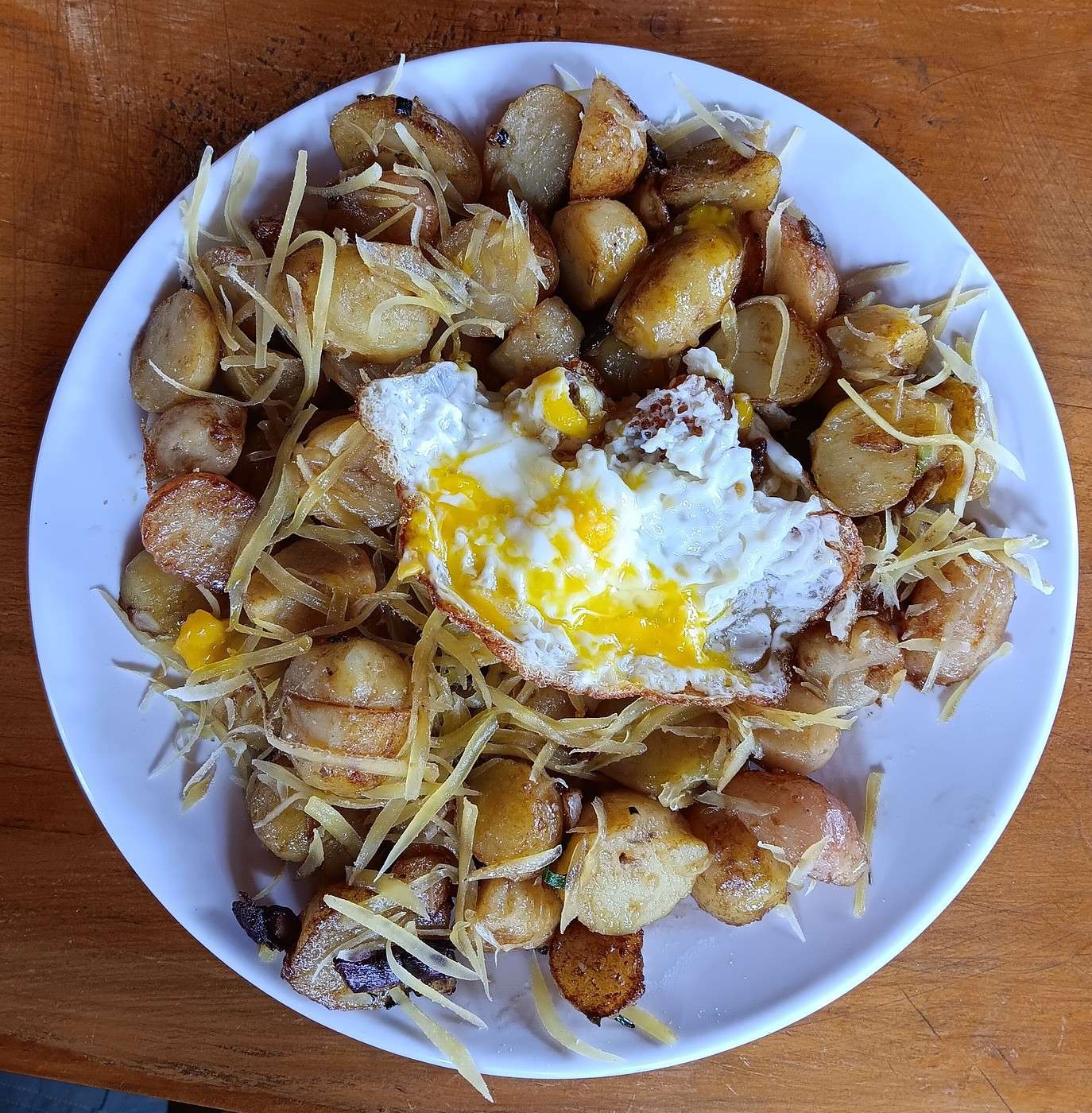
Tonight’s guesthouse is one of those colorful multi-story houses. Our room is on the 3rd floor, the kitchen and common room are on the 5th. We meet up there a little after 1 PM for lunch. I ordered sautéed potatoes with cheese and a fried egg (second photo). It’s pretty decent—filling, at least. 🙂
The Australians are here too, in one corner, the guy still looking miserable. 😐 A group of people occupies the other side of the room. One of the women, lying on the middle bench, sits up to make room for me. From the few words she says, I can easily tell she’s American. Yes, from Colorado, she tells me, and “You sound European” prompts me to clarify that I’m French.
These Americans, three couples in their forties, are very loud. It’s like they’re the only ones in the room. 😐 From the few words exchanged with the woman, I’d already picked up on that hint of hardness bordering on arrogance (I’m searching for the right words) that I’ve often noticed among Americans (I’ve had enough experience with them, professionally and otherwise). Oh, not all of them, of course!
But to end this fairly short post on a different note, I’ve meanwhile uploaded a short video of the Langtang to YouTube, just after Syapru Besi and before the hydroelectric plant. Here’s the link:
https://youtu.be/ZjeUssR5WeQAdmire the river!
Langtang – Trekking in the Rain
Djalma · 2025-10-06 · Message 33 of 109
Hi,
Will you end up having a sunny day after all?🤪
Kyangin Gompa really isn’t very nice in this weather. There are a few more buildings than when I passed through. Didn’t you go buy some cheese at the dairy? I heard it was the Swiss who started making cheese there...
It’s also worth continuing a few more kilometers to the end of the valley. There were lots of yak herds there!
Langtang – Trek in the Rain
GeorgesOZ · 2025-10-06 · Message 34 of 109
Hello,
You’ll end up having a sunny day after all?
Kyangin Gompa really isn’t very pretty. There’s a bit more construction than when I passed through. Didn’t you go buy cheese at the dairy? I heard it was the Swiss who started making the cheese here...
It’s also worth continuing a few more kilometers to the end of the valley. There used to be lots of yak herds there.
Nope, sunshine was rare, unfortunately! It didn’t always rain, either—there were a few breaks, but I wouldn’t exactly call them sunny...
The rain we got was pretty light, sometimes just a drizzle.
Maybe I should’ve titled my travel journal: "Trek in the Mist"... or maybe I should’ve ripped off the movie with Sigourney Weaver and gone with "Monkeys in the Mist", since we saw those monkeys a little lower down?
As for the cheese, no, we didn’t go any farther than Kyanjing Gompa. Higher up, though—that’ll be on my next page!
Langtang – Trekking in the Rain
Djalma · 2025-10-07 · Message 35 of 109
The cheese was indeed at Kyangin Gompa... A real cheese shop! You couldn’t miss it unless it’s no longer there after the earthquake. I stocked up on cheese there for the Ganja La pass: 3 whole days, partly in the snow, without seeing a soul until Tharke Gyang!
Langtang – Trekking in the Rain
GeorgesOZ · 2025-10-07 · Message 36 of 109
The cheese was indeed at Kyangin Gompa... A real cheese dairy! Impossible to miss unless it no longer exists after the earthquake... I stocked up on cheese there for the Ganja La pass: 3 whole days, partly in the snow, without seeing a soul until Tharke Gyang!
Honestly, I don’t know. I imagine our guide would’ve mentioned something about the cheese. We had a whole afternoon free with nothing planned after an easy hike from Langtang.
None of the other trekkers we met mentioned cheese...
PS: It feels like you’re the only one reacting to my travel journal!
Langtang – Trekking in the Rain
Djalma · 2025-10-07 · Message 37 of 109
Since the COVID period, the Nepal section hasn’t seen much activity!
In post #6, Terry tara confirms that the cheese shop is still there, but they probably went before you.
Post #7 here talks about it:
https://voyageforum.com/v.f?post=3471989;search_string=fromagerie%20a%20kyangin%20gompa
PS: Langtang Lirung in good weather😉:
https://media.decathlontravel.com/assets/1920x0/MYLLXB.avif
Langtang – Trek in the Rain
Tilicho · 2025-10-07 · Message 38 of 109
The cheese was indeed at Kyangin Gompa... A real cheese shop! Impossible to miss unless it no longer exists after the earthquake... I stocked up on cheese there for the Ganja La pass: 3 whole days, partly in the snow, without seeing a soul until Tharke Gyang!
Honestly, I don’t know. I imagine our guide would’ve mentioned something about the cheese. We had a whole afternoon free with nothing planned after an easy hike from Langtang.
None of the other trekkers we met mentioned cheese...
PS: It feels like you’re the only one reacting to my travel journal!
Hello,
Having traveled to Nepal several times—including 3 trips around Langtang and the Tamang Trail—I’ve been following your amazing story with passion and nostalgia from the start.
Wishing you great Nepalese adventures!
Michel
Langtang – Trekking in the Rain
TerryTara · 2025-10-07 · Message 39 of 109
It's peak season in Nepal, and I'm swamped with work, so I really haven't had time to read up on all the stage details. Personally, it's been a while since I've been there (2023), but I have lots of clients who go, and the last ones who visited the cheese factory were there in May. Depending on the time of year, it's not automatically open, and you might need to ask locals if it's possible to visit and buy cheese.
I haven't checked with my local contacts, but I'd be surprised if it's been closed since the monsoon season. That said, in early September, it might not be open non-stop since it's not quite peak season yet.
Langtang – Trek in the Rain
GeorgesOZ · 2025-10-08 · Message 40 of 109
The cheese was indeed at Kyangin Gompa... A real cheese shop! Impossible to miss unless it no longer exists after the earthquake... I stocked up on cheese there for the Ganja La pass: 3 whole days, partly in the snow, without seeing a soul until Tharke Gyang!
Honestly, I don’t know. I imagine our guide would’ve mentioned something about the cheese. We had a whole afternoon free with nothing planned after a relatively easy hike from Langtang.
None of the other trekkers we met mentioned cheese...
PS: It feels like you’re the only one reacting to my travel journal!
Hi,
I’ve been to Nepal several times over the years, including 3 trips around the Langtang and Tamang Trail, and I’ve been following your amazing story with passion and nostalgia from the start.
Great Nepalese adventures to you!
Michel
Hi Michel!