Back to the discussion

in Entre deux voyages › Carnets de voyage

16 days with family in La Gomera (Canary Islands) (page 2 of 3)

Discussion started by Pagaljavab on 2026-08-14

53 replies

This thread has been translated into English.


16 days in La Gomera (Canary Islands) with family

Pagaljavab · 2026-08-19 · Message 21 of 54

Day 4, Friday, July 31: Valle Gran Rey/La Calera

Nothing too special in the first part of the day. For breakfast, now that we have the ingredients, I decided to prepare a 100% Gomeran breakfast using gofio, a flour made from roasted cereals with a deliciously toasted flavor, which has remained a staple food in the Canary Islands. It can include one or several cereals or legumes: wheat, corn, millet, barley, rye, oats, chickpeas, or lentils. The one I bought at the Spar the day before actually contains all seven! You can use it in all sorts of ways: sweet, savory, as a drink, cream, mousse, soup, mixed with many ingredients, or just with water. For my part, I followed a traditional recipe: I mixed the gofio with boiled water and milk until I got a purée, which I then drizzled with palm honey. I poured it all into a bowl where I’d cut up pieces of those small, tasty Canarian bananas. With coffee, it’s a delight and gives you an ancestral energy boost! The La Gomera Travel site explains that the Guanches used to find the strength to trek long mountain trails by eating gofio and palm honey porridge. This morning, we don’t have any trails to hike, but we’ll head to the beach!

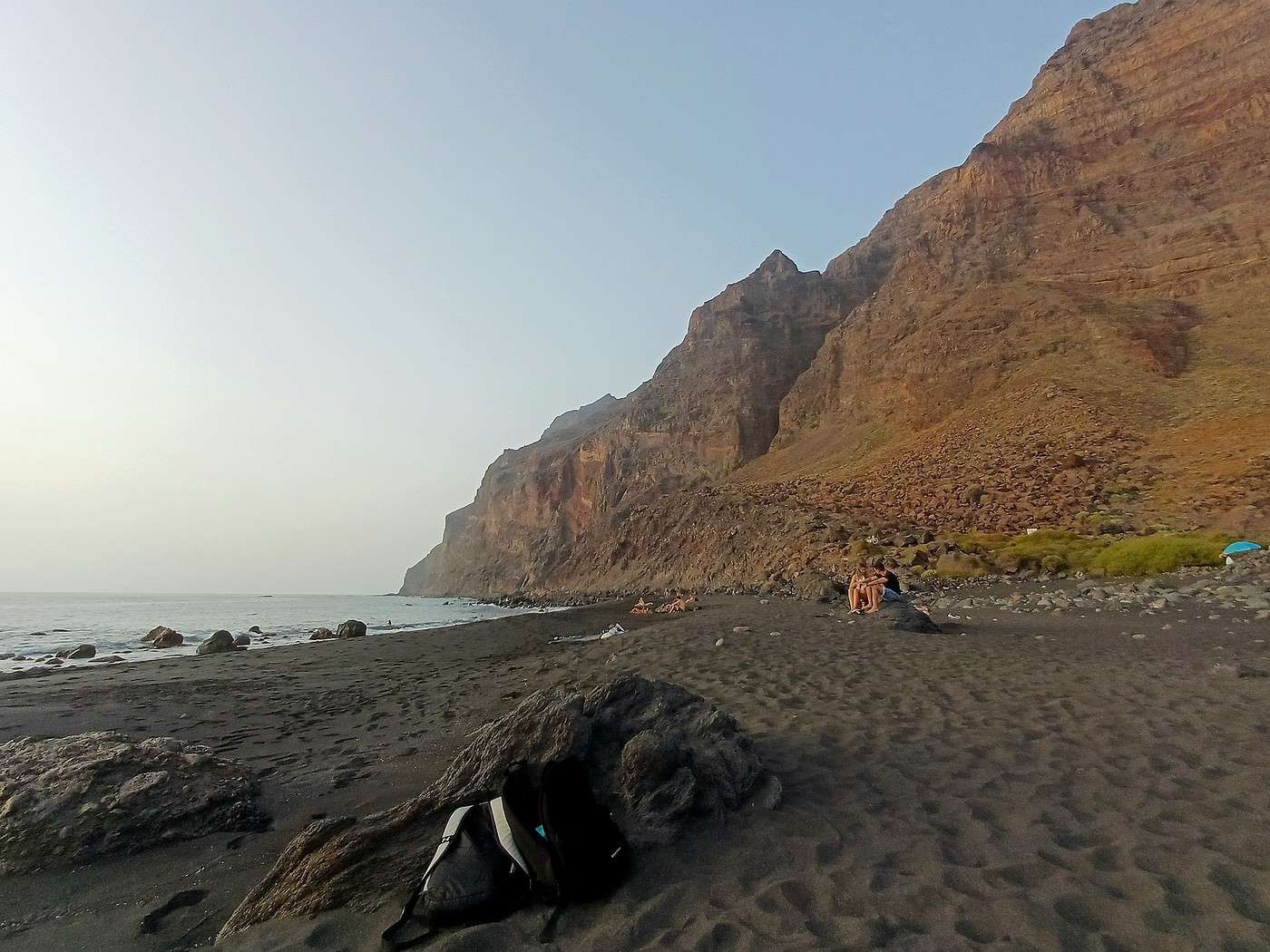
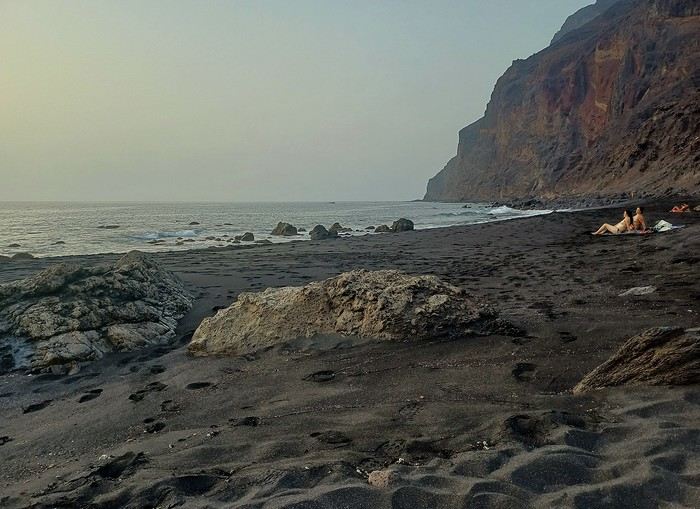
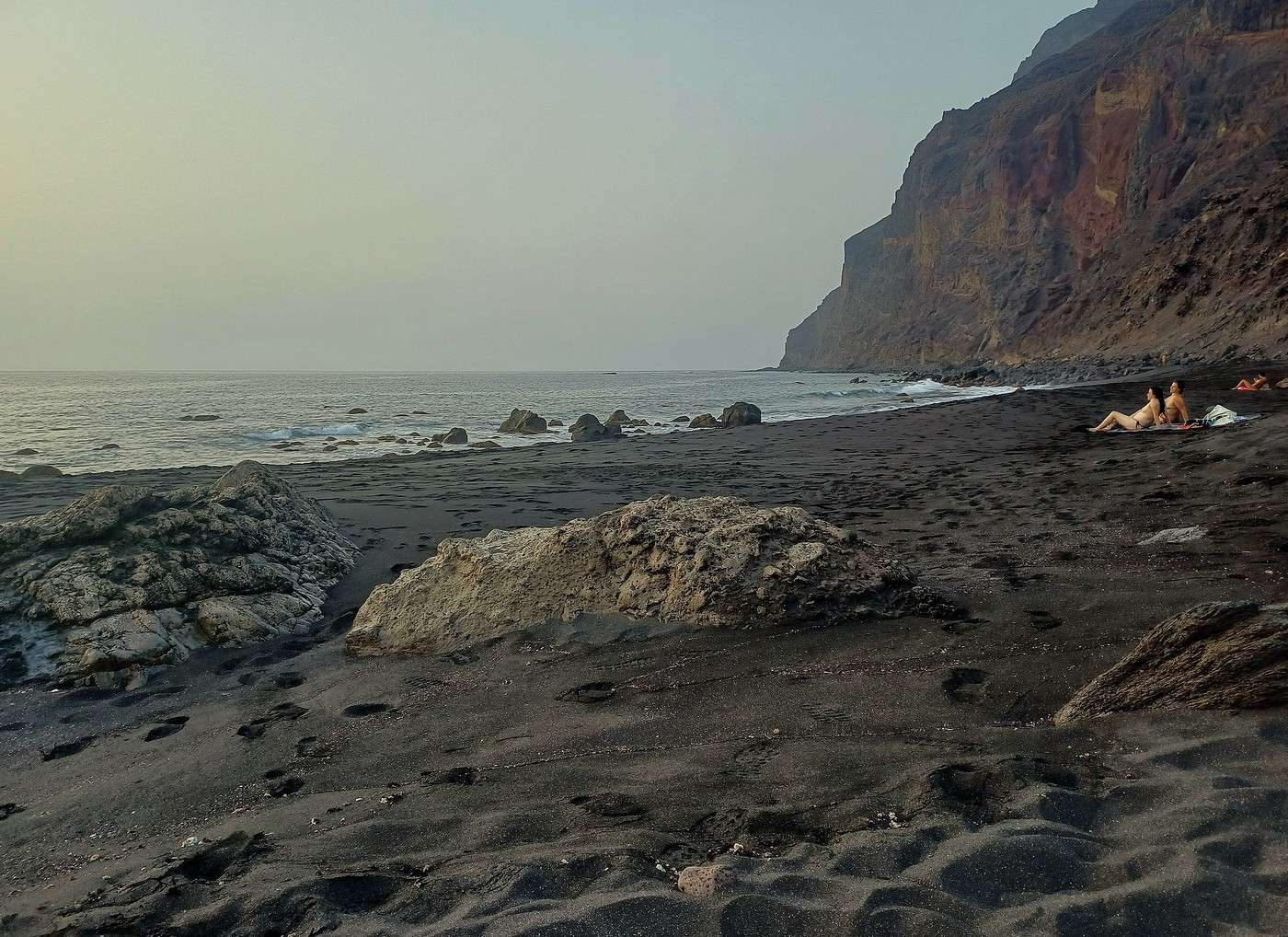
So, a morning of swimming and relaxing. We tried a new beach, playa del Inglés, very close to La Calera, separated by a small commercial and residential area and a rugged line of rocks topped with beautiful black sand dunes, which makes it impossible to access from the seaside. At the foot of the cliff of La Mérica, which closes off the valley to the north (where our accommodation is located), playa del Inglés is more secluded, less developed, and attracts naturists and some gay and lesbian couples for that reason. It’s still early, and there’s almost no one around, but the waves and current seem a bit stronger, and the shore is rockier. That puts us off a bit, so we head back to playa de la Calera. Still, we’ve read that it’s ideal for watching sunsets, and Magali suggests we come back for a picnic this evening.

So, we’re back at our favorite beach, where the water is still just as nice, and the swim is pleasant with just the right amount of small waves. The sun is gorgeous, the sky is blue, and there are still very few people around. Only the familiar faces of the morning regulars are there—mostly Germans who look great for their age, doing yoga or swimming lengths about forty meters from the shore. Camper vans are parked along the beach with no restrictions, and their occupants just have to step over the small wall to take a dip. We also took the opportunity to do some laundry, as there’s a laundromat in the small commercial area next to the beach. On the little square, the same wandering hippies we’ve seen the other days haven’t moved from their wall—one looks like a surfer who’s gone a bit off the rails, and the other two seem more like drifters, staring blankly at the beach. We also restocked our supplies, including those essential 8-liter water jugs because the tap water has a swampy smell and isn’t drinkable. Then it’s casa Buena Vista, garbanzos, pasta, tapas, Dorada... and siesta.

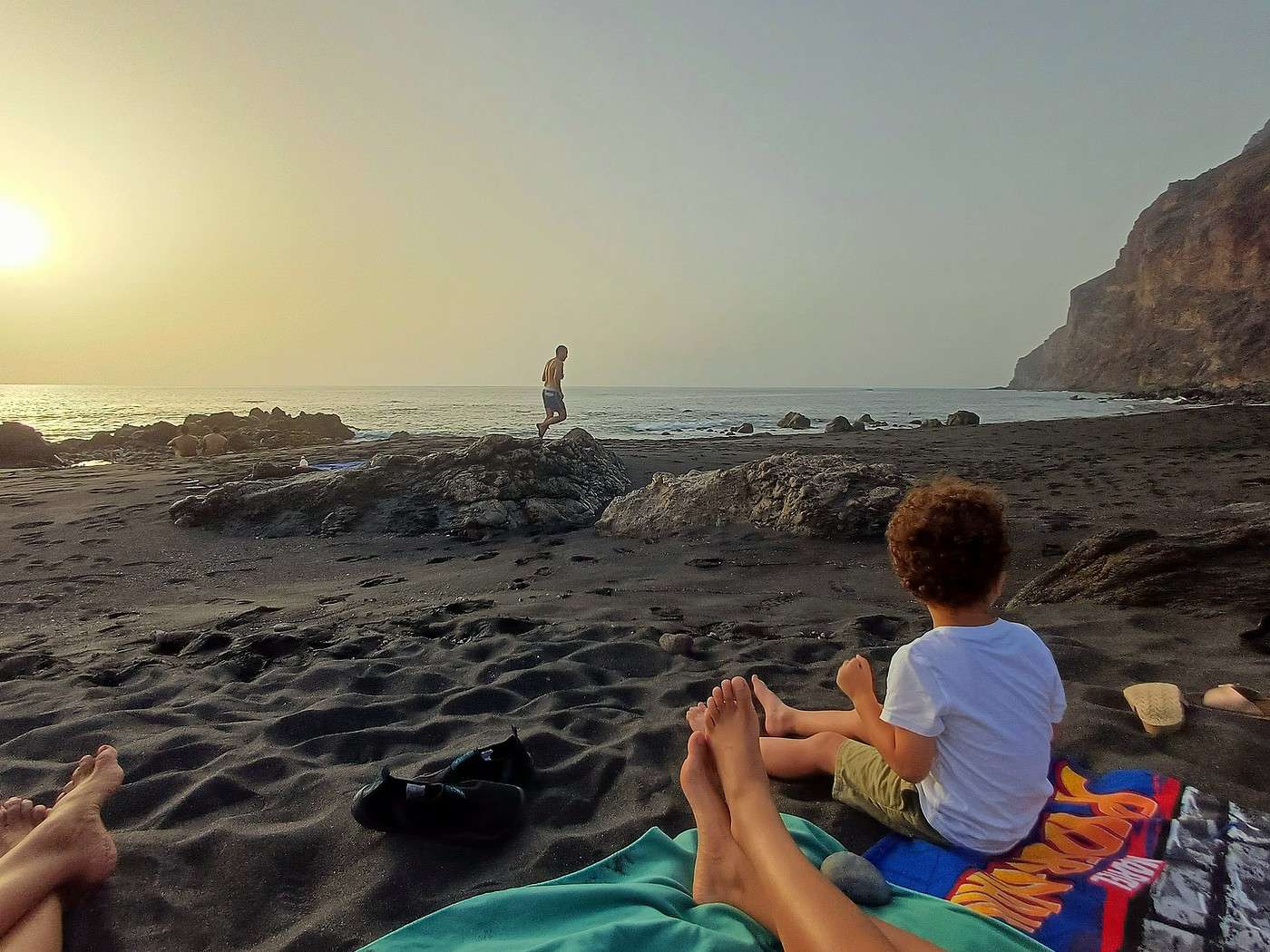
In the evening, with chorizo, salami, Iberian mortadella sandwiches, and my nice cold homemade gazpacho packed up, we drove to playa del Inglés. We parked in the small lot at the foot of the dunes, where vans and camper vans were also parked. We laid out our towels and unpacked our picnic.
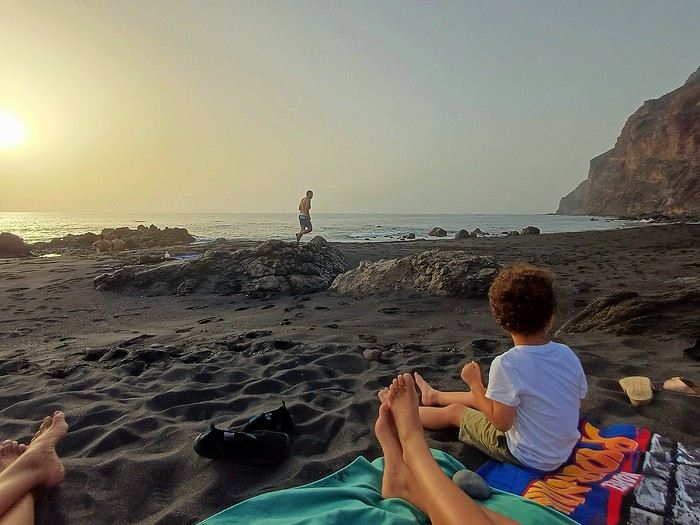
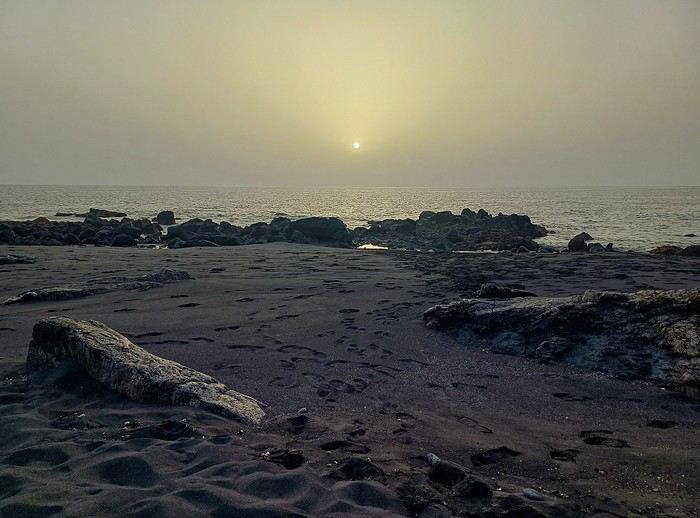
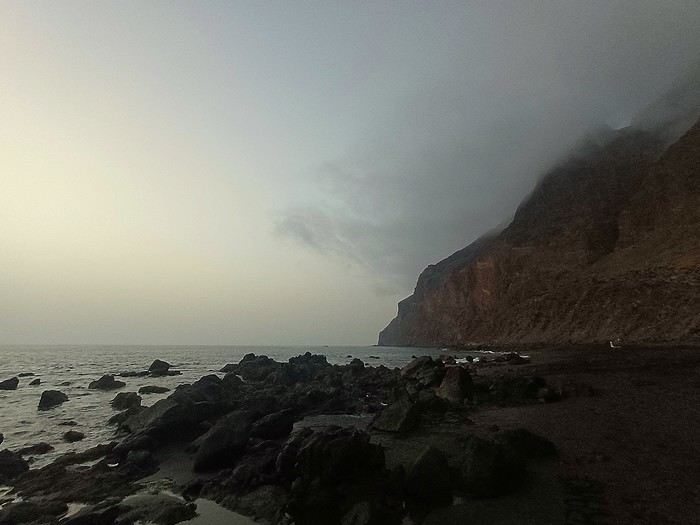
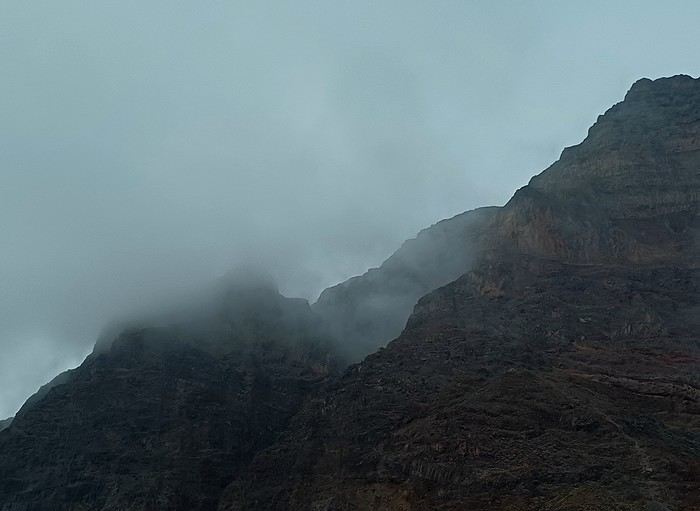
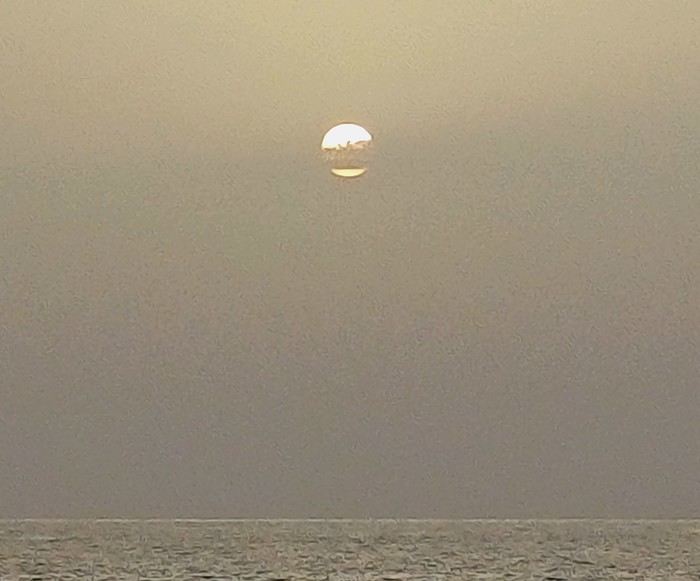
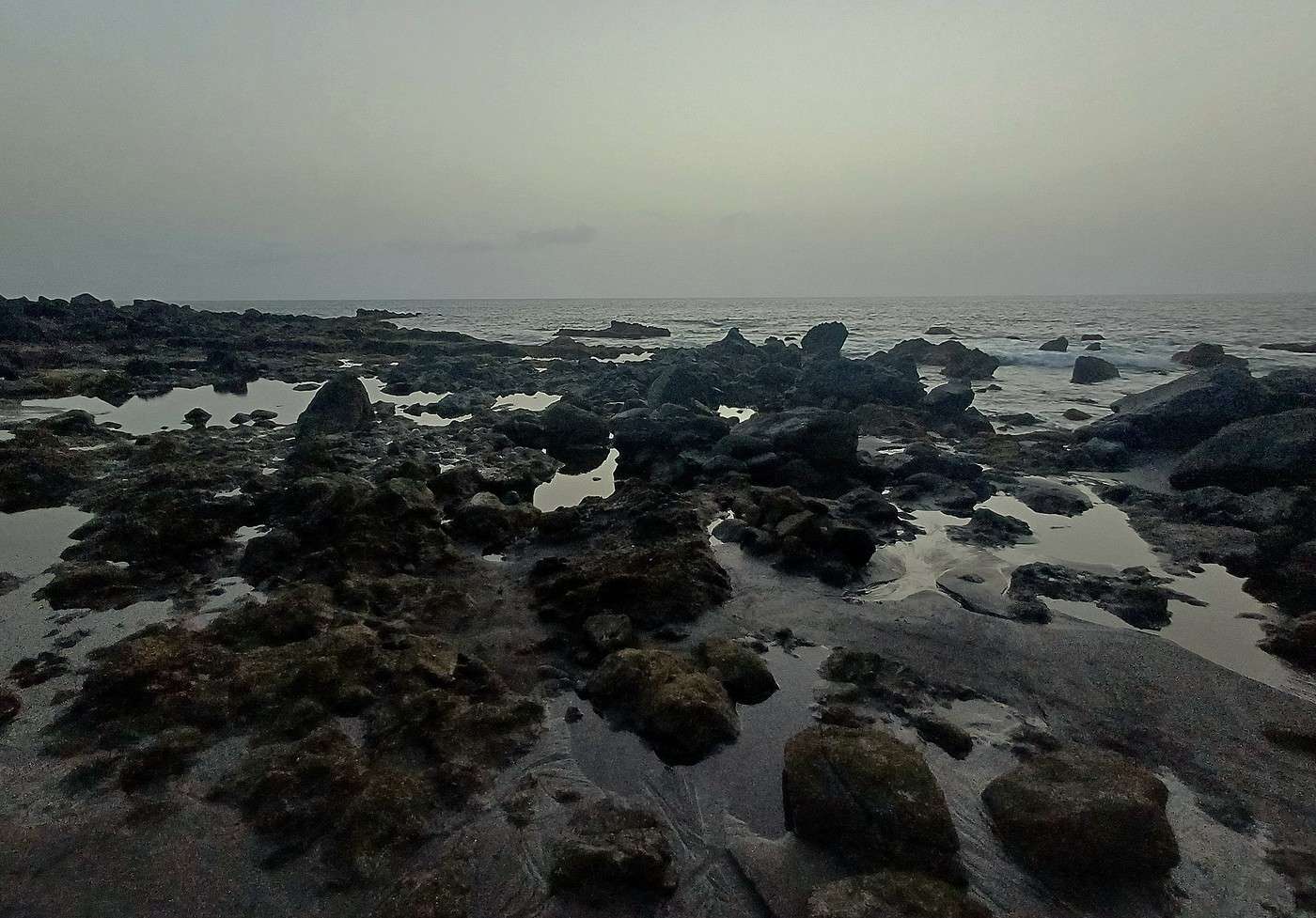
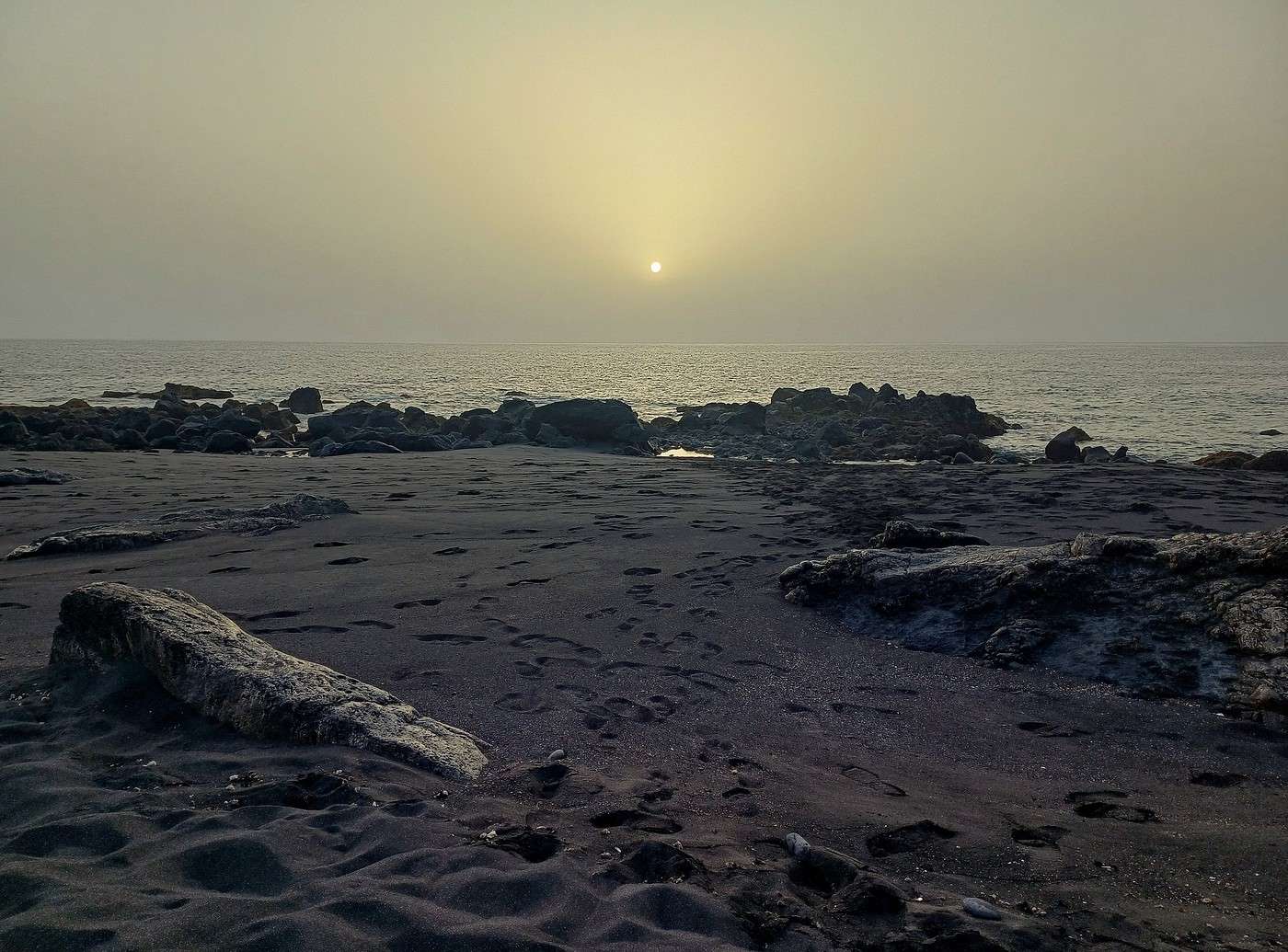
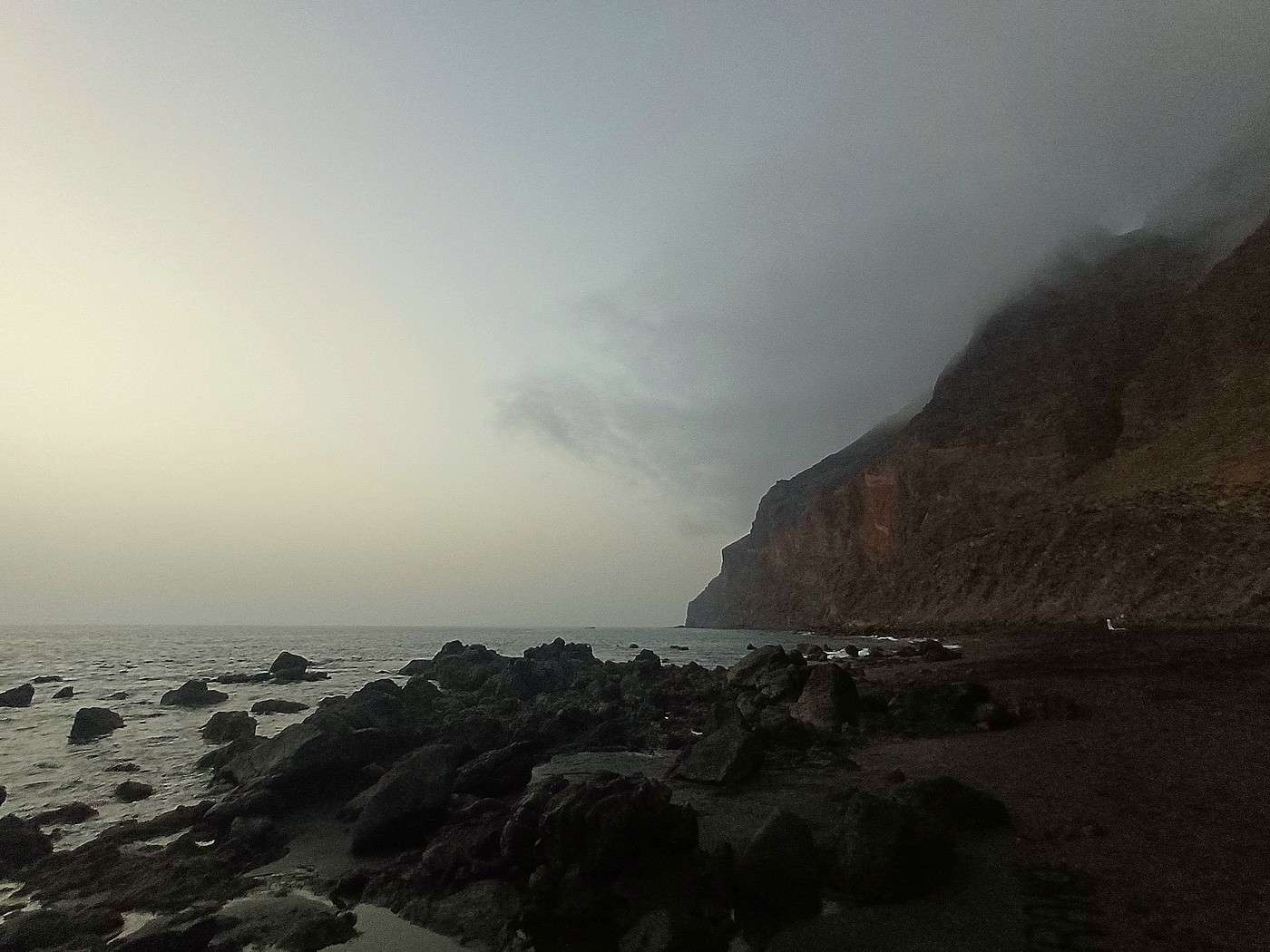
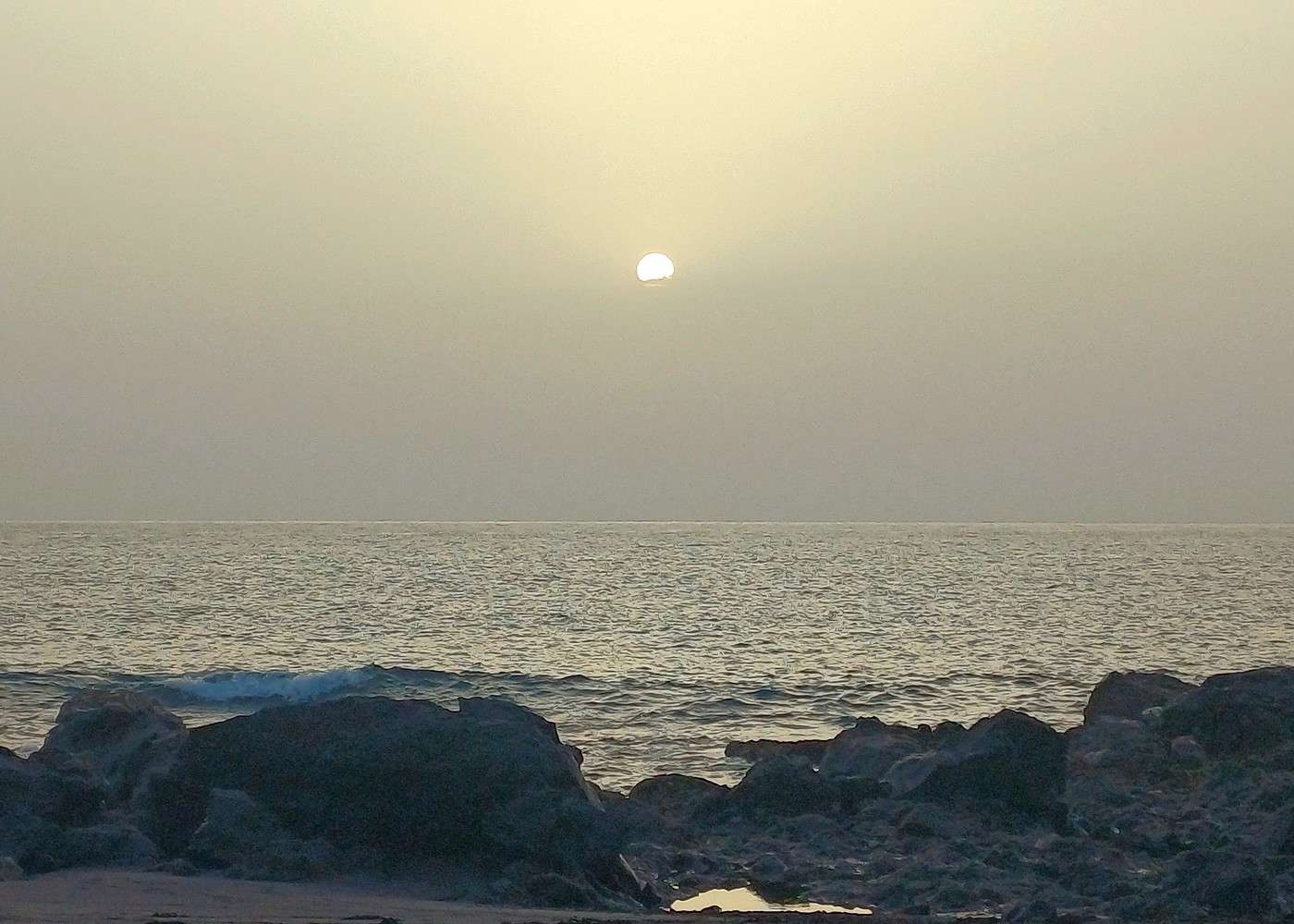
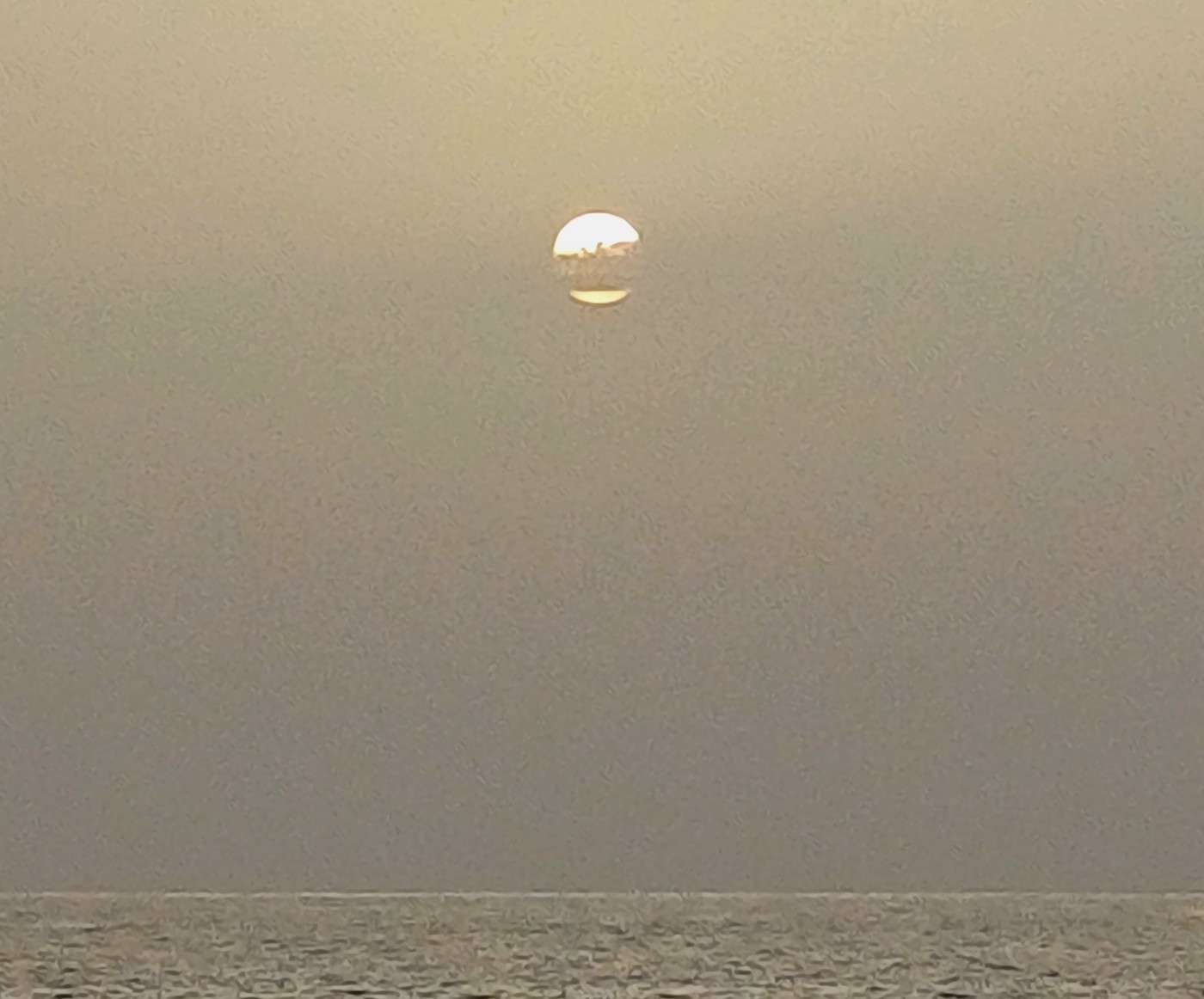
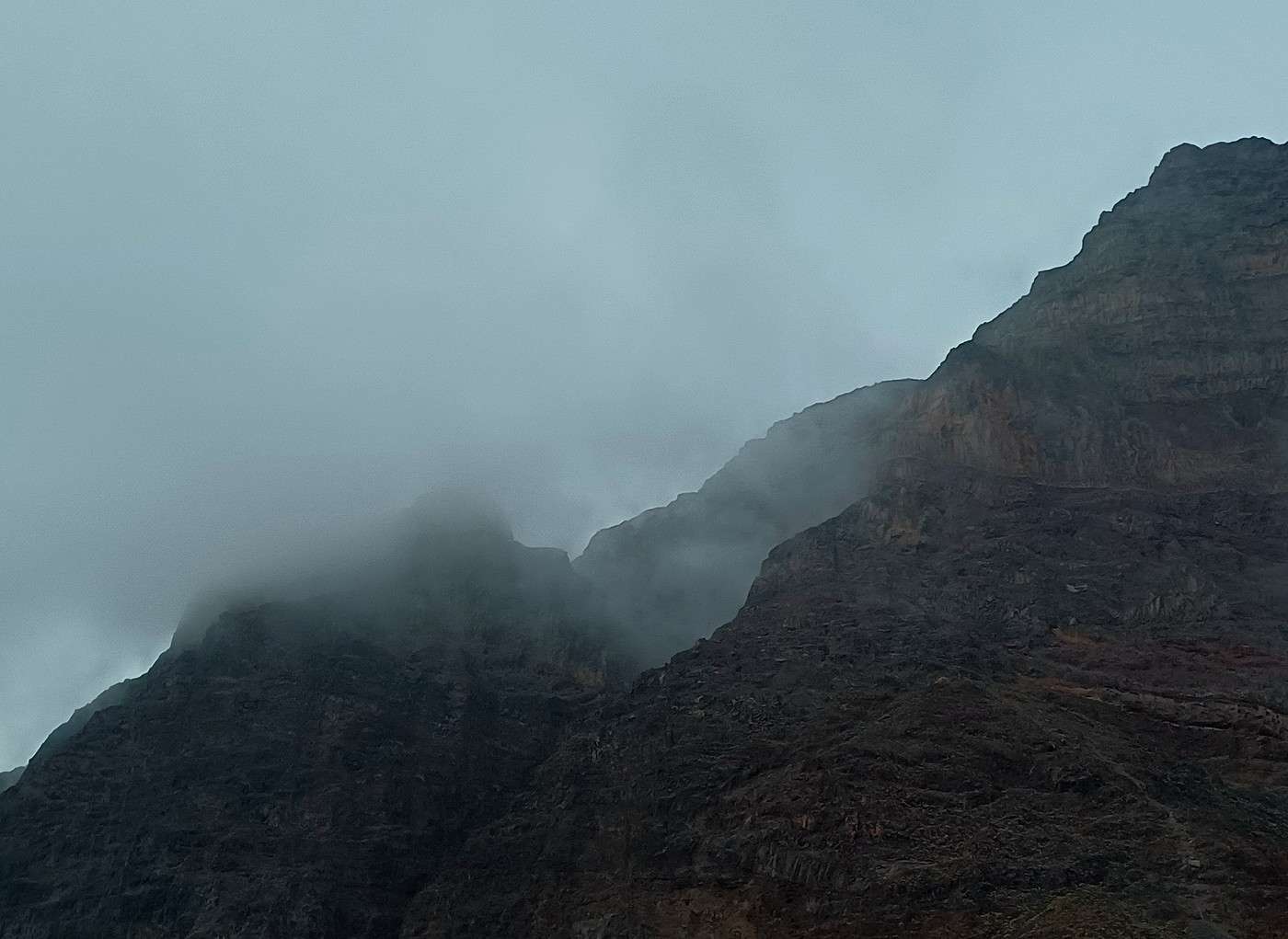
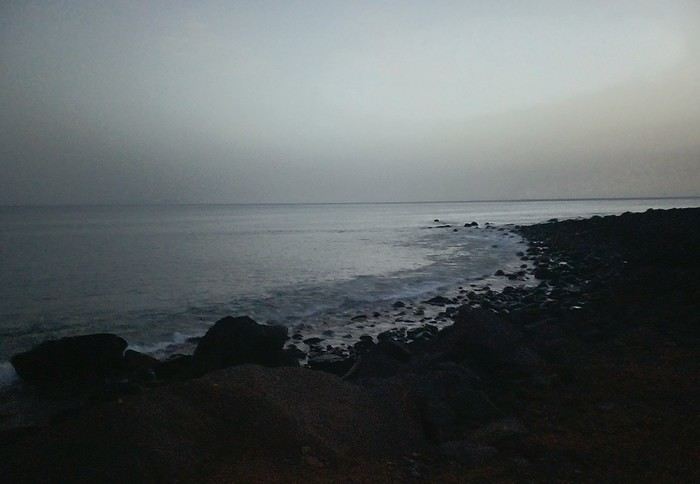
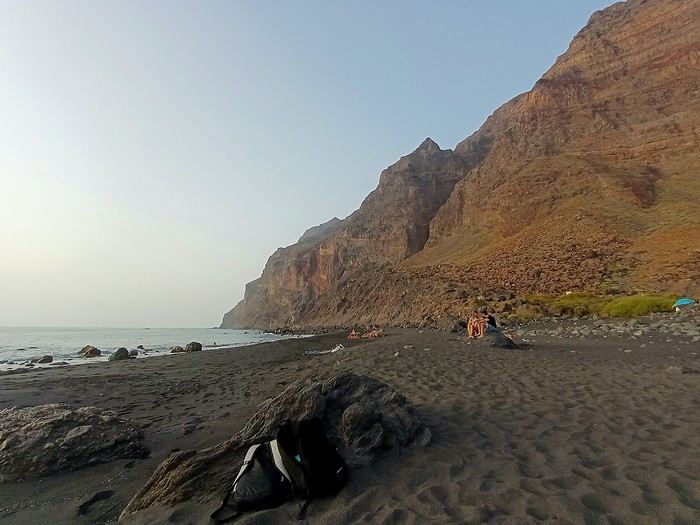
A few naturists were indeed there, mostly at the far ends of the beach near the rocks or dunes. The gay and lesbian couples were also around, visible but discreet. There were even a few swimmers braving the evening waves against the backdrop of the red cliff. There were no more than fifteen of us, and the atmosphere was calm and free. The sun slowly set behind the ocean and the Americas, changing the hues of the water and the cliff of La Mérica, which was misty at the top, every minute, while the temperature grew even milder. We even dipped our feet near the rocks, which were teeming with countless black crabs. A truly beautiful moment.
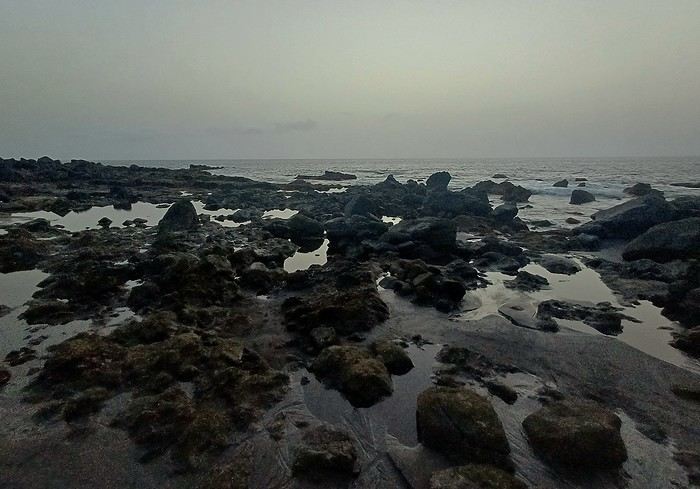
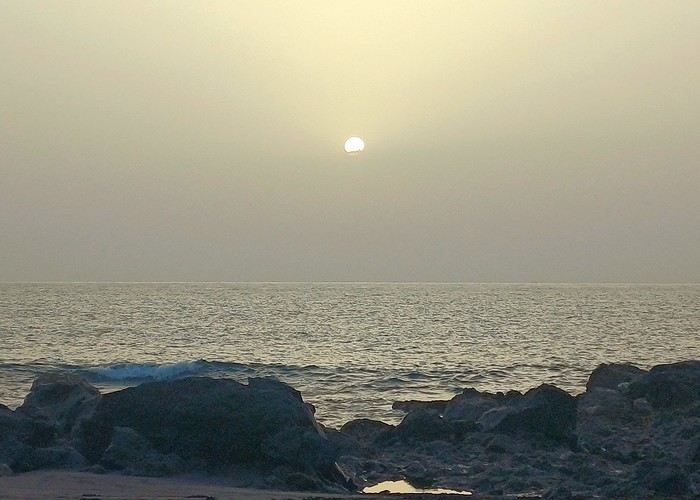
Night fell, and we took the path back toward the small seaside center. But then, it was pitch black in the shadow of the cliff of La Mérica, and the Cory’s shearwaters began their eerie, shrill cries. From our terrace overlooking the valley, the echoes created a ghostly effect. But here, the cries were sharper, and we were literally in the eye of the storm—it felt more real and heart-wrenching. We could see the pathetic birds flying just above us or behind the vegetation along the road. First-timers like us were amused, with a hint of awe, while the regulars barely paid attention. Dogs barked, and goats bleated like the night before. Théo was petrified, crying and refusing to walk unless we carried him close. You really have to see it to believe it! Either way, we found our foolproof argument for when Théo misbehaves: "If you don’t stop, we’ll leave you with the Cory’s shearwaters!" We’re terrible parents, but it’s so effective...

Playa de La Calera was lively that evening, and we couldn’t hear the shearwaters making their racket just 200 meters away. It was clearly a party night, and we’d never seen so many people. The beachfront bars and restaurants were packed, there was music, and a stage was set up with a comedian dressed as an extravagant large woman—though the language barrier kept us from getting the humor, unlike the Spanish speakers, who were laughing and gathered around the stage. The ice cream from a small stand caught our eye, but our stomachs were too full.

We gave up and headed back to the parking lot at playa del Inglés, which meant crossing the shearwater path again, much to Théo’s dismay. He claimed he wasn’t scared but ran to cling to his mom’s arms as soon as a cry got too close. We picked up our Opel Corsa among the travelers showering with basins behind their camper vans at the foot of the dunes and headed back to our Buena Vista.
16 days with family in La Gomera (Canary Islands)

Babouandco · 2026-08-20 · Message 22 of 54

Hi Pagal,

I really love your travel journal and your writing style! Your attention to detail and impressions, and the way you bring them to life so vividly, makes it such a pleasure to read!

I also read about your little family’s adventures in India and enjoyed them a lot, even though I didn’t comment at the time.

Anyway, you’ve really made me want to discover La Gomera, despite (or maybe because of?) the incredible Cory’s shearwaters! I listened to their calls—almost supernatural—and I can see why little Théo was so impressed...

Thanks for sharing, and looking forward to reading more! 😉

16 days with family in La Gomera (Canary Islands)

Pagaljavab · 2026-08-20 · Message 23 of 54

I really love your travel journal and your writing style! Your attention to detail, to impressions, and your ability to bring them to life in such a vivid and colorful way—it’s so enjoyable to read!


Thank you! It makes it even more rewarding since what you describe is exactly what I aim for when writing travel journals. I know it’s not everyone’s cup of tea, but at least some people appreciate it.

I also read about your little family’s adventures in India and really enjoyed it, even though I didn’t comment.


I haven’t even finished it, actually. There’s just a little left to write, so I’ll try to wrap it up if I get the time… even though the trip was two years ago now.

Anyway, you’ve really made me want to discover La Gomera, despite (or maybe because of?) the incredible Cory’s shearwaters!


I can only encourage you to explore this little island, which is still quite off the beaten path. The shearwaters aren’t everywhere, don’t worry 😄

16 days with family on La Gomera (Canary Islands)

RichardXI · 2026-08-21 · Message 24 of 54

Hey Pagal,

Kate and I went to the Canary Islands in 2021—Lanzarote and Gran Canaria. It was right after Covid, so there weren’t many people around. Back then, Kate hadn’t converted me to VF yet, so I didn’t write a travel journal. I’m hopping on board with you for La Gomera to follow along on this island, which, based on your first posts, seems quite different from its bigger sisters. P.S. Saw you’re a Lovecraft fan. Me too. 😉

16 days with family in La Gomera (Canary Islands)

Pagaljavab · 2026-08-23 · Message 25 of 54

Hi Richard,

La Gomera definitely shares some natural features with the other Canary Islands, but what seems to set it apart from the larger ones is its intimate vibe and preserved culture.

Ps. I saw you're a Lovecraft fan. Me too. Wink


No way!

Alright, more to come!

16 days with family in La Gomera (Canary Islands)

Pagaljavab · 2026-08-23 · Message 26 of 54

Day 5, Friday, August 1st: Valle Gran Rey/La Calera, Garajonay Natural Park (El Contadero-El Cedro trail), Valle Gran Rey/La Calera

We’re especially excited about today because we’ve planned one of the highlights of this trip: a long hike through the Garajonay Natural Park. The cool, humid microclimate of the large basin formed by the peaks at the center of La Gomera has allowed this unique forest to emerge—actually, a collection of forests grouped under the name Garajonay National Park (named after the island’s highest point), recognized as a UNESCO World Heritage Site and a global biosphere reserve. This laurel forest (a subtropical forest of endemic laurels from the Macaronesia islands: Azores, Madeira, Canaries, and Cape Verde) is the best preserved of its kind. To fuel up, Magali made Canarian pancakes with gofio, which we drizzled with palm honey and devoured like the Guanches.

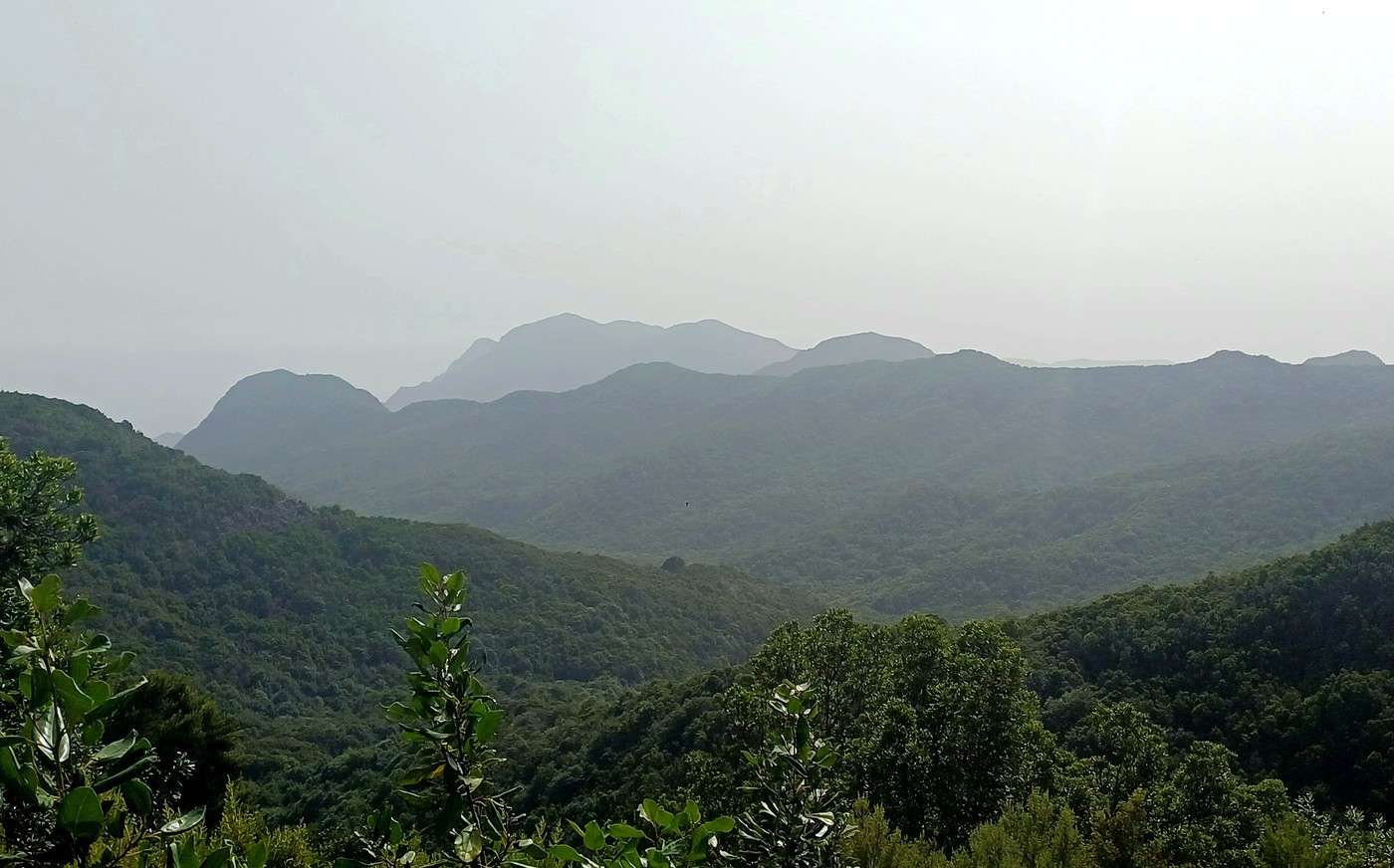
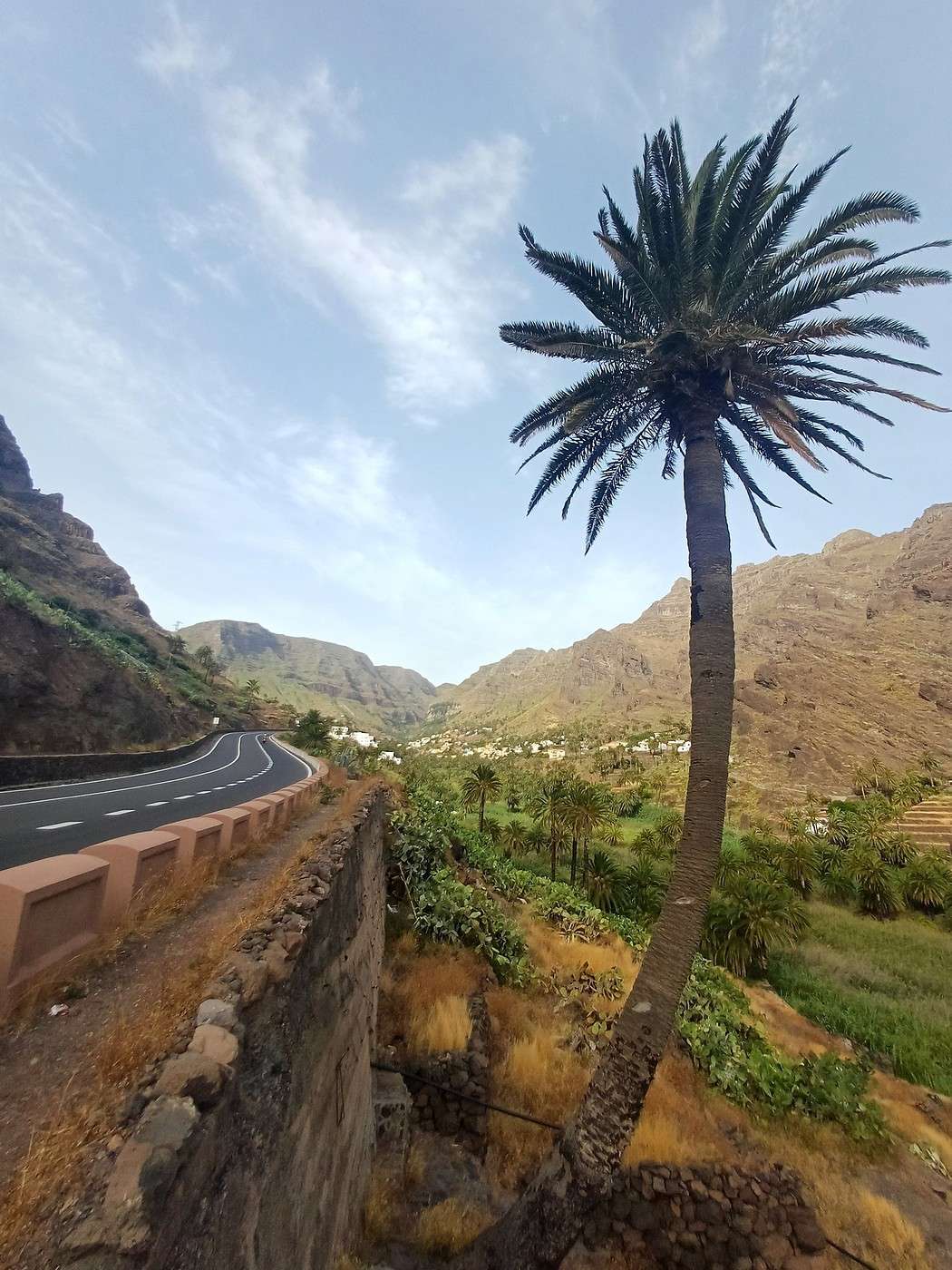
As usual, we take the only road out of Valle Gran Rey, which climbs steeply past the villages of El Guro at 150 meters, Las Granadas at 300, the two viewpoints at Curva del Queso at 600, La Retama at 800, the two tunnels that follow, and Arure at 850 meters, where we turn toward the center of the island via the charming little village of Las Hayas at 1,000 meters, which really draws us in. So many incredible views of the Valle del Gran Rey, the dizzying ridges, and the ocean. The road continues to climb, becoming more wooded, then plunges into the dense forest as we enter Garajonay Park. We push on to the Pajarito parking lot at 1,250 meters (25 kilometers in 40 minutes), where La Gomera Travel says our chosen hike starts.

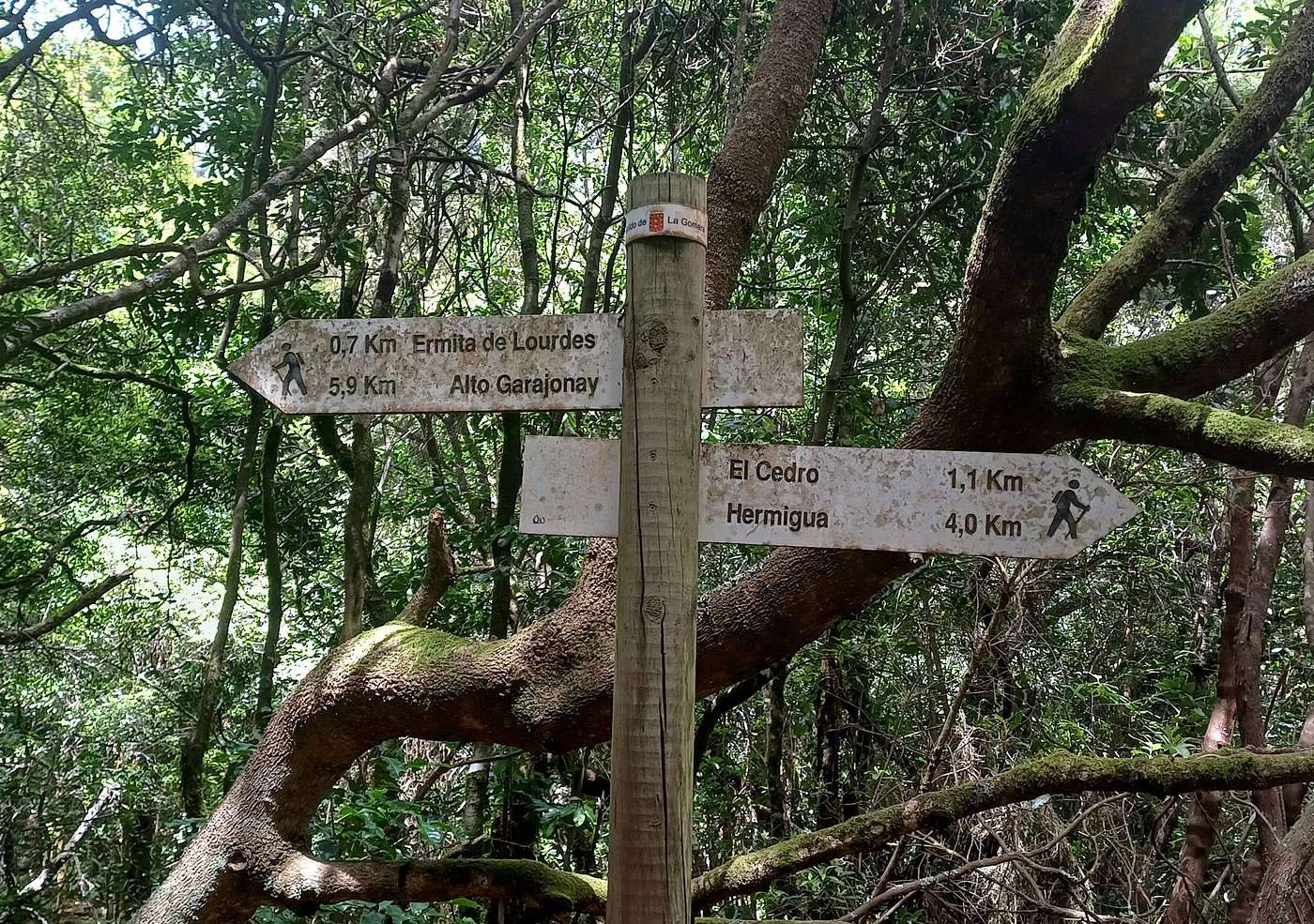
We start looking for our trail. There are several, but not the one we want. Contrary to the info on the website, it doesn’t seem to be here. We finally spot a sign indicating that the El Contadero starting point, where our route passes, is a kilometer back. We backtrack to El Contadero, which actually has its own parking lot. We don’t understand why La Gomera Travel suggests parking at Pajarito to walk a kilometer on the main paved road when we could’ve parked right here. Oh well, we’ve found our path. The explanatory sign confirms the El Contadero-El Cedro trail is 6 kilometers, with a 13-kilometer loop. That makes 15 kilometers round-trip from the Pajarito parking lot. We’ll see how it goes!

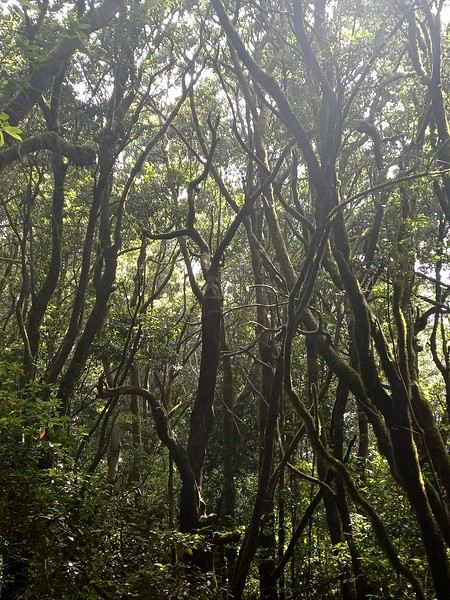
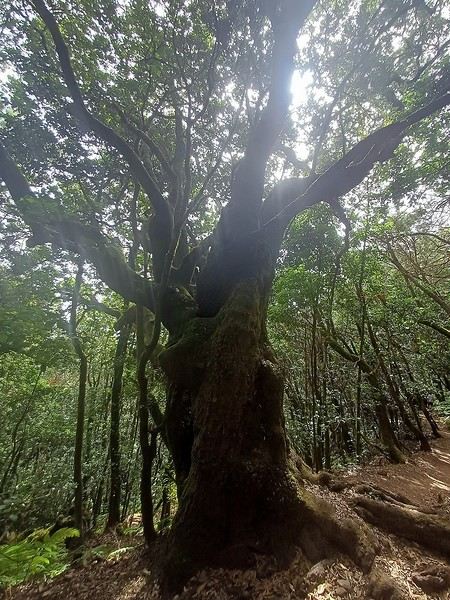
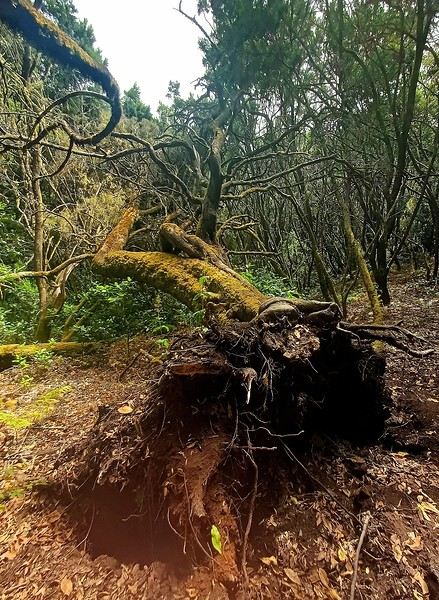
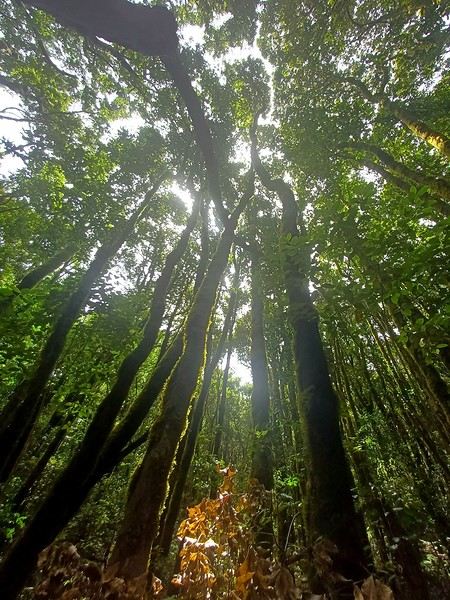
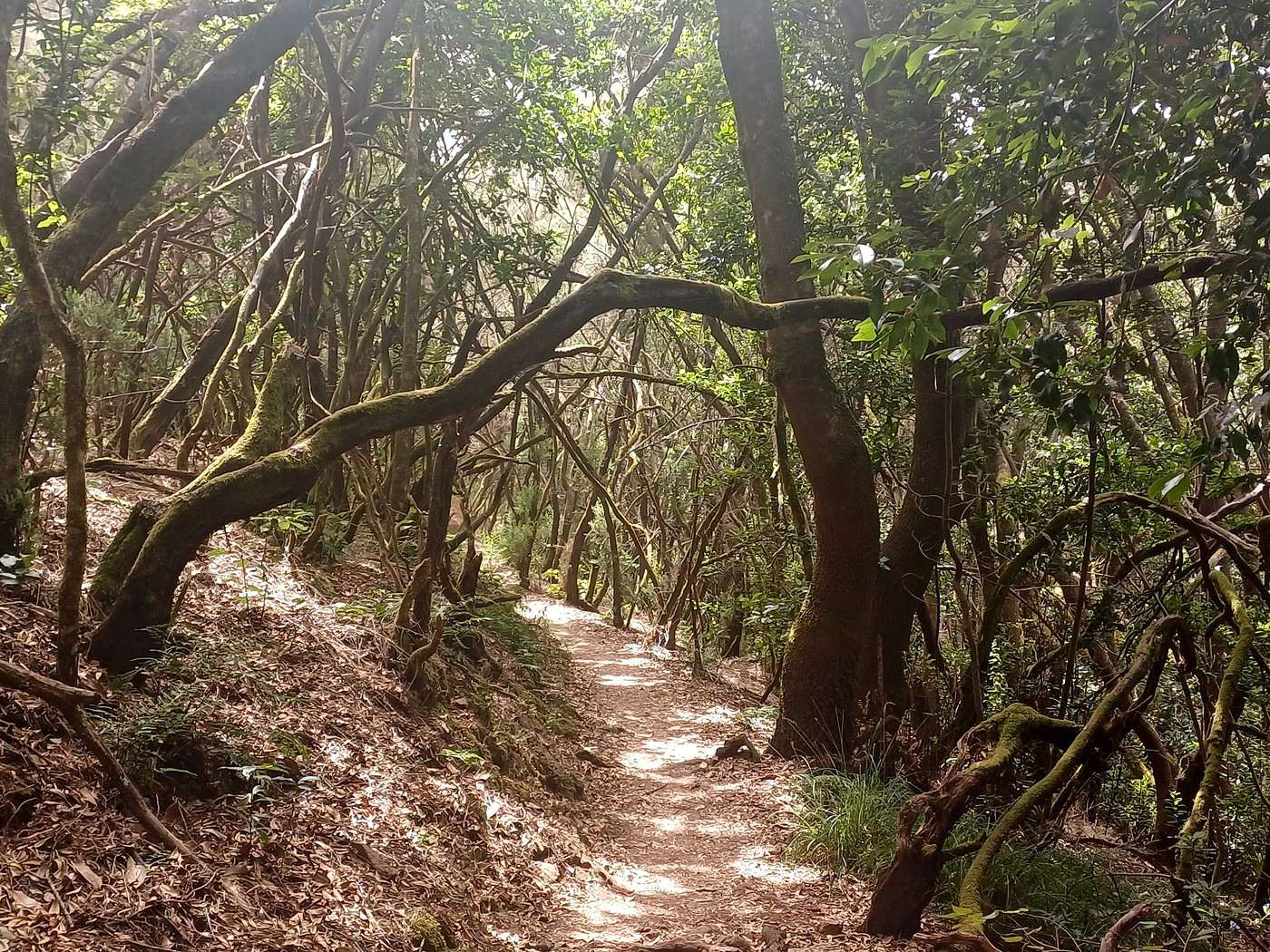
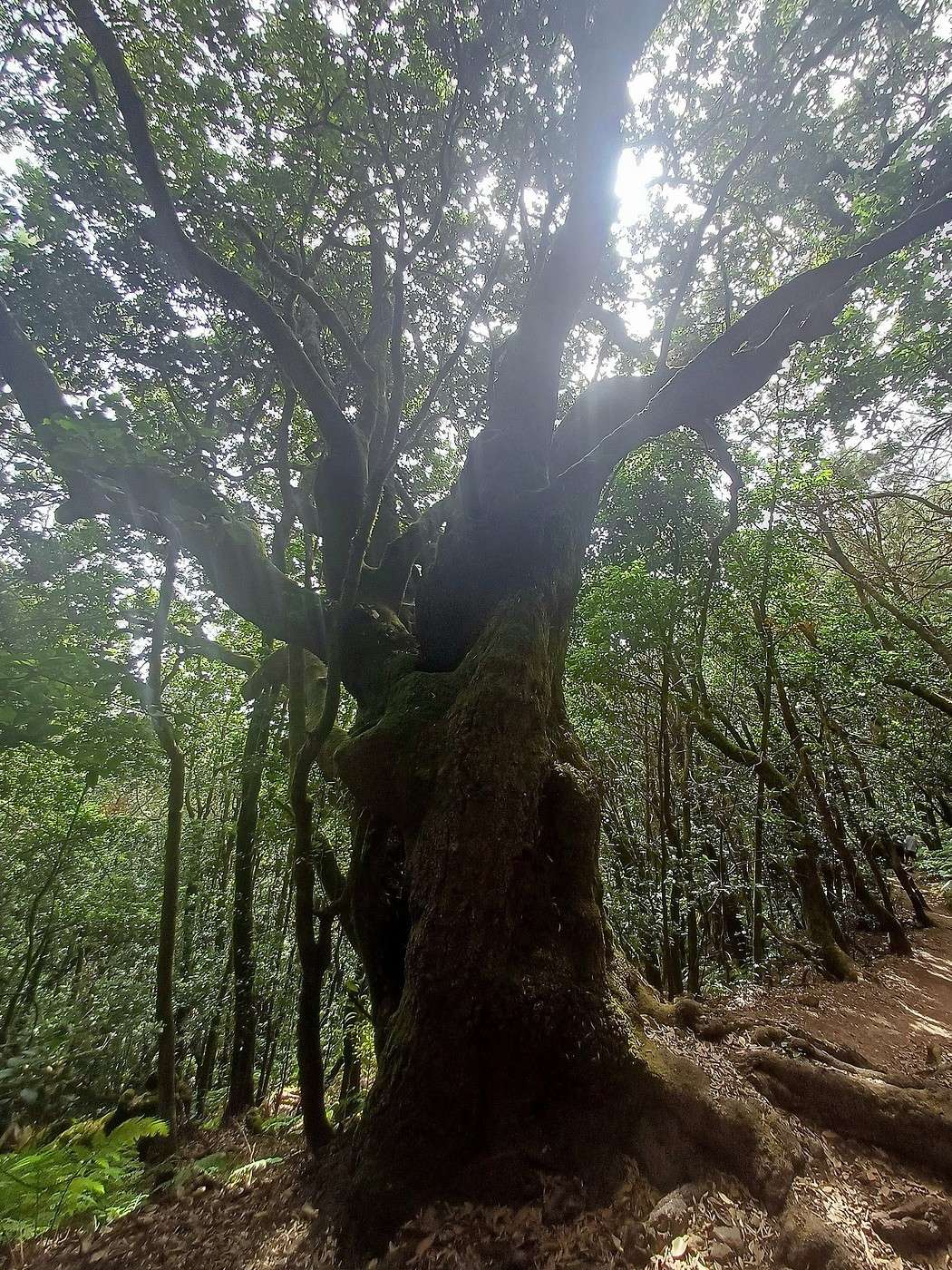
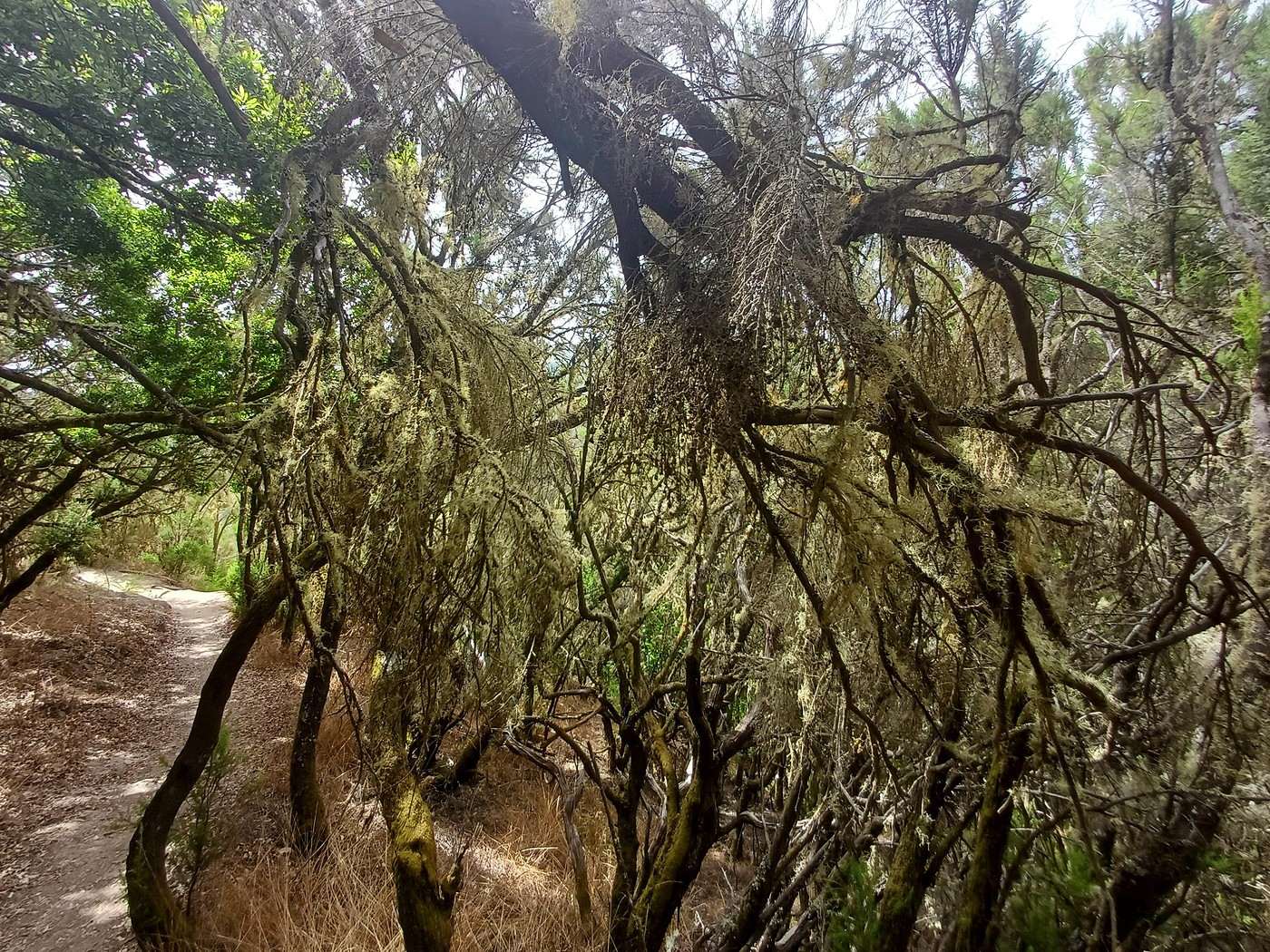
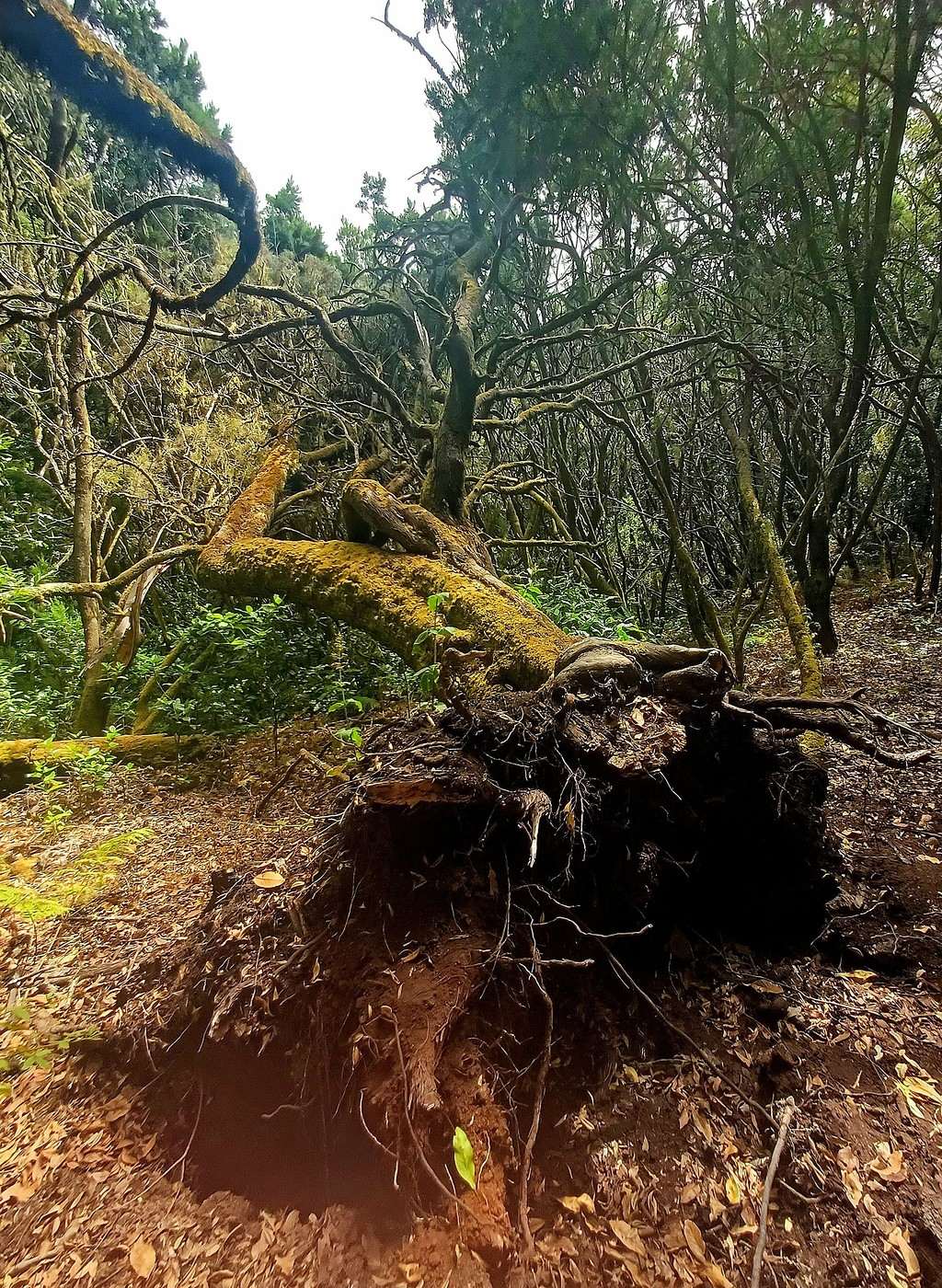
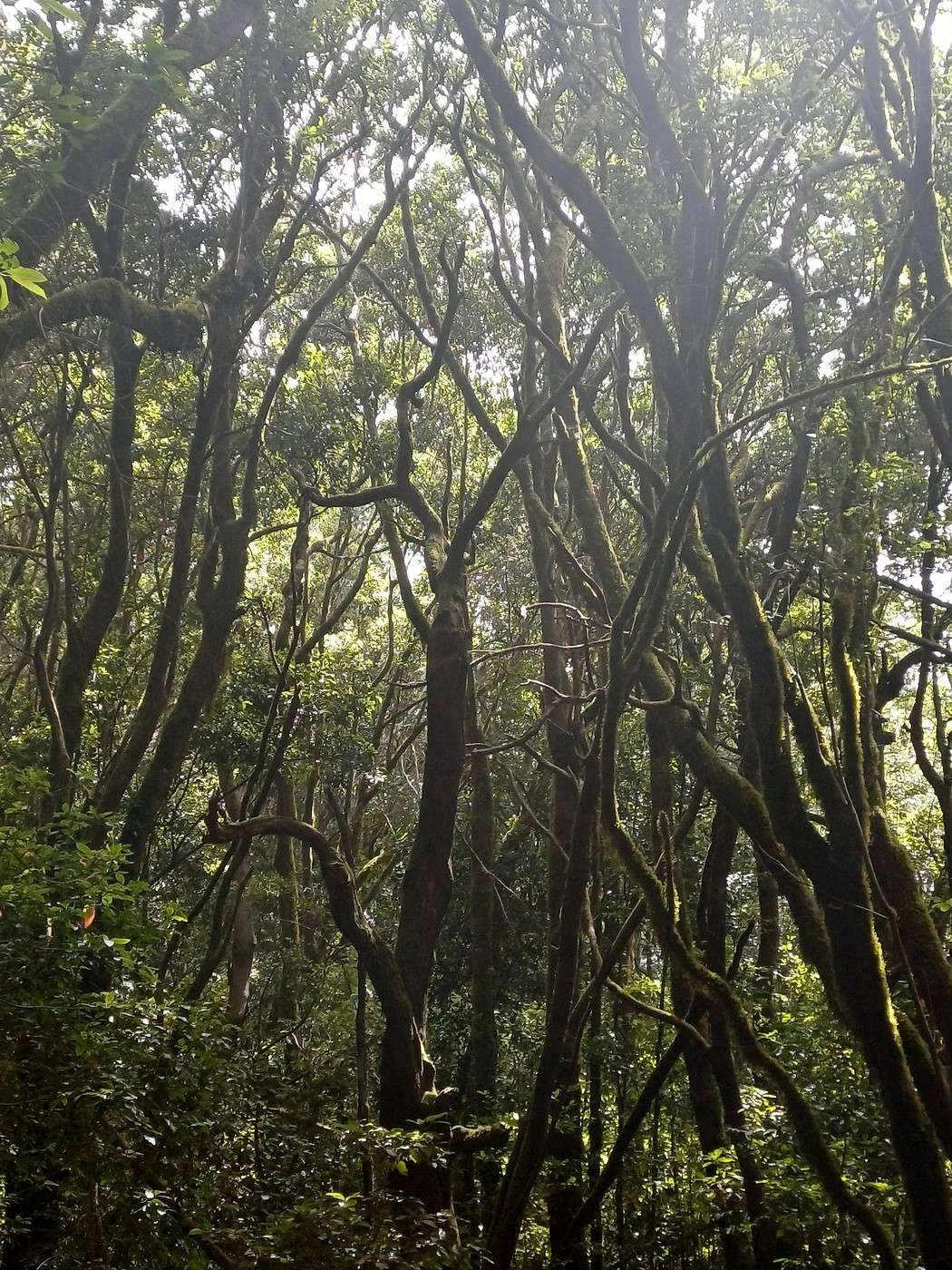
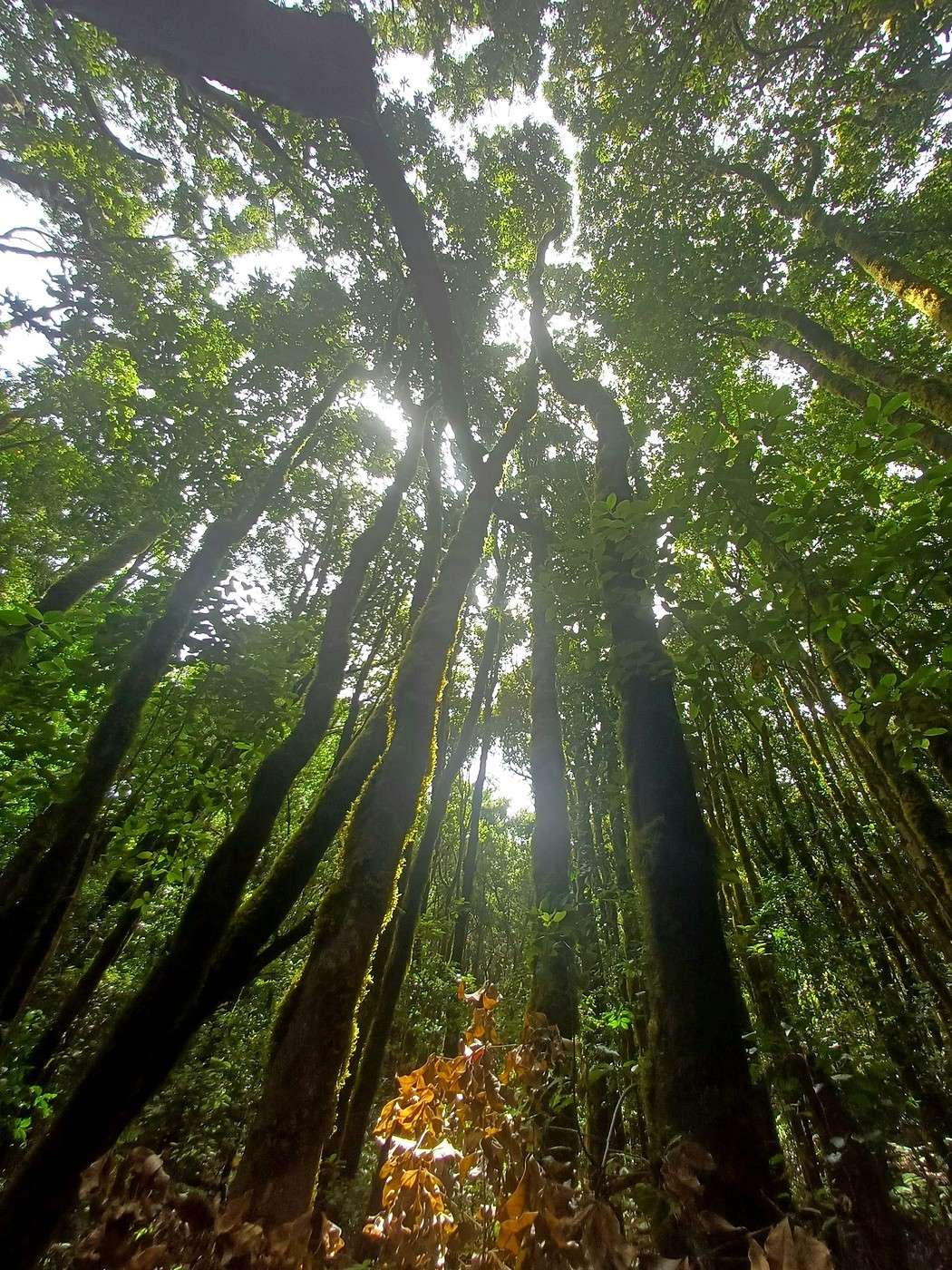
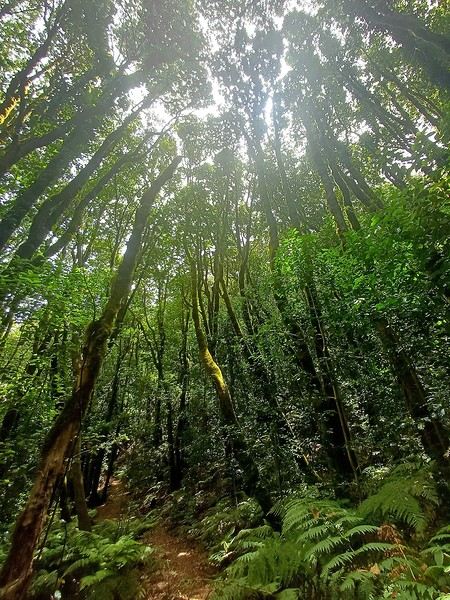
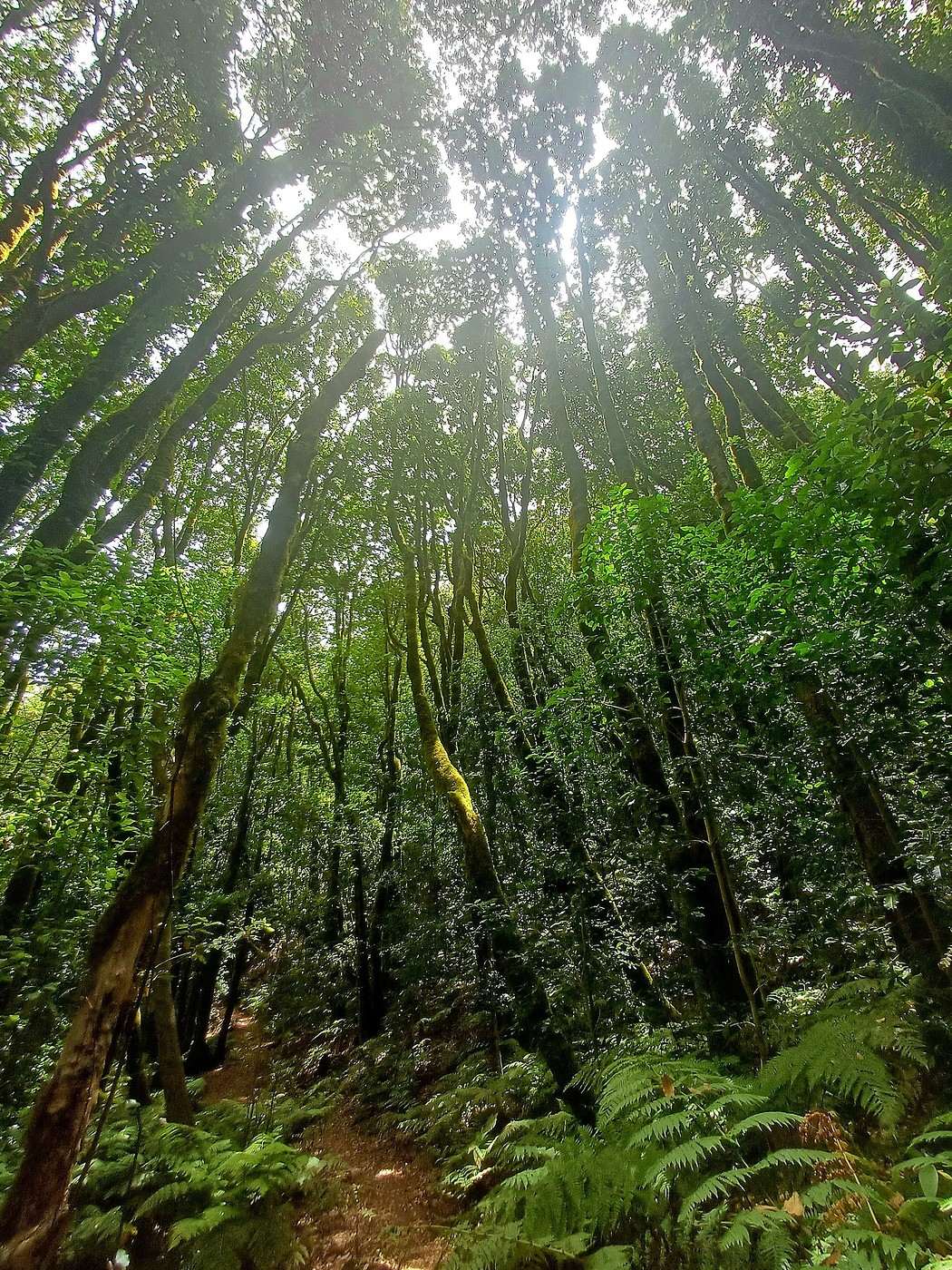
Good news for the start: the small dirt path is steep since we’re descending from the top of the park into its valley. Already, a viewpoint offers a plunging panorama of the laurel canopy, where the tallest laurel groups rise to about thirty meters. From the first few meters, we’re immersed in the lush setting of this mass of laurels with their gnarled branches sometimes blocking the path, covered in lichen and vine-like brambles, along with fayal-brezal shrubs and a carpet of ferns.
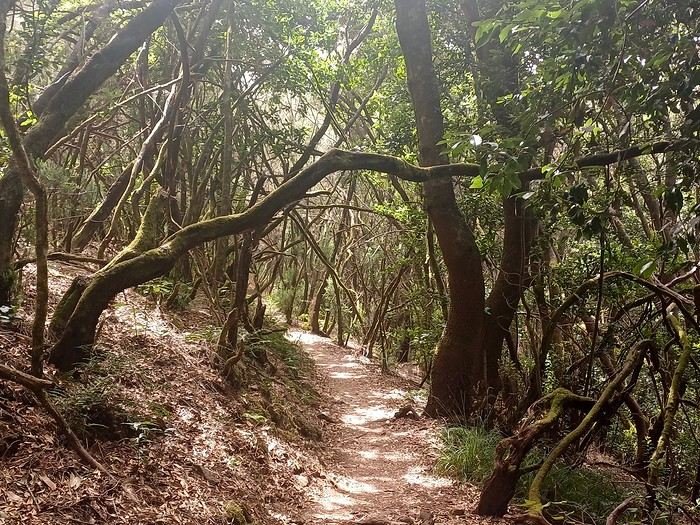
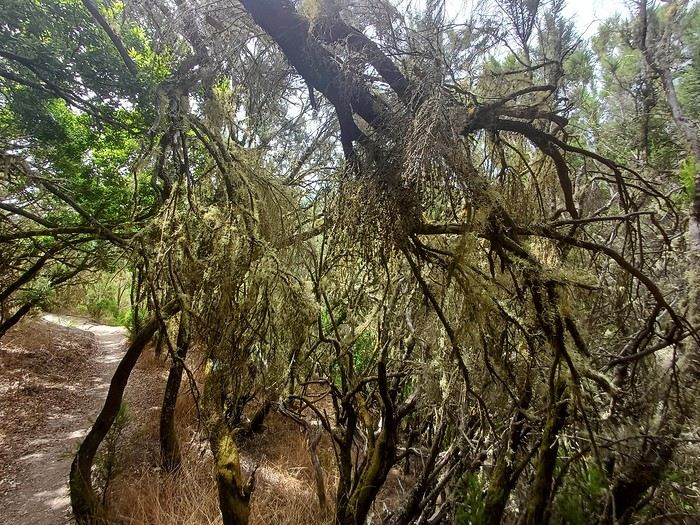
We’re literally in a European forest that strongly resembles Brocéliande, or parts of southern France. It’s already a bit warm, and the hike is making us sweat. However, we feel a hint of coolness in the shade of this dense laurel concentration, which subtly filters the sunlight to create an impressionist masterpiece on the ground.

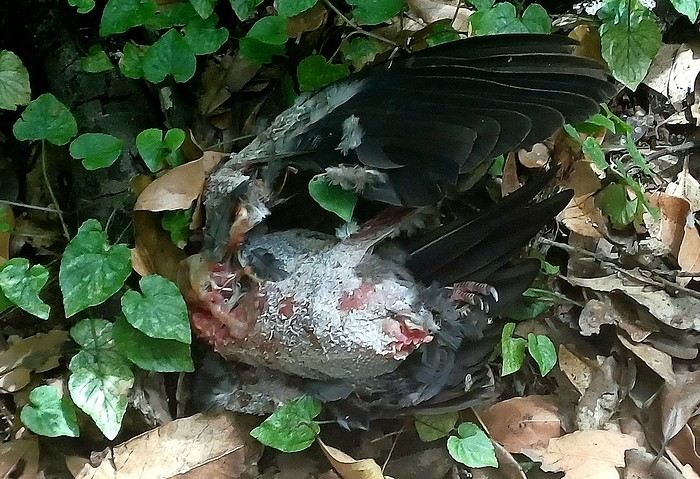
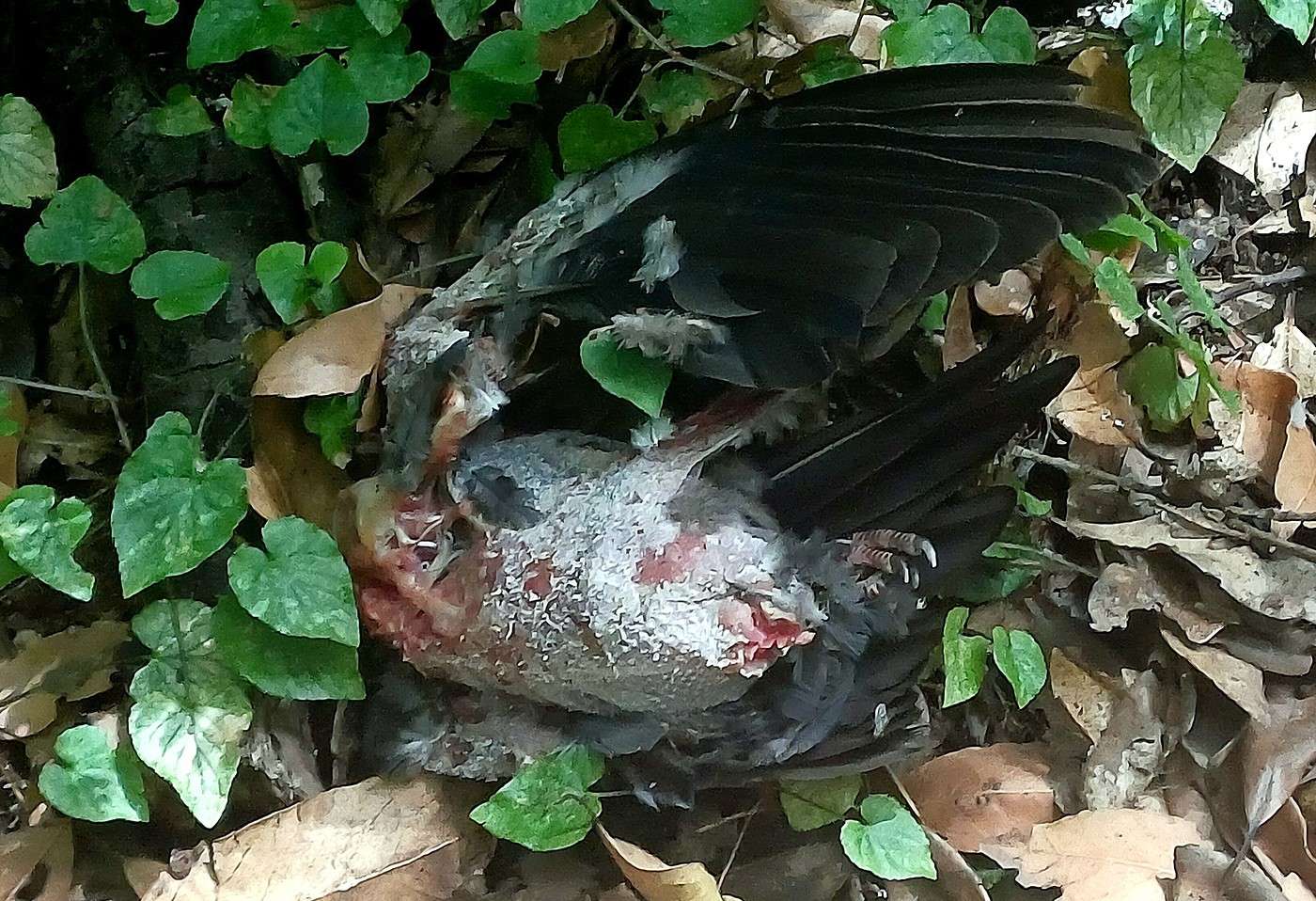
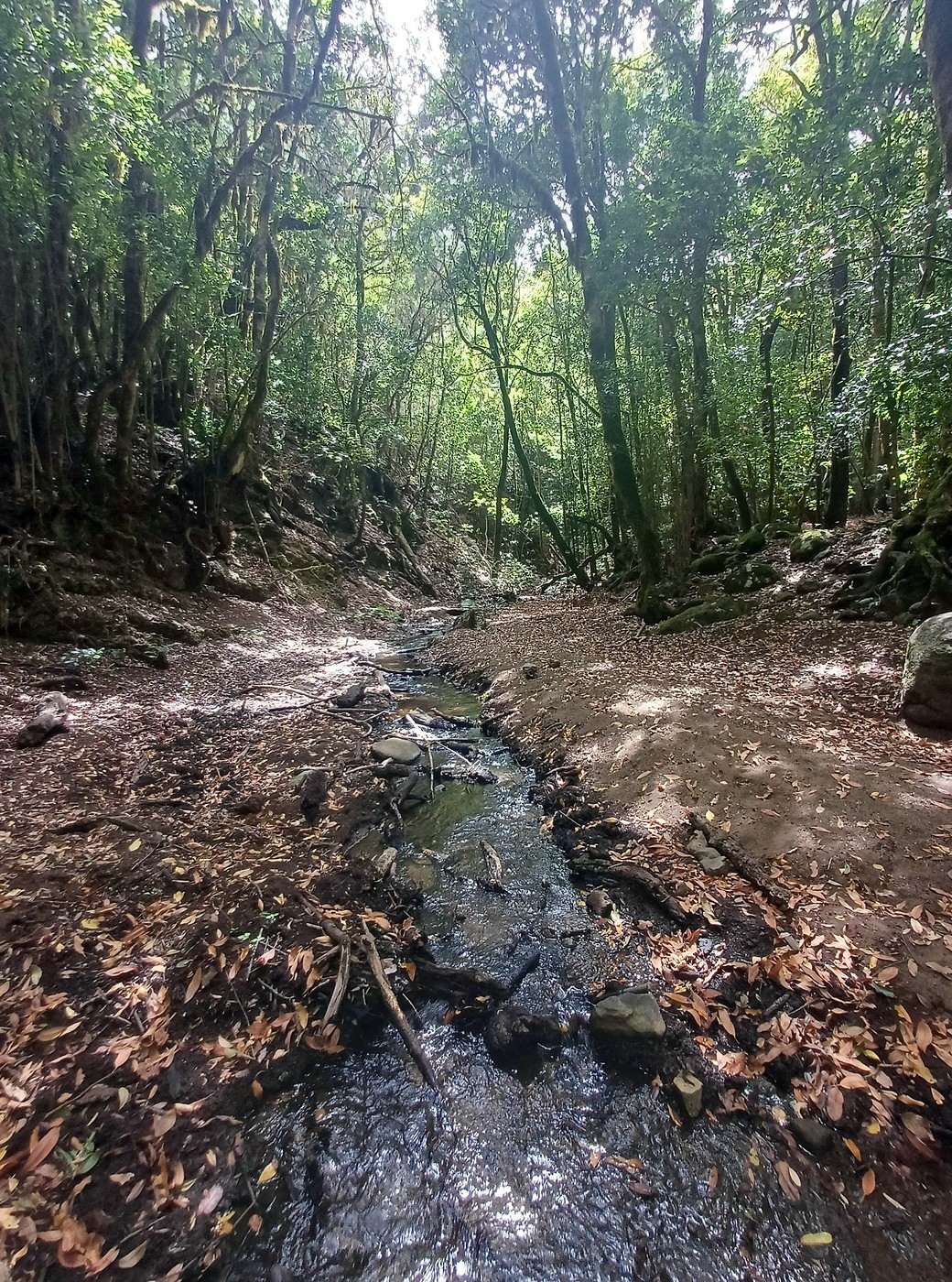
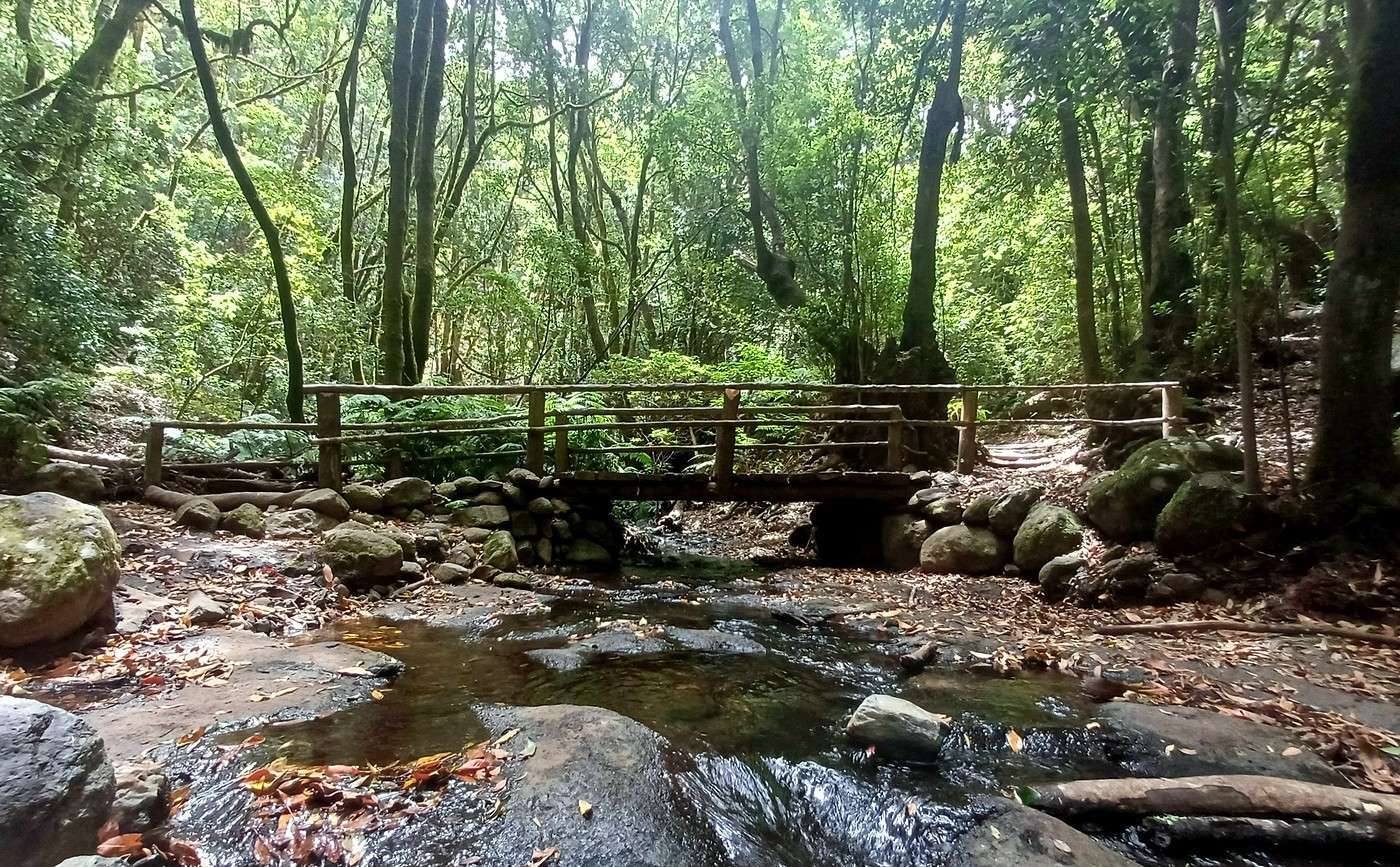
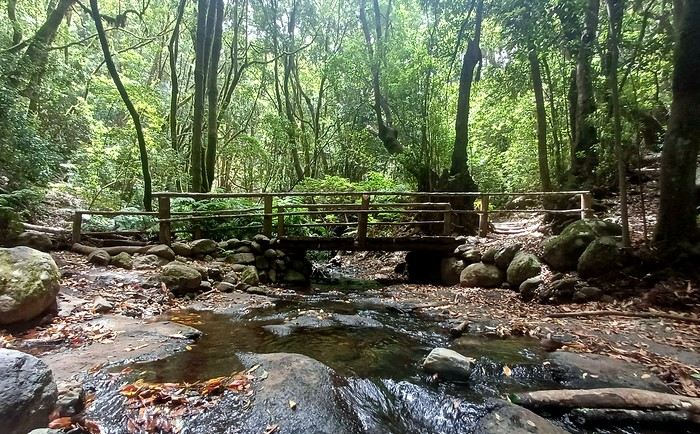
Despite the downhill walk, we realize by checking our position on Google Maps that we’re making slow progress. The steep descent requires careful steps, straining our thighs and knees. Plus, Théo isn’t having a great day and keeps stopping to ask to be carried. We cross paths with a few hikers going the opposite direction, often French—we clearly share the same interests! After an hour of walking, we hear the sound of flowing water. Yes, there’s a river, the first (and last) watercourse we’ll see on La Gomera! Our trail now follows the riverbed, keeping us company. A freshly plucked laurel pigeon carcass proves there are predators in this forest, where, unlike the flora, the fauna doesn’t show itself much. A little further on, a milestone indicates we’re in the area of the hamlet of El Cedro, but there’s still some way to go before we get there. Half an hour later, we reach a small wooden bridge that diverts to another trail. The river is accessible, and we take a welcome break to soak our feet and cool off.
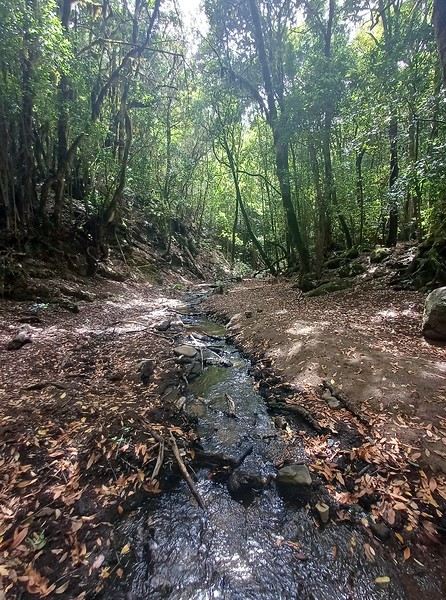
16 days with family in La Gomera (Canary Islands)

Pagaljavab · 2026-08-23 · Message 27 of 54

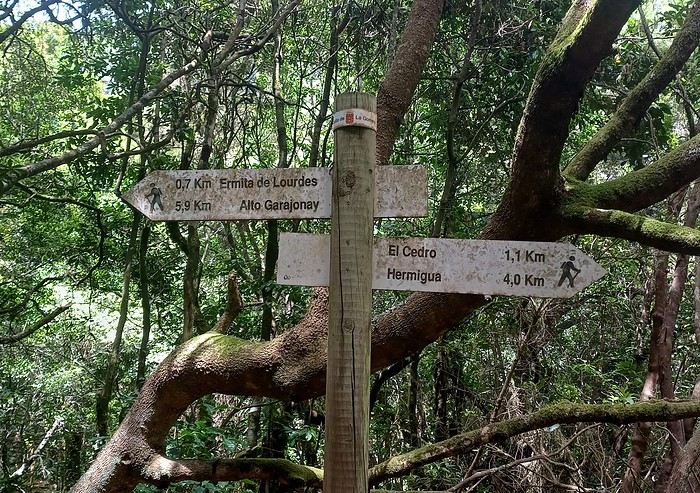
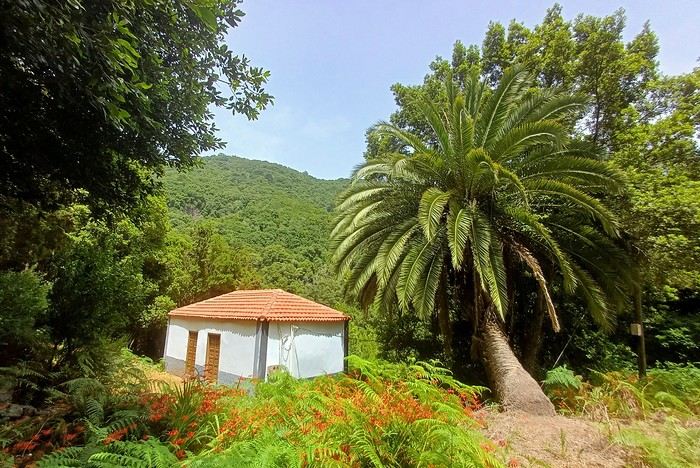
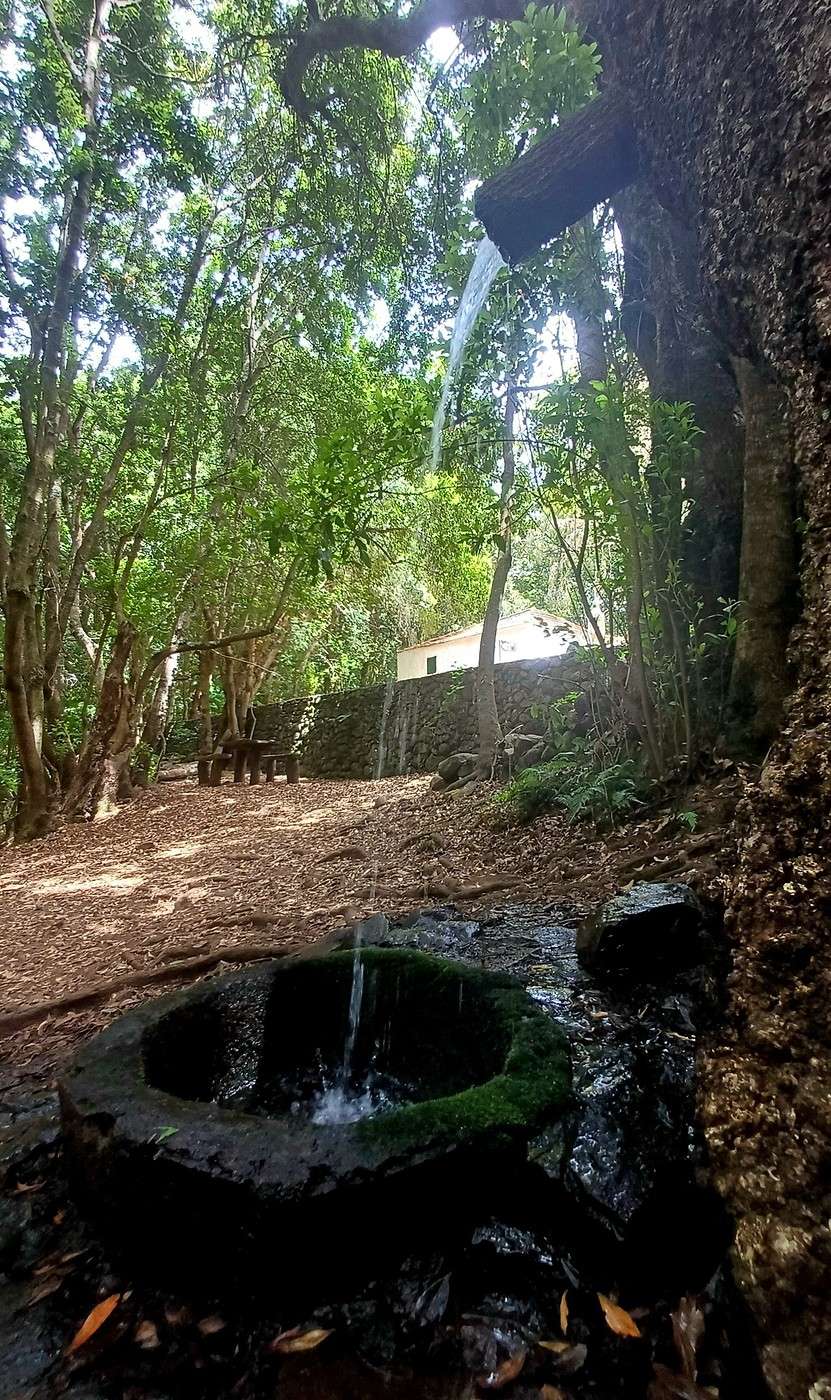
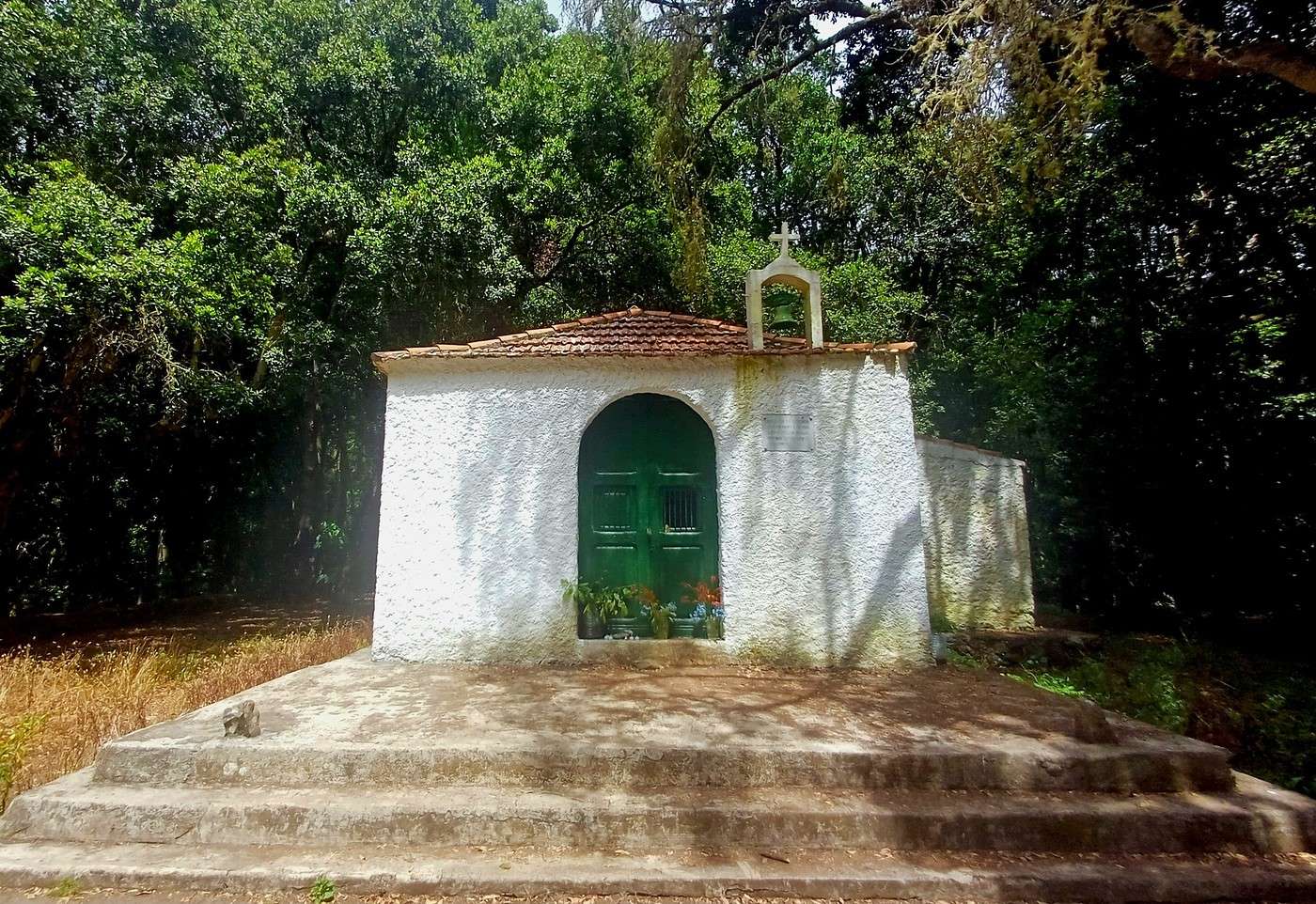
Afterwards, the path becomes increasingly flat, and we come across more small bridges like the first one, then finally, small wooden signs indicating we’re near the chapel of Notre-Dame-de-Lourdes. From there, there are a few more hikers, and we feel like we’re returning to civilization. Indeed, after two hours of walking, we emerge into a sort of clearing. A small fountain flows from a tree, and behind it stands the pretty little white chapel—though it’s closed. It seems many visitors don’t do the full route and arrive here from closer points. Either way, we’re now less than two kilometers from our destination.
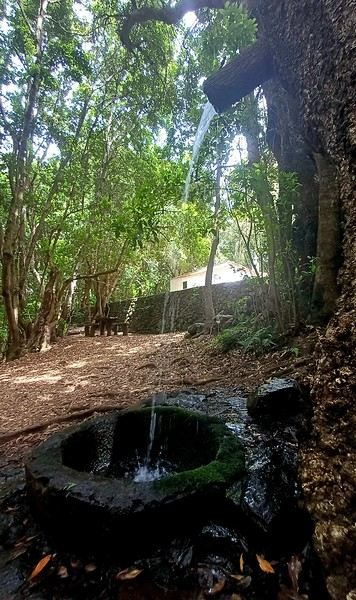
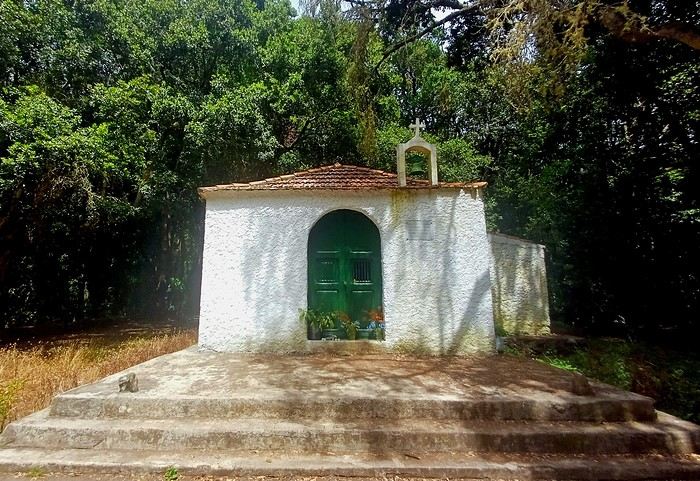
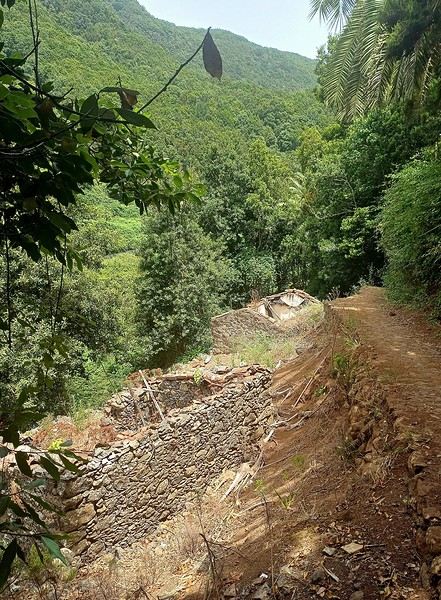
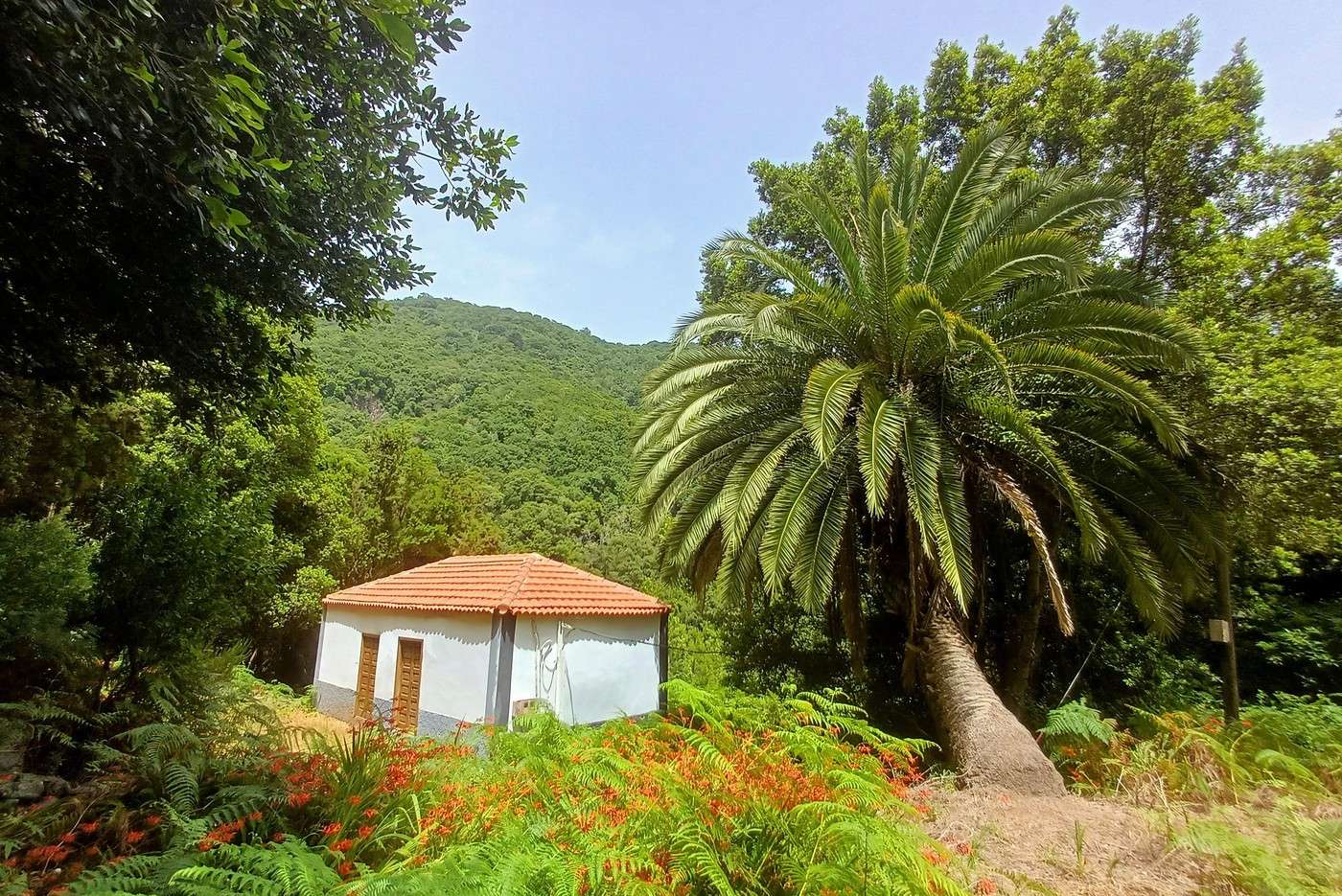
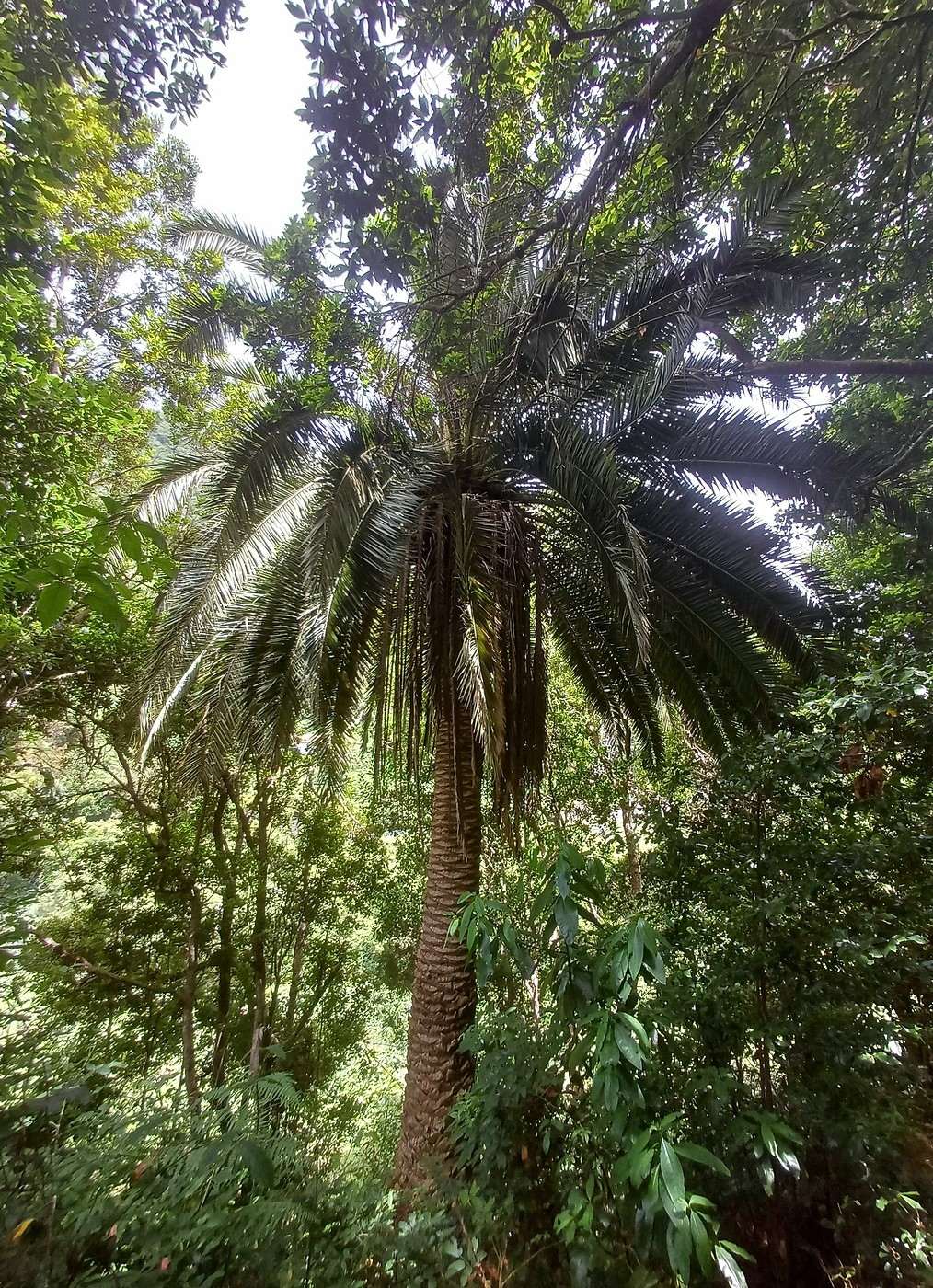
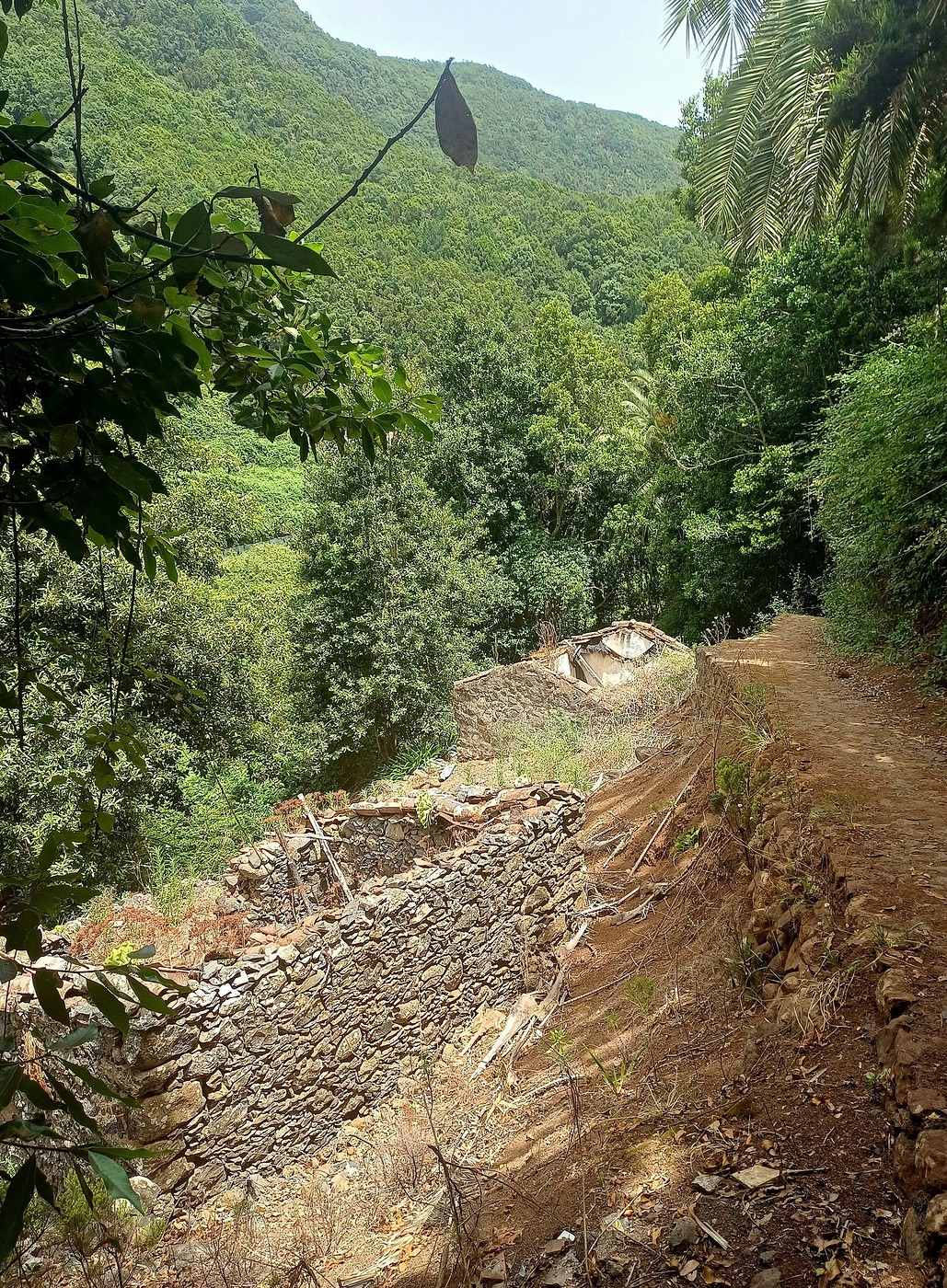
The trail leaves the forest slightly, and we spot the first houses in the middle of nature on the edge of El Cedro and some abandoned farms. The vegetation clearly marks this boundary: palm trees reappear among the laurels.
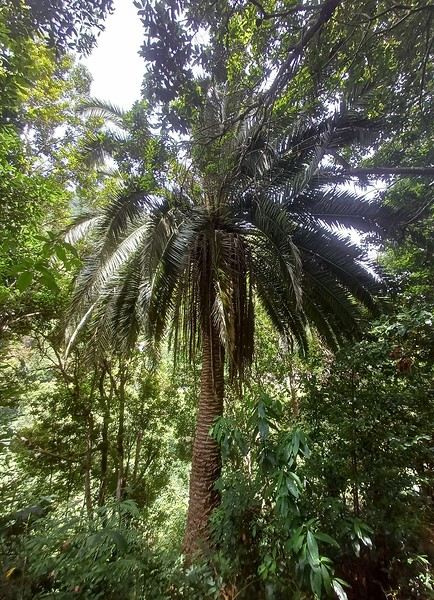
Finally, the hamlet, at the entrance of which workers (we see them everywhere here) are building a ditch alongside the track leading up to the main road above. We scan the horizon for the famed Bar Restaurante Camping La Vista, the only restaurant in Garajonay Park, known for its authentic Canarian cuisine. El Cedro appears as a cluster of a few houses in a slightly open spot in the heart of the forest, and just a few more minutes’ walk away, a terrace on a plateau with blue umbrellas in the distance leaves no doubt about our imminent destination. The sun has been beating down since we left the heart of the forest, we’re sweating like pigs, and we’re happy at the thought of sitting down and recharging. It’s still surprising to find such a restaurant on a hiking trail in the middle of a natural park.

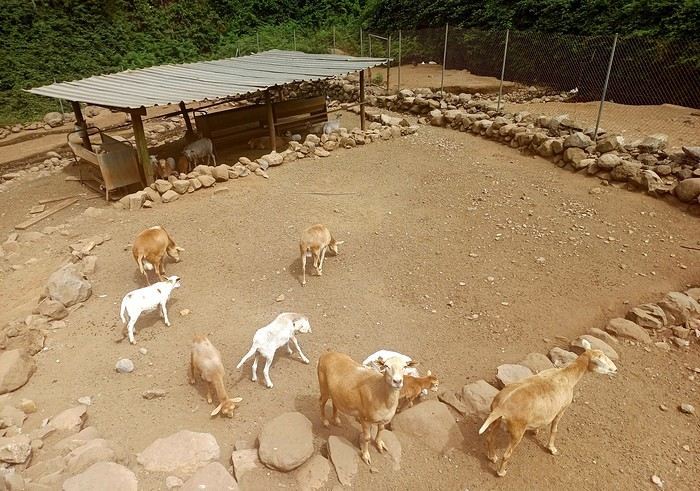
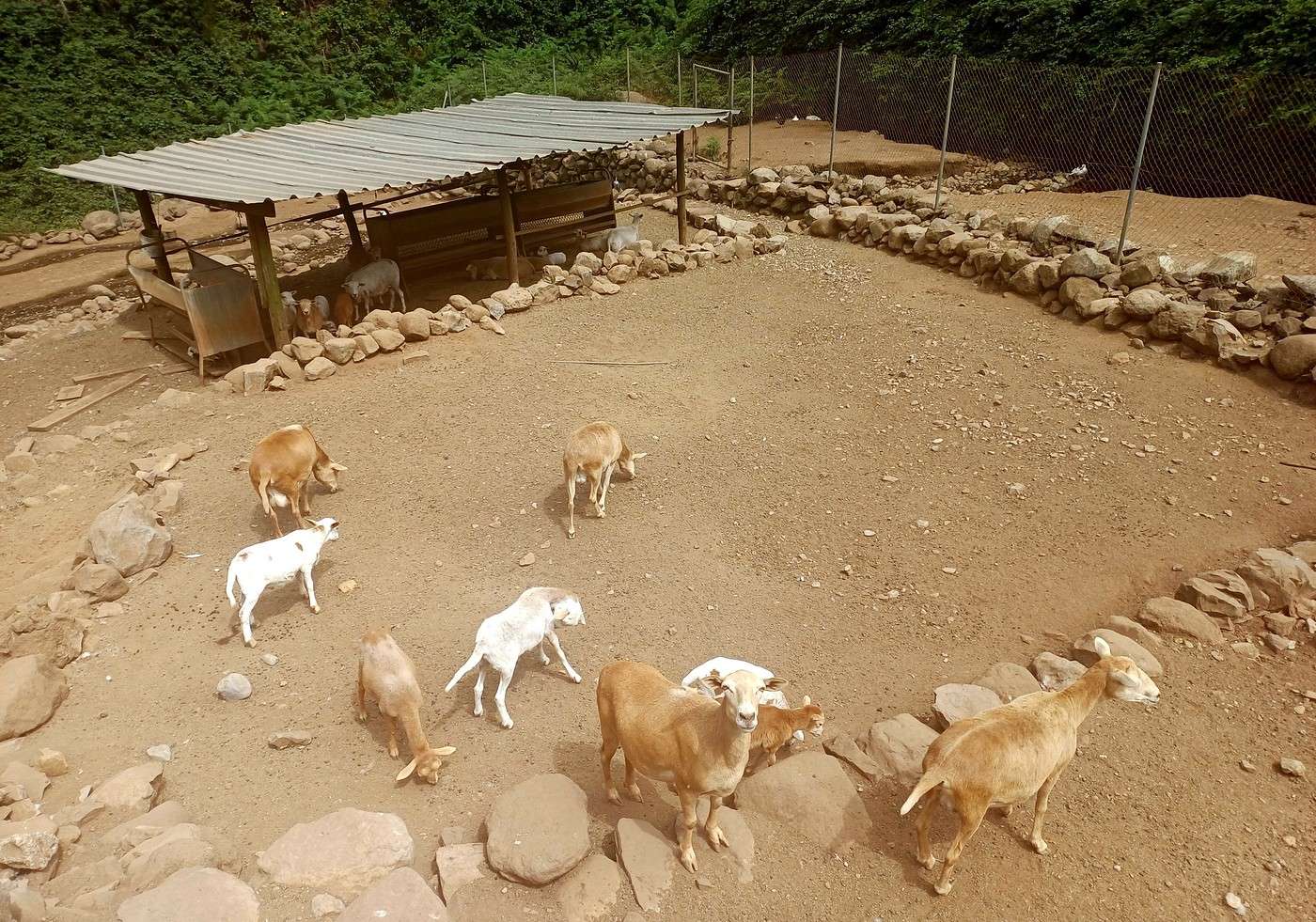
The Bar Restaurante Camping La Vista makes its intentions clear at the entrance: "Here, you’ll eat food you may not find anywhere else." It has a large dining room and a big terrace, and contrary to what we imagined, it’s nearly full! There are Spaniards, Germans, and a French family sitting at the large wooden tables—more like picnic benches. It’s actually a very rustic restaurant with deliberately old-fashioned decor, a bit like a big chalet, clearly run by a farming family, judging by the gardens and the sheep and goat pen down below near the camping area. You could compare it to a truck stop if it weren’t in the middle of the forest. Either way, its name isn’t misleading: it offers a beautiful view of the forest and, in the distance, the Hermigua Valley, where we’ll be staying in a few days.
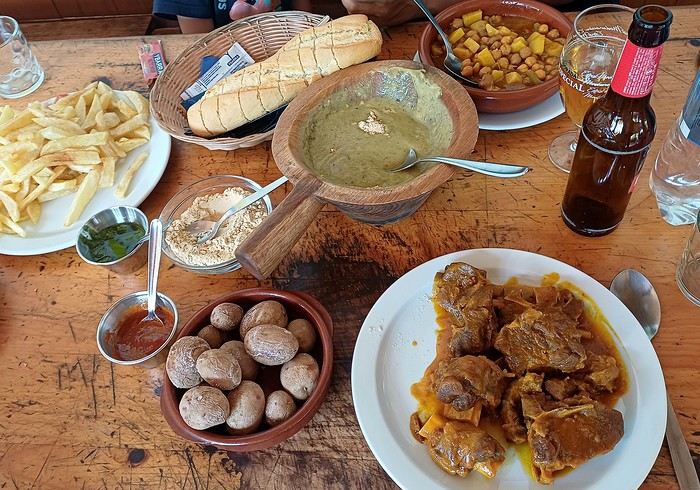
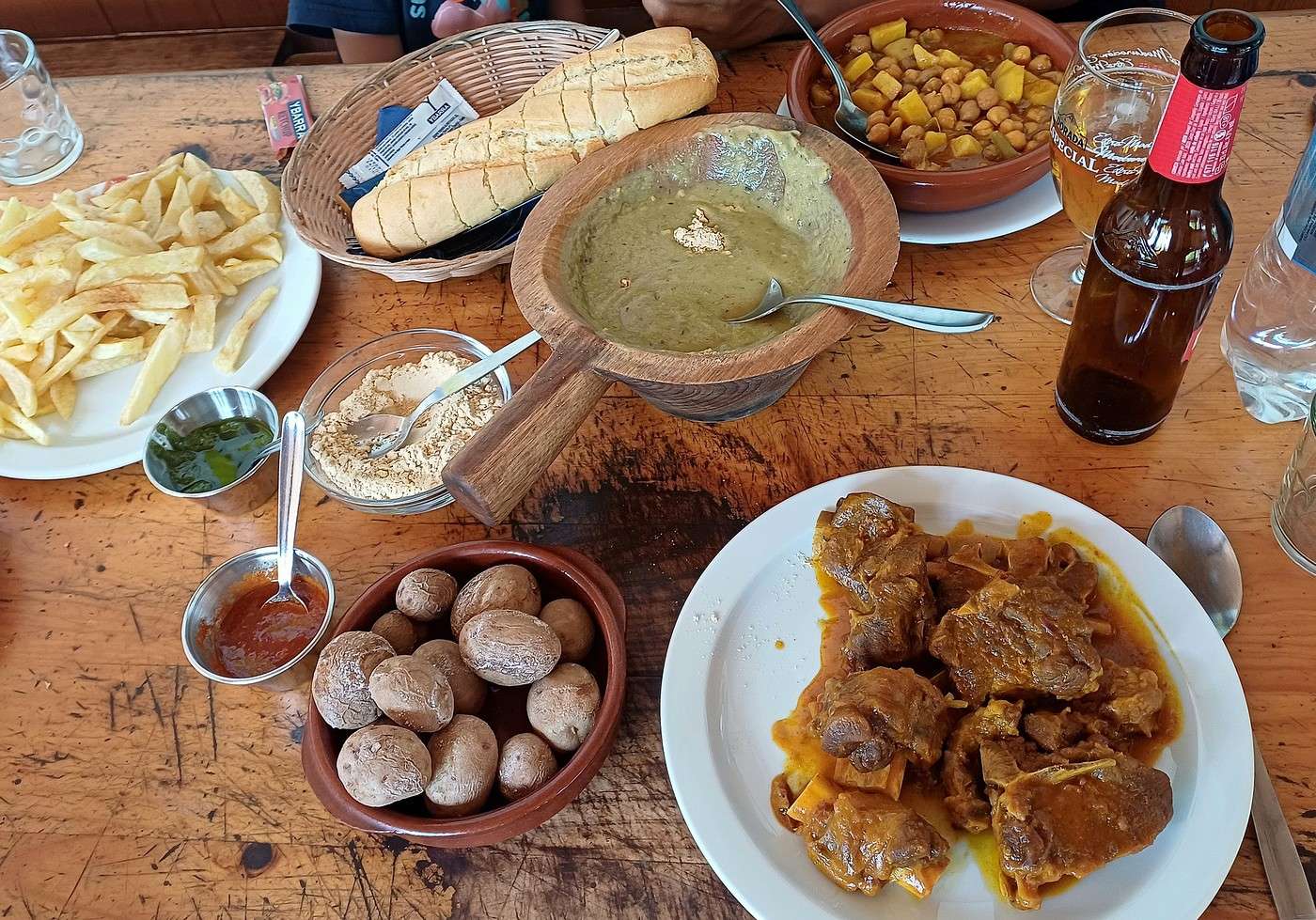
We settle at the last available table inside. It’s too hot outside anyway. The menu is displayed on the wall, listing the house’s Canarian specialties without categorization. The owner and her daughter—whose family resemblance is obvious at first glance—run the place with a firm hand. With a stern demeanor, they juggle between the dining room, the counter, and the kitchen, barking orders at customers in their path in a sharp, authoritative tone. The dishes are really cheap, and they all look tempting. The daughter points out that our order is too big, as the portions are generous. The platters passing by our neighbors confirm this and make our mouths water! We insist on keeping our order anyway because we’re starving and want to taste this delicious traditional cuisine, and the waitress gives in. A few minutes later, we’re presented with a gargantuan Gomeran feast, as authentic as can be: pan y mojo (red and green mojo sauce with half a baguette), carne de cabra (slow-cooked goat meat), garbanzas (chickpea and potato stew), papas arrugadas (wrinkled salted potatoes), potaje de berros (a thick watercress soup typical of La Gomera) served in a traditional wooden mortar with a small bowl of gofio, fries, and of course, fresh blonde Dorada fish...

The divine carne de cabra, served in generous portions, melts in your mouth—almost bringing a tear to my eye—and the watercress soup sprinkled with gofio is pure delight. And guess what? We finished it all! Far from being impressed, the owner’s daughter clears our table without missing a beat. Still, we get a few fleeting smiles at the end of service, surely in recognition of having appreciated and finished every last bite. “What are these French people eating?” they seem to think for a second before getting back to work. And to top it all off, with drinks, desserts (yes, we even had dessert—we had to try the tarta de queso!), and coffees, our bill barely reaches 57 €.

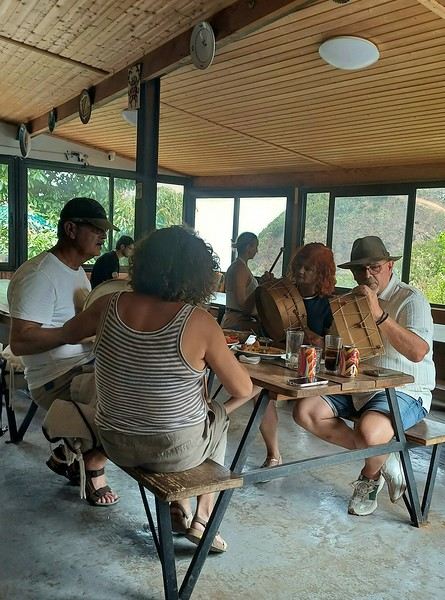
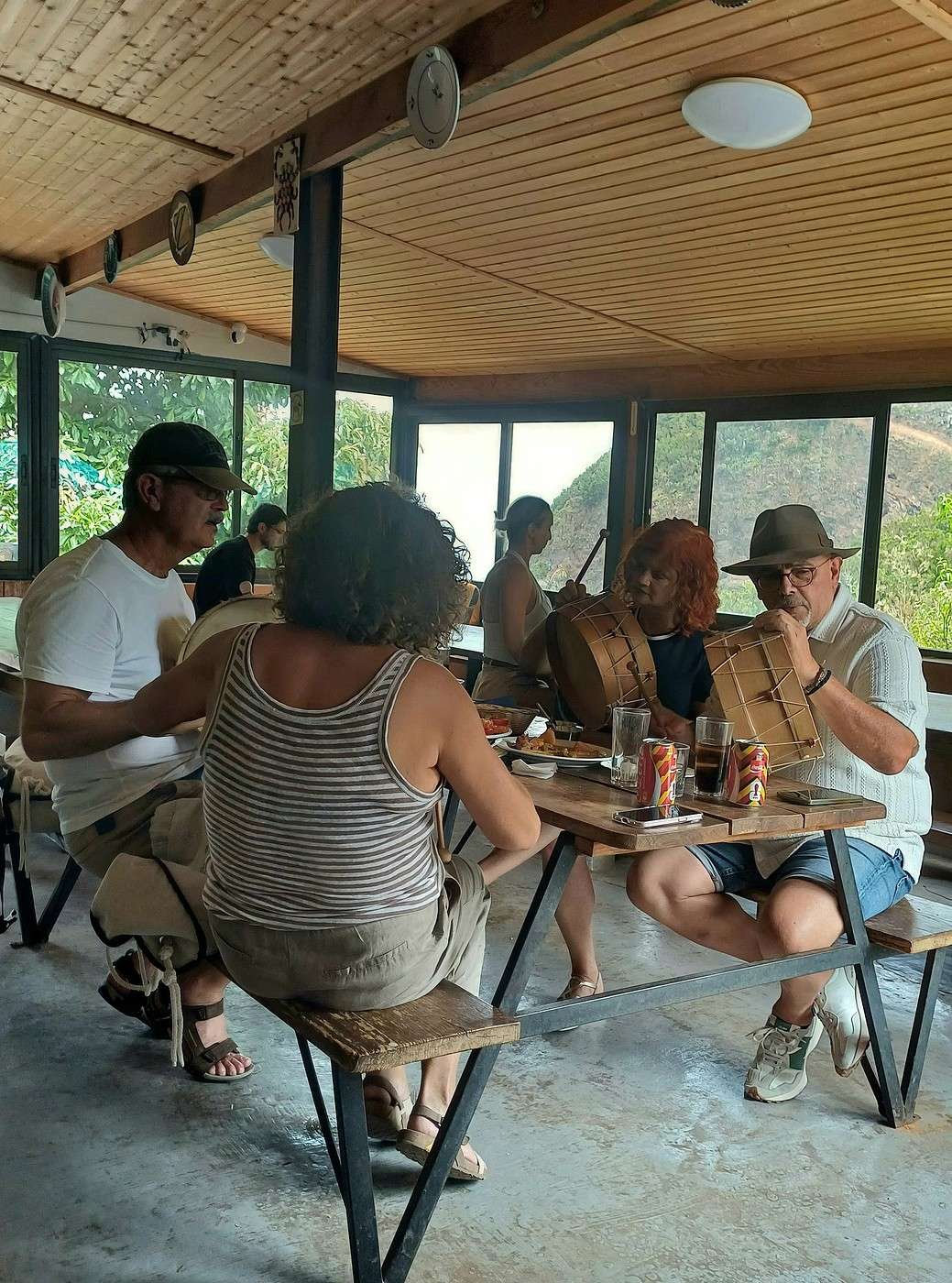
We’re feeling heavy and stay at the table a little longer to enjoy the place, which has emptied out a bit in the meantime. It’s also a chance to rest after 6 kilometers of steep downhill hiking, tough on the knees, and to gather the strength to finish the loop on the uphill path. Suddenly, powerful drumming and singing jolt us out of our daze. Without warning, the four people at the next table—two men and two women in their sixties, having just finished their meal—pull out drums and start singing. The four drums play a hypnotic rhythm while the chants are incantations that respond to each other. The haunting sounds evoke a very ritualistic and mystical feeling. Not at all European, the music suggests something both Berber, Sub-Saharan, and pre-Columbian American. We smile, imagining them performing a sacrifice at the summit of the fearsome Teguerguenche, which rises opposite our house. We move closer to their table to listen.

The owner approaches, dancing, and accompanies them with chácaras, Gomeran wooden castanets. I’d read on La Gomera Travel that tambores y chácaras are the emblematic percussion instruments of La Gomera, accompanying all the patron saint processions. It sounds incredibly pagan for a Catholic ritual! A table of Spaniards, annoyed by this impromptu performance, asks the owner’s daughter to make them stop. She finds a compromise and moves them to the back of the room. This doesn’t stop the young Spaniards from showing their displeasure by moving to the terrace with slightly disdainful looks toward the musicians, who couldn’t care less and continue their trance, ignoring them completely. When they pause, I ask if it’s traditional Canarian music. “No, from the Canary Islands, only from La Gomera! We live in Tenerife but are originally from La Gomera.” Indeed, I’d also read that there are more Gomerans in Tenerife than in La Gomera itself, likely seeking more dynamism and jobs other than road maintenance... Clearly, their sense of identity remains strong. They’re thrilled that some French people are interested in their music. There’s an immediate connection between one of them and Théo, a redhead I’d whispered to him was “the witch.” She plays at scaring him, running between the tables, while sensing my interest in the music, she hands me her drum and teaches me the rhythmic pattern (ternary in six beats: three sharp hits, a rest, and two muted ones) so I can join the quartet and take part in the trance. An experience as beautiful as it was unexpected. The owners have traded their grumpy expressions for delighted faces as they watch the scene while clearing tables.

They didn’t explain it to me, but I later read that pilgrims heading to the nearby chapel of Notre-Dame-de-Lourdes walk toward the sanctuary while playing these rhythms, associated with a dance, el baile del tambor, and songs of legends, love, and devotion that survive as a syncretism between Guanche and Castilian traditions. One of the pilgrims even gives us a little demonstration of silbo gomero, the famous whistled language of La Gomera, recognized as UNESCO Intangible Cultural Heritage. It was developed by Gomeran shepherds to communicate over long distances but has its origins among the Guanches: Norman and Spanish navigators described the Canarian natives communicating with articulated whistles. The Castilians later adopted it, adapting it to Spanish. Silbo can adapt to any language because words are whistled to reduce vowels and consonants.

This beautiful musical, cultural, and human exchange is one of the key moments of our trip. But they have to leave, and so do we. After warm goodbyes, we return to reality: it’s already 4 PM, it’s very hot, we’re weighed down by our Canarian feast, and we can hardly imagine Théo hiking the 6 kilometers uphill. There’s no minibus leaving El Cedro right now—maybe not even today. We consider continuing the 4-kilometer hiking trail to Hermigua, where we can find a taxi to take us back to the Pajarito parking lot.

So we have no choice but to ask for a taxi. We make our request to the owner, who picks up her phone: there’s one leaving Hermigua and arriving in 40 minutes. We have no idea how much it’ll cost, but it’s a done deal. We take the opportunity to explore the property and the sheep pen down below.

Then our taxi arrives. It takes the only partially paved track connecting El Cedro to the road above, which we reach in a few minutes at Reventón Oscuro, another very popular hiking starting point in Garajonay, then drives the last few kilometers to Pajarito, where our trusty Opel Corsa is waiting. We head back to Valle Gran Rey via the usual route, passing through the beautiful village of La Hayas and its plateau overlooking the misty ocean, then descend the slope with viewpoints starting from Arure down to the coast. Tonight, it’s obviously light snacks and rest. When night falls, the Cory’s shearwaters can be heard in the valley, but they’ve quieted down. Could it be because of the waning moon?

16 days with family in La Gomera (Canary Islands)

Pagaljavab · 2026-08-24 · Message 28 of 54

Day 6, Sunday, August 2: Valle Gran Rey/La Calera, El Guro-Las Granadas (Los Reyes gardens trail), Valle Gran Rey/La Calera

After yesterday’s hike, we’re taking it easy this morning. We kick things off with my Gomeran specialty for breakfast—this kind of gofio porridge with milk, palm honey, and banana. Super energizing! With another beautiful sunny day ahead, we head for our usual swim at La Calera beach, where the ocean is always perfect. Then it’s laundry and a quick shop at the Spar. For lunch, I spice up my garbanzos with some smoked pimentón and pair them with another local specialty: sweet potatoes and palm honey in foil. A winning combo! And then… siesta...

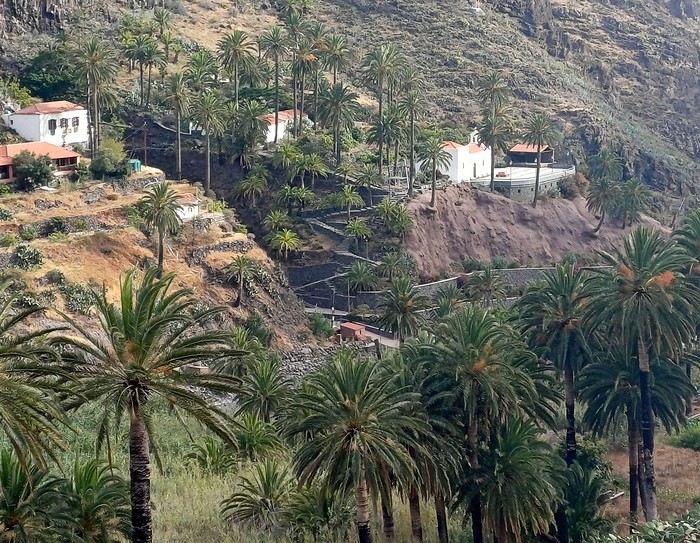
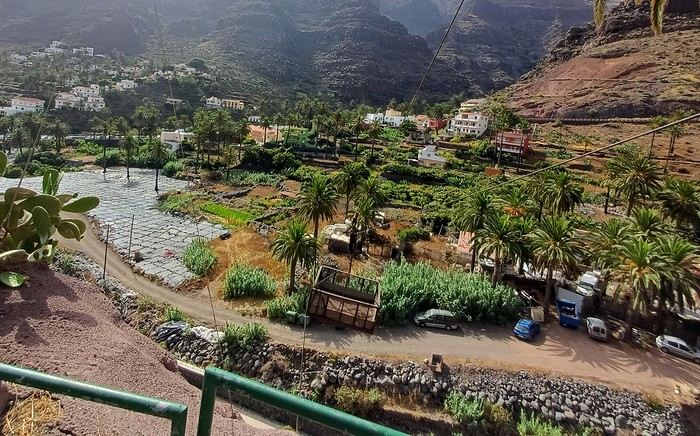
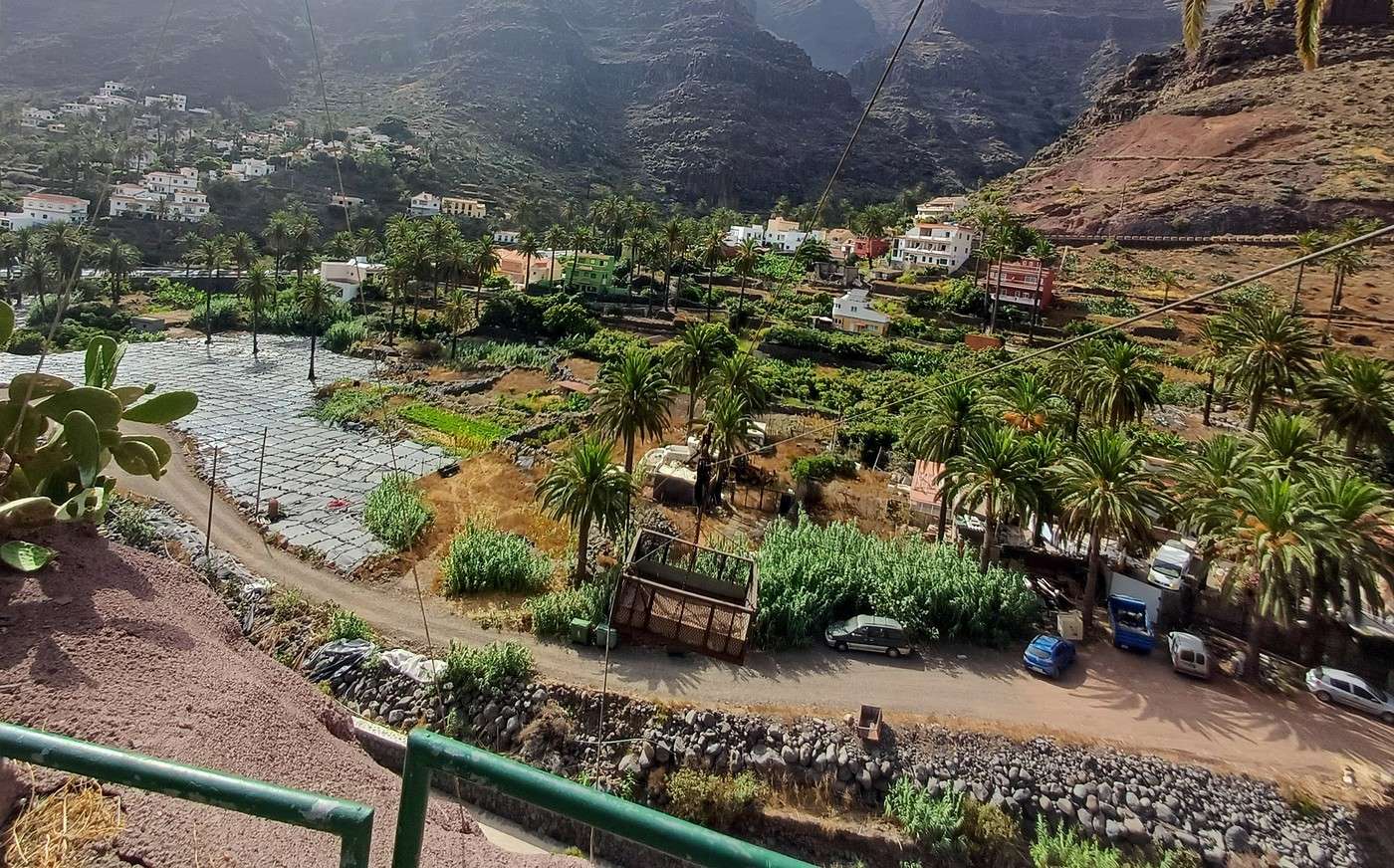
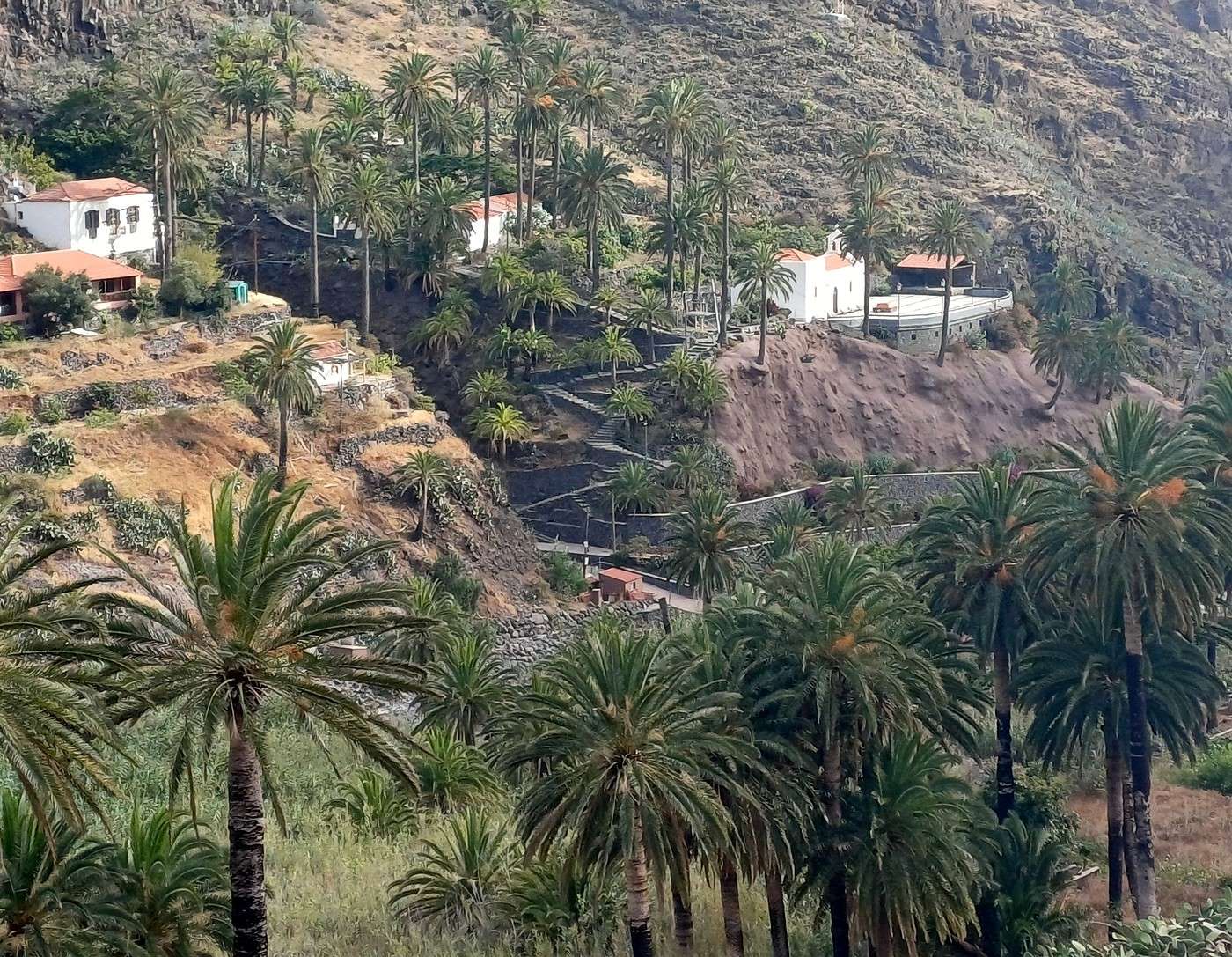
Later in the afternoon, Magali—who’s really taken a liking to the nearby village of El Guro—suggests a short hike of just over 2 kilometers. At 5:30 PM, it’s still scorching hot, and the sun is beating down. It’s not the awful heatwave hitting France right now, but the Canary Islands’ reputation for eternal spring takes a little hit—this weather is definitely summer vibes. We park in the same spot as before, on the side of the road in El Guro, where a trail supposedly leads up to the next village, Los Granados (or Las Granadas in Canarian dialect). First, we cross the valley floor, lined with little houses and plantations, to reach the cute white church of Los Reyes, perched on a volcanic rock outcrop at the end of a zigzag path through the palm trees.

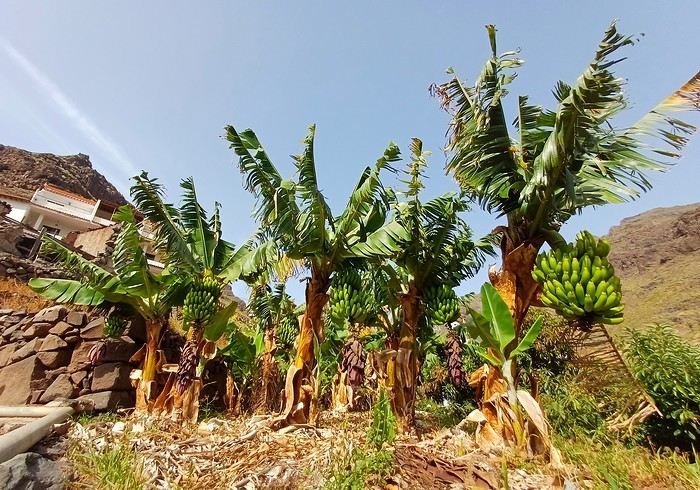
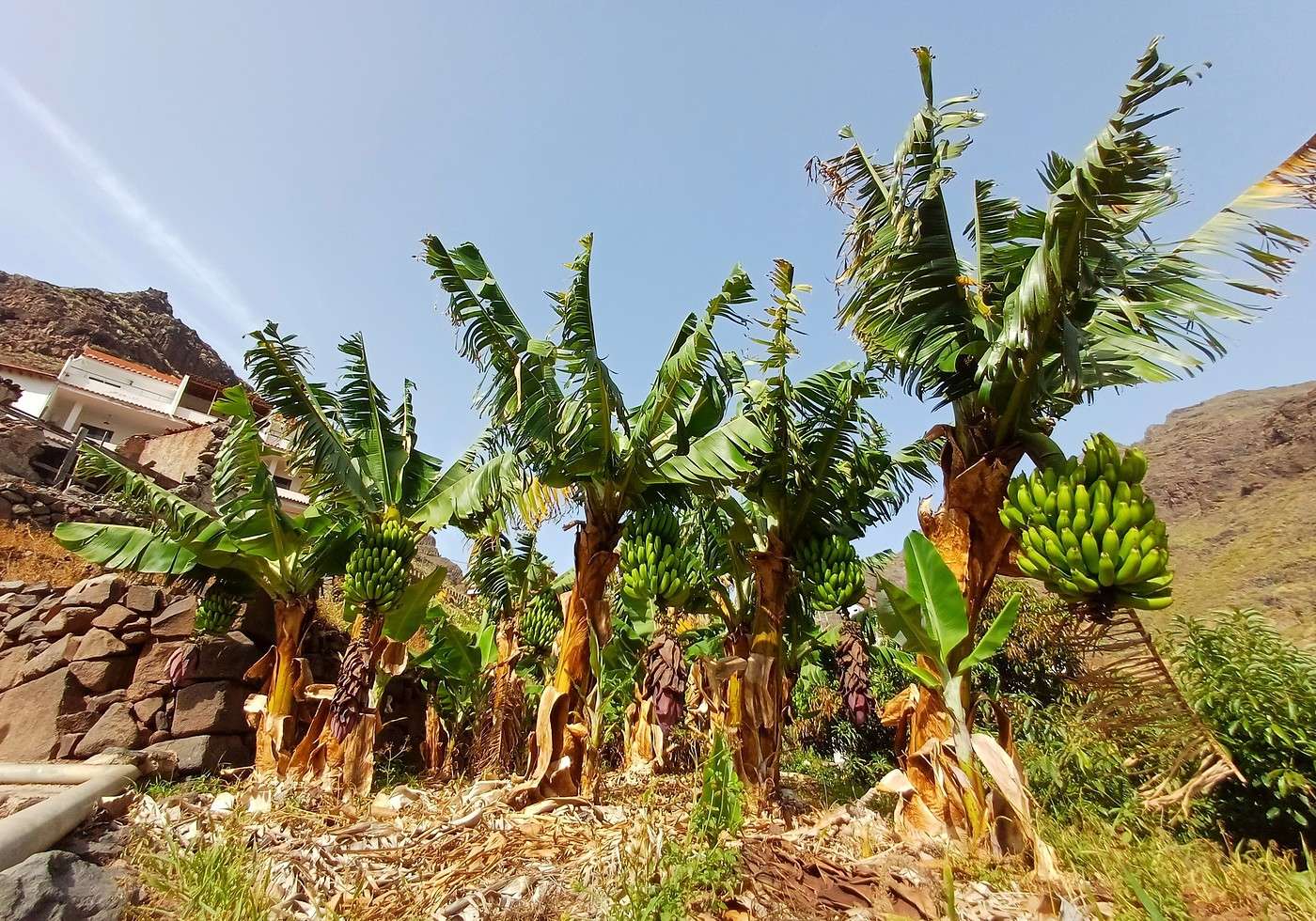
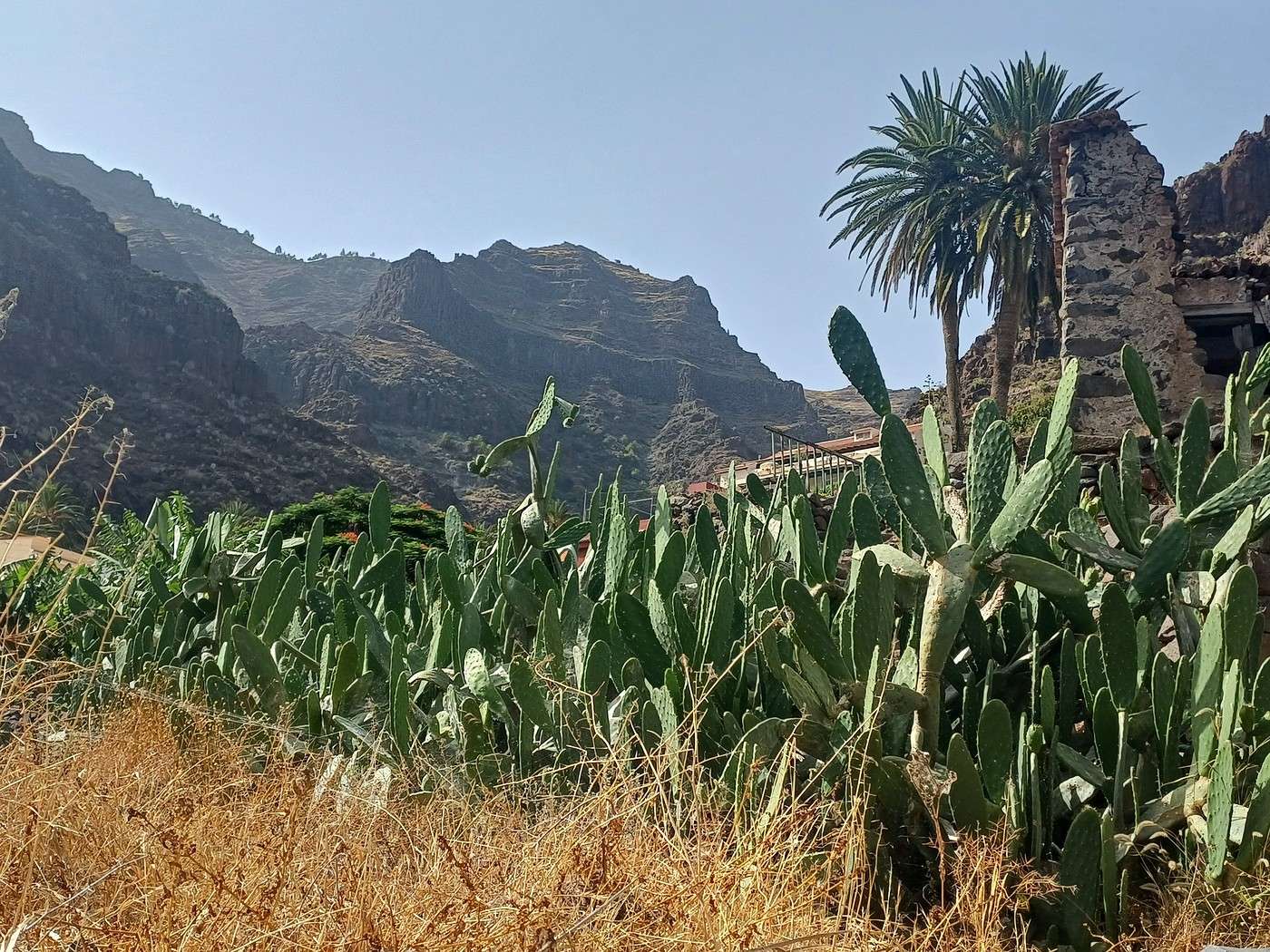
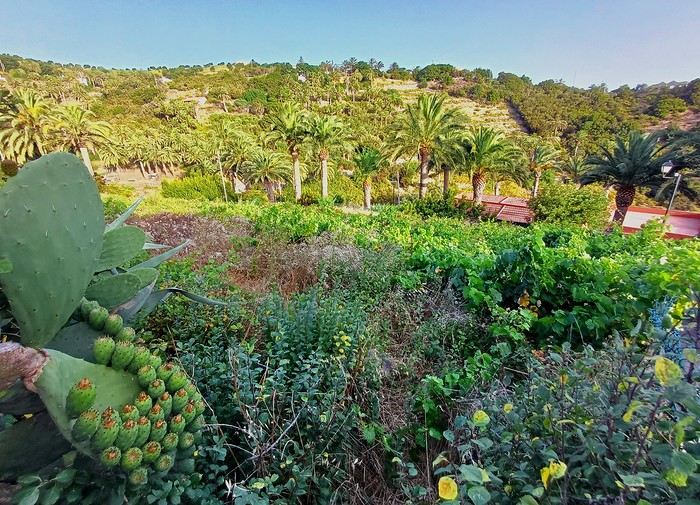
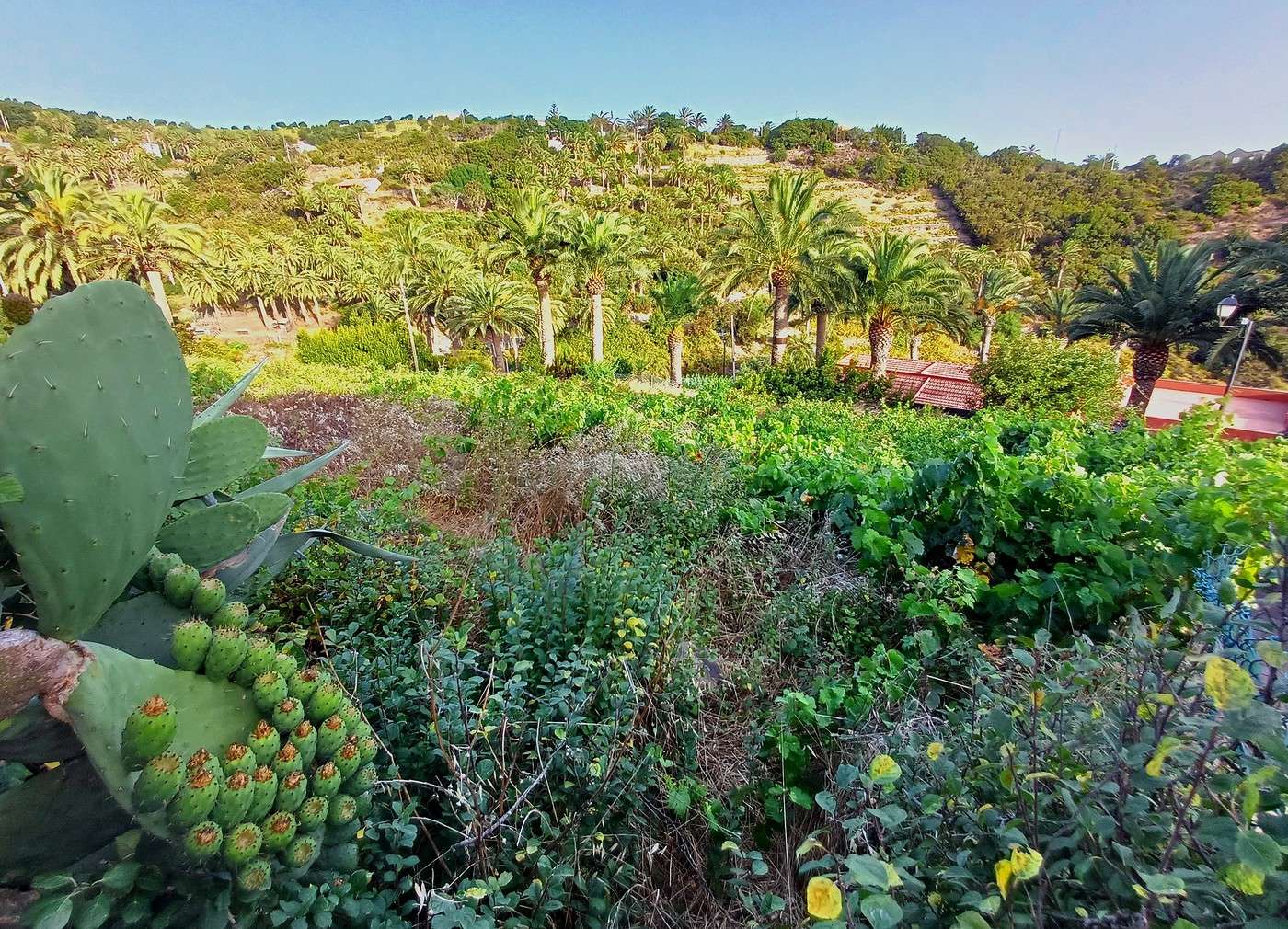
Gardens? The sanctuary of Los Reyes? Oh, of course—we realize this is the famous Los Reyes gardens trail we’d been looking for without success on our first visit to El Guro! What threw us off is that it’s not a hiking trail but more of a stroll through the bancos (terraces) of fruit and vegetable crops that define the island’s visual identity: banana trees, palm trees, aloe vera, vines, sweet potatoes...

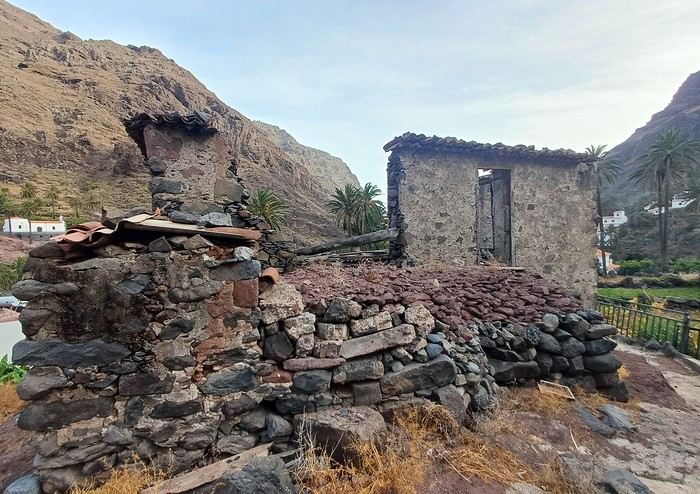
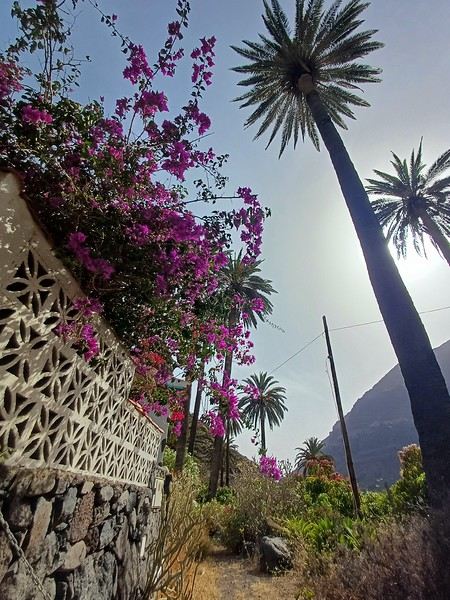
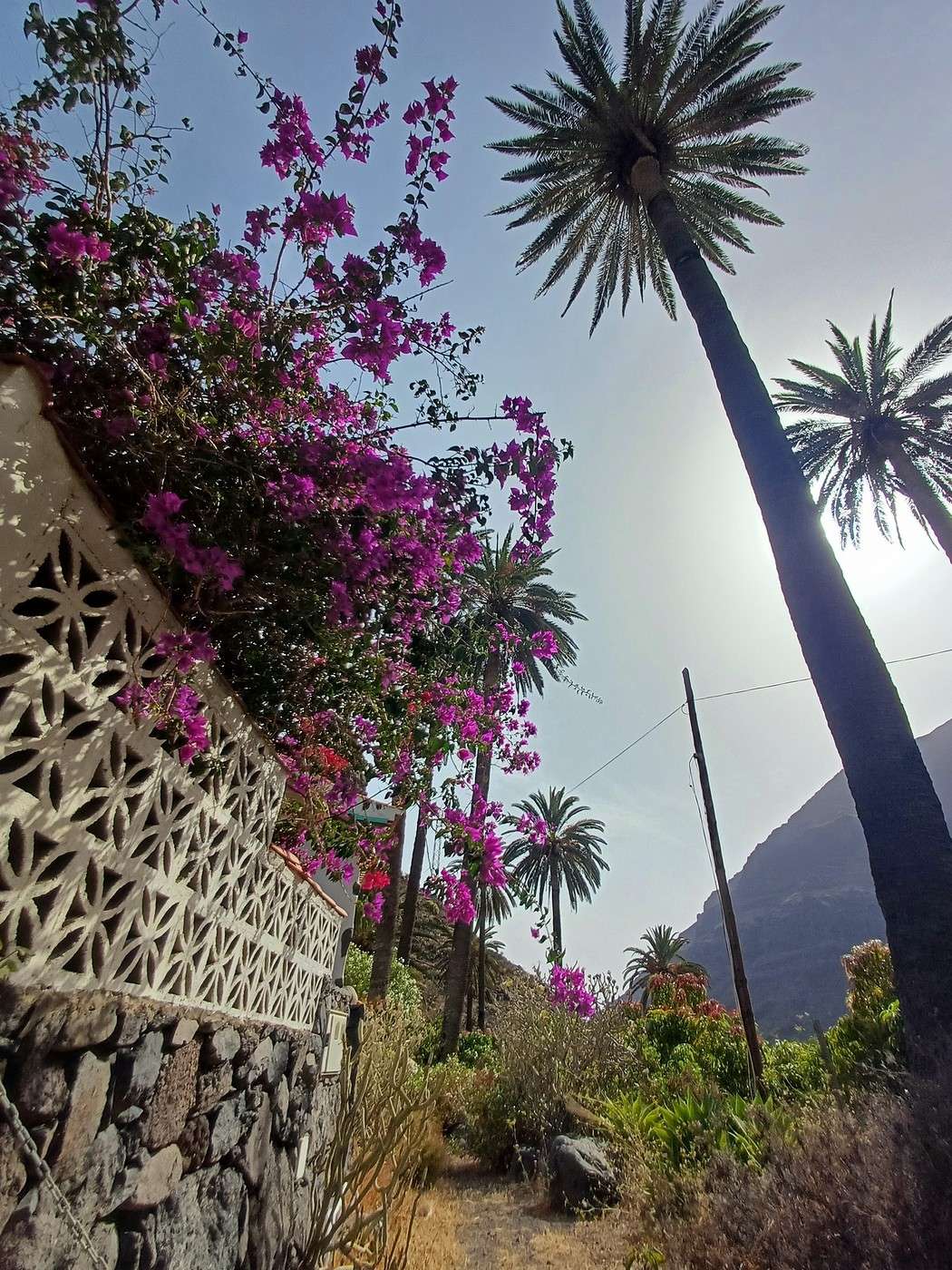
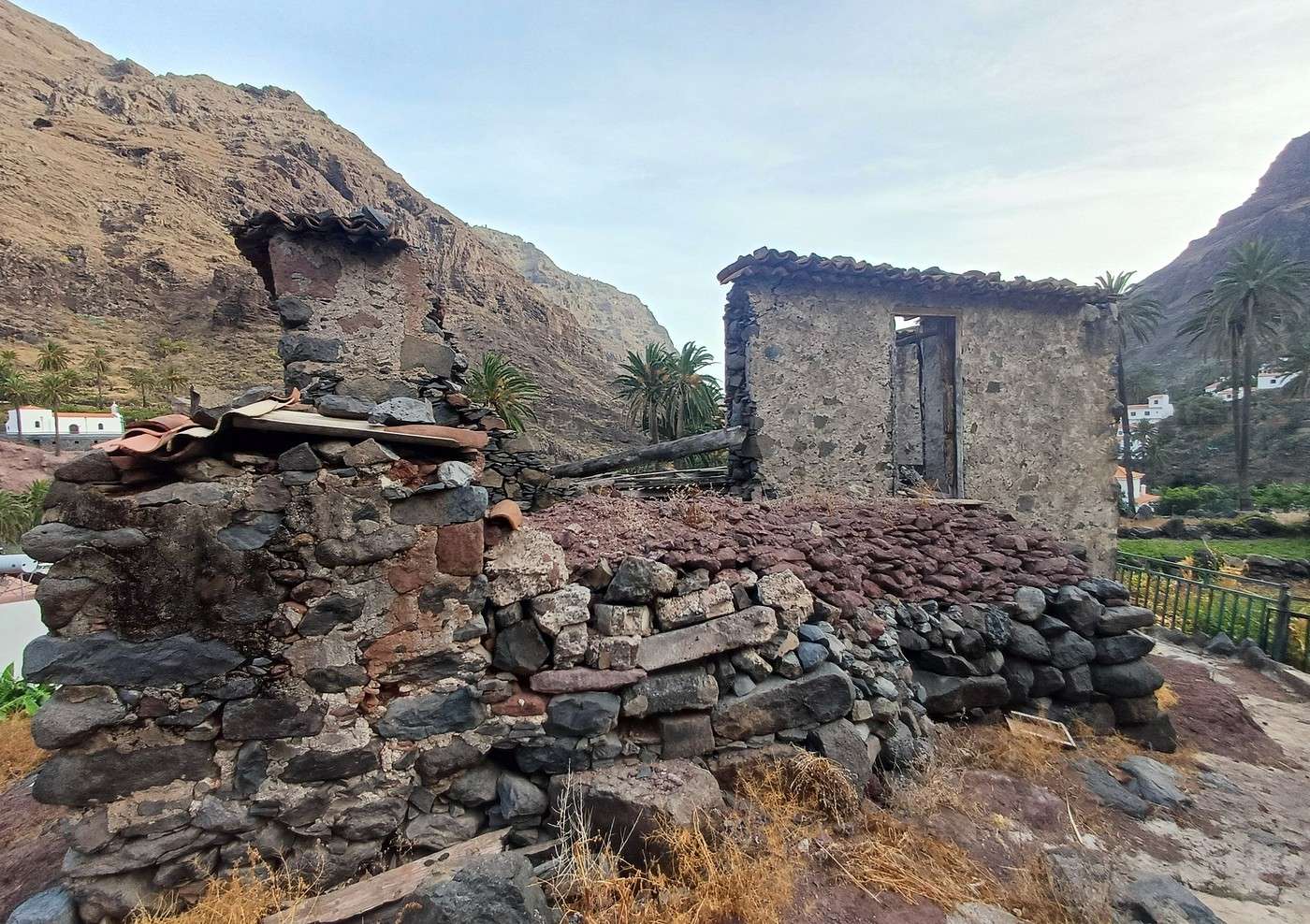
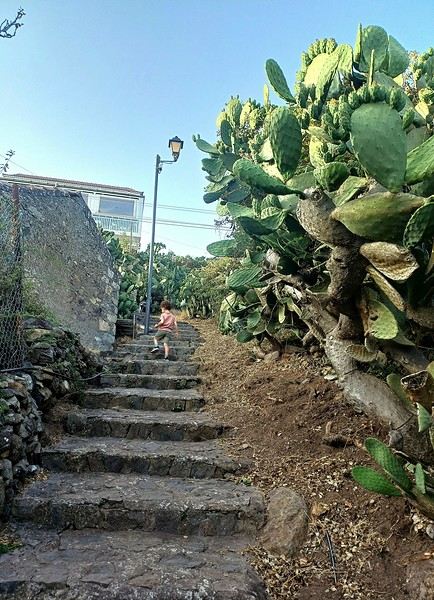
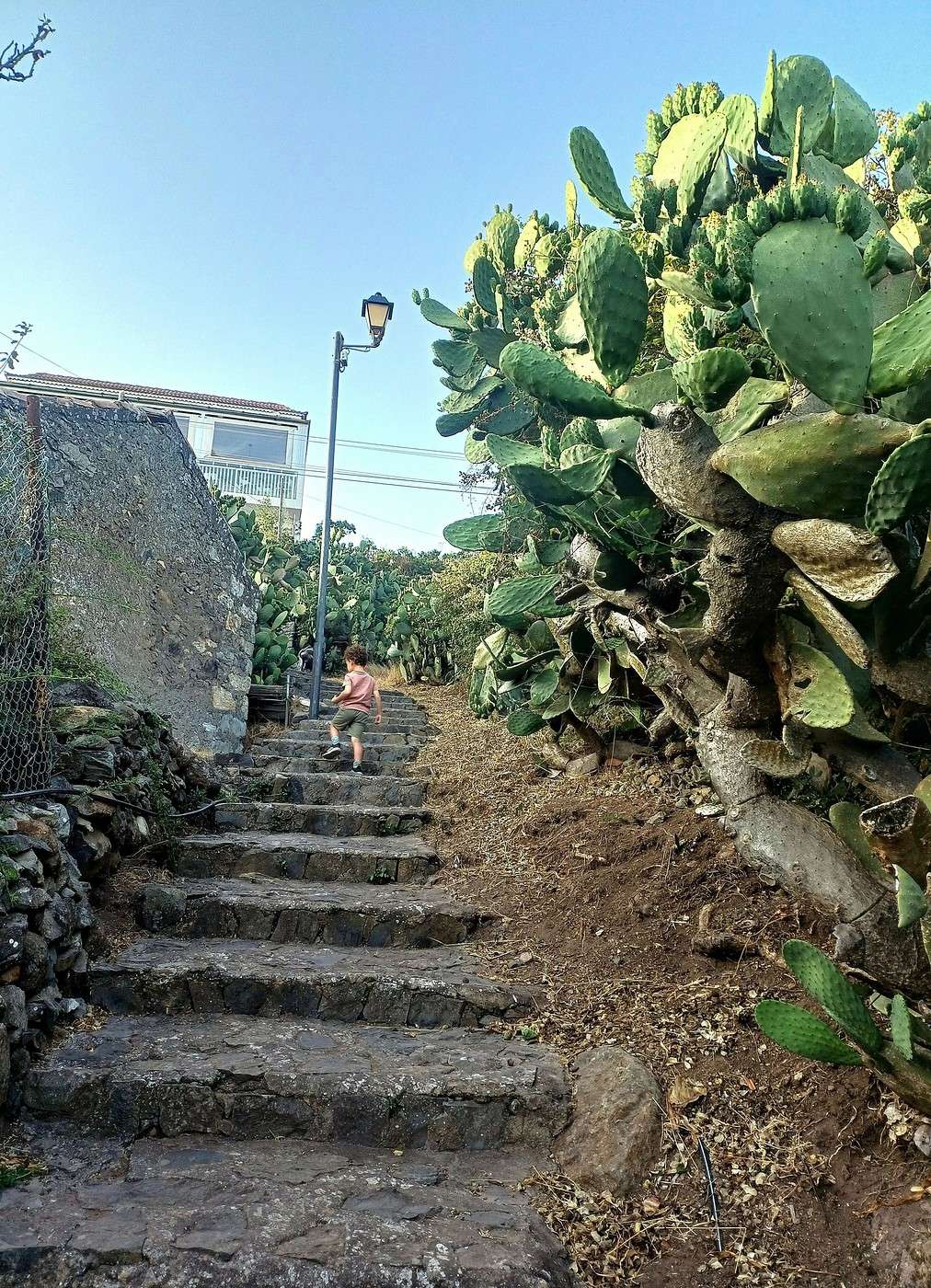
We descend one of the stone staircases leading to the gardens and weave our way through the colorful little houses of the farmers, past flowering trees with exquisite scents, terraces, enclosures, and even some abandoned small farms.

A few farmers are working, and elderly women sit in their doorways. We feel a bit like we’re intruding on the locals’ properties, but the “¡hola!” greetings show that no one seems to mind. Besides, as usual, we’re the only walkers around, and it’s a stunning, privileged spot to explore and learn. These gently sloping gardens stretch along the valley floor, apparently following the bed of a stream that dries up in summer. We’re right at the front row to observe the irrigation system seen all over La Gomera—though it might seem a bit old-school, it’s ingeniously adapted to the island’s geological quirks. Small channels drain water from springs and ravines into reservoir-like basins (which we’d mistaken for open-air wastewater tanks in the first few days), connected to networks of pipes that distribute water to the different crops.

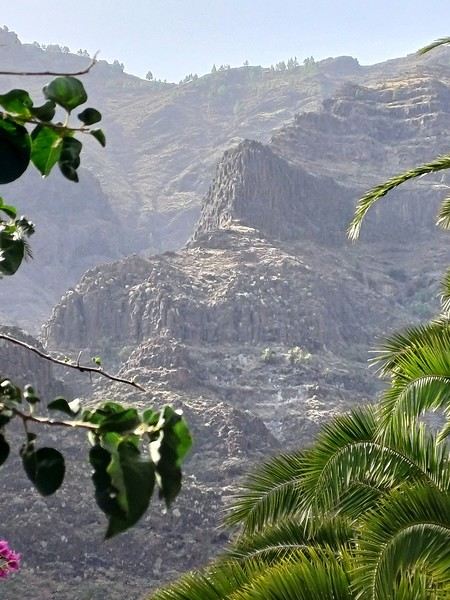
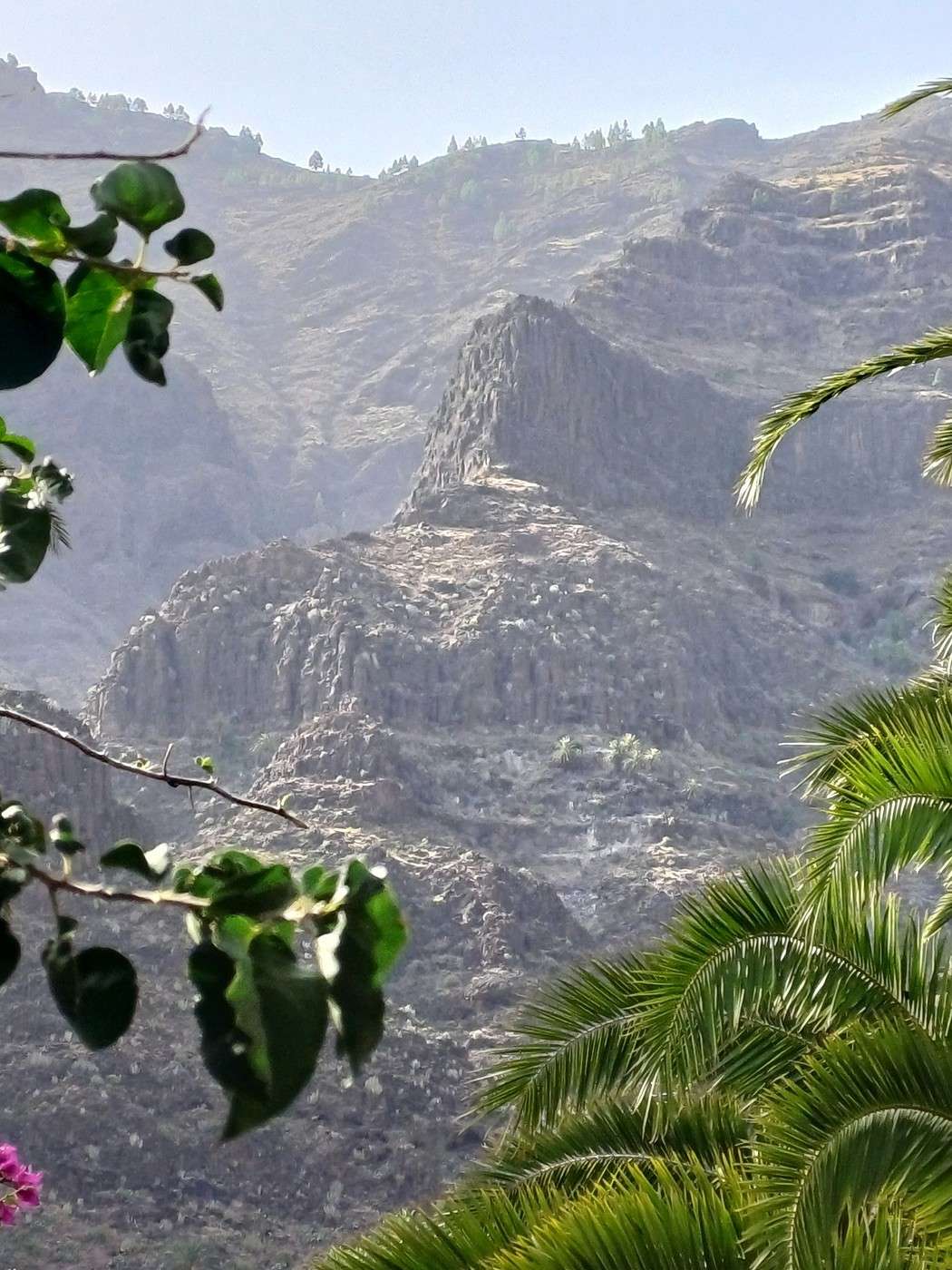
The walk through the gardens is short, but it’s not our main goal. We climb the winding paths up to the church (which isn’t anything special inside), and behind it, we find our trail, overlooking the gardens as it follows the slopes of the rugged Teguerguenche and Adivino.

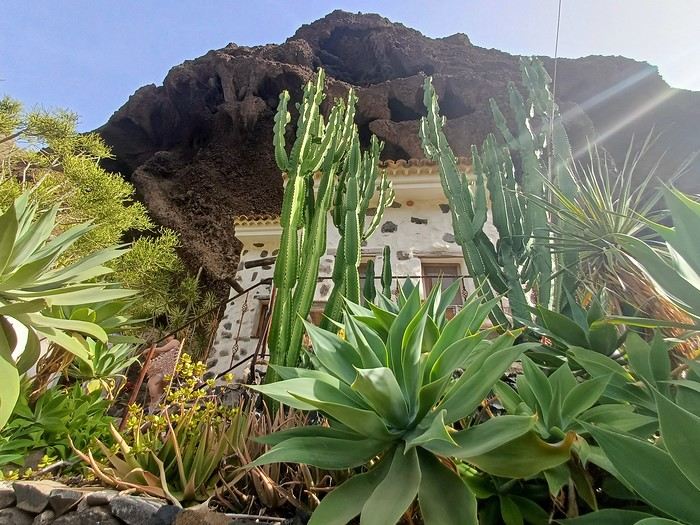
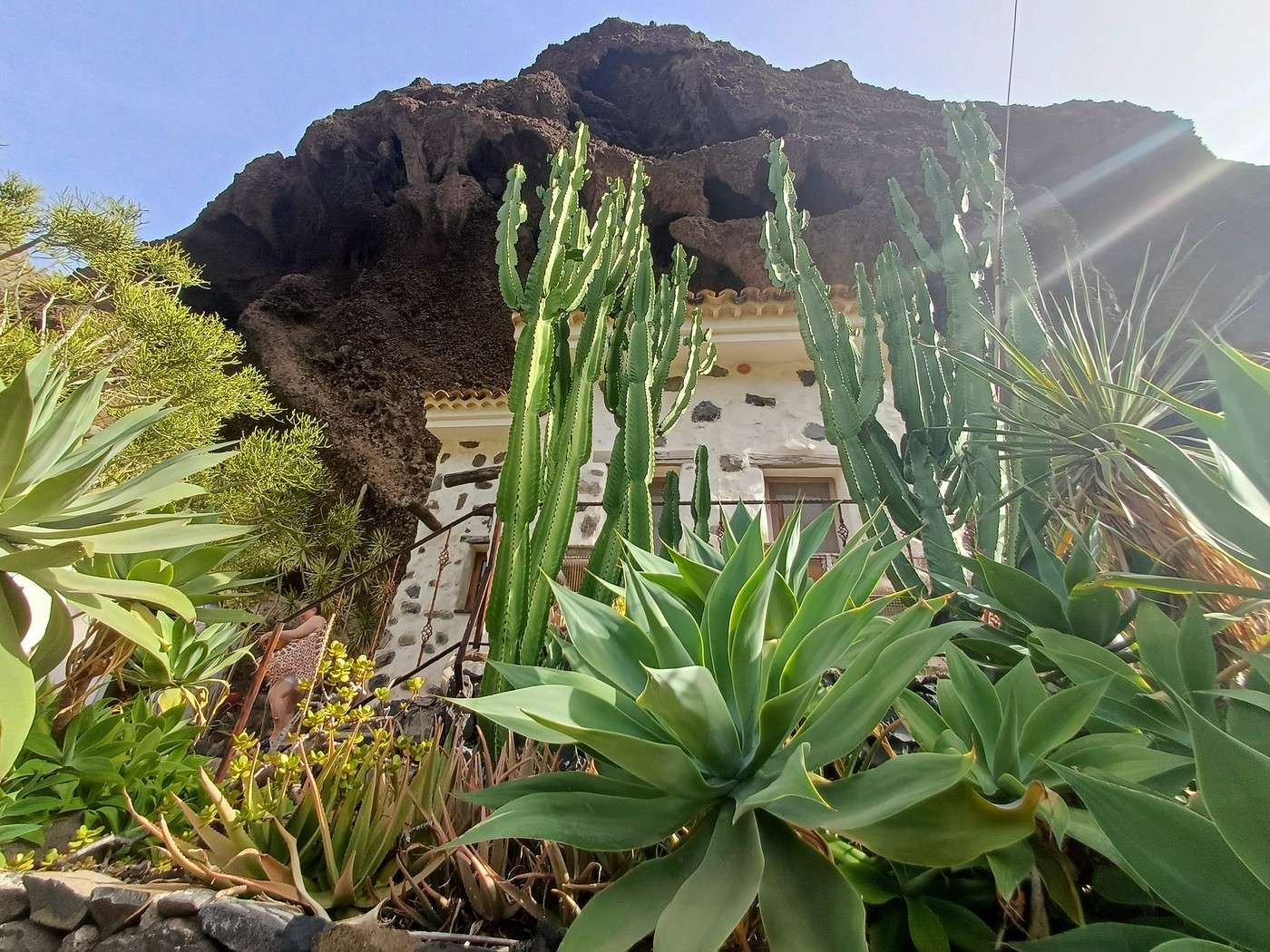
The rocky trail starts with a steep climb, then passes by houses, including one that’s absolutely fascinating—built in the shade of a volcanic cavity carved into the black rock.

This house marks the entrance to the charming hamlet of Chele, nestled next to Las Granadas. The hike isn’t long, but the slope, the still-intense late-afternoon sun, and a not-so-energetic Théo make it a bit of a challenge. Instead of retracing our steps, we cross through El Guro in search of the only grocery store—unfortunately closed. Instead of taking the same trail back, we decide to loop around by descending the GM-1, the main road that winds down to Valle Gran Rey, one of La Gomera’s three major routes.

It turns out to be a great idea because, from one side of the valley to the other, we get a bird’s-eye view of the Los Reyes gardens from a different perspective than the narrow trail we’d walked earlier, visible in parallel on the other side of the crops. The road is also a quicker way back to the car.

After dinner, we take a little evening stroll along La Calera beach. It’s lively but not too crowded—the restaurants are full, but there aren’t many people on the coastal path where you can sit and watch the waves crash against the rocks.

The kids can’t resist getting ice cream. On the way to Playa del Inglés, we hear the shearwaters, but much less than on other nights, which seems to confirm my theory about their activity depending on the moon. Théo tries to act tough, saying he’s not scared of them anymore with some over-the-top heroic gestures… but he still runs back to us, yelling for us to wait when we playfully try to lose him! We walk along the beach, where some brave souls are swimming in the middle of the night. We think we see the lights of El Hierro in the distance through the nighttime haze, but it might just be boats. Before heading back to Buena Vista, we sit on a low wall facing the beach. The hippie with the stranded-Hawaiian look is there, same spot as always, calmly settling in between the two trash containers that serve as his bed. Good night!

16 days with family in La Gomera (Canary Islands)

Muriel18 · 2026-08-25 · Message 29 of 54

We do find landscapes similar to those on the other Canary Islands, but the atmosphere in La Gomera seems unique.

16 days with family in La Gomera (Canary Islands)

Pagaljavab · 2026-08-25 · Message 30 of 54

I don’t know the other Canary Islands except for our two short stopovers in Tenerife, but this is what kept coming up on the La Gomera Travel site and in conversations with other Canary Islanders on vacation. What sets La Gomera apart is its very moderate tourist traffic, its deep rural feel—even in the locals’ mindset—the peaceful vibe, and the Canarian culture that’s much more alive and preserved than elsewhere.

16 days with family in La Gomera (Canary Islands)

Pagaljavab · 2026-08-25 · Message 31 of 54

Day 7, Monday, August 3: Valle Gran Rey/La Calera, Garajonay Natural Park (Laguna Grande), Las Hayas, Valle Gran Rey/La Calera

And just like that, our last day in Valle Gran Rey has arrived. To make the most of it one more time, we spend the morning at the La Calera beach. There’s no reason to change—we think it’s simply the best family beach on all of La Gomera: a strip of black sand that’s long enough but not too long, a sea that’s calm and pleasant for swimming with a few waves at the shore, moderate crowds until noon, discreetly supervised swimming, and a semi-urban, semi-natural setting with a few amenities and a small area of shops and restaurants nearby—without spoiling the landscape or the valley’s gardens. On our way back to the car, we run into our Belgian friend again... this time in municipal worker attire, picking up street litter. This leads us to two sociological observations: - We now understand how he managed to settle in the village long-term, - It seems like half the residents of La Gomera work as road maintenance workers.

In the afternoon, we realize it might be time to book our whale-watching boat excursion to see marine life and cetaceans. Most of the agencies offering these trips are in Valle Gran Rey, and it’s a bit silly that we waited until our last day here to book. No matter—we’ll come back from Hermigua; the island isn’t that big. We don’t beat around the bush and decide on Oceano Whale Watching, the highest-rated agency, known for its ethics and ecological commitment. It’s located in Las Vueltas, across from the small port of Valle Gran Rey. It’s run by passionate Germans. We’re greeted by a German woman who speaks to us in Spanish, and we book for three days later (176 € for four, including child rates). The agency is spacious and even has a small cetacean interpretation center. The organization’s seriousness and professionalism inspire confidence. It all looks very promising.

With the tickets in hand, we decide to return to Garajonay Natural Park. This time, not for a hike, but to spend some time in the shade of the laurel forest, as the heat is a bit stifling in Valle Gran Rey this afternoon. On La Gomera Travel, the Laguna Grande recreational area is often mentioned—a place we’ve driven past several times. It’s a large clearing that seems to serve as a landmark in Garajonay: starting point for hikes, a restaurant, a playground for kids, a gas station, and an information center. It takes us a good half-hour to get there, and as usual, the GM-1 road makes us queasy. We turn off the road into Laguna Grande, which is indeed a vast clearing where we spot wooden structures here and there. The most surprising thing is that there’s no one around—just a Spanish couple checking a map before leaving. The gas station, actually just a pump at the edge of the forest, looks completely abandoned. The restaurant and information center are closed, the kids’ playground is cordoned off, and the marked trails around the clearing don’t look too inviting. Above all, seeing this large, deserted site—presented as a major hub of the park and a public landmark—gives a strange feeling, like walking through a ghost town. We lie down on the picnic tables for a bit to recover from the dizziness, but we don’t like the place and decide to head back a few kilometers to the village of Las Hayas, which always has such an effect on us when we drive through it.

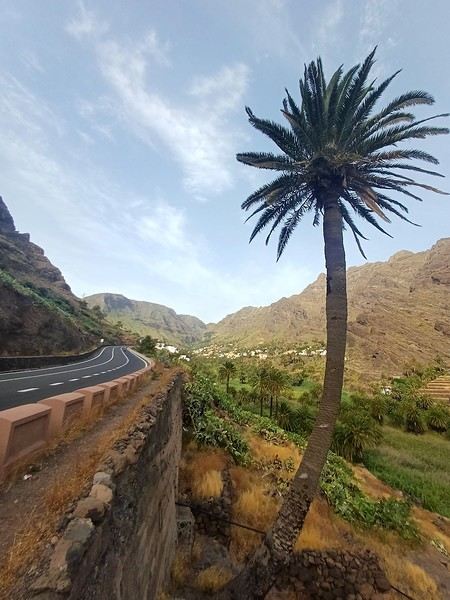
Las Hayas is a charming little village—or rather, a hamlet—on the edge of the natural park. Located on the highest part of the Valle Gran Rey municipality, it offers breathtaking views of the ocean, the cliffs, and the barranco de la Rajita, which plunges dramatically toward a somewhat isolated beach of the same name, the heights of Garajonay Park, and the Fortaleza de Chipude, a spectacular volcanic formation with its wide plateau—perhaps the most remarkable on La Gomera. We take a short break to admire the view and walk a few dozen meters on a trailhead in the middle of gardens after parking in the empty lot of Casa Efigenia, one of the island’s most renowned restaurants.

I’ve read that it’s famous for its organic and vegetarian cuisine, with ingredients grown on-site in the restaurant’s gardens, and that it’s possible to buy some of their products, which they’ve even turned into a small brand. We think it’s the perfect time to pick up some local specialties. A waitress of Indigenous American descent offers us a table. I tell her, « Solo para comprar productos ». « Vale », she replies without any emotion, pointing to two small display cases. All around, on the walls and a large table, are books and press articles, all centered on an elderly woman, Efigenia Borges Hernández, who is or was the founder of this place and this concept of local, organic production—a true Gomeran institution! We go for jars of red and green mojo, different from their distant cousins at Spar that look like colored mayonnaise, another of almogrote, a sort of spread made from dried goat cheese typical of La Gomera, mixed with more or less the same ingredients as mojo, and a bottle of red wine from La Gomera. I notice these products are the same as those sold more expensively elsewhere on the island, or even at Spar, where the same bottle costs—from what I remember—10 € more! There are also small gift boxes with assorted products at reasonable prices, but we’ll come back for those.

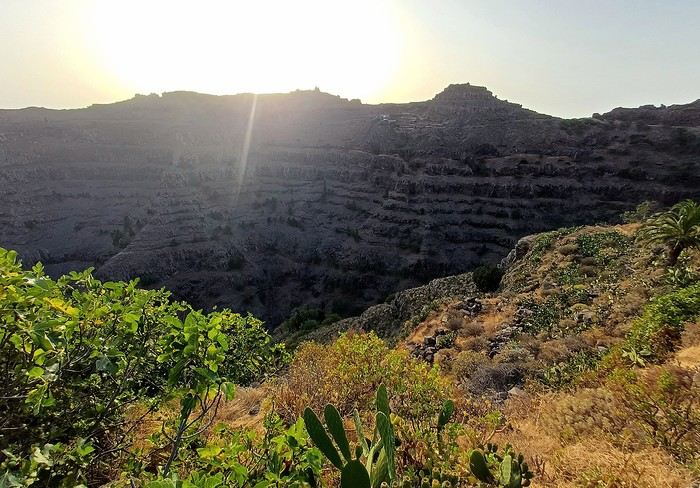
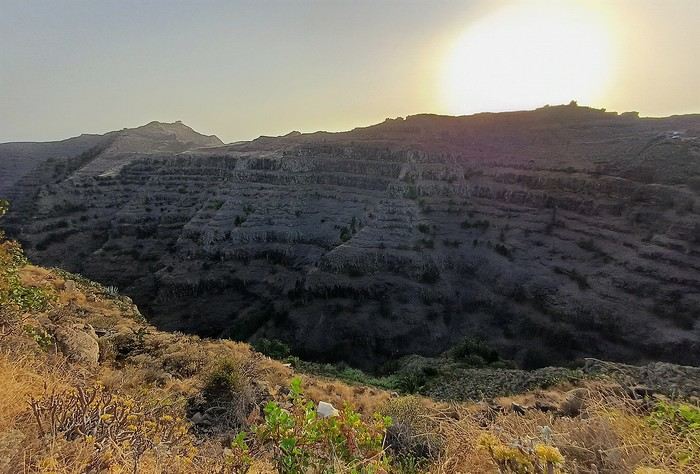
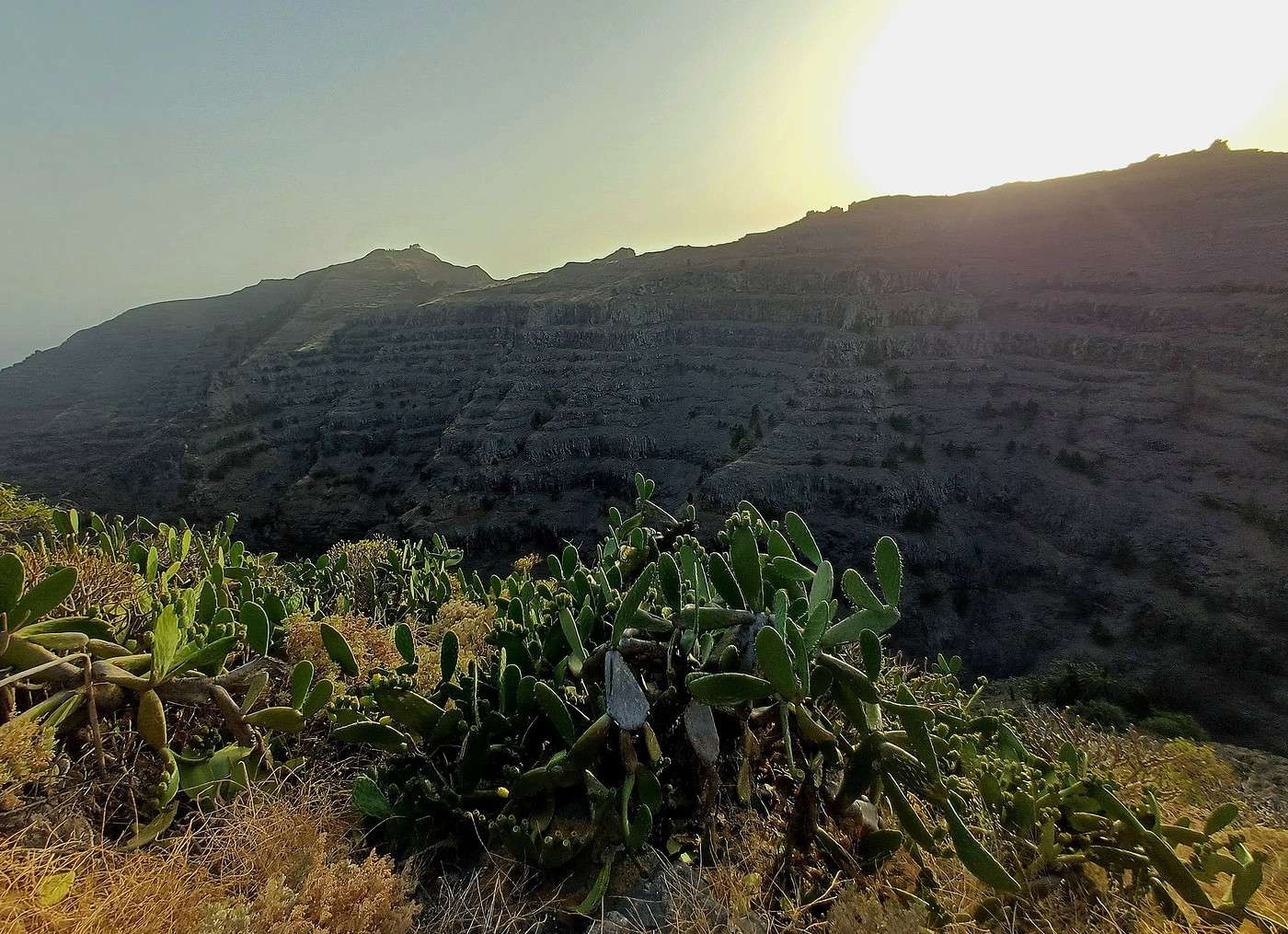
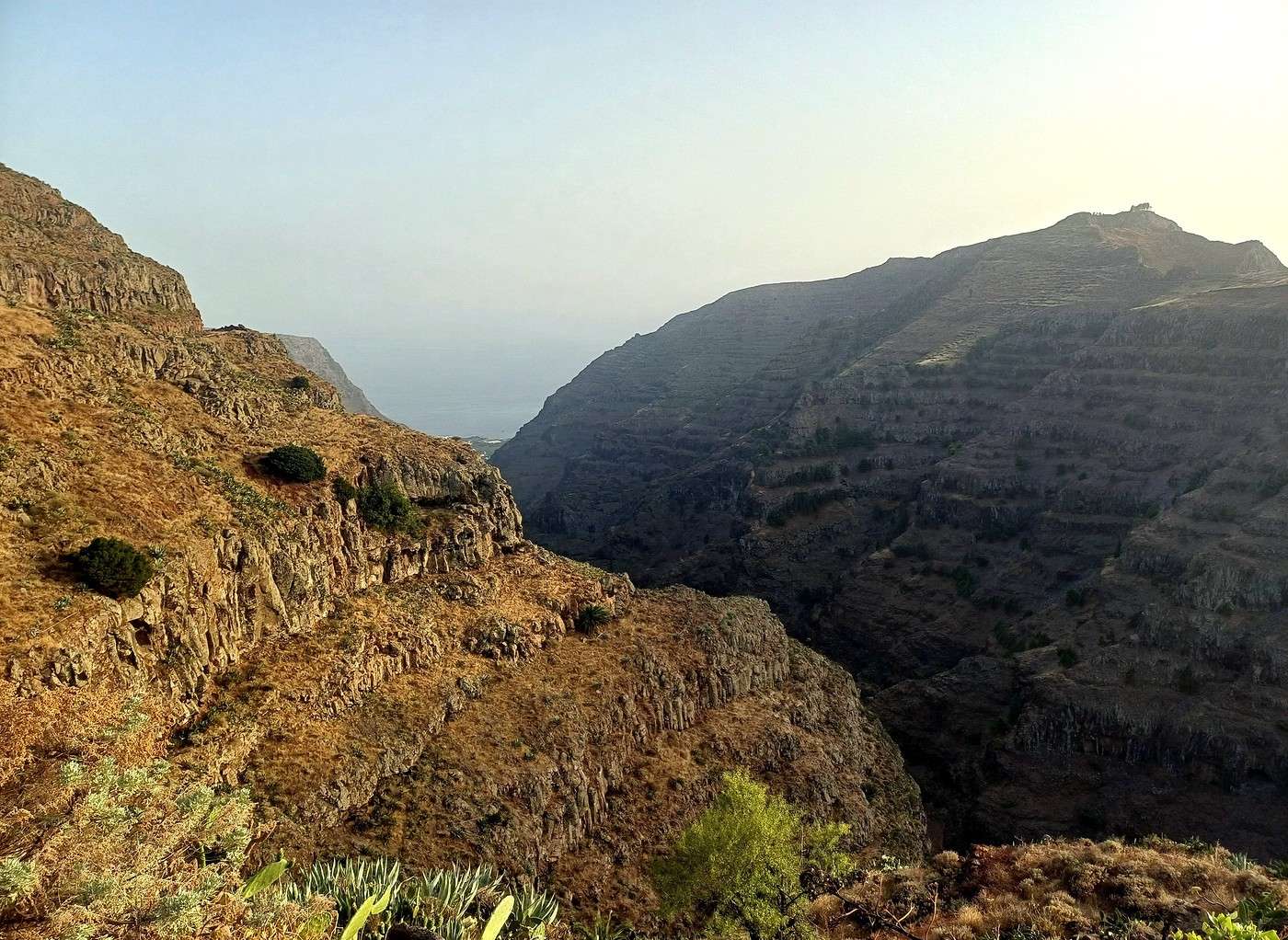
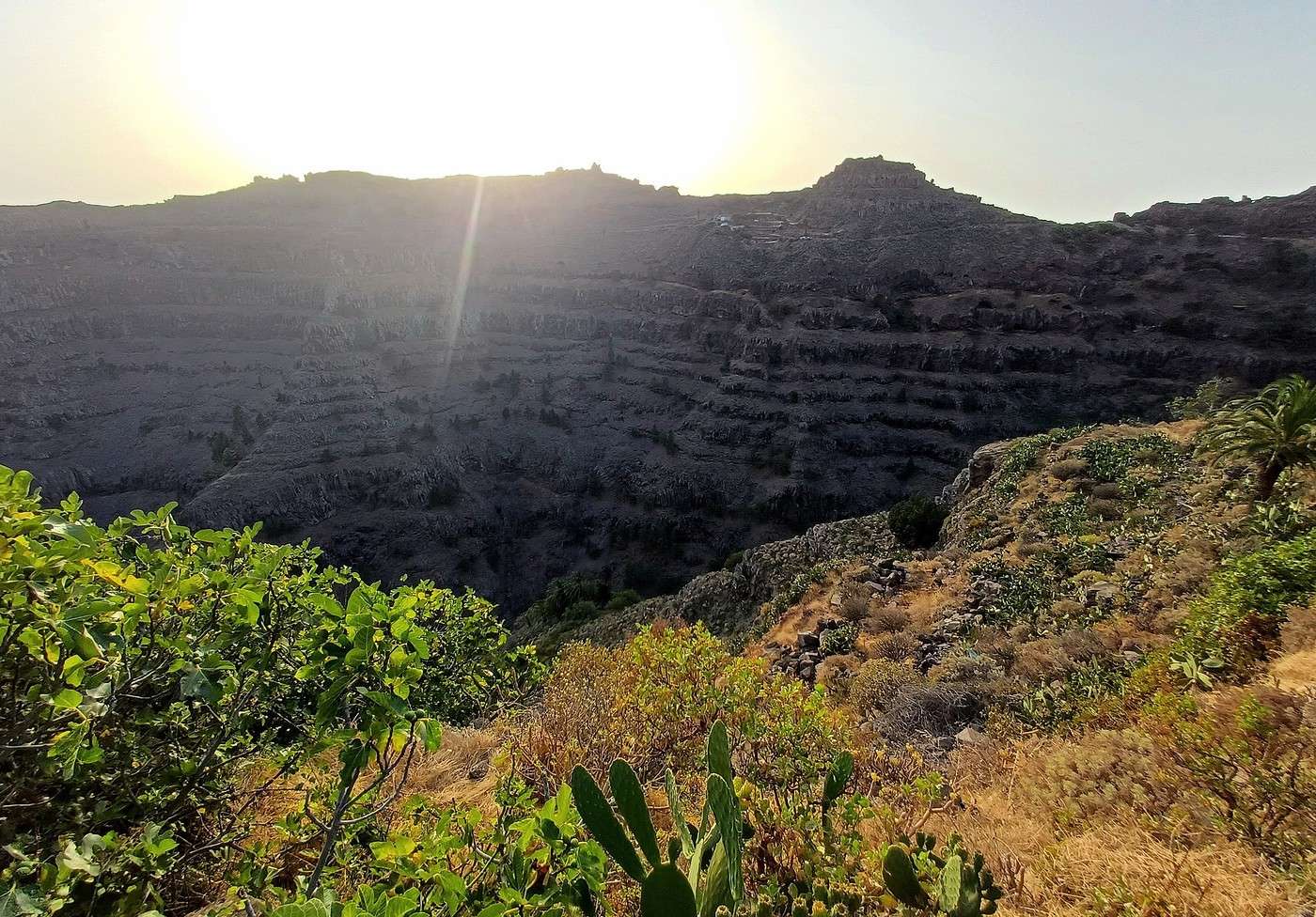
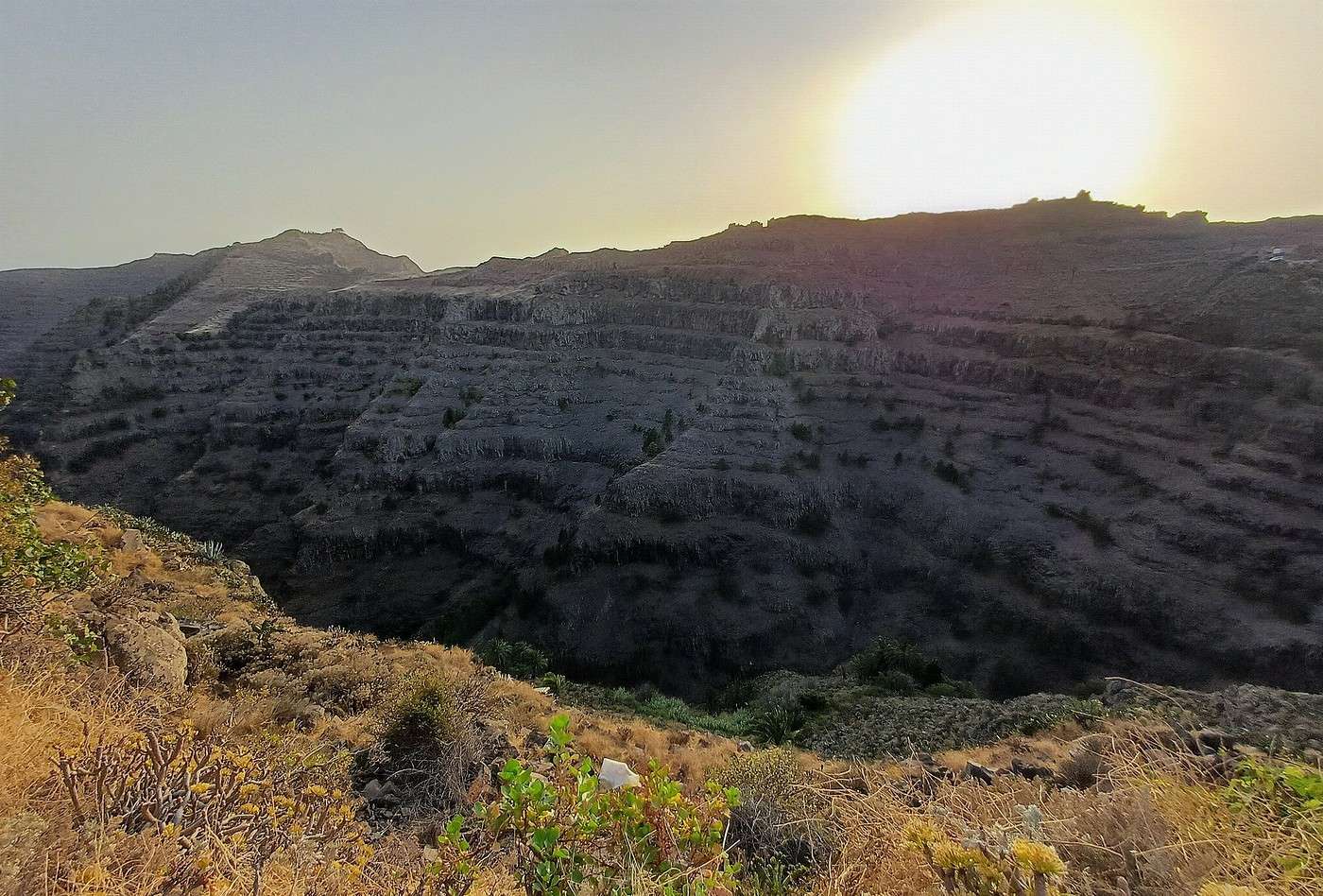
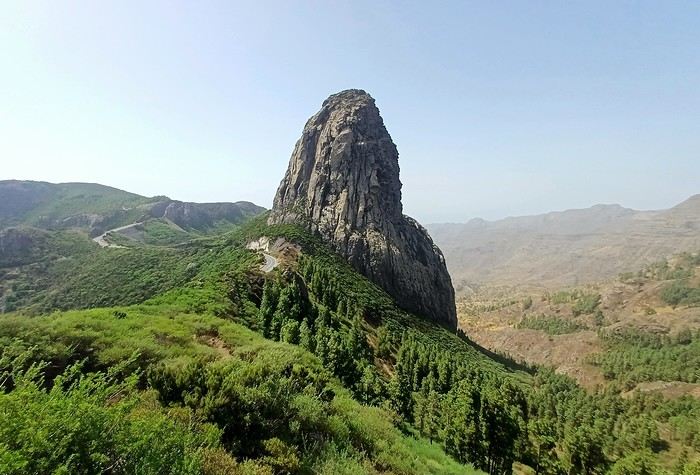
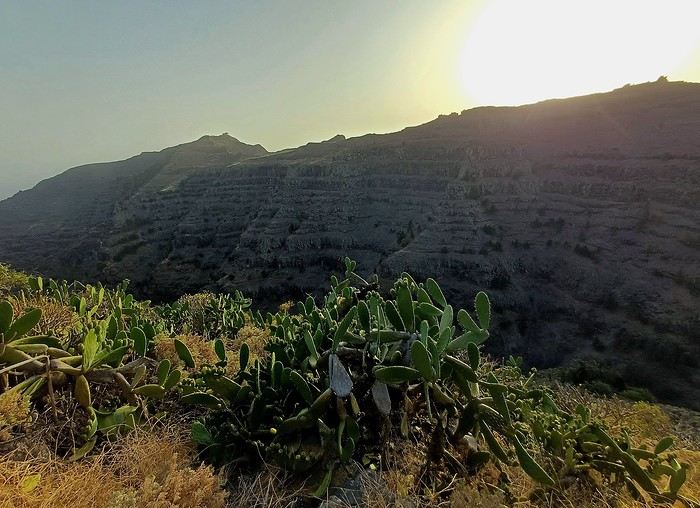
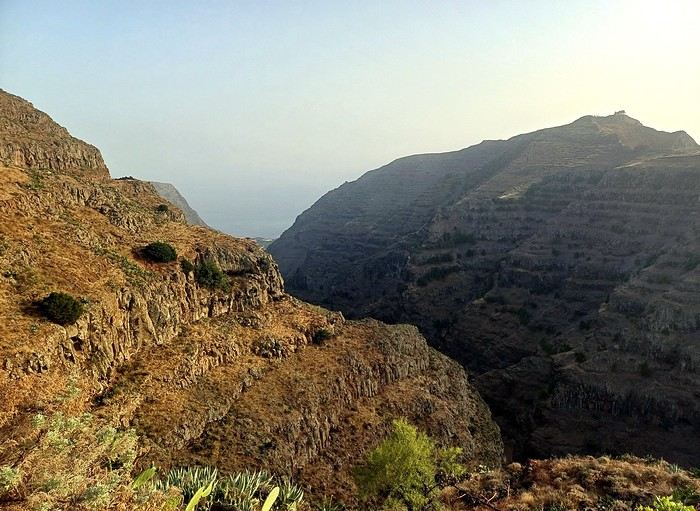
A little further on, past Arure, the beginning of the sunset invites us to stop at the Mirador de la Retama, one of the highest viewpoints in Valle Gran Rey, where it’s indeed better not to take a tumble... Tucked into a bend, it doesn’t offer a plunging view of the valley or the sea. Instead, the viewpoint is almost at the level of the summits of Mérica and Adivino, with their titanic walls of black volcanic rock, striated and layered, sculpted by time. The scene is moving, with the rays of the setting sun.

In the evening, we have one last meal on our big terrace and start packing our suitcases, as we’ll have to leave the accommodation at 11 AM tomorrow.

16 days with family in La Gomera (Canary Islands)

Pagaljavab · 2026-08-25 · Message 32 of 54

Day 8, Tuesday, August 4th, Valle Gran Rey, Garajonay Natural Park (Reventón Oscuro-El Cedro trail), Hermigua/El Corralete

So today we’re heading to Hermigua, which marks the second part of our stay. We don’t get up too late so we have time to enjoy a 100% Gomeran warrior breakfast—that is, once again, my gofio mousse with banana and palm honey, which is a hit and gives us the energy we need to finish packing, clean up the place, and leave a little before 11 AM. Well, Valle Gran Rey, that’s it for now… though not entirely, since we’ll have to come back in two days for the whale-watching boat trip. Off we go for an hour and ten minutes of winding roads for just forty kilometers.

We take the GM-1 road, which holds no more secrets for us as we climb through the villages, hamlets, and viewpoints of Valle Gran Rey before turning off at Las Hayas toward Garajonay Park, where it becomes the GM-2. As usual on this road, the kids get a little carsick. Luckily, we’ve done the hardest part once we reach that familiar forest, where we stop for a long break since we can’t check into our place in Hermigua before 3 PM. First, we stop at the Mirador de los Roques, which, as the name suggests, offers a view of a landscape of massive lava-rock formations, especially Zarcita and Agando, standing proudly against the sky.

Then, since we’re just a few hundred meters from the hamlet of El Cedro, we decide to do a short hike in the forest—and, most importantly, to return to the Bar Restaurante Camping La Vista, in the heart of the forest, which we loved so much two days ago. We’re surprised to see that compared to the first days of our trip, there are more people parked at every viewpoint or notable spot in Garajonay Park. You can even occasionally spot those rare tourist buses that visit La Gomera on a (half-)day trip from Tenerife. Still, we’re far from overtourism.

This time, we turn off at Reventón Oscuro, the starting point of a much shorter trail than the one from the day before yesterday to reach El Cedro. We take the small paved forest track used by both cars and hikers, park in a pull-off, and from there, it’s just a kilometer and a half downhill (which, of course, we’ll have to climb back up later…). What’s great about La Gomera is that even the tiniest stretch of the island’s 600 kilometers of hiking trails is marked with little wooden signs. That lets us eventually leave the paved track for a more pleasant dirt path. It’s a joy to walk through this laurel forest again, with its gnarled shapes, branches hanging like vines, and heather. Finally, this trail joins the end of yesterday’s route, between the Chapel of Our Lady of Lourdes and the first farmhouses of El Cedro, surrounded by gardens and palm trees. In the distance, we spot the terrace with blue umbrellas nestled in the greenery, and we know our favorite restaurant is just a ten-minute walk away.

Thanks to this little forest walk, the nausea has vanished like magic, and we’re ready to fill our bellies. We sit down, and the owner greets us, letting us know she remembers us. A French family approaches to ask how we got here because, like us, they started from Reventón Oscuro but were disappointed not to find a forest trail. We point them to the long hike we did the day before yesterday from the Pajarito starting point and mention there are also other, easier dirt paths. But they didn’t find them and are now thinking of sticking to the trail near the Hermitage of Our Lady of Lourdes. All that effort to put on their adventurer gear for nothing! Meanwhile, Théo is still the center of attention, drawing admiration from a Madrid family who speaks great French and whose son is studying in Lyon. They’re impressed he can handle such hikes at just 4 years old. We don’t tell them it’s not always easy and that we have to carry him sometimes… But for his age, he’s already doing a lot.

We feast again on the famous potaje de berros, the restaurant’s pride and joy, along with bocadillos with sausage, rustic beef in sauce, the famous papas arrugadas, and the ever-present mojos rojo y verde, spicier this time (which we don’t mind at all), all washed down with a nice cold Dorada beer. The restaurant is packed today, and the owner, with her grumpy but funny demeanor that amuses the customers, bends over backward to help. She’s actually very kind. Since we’ll have to climb back up that kilometer and a half in the heat, we don’t forget dessert for everyone, including a wonderful gofio mousse—light as air, made with roasted cereal flour mixed with whipped cream and topped with chocolate sauce. Simply divine. All in all, with dishes, sides, drinks, desserts, and coffee, it comes to exactly 50 € for the four of us.

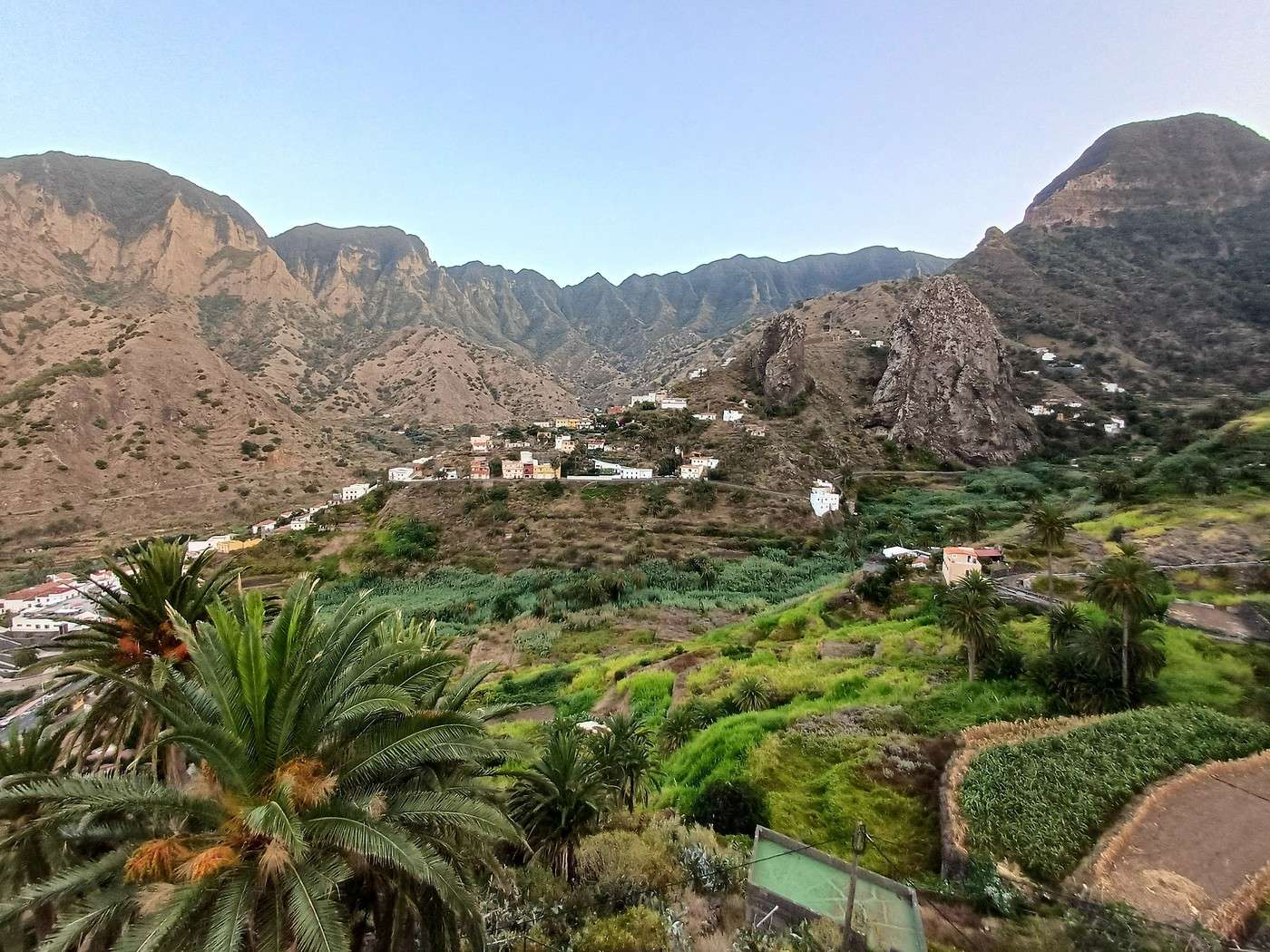
Full and happy, we start walking back to the car, this time taking the paved track, which is a little less tough for the climb. Then, just a fifteen-minute drive later, the Hermigua Valley finally comes into view. From up here, it doesn’t look all that different from Valle Gran Rey, with its terraced fields and exotic plants, its main village surrounded by mountain hamlets, and its coastline between two massive mountain arms. But it quickly appears much greener, and it’s noticeably cooler—29°C compared to the 35°C we’d already reached by late morning just a few kilometers away as the crow flies. On this island, every valley and natural park has its own ecosystem, something we’ll keep noticing. We make a quick stop in Hermigua’s center to fill up the car with gas for the first time since we picked it up, then grab some Spanish and Canarian products at the Spar. Now, we need to find the little hamlet of El Corralete, much farther upstream, where our new place is.

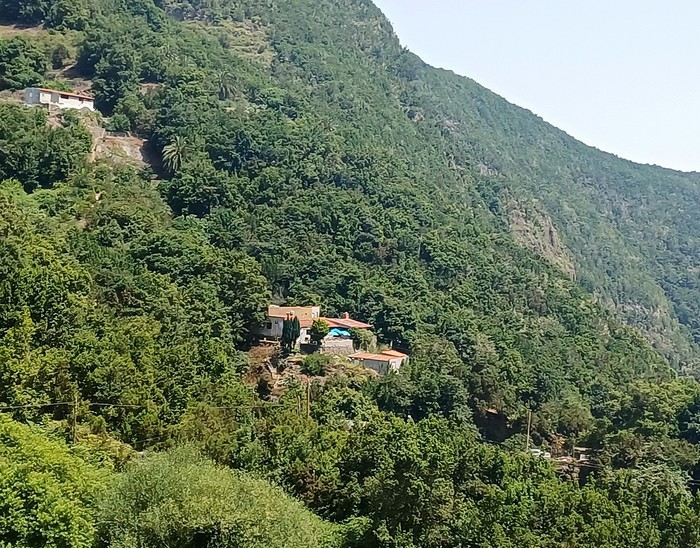
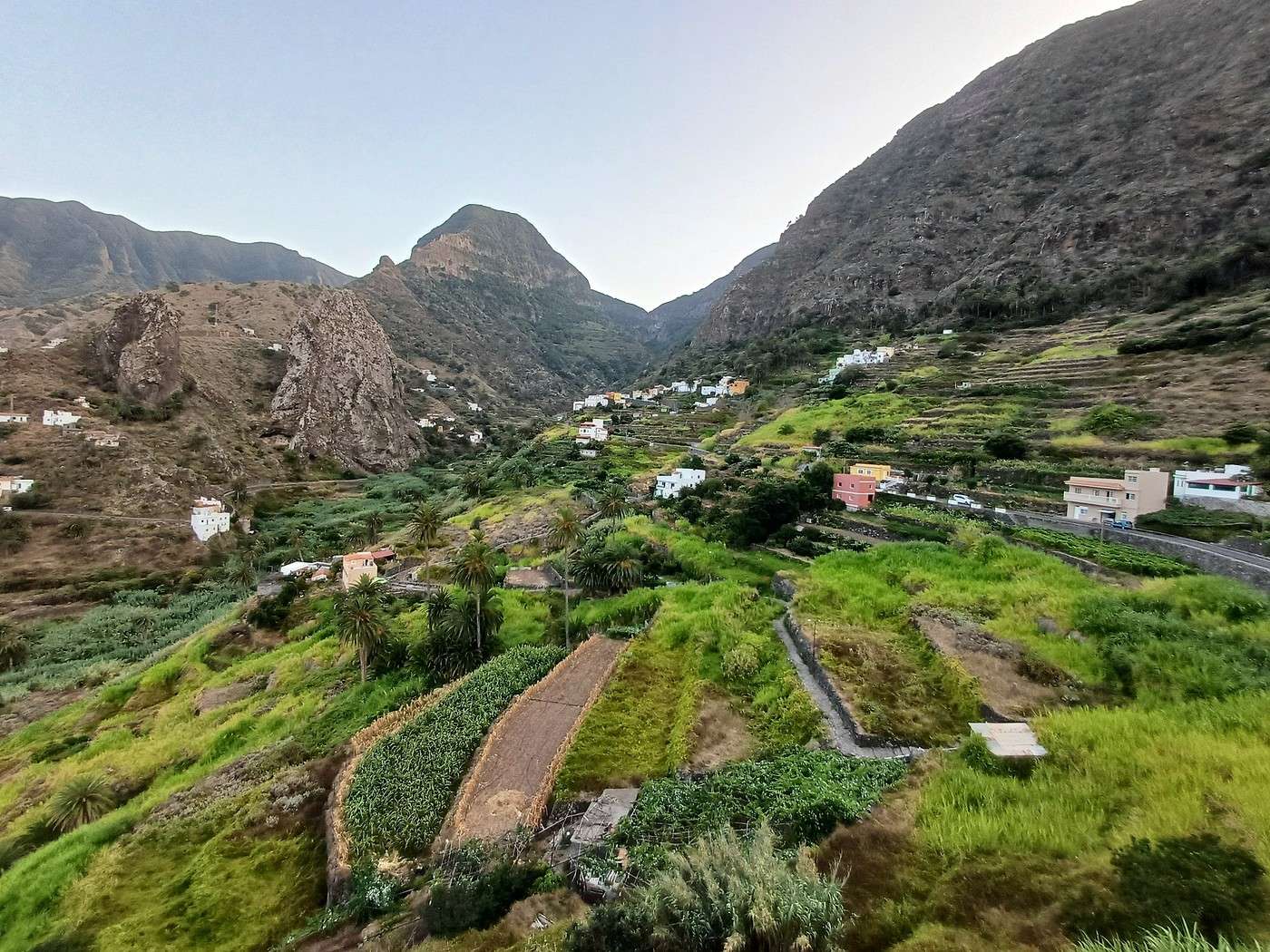
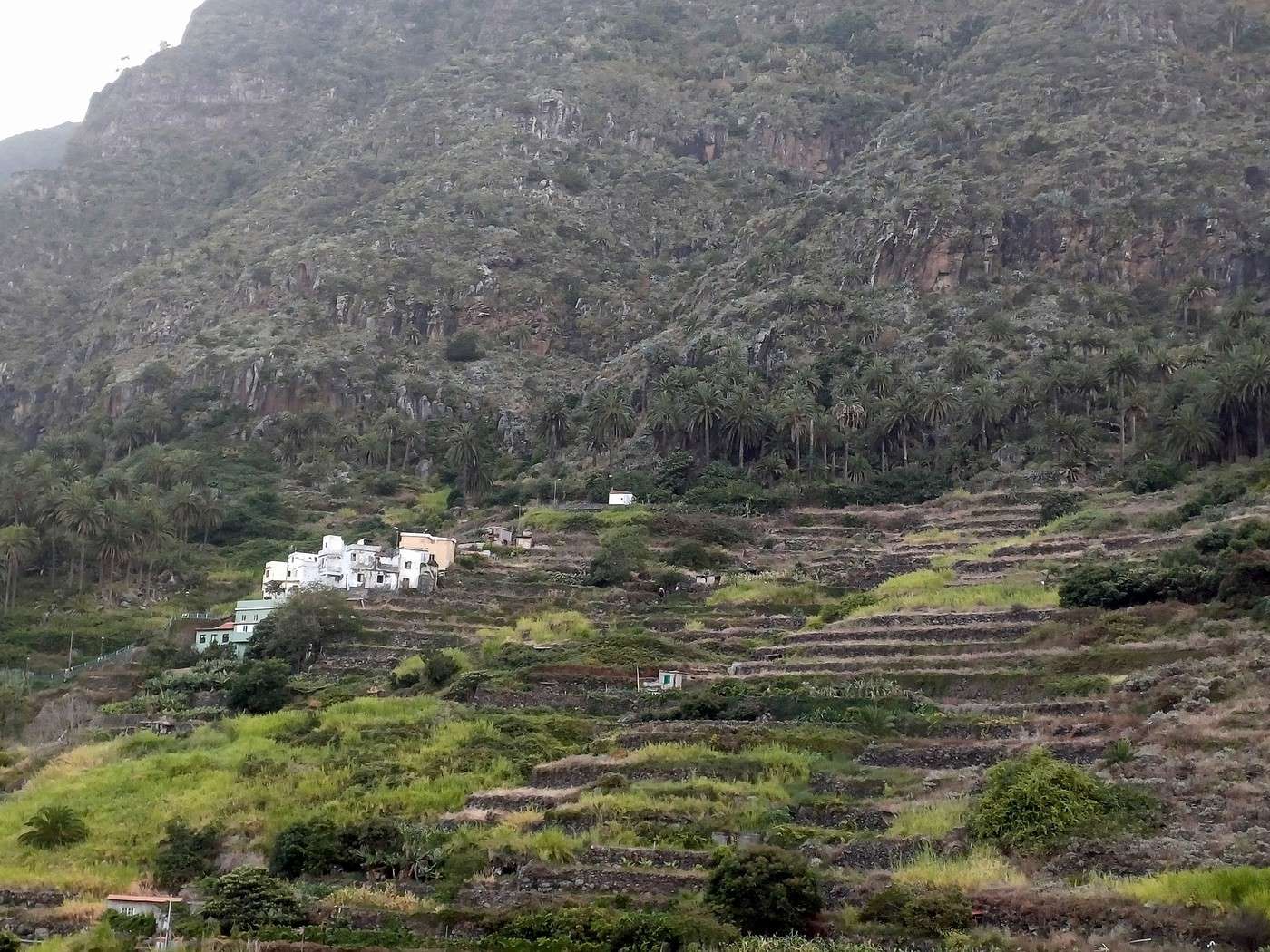
A steep, narrow road of 2 or 3 kilometers with a panoramic hairpin turn over the valley leads us to Casa Yaya, a bright white house in a bend at the bottom of the hamlet, surrounded by terraced fields of banana trees, palm trees, rice paddies, corn, vineyards, and plenty of other crops I can’t identify. The view down over Hermigua and the ridges stretching back to Garajonay Park is absolutely spectacular. The place can sleep up to seven people, with the main house on the ground floor and stairs leading to two large terraces above, which have two extra bedrooms and even a laundry room with a washing machine. For just 99 € a night! You can tell the house has been renovated, though it still has a rustic feel despite the Airbnb-style updates. The view from the windows and terraces is stunning. The valley is much greener, more mountainous, and maybe even more beautiful than Valle Gran Rey, though I did love its drier, rockier landscape. Hermigua below looks both close and far away. If we could jump off one of the terraces with a paraglider or zip line, we’d land in the village square in seconds. We can even spot a bit of ocean toward the beach on one side and, on the other, the ridges stretching toward the island’s green heart.

The hosts (okay, fine, a local agency managing the place remotely from Gran Canaria) have thought of everything to make a good impression. A tray with a variety of teas, infusions, and coffees, a bottle of Spanish wine, and two glasses are nicely arranged on the table. The cupboards are stocked with food probably left by previous travelers. We settle in… and the power goes out after just a few minutes! Luckily, the agency is very responsive on WhatsApp and guides us step by step to try to restore it. Turns out it’s a regional outage that’s supposed to last two hours. But no sooner do they tell us that than the power comes back on.

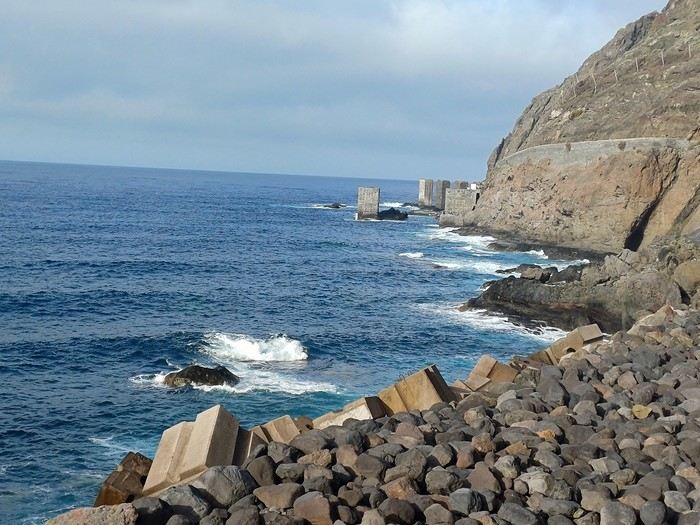
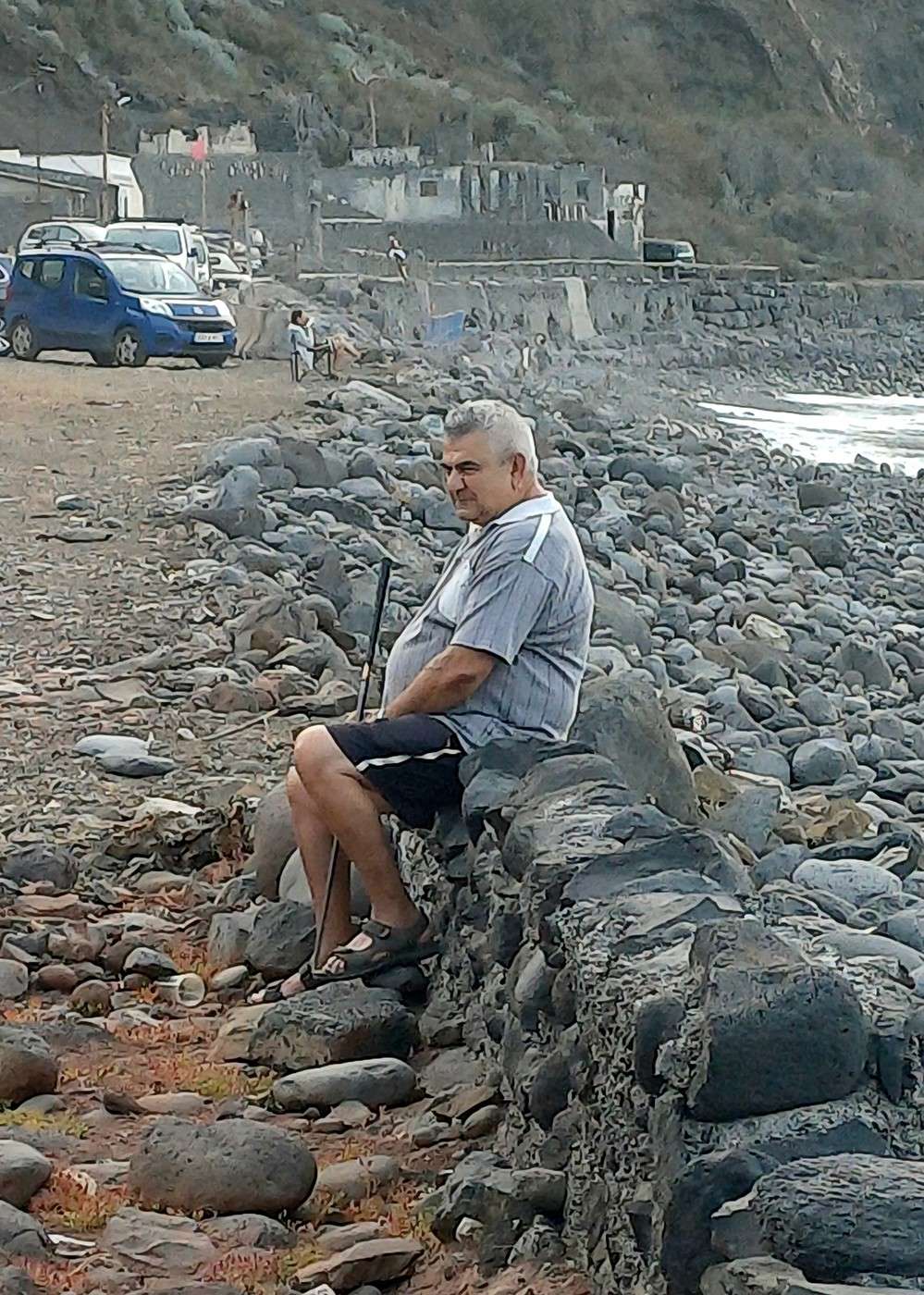
To wrap up the day, we hesitate between a few outings but opt for the closest: Hermigua Beach and its pier. A quick drive, and we’re there. More precisely, it’s Playa de Santa Catalina, protected by a small altar carved into the cliff facing the ocean. Hmm… this isn’t quite what we expected, and some online reviews confirm it: the seafront is lined with abandoned buildings, an empty municipal pool, and a small food truck along a dusty path. Behind the sea wall, there’s no real beach—just a pile of big rocks facing a rough ocean and a red flag made from what looks like an old T-shirt, planted there forever… It’s a far cry from Valle Gran Rey, and it’s definitely not for swimming. In the distance, we see more people near the old Hermigua pier.

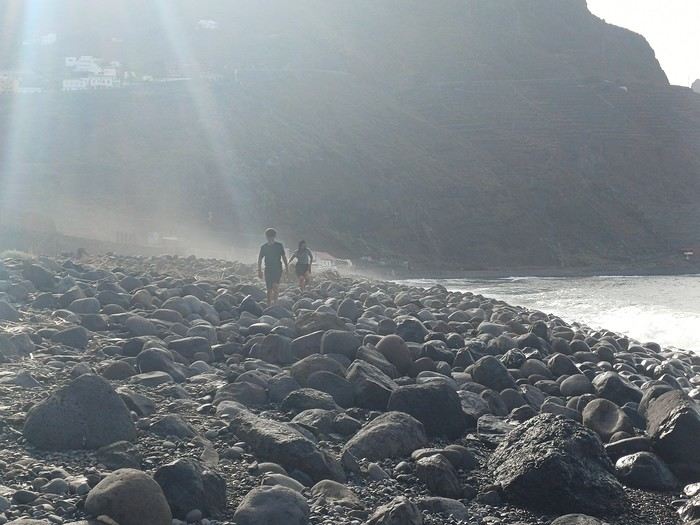
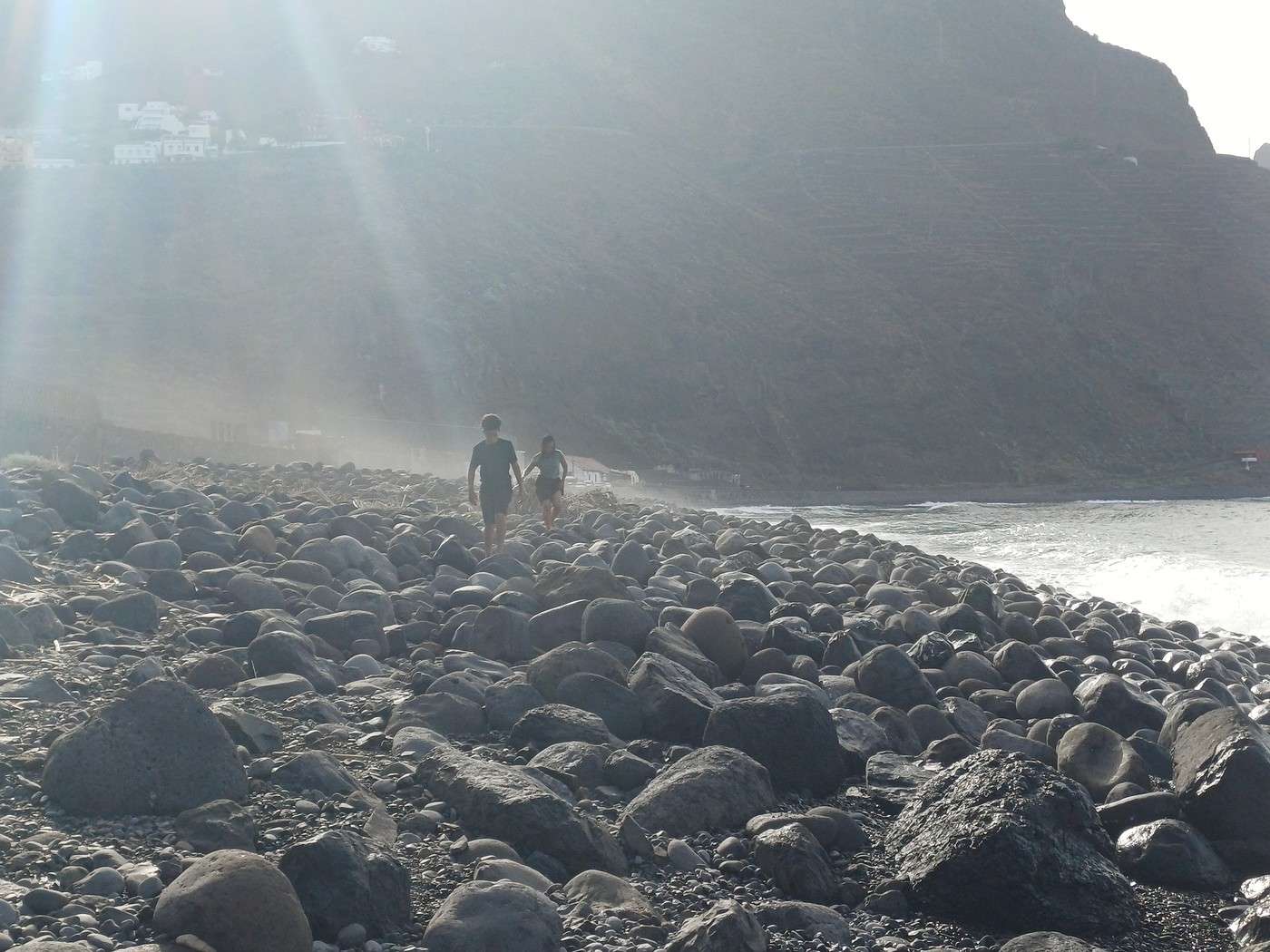
From where we are, we have to walk along the pebble and rock beach to avoid going all the way around. Powerful waves crash every five seconds, licking our feet and spraying us with mist that softens the cliffside landscape in the fading late-afternoon light.

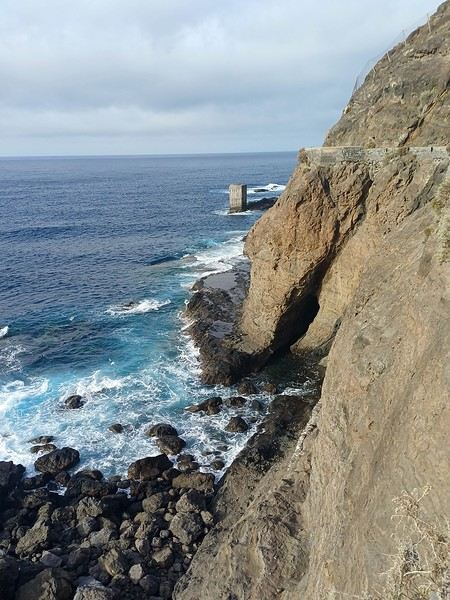
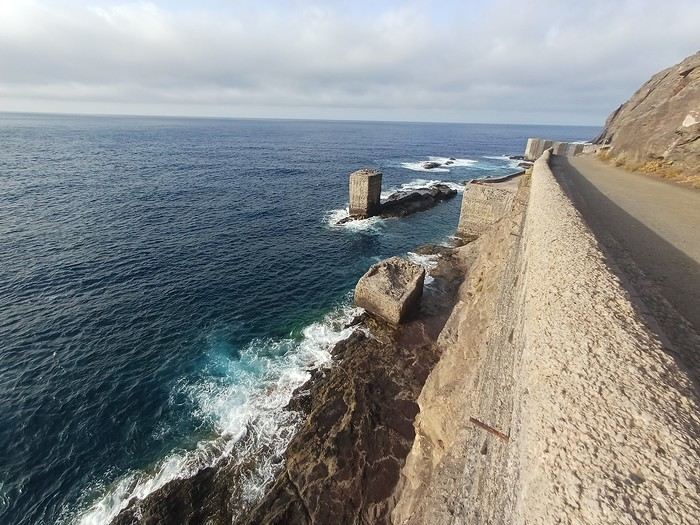
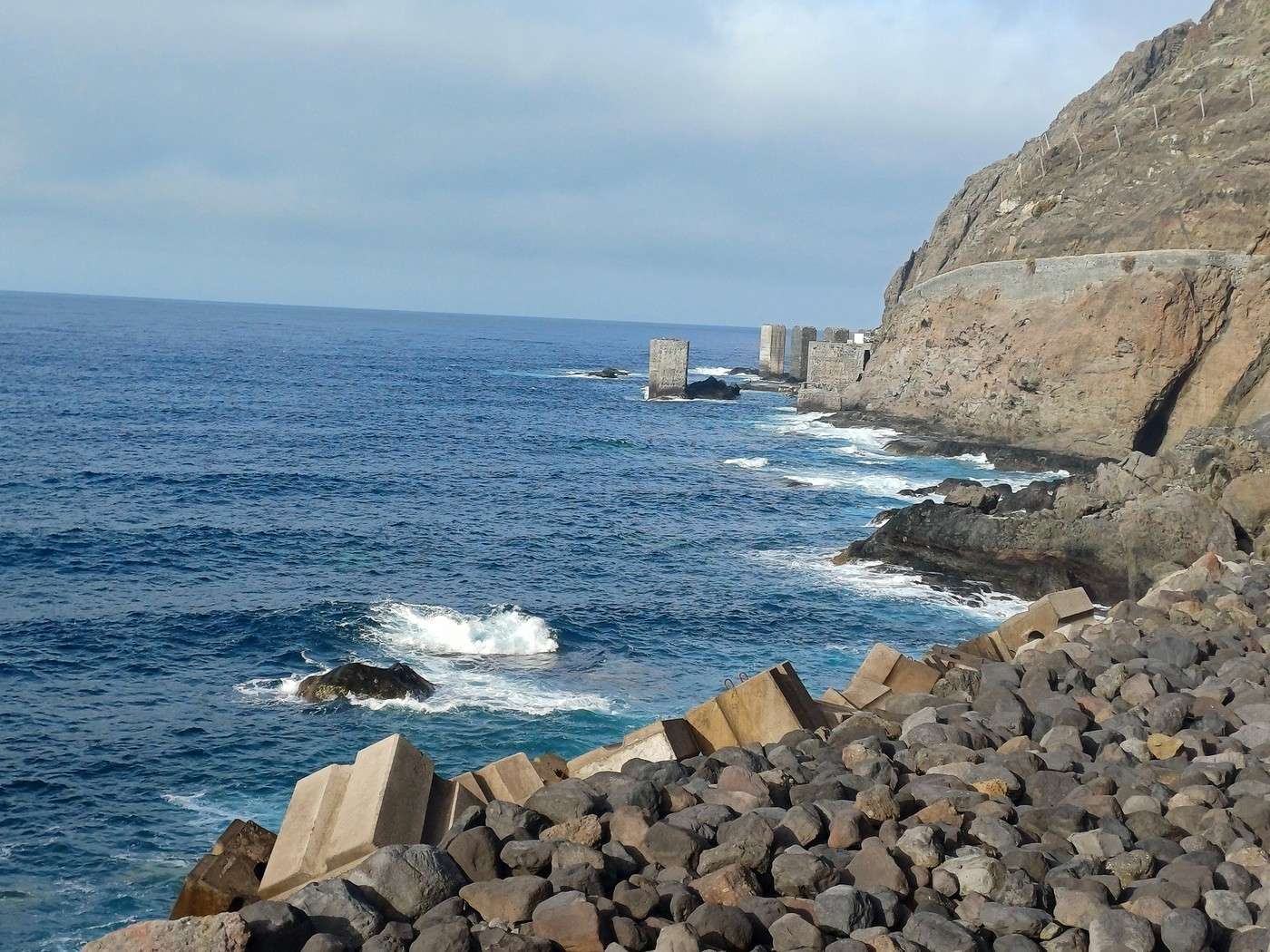
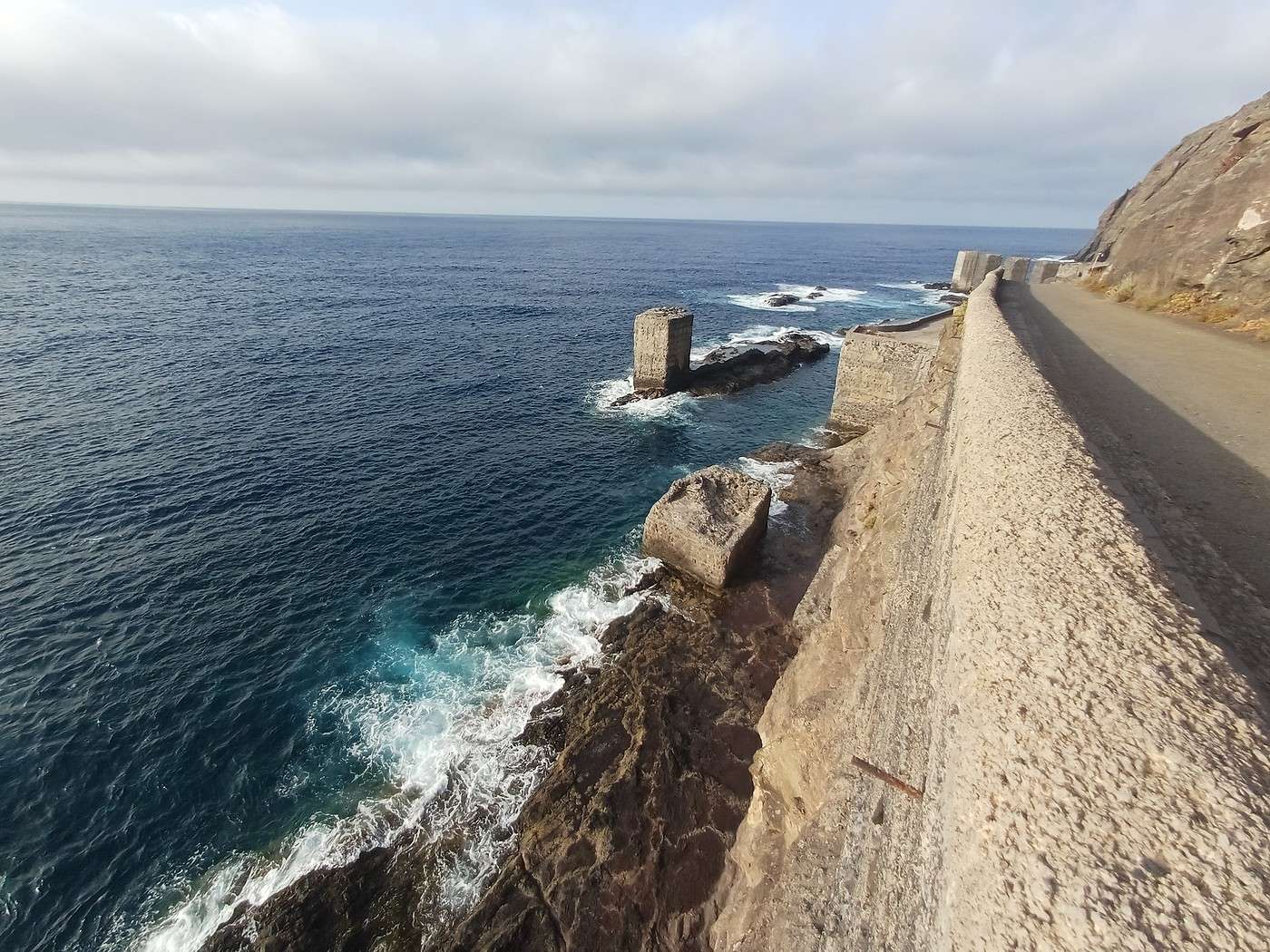
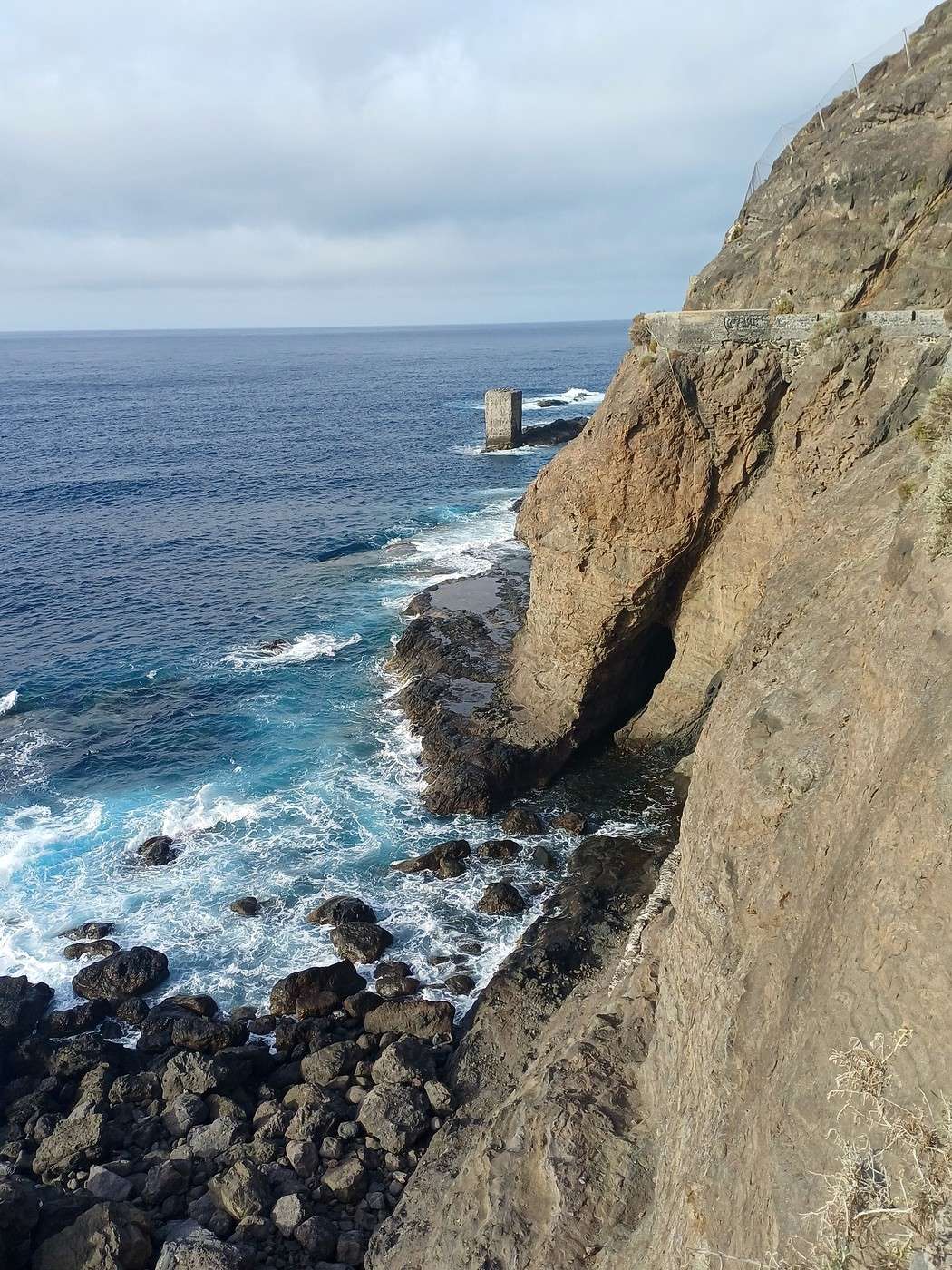
At the end, the pebble beach gives way to a path leading to the pier along the cliffs.


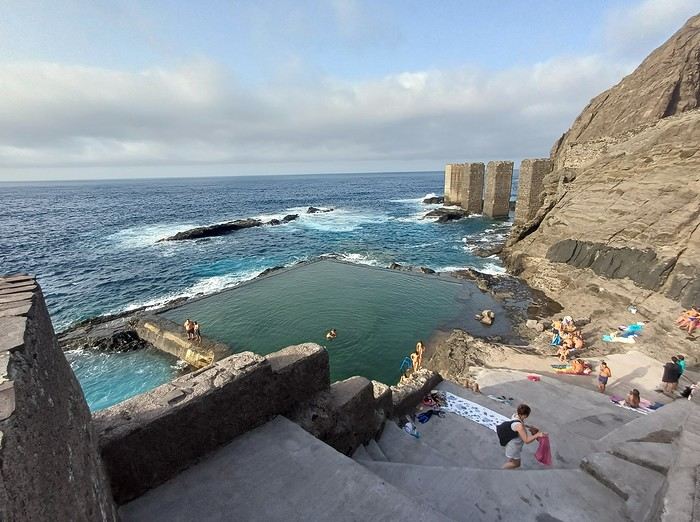
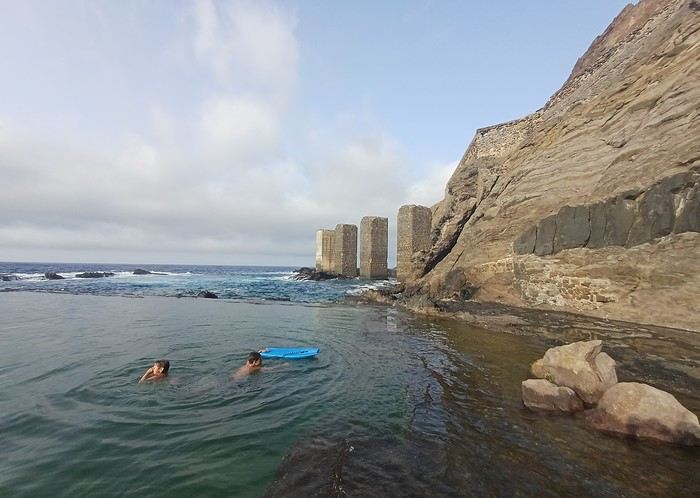
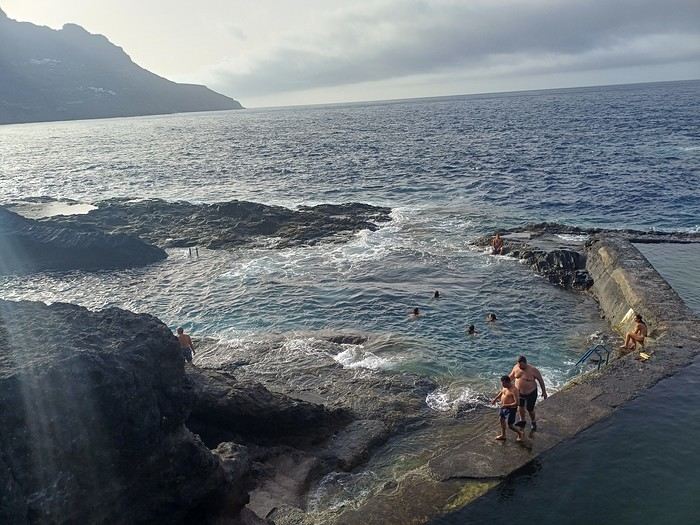
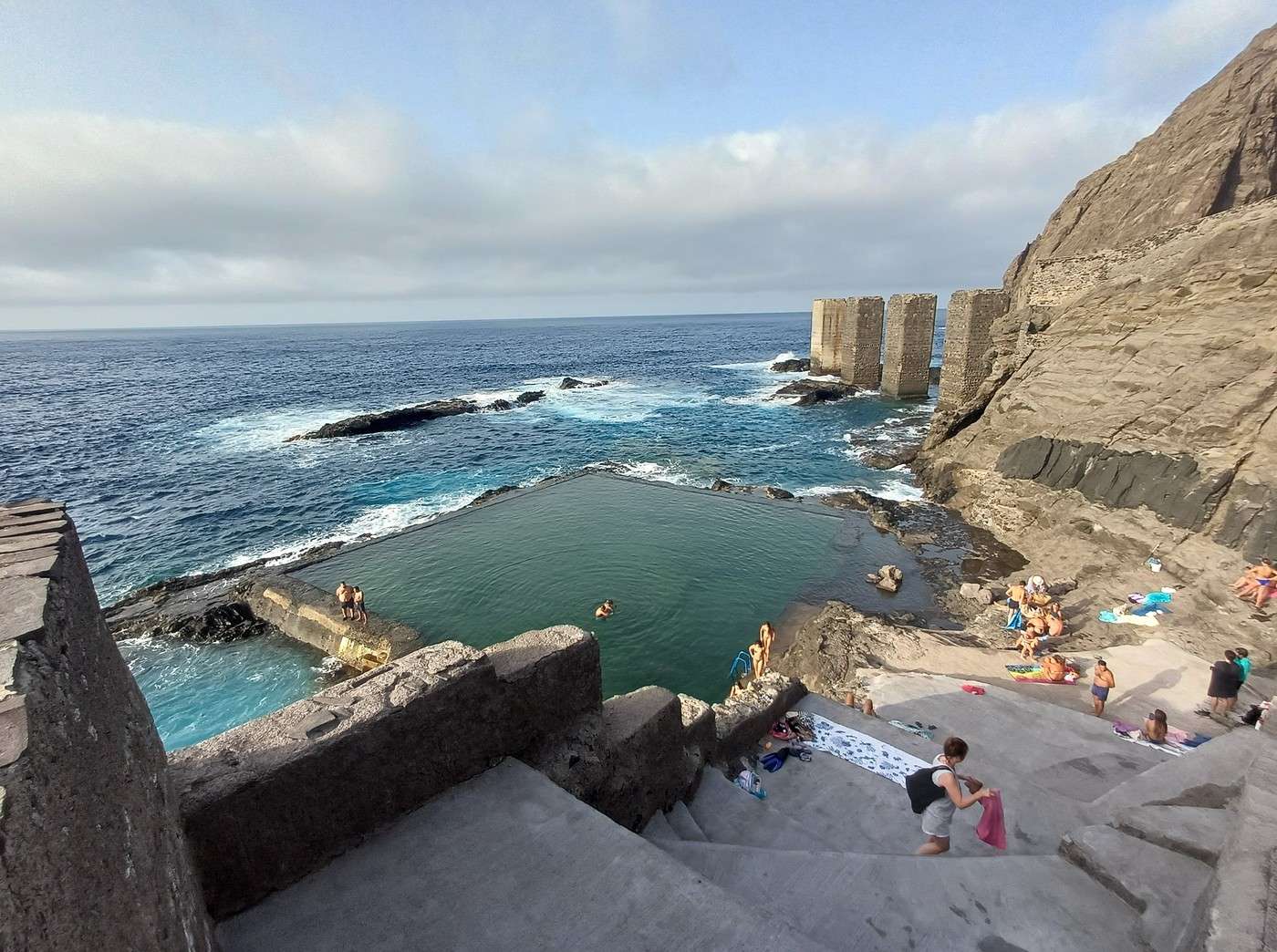
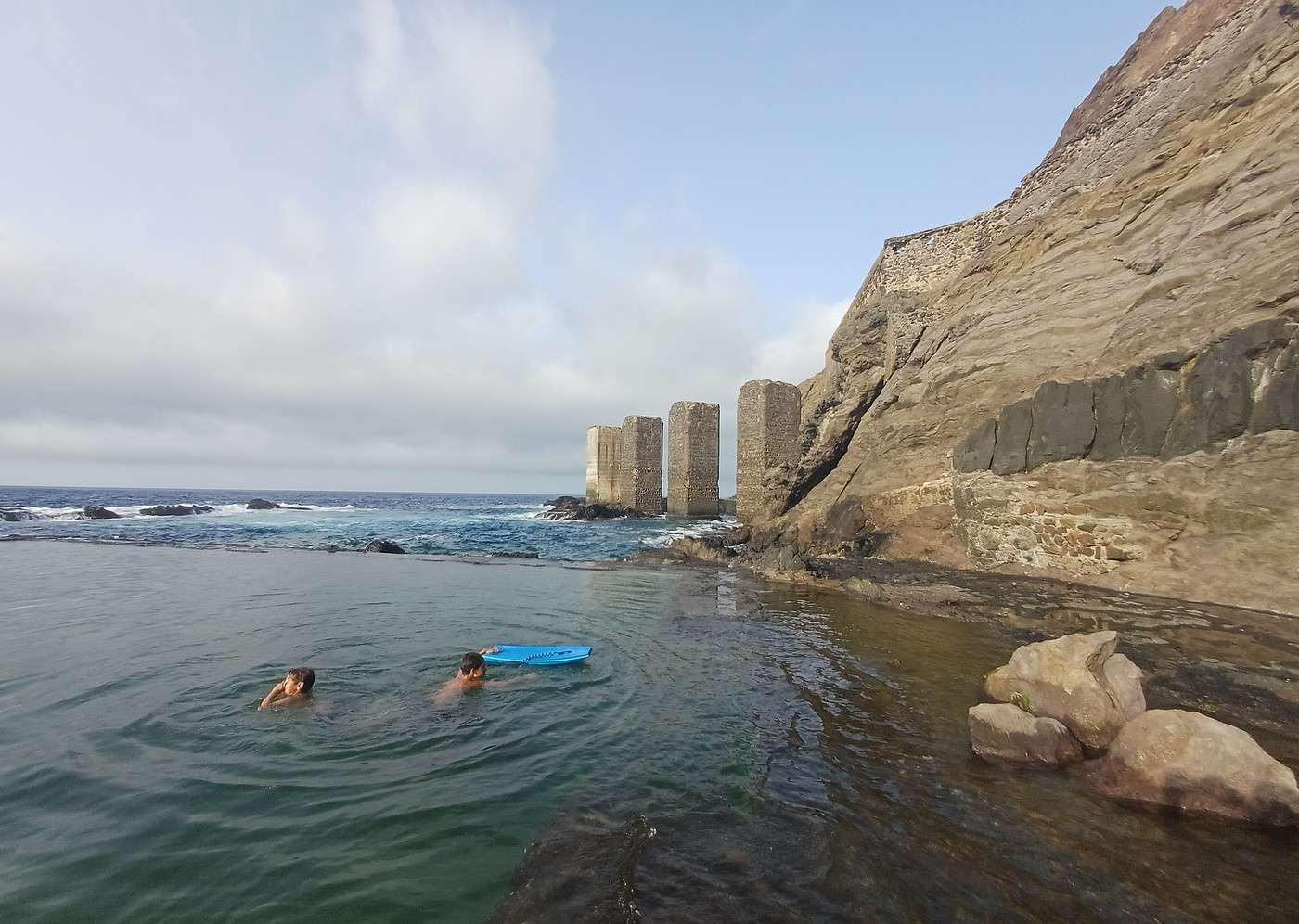
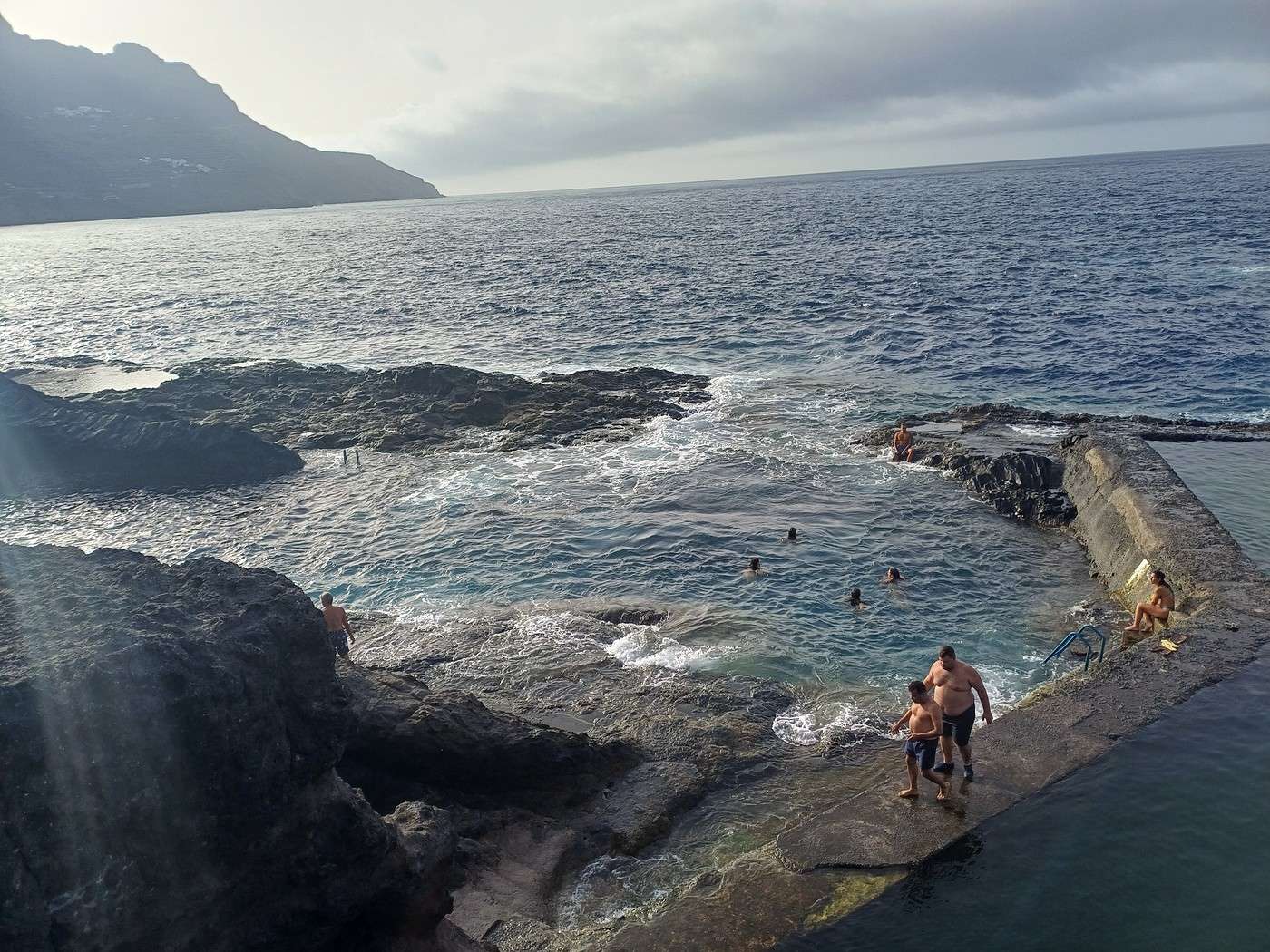
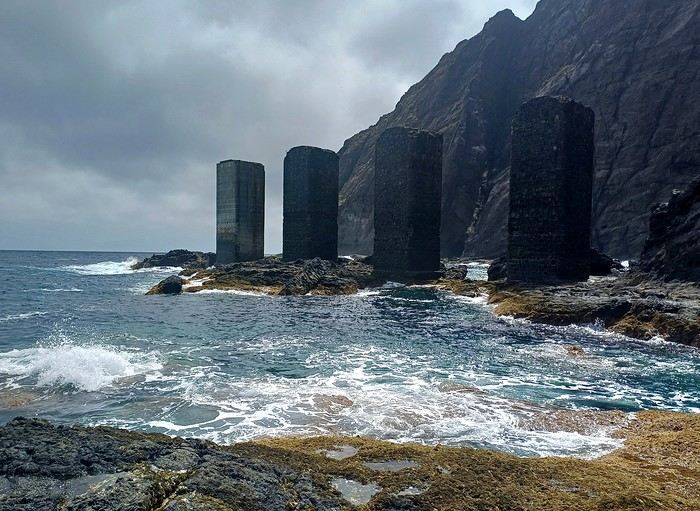
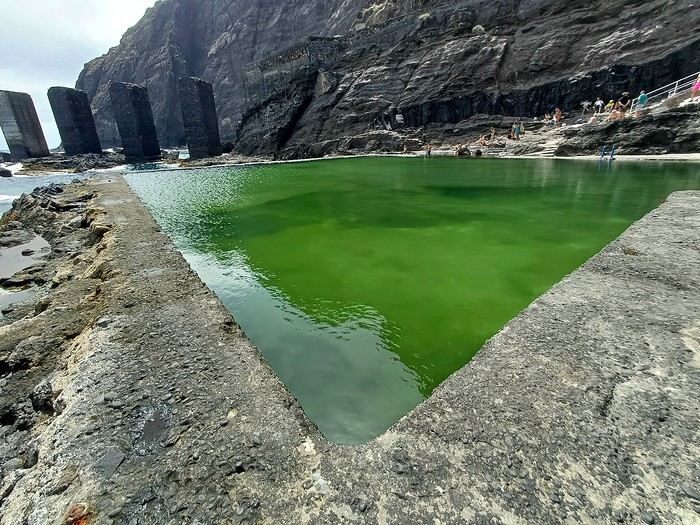
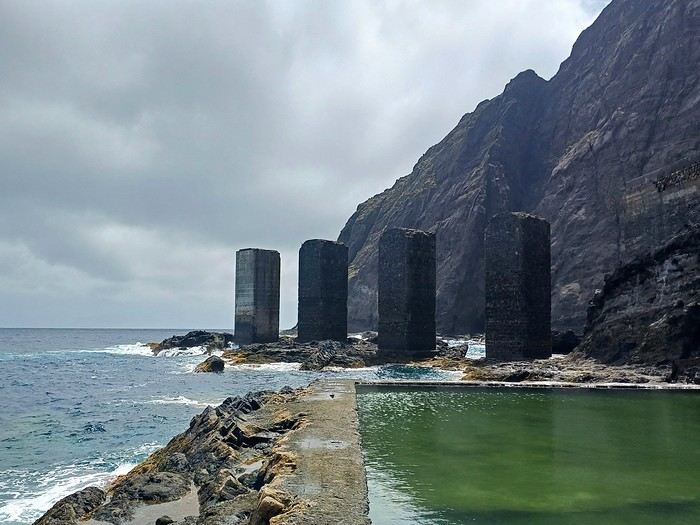
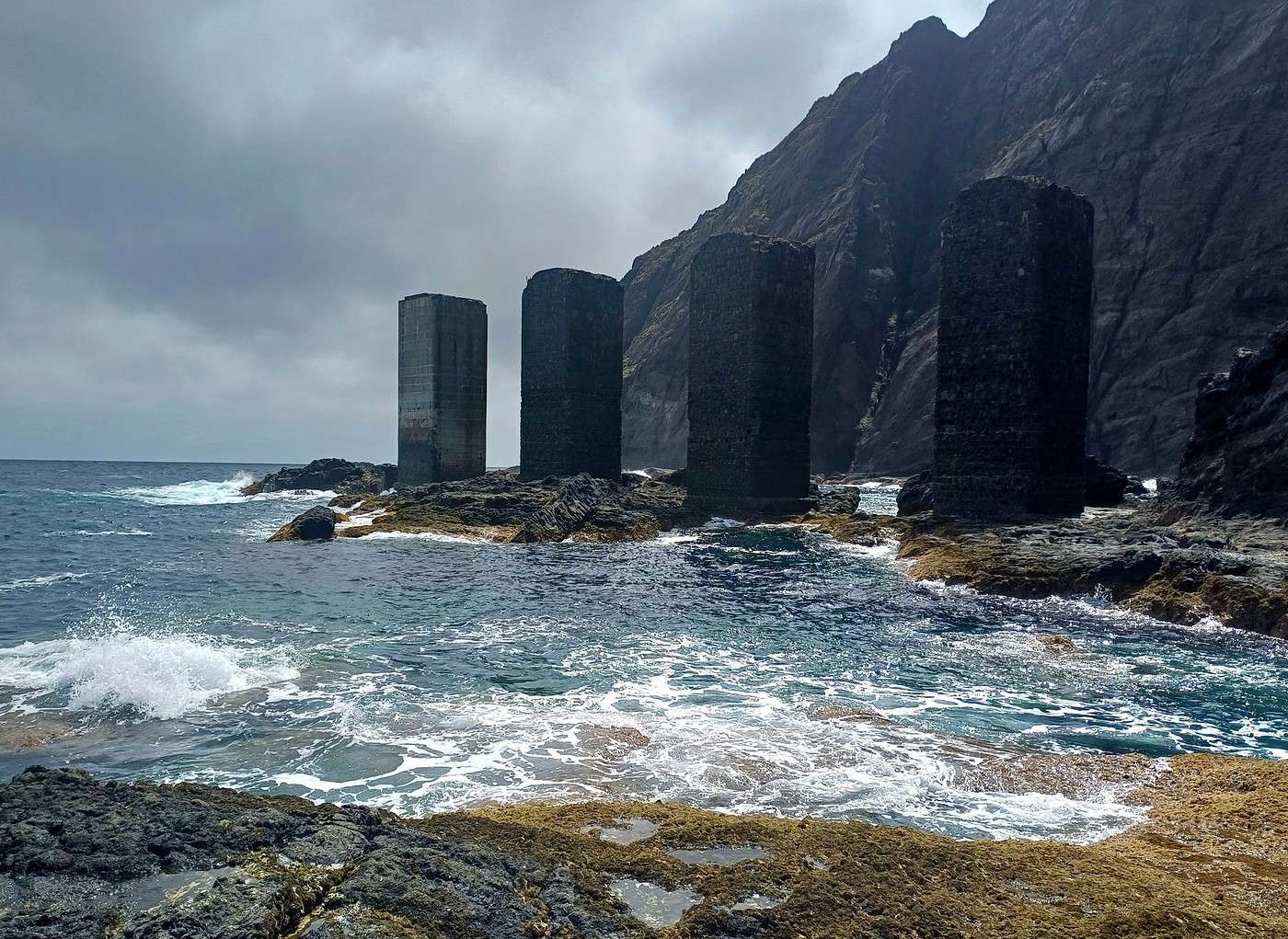
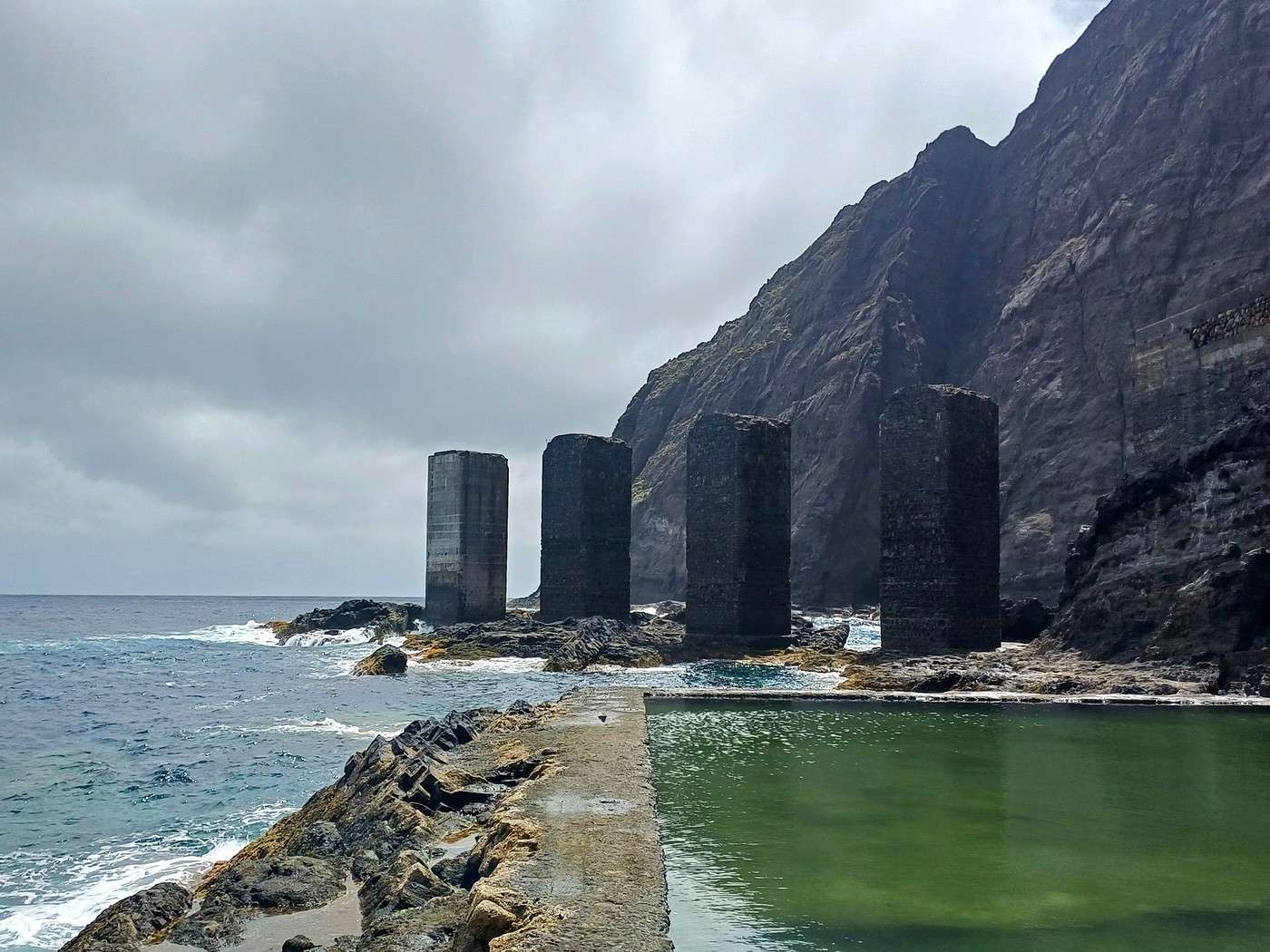
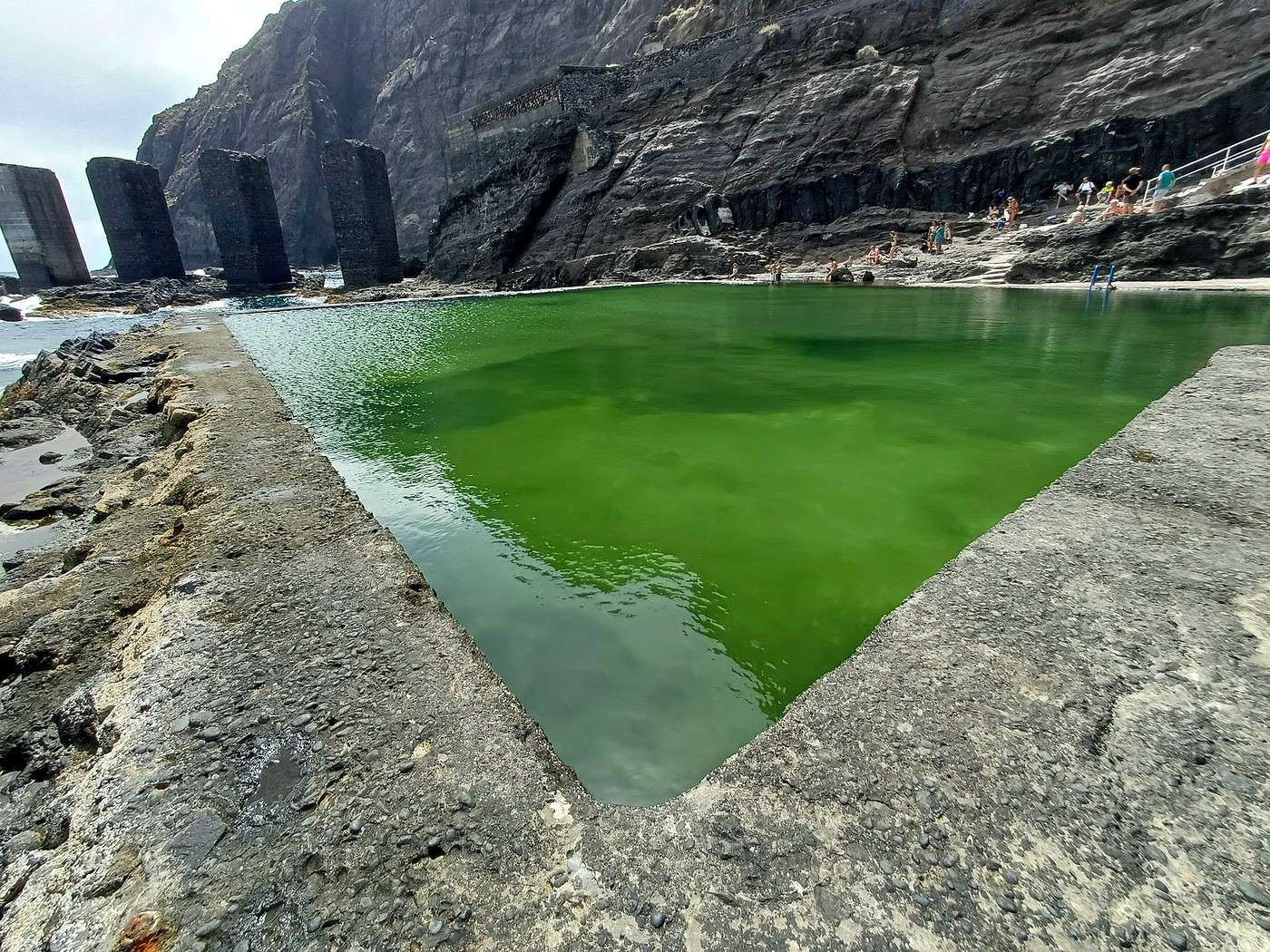
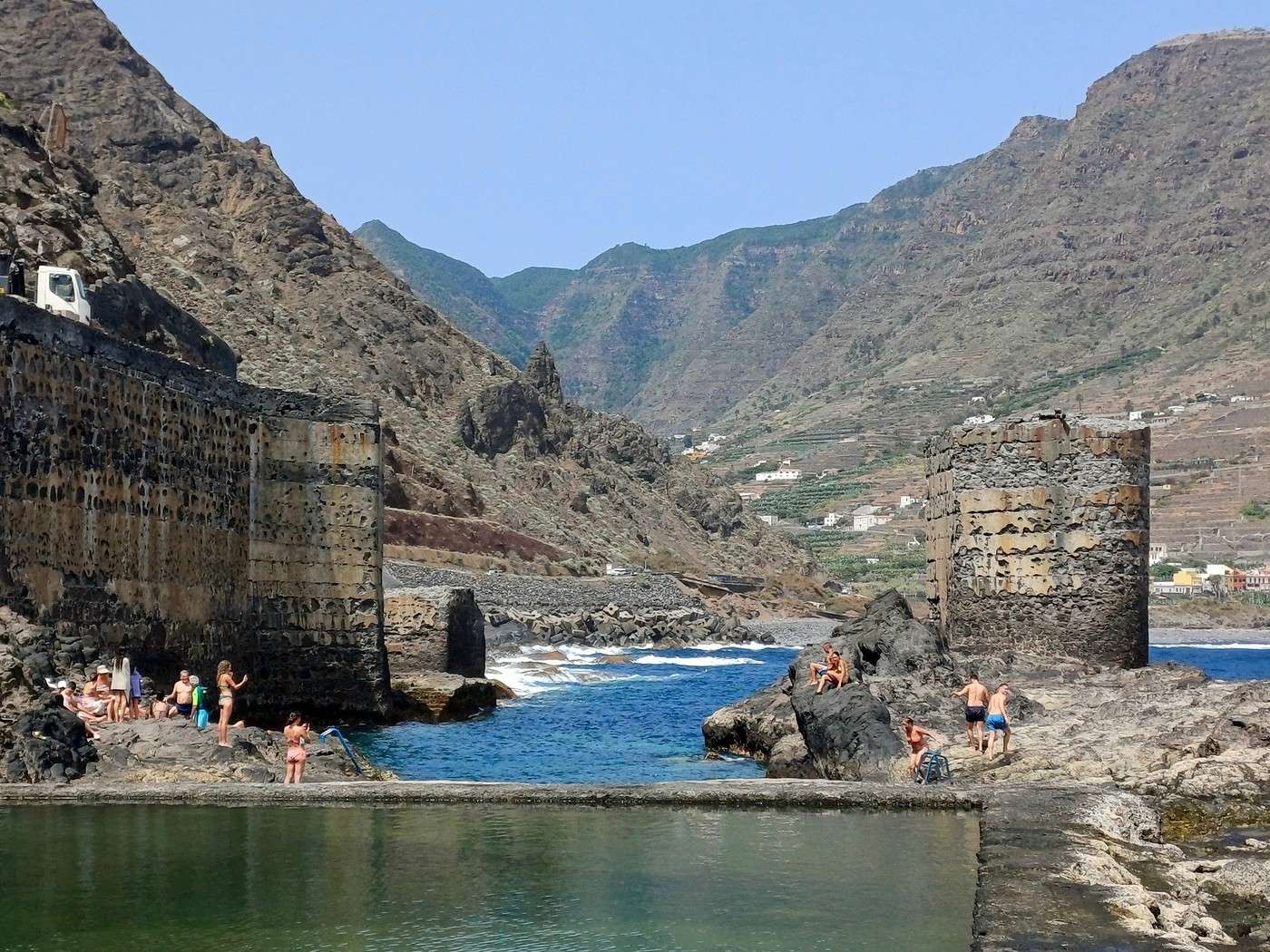
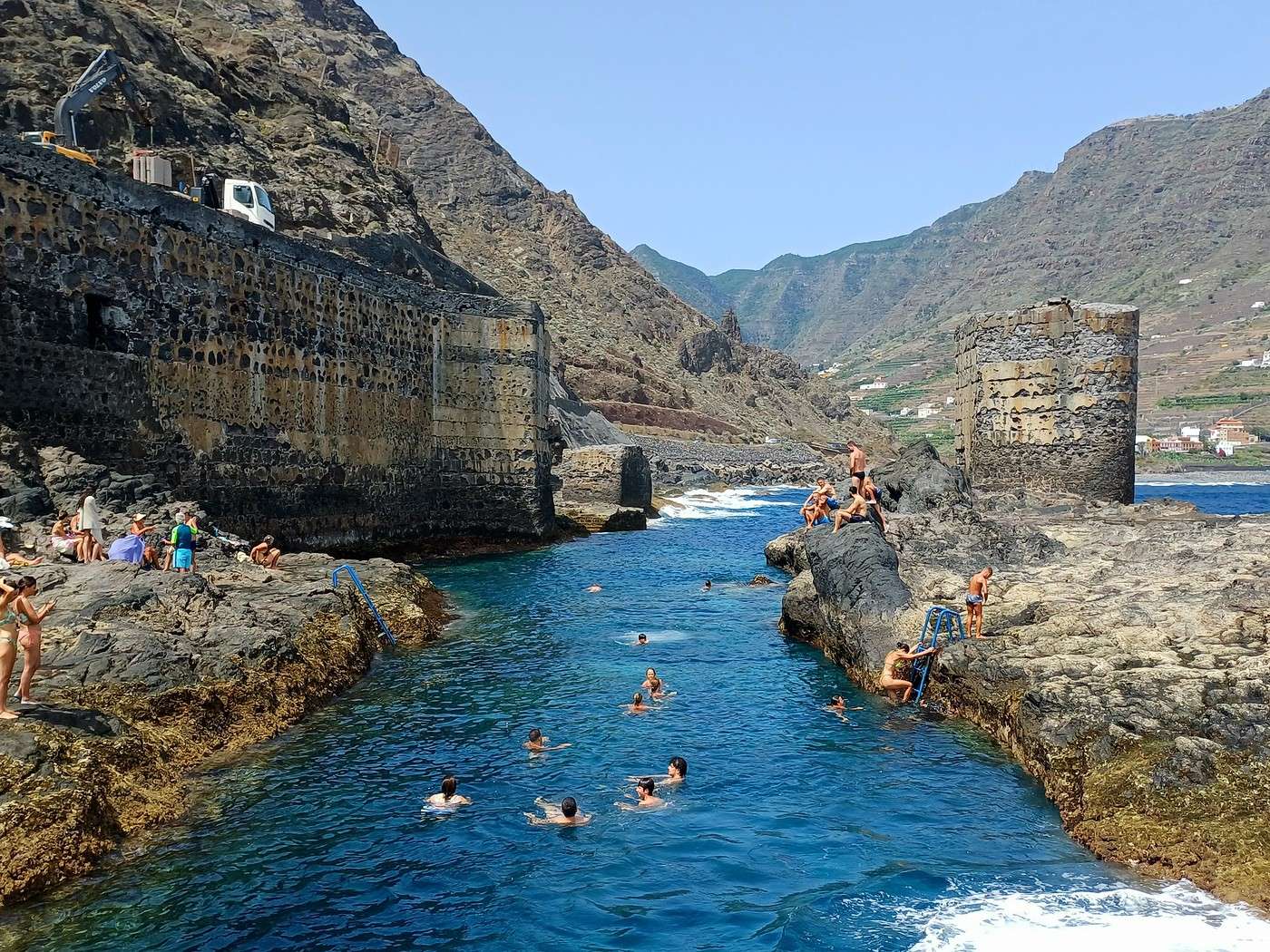
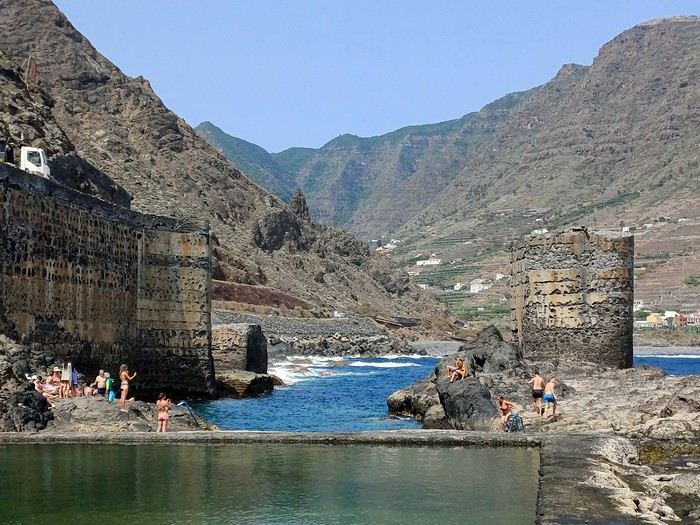
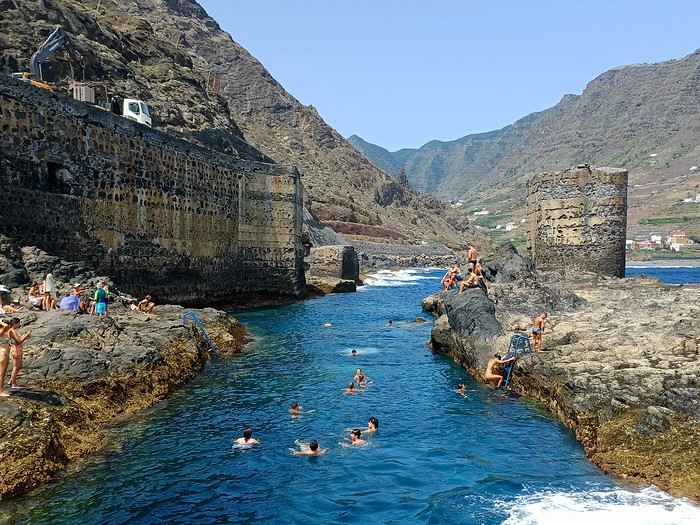
A large sign warns that the path is closed due to rockfall risks. Which makes sense, since small—and sometimes large—rocks have fallen onto the path despite the metal nets filled with debris covering the cliffs. And yet, workers are still there, working on safety improvements. Despite the warning and the obvious danger, we see people hurrying toward the ruins of the pier, while others are coming back. The site seems to attract quite a few visitors. As we get closer, we understand why. Swimmers are in the water among the half-submerged ruins of the pier, because it’s actually the famous natural pool of Hermigua! It’s amazing—we’ve never seen anything like it! In front of the four large pillars standing in the ocean, an old structure with only its foundation left has become a literal pool filled with seawater. Just a low wall separates it from another, wilder area between the rocks and old walls, forming a deeper, crystal-clear basin sheltered from the crazy currents raging just beyond.

This is nothing like the little Charco del Conde wading pool in Valle Gran Rey—this is what you’d call a real natural pool! Another sign warns against swimming due to dangerous currents, but the swimmers don’t care and seem to be having a blast. We regret not bringing our swimsuits because we’d love to join them. Well, the kids and I would—Magali isn’t at all reassured by the rockfall risks on the path above or the current dangers we’d read about, which led to the site’s closure even though it was allowed not long ago. But clearly, no one’s paying attention, and everyone’s swimming, sunbathing on a rocky corner, or diving carefree from the ledges by the wild basin. It doesn’t *seem* that dangerous. But since we didn’t plan to go for a dip tonight, we head back, trying to convince Magali to come back tomorrow morning. To which she replies, “Yeah, why not…,” without much enthusiasm. We return along the same wave-lapped path and are surprised to see surfers braving the choppy waters as the sun starts to set behind the cliff near the village of Agulo.

16 days with family in La Gomera (Canary Islands)

Pagaljavab · 2026-08-25 · Message 33 of 54

In the end, even though it’s not a swimming spot, this beach is lovely, and locals come here to find some peace.

The trip back up to our mountain retreat at Casa Yaya is quick, and we enjoy the view while preparing a tapas-style apéro dinner on our new terrace: squid in ink, cheese, chorizo, almogrote, and wine…

Higher up, we spot a small chapel in the middle of the *bancos* (terraced fields), clearly situated above the neighboring hamlet of El Estanquillo (and beyond which there seems to be nothing but the mountain ridge). Since we still have some energy and the cool air of Hermigua revives us after the heavy heat of Valle Gran Rey, we set off to see what’s up there for a post-dinner stroll. There’s not a single car on the winding road, and our only company is the croaking of frogs in the fields.

After about fifteen minutes of walking, we enter the nearly deserted hamlet—except for the lights in a few windows, a shy dog that starts following us, and, at the very top, a small belvedere square where a group of three retirees are chatting over Doradas. *"¡Hola, quieres una cerveza?"* they ask as we reach the top of our climb, pointing to the two large packs of beer on the bench. We politely decline. *"¡Para el niño!"* they joke. They’re really friendly, and we end up chatting with them for a bit. They ask where we’re staying, and we point down to our Casa Yaya, still visible despite the darkness. They explain that this is the end of the road and that from here, it turns into a short trail leading to a chapel. They gesture toward Hermigua below, where we can make out the decorated village square, a stage set up, and a few people. Perfect timing—tomorrow kicks off a traditional festival that’ll last a few days. We’d noticed it during our research and on posters when we arrived in Hermigua: it’s the feast of Santo Domingo de Guzmán, aka Saint Dominic, founder of the Dominican order. It’s one of the biggest events of the year in Hermigua, and we’re thrilled to have stumbled upon it by pure chance. It was a short but really pleasant moment, another example of the simple, genuine kindness of the Gomeros. We say our goodbyes—it’s time to head back down to the casa to recover from our packed day. A few soundchecks echo through the valley as they prepare for tomorrow’s festivities.

16 days with family in La Gomera (Canary Islands)

Pagaljavab · 2026-08-26 · Message 34 of 54

Day 9, Wednesday, August 5, Hermigua/El Corralete: Hermigua’s pier and natural pool, El Curato Park

First night at Casa Yaya, and what we love right away is the much cooler climate in Hermigua Valley compared to Valle Gran Rey, and the lush greenery—natural or agricultural—all around us, since this side of Garajonay is also more humid.

Since the majority rules, we’ll brave the double ban—rockfall risks and dangerous currents—to spend a great morning at the natural pool by the Hermigua fishing pier! On one side, the pool seemed well protected from the currents, and on the other, the cliff is covered with nets while road workers are busy smoothing out the dangerous spots. Then Magali whipped up some fluffy pancakes with gofio flour and palm honey to face any peril. We take the semi-circular road that passes by the house—we can go either way to head down to Hermigua. We realize it actually serves all the hamlets overlooking the village. It’s pretty narrow, and sometimes you have to reverse quite a bit when two cars meet.

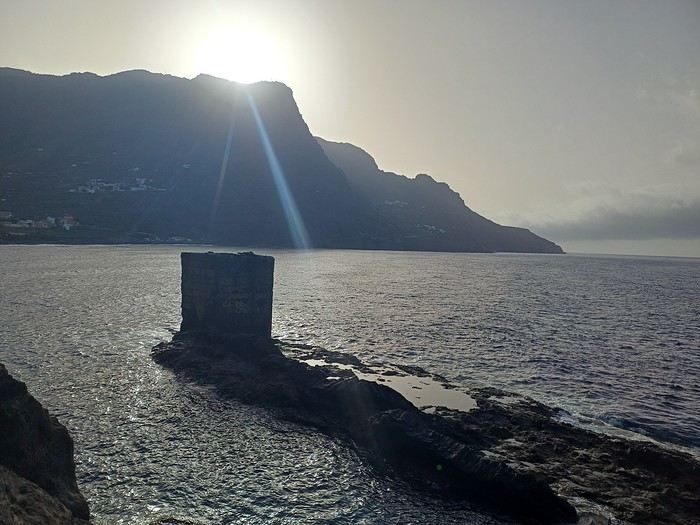
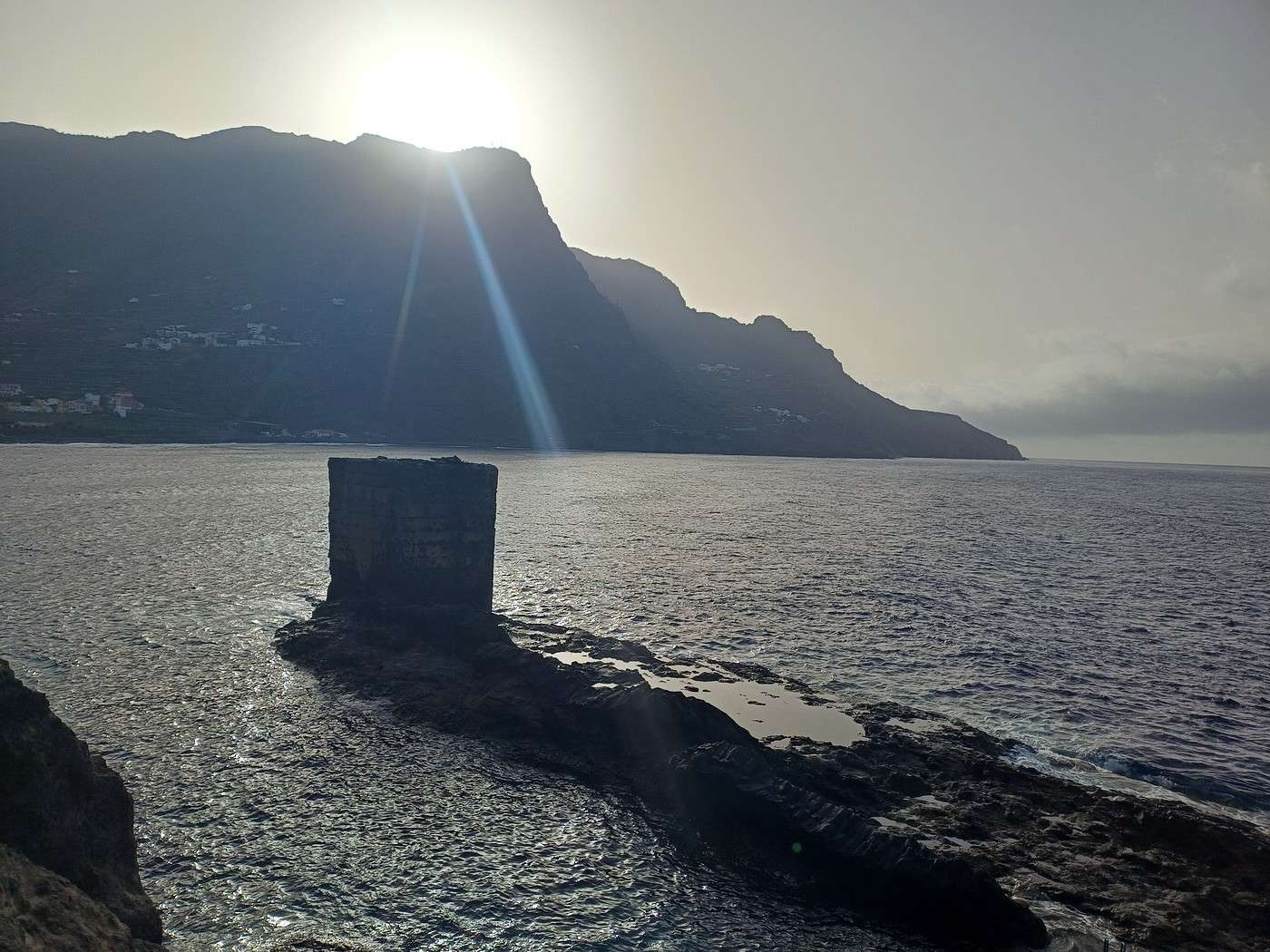
Here’s Santa Catalina Beach. This time, we don’t walk the pebble path and park the car like everyone else on the roadside, where it’s less than 500 meters to the natural pool. At the end of the pedestrian path stand the four pillars of the old pier, planted firmly in the ocean, unshaken. Built in 1907 and partly funded by Gomeran families returning from Cuba, where they’d migrated for better living conditions, it served as the island’s main port infrastructure for about forty years. This pescante (fishing pier) boosted transport and trade on La Gomera, making intra-island exchanges easier, since agricultural products used to be carried on foot along rough trails for miles—you really needed gofio for that! Its construction also paved the way for imports and exports, especially bananas. But it fell into disuse in the 1950s with the building of San Sebastián de La Gomera port and the road connecting the two towns. Still, these four pillars—once crane supports—are the only ones left standing on the island, unlike those in nearby Agulo and Vallehermoso, a testament to La Gomera’s early 20th-century development.

Since Spaniards aren’t early risers, there’s almost no one around at 10 AM except a chatty, friendly group of Italians (how’s that for a pleonasm?) and a handful of others. I notice the vibe here isn’t the hippie/nudist beach scene of Valle Gran Rey. Hermigua isn’t really a beach resort, despite its shores. We start with the semi-natural pool, the most accessible one—a basin formed by the old port’s quadrilateral structure, with greenish water. Like a real pool, there’s a ladder to get in. No waves here since they don’t reach the basin (at least not now), and adults can easily touch the bottom despite the rocky spots that sometimes form holes. You can swim peacefully with the fish and the idyllic ocean backdrop. Théo tests his armbands, though he’s still a bit scared and clings to us. It’s lovely, but encouraged by the swimmers nearby, Kelyandre and I want to step it up: the *real* natural pool, which looks way more fun! Just below the first basin, reefs and other remnants of the old port have formed a tiny cove with crystal-clear water about 3 meters deep. Here too, pool ladders are fixed to the rocks, though some folks skip the details and dive from low rocky ledges. The water’s perfect, and the ocean swell seeps in at regular intervals through a channel between two rocks, creating nice little waves. But watch out—sometimes the water’s force creates a washing-machine effect when it meets an opposing current from the cove’s entrance. No risk of being swept out to sea, though, at least not this season when the ocean’s calmest on the island’s north side. I almost wipe out joining this pool since the edges are slippery in spots. More fear than harm—I regain my balance just in time. Magali finally takes the plunge, and we take turns watching Théo, who’s found a little puddle near the first pool for his delight. A standout moment in this magical, unusual spot.
Back at Casa Yaya for a tapas lunch: squid in ink, mussels and fish in sauce, chorizo, Iberian mortadella, mojo. Then a failed siesta attempt, and we drive back down to Hermigua’s center to check out El Curato Park, a small park with a fountain, a few geese, and kids’ games. Théo has a blast, and despite the language barrier, Kelyandre finds a playmate around his age for a soccer game. I follow them to Hermigua’s pretty soccer field next to the park (which I later learned would host a Real Madrid summer camp a few days later) for some free kicks and penalties under the mid-afternoon sun. A few errands at the village Spar, and we’re tempted to visit the La Gomera Ethnographic Park-Museum right in Hermigua’s center. Unfortunately, it’s closed, so we’ll have to come back another day. Across the street, the village square is getting ready for the party, with a band doing soundchecks on a small outdoor stage facing neatly arranged chairs.

Another trip back home via the narrow road up to our place, where Magali sometimes has to maneuver when we meet other cars. To switch things up from tapas, I fall back into old habits and cook a pretty decent vegetable curry with whatever’s on hand. Down below, the music starts—time to party! We don’t go back down to Hermigua since, despite the three kilometers of road, we have a bird’s-eye view of the little square from our windows, and we can see what’s happening. The music—first a bal musette group, then a set of Canarian and Spanish dance songs—is so loud it echoes through all the hamlets perched in the valley, reaching our open windows like our neighbors are throwing a huge party. At night, we can see the lit-up square clearly from home. Doesn’t seem crowded, but the band’s playing like they’re in front of 10,000 people. The noise is real, but the Canarian music with its Iberian and Caribbean vibes has such a good energy that it eventually lulls us to sleep in the warm Gomeran night.

16 days with family in La Gomera (Canary Islands)

Kate · 2026-08-27 · Message 35 of 54

Hello 🙂 Here I am, a little late… I think there’s a real evolution in your photography—you’ve gained mastery while keeping your style. It’s such a pleasure to browse through this illustrated travel journal!

16 days with family in La Gomera (Canary Islands)

Pagaljavab · 2026-08-27 · Message 36 of 54

Thanks so much, Kate! I totally agree with you about the photos. When I look at my photos from several years ago, a lot of them are shockingly bad (terrible framing, wrong settings, no consideration of light, no knowledge of editing...). But there was still a unique way of photographing that I kept—I realize that now. I don’t know what it is, maybe just my perspective on things. The rest, it’s thanks to you, the experienced photographers, and your advice from the photo contest, which I learned a lot from—it was exactly the goal, after all!

16 days with family in La Gomera (Canary Islands)

Kate · 2026-08-27 · Message 37 of 54

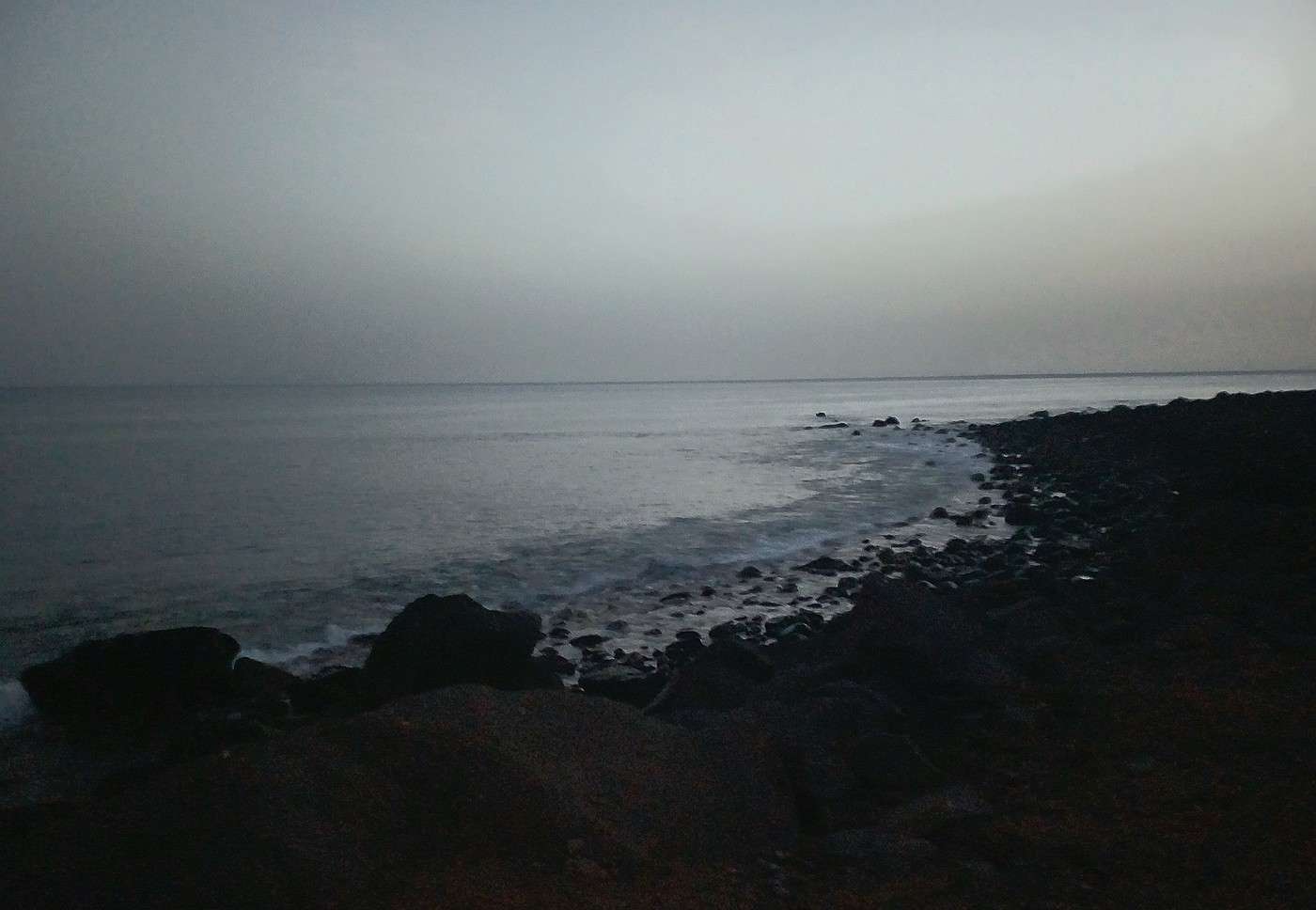
(Just a little aside: be careful with the horizon—it looks like you're trying to empty the sea 😛😉)

16 days with family in La Gomera (Canary Islands)

Muriel18 · 2026-08-28 · Message 38 of 54


For a moment, I thought I was in a remake of *2001: A Space Odyssey* 😏

16 days with family in La Gomera (Canary Islands)

Pagaljavab · 2026-08-28 · Message 39 of 54

Thanks for your comment! Before, I didn’t even pay attention to the horizon line, but now I do more often! I don’t want to get too deep into a photography discussion, but there are times when you have little room to step back and you want to highlight several elements in your frame that would get cut off if you didn’t tilt the horizon line. That’s the case with the photos you mentioned—if I straightened the horizon line, some small details I wanted to keep would be lost. And it gives an asymmetrical style in the end 😊

16 days with family in La Gomera (Canary Islands)

Pagaljavab · 2026-08-28 · Message 40 of 54

For a moment, I thought I was in a remake of *2001: A Space Odyssey*!


😂

VoyageForum — the largest community of French-speaking travellers.