Yet another travel journal in this (all-too-familiar) Rajasthan, but with family and kids
Day 3, July 26: Ahmedabad-Adalaj-Ahmedabad
"A little detour for exhilarating wanderings"
Wake-up, breakfast in the room just like the day before, and we get ready without dawdling too much because an intense day awaits us. The day before, just to get out of Ahmedabad a bit, I suggested to Magali that we take a trip to Adālaj ni Vāv, one of the remarkable bāolī of Gujarat, which I had also visited ten years earlier. The bāolī (vāv in Gujarati and Marathi) are these large Indian stepwells adorned like temples that served both practical and religious functions. It’s not the most impressive bāolī in Gujarat (the Rānī kī vāv in Patan, a bit further north, is on my list of the most beautiful things I’ve seen in India), but it’s remarkable and only about twenty kilometers from the center of Ahmedabad, which allows us to take our first trip into the Indian countryside without going too far. Magali, who doesn’t dislike Ahmedabad, isn’t absolutely smitten with the city—or maybe she’s just not yet accustomed to the joys of the hustle, pollution, and dirt of Indian metropolises. It’s also our last moment before taking the overnight train to Jaisalmer that same evening. We decide to walk to Laal Darwaza this time, as all roads seem to lead there, because I saw online that it’s from the bus station there that you can reach the village of Adalaj. We walk along Relief Road with its many clothing shops, restaurants, and all kinds of stores, still closed at this rather early hour. We make a quick stop along the way at a great lassi and juice stand, Masti Juice (Juice of Happiness), to enjoy the specialties and stock up on water in this muggy monsoon heat of Gujarat that makes us sweat a little. That said, we haven’t suffered too much from the heat since our arrival: the occasional rains cool the air a bit, the mornings are pleasant, and during the sunny spells, it’s hot but not unbearable.
We arrive at Laal Darwaza relatively quickly despite Théo, who often needs to be carried. He’s taken our warnings about the dangers of traffic and Indian sidewalks to heart and is very cautious amid the noise, though he’s usually so outgoing. He takes the opportunity to ask us to carry him more often than usual, citing fatigue. We know he’s exaggerating a bit, but it’s true that even if he walks, he’s only 2 years old and isn’t used to hiking so much, nor to this humid, heavy heat. We find the Laal Darwaza bus station and ask around to find the bus line(s) going to Adalaj. Several people—employees or just friendly passersby—help us out with great kindness and chat easily with us. We wait maybe half an hour before someone signals that a bus to Adalaj is pulling in. Everyone rushes toward the opening door, and we try our best not to get pushed aside, as is the tradition in India. We manage to find seats, the bus leaves, and we buy tickets from the conductor for a ridiculous sum, the equivalent of a few dozen cents. It’s our first public bus ride, and everyone appreciates the folklore of this old bus packed with colorful saris, immaculate white shirts and kurtās, and more...
I track our route by regularly checking my phone’s location on Google Maps and see that, heading north through the city, we’re indeed going in the right direction along the Sabarmati to Gandhi’s famous ashram (which we’ll never find time to visit), then past the Narendra Modi Stadium. Traffic is dense, but we gradually leave the city behind. Adalaj is halfway between Ahmedabad and its more modern satellite city, Gandhinagar, which is incidentally (and curiously) the capital of Gujarat. At one point, I notice the bus veering west, but since we’re not far from Adalaj, I think it’s a detour to the village of Shantigram and that it’ll head back east. But the road stretches on, and we keep moving northwest, getting farther and farther from our destination. I ask the driver if we’re really going to Adalaj’s stepwell. He seems a little embarrassed, nods vaguely without giving a clear answer—anyone who knows India knows that’s a bad sign! Then he finally tells me not to worry, that the bus isn’t going to Adalaj but will pass within 5 kilometers, and he’ll let us know when to get off to take another bus or a rickshaw. I catch a passenger telling him, “rather *pandrah kilometers*,” meaning 15 kilometers... I quickly check Google Maps, which confirms the passenger’s words and contradicts the conductor’s: if we keep going this way, geometry dictates it’s impossible to pass within 5 kilometers of Adalaj... or even 15... more like 20-25... I don’t know why everyone at the bus station told us this bus was going to Adalaj when it clearly isn’t, and I start wondering where the conductor will tell us to get off... Some passengers finally realize what’s happened and explain the confusion: the bus isn’t going to Adalaj but to... ADRAJ... which sounds almost the same! Several feelings wash over me, but though a little annoyed, I accept our fate. I tell myself that even when speaking Hindi and with helpful people, these kinds of mix-ups still happen when traveling in India... We continue our journey through fields and villages for what feels like an eternity, as I can’t help feeling we’re getting even farther away. But I never panic in these situations—it’s happened to me several times on India’s roads, and there’s always a solution. That’s why it’s an ideal country for wandering: you’re never truly lost, and these moments of aimlessness that invite letting go are, for me, part of the joy of travel. I explain to my crew that we need to keep things in perspective: we’re not that far from Adalaj, we’re on vacation to discover India, we have time, and taking a rickshaw through the Gujarati countryside will be even more fun. We finally arrive in a village called Vamaj, where the conductor tells us to get off and find a rickshaw.
The small village is at the crossroads of several roads, and there’s hardly anyone around—no crowd, barely a soul, and not even a place to grab a chāy or eat a samosā. We start wondering if we’ll find any way to leave this village. I ask just in case if there’s a bus to Adalaj, but no... The few travelers who got off with us all rush toward the few rickshaws there and leave without waiting, leaving us alone in this middle of nowhere. Kelyandre doesn’t quite share my mindset: his anxious nature doesn’t handle surprises well, and he seems to see the situation as a failure. I try to reassure him by reminding him that I know the country well and that these unexpected moments are often the most interesting parts of travel (which is true, since I’m the one saying it). We sell this little unplanned detour to the kids as a super attraction (which is also true), and we dive right in! We finally spot two rickshaws. One offers an outrageous price (for India) before lowering it to 500 rupees. Since I flat-out refuse because I know it’s way too much, even for “30 kilometers,” as he claims, they call over a colleague further away who, they say, will be cheaper. It’s an old man to whom I carefully emphasize the long and short “a” sounds, telling him we’re going to “ADAALAJ!” and not “AADRAJ!” We agree on 350 rupees. It’s certainly still above the usual price, but he’s the only one left in this deserted village, and we don’t want to linger here since we have a busy schedule. Plus, as Attila (the traveler, not the Hun emperor) would say, we’re not here to quibble over a few cents—it’s a fair price for us: it’s only 4 € to take four people 25 kilometers. And if we see it as an attraction (with air conditioning thanks to the wind), then it’s practically a steal! In the end, Magali and the kids, who love rickshaws, thoroughly enjoy this ride through villages and countryside. It’s even their most authentic experience of India since our arrival: cows, goats, and dogs on the road, rickshaws packed to the brim, overloaded motorcycles, decorated trucks with blaring horns, rural life scenes, and even urban ones as we pass through the crowded town of Kalol INA, an “industrial notified area.” It’s indeed a satellite industrial-urban area of Gandhinagar, and at times, we’re stuck in traffic. This proximity allows people to wave hello at us. Everyone’s delighted, and we even feel like the trip is really starting now. After about forty minutes, we finally arrive in Adalaj, where our very friendly driver finds the stepwell area, which I recognize immediately. A really nice experience in the end!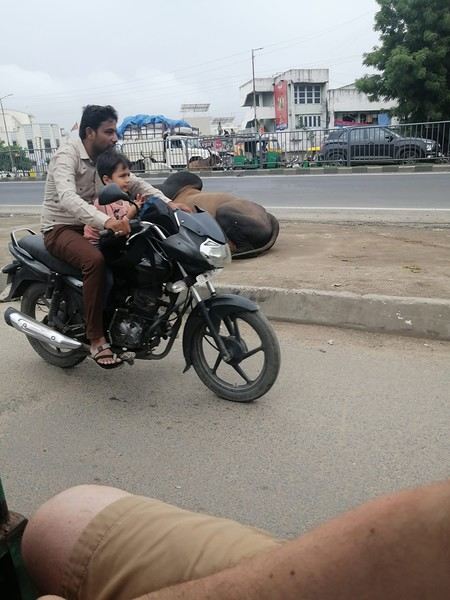 To recover from our emotions and since it’s almost lunchtime, we look for a place to grab at least some chaat (quick food), but there are only two small shops in front of the monument’s entrance, and we have to settle for chips, ice cream, and small Amul-brand lassi cartons—the indispensable national dairy brand, which, like Tata or Birla, was founded by wealthy Gujarati industrialist families who played a major role in helping Nehru develop the country after independence. These 20-rupee lassi cartons are filling and safe: a blessing for Théo, who loves them and won’t risk getting sick.
At the site’s entrance, we take a quick look at the small temple of the goddess Ambe Māta, then head to the ticket counter to buy our tickets (250 rupees for adult foreign visitors, free for kids). The Adalaj bāolī is one of those ornate stepwells typically found in western India, especially in the arid regions of Rajasthan or northern Gujarat, as they were used to store rainwater. This one was commissioned by a Hindu ruler in the late 15th century before a Muslim ruler, grandson of Sultan Ahmed Shah (founder of Ahmedabad, which logically means “Ahmed’s city”), invaded this neighboring kingdom. He married the defeated king’s daughter, who later allegedly committed suicide in the stepwell’s waters, according to legend... It’s absolutely stunning, with a distinctly Gujarati style blending Hindu, Jain, and Muslim influences.

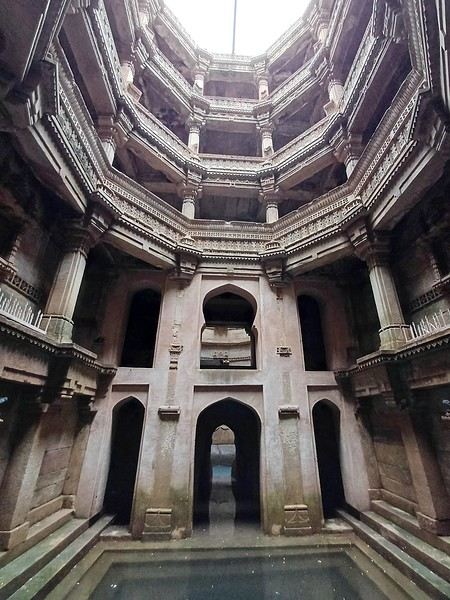
 These intricately carved pillars, like lace, form square lattice structures leading down to a large octagonal well accessible by steps.
 The murky waters and rays of light filtering through the top and cracks in the structure create a beautiful visual effect.
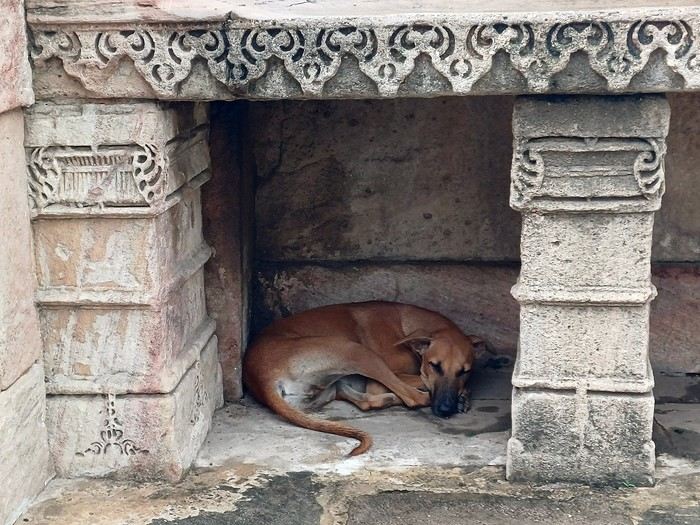
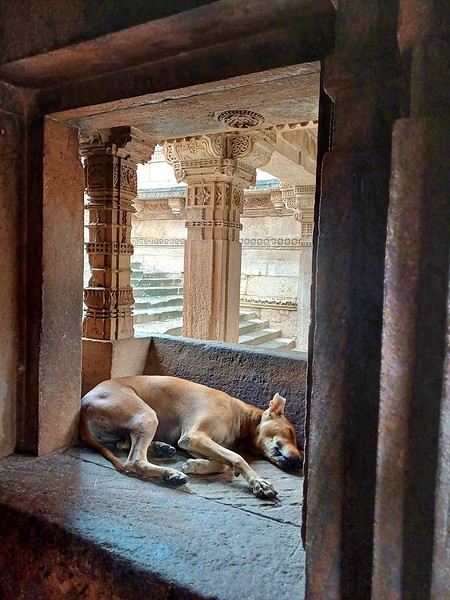
 Here and there, while exploring the nooks and crannies, I spot dogs curled up, asleep and undisturbed, in hidden corners of the monument or small alcoves sheltered from the sun and humans.
 You can even walk on the roof (carefully) for an overview and admire other beautiful decorations. It’s all the more pleasant because the area around the stepwell is quiet, with flower-lined paths and large grassy areas to stroll, where Théo can eagerly watch gilahari (those little Indian squirrels) and big lizards scurrying along the stone walls, as well as an impressive banyan tree.
 Plus, there aren’t too many people, which is nice. There’s a small group of Asian tourists, which makes us realize we haven’t seen (or hardly any) foreign tourists since arriving in Ahmedabad. We take advantage of the very clean restrooms (rare enough to mention) at the back of the site and the benches to rest a bit.
Then we head out, happy with this beautiful visit, in search of a real place to eat quickly, as we have our overnight train early in the evening. We find a tiny little eatery in the alleys near the site that looks promising. The friendly owners seat us at the side table of their narrow shop and serve us delicious samosās, kachaurīs (small fried stuffed pastries), and other spicy chaat for next to nothing. While we eat, some Banjārā girls (Indian gypsies) show up to buy food and try to beg from us. Théo can’t think of anything better than to want to play with them—just when we wanted to eat without being bothered! But the owner asks them to leave us alone. Once we finish our meal, we quickly look for a rickshaw and ask the driver to take us to the nearest bus stop. He’s a bit lost because he says there are stops everywhere... I remember that ten years ago, all we had to do was stand by the regional highway, the SH41, which borders the village, and wait for the first bus to Ahmedabad. He asks a colleague for help, who tells him to drop us off at a specific spot by the road where a direct line to Laal Darwaza passes. We arrive at the indicated spot: a chāy and snack stand that serves as a stop. The vendor and a few customers assure us we just need to watch for the red bus that’ll arrive in “ten minutes.” But time passes, and nothing happens. It becomes a game to watch every bus coming from afar... which quickly gets annoying because either they pass without stopping, or our fellow passengers dissuade us from boarding because they’re heading to Ahmedabad but not the old city... and anyway, our bus should arrive in “ten minutes.” After an hour of waiting for “ten minutes” while buses speed past us, we fend off rickshaw drivers offering to take us directly to Laal Darwaza for exorbitant sums, chat amiably with our new friends, down bottles of water, chāy for the parents, and weird sodas/chip bags for the kids (Nutri-Score Z, but no choice...), meet a sādhu who shows off his outfit to squeeze a little money out of us before leaving not too happy with 10 rupees. We finally convince our chāywālā friend that the bus won’t arrive in “ten minutes” and that we’ll take whichever one comes since they’re all going to Ahmedabad. An unassailable argument he eventually accepts. We’re not late yet, but we will be if we don’t take our fate into our own hands. We finally board a bus whose terminus is 4 kilometers further, at the Chandkheda bus station. And as soon as we get off the first bus, we hop onto a second one that leaves immediately for a northern neighborhood of Ahmedabad, where we arrive much faster than on the way there. We realize just how close Adalaj actually was to Ahmedabad! Before getting off at the new stop, the conductor explains that our ticket will still be valid on the next bus. I want to emphasize here that up to this point, people have been incredibly kind upon seeing this quirky French family exploring India. Then, after a short chat with a man under the bus shelter trying to sell us trinkets, he points us to a bus going to Laal Darwaza. In the nearly empty vehicle, we feel reassured and satisfied to be on the home stretch. In no time, we’re back along the Sabarmati, turning by the grand Siddi Saiyyed Mosque before arriving at Laal Darwaza. We take a rickshaw that drops us off at our hotel, where our faithful guard is still on duty: he rushes to accompany us into the old elevator. Between the mishaps on the way there and the three buses on the way back, we’ve definitely taken the scenic route, but it’s made for a rich day full of stories and images that’ll stay with us.
Time to shower one by one while we efficiently pack our suitcases, then we leave our room for check-out, give a small tip to the hotel guard and his two young helpers who’ve always assisted us, and load our suitcases into a rickshaw once more for the day’s final destination: Kalupur Station. We’re early enough to grab a bite to eat. We settle on Darshan, a small restaurant packed with travelers but air-conditioned, right next to the station, which has the advantage of serving almost all the North Indian, South Indian, and other Indo-modern classics you could want: everyone finds something they like. Théo is restless, probably on edge from this long day. Finally, we enter the huge station and head to the platform where our train, the Bandra Terminus Jaisalmer Superfast, arrives on time, once again announced by the two synthetic trumpet notes followed by the cheerfully robotic voice of Indian Railways’ virtual lady. We head to our 2AC compartment (for the uninitiated, a good air-conditioned class with 4 berths and no real separation from the corridor except curtains), which, though simple, pleasantly surprises Magali and Kelyandre with its quality. It cost us 1600 rupees per person, except for Théo, who rides for free. We stow our big suitcases under the seats and settle onto our benches. Delivery guys come and go, dropping off big bags for their clients, as apps now let you order meals on the train, at certain stations and times, from various restaurants: we wonder if that’s what we should’ve done. The train gradually fills up and leaves right on time at 7:30 PM. In a little over 14 hours, if all goes well, at an average speed of 50 km/h—which is “superfast” by Indian rail standards—we’ll be in Jaisalmer! Trains (like almost all services in India) are free for children under 5, as long as they sleep with one of the parents and don’t take up an extra berth. We share our compartment with a solitary, somewhat curious man in his sixties who’s come from Hyderabad to visit Jaisalmer, the train’s terminus. We chat with him a bit, but he seems quite reserved by nature. Despite my attempts to lighten the mood with comments like, “Ah, Hyderabad, the city of biryani!” he eventually retreats to his phone, where he listens to news from his region in Telugu at full volume. When we booked three berths in this four-berth compartment back in France, we wondered what kind of person would share the space with us. Now we know, and we’re not too bothered to have ended up with this curious and noisy co-traveler. But to our delight, a man sitting with his friend on the side benches across from us finally tells him firmly, “Uncle! Use headphones!” Our neighbor, who doesn’t have any, puts his phone away with a somewhat depressed look that makes me wonder: my imagination starts spinning stories about this strange but not unkind character’s life... My little family checks out the train’s restrooms, which they find less dirty than I’d warned them. The train gets a big thumbs-up from the crew! Then the blue-upholstered benches become berths, and we fall asleep pretty quickly, especially me, who so easily drifts off to the rocking of Indian trains. Goodbye, Ahmedabad and Gujarat—we’ll be back in just under three weeks! Now we can start dreaming of Rajasthan, of Jaisalmer and its desert fort, of camel caravans... zzzzzzzzzzzzzzzz...
Ratings Ahmedabad 😊😊 Laal Darwaza Bazaar 😊😊😊 Adalaj Stepwell 😊😊
Hotel Prime ⭐ Ambrosia Restaurant 😊😊😊 South Indian Restaurant 😊😊😊 Darshan Restaurant 😊 Overnight train Ahmedabad-Jaisalmer in 2AC class 😊😊😊
Wake-up, breakfast in the room just like the day before, and we get ready without dawdling too much because an intense day awaits us. The day before, just to get out of Ahmedabad a bit, I suggested to Magali that we take a trip to Adālaj ni Vāv, one of the remarkable bāolī of Gujarat, which I had also visited ten years earlier. The bāolī (vāv in Gujarati and Marathi) are these large Indian stepwells adorned like temples that served both practical and religious functions. It’s not the most impressive bāolī in Gujarat (the Rānī kī vāv in Patan, a bit further north, is on my list of the most beautiful things I’ve seen in India), but it’s remarkable and only about twenty kilometers from the center of Ahmedabad, which allows us to take our first trip into the Indian countryside without going too far. Magali, who doesn’t dislike Ahmedabad, isn’t absolutely smitten with the city—or maybe she’s just not yet accustomed to the joys of the hustle, pollution, and dirt of Indian metropolises. It’s also our last moment before taking the overnight train to Jaisalmer that same evening. We decide to walk to Laal Darwaza this time, as all roads seem to lead there, because I saw online that it’s from the bus station there that you can reach the village of Adalaj. We walk along Relief Road with its many clothing shops, restaurants, and all kinds of stores, still closed at this rather early hour. We make a quick stop along the way at a great lassi and juice stand, Masti Juice (Juice of Happiness), to enjoy the specialties and stock up on water in this muggy monsoon heat of Gujarat that makes us sweat a little. That said, we haven’t suffered too much from the heat since our arrival: the occasional rains cool the air a bit, the mornings are pleasant, and during the sunny spells, it’s hot but not unbearable.
We arrive at Laal Darwaza relatively quickly despite Théo, who often needs to be carried. He’s taken our warnings about the dangers of traffic and Indian sidewalks to heart and is very cautious amid the noise, though he’s usually so outgoing. He takes the opportunity to ask us to carry him more often than usual, citing fatigue. We know he’s exaggerating a bit, but it’s true that even if he walks, he’s only 2 years old and isn’t used to hiking so much, nor to this humid, heavy heat. We find the Laal Darwaza bus station and ask around to find the bus line(s) going to Adalaj. Several people—employees or just friendly passersby—help us out with great kindness and chat easily with us. We wait maybe half an hour before someone signals that a bus to Adalaj is pulling in. Everyone rushes toward the opening door, and we try our best not to get pushed aside, as is the tradition in India. We manage to find seats, the bus leaves, and we buy tickets from the conductor for a ridiculous sum, the equivalent of a few dozen cents. It’s our first public bus ride, and everyone appreciates the folklore of this old bus packed with colorful saris, immaculate white shirts and kurtās, and more...
I track our route by regularly checking my phone’s location on Google Maps and see that, heading north through the city, we’re indeed going in the right direction along the Sabarmati to Gandhi’s famous ashram (which we’ll never find time to visit), then past the Narendra Modi Stadium. Traffic is dense, but we gradually leave the city behind. Adalaj is halfway between Ahmedabad and its more modern satellite city, Gandhinagar, which is incidentally (and curiously) the capital of Gujarat. At one point, I notice the bus veering west, but since we’re not far from Adalaj, I think it’s a detour to the village of Shantigram and that it’ll head back east. But the road stretches on, and we keep moving northwest, getting farther and farther from our destination. I ask the driver if we’re really going to Adalaj’s stepwell. He seems a little embarrassed, nods vaguely without giving a clear answer—anyone who knows India knows that’s a bad sign! Then he finally tells me not to worry, that the bus isn’t going to Adalaj but will pass within 5 kilometers, and he’ll let us know when to get off to take another bus or a rickshaw. I catch a passenger telling him, “rather *pandrah kilometers*,” meaning 15 kilometers... I quickly check Google Maps, which confirms the passenger’s words and contradicts the conductor’s: if we keep going this way, geometry dictates it’s impossible to pass within 5 kilometers of Adalaj... or even 15... more like 20-25... I don’t know why everyone at the bus station told us this bus was going to Adalaj when it clearly isn’t, and I start wondering where the conductor will tell us to get off... Some passengers finally realize what’s happened and explain the confusion: the bus isn’t going to Adalaj but to... ADRAJ... which sounds almost the same! Several feelings wash over me, but though a little annoyed, I accept our fate. I tell myself that even when speaking Hindi and with helpful people, these kinds of mix-ups still happen when traveling in India... We continue our journey through fields and villages for what feels like an eternity, as I can’t help feeling we’re getting even farther away. But I never panic in these situations—it’s happened to me several times on India’s roads, and there’s always a solution. That’s why it’s an ideal country for wandering: you’re never truly lost, and these moments of aimlessness that invite letting go are, for me, part of the joy of travel. I explain to my crew that we need to keep things in perspective: we’re not that far from Adalaj, we’re on vacation to discover India, we have time, and taking a rickshaw through the Gujarati countryside will be even more fun. We finally arrive in a village called Vamaj, where the conductor tells us to get off and find a rickshaw.
The small village is at the crossroads of several roads, and there’s hardly anyone around—no crowd, barely a soul, and not even a place to grab a chāy or eat a samosā. We start wondering if we’ll find any way to leave this village. I ask just in case if there’s a bus to Adalaj, but no... The few travelers who got off with us all rush toward the few rickshaws there and leave without waiting, leaving us alone in this middle of nowhere. Kelyandre doesn’t quite share my mindset: his anxious nature doesn’t handle surprises well, and he seems to see the situation as a failure. I try to reassure him by reminding him that I know the country well and that these unexpected moments are often the most interesting parts of travel (which is true, since I’m the one saying it). We sell this little unplanned detour to the kids as a super attraction (which is also true), and we dive right in! We finally spot two rickshaws. One offers an outrageous price (for India) before lowering it to 500 rupees. Since I flat-out refuse because I know it’s way too much, even for “30 kilometers,” as he claims, they call over a colleague further away who, they say, will be cheaper. It’s an old man to whom I carefully emphasize the long and short “a” sounds, telling him we’re going to “ADAALAJ!” and not “AADRAJ!” We agree on 350 rupees. It’s certainly still above the usual price, but he’s the only one left in this deserted village, and we don’t want to linger here since we have a busy schedule. Plus, as Attila (the traveler, not the Hun emperor) would say, we’re not here to quibble over a few cents—it’s a fair price for us: it’s only 4 € to take four people 25 kilometers. And if we see it as an attraction (with air conditioning thanks to the wind), then it’s practically a steal! In the end, Magali and the kids, who love rickshaws, thoroughly enjoy this ride through villages and countryside. It’s even their most authentic experience of India since our arrival: cows, goats, and dogs on the road, rickshaws packed to the brim, overloaded motorcycles, decorated trucks with blaring horns, rural life scenes, and even urban ones as we pass through the crowded town of Kalol INA, an “industrial notified area.” It’s indeed a satellite industrial-urban area of Gandhinagar, and at times, we’re stuck in traffic. This proximity allows people to wave hello at us. Everyone’s delighted, and we even feel like the trip is really starting now. After about forty minutes, we finally arrive in Adalaj, where our very friendly driver finds the stepwell area, which I recognize immediately. A really nice experience in the end!
To recover from our emotions and since it’s almost lunchtime, we look for a place to grab at least some chaat (quick food), but there are only two small shops in front of the monument’s entrance, and we have to settle for chips, ice cream, and small Amul-brand lassi cartons—the indispensable national dairy brand, which, like Tata or Birla, was founded by wealthy Gujarati industrialist families who played a major role in helping Nehru develop the country after independence. These 20-rupee lassi cartons are filling and safe: a blessing for Théo, who loves them and won’t risk getting sick.
At the site’s entrance, we take a quick look at the small temple of the goddess Ambe Māta, then head to the ticket counter to buy our tickets (250 rupees for adult foreign visitors, free for kids). The Adalaj bāolī is one of those ornate stepwells typically found in western India, especially in the arid regions of Rajasthan or northern Gujarat, as they were used to store rainwater. This one was commissioned by a Hindu ruler in the late 15th century before a Muslim ruler, grandson of Sultan Ahmed Shah (founder of Ahmedabad, which logically means “Ahmed’s city”), invaded this neighboring kingdom. He married the defeated king’s daughter, who later allegedly committed suicide in the stepwell’s waters, according to legend... It’s absolutely stunning, with a distinctly Gujarati style blending Hindu, Jain, and Muslim influences.
These intricately carved pillars, like lace, form square lattice structures leading down to a large octagonal well accessible by steps.
The murky waters and rays of light filtering through the top and cracks in the structure create a beautiful visual effect.
Here and there, while exploring the nooks and crannies, I spot dogs curled up, asleep and undisturbed, in hidden corners of the monument or small alcoves sheltered from the sun and humans.
You can even walk on the roof (carefully) for an overview and admire other beautiful decorations. It’s all the more pleasant because the area around the stepwell is quiet, with flower-lined paths and large grassy areas to stroll, where Théo can eagerly watch gilahari (those little Indian squirrels) and big lizards scurrying along the stone walls, as well as an impressive banyan tree.
Plus, there aren’t too many people, which is nice. There’s a small group of Asian tourists, which makes us realize we haven’t seen (or hardly any) foreign tourists since arriving in Ahmedabad. We take advantage of the very clean restrooms (rare enough to mention) at the back of the site and the benches to rest a bit.Then we head out, happy with this beautiful visit, in search of a real place to eat quickly, as we have our overnight train early in the evening. We find a tiny little eatery in the alleys near the site that looks promising. The friendly owners seat us at the side table of their narrow shop and serve us delicious samosās, kachaurīs (small fried stuffed pastries), and other spicy chaat for next to nothing. While we eat, some Banjārā girls (Indian gypsies) show up to buy food and try to beg from us. Théo can’t think of anything better than to want to play with them—just when we wanted to eat without being bothered! But the owner asks them to leave us alone. Once we finish our meal, we quickly look for a rickshaw and ask the driver to take us to the nearest bus stop. He’s a bit lost because he says there are stops everywhere... I remember that ten years ago, all we had to do was stand by the regional highway, the SH41, which borders the village, and wait for the first bus to Ahmedabad. He asks a colleague for help, who tells him to drop us off at a specific spot by the road where a direct line to Laal Darwaza passes. We arrive at the indicated spot: a chāy and snack stand that serves as a stop. The vendor and a few customers assure us we just need to watch for the red bus that’ll arrive in “ten minutes.” But time passes, and nothing happens. It becomes a game to watch every bus coming from afar... which quickly gets annoying because either they pass without stopping, or our fellow passengers dissuade us from boarding because they’re heading to Ahmedabad but not the old city... and anyway, our bus should arrive in “ten minutes.” After an hour of waiting for “ten minutes” while buses speed past us, we fend off rickshaw drivers offering to take us directly to Laal Darwaza for exorbitant sums, chat amiably with our new friends, down bottles of water, chāy for the parents, and weird sodas/chip bags for the kids (Nutri-Score Z, but no choice...), meet a sādhu who shows off his outfit to squeeze a little money out of us before leaving not too happy with 10 rupees. We finally convince our chāywālā friend that the bus won’t arrive in “ten minutes” and that we’ll take whichever one comes since they’re all going to Ahmedabad. An unassailable argument he eventually accepts. We’re not late yet, but we will be if we don’t take our fate into our own hands. We finally board a bus whose terminus is 4 kilometers further, at the Chandkheda bus station. And as soon as we get off the first bus, we hop onto a second one that leaves immediately for a northern neighborhood of Ahmedabad, where we arrive much faster than on the way there. We realize just how close Adalaj actually was to Ahmedabad! Before getting off at the new stop, the conductor explains that our ticket will still be valid on the next bus. I want to emphasize here that up to this point, people have been incredibly kind upon seeing this quirky French family exploring India. Then, after a short chat with a man under the bus shelter trying to sell us trinkets, he points us to a bus going to Laal Darwaza. In the nearly empty vehicle, we feel reassured and satisfied to be on the home stretch.
In no time, we’re back along the Sabarmati, turning by the grand Siddi Saiyyed Mosque before arriving at Laal Darwaza. We take a rickshaw that drops us off at our hotel, where our faithful guard is still on duty: he rushes to accompany us into the old elevator. Between the mishaps on the way there and the three buses on the way back, we’ve definitely taken the scenic route, but it’s made for a rich day full of stories and images that’ll stay with us.Time to shower one by one while we efficiently pack our suitcases, then we leave our room for check-out, give a small tip to the hotel guard and his two young helpers who’ve always assisted us, and load our suitcases into a rickshaw once more for the day’s final destination: Kalupur Station. We’re early enough to grab a bite to eat. We settle on Darshan, a small restaurant packed with travelers but air-conditioned, right next to the station, which has the advantage of serving almost all the North Indian, South Indian, and other Indo-modern classics you could want: everyone finds something they like. Théo is restless, probably on edge from this long day. Finally, we enter the huge station and head to the platform where our train, the Bandra Terminus Jaisalmer Superfast, arrives on time, once again announced by the two synthetic trumpet notes followed by the cheerfully robotic voice of Indian Railways’ virtual lady. We head to our 2AC compartment (for the uninitiated, a good air-conditioned class with 4 berths and no real separation from the corridor except curtains), which, though simple, pleasantly surprises Magali and Kelyandre with its quality. It cost us 1600 rupees per person, except for Théo, who rides for free. We stow our big suitcases under the seats and settle onto our benches. Delivery guys come and go, dropping off big bags for their clients, as apps now let you order meals on the train, at certain stations and times, from various restaurants: we wonder if that’s what we should’ve done. The train gradually fills up and leaves right on time at 7:30 PM. In a little over 14 hours, if all goes well, at an average speed of 50 km/h—which is “superfast” by Indian rail standards—we’ll be in Jaisalmer! Trains (like almost all services in India) are free for children under 5, as long as they sleep with one of the parents and don’t take up an extra berth. We share our compartment with a solitary, somewhat curious man in his sixties who’s come from Hyderabad to visit Jaisalmer, the train’s terminus. We chat with him a bit, but he seems quite reserved by nature. Despite my attempts to lighten the mood with comments like, “Ah, Hyderabad, the city of biryani!” he eventually retreats to his phone, where he listens to news from his region in Telugu at full volume. When we booked three berths in this four-berth compartment back in France, we wondered what kind of person would share the space with us. Now we know, and we’re not too bothered to have ended up with this curious and noisy co-traveler. But to our delight, a man sitting with his friend on the side benches across from us finally tells him firmly, “Uncle! Use headphones!” Our neighbor, who doesn’t have any, puts his phone away with a somewhat depressed look that makes me wonder: my imagination starts spinning stories about this strange but not unkind character’s life... My little family checks out the train’s restrooms, which they find less dirty than I’d warned them. The train gets a big thumbs-up from the crew! Then the blue-upholstered benches become berths, and we fall asleep pretty quickly, especially me, who so easily drifts off to the rocking of Indian trains. Goodbye, Ahmedabad and Gujarat—we’ll be back in just under three weeks! Now we can start dreaming of Rajasthan, of Jaisalmer and its desert fort, of camel caravans... zzzzzzzzzzzzzzzz...
Ratings Ahmedabad 😊😊 Laal Darwaza Bazaar 😊😊😊 Adalaj Stepwell 😊😊
Hotel Prime ⭐ Ambrosia Restaurant 😊😊😊 South Indian Restaurant 😊😊😊 Darshan Restaurant 😊 Overnight train Ahmedabad-Jaisalmer in 2AC class 😊😊😊


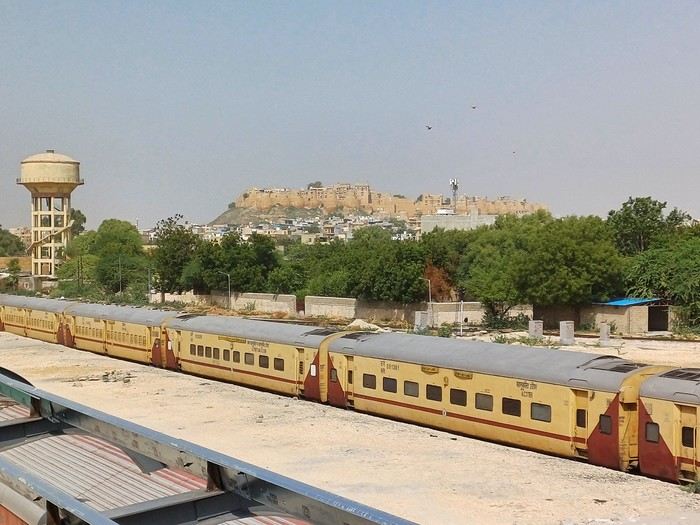
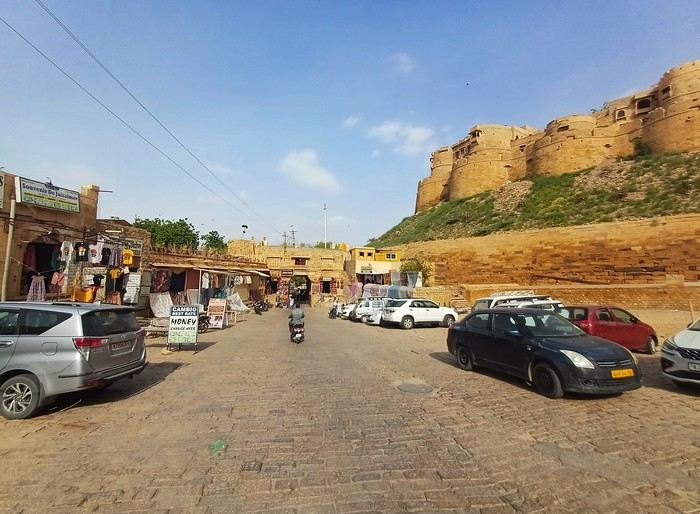 The atmosphere starts to change as we approach the fort, where tourist activity is concentrated, and we’re soon approached by touts. One of them, who heard us speaking, says: "I speak Fraaanch! I lived in Fraance, which city are you from?"... a line I’ve heard countless times from Rajasthani touts, often from gypsy and itinerant artist castes, who learn tourists’ languages to better hook them. Some of them have even actually lived in France for a few years, hosted by their French girlfriends while they’re married back home (true story). His jeans and plaid shirt don’t fool me: with his Rajasthani mustache and caste-specific jewelry, he’s a Bhopā—easy to imagine in a dhotī and turban, with his staff and goats grazing on the paths of the Thar. I try to make Magali understand that we should avoid engaging too much with his apparent friendliness and tempting references to France, because that’s the trap: he’s trying to create a connection so he won’t let us go so easily... And even though I have the experience to make it clear I don’t need his services, I know how time-consuming and draining it can be to shake them off! Sure enough, he sticks to us, offering a thousand services: tours of the fort and other city sites, restaurants, shops, etc... I tell him we haven’t planned any visits right away and don’t have time because we urgently need to exchange money, which is actually true since we’re running low. He fires back that he knows a clothing store at the fort’s entrance that exchanges money at a great rate because they take a very small commission. We don’t risk much by following him, and we’re free to refuse if it doesn’t suit us. Passing through the fort’s main gate, he introduces us to the owner of a small shop on the right. The rate is indeed very good: 1 € for 91 rupees, while the official rate is 92. Deal! We exchange a large sum that will last us almost the entire trip, and we take our time counting the bundles several times under the watchful eye of our desert gypsy, who observes the transaction from a distance. Everyone’s happy: we got a great exchange rate, and our sticky shadow, who won’t completely let us go, relaxes a bit because he earned a commission. He still offers to take us to see the gypsy women every Jaisalmer visitor has met, who sell jewelry and other tribal items further up the fort’s entrance. Again, we follow him because Magali isn’t against taking a look and bringing some back for herself and as gifts. I chat a bit with these Bhopā women, pastoral musicians of the Thar who, in the local caste system, traditionally serve the Rabārī camel herders (also called Rāīkā), for whom they play and sing the epic of the divine hero Pābūjī Rāṭhauḍ during performances that once lasted several days. I mention encounters with other bhopās I met during my previous stays in Rajasthan, whom they know well. Then Magali’s hair becomes the center of their attention: the mood turns friendly. Then we move on to negotiations, always under the sharp gaze of our companion, who tries to understand what we’re saying in French and intervenes somewhat authoritatively in mārwāṛī (the local dialect) to give them instructions. Clearly, they’re from the same family. Our new friends unsurprisingly quote outrageous prices for India, which we haggle over just as outrageously—a game that makes everyone laugh. Either way, we let them know we didn’t plan to buy anything today and that we’ll come back to visit the fort another time because we’re going to eat. Our buddy, of course, quickly suggests a restaurant near the fort, which we refuse because we’ve already spotted another one online that suits us, a bit away from the old city: the Green Park. He doesn’t give up and hails a rickshaw for us, giving the driver orders to take us to the Green Park as if he were the godfather of the fort’s touts, boasting that he negotiated the Indian price for us at 50 rupees—which, this time, isn’t far from the truth. He’s no longer too pushy about forcing other services on us: we’re tougher tourists than usual, and his commission has relaxed him a bit. Also, he doesn’t have time to waste and will move on to more innocent prey. He tells us to see him "next time."
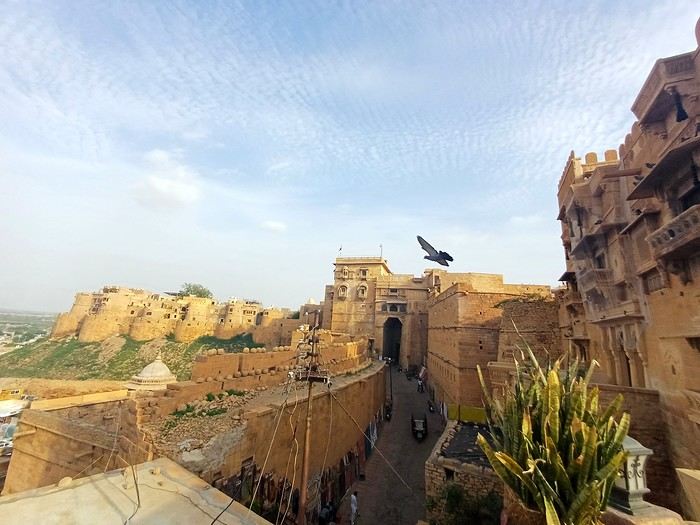 For today, we don’t want to visit the paid section and are content to explore the alleys at our own pace. Unlike its status as a living city, it feels more dead this afternoon: the interior is almost deserted, except for a few rare inhabitants and even rarer tourists we occasionally cross paths with—so much so that we wonder if we’ve stumbled upon a holiday or something. The fort is practically ours! We wander a bit through the alleys of beautiful houses, not all in good condition.
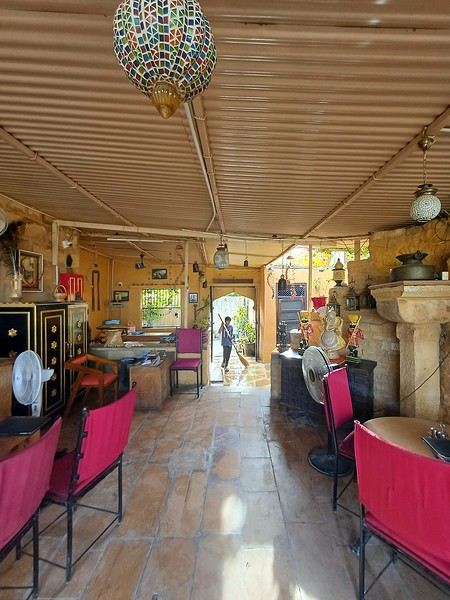
 We’re (finally) approached by a woman in a sari who invites us into her shop. Not to pressure us into buying, she promises, but because she wants to talk to us. We’re glad we did because her story is fascinating: she’s a very committed and locally well-known feminist. She fights for women’s rights in India—a task that takes a lot of courage here—and her shop sells only handicrafts made by women from the region’s villages. In excellent English, she tells us how, against the grain of society, she chose her husband and resisted her in-laws’ disdain. I smile inwardly when she suddenly interrupts her life story with feminist slogans, raising her voice and fist, before returning to a normal tone—as if she’s experiencing brief, uncontrollable personality splits! And since she practices what she preaches, we see her husband, quite subdued, enter the shop without a word with their little girl, whom he’s just picked up from school, while she shares her militant thoughts and explains her association’s principles. Totally unusual for India! She shows us some beautiful items in her shop—fabrics, jewelry, bags, and other trinkets—explaining their context without pushing us to buy, which we wouldn’t do anyway because they’re expensive... Later, checking Lonely Planet, I realize it’s the Bellissima boutique, well-known and praised for its initiative. Satisfied with this unique encounter, we say goodbye. In search of coolness, we continue to the nearby Desert Café, which makes a good impression with its décor blending Rājpūt and Art Deco styles favored by the Maharajas of the early 20th century—a bit cozy with a beautiful view of the city from its rampart terrace.
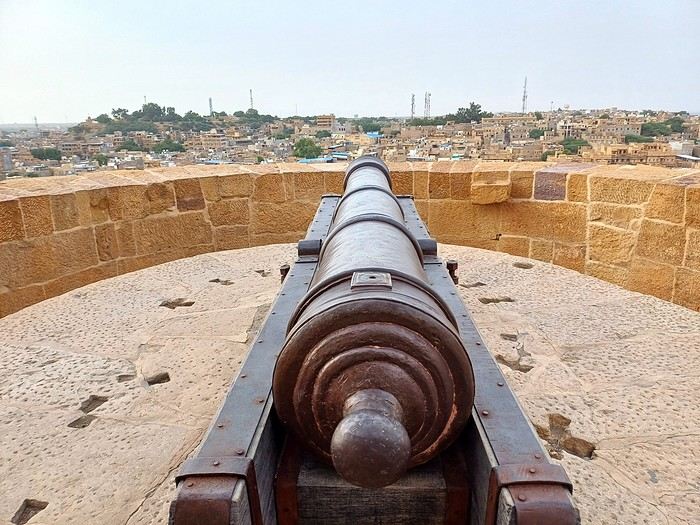
 Then we end up at Cannon Point, a stretch of ramparts accessible by a rather dangerous stone staircase, especially for kids. This place gets its name from the cannons, perfect for striking poses and pretending to fire through the battlements for the kids, or admiring the towers, the fort’s rooftops, and another beautiful view of the city’s west side as the sunset begins.
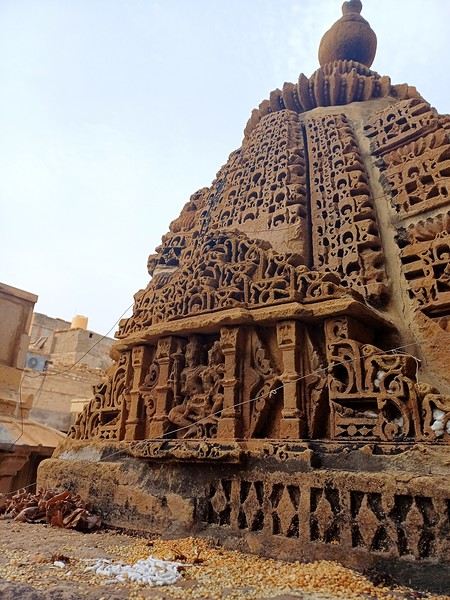
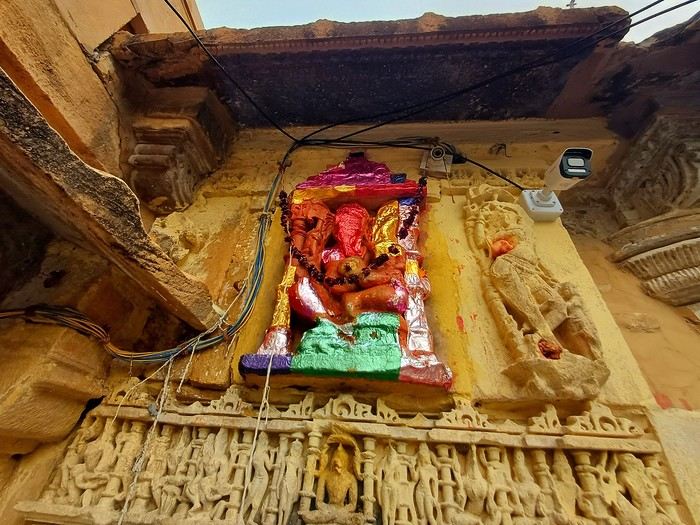
 On the way, near the exit, we visit Śrī Lakṣmī, goddess of wealth and First Lady of the great Viṣṇu, master of the cosmos’ construction—which is no small feat when you think about it. A few devotees perform their pūjā (ritual to the deity) at this crucial transition time between day and night, while kids play cricket, by far the nation’s most popular sport, in the adjacent street.
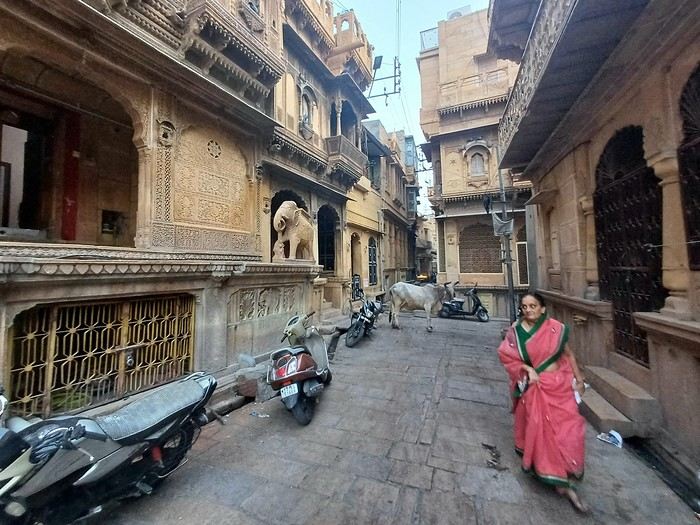 The last glimmers of daylight still illuminate the façade and finely carved windows of the five stories of Paṭwon kī havelī, which belonged to a family of wealthy and pious Jain merchants. Considered the most remarkable in Jaisalmer, it’s possible to visit its sumptuous interior, but not at this slightly late hour.
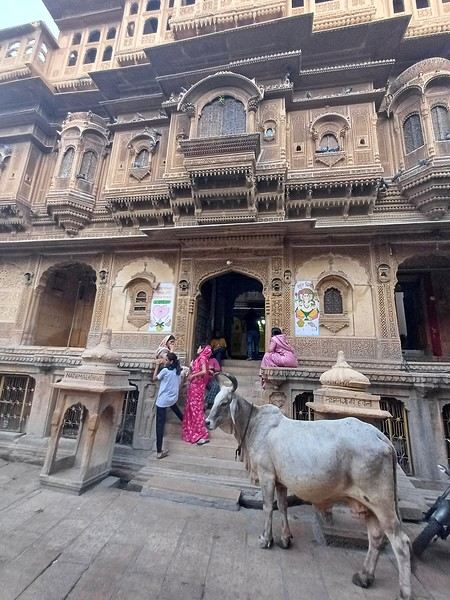 Since we won’t have time to come back, we admire its façade and meet a neighboring owner who comes to greet us: he owns a shop next to the famous mansion, but we explain that we’ve just made our purchases, which he good-naturedly admits were at a great price. That doesn’t stop him from having a very pleasant conversation with us about our respective lives. But night falls, and we hail a rickshaw to return to the Tokyo Palace. A short cool break before the owner tells us that his rooftop restaurant, which we’d read so much about, isn’t open in this low season. He recommends the well-known Desert Boy’s Dhani at the end of the street, where you can either eat on the floor on cushions indoors or by candlelight in the beautiful garden. We first choose the indoor option, but it’s unbearably hot without AC. So we switch to the garden. Despite the mosquitoes forcing us to break out our Odomos cream bought at a pharmacy in Ahmedabad airport (nothing’s more effective than this Indian brand), the meal is delicious. Magali tries kājū masālā (cashew curry, a Rajasthan specialty) again, which she enjoys, though it’s not as good as the one that blew her away at our beloved Ambrosia in Ahmedabad. We quickly head to the nearby bus station, where we ask the only small private agency still open for information on buses to Jodhpur, where we’re heading in two days. But for now, we need to go to Khuri, a desert village where we’ve booked a homestay with a short camel safari in the evening. The owner of the Tokyo Palace, who agreed to keep some of our luggage until we return, calls a rickshaw driver to drop us off at the bus stop. The appointment made, we return to our cozy cardboard havelī to recharge after this intense day. Tomorrow, the desert...


