Warning for those traveling to Russia soon.
Currently, in the central regions and Moscow, gas stations are not selling more than 20 liters per vehicle, and jerry cans are prohibited.
A friend from Saint Petersburg alerted me to this during a conversation. (His family lives in Vladimir)
They must have told you that the disruption varies by district and gas station. It’s been in the press, too. I just got back from Russia—I took the Pskov-Riga bus yesterday. In the Pskov and Smolensk regions, where I was this time, nothing unusual.
A friend from SPb drives the SPb-Kazan route occasionally.
For several months, NATO has been using repeated swarms of drones flying at very low altitudes, relying on the Starlink satellite network rather than 4G antennas.
As a result, a major refinery in Tatarstan sustained damage, which is now affecting Tatneft and its resellers.
The paradox is that there are large stocks of refined fuel in the northern Siberian basin (Surgut, Nefteyugansk) and another owned by Gazprom, but these are far from Tatarstan and the central Russian basin. Shifting supplies by rail and road takes time while the refinery section in Tatarstan is being repaired.
In the south—Rostov, Kuban, Crimea—there have been drone strikes targeting fuel tankers delivering to gas stations. The issue was resolved with a powerful jamming system that blocks Starlink signals along road perimeters.
This is now being extended to protect refineries, along with other measures like anti-drone patrols along major routes.
These disruptions may not last, as Russia has recently been targeting warehouses and logistics platforms of Ukrposhta, the Ukrainian postal service.
Drones manufactured by the EU and the U.S. are shipped in postal freight, often in separate parts for larger models. The freight is mixed: mail, commercial and industrial goods, and military cargo. Until now, Russia hadn’t struck these warehouses, but recently they’ve destroyed a few, including a large one in Kharkiv.
There was also a strike on a hydroelectric plant and the bridge above it on the Dnieper. Lawmakers have started complaining in the Duma, demanding the destruction of all bridges over the Dnieper, postal depots, the annihilation of the railway network by targeting locomotive warehouses and sorting centers, and other "delights."
As for drone swarms using 4G antennas, that’s been happening since 2023—nothing new.
The Pskov region is often affected because these drones are launched from the Baltic states by NATO.
That’s why 4G is occasionally shut down when electronic jamming is activated.
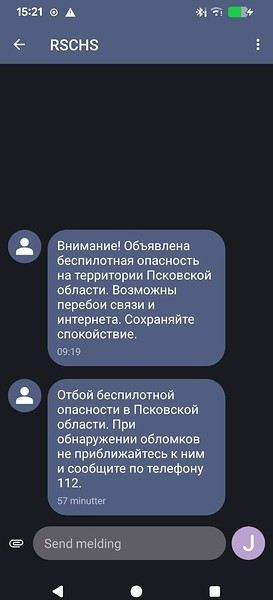
The day before yesterday, I received two SMS messages on my Megafon SIM, which are sent in such cases to warn about 4G and SMS disruptions.
The first SMS announced that drones were flying over the area and to expect internet outages. The second mentioned that service had resumed and that if you find debris (in a field, forest, etc.), you should call 112. These SMS are sent by the Ministry of Emergency Situations (RSCHS/РСЧС).
By the way, last fall, I experienced very limited 4G (only basic practical apps) in Vladimir. It’s far from the border, but Vladimir hosts a major missile command center.
