This thread has been translated into English.
Ban Gioc Waterfalls (Vietnam)
Franklenfant · 2017-03-30 · Message 41 of 53
Father Binh must be around 75 to 80 years old now, so he’s certainly retired;
hopefully enjoying his retirement where he used to teach.
I knew him well and spent a lot of time with him between 1991 and 1996; he lived in a house on the path behind the train station.
First, we’d need to find out if he’s met them or heard of them...
If he has, he’ll share his personal thoughts;
he’s not the type to proselytize—he’s a Vietnamese man of great culture.
Watch out for his tea, though!! It’s *super* strong and gives you a killer headache. 😉 Dilute it before drinking...
Ban Gioc Waterfalls (Vietnam)
Franklenfant · 2017-03-31 · Message 43 of 53
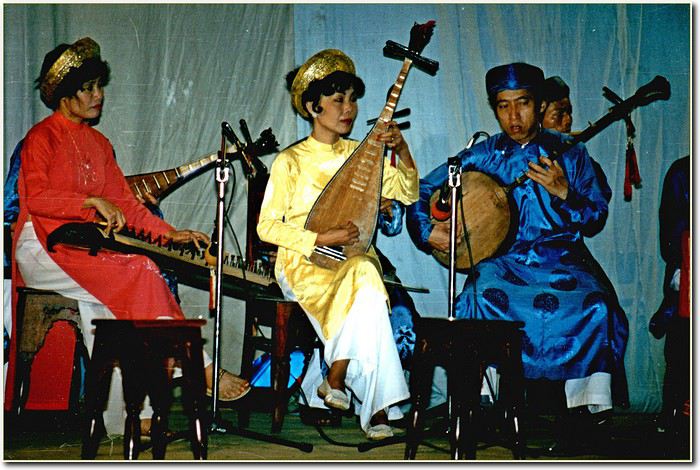
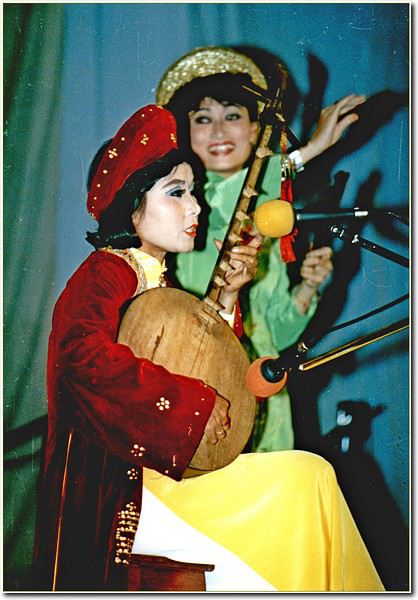
I was lucky enough to take part in the first festival, which began on April 4, 1992;
At the time, there was a French Center in Huế run masterfully by Mr. Philippe Catelin;
he was about 30 years old, a doctor in—I don’t remember what—specializing in the Spanish War! (The one from 1808 to 1813.) So, nothing to do with Vietnam 😉
It’s quite a long story, and it’s starting to feel like ancient history;
it was thanks to Vietnamese people from Huế who worked at EDF (Électricité de France) that this festival came to life, largely sponsored by their company.
Two photos taken on April 4 or 5, 1992; scans of film photos
Ban Gioc Waterfalls (Vietnam)
Tim07 · 2025-06-07 · Message 45 of 53
Hi Quynh,
- Do you happen to know if it’s possible to rent a car for the day (with a driver) in Trung Khanh to visit the Phong Nam Valley and the Ngoc Con Valley? I’m sure there are some in Cao Bang, but are there any in Trung Khanh itself?
- Do you know if the bus from Cao Bang to Ban Gioc stops near the "Khu Bảo Tồn Vượn Cao Vít" nature reserve, which is on the way to the waterfalls? It would really work for us to take the bus to that spot since it’s only 4 km from our hotel.
This would be for a 3-4 day trip to the region next December. My dad speaks Vietnamese, but we haven’t been able to get precise information about this.
Ban Gioc Waterfalls (Vietnam)
ThomasBerna1 · 2025-10-07 · Message 46 of 53
Generally, in October, there isn’t much water left,
but based on my last trip this year, the rains came later in Vietnam.
The rainfall was heavy, so the waterfall is still really beautiful.
That said, watch out for storms.
I got stuck for three days and stayed in a homestay the whole time.
Ban Gioc Waterfalls (Vietnam)
Vdquynh · 2025-10-08 · Message 47 of 53
Hi there,
Sorry for the late reply, but I came across your message today while checking a new post alert in this thread generated by the site.
Hi Quynh,
- Do you happen to know if it’s possible to rent a car for the day (with a driver) in Trung Khanh to visit Phong Nam Valley and Ngoc Con Valley? There are probably options in Cao Bang, but are there any in Trung Khanh?
- Do you know if the bus from Cao Bang to Ban Gioc stops near the "Khu Bảo Tồn Vượn Cao Vít" nature reserve on the way to the waterfalls? It would be convenient for us to take the bus to that spot since it’s only 4 km from our hotel.
This would be for a 3-4 day trip in the region next December.
My dad speaks Vietnamese, but we haven’t been able to get precise info on this.
The "Khu Bảo Tồn Vượn Cao Vít" is located on the DT211 provincial road, starting from Trung Khanh, while the road to Ban Gioc Waterfalls is on the DT206. The public bus from Cao Bang passes through Trung Khanh before continuing on the DT206 toward Ban Gioc Waterfalls. From what I can tell, the "Khu Bảo Tồn Vượn Cao Vít" is about 4-5 km from Trung Khanh.
As for renting a car with a driver in Trung Khanh, I can’t say for sure, but I assume it’s possible (with services like Grab, for example). If you’re staying at a hotel in Trung Khanh, they probably won’t have too much trouble finding you a car with a driver.
Best regards,
Quynh
Ban Gioc Waterfalls (Vietnam)
Tim07 · 2025-11-28 · Message 49 of 53
Hi there,
Thanks so much for your reply—looks like I’m getting back to you pretty late too. My apologies for the delay.
It’s been really tough to get info on the questions I asked:
We’ll try to find a car with a driver in Trung Khanh... We’ll see how it goes.
On the other hand, there’s a hotel—the Phong Nam Station—that isn’t responding, despite our booking... Hope it hasn’t closed down.
All the best,
Tim07
Ban Gioc Waterfalls (Vietnam)
Larsay · 2025-12-03 · Message 50 of 53
I doubt you’ll find a car with a driver in Trùng Khánh, a small non-touristy town. Rent in Cao Bằng instead and head down to the excellent 3-star JEANNE hotel (she was Chartron’s nurse). There are several Gioc hotels, including a 3-star one; no need to book ahead—few people spend a night in Ban Gioc since it’s easy to visit in a day with lunch by the falls.
For reference, here’s a reminder of the terrible events of late October 1950:
THE BATTLE OF ROUTE COLONIALE 4
Route Coloniale 4 (RC 4), now Highway 4A from Lạng Sơn to Cao Bằng and 4B from Lạng Sơn to the coast, was a super-strategic road because it runs along the entire Chinese border between the Gulf of Tonkin and Cao Bằng in the northeast, including the three “gates” to China: Móng Cái, Lạng Sơn, and Cao Bằng. This partly explains why, in 1979, the Chinese suddenly bombed and leveled these three cities—plus Lào Cai, the fourth “gate”—before invading the north and suffering a humiliating defeat (50,000 dead and over 400 tanks destroyed).
Many tourists travel from Lạng Sơn to Cao Bằng without knowing—or at all—what happened there in 1950. Yet October 7, 1950, should be a major date in modern history: for the first time, a colonized people in rebellion inflicted a bloody defeat on a colonizing army, which, for France, foreshadowed the inevitable conclusion—delayed by four years due to the stupidity of the governments at the time: Điện Biên Phủ. In fact, the Indochina War was lost at Đông Khê in October 1950.
THE PLAYERS:
On the Asian side: Hồ Chí Minh and Giáp, who had been hiding in the limestone mountains of the northeast since 1941, Viet Minh groups with nothing, and Mao, who was pushing Chiang Kai-shek’s troops back to the Vietnamese border.
On the French side: a government that only cared about Indochina for the billions it brought in, mainly in Vietnam, with big corporations exploiting the three countries (Banque d’Indochine, Brasseries et Glacières d’Indochine, Michelin—rubber plantations—the import-export and maritime shipping companies, etc.), blocking all reforms to keep lining their pockets, and an Expeditionary Corps, the best troops in the world at the time, including the Legion, paratroopers, and Moroccan tabors, led by commanders who would later become famous: Bigeard, Jeanpierre, Trinquier, Faulques, Ponchardier (yes, the brother of the future author of the *Série Noire* novels *Le Gorille*), Élie de Saint Marc, Charton, etc., veterans of Leclerc’s 2nd Armored Division and de Lattre’s 1st Army. Unfortunately for them, this incredible military force was led by a complete incompetent, a protégé of Marshal Juin, General Carpentier, whom de Lattre had fired for incompetence in 1944. This hothead refused to learn about the terrain—crucial in a war like this—or the troops: that was the job of his subordinates. He stayed in his Saigon office, writing glowing reports to the government claiming everything was improving (how history repeats itself; these were the same lies told by U.S. generals during the Vietnam War, with the same results). In fact, just before the disaster, this incompetent told the government he “had the situation well in hand and could likely send troops back to France soon.” The result of his ineptitude: by 1950, he had rarely set foot in Tonkin, except for brief staff meetings, and he refused to listen to the field officers—and French intelligence—who knew exactly what was really happening.
THE SETTING
The northeast is a maze of limestone peaks and deep canyons or valleys, all covered in jungle, riddled with caves, and crisscrossed by a labyrinth of small roads and trails. From Lạng Sơn to Đông Khê, halfway between Lạng Sơn and Cao Bằng, the road follows a valley lined with cultivated hills and has no particularly dangerous spots. From Đông Khê onward, it’s a death trap: the road winds from one pass to another along the river, with limestone cliffs covered in jungle on either side and the river below to the right. Any maneuver is impossible. A small mountain cannon in a cave overlooking the road—and there are hundreds—could destroy the lead and rear trucks of a convoy, and *boom*, no more convoy. Giáp knew this well, but Carpentier didn’t at all, since he’d never been there and refused to listen to the many officers who predicted a catastrophe and recommended evacuating all the posts between Cao Bằng and the impregnable Lạng Sơn before the Viet Minh grew too strong.
THE PRELUDE
In early 1950, Mao’s troops reached the Vietnamese border, pushing back Chiang Kai-shek’s forces in northern Tonkin, which the French managed to disarm, and in northern Thailand, where they settled in the Golden Triangle. In addition to tea plantations, they organized the opium trade, controlling 80% of global production in the 1960s–80s. Mao had now taken over the massive American arms depots and camps in Yunnan, where he invited Giáp to train entire divisions, armed and trained by his generals. French intelligence, no less competent than others, was fully aware of the situation and informed the General Staff, which did nothing except send the Legion to Cao Bằng (the famous 2nd BEP under the command of a legendary warrior, Colonel Charton) and to posts along RC 4, including the main ones: Thất Khê, Na Cham, and Đông Khê (plus smaller ones at the top of each pass). Now well-equipped and trained, the Viet Minh constantly harassed the posts to “get their bearings.” In 1950, some supply convoys lost up to 90% of their trucks between Đông Khê and Cao Bằng.
THE DISASTER
On May 25, 1950, the warning shot: the Viet Minh’s elite 308th Division seized Đông Khê and cut RC 4 in two. The French command was surprised (though intelligence had warned them) to discover that the Viet Minh now had entire, well-equipped divisions. On May 27, the paratroopers of the 3rd BCCP jumped directly onto Đông Khê and recaptured it. On September 15, the Viet Minh took the town back, and it was never retaken. Carpentier decided to evacuate RC 4 between Cao Bằng and Lạng Sơn, which could have been done by airlift, but—ever the genius—he decided it would be done… by road. His plan was for the paratroopers to retake Đông Khê a second time, for a column led by Colonel Lepage to move up the road from Lạng Sơn and link up with the column evacuating Cao Bằng, and for everyone to return calmly to Lạng Sơn. The whole plan hinged on the French retaking Đông Khê.
Charton left Cao Bằng, taking all the civilians with him—which largely explains the evacuation’s failure, and he knew it but refused to abandon them to a certain fate. Of course, nothing went as planned: Despite their heroism, the paratroopers of the 1st BEP couldn’t retake Đông Khê—so RC 4 was still cut off. Lepage’s column was sliced up by the Viet Minh and ended up in a basin south of Đông Khê, at Cốc Xá, hemmed in by sheer cliffs on one side and jungle-covered mountains on the other. Learning that Đông Khê was still in Viet Minh hands, the command—still safely in Lạng Sơn—ordered Charton to take an isolated jungle trail, the Quảng Liêt trail, which bypassed Đông Khê. When he reached the town’s level, as a good soldier, he had everyone climb the ridges overlooking the basin, but Lepage sent desperate distress calls, so Charton also brought his troops down into the Cốc Xá basin to try to rescue him. It was the rendezvous of death: On October 7, 1950, both columns were annihilated at Cốc Xá. The toll: 2,000 French soldiers dead and 3,000 prisoners, fewer than 1,000 of whom were recovered when de Lattre arrived—mostly North Africans, now well-indoctrinated in anti-colonial warfare. The others died of starvation and disease in the Viet Minh’s terrible camps, which Hélie de Saint Marc, who experienced both, said were worse than Nazi concentration camps. Only about a hundred men escaped the trap and managed to reach Thất Khê after days of wandering in the jungle.
THE SHAME
After the disaster, total shame and panic among the French. Though Lạng Sơn was impregnable, the garrison commander, Colonel Constans, decided to abandon it “by surprise,” so he didn’t blow up the huge forts surrounding the city or the massive depots, which were so enormous that they supplied an entire Giáp division for a year. Panic also set in in Hanoi, which the French began evacuating. De Lattre, appointed Commander of the Expeditionary Corps and Governor-General of Indochina, saved the situation in three bloody battles: Vĩnh Yên west of Hanoi, Mạo Khê to the north, and Ninh Bình to the south. But as of October 7, 1950, the Indochina War was lost. Giáp now controlled the entire northeast, from which soldiers (including many Chinese technicians and even troops) and, most importantly, motorized supply convoys instead of porters could move freely all the way to Điện Biên Phủ.
Nothing remains of the large French post at Đông Khê except a small blockhouse made of rubble and a few ammunition bunkers. However, a fantastic walk takes you to Hồ Chí Minh and Giáp’s headquarters during the Battle of RC 4, located in the village of Đức Long. To get there, continue down the street in front of the fort and go straight to the village. At the end of the road, a small sign points left to a path; take it and you’ll enter a maze of concrete trails with caves everywhere—that’s the famous HQ. The yellow stilt house was where Giáp and HCM slept; walk around it and climb the steps. The caves are scattered to the right and left. Return to the road and continue left to reach a small, interesting museum about the October 1950 battle.
The Cốc Xá basin south of Đông Khê
Unforgettable day! Take RC 4 toward Cao Bằng; at a roundabout, turn left onto the old RC 4 and climb the Nguộm Kim Pass, site of the most terrible ambushes on the “Bloody Road.” The views are breathtaking. At the kilometer marker “Cao Bằng 32 km” (there are two houses on the right and one on the left), take a small road to the left (make sure you take the right one by simply asking for “Cốc Xá,” pronounced *Coc Sa*). This road quickly turns into a trail; keep going until you can’t drive any farther in a 4x4. You’re in an idyllic valley with, from left to right, the famous limestone cliffs of Cốc Xá that trapped the French, the trail, a small river, rice paddies, and wooded hills. In the small Tay village, there’s a house-grocery-bar on the left; you have two choices: walk 4 km to the foot of the Cốc Xá cliff where the French were “trapped,” or ask the shopkeeper to call some motorbikes. The local young people, smiling and knowledgeable about the battle’s history, are happy to make 100,000 ₫ per bike (we went by motorbike and walked back—it’s so beautiful, including the Tay women transplanting rice).
If you want to spend a night in Đông Khê, the only decent hotel is the Mai Hiền at the town’s entrance, and the only decent restaurant is the Nhà Hàng Bảo Văn in the town center.
Ban Gioc Waterfalls (Vietnam)
Tim07 · 2025-12-03 · Message 51 of 53
Hi Larsay,
Thanks so much for your reply.
I hadn’t realized the current situation in Vietnam was this bad… I thought the flooding would’ve calmed down by now, but apparently, it’s still a total mess.
-Do you think it’s reasonable to plan a trip to the Cao Bang area with a driver? I’m worried about landslides and ending up in a ravine.
-Do you know if the situation is just as bad near Ninh Binh (Tam Coc, Hoa Lu)?
Have a great day,
Tim
Ban Gioc Waterfalls (Vietnam)
Vdquynh · 2025-12-04 · Message 53 of 53
Hello,
I hadn’t realized the current situation in Vietnam was this catastrophic... I thought the flooding would have calmed down by now, but apparently, it’s still a disaster...
Indeed, the situation is catastrophic—but in central Vietnam (as well as in Southeast Asia, where southern Thailand, Indonesia, and others have seen record floods and over 1,000 deaths have been reported)—which is the target of typhoons at the end of the typhoon season (November to early December). The railway line had to be repaired in many places where the embankment was washed away by floodwaters, and north-south (and vice versa) rail traffic was disrupted (21,000 train tickets had to be refunded).
Northern Vietnam is generally no longer affected by typhoons during this period (though... with climate change... who knows).
Best regards,
Quynh

