Back to the discussion

in Entre deux voyages › Carnets de voyage

Biking (MTB) along the Canal between the Two Seas (France) (page 9 of 16)

Discussion started by Facteur4 on 2007-03-17

309 replies

This thread has been translated into English.


Biking (MTB) along the canal between the two seas (France)

Facteur4 · 2013-05-30 · Message 161 of 310

Day 4 Thursday 30/05 Portiragnes 08:30 St Gilles 18:00 120 km

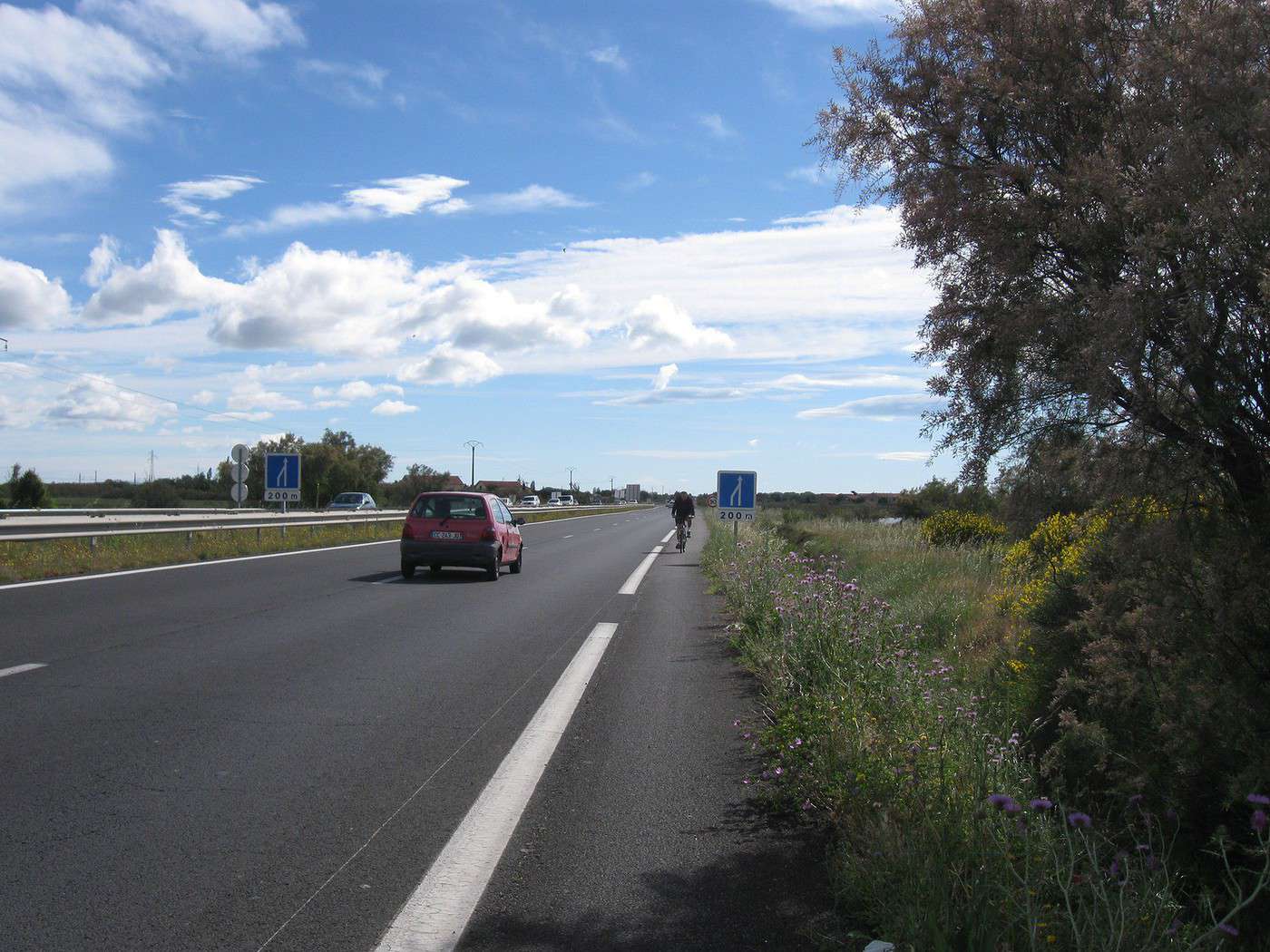
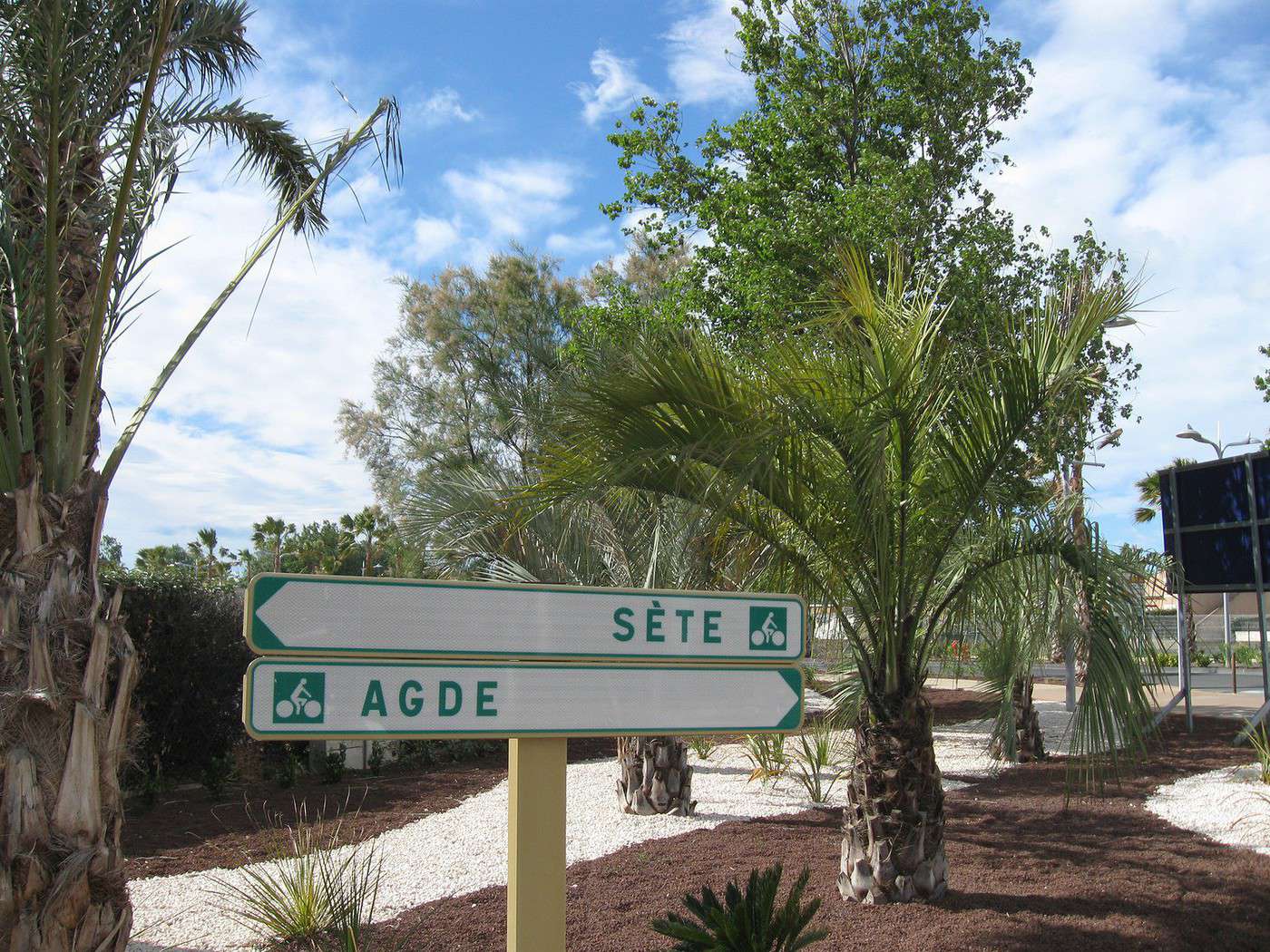
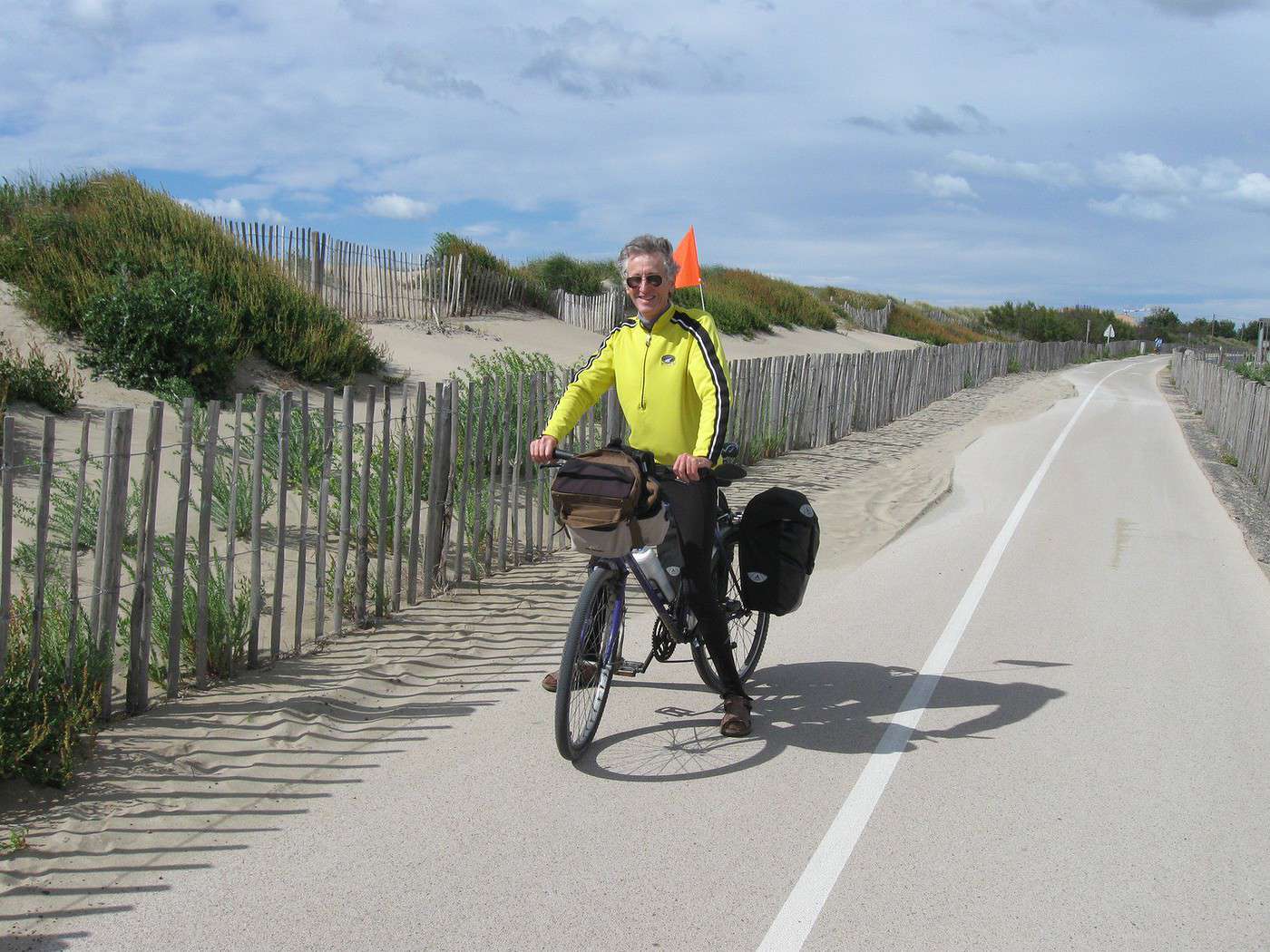
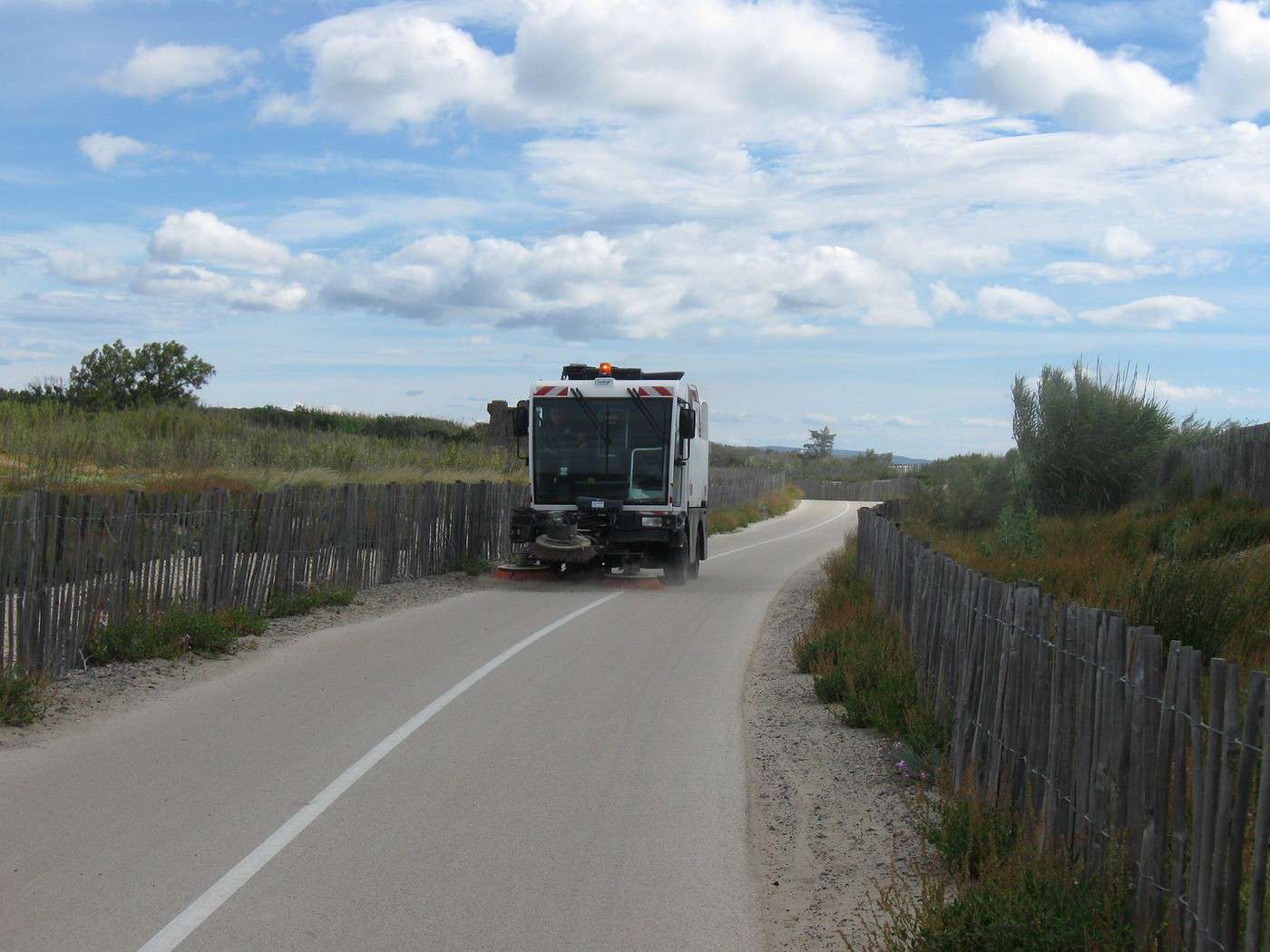
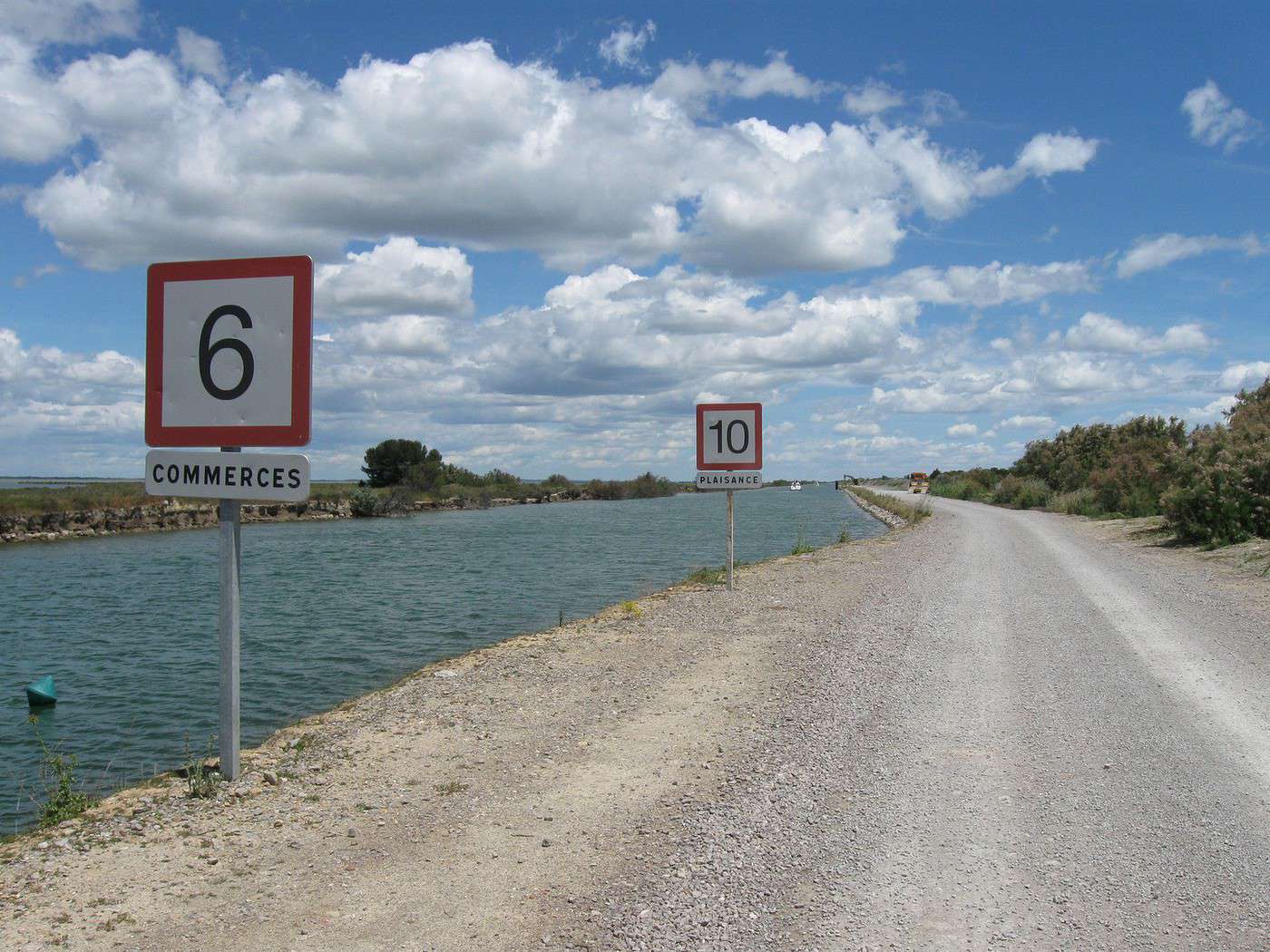
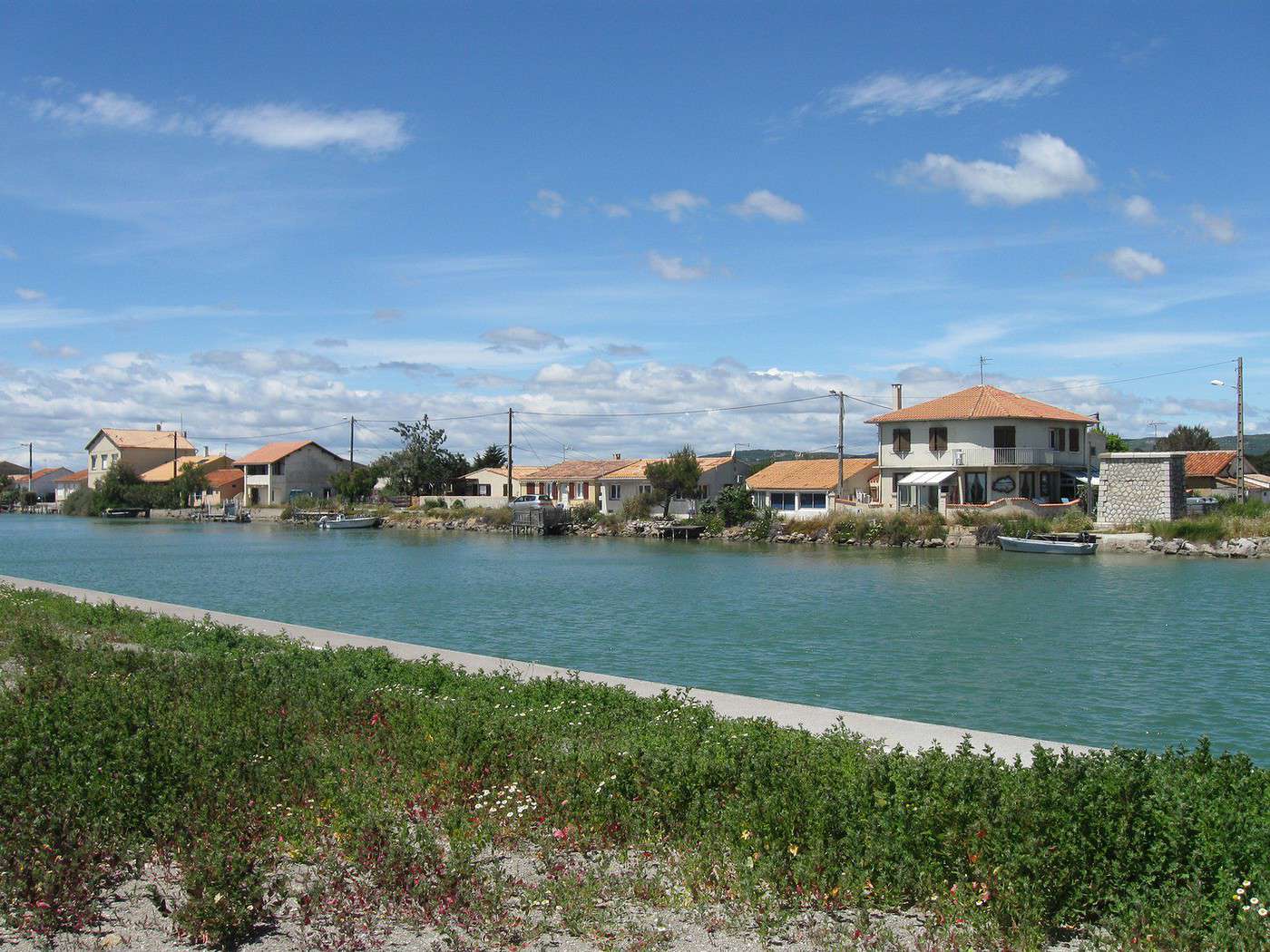
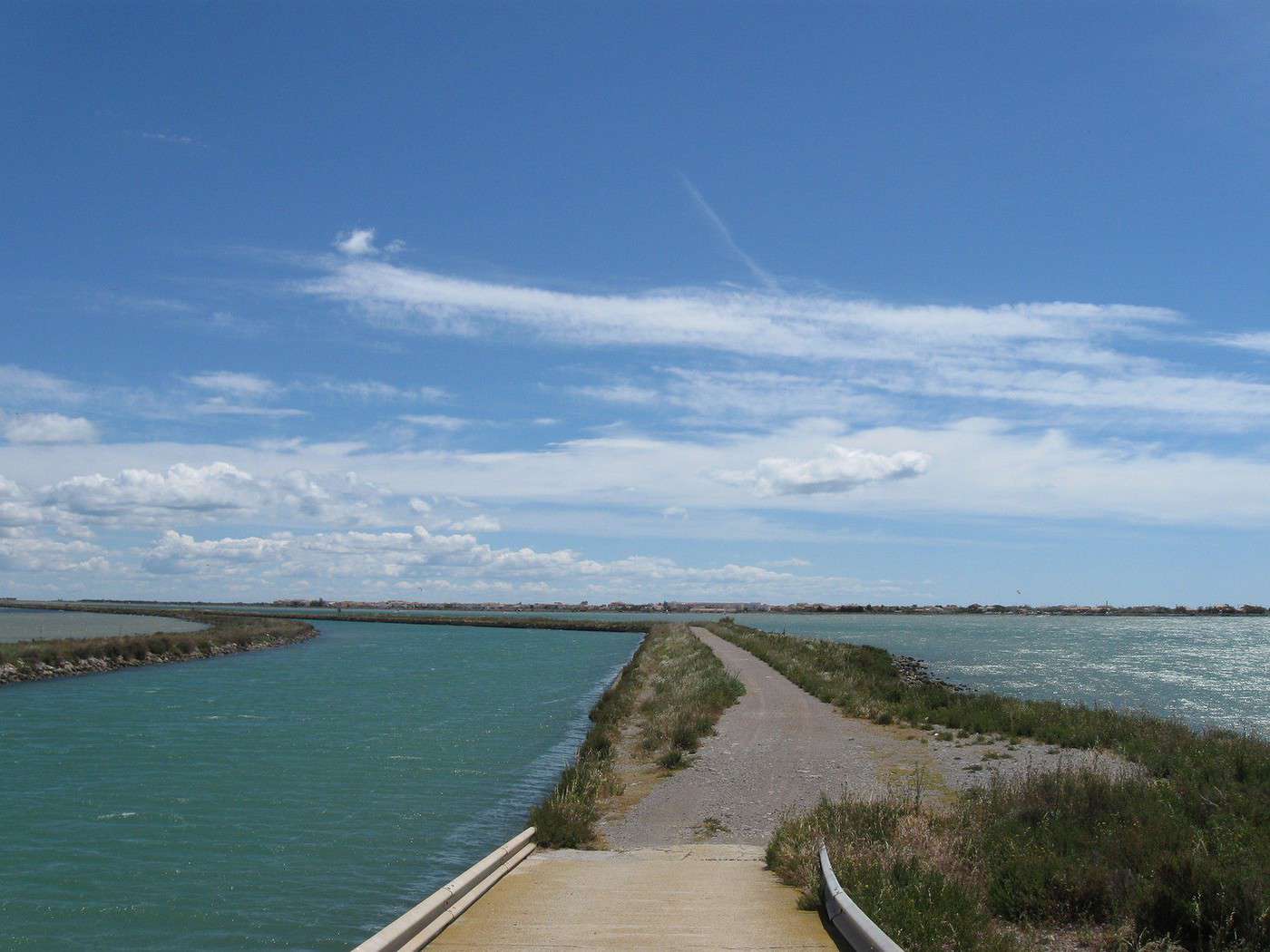
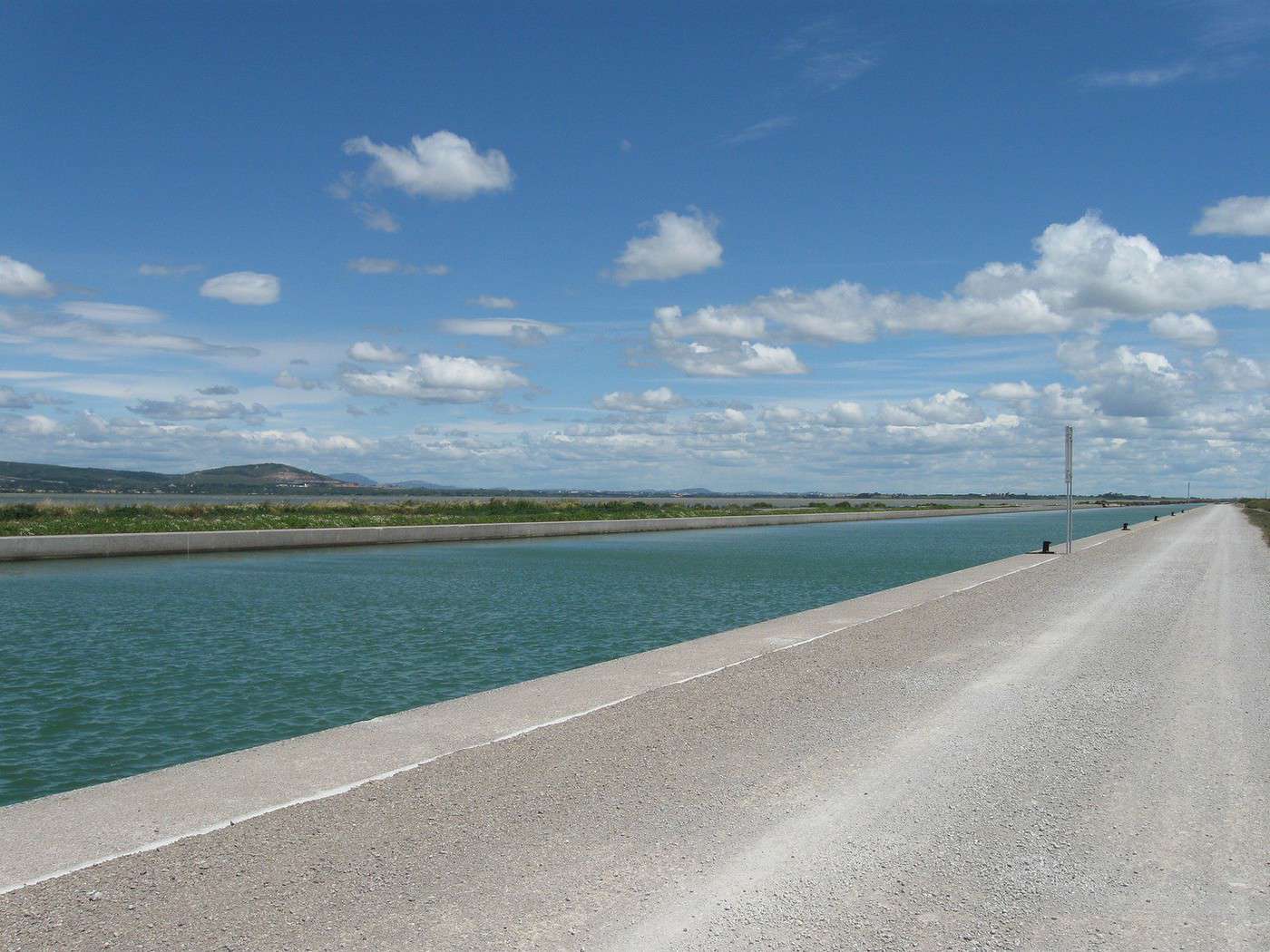
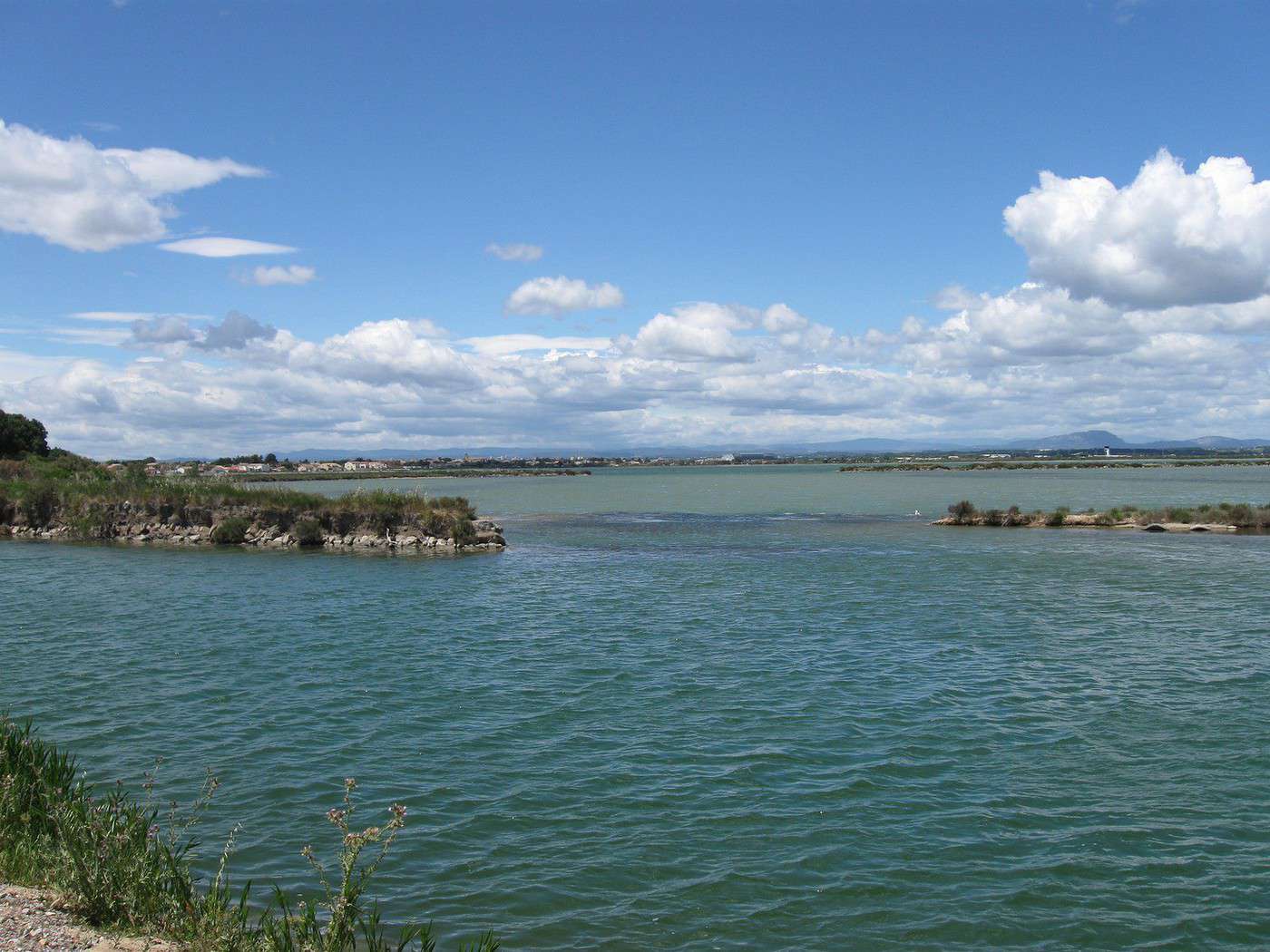
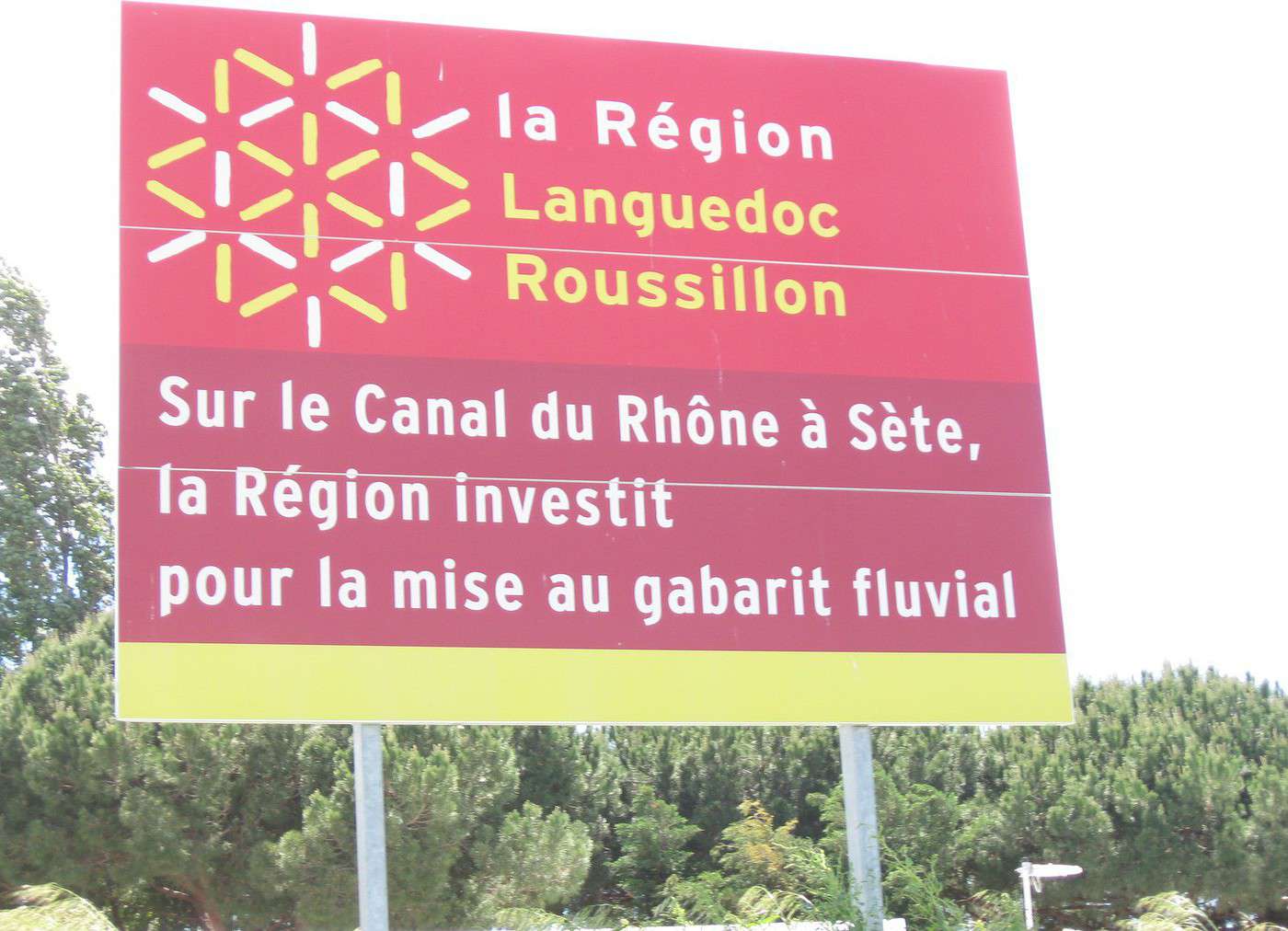
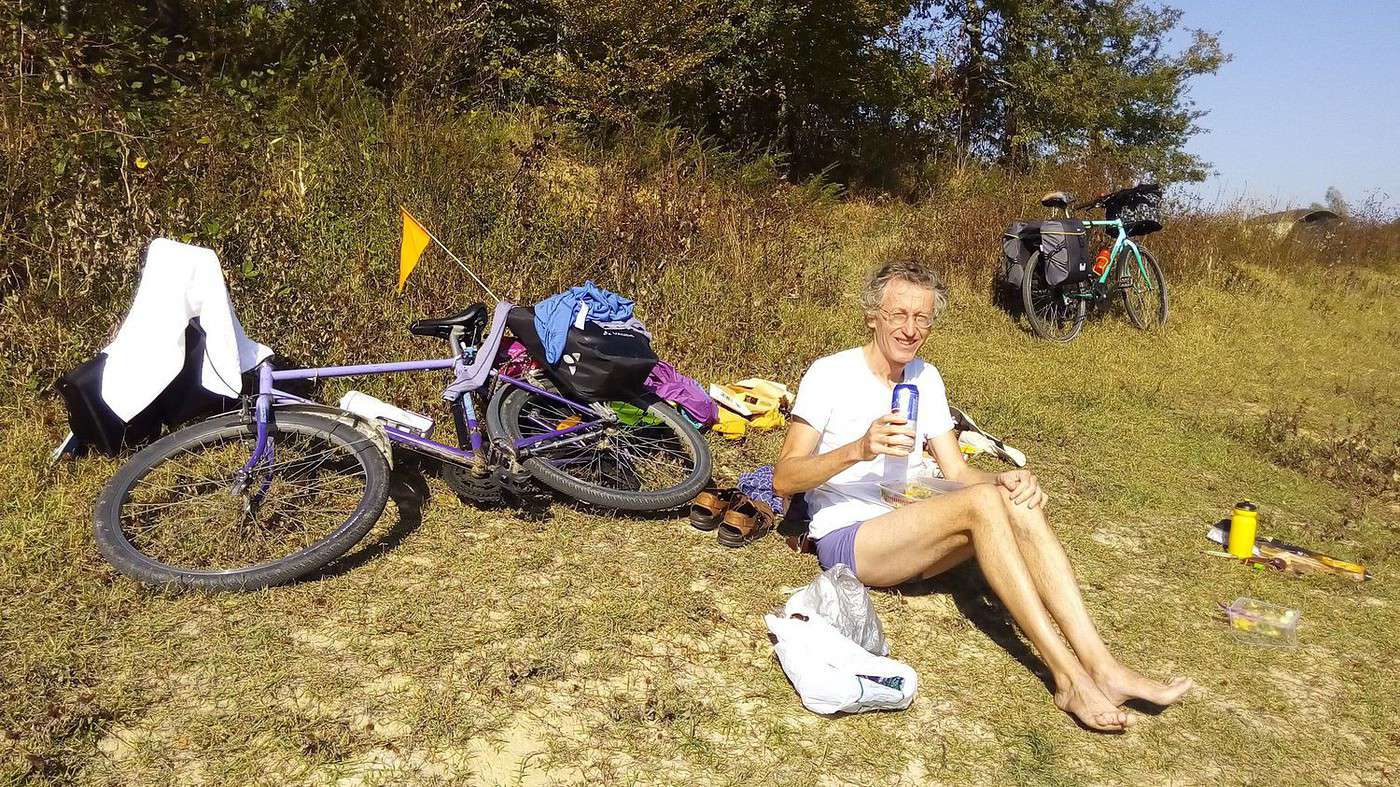
The receptionist hands me the remote that lets me retrieve my bike from the garage. I notice the odometer shows exactly 300 km. So I’ve met my goal of 100 km/day. Before leaving Portiragnes, as agreed with the hostess, I drop off the map and brochure she gave me in the tourist office’s mailbox. Recycling is good, reusing is even better: http://voyageforum.com/v.f?post=5957160#5957160 I find the canal and its ruts again, leading me to Agde. Luckily, the ground has dried. Today I’m in the only region of France where the sun is shining. At the round lock, I have to leave the towpath because the boats continue down into the Hérault, and at the end of the Canal du Midi, the towpath disappears into the reeds. Anyway, it doesn’t go to Sète; boats go there via the Étang de Thau. See photos here: http://voyageforum.com/v.f?post=5071826#5071826 As soon as I hit the road, I spot the level crossing at Agde train station. I speed up because I’m afraid the barrier will come down. Just thinking about it made the lights start flashing. I escape via the Canalet because I know the barrier stays down the whole time a train is at the station! http://www.herault-tribune.com/articles/2459/agde-le-passage-a-niveau-doit-etre-supprime/ I recognize the tower of the Hôtel la Galiote, where I slept when I arrived in central Agde, and cross the market to find the D612 (former N112). At the edge of town, the road to Sète becomes a 4-lane highway and is off-limits to bikes. Obeying the rules, I take the path to the right but worry I’m heading toward Cap d’Agde. As I hoped, an underpass lets me get back on track. I ask some English cyclists if I’m heading toward Sète, and some walkers confirm it. But they all tell me to take the main road. I’m surprised to see one, then two, then five cyclists coming toward me. Turns out the D612 goes back to one lane here. There’s just 500 m of 4-lane road to discourage cyclists from using it? It’s no longer off-limits, but since it only has a shoulder on one side, cyclists use it in both directions. Shows how much it’s needed. That’s what I’ve been asking for on the right side of French roads—a bike lane: http://voyageforum.com/v.f?post=5900201#5900201 Finally, the Voie Verte begins, and with it, serenity, reinforced by a 10 cm wall separating it from the road. Then the D612 was moved inland to leave the coastline to soft transport modes. I stop before crossing a street sweeper to photograph it. If only we could be pampered like this everywhere! The driver stops and lifts the brushes to let me pass. With a wave of my hand, I signal for him to start again so I can capture it in action. I thank him as I pass and get sprayed with sand too fine to be trapped. Since the wind is still in my favor, I don’t need to push hard. It’s funny how you forget to notice the absence of pain. The first two days, like often, my right knee hurt. That passed. From Toulouse, I reached Sète in two and a half days. So you can cover the 240 km of the Canal du Midi in 2 days with an unloaded hybrid bike. But in that case, you don’t get to enjoy the scenery or the engineering works. Since there’s no time to linger at restaurant terraces (on the port, I pass the one where I ate sardines), I buy a sandwich and head off to find the start of the Canal de Sète au Rhône. Here’s a discovery and link to visualize the canals: http://voyageforum.com/v.f?post=2631582#2631582 Knowing you can’t follow it at the start because it crosses an industrial zone, I’m forced to take the road toward Frontignan for a few km. Then on my right, I see a very wide canal. Even though his car is marked 38, I ask a fisherman if it’s the one from the Rhône to Sète. He can’t be sure but says it flows into the Étang d’Ingril, which matches my map. A second fisherman confirms it and tells me I need to switch banks. I can’t reach the bridge. A little further on, I walk against traffic on the highway to take it. Soon the canal is surrounded by water, and it’s impressive. Luckily, the towpath is wide and smooth for VNF vehicles. Too bad it’s always off-limits to bikes because of the ever-present and sometimes violent wind. Near some fishermen’s houses, I take shelter behind rocks to eat. My beer stayed cool because of the temperatures, but it fizzes violently when opened. And in Lapland, it’s 29°C! I put the jersey I washed yesterday out to dry, using a rock, sun, and wind. As I leave, I discover a quay carefully redone with brand-new mooring bollards. It’ll be inaugurated tomorrow. I almost stumbled into a ceremony in the arms of law enforcement. A big sign confirms the push to revive river transport: http://www.peniche.com/Breves/dev-durable.htm I reach Palavas-les-Flots—I’m near Montpellier, where Bruno and Vincent got married yesterday. Two pedals tied together. Mine is giving me trouble. The chain won’t shift onto the small chainring. It’s really annoying when, in a hurry, I want to switch to an easier gear and the transmission won’t cooperate. I try tightening the cable with the barrel adjuster near the shifter, but turning it doesn’t help. I just manage to make the front derailleur rub against the chain. It’s tough when you’re not mechanically inclined. Since this has happened several times in recent years, I’ll get it replaced after 20 years of service. Commercial boats aren’t allowed to go faster than 6 km/h, and pleasure boats 10 (8 on the Canal du Midi). Since, depending on the surface and the favorable wind, I ride between 15 and 30 km/h, I pass them with disconcerting ease. But I don’t see any merchant boats. A floating pedestrian and bike bridge that stays in place all day must make navigation tricky. Coming by boat would’ve been a much bigger challenge—I’d estimate 3 weeks. An excavator is moving dredged sludge, which is reused once it regains its mechanical properties after drying. I stop to wait for the operator’s permission. A few raised grated crossings allow the towpath to continue where the canal connects with the étangs. As I get off one, a jolt makes a noise that catches my attention. The top of my pannier’s fabric has come unstitched. It won’t be waterproof anymore. I wouldn’t have thought my VAUDE panniers would give out before my GO SPORT handlebar bag, which is also heavily used. Suddenly, a barrier blocks the entire road. Machines are working. I have no choice but to take the bridge toward Lunel. I want to turn right onto the D34 toward Marsillargues. But there’s no city name or road number. The directional signs only point to 3 *Mas* that mean nothing to me. I already experienced this in March when discovering the Petite Camargue on a recumbent trike: http://voyageforum.com/v.f?post=5898281#5898281 Then every km is marked D34. It’s really bad faith! I go for a mint water and have my bottle refilled at a bar. I take advantage of a mini market to buy some electrician’s tape. I hesitated to bring my roll of duct tape but I’m already so loaded. Now I have to cover the km, even if it means taking busy roads. At an intersection, I still take the time to enjoy the first cherries sold by the side of the D6572, which takes me toward St Gilles. With the heat setting in, I switch to shorts. 5 minutes later, I feel the first drops. But while the sky darkens behind me, I’m riding toward the sun. It wasn’t planned, but I pass through Vauvert, where I was just 2 months ago. I hesitate when I see a *mas* offering rooms, but I want to reach the Rhône to start riding upstream tomorrow. 5 or 6 km later, the rain forces me to put on my poncho. I ride 100 m uncomfortably, then the downpour intensifies, and I stop at the entrance to a field. I feel hail hitting my back and bouncing off the ground. Really stupid not to have stopped earlier. I need 15 to 20 minutes of patience for the rain to stop. I’m surprised I’m not cold in shorts and a t-shirt under the poncho. After more than 100 km, my boiler has inertia. On the other hand, my feet and sandals are full of mud from the splashes. Since it’s already 18:00 when I arrive in St Gilles and I saw an ad for a hotel-restaurant, I give up on the 30 km to Beaucaire and Tarascon. Especially since I don’t feel like taking another shower. Since the receptionist doesn’t have a shelter for my bike, she offers to put it in my room, giving me the one closest to the entrance.

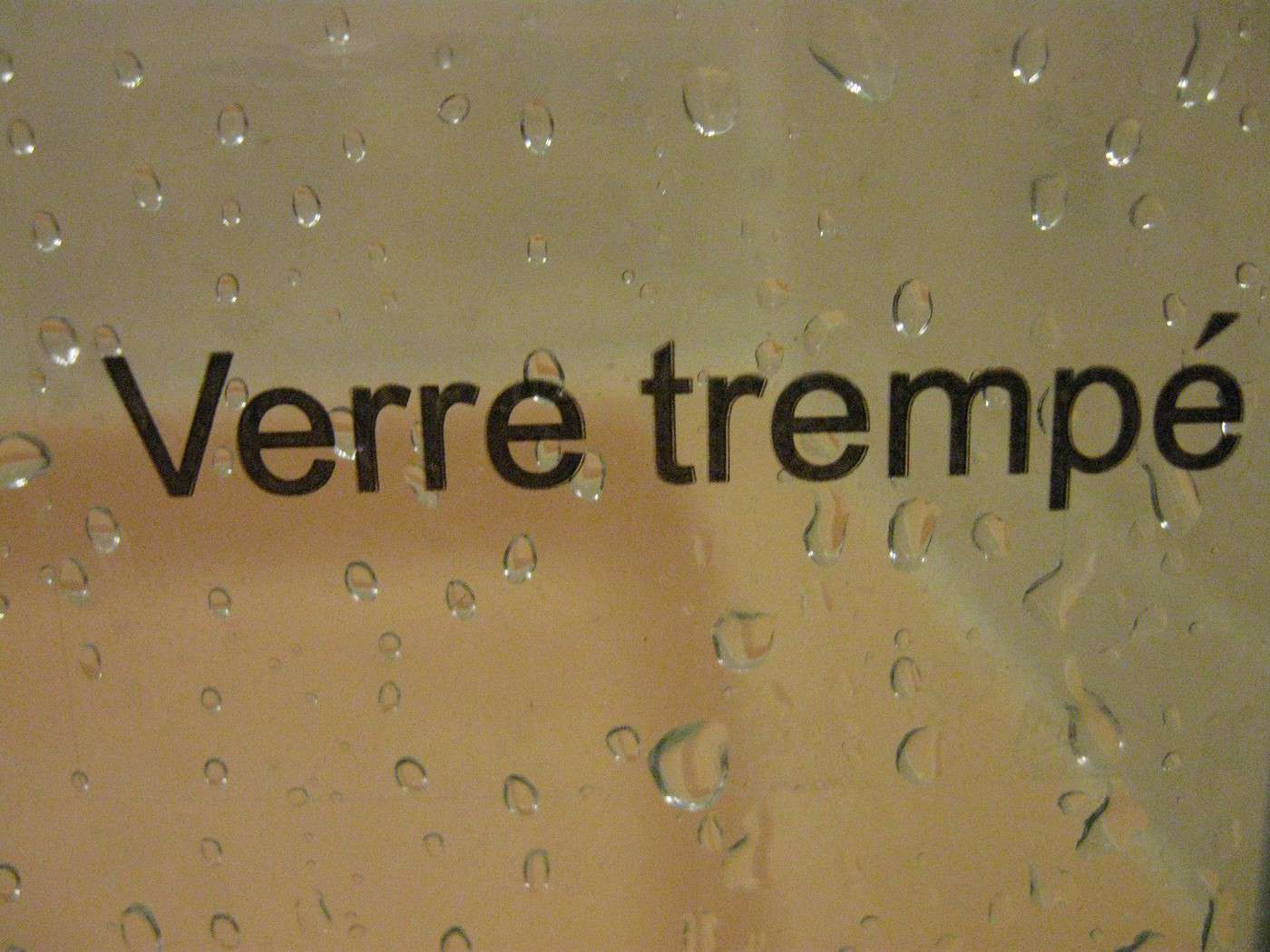
Even the glass is soaked!
Mountain Biking (MTB) Along the Canal Between the Two Seas (France)

Facteur4 · 2013-05-31 · Message 162 of 310

Day 5, Friday 31/05 – St Gilles 07:30 to Avignon 12:30, 57 km

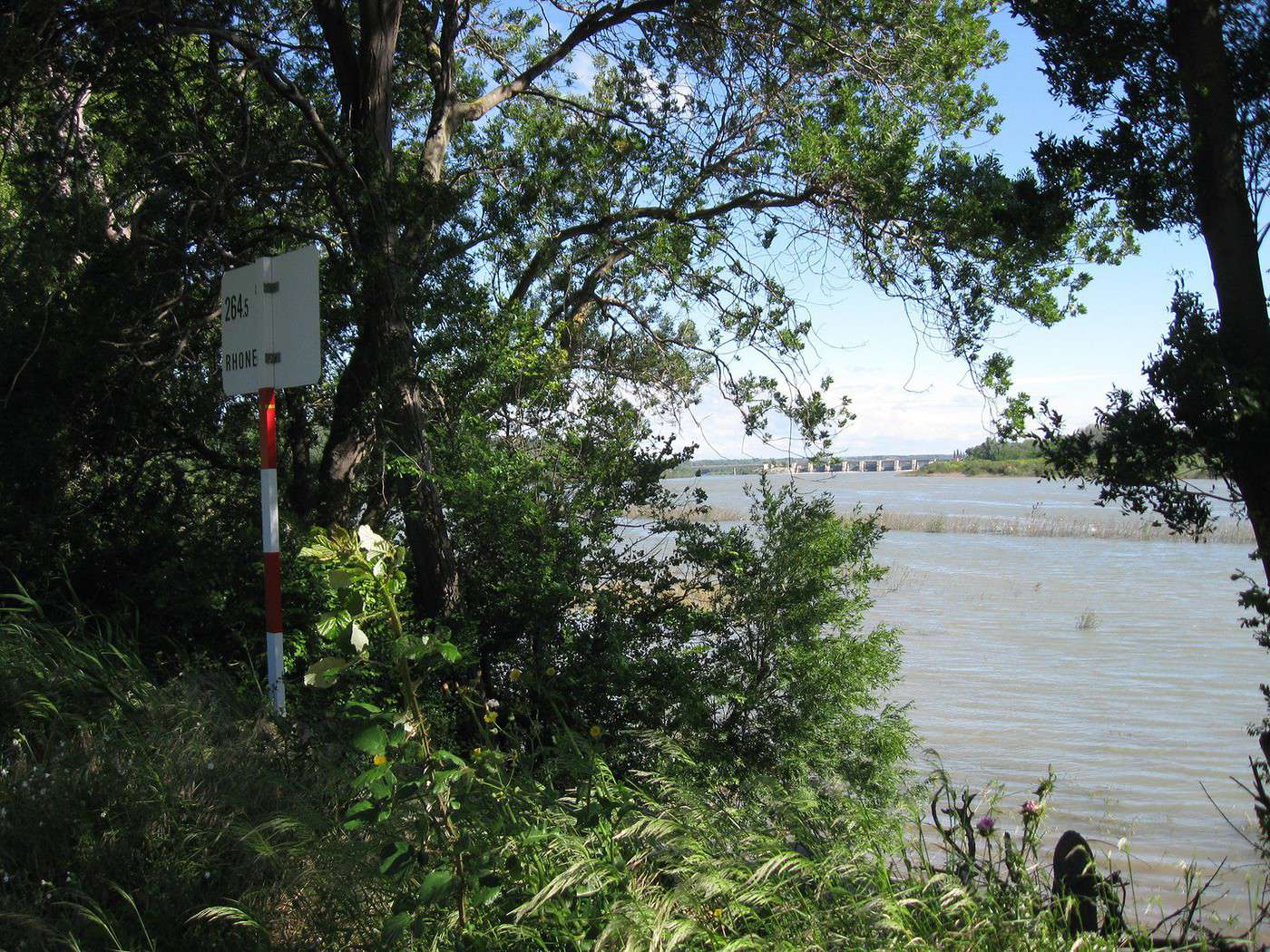
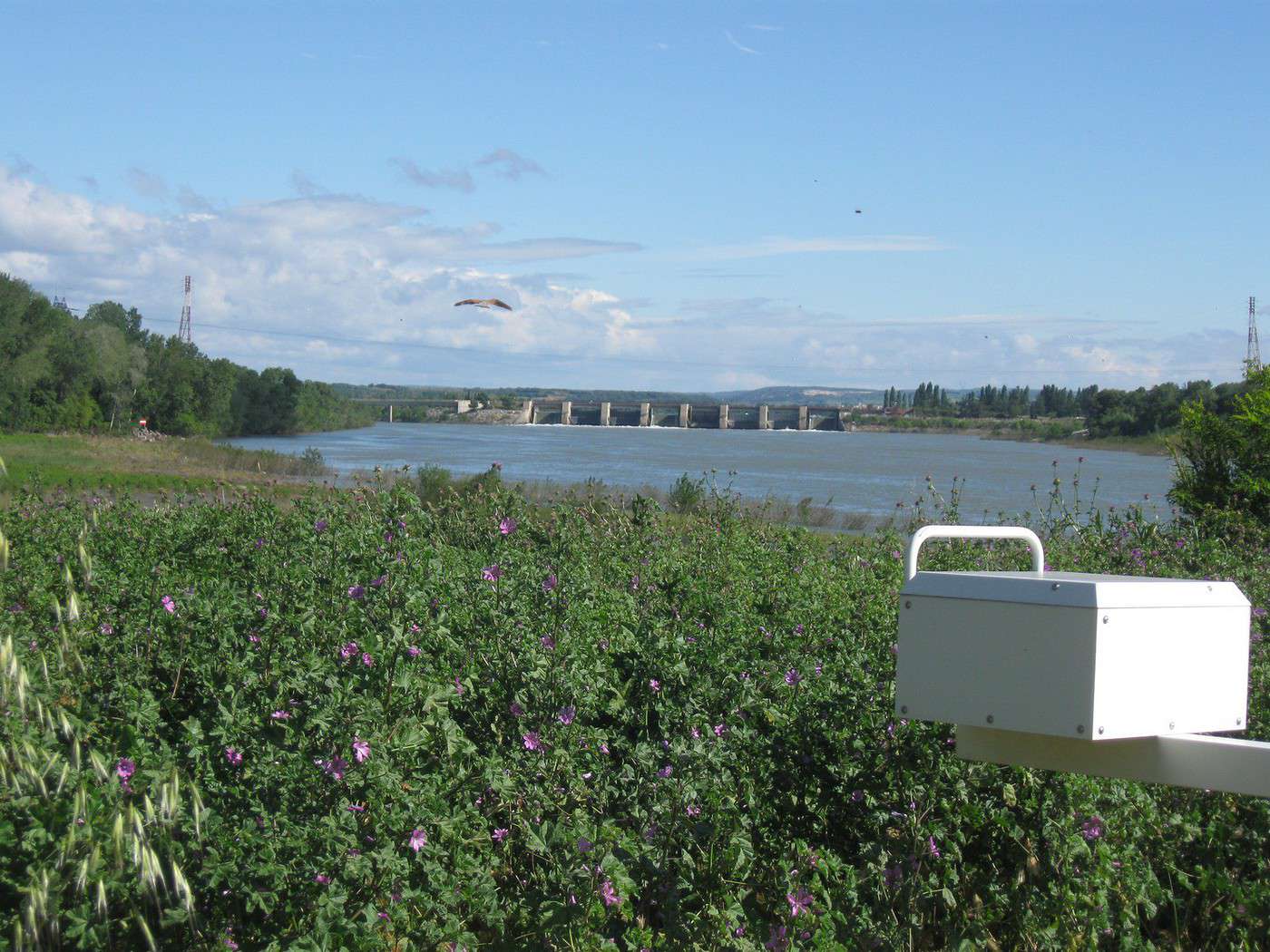
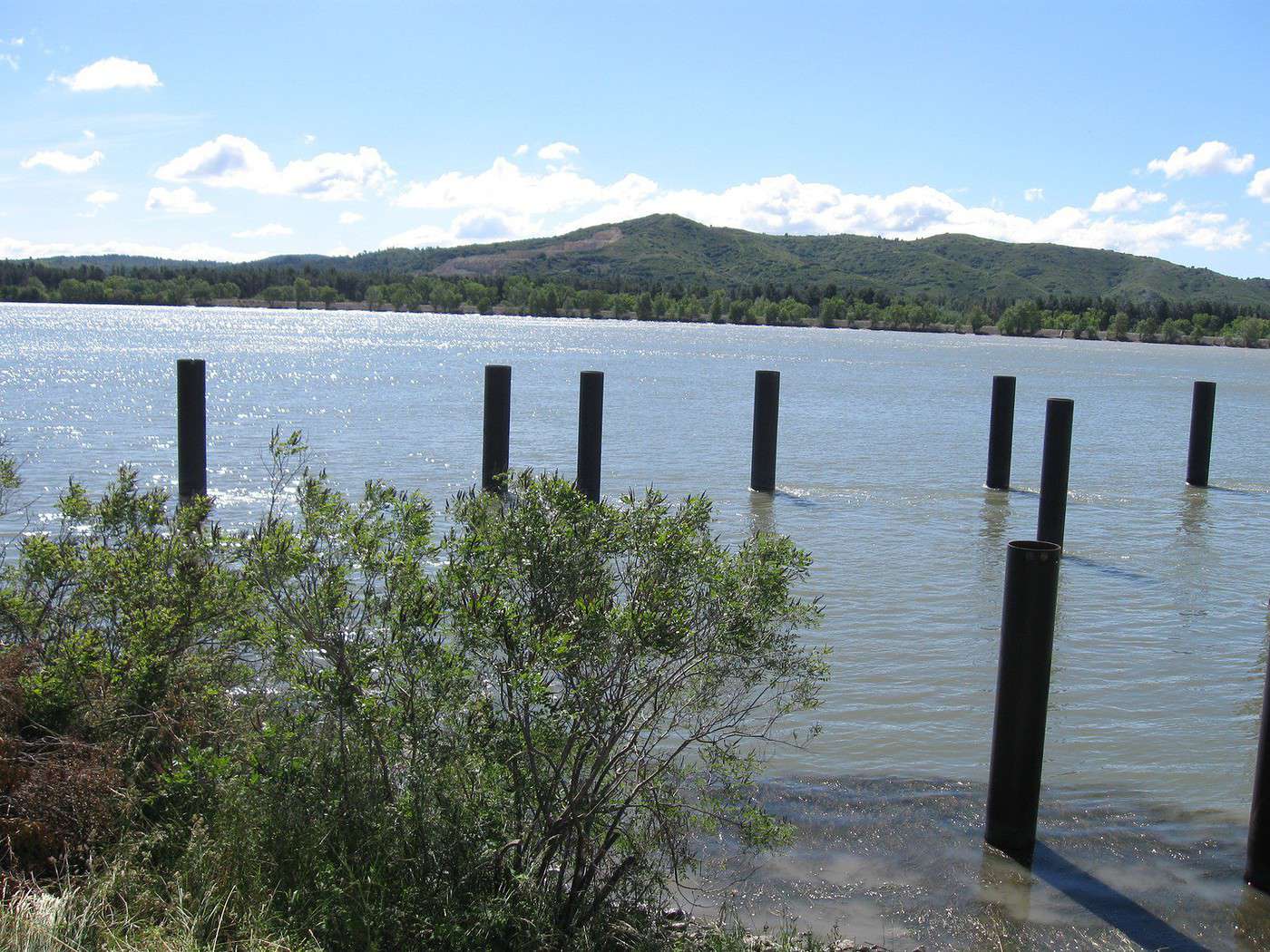
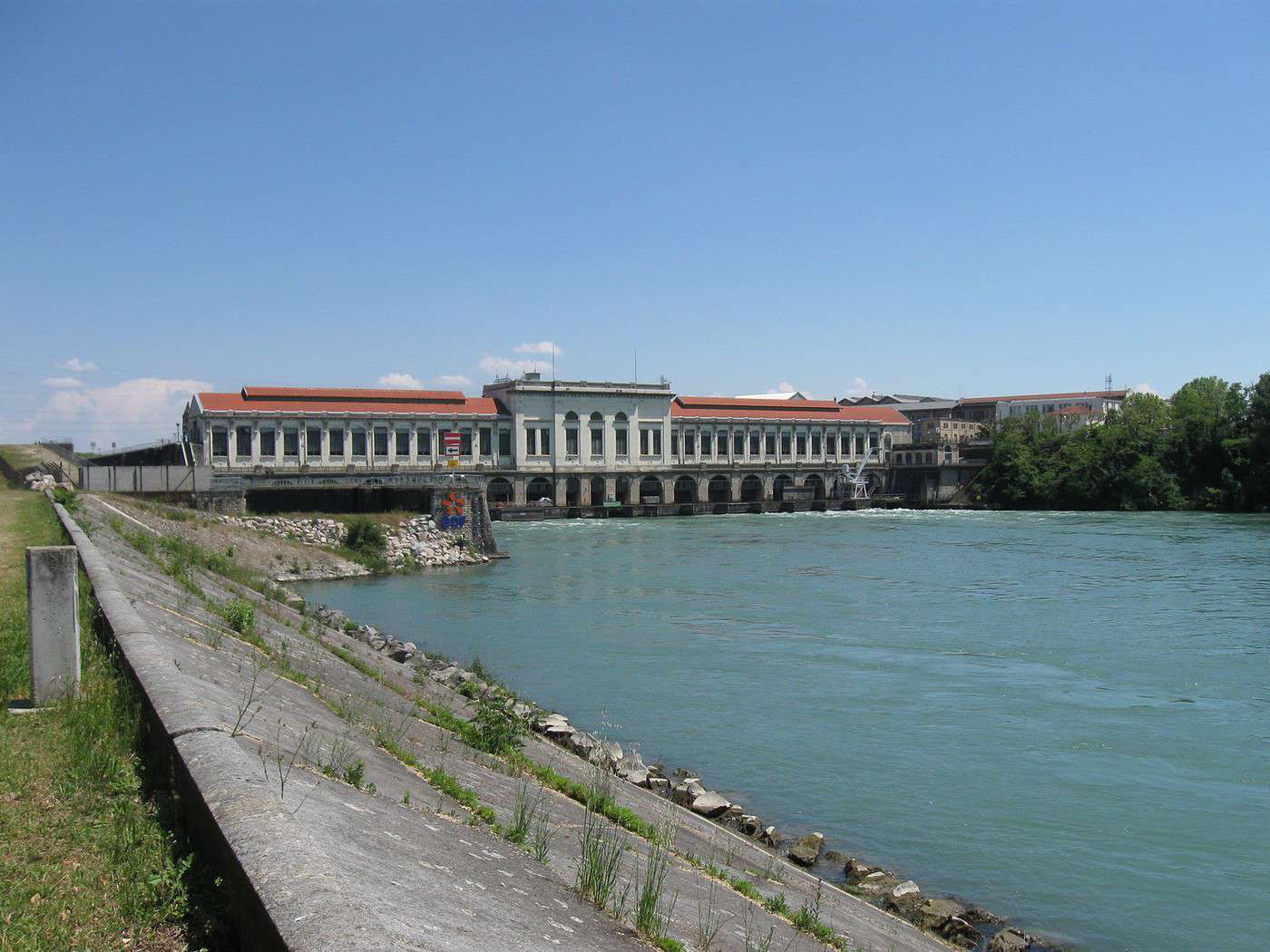
Breakfast is served from 7 AM. Perfect for tackling another long stage. I need to start heading up the Rhône before the wind picks up. First, the D38 should take me to Beaucaire. I quickly start feeling it. Since I don’t want to get caught in traffic on the bridge over the Rhône that connects to Tarascon without a chance to turn back, I decide to avoid it by taking the D90 expressway, which passes near the Vallabrègues dam. But with the traffic building up before a climb, I turn right, hoping to reach the river. After a few twists through residential areas, I ask how to get to Vallabrègues. A very kind young girl tells me I can either take the bypass (where I just came from) or go down into Beaucaire (which I wanted to avoid). She wishes me good luck without realizing how much farther I plan to go. I end up before the bridge on the Tarascon road, which I wanted to avoid. I turn left to stay on the right bank along the quays. Soon, the road leaves the riverbank, and I continue down a dead end, following the garbage truck I’d already seen in town. But it turns around because the only path left is a muddy track with deep ruts. Here we go again! I also have serious doubts because the waterway I’m following isn’t wide enough to be the Rhône. I’m glad I kept going because soon a sign indicates RHONE and 264.5. That’s exactly the distance I have left to reach LYON. I don’t see why the capital of Gaul would be kilometer zero. The Rhône flows from Lake Geneva. My trail rejoins the road without me getting stuck. I should’ve stayed on the bypass. I cross the dam bridge. Indeed, only part of the Rhône is used for navigation after its waters are swelled by the Durance.

I’m finally on the D2, which Claude Banderias recommends in his ViaRhôna guide: http://www.velopepere.fr/article-nouveau-pour-la-viarhona-le-topoguide-de-claude-bandiera-89710325.html I ordered it before leaving because the bike route is far from finished, especially in its southern half. The downside for me is that the route follows the river downstream. That makes sense since it’s called "From Lake Geneva to the Sea." Besides, Claude advises buying your train ticket back from the Mediterranean and reserving a spot for your bike before you leave. It’s harder to follow the signs in reverse. But the main reason is the Mistral. And I quickly realize it’s better to go down the Rhône Valley. I have to push hard, and my right hip starts hurting.

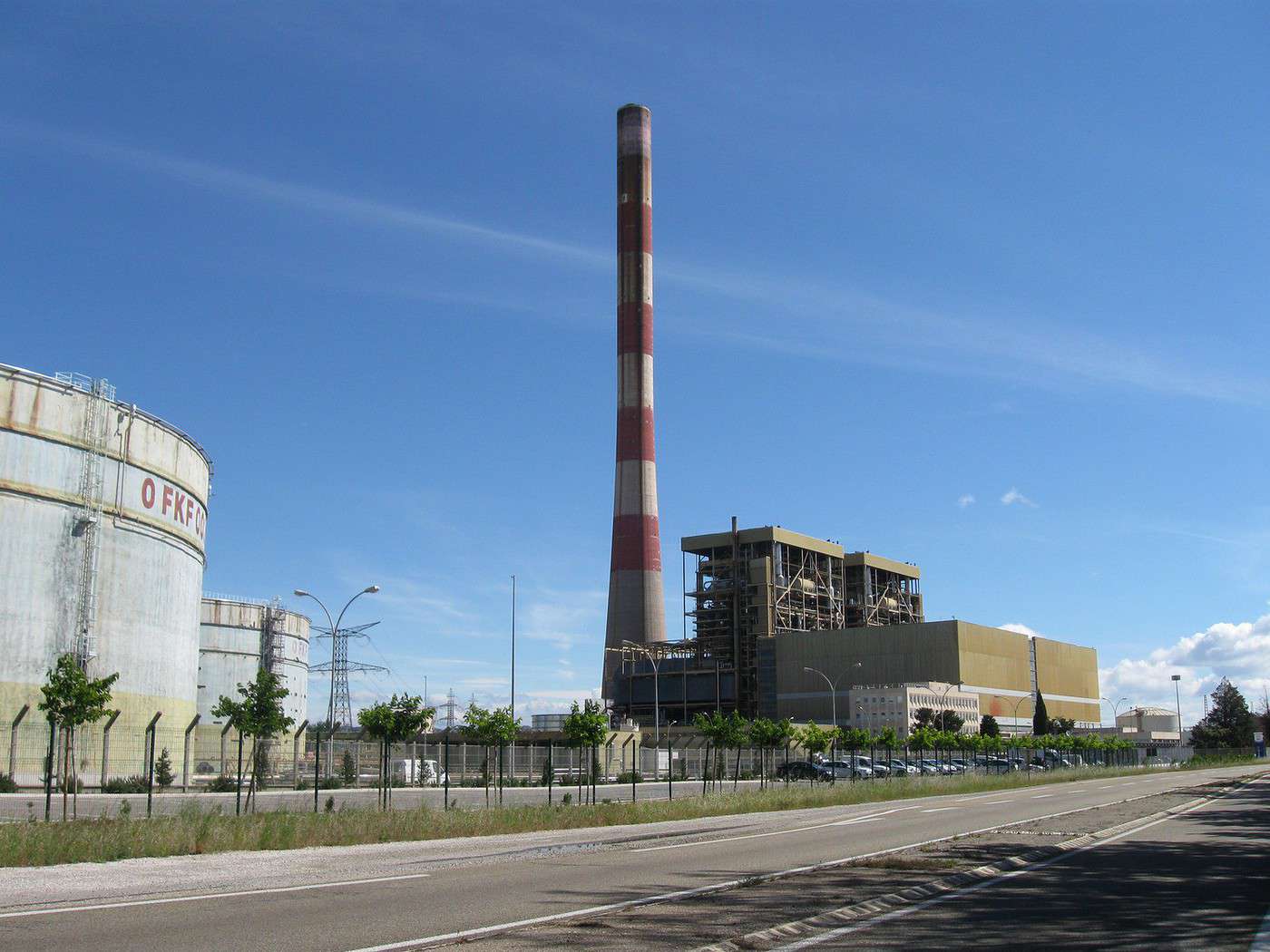
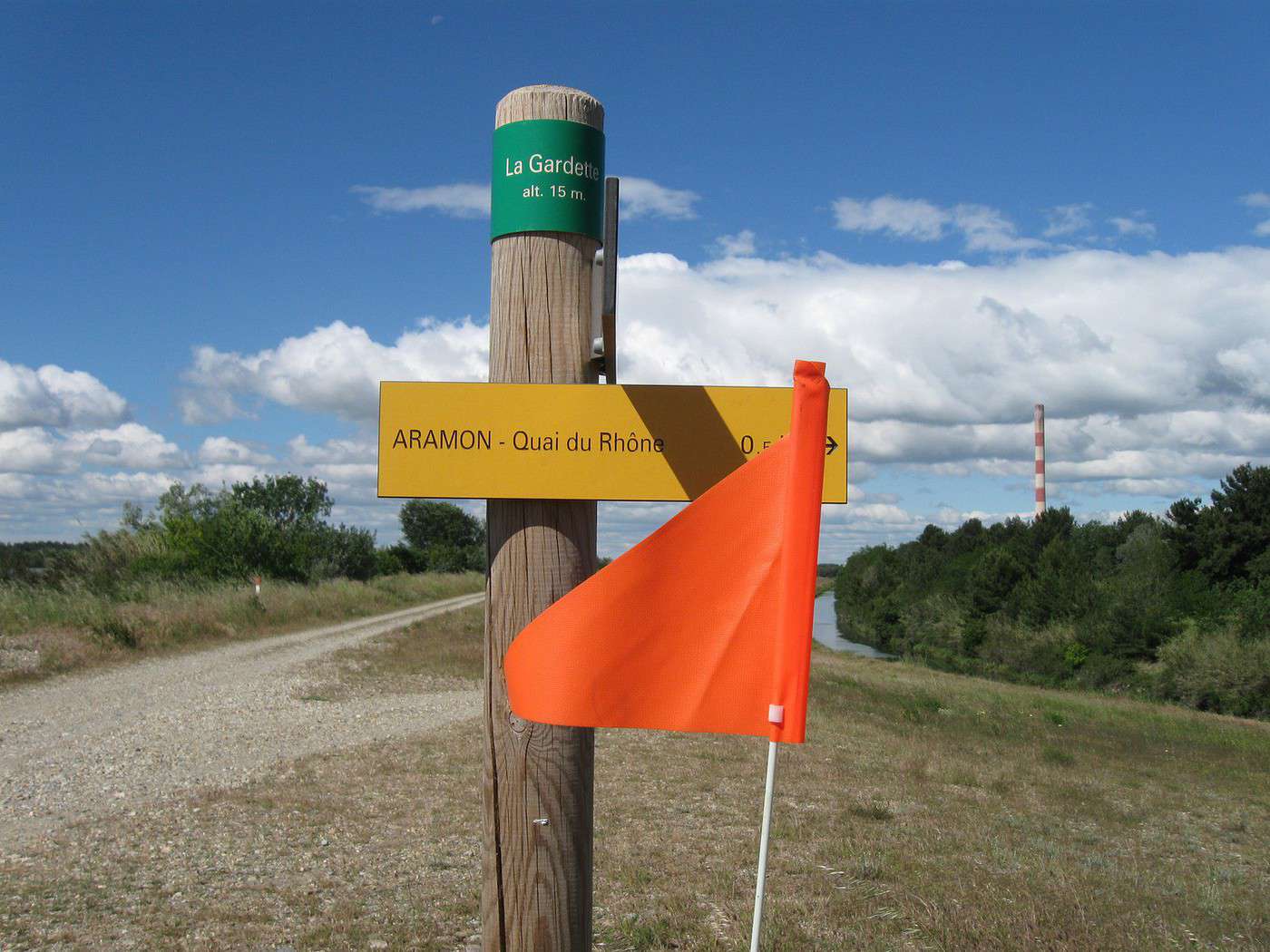
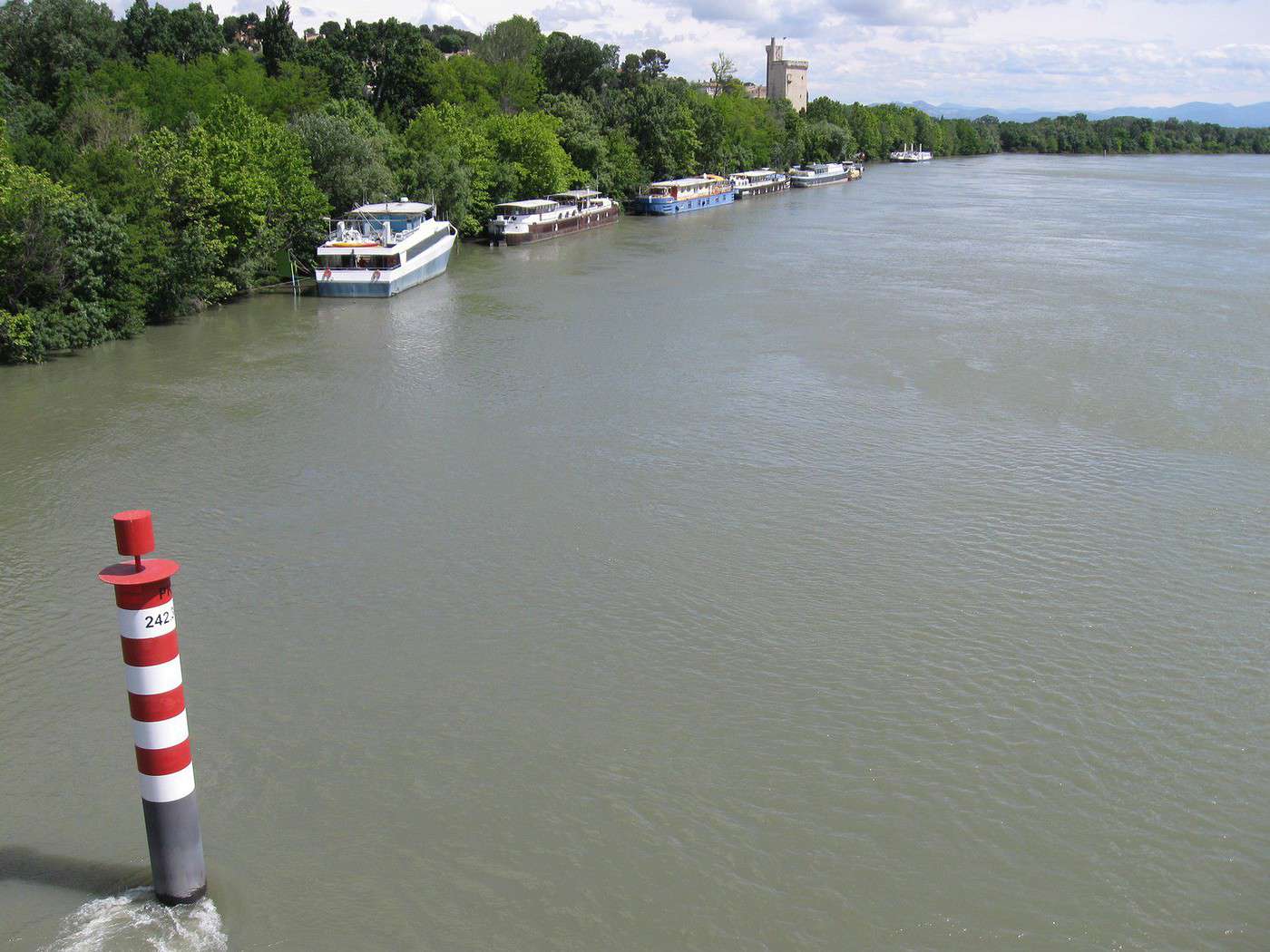
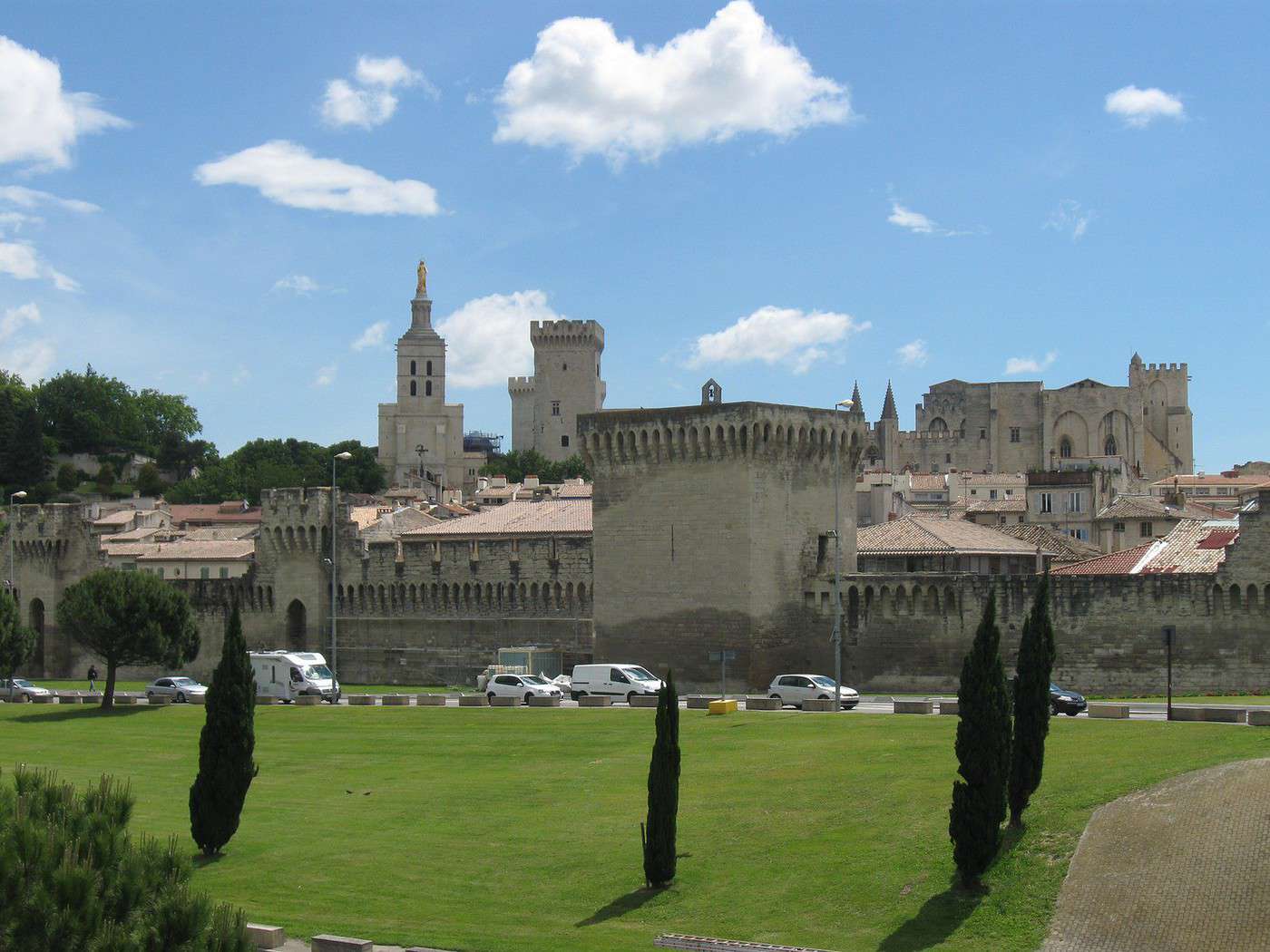
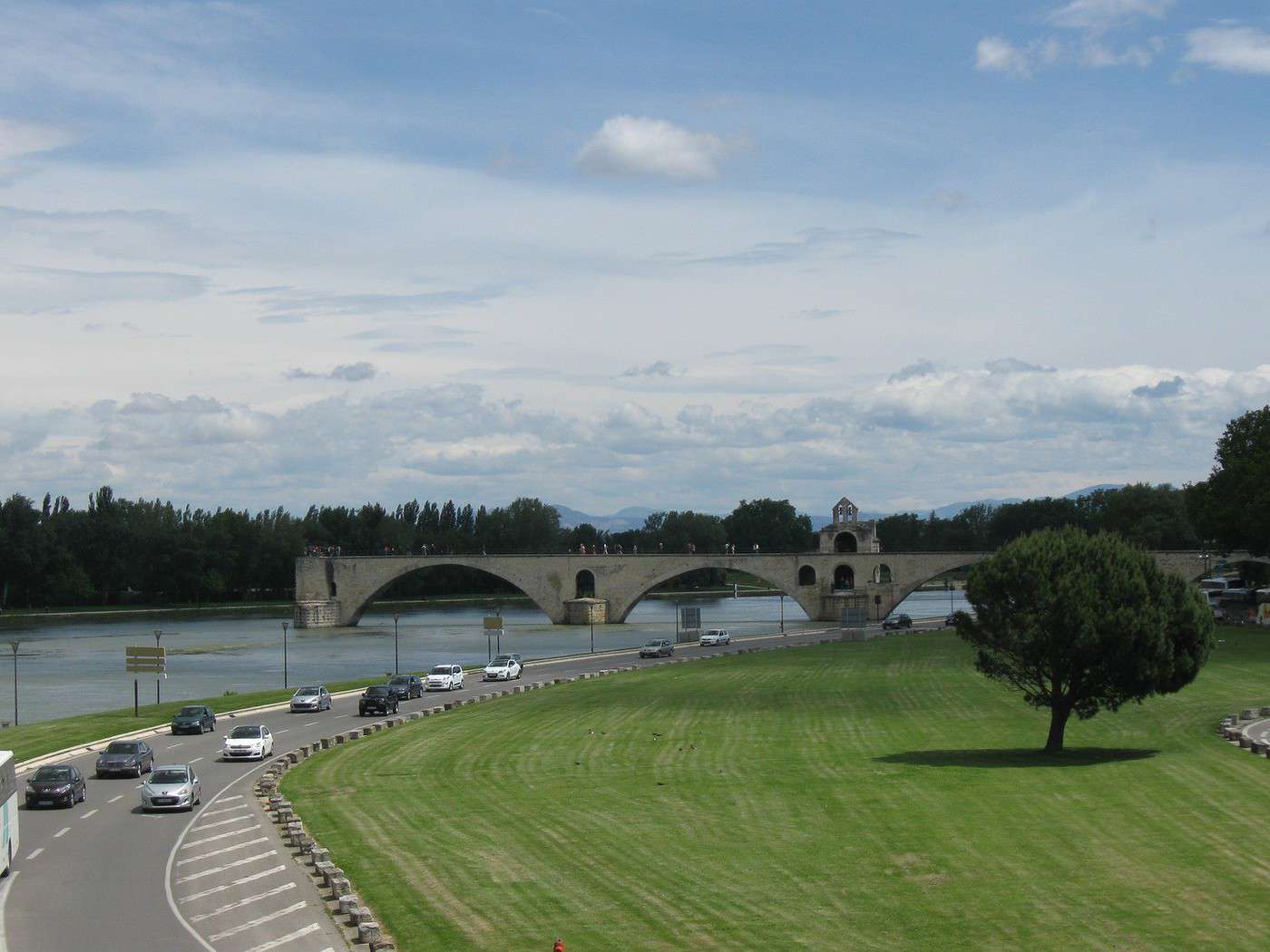
When I reach the oil-fired power plant in Aramon, I notice at least one truck passing me every minute. Can’t wait for a proper bike path. I’m tempted by the "halte nautique" sign, but there’s nothing but piles and construction equipment working on the bank. I’m surprised to be only 15 meters above sea level. The Rhône really has a gentle slope. Then I realize my second pannier is cracked too! While enjoying the last of yesterday’s cherries, I decide to call it quits and finish the trip by train. Riding against the wind isn’t worth the effort on this unmarked route. Giving up feels like popping a tire, but I suddenly feel relieved. I go from being a long-distance cyclist to a vacationer. In Villeneuve-lès-Avignon, I cross the Rhône. A recumbent cyclist is ahead of me. He has to carry his bike for a few meters because of broken glass. A river marker shows 242 km. Later, I learn that’s the distance to the Saône confluence, specifically from La Mulatière because upstream from Lyon, the Rhône isn’t navigable. I reach Avignon, which will be a great access point to the SNCF network. It’s really tough to cross the road to take a photo of the bridge or the Palais des Papes. At noon, the car traffic is so heavy it takes away all the pleasure of discovering the city. Luckily, as soon as you enter the old town, you forget about it—and the wind too.

On the news, I hear RYANAIR has been fined again: http://www.lesechos.fr/entreprises-secteurs/auto-transport/actu/0202798670880-proces-ryanair-le-parquet-requiert-225 000 € d'amende et la confiscation de quatre avions-571201.php So not all the news is bad! http://voyageforum.com/v.f?post=5968028#5968028
Mountain Biking (MTB) Along the Canal Between the Two Seas (France)

Facteur4 · 2013-06-08 · Message 163 of 310

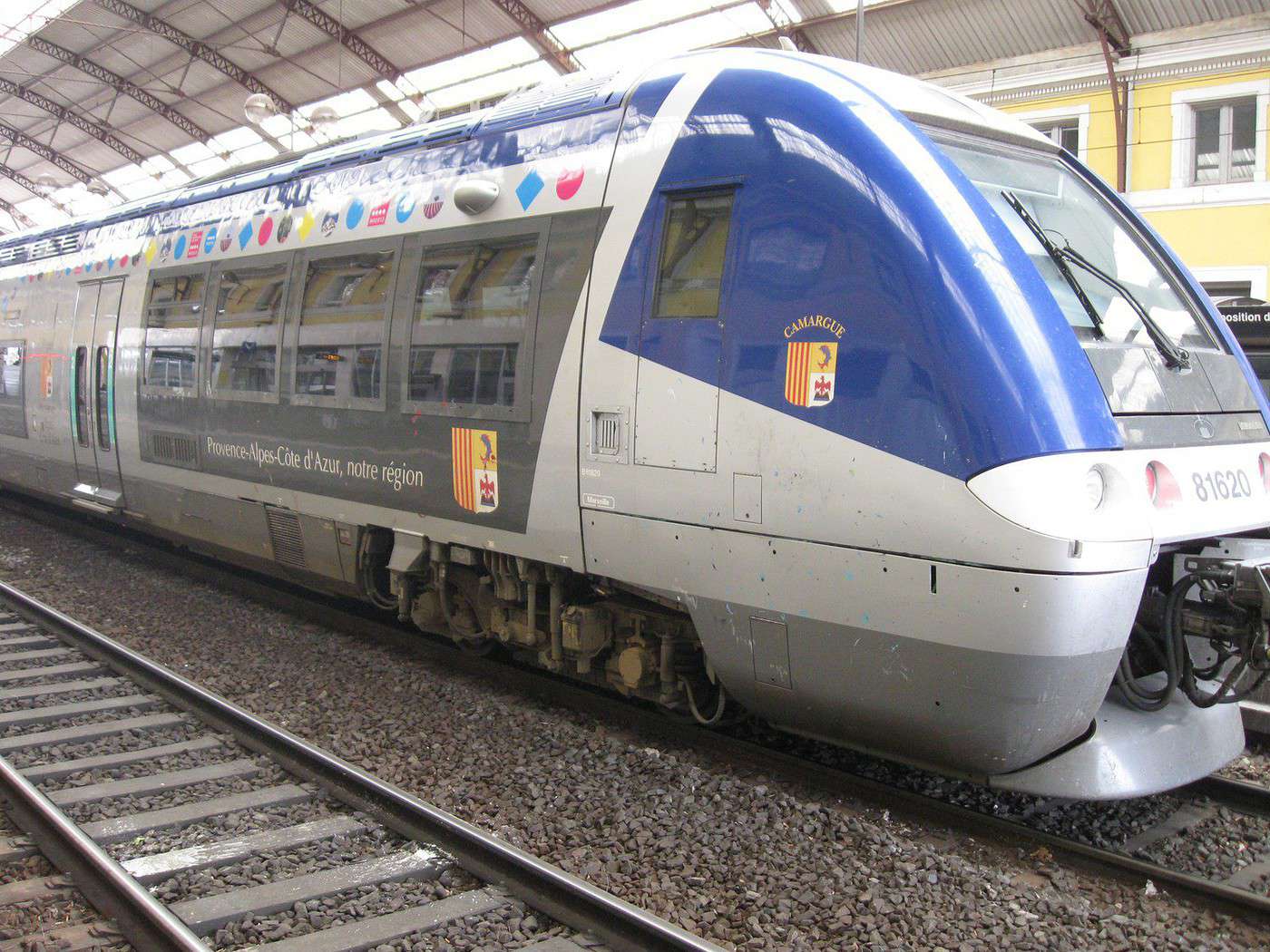
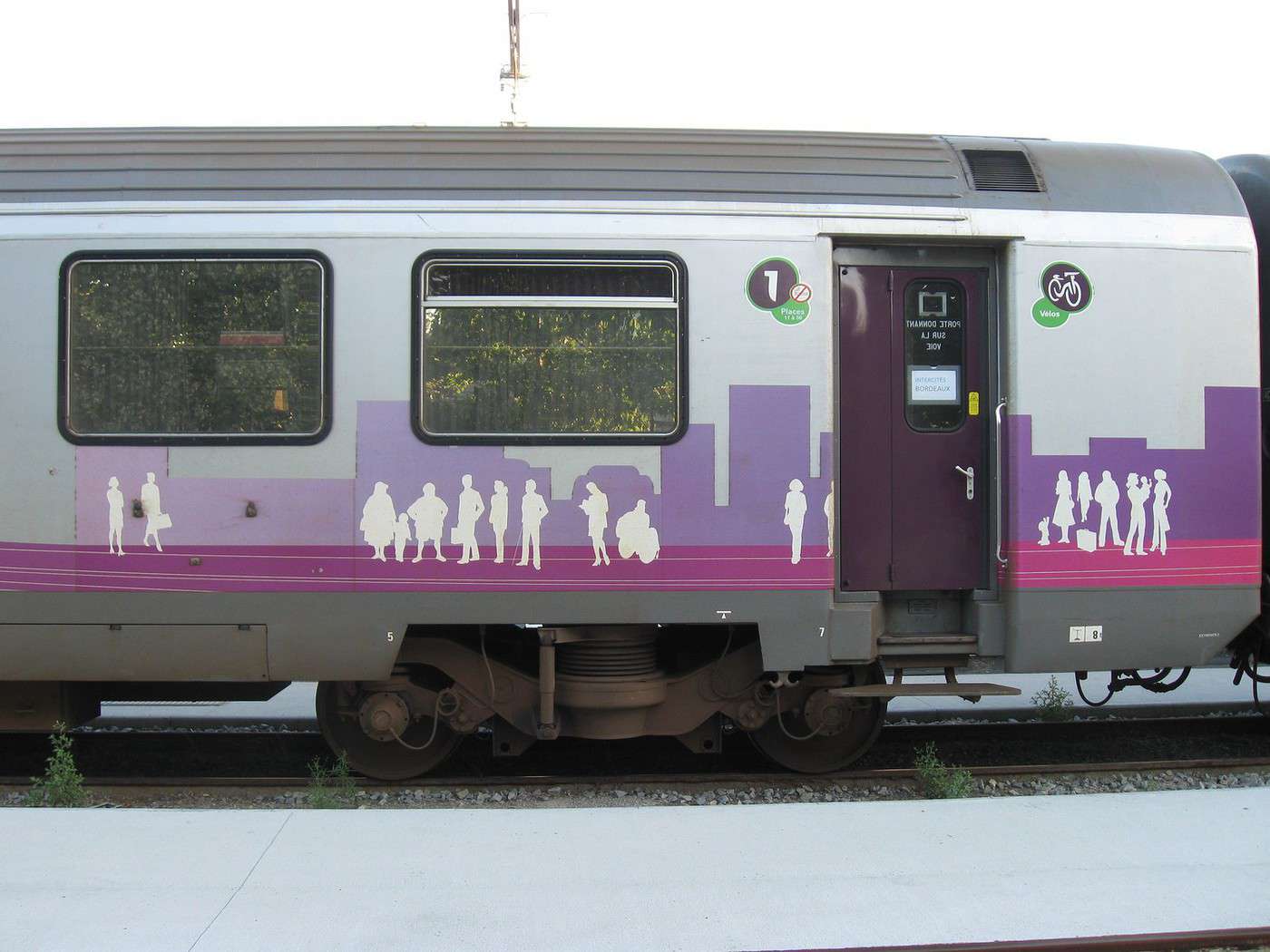
Day 6, Saturday, June 1, 2013 – Avignon to Lyon, 230 km by train. I’m worried it might be an Intercité (an old Corail train) since it’s coming from Marseille. Especially since I counted nine bikes that arrived after mine. A man with front and rear panniers doesn’t seem concerned. I can’t picture him hauling his fully loaded bike—complete with camping gear—up the two big steps through the narrow train door. Luckily, the Alpes Provence Côte d'Azur region funded some Bombardier TER trains with floors level with the platform. But I don’t see any bike logos. When I ask, the SNCF agent tells me the bike spot is probably in the middle. I just needed a magnifying glass to see the sign. After removing my panniers, I hang my bike on the hook, which would’ve been impossible for the camper. He tells me he hasn’t taken the train in years. He’s heading to the EUROVELO 6 route to eventually ride all the way to Prague. We chat the whole trip. Twenty minutes before arriving in Lyon, I notice no one’s gone into the restroom for a while, so I open the door next to us. I quickly close it and apologize to the woman inside who hadn’t locked it electrically. A young girl confirms she’s been in there for a quarter of an hour. Five minutes later, desperate for the beer that came with my sandwich, I press the sliding door button and ask if she’ll be much longer. She apologizes, explaining she had to change for work (mostly the makeup took forever). I leave her at the sink and mirror, lock the door, and relieve myself in the adjacent toilet. When I come out, my travel companion is passed out. Adding the final 230 km to the 477 km I’ve already biked, my goal of 100 km per day was perfect for starting the training on Monday. Only the Mistral wind messed up my plan.

Cycling (MTB) along the Canal between the Two Seas (France)

Facteur4 · 2013-06-08 · Message 164 of 310

Day 7 Sunday, June 2 Lyon

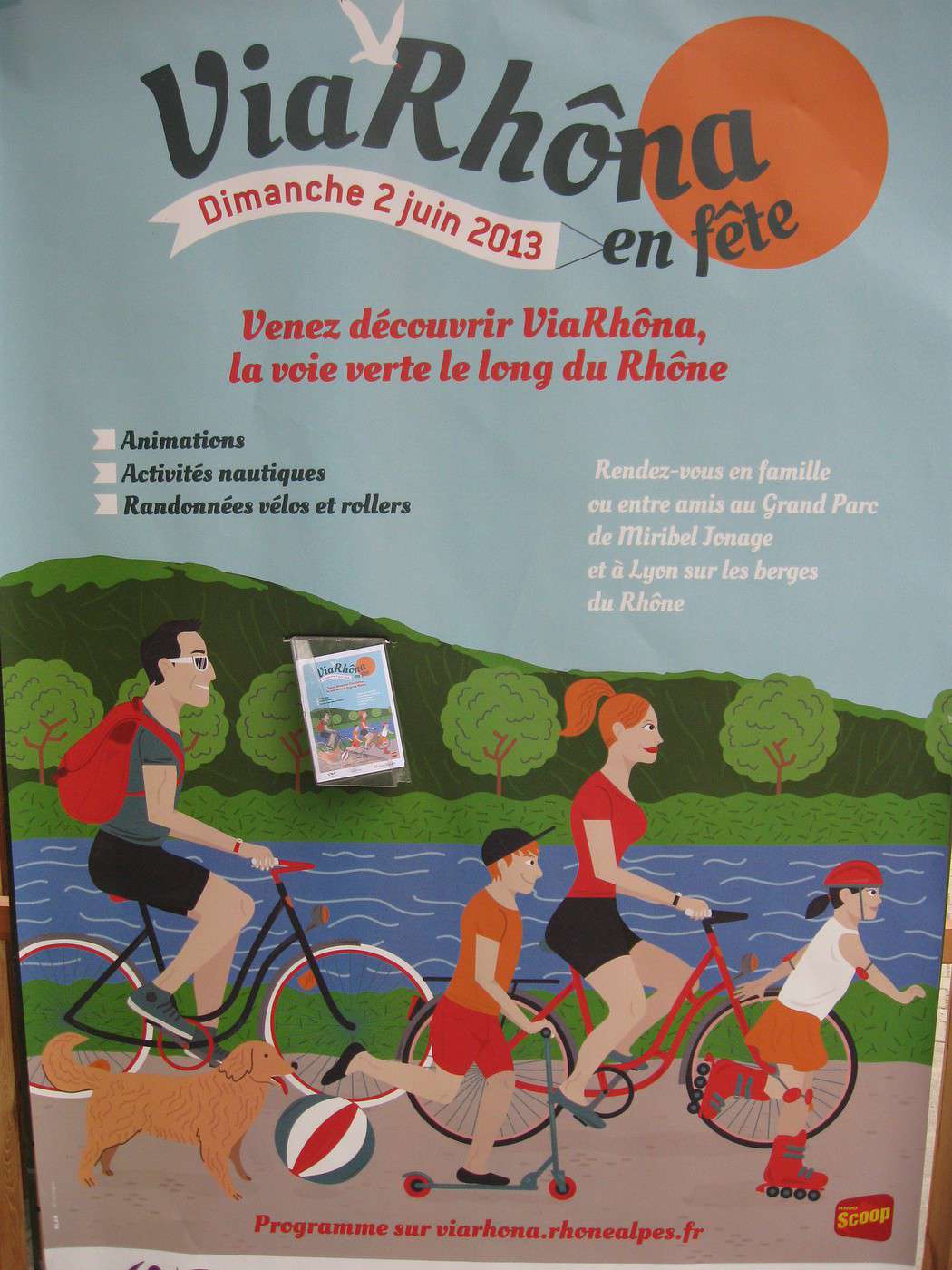
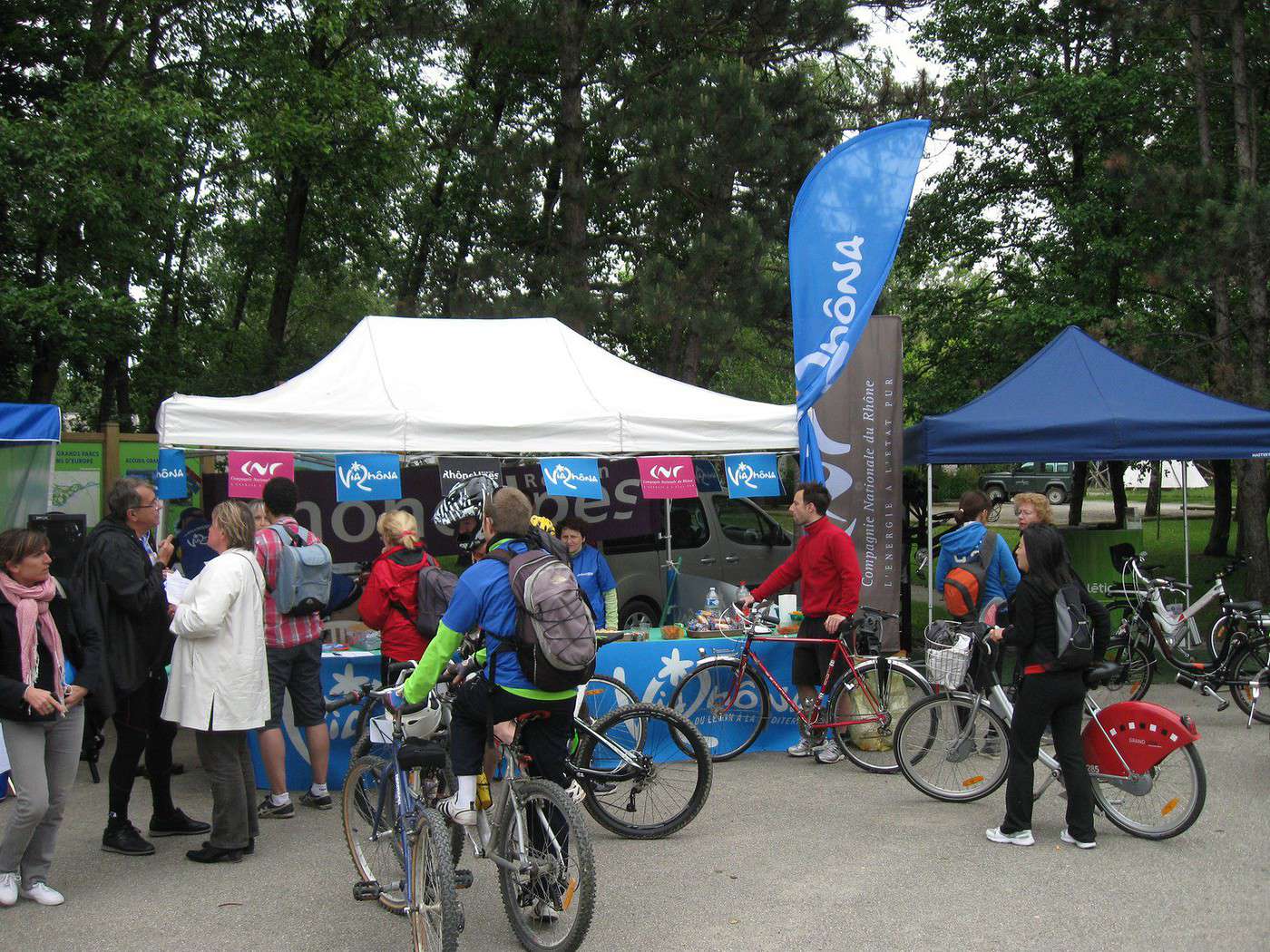
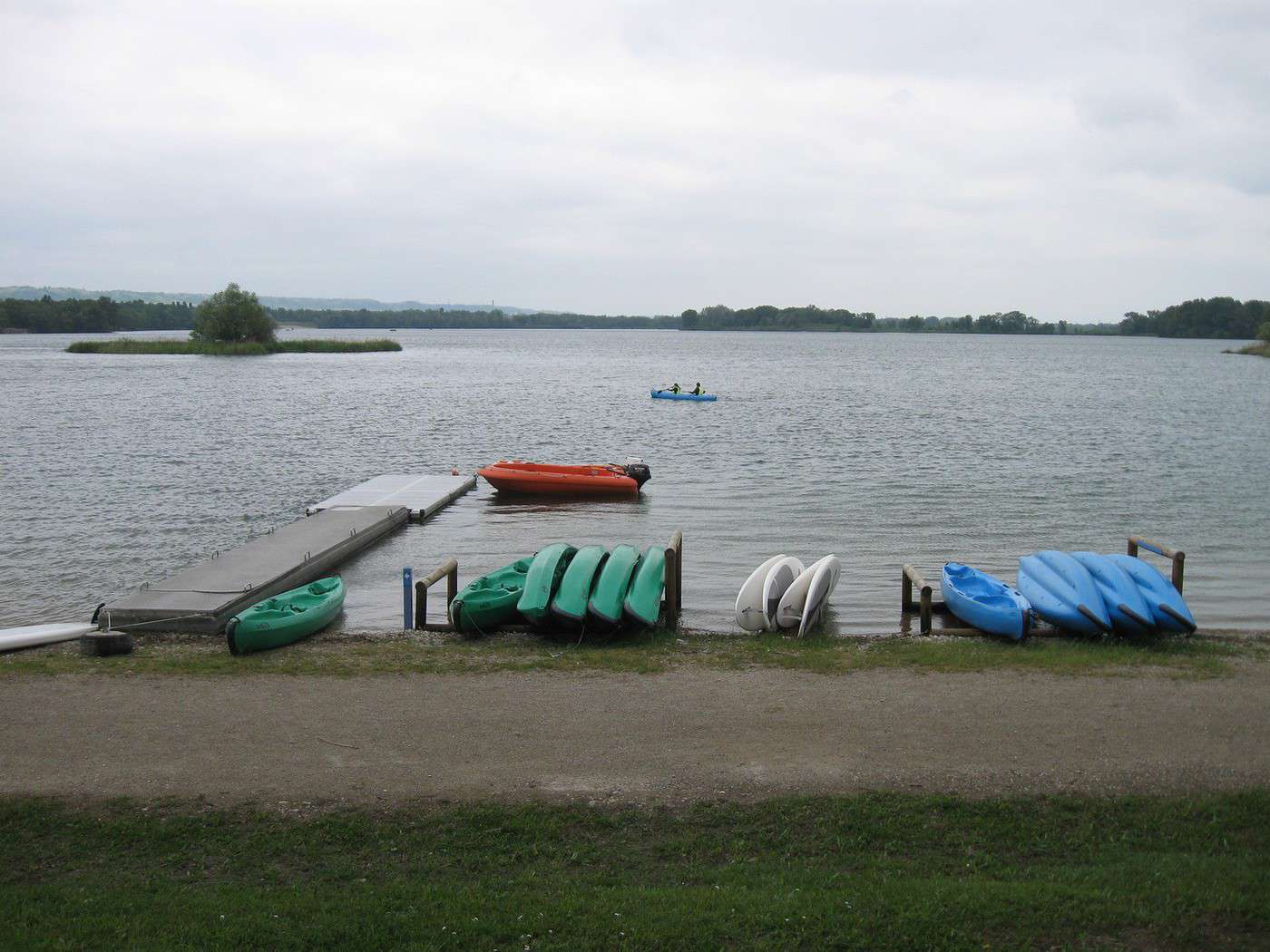
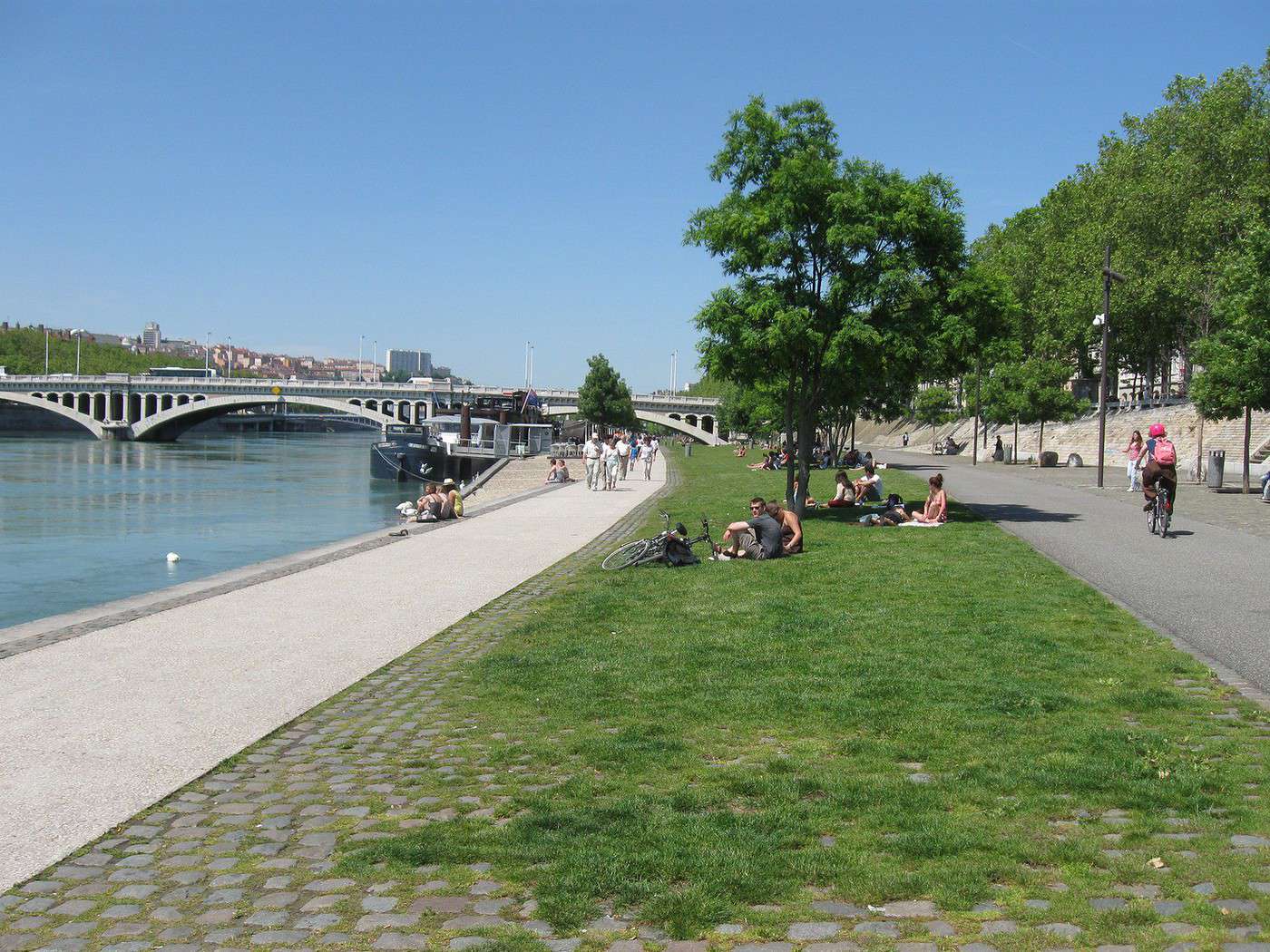
In my misfortune of not being able to explore the completed sections of the Léman-to-the-Sea cycle route, I’m lucky because today Lyon is celebrating the ViaRhôna. A few kilometers of the route have been set up for a cycling and rollerblading rally, with nautical activities and events. The entire path isn’t paved, but it’s really pleasant to ride. It’s signposted, though not enough—many cyclists get caught in the classic trap where two bike routes intersect, especially when you’re told to take a paved track and there’s no sign to continue on the ViaRhôna. With so many people turning up for this Greenway, I’m worried that those with limited stamina will get discouraged after riding kilometers in the wrong direction due to poor signage. I take advantage of the well-organized activities to go kayaking at the large Miribel Jonage park. I’m really lucky—I can buy the first issue of the magazine that just came out: http://www.revv-valence.org/images/stories/vvv/ViaRhona-DL/Viarhona-dl-2013-05.pdf It’s announced that the cycle route will be finished in 2015. I don’t think so. For example, this village whose land it’s supposed to cross has overturned the municipal council’s support for the bike path by forming an alliance of hunters and environmentalists…

Biking (MTB) along the canal between the two seas (France)

Facteur4 · 2013-06-17 · Message 165 of 310

Week of June 3–7, 2013 – Lyon, 113 km

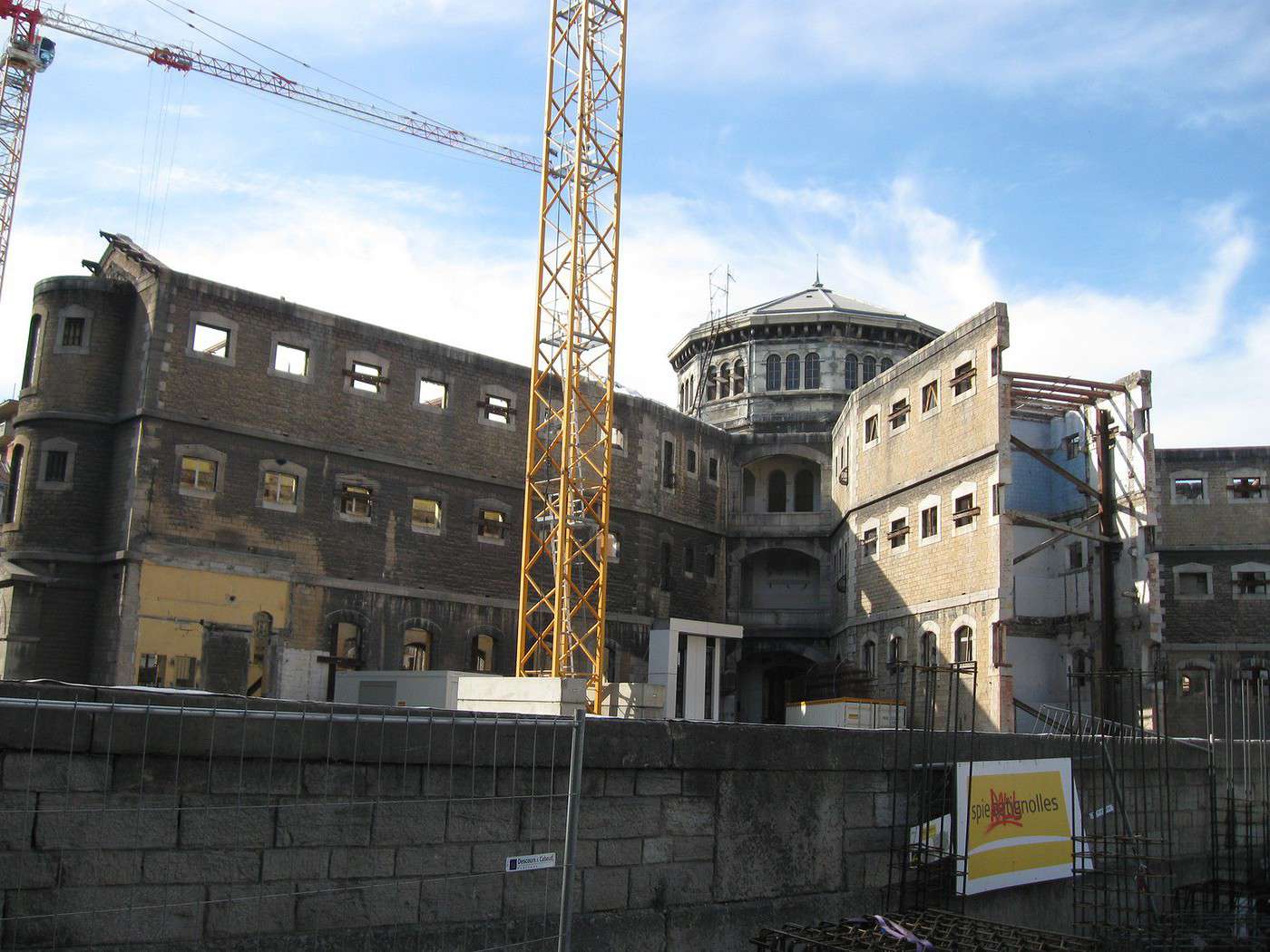
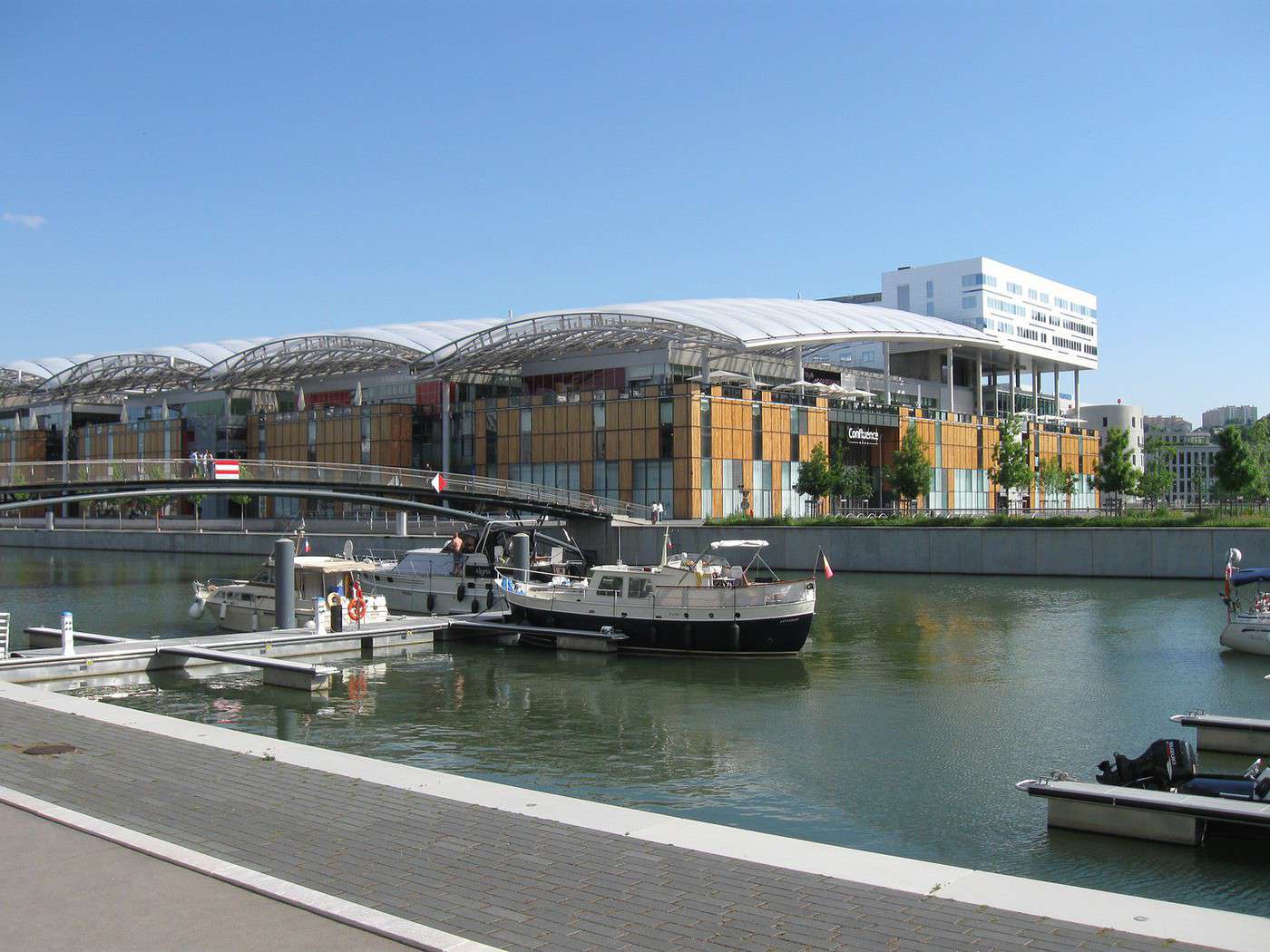
The advantage of having a bike is that I can stay somewhere cheaper than the downtown hotels. To cover the 8 km and get to CPE at Place Bellecour: http://www.cpe.fr/, I use my GPS in bike mode. It knows the bike lanes and the authorized contraflow streets, but the route it suggests is too complicated for me to memorize. Since three-quarters of my trip can be done on Avenue Santy and Avenue Berthelot, I choose that straight-line path on the following days. The first has a bike lane, but the second doesn’t—it’s already taken up by the tram line and two one-way car lanes. Quickly, I decide to take the tram tracks, just like other cyclists do. All you have to do is follow a tram. It pulls away, but I catch up at every stop. You might be tempted to follow it very closely to take advantage of its green wave (the traffic lights prioritize trams), but the trams are very short, and it’s pretty dangerous. It’s better to keep your distance and respect car right-of-way. This is easier because all the cross streets are one-way. You still have to stay alert, though—even if it’s less dangerous than in Bordeaux, where I once saw a bike collide with a tram (see September 13, 2010, from my trip: http://voyageforum.com/v.f?post=3804254#3804254). Drivers here are pretty tense. They’ve seen their number of lanes reduced, and with the success of Vélov’, bike traffic has increased: http://www.velov.grandlyon.com/. Beyond knowing the subject of the training inside and out, the two instructors are great teachers. Both are interested in my bike trip, and we chat about it during breaks and lunches. The first because he’s traveled the canals by boat, the second because he and his wife are buying a tandem. I end up giving him Claude Bandiera’s guidebook since I don’t think I’ll follow the Rhône before the véloroute is finished (or nearly so). I’m no longer pressed for time and will do it in retirement. Now I’m a few grams lighter. But since my saddlebag and the training documents weigh 1,850 g, I don’t exactly come out ahead when leaving the engineering school, which will soon move into the old prison in the new Confluence district.

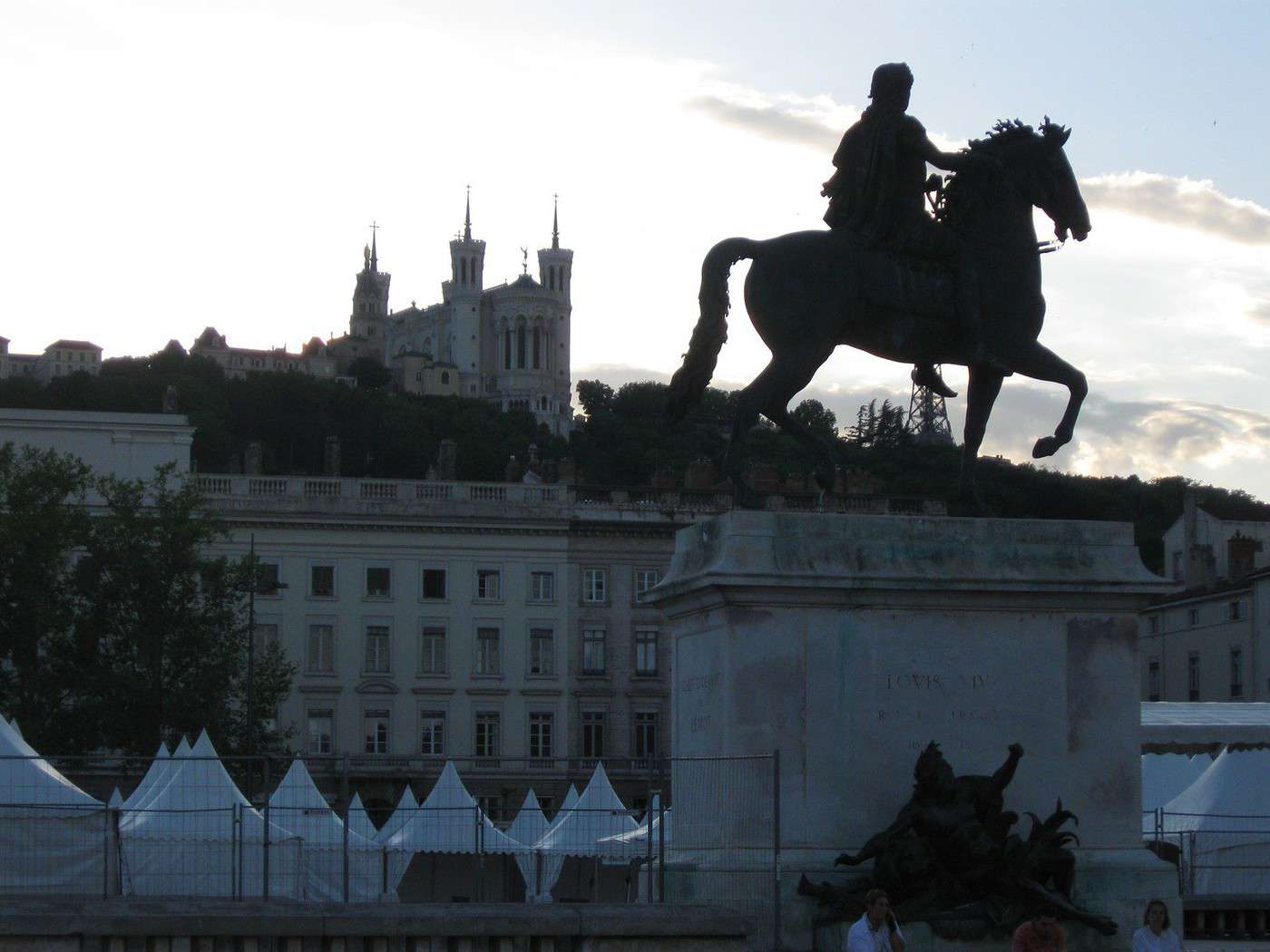
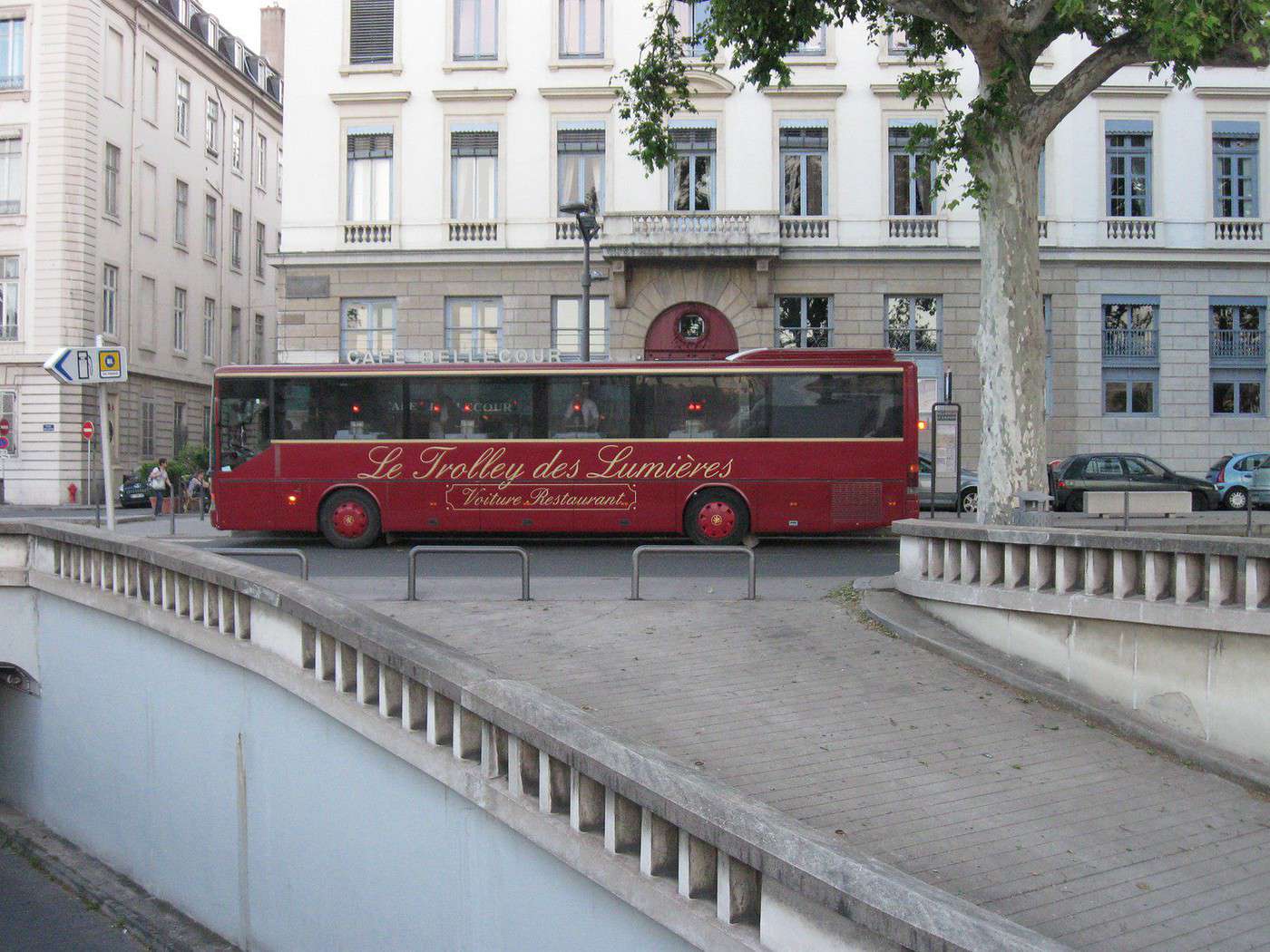
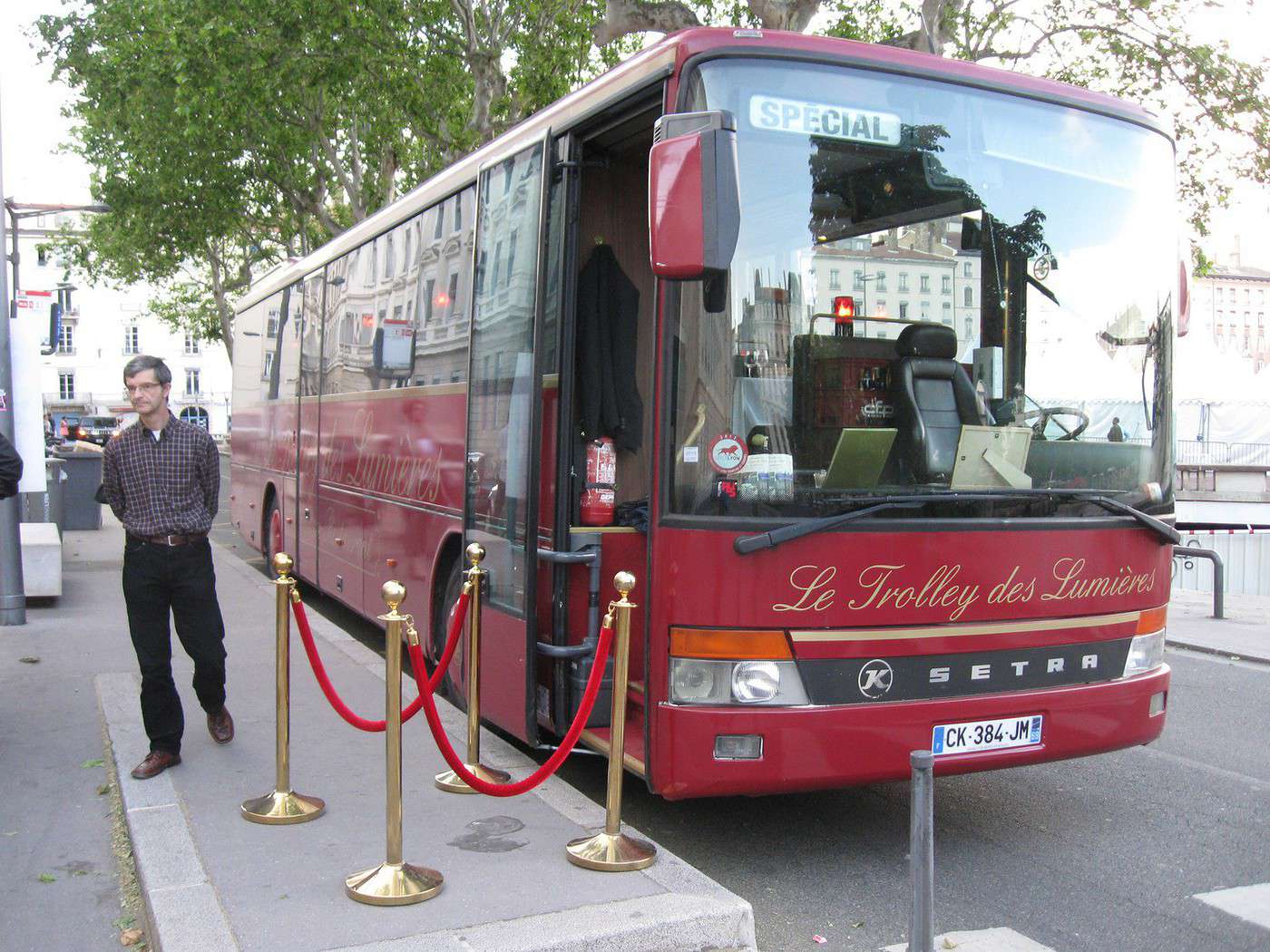
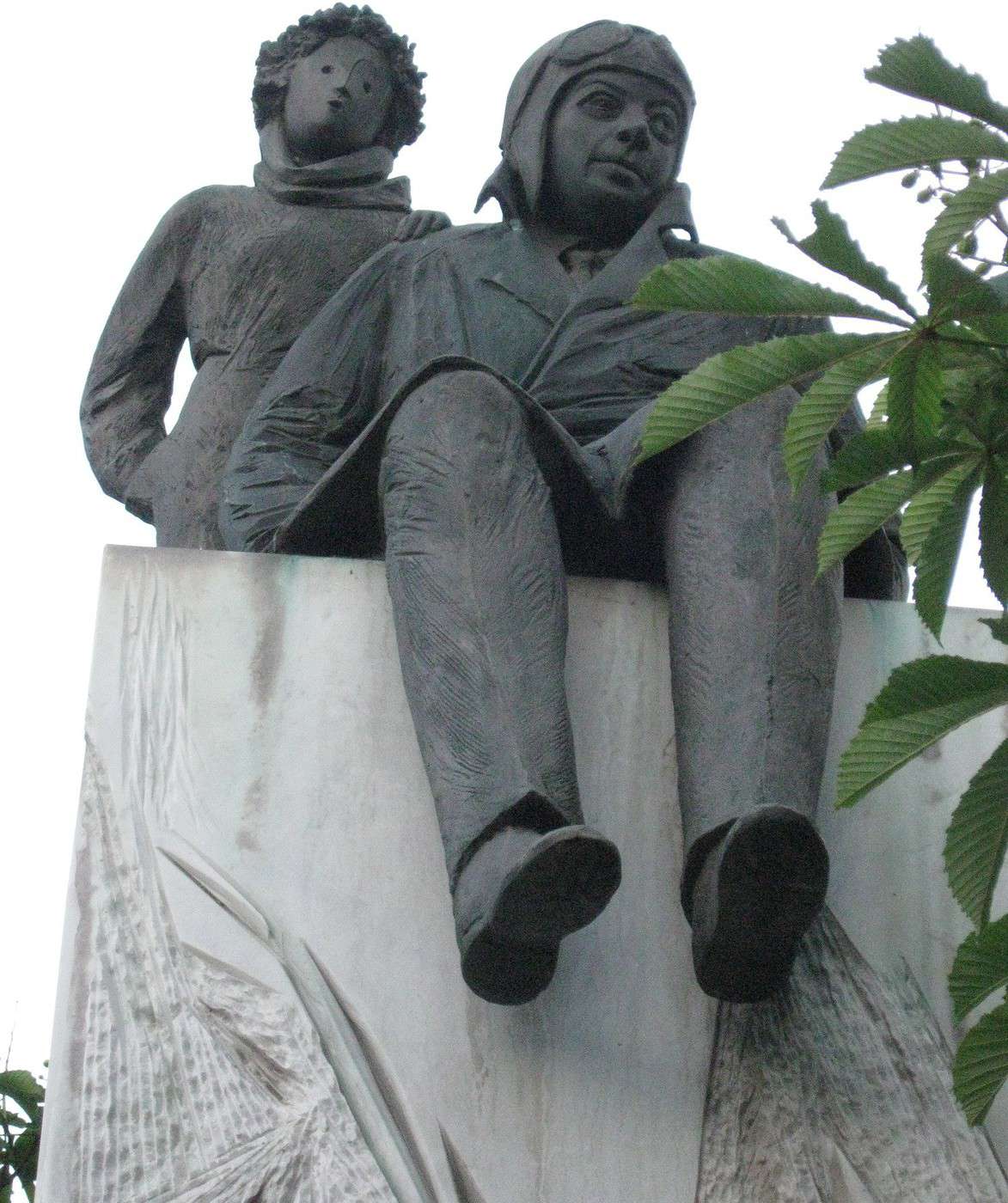
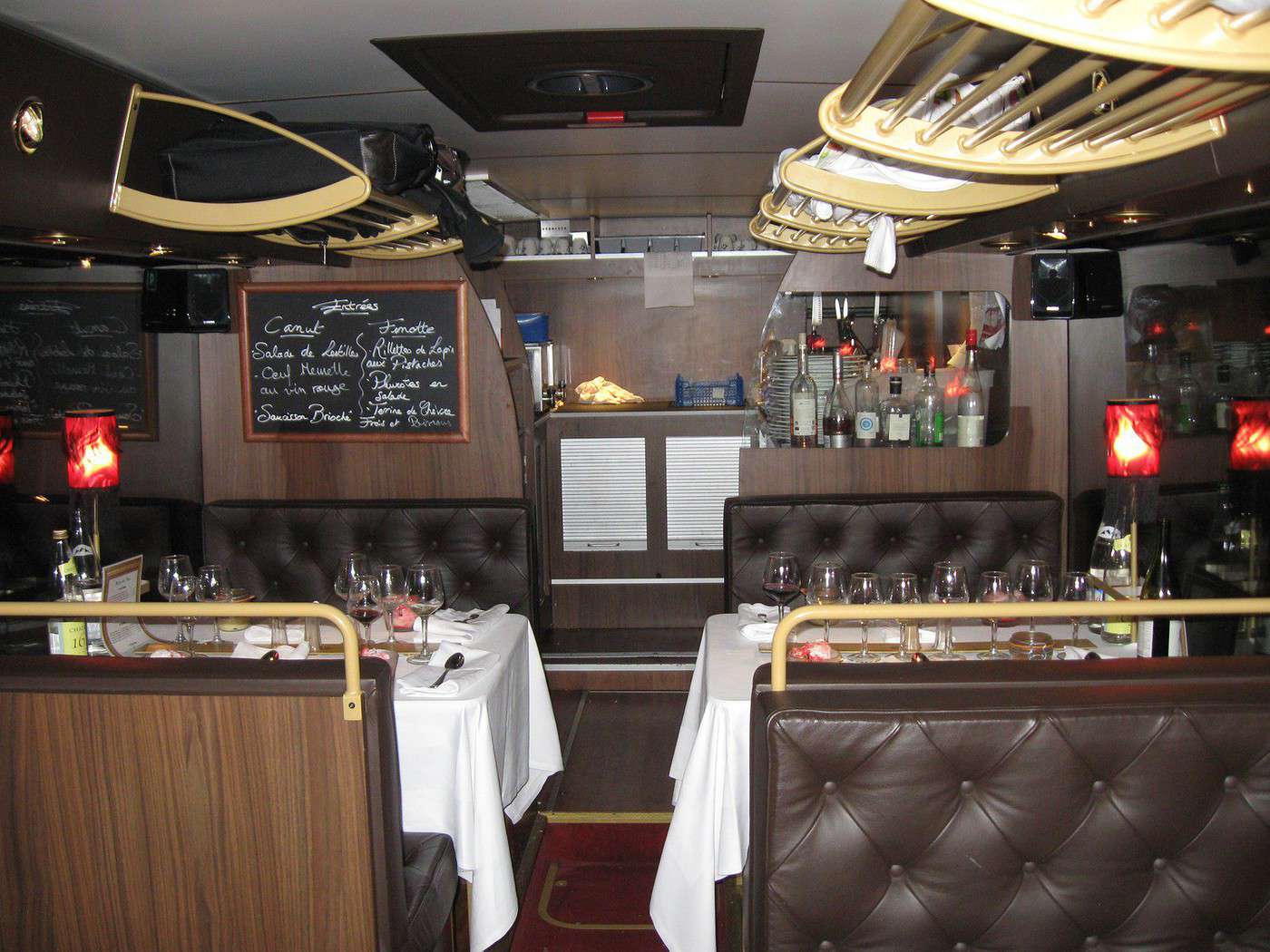
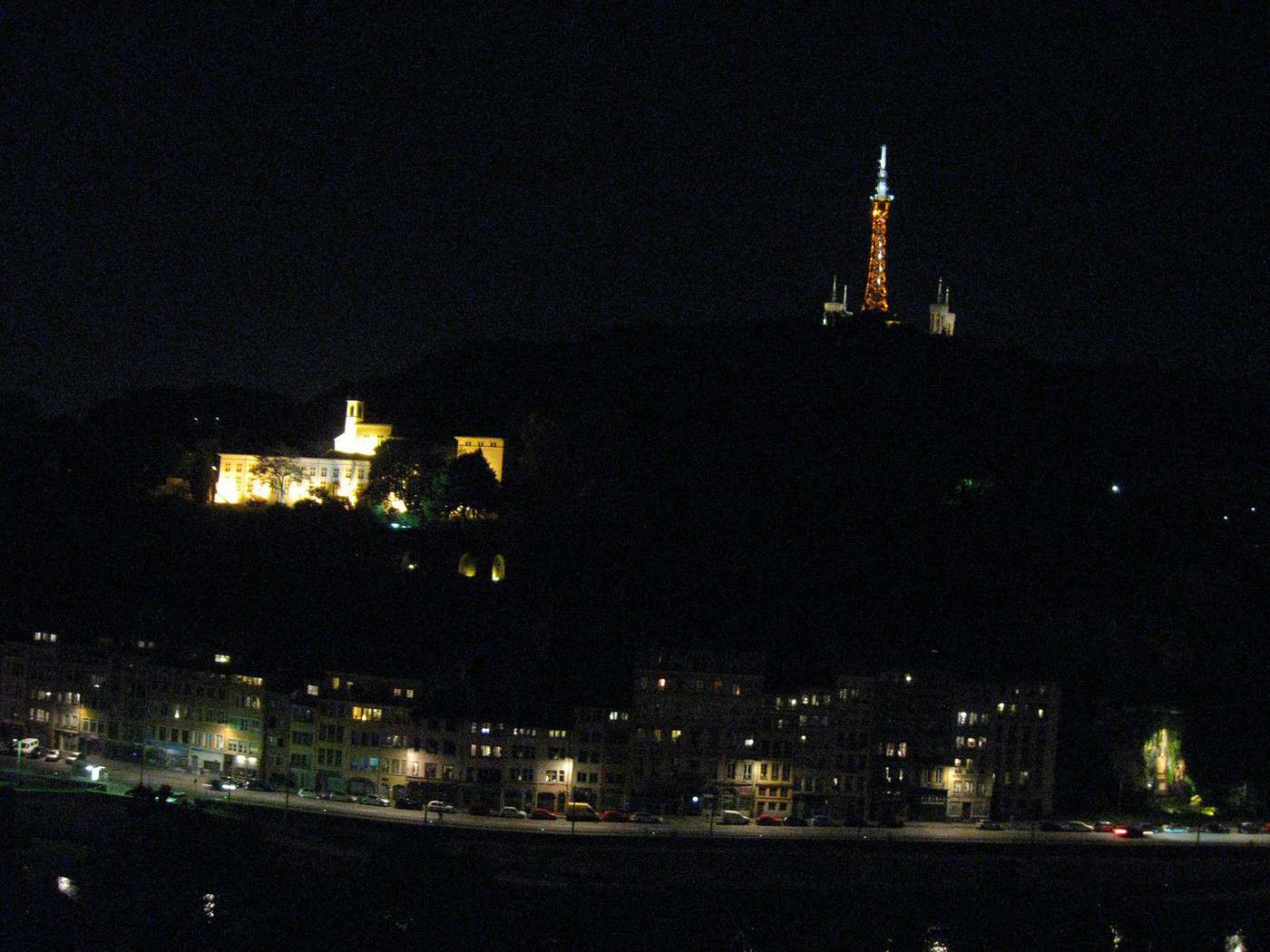
To wrap up, I’ll suggest a nighttime tour of Lyon: http://www.trolleydeslumieres.com/restaurant-fr-bus The tour starts at Place Bellecour. We meet at 9 p.m. near the statue of Saint-Exupéry (who was born nearby) and the Little Prince. We set off at 9:15. The downside at this time of year is that it’s still light out, so we don’t get to enjoy the lights of Vieux Lyon, where our route begins. The vehicle is comfortable, and the atmosphere is friendly, but there’s no trolley (which would limit the route if overhead wires existed). It’s actually a diesel bus—still too noisy and vibrating. Still, it wins over passersby (in their cars, on terraces, or on foot) who realize we’re having dinner. This is really where an electric vehicle (with batteries) would make sense—the diesel is just too ugly. For the meal, we have a choice of two starters. You have to pick your main course when you book. The logistics make sense. Before or after the stop on the heights, you choose your dessert based on how fast the service is moving. I don’t have an unforgettable memory of the meal, but I’m won over by the sparkling rosé: http://www.grandsbourgognes.com/bugey-cerdon-rose-methode-ancestrale.html Since it doesn’t seem possible to buy directly from the producer, the next day I order the 9 available bottles from this site. (After a week, I get a promotional email from Grands Bourgognes. I’m surprised by how quickly they sent it—and how slow they are to update me on my order. In response, I learn my package is being returned due to breakage. After 15 days, my undamaged package will be resent. It’s a wine called Désiré. Will it arrive in time for my wife’s birthday? Will there still be bubbles left?)

Mountain Biking (MTB) Along the Canal Between the Two Seas (France)

Facteur4 · 2013-06-22 · Message 166 of 310

Saturday, June 8th – 671 km by train

Since I booked early, I managed to get a reservation for my bike on the TGV from Lyon to Montpellier for 10 € and an additional 10 € for the Intercité from Montpellier to Toulouse. It’ll be free on the TER to Valence d’Agen. I decided not to leave Friday evening to avoid the crowds with my bicycle during train changes. I arrive at Part-Dieu 45 minutes before the scheduled departure at 07:10. I prefer to have breakfast at the station now that I’m sure I won’t miss the train. I take an elevator down to the platform and reach car 8, where my reservation is. You don’t board the train directly—you have to go downstairs because it’s a double-decker TGV. I confirm that the TGV Duplex doesn’t accept bikes since there’s no designated space. I ask an agent, showing her my ticket. She tells me to wait while she checks with her colleague. After stowing my panniers inside, I wait on the platform to avoid blocking passengers from reaching their seats. Two minutes before departure, I carry my bike up the stairs to the first floor and lean it against the luggage. The conductor explains that this wasn’t the train originally scheduled—it was supposed to be an older model. I tell her it doesn’t bother me, but it might inconvenience other passengers. I even have to explain my situation to some who think I’m in the wrong.

In Montpellier, like everywhere else, the Intercité is made up of old "Corail" cars. I leave my bike to stow my panniers inside. Then, with my handlebar bag and stage bag slung over opposite shoulders, I carry my bike up the two steps, squeezed by the accordion door that’s just waiting to close. Luckily, a man helps me board and tells me I got on from the wrong side. I have to cross the entire corridor that leads to the compartments. He carries my panniers for me. In the rush, I forget my safety flag pole, which always gets stuck during transfers. We sit near the bike storage area, where there’s already a cyclist from Eastern Europe. It’s impossible to hang the bikes because the upper bar with the hooks was torn off. The three of us chat pleasantly until the conductor arrives. Since the Eastern European cyclist doesn’t have a ticket, he can’t avoid the fine. The guy who helped me explains all the tricks to know when you’re on a tight budget. Now, with 10 SNCF fines in a year, you can go to prison. So it’s best to avoid accumulating them. You should anticipate and tell the conductor, for example, that you only have 20 €. For this time, you need to write a letter admitting your mistake and pay a small amount to stop the procedure. It seems that hardship brings people closer together, and I’m also surprised by his analysis of the world’s situation from both social and ecological perspectives. I wish him a good stay in Saint-Girons and success in his project to partner with landscapers to build dry stone walls using traditional methods.

Coincidence: The Toulouse bike association is holding the last planning meeting this Saturday morning for the activist ride along the Pyrenees foothills, which I’ll be joining in early July: http://toulousevelo.le-pic.org/randovelosud2013/ I won’t be able to attend, but since I arrive at Matabiau at 12:10, I’ll share a meal with the organizers. Before leaving Toulouse station, I put on my rain jacket because it’s starting to drizzle. By the time I cross the avenue, it’s pouring. Luckily, I only have a few meters to wait for the Maison du Vélo and its restaurant, *Le Vélo Sentimental*.

A beer is welcome while I wait for the activists. I give Julien Savary, the organizer, a copy of the *Viarhôna* magazine, which he didn’t know had come out. He knows Albert Cessieux, a fellow AF3V member who wrote a long article about his descent of the Rhône. He tells me the greenway project along the Canal du Rhône à Sète has been approved: http://www.af3v.org/

After the meal in a friendly atmosphere, I have 3 hours before the next TER to Valence d’Agen. I’m weighed down with my gear. I had thought about using the new bike station at Matabiau, which just opened on the 6th: http://www.ladepeche.fr/...aces-a-matabiau.html But it’s reserved for subscribers (commuters) and not accessible to passing cyclists. That’s too bad—I would’ve liked to promote it, and I think it’s empty on weekends. Especially since I received an ad inviting me to try it for free. After asking, I find out you need a 30 € deposit to get a badge. A CPE teacher told me that in Lyon, you can access it with a credit card.

Since I saw a "Free WiFi" sign when I got off the Intercité, I settle on a bench on the platform and take out my 10-inch laptop. While uploading photos (you can see the titles—I added them for you—by hovering over them), I continue this story. After 2 hours of work without physical activity, I’m cold. I reattach my bike near the Paul shop and buy a tea and a chocolate fondant. Since it’s burning hot, I add some water from my bottle. But it’s not enough to quench my thirst, so I ask the server to add more water to my tea bag in the cup and also get a pistachio macaron.

On the platform used by TERs that terminate in Agen, there’s a train on the first track and a crowd on the second. That is, until the announcement about the display error causes a migration. At the first stop, 5 people who wanted to get off through the door near the bike hooks are stuck on the train because the door won’t open, and they don’t have time to reach the other end of the car before departure. At the next stop, I advise the people about to get off to use the other exit while the conductor, with her square key, tries to unlock the door. At that moment, a man presses the external control, and the agent’s finger gets crushed between her key and the door frame. She holds back from screaming. After the train starts moving, instead of asking about her condition, I ask if she thinks the door will open next time. I don’t want to end up like the first passengers. It’s impossible to cross the car with the bike and luggage. In the end, I’m more exhausted from a day on the train than from biking…

Biking (MTB) along the canal between the two seas (France)

Facteur4 · 2013-06-22 · Message 167 of 310

Summary:

Another 600 km covered without a flat tire. However, my panniers started to crack, and I haven’t heard back from my retailer about whether they can be repaired. If I managed it, it’s because I was off work the week before my internship. Since I work 40 hours for 7 weeks, I don’t work the 8th week. Thanks to the socialists and the 35-hour workweek—so often criticized—I was able to support hoteliers and restaurant owners along my route. Those who suggest working more, especially by cutting public holidays, should consider the tourism activity generated for others by days off for some. In the end, I’m happy with my trip, even if I didn’t reach my goal in the time I’d set. Of course, better weather would’ve helped, and more bike lanes would’ve made the route safer. I could’ve enjoyed the Viarhôna more by taking the train to my internship and biking back—it would’ve been enough to send the documents via La Poste.

What was the essential accessory for this journey? I’d say the rearview mirror, then willpower, and above all, motivation. Everything our elected officials aren’t lacking when it comes to the energy transition, inviting us to the debate: http://www.midipyrenees.fr/...ansition-Energetique

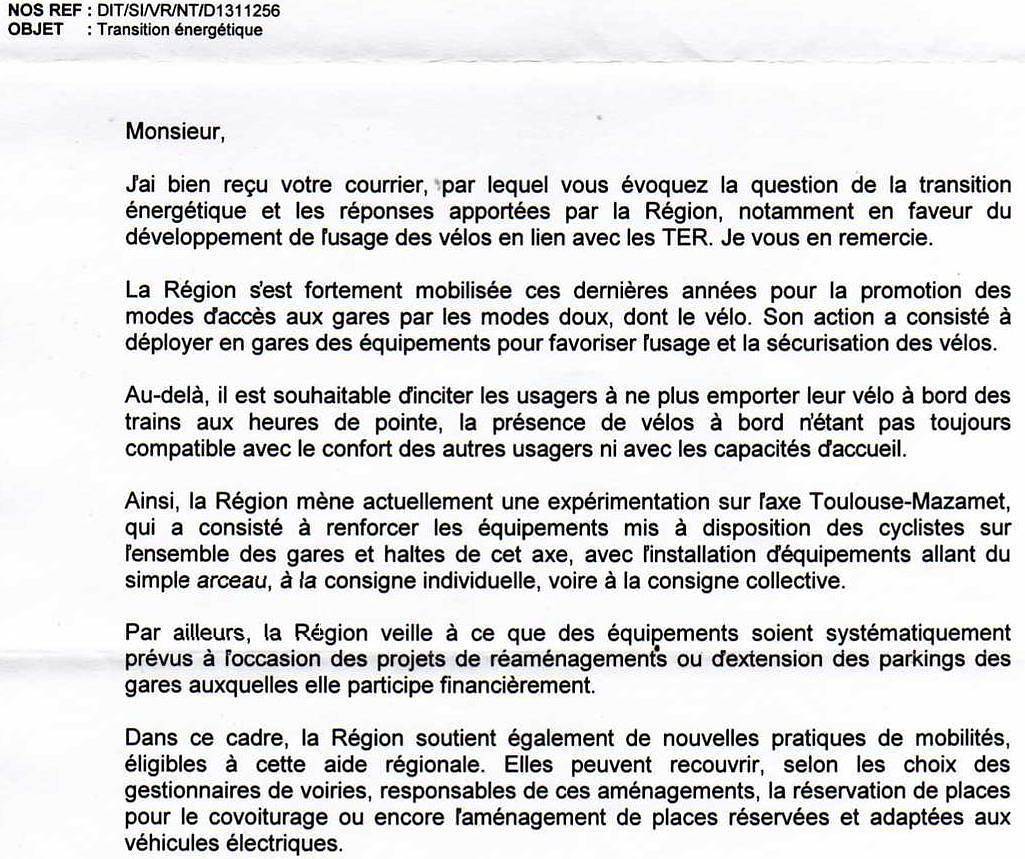
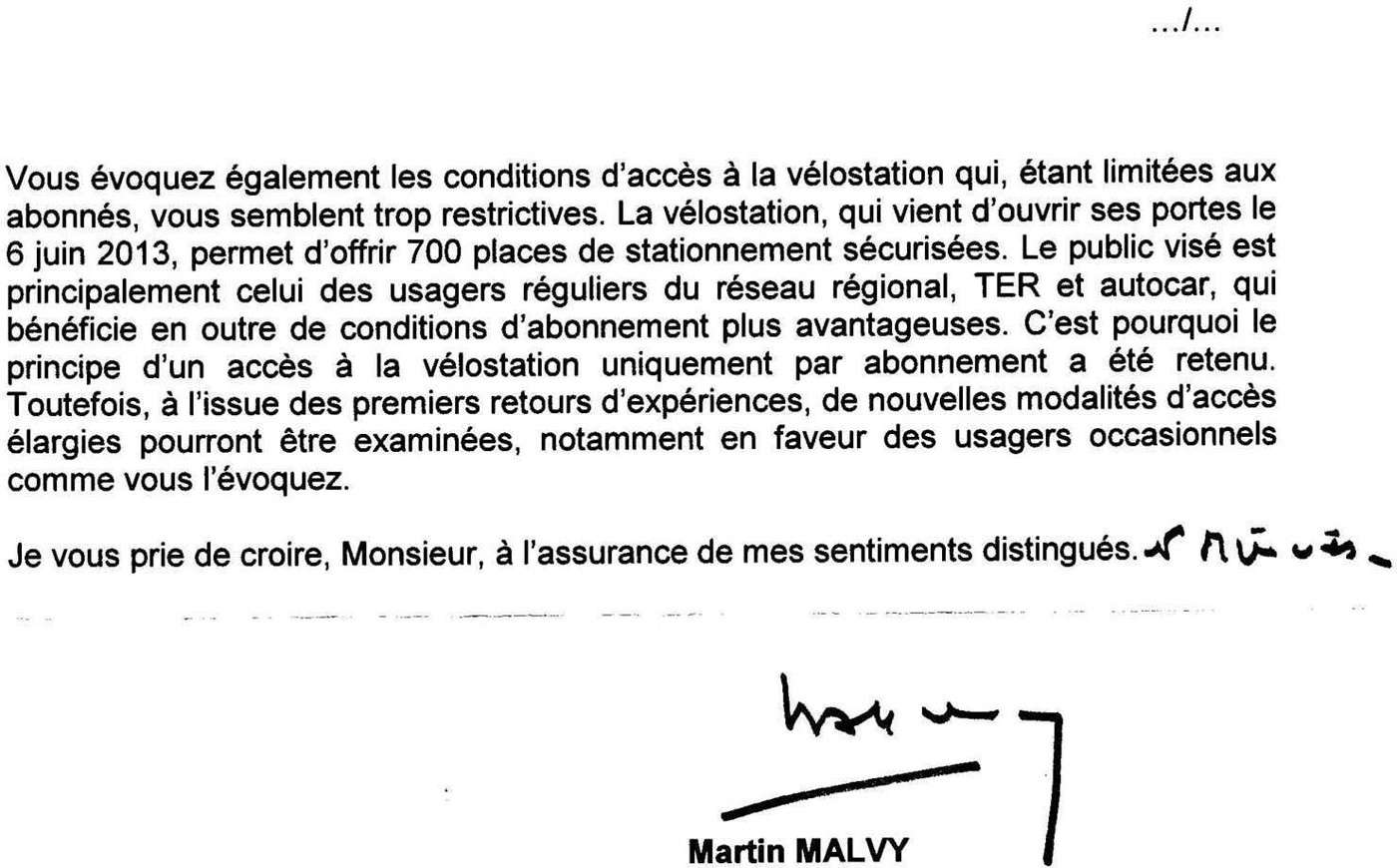
Here’s the letter I sent to Martin Malvy:

Gilles ROULAND 4 rue Pierre Perret 82400 Valence d’Agen June 14, 2013

To Mr. President of the Regional Council of Midi-Pyrénées

You stated in the press that Midi-Pyrénées is the most advanced region in the energy transition.

Indeed, investments have been made for TER trains, and train access is easier thanks to subscriptions, reduced fares for young people, the unemployed, and weekend travelers. I congratulate you on the bike path along the Garonne lateral canal and other greenways reserved for soft mobility. Bravo for creating the bike station at Matabiau. However, it’s not accessible to passing travelers. On Saturday the 8th, in Toulouse for a bike association meeting, I couldn’t try it even though I would’ve liked to promote it. It’s only available to subscribers. It makes sense that they have priority for their daily commute, but I assume it stays empty on weekends. In Lyon, you can access it with a credit card. Still, a lot remains to be done to make bike access to trains easier (lack of information, steps and narrow doors, bikes banned in TGV Duplex…). For example, no train accepts bicycles between Toulouse and Biarritz, forcing cyclists to go through Bordeaux. These two modes of transport should be combined to enable the energy transition.

I’m also surprised that my region doesn’t offer aid for purchasing an electric vehicle, while Alsace or Poitou-Charentes, for example, encourage buying clean vehicles. I’d like to buy a RENAULT Zoé. Of course, its range is limited, but above all, the manufacturer only allows recharging the batteries with a specific cable matching public charging stations. It’s very restrictive because you can’t recharge at family’s, friends’, or even at a hotel on a standard electrical outlet. Since there are hardly any public charging stations, it would be harder for me today to go from Valence d’Agen to Lyon with a Zoé than by bike, as I just did for my internship last week. Yet by bicycle, it’s not easy and sometimes very dangerous (due to lack of bike lanes). Even returning by train is complicated. I recounted this third professional trip by bike here: http://voyageforum.com/v.f?post=6005558#60055...I describe all the difficulties I faced in my effort to reduce the carbon footprint of this trip. We must stop believing that pollution is acceptable because it’s for work. I therefore ask you to support these pioneers—early electric vehicle users—by offering an incentive grant to take the leap while the infrastructure doesn’t yet exist.

Looking forward to your response, please accept, Mr. President of the Regional Council, the expression of my respectful regards.

I’m glad that in the land of soccer, Brazilians are revolting against the World Cup organization. It’s clear there are better ways to spend 11 billion. For my part, I preferred to donate to the outraged: http://www.roosevelt2012.fr/

Mountain biking (MTB) along the Canal between the Two Seas (France)

Belzeboss · 2013-06-25 · Message 168 of 310

Really nice post! :)
Mountain Biking Along the Canal Between the Two Seas (France)

Facteur4 · 2013-07-18 · Message 169 of 310

My Second Advocacy Bike Ride: After the 2011 trip that let me follow the Lot River for 500 km: http://toulousevelo.le-pic.org/velotroute2011/ And the 2012 one I couldn’t join: http://toulousevelo.le-pic.org/randovelosud2012/ I met up with 40 bike-campers in Biarritz: http://toulousevelo.le-pic.org/randovelosud2013/ We left on July 1st from the cool Atlantic coast and, after 700 km, reached the Mediterranean in Port-Barcarès on the 12th, riding 50 to 60 km a day. That was enough with our gear (tent, sleeping pad, sleeping bag—my bike weighed 36 kg). Every day, we met with local officials to ask for signage on the *véloroute* along the Pyrenees foothills and safer routes so families can use them. This V81 is part of the national program: http://www.af3v.org/...carte-detaillee.html Some sections already exist as *Voie Verte*, especially on old railway lines: http://www.af3v.org/...e-VVV-.html?voie=279 But it’s important for mayors and regional councilors to see that loaded cyclists are ready to ride its 620 km to encourage them to help build it. We also met journalists and local cycling clubs who often joined us for the day, did tourist and cultural visits, so our schedule was packed—we had to get up at 6 a.m. to eat, pack the tent, and load everything into our panniers. Julien Savary, vice-president of the Toulouse cycling association and southern delegate for AF3V, spent a year organizing this advocacy ride. The route (with GPS coordinates), maps, campgrounds, lodging, bike shops, and more are all available for download on the site. It’s a gorgeous route along the Pyrenees, with a high point at 670 m—I highly recommend checking it out.

Biking (MTB) along the canal between the two seas (France)

Facteur4 · 2013-08-10 · Message 170 of 310

Hello Facteur 4, Do you know if there’s a collective or a patronage group to support replanting trees along the Canal du Midi? While we’re at it, why not make a small contribution to this cause... Cheers, Gilles

Hi Degiv, To finally answer your question (above): Voies Navigables de France has just launched a website to contribute to replanting the Canal du Midi: http://www.replantonslecanaldumidi.fr/fr Have a great weekend

Biking (MTB) along the Canal between the Two Seas (France)

Facteur4 · 2013-11-18 · Message 171 of 310

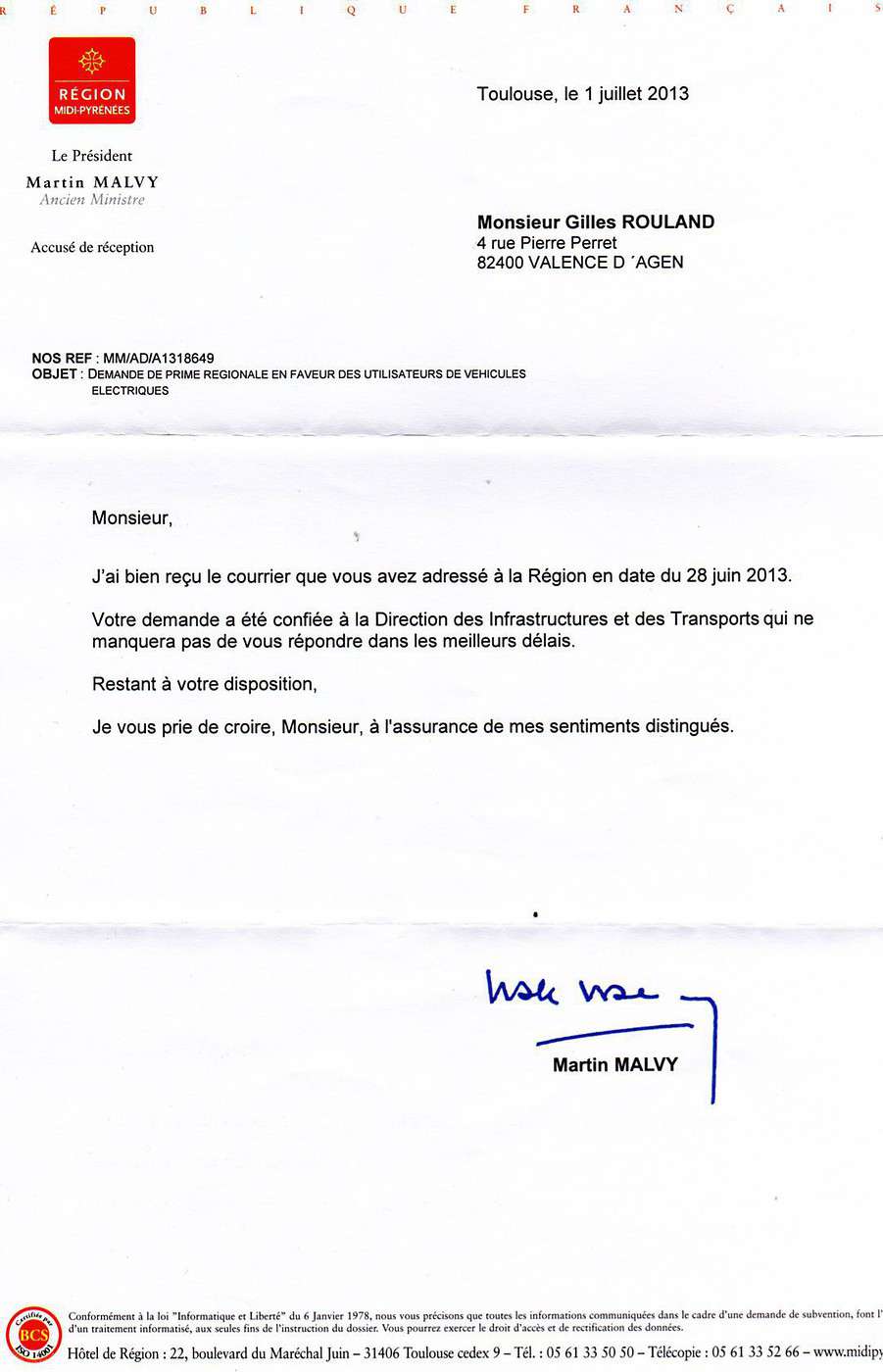
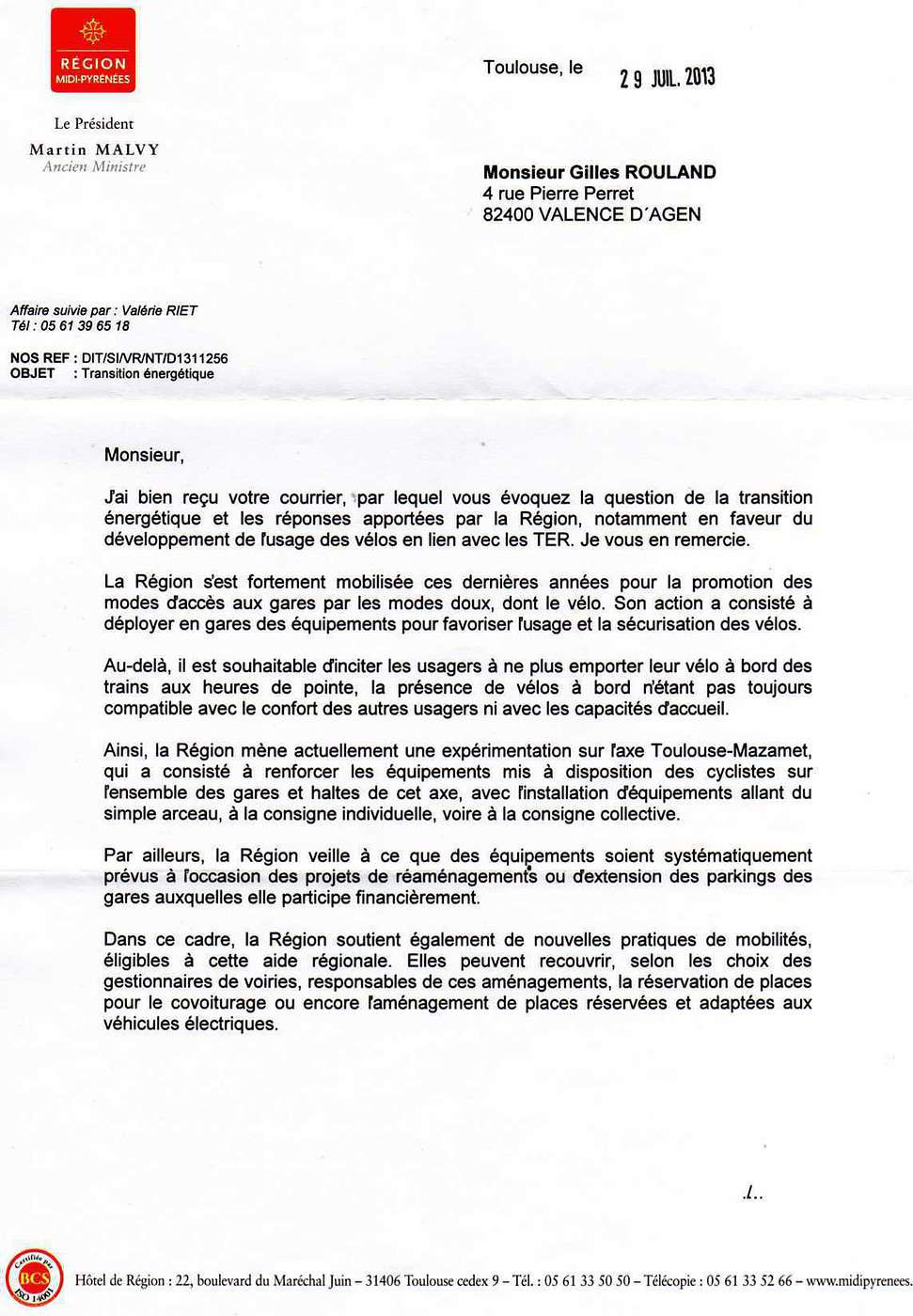
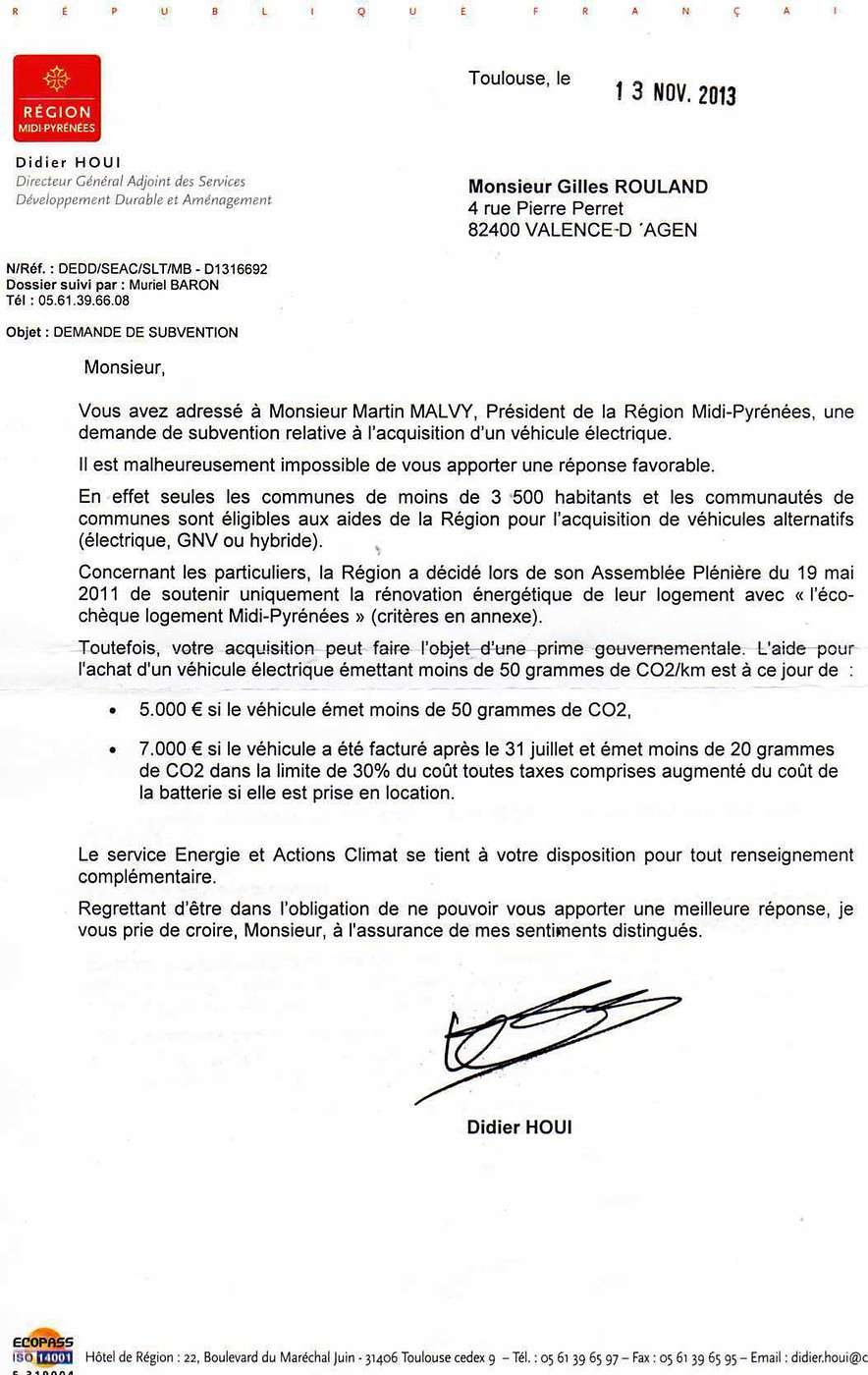
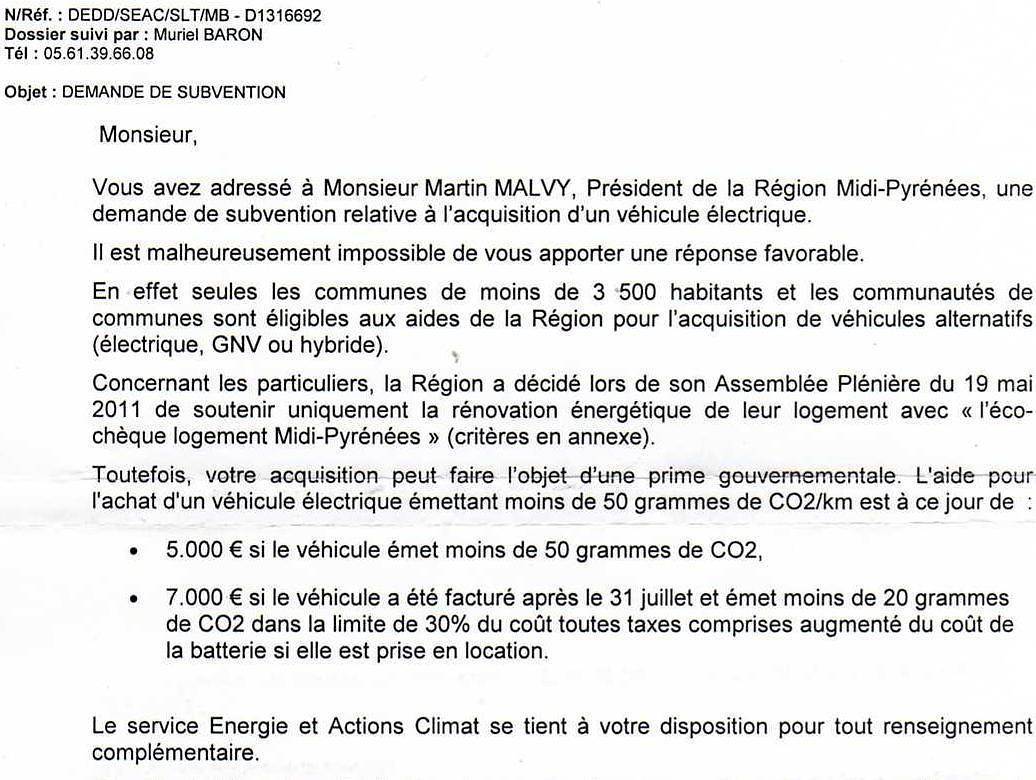
It took me 2 reminders to get a response to my letter from June 28th addressed to the President of my Region. (See the text a bit above). After the acknowledgment of receipt on July 1st confirming that my question was about electric vehicles, I received a reply that only addressed train + bike. And finally, I found out from the letter on November 13th that I wouldn’t get any help from the region for buying an electric vehicle, unlike in Alsace or Poitou-Charentes. Still, I went ahead and ordered a RENAULT Zoé before the state subsidy dropped from 7,000 € to 6,300 €.

Biking (MTB) along the canal between the two seas (France)

Facteur4 · 2014-04-13 · Message 172 of 310

Sète in seven days. Spring’s arrival wakes up the cyclists. Even though I still bike to work, with this rainy winter, I was tempted to use my Zoé a few times. My wife and three kids found it really comfortable, and we covered 2,000 km in four months—way below cost-effectiveness, but that wasn’t the point. My son will use it every day for his end-of-second-year IUT internship. That’ll help offset the 79 € monthly battery rental and avoid greenhouse gas emissions. For the first time, I didn’t set off alone along the canal. I accompanied a young retiree who’d been dreaming of discovering it by bike for years. We were lucky with the weather. We left Valence d’Agen on Saturday, April 5, and arrived in Sète on Tuesday, April 8, early in the afternoon after 365 km made very difficult by the state of the towpath. We only had a few drops of rain on the last kilometers of the Canal du Midi and rain at the Phare des Onglous. The mud would’ve made progress impossible on the towpath—even without it, my companion fell twice. Many plane trees have been cut down, and the uprooting of their roots causes major unevenness. We saw workers burning trunks, branches, and roots to destroy the ravaging fungus. One of them, lifted above the water by a cherry picker, was trying to retrieve a branch carried away by the weak current. With a rope weighted by a lead sinker, he managed to bring it back before it drifted too far. I don’t know if the goal was to prevent it from obstructing navigation or, more likely, to stop the spread of canker stain. When I told the owner of a guesthouse where we stayed in Minervois that he might receive fewer cyclists, he wasn’t worried and told me that the plane tree felling should stop with the discovery of a vaccine: http://www.midilibre.fr/2013/12/09/aude-l-etat-se-fait-desirer-pour-tester-les-vaccins-contre-le-chancre-colore,794871.php http://www.midilibre.fr/2013/09/27/canal-du-midi-un-vaccin-pour-sauver-les-platanes,762802.php http://www.lindependant.fr/2013/10/03/et-s-il-existait-un-vaccin-pour-sauver-les-platanes-du-canal,1795781.php http://www.ladepeche.fr/article/2013/11/17/1754635-espoir-vaccin-platanes-malades-canal-midi.html Given the state of the towpath, we decided to put on our yellow vests and return by road. The hotel owner in Sète kindly let me use her computer at reception. Viamichelin suggested a bike route from Sète to Toulouse: 217 km in 15.5 hours. Since her printer wasn’t working, I copied it down. Before we walked up Mont St Clair to enjoy the stunning azure panorama of the island and dined on oysters from the Étang de Thau and seafood, my friend bought a road map (and I bought postcards). I highlighted the route before breakfast (despite his reluctance) so we wouldn’t have trouble finding the way, which partly goes through small villages. We started on the Voie Verte along Plage du Lido, which stretches for 10 km. As the bike signage gradually disappeared, we had to cross a highway by climbing over a double guardrail to reach Agde’s city center. To get to Béziers, we temporarily left the Viamichelin route—it doesn’t know about greenways (no one pays to include them in GPS)—and took the 15 km of bike path. That’s where we had our last picnic by the Canal du Midi. It remained ever-present on our route, which started with very smooth but busy country roads. A southwesterly wind hit us all afternoon and made progress really tough. We estimated it reached 70 km/h before learning it’s called the *Cers* in Minervois and shares with the *Marin* the privilege of constantly sweeping the region. Luckily, my partner, who was in great shape, "pulled" me along, shielding me from the wind. On the second day, it was my turn to drag him through the succession of climbs (showing us the snowy Pyrenees peaks) and descents of the Montagne Noire, with the highest point at Les Cammazes (where the canal is fed by the *rigole de la montagne*). Then we descended to Revel, admiring Lac de St Ferréol, and finally reached Toulouse via St Orens. Of course, we returned to Valence d’Agen via the bike path along the Canal Latéral à la Garonne. The last day was tough for my travel companion, who, despite a gel saddle cover, suffered in pain. In total: 670 km in 7 days. That might seem like little, but considering the loaded MTBs, the degraded towpath, the wind, and the elevation changes, it’s a lot. I didn’t detail the route to Sète since I’ve described it many times before (see previous pages). My friend loved it. I’ve biked the Canal du Midi 5 or 6 times but don’t plan to return for another decade—the time needed to complete the Voie Verte. I don’t think merging the Midi-Pyrénées and Languedoc-Roussillon regions, as the new government wants, will speed things up. Maybe by eliminating the *départements*? That way, the Aude wouldn’t be responsible for 140 km of towpaths. But who would fund the work? The region, France, Europe? I’ve always said the canal between the two seas—a route of international interest (with huge economic, cultural, and tourist potential)—needs a global vision. But I don’t think it’ll happen faster. I’d even advise against biking the Canal du Midi (except between Toulouse Port Lauragais and Béziers Portiragnes) unless you like rough rides or have a fully suspended MTB with no luggage. I recommend the Voie Verte along the Canal Latéral à la Garonne and its 170 km of paved path, which, after Bordeaux, invites you to join the 600 km of bike paths in the Gironde.

Biking (MTB) along the canal between the two seas (France)

Facteur4 · 2014-05-23 · Message 173 of 310

To counter my pessimism, some excellent news: Julien Savary from the Association Deux Pieds Deux Roues (formerly Vélo Association) (in Toulouse) (Regional Delegation of AF3V Midi-Pyrénées and Languedoc-Roussillon) took part in the first official meeting of the Steering Committee for the Canal des Deux Mers Cycle Route (V80) itinerary, which was held on April 25, 2014, in Montauban.

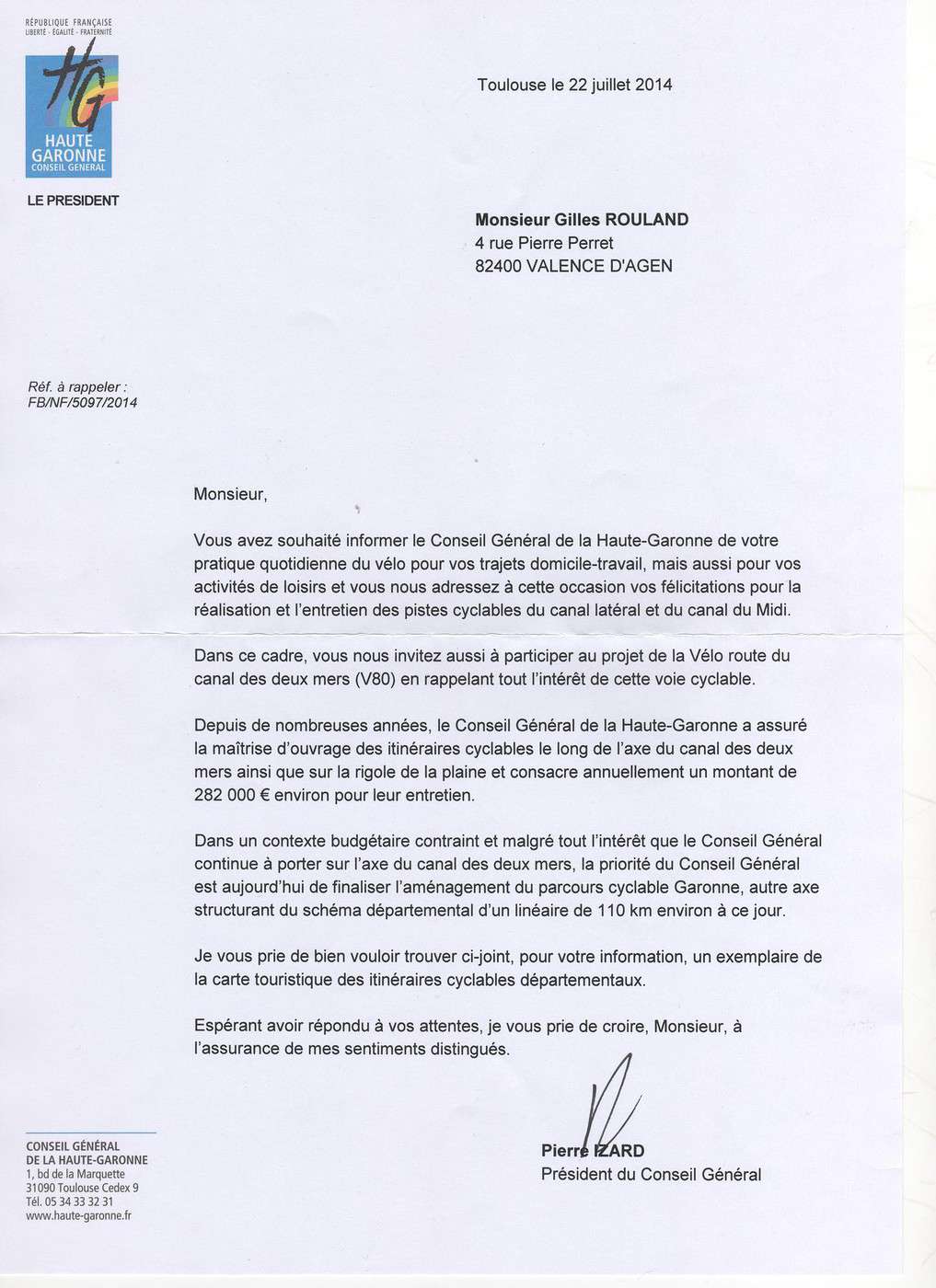
The departments of Aude and Hérault, where large sections are still missing, are members of this Itinerary Committee and seem determined to speed up the development work. Surprisingly, Haute-Garonne, where everything is already done, is absent, as is the regional council of Languedoc-Roussillon. I immediately wrote to the President of the Haute-Garonne General Council:

To Monsieur le Président du Conseil Général de la Haute Garonne Subject: Bike paths and cycle routes

I use my bicycle every day of the year to get from home to work. I don’t deserve much credit for it since the trip is only 6 km under pleasant riding conditions.

I also go on bike vacations. To inspire others and show how easy it is to travel hundreds of kilometers, I’ve shared accounts of my various trips on Voyage Forum: http://voyageforum.com/v.f?post=1000920#10009...I’ve ridden along the Canal Latéral à la Garonne and the Canal du Midi several times. I know how different it is to ride a loaded bike (30 kg) on a dirt towpath with stones and roots compared to a paved path. So I congratulate your department on the creation and maintenance of the bike path along the Canal Latéral à la Garonne and the Canal du Midi, which are rewarded by high usage. During my trips, I’ve stayed in Toulouse several times, where I appreciate the bus lanes and the contraflow bike lanes on one-way streets. I took it a step further by using my bike for a work trip. I wouldn’t have considered it without such infrastructure: http://voyageforum.com/v.f?post=2799841#27998...Last year, taking advantage of the absence of cars on towpaths, I safely and harmoniously rode from Valence d’Agen to Lyon along the Canal de Garonne, the Canal du Midi, and then from Sète to the Rhône. I attended a week-long training course and returned by train: http://voyageforum.com/v.f?post=6006514#60065...So I don’t understand why Haute-Garonne isn’t part of the steering committee for the Canal des Deux Mers Cycle Route (V80). You were the first to develop the section of this route that crosses your department. I’m dismayed when I recall renting your beautiful greenway between Lac de Lenclas and the Saint-Ferréol Dam, compared to the section of the Rigole de la Plaine in Aude. I urge you to join this fantastic cycle route project. Not only for local cyclists, French and international tourists, but perhaps also for an unexpected impact on commuting. Looking forward to your response and hoping you can support the development of sustainable transport, please accept my respectful regards.

While waiting for a reply, I’ll temporarily leave my favorite canal to ride along some rivers:

http://www.af3v.org/Nouvel-article,428.html

http://af3v.org/croisiere-cycliste-2014/

Biking (MTB) along the canal between the two seas (France)

Facteur4 · 2014-07-19 · Message 174 of 310

The cycling cruise has safely arrived in Nantes, where the metropolis welcomed us at the Île aux Machines: http://www.ouest-france.fr/...leurope-velo-2704105 I was able to watch the fireworks from the bridge (in Nantes). On the 15th, I took a direct train that accepts bikes to Agen.

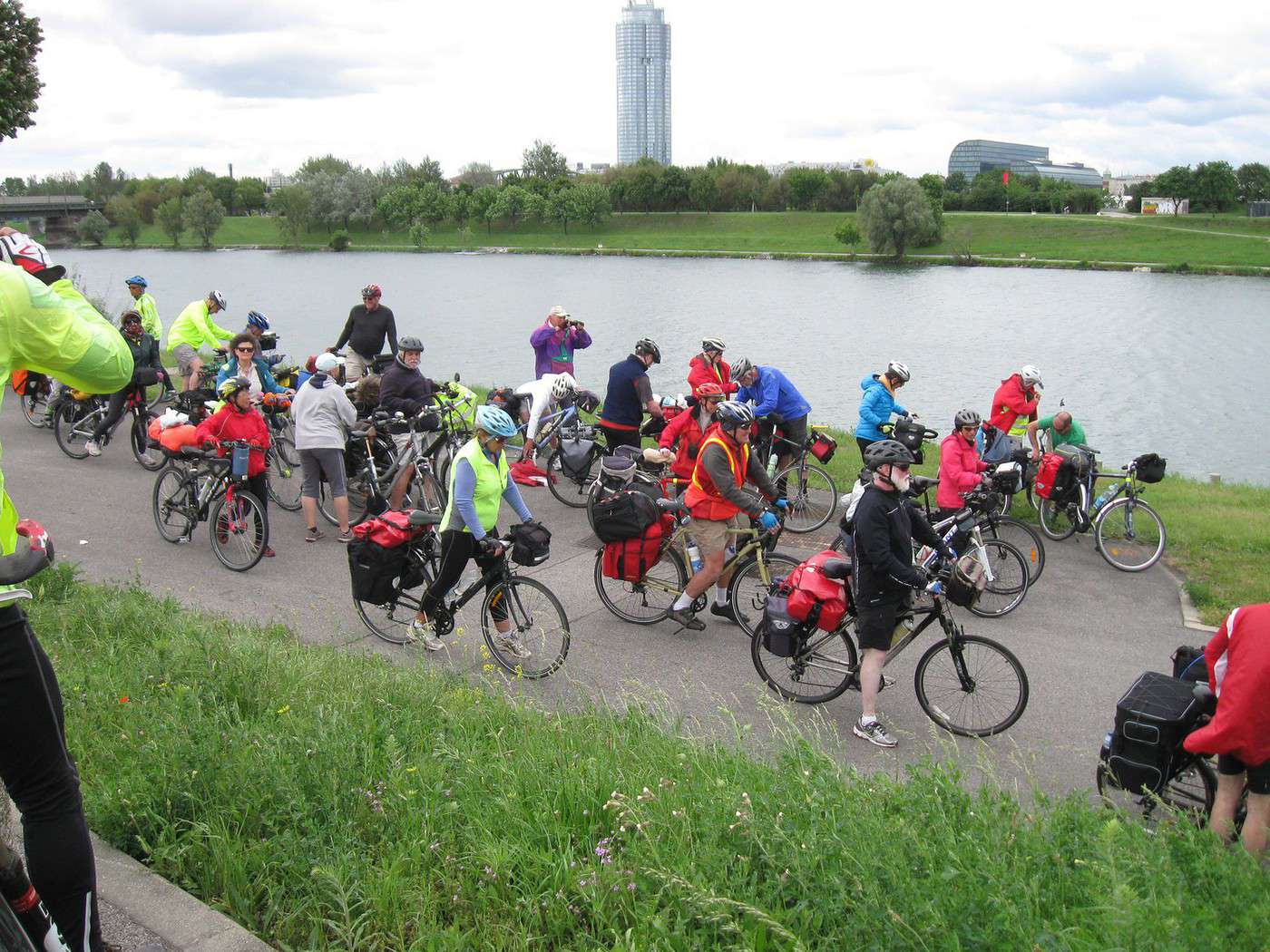
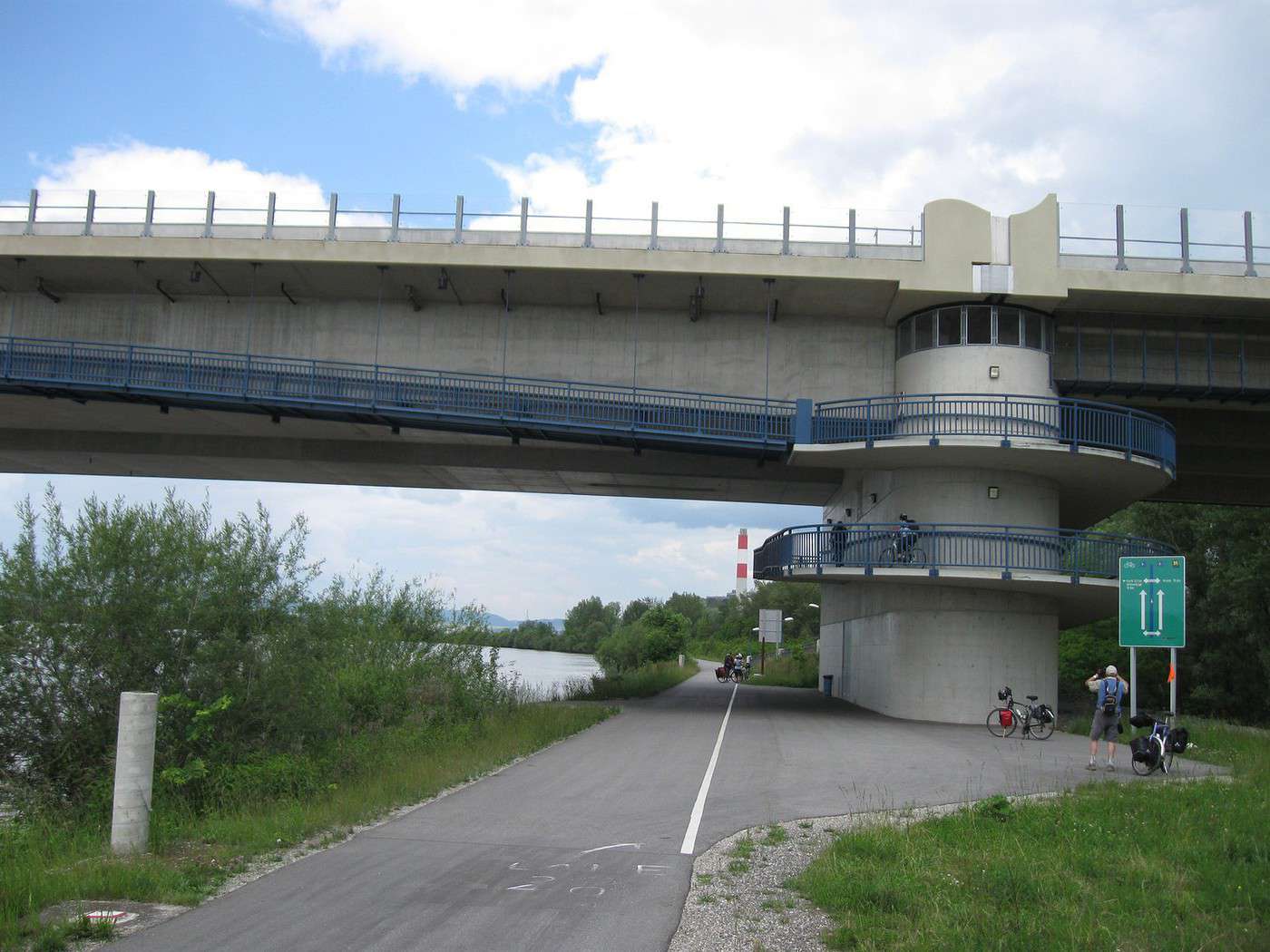
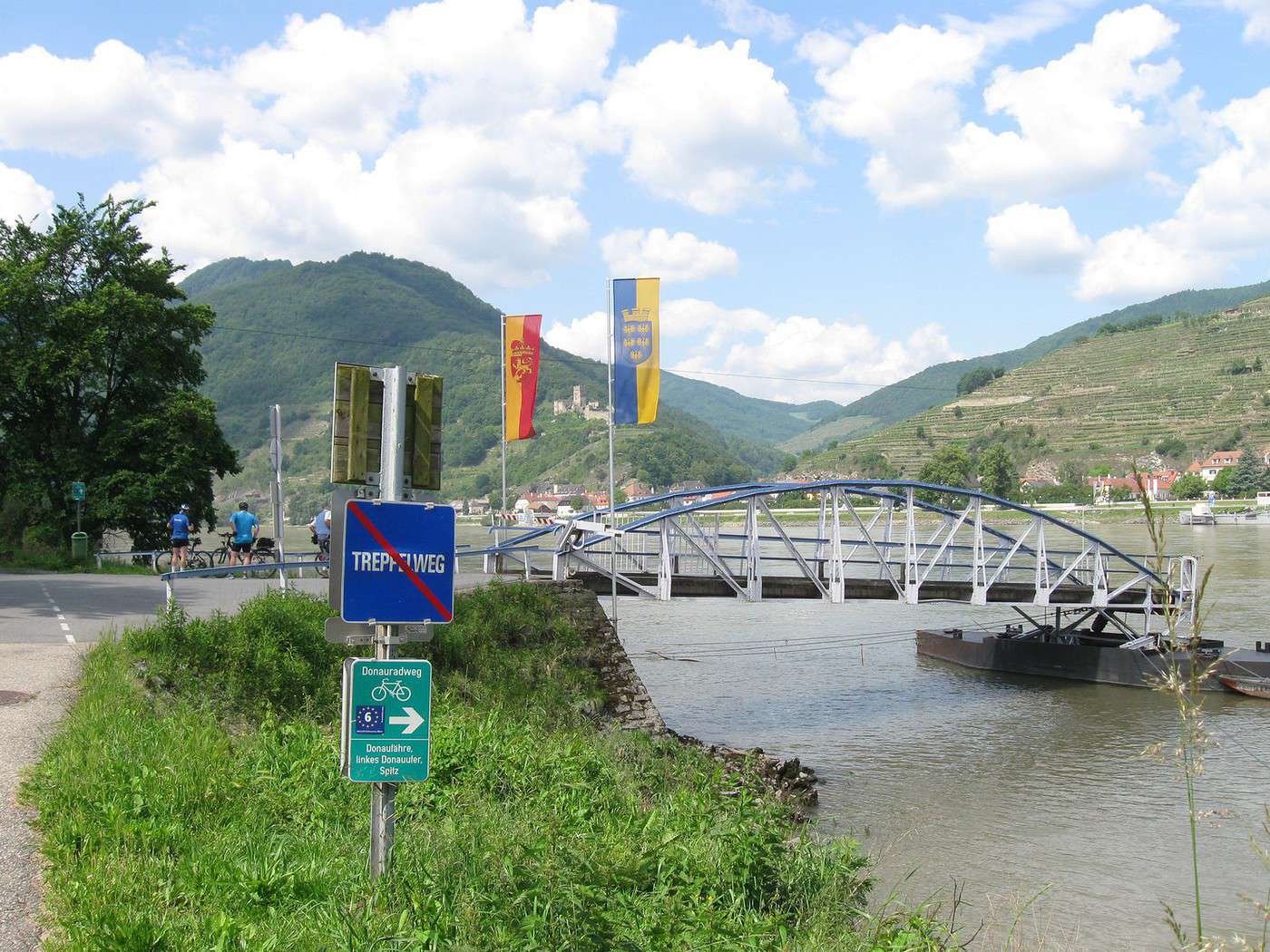
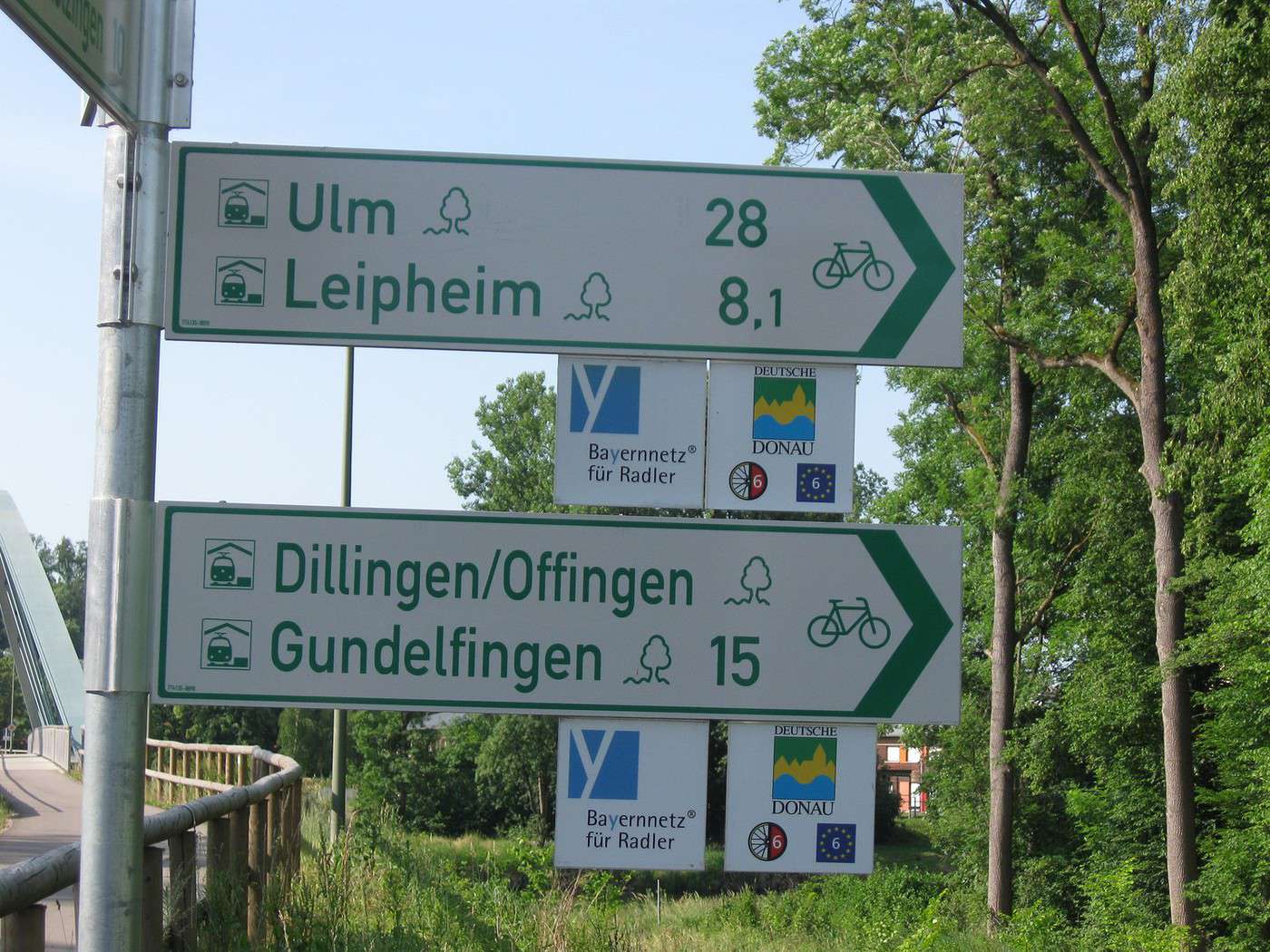
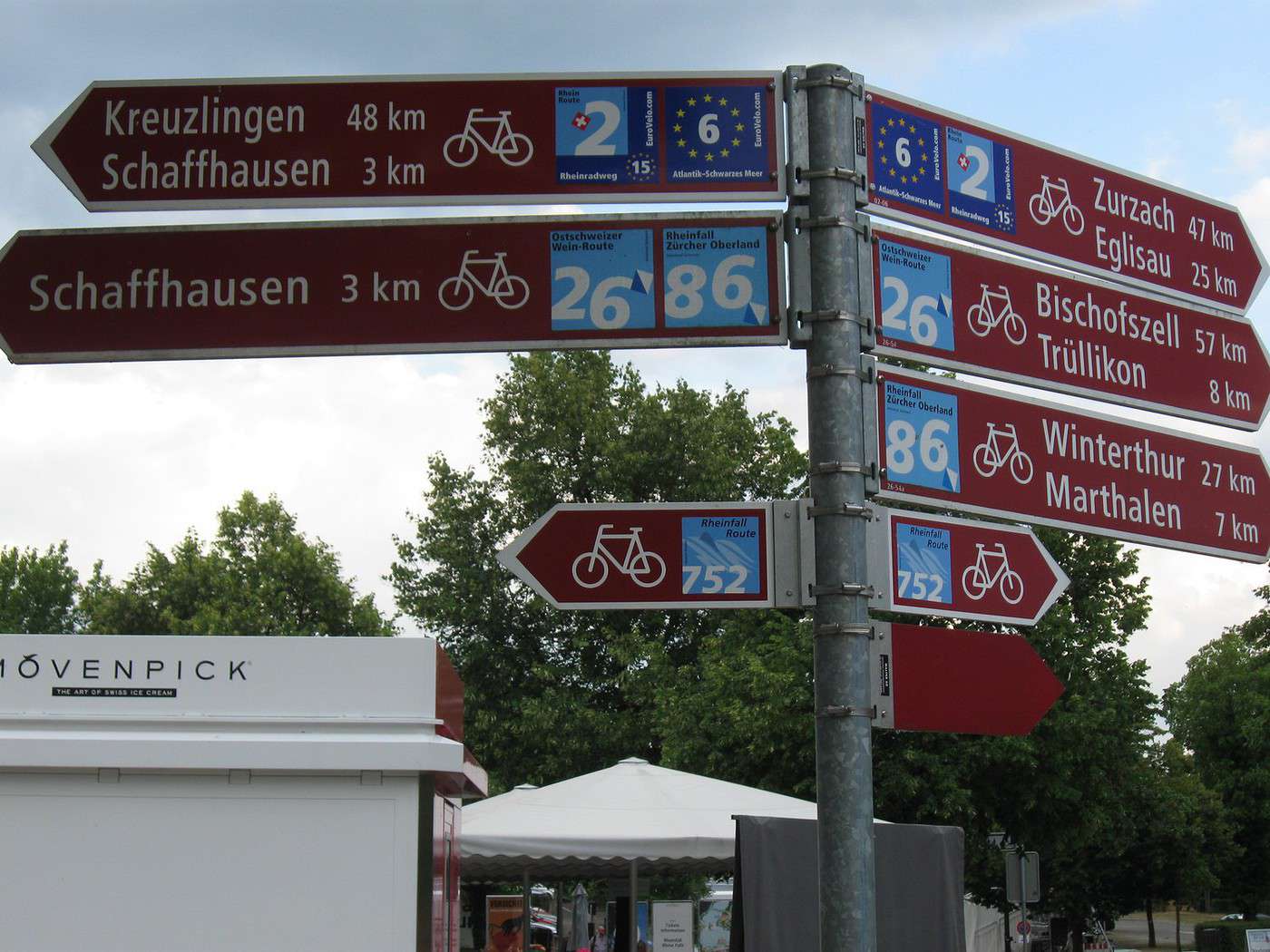
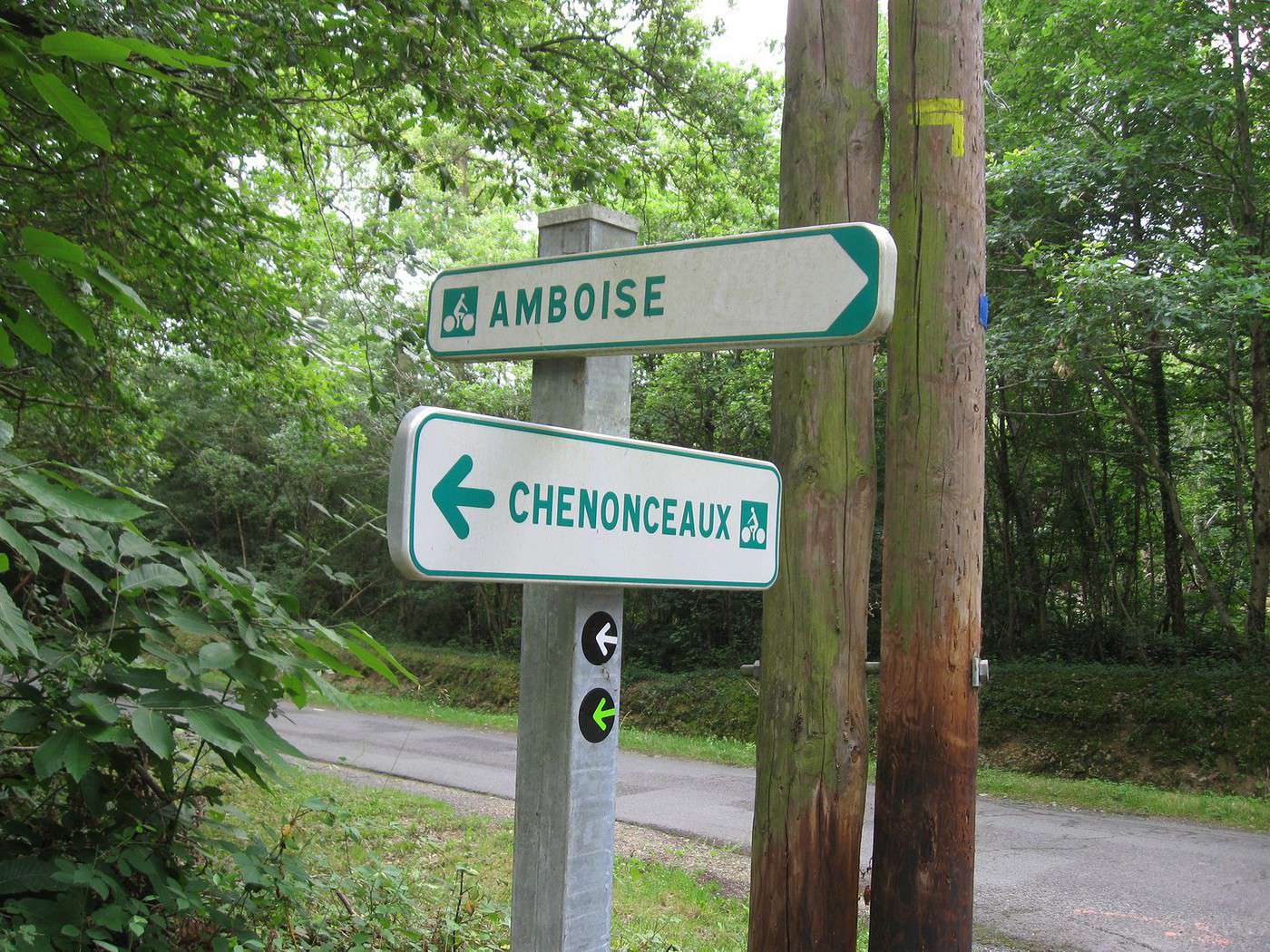
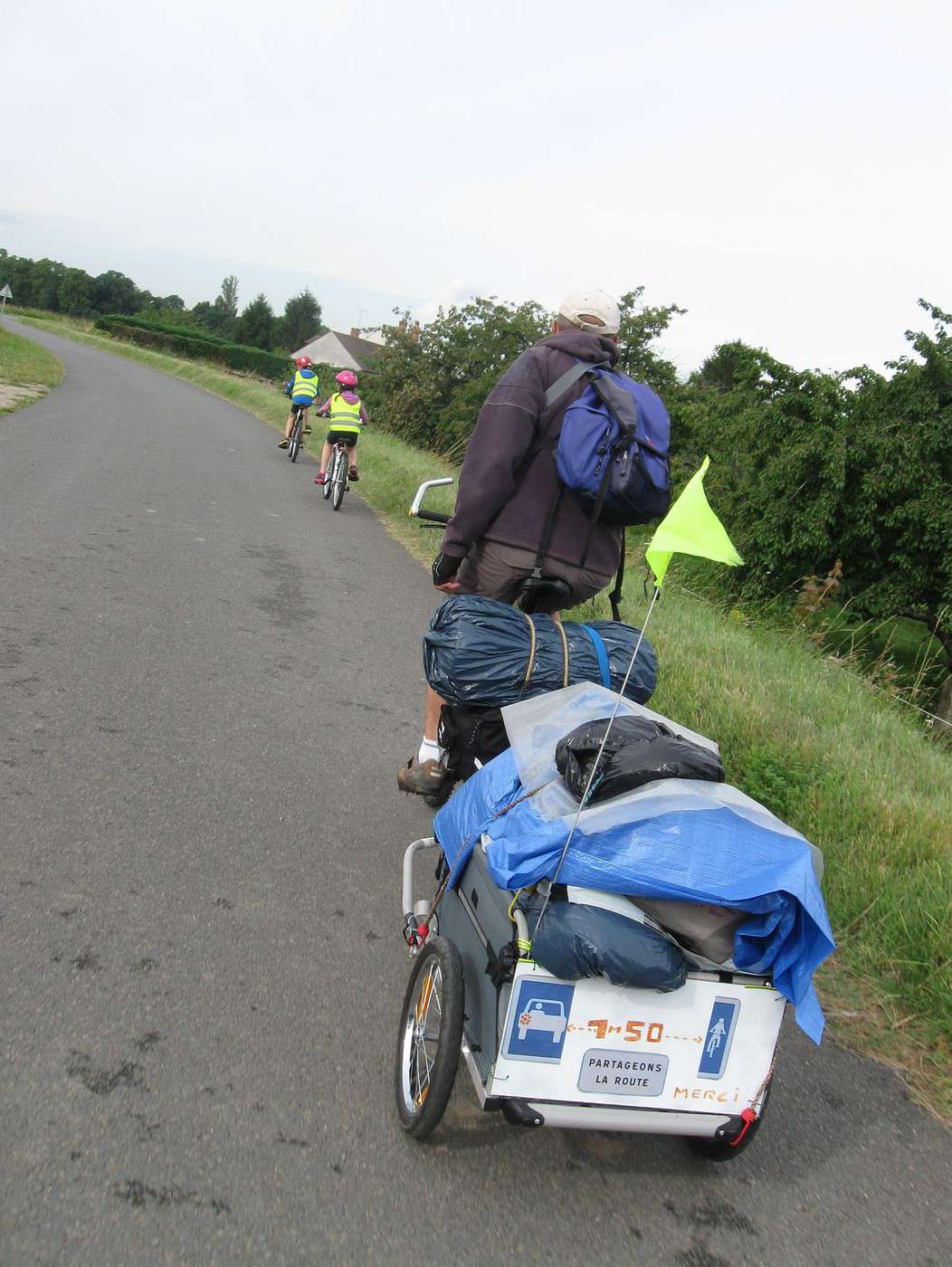
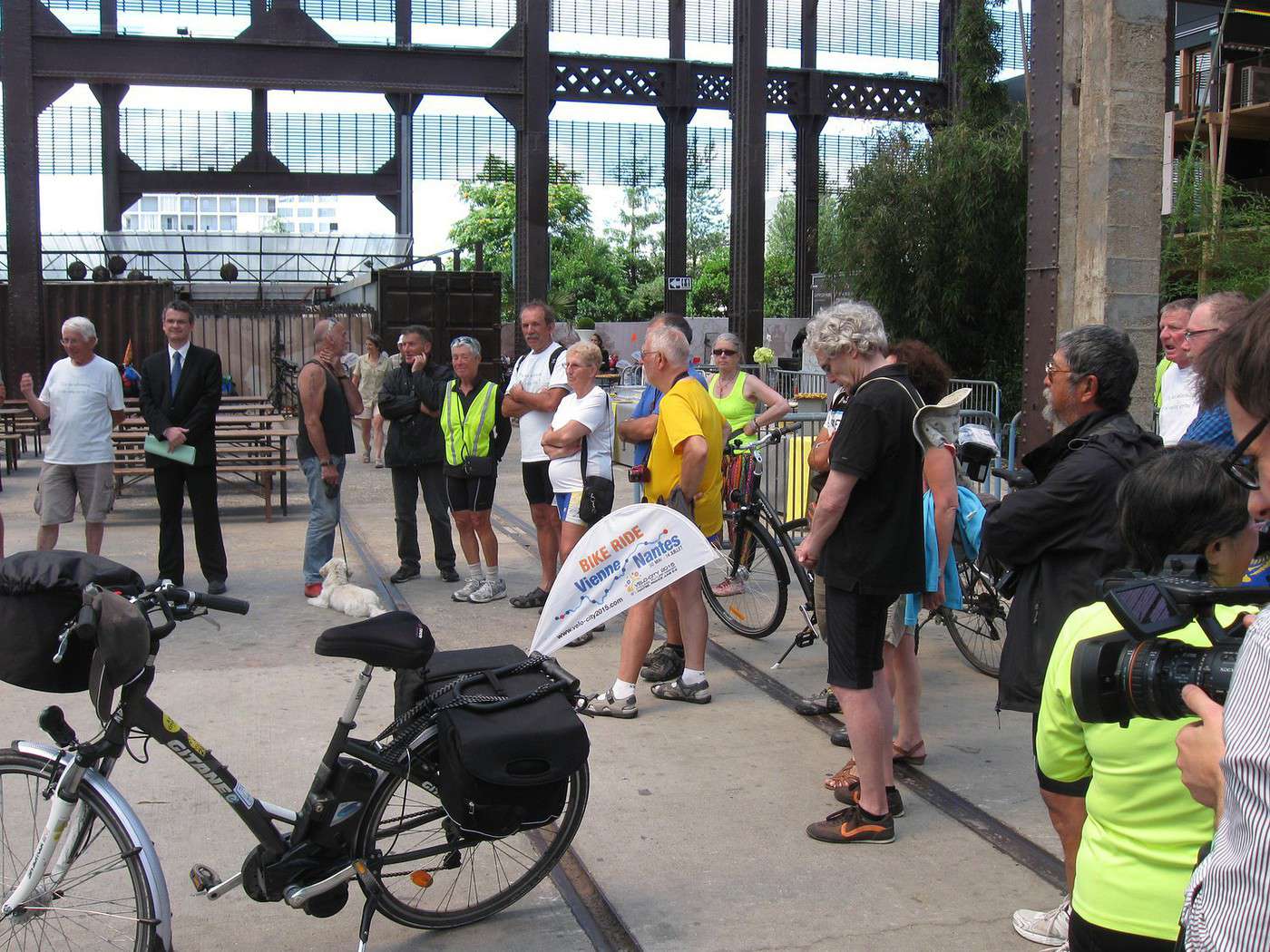
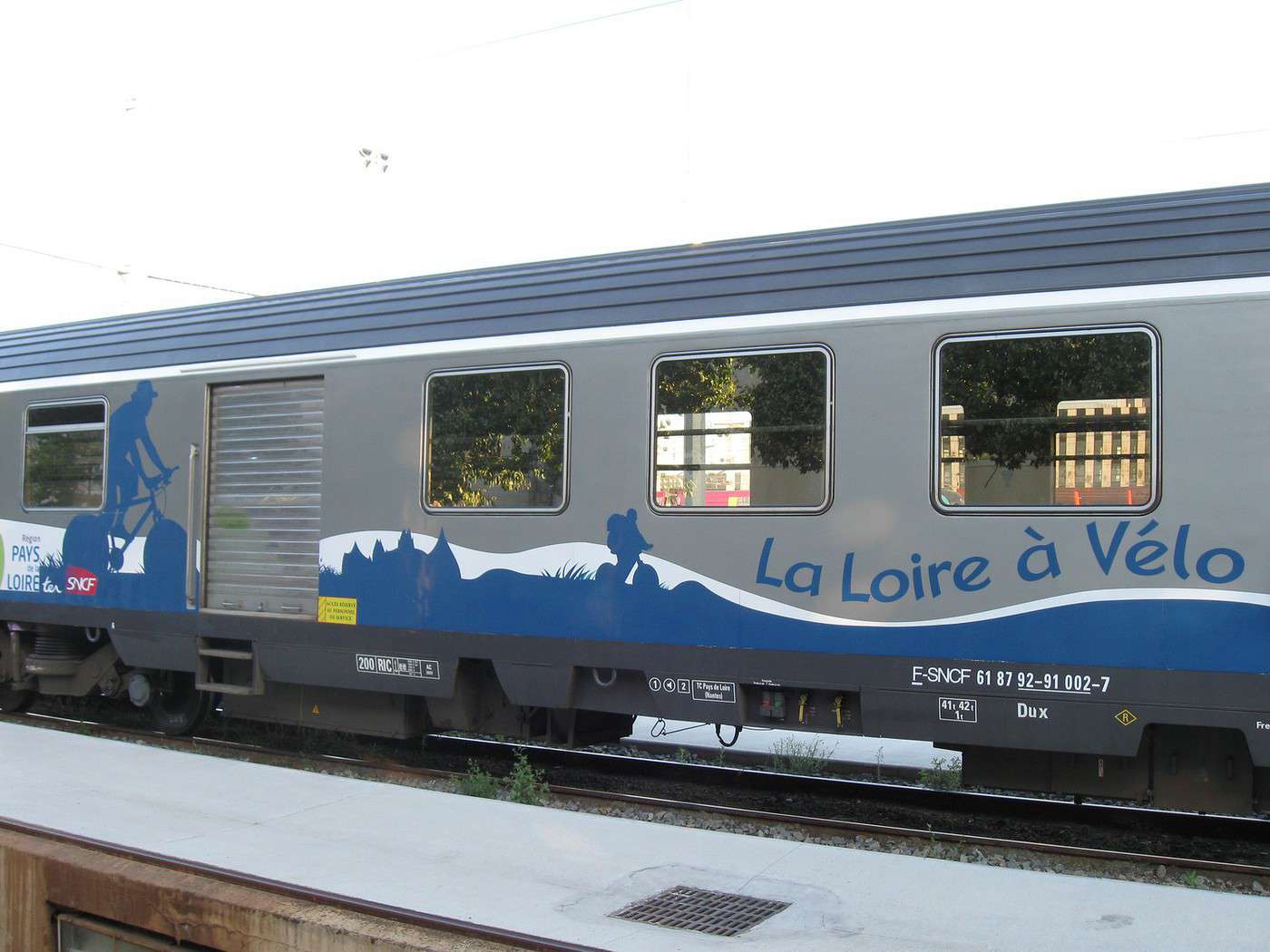
On May 30th, we were 19 cyclists from Hong Kong, 6 from the USA, 2 from New Zealand, a few Brits, Belgians, and around fifteen French folks starting the EuroVelo 6 in Vienna. Two Handibike tricycles coming from the Black Sea joined us. For a theoretical 2,222 km to Nantes, we ended up covering over 2,800 km. This was due to accommodations sometimes being far from the route, sightseeing, and plenty of wrong turns. Even though the EUROVELO 6 is signposted, like all cycling routes, it very rarely has advance signage. So, you might miss a turn, especially if it’s hidden or missing. Sometimes towns are mentioned on signs, and even more rarely, distances. See the photos (the title appears when you hover over them). But you’re never told whether you’re heading east or west, and I once met one of our Chinese cyclists who, not knowing our Latin characters, was following the six circled stars of Europe in the wrong direction. I’d suggest, for example, green dots to indicate we’re heading toward the Atlantic and red ones for the Black Sea direction. This would let us ride in peace and enjoy the stunning landscapes and magnificent monuments we encountered along the Danube for 1,000 km. The same goes for the Loire à Vélo. I had just visited the Château de Chaumont-sur-Loire with Cynthia, an American from Rhode Island riding a recumbent bike. While following the route to Chenonceau, we ended up at the other entrance of the Château de Chaumont after a 15 km detour because a directional sign was missing. We had to climb back up the hills and choose a direction with no indication. It’s worth noting that the route rarely follows the Loire itself, and the signage often sends you up into the countryside to avoid bothering cars on the riverbanks. I don’t think the young mom pushing her bike with luggage and a child trailer up a 10%+ hill imagined the Loire à Vélo like this. Unfortunately, it’s not very family-friendly, even though I met a grandpa who’s been doing a section of it with his grandkids for the third year in a row.

Mountain biking (MTB) along the Canal des Deux Mers (France)

Facteur4 · 2014-08-04 · Message 175 of 310

I received a response to my letter to the President of the Haute-Garonne Departmental Council (see above). I understand that this department doesn’t want to pay for the creation of the greenway between the Two Seas in departments that, unlike Haute-Garonne, haven’t yet built a bike path along the canal—but it could have participated in the steering committee under that specific condition. I didn’t receive the documentation mentioned in the letter, but I assume it’s this: http://tourisme.haute-garonne.fr/FR/la_haute-garonne_a_velo/un_departement_cyclable.aspx

I hope I’ll have better luck with the letter I sent to Ségolène Royal:

GillesROULAND to Madam the Minister

4 rue Pierre Perret of Ecology, Sustainable Development

82400 VALENCE d’AGEN and Energy

Subject: Cycling and environmental protection.

Madam,

I’m sending you this letter by email to make the links active. But since this method is considered minor, I’m also mailing it via La Poste so it reaches you and I receive a well-reasoned response. I use my bicycle every day of the year to commute from home to work. It’s not a big deal since the trip is only 6 km in pleasant riding conditions.

I also go on cycling vacations. To inspire others and show how easy it is to travel hundreds of kilometers, I’ve documented my various trips on Voyage Forum: http://voyageforum.com/v.f?post=1000920#1000920 I took it a step further by cycling to work for a business trip. I wouldn’t have considered it without safe cycling infrastructure.

Finally, taking advantage of car-free towpaths, I cycled safely and in harmony with nature from Valence d’Agen to Lyon along the Canal de Garonne, Canal du Midi, and from Sète to the Rhône. I did a week-long training course and returned by train: http://voyageforum.com/v.f?post=6006514#6006514

I ask you to do everything in your power to promote soft mobility and make it accessible to everyone. For example, while following the Loire à Vélo route, I saw a mother pushing her bike with luggage and a child trailer up a slope steeper than 10%. I don’t think she expected such gradients. To keep bikes from interfering with cars on the Loire’s banks, cyclists are directed onto the hills in the countryside. This discourages travelers and their children from cycling. I also ask you to implement the kilometer allowance, currently reserved for motor vehicles (the more polluting the vehicle, the higher the rate—a real paradox), and to improve bike access on trains and public transport.

I recently participated in a ride organized by AF3V: http://www.af3v.org/Nouvel-article,428.html Its goal was to connect Vienne Vélocity 2013 to Nantes, which will host Vélocity 2015.

While traveling through Austria and Germany, where glass bottles are still reused, something struck me. When I bought a drink for 1 € in a plastic bottle, I paid 1.40 € due to the deposit. This way, all plastic bottles—big and small—are returned to the store (I noticed the same for aluminum cans in Quebec). If your role as Minister of the Environment matters to you, you could implement this highly effective recycling method in France. By keeping bottles out of our streets, ditches, and rivers, you’d help stop feeding the sixth continent.

I don’t understand why the Ecotax, which had the support of all our elected officials, was abolished. It would be enough to apply it to all products based on the harm caused by their transport—so, for example, chickens “raised” in China wouldn’t keep undercutting those from Brittany.

Finally, if you truly want to leave your mark in government, you should push Europe to tax kerosene in proportion to its pollution. It’s outrageous that the most harmful mode of transport is completely tax-exempt. This would help France regain its historic influence in defending the public interest.

You should also ban Departmental Councils from subsidizing low-cost airlines to set up in their airports. This is the case with Ryanair, which employs staff in France under Irish labor law. It’s appalling that local tax money funds such companies and the most polluting mode of transport, distorting competition with trains.

These measures would certainly benefit the planet more than shutting down nuclear power plants, for which studies and investments have already been made and which can still operate safely for decades while we wait for better alternatives.

Hoping you’ll bring real change for the environment, please accept, Madam Minister, my respectful regards.

Mountain biking (MTB) along the Canal between the Two Seas (France)

Facteur4 · 2014-09-12 · Message 176 of 310

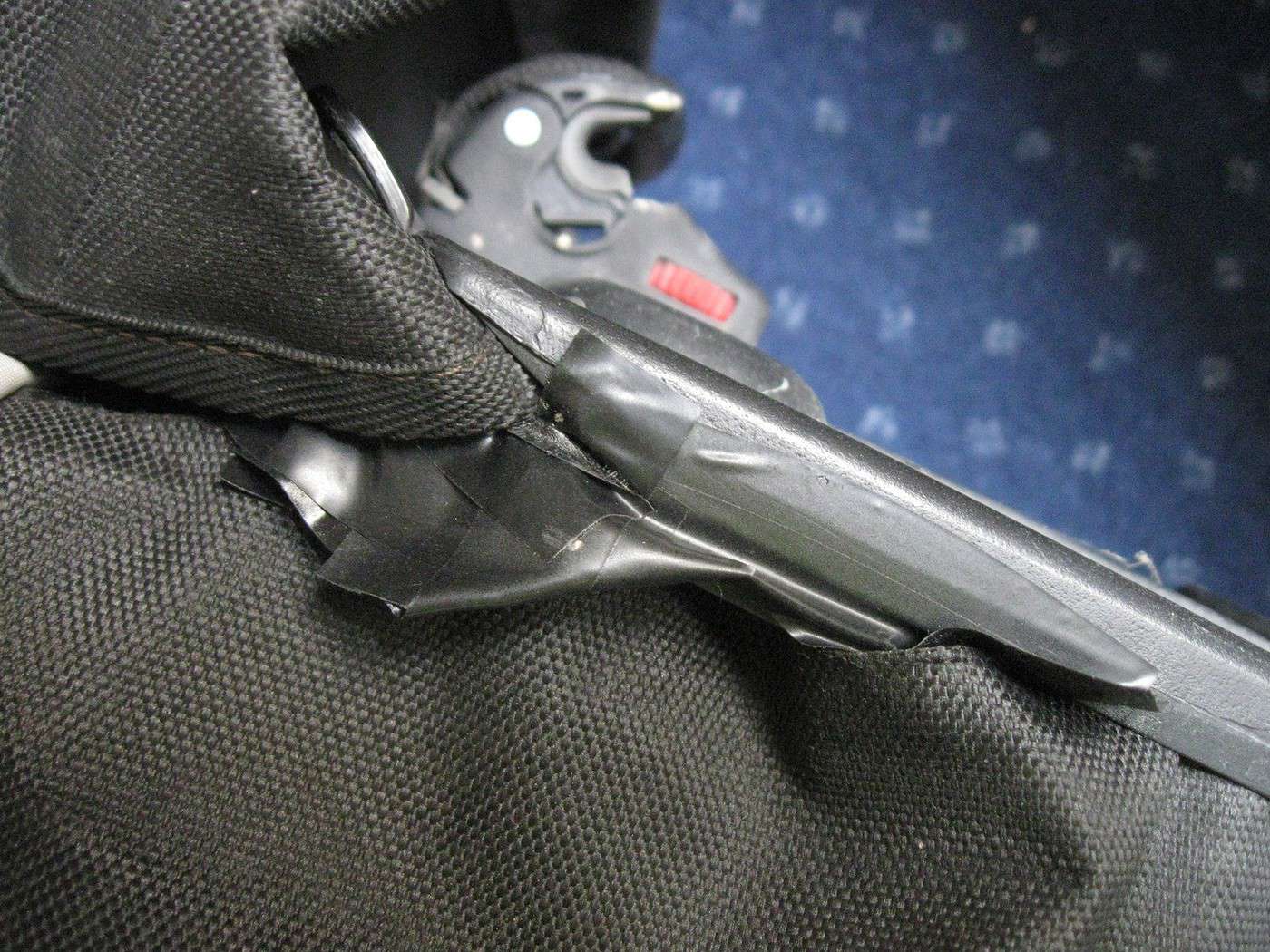
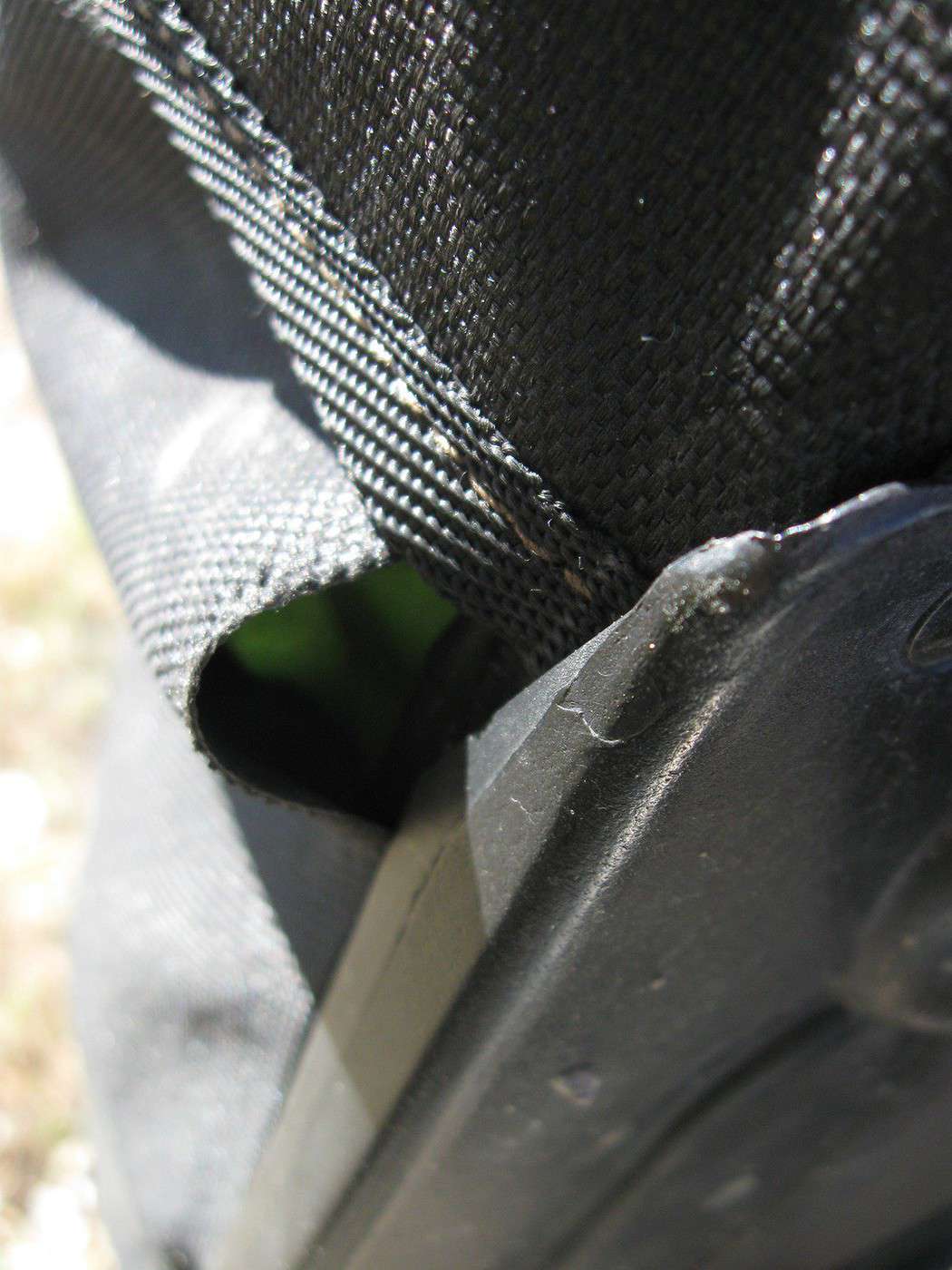
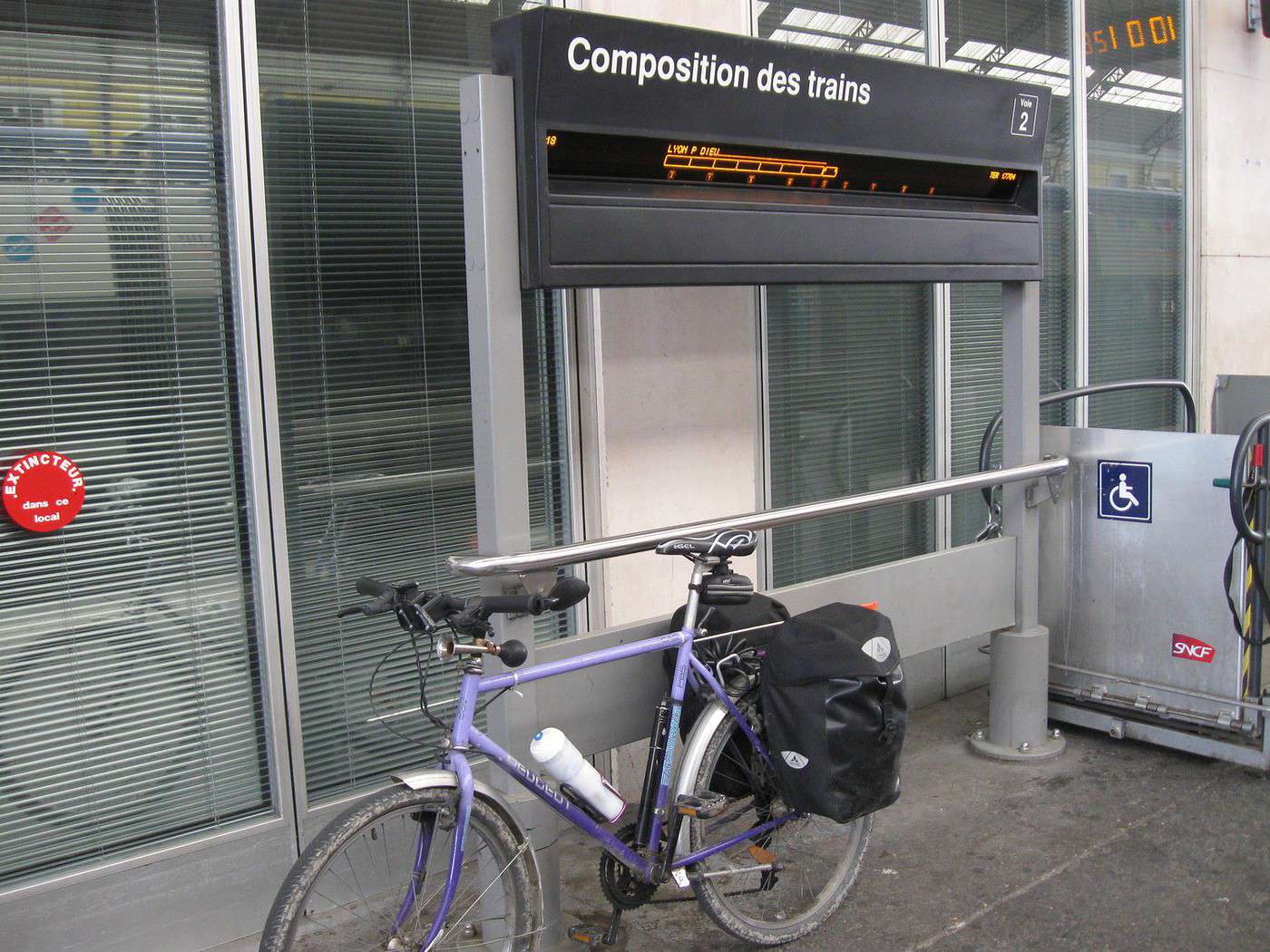
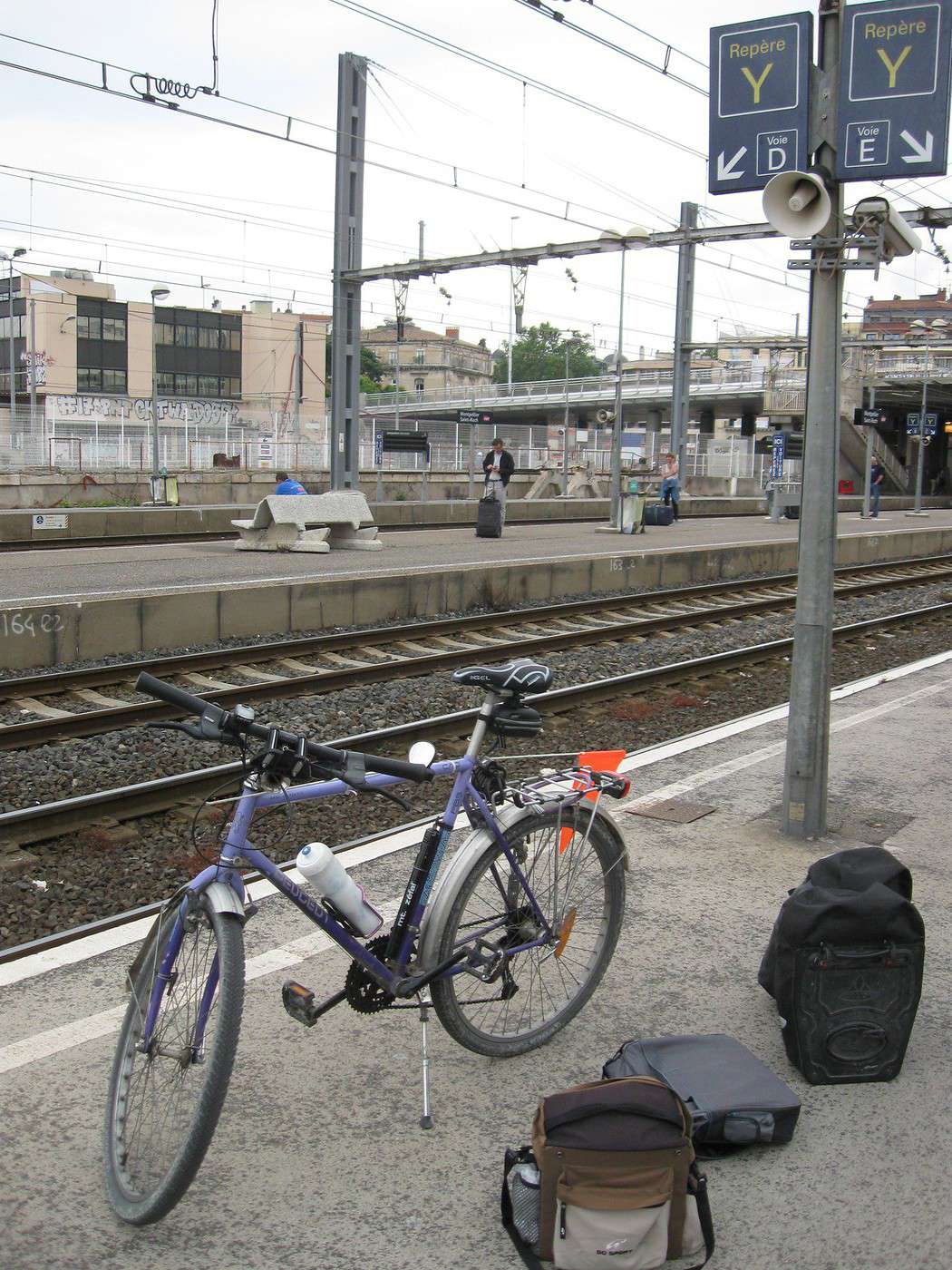
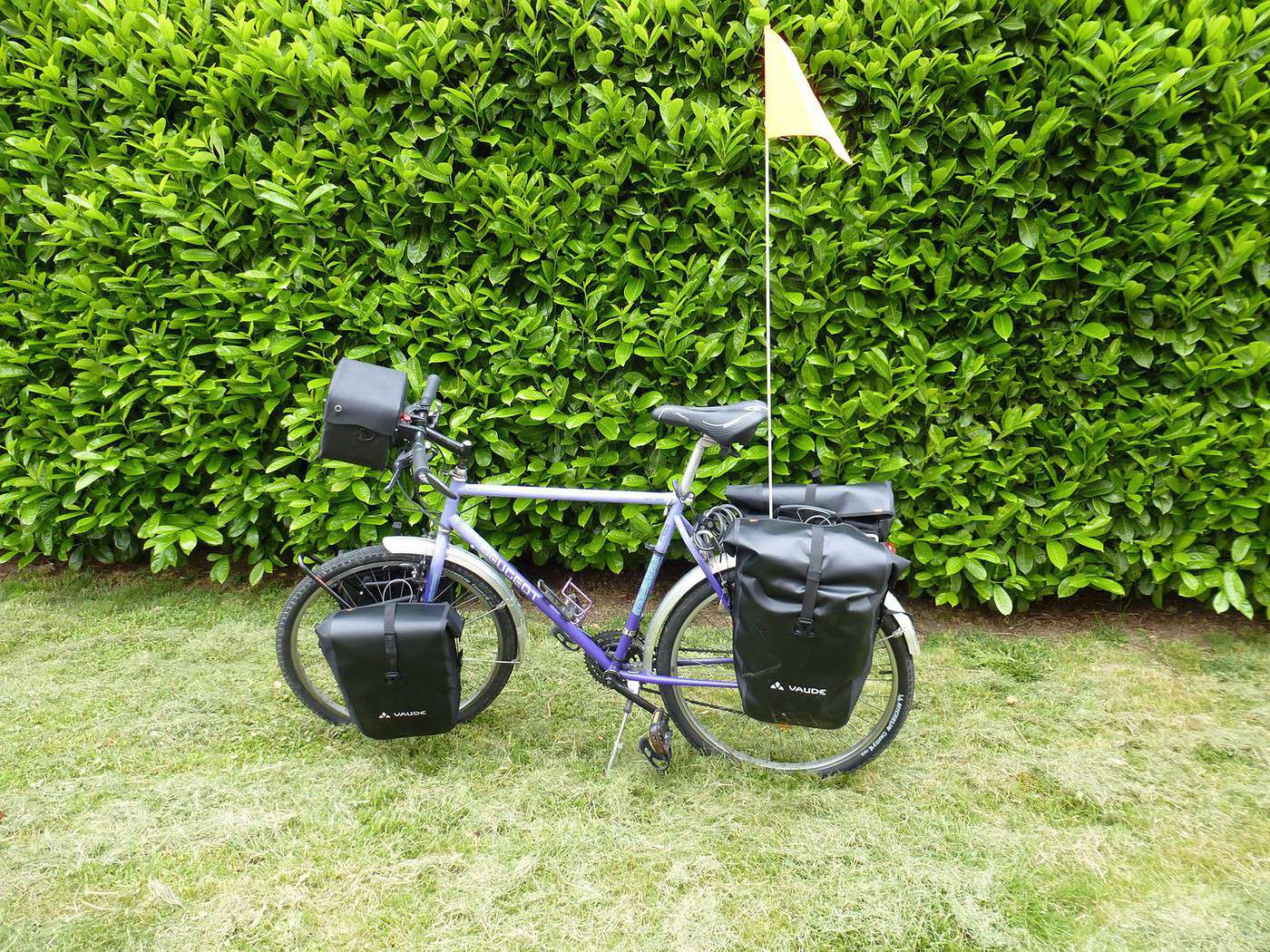
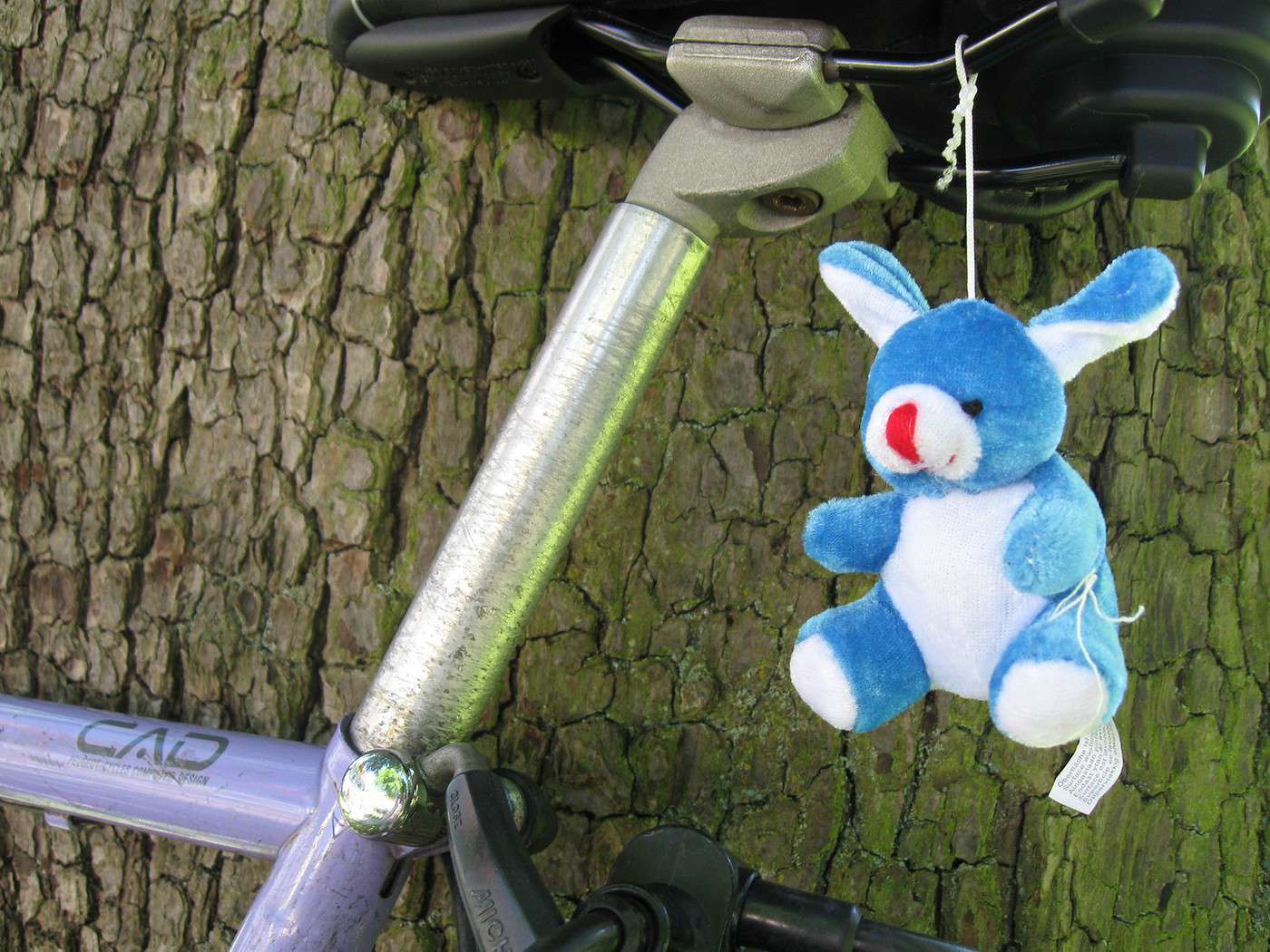
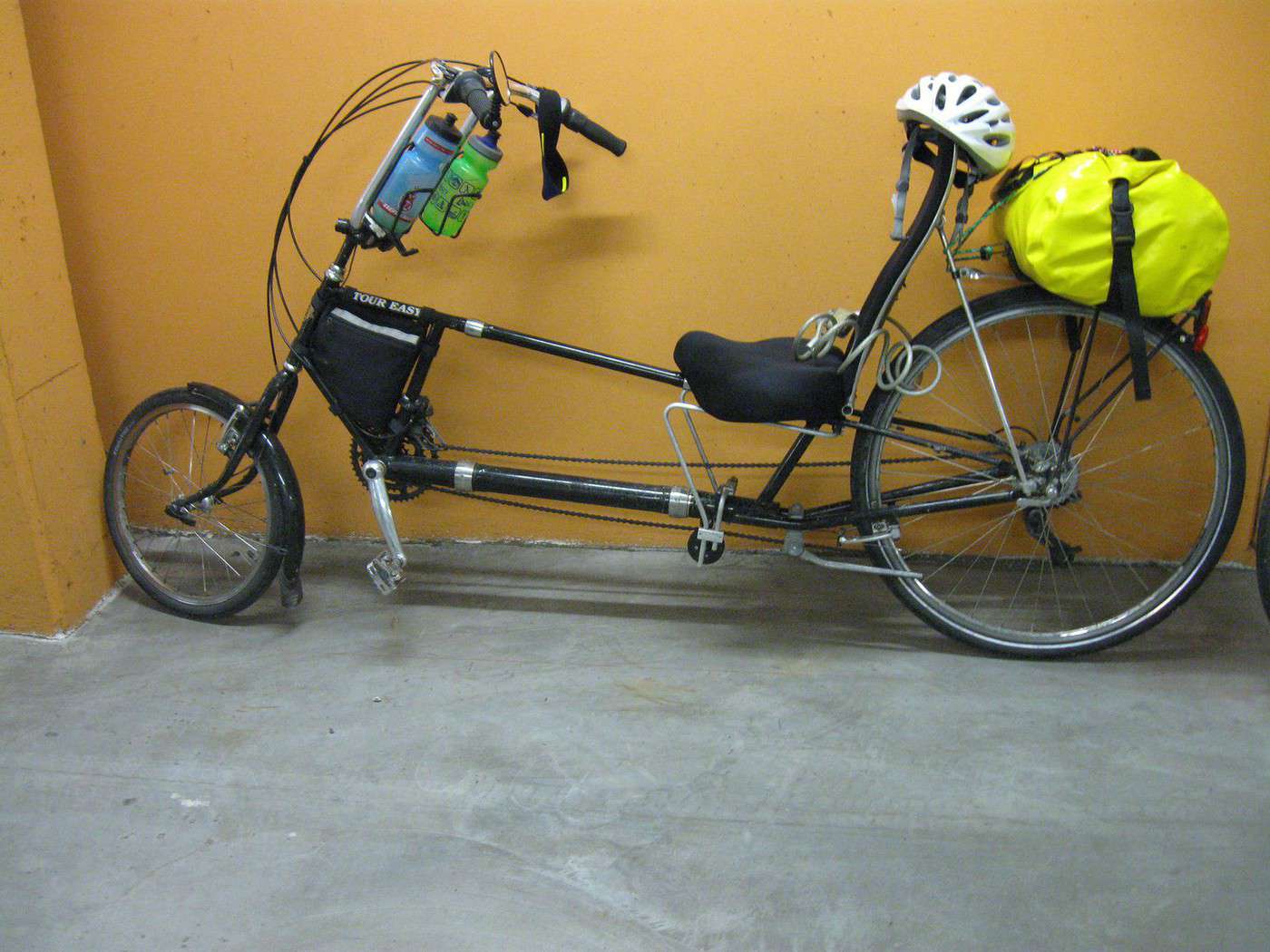
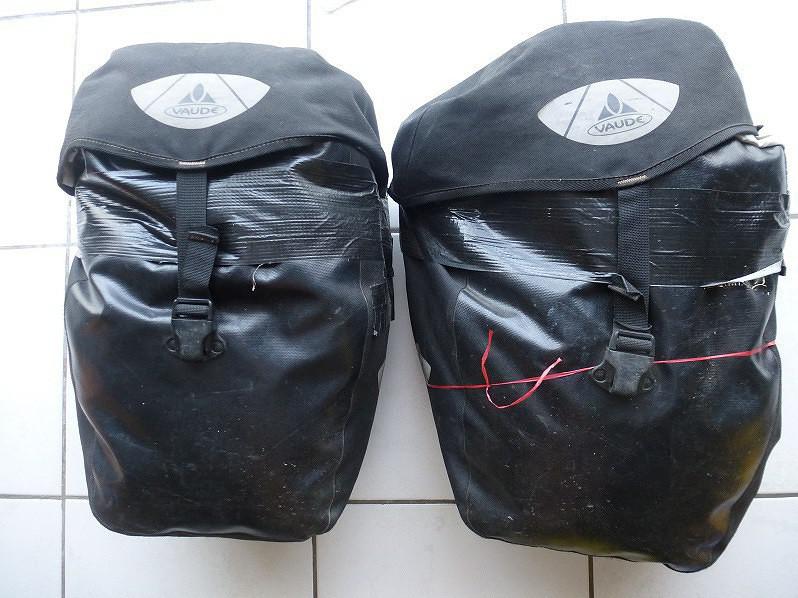
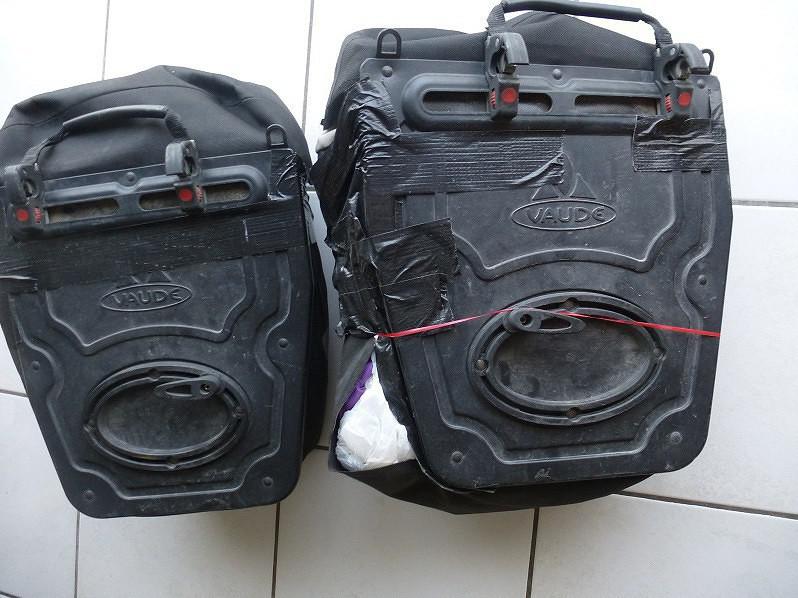
After nearly a year, I finally got my Vaude panniers back from Germany, where the manufacturer refused to repair them. They were only 4 years old and didn’t tear, but the fabric detached from the rigid base (see photo). Luckily, Cyclable Toulouse offered to sell me another pair of rear panniers at half price (to compensate me) for my Vienne-Nantes trip. Nantes Métropole video: http://www.nantesmetropole.fr/actualite/webtv/la-croisiere-cycliste-en-premices-de-velo-city-70991.kjsp?RH=WEB_FR I also bought a rear rack and front panniers there for the first time. It helps lower the center of gravity and stabilize the bike. With my 5 Vaude panniers (bike photo above), I totaled 18 kg of luggage. Other cyclists were much less loaded—except for the campers.

Biking (MTB) along the canal between the two seas (France)

Facteur4 · 2014-10-18 · Message 177 of 310

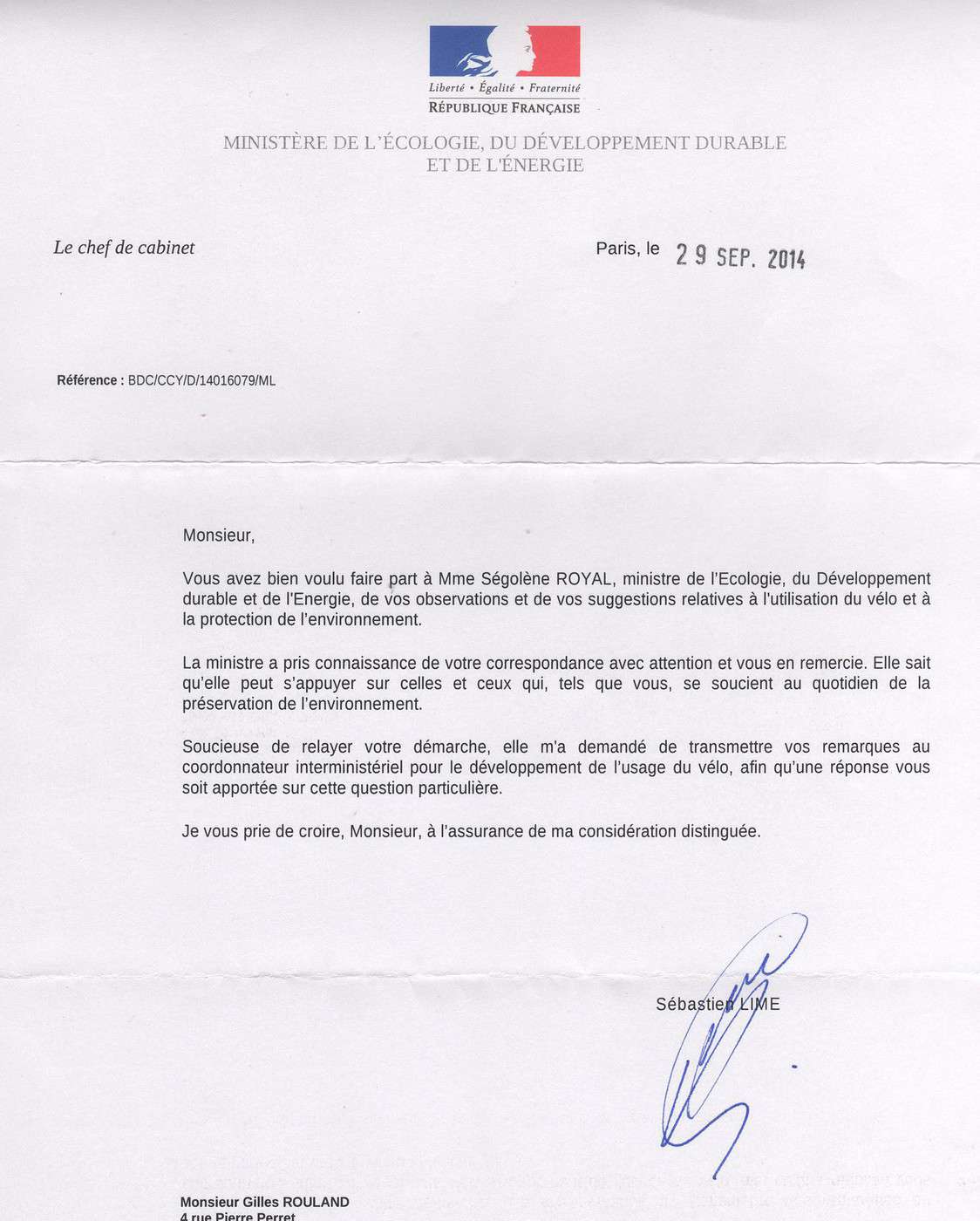
Here's the response to my letter (see previous message) to the Minister of Ecology, Sustainable Development, and Energy. Hoping for a more detailed answer about biking...

Biking (MTB) along the canal between the two seas (France)

Facteur4 · 2014-11-12 · Message 178 of 310

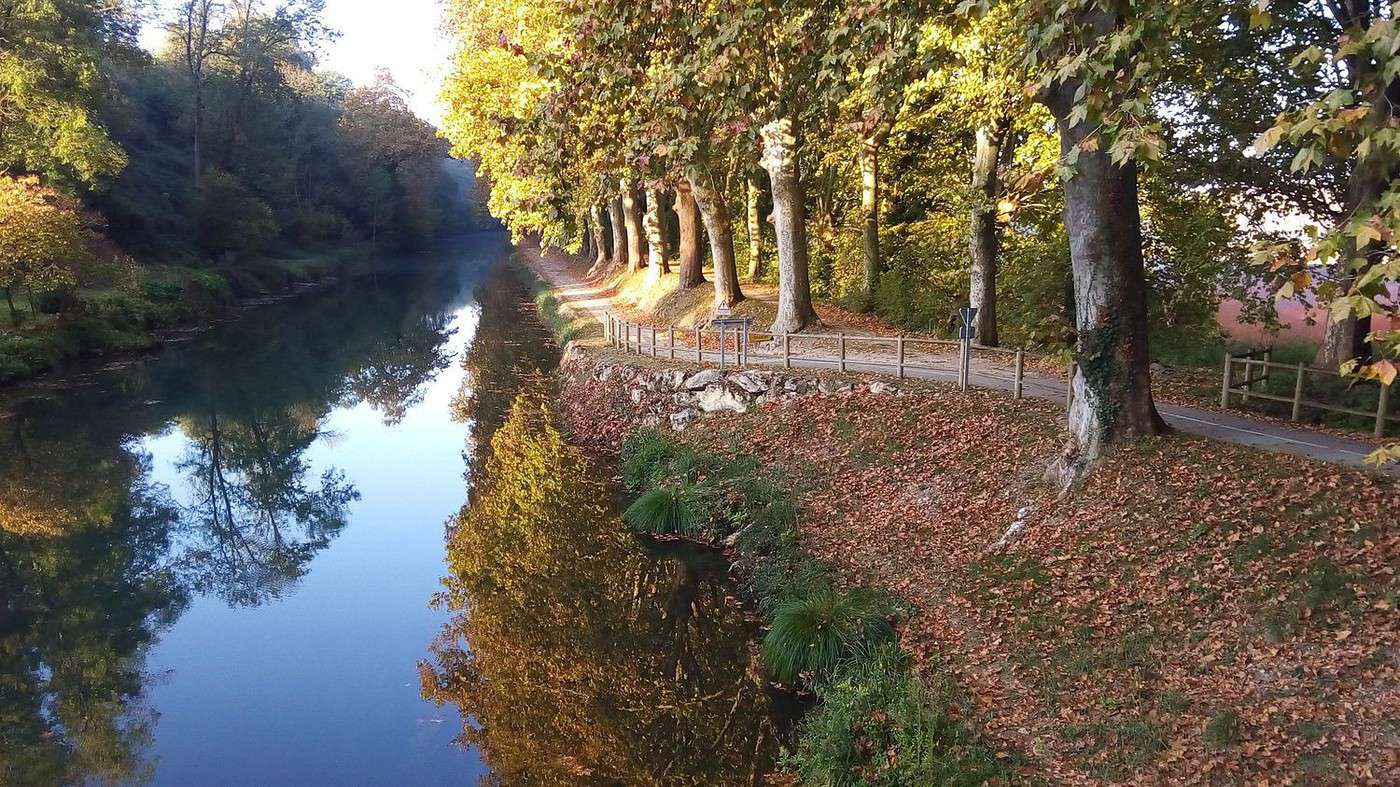
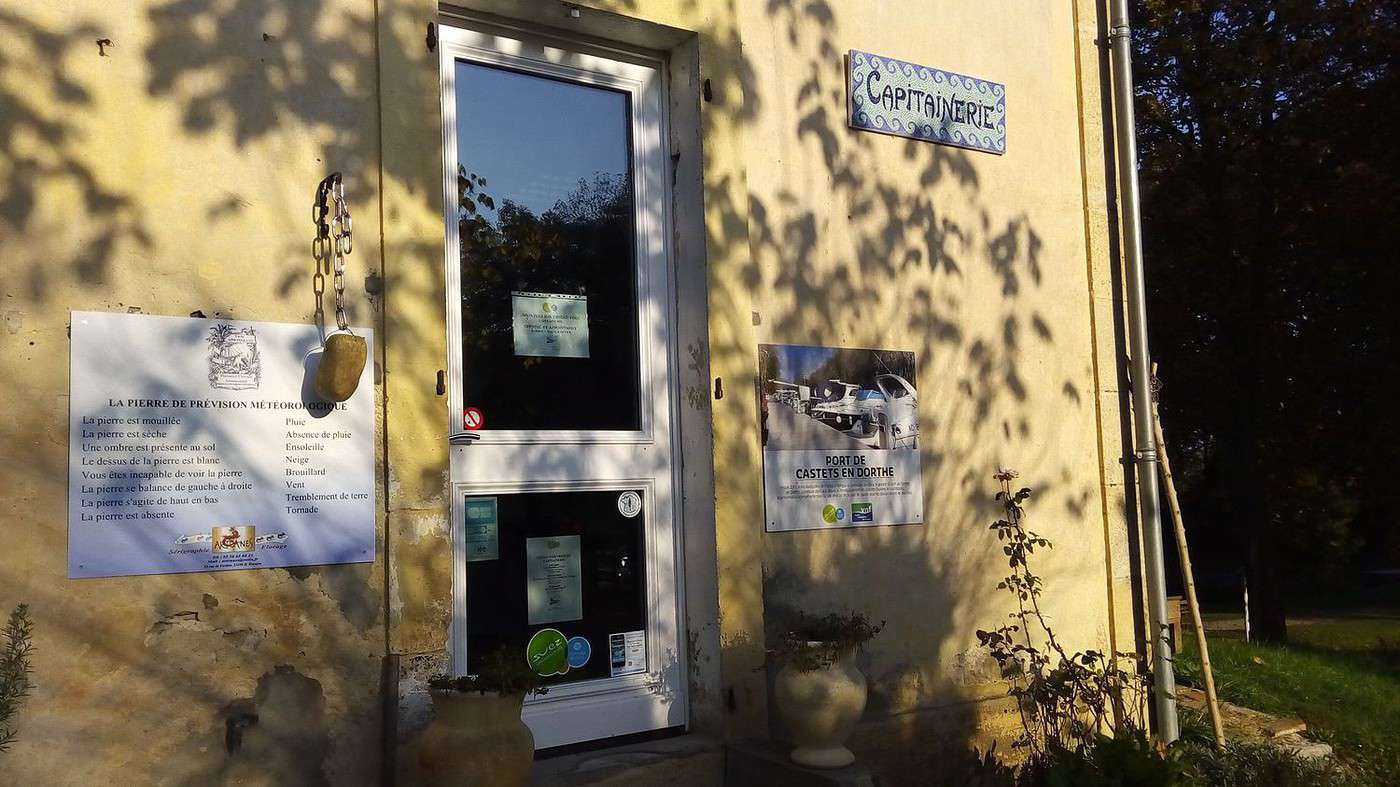
270 km in 3 days. My friend, with whom I went to Sète in April, suggested we travel along the lateral canal of the Garonne toward Bordeaux. Tuesday, October 28 – Valence d’Agen 08:30 to Blaignac 16:30 – 107 km We’re enjoying a lovely Indian summer in the Southwest, and the canal is showing off its most beautiful colors. After crossing Agen and its canal bridge, we reach the port of Buzet, where boats can head down the Baïse. We take advantage of the picnic tables nicely shaded by honeysuckle arbors to have lunch. Then, a favorable southeast wind helps us approach the end of the canal. Once in Gironde, signs constantly indicate "road closed." Kudos to the department for maintaining the Greenway by redoing the surface, but these signs—left up, I assume, for the entire duration of the work—are excessive since we had no trouble biking. It would make more sense to close the road only when machinery is present and the asphalt is being poured. In Blaignac, a guest room located along the bike path invites us to stop before the canal’s end: http://www.gites-gironde.com/...temid=54&lan... Since only a large gîte is available, the Belgian-born owner offers it to us at the price of a guest room (70 €). But we won’t use all its amenities—not even the TV (too tired)—and the big space is cold (though we don’t turn on the heaters). A room would’ve been more suitable for two cyclists who only need a good shower and a comfy bed. We would’ve preferred being offered the Belgian beers we drink while the Luxembourgish-born hostess prepares our beds. They’re as shocked as I am that bottles aren’t returnable in France. On top of that, they’re subject to household waste weighing and very selective trash collection. We dine with our hosts (14 € + wine) and quickly drift off to sleep. After a very pleasant included breakfast, we’re glad we stopped here instead of facing Langon’s traffic at dusk in search of a hotel, which would’ve likely been a bit cheaper. Wednesday, October 29 – Blaignac 08:30 to Mas d’Agenais 17:00 – 78 km It’s in Castets-en-Dorthe that the lateral canal of the Garonne flows into the river, which is then navigable to Bordeaux and toward the estuary. We make it to the port, but the harbormaster’s office is closed. I won’t be able to pass along the greeting I was asked to give by the Captain of Briare, whom I met during the Vienne-Nantes bike tour. Navigation is already slowing down in autumn. We cross the Garonne before following it along a dirt path, passable thanks to the drought. It leads us to Saint-Macaire. Then we take the road and the bridge to return to the left bank in Langon. We do some quick shopping for our picnic and start heading back through the hills. We pass through Auros and Aillas. Our progress is slower, and the climbs warm us up. I enjoy the coolness of Lac de Sigalens before lunch. Then we continue through the vineyards, heading to Cocumont and then Sainte-Marthe, choosing Mas d’Agenais for the night. There are no more hotels, and after checking with the town hall, we only have two guest rooms to choose from: one in town for 90 € and another in the countryside for 80 €. We pick the latter, which means backtracking after stopping at the grocery store. The owner, on the phone, tells us she doesn’t provide meals. She asks if it’s really us she saw when we arrived in Mas d’Agenais. I hadn’t dared stop the woman on her bike to ask about accommodations, not wanting to interrupt her, and she hesitated to offer hers when she saw us with our loaded bikes. We’re warmly welcomed into this large, old family farmhouse: http://www.gites-de-france-47.com/...Garonne-47G... The owner not only warms up our brick of soup but also offers us rice to thicken it, and we have a pleasant chat with her and her partner, an artist painter. They’re registered on http://www.canal-et-voie-verte.com/...spots%2Fho... and host many cyclists.

Thursday, October 30 – Mas d’Agenais 09:00 to Valence d’Agen 16:00 – 95 km We stop to admire Rembrandt’s Christ http://www.sudouest.fr/...andt-325884-4397.php Then we quickly find the towpath again, but this time the southeast wind is against us. One last picnic by the canal in Sérignac-sur-Garonne, and it’s time to head back. My companion is still sore but already dreaming of our next destinations.

Mountain biking (MTB) along the Canal between the Two Seas (France)

Facteur4 · 2014-11-22 · Message 179 of 310

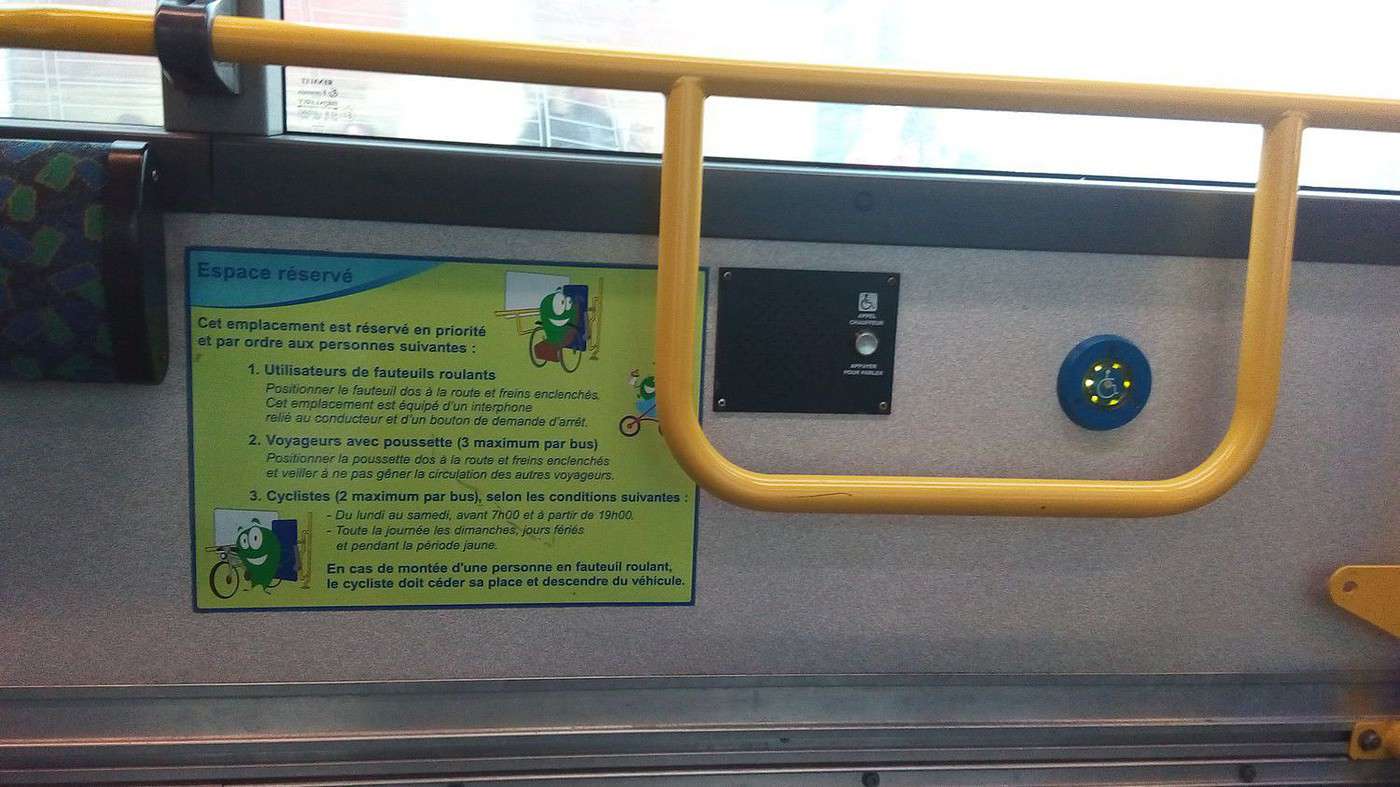
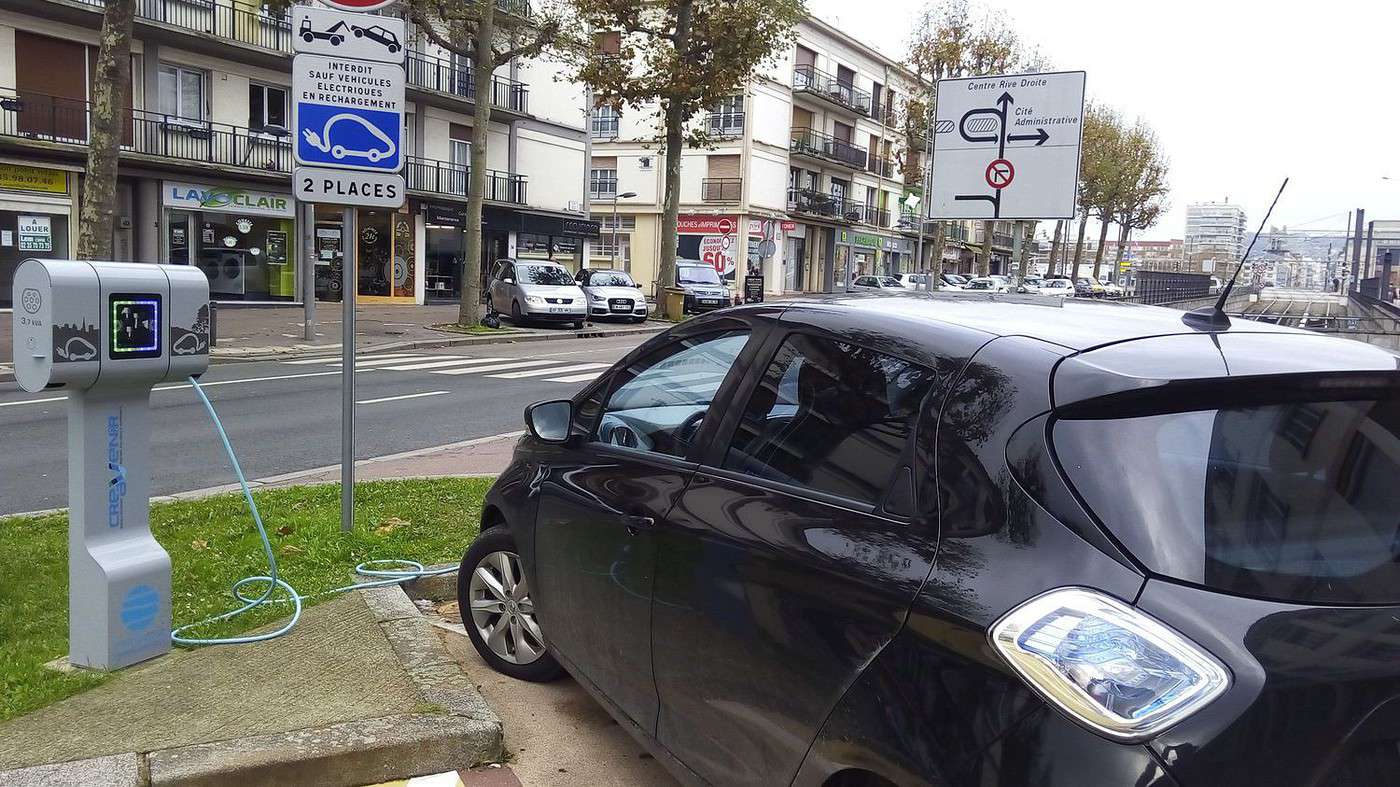
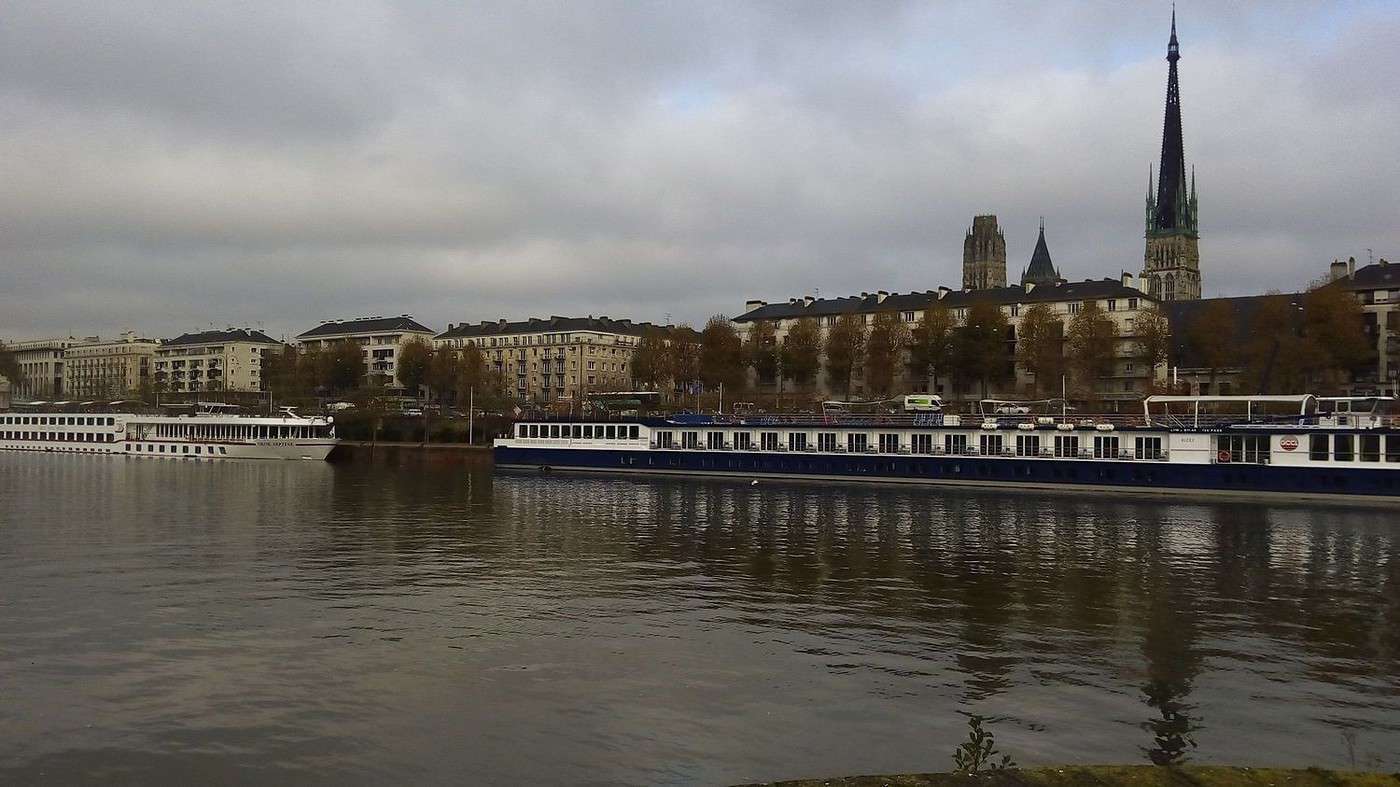
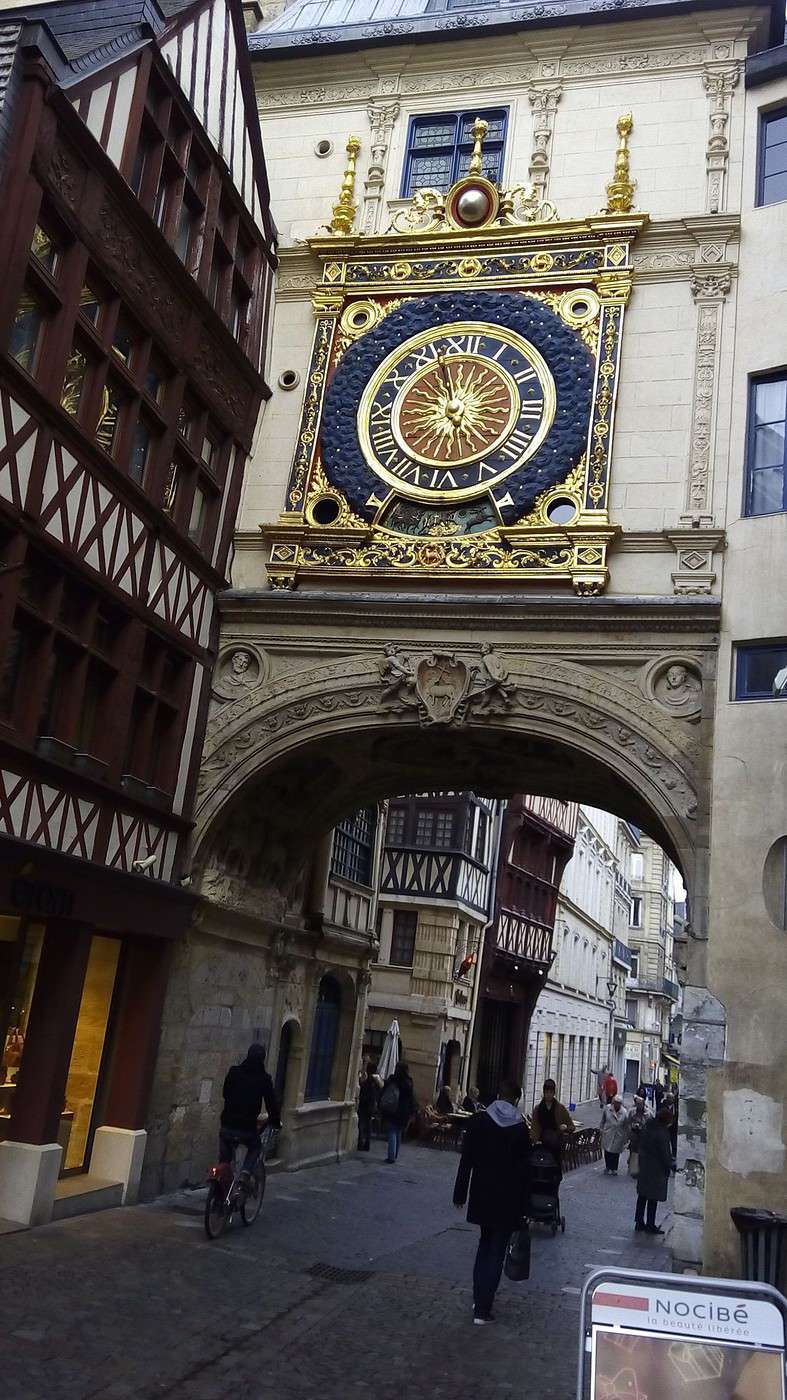
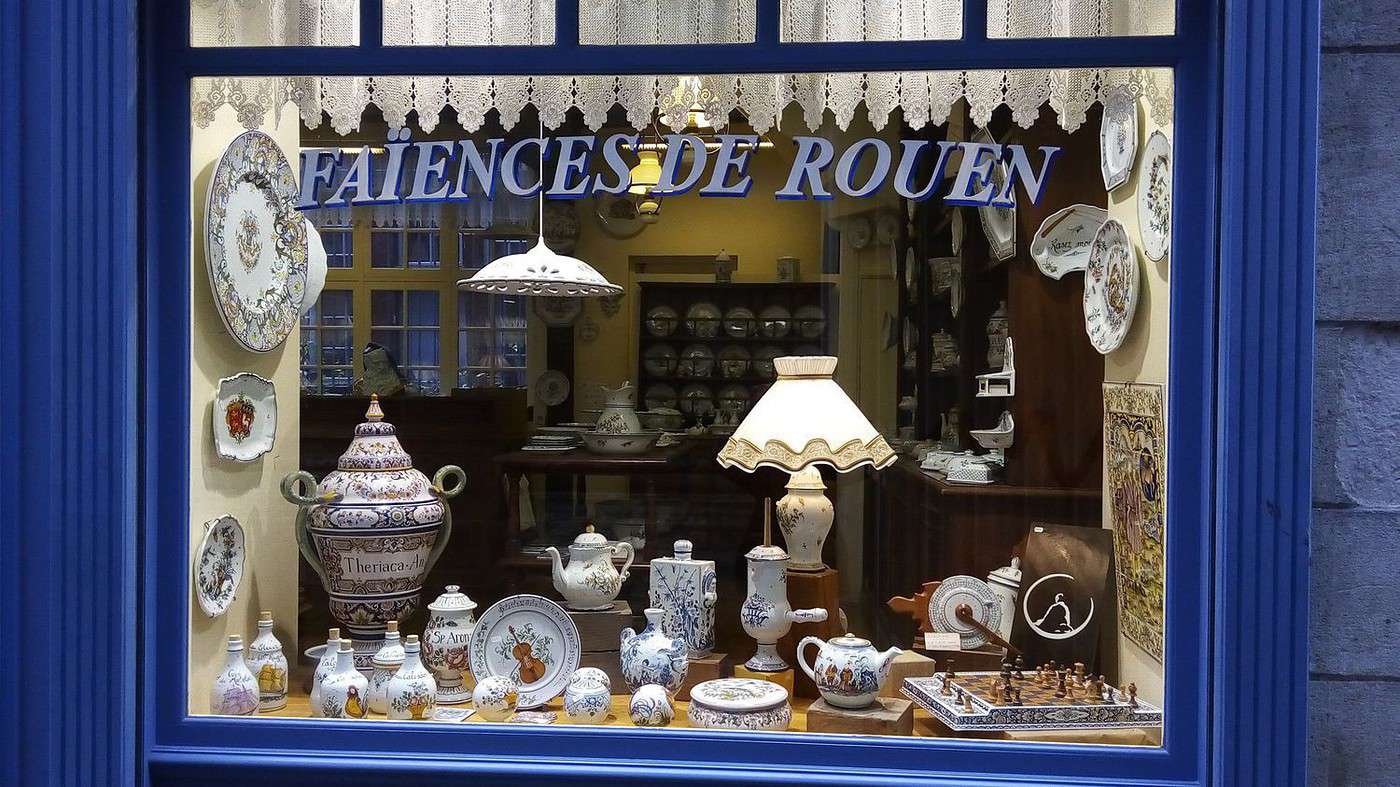
During a family trip to my hometown, I noticed how involved the greater Rouen community is in developing soft transport options. Large coaches now accept bikes—admittedly only during off-peak hours, but it’s a first stepturn of the wheel (see photo). They also offer parking and charging for electric vehicles across 20 stations: http://www.la-crea.fr/...ation-des-bornes.pdf Plus, the Seine-Maritime General Council is heavily involved in creating and promoting the Avenue Verte: http://www.avenuevertelondonparis.com/ In their magazine, they note that since the start of the year, over 10,000 cycle tourists have taken the Transmanche route. The presence of 67 "Accueil Vélo" providers has boosted this tourism growth, along with many foreign tour operators featuring this destination.

Biking (MTB) along the Canal between the Two Seas (France)

Facteur4 · 2014-12-13 · Message 180 of 310

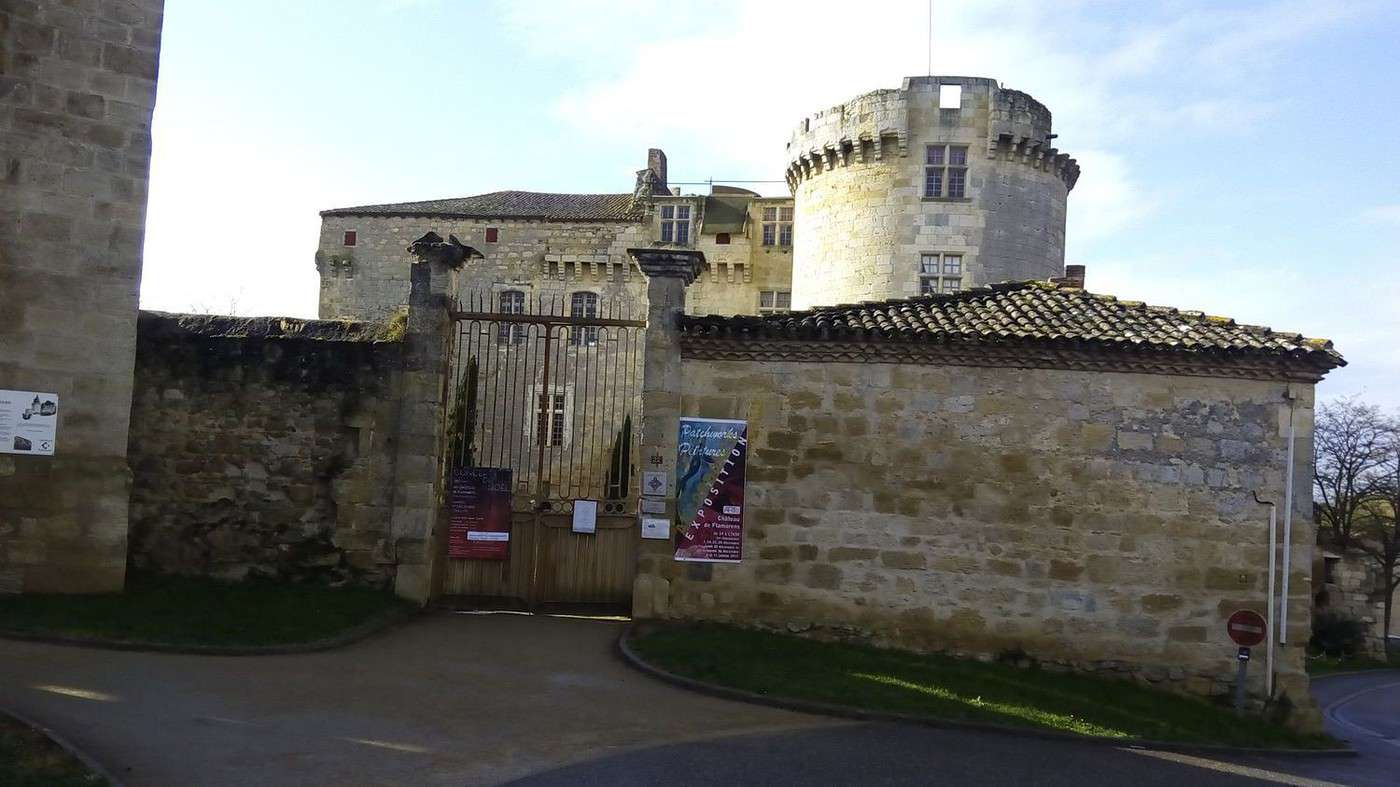
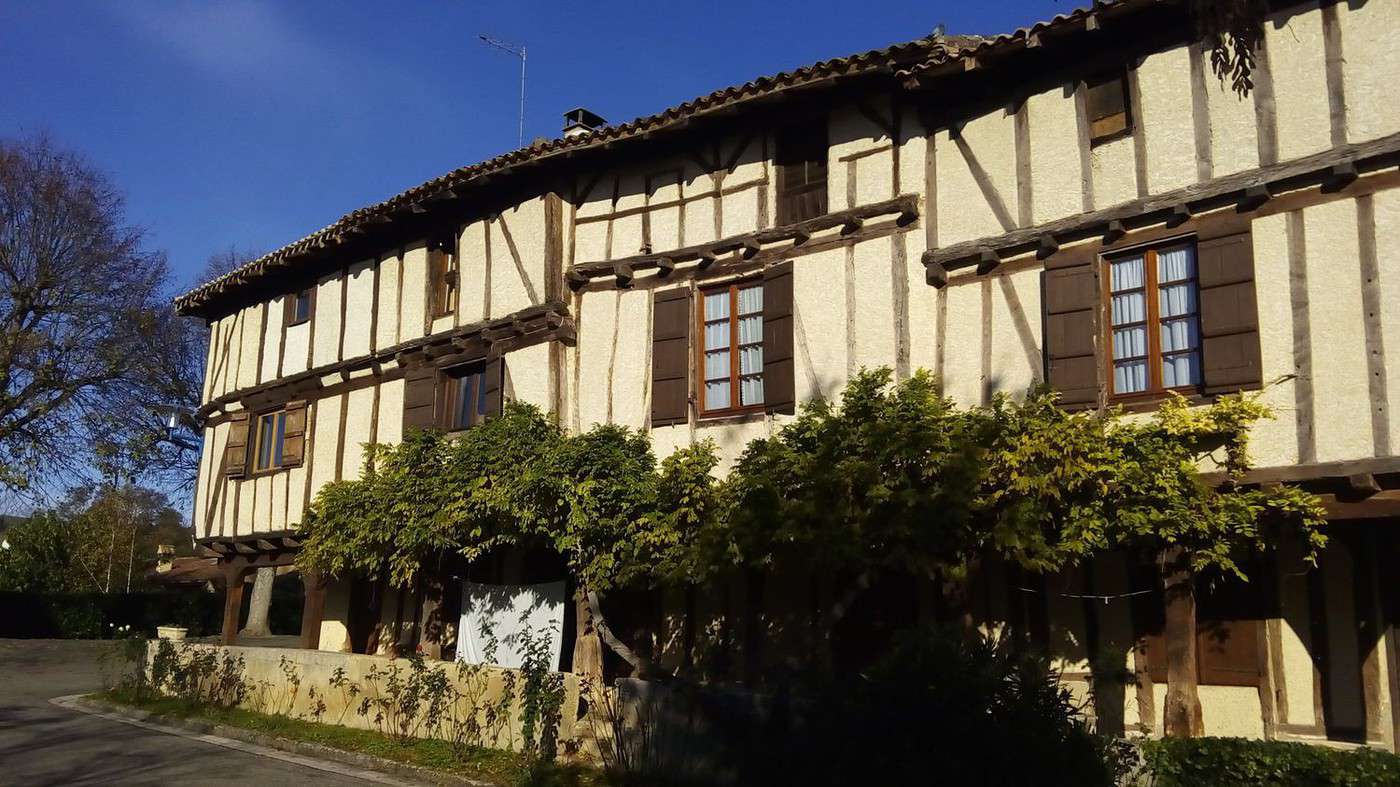
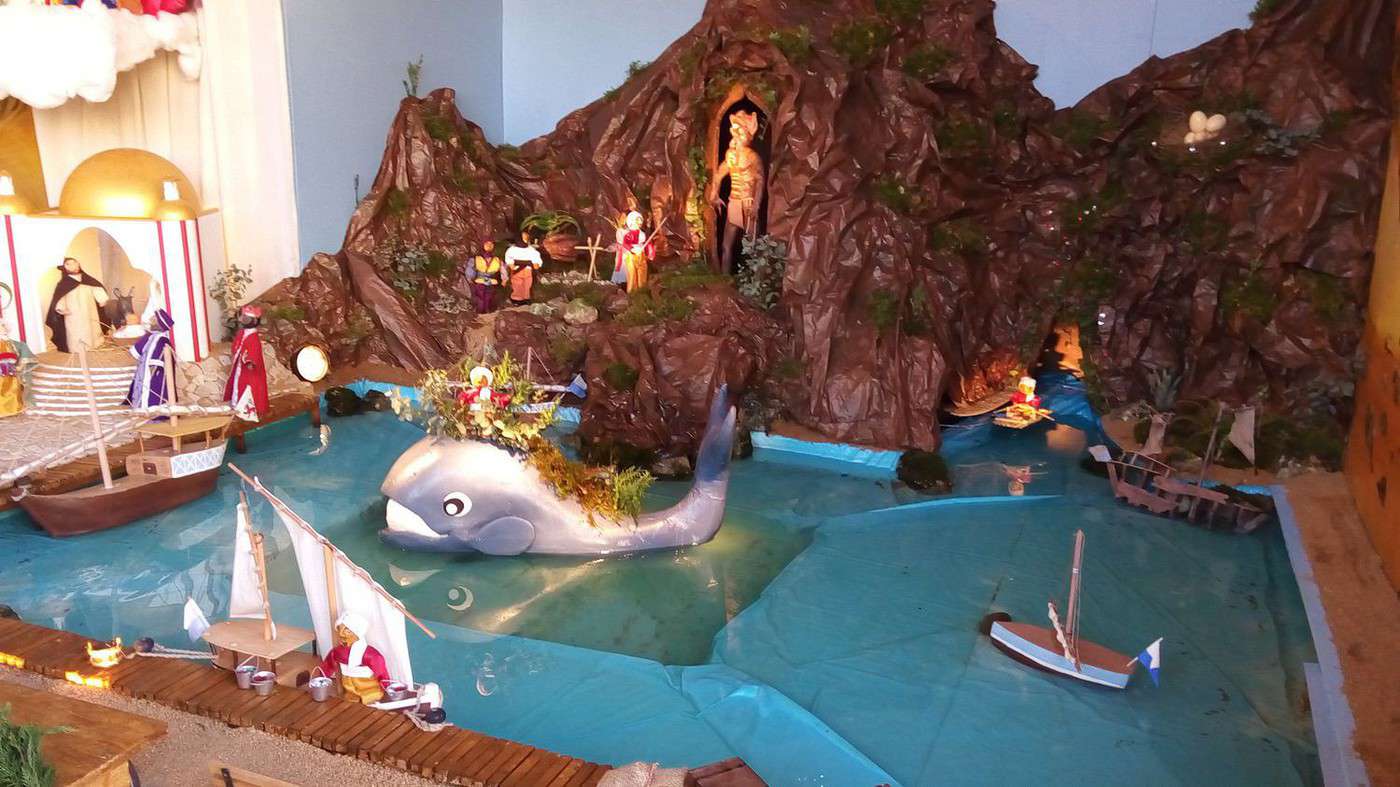
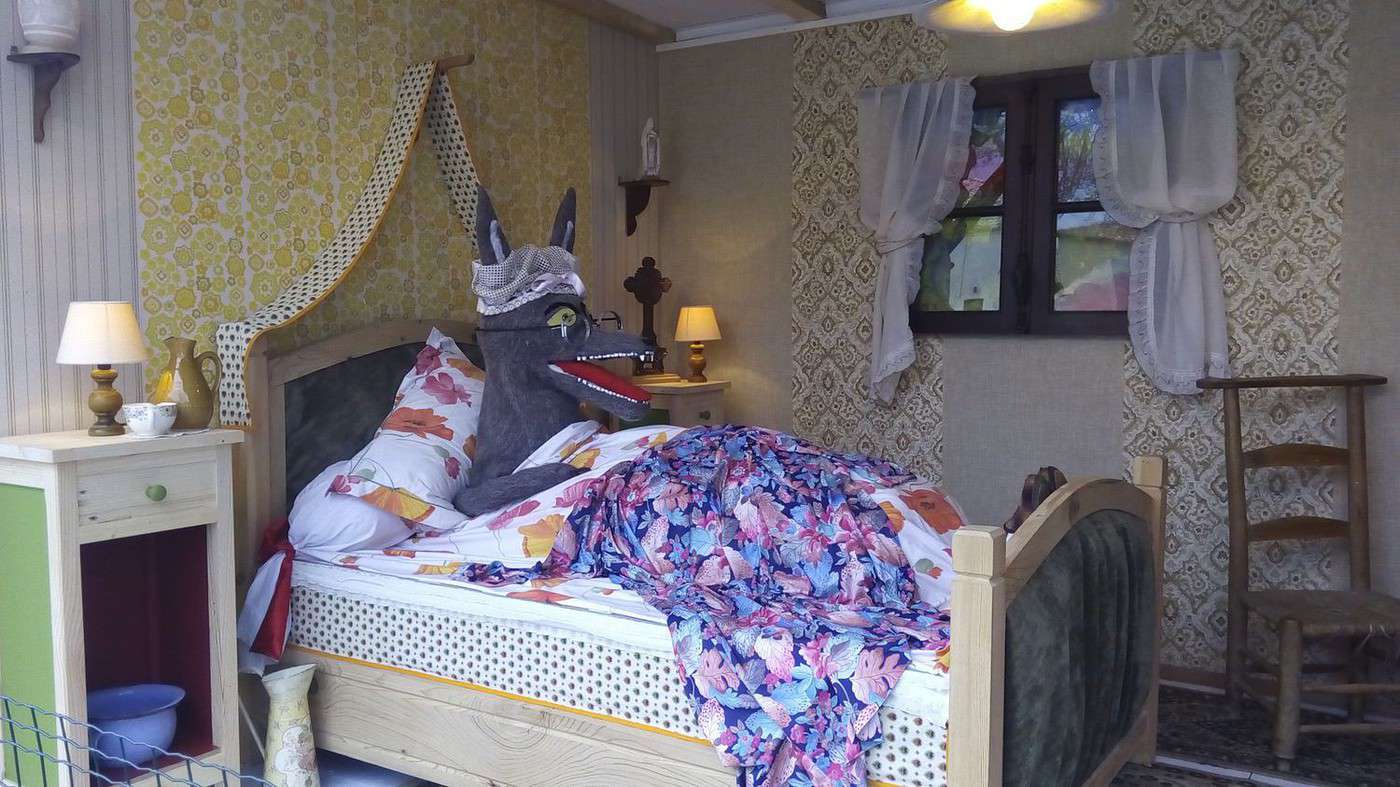
To encourage cyclists to brave the December chill, 8 communes in the Gers invite you to ride the Ronde des Crèches, which this year has the theme "Tales and Legends." It's an 80 km route that's quite hilly but really enjoyable: http://www.larondedescreches.org/ You can also check out the round of sites to visit and restaurants along the way.

VoyageForum — the largest community of French-speaking travellers.