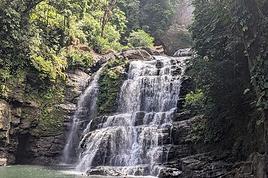
We visited the northern/northeast part of Oman, the most touristy area, last February over 11 days there. It’s a great time to go because the temperatures are pleasant and there aren’t too many tourists, even though the country is only just starting to develop its image. 11 days was enough for us to see the essentials, but you can always extend your stay depending on what you want.
2 days in Muscat, 2 days in the desert—we would’ve happily stayed longer—2 days in the mountains, 3 days in the wadis, and the rest for the cities, villages, and the coast.
Oman offers stunning landscapes and a genuinely warm welcome. We always felt safe, never experienced any malicious looks or gestures.
As usual for our trips, we chose to organize everything ourselves but with a guide to better explore and soak up the local culture.
The point of my post isn’t to recount our journey but to encourage and reassure anyone considering this destination.
If I can be of help, I’m happy to answer your questions based on what I know.
9 similar discussions in English

If I close my eyes and think of the Sultanate of Oman, I first smell a light scent of incense, feel the warmth of a sunbeam on my skin, before sand slips through my fingers. I taste the sweetness of a date, a real candy, then the flavor of coffee with a hint of cardamom and rosewater... I hear the desert wind whistling in my ears, the distant call of a muezzin, then the murmur of water. I open my eyes to see smiles, welcoming gestures, a turquoise sea, rocks ranging from ochre to purple, deep wadis where torrents burst forth, orange dunes, white sandy beaches where tiny crabs scurry at full speed. I see incredible oases emerging between arid mountains. I see abandoned villages that I’d dream were full of life, imposing fortresses overlooking valleys, and lively souks where offers are delicate and negotiation is a mutual courtesy.
All that, and so much more.
This is what I tried to capture in my illustrated travel journal, which I’ll fill in here and there with photos. I drew this journal “cold,” after my return (actually, I made it this summer, while our trip was last winter). It’s a pretty special format—I bought it in Japan without really knowing what I’d do with it. Well, it found its purpose! Below is a photo of this accordion-style journal: here, it’s only partially open, because when fully unfolded, it’s 5 meters long!
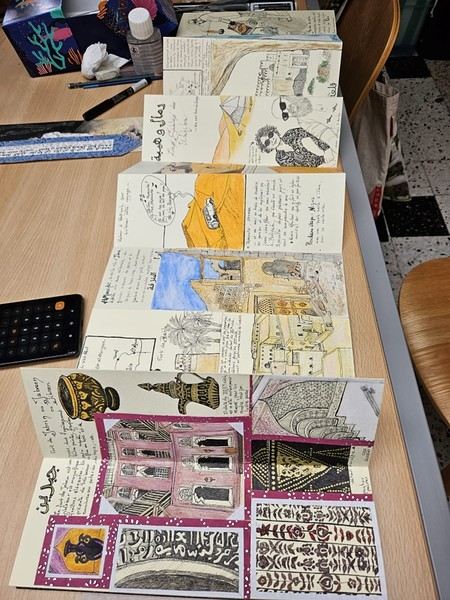
For drawing enthusiasts: The accordion format is both a constraint (each sheet is 9 cm x 27 cm) and a freedom (you can create a fresco). The paper is also a bit special: it doesn’t allow for fine lines, but it takes ink well (liner pen). However, everything has to be done almost in one go (with a very light pencil sketch) because it erases poorly. It absorbs too much water for coloring with markers or watercolors (unless you avoid soaking it), but it works well with oil pastels and their use with a brush and solvent. Since it’s yellowish, it allowed me to create contrasts even with white pastel.
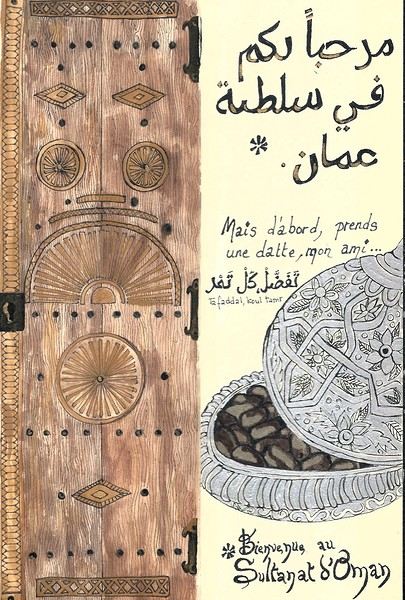 On the right, the "welcome marker"—those dates offered everywhere as a sign of hospitality. On the left, a tribute to those stunning doors worn by time, admired all over the old quarters, including the abandoned ones.
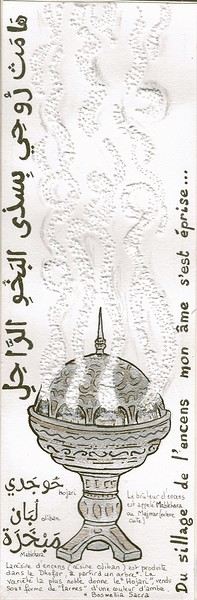
Oman is one of the world’s largest producers of frankincense resin. Incense burners are everywhere, from the simplest clay ones to the most precious handcrafted silver ones...
 Hospitality will often lead you to accept a small coffee, an "Omani coffee," very light, subtly flavored with cardamom, maybe a touch of saffron, and occasionally rosewater.
Here, I’ve depicted a man in the common everyday attire of Omanis: the dishdasha, mostly white (during the week and daytime; colors are more common in the evening or on Fridays and Saturdays). While you’ll see some men dressed in Western clothes, they’re very few. The white dishdasha is truly the shared attire of all men. The dishdasha, which has no hood, is distinguished by a small pom-pom attached to the collar, the furakha, which is soaked in perfume. And believe me, Omanis go overboard with it! "It smells like the pom-pom" is an expression that’s now part of our shared language, my husband and I.
Another must of men’s attire is the kuma, a small round head covering, usually white with brightly colored patterns. The keffiyeh is also worn (but without the cord called an agal in Arab countries), and it’s mostly worn by those with roots in the desert, from what I understood.
And what about the women, you might ask? Some are veiled, some in full black (but not a burka—more like a chador + abaya), due to the influence of Saudi Arabia and the United Arab Emirates, whereas the traditional outfit used to be a layering of very colorful dresses. Most of the women we saw wore neutral clothing, a plain veil over their hair, but with their faces uncovered. We also saw many saris and colorful veils—don’t forget that 40% of the population consists of Indian, Nepalese, and Bangladeshi immigrants, who work a lot in tourism, hospitality, restaurants, services, and construction.
Just to clarify, as a tourist, there’s no pressure to wear a veil, and never any disapproving looks. Of course, you’ll save the mini shorts, plunging necklines, bare shoulders, and midriffs for the hotel terrace—but I’d say that’s the same for men and women, and with the sun being strong, it’s better for your skin too.
Here’s the introduction! In the next post, I’ll tell you about my itinerary, and we can dive in!
Hi there,
I’ll be in Oman in early March 2025. I’ve rented a 4x4 to reach the Oman Sea coast from Ibra. I’ve seen two options on Oman Off Road:
The OOR 30 route via Wadi Kabbah, Wadi Bani Jabir to Qalhat.
Combine the OOR 30 and OOR 28 routes via the Salma Plateau to Tiwi or Fins.
Can anyone advise me on the current condition of the tracks? For option 2, is it better to head down to Tiwi or Fins? Can this trip be done in one day? Thanks in advance to those who can share some great tips!
Best regards.
Hi there, my partner and I did a road trip in Oman in January 2025 with a 4x4 and a rooftop tent. We only slept in free spots out in nature. It’s essential to have a 4x4 to experience this. The *Oman Off Road* book was a huge help—we bought it locally. I’ve written up our whole adventure and shared all our tips on my blog, including GPS coordinates to help you find campsites or even cross the desert on your own. Here’s the link: https://worldseenbymathilde.blogspot.com/2025/02/notre-itineraire-de-10-jours-oman-en.html
Hi there, I traveled to the Sultanate of Oman last January and had the book *Oman Off Road* in digital format in English, plus a second version in French. For anyone planning their trip, if this book interests you, don’t hesitate to reach out—it’s a real bible for off-the-beaten-path travel. Here’s my email for direct contact:
xavierpous@orange.fr
Or through Voyage Forum, which we’re always happy to use.
Hi there,
I’m looking for a female co-traveler to join me in Oman for a month, from mid-February to mid-March.
We’ll rent a Toyota 4X4 locally for 1 050 € for the month—I’ll be driving the vehicle.
At the moment, there are two vehicles in our group, with a gentleman who’s going for the 4th time.
We’re planning on free camping on-site, alternating with guesthouse stays roughly every 8 days.
Planned itinerary: Muscat, heading south to the Empty Quarter desert, then back up along the coast, with canyon swims along the way, and the Hajar Mountains on the return to Muscat.
I’m a 70-year-old woman, experienced in travel.
Drop me a line for more details.
Thanks!
The hike from Misfat AA and Bilad Sayt via W9a, W10 via Ras Al Haraq, and W8 has recently been redone and clearly marked in green. The path is well-built, though W8 remains exposed (W8 is in the shade in the afternoon). You’ll find water at the passes just before and after Ras Al Haraq, which offers the best view. The signage starts on the descent toward the palm grove at the entrance of Misfat AA. In Bilad Sayt, the start is hidden by a construction site.
On the ridge, the W10 west of the intersection with W9a is just a faint trail, only partially marked by cairns. You’ll need to skirt the rocky summits to the south. It’s slow and rugged but without major issues. There’s a building with water 20 minutes before the last pass, where you hit the cliffs of Jbel Shams. At this point, W10 descends onto the northern slopes, continuing along narrow ledges—very adventurous since it’s unmarked. I didn’t continue. From this pass, you can also descend off-trail more directly toward Misfat AA, which is equally adventurous.
For the return, take the track to Shorfet Al Alamin pass (there’s a canal with water along the way—it’s in the shade in the morning), then the W10h and W9 trails. W9 is just a trace, not a proper trail, but it’s very clearly marked.
This makes for a 3-day loop (the goal is to camp up high for the views, sunsets, and sunrises) or a relaxed 4-day trek.
Al Hamra GH is a good place to stay before and after.
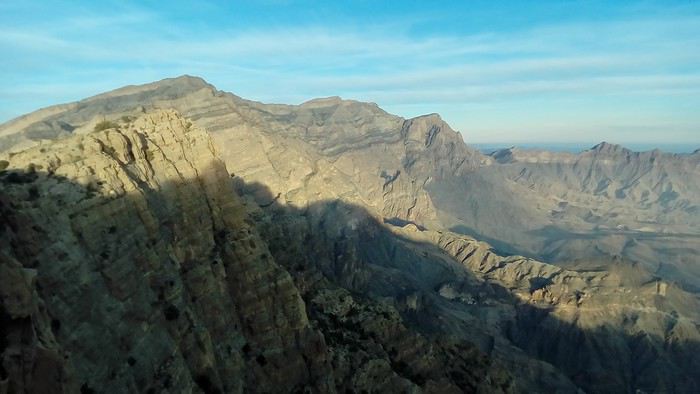
On the ridge, the W10 west of the intersection with W9a is just a faint trail, only partially marked by cairns. You’ll need to skirt the rocky summits to the south. It’s slow and rugged but without major issues. There’s a building with water 20 minutes before the last pass, where you hit the cliffs of Jbel Shams. At this point, W10 descends onto the northern slopes, continuing along narrow ledges—very adventurous since it’s unmarked. I didn’t continue. From this pass, you can also descend off-trail more directly toward Misfat AA, which is equally adventurous.
For the return, take the track to Shorfet Al Alamin pass (there’s a canal with water along the way—it’s in the shade in the morning), then the W10h and W9 trails. W9 is just a trace, not a proper trail, but it’s very clearly marked.
This makes for a 3-day loop (the goal is to camp up high for the views, sunsets, and sunrises) or a relaxed 4-day trek.
Al Hamra GH is a good place to stay before and after.
Hello,
I’m 76 years old and travel a lot around the world. I’m planning to go to Oman from March 19 to April 8, 2026. (After that, I’m off to Turkey to meet some friends.)
I’m looking for a fellow traveler to share a car rental to explore some off-the-beaten-path spots.
I just got back from Cape Verde, and before that, I was in the USA, Japan, Chile, etc.
I usually travel solo, and obviously, I meet a lot of people along the way.
For Oman (and Namibia next year), it seems more practical to travel with 2 or 3 people.
That’s all!
Patrice
What's the best time to travel to Oman?