We stayed in Iceland from August 27 to September 13, 2023. Actually, this was our second trip to the island.
During our first visit, we rented a camper van from Snail Motorhome Rental, a family-run business that provided outstanding service.
Unfortunately, we discovered that this company no longer exists.
So, we rented a camper van through a third party, specifically via the Nordic Travel Group website.
We chose City Car Rental, located near Keflavik Airport, because the rental cost was really appealing.
Apart from the quality of the sleeping bags and the size of the pillows we rented, our experience with this company was very positive.
We noticed a significant increase in tourism since our last trip in 2015.
Several sites have been redeveloped, and parking is now paid in many places.
Accommodations have multiplied, not only near major cities but also in remote areas.
One notable advantage, however, was discovering the wide variety of food products available in supermarkets. In 2015, the selection was very limited.
I invite you to continue reading this travel journal and watch the videos that will let you explore this destination, which has everything to charm outdoor enthusiasts.
Videos are embedded throughout the summary. Click on the image to start the video.
To jump to a specific post, here are the relevant links:
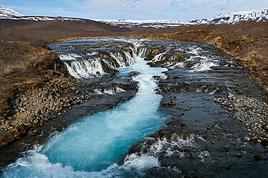
Hlauptungufoss, Midfoss and Bruarfoss
Geysir, Blesi and Strokkur
Gullfoss
Brúarhlöð Canyon
Faxafoss
Kiðjabergsvöllur – Belvedere
Kerið Crater
Reykjadalur Valley – Hike to the hot springs
Seljalandsfoss
Gljúfrabúi Waterfall
Seljavallalaug – One of Iceland’s oldest geothermal pools
Skógafoss – Fimmvörðuháls hiking trail (partial)
Kvernufoss
Plane wreck at Solheimasandur
Dyrhólaey Peninsula
Reynisfjara Beach – Puffins and seals
Vík í Mýrdal
Fjaðrárgljúfur Canyon
Skaftafell National Park – Svartifoss, Magnusarfoss & Hundafoss
Svínafellsjökull Glacier
Hofskirkja Church
Fjallsárlón Glacial Lagoon (West)
Fjallsárlón Glacial Lagoon (East)
Jökulsárlón Glacial Lagoon
Litlanefsfoss and Hengifoss
Rjúkandi (Rjúkandafoss)
Stuðlagil Canyon
Selfoss and Dettifoss
Krafla – Viti Crater Lake
Krafla – Leirhnjúkur Lava Field
Hverir Geothermal Site (Námafjall)
Hverir – Hverarönd Geothermal Site – Blue Lagoon
Grjótagjá – Hot Spring Cave
Stóragjá – Hot Spring Cave
Goðafoss
Akureyri Zipline
Hofsós – Pool by the Skagafjörður Fjord
Víðimýrarkirkja Church
Hvítserkur Rock – The Troll of Northwest Iceland
Gislahellir (Gisli's Cave)
Dynjandi (Fjallfoss) – One of Iceland’s most beautiful waterfalls
Hellulaug (Natural hot spring pool)
Stykkishólmur – Stykkishólmshöfn Port
Kirkjufell & Kirkjufellsfoss
Ólafsvík – Bugsfoss
Lóndrangar Basalt Columns
Arnarstapi
Ytri-Tunga Farm – Seal watching
Deildartunguhver Hot Spring
Hraunfossar & Barnafoss
Exploring Reykjavik
Reykjavik – Whale Safari – Whale watching
Raufarholshellir Lava Tunnel
Gígvatnsvatn Lake (Green Lake/Graenevatn)
Seltún Geothermal Site (Krýsuvík)
Kleifarvatn Lake
Blue Lagoon Thermal Spa
Gunnuhver Geothermal Site
Reykjanes Peninsula – Reykjanesviti Lighthouse
Reykjanes Peninsula – Valahnúkamöl – Reykjanestá
Ægissíðufoss
Super Jeep excursion to Landmannalaugar
Hiking in Landmannalaugar
Scenery along the way
2,958 similar discussions in English
Hi there,
I’m planning a trip to Greece this summer with my 3-year-old son. I recently separated, and we were originally supposed to go on a road trip to Brazil, so I’m now forced to find a Plan B.
I’m usually a backpacker who travels with just my backpack, but with my son, I’ll have to opt for all-inclusive hotel packages. I don’t feel ready yet to go backpacking alone with him at the other end of the world. When he’s 5, it’ll be easier :)
Anyway, with so many options for Greece, I’m a bit overwhelmed. There are so many islands and resorts. Do you have an island to recommend? And more specifically, a hotel?
We’re looking at the first two weeks of August.
Thanks for your help!
Thomas
Anyway, with so many options for Greece, I’m a bit overwhelmed. There are so many islands and resorts. Do you have an island to recommend? And more specifically, a hotel?
We’re looking at the first two weeks of August.
Thanks for your help!
Thomas
Hi there,
My sister and I are planning a little 10-day trip to Morocco. We haven’t decided on a destination yet.
We’d like to go at the end of March or beginning of April.
We want to be close to a big city but near the sea, in a hotel with a pool and gym.
For this first trip to the country, we’d like to mix relaxation, sports activities, and visits to the city and surrounding areas.
If you have any suggestions, we’d love to hear them.
Thanks in advance.
✈️ One-month itinerary idea for Laos 🇱🇦
We’re sharing this trip from July 2024—a pretty classic route for a first visit to Laos. An amazing country that’s still authentic and just starting to embrace tourism. Hope this gives some ideas to anyone thinking of heading to Southeast Asia!
You can check out our day-by-day adventure on our travel journal. There are plenty of photos there too.
✈️ One-month Thailand itinerary idea 🇹🇭
We’re sharing this trip from July 2023—a pretty classic route from Bangkok to northern Thailand. A great circuit for discovering this amazing country. Hope it gives some ideas to those who’d like to head to Southeast Asia!
You can check out our day-by-day adventure on our TRAVEL JOURNAL. There are lots of photos there.
Travel Journal: 21 Days in La Gomera and La Palma
From February 6 to February 26, 2024
Tuesday, February 6 We left around 9 AM with our car, along with Pierre-Paul and Patricia, heading to the Bluepark parking lot in Bartenheim. As expected, we were awaited and left promptly for EuroAirport Basel. Took off at 12:25 PM for a 4-hour-15-minute flight under excellent conditions. Beautiful arrival in Tenerife with Teide in sight under a clear blue sky. Fifteen minutes later, we waited for bus No. 40 to Los Cristianos with quite a few other tourists, but we managed to find four seats. From the bus station, it was a 20-minute walk to our hotel. We checked into a lovely apartment for the four of us, complete with all the comforts. Outside, it was quite warm—at least 25°C! After dropping off our luggage, we went for a stroll. The immediate surroundings of the hotel held no interest for us: a modern, concrete area filled with hotels, bars, tourist agencies, and unappealing restaurants all offering the same bland international cuisine. Pat went to cool off at the pool, unfortunately overrun by loud, drunk English tourists. I took a walk to the paseo maritimo that leads to the port, skirting the seafront. The promenade was pleasant, but it could have been any seaside resort in the world—same old scene: a succession of bars with blaring music where many elderly people sipped cold beers waiting for the sunset, the backdrop a wall of resort-style hotels resembling rabbit hutches! Upon reaching the port, I scouted the route we’d take the next day to the Fred Olsen ferry. Back at the apartment, in the early evening, we looked for a non-touristy restaurant for dinner. Monique stopped a woman to ask her opinion! In this area, she told us, there’s no restaurant that serves Canarian or Spanish cuisine! The only place with decent restaurants is at the port. Off we went to the port, where we sat down at Al Bordo restaurant and ordered a seafood paella for four. Excellent, and at a very reasonable price (36 € for two). We returned to the hotel along the seafront.
Wednesday, February 7
Woke up at 6 AM. Had breakfast in the apartment with what we’d bought the day before at a supermarket. It was still dark when we left on foot toward the port, walking along the calm seafront at this early hour. Forty minutes later, we arrived and waited 10 minutes before the ferry docked. At 9:30 AM, we left the port of Los Cristianos for a 50-minute crossing on a calm sea under a beautiful blue sky. There were quite a few people on this large ferry, but many had no luggage, meaning they were visiting La Gomera for the day and would take the ferry back in the evening. Upon disembarking, we went straight to our rental car agency to pick up the car we’d booked online a few months earlier. It was a nice Peugeot 2008, spacious enough for the four of us and our luggage. We immediately took the beautiful road from San Sebastián that climbs directly into the mountains toward our rental in Vallehermoso. The road was in perfect condition—it seemed brand new, like all the others we’d take on this island later. This side of the island is very arid with little vegetation, and the terrain is particularly rugged, as it is throughout the island. We stopped at our first miradors, which would be followed by many more throughout our Canarian trip. Our first visit was to the small village of Agulo, perched on a promontory above the sea and at the foot of a high cliff. The village features typical Canarian houses with windows flush with the façade and black volcanic stone masonry on white or reddish-brown walls. The first recommended restaurant was already booked for a group, so we settled for the shaded terrace of the excellent El Alameda bar-restaurant. From Agulo, you can access the Abrante viewpoint via a winding road, where the view of Agulo, 600 meters below, is exceptional. A glass ledge over the void lets you test your fear of heights!
We drove to Vallehermoso to do our grocery shopping at the supermarket—a habit that would continue until the end of the trip. Our little house, "Casa rural El Encatadora," is located in a beautiful flower-filled valley a few kilometers west of Vallehermoso. Each of us had a bedroom with an en-suite bathroom, plus a living room, kitchen, and a small terrace overlooking the quiet street at the valley’s end, which didn’t bother us at all.
Thursday, February 8 The good weather seemed to follow us since our arrival in the Canary Islands. This morning, we took the road—still as beautiful and new—toward Arure, high up to the west. The landscape was magnificent, with breathtaking glimpses of the sea far below. In Arure, we parked in front of Conchita’s bar, where a hike (Rother No. 30) starts toward two viewpoints: Alojera, which we reached after 45 minutes on a lovely path. Monique, tired from the first steep climb, stopped at the first viewpoint and hitchhiked back to Arure. Meanwhile, we continued toward the second viewpoint, Los Barranquillos, where the view of the surroundings was partially hidden by misty clouds rising from the sea. The entire mountain is sculpted by ancient, endless terraces climbing until the slope becomes too steep for construction—visible traces of the hard work of past inhabitants trying to survive in a harsh environment. We had a decent lunch at La Conchita bar, then drove to the small seaside town of Puerto la Caleta, sheltered by an immense cliff plunging into the sea. Black sand beach, rough sea—despite our encouragement, Pat didn’t dare to swim! As for the old village of Caleta, it’s perched on the mountainside, and visiting it requires climbing steep, stair-filled alleys to discover a few traditional houses. Back at the casa, dinner in, and card games...
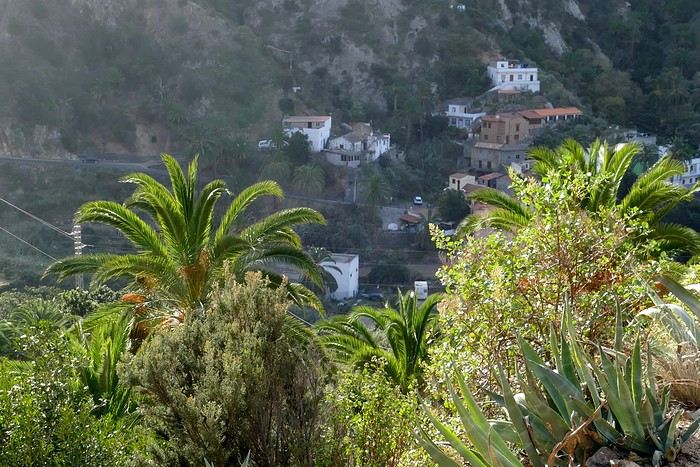 Vallehermoso
Friday, February 9 This morning, the sky was overcast, and the peaks around us were shrouded in clouds. We took the same road as yesterday to hike Las Creces. Quickly gaining altitude, we entered a thick fog—visibility was very limited. We stopped at the Las Creces parking lot; visibility improved, and the sun wasn’t far off. The hike is entirely within a beautiful laurel forest, with the sun playing hide-and-seek, but it wasn’t cold despite the altitude. After finishing the loop trail, we decided to picnic—not there, as it was too chilly—but on Vallehermoso’s beach, where we found a nice picnic area sheltered by large black rocks. A short digestive walk on the surrounding hill to admire the little beach from above. Back in Vallehermoso, we did some grocery shopping, then tried to return to the casa—only to find ourselves locked out because we’d left the key in the lock inside! After several attempts and with the help of Yéli, a relative of the owner we called for help, we were finally able to get back in!
Saturday, February 10
It rained last night, and the sky remained overcast. Monique decided to rest this morning. PP, Pat, and I set off on the hike that starts from the house toward the Marichal reservoir. The sun wasn’t far off, and by 11 AM, it was fully out. The pleasant hike passed by many flower-filled gardens and orchards—orange, lemon, and mandarin trees in fruit. The path climbed gently toward the reservoir, where the view of the Cano rock dominating the landscape was magnificent. The last part of the climb was a bit tough, overgrown with lush vegetation, and the trail was slippery from last night’s rain. We descended via a different, much more pleasant path and returned to the casa just in time for lunch, prepared by Monique. This valley is rich with its many farmers and market gardeners who’ve cultivated the entire valley, taking advantage of the water flowing down from the mountain, captured upstream and redistributed through countless pipes snaking along the paths. Numerous tanks also store water during dry periods. The houses are scattered across both sides of the valley, and these colorful little homes add a beautiful touch to the landscape. The many palm trees give this valley a distinctly tropical feel—you could almost imagine yourself in the Caribbean. Add to that some salsa music drifting from a hut where farmers were working, and the picture is complete. A well-chilled beer apéro capped off a lovely morning. The afternoon was dedicated to rest, relaxation, reading, and games.
Sunday, February 11 The blue sky returned, though a few clouds still capped the highest peaks. Today, we visited Garajonay National Park, which covers the highest central mountains. Up there, we were above the clouds, and the panoramas from the various viewpoints were stunning: first, Cherelepin, accessible from the Laguna Grande parking lot, then Alto de Garajonay, offering an exceptional view of Teide—over 3,000 meters high—emerging from the clouds on Tenerife, far in the distance. We continued to the Los Roques viewpoints, then stopped for lunch at the Degollada de Peraza restaurant, where the view of the barranco was impressive. We descended toward San Sebastián and checked into our new lodging, La Cabezada, located in the countryside about 3 km above San Sebastián. It’s a small apartment adjacent to the owner’s, with a lovely terrace overlooking the surrounding mountains and surrounded by a beautiful garden. Apéro, then dinner on our beautiful terrace.
Monday, February 12 This morning, we went down to visit San Sebastián de La Gomera: its old tower, main street with some beautiful traditional houses, and the Church of the Assumption. Back at the casa for lunch. In the afternoon, Pat, PP, and I set off on the short hike from San Sebastián beach to La Guancha beach. We drove down and parked on the beach. The path climbs along the hill overlooking San Sebastián, passes by the tall Christ statue dominating the landscape, and roughly follows the coast down to the isolated Guancha beach. A beautiful hike under a hot sun, and a swim was welcome, even if the beach and sea access weren’t very comfortable due to large pebbles and quickly deepening water. Apart from two nudist bathers, there was no one on this beach. We returned the same way.
Tuesday, February 13 Rest day. We went down to town to stroll and do some shopping. I took the opportunity to visit the parador, beautifully situated above the city in a lovely garden overlooking the port and town. Together, we went for a cuba libre at the "Cuba Libre" bar, then had lunch at Breñusca (mediocre paella!). Back at the casa, then we went back down to town to see a carnival parade, a "passacalles," which actually passed an hour earlier than scheduled. Oh well.
Wednesday, February 14 Each to their own program this morning. Pat went swimming at San Sebastián beach, Monique rested at the casa, and PP and I set off on the hike from Playa de Avalos to the Ermita de Guadalupe on Playa del Cangrejo. It wasn’t easy to find the right road or the parking spot, but we managed. The path seemed to have suffered landslides, according to a sign at the trailhead! We decided to check it out, ready to turn back if it seemed too dangerous. In the end, apart from one or two slightly tricky spots where we had to climb a pile of rocks, the trail remained passable, though a bit vertigo-inducing in places. The narrow path clings to very vertical cliffs nearly 300 meters above sea level! But what a magnificent view. At one point, the trail runs alongside a wall of basaltic pipes. We returned via the drivable track that parallels the trail a bit lower. Back at the house for lunch. In the late afternoon, we returned to town to attend the "Entierro de las Sardinas" (Burial of the Sardine), which closes the Canarian carnival festivities. While waiting, we strolled through the parador’s gardens and had mojitos in town. Around 9 PM, we heard the noise and cries of the mourners. The procession advanced, led by a large papier-mâché sardine on a float, surrounded by wailing mourners. The procession headed toward the sea, where the sardine was burned, and a mini fireworks display ended the procession. It was all very good-natured, and everyone had fun. We ended the evening with dinner at a good fish restaurant, El Pajar.
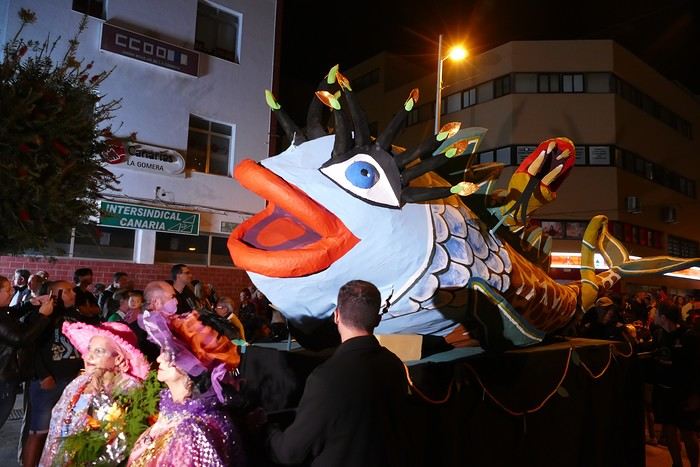 Entierro de la Sardina in San Sebastián de La Gomera
Thursday, February 15
Woke up at 5:15 AM. The only suitable ferry was at 7 AM, which would get us to La Palma by late morning rather than evening. We packed our bags, had breakfast, then headed to the port, left our rental car, and boarded the ferry to Tenerife, from where we’d continue to La Palma. Calm sea, beautiful sun—by 10:30 AM, we disembarked in La Palma. We picked up our car and immediately headed to our new apartment in Breña Alta. It’s a large apartment with a superb terrace facing the sea, fully equipped and very comfortable. The hosts recommended Casa Goyo restaurant, near the airport and close to us. It’s a restaurant with many small rooms, some of which can be reserved for families. The fish-based cuisine (chipirones, pulpo) was excellent, hearty, and reasonably priced. Since it’s in the airport’s flight path, we occasionally heard planes landing. Quick and efficient service. Afterward, we visited Santa Cruz de La Palma, which reminded us of the historic quarters of La Orotava in Tenerife or the capital of Gran Canaria.
Friday, February 16
Beautiful weather, blue sky. We headed to the San Bartolo viewpoint toward the northeast coast, then to the lovely village of San Andrés, which we explored. From there, we walked along the shore to the natural pools of Charco Azul, where we swam in the cool but "swimmable" sea. Back in San Andrés for lunch at the "San Andrés" restaurant on the beautiful church square. Very good fish-based meal. We got back in the car and continued along the north coast to the port of Espindola and the natural pools of Fajana near the Cumplida lighthouse. A fairly strong wind whipped up beautiful waves crashing onto the rocky coast in bursts of foam. Back in Santa Cruz, we stopped at the Mercadona supermarket to buy fresh shrimp for dinner.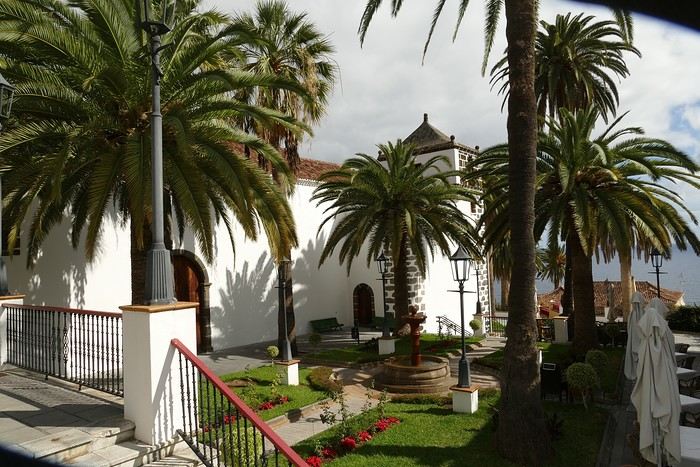 San Andrés
Saturday, February 17
Uniform blue sky, even on the heights. We took the beautiful road that winds up to the summit of the Caldera de Taburiente. Several viewpoints offer 360° views of the entire island and beyond: you can make out La Gomera, El Hierro, and, of course, Tenerife with the perfect triangle of Teide. We parked at the Los Andes viewpoint parking lot and started our hike to Pico de la Cruz along a trail following the ridge, offering superb views into the caldera. We got back in the car and passed by the Roque de los Muchachos astronomical complex, composed of numerous observatories, some with very aesthetic mirror telescopes. We hiked from the Roque de los Muchachos parking lot to the various viewpoints, always as impressive. Picnic on site, then back to Santa Cruz. We stopped by our car dealer because the oil warning light came on—better safe than sorry. The representative reassured us but preferred to give us a Fiat Cross SUV instead.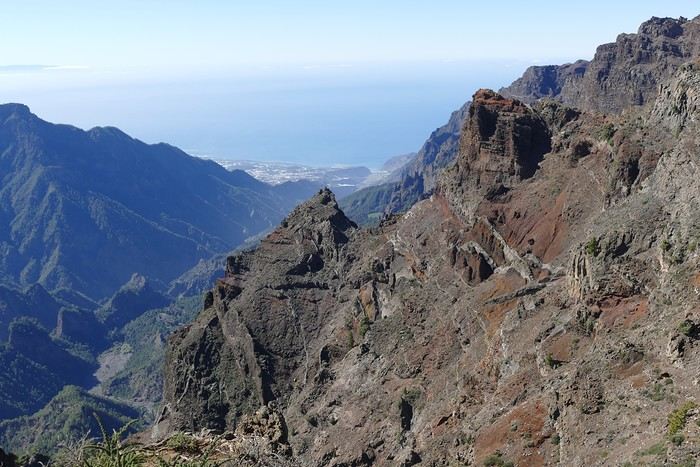 The Caldera de Taburiente
Sunday, February 18 The weather was a bit mixed, with cloudy patches. We set off to hike the Barranco de la Cuba de Galga. Unfortunately, the Los Tilos trail had been closed for several months due to a major landslide. The parking lot by the road was already quite full, and indeed, we crossed paths with many hikers along the way—it’s an easy hike with little elevation gain, which is rare here in La Palma! The beautiful path winds through a very narrow, deep gorge covered in lush tropical vegetation—you’d think you were in a Southeast Asian forest, especially with the humidity in the gorge bringing out earthy and floral scents. Halfway through, Monique turned back while the rest of us continued to the Cuba de Galga. A light drizzle accompanied us on the return. For lunch, we went to Chipi Chipi restaurant in the heights of Santa Cruz. The cool air forced us to leave the lovely terrace for the slightly noisy dining room. The meal was very good and hearty. Afternoon spent resting at our house.
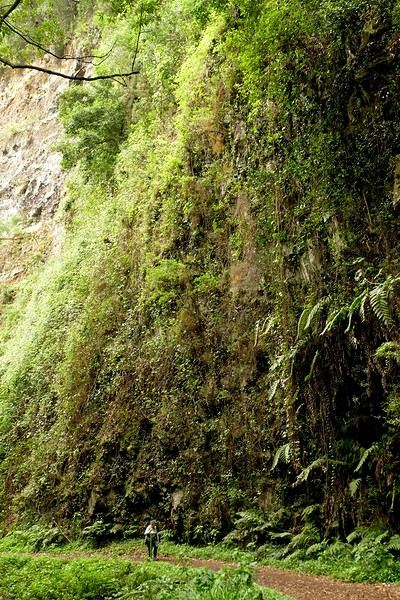 La Cuba de la Galga
Monday, February 19 A few clouds still clung to the nearby mountain peaks. We headed south to Los Canarios. We stopped in front of the small San Antonio Abad church, where a path leads to the viewpoint in 15 minutes. Then we visited the San Antonio Volcano Interpretation Center and climbed to the viewpoint via the trail along the crater’s edge, offering a plunging view into the crater. Then PP, Pat, and I headed toward the Teneguía volcano but turned back given the remaining distance and the intense heat bearing down on us! Plus, the landscape was rather arid and not very interesting. We got back in the car and drove down to the salt flats at the island’s southern tip. The ocean crashes here in large waves, exploding against the volcanic rocks and feeding a "blowhole" carved into the rock. We stopped for drinks at the salt flats restaurant, then headed home.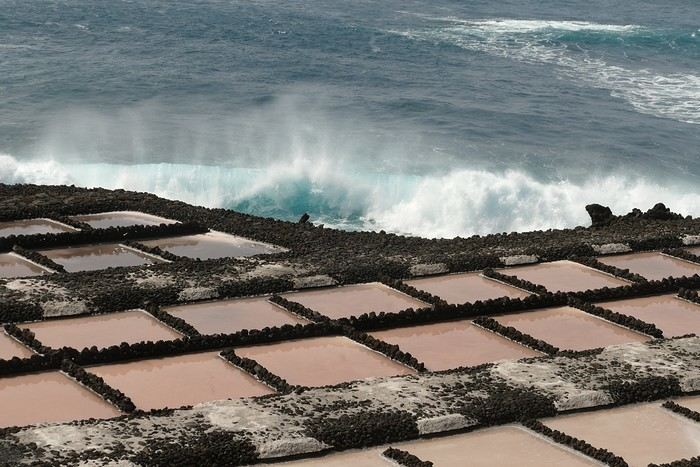 The salt flats in Fuencaliente
Tuesday, February 20 Beautiful weather with a few clouds clinging to the mountains, as usual. A relaxed morning since my parking reservation at La Cumbrecita didn’t start until 1 PM. It takes about 30 minutes from Santa Cruz to reach the valley floor via a beautiful but narrow road toward the end, though there’s very little traffic. Meanwhile, the clouds had disappeared, and the view from the La Cumbrecita viewpoint was superb. We recognized Pico de la Cruz in the distance, where we’d been a few days earlier. We then took the path leading to the Las Chozas viewpoint through a magnificent Canarian pine forest. We picnicked on site, then took the path to the Los Roques viewpoint. We returned the same way since the direct route was closed for construction. Back in Santa Cruz, we visited the Sanctuary of Las Nieves, with its beautiful golden Baroque altar.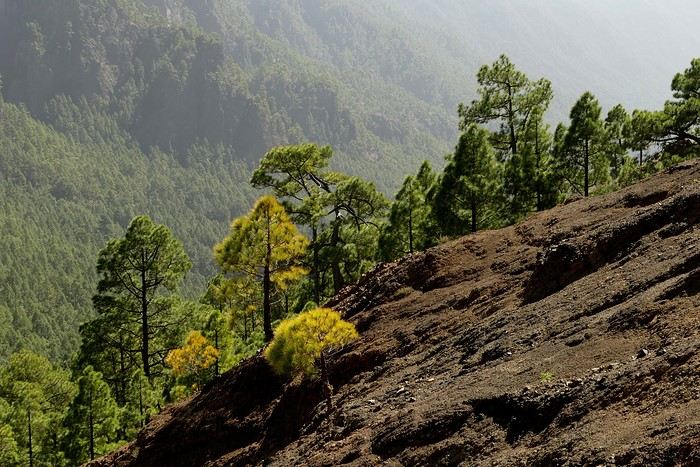 Hike from La Cumbrecita
Wednesday, February 21 After packing our things and loading the car, we left Santa Cruz under a very blue sky for Los Llanos de Aridane, where we stopped to visit this lovely town. The Church of Nuestra Señora de los Remedios has a beautiful coffered ceiling and an original papier-mâché Christ statue from the 16th century. Around it, colorful old Canarian houses brighten the streets of the town center. We took the opportunity to stroll, do some shopping, and finally sat down at La Pergola restaurant for a mediocre lunch. We got back in the car to check into our new house in Arecida. On the way, we stopped at the Mirador del Time, which once again offered an impressive panorama, allowing us—for the first time—to see the damage caused by the Tajogaite volcano eruption in 2021. You can clearly see the still-smoking crater and the large black lava flow covering the landscape down to the sea. We really liked our new accommodation: a local house that’s been renovated on the heights of Arecida, not far from the Canarian pine forest. From several terraces, we have a 360° view of the sea and mountains. We even have a private pool! There are two beautiful, brand-new bedrooms, each with its own bathroom—the best. Plus, we’re on the GR 131 trail that runs along the Barranco de las Angustias toward the northeast.
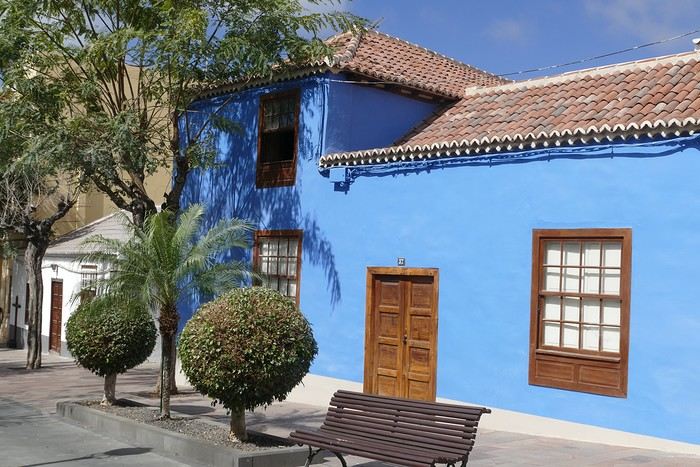 Los Llanos de Aridane
Thursday, February 22 Once again, beautiful weather greeted us when we woke up. We started the GR 131 with the goal of reaching the Torre del Time viewpoint—about 400 meters of elevation gain. The path, quite steep at first, winds through a superb Canarian pine forest. A few viewpoints let you appreciate the sheer drop of the Barranco de las Angustias—watch out for vertigo! At the Torre del Time viewpoint, there’s a nearly 1,000-meter vertical drop. We returned via another path, the PLP1, which meanders first through this beautiful forest, then along lovely flower-filled gardens adjacent to beautiful properties that cascade from the forest down to the road serving these neighborhoods. This afternoon, we tried to get closer to the area devastated by the 2021 lava flows. Several roads are still closed or reserved for residents, while others—brand new—have been rebuilt to open up this densely populated and cultivated region. In some places, the lava flow slightly diverted, sparing some properties that logically should have disappeared. Now, they’re encircled by a massive cooled lava field. In other spots, twisted and charred metal scraps or greenhouse remains protrude from the lava—all that’s left of the former banana plantations. A little higher up, you can see the slightly smoking crater of Tajogaite, responsible for this disaster. Back to Casa Barreros.
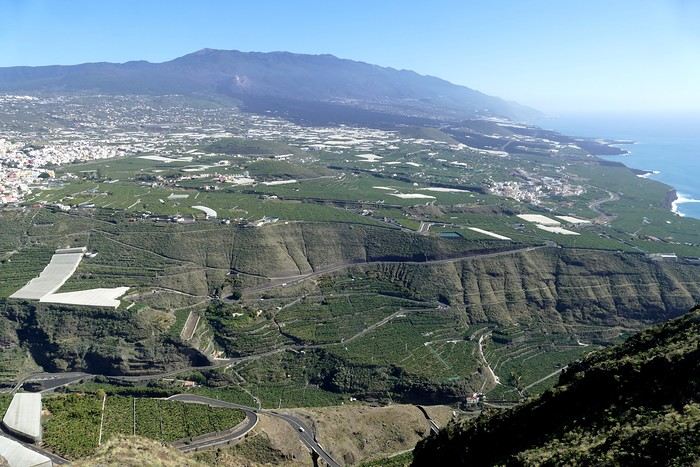 View of Los Llanos and, in the background, the 2021 lava flow
Friday, February 23
Though the sky was still blue, the temperature had dropped due to a chilly wind. By midday, it still rose to 22°C. Today, we headed north, specifically to the town of Tijarafe, where a very narrow road descends to the small port, Porís de Candelaria. The 3.7-kilometer road drops 700 meters in elevation, with gradients up to 30%—it was going to be intense! Indeed, the descent was scary, with the void right next to the very narrow road where passing was impossible except at a few rare spots. Everything went well—there was little traffic at this early hour. From the parking lot at the bottom, a path leads to Porís de Candelaria. It’s surprising to see this small fishing hamlet nestled in the shelter of an immense cave opening onto the sea, which was quite rough today. The sun, at this time of year, would appear late in the cave, which remained in shadow for much of the day. We returned via the same road, strolled through the small town of Puntagorda, and had lunch at El Jardín de los Naranjos restaurant—excellent meal.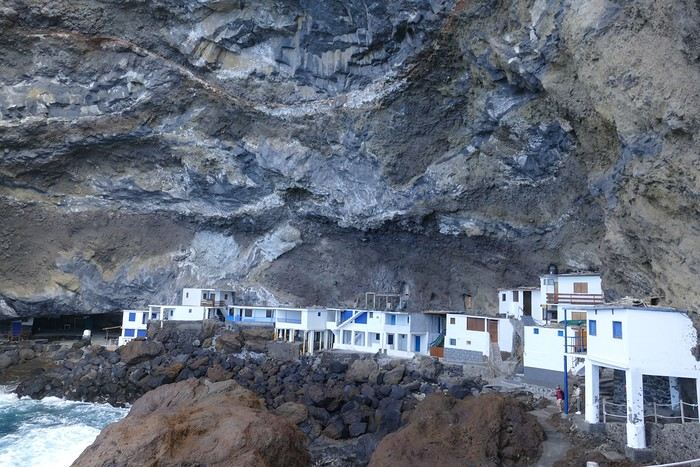 Fishing hamlet of Candelaria
Saturday, February 24 The air was still cool, but the sun was beautiful. While Monique stayed home to rest, the three of us headed to the village of Las Tricias to hike the Buracas Caves trail. We left the car parked on the LP1 road and took the small paved road down to the sign marking the trail’s start. The signage for all the trails we took here, as in La Gomera, was very well done. The path descended steadily, then more steeply toward the caves where the island’s first inhabitants lived—some petroglyphs are still visible in certain caves. The path then climbed back up, passing magnificent dragon trees and more or less elaborate huts occupied by Germans who’ve lived here for many years. Back at Casa Barreros for some rest.
Sunday, February 25 The weather once again blessed us with a beautiful day. This morning, we visited the local produce market held on weekends in Puntagorda. You’ll find agricultural products, crafts, and food to keep you going. A little further on, there’s a glass viewpoint overlooking the barranco plunging toward the sea, with a view of the thrill-seekers trying the zip line right next to it. Lunch at Naranjos—definitely a good spot—with their shrimp and spice tagliatelle. Back home for an afternoon of relaxation.
Monday, February 26 We left Arecida under a cloudy sky. Driving up from Los Llanos de Aridane toward the east, an enormous cascade of clouds poured from the mountain peaks into the Los Llanos plain—very impressive. Arriving in Santa Cruz, we went for a stroll, did some last-minute shopping, then had a final good-quality paella at La Chalana on the paseo maritimo. We left the car in the parking lot and took the 5 PM Olsen ferry to Tenerife on a slightly choppy sea, but the ferry didn’t rock too much. Arriving at 7:15 PM, we dropped off our things near the port in our reserved apartment and went for dinner at Abordo—rubbery chipirones. A digestive stroll among the ever-increasing number of tourists in Los Cristianos—restaurants were packed to the brim, the season is in full swing here. Gone is the calm of La Gomera and La Palma, and the laid-back tourism of German hikers among whom a few French were hiding!
Tuesday, February 27 To make our homemade breakfast more enjoyable, we went to buy pastries at the local bakery, then took one last walk on the paseo along the beaches, mingling with the many mobility scooters driven by elderly or disabled people, joggers, and tourists. Last apéro near the bus station, then off to the airport. After a smooth 4-hour-30-minute flight, we arrived in Basel-Mulhouse at 10:20 PM.
THE END
Conclusion A fantastic trip to two islands with magnificent and diverse nature, where landscapes range from desert-like to tropical depending on exposure to winds and clouds. Thanks to the many beautiful viewpoints, you can truly appreciate these exceptionally dynamic reliefs. A hiker’s paradise, the trails are all very well marked, though the choice of easy or moderate paths for "casual walkers" is quite limited. Another notable advantage, in our opinion, is that these islands are very lightly developed—you’ll hardly see any of those ugly hotel blocks that spoil the landscapes of some other Canary Islands. It’s true that the beaches on these two islands don’t meet traditional international tourism criteria: they’re small, with black sand, and often difficult to access. Special mention for the quality of the road network (except for a few small local roads), which seems brand new, well-paved, and well-signposted. We also enjoyed exceptional weather for February, with fewer than three days of gray or rainy weather out of 21.
Almost all the accommodations we chose met or exceeded our expectations, often at reasonable prices: an average of 98 € per night for an apartment or house with two bedrooms for four people.
All photos can be viewed by clicking this link: https://photos.app.goo.gl/G44pPk4g9PW1rNzg8
Tuesday, February 6 We left around 9 AM with our car, along with Pierre-Paul and Patricia, heading to the Bluepark parking lot in Bartenheim. As expected, we were awaited and left promptly for EuroAirport Basel. Took off at 12:25 PM for a 4-hour-15-minute flight under excellent conditions. Beautiful arrival in Tenerife with Teide in sight under a clear blue sky. Fifteen minutes later, we waited for bus No. 40 to Los Cristianos with quite a few other tourists, but we managed to find four seats. From the bus station, it was a 20-minute walk to our hotel. We checked into a lovely apartment for the four of us, complete with all the comforts. Outside, it was quite warm—at least 25°C! After dropping off our luggage, we went for a stroll. The immediate surroundings of the hotel held no interest for us: a modern, concrete area filled with hotels, bars, tourist agencies, and unappealing restaurants all offering the same bland international cuisine. Pat went to cool off at the pool, unfortunately overrun by loud, drunk English tourists. I took a walk to the paseo maritimo that leads to the port, skirting the seafront. The promenade was pleasant, but it could have been any seaside resort in the world—same old scene: a succession of bars with blaring music where many elderly people sipped cold beers waiting for the sunset, the backdrop a wall of resort-style hotels resembling rabbit hutches! Upon reaching the port, I scouted the route we’d take the next day to the Fred Olsen ferry. Back at the apartment, in the early evening, we looked for a non-touristy restaurant for dinner. Monique stopped a woman to ask her opinion! In this area, she told us, there’s no restaurant that serves Canarian or Spanish cuisine! The only place with decent restaurants is at the port. Off we went to the port, where we sat down at Al Bordo restaurant and ordered a seafood paella for four. Excellent, and at a very reasonable price (36 € for two). We returned to the hotel along the seafront.
Wednesday, February 7
Woke up at 6 AM. Had breakfast in the apartment with what we’d bought the day before at a supermarket. It was still dark when we left on foot toward the port, walking along the calm seafront at this early hour. Forty minutes later, we arrived and waited 10 minutes before the ferry docked. At 9:30 AM, we left the port of Los Cristianos for a 50-minute crossing on a calm sea under a beautiful blue sky. There were quite a few people on this large ferry, but many had no luggage, meaning they were visiting La Gomera for the day and would take the ferry back in the evening. Upon disembarking, we went straight to our rental car agency to pick up the car we’d booked online a few months earlier. It was a nice Peugeot 2008, spacious enough for the four of us and our luggage. We immediately took the beautiful road from San Sebastián that climbs directly into the mountains toward our rental in Vallehermoso. The road was in perfect condition—it seemed brand new, like all the others we’d take on this island later. This side of the island is very arid with little vegetation, and the terrain is particularly rugged, as it is throughout the island. We stopped at our first miradors, which would be followed by many more throughout our Canarian trip. Our first visit was to the small village of Agulo, perched on a promontory above the sea and at the foot of a high cliff. The village features typical Canarian houses with windows flush with the façade and black volcanic stone masonry on white or reddish-brown walls. The first recommended restaurant was already booked for a group, so we settled for the shaded terrace of the excellent El Alameda bar-restaurant. From Agulo, you can access the Abrante viewpoint via a winding road, where the view of Agulo, 600 meters below, is exceptional. A glass ledge over the void lets you test your fear of heights!
We drove to Vallehermoso to do our grocery shopping at the supermarket—a habit that would continue until the end of the trip. Our little house, "Casa rural El Encatadora," is located in a beautiful flower-filled valley a few kilometers west of Vallehermoso. Each of us had a bedroom with an en-suite bathroom, plus a living room, kitchen, and a small terrace overlooking the quiet street at the valley’s end, which didn’t bother us at all.
Thursday, February 8 The good weather seemed to follow us since our arrival in the Canary Islands. This morning, we took the road—still as beautiful and new—toward Arure, high up to the west. The landscape was magnificent, with breathtaking glimpses of the sea far below. In Arure, we parked in front of Conchita’s bar, where a hike (Rother No. 30) starts toward two viewpoints: Alojera, which we reached after 45 minutes on a lovely path. Monique, tired from the first steep climb, stopped at the first viewpoint and hitchhiked back to Arure. Meanwhile, we continued toward the second viewpoint, Los Barranquillos, where the view of the surroundings was partially hidden by misty clouds rising from the sea. The entire mountain is sculpted by ancient, endless terraces climbing until the slope becomes too steep for construction—visible traces of the hard work of past inhabitants trying to survive in a harsh environment. We had a decent lunch at La Conchita bar, then drove to the small seaside town of Puerto la Caleta, sheltered by an immense cliff plunging into the sea. Black sand beach, rough sea—despite our encouragement, Pat didn’t dare to swim! As for the old village of Caleta, it’s perched on the mountainside, and visiting it requires climbing steep, stair-filled alleys to discover a few traditional houses. Back at the casa, dinner in, and card games...
VallehermosoFriday, February 9 This morning, the sky was overcast, and the peaks around us were shrouded in clouds. We took the same road as yesterday to hike Las Creces. Quickly gaining altitude, we entered a thick fog—visibility was very limited. We stopped at the Las Creces parking lot; visibility improved, and the sun wasn’t far off. The hike is entirely within a beautiful laurel forest, with the sun playing hide-and-seek, but it wasn’t cold despite the altitude. After finishing the loop trail, we decided to picnic—not there, as it was too chilly—but on Vallehermoso’s beach, where we found a nice picnic area sheltered by large black rocks. A short digestive walk on the surrounding hill to admire the little beach from above. Back in Vallehermoso, we did some grocery shopping, then tried to return to the casa—only to find ourselves locked out because we’d left the key in the lock inside! After several attempts and with the help of Yéli, a relative of the owner we called for help, we were finally able to get back in!
Saturday, February 10
It rained last night, and the sky remained overcast. Monique decided to rest this morning. PP, Pat, and I set off on the hike that starts from the house toward the Marichal reservoir. The sun wasn’t far off, and by 11 AM, it was fully out. The pleasant hike passed by many flower-filled gardens and orchards—orange, lemon, and mandarin trees in fruit. The path climbed gently toward the reservoir, where the view of the Cano rock dominating the landscape was magnificent. The last part of the climb was a bit tough, overgrown with lush vegetation, and the trail was slippery from last night’s rain. We descended via a different, much more pleasant path and returned to the casa just in time for lunch, prepared by Monique. This valley is rich with its many farmers and market gardeners who’ve cultivated the entire valley, taking advantage of the water flowing down from the mountain, captured upstream and redistributed through countless pipes snaking along the paths. Numerous tanks also store water during dry periods. The houses are scattered across both sides of the valley, and these colorful little homes add a beautiful touch to the landscape. The many palm trees give this valley a distinctly tropical feel—you could almost imagine yourself in the Caribbean. Add to that some salsa music drifting from a hut where farmers were working, and the picture is complete. A well-chilled beer apéro capped off a lovely morning. The afternoon was dedicated to rest, relaxation, reading, and games.
Sunday, February 11 The blue sky returned, though a few clouds still capped the highest peaks. Today, we visited Garajonay National Park, which covers the highest central mountains. Up there, we were above the clouds, and the panoramas from the various viewpoints were stunning: first, Cherelepin, accessible from the Laguna Grande parking lot, then Alto de Garajonay, offering an exceptional view of Teide—over 3,000 meters high—emerging from the clouds on Tenerife, far in the distance. We continued to the Los Roques viewpoints, then stopped for lunch at the Degollada de Peraza restaurant, where the view of the barranco was impressive. We descended toward San Sebastián and checked into our new lodging, La Cabezada, located in the countryside about 3 km above San Sebastián. It’s a small apartment adjacent to the owner’s, with a lovely terrace overlooking the surrounding mountains and surrounded by a beautiful garden. Apéro, then dinner on our beautiful terrace.
Monday, February 12 This morning, we went down to visit San Sebastián de La Gomera: its old tower, main street with some beautiful traditional houses, and the Church of the Assumption. Back at the casa for lunch. In the afternoon, Pat, PP, and I set off on the short hike from San Sebastián beach to La Guancha beach. We drove down and parked on the beach. The path climbs along the hill overlooking San Sebastián, passes by the tall Christ statue dominating the landscape, and roughly follows the coast down to the isolated Guancha beach. A beautiful hike under a hot sun, and a swim was welcome, even if the beach and sea access weren’t very comfortable due to large pebbles and quickly deepening water. Apart from two nudist bathers, there was no one on this beach. We returned the same way.
Tuesday, February 13 Rest day. We went down to town to stroll and do some shopping. I took the opportunity to visit the parador, beautifully situated above the city in a lovely garden overlooking the port and town. Together, we went for a cuba libre at the "Cuba Libre" bar, then had lunch at Breñusca (mediocre paella!). Back at the casa, then we went back down to town to see a carnival parade, a "passacalles," which actually passed an hour earlier than scheduled. Oh well.
Wednesday, February 14 Each to their own program this morning. Pat went swimming at San Sebastián beach, Monique rested at the casa, and PP and I set off on the hike from Playa de Avalos to the Ermita de Guadalupe on Playa del Cangrejo. It wasn’t easy to find the right road or the parking spot, but we managed. The path seemed to have suffered landslides, according to a sign at the trailhead! We decided to check it out, ready to turn back if it seemed too dangerous. In the end, apart from one or two slightly tricky spots where we had to climb a pile of rocks, the trail remained passable, though a bit vertigo-inducing in places. The narrow path clings to very vertical cliffs nearly 300 meters above sea level! But what a magnificent view. At one point, the trail runs alongside a wall of basaltic pipes. We returned via the drivable track that parallels the trail a bit lower. Back at the house for lunch. In the late afternoon, we returned to town to attend the "Entierro de las Sardinas" (Burial of the Sardine), which closes the Canarian carnival festivities. While waiting, we strolled through the parador’s gardens and had mojitos in town. Around 9 PM, we heard the noise and cries of the mourners. The procession advanced, led by a large papier-mâché sardine on a float, surrounded by wailing mourners. The procession headed toward the sea, where the sardine was burned, and a mini fireworks display ended the procession. It was all very good-natured, and everyone had fun. We ended the evening with dinner at a good fish restaurant, El Pajar.
Entierro de la Sardina in San Sebastián de La GomeraThursday, February 15
Woke up at 5:15 AM. The only suitable ferry was at 7 AM, which would get us to La Palma by late morning rather than evening. We packed our bags, had breakfast, then headed to the port, left our rental car, and boarded the ferry to Tenerife, from where we’d continue to La Palma. Calm sea, beautiful sun—by 10:30 AM, we disembarked in La Palma. We picked up our car and immediately headed to our new apartment in Breña Alta. It’s a large apartment with a superb terrace facing the sea, fully equipped and very comfortable. The hosts recommended Casa Goyo restaurant, near the airport and close to us. It’s a restaurant with many small rooms, some of which can be reserved for families. The fish-based cuisine (chipirones, pulpo) was excellent, hearty, and reasonably priced. Since it’s in the airport’s flight path, we occasionally heard planes landing. Quick and efficient service. Afterward, we visited Santa Cruz de La Palma, which reminded us of the historic quarters of La Orotava in Tenerife or the capital of Gran Canaria.
Friday, February 16
Beautiful weather, blue sky. We headed to the San Bartolo viewpoint toward the northeast coast, then to the lovely village of San Andrés, which we explored. From there, we walked along the shore to the natural pools of Charco Azul, where we swam in the cool but "swimmable" sea. Back in San Andrés for lunch at the "San Andrés" restaurant on the beautiful church square. Very good fish-based meal. We got back in the car and continued along the north coast to the port of Espindola and the natural pools of Fajana near the Cumplida lighthouse. A fairly strong wind whipped up beautiful waves crashing onto the rocky coast in bursts of foam. Back in Santa Cruz, we stopped at the Mercadona supermarket to buy fresh shrimp for dinner.
San AndrésSaturday, February 17
Uniform blue sky, even on the heights. We took the beautiful road that winds up to the summit of the Caldera de Taburiente. Several viewpoints offer 360° views of the entire island and beyond: you can make out La Gomera, El Hierro, and, of course, Tenerife with the perfect triangle of Teide. We parked at the Los Andes viewpoint parking lot and started our hike to Pico de la Cruz along a trail following the ridge, offering superb views into the caldera. We got back in the car and passed by the Roque de los Muchachos astronomical complex, composed of numerous observatories, some with very aesthetic mirror telescopes. We hiked from the Roque de los Muchachos parking lot to the various viewpoints, always as impressive. Picnic on site, then back to Santa Cruz. We stopped by our car dealer because the oil warning light came on—better safe than sorry. The representative reassured us but preferred to give us a Fiat Cross SUV instead.
The Caldera de TaburienteSunday, February 18 The weather was a bit mixed, with cloudy patches. We set off to hike the Barranco de la Cuba de Galga. Unfortunately, the Los Tilos trail had been closed for several months due to a major landslide. The parking lot by the road was already quite full, and indeed, we crossed paths with many hikers along the way—it’s an easy hike with little elevation gain, which is rare here in La Palma! The beautiful path winds through a very narrow, deep gorge covered in lush tropical vegetation—you’d think you were in a Southeast Asian forest, especially with the humidity in the gorge bringing out earthy and floral scents. Halfway through, Monique turned back while the rest of us continued to the Cuba de Galga. A light drizzle accompanied us on the return. For lunch, we went to Chipi Chipi restaurant in the heights of Santa Cruz. The cool air forced us to leave the lovely terrace for the slightly noisy dining room. The meal was very good and hearty. Afternoon spent resting at our house.
La Cuba de la GalgaMonday, February 19 A few clouds still clung to the nearby mountain peaks. We headed south to Los Canarios. We stopped in front of the small San Antonio Abad church, where a path leads to the viewpoint in 15 minutes. Then we visited the San Antonio Volcano Interpretation Center and climbed to the viewpoint via the trail along the crater’s edge, offering a plunging view into the crater. Then PP, Pat, and I headed toward the Teneguía volcano but turned back given the remaining distance and the intense heat bearing down on us! Plus, the landscape was rather arid and not very interesting. We got back in the car and drove down to the salt flats at the island’s southern tip. The ocean crashes here in large waves, exploding against the volcanic rocks and feeding a "blowhole" carved into the rock. We stopped for drinks at the salt flats restaurant, then headed home.
The salt flats in FuencalienteTuesday, February 20 Beautiful weather with a few clouds clinging to the mountains, as usual. A relaxed morning since my parking reservation at La Cumbrecita didn’t start until 1 PM. It takes about 30 minutes from Santa Cruz to reach the valley floor via a beautiful but narrow road toward the end, though there’s very little traffic. Meanwhile, the clouds had disappeared, and the view from the La Cumbrecita viewpoint was superb. We recognized Pico de la Cruz in the distance, where we’d been a few days earlier. We then took the path leading to the Las Chozas viewpoint through a magnificent Canarian pine forest. We picnicked on site, then took the path to the Los Roques viewpoint. We returned the same way since the direct route was closed for construction. Back in Santa Cruz, we visited the Sanctuary of Las Nieves, with its beautiful golden Baroque altar.
Hike from La CumbrecitaWednesday, February 21 After packing our things and loading the car, we left Santa Cruz under a very blue sky for Los Llanos de Aridane, where we stopped to visit this lovely town. The Church of Nuestra Señora de los Remedios has a beautiful coffered ceiling and an original papier-mâché Christ statue from the 16th century. Around it, colorful old Canarian houses brighten the streets of the town center. We took the opportunity to stroll, do some shopping, and finally sat down at La Pergola restaurant for a mediocre lunch. We got back in the car to check into our new house in Arecida. On the way, we stopped at the Mirador del Time, which once again offered an impressive panorama, allowing us—for the first time—to see the damage caused by the Tajogaite volcano eruption in 2021. You can clearly see the still-smoking crater and the large black lava flow covering the landscape down to the sea. We really liked our new accommodation: a local house that’s been renovated on the heights of Arecida, not far from the Canarian pine forest. From several terraces, we have a 360° view of the sea and mountains. We even have a private pool! There are two beautiful, brand-new bedrooms, each with its own bathroom—the best. Plus, we’re on the GR 131 trail that runs along the Barranco de las Angustias toward the northeast.
Los Llanos de AridaneThursday, February 22 Once again, beautiful weather greeted us when we woke up. We started the GR 131 with the goal of reaching the Torre del Time viewpoint—about 400 meters of elevation gain. The path, quite steep at first, winds through a superb Canarian pine forest. A few viewpoints let you appreciate the sheer drop of the Barranco de las Angustias—watch out for vertigo! At the Torre del Time viewpoint, there’s a nearly 1,000-meter vertical drop. We returned via another path, the PLP1, which meanders first through this beautiful forest, then along lovely flower-filled gardens adjacent to beautiful properties that cascade from the forest down to the road serving these neighborhoods. This afternoon, we tried to get closer to the area devastated by the 2021 lava flows. Several roads are still closed or reserved for residents, while others—brand new—have been rebuilt to open up this densely populated and cultivated region. In some places, the lava flow slightly diverted, sparing some properties that logically should have disappeared. Now, they’re encircled by a massive cooled lava field. In other spots, twisted and charred metal scraps or greenhouse remains protrude from the lava—all that’s left of the former banana plantations. A little higher up, you can see the slightly smoking crater of Tajogaite, responsible for this disaster. Back to Casa Barreros.
View of Los Llanos and, in the background, the 2021 lava flowFriday, February 23
Though the sky was still blue, the temperature had dropped due to a chilly wind. By midday, it still rose to 22°C. Today, we headed north, specifically to the town of Tijarafe, where a very narrow road descends to the small port, Porís de Candelaria. The 3.7-kilometer road drops 700 meters in elevation, with gradients up to 30%—it was going to be intense! Indeed, the descent was scary, with the void right next to the very narrow road where passing was impossible except at a few rare spots. Everything went well—there was little traffic at this early hour. From the parking lot at the bottom, a path leads to Porís de Candelaria. It’s surprising to see this small fishing hamlet nestled in the shelter of an immense cave opening onto the sea, which was quite rough today. The sun, at this time of year, would appear late in the cave, which remained in shadow for much of the day. We returned via the same road, strolled through the small town of Puntagorda, and had lunch at El Jardín de los Naranjos restaurant—excellent meal.
Fishing hamlet of CandelariaSaturday, February 24 The air was still cool, but the sun was beautiful. While Monique stayed home to rest, the three of us headed to the village of Las Tricias to hike the Buracas Caves trail. We left the car parked on the LP1 road and took the small paved road down to the sign marking the trail’s start. The signage for all the trails we took here, as in La Gomera, was very well done. The path descended steadily, then more steeply toward the caves where the island’s first inhabitants lived—some petroglyphs are still visible in certain caves. The path then climbed back up, passing magnificent dragon trees and more or less elaborate huts occupied by Germans who’ve lived here for many years. Back at Casa Barreros for some rest.
Sunday, February 25 The weather once again blessed us with a beautiful day. This morning, we visited the local produce market held on weekends in Puntagorda. You’ll find agricultural products, crafts, and food to keep you going. A little further on, there’s a glass viewpoint overlooking the barranco plunging toward the sea, with a view of the thrill-seekers trying the zip line right next to it. Lunch at Naranjos—definitely a good spot—with their shrimp and spice tagliatelle. Back home for an afternoon of relaxation.
Monday, February 26 We left Arecida under a cloudy sky. Driving up from Los Llanos de Aridane toward the east, an enormous cascade of clouds poured from the mountain peaks into the Los Llanos plain—very impressive. Arriving in Santa Cruz, we went for a stroll, did some last-minute shopping, then had a final good-quality paella at La Chalana on the paseo maritimo. We left the car in the parking lot and took the 5 PM Olsen ferry to Tenerife on a slightly choppy sea, but the ferry didn’t rock too much. Arriving at 7:15 PM, we dropped off our things near the port in our reserved apartment and went for dinner at Abordo—rubbery chipirones. A digestive stroll among the ever-increasing number of tourists in Los Cristianos—restaurants were packed to the brim, the season is in full swing here. Gone is the calm of La Gomera and La Palma, and the laid-back tourism of German hikers among whom a few French were hiding!
Tuesday, February 27 To make our homemade breakfast more enjoyable, we went to buy pastries at the local bakery, then took one last walk on the paseo along the beaches, mingling with the many mobility scooters driven by elderly or disabled people, joggers, and tourists. Last apéro near the bus station, then off to the airport. After a smooth 4-hour-30-minute flight, we arrived in Basel-Mulhouse at 10:20 PM.
THE END
Conclusion A fantastic trip to two islands with magnificent and diverse nature, where landscapes range from desert-like to tropical depending on exposure to winds and clouds. Thanks to the many beautiful viewpoints, you can truly appreciate these exceptionally dynamic reliefs. A hiker’s paradise, the trails are all very well marked, though the choice of easy or moderate paths for "casual walkers" is quite limited. Another notable advantage, in our opinion, is that these islands are very lightly developed—you’ll hardly see any of those ugly hotel blocks that spoil the landscapes of some other Canary Islands. It’s true that the beaches on these two islands don’t meet traditional international tourism criteria: they’re small, with black sand, and often difficult to access. Special mention for the quality of the road network (except for a few small local roads), which seems brand new, well-paved, and well-signposted. We also enjoyed exceptional weather for February, with fewer than three days of gray or rainy weather out of 21.
Almost all the accommodations we chose met or exceeded our expectations, often at reasonable prices: an average of 98 € per night for an apartment or house with two bedrooms for four people.
All photos can be viewed by clicking this link: https://photos.app.goo.gl/G44pPk4g9PW1rNzg8
ISTANBUL STAY in 2014 - (Full story)
dFrom Monday, March 10, 2014, to Sunday, March 16, 2014.
After my first trip to Istanbul in 1979 by motorcycle (Honda Gold Wing), where I stayed for about ten days at a campsite very close to Istanbul, I wanted to revisit this city that had already charmed me back in 1979.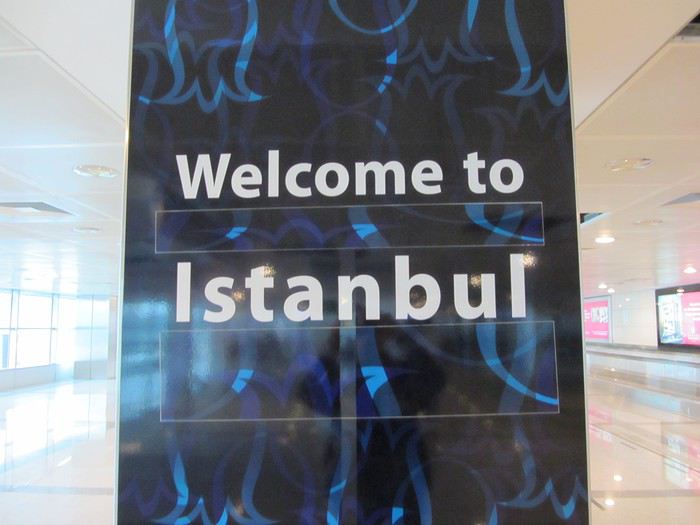
Our flight from Lyon (6:45 AM) wasn’t direct. Basically, we left home at 3:00 AM, and it takes us about 1 to 1.25 hours to get to Lyon Saint-Exupéry Airport. I always leave a little extra time in case of bad weather (snow) or a flat tire. Our flight departed Lyon on time, heading to Frankfurt with an arrival at 8:15 AM, and a connecting flight to Istanbul at 9:05 AM. Needless to say, you can’t dawdle in the airport to get to your gate—Frankfurt Airport is huge compared to Lyon’s. After a 2-hour, 55-minute flight, we landed at Istanbul Atatürk Airport, followed by a good hour of waiting to clear customs and immigration.
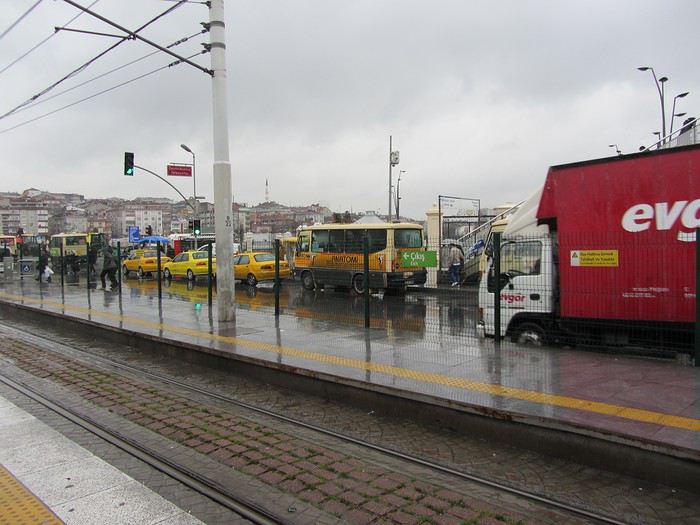
To get to our hotel from the airport, we took the metro and then the tram. When we travel in big cities, I always bring my TomTom GPS, which is super helpful for knowing which station to get off at to be as close as possible to the hotel.
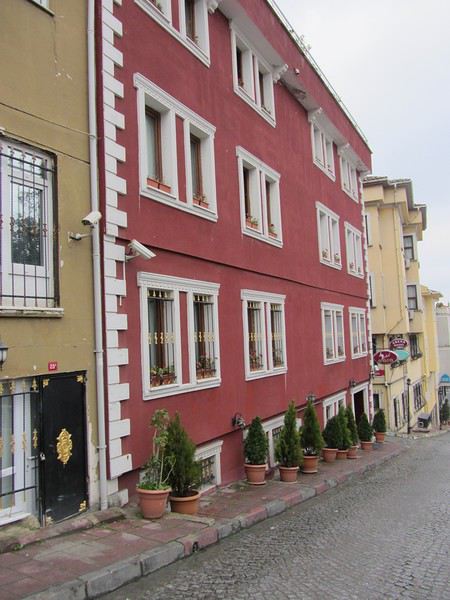
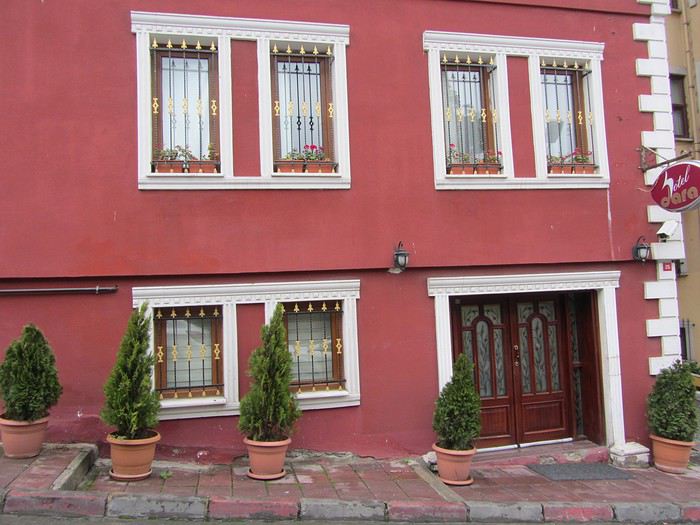
And here it is—our little hotel, "Hotel DARA," just a 5- to 10-minute walk from the Blue Mosque and right next to one of the many entrances to the Grand Bazaar.
Speaking of which, when we arrived in Istanbul in the rain, once we got our room, we headed straight to the Grand Bazaar to take shelter from the downpour.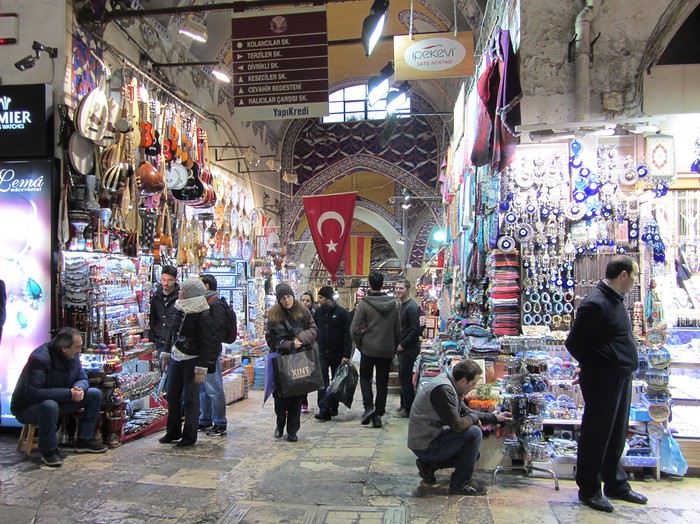 Located along 58 indoor streets accessible through 18 gates, it’s home to 4,000 shops. It’s right in the heart of the city.
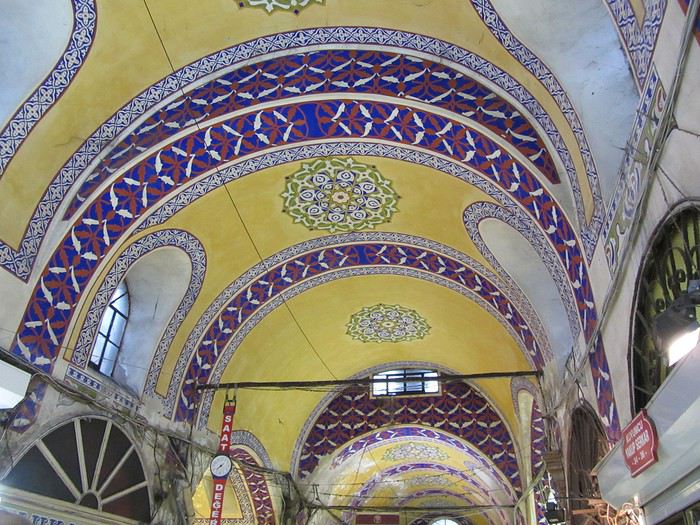
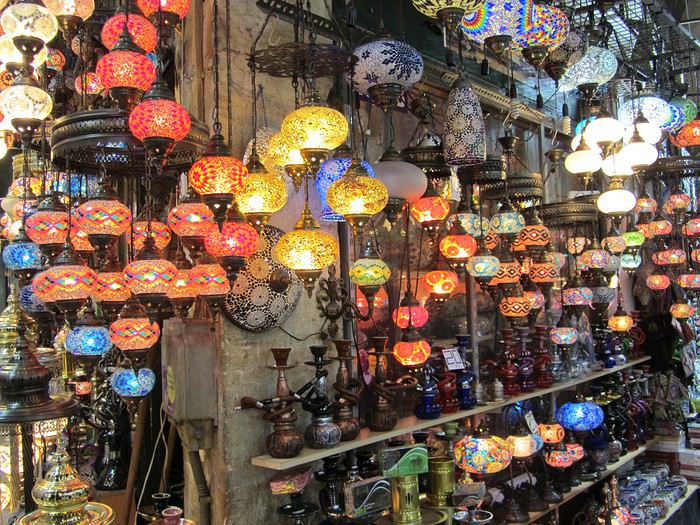
Like all bazaars, it’s organized into sections, each grouping a certain type of craft: jewelry, carpets, textiles, mosaics, silverware...
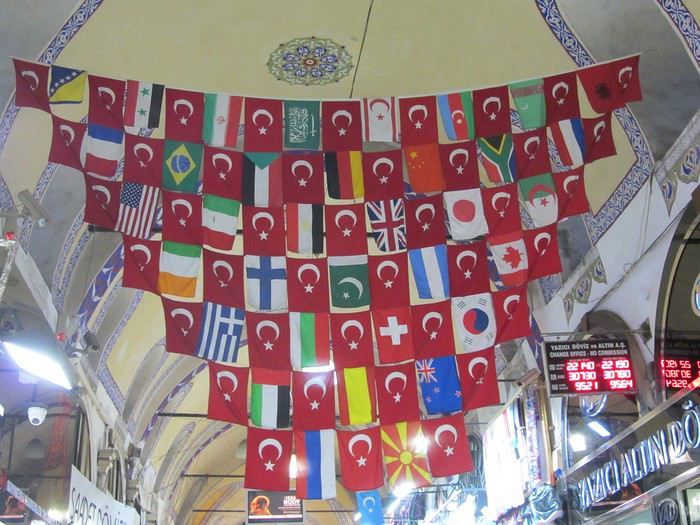
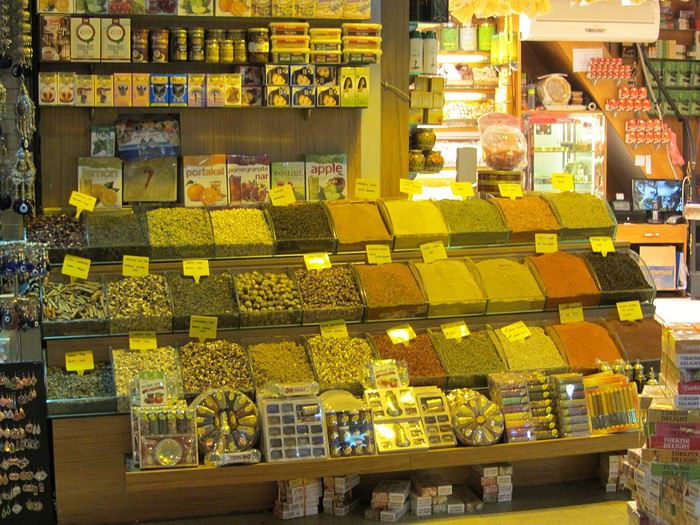
And when we left the Grand Bazaar, surprise—the rain had stopped, and the sun and a bright blue sky had returned.
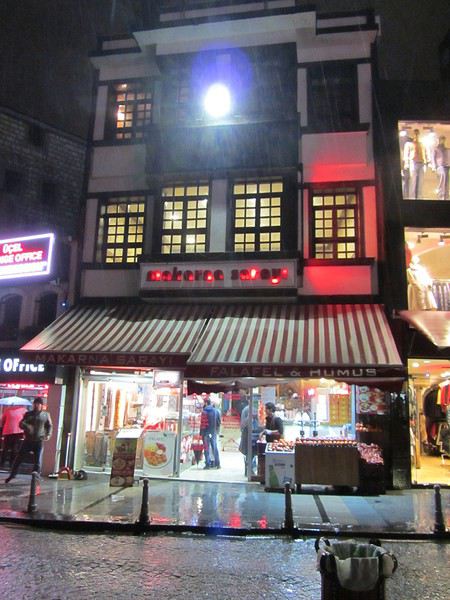
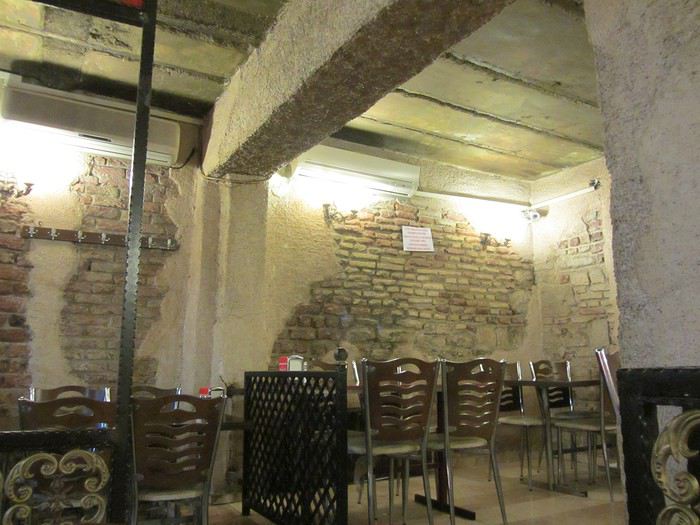
And here’s the restaurant we went to every evening during our stay—a cozy spot with varied dishes, friendly staff, and not too expensive, with a mostly local crowd.
Tuesday, March 11.
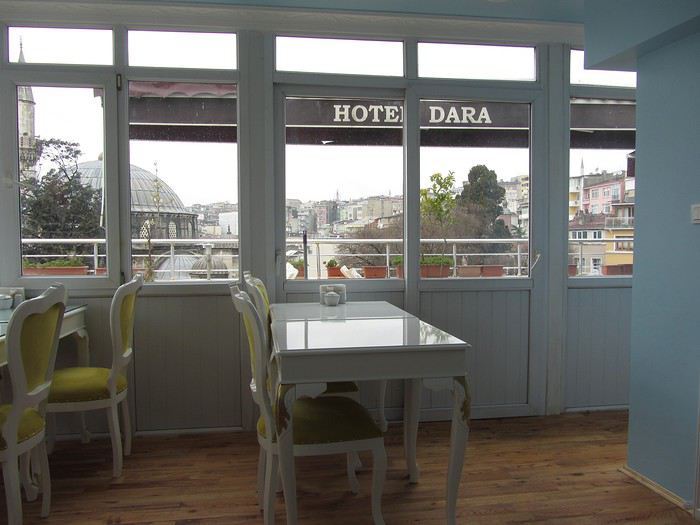
Disappointment this morning—the blue sky didn’t last. We woke up to gray skies and a light rain, so we couldn’t have breakfast on the rooftop terrace of our hotel, where the view is amazing.
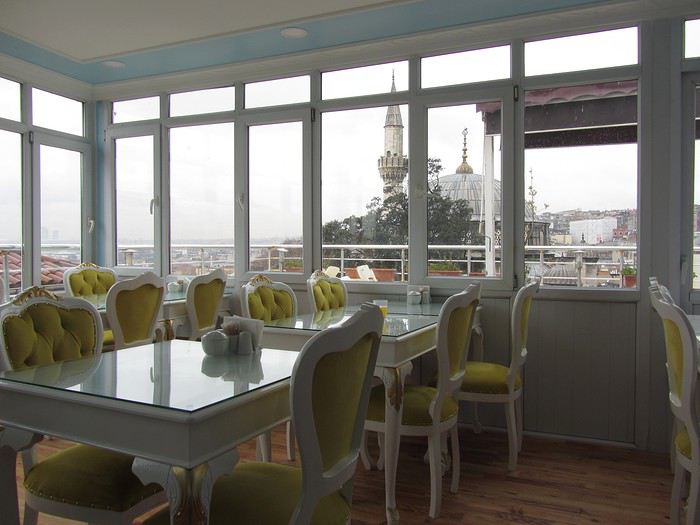
The breakfast was hearty and great, with both sweet and savory options, and a server who immediately hit it off with my partner, even though she didn’t speak a word of French. My partner got a kiss every morning.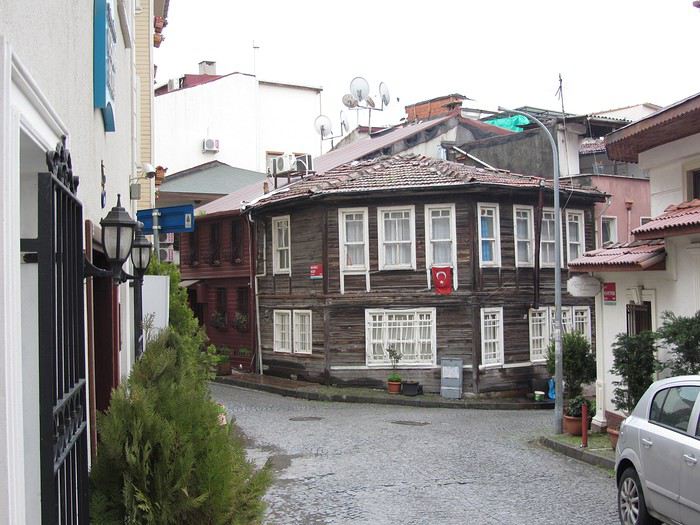
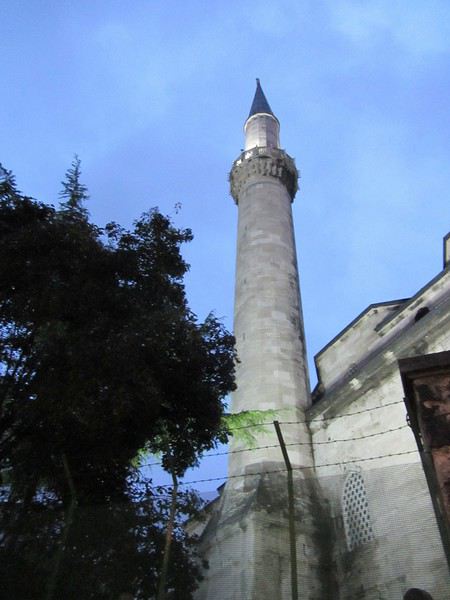
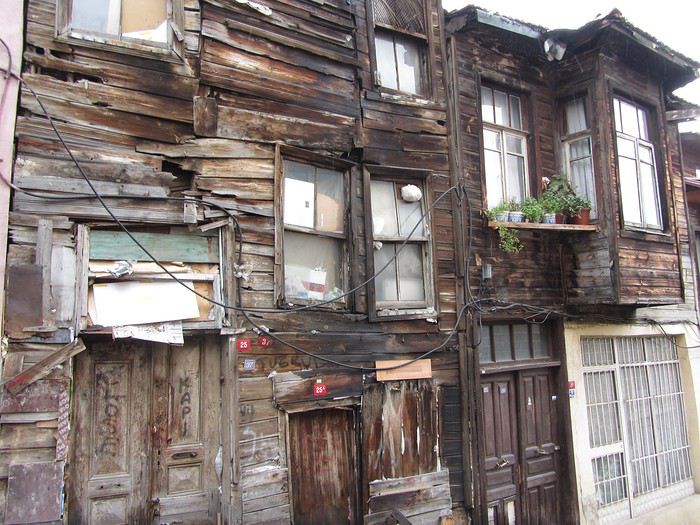
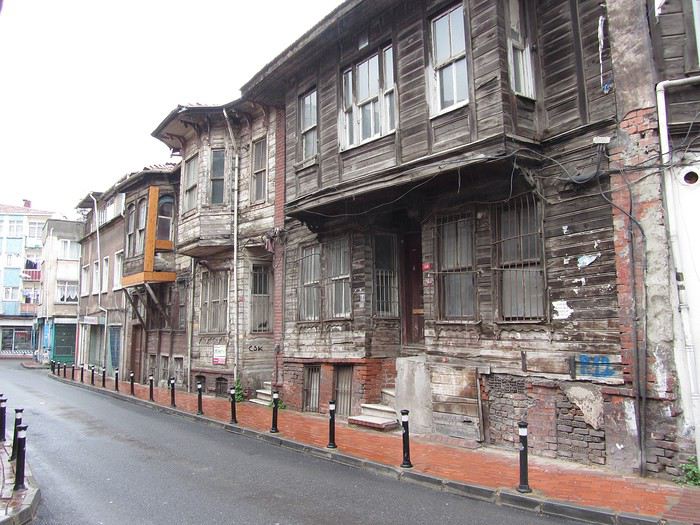
We wandered around the neighborhood below our hotel, an area with the few remaining wooden houses. In 1979, I remember there were many more, but now they’re either falling into ruin or being torn down for more modern buildings.
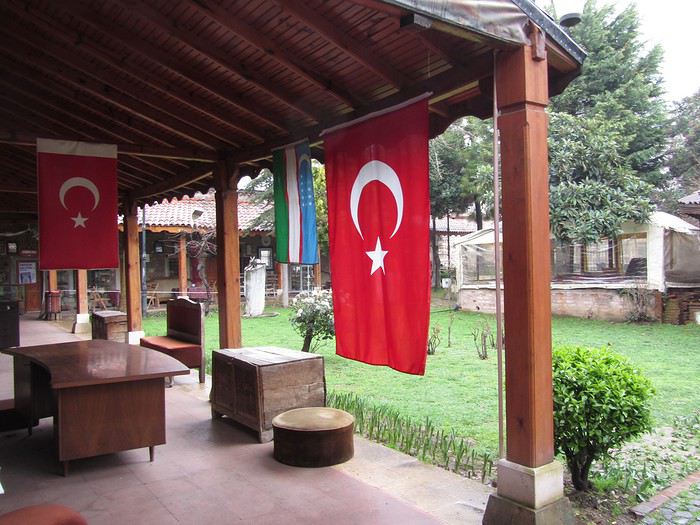
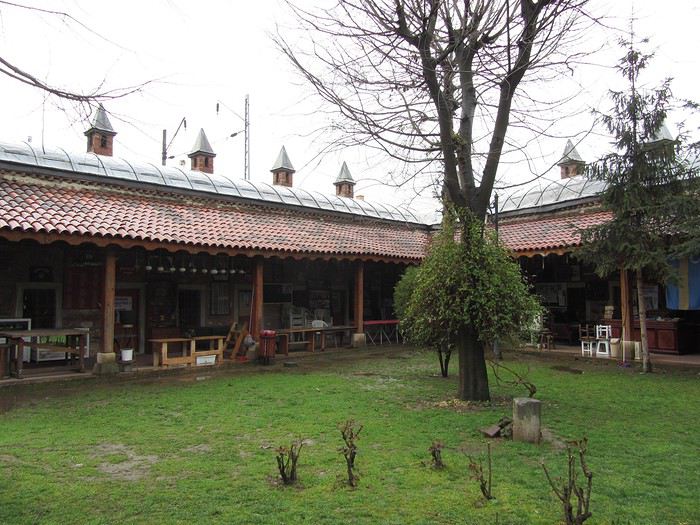
The Little Hagia Sophia Mosque. Küçük Ayasofya
dFrom Monday, March 10, 2014, to Sunday, March 16, 2014.
After my first trip to Istanbul in 1979 by motorcycle (Honda Gold Wing), where I stayed for about ten days at a campsite very close to Istanbul, I wanted to revisit this city that had already charmed me back in 1979.
Our flight from Lyon (6:45 AM) wasn’t direct. Basically, we left home at 3:00 AM, and it takes us about 1 to 1.25 hours to get to Lyon Saint-Exupéry Airport. I always leave a little extra time in case of bad weather (snow) or a flat tire. Our flight departed Lyon on time, heading to Frankfurt with an arrival at 8:15 AM, and a connecting flight to Istanbul at 9:05 AM. Needless to say, you can’t dawdle in the airport to get to your gate—Frankfurt Airport is huge compared to Lyon’s. After a 2-hour, 55-minute flight, we landed at Istanbul Atatürk Airport, followed by a good hour of waiting to clear customs and immigration.
To get to our hotel from the airport, we took the metro and then the tram. When we travel in big cities, I always bring my TomTom GPS, which is super helpful for knowing which station to get off at to be as close as possible to the hotel.
And here it is—our little hotel, "Hotel DARA," just a 5- to 10-minute walk from the Blue Mosque and right next to one of the many entrances to the Grand Bazaar.
Speaking of which, when we arrived in Istanbul in the rain, once we got our room, we headed straight to the Grand Bazaar to take shelter from the downpour.
Located along 58 indoor streets accessible through 18 gates, it’s home to 4,000 shops. It’s right in the heart of the city.Like all bazaars, it’s organized into sections, each grouping a certain type of craft: jewelry, carpets, textiles, mosaics, silverware...
And when we left the Grand Bazaar, surprise—the rain had stopped, and the sun and a bright blue sky had returned.
And here’s the restaurant we went to every evening during our stay—a cozy spot with varied dishes, friendly staff, and not too expensive, with a mostly local crowd.
Tuesday, March 11.
Disappointment this morning—the blue sky didn’t last. We woke up to gray skies and a light rain, so we couldn’t have breakfast on the rooftop terrace of our hotel, where the view is amazing.
The breakfast was hearty and great, with both sweet and savory options, and a server who immediately hit it off with my partner, even though she didn’t speak a word of French. My partner got a kiss every morning.
We wandered around the neighborhood below our hotel, an area with the few remaining wooden houses. In 1979, I remember there were many more, but now they’re either falling into ruin or being torn down for more modern buildings.
The Little Hagia Sophia Mosque. Küçük Ayasofya
hi everyone, just a quick stop in Tangalle to enjoy the beach and relax
stayed at "Patini Bungalows" by the sea, direct beach access
bungalows very clean, amazing welcome from Severine, Daya, and their two kids
long beach, several kilometers to walk, lots of great and cheap restaurants:
"Malika" and "Little Pumpkin"
good mid-range options: "Star Fish", "Blue Horizon", "Zanzibar Restaurant", "Chance Lanka"
nicer upscale spots: "Ibis Bungalows", "Ganesh Beach"
loads of accommodations on that side of town and quite a few along the Matara road
best to use tuk-tuks for transport, even to get to Temple Rock; anyway, traffic conditions
are tough for all transport—average speed is only about 40–50 km/h max
at restaurants, expect to wait around 30–40 minutes for food everywhere—nothing’s prepped ahead of time
this is Sri Lanka, and "tomorrow is another day"; say hello to all the friendly locals—it’ll make their day
swimming conditions can be tricky; better to swim in the morning and listen to local advice
not far from the port, fishermen bring their nets ashore with help from the community
if you’re passing by, lend a hand—it’s a great experience
market days are Wednesday and Saturday near the bus station
small shops are nice and cheap; for mail, the post office is near the hospital
Tangalle is a simple little town where mass tourism hasn’t taken over yet—enjoy it while you can!
happy travels!
A trip often gets complicated because of small details: a passport about to expire, a low bank limit, or documents that aren’t accessible offline. A checklist a few days before departure helps eliminate most avoidable risks.
1. Check passport, visa, and entry requirements Passport validity requirements vary by destination, as do visa or electronic authorization rules. Service-Public.fr recommends planning ahead for ID renewals. Before booking anything non-refundable, verify the country’s requirements and those of any layovers.
2. Consult official destination information France Diplomatie’s Travel Advice provides country-by-country security information, entry conditions, health recommendations, and recent alerts. Checking before departure—and again closer to the trip—helps avoid outdated information.
3. Register for Fil d’Ariane for short stays For tourist or business trips under six months, Fil d’Ariane lets you receive security alerts in case of major events in your destination country. The service is free. It doesn’t replace insurance or geolocation services but is a simple way to stay reachable during a crisis.
4. Plan multiple payment methods A blocked or lost card can quickly strand a traveler. Two separate payment methods, a small cash reserve, and verified withdrawal limits reduce this risk. Also, save emergency contact numbers before departure.
5. Know how to activate your medical coverage Before leaving, travelers should identify coverage suited to their trip and understand how to use it: who to contact, which documents to keep, which expenses require approval, and how to request reimbursement. This practical info is often more useful when a problem arises than just a list of limits.
6. Keep documents in duplicate Passports, tickets, certificates, prescriptions, and reservations should be stored as secure digital copies—and mostly offline. Avoid keeping all originals and copies in the same place.
7. Download essentials before takeoff Offline maps, tickets, your first accommodation address, booking confirmations, and emergency contacts can all be downloaded before departure. This habit is still useful even with an international plan—a dead battery, no signal, or a finicky local connection can make a document inaccessible at the worst time.
A short checklist for peace of mind The goal isn’t to plan everything but to secure the things that are hard to fix once abroad. Documents, official info, payments, medical coverage, and offline access form a simple foundation. The rest of the trip can stay unpredictable—in the best way.
Verified sources: France Diplomatie – Travel Advice | France Diplomatie – Fil d’Ariane | Service-Public.fr – Travel Documents
Okay, it wasn’t a total disaster either. Actually, I hesitated before starting this travel journal: is it even worth writing about a holiday that won’t leave an unforgettable memory?
In the end, I went for it (there aren’t many recent travel journals about this destination).
So, read on... or don’t .
Every time we’ve been to the Canary Islands, it’s been by default (basically: where can we go in winter or early spring when we only have a week—so not too far, not too much jet lag, but with decent weather?).
This time, we had two weeks, but the winter plan kept changing: first Thailand (dropped for personal reasons), then Martinique (dropped because of work leave dates that weren’t up to me), and finally, the Canary Islands.
We’ve already been to Tenerife (which we really liked) and Lanzarote (which we liked a little less). This year, two options: Gran Canaria or one of the smaller islands west of Tenerife (La Palma, or even La Gomera or El Hierro). We chose Gran Canaria... not sure it was the right call! Whose fault is it? Storm Thérèse’s! Yes, Storm Thérèse followed us on arrival, and its effects lasted quite a while. We had to adapt, cancel visits, change activities...
But even without Thérèse...
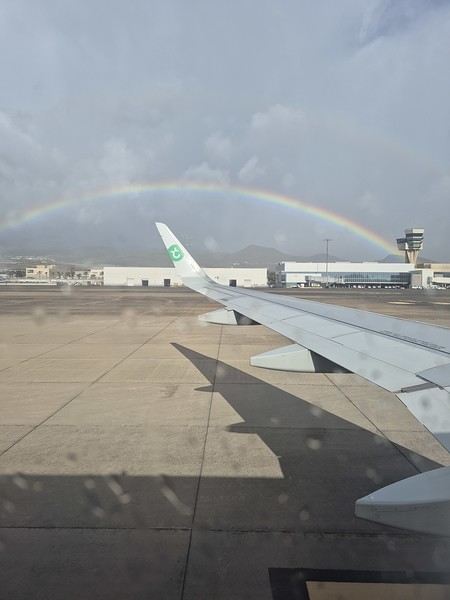
Saturday 21/03 Departure from Orly at 6:10 AM with Transavia. The plane took off on time and landed a little early, tossed around by strong winds before touching down. It had just rained, but it was (almost) no longer raining.
We quickly picked up our luggage and then the car at the Cicar counter. We got a Seat Arona instead of the Corsa we’d booked. Well, while the driving position didn’t feel great at first (I got used to it), the engine’s smoothness and power were much appreciated on the island’s winding and sometimes steep roads.
It was only 10 AM, and we couldn’t theoretically check into our accommodation until 3 PM (the owner promised to message me if it was ready earlier). So, we headed to the (big) *Jardín Botánico Viera y Clavijo*, where we planned to spend a few hours. We found a huge parking lot... empty. The passenger in the car in front of us (yes, we weren’t the only ones at the closed gate—there was a car in front and one behind) went to ask for info: it was closed due to the storm 😕. So, we calmly headed toward Puerto de las Nieves, on the northwest coast of the island.
The plan: go to a restaurant, visit the village, and do some shopping while waiting for early afternoon. As soon as we got out of the car, it started raining... we took shelter under the awning of a shop, waiting for it to pass. But the rain turned into a downpour, and within minutes, awning or not, Gore-Tex or not, we were soaked!
Since we were already wet, we might as well go to the restaurant—they weren’t far! But here’s the thing: contrary to what Google Maps said, they all opened at 1 PM, not noon! Back to the car, wading through 5 cm of water because all the village streets were flooded . The rain let up, we did some shopping, went to eat, and I got a message from the owner saying the accommodation was ready 🙂.
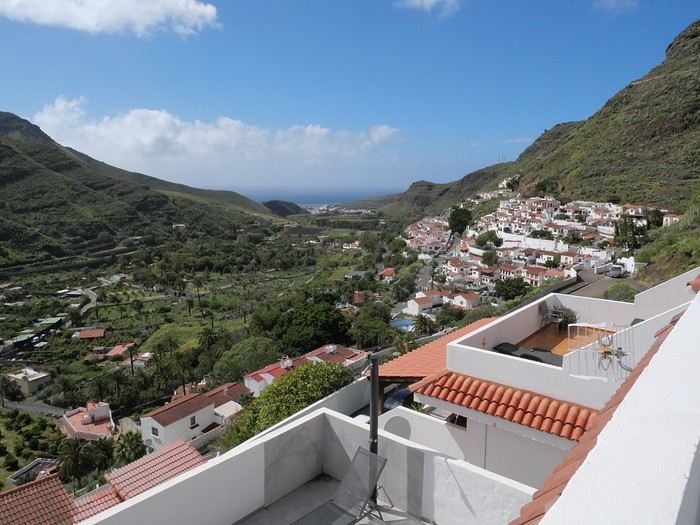
So, off we went to La Suerte, a few kilometers north of Agaete. The downside of the place, especially with luggage, is that you have to climb several flights of stairs via an outdoor staircase (after parking more or less far away on a steep street) to get there 😛). Of course, on the way from the car to the apartment, it started pouring again—the bags got soaked! Enough rain for today! We settled in quietly, and by late afternoon, we could (finally!) go admire the view from the terrace.
Every time we’ve been to the Canary Islands, it’s been by default (basically: where can we go in winter or early spring when we only have a week—so not too far, not too much jet lag, but with decent weather?).
This time, we had two weeks, but the winter plan kept changing: first Thailand (dropped for personal reasons), then Martinique (dropped because of work leave dates that weren’t up to me), and finally, the Canary Islands.
We’ve already been to Tenerife (which we really liked) and Lanzarote (which we liked a little less). This year, two options: Gran Canaria or one of the smaller islands west of Tenerife (La Palma, or even La Gomera or El Hierro). We chose Gran Canaria... not sure it was the right call! Whose fault is it? Storm Thérèse’s! Yes, Storm Thérèse followed us on arrival, and its effects lasted quite a while. We had to adapt, cancel visits, change activities...
But even without Thérèse...
Saturday 21/03 Departure from Orly at 6:10 AM with Transavia. The plane took off on time and landed a little early, tossed around by strong winds before touching down. It had just rained, but it was (almost) no longer raining.
We quickly picked up our luggage and then the car at the Cicar counter. We got a Seat Arona instead of the Corsa we’d booked. Well, while the driving position didn’t feel great at first (I got used to it), the engine’s smoothness and power were much appreciated on the island’s winding and sometimes steep roads.
It was only 10 AM, and we couldn’t theoretically check into our accommodation until 3 PM (the owner promised to message me if it was ready earlier). So, we headed to the (big) *Jardín Botánico Viera y Clavijo*, where we planned to spend a few hours. We found a huge parking lot... empty. The passenger in the car in front of us (yes, we weren’t the only ones at the closed gate—there was a car in front and one behind) went to ask for info: it was closed due to the storm 😕. So, we calmly headed toward Puerto de las Nieves, on the northwest coast of the island.
The plan: go to a restaurant, visit the village, and do some shopping while waiting for early afternoon. As soon as we got out of the car, it started raining... we took shelter under the awning of a shop, waiting for it to pass. But the rain turned into a downpour, and within minutes, awning or not, Gore-Tex or not, we were soaked!
Since we were already wet, we might as well go to the restaurant—they weren’t far! But here’s the thing: contrary to what Google Maps said, they all opened at 1 PM, not noon! Back to the car, wading through 5 cm of water because all the village streets were flooded . The rain let up, we did some shopping, went to eat, and I got a message from the owner saying the accommodation was ready 🙂.
So, off we went to La Suerte, a few kilometers north of Agaete. The downside of the place, especially with luggage, is that you have to climb several flights of stairs via an outdoor staircase (after parking more or less far away on a steep street) to get there 😛). Of course, on the way from the car to the apartment, it started pouring again—the bags got soaked! Enough rain for today! We settled in quietly, and by late afternoon, we could (finally!) go admire the view from the terrace.
Hey everyone!
We just finished 9 days in the American West and wanted to share our experience because we had an amazing time.
I know some of you might ask, why use an agency? Honestly, we didn’t really feel like doing all the driving and planning, especially since we didn’t know the area at all. And since our English isn’t great, having French-speaking guides was a big comfort.
We found Emmanuelle and Isabelle, and wow, they were fantastic. It was just the two of us with them, so it was a truly VIP, ultra-personalized experience. They treated us like royalty from start to finish. These two live in Las Vegas and know the region like the back of their hand. They told us they’ve spent over 15 years exploring every corner of the American West, and it really shows. Their knowledge of geology, park history, and local anecdotes is just impressive. It’s nothing like someone reciting a memorized script. They answer all your questions and really adapt to what you want to see or do.
What we really loved: the vehicle was super comfortable, and the little details made a difference—like snacks and even a homemade cake! Though, to be fair, we devoured the cake right away, so that counts.
Since they know the sites inside out, they took us at the right times to avoid crowds. So we could enjoy peaceful picnics at Grand Canyon viewpoints without being packed in with 200 people. Plus, on top of the must-see spots, they showed us some hidden gems that were absolutely stunning—places we never would’ve found on our own. They’re true locals who know all the best tips.
The service was really personalized. They adapted to our pace and preferences, and we could stop whenever we wanted to take photos. It’s the luxury of being in a small private group—you’re not just a number on a big bus. In short, we really felt like we were traveling with friends rather than professional guides. Everything’s included in the price (hotel pickup, meals, park entries, etc.), so the value for money is fair.
We loved it so much that we’re already planning to come back next year to explore other areas with them. I think we’ve caught the American West bug—it’s all we can think about, and we can’t wait to return.
If you’re looking for a French-speaking tour with real personalized service and guides who know the region like no one else, we highly recommend them. We had unforgettable moments. They also design road trips for those who don’t want a guide. And they handled our hotel reservations in Las Vegas too. If you want genuine advice from friendly locals, we’re giving them a 200% recommendation!
Hi there,
I recently saw that you need to register your phone on a specific website one week before leaving.
Since the trip will last less than a month, is this necessary, please?
Also, do I need to do this only for the phone that will have a local SIM card? Or do I also need to do it for my phone that will probably have an eSIM?
With a local SIM or eSIM, will we still be able to use our French SIM card with an international plan?
Thanks,
Odile
Hi, we’re heading to Laos for 3 weeks from December 12 to January 1, 2025. We land in Bangkok. We’d like to know if we need a visa for a very short stay in Thailand since we’ll just be passing through. I read that since July 2024, a visa isn’t required for stays under 30 days. Is that correct?
Thanks for your help! Elise
Thanks for your help! Elise
Hi everyone! This is my first time in Spain, and I don’t know it at all. I’m heading to Barcelona for 3 days, but I don’t have any specific plans yet. I’ve heard it can be quite expensive, so I’d love to get some tips on how not to break the bank during these 3 days! 😊
Hi,
I’m planning a trip to Thailand from April 1st to 24th. I’m flying with Qatar Airways.
My passport is valid until October 7th, 2025.
My question:
For entry into Thailand, my passport is valid for more than 6 months (6 months and 6 days).
For my exit, my passport’s validity will be 5 months and 14 days.
Do I need to renew my passport, or is it okay?
Thanks for your answers!
My train to Mathura is at 2 PM, and we’ll arrive an hour late—all good. I booked a hotel on booking, but unfortunately, it’s really far from the ghats. Walking there is out of the question—what a shame.
The hotel itself is fine, and there are several restaurants right across the street, which will be handy for dinner. This won’t be an exception, though—starting at 10 PM, they must wake up because I can hear them talking loudly, and music is playing along. My room faces the entrance, so it’s going to be tough. At midnight, I ask them to lower the volume, but they don’t listen. By 1 AM, I lose my temper, and this time, everything stops. Finally, I can get some sleep—until 4 AM, when they start up again for a little while before quiet returns until 6 AM. But when do they sleep? The noise never seems to bother them—it’s unbelievable, and I’m finding it harder and harder to tolerate. It makes a huge difference.
The next morning, as I leave, they tell me they’ll give me another room for the following night. Oh, two nights like that wouldn’t be possible—I’m exhausted.
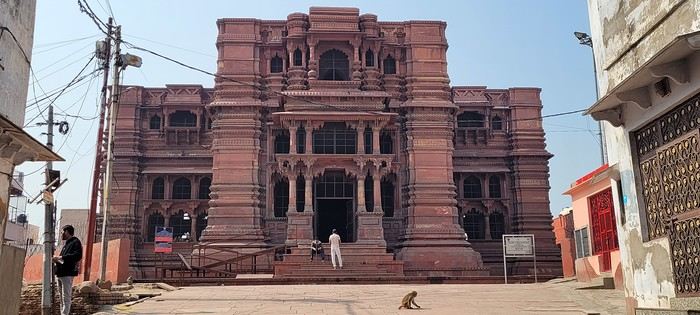
I head out to explore the ghats and take a rickshaw, which I share with a family, to Vrindavan, a city of temples dedicated to Krishna. I visit several while wandering through the lively streets, surrounded by a crowd of devotees. By 1 PM, I’m near the Bankey Bihari Temple, but I can’t go in—it just closed. Nearby, there are restaurants, so I take the opportunity to grab my usual aloo paratha with a lassi.

The work women do here is incredibly hard, and their pay must be miserable.

I want to leave Vrindavan for Govardhan. Two young guys on a motorcycle in front of the temple approach me, and the driver offers to take me part of the way. I’m pretty skeptical, but he insists, and I eventually agree. I didn’t fully understand what was happening. Once on the bike, his friend hops on too, and suddenly I’m sandwiched between them for a multi-kilometer ride—*travel Indian-style*. We quickly drop off the friend, and I breathe easier for the rest of the trip. At an intersection, he stops—Govardhan is straight ahead, but to get to his village, he needs to turn right. We wait for the bus for a few minutes, and he flags it down so I can hop on and continue my journey. What an adventure.
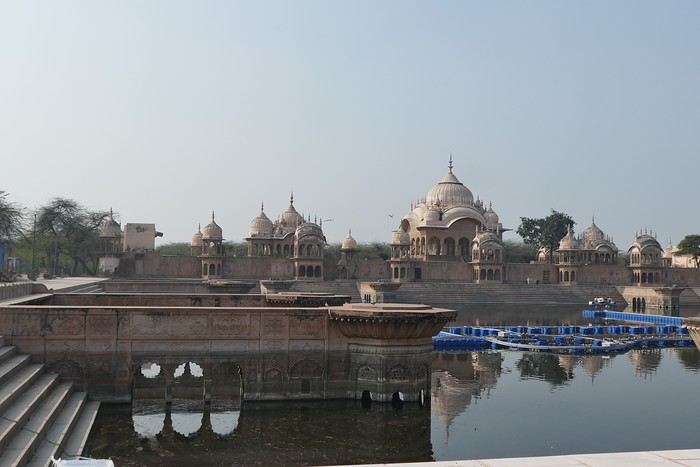
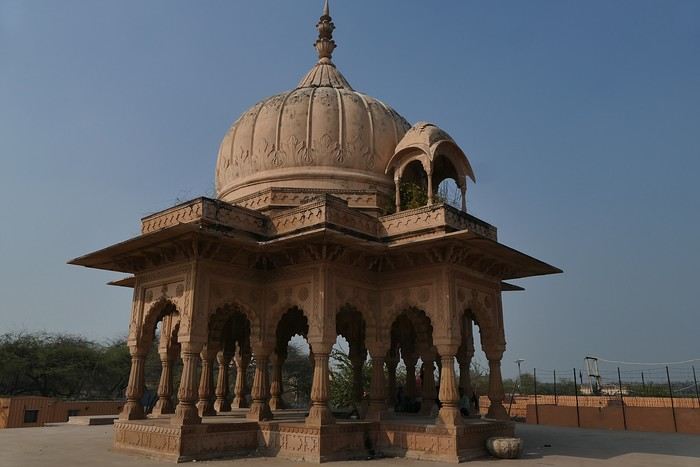
the neighbor with its beautiful dome.
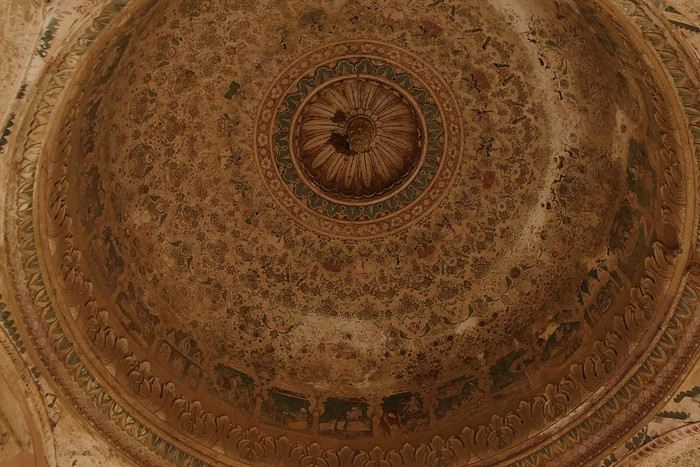
The work women do here is incredibly hard, and their pay must be miserable.
I want to leave Vrindavan for Govardhan. Two young guys on a motorcycle in front of the temple approach me, and the driver offers to take me part of the way. I’m pretty skeptical, but he insists, and I eventually agree. I didn’t fully understand what was happening. Once on the bike, his friend hops on too, and suddenly I’m sandwiched between them for a multi-kilometer ride—*travel Indian-style*. We quickly drop off the friend, and I breathe easier for the rest of the trip. At an intersection, he stops—Govardhan is straight ahead, but to get to his village, he needs to turn right. We wait for the bus for a few minutes, and he flags it down so I can hop on and continue my journey. What an adventure.
the neighbor with its beautiful dome.
Hi there,
I’m heading to Bangladesh in less than a month for about three weeks—a country I’ve never traveled to before and one with no recent guidebooks (Routard, Lonely Planet, etc.). I’m reaching out to those of you who’ve explored it in the last few years and are willing to share your experiences. I’d love your help planning my route so it takes me not just to the "tourist" spots but also to places where local life is a real treat, especially for someone who’s a true contemplative traveler. Thanks so much for your invaluable tips!
Philou
Hello fellow travelers 😎,
I’m taking advantage of VoyageForum’s comeback 😉even better😉 to post my request for help.
Thanks for reopening this essential forum.
My wife and I are planning a trip to Scotland in April-May 2025, in a camper van (L 8.70 x H 3.00).
I’m mentioning this just to avoid roads that won’t work for us.
However, we also enjoy parking and exploring by bike.
We’ve already prepared the first part of this trip well.
To combine business with pleasure, we’d like to continue on to Wales and Cornwall. This extension will last about 20 days. The second part of our trip will start in Chester and end in Dover.
We’d love to hear from "seasoned travelers" who’ve already done these routes—tips on must-see places and landmarks, possible stops at campsites, motorhome areas, or "wild" camping spots without issues or restrictions.
And of course, the culinary stops!
All of this with respect for the places and people.
I’m sure I’m forgetting some things, but I’ll build our itinerary as I gather information.
A big THANK YOU to everyone who shares their experiences and recommendations.
Gérard 😉
Hello,
I’m planning a trip of about three months in Vietnam starting in September 2026. I’ll arrive in Hanoi, where I plan to stay for around two to three weeks to explore the city at a relaxed pace, as well as several nearby spots: historical heritage, museums, traditional neighborhoods, markets, and craft villages.
After that, I’d like to gradually make my way toward the center and south of the country, depending on the people I meet, the weather, and opportunities along the way. I’m particularly looking forward to another longer stop in Ho Chi Minh City—probably two to three weeks—to discover the city’s modern history, Cholon, the markets, Southern cuisine, and take a few day trips, like to the Mekong Delta or natural areas accessible from the city. The rest of the itinerary is intentionally flexible: I’d rather linger in an interesting place than stick to a rigid schedule.
I’m especially interested in culture and history, museums, markets, local food, craft villages, and slightly less touristy spots. I also enjoy walking around a city, observing daily life, chatting over coffee, or occasionally going out in the evening. That said, I’m not looking for a very active trip or one focused mainly on nightlife.
I’m a calm, curious, and fairly independent person. I can be a bit reserved at first, but I’m sociable once I feel comfortable. I’m particularly interested in IT, artistic creation, and personal projects, and I enjoy quiet conversations about a variety of topics.
I’ll be traveling on a fairly budget-friendly basis: youth hostels, local transport, street food, and small restaurants, with the occasional splurge on an activity or slightly more comfortable accommodation. Of course, everyone would keep their own budget and independence, while sharing certain expenses when it makes sense.
The idea would be to start by meeting in Hanoi for a visit, a meal, or a few days together, then simply see if our paces and interests align. There’s no need to travel together for the full three months—it could be a day, a few days, a few weeks, or longer, depending on how well we get along. I like sharing parts of the journey and activities while still having the freedom to take time alone or do some sightseeing separately.
I’m open to meeting people, with a preference for a female travel companion. My approach is mainly friendly, without any particular expectations, though I’m open to a connection developing naturally.
Feel free to message me to share your dates, itinerary, and travel style.
Hi everyone,
After a year where I’ve worked way too much and with a house under renovation, it’s become essential to take a breather. My contract ends on 01/30, and I’ll try to find a new client for early March, so overall, let’s go somewhere in February!
I thought Réunion with the full trek around the Mafate cirque for reconnecting with Nature would be perfect, but since it’s cyclone season, it wasn’t such a great idea. Then came the idea that Southeast Asia could fulfill the peace-and-beach vibe, especially Cambodia with its cultural past, but the flight ticket price and a chat with a friend made me change my mind—and boom, Cape Verde popped up, with Santo Antão for hiking and São Vicente for culture and the beach.
So I bought a ticket a week ago, and oh, what a coincidence—it’s during Carnival!
Except now, I don’t know if it’s reality or just exhaustion talking, but I feel like I’m making a mess of things.
I’ve traveled a lot without even booking the first night, but this time, I pre-booked 2 nights in Mindelo (though one of them ended up canceling itself).
But the main issue is that I arrive on Monday, 02/09 at 6 PM and leave on Sunday, 02/22 at 11 AM, and there’s a little hiccup in the logical organization—actually, several hiccups—since I don’t really have any organization right now, and that’s where I need help
Because Carnival is in full swing from 02/15 to 02/17, right in the middle of my trip, so the logic of my visit to Santo Antão isn’t clicking for me. Plus, I just checked, and there’s zero accommodation available in Mindelo from 02/15 to 02/18 😕
So I don’t know: should I skip Carnival, should I forget about planning and just wing it once I’m there, should I stay on São Vicente after Carnival (because I read Montaganrd’s trip report, and he made São Vicente sound like a rock !), or should I keep in mind the option of heading to Santiago afterward and buying a return flight to Paris from Praia?
I need help 🏴☠️
Please, "HELP ME".
Hello everyone, and especially to the regulars of the MADA forum that I read every day. This time, I’m asking you not to argue and to try to help me with my problem.
A week ago, I submitted a visa application for France where I was supposed to meet a family who was going to help me with medical exams and host me on a short-stay tourist visa. My application was put together with the help of my friends over the past two months, and we checked everything multiple times—nothing was missing, and everything was in order. Last Friday, I picked up a visa refusal from the embassy in Tana with the reason: your intention to leave the territory of the member states before the visa expires could not be established. Yet, I had handwritten a letter committing to return to my country.
I went to the embassy twice because the first time they couldn’t find my file, and the second time I still wasn’t registered in their computer. After a while, the person came back from another room with my passport and this refusal slip. I’m starting to wonder if my application was even reviewed. I’m completely desperate, and even though my friends in France have filed an appeal in Nantes, I’m forced to leave Tana because my savings are running out fast. We have very little hope for the appeal in France since there must be hundreds of applications. So I’m open to any information or advice, but please "HELP ME".
Visiting the islands of the South Pacific is a dream we’re trying to make come true, so we’re doing our research to make sure we don’t miss out.
We’ve been dreaming of visiting French Polynesia for a long time, but now that we might finally be able to go, we’re torn between a cruise or a traditional stay.
Our plan is to visit Tahiti, Moorea, Bora Bora, Huahine... and we’re also considering the Tuamotu Islands.
For us, the priority is to explore the islands properly, not so much to enjoy life on a boat—we do cruises closer to home for that. But sailing through those lagoons must be an extraordinary experience too.
I’m reaching out to get your help in weighing the pros and cons of each option.
I’d love to hear from travelers who’ve done this trip.
How many nights would you recommend staying on each island?
And so on...
Thanks in advance for your input!
Hello everyone,
My husband and I are planning a trip to Thailand from January 2 to 10. Departure from Brussels on January 1 – arriving in Bangkok at 6:00 AM on January 2. Departure from Bangkok on January 11 at 2:00 AM, arriving in Brussels at 1:25 PM the same day. For professional and personal reasons, we can’t extend the trip.
I don’t plan on just lounging on a beach in Phuket, so with 9 days on the ground, I know it’s short... But having done this before in Hong Kong and Shanghai, I know it’s doable, refreshing, and enjoyable. We did it with the kids and included a 2- or 3-day stay at Disneyland in each city. Basically, we spent 5-6 days in each city.
Anyway, I’m reaching out because I’ve heard and read so many conflicting opinions that my head is spinning.
Following the saying, "don’t bite off more than you can chew," I’m assuming I should keep it simple. So I’m torn between just Bangkok or Bangkok and Chiang Mai.
If I go with the second option, I’m debating whether to head straight to Chiang Mai on the day we arrive (but given the flight times, we’d lose pretty much the whole day) or spend two days in Bangkok first, then go to Chiang Mai for 3-4 days, and return to Bangkok.
Thanks for your advice!
Hello,
Starting November 15th, I’ll be arriving in Thailand, and during my stay, I plan to visit the north, around the Chiang Mai area, then head south to the Krabi region. After Krabi, I’m planning to take an overnight train to Bangkok. I was wondering if there’s a train that leaves from Krabi or Trang, or if I absolutely have to go to Surat Thani? Also, which official website can I use to book my ticket?
Next, since I’ll be arriving at dawn in Bangkok, I’ve planned to spend 2 days in Kanchanaburi. What’s the most convenient way to get there—bus or train? And if you know any companies or websites, that’d be great.
Thanks for your tips!
Fred
Hi there,
We’re planning a 15- to 20-day trip to Croatia starting July 15. We’ll be taking the ferry from Italy, so our arrival/departure city will be Zadar.
We’d like to avoid too many kilometers and too many crowds, and split our time between the inland areas and the coast to mix up the activities. We’re big fans of Corsica because of the mix of snorkeling, river swimming, kayaking, hiking, etc.—we’re looking for something similar in Croatia.
The only touristy spot we definitely want to visit is Plitvice Lakes National Park. We’ll stay very close by and go super early, but other than that, there’s nowhere we *absolutely* have to see.
So far, I’ve been thinking of:
3 days in Plitvice (are there any hikes outside the paid park area? Even if they’re less stunning, but with fewer people. Rastoke?) Heading to one or two islands. We were thinking of Cres, Dugi Otok, or Rab. We’d like a spot with some shaded hikes, coves for snorkeling, and if there’s a sandy beach, even better. We’d stay 5 days + 3 days, or a full week if we pick just one island. 3 days around the Krupa River (hiking, swimming, kayaking on the Zrmanja) or in Paklenica National Park if there are fun activities to fill 3 days
Does this sound like a nice, not-too-crowded itinerary? Any other ideas like this, or tips for the islands?
Thanks for your help, Marie.
Hello,
I’d like to travel alone to the Algarve for about 10 days, as my husband sadly passed away.
I’m thinking of going at the end of April or beginning of May 2026. I’ll fly into Faro, then rent a car and head toward the westernmost tip of the coast.
Over 10 days, what are the best spots to see from Faro to the tip—hikes along the coastline or even exploring the countryside? For accommodations, can I also stay with locals? And which car rental company is the best?
Thanks in advance for your help!
Jo
Hi,
We’re planning a trip to Nosy Be from March 14th to 29th. I saw on the "Where and When to Go" site that the weather isn’t great then—has anyone been to this part of Madagascar during this period? Does it rain a lot? Thanks so much for your help!
Hi there,
We’re planning a week-long trip to Iceland to see the Northern Lights. We’re looking at staying from March 22nd to 30th: will we still be able to see the Northern Lights, or is it too late in the season?
We found a deal on Voyage Privé that seems like a good price, with a hotel in Reykjavik. If we rent a car, are there any interesting sites we can visit during the day, since we’re tied to returning to Reykjavik every night—or else we’d lose our nights at the hotel!
Thanks so much for your advice!
Best regards,
marc
This three-week trip to Namibia was a big first for us:
- Visiting a country in winter, for someone who starts feeling comfortable at 25°C (77°F).
- Camping, when we usually feel at home in a starred hotel.
- Sleeping on the roof of a car—what an idea... when a comfy bed is waiting just a bit further.
- Grocery shopping, cooking, doing the dishes... all the things we usually avoid to fully enjoy our vacation.
- Washing up when and how we can, when we can’t imagine going a day without a shower.
- Driving a big 4x4 on the left, with a manual transmission, when we usually opt for an automatic for more comfort.
Yep! You guessed it—we stepped way out of our comfort zone during this trip.
I had quite a few doubts while planning this adventure, but the more I read travel journals about Namibia, the more I wanted to go.
Personally, without this forum, I never would’ve dared to hit the Namibian roads in a 4x4. I was really anxious during the planning, so I want to thank everyone who contributed with their journals and forum discussions for helping me leave more peacefully.
At first, I wasn’t even considering sleeping in a tent. But after my husband’s persuasion—and my own curiosity to experience what I’d read in those travel journals—I gave in. So off we went in a double-cab Hilux with a rooftop tent.
And of course, let’s talk about me—the big cold-weather wimp. One of the biggest pre-trip challenges was choosing a sleeping bag. After a while, sleeping bags had no more secrets for me: temperature ratings (comfort, limit, extreme), shapes (mummy, rectangular), fillings (synthetic, down), compression rate, and weight... all these factors were a real puzzle. In the end, to make sure I wouldn’t be put off camping in winter (Australian winter, mind you), I went for a sleeping bag with a comfort rating of -10°C. And just to be *extra* sure I wouldn’t get cold, I bought a liner (never knew what that was before) in Thermolite, which boosts the sleeping bag’s temperature by 11°C. There are liners that add up to 15°C, but let’s not exaggerate—we’re not heading to the North Pole! My husband, on the other hand, got a sleeping bag with a -5°C comfort rating and a silk liner.
Was it enough? You’ll find out soon. In the meantime, another big thank you to everyone who helped me make this choice with their advice and experience.
Over a year in advance, we planned a three-week itinerary for our first trip to Namibia—classic route, nothing too out there. We chose to do the circuit clockwise because we wanted to finish on a high note in Etosha and its wildlife. They say it’s like Noah’s Ark out there! And why not, the cherry on top... some big cats.
We used Tourmaline’s services to book our accommodations and the 4x4.
Here’s our planned itinerary with campsites and lodgings—yes, there are a few solid roofs in there; we didn’t want to push it too far.
Day 1: Windhoek – Windhoek Gardens Guesthouse Day 2: Kalahari Anib Campsite Day 3: Namibrand Family Hideout Day 4: Sesriem Camp Day 5: Sesriem Camp Day 6: Rostock Ritz Camp Day 7: Swakopmund - Sea Breeze Guesthouse Day 8: Swakopmund - Sea Breeze Guesthouse Day 9: Spitzkoppe Camp Tented Day 10: Brandberg White Lady Campsite Day 11: Grootberg Lodge Day 12: Opuwo Country Campsite Day 13: Epupa Camp Day 14: Hobatere Lodge Day 15: Etosha Olifantsrus Camp Day 16: Etosha Okaukuejo Camp Day 17: Etosha Halali Camp Day 18: Etosha Namutoni Camp Day 19: Cheetah Eco Lodge Day 20: Windhoek – Londiningi B&B
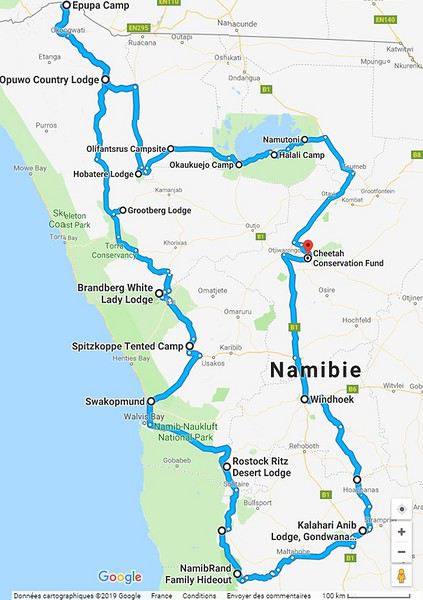
Alright! Are you ready to follow this adventure with us in our Hilux?
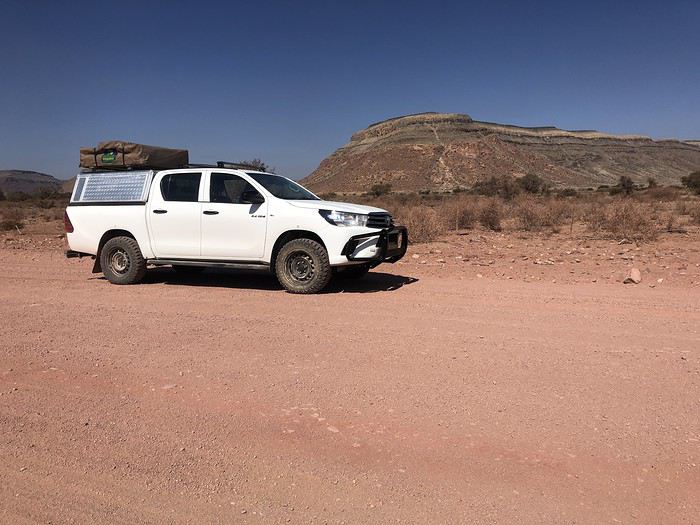
Yep! You guessed it—we stepped way out of our comfort zone during this trip.
I had quite a few doubts while planning this adventure, but the more I read travel journals about Namibia, the more I wanted to go.
Personally, without this forum, I never would’ve dared to hit the Namibian roads in a 4x4. I was really anxious during the planning, so I want to thank everyone who contributed with their journals and forum discussions for helping me leave more peacefully.
At first, I wasn’t even considering sleeping in a tent. But after my husband’s persuasion—and my own curiosity to experience what I’d read in those travel journals—I gave in. So off we went in a double-cab Hilux with a rooftop tent.
And of course, let’s talk about me—the big cold-weather wimp. One of the biggest pre-trip challenges was choosing a sleeping bag. After a while, sleeping bags had no more secrets for me: temperature ratings (comfort, limit, extreme), shapes (mummy, rectangular), fillings (synthetic, down), compression rate, and weight... all these factors were a real puzzle. In the end, to make sure I wouldn’t be put off camping in winter (Australian winter, mind you), I went for a sleeping bag with a comfort rating of -10°C. And just to be *extra* sure I wouldn’t get cold, I bought a liner (never knew what that was before) in Thermolite, which boosts the sleeping bag’s temperature by 11°C. There are liners that add up to 15°C, but let’s not exaggerate—we’re not heading to the North Pole! My husband, on the other hand, got a sleeping bag with a -5°C comfort rating and a silk liner.
Was it enough? You’ll find out soon. In the meantime, another big thank you to everyone who helped me make this choice with their advice and experience.
Over a year in advance, we planned a three-week itinerary for our first trip to Namibia—classic route, nothing too out there. We chose to do the circuit clockwise because we wanted to finish on a high note in Etosha and its wildlife. They say it’s like Noah’s Ark out there! And why not, the cherry on top... some big cats.
We used Tourmaline’s services to book our accommodations and the 4x4.
Here’s our planned itinerary with campsites and lodgings—yes, there are a few solid roofs in there; we didn’t want to push it too far.
Day 1: Windhoek – Windhoek Gardens Guesthouse Day 2: Kalahari Anib Campsite Day 3: Namibrand Family Hideout Day 4: Sesriem Camp Day 5: Sesriem Camp Day 6: Rostock Ritz Camp Day 7: Swakopmund - Sea Breeze Guesthouse Day 8: Swakopmund - Sea Breeze Guesthouse Day 9: Spitzkoppe Camp Tented Day 10: Brandberg White Lady Campsite Day 11: Grootberg Lodge Day 12: Opuwo Country Campsite Day 13: Epupa Camp Day 14: Hobatere Lodge Day 15: Etosha Olifantsrus Camp Day 16: Etosha Okaukuejo Camp Day 17: Etosha Halali Camp Day 18: Etosha Namutoni Camp Day 19: Cheetah Eco Lodge Day 20: Windhoek – Londiningi B&B
Alright! Are you ready to follow this adventure with us in our Hilux?
Hi,
During our stay in Luang Prabang, we're considering a 2- to 3-day trek, but we're torn between two options:
- Organized by an agency? Do you know any that offer what I'd call "authentic" experiences at "reasonable" prices?
- Going solo? Can you easily find public transport to get 80 to 150 km away from Luang Prabang without spending all day on the road, and hike to a few villages? (Car rental seems quite expensive, and the driving conditions are unpredictable.)
Do you have any advice on which direction to prioritize from Luang Prabang? North, East, West, or South?
Thanks for your help! Christian