Hello,
After asking questions on the site, here’s a little feedback on our trip in March and April.
Marseille/Antananarivo flight with Ethiopian Airlines was great both ways. I’d recommend it.
Domestic flights with Madagascar Airlines were just as smooth.
We had to change our plans because I was the victim of a snatch-theft attempt at Ivato... patellar fracture... so I ended up with a brace and more rest than hikes.
This let us spend more time in the same areas and make some connections.
We loved Tulear. Stayed with Alain—excellent value for money.
Mangily, where we stayed for 15 days. Hotel Bella Dona due to my little handicap. The pool replaced sea swims.
Mangily gets a bad rap for being very touristy. True, you get approached a lot on the beach—you have to play along and buy some trinkets, but after that, you get royal peace and lots of exchanges with locals. The village and its lively street are nice too. Don’t hesitate to eat with fishermen or at local bars.
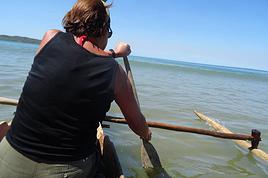
Anakao, a big favorite. Just the journey there is worth it. Watching dozens of pirogues set off between 5 and 6 AM is a magical moment.
Stayed at Peter Pan’s place. Lots of chats with Dario since we were the only guests.
Planned a 4-day Antananarivo–Soniara–Ivango road trip with a driver.
Cut to 2 days because the boat to Sainte Marie was moved up due to weather. I don’t remember the company’s name, but it wasn’t great for safety—plus, we brought back fleas.
Visited Andasibe Park along the way. Quick tip: go in the morning.
A little over 2 weeks on Sainte Marie at Hôtel Mantis Soanambo—total luxury negotiated at a price that defied all competition because it was low season.
Meals were at little local eateries nearby.
We chose not to sleep on Île aux Nattes but went there several times during the day (crossing: 4000 ariary for 2).
You have to take a pirogue tour—it’s like stepping into a postcard.
Sainte Marie is a special place. A tropical island that feels like the Caribbean ones we’ve lived on. No security issues at all. We rented a scooter because we found tuk-tuk prices a bit steep. You can leave the scooter with helmet and keys and come back 4 hours later.
More amazing encounters here too.
Last part of our trip in Ampefy, a beautiful volcanic region with a very welcoming population.
Stayed with a friend of our driver.
Hotels in Ivato are plentiful and vary a lot in quality.
Les 12 Collines is a bit out of the way but only 21 € per night.
La Chato... very expensive for what you get.
I tried to keep it short.
Madagascar is a wonderful island with so many facets. Always so many emotions when I think back on this trip.
The extreme poverty... don’t hesitate to buy food for the kids on the beach, for example. It doesn’t cost much, but it means a lot to them.
The kindness of the people and, above all, those SMILES.
We’re hooked—we’re going back in November for 6 months... because yes, you can buy a 3-month visa at the airport (a question I’d asked), and you can extend it for another 3 months... if you apply in time at a police station.
We didn’t take Malarone either. We’d brought some, but there were few mosquitoes, and "Insect Écran" worked really well.
36 similar discussions in English
Hello,
We’ll be on vacation in the Seychelles in July and will visit La Digue, Praslin, and then Mahé in that order. Our 21-year-old daughter will have to leave earlier than us while we’re still on Praslin.
We’re hesitating between the following options for her return:
Option 1:
- July 9: ferry from Praslin at 2:00 PM – arrives in Mahé at 3:15 PM.
- International flight departing at 7:30 PM.
- The connection is very tight, leaving a 1- to 2-hour safety margin in case the ferry is delayed.
Option 2:
- July 9: ferry from Praslin at 8:00 AM – arrives in Mahé at 9:15 AM.
- International flight departing at 7:30 PM.
- This is safer than Option 1, but it means she’d lose the whole day, spending it alone. We’d pay for a day pass giving her access to a hotel pool to kill time.
From experience, what do you think? Are significant ferry delays (2 hours or more) common, especially in July with the swell, making Option 1 too risky?
Or is even Option 2 too risky, and should our daughter take a ferry the day before (though that would mean missing a lot of time with us)?
Or should she take an Air Seychelles flight the same day instead of the ferry? Is that safer than the ferry? But it’s much more expensive…
I know no one can give me certainty on this, but I’d just love to hear your gut feeling from those who have experience with inter-island transfers in the Seychelles.
Thanks so much in advance!
Christophe
Well, I still feel a bit lonely about this destination—no requests for info, no travel journals, or trip reports since I last posted over a year ago. A little disheartening.
That said, I did cross paths with slightly more tourists this time. Not a ton, but enough to notice compared to my last stay. Beyond that, not much has changed—the people are just as lovely, and every interaction, whether at the market, in the medinas, in town, or in the countryside, was positive. It was so pleasant; my "alert meter" stayed at zero the whole time (which is pretty different from some other places I visit now and then). The roads outside the cities remain dangerous, and the accident rate seems high. Best to drive during the day and take it easy (on some rough stretches, you don’t really have a choice anyway). The scattered plastic and metal waste hasn’t magically disappeared, and it’s still pretty discouraging to see the most beautiful beaches surrounded by empty bottles, straws, diapers, and rusted carcasses of an old Xantia or a skeletal Espace. When it’s not on the beach itself (since those are cleaned), it’s just a few meters away. Usually, there’s not much in the water or close to shore—the seabeds are gorgeous, with coral and a wide variety of scaly friends... But stepping back onto the hardened lava, you dodge a chip bag or a shriveled battery. Such a paradox. Honestly, it’s like this almost everywhere except on hotel beaches or those far from human settlements. But otherwise, in places like Chomoni, Bouni, Itsandra, Moya, and Domoni (on Anjouan), Nioumachoua (on Mohéli, and even on the nearby islets), it’s hard to ignore. And it unfortunately tarnishes the beauty of these otherwise stunning spots.
That said, you can still find secluded micro-bays, protected and remote, where this isn’t an issue. And where there are hotels—like in Petite Itsandra in Moroni, in front of Laka Lodge in Nioumachoua, Trou du Prophète, or even Chomoni (though the surrounding areas are so littered...)—the beaches are cleaned, so...
So why go? Why still love it despite all this? Well, first, the Comorians themselves—that’s already essential and probably the main reason. Then there’s the breathtaking topography: the imposing Karthala, the dizzying peaks and cliffs of Anjouan, vast ravines, a tortured geology covered in lush nature, and Mohéli, much more serene and gentle, blanketed in spice plants and trees with names that make you dream, like an open-air spice market. The flora across the islands—the fields, trees, scents: clove trees, cinnamon trees, lychee, mango, cardamom, nutmeg, vanilla, coconut palms, banana trees, coffee plants, cocoa... A profusion of green dotted with red, white, and yellow berries and flowers... The seabeds are stunning in many places, and there are some beautiful beaches/oceanfront spots, especially near Trou du Prophète (but not only there). The history and culture—between traditional festivals, but especially the medinas with their staircases, covered passages, palaces, and mosques that create Escher-like constructions. I love wandering through them for hours, stumbling upon an unlikely shop, a more or less philosophical saying like "pain is a warning," "a promise is a debt," or the less original "little by little, the bird makes its nest." A grocery store, women negotiating freshly caught fish (usually tuna, immediately cut and ready to sell), kids playing, old men playing checkers, a call to prayer... In Moroni, Mutsamudu, and Domoni, I spent most of my "urban" time.
If anyone’s interested—though given the hype about Comoros on the forum, I doubt it—but if you need info on accommodation across the three islands, some restaurants, or sites to visit, don’t hesitate to ask.
This message is another message in a bottle (one more, if I dare...) for the Comoros destination.
Hello,
I’m continuing the Antalaha–Maroantsetra discussion but for some info in the other direction, specifically about hiking from Maroantsetra to Antalaha.
In mid-December, I plan to take it easy from Tamatave to Antalaha. I’m thinking of making a few stops, like Nosy Atafana—has anyone snorkeled there? Is it nice? Can you find bush taxis on the Soniera–Ivongo / Maroantsetra stretch?
After that, I’m considering walking from Maroantsetra to Antalaha and figuring things out as I go, since the path seems well-used, so I’m not planning on a guide. Good idea or totally foolish? Should I bring a tent and some camping gear, or, as I’ve read multiple times, are there several villages with lodging and food options along the way? Any spots worth stopping at or nothing special to see?
In Antalaha, I saw the recommendation for Villa Malaza in the previous discussion, so I’m keeping that in mind. If there’s space, I’ll plan to stay there. In Antalaha itself, are there any places to visit, things to see, or activities you’d recommend?
Thanks in advance to everyone for any tips—they’ll be really helpful!
Oh, the good news—the site is back up after such a long closure. I think many of us were really missing it, though some have moved on to other forums like Routard.
Hopefully, activity will pick up little by little. Travel habits have probably changed post-Covid, and some regulars won’t be coming back for all sorts of reasons.
But for the rest of us, the forum is here for travel journals and pre-trip questions. Anyway…
Back to the main point: my last trip to Madagascar was a while ago now—about a year—on the High Plateaus during the austral winter. It was really chilly, and to be honest, my feelings were mixed between the joy of returning to Madagascar and the sadness of seeing the state of the country. The infrastructure is crumbling, and the population is sinking into poverty at unprecedented levels. The country’s closure likely had immeasurable consequences, compounded by destructive cyclones. Even secondary cities have seen large numbers of rural people arriving in search of work, while some rural areas barely allow survival. I’ve never felt such despair over the situation in 20 years.
From Tana to Fianar, it was nothing but heartbreaking observations. Probably made worse by the drizzle and cold typical of that season in the region.
In a few weeks, I’m planning to return to the High Plateaus and also Sainte Marie. On that note, a few questions: has anyone stayed at Samaria Cosy Lodge, and what did you think of it? On Île aux Nattes, which hotel would you recommend for a few peaceful days, ideally on the coast best suited for snorkeling?
Thanks in advance
Hi there, following a work trip, I’ll have 4.5 days left to get a quick overview of Madagascar during the last week of February. I’ll already have had a good look around Tana (3 days of work and 1.5 days beforehand to see 1 or 2 points of interest 2-3 hours from Tana).
Is it feasible to spend the remaining 4.5 days like this:
- Day 1 & 2 (and maybe the morning of Day 3): relaxing on a coast with a pleasant climate, for example, a one-way flight to Tuléar (there’s a flight on Day 1 at 3 AM) and heading to a nice beach. Ideally, I’d have liked to go toward Morondava (baobabs, beautiful beaches near Belo), but the flight schedules don’t really work, and it wouldn’t let me visit Isalo.
- Then 2 days to head back up via the RN7, ideally with a stop in Isalo, which really appeals to me (I’m an experienced hiker in France), and/or Ranomafana. But do the weather conditions allow for long hikes in that area? Ideally, I’d like to do Tuléar–Tana by public transport up to my first road stop (shared bus? To Isalo?), then find a local hiking guide for the day. And take another transport to another point of interest before returning to Tana, where I have my return flight to France on Day 5 at noon.
My questions: - How to travel from Day 3 to Day 5 from the west coast (Tuléar? Morondava?) back to Tana? I’d prefer not to depend on a guide the whole way, but if I have to 🤷🏽♂️) If I choose Morondava, will I miss out on really interesting spots I could’ve seen along the RN7?
I’m open to any suggestions or ideas to make the most of these 4.5 days, like another beach destination I might not have considered (I ruled out Nosy Bé because of the February weather—maybe I was wrong?)