Hi there,
we’re planning our trip to the North Cape this summer. We bought a new vehicle for it. Unfortunately, the registration document is still being processed, and the delay seems long—I don’t think I’ll have it in time for our departure...
I have the transfer documents, insurance in my name, and all the supporting paperwork, but not the registration document. So my question is: does the ferry company require the registration document *mandatorily* when boarding in Denmark or not?
Thanks for any insights...
Hi everyone, I’d like to travel to Senegal with my two dogs—an Amstaff and a French Bulldog (who can’t fly). I’m wondering if you think it’ll be complicated or if the formalities are easy to sort out.
I’m giving myself a year to prepare for this trip.
Thanks in advance for your replies
Thanks in advance for your replies
I'm looking for any recent info (2024) on entering Myanmar from Ranong in Thailand, as well as the journey up to Mawlamyine. Are there any restricted areas?
Hi there,
I’m leaving for Japan in a few weeks. I just noticed my passport has an ink stain on the signature page. Could this cause any issues?
I’m leaving for Japan in a few weeks. I just noticed my passport has an ink stain on the signature page. Could this cause any issues?
Hi,
recently Namibia introduced a visa requirement for French travelers (among others). I’ve seen there’s a dedicated website for obtaining it.
But my question is about getting it on arrival at Windhoek Airport. I’d love any info on this: how fast it is, cost, documents needed, etc.
Thanks for your feedback!
Happy travels to you all
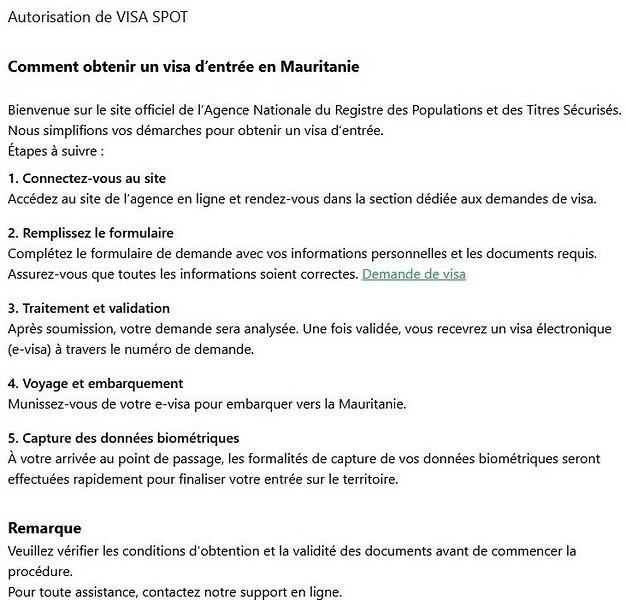
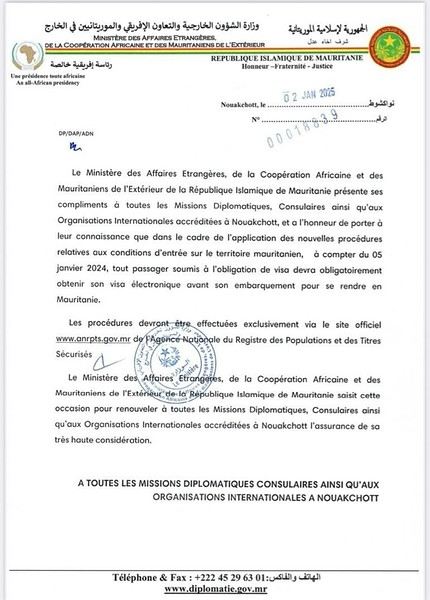
Starting January 5, you’ll need to arrive at the Mauritanian border with an E.Visa.
To get it, you’ll have to go to the Mauritanian website:
https://anrpts.gov.mr/fr
Hi
Has anyone been to Rwanda recently and gotten a 3-month visa on arrival easily?
Thanks
Hello,
My partner, who is Malagasy, would like to visit France (ideally in mid-August) and therefore apply for a short-stay visa (90 days).
I’ve heard that many applications are refused even when all the required documents are submitted, which is why I’m here—to get advice and guidance to be "almost" sure the application will be accepted.
I have a lot of questions, and your help would be invaluable to us.
She is 27 years old, has a passport with her current occupation listed as self-employed (she owns a "taxi-brousse" truck) and thus has a statistical card, a business license, and annual tax certificates. She started her business at the beginning of this year.
As for me, I am an adult with a disability. I receive disability benefits until May 2026. I’m in the process of professional reintegration and will start a job in a few days, likely on a fixed-term contract (CDD).
Here are my questions about the supporting documents to provide:
-Purpose of the trip/stay
Flight ticket reservation (round-trip) (the ticket should only be purchased once the visa is approved). Letter of commitment to return, written on plain paper. Any other document demonstrating potential family, economic, or material ties in the country of residence. Confirmation of a booked organized trip or any other document outlining the planned itinerary.
I’ve been told that for the flight reservation, my partner just needs to go to Air Madagascar in Antananarivo and pay around 50,000 ariary to get this reservation. Given that the French short-stay visa takes between 15 to 45 days (I might be wrong) to be processed and approved, I wonder if the reservation will still be valid if the visa is approved late. For the letter of commitment to return, I assume two sentences are enough, and what matters most are the documents proving ties to the country of residence (her economic activity). Do you think that will be sufficient? And for the planned itinerary, since this isn’t an organized trip, what document could work? A handwritten letter explaining a few planned visits?
-Proof of residence in the country of origin
For employees: original work certificate, original leave certificate, last 3 payslips (or bank statements). For retirees: pensioner’s card and last 3 pension statements. For traders or entrepreneurs: professional registration, professional card, and recent bank statements.
For liberal professions: professional registration, professional card, and recent bank statements. For unemployed applicants and students: sponsorship letter and copies of the sponsor’s financial documents.
For this point, she can justify her self-employed status with the statistical card, business license, and annual tax certificates. As for bank statements, she deposits her earnings in cash into her bank account—will this be an issue during the application review?
-Financial resources
Bank account statements (last 3 months). Last 3 payslips or pension statements. Foreign currency allocation certificate, whose origin must be demonstrated (recent bank statement, savings account), issued by local banks or exchange offices (minimum 32.50 € per day if staying with a private individual or 65 € per day if staying in a hotel) or presentation of an international bank card with supporting account statement.
I need help with this point because I don’t fully understand what she needs to provide as a self-employed individual, especially since she doesn’t earn 32.50 € per day. I can obviously transfer money to cover this. So, overall, what documents should be provided for this section?
-Accommodation
Confirmed hotel reservation with the hotel’s phone number and reservation number / payment confirmation for stays longer than 1 month or original hosting attestation.
For this point, do I just need to write a handwritten letter stating that I will be hosting her? Then scan it and email it to her? Is that all?
-Travel medical insurance
Insurance certificate: must specify the amount and scope of coverage (30,000 € coverage / medical expenses and repatriation).
For this, I’ll opt for AXA Schengen insurance (low-cost). Any advice is still welcome...
I have one last question about the following point:
The short-stay visa allows you to stay for a maximum of 90 days for a continuous stay or multiple stays within the Schengen area over a 180-day period.
If we decide to leave the Schengen area during the stay (to visit the United Kingdom, for example), will the 90-day visa be paused and resume once we return to the Schengen area? And if so, can we plan a return ticket beyond the 3 months by justifying an exit/entry?
Thank you in advance for all your advice and suggestions. I may have forgotten some important points—feel free to let me know.
Best regards.
She is 27 years old, has a passport with her current occupation listed as self-employed (she owns a "taxi-brousse" truck) and thus has a statistical card, a business license, and annual tax certificates. She started her business at the beginning of this year.
As for me, I am an adult with a disability. I receive disability benefits until May 2026. I’m in the process of professional reintegration and will start a job in a few days, likely on a fixed-term contract (CDD).
Here are my questions about the supporting documents to provide:
-Purpose of the trip/stay
Flight ticket reservation (round-trip) (the ticket should only be purchased once the visa is approved). Letter of commitment to return, written on plain paper. Any other document demonstrating potential family, economic, or material ties in the country of residence. Confirmation of a booked organized trip or any other document outlining the planned itinerary.
I’ve been told that for the flight reservation, my partner just needs to go to Air Madagascar in Antananarivo and pay around 50,000 ariary to get this reservation. Given that the French short-stay visa takes between 15 to 45 days (I might be wrong) to be processed and approved, I wonder if the reservation will still be valid if the visa is approved late. For the letter of commitment to return, I assume two sentences are enough, and what matters most are the documents proving ties to the country of residence (her economic activity). Do you think that will be sufficient? And for the planned itinerary, since this isn’t an organized trip, what document could work? A handwritten letter explaining a few planned visits?
-Proof of residence in the country of origin
For employees: original work certificate, original leave certificate, last 3 payslips (or bank statements). For retirees: pensioner’s card and last 3 pension statements. For traders or entrepreneurs: professional registration, professional card, and recent bank statements.
For liberal professions: professional registration, professional card, and recent bank statements. For unemployed applicants and students: sponsorship letter and copies of the sponsor’s financial documents.
For this point, she can justify her self-employed status with the statistical card, business license, and annual tax certificates. As for bank statements, she deposits her earnings in cash into her bank account—will this be an issue during the application review?
-Financial resources
Bank account statements (last 3 months). Last 3 payslips or pension statements. Foreign currency allocation certificate, whose origin must be demonstrated (recent bank statement, savings account), issued by local banks or exchange offices (minimum 32.50 € per day if staying with a private individual or 65 € per day if staying in a hotel) or presentation of an international bank card with supporting account statement.
I need help with this point because I don’t fully understand what she needs to provide as a self-employed individual, especially since she doesn’t earn 32.50 € per day. I can obviously transfer money to cover this. So, overall, what documents should be provided for this section?
-Accommodation
Confirmed hotel reservation with the hotel’s phone number and reservation number / payment confirmation for stays longer than 1 month or original hosting attestation.
For this point, do I just need to write a handwritten letter stating that I will be hosting her? Then scan it and email it to her? Is that all?
-Travel medical insurance
Insurance certificate: must specify the amount and scope of coverage (30,000 € coverage / medical expenses and repatriation).
For this, I’ll opt for AXA Schengen insurance (low-cost). Any advice is still welcome...
I have one last question about the following point:
The short-stay visa allows you to stay for a maximum of 90 days for a continuous stay or multiple stays within the Schengen area over a 180-day period.
If we decide to leave the Schengen area during the stay (to visit the United Kingdom, for example), will the 90-day visa be paused and resume once we return to the Schengen area? And if so, can we plan a return ticket beyond the 3 months by justifying an exit/entry?
Thank you in advance for all your advice and suggestions. I may have forgotten some important points—feel free to let me know.
Best regards.
Hi,
I’ve read on various semi-official websites that you can pay for the 30-day visa at the counter at the airport by credit card.
Has anyone arrived in Laos recently (I’ll be landing in Luang Prabang) and can confirm this?
If not, which currencies are accepted?
Thanks in advance.
Alain
Hi,
I just had a really bad experience leaving for Thailand with Etihad Airways, along with my partner and her 11-year-old son. We were denied boarding because the child’s passport was invalid (by about 3 days), as it’s indeed required to have 6 months of validity. But come on—just 3 days over! On top of that, we were able to check in online for our round-trip flight (just the flights, no extras), entered our passport numbers and expiry dates, and even had to check in online again 30 hours before departure, where we got our boarding passes without any issues. How is it possible that no one called, warned, or even blocked us online? Instead, they waited to tell us at the airport during baggage check-in. I’ve asked the airline for a full refund of our expenses—do I have any chance? Thanks for your help
Hi there, we’re spending March in Sri Lanka, and on several blogs travelers mention they’ve rented scooters or mopeds.
On government info sites, it seems they say you need a Sri Lankan license to rent these vehicles. Have any of you run into this kind of issue?
Thanks, Marie
Hi everyone!
What a joy to be back on this forum where I’ve spent so many hours traveling and gathering info—let’s get started! 👋
Almost everything’s in the title, but just to clarify: As far as I know, you currently need a full French motorcycle license (A) to legally ride a scooter in Thailand, since they don’t recognize A1 or A2 licenses. Yes, I know most rental places only ask for an international car license (B), or sometimes nothing at all… but that’s not what I’m asking. What I’d like to know is whether you think this might change in the future, allowing A1 licenses (which are easier to get) or even car licenses (B), since you can ride a scooter in France with one. I don’t want to get a motorcycle license—I’m scared of motorcycles, even though I’m comfortable on a scooter. I’m a bit confused by their regulations. Thanks for any insights you can share!
Lulu56😅
What a joy to be back on this forum where I’ve spent so many hours traveling and gathering info—let’s get started! 👋
Almost everything’s in the title, but just to clarify: As far as I know, you currently need a full French motorcycle license (A) to legally ride a scooter in Thailand, since they don’t recognize A1 or A2 licenses. Yes, I know most rental places only ask for an international car license (B), or sometimes nothing at all… but that’s not what I’m asking. What I’d like to know is whether you think this might change in the future, allowing A1 licenses (which are easier to get) or even car licenses (B), since you can ride a scooter in France with one. I don’t want to get a motorcycle license—I’m scared of motorcycles, even though I’m comfortable on a scooter. I’m a bit confused by their regulations. Thanks for any insights you can share!
Lulu56😅
Hey fellow travelers! 🙂
I’m heading to India in January with a tourist multi-entry ETA (is it still called an e-visa?).
First things first, if I’ve understood correctly: I can enter and exit India as many times as I want, as long as my total stay doesn’t exceed 180 days in a full year and no single stay goes over 90 days.
Okay, that’s the theory.
Now, how does it work in practice?
I plan to spend 3 months in India (Rajasthan, then the Ganges Valley up to Varanasi, then Sikkim), then head to Nepal for another 3 months (Kathmandu, Pokhara), and return to India for 3 more months before flying back to France.
But here’s the thing—I’ve got the impression (maybe I misunderstood) that renewing the Indian visa has to be done in Kathmandu or Pokhara, and only in one of those two Nepali cities.
Yet, on *Le Routard*, I thought I read that you just need to "cross the border and come back," meaning you can enter Nepal at any border point, which would be way more practical...
Imagine someone who wants to spend 6 months in northern India and starts from Shimla—they’d have to travel all the way to Kathmandu, then back to Shimla, crossing a big chunk of Nepal just to renew their Indian visa. That seems pretty convoluted, especially since the northwest border with India is so far from Kathmandu.
I used this example because I originally wanted to spend 6 months only in northern India, and while waiting for clear answers, I’ve planned an alternative route (the one I described at the start of this post).
Could someone explain exactly how this Nepal border crossing thing works for renewing an Indian visa (and getting another 90 days, within the 180-day annual limit, of course)? How long does it take? How much does it cost?
Can’t wait to hear from you, and thanks in advance for your valuable insights! 🙂 !
Could someone explain exactly how this Nepal border crossing thing works for renewing an Indian visa (and getting another 90 days, within the 180-day annual limit, of course)? How long does it take? How much does it cost?
Can’t wait to hear from you, and thanks in advance for your valuable insights! 🙂 !
Hi everyone,
We’re planning to travel from Mongolia to China in July 2026 via the land border. I know there’s a visa exemption for French citizens in China, but I think I read that if you’re coming from Mongolia, you need a visa.
Has anyone got any info on this?
Thanks!
Séverine
Hi everyone,
in a few months I need to bring my Thai partner to France.
I’m going to prepare the "attestation d’accueil" for 3 months.
On the form, they ask me to act as a financial guarantor for her stay—no problem for me. But on the visa application, France asks her to prove she has sufficient income to get the visa. Is it still necessary for her to prove that, given that I’m acting as her financial guarantor?
Thanks
Hi,
We're heading to Germany in August. Finally, after all this time I wanted to go back to Germany :)
I think I need an eco sticker for my car, but I'm not sure.
I found this info:
"Since June 1, 2022, it’s no longer necessary to buy the German eco sticker to drive in Freiburg-im-Breisgau’s Umweltzonen (low-emission zones).
The Crit'Air sticker, rated from 0 to 3, is recognized by the authorities."
Could you tell me the name of the website where I can find this info, please?
We’ll be staying in Brigachtal (Baden-Württemberg). We’ll visit Friedrichshafen, Triberg, and Hohenzollern Castle.
Thanks :)
Thanks :)
Hello,
I’m a divorced mom with a 12-year-old, planning to take the train from France to London for a 5-day trip over Christmas.
My question: is it mandatory to present the father’s authorization (which I’ll probably never get)?
I’ve heard so many different stories from people who’ve already traveled—I’m totally lost.
Please share your experiences!
Have a great day
Have a great day
Need your advice—this is a bit urgent! 😅
I’m leaving in 1 month for 7 months in South America (mainly Argentina, with a quick stop in Chile and Bolivia). I still haven’t decided on: 👉 Travel insurance. 👉 The best bank card for abroad.
I’m a bit behind schedule and would really love your feedback: 👉 Which insurance do you recommend (reliability in case of trouble)? 👉 Which bank do you use while traveling to avoid fees (mainly in Argentina)? Boursorama? 👉 Any idea about fees with Western Union?
For now, I’m planning to bring as much cash as possible to avoid fees and exchange money locally. My bank (La Poste) gave me a Visa Premier for insurance/repatriation, but after reading the terms, I see it’s limited to 180 consecutive days—so 6 months, not 7.
Thanks in advance for your tips—it’ll help me make a decision quickly! :)
I’m leaving in 1 month for 7 months in South America (mainly Argentina, with a quick stop in Chile and Bolivia). I still haven’t decided on: 👉 Travel insurance. 👉 The best bank card for abroad.
I’m a bit behind schedule and would really love your feedback: 👉 Which insurance do you recommend (reliability in case of trouble)? 👉 Which bank do you use while traveling to avoid fees (mainly in Argentina)? Boursorama? 👉 Any idea about fees with Western Union?
For now, I’m planning to bring as much cash as possible to avoid fees and exchange money locally. My bank (La Poste) gave me a Visa Premier for insurance/repatriation, but after reading the terms, I see it’s limited to 180 consecutive days—so 6 months, not 7.
Thanks in advance for your tips—it’ll help me make a decision quickly! :)
Hi there,
We’re planning to drive to Senegal by car. We’re a little nervous because it’ll be our first time making the trip with a car that isn’t ours. We’re doing the trip to deliver it to its owner. Has anyone here done this before? What documents will we need?
Thanks in advance for your tips!
We’re planning to drive to Senegal by car. We’re a little nervous because it’ll be our first time making the trip with a car that isn’t ours. We’re doing the trip to deliver it to its owner. Has anyone here done this before? What documents will we need?
Thanks in advance for your tips!
Hey everyone, hope you're doing well! :)
I’m planning to go back to Thailand at the start of next year—once just wasn’t enough 😅
I’ve seen that nothing’s official yet, but they’re considering reducing the visa-free stay from 60 to 30 days. If I book for 58 days like last time and they change the rules last minute, what happens?
It takes forever to get a visa—I saw you have to prove you have enough funds to cover your stay. How much money do you need in your account?
Thanks!
Hi there
I’d like to visit Niagara Falls from the Canadian side: is an eTA enough for a French citizen (from Toronto or Ottawa) and then public transport? Which Canadian city is the easiest to get there from? I plan to spend one night in Canada before seeing the falls on the American side. Do I need an ESTA to visit the American side for just a few hours and then return to Canada?
I’d like to visit Niagara Falls from the Canadian side: is an eTA enough for a French citizen (from Toronto or Ottawa) and then public transport? Which Canadian city is the easiest to get there from? I plan to spend one night in Canada before seeing the falls on the American side. Do I need an ESTA to visit the American side for just a few hours and then return to Canada?
hi there
since the forum is back up, let’s try to gather some updated info.
first off, arrival formalities are changing—starting January 1st, you’ll need to fill out an electronic form before arrival. This replaces the paperwork you used to fill out on the plane or at the airport (for air arrivals). Here’s the link: https://www.arrival.gov.kh/.
for visas, the same options remain: e-visa, visa on arrival, or visa at the embassy. The standard price is $30 on arrival, but at land borders, be prepared for a small "extra" for "cigarettes or coffee."
don’t forget your passport must be valid for at least 6 months after your return.
regarding airlines, prices are pretty high for carriers like Singapore, Qatar, Emirates, Vietnam Airlines, and Thai. EVA Air is a great Taiwanese airline with slightly lower fares, but ongoing pressure from mainland China and quasi-blockades could cause delays or issues—something to watch.
there are cheaper Chinese airlines, but friends from China advise being cautious with connections. Worth double-checking.
transport is evolving too—there’s now a highway from Phnom Penh to Kampot. Soraya, a well-known bus company, has disappeared. More highway projects are in the works. Buildings are popping up fast, just mentioning this for those who haven’t been to Cambodia in a while.
Hi there,
I’ve read that medication supplies shouldn’t exceed 30 days.
How can I handle a two-month stay?
Thanks for your tips!
Thanks for your tips!
Hi there.
I’m reaching out to ask for your advice about travel insurance for my trip.
I bought Eurostar tickets back in January, but I forgot to take out travel insurance right away.
I’d like to get multi-risk travel insurance now, but most insurers say you have to sign up within 48 to 72 hours after buying your transport tickets.
Do you know of any insurance that doesn’t have this deadline and lets you sign up even months after buying your tickets?
Thanks so much for your help in advance.
Best regards
I bought Eurostar tickets back in January, but I forgot to take out travel insurance right away.
I’d like to get multi-risk travel insurance now, but most insurers say you have to sign up within 48 to 72 hours after buying your transport tickets.
Do you know of any insurance that doesn’t have this deadline and lets you sign up even months after buying your tickets?
Thanks so much for your help in advance.
Best regards
Hi there,
My departure is slowly approaching, and now that I’ve got my Russian visa sorted, I’m fine-tuning the rest of my trip to Tajikistan. Since the Tajik visa is no longer required for stays under 30 days (for French nationals), I’ll need to visit the Ministry of Interior (OVIR) to register within 10 days of entering the country. No big deal, though, since I had to go there anyway to apply for my GBAO permit. 😉 However, I’ve *seen* several reports from travelers (mostly motorized) mentioning that you need an entry permit for Kyrgyzstan, which has to be arranged in advance at the Kyrgyz Ministry (consulate?) in Dushanbe. Otherwise, you’re *stuck* at the Kyzyl-Art border (with no Wi-Fi, of course, to try and sort it out). The most recent report was from a year ago, so I’d love to know if this is still the case and if it’s indeed at the Kyrgyz Ministry (consulate?) where you need to go for this pre-authorization.
Does anyone have any recent info on this?
Thanks in advance!
Today I ended up being denied boarding at CDG. I booked the trip through a physical travel agency with no assistance for the visa application. I applied in plenty of time and got the approval. Except I put the 9th (the day I left France) as the date instead of the 10th, which is the arrival date in India. That’s what caused the denial. I’m guessing I don’t have any recourse? Thanks for your replies.
Hi there,
I’d like to visit North Korea after the summer, coming from China.
After watching a few videos, I’ve got some doubts and was hoping for some firsthand experiences:
- Do they really confiscate passports on arrival? - Do they also keep our phones?
And about medications—are there any limits? Do we need documentation or special precautions? Is there a risk they might be confiscated on arrival? (This treatment is vital for me.)
Thanks in advance for your help! !
I’d like to visit North Korea after the summer, coming from China.
After watching a few videos, I’ve got some doubts and was hoping for some firsthand experiences:
- Do they really confiscate passports on arrival? - Do they also keep our phones?
And about medications—are there any limits? Do we need documentation or special precautions? Is there a risk they might be confiscated on arrival? (This treatment is vital for me.)
Thanks in advance for your help! !
Hi,
I’m arriving soon in southern Laos and the 4000 Islands, with plans to head to Cambodia next.
The latest news I got this morning (Paksé, La Boulange) isn’t great—the Cambodian border is also in a latent conflict with Laos for the same reasons as with Thailand...
So, what’s the best site to check for updates on the border opening? Since the situation isn’t stable right now and could change from one day to the next?
Thanks for your input.
So, what’s the best site to check for updates on the border opening? Since the situation isn’t stable right now and could change from one day to the next?
Thanks for your input.
The consulate tells me my French residence permit needs to be valid for at least 6 months after I leave Egypt, but my permit will only be valid for 5 months and a few days by my departure date from Egypt.
Is it still doable to get a visa on arrival (at the airport)?
Thanks in advance to anyone who can answer me.
India inaugurates the new Navi Mumbai International Airport and the final phase of Mumbai’s Metro Line 3—a major turning point for the country’s infrastructure.
Mumbai, India’s economic capital, is entering a new era of modernization. The Indian government has officially inaugurated the Navi Mumbai International Airport, one of the country’s most ambitious infrastructure projects, along with the final phase of Metro Line 3, a key axis to ease congestion in the megacity.
The Navi Mumbai International Airport (NMIA), located about 35 km from the city center, aims to eventually handle up to 60 million passengers per year. Built to reduce pressure on the already saturated Chhatrapati Shivaji Maharaj Airport, it features ultra-modern facilities, sustainable design, and cutting-edge technologies for air traffic management and energy efficiency.
At the same time, the completion of Mumbai’s Metro Line 3, connecting Colaba to Bandra-SEEPZ, marks a major advancement in urban mobility. This 33.5 km underground section will significantly reduce travel time and congestion in a city known for its chronic traffic jams.
These two projects reflect the Indian government’s commitment to transforming Mumbai into a global hub, combining connectivity, sustainability, and economic development.
The Navi Mumbai International Airport (NMIA), a project two decades in the making, has finally come to fruition. Phase one of the airport was inaugurated Wednesday by Prime Minister Narendra Modi, in the presence of Chief Minister Devendra Fadnavis and Deputy Chief Ministers Eknath Shinde and Ajit Pawar. Although the first phase, which includes Terminal 1 and Runway 1 with 10 bus gates and 29 aero bridges, has been inaugurated, flight operations will not begin immediately.
"Post-inauguration, the airport will be handed over to the Central Industrial Security Force (CISF) for a security sweep, which could take 30 to 45 days. We also need to mobilize customs and immigration teams and complete end-to-end testing, which is a 45-60-day process," said Arun Bansal, CEO of Adani Airports Holdings Ltd, developer and operator of the NMIA, during a press briefing at the NMIA premises Monday. Even though an exact date hasn’t been announced, NMIA CEO Captain B V J K Sharma and Bansal said commercial flights are expected to begin in December 2025. Plans of major carriers Three major airlines—Air India, Akasa Air, and IndiGo—have already signed on to shift part of their operations to NMIA. Last month, Air India announced plans to start with 20 daily departures (40 air traffic movements) through Air India Express, connecting 15 Indian cities in the first phase. By mid-2026, it aims to scale up to 55 daily departures, including up to five international flights. IndiGo, which made its announcement in May, plans to operate 18 daily flights to more than 15 cities from the first day of commercial operations and intends to expand to 140 daily flights—30 of which will be international—within 18 months. In June, Akasa Air said it will start with 15 daily domestic flights, scaling up to over 300 domestic and 50 international flights a week within a few months. When asked which airline will operate the first flight, Bansal said, "We want all three airlines to be there on Day 1. It depends on who has the earliest slot that day, and the destination choice lies entirely with the airlines." Operations to begin with 12-hour window In the first month, flights will operate between 8 am and 8 pm, with the 12-hour window likely to be extended as operations stabilize. Although NMIA’s full capacity is 40 air traffic movements (ATMs) per hour, the initial phase will handle 10 ATMs—allowing 10 aircraft to land or take off every hour. Airlines are expected to announce routes and ticket sales soon. Touted as an international aviation hub, NMIA positions Mumbai alongside global twin-airport cities such as London, Dubai, and New York, and plans to launch both domestic and international operations from Day 1. Concession for international carriers When asked if international carriers will be given any concessions, Bansal said, "For international airlines, we will not charge them parking fees for the first year." The duo added that NMIA aims to reclaim Mumbai’s rightful place on the global aviation map. "For a decade… travelers didn’t have a choice—airlines couldn’t get additional slots (at the Mumbai airport), so traffic shifted to Delhi. We are course-correcting that with NMIA. It won’t happen overnight, but over the next five–seven years, you’ll see the change," said Bansal. He noted that Mumbai currently lacks direct flights to major destinations in Europe and the U.S., something NMIA hopes to change. "If you see east-to-west flights, Mumbai is a natural stop," added Sharma. As reported earlier, NMIA will eventually feature four terminals and two parallel runways, with a total capacity to handle up to 90 million passengers per annum (MPPA), compared to 20 MPPA in the first phase. In the long term, the airport aims to serve as a key transfer hub between the East and the West, enabling passengers from Southeast Asia to connect seamlessly to Europe and North America.
The Navi Mumbai International Airport (NMIA), a project two decades in the making, has finally come to fruition. Phase one of the airport was inaugurated Wednesday by Prime Minister Narendra Modi, in the presence of Chief Minister Devendra Fadnavis and Deputy Chief Ministers Eknath Shinde and Ajit Pawar. Although the first phase, which includes Terminal 1 and Runway 1 with 10 bus gates and 29 aero bridges, has been inaugurated, flight operations will not begin immediately.
"Post-inauguration, the airport will be handed over to the Central Industrial Security Force (CISF) for a security sweep, which could take 30 to 45 days. We also need to mobilize customs and immigration teams and complete end-to-end testing, which is a 45-60-day process," said Arun Bansal, CEO of Adani Airports Holdings Ltd, developer and operator of the NMIA, during a press briefing at the NMIA premises Monday. Even though an exact date hasn’t been announced, NMIA CEO Captain B V J K Sharma and Bansal said commercial flights are expected to begin in December 2025. Plans of major carriers Three major airlines—Air India, Akasa Air, and IndiGo—have already signed on to shift part of their operations to NMIA. Last month, Air India announced plans to start with 20 daily departures (40 air traffic movements) through Air India Express, connecting 15 Indian cities in the first phase. By mid-2026, it aims to scale up to 55 daily departures, including up to five international flights. IndiGo, which made its announcement in May, plans to operate 18 daily flights to more than 15 cities from the first day of commercial operations and intends to expand to 140 daily flights—30 of which will be international—within 18 months. In June, Akasa Air said it will start with 15 daily domestic flights, scaling up to over 300 domestic and 50 international flights a week within a few months. When asked which airline will operate the first flight, Bansal said, "We want all three airlines to be there on Day 1. It depends on who has the earliest slot that day, and the destination choice lies entirely with the airlines." Operations to begin with 12-hour window In the first month, flights will operate between 8 am and 8 pm, with the 12-hour window likely to be extended as operations stabilize. Although NMIA’s full capacity is 40 air traffic movements (ATMs) per hour, the initial phase will handle 10 ATMs—allowing 10 aircraft to land or take off every hour. Airlines are expected to announce routes and ticket sales soon. Touted as an international aviation hub, NMIA positions Mumbai alongside global twin-airport cities such as London, Dubai, and New York, and plans to launch both domestic and international operations from Day 1. Concession for international carriers When asked if international carriers will be given any concessions, Bansal said, "For international airlines, we will not charge them parking fees for the first year." The duo added that NMIA aims to reclaim Mumbai’s rightful place on the global aviation map. "For a decade… travelers didn’t have a choice—airlines couldn’t get additional slots (at the Mumbai airport), so traffic shifted to Delhi. We are course-correcting that with NMIA. It won’t happen overnight, but over the next five–seven years, you’ll see the change," said Bansal. He noted that Mumbai currently lacks direct flights to major destinations in Europe and the U.S., something NMIA hopes to change. "If you see east-to-west flights, Mumbai is a natural stop," added Sharma. As reported earlier, NMIA will eventually feature four terminals and two parallel runways, with a total capacity to handle up to 90 million passengers per annum (MPPA), compared to 20 MPPA in the first phase. In the long term, the airport aims to serve as a key transfer hub between the East and the West, enabling passengers from Southeast Asia to connect seamlessly to Europe and North America.