I'm struggling to fit everything into my West US itinerary (it's here!) and one way to relax it could be to skip Mesa Verde.
I quite liked it, but nothing more (I was actually pretty indifferent to Canyon de Chelly too). My partner hasn’t been there yet (first trip to the US, aside from a stay in NYC).
Any arguments for or against? Thanks in advance :)
3,711 similar discussions in English
Yiiihiiiiii😎
Hey everyone, and warm greetings to all you Southern African wanderers exploring the eastern lands of this African forum!
Four years later, I can finally create a new thread about my next trip—and not just any trip: Uganda! 🙂 A destination that’s been making me dream more and more over the past few years. Originally planned for 2019 but swapped for Tanzania, Kilimanjaro, and Zanzibar. Then pushed aside for another well-known African destination, Namibia, with 6 friends in 2021 (but ultimately done with just 2 because of Covid). 2022 was supposed to be the year of our Canada trip (initially planned for 2020 and canceled two years in a row for the same health reasons). The 2021 safari with friends finally happened in South Africa in 2023—a classic loop that didn’t require much planning and let me start dreaming about my next African destination while devouring all the Uganda travel journals, frustrated I couldn’t reply or comment. Uganda was then reconsidered for 2024 as a follow-up to a 6-week road trip in Finland and Norway, starting from Paris to save time, money, and the ecological footprint of a transatlantic round trip—but ultimately canceled due to budget constraints, the start of my freelance work (no more paid leave), the high cost of 6 weeks in Scandinavia, and no desire to cheapen our first Uganda trip.
Uganda will be the absolute priority for 2025! 😉 And I plan to use this time to prepare for the trip properly. I also hope to use this period to get back to writing our travel journals. By absolute priority, I mean minimal restrictions and compromises on budget and travel time. 🙂
So, we’re planning to spend a month in Uganda next summer (2025). The exact month will be decided in the coming weeks. Why a month? To explore a good part of the country (really want to go up to Kidepo), enjoy the stops, and avoid putting ourselves at risk on the roads. Also, several rental companies offered me 4x4 quotes with a 10% discount for 30+ days of rental...
Here’s my humble draft itinerary:
Day 1: Late arrival in Entebbe around 11 PM. Day 2: Pick up 4x4 vehicle. Night in Jinja.
Day 3: Drive and night in Sipi Falls. Day 4: Night in Sipi Falls. Day 5: Night in Moroto. Day 6: Night in Moroto. Day 7: Drive to Kidepo NP. Day 8: Safari in Kidepo NP. Day 9: Safari in Kidepo NP. Day 10: Full day drive to Murchison Falls. Day 11: Safari in Murchison Falls. Day 12: Safari in Murchison Falls. Day 13: Ziwa Rhino Sanctuary. Day 14: Lake Albert. Day 15: Full day drive to Kibale Forest. Day 16: Kibale Forest NP. Day 17: Drive to Kilembe (Rwenzori NP). Day 18: Hike in southern Rwenzori region. OR start Weismann’s Peak trek (Day 1). Day 19: Weismann’s Peak trek (Day 2). Day 20: Weismann’s Peak trek (Day 3). Day 21: Weismann’s Peak trek (Day 4). Day 22: Weismann’s Peak trek (Day 5), night in QENP. Day 23: QENP. Day 24: Visit Ishasha and drive to Lake Bunyonyi. Day 25: Drive to Ruhija. Day 26: Ruhija, Bwindi NP, gorilla tracking. Day 27: Mgahinga Gorilla NP... Day 28: Morning trek (gorillas or golden monkeys). Drive and night in Mburo NP.
Day 31: Visit Mburo NP and drive to Entebbe. Mabamba Swamp if we haven’t seen shoebills yet? Return 4x4 (30 days rental). Day 32: Departure from Entebbe (flight at 7:30 PM direct to Johannesburg with Uganda Airlines).
It’s not easy to visualize such a long itinerary. In terms of nights, it would look like this:
● Entebbe (1 night)
● Jinja (1 night)
● Sipi Falls (2 nights) ● Moroto (2 nights) ● Kidepo NP (3 nights) ● Murchison Falls (3 nights)
● Ziwa Rhino Sanctuary (1 night)
● Lake Albert (1 night) ● Kibale Forest (2 nights)
● Rwenzori NP (5 nights) ● QENP (2 nights)
● Lake Bunyonyi (1 night)
● Ruhija (2 nights)
● Mgahinga Gorilla NP (1 night?)
● Mburo NP (2 nights)
● Entebbe (1 night)
Obviously, I already have a lot of questions .
A question I really like: Where would you add extra nights? Keeping the 5 days in Rwenzori, we still have at least 2 nights to add to this itinerary.
Also, I don’t really have a clear idea about the loop’s direction. Instinctively, I thought of doing the gorillas last to end on a high note, but given the state of rental vehicles and traveler feedback, it seems we might not even make it to the end of the trip . Is there a meteorologically better direction? Given we’re likely leaving from early August to early September.
We’ve debated a lot about renting a vehicle with or without a guide, RAV4 or a proper 4x4, rooftop tent or not... In the end, after testing the guided experience in Tanzania and noting the relatively reasonable prices of hard lodgings (compared to Tanzania, Namibia, or Botswana, for example), the high cost of equipped 4x4s, and their unpredictable condition... We’re currently leaning toward a non-equipped 4x4, opting for the newest and most reliable vehicle possible to minimize breakdowns and missed stops. Any agencies/vehicles you’d recommend? Any recent feedback from the past few years?
Where’s the best place to see golden monkeys? I read that the southern part of QENP is no longer accessible. Can’t we go to Ishasha anymore? I’ve seen a lot of disappointed reviews about QENP, but it still seems like a good place to spot leopards and hyenas. If we stick with hard lodgings, which lodge is worth it in QENP, and how many nights should we plan? Are there night drives in Uganda to observe nocturnal wildlife? Initially, I thought of doing two gorilla treks—one in Bwindi (Ruhija) and another in Mgahinga Gorilla NP. But I got excited about Rwenzori (especially with the option to extend the stay a bit) and now I’m considering a trek there instead. However, the trek to Margherita Peak’s summit takes at least 7 days at 1580 $/person (plus extra rental days...), so I’m leaning toward the 5-day Weismann’s Peak trek. Has anyone done the Weissman’s Peak trek? If we skip the gorilla trek, is Mgahinga Gorilla NP still worth visiting?
Thanks in advance for all your comments, answers, feedback, favorite spots, and tips! 🙂
Looking forward to chatting with you all on this forum again! 😉
Pierre & Alison
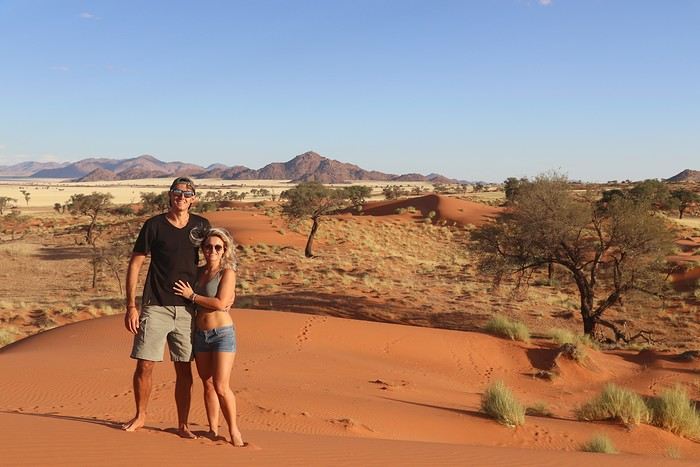
Hey everyone, and warm greetings to all you Southern African wanderers exploring the eastern lands of this African forum!
Four years later, I can finally create a new thread about my next trip—and not just any trip: Uganda! 🙂 A destination that’s been making me dream more and more over the past few years. Originally planned for 2019 but swapped for Tanzania, Kilimanjaro, and Zanzibar. Then pushed aside for another well-known African destination, Namibia, with 6 friends in 2021 (but ultimately done with just 2 because of Covid). 2022 was supposed to be the year of our Canada trip (initially planned for 2020 and canceled two years in a row for the same health reasons). The 2021 safari with friends finally happened in South Africa in 2023—a classic loop that didn’t require much planning and let me start dreaming about my next African destination while devouring all the Uganda travel journals, frustrated I couldn’t reply or comment. Uganda was then reconsidered for 2024 as a follow-up to a 6-week road trip in Finland and Norway, starting from Paris to save time, money, and the ecological footprint of a transatlantic round trip—but ultimately canceled due to budget constraints, the start of my freelance work (no more paid leave), the high cost of 6 weeks in Scandinavia, and no desire to cheapen our first Uganda trip.
Uganda will be the absolute priority for 2025! 😉 And I plan to use this time to prepare for the trip properly. I also hope to use this period to get back to writing our travel journals. By absolute priority, I mean minimal restrictions and compromises on budget and travel time. 🙂
So, we’re planning to spend a month in Uganda next summer (2025). The exact month will be decided in the coming weeks. Why a month? To explore a good part of the country (really want to go up to Kidepo), enjoy the stops, and avoid putting ourselves at risk on the roads. Also, several rental companies offered me 4x4 quotes with a 10% discount for 30+ days of rental...
Here’s my humble draft itinerary:
Day 1: Late arrival in Entebbe around 11 PM. Day 2: Pick up 4x4 vehicle. Night in Jinja.
Day 3: Drive and night in Sipi Falls. Day 4: Night in Sipi Falls. Day 5: Night in Moroto. Day 6: Night in Moroto. Day 7: Drive to Kidepo NP. Day 8: Safari in Kidepo NP. Day 9: Safari in Kidepo NP. Day 10: Full day drive to Murchison Falls. Day 11: Safari in Murchison Falls. Day 12: Safari in Murchison Falls. Day 13: Ziwa Rhino Sanctuary. Day 14: Lake Albert. Day 15: Full day drive to Kibale Forest. Day 16: Kibale Forest NP. Day 17: Drive to Kilembe (Rwenzori NP). Day 18: Hike in southern Rwenzori region. OR start Weismann’s Peak trek (Day 1). Day 19: Weismann’s Peak trek (Day 2). Day 20: Weismann’s Peak trek (Day 3). Day 21: Weismann’s Peak trek (Day 4). Day 22: Weismann’s Peak trek (Day 5), night in QENP. Day 23: QENP. Day 24: Visit Ishasha and drive to Lake Bunyonyi. Day 25: Drive to Ruhija. Day 26: Ruhija, Bwindi NP, gorilla tracking. Day 27: Mgahinga Gorilla NP... Day 28: Morning trek (gorillas or golden monkeys). Drive and night in Mburo NP.
Day 31: Visit Mburo NP and drive to Entebbe. Mabamba Swamp if we haven’t seen shoebills yet? Return 4x4 (30 days rental). Day 32: Departure from Entebbe (flight at 7:30 PM direct to Johannesburg with Uganda Airlines).
It’s not easy to visualize such a long itinerary. In terms of nights, it would look like this:
● Entebbe (1 night)
● Jinja (1 night)
● Sipi Falls (2 nights) ● Moroto (2 nights) ● Kidepo NP (3 nights) ● Murchison Falls (3 nights)
● Ziwa Rhino Sanctuary (1 night)
● Lake Albert (1 night) ● Kibale Forest (2 nights)
● Rwenzori NP (5 nights) ● QENP (2 nights)
● Lake Bunyonyi (1 night)
● Ruhija (2 nights)
● Mgahinga Gorilla NP (1 night?)
● Mburo NP (2 nights)
● Entebbe (1 night)
Obviously, I already have a lot of questions .
A question I really like: Where would you add extra nights? Keeping the 5 days in Rwenzori, we still have at least 2 nights to add to this itinerary.
Also, I don’t really have a clear idea about the loop’s direction. Instinctively, I thought of doing the gorillas last to end on a high note, but given the state of rental vehicles and traveler feedback, it seems we might not even make it to the end of the trip . Is there a meteorologically better direction? Given we’re likely leaving from early August to early September.
We’ve debated a lot about renting a vehicle with or without a guide, RAV4 or a proper 4x4, rooftop tent or not... In the end, after testing the guided experience in Tanzania and noting the relatively reasonable prices of hard lodgings (compared to Tanzania, Namibia, or Botswana, for example), the high cost of equipped 4x4s, and their unpredictable condition... We’re currently leaning toward a non-equipped 4x4, opting for the newest and most reliable vehicle possible to minimize breakdowns and missed stops. Any agencies/vehicles you’d recommend? Any recent feedback from the past few years?
Where’s the best place to see golden monkeys? I read that the southern part of QENP is no longer accessible. Can’t we go to Ishasha anymore? I’ve seen a lot of disappointed reviews about QENP, but it still seems like a good place to spot leopards and hyenas. If we stick with hard lodgings, which lodge is worth it in QENP, and how many nights should we plan? Are there night drives in Uganda to observe nocturnal wildlife? Initially, I thought of doing two gorilla treks—one in Bwindi (Ruhija) and another in Mgahinga Gorilla NP. But I got excited about Rwenzori (especially with the option to extend the stay a bit) and now I’m considering a trek there instead. However, the trek to Margherita Peak’s summit takes at least 7 days at 1580 $/person (plus extra rental days...), so I’m leaning toward the 5-day Weismann’s Peak trek. Has anyone done the Weissman’s Peak trek? If we skip the gorilla trek, is Mgahinga Gorilla NP still worth visiting?
Thanks in advance for all your comments, answers, feedback, favorite spots, and tips! 🙂
Looking forward to chatting with you all on this forum again! 😉
Pierre & Alison
Hi everyone,
It’s all in the title—we’re planning to travel with three of us: my wife, our 2-year-old baby, and myself for Christmas in Portugal. Is this a good idea? We don’t have much time to figure out everything we can do or visit. We were thinking of flying into Porto, staying there for 2 or 3 days, and then traveling by train to either Lisbon or Faro—I’m not sure yet. Book 2 nights for the arrival and then decide the rest once we’re there. Will we manage without a car? I’d love all your tips! 🙂
Richard
Hi everyone.
We’ve just returned from a trip with our 8- and 12-year-old sons, our eyes full of memories. We went to Analalava, a village that’s hard to reach by dirt road in the dry season and impossible during the rainy season. The upside is that there are few motorized vehicles—it’s really off the beaten path. Located at the mouth of a huge river, you have to travel 60 km by speedboat from Antsohihy to get there. This was our first trip of this kind as a family—pretty adventurous, with plenty of questions and even some worries from my wife (bugs, safety, amenities, etc.). We joined a friend who’s staying there, so we weren’t completely in the dark. I’ll give you the highlights without going into too much detail. After arriving in Tana, we spent the night at a "high-end" hotel (La Ribaudière) for 56 € a night in a mini-suite with all the European comforts, then we left early the next morning. We decided to hire a car and a guide for the trip from Tana, with a stop at Ankarafantsika Park. The guide accompanied us all the way to Antsohihy. Leaving Tana, we got our first shock driving through the city, then we crossed stunning high plateaus toward Majunga (RN4). We zigzagged between potholes, zebu-drawn carts, broken-down trucks, and *taxi-brousses*. We passed through countless villages, honking all the way—pedestrians just have to watch out. Rice fields and tropical greenery filled every valley, water didn’t seem scarce. Then came the savanna and bushfires everywhere! After a full day of travel and a few stops, we arrived in Andranofasika, the village at the park entrance. We thought the agency (Look Gazy) had booked us a room at the Blue Lodge, but there was a mix-up—no reservation, no space. So we headed to the park, which has about ten bungalows. It was amazing: right in the jungle with all the ambient sounds. Geckos in the room became our friends, frogs in the toilet, and HUGE spiders under the terrace roof—they didn’t budge. Comfort was still there, though. We did three park circuits in one day with a guide. It’s a bit pricey, but it’s an excellent introduction. We saw lemurs (makis), birds, snakes, crocodiles, and fishing eagles—maybe we were just lucky! On the third day, we headed to Antsohihy through more savanna and bushfires. The town was lively, but the Hotel Anaïs was a serious downgrade! Loud music late into the night, then dogs barking and howling for the rest of it. Bucket showers and squat toilets. The guide left us here. - Quick tip: guides charge by the day, excluding fuel, and the empty return trip is on you. When I got the quote, they offered 3 days of guiding, 2 days of return trips (about 700 km), plus fuel for 600 €! I turned it down—it wasn’t worth it. By the day plus fuel, it cost us 400 €. The next day, we took the speedboat (I’d call it an uncomfortable, noisy, slow raft!) for the 60 km river trip through the mangroves. - Tip: bring an umbrella to shield yourself from the sun, and maybe use your airplane earplugs! It was a long, peaceful river—absolutely stunning. We were diving even deeper into the African vibe. We arrived in Analalava at dusk. The sunsets over the nearby islands were incredible. It was 6:30 PM—back home, it stays light until 10 PM, so we’d have to get up early to make the most of the days. Here, it’s winter: "almost cool" at night (20–22°C) and 30–32°C in the shade during the day. A friend found us a bungalow to rent next to his (which he rents year-round). It’s solidly built with a palm-leaf roof, sheltered by huge mango trees. The bucket-and-squat toilets are outside, electricity comes and goes (when the neighborhood isn’t blacked out), and the view of the sea and islands is breathtaking (15,000 Ariary/day). Sometimes, the last pair of sifakas (that weren’t eaten 😕) passes by! A woman comes every day to fill the water bucket from the well and takes any laundry we want washed—for a few Ariary. It’s her livelihood, and she’s happy to have the work, though I feel bad seeing her make endless trips with buckets on her head. She charges 100 Ars per bucket or per piece of laundry. And there we were, deep in Africa, 8,000 km from our comfort zone. Surrounded by chickens, ducks, goats, and zebus roaming semi-freely. My wife was a bit overwhelmed by the "bathroom" at first, but she got used to it. The plan: *mora mora* (take it easy), fishing, walks around Analalava, island expeditions, and—most importantly to me—the Bay of Morambe. My friend on-site just got his own pirogue, built locally with an outboard motor—total luxury! He’s a great hunter-fisherman, so we ate amazing, ultra-fresh seafood during our stay, expertly prepared by his partner. But the pirogue that was supposed to take us to the islands (Nosy Lava, Ilane, and Fao) came with challenges. Though it’s called *Freedom*, it wasn’t that simple. July is windy—the *Varataz* (trade winds) blows every morning and usually shifts in the afternoon. Pirogues without keels can’t sail against the wind and don’t handle strong gusts well. You can’t reef the sail, and there’s a risk of capsizing despite the float—it’s intense. A local joined us to sail, and we waited for the right day. Fishermen weren’t going out because the wind was strong and didn’t shift. Then one morning, after a windless night, we set off for Ilane—a tiny island with coconut trees and fine sand, like playing *Survivor*. We ate the day’s catch and coconuts; the kids were in heaven, and so were we. :) Though small, you can walk around the island in 20 minutes. It’s home to fishermen and littered with turtle skeletons :( The return was more chaotic—like boat people at 4 AM in the waves before the strong wind picked up. We took the shortest route to shore and then hugged the coast with the motor. I wasn’t feeling great about it! For Morambe, we negotiated a private speedboat (350,000 Ars/day + fuel). A full day’s navigation to get there—paradise, no other word for it. I hope it stays that way! I won’t say more. Getting there is an adventure in itself! Originally, I just wanted to cross the Bay of Narinda by boat and reach Morambe on foot by crossing the peninsula, but the return wasn’t guaranteed. There’s little info about the place, and we didn’t know what to expect. After two or three weeks soaking in the vibe, we were ready for the Malagasy return trip. We’d taken the speedboat too many times and wanted to leave Analalava by 4x4—some people make the trip to Antsohihy, but it’s not regular. No luck: the 4x4 was stuck in Antsohihy the day we left. So we took the speedboat again, then hopped straight onto a night *taxi-brousse* to Tana, leaving a buffer day just in case. The trip went smoothly, with music and a screen playing music videos all night—you just have to deal with it! We arrived in Tana without any issues and had a day to explore the Analakelly market and buy some souvenirs. My wife splurged on a beautiful piece of Malagasy stone jewelry on Jewelry Street, right near the hotel (still La Ribaudière). She blew the budget! Finally, a taxi took us to the airport, taking shortcuts to avoid traffic and giving us a mini tour for a good price: 40,000 Ars. We left him a bag of clothes. This trip will leave us with unforgettable memories—and a few frustrations. We couldn’t enjoy the marine life because the water was murky from the constant wind during our stay—*maloutre*, as they say, even at Morambe and the islands. The failed 4x4 return was a bummer, too. We also wanted to do a big hike on the Narinda Peninsula, but it would’ve required more prep. Otherwise, no mosquito issues (fewer than in France!), no major digestive problems or other ailments. Safety? Didn’t see any issues, and we didn’t take unnecessary risks. We’ve set the bar high for our next trips!
We’ve just returned from a trip with our 8- and 12-year-old sons, our eyes full of memories. We went to Analalava, a village that’s hard to reach by dirt road in the dry season and impossible during the rainy season. The upside is that there are few motorized vehicles—it’s really off the beaten path. Located at the mouth of a huge river, you have to travel 60 km by speedboat from Antsohihy to get there. This was our first trip of this kind as a family—pretty adventurous, with plenty of questions and even some worries from my wife (bugs, safety, amenities, etc.). We joined a friend who’s staying there, so we weren’t completely in the dark. I’ll give you the highlights without going into too much detail. After arriving in Tana, we spent the night at a "high-end" hotel (La Ribaudière) for 56 € a night in a mini-suite with all the European comforts, then we left early the next morning. We decided to hire a car and a guide for the trip from Tana, with a stop at Ankarafantsika Park. The guide accompanied us all the way to Antsohihy. Leaving Tana, we got our first shock driving through the city, then we crossed stunning high plateaus toward Majunga (RN4). We zigzagged between potholes, zebu-drawn carts, broken-down trucks, and *taxi-brousses*. We passed through countless villages, honking all the way—pedestrians just have to watch out. Rice fields and tropical greenery filled every valley, water didn’t seem scarce. Then came the savanna and bushfires everywhere! After a full day of travel and a few stops, we arrived in Andranofasika, the village at the park entrance. We thought the agency (Look Gazy) had booked us a room at the Blue Lodge, but there was a mix-up—no reservation, no space. So we headed to the park, which has about ten bungalows. It was amazing: right in the jungle with all the ambient sounds. Geckos in the room became our friends, frogs in the toilet, and HUGE spiders under the terrace roof—they didn’t budge. Comfort was still there, though. We did three park circuits in one day with a guide. It’s a bit pricey, but it’s an excellent introduction. We saw lemurs (makis), birds, snakes, crocodiles, and fishing eagles—maybe we were just lucky! On the third day, we headed to Antsohihy through more savanna and bushfires. The town was lively, but the Hotel Anaïs was a serious downgrade! Loud music late into the night, then dogs barking and howling for the rest of it. Bucket showers and squat toilets. The guide left us here. - Quick tip: guides charge by the day, excluding fuel, and the empty return trip is on you. When I got the quote, they offered 3 days of guiding, 2 days of return trips (about 700 km), plus fuel for 600 €! I turned it down—it wasn’t worth it. By the day plus fuel, it cost us 400 €. The next day, we took the speedboat (I’d call it an uncomfortable, noisy, slow raft!) for the 60 km river trip through the mangroves. - Tip: bring an umbrella to shield yourself from the sun, and maybe use your airplane earplugs! It was a long, peaceful river—absolutely stunning. We were diving even deeper into the African vibe. We arrived in Analalava at dusk. The sunsets over the nearby islands were incredible. It was 6:30 PM—back home, it stays light until 10 PM, so we’d have to get up early to make the most of the days. Here, it’s winter: "almost cool" at night (20–22°C) and 30–32°C in the shade during the day. A friend found us a bungalow to rent next to his (which he rents year-round). It’s solidly built with a palm-leaf roof, sheltered by huge mango trees. The bucket-and-squat toilets are outside, electricity comes and goes (when the neighborhood isn’t blacked out), and the view of the sea and islands is breathtaking (15,000 Ariary/day). Sometimes, the last pair of sifakas (that weren’t eaten 😕) passes by! A woman comes every day to fill the water bucket from the well and takes any laundry we want washed—for a few Ariary. It’s her livelihood, and she’s happy to have the work, though I feel bad seeing her make endless trips with buckets on her head. She charges 100 Ars per bucket or per piece of laundry. And there we were, deep in Africa, 8,000 km from our comfort zone. Surrounded by chickens, ducks, goats, and zebus roaming semi-freely. My wife was a bit overwhelmed by the "bathroom" at first, but she got used to it. The plan: *mora mora* (take it easy), fishing, walks around Analalava, island expeditions, and—most importantly to me—the Bay of Morambe. My friend on-site just got his own pirogue, built locally with an outboard motor—total luxury! He’s a great hunter-fisherman, so we ate amazing, ultra-fresh seafood during our stay, expertly prepared by his partner. But the pirogue that was supposed to take us to the islands (Nosy Lava, Ilane, and Fao) came with challenges. Though it’s called *Freedom*, it wasn’t that simple. July is windy—the *Varataz* (trade winds) blows every morning and usually shifts in the afternoon. Pirogues without keels can’t sail against the wind and don’t handle strong gusts well. You can’t reef the sail, and there’s a risk of capsizing despite the float—it’s intense. A local joined us to sail, and we waited for the right day. Fishermen weren’t going out because the wind was strong and didn’t shift. Then one morning, after a windless night, we set off for Ilane—a tiny island with coconut trees and fine sand, like playing *Survivor*. We ate the day’s catch and coconuts; the kids were in heaven, and so were we. :) Though small, you can walk around the island in 20 minutes. It’s home to fishermen and littered with turtle skeletons :( The return was more chaotic—like boat people at 4 AM in the waves before the strong wind picked up. We took the shortest route to shore and then hugged the coast with the motor. I wasn’t feeling great about it! For Morambe, we negotiated a private speedboat (350,000 Ars/day + fuel). A full day’s navigation to get there—paradise, no other word for it. I hope it stays that way! I won’t say more. Getting there is an adventure in itself! Originally, I just wanted to cross the Bay of Narinda by boat and reach Morambe on foot by crossing the peninsula, but the return wasn’t guaranteed. There’s little info about the place, and we didn’t know what to expect. After two or three weeks soaking in the vibe, we were ready for the Malagasy return trip. We’d taken the speedboat too many times and wanted to leave Analalava by 4x4—some people make the trip to Antsohihy, but it’s not regular. No luck: the 4x4 was stuck in Antsohihy the day we left. So we took the speedboat again, then hopped straight onto a night *taxi-brousse* to Tana, leaving a buffer day just in case. The trip went smoothly, with music and a screen playing music videos all night—you just have to deal with it! We arrived in Tana without any issues and had a day to explore the Analakelly market and buy some souvenirs. My wife splurged on a beautiful piece of Malagasy stone jewelry on Jewelry Street, right near the hotel (still La Ribaudière). She blew the budget! Finally, a taxi took us to the airport, taking shortcuts to avoid traffic and giving us a mini tour for a good price: 40,000 Ars. We left him a bag of clothes. This trip will leave us with unforgettable memories—and a few frustrations. We couldn’t enjoy the marine life because the water was murky from the constant wind during our stay—*maloutre*, as they say, even at Morambe and the islands. The failed 4x4 return was a bummer, too. We also wanted to do a big hike on the Narinda Peninsula, but it would’ve required more prep. Otherwise, no mosquito issues (fewer than in France!), no major digestive problems or other ailments. Safety? Didn’t see any issues, and we didn’t take unnecessary risks. We’ve set the bar high for our next trips!
Hi everyone,
First of all, thank you for all the valuable information you share—it’s really helpful.
My husband and I are heading to South Korea from September 19 to October 6. We know the timing might not be ideal because of Chuseok, but for various reasons, we didn’t have other date options. Plus, this period coincides with some festivals we’ve been eager to check out: the Andong Mask Dance Festival, the Jinju Lantern Festival, and the Hwaseong Festival in Suwon.
Here’s our tentative itinerary:
09/19: Arrival in Seoul 09/20: Bus to Sokcho – explore the city or short hike 09/21: Seoraksan Park 09/22: Return to Seoul 09/23–09/26: Seoul 09/27: Bus or train to Andong – explore the city 09/28: Hahoe 09/29–10/01: Gyeongju 10/01–10/03: Busan 10/03–10/04: Jinju 10/05: Bus/train to Suwon 10/06: Suwon
So here’s my question: Given that several of our trips fall during or around festivals, will it be possible to book bus/train tickets once we’re there, or is there a risk they’ll already be sold out? Specifically for Seoul-Andong, Busan-Jinju, and Jinju-Suwon. I was thinking of booking everything on our first day in Seoul. And if it’s better to plan ahead, how should we go about it? I can’t seem to access the Korail (letskorail) or Kobus websites. Thanks in advance for your answers and help—and sorry for the long post! :)
Have a great day!
Hi, a friend will be in Panama at an all-inclusive resort and was wondering if it's worth visiting the Canal in a single day, and also which attractions shouldn't be missed.
Is it better to choose a package deal? What's the recommended mode of transport for this trip?
Thanks
Hi there,
I have a bit of a crazy dream... I'd love to drop everything and hit the road with my wife and kids in a camper van.
I want to visit villages to learn, immerse ourselves in other cultures, and see different perspectives on the world. To teach my kids different values.
Hi everyone,
I’ve planned a three-week itinerary for this summer, from August 9 to 27, in Sri Lanka: Negombo – 1 night Sigiriya and the Cultural Triangle – 4 nights Kandy – 2 nights Ella – 3 nights Tangalle – 6 nights Colombo Airport – 1 night
I know this isn’t the ideal time for the south since the beach conditions aren’t great, but we’ve booked a hotel with a pool and won’t be swimming in the sea. We want to relax after all the travel since we’re bringing our two kids, aged 6 and 8.
I know the east would be better, but (i) I’m struggling to find suitable accommodation, and (ii) it adds a lot of travel time, and my kids can only handle about 3 hours at a stretch.
I looked into Arugam Bay, but it’s a 7-hour trip back to Colombo from there.
I’ve checked every weather site imaginable, but they don’t all agree. Do you think we’ll spend our whole trip in the rain, or is the monsoon in the south mostly limited to the sea, as I’ve read?
I’m worried about ending up in the middle of a natural disaster with my two young kids, given recent events.
Thanks for your advice! S
Hi everyone,
My wife and I are planning our very first 4x4 trip. We recently bought a used Toyota Land Cruiser 150, still completely stock but in great condition. This is a big first for us—until now, our travels have been more hiking-focused, but the idea of trying out a 4x4 has been itching at me for a few years.
We’re thinking of heading to Morocco for a few weeks, probably in the spring. The plan is to mix the Atlas Mountains, southern valleys, and some easy trails between Merzouga, Tata, Foum Zguid, or the Draa Valley. Nothing extreme—we’re total beginners.
I’m in the middle of outfitting the vehicle and could really use your input, especially from those who know the country or have prepped a 4x4 for this kind of itinerary.
For a trip like this, is a stock Land Cruiser 150 enough, or should we consider a few upgrades (AT tires, sand ladders, compressor) to feel more confident on the southern trails?
For a first off-road adventure: would you recommend bringing a kit of wear-and-tear parts (filters, belts, hoses), or is a good pre-trip inspection with just the bare essentials enough in Morocco?
Finally, I’m torn between three roof tent brands: James Baroud, Autohome, and Roof Space. For heavy use in Morocco (heat, wind, daily setup), which brand do you think is best in terms of ventilation and mechanism durability? Are there any key criteria to consider when choosing?
Thanks in advance for your advice! We’re finalizing the budget and gearing up the vehicle, so all real-world feedback is welcome.
Julien
Hi everyone!
That was about all the Spanish I could say before we left... Luckily, Tom, 15 and in high school, gets by really well! And Caroline did a year of Duolingo before we left... Anyway, after 55 days in the American West three years ago, it’s Mexico’s turn for this second long trip.
That was about all the Spanish I could say before we left... Luckily, Tom, 15 and in high school, gets by really well! And Caroline did a year of Duolingo before we left... Anyway, after 55 days in the American West three years ago, it’s Mexico’s turn for this second long trip.
Hello everyone,
I'm just starting to plan a two-week trip I'd like to take with my wife in early May.
This trip would include the Atacama Desert, which I was lucky enough to visit alone once and would love to experience again with her.
But I'd like to add one or two other places to visit, keeping in mind that we're much more into nature than cities.
I was thinking about part of adjacent Bolivia... but since we'll have already seen quite a few stunning high-altitude lakes around Atacama, what would be some interesting and very different spots?
We would have loved to include Peru as well, but it might be tricky to combine in just two weeks.
I'll go through the many posts on this forum, but if any of you have some tempting ideas for this time of year (late April - early May), I'm all ears.
Thanks! :)
Hi everyone,
I recently noticed that when you "mark as read" a discussion, the bullet point next to it stays "green" as if it hadn’t been "marked."
I tested marking all discussions as read, and they all still show up as "unread!"
Nothing major, but I was wondering if it’s just "my computer"!
Hi there,
Not only do I love the countryside, but I’m also really into trains, so I’m starting this photo thread dedicated to trains in Thailand (I bet most of us have taken one at some point...).
Hello,
Since I enjoy not only the countryside but also everything related to rail travel, I’m starting this photo thread dedicated to trains in Thailand (I’d guess most of us have taken one at some point...).
Feel free to post your pictures here as long as they fit the theme: rolling stock**, stations**, platforms, tracks (even without a train on them), technical equipment, engineering structures (bridges, viaducts), etc.—all in Thailand.
For each photo, I’ll (or you can) note the station or line where it was taken.
Comments and questions are welcome.
* train ** interiors or exteriors
All aboard!
* train ** interiors or exteriors
All aboard!
Hello,
We already did a self-organized trip to Namibia in March 2019, covering Windhoek and the southern part up to the South African border, then heading back via Lüderitz, the dunes, the Atlantic coast, Swakopmund, and Erongo.
We’ve organized a second trip for May 2026. Here’s our itinerary and the bookings we’ve made directly or through Booking. The 4x4 Toyota Hilux is reserved with Africa on Wheels in Windhoek—we used them five years ago and were happy with the service.
May 9: Arrival in Windhoek via Lufthansa; Okahandja Country Hotel in Okahandja May 10: Spitzkoppe, Spitzkoppe Tented Camp May 11: Brandberg, White Lady Lodge Tree House May 12 & 13: Twyfelfontein, Twyfelfontein Adventure Camp May 14 & 15: Palmwag, Grootberg Lodge May 16: Opuwo, Opuwo Country Lodge May 17 & 18: Epupa Falls, Omarunga Epupa Falls May 19: Etosha, Dolomite Resort May 20: Okaukuejo, NWR waterhole chalet May 21: Onguma, Mushara Bush Camp May 22 & 23: Waterberg, Waterberg Wilderness Valley Lodge May 24: Brakwater, Windhoek Gama Camp May 25: Return to Windhoek and flight home
- My first question is about the route between Opuwo and Epupa Falls. We’ll take the C43 and D3700. According to the Tracks4Africa map, it’s about a 3-hour drive. What’s the condition of the road? I’ve also heard that the local population, including children and adults, can be insistent and sometimes exhibit dangerous behavior toward tourists and vehicles, asking for food or other things. Is this accurate? After our stay in Epupa, we’ll retrace our steps back to Opuwo, then take the C41 to Galton Gate to enter Etosha National Park. - Do you know what time Galton Gate at Hobatere closes? We’ll need to leave Epupa very early to arrive before the gate shuts, as we’re heading straight to Dolomite Resort.
Thanks for your advice and experiences! Christine
We decided to leave.
To drop everything and try the adventure. The real deal? Not quite. We did some planning, skimmed through travel guides, and booked 4 nights.
But most importantly, we have a return flight.
The adventure has an end date. Like in any neat story, the parenthesis will close. The memory-making machine will run, feeding us for a while. For a long time, we hope. Helping us grow. But we know the machine will stop, leaving its faint scent lingering in our orderly lives, like a footprint in the sand.
Read more here: our blog
Another fresh travel journal!
The context: For my 60th birthday, I had planned to take my family (kids + partners) for a week in Gran Canaria, at an all-inclusive hotel, but with the firm intention of exploring and hiking. The deal was to meet up at least in the evenings to spend time together, if my pace didn’t suit them. Personally, I’m not into beaches and lazing around, but my daughter-in-law is pretty cool. We were going to be together, do what we liked, and all would be well. Unfortunately, five days before departure, my mother-in-law passed away, and of course, we had to cancel everything. I was able to get a refund for a lot of things, including the hotel despite missing the free cancellation deadline (really cool of them), and I got a one-year credit for the full price of the flight tickets. So, we tried to plan the same thing for my kids, but with their schedules, we couldn’t find a date. I had to find a destination served by Iberia, far enough to use up my credit. We don’t know the Caribbean, we needed sun and a bit of rest, so the Dominican Republic won out. But no way were we going to mess up by staying in an all-inclusive hotel and only visiting the island’s paradise beaches… (we’ll get back to that). So, as usual, I put together a little road trip with a rental car.
Here we go!!!!
Day 1: Crossing the Atlantic Super early departure for Lyon-Saint Exupéry Airport. A 3-hour layover in Madrid (my wife’s had enough of flight delays, so I played it safe). Flight to Santo Domingo without any issues. The luggage arrived, the driver I’d booked was there, everything went smoothly. We got to our hotel in the Zona Colonial around 4 PM. Bad luck—it’s on a cute little square where there was supposed to be neighborhood activity in the evening. It’s completely under construction! Too bad! We decided to head to the Malecón, a sort of local Promenade des Anglais, except there are no English people. It’s nice, safe, spacious, and by the ocean. We walked for a while, and as happy hour rolled around, I started my training as an intern in rum-based cocktails. A mojito, classic, but it’s amazing to be sipping the drink in the warmth, right by the big blue. On the way back to the hotel, we grabbed some bananas, ate them in the room, and then bedtime.
The plus: We actually left! The minus: There isn’t one
easiest way to get there
Short version: I booked through Croisières.fr, and everything went smoothly until my order was confirmed. When I requested a date change—due to administrative reasons—the sales rep initially assured me the fee would be 50 € per person, but then demanded 600 € (negotiated down to 338 €), even though the price remained unchanged. On top of that, Paul, the sales rep, was dishonest, claiming that drinks (excluding alcohol) were included and that there were "all-inclusive" packages for alcoholic beverages, which is completely false. All drinks—even water—are charged onboard. I had also requested a cabin with two separate beds to travel with my mother, a request that wasn’t honored, forcing me to sleep on a small couch. To make matters worse, all my emails and calls to customer service were ignored or handled carelessly. While the cruise itself was satisfactory—thanks to Costa for the onboard organization—I recommend booking directly with Costa to avoid these bad surprises with Croisières.fr.
Long version: I booked a cruise for two through Croisières.fr, and the process went perfectly until the final confirmation of my order, which initially reinforced my trust. However, as soon as I requested a change in departure dates—due to a delay in obtaining my mother’s ID card—the situation quickly deteriorated. During this process, Paul, the Croisières.fr sales rep, initially told me that the date-change fee would be only 50 € per person. To my surprise, I was then hit with an exorbitant processing fee of 600 €, which was eventually negotiated down to 338 €. This turnaround was all the more baffling because the new cruise offered was priced exactly the same as the original booking on the website.
The situation worsened when the cruise line later changed the dates for internal reasons at Costa. The new dates didn’t work for us at all, especially because of my mother’s non-reschedulable medical appointment. Despite my flexibility and numerous phone calls and emails, we were forced to accept these new dates against our will. It took a lot of effort to secure another slot, even though we had been accommodating on almost all other dates.
I also noticed other serious shortcomings in Croisières.fr’s sales service. Paul, the sales rep, turned out to be dishonest: he claimed that drinks (excluding alcohol) were included in the ticket price and that there were "all-inclusive" packages for alcoholic beverages. That’s absolutely not true! Without a package, all drinks—even water—are charged onboard. Additionally, I had specifically requested a cabin with two separate beds to travel with my mother. This request wasn’t honored, and I had to make do with a small couch because there was no way to set up two separate beds.
I’m willing to accept rules and constraints if they’re communicated upfront, but these crucial details were never shared with me. What disappoints me the most is how my requests were handled by customer service. None of the emails I sent received a response, and my numerous phone calls were dealt with carelessly and without any consideration. Everything was fine until the order was confirmed, and then suddenly, there was a complete lack of attention and follow-up, leaving a bitter taste.
That said, despite these issues, I was very satisfied with the cruise itself, and I’d like to sincerely thank Costa for their excellent onboard organization. Based on this experience, I strongly advise travelers to book directly with Costa to avoid the bad surprises and lack of follow-up that seem characteristic of Croisières.fr.
Hi there,
The title might be a bit long, but I hope it’s completely understandable!
When it comes to choosing your next trip, what tips the scales in favor of Eritrea over Ibiza?
Why pick Canada over French Polynesia?
The price? A magazine or TV report, a travel journal, an Instagram ad? Ease of travel? Minimal time difference? The country that has the most in common with all the trip participants? Activities? Relaxation? The desire to push your limits?
A photo?
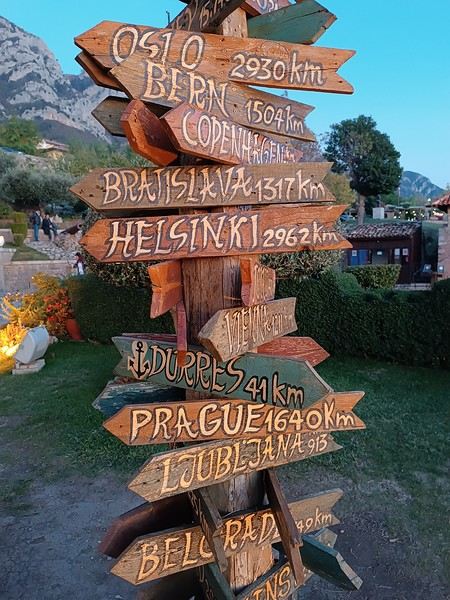
What else, I wonder...
Personally, I often prioritize simple destinations (no administrative hassles), where I’m not at risk (nothing extraordinary like getting kidnapped by Daesh or ending up in a jail cell because the current geopolitics aren’t favorable to my passport, etc.), and where I can drive.
Wide-open natural spaces are more my thing than urban anthills.
Finally, I try not to spend three days on a plane to reach my destination, and I aim for a maximum budget of 3500 € (for 3 weeks) in comfortable conditions—that means charming hotels, good meals, etc.
What about you?🙂
The title might be a bit long, but I hope it’s completely understandable!
When it comes to choosing your next trip, what tips the scales in favor of Eritrea over Ibiza?
Why pick Canada over French Polynesia?
The price? A magazine or TV report, a travel journal, an Instagram ad? Ease of travel? Minimal time difference? The country that has the most in common with all the trip participants? Activities? Relaxation? The desire to push your limits?
A photo?
What else, I wonder...
Personally, I often prioritize simple destinations (no administrative hassles), where I’m not at risk (nothing extraordinary like getting kidnapped by Daesh or ending up in a jail cell because the current geopolitics aren’t favorable to my passport, etc.), and where I can drive.
Wide-open natural spaces are more my thing than urban anthills.
Finally, I try not to spend three days on a plane to reach my destination, and I aim for a maximum budget of 3500 € (for 3 weeks) in comfortable conditions—that means charming hotels, good meals, etc.
What about you?🙂
The market sprawls outside all around the large, circular, multi-story hall. We buy some grapes and bottles of pomegranate juice pressed right in front of us for just a few sums.
Tonight, we’re meeting up with Nasrullo. Such a warm encounter—we’ve been exchanging messages for over two years, and I’ve really put him through the wringer with my constant itinerary changes and shifting trip durations.
Hi everyone,
I’m just at the very beginning of my research, so I’m coming straight to you for some info. I’d like to visit Morocco to discover a bit of the country. I’ve just found out about the Toubkal circuit, which I’d love to do in January/February. I’m open to going independently with a tent, food, etc., and also open to whatever other possibilities this circuit offers that I don’t know about yet... Could you share any random tips or info? I’d also love to hear your opinions? What I like about this circuit is that it’s fairly accessible and seems interesting for many reasons. I’ll leave it to you to share your thoughts—thanks in advance for your help! 🙂 Wishing you all lots of exciting plans for the new year ahead!
Nicolas
Exploring India by road is all about having a good driver. I highly recommend the one I’ve traveled with for 5 "safe" trips—Rajasthan 3 times over 16 years, Gujarat, Himachal Pradesh, and Punjab. He’s been driving tourists for 25 years now and is more than just a driver. He knows how to talk about his country, the cities you visit, and suggests alternative routes.
He’s well-connected with real local guides who don’t just ramble (as he puts it himself) or drag you into shops claiming to be run by their "so-called family." Depending on your preferences, he can suggest well-tested itineraries and recommend typical hotels like Havelis.
For dining, he oversees meal prep based on your spice-level preferences. He’s Sikh and deeply respectful of his passengers.
He speaks English better than French, but one of his daughters is studying French at university.
DM me if you’d like his contact details.
Happy travels!
Hi fellow travelers!
I’ve been reading so much conflicting info—I’m totally lost.
I’m planning a nearly 4-week trip (25 days) in Indonesia. I’ll arrive in Denpasar, then travel around (Bali + some islands). We’ll leave with layovers in Jakarta (1 day + 1 night) and Kuala Lumpur (2 days + 2 nights).
My question is: is a B1 visa enough? It says "single entry" on it. Does that mean just one entry into Bali, or can I also pass through Jakarta with it?
Can anyone clarify this for me, please? THANKS
Hello,
I’ve been retired since 2018 and travel solo every winter. But after my sons pointed out: “riding alone through Laos on a bike! Safety-wise, there’s room for improvement.” I’m getting older and need to be more careful. That’s the reason for this post. The idea is to look out for each other if needed, while still keeping our independence and privacy. I’ll be in Laos starting December 6th, then probably Thailand in January since I want to do some diving. After that, it’s all improvisation—nothing’s set in stone. If the destination and the concept interest you, well, we can just chat about it.
Sometimes fantasy and a change of scenery are right near home! I love exploring the four corners of the planet, but there can also be a whole world just a little farther than the end of your street—or even the tip of your nose! So I’ll share with you in pictures the beautiful kermesse of Ath, which we only discovered last August, even though we’re neighbors (we live in Lille).
I could have subtitled this travel journal: "Ferme eut’bouc tin nez va quer eud’dans"; it’s an expression in Picard language, literally “Close your mouth or your nose will fall in,” said to someone who’s amazed—and amazed I was!!!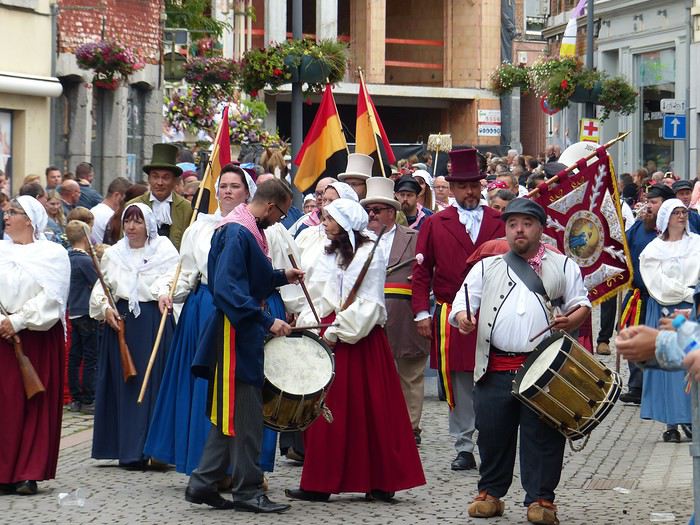
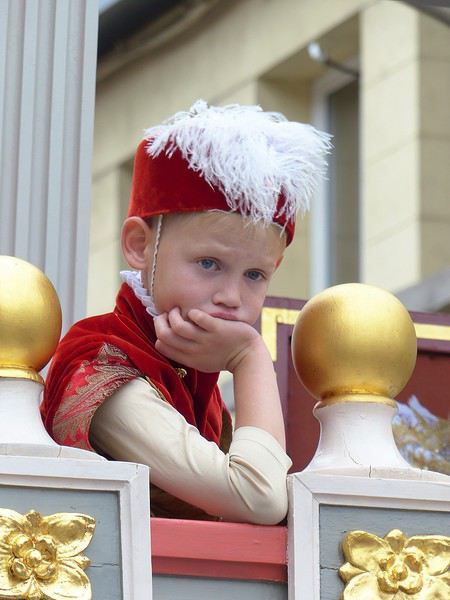 Ooooooooh, giants!
Oh, how I love them! In the North, we have lots of these giants, like Reuze Papa and Reuze Maman in Cassel, or Gayant, Marie, and their children Binbin, Jacquot, and Fillon in Douai, and many more.
Huh? What? You don’t know what a Géant du Nord is?
Well, it’s a benevolent hero, a legendary figure, a protector, a symbol tied to a city that parades through it, walking and dancing during carnival or the local festival. The tradition is said to have originated in Portugal in the 13th century (at least that’s where we have the first records), then we see them in the Netherlands starting in the 15th century. In the North, the oldest are Gayant and Marie of Douai (16th century), but many new ones have appeared since the 1980s with the revival of carnivals. In practice, it’s a large character (or animal figure) several meters tall; the structure is made of wicker, the body is often papier-mâché, but the head can be wood, as in Ath (lime wood), and the clothes and accessories are made of fabric, leather, and wood. The flared robe (for both male and female giants) allows one or more carriers to slip underneath to move it using only their arms, shoulders, and legs—and even make it dance! There are over 1,500 giants in Belgium and 450 in Hauts-de-France, mostly in the Nord and Pas-de-Calais departments.
In Ath, there are giants—LOTS of them! I’ve never seen so many at once. And each one is carried by only one man at a time (except for Bayard, you’ll see why later), even though the structure weighs over 100 kilos—so the carriers take turns quickly! The Ducasse of Ath and its giants have been inscribed on the UNESCO Intangible Cultural Heritage list since 2008, as part of the "Processional Giants and Dragons of Belgium and France."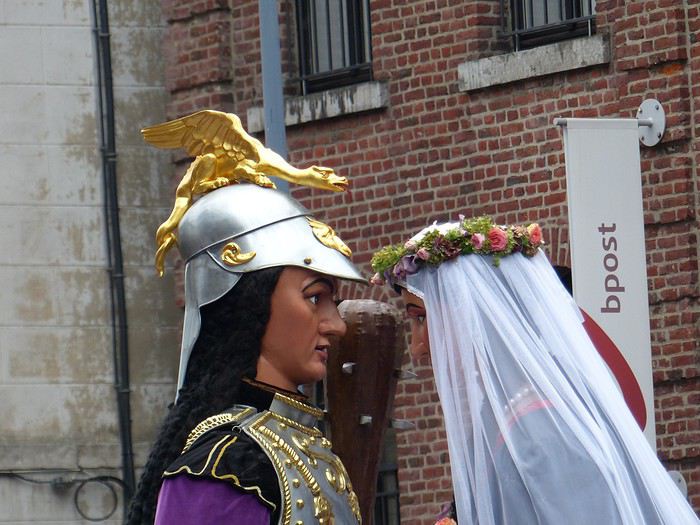 What’s more, the Ducasse of Ath is remarkable for its age and local roots; a procession was first mentioned in 1399, and today the many musical groups are still local (Ath and surrounding towns). The event is extremely popular: a good part of the population is there, all generations mixed together. Everyone knows the groups, floats, and giants, and each has their favorite! Originally, religious groups paraded, illustrating episodes from the Bible or the Golden Legend. Gradually, the parade became secular and kept evolving by adding new giants, historical figures, or allegories linked to local history (Ath, Belgian Hainaut, Belgium).
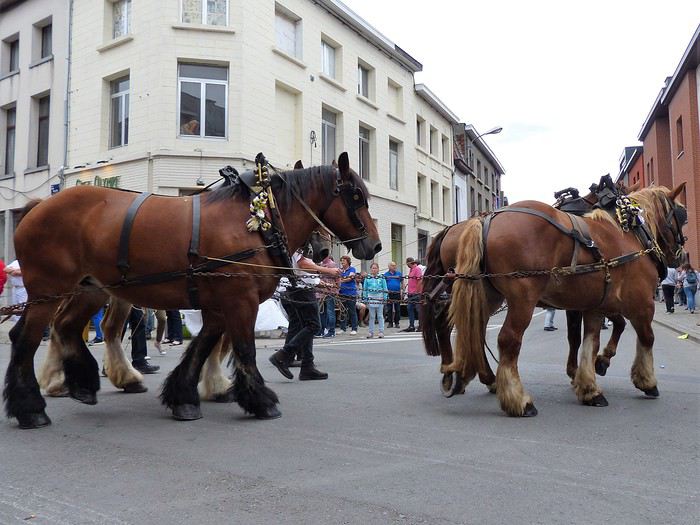
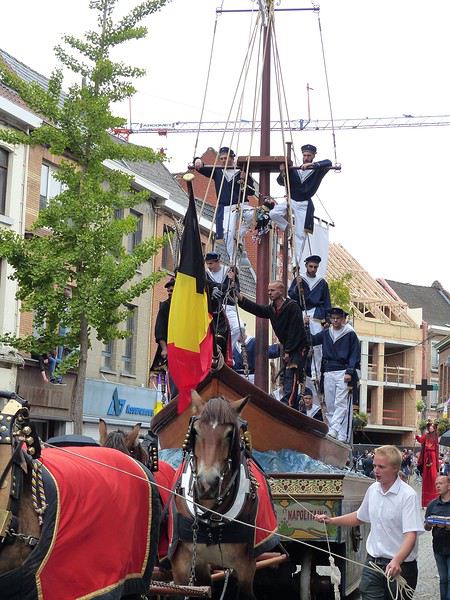
Finally, the beautiful floats are all pulled by magnificent draft horses, and that’s extraordinary! The town council itself rides in fine carriages that close the parade.
 To wrap up this long introduction, know that the Ducasse of Ath lasts several days, but the highlight is the highly codified procession that takes place on the 4th Sunday of August (actually, the procession passes twice, once in the morning and once in the afternoon).
So, let’s go!
On this Sunday, August 26th, we’re in Ath in the early afternoon to see the procession. What a popular enthusiasm! Everyone is wearing the city’s colors (purple, yellow, and white), often with a twisted fabric necklace. Everyone is happy, smiling, from the giggling toddler to the sprightly centenarian sipping beer with her rosy-cheeked cousin and the pretty freckled blonde niece. People call out to each other, laugh, hum, and congratulate each other all around.
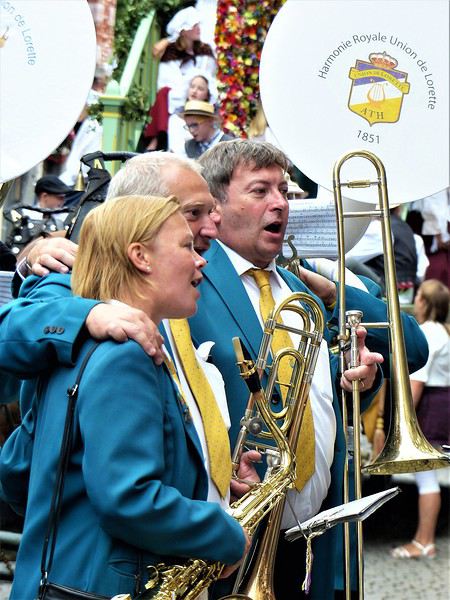
People start positioning themselves at strategic spots along the route—wider areas where the giants stop to perform a dance to the tunes of the brass bands accompanying them. And there are brass bands—at least one per giant and float!
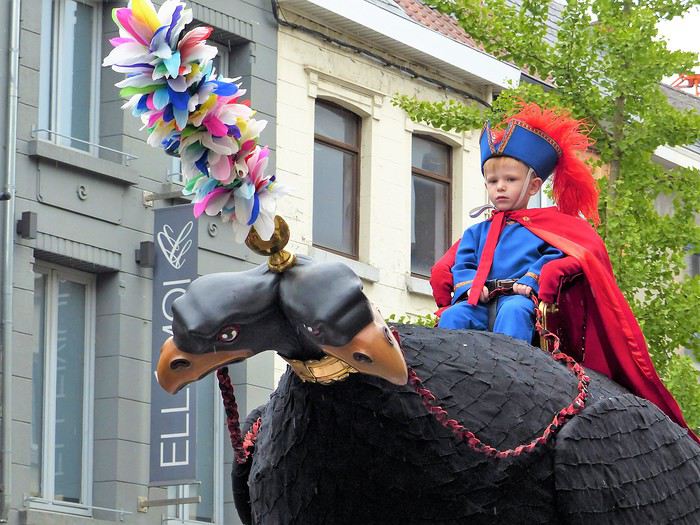
The wait passes quickly in this joyful atmosphere. Suddenly, the music grows louder, and here comes the first giant at last! It’s the "two-headed eagle," with a child (a real one) sitting safely on a little chair.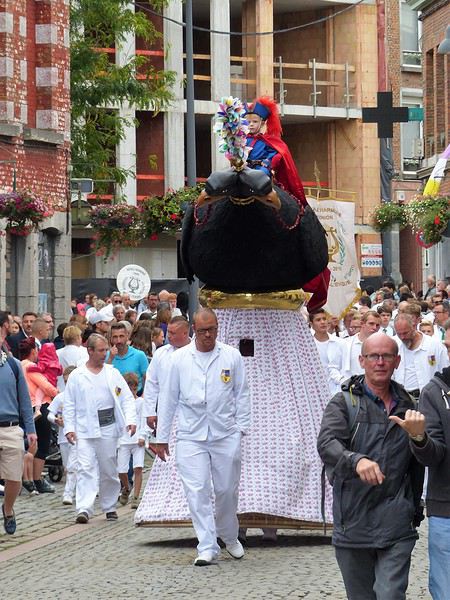
Present in the procession since the late 17th century, it originally had only one head (normal, right?) and accompanied the tailors’ guild. It gained a second head during the royal visit of 1854 (go figure why!). It’s 3.30 meters tall and weighs 115 kilos (without the child). All the men you see in white are carriers taking turns. Its dance consists of spinning the bird around—you’d think that little kid up there must be getting dizzy!
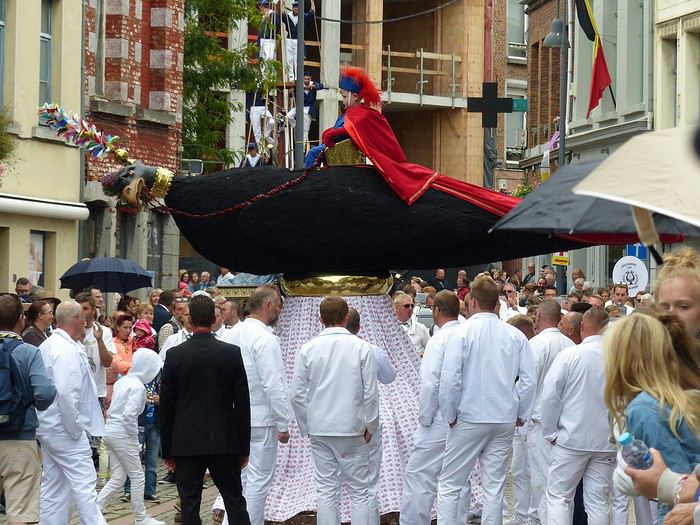
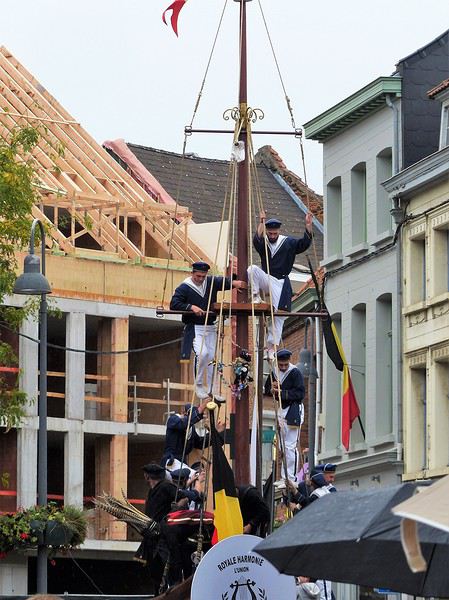
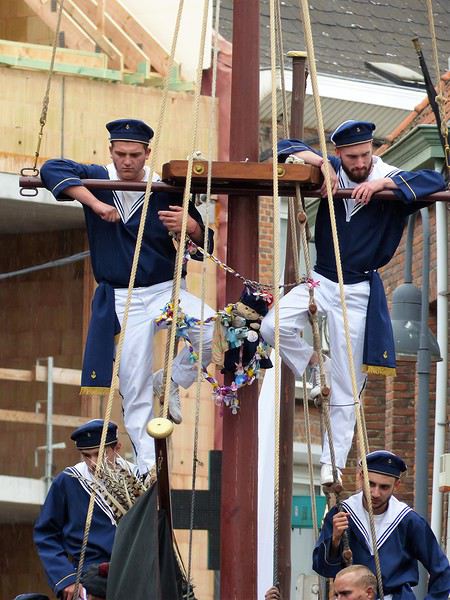
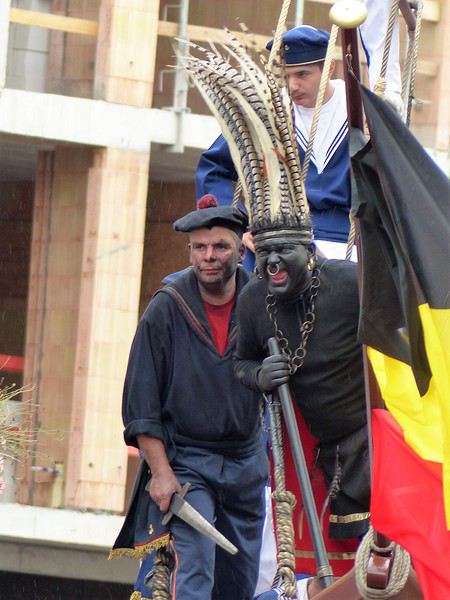
Next is the "Neapolitan fishermen’s boat." It’s a magnificent float representing a ship, with handsome sailors clinging to its rigging. This float first appeared in the parade in 1856.
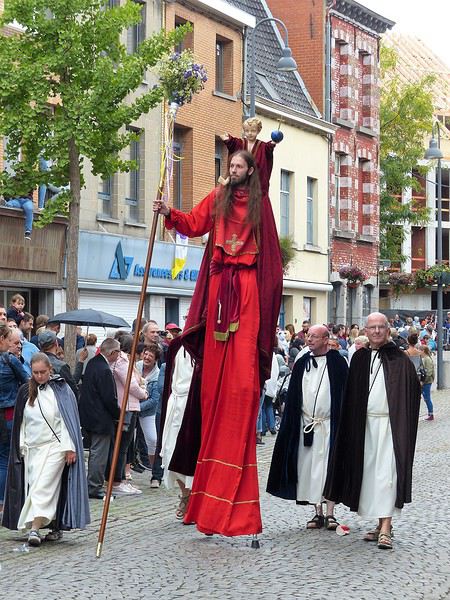
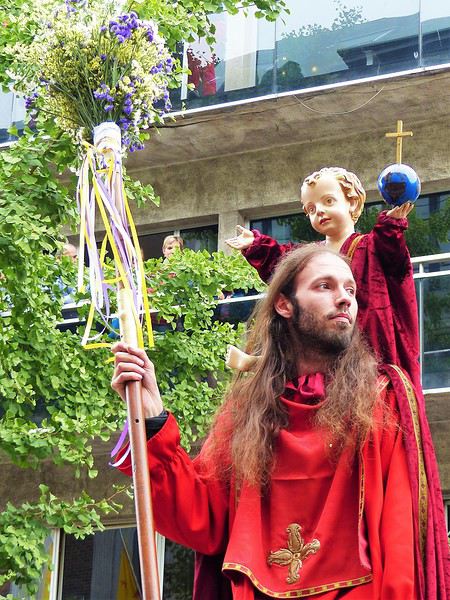
 It’s followed by a human giant on stilts: "Saint Christopher of Flobecq," holding a flowered staff and carrying Christ on his shoulders (this time, not a real child!). It appeared in the 19th century, then disappeared from the procession before being reintroduced in 1976.
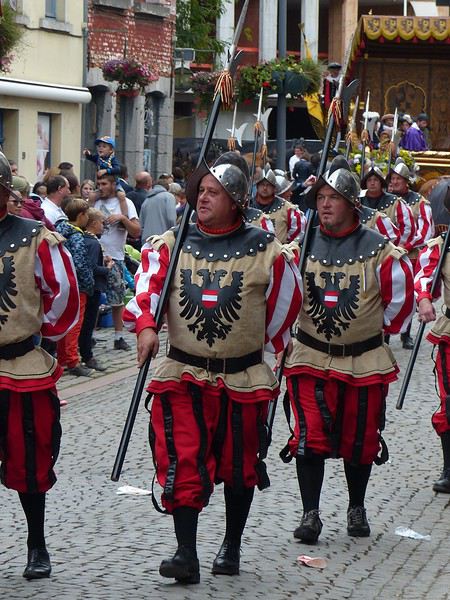
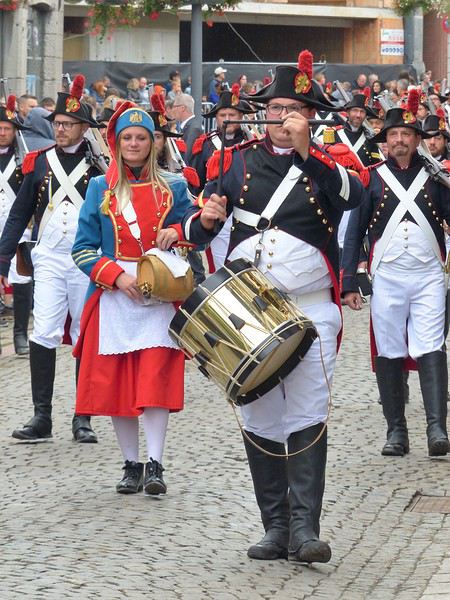
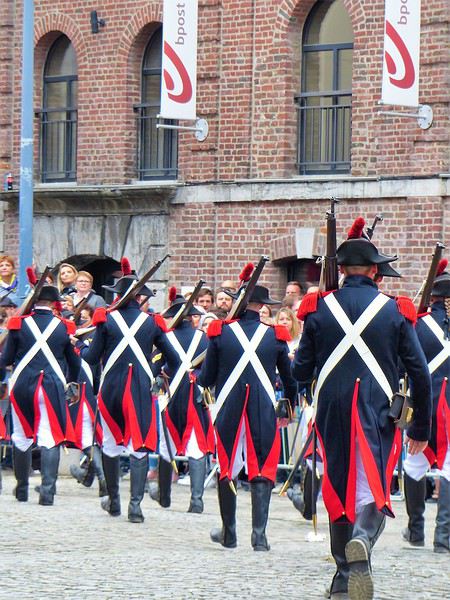
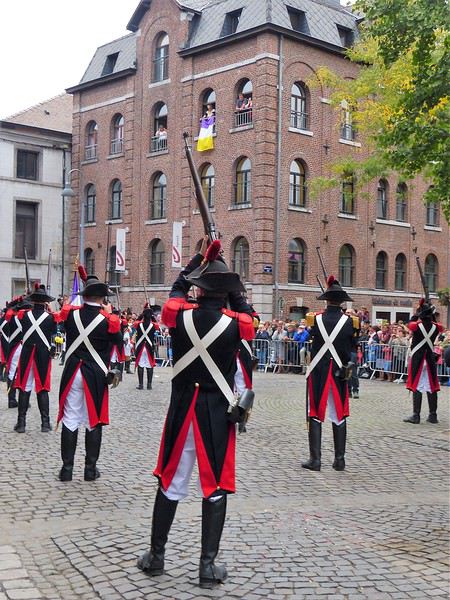
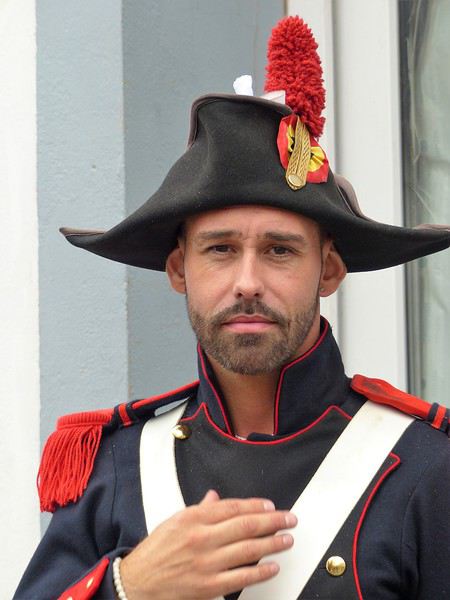
Now here come the "Blues," dressed in French uniforms. This group is the heir of the former cannon-arquebusier company, and they punctuate their parade with gun salutes!

To be continued: the giant Samson!
I could have subtitled this travel journal: "Ferme eut’bouc tin nez va quer eud’dans"; it’s an expression in Picard language, literally “Close your mouth or your nose will fall in,” said to someone who’s amazed—and amazed I was!!!
Ooooooooh, giants!
Oh, how I love them! In the North, we have lots of these giants, like Reuze Papa and Reuze Maman in Cassel, or Gayant, Marie, and their children Binbin, Jacquot, and Fillon in Douai, and many more.Huh? What? You don’t know what a Géant du Nord is?
Well, it’s a benevolent hero, a legendary figure, a protector, a symbol tied to a city that parades through it, walking and dancing during carnival or the local festival. The tradition is said to have originated in Portugal in the 13th century (at least that’s where we have the first records), then we see them in the Netherlands starting in the 15th century. In the North, the oldest are Gayant and Marie of Douai (16th century), but many new ones have appeared since the 1980s with the revival of carnivals. In practice, it’s a large character (or animal figure) several meters tall; the structure is made of wicker, the body is often papier-mâché, but the head can be wood, as in Ath (lime wood), and the clothes and accessories are made of fabric, leather, and wood. The flared robe (for both male and female giants) allows one or more carriers to slip underneath to move it using only their arms, shoulders, and legs—and even make it dance! There are over 1,500 giants in Belgium and 450 in Hauts-de-France, mostly in the Nord and Pas-de-Calais departments.
In Ath, there are giants—LOTS of them! I’ve never seen so many at once. And each one is carried by only one man at a time (except for Bayard, you’ll see why later), even though the structure weighs over 100 kilos—so the carriers take turns quickly! The Ducasse of Ath and its giants have been inscribed on the UNESCO Intangible Cultural Heritage list since 2008, as part of the "Processional Giants and Dragons of Belgium and France."
What’s more, the Ducasse of Ath is remarkable for its age and local roots; a procession was first mentioned in 1399, and today the many musical groups are still local (Ath and surrounding towns). The event is extremely popular: a good part of the population is there, all generations mixed together. Everyone knows the groups, floats, and giants, and each has their favorite! Originally, religious groups paraded, illustrating episodes from the Bible or the Golden Legend. Gradually, the parade became secular and kept evolving by adding new giants, historical figures, or allegories linked to local history (Ath, Belgian Hainaut, Belgium).Finally, the beautiful floats are all pulled by magnificent draft horses, and that’s extraordinary! The town council itself rides in fine carriages that close the parade.
To wrap up this long introduction, know that the Ducasse of Ath lasts several days, but the highlight is the highly codified procession that takes place on the 4th Sunday of August (actually, the procession passes twice, once in the morning and once in the afternoon).So, let’s go!
On this Sunday, August 26th, we’re in Ath in the early afternoon to see the procession. What a popular enthusiasm! Everyone is wearing the city’s colors (purple, yellow, and white), often with a twisted fabric necklace. Everyone is happy, smiling, from the giggling toddler to the sprightly centenarian sipping beer with her rosy-cheeked cousin and the pretty freckled blonde niece. People call out to each other, laugh, hum, and congratulate each other all around.
People start positioning themselves at strategic spots along the route—wider areas where the giants stop to perform a dance to the tunes of the brass bands accompanying them. And there are brass bands—at least one per giant and float!
The wait passes quickly in this joyful atmosphere. Suddenly, the music grows louder, and here comes the first giant at last! It’s the "two-headed eagle," with a child (a real one) sitting safely on a little chair.
Present in the procession since the late 17th century, it originally had only one head (normal, right?) and accompanied the tailors’ guild. It gained a second head during the royal visit of 1854 (go figure why!). It’s 3.30 meters tall and weighs 115 kilos (without the child). All the men you see in white are carriers taking turns. Its dance consists of spinning the bird around—you’d think that little kid up there must be getting dizzy!
Next is the "Neapolitan fishermen’s boat." It’s a magnificent float representing a ship, with handsome sailors clinging to its rigging. This float first appeared in the parade in 1856.
It’s followed by a human giant on stilts: "Saint Christopher of Flobecq," holding a flowered staff and carrying Christ on his shoulders (this time, not a real child!). It appeared in the 19th century, then disappeared from the procession before being reintroduced in 1976.
Now here come the "Blues," dressed in French uniforms. This group is the heir of the former cannon-arquebusier company, and they punctuate their parade with gun salutes!
To be continued: the giant Samson!
Hi everyone,
I know you can buy anything in Thailand, but here’s a question you might find a bit odd. Are there plus sizes available? 😛 For example, for shoes, can you easily find sizes 38–40? And XL pants in sports brands????
Thanks in advance!
I know you can buy anything in Thailand, but here’s a question you might find a bit odd. Are there plus sizes available? 😛 For example, for shoes, can you easily find sizes 38–40? And XL pants in sports brands????
Thanks in advance!
Hi everyone,
I’m planning our very first trip to mainland France in January 2027. There’ll be 2 adults and 2 kids, and we’ll mostly be traveling by train.
Here’s our itinerary:
Paris Rouen (Normandy) Lyon Aix-les-Bains (with day trips to Annecy and Geneva) Saint-Gervais-les-Bains (with Chamonix and a day in Aosta) Back to Paris
Do you think this itinerary is well-balanced? Any tips, must-see spots, or mistakes to avoid for a first-time visit?
Thanks in advance for your advice! !
Hi,
How do you manage to charge your battery using a solar panel while keeping your vehicle in the shade so it doesn’t turn into an oven?
I have a Renault Trafic, unfortunately black, and my cooler, battery, and BougeRV solar panel.
My battery is mainly used for my electric cooler.
https://www.amazon.fr/dp/B0CQ4LFVVR?ref_=ppx_hzsearch_conn_dt_b_fed_asin_title_3
Thanks in advance! Nath
...
" We’re ALL different, and so are our expectations when it comes to travel or leisure ". There are—without a doubt—as many ways to experience a trip as there are travelers!! For the two of us, it’s only our love of wild nature that guides us to East Africa. The stated goal of this trip was purely wildlife-focused, and NOT about discovering the country or its people.
...
Hello everyone,
Previously, I shared the account of a trip/safari in southern Tanzania in June 2024, in the Mikumi and Selous reserves.
This time, still in southern Tanzania, I invite you to join us in Ruaha National Park. (Then, depending on the number of images allowed in my quota, at the end of my story, we’ll return to Selous for the second part of the same trip.)
- This trip/safari took place in November 2022. - Our flight started in Marseille, heading to Addis Ababa, then Dar es Salaam (via Ethiopian Airlines). In Dar, we spent one night at a hotel near the airfield.
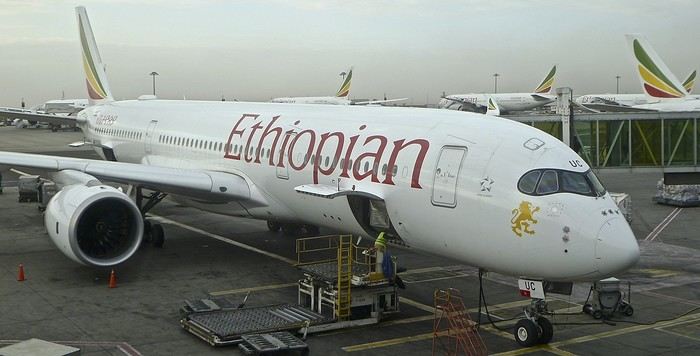
-1- During the layover in Addis Ababa. The Airbus A-350 in the early morning mist.
Reminder: Click on each image to enlarge it, if needed. .
From Dar es Salaam, if you want to go by road to Ruaha, it’ll take a very long and tiring day. 🤪
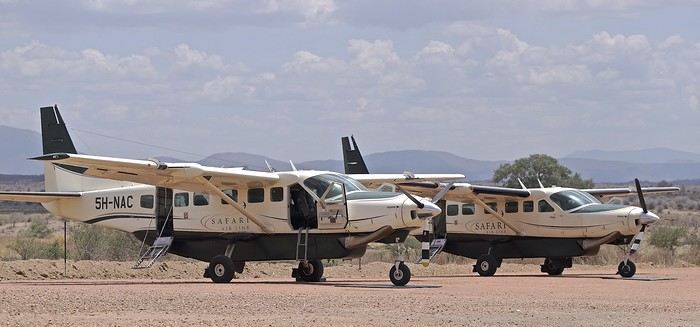
On previous trips, we’ve always taken a bush plane for this route. In this case, it took just over an hour and a half, with two short intermediate stops to drop off passengers at other bush airstrips.
Since I’m also passionate about aviation, I love these flights where you can admire the landscapes from low altitude while sitting right behind the pilot 🙂.
-2- These routes mainly use Cessna 208 Caravans.
At the Msembe airstrip, we’re greeted around 1:30 PM by a guide and a driver from our chosen lodge. They brought a picnic basket, which we enjoy at a nearby picnic area. We’re by the Ruaha River, completely dry—it’s scorching hot.
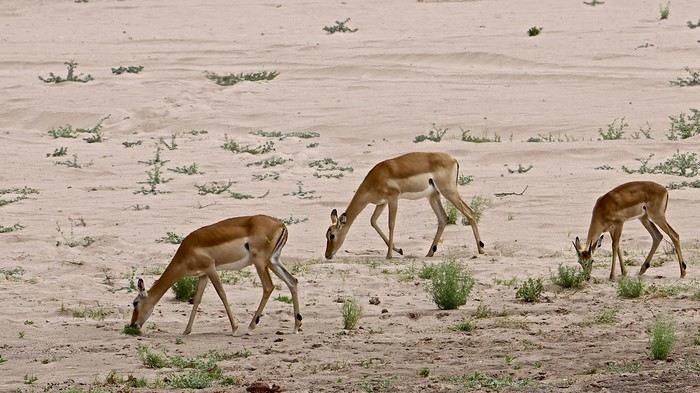
-3- The first mammals we encounter are a pair of female impalas, accompanied by a young male.
Reminder: Click on the image to view it in larger size. 😉
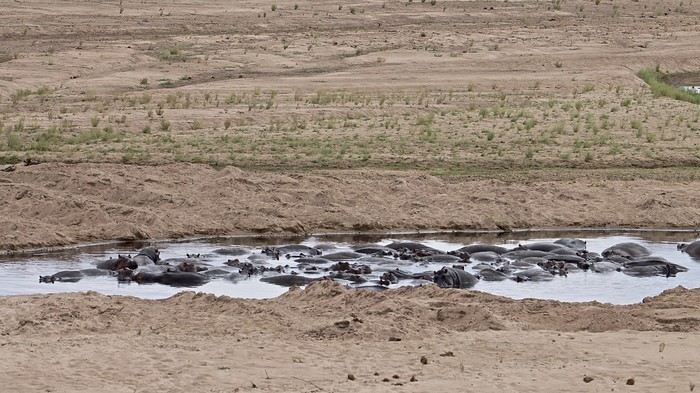
-4- To save the hippopotamus populations from certain death, rangers had to dig holes in the sand with bulldozers. Fortunately, water is present beneath the sand layer.
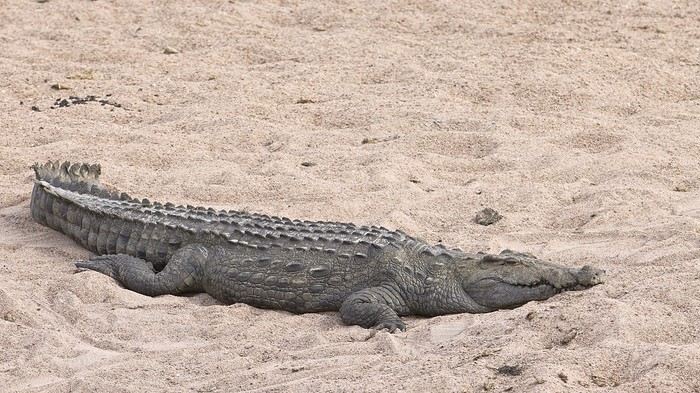
-5- This crocodile doesn’t seem to have been accepted as a swimming neighbor by the hippos...
We’ll explore along the river for 2-3 hours before crossing it at a ford toward the southern part of the reserve.
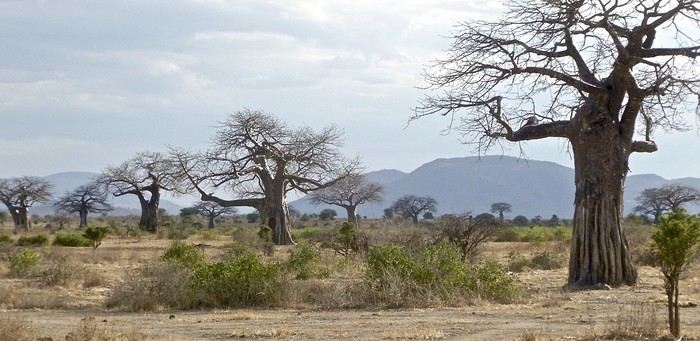
-6- The typical landscape of Ruaha, with its many baobabs.
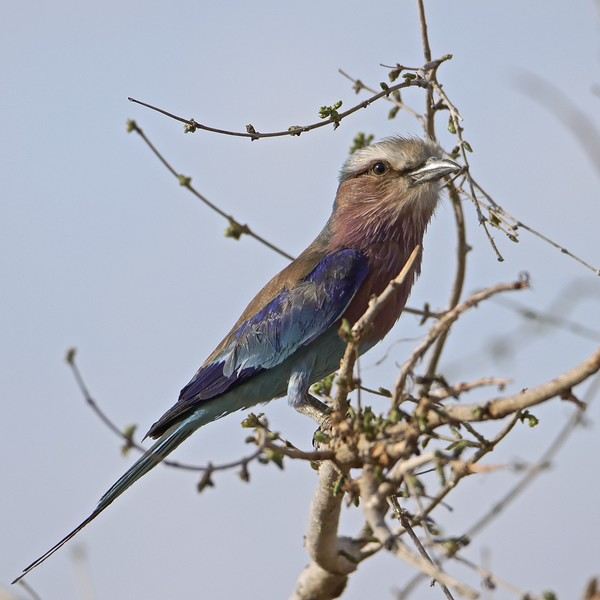
-7- My buddy the R.L.B. is also here to welcome me.... 🙂 🙂
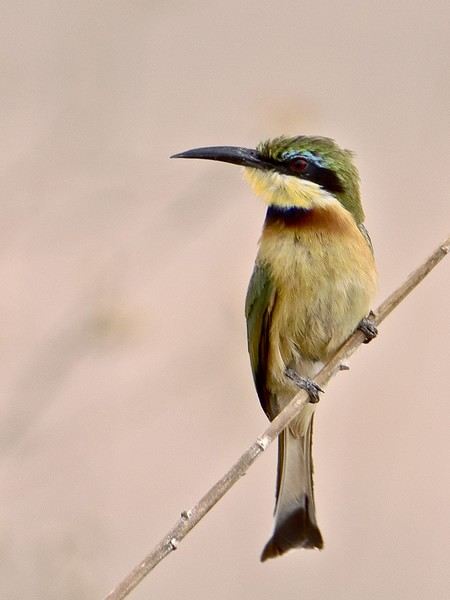
-8- As well as this little bee-eater... 😎
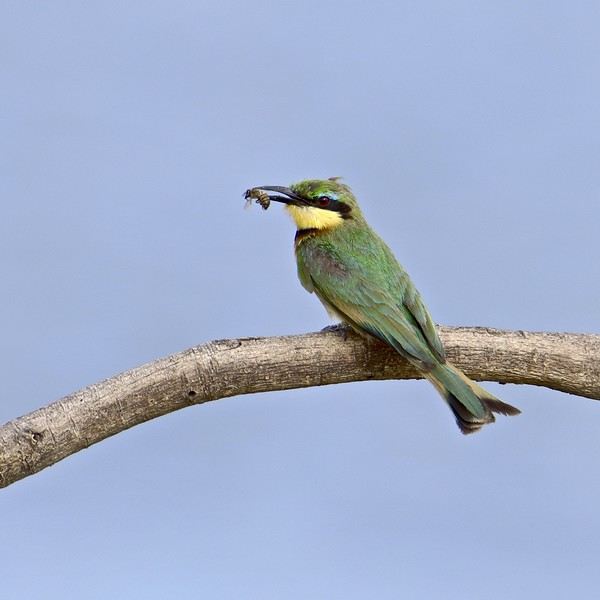
-9- ...which reminds us of the origin of its name...!
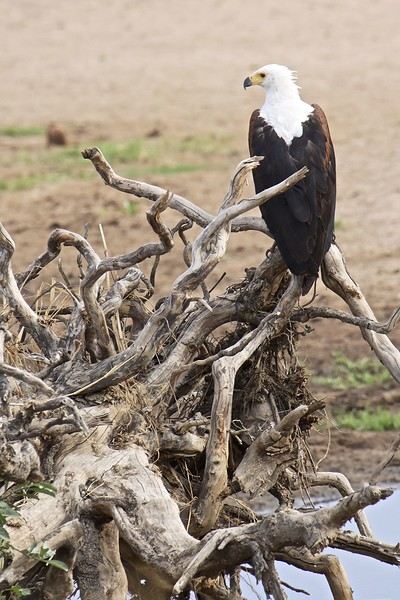
-10- Above a rare waterhole, a fish eagle keeps watch for fish...
...
*** Please wait until the end of the story for any questions or to share your own experiences in Ruaha. (Or via PM.) Thanks in advance for keeping this account smooth and enjoyable. 😉
...
*** I’m not an ornithologist, but birds are an important and unavoidable part of safari discoveries. You’ll find quite a few in the images of my story. 😎
...
" We’re ALL different, and so are our expectations when it comes to travel or leisure ". There are—without a doubt—as many ways to experience a trip as there are travelers!! For the two of us, it’s only our love of wild nature that guides us to East Africa. The stated goal of this trip was purely wildlife-focused, and NOT about discovering the country or its people.
...
Hello everyone,
Previously, I shared the account of a trip/safari in southern Tanzania in June 2024, in the Mikumi and Selous reserves.
This time, still in southern Tanzania, I invite you to join us in Ruaha National Park. (Then, depending on the number of images allowed in my quota, at the end of my story, we’ll return to Selous for the second part of the same trip.)
- This trip/safari took place in November 2022. - Our flight started in Marseille, heading to Addis Ababa, then Dar es Salaam (via Ethiopian Airlines). In Dar, we spent one night at a hotel near the airfield.
-1- During the layover in Addis Ababa. The Airbus A-350 in the early morning mist.
Reminder: Click on each image to enlarge it, if needed. .
From Dar es Salaam, if you want to go by road to Ruaha, it’ll take a very long and tiring day. 🤪
On previous trips, we’ve always taken a bush plane for this route. In this case, it took just over an hour and a half, with two short intermediate stops to drop off passengers at other bush airstrips.
Since I’m also passionate about aviation, I love these flights where you can admire the landscapes from low altitude while sitting right behind the pilot 🙂.
-2- These routes mainly use Cessna 208 Caravans.
At the Msembe airstrip, we’re greeted around 1:30 PM by a guide and a driver from our chosen lodge. They brought a picnic basket, which we enjoy at a nearby picnic area. We’re by the Ruaha River, completely dry—it’s scorching hot.
-3- The first mammals we encounter are a pair of female impalas, accompanied by a young male.
Reminder: Click on the image to view it in larger size. 😉
-4- To save the hippopotamus populations from certain death, rangers had to dig holes in the sand with bulldozers. Fortunately, water is present beneath the sand layer.
-5- This crocodile doesn’t seem to have been accepted as a swimming neighbor by the hippos...
We’ll explore along the river for 2-3 hours before crossing it at a ford toward the southern part of the reserve.
-6- The typical landscape of Ruaha, with its many baobabs.
-7- My buddy the R.L.B. is also here to welcome me.... 🙂 🙂
-8- As well as this little bee-eater... 😎
-9- ...which reminds us of the origin of its name...!
-10- Above a rare waterhole, a fish eagle keeps watch for fish...
...
*** Please wait until the end of the story for any questions or to share your own experiences in Ruaha. (Or via PM.) Thanks in advance for keeping this account smooth and enjoyable. 😉
...
*** I’m not an ornithologist, but birds are an important and unavoidable part of safari discoveries. You’ll find quite a few in the images of my story. 😎
...