Hi, I’m taking a cruise in Japan on the Diamond Princess from May 23 to June 5 and would love to hear from anyone who’s done it. Also, can we pay on board with Euros? Is it easy to use Wi-Fi when we’re ashore? What’s the weather like—do we need warm clothes or not? Are the excursions essential, or can we manage on our own outside of Tokyo, where we have a guide? If not, which excursions would you recommend? Thanks in advance for your replies.
Betty from the islands
43 similar discussions in English
Hi there,
I haven’t found what I’m looking for despite my searches!
For a 15-day trip next spring, I’d like to buy a card (preferably an eSIM, but a physical SIM is fine too) that also lets me make calls in the country (to contact a hotel, a tourist spot, etc.).
You can easily find options just for data, but I haven’t come across any that include calls, texts, or even MMS. Could you recommend something?
Thanks in advance
Hi,
Our trip is planned for 20 days in Japan next April. We have a free subscription that would allow us to use 35 GB (I’m a bit confused), but we also need to be able to make phone calls with a French couple traveling with us for a few days, and that seems impossible due to cost... Any solutions for using GPS while keeping those 35 GB? Used to traveling in Southeast Asia, we usually rely on local SIM cards. Is it easy to do the same in Japan?
Thanks for your help!
Best,
Tialou
hi how can I get internet when I arrive at Haneda? I mean in areas without free wifi. Is it more interesting to buy a SIM card? If so, at the airport? thanks for your help
Hi there,
I have a question about the eSIM card:
I bought an eSIM from Saily for my trip to Japan in 5 days.
What should I do with my Samsung smartphone?
What should I do with my current SIM card: deactivate/remove it?
It says activation in Japan is automatic—what does that mean exactly?
Hi everyone,
I’m back from my 10-day cruise to Japan and South Korea and wanted to share my experience. Before leaving, I searched the forums but found very few firsthand accounts of this kind of trip.
Just so you know, a cruise isn’t some slow, easy trip—every port stop is an adventure!
We flew from Marseille with Lufthansa via Frankfurt, with a short 1.5-hour layover that was just enough, though we still had to sprint to make our connection. We’d booked seats with extra legroom, which was great—we were next to premium economy, so we had a good spot. The airline hadn’t sold all the premium seats and kept making announcements to attract takers, but no discounts!
After about 12 hours, we arrived at Tokyo Haneda feeling pretty wiped since we hadn’t slept. The time difference is 7 hours, so we landed in late morning in Japan. We took the free rail shuttle to central Tokyo. The entry process went smoothly thanks to the Japan web app. For the subway, we’d registered our Suica card, but we hadn’t anticipated how tricky transfers could be when stations don’t always have elevators—bit of a hassle, but still cheap! Navigating the subway is super easy, though. We’d bought a SIM card on Amazon beforehand, so everything was smooth.
We’d booked a room at the Grand Hazelmon Hotel, which is near the Imperial Palace. It’s a quiet business district in the evenings and well-connected by subway.
I’d opted for a half-room, so I was worried about space, but it was fine—no smaller than a London or Paris hotel room! Breakfast was included and really good.
We even had dinner there one night—dishes were around 9 € at a 4- or 5-star hotel, so we didn’t hold back.
In the afternoon, we visited the Imperial Palace. You can’t go inside, but it’s a green oasis—surprisingly peaceful despite Tokyo’s 36 million people—and very secure.
I’ll share more of my adventures later!
Hi everyone,
So great to see our forum back up and running. What a nice surprise to see some familiar faces again!
Anyway, today’s topic: I’m heading to Japan and South Korea for three weeks. I’m looking for the best way to stay connected (I have a recent iPhone, eSIM compatible). I’ve read that Holafly is a good option, but I’d love to hear your thoughts.
Thanks, everyone, and long live VoyageForum!
Hi there,
In 2022, I went to Japan where I planned to buy a bike (you need to know a trusted Japanese resident or similar, otherwise it's impossible, but you get a registration in return).
There are many websites selling second-hand bikes, accessories, and parts at all price points that you can find online.
I bought a suitable bike, the right size, for around 600 €, which allowed me to cover the 850 km I had planned.
For transport, you absolutely need a soft bike bag, because you must dismantle it to board any train or bus! And even to move it around the station!
For express trains in certain regions, you need to make a reservation for oversized luggage (check at the station), and in return, there will be a reserved space.
Keep in mind that Japanese people travel with little luggage since they rarely go away for more than a week. So, if you don’t end up with a crowd of tourists... (watch out on tourist routes in Tokyo and Hiroshima).
Avoid tourist areas during GOLDEN WEEK in April-May—trains and hotels are fully booked. Take the opportunity to escape to the countryside...
For hotel bookings, Booking and Agoda are safe options—you can confidently choose the cheapest ones.
In small towns, street life shuts down at sunset, so plan ahead for restaurants. Otherwise, there’s always the konbini!
For ferries, there’s no problem, but you may have to pay in some cases.
Otherwise, it’s all very pleasant: drivers are very respectful.
Bear in mind that driving is on the left side of the road.
I took a few trips around Tokyo and its suburbs without any issues, except for orientation. A GPS is essential because many people don’t speak much English or know exactly where they are in relation to your destination.
But luckily, there’s the KOBAN—a neighborhood police box where an officer has a big book of maps, and their mission is to help you find your way if you know the address, the neighborhood name, the subway station, or even the name of a bar (!)
Otherwise, I cycled on very small roads away from main routes, through small villages, and that’s where you really discover "deep" Japan.
Japan is a mix of landscapes, often wilder than what we’re used to in Europe, but also signs of an aging population, with rural exodus and many abandoned houses in the mountainous countryside of SHIKOKU or NOTO.
I explored or took rides from town to town, sometimes ahead of or behind my partner, who traveled by train or bus on her own.
I met few Japanese cyclists (with very basic bikes) or non-Japanese ones, except for cyclists on the SHIMANAMI route with amazing bikes.
No need for a heavy lock—you can find them there.
There are also shops for second-hand parts.
For safety, ideally, you should get a local SIM card. It’s good to know that in an emergency, your phone will work to call for help—dead zones are rare.
I brought the bike back to Europe as checked luggage in a properly sized box with no special formalities, for a transport cost of around 150 €. I got the box from an international bike shop in Tokyo after some searching and resizing it (with a knife and packing tape).
Hi there!
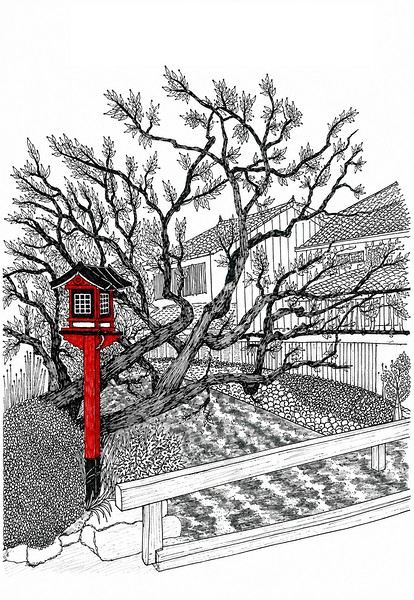 I’m inviting you on a stroll through my drawings—a completely subjective, far from exhaustive, and totally personal take, since it’s based on my own sketches. I put this travel journal together after returning in late 2024, mostly using felt-tip pens and pencils, with a few collages thrown in. I worked from our personal photos.
Let’s start with the shotengai...
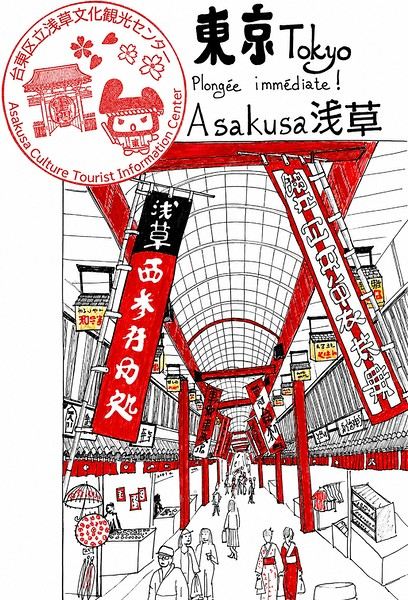
Our first "wow" moment came as we stepped out of the subway in Asakusa, the Tokyo neighborhood where we’d booked our hotel for our first five nights. Exhausted after our long flight, we finally arrived and took an exit that led straight into a shotengai—one of those covered shopping streets that pop up in city centers and flourished between the 1950s and 1980s.
It was an instant aesthetic shock, like a close encounter of the third kind between the modern city, a typical Asian market with its street stalls, the vintage vibe of the arcade, the sheer abundance of goods, and the bustling crowd—a mix of tourists, pilgrims (thanks to nearby Senso-ji Temple), and locals (it’s a very working-class area). In the end, it set the tone for a feeling we’d experience throughout the trip. Wherever we went, shotengai turned out to be fantastic spots for finding little restaurants, shops, or even fresh produce. Some are like real mazes, like in Kyoto, where we spent ages trying to relocate a restaurant we’d loved ;-)
In Kanazawa, the Omicho Market: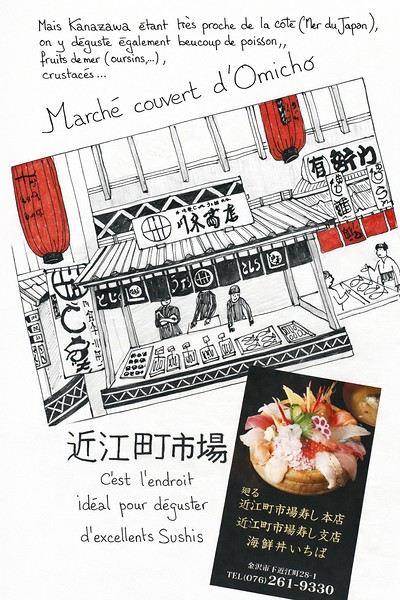 And in Kyoto, Nishiki Market:
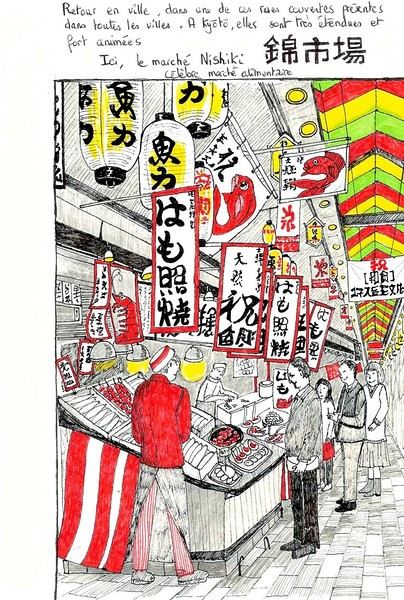
To be continued...
I’m inviting you on a stroll through my drawings—a completely subjective, far from exhaustive, and totally personal take, since it’s based on my own sketches. I put this travel journal together after returning in late 2024, mostly using felt-tip pens and pencils, with a few collages thrown in. I worked from our personal photos.Let’s start with the shotengai...
Our first "wow" moment came as we stepped out of the subway in Asakusa, the Tokyo neighborhood where we’d booked our hotel for our first five nights. Exhausted after our long flight, we finally arrived and took an exit that led straight into a shotengai—one of those covered shopping streets that pop up in city centers and flourished between the 1950s and 1980s.
It was an instant aesthetic shock, like a close encounter of the third kind between the modern city, a typical Asian market with its street stalls, the vintage vibe of the arcade, the sheer abundance of goods, and the bustling crowd—a mix of tourists, pilgrims (thanks to nearby Senso-ji Temple), and locals (it’s a very working-class area). In the end, it set the tone for a feeling we’d experience throughout the trip. Wherever we went, shotengai turned out to be fantastic spots for finding little restaurants, shops, or even fresh produce. Some are like real mazes, like in Kyoto, where we spent ages trying to relocate a restaurant we’d loved ;-)
In Kanazawa, the Omicho Market:
And in Kyoto, Nishiki Market:
To be continued...
Hi there,
The info I found on the forum is a bit outdated, so I’m asking again!
1) What budget should I plan for 15 days, given that hotels with breakfast, transfers, and transport are already paid for? I know it depends on the person, but I’d love a rough idea. For meals, we’re thinking simple street food or small local restaurants.
2) I’ve heard that credit cards (we each have a Revolut + 1 Visa Premier) aren’t widely used and that it’s better to have cash. Can you confirm?
3) Are foreign credit cards still not accepted at bank ATMs? Still 7-Eleven or the Post Office? And what about American Express?
Thanks in advance, Best regards
Here’s a little story about my first trip to Japan with my partner.
We went for our first visit from October 29 to November 13, 2024.
I had planned this entire trip back in November 2020, but given the health situation at the time, I had to cancel...
Here’s the classic route we took: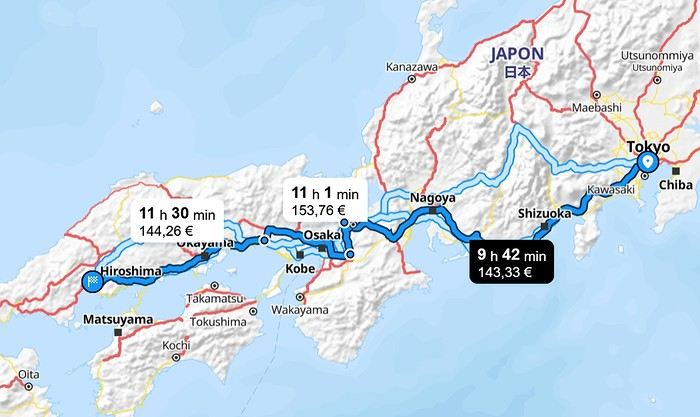
We booked everything ourselves and got a regional pass for the area from Kyoto to Hiroshima. The hotels were reserved 3 months in advance on Book... and Agod... (1030 € for 2 people for 13 nights = 80 €/night). For the flight, we chose a Qatar Airways flight with a layover to break up the long journey (950 € per person). We also got a pass on the same site (Japan-Experience) to take the train connecting Narita Airport to Shibuya Station (the N'EX Narita Express). Since the airport is 75 km from central Tokyo, we opted for this mode of transport, even though there are cheaper alternatives. After reading various posts on VoyageForum, I understood how important it was to have a Welcome Suica card to pay for public transport (subway, tram, bus, boat throughout the country), and we were able to buy one at Narita Airport. It turned out to be super useful! After a long but smooth journey, we found ourselves at Narita Airport in the evening. Even though we had a pass for the Narita Express, we had to go to a counter to make a reservation for the train (mandatory). Then, once we arrived at Shibuya Station, we took the subway for 2 stops and finally reached our hotel, exhausted (Hotel Asia Center of Japan – 270 € for 3 nights with breakfast included).
I had planned this entire trip back in November 2020, but given the health situation at the time, I had to cancel...
Here’s the classic route we took:
We booked everything ourselves and got a regional pass for the area from Kyoto to Hiroshima. The hotels were reserved 3 months in advance on Book... and Agod... (1030 € for 2 people for 13 nights = 80 €/night). For the flight, we chose a Qatar Airways flight with a layover to break up the long journey (950 € per person). We also got a pass on the same site (Japan-Experience) to take the train connecting Narita Airport to Shibuya Station (the N'EX Narita Express). Since the airport is 75 km from central Tokyo, we opted for this mode of transport, even though there are cheaper alternatives. After reading various posts on VoyageForum, I understood how important it was to have a Welcome Suica card to pay for public transport (subway, tram, bus, boat throughout the country), and we were able to buy one at Narita Airport. It turned out to be super useful! After a long but smooth journey, we found ourselves at Narita Airport in the evening. Even though we had a pass for the Narita Express, we had to go to a counter to make a reservation for the train (mandatory). Then, once we arrived at Shibuya Station, we took the subway for 2 stops and finally reached our hotel, exhausted (Hotel Asia Center of Japan – 270 € for 3 nights with breakfast included).
Hi,
Over the past few months, I’ve been noticing more and more reports about safety issues in Tokyo and Osaka targeting tourists. I knew the local population didn’t want tourists—or at least a lot fewer—under the previous prime minister’s policies. Right now, some friends are in Tokyo—four guys traveling together—and this is what happened to them: a Japanese guy approached them in Akihabara with a map, pretending to ask for directions. Then, eight others came from behind, beat them up, stole their phones, and 30,000 yen. They ran off, and all this happened around 6:00 PM.
They went to the *koban* (police station), but the police just laughed at them. Luckily, two of the phones had trackers, which they mentioned to the police, but the cops didn’t do anything. So, they called the French embassy. The next day, they had a meeting with an embassy delegate at the police station, but nothing happened for 24 hours. Then, two days later, they were summoned back to the police station, and to their shock, the police offered them a deal: they’d get their phones and the 30,000 yen back if they withdrew their complaint. In the end, they got their phones back (one with a cracked screen) and the 30,000 yen without withdrawing their complaint.
Before leaving their hotel for Osaka, they received a letter saying they could be banned from the country for three years. When they arrived in Osaka, their ATM withdrawals with their card were limited to 20,000 yen. They asked the Japanese postal agent why, and the response was, "You’re flagged in the deportable travelers registry." Their hotel canceled their reservation, and the embassy is now taking over by involving the justice system. (more below)
Hi there,
We’re traveling to Japan as a family with two kids (10 and 8 years old) next summer, and we’ll have 16 days there.
I’d love to share our itinerary with you to check if it makes sense and also ask a few practical questions.
Day 1: Arrival, settling in, and exploring Tokyo Day 2: Tokyo Day 3: Tokyo Day 4: Tokyo or a day trip to Nikko? Day 5: Tokyo Day 6: Tokyo Day 7: Matsumoto Day 8: Kamikochi or Takayama Day 9: Takayama Day 10: Takayama-Shirakawago-Kanazawa Day 11: Kanazawa Day 12: Kyoto Day 13: Himeji (is a full day needed?) Day 14: Kyoto (Arashiyama and Fushimi Inari—doable in one day?) Day 15: Kyoto Day 16: Osaka Day 17: Departure from Osaka
What would be the ideal neighborhood in Tokyo to stay in? (Good location, kid-friendly, etc.) For getting around, is a pocket Wi-Fi the only/best option? Is the Suica card suitable and sufficient for getting around all of Tokyo? Would the JR Pass be a good option for us? Are the Japanese Alps a good compromise for us if we want to see some of the Japanese countryside and maybe take a breather after the intensity of Tokyo?
Thanks so much in advance for your replies
Hi everyone, I’m Patrick, 67 years old, a seasoned traveler (already 22 trips outside Europe).
In autumn 2025, I took my first 3-week trip to Japan, with stops in Tokyo, Kamakura, Matsumoto, Kamikochi, Takayama, Kanazawa, Kyoto, Nara, Osaka, Koyasan, Tokyo again, and Nikko.
I wanted to go back in May 2026 and explore some lesser-known places to complement my first trip.
Last year, there were four of us traveling together to discover Japan (a fairly classic itinerary). This time, I’ll be traveling solo for part of the trip and with a couple of French friends for the rest.
The weather was gorgeous in May, averaging around 25°C, with two very hot days in Kyoto and only two rainy days.
As usual, I organized everything myself, gathering plenty of information from various sites, including this one.
Transportation: An ICOCA card is essential. I got a 5-day Kansai-Hiroshima pass because I took the shinkansen between Hiroshima and Osaka three times, and it paid for itself quickly.
Accommodations: Mostly through Booking. No issues at all. Average cost was 46 € per night.
Meals: For breakfast, I alternated between buying food at a konbini to eat in my room or on the train and grabbing something at local cafés. For lunch and dinner, I tried to vary my meals as much as possible—lots of sashimi, sushi, and ramen. Okonomiyaki in Osaka and Hiroshima. Oysters in every form (raw, grilled, fried) in Onomichi and Hiroshima. A variety of seafood (shrimp, shellfish) in Hiroshima and Matsumoto. Fish whose names often escaped me, but notably mackerel and eel (unagi). Tempura and gyoza. Chicken skewers (yakitori) and one teppanyaki meal. One omakase meal (9 different dishes). In the end, not much meat aside from a few yakitori skewers. No splurges on super expensive wagyu or Kobe beef. Average dinner cost: 4,800 yen, drinks included.
The Itinerary: Day 1: Departure from Brussels Day 2: Arrival in Osaka Day 3: To Himeji, then Kurashiki Day 4: To Fukuyama, then Tomo no Ura, then Onomichi Day 5: Cycling the Shimanami Kaido Day 6: To Takahara, then Hiroshima Day 7: To Kyoto to attend the Aoi Matsuri parade Day 8: To Miyajima Day 9: Hiroshima, then Kyoto Day 10: Southern Kyoto Day 11: Northern Kyoto Day 12: Final day in Kyoto, then to Nagatsugawa Day 13: Start of the Nakasendo Trail (Magome to Tsumago) Day 14: Second day of the trail (Kiso Fukushima) Day 15: Third day of the trail (Narai), then Matsumoto Day 16: To Mt. Fuji (Kawaguchiko) Day 17: To Tokyo Day 18: Excursion to Enoshima and Kamakura Day 19: Flight home, with a 10-hour layover in Hong Kong Day 20: Arrival in Brussels
Hi,
I’ve always been used to exchanging my money (€) in town no matter the country (with a "mini exchange" at the airport if needed).
I can’t find any recent posts on this topic from the last few years.
Does anyone have any insights on this? Intrinsic benefits, best places to exchange, etc.?
I arrive at Tokyo Haneda on a Friday around 12:30 PM, and my first night is very close to Shinjuku.
Thanks.
Hi there,
I’ll be traveling to Japan this coming August. We’ve finalized our itinerary and booked our flight tickets. Now I’m at the stage of buying train tickets for the few segments we’ll need to cover:
Tokyo - Hakone
Hakone - Kyoto
Kyoto - Osaka
Osaka - Tokyo
Here are my questions:
a) Is it possible to buy train tickets for these segments from Canada?
b) If so, which website should I use to do this?
c) And if it is possible, will we be able to print our tickets from Canada?
d) If it’s not possible, where in Tokyo should I go to buy these tickets when I arrive?
Thanks a bunch,
Mario Séguin Québec, Canada
Thanks a bunch,
Mario Séguin Québec, Canada
Hi everyone,
I’m often in transit in Tokyo and I stay at the hotel because Japanese people speak little English and the signs are almost always in Japanese!
Any ideas for getting from Narita to a nice park or an onsen? I wanted to try Hokkaido, but apart from renting a car, it’s all trains! Any suggestions for a car with a driver? Or is it too expensive? Small group tours in Hokkaido? I read about the Explorator group’s offer—way too expensive!!!
I’ve got a maximum of 8 days. I’d just like a nice Japanese break.
Thanks for any tips you can share!
Hi there,
I’m planning a trip to Japan in April/May.
I’ll start my journey in Tokyo for 3 to 4 days.
I’d love your advice on accommodation, transportation, an itinerary, and whether a guide would be useful.
I’m traveling solo and could use a little reassurance.
Before I forget... how do payments work?
Thanks for your help, Petra
Thanks for your help, Petra
Hi everyone,
It’s been a while since I last posted... so I’m jumping back in with this amazing trip we took in October 2025:
We’re doing this trip with fellow traveler friends who, like us, have already been to Japan. That means we can aim for a different side of Japan, away from the usual tourist circuits. That’s why I opted to rent a car instead of relying on trains. I was drawn to the castles and the samurai-novel atmosphere.
When I plotted the sites I wanted to visit on Google Maps, it suggested a return route via the island of Shikoku, so it turned into a nice loop around the Seto Inland Sea between Kyushu, Chugoku, and Shikoku.
The trip will be just the four of us, doing it all independently. I rented a car from Budget in Fukuoka. Before heading over, I watched several videos to get an idea of what to expect—road signs, parking, and general driving behavior. In Japan, they drive on the left, but that’s not an issue since in Southern Africa we also drive on the “wrong side of the road,” so I’m used to it. For accommodations, after checking with two agencies, I decided to handle it myself. It saved a significant amount of money, and I was able to choose exactly what I wanted. I know I can be picky about the type of lodging I want, especially in Japan where you can really treat yourself. We stayed in some stunning ryokans, once in little cabins run by monks next to a temple, and more.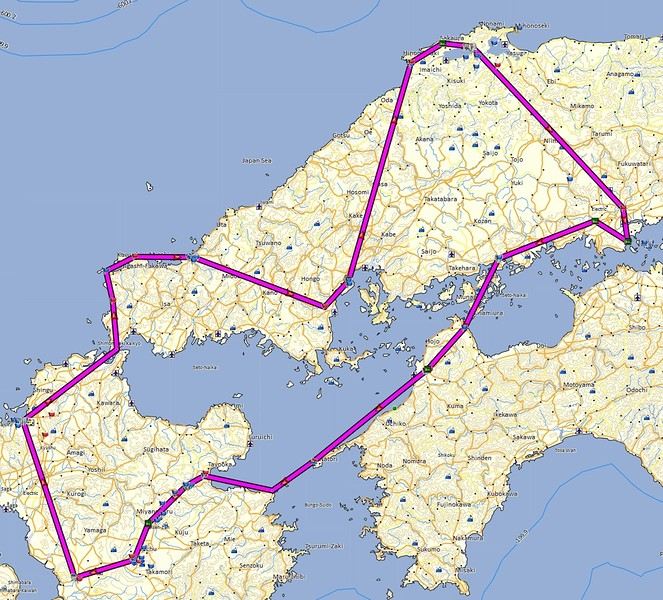
Here’s the route: Fukuoka - Hagi - Miyajima - Matsue - Okayama - Kurashiki - Matsuyama - Yufuin - Kurokawa - Kumamoto - Fukuoka
Here we gooo...
It’s been a while since I last posted... so I’m jumping back in with this amazing trip we took in October 2025:
We’re doing this trip with fellow traveler friends who, like us, have already been to Japan. That means we can aim for a different side of Japan, away from the usual tourist circuits. That’s why I opted to rent a car instead of relying on trains. I was drawn to the castles and the samurai-novel atmosphere.
When I plotted the sites I wanted to visit on Google Maps, it suggested a return route via the island of Shikoku, so it turned into a nice loop around the Seto Inland Sea between Kyushu, Chugoku, and Shikoku.
The trip will be just the four of us, doing it all independently. I rented a car from Budget in Fukuoka. Before heading over, I watched several videos to get an idea of what to expect—road signs, parking, and general driving behavior. In Japan, they drive on the left, but that’s not an issue since in Southern Africa we also drive on the “wrong side of the road,” so I’m used to it. For accommodations, after checking with two agencies, I decided to handle it myself. It saved a significant amount of money, and I was able to choose exactly what I wanted. I know I can be picky about the type of lodging I want, especially in Japan where you can really treat yourself. We stayed in some stunning ryokans, once in little cabins run by monks next to a temple, and more.
Here’s the route: Fukuoka - Hagi - Miyajima - Matsue - Okayama - Kurashiki - Matsuyama - Yufuin - Kurokawa - Kumamoto - Fukuoka
Here we gooo...
Hi everyone,
I’m planning our trip to Japan from March 21 to April 11, 2026. We’re planning to travel by plane for long distances (Okinawa) and by train for the rest. I’d like to know if renting a car is easy and, most importantly, if driving with road signs written in Japanese isn’t too complicated. For trains, are there any tips to save money?
Thanks for your advice!
A scam from A to Z.
A scam from A to Z.
I just got off a 15-day cruise around Japan on the Norwegian Spirit. Never again!
Drink prices are exorbitant ($12 before tax for a beer, a 500ml bottle of water for $6.50 before tax!!!)
That’s $13 per liter of water before tax!!!!!
No entertainment at all.
Shows were really mediocre.
No dedicated space for kids.
Food was repetitive, way too salty, and just not good.
Port stops were too short, and some days at sea were way too long!
Time to disembark: over an hour, like in Korea (Icheon). On a 5-hour stop, that’s wasted time!!
Excursion prices ranged from $199 to $350 per person (for less than 6 hours on land!!!)
And to top it all off: after a case of food poisoning on board and a visit to the ship’s doctor (in the middle of the night due to feeling unwell and vomiting), we were charged $4,800 for medical exams!!
Yes, you read that right: $4,800!!!!!!
Just to clarify, the person was in consultation for about 2.5 hours... These fees were directly charged to our account since they force you to register a credit card at the start of the cruise!!
On top of that: service charges on board: $20 per person per day! That’s $1,680 before tax, of course!! We contested them, but they were still charged!!
Other unknown fees charged by mistake!! I had to open a dispute with my bank.
So go with MSC or Costa instead...
but avoid Norwegian—an unscrupulous company that takes advantage of vulnerable people.
Date of experience: August 10, 2025
Hi everyone,
I’m heading to Japan for the second time with my 20-year-old son. During our first trip, we spent two weeks in Tokyo and Kyoto (plus the surrounding areas). This time, we’re planning to stay in Tokyo for at least 4-5 days and then head to the island of Naoshima. I’m looking for suggestions and advice: Is getting to Naoshima from Tokyo complicated? If so, do you have any recommendations for a stopover somewhere? Given that we’d prefer not to move every day, we’d rather settle in one place and then explore on day trips... Do you think it’s possible to do something like this: 5 nights in Tokyo (Shinjuku) 3 nights in Kyoto 2 nights in Naoshima (or is one night enough??) and if one night is enough, where could I spend a second night on the way back to Tokyo? 2 nights in Tokyo (I’d love your advice on staying in a different neighborhood—last time we stayed near Ueno Park)—keeping in mind we’re flying out of Narita.
I’m considering maybe skipping Kyoto, which I love but has apparently become *very* touristy... Not really keen on Osaka... since we’ll already have done Tokyo as our "big city." I’d prefer towns where nature is present... (a bit like Kyoto, which offers all that...)
For info, we’ll be traveling by train. Thanks in advance for all your suggestions and help!
I have one last little question: Is cash still widely used in Japan, or not at all anymore?
Thanks so much,
Karine
Hello,
I'm planning to travel from Matsumoto to Tsumago to hike to Magome. Is it reasonable to leave early in the morning from Matsumoto by train, stop in Narai for a stroll (knowing we'll have our big backpacks, I hope there's a luggage locker at the station), and then continue to Tsumago to do the hike to Magome?
Or is it better to stop and sleep halfway in Kiso-Fukushima? (I looked for accommodations in Narai but couldn't find any.)
Thanks in advance for your advice.
Hello,
I’m new to the forum (I live in Paris), though I’ve used it before during my past trips, a long time ago when I was young :). I’m now the venerable age of 49.
As mentioned in the title, I’m looking for some great accommodation tips for myself and my two daughters, aged 10 and 12, that you may have recently tried during your travels in Japan.
Ideally, since I haven’t been back to Japan since 2008, I’d love to get some reliable recommendations for hotels or ryokan where you’ve stayed.
When I visited Japan several times in 2007 and 2008, I didn’t have kids, so I wasn’t as concerned about comfort. Even though my daughters are used to traveling with me, I’d still like to use the Japan Rail Pass as I did before—except back then, I didn’t book in advance. With kids, I’d prefer to plan ahead.
So if you have any great recommendations to share for these cities (priority), but I’m also interested in Nara, Matsuyama, Fukuoka/Hakata, and Hiroshima.
All your suggestions based on your past experiences will be much appreciated here.
I’d also be happy to chat with you about the differences between Japan nearly 20 years ago, when I first visited, and today. Have many things changed or evolved?
Thanks so much for your help.
Arnaud
Not very well known: Hokkaido Island has national parks that rival those in North America. Hiking there is free (even many mountain huts) and requires no formalities. These treks are described in the LP *Hiking in Japan* guide—you can just buy the Hokkaido PDF. It’s way better than Mount Fuji. Of course, everything depends on the weather, which is very unstable in the Japanese mountains (frequent strong winds). The trails are often obstacle courses.
The Daisetsu Zan traverse is a stunning hike through volcanic terrain with a remote section in the middle that requires at least one night of camping (there are basic huts for the rest, which is popular with Japanese hikers): 4 to 6 days.
The Shiretoko traverse takes 2 days with views including an island in Russia, but the ridge is brown bear territory—there are even more here than in Denali National Park in Alaska (brown bears and grizzlies are the same). I ran into 7 in just 6 hours of hiking!
I’m heading to Rebun and Rishiri Islands next.
Hi there,
We’re arriving as a group of three in Tokyo on Saturday, October 17th, then heading straight to Kyoto by direct train. On Sunday and Monday, we’ll explore Kyoto, and in the evening, we’ll take a train to Osaka to spend the night. On Tuesday, we’ll pick up a rental car at Itami Airport for a 6-day/5-night road trip around Shikoku: - 2 nights in the Iya Valley - Thursday morning, we’ll head to Matsuyama for 2 nights. - Saturday, we’ll visit Mima (town, a few temples + overnight stay) and return on Sunday to drop off the car in Osaka. We’ll leave very early on Monday the 26th by plane for Aomori in northern Honshu, where we’ll pick up another rental car at the airport for a 5-day/4-night trip: - Day 1: Tsugaru Peninsula (Takayam Inari, Cape Tappi, Kanita); overnight in Kanita - Day 2: Ferry transfer to the Mutsu Peninsula (cliffs, Lake Usori); overnight in Shimofuro - Day 3: Head to the Hakkoda Mountains and onsens galore; overnight TBD - Day 4: Return the car in Aomori by noon and explore the city before taking the train to Tokyo in the evening We’ll spend Friday night in Tokyo, wander around on Saturday, and head home on Sunday.
Thoughts on the road feasibility of this trip? We’ll be there right in the middle of Koyo season, so it’ll be busy... I know it’s a lot of driving, but there are two of us who can take turns. We’re not afraid of driving, even in the mountains and on the left side! Just wondering, are we going to be rushing, or is this manageable? AI says it’s all good, but it’s not the one driving... Any tips for booking accommodations in the Iya Valley? Not many places have email addresses or websites (I know Booking.com exists, but not all listings are on there... and given the season, I think it’s better to book ahead!). Same question applies for northern Honshu. For the rental car, I’m thinking of going with Alamo since at least it’s in French and straightforward, but are there any direct rental companies with user-friendly websites (Toyota Rentacar, ugh... 🏴☠️)? Another question: With so many trains, is it even necessary to book them in advance? Can we just go to the ticket counter and grab seats on the spot? For paying for the rental car, do we need a credit or debit card?
Thanks for your help!
I’m sharing our three-week trip to Japan from late October to mid-November 2025. There were four of us—my partner and a couple of friends.
I’ve traveled often with my friend Christian (Bolivia, Argentina, Costa Rica, Namibia, Laos), but this time our partners joined us.
The rough itinerary:
Arrival in Tokyo. Visiting Shinjuku/Shibuya districts + day trip to Kamakura
5 days in the Japanese Alps, from Matsumoto to Kanazawa (via Kamikochi, Hirayu Onsen, and Takayama)
5 days in Kyoto
Nara, Osaka, Koyasan
Return to Tokyo (Asakusa district), with a day trip to Nikko
We booked our flights well in advance (9 months ahead): the flight cost 1086 € per person. Compared to over 2000 € if we’d booked for the same dates just 3 months prior.
For accommodations, we mostly used Booking.com. The onsen was booked via Japanican, and in Kyoto, we stayed in an Airbnb.
We also made 5 train reservations a month in advance on Klook or directly on the train’s website.
Day 1: Departure from Brussels (October 24, 2025) Early morning takeoff at 6 AM to Munich (1.5-hour layover) with Lufthansa, then a 12-hour flight with ANA, arriving the next morning at 7 AM at Tokyo Haneda.
Day 2: Arrival in Tokyo Airport formalities were quick. The eSIM we bought before leaving activated as soon as we landed (10 GB plan with Saily—more than enough for our mobile internet needs, mainly Google Maps and Google Translate). We’d received 4 ICOCA cards from our neighbors, which we loaded with 15000 ¥ each. We took the Keihin train, then the Yamanote Line. It’s easy to navigate since everything is in English, and each station is announced on scrolling displays in English too.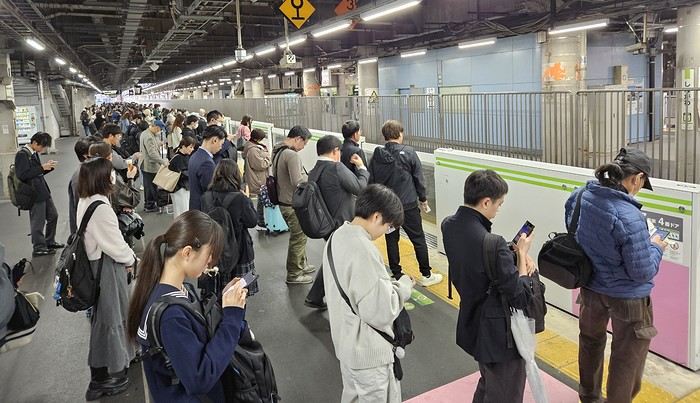
We got off the Yamanote Line at the station just after Shinjuku because it’s easier to exit that massive station with our luggage. So we ended up in Shin-Okubo, right in the Korean district. A 10-minute walk took us to Villa Fontaine Hotel. A great hotel, well-located north of the Kabukichō district. The room even seemed bigger than we’d expected.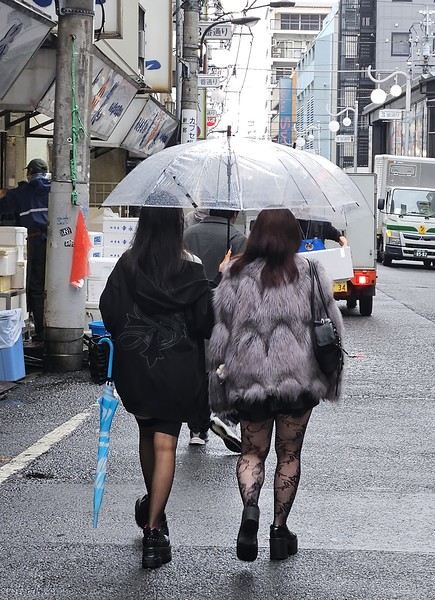
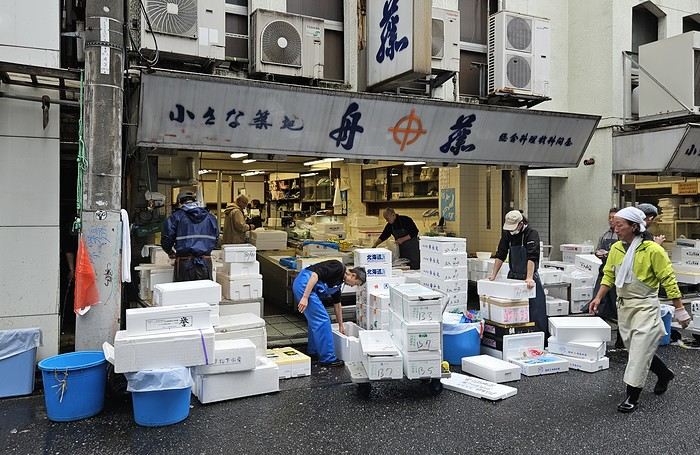 It was 15°C, but it rained—and kept raining on and off all day. Belgian weather, basically.
We went for a walk in Shinjuku Gyoen Park. Not as pretty in the rain, but the big greenhouse was interesting.
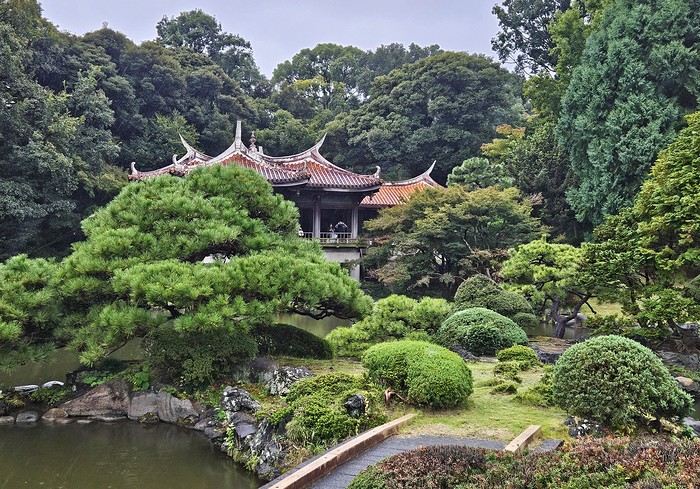
Then our first ramen (hearty and for 1000 ¥—pretty much the price of all our ramen during the trip). We headed back to the hotel since check-in was after 3 PM. Shower and relax before going out for dinner. Dinner was barbecue at Shichirin Yakiniku Anan (1700 ¥ each—good and cheap). Ordering via tablet wasn’t easy, but luckily it was in English.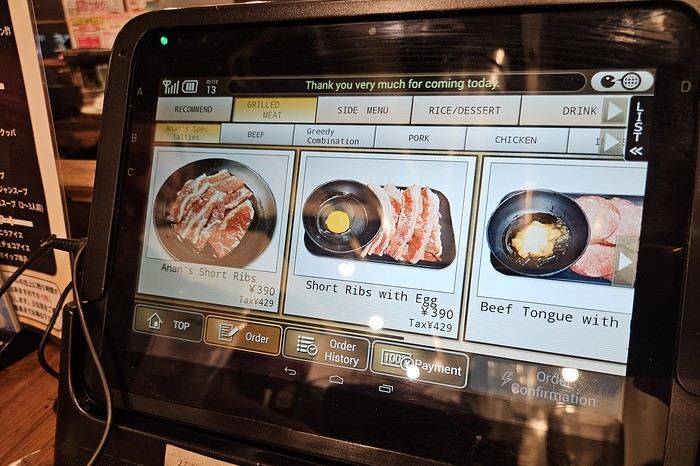
We ended the evening with a stroll through Kabukichō before a well-deserved sleep.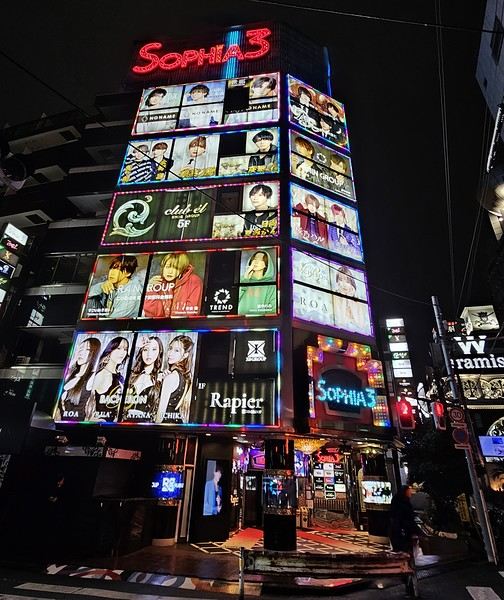
Day 1: Departure from Brussels (October 24, 2025) Early morning takeoff at 6 AM to Munich (1.5-hour layover) with Lufthansa, then a 12-hour flight with ANA, arriving the next morning at 7 AM at Tokyo Haneda.
Day 2: Arrival in Tokyo Airport formalities were quick. The eSIM we bought before leaving activated as soon as we landed (10 GB plan with Saily—more than enough for our mobile internet needs, mainly Google Maps and Google Translate). We’d received 4 ICOCA cards from our neighbors, which we loaded with 15000 ¥ each. We took the Keihin train, then the Yamanote Line. It’s easy to navigate since everything is in English, and each station is announced on scrolling displays in English too.
We got off the Yamanote Line at the station just after Shinjuku because it’s easier to exit that massive station with our luggage. So we ended up in Shin-Okubo, right in the Korean district. A 10-minute walk took us to Villa Fontaine Hotel. A great hotel, well-located north of the Kabukichō district. The room even seemed bigger than we’d expected.
It was 15°C, but it rained—and kept raining on and off all day. Belgian weather, basically.
We went for a walk in Shinjuku Gyoen Park. Not as pretty in the rain, but the big greenhouse was interesting.
Then our first ramen (hearty and for 1000 ¥—pretty much the price of all our ramen during the trip). We headed back to the hotel since check-in was after 3 PM. Shower and relax before going out for dinner. Dinner was barbecue at Shichirin Yakiniku Anan (1700 ¥ each—good and cheap). Ordering via tablet wasn’t easy, but luckily it was in English.
We ended the evening with a stroll through Kabukichō before a well-deserved sleep.
Hi everyone,
I’ve been planning several itineraries for a trip to Japan with my wife but would love your insights before we start booking!
In short, we want to go during Golden Week, see late-blooming cherry trees, and have the freedom to get around with a rental car.
Here’s the plan:
18-day itinerary in Japan (April 25 → May 12)
Goal: freedom, late cherry blossoms, culture & nature
---
Days 1–3: Tokyo (April 25–27) Arrival and adjustment (no car needed yet). Neighborhoods to visit: Shinjuku, Asakusa, Meiji Jingu, Shibuya, Odaiba. Suggested activities: Ghibli Museum, Sumida River cruise, izakaya meals. Late cherry blossoms (yaezakura) possible at Shinjuku Gyoen. Pick up the rental car on the morning of April 27.
---
Days 4–5: Mount Fuji & Hakone (April 27–28) Route: Tokyo → Kawaguchiko/Hakone (~2 h).
Activities: Lake Kawaguchi, Chureito Pagoda (Fuji views + late cherry blossoms) Onsen baths, Hakone Open-Air Museum. Stay: ryokan with onsen and views of Mount Fuji.
---
Days 6–7: Takayama & Shirakawa-go (April 29–30) Route: Hakone → Takayama (~4 h).
Activities: Preserved old town, sake breweries, UNESCO village of Shirakawa-go. Stay: traditional minshuku (thatched-roof house). Cherry blossoms are finishing at this altitude — beautiful mountain/nature contrasts. ---
Days 8–10: Kyoto & Nara (May 1–3) Route: Takayama → Kyoto (~4 h 30).
Activities in Kyoto: Fushimi Inari (red torii gates), Golden Pavilion, Arashiyama, Gion (geisha district).
Day trip to Nara: Free-roaming deer in Nara Park, Todai-ji Temple, Kasuga Taisha Shrine. Stay: Kyoto (3 nights).
---
Day 11: Osaka or Himeji (May 4) Route: Kyoto → Osaka (~1 h) or Himeji (~1 h 30).
Option 1: Osaka → modern vibe, street food, castle. Option 2: Himeji → stunning UNESCO-listed castle. Stay: Osaka.
---
Days 12–13: Kanazawa (May 5–6) Route: Osaka → Kanazawa (~4 h 30).
Activities: Kenroku-en Garden (gorgeous in spring), Omicho Market, samurai district. Stay: Kanazawa.
---
Days 14–15: Northern Japan – Aomori / Hirosaki (May 7–8) Route: Kanazawa → Aomori (~7 h, possible to break via Sendai).
Activities: Hirosaki Castle Park (peak bloom early May). Northern onsen (e.g., Sukayu). Stay: Hirosaki or Aomori.
---
Days 16–17: Nikko (May 9–10) Route: Aomori → Nikko (~6 h).
Activities: Toshogu Shrine, Kegon Falls, Lake Chuzenji. Stay: Nikko.
---
Day 18: Return to Tokyo & Relax in Kamakura (May 11–12) Route: Nikko → Kamakura (~3 h) → Tokyo (~1 h).
Activities: Great Buddha, Zen temples, seaside at Enoshima. Final night: Tokyo before the return flight.
Thanks in advance for your feedback!
---
Days 1–3: Tokyo (April 25–27) Arrival and adjustment (no car needed yet). Neighborhoods to visit: Shinjuku, Asakusa, Meiji Jingu, Shibuya, Odaiba. Suggested activities: Ghibli Museum, Sumida River cruise, izakaya meals. Late cherry blossoms (yaezakura) possible at Shinjuku Gyoen. Pick up the rental car on the morning of April 27.
---
Days 4–5: Mount Fuji & Hakone (April 27–28) Route: Tokyo → Kawaguchiko/Hakone (~2 h).
Activities: Lake Kawaguchi, Chureito Pagoda (Fuji views + late cherry blossoms) Onsen baths, Hakone Open-Air Museum. Stay: ryokan with onsen and views of Mount Fuji.
---
Days 6–7: Takayama & Shirakawa-go (April 29–30) Route: Hakone → Takayama (~4 h).
Activities: Preserved old town, sake breweries, UNESCO village of Shirakawa-go. Stay: traditional minshuku (thatched-roof house). Cherry blossoms are finishing at this altitude — beautiful mountain/nature contrasts. ---
Days 8–10: Kyoto & Nara (May 1–3) Route: Takayama → Kyoto (~4 h 30).
Activities in Kyoto: Fushimi Inari (red torii gates), Golden Pavilion, Arashiyama, Gion (geisha district).
Day trip to Nara: Free-roaming deer in Nara Park, Todai-ji Temple, Kasuga Taisha Shrine. Stay: Kyoto (3 nights).
---
Day 11: Osaka or Himeji (May 4) Route: Kyoto → Osaka (~1 h) or Himeji (~1 h 30).
Option 1: Osaka → modern vibe, street food, castle. Option 2: Himeji → stunning UNESCO-listed castle. Stay: Osaka.
---
Days 12–13: Kanazawa (May 5–6) Route: Osaka → Kanazawa (~4 h 30).
Activities: Kenroku-en Garden (gorgeous in spring), Omicho Market, samurai district. Stay: Kanazawa.
---
Days 14–15: Northern Japan – Aomori / Hirosaki (May 7–8) Route: Kanazawa → Aomori (~7 h, possible to break via Sendai).
Activities: Hirosaki Castle Park (peak bloom early May). Northern onsen (e.g., Sukayu). Stay: Hirosaki or Aomori.
---
Days 16–17: Nikko (May 9–10) Route: Aomori → Nikko (~6 h).
Activities: Toshogu Shrine, Kegon Falls, Lake Chuzenji. Stay: Nikko.
---
Day 18: Return to Tokyo & Relax in Kamakura (May 11–12) Route: Nikko → Kamakura (~3 h) → Tokyo (~1 h).
Activities: Great Buddha, Zen temples, seaside at Enoshima. Final night: Tokyo before the return flight.
Thanks in advance for your feedback!
From Southern Shikoku, between land and sea, to the blue waters of Miyakojima and finally Tokyo’s megacity
Hi everyone,
I have to admit, I really hesitated before deciding to write this travel journal... Writing one takes a lot of time and energy, and since this is my 4th trip, I wondered if it would actually interest anyone other than myself (both for the discovery and the writing). But after a few "Are you going to write a journal?" requests and especially the renewed pleasure from reading other travelers’ travel journals about Japan or elsewhere on this forum or elsewhere, I’ve decided to share this 4th installment in the Land of the Rising Sun here.
The itinerary: 27 full days, from late May to late June 2025, right in the middle of the rainy season, including:
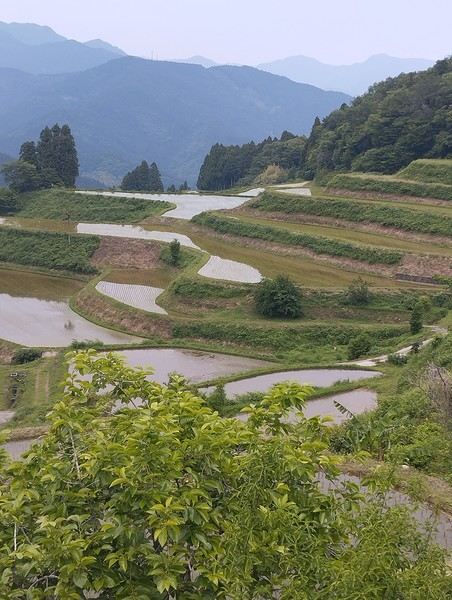
-->13 days in Shikoku, from Kochi (Kochi Prefecture) to Matsuyama (Ehime Prefecture)
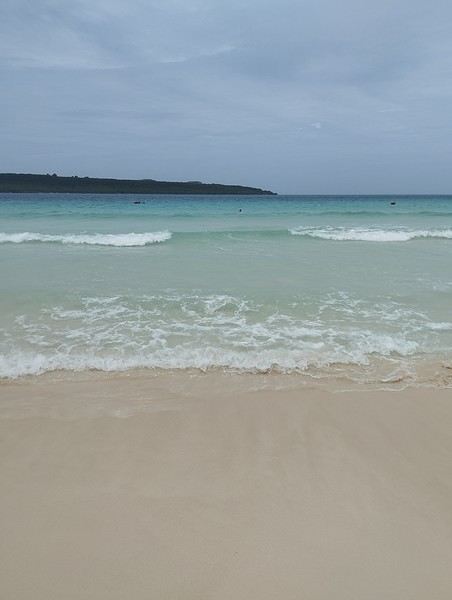
-->7 days in Miyakojima (Okinawa Prefecture)
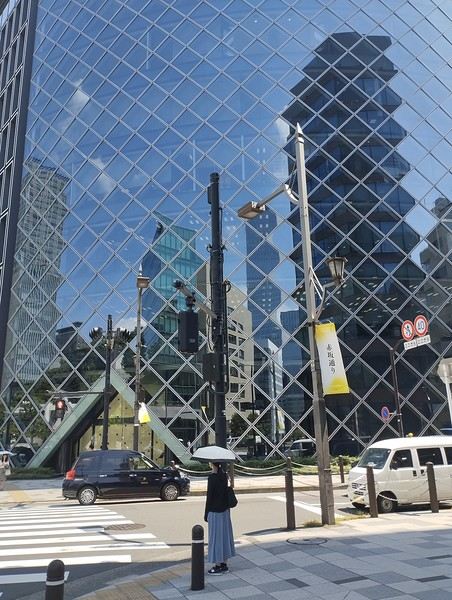
-->7 days in Tokyo
The trip was decided on fairly last-minute this year, as usual.
I regularly check flight prices to track fluctuations for this destination, even without concrete plans. Finding a slightly cheaper direct flight (900 €) than what I’d seen in previous months (around 1,200–1,400 € on average) for a Paris-Tokyo route with Japanese airline ANA was too tempting to resist the urge to return to this enchanting country. After long hesitations between exploring the San’in region (Matsue, Tottori, Yamaguchi) and southern Shikoku, the decision was made—I took the plunge! The tickets are booked: Paris to Kochi with a layover in Tokyo, all with ANA, the airline I’d been dreaming of... for 1,120 € per person. Okay, it’s not cheap, but it’s still better than in 2023.
We leave in 2 weeks!! Now it’s just a matter of getting everything ready!
Intense work ahead in these 2 weeks to:
finalize a more precise itinerary and reach an agreement—yep, because even though we both love Japan, our preferences differ slightly, and we have to choose between exploring new places or taking time to revisit beloved spots... decide how much time to spend in each selected area without rushing while still exploring research places that might interest us and watch videos about Japan book accommodations: yes, it’s possible to do this on the spot as we go, but last year, we noticed that last-minute options were pretty expensive, so we’re booking ahead—even if it means keeping a few options open while we decide or see if better deals pop up later reserve rental cars order yen check the weather regularly and wonder if choosing the *tsuyu* (rainy season) was really a good idea—and whether we’ll be stuck in non-stop rain???
What a tough job, right? Traveling to Japan for a month—such a hard life! Despite this being my 4th trip, the excitement is just as intense as the first time.
The only small downside is that when we booked the flight tickets, there were only a few seats left, so we’re only sitting together on the international return flight. Plus, on the outbound flight, we’ve got the middle seats. Another lingering question: what French-language films will be available? According to the internet, the selection seems limited. Oh well, these are just minor details—it’s almost time to fly!
PS: I’ll be posting slowly and irregularly... so for those interested, be patient or maybe set an alert...
Hi everyone,
I have to admit, I really hesitated before deciding to write this travel journal... Writing one takes a lot of time and energy, and since this is my 4th trip, I wondered if it would actually interest anyone other than myself (both for the discovery and the writing). But after a few "Are you going to write a journal?" requests and especially the renewed pleasure from reading other travelers’ travel journals about Japan or elsewhere on this forum or elsewhere, I’ve decided to share this 4th installment in the Land of the Rising Sun here.
The itinerary: 27 full days, from late May to late June 2025, right in the middle of the rainy season, including:
-->13 days in Shikoku, from Kochi (Kochi Prefecture) to Matsuyama (Ehime Prefecture)
-->7 days in Miyakojima (Okinawa Prefecture)
-->7 days in Tokyo
The trip was decided on fairly last-minute this year, as usual.
I regularly check flight prices to track fluctuations for this destination, even without concrete plans. Finding a slightly cheaper direct flight (900 €) than what I’d seen in previous months (around 1,200–1,400 € on average) for a Paris-Tokyo route with Japanese airline ANA was too tempting to resist the urge to return to this enchanting country. After long hesitations between exploring the San’in region (Matsue, Tottori, Yamaguchi) and southern Shikoku, the decision was made—I took the plunge! The tickets are booked: Paris to Kochi with a layover in Tokyo, all with ANA, the airline I’d been dreaming of... for 1,120 € per person. Okay, it’s not cheap, but it’s still better than in 2023.
We leave in 2 weeks!! Now it’s just a matter of getting everything ready!
Intense work ahead in these 2 weeks to:
finalize a more precise itinerary and reach an agreement—yep, because even though we both love Japan, our preferences differ slightly, and we have to choose between exploring new places or taking time to revisit beloved spots... decide how much time to spend in each selected area without rushing while still exploring research places that might interest us and watch videos about Japan book accommodations: yes, it’s possible to do this on the spot as we go, but last year, we noticed that last-minute options were pretty expensive, so we’re booking ahead—even if it means keeping a few options open while we decide or see if better deals pop up later reserve rental cars order yen check the weather regularly and wonder if choosing the *tsuyu* (rainy season) was really a good idea—and whether we’ll be stuck in non-stop rain???
What a tough job, right? Traveling to Japan for a month—such a hard life! Despite this being my 4th trip, the excitement is just as intense as the first time.
The only small downside is that when we booked the flight tickets, there were only a few seats left, so we’re only sitting together on the international return flight. Plus, on the outbound flight, we’ve got the middle seats. Another lingering question: what French-language films will be available? According to the internet, the selection seems limited. Oh well, these are just minor details—it’s almost time to fly!
PS: I’ll be posting slowly and irregularly... so for those interested, be patient or maybe set an alert...
Hi there,
I’m planning a trip to Japan with my three grown-up kids, who aren’t exactly keen on rushing from one place to another with heavy luggage. I’ve tried to balance things so we can see as much as possible while still giving them time to enjoy the evenings.
Here’s what I’ve come up with:
- Arrival in Tokyo on May 17
- Staying in Tokyo from May 17 to 22, exploring the city,
with a day trip to Nikko (round trip in one day): is it worth it, considering it’s a 2-hour train ride each way?
- Sending our big suitcases directly to Osaka
- Traveling to Kamakura on May 23: 1 night (with small luggage)
- Traveling to Hakone on May 24: 1 night (with small luggage)
- Heading to Osaka on May 25: staying from May 25 to June 2 in Osaka, where we’ll pick up our big suitcases
Day trips from Osaka:
- Kyoto: 2 days (round trip in one day)
- Nara: 1 day (round trip in one day)
My son would prefer to stay in Osaka for all 8 days, but I’m wondering if it’s a good idea to spend at least one night in Kyoto. What do you think?
- Leaving for Himeji on June 3: is it possible to leave both big and small luggage in a coin locker to visit the castle, or is it better to do a round trip from Osaka?
- Traveling to Hiroshima: 3 nights from June 3 to 5:
- Hiroshima: 1 day
- Miyajima: 1 day
- Okayama and Kurashiki: 1 day: is it better to do a round trip from Hiroshima and return to Tokyo from there, or spend the night of June 5 in Okayama and head to Tokyo from there?
- Back to Tokyo from June 6 to 9, with departure on the morning of June 9.
Since I’ve never been to Japan, I’ve tried to focus on the most interesting spots. Are there any places I’ve missed that you think we should add, or others that might not be as worthwhile?
About the luggage: is it a hassle to forward it to Kamakura, Hakone, and Kyoto? How much do coin lockers usually cost?
My son says the JR Pass isn’t worth it—what’s your take?
For accommodations, we’re leaning toward mid-range hotels with good value rather than apartments. Any great tips?
I know I’m asking a lot of questions—I really appreciate anyone who can point me in the right direction.
Thanks in advance!