Posts by Max68
About 8,135 results.
More options
Search results
Review of EasyTahiti agency
Good evening,
I had contacted them. They asked for a phone meet-up, which I did... and then nothing. We exchanged a bit, then no more responses. What I think: I wanted a trip a bit "off the beaten path," especially regarding the islands I wanted to visit, and they weren’t really interested. They prefer to stick with the "classic" options.
I had contacted two other agencies—one made me an offer, and the other threw in the towel like EasyTahiti... The others I consulted were Nani Travels and Manaventura. But if you want something classic, I think they’ll do it—and even do it well... though for something classic, do you really need an agency?
Happy pondering!
3 weeks in Kazakhstan and Kyrgyzstan, preliminary travel questions
Darn, my phone changed Mirza to Maria!
There were quite a few options for memory cards on the spot, so I’d try without a reservation. If it’s like in Asia, Agoda is better established than Booking
3 weeks in Kazakhstan and Kyrgyzstan, preliminary travel questions
We had stayed with Maria... but she didn’t seem to be very active on social media.
Some trips are born twice - Peru April - May 2025
Hello Carmen,
It’s a pleasure to catch up on your story—it’s enjoyable to follow despite your accident.
I hope there won’t be any lasting effects.
Thanks for taking us along on your journey! 😊😊
3 weeks in Kazakhstan and Kyrgyzstan, preliminary travel questions
vallée de Suusamyr
No, don’t miss it! I thought you were covering this area on the way there. So yes, you should definitely return by car :)
No, don’t miss it! I thought you were covering this area on the way there. So yes, you should definitely return by car :)
Planning a Zimbabwe-Zambia Road Trip
Hi Jean-Pierre,
Here’s a motivating itinerary! 🙂
How long are you going for? Combining Gonarezhou and Zambia in the same trip is ambitious, especially since Zambia’s flagship park, South Luangwa, is way over in the east. Wouldn’t it make more sense to save it for a combo with eastern Zambia + Malawi?
Gonarezhou is best known for its northern section along the Runde River. It’s truly stunning. For camps, there’s a public one: Chipinda, which is really nice by the Runde but I find it a bit far from the main points of interest to use as a base. The park is more famous for its exclusive camps (which need to be booked a year in advance). We loved Bhenji Wear—it’s remote and perched on a bluff with a river below and a watering hole a little farther away. Director and Hlaro let you see the Cliffs. Near the confluence: Chitove, Pokwe, and Mutamagwenzi, which are close to areas with lots of wildlife.
Be aware the park is way down south, so plan for a lot of driving. On the way to Hwange, you’ve got Matopo, which we really enjoyed. We camped at Big Cave, which is close to the park.
In Hwange, we love Masuma Dam (we’ve camped twice in this hide, which you can privatize). Deteema and Mandavu Dam are also great in that area. Otherwise, around Ngwesla is fantastic. There’s no direct watering hole like at Masuma, but you get this amazing "end of the world" vibe. The surroundings are really nice too.
From Gonarezhou to northern Zimbabwe, Great Zimbabwe makes a pleasant stop, and especially Lake Mutirikwi. We stayed at Romelda Retreat—it was amazing.
Zimbabwe is way more enjoyable to drive through than Botswana—there’s more life, villages, lakes, little hills, and granite outcrops. We really love it.
In the north, the concentration of parks is higher. First, there’s Lake Kariba. You can: - Cross it from west to east by ferry—it’s a fantastic experience (22 hours by boat).
- Or take the track that follows the same east-west route. Be careful—some sections are in bad shape. From Hwange, you could plan a stop along the lake (like Maabwe Bay), then head up into the highlands in Chizarira Park (the camps along the cliff are great—we stayed at Mucheni Gorge Camp), even if the wildlife isn’t as concentrated there. You’ll find more animals around Mabola. Next, you can go to Matusadona, a park I adore. There’s a stunning public campsite there: Tashinga. We’ve also stayed in exclusive camps but preferred Tashinga. The track improves every year but is still long. After that, there’s the Gache Gache area, but I haven’t been there. And finally, the jewel: Mana Pools. Like Chobe, everything happens along the water, so there aren’t many tracks, and it gets crowded, but it’s absolutely breathtaking. There’s a public campsite, Nyamepi, but we only passed through—we stayed in exclusive camps far from everything: Nkupe and BBC Camp (which no longer exists). The closest to BBC now is Mucheni. And if you go to Mana Pools, don’t forget to camp at one of the most magical spots in southern Africa: Chitake. It’s completely off the grid, but you’ll be above a wide canyon with a spring. It’s the only water source for 20 or 30 km around, so you’ll likely see elephants down below and buffaloes racing down from the heights to drink, then rushing back up to avoid becoming dinner for the two lion prides fighting for dominance in the area. One of the prides even passed through our camp at night—we could hear them breathing and growling. Our friends in a ground tent didn’t sleep a wink!
That’s it for Zimbabwe.
Across from Mana Pools, on the Zambian side, you’ve got Lower Zambezi. But the view from the Zimbabwean side is more beautiful because you can see the rift, which you don’t get from the other side. Plus, Lower Zambezi doesn’t have camping inside the park, so you end up driving a lot.
On the Zambian side, Bangwelu is nice for spotting the shoebill. Otherwise, there’s Kafue Park—it’s great for a river cruise since the river is so wide. However, the animals were heavily poached for a long time, so they were pretty skittish when we were there. That said, north of Kafue, there’s an area called Busanga Plains—one of the most incredible places I’ve seen in southern Africa.
Booking in these countries isn’t easy, though. We went through a Zimbabwean agency we were really happy with. Keep in mind that very few agencies are willing to handle self-drive campers.
Should I stop here, or do you want me to keep going? [;]
3 weeks in Kazakhstan and Kyrgyzstan, preliminary travel questions
Hi Agnès,
Sorry I’ve been around so little lately. I really loved the "end of the world" vibe in Sary Tash... but there’s still a grocery store, gas station, and exchange bureau. It might be worth taking the road toward Tajikistan—the views are gorgeous. You can always turn back before the border post.
Couldn’t you leave the car in Osh and fly home from there?
3 weeks in Kazakhstan and Kyrgyzstan, preliminary travel questions
Hello Jean Pierre,
The Pamir is a whole different trip... forgotten tracks except on old Soviet-era maps, and you’d better be ready to camp at high altitudes (over 4,000 meters for quite a while). As for the facilities, I remember a lovely guesthouse in the Wakhan Valley where you had to hold your breath just to use the toilet 🤪
The Pamir is a whole different trip... forgotten tracks except on old Soviet-era maps, and you’d better be ready to camp at high altitudes (over 4,000 meters for quite a while). As for the facilities, I remember a lovely guesthouse in the Wakhan Valley where you had to hold your breath just to use the toilet 🤪
3 beautiful weeks during the Japanese autumn
Ah, so you're the ones who got all the sunshine! 😉 We were there the second half of October, and the sun wasn’t really on our side—just white skies and rainy spells. 🤪
Lovely varied itinerary you took the time to share all the way through! 🙂
Lovely varied itinerary you took the time to share all the way through! 🙂
Road trip in Japan by car: Kyushu - Chugoku - Shikoku - Kyushu
But not at the same price...🤪
We paid 1028 € for the two weeks for a medium-sized car (4 adults + 4 bags). That seems pretty reasonable to me
We paid 1028 € for the two weeks for a medium-sized car (4 adults + 4 bags). That seems pretty reasonable to me
Road trip in Japan by car: Kyushu - Chugoku - Shikoku - Kyushu
Yes, a self-drive travel journal is a great idea!
For you, I’ll jump to the conclusion: traveling by car in Japan is almost as easy as it is in France :cool:
For you, I’ll jump to the conclusion: traveling by car in Japan is almost as easy as it is in France :cool:
Three weeks in Japan with family
Hello,
Thanks for your comment and the link. I ended up taking another look at your travel journal and discovered we followed in your footsteps—we also went to Teshima! 🙂
Thanks for your comment and the link. I ended up taking another look at your travel journal and discovered we followed in your footsteps—we also went to Teshima! 🙂
Road trip in Japan by car: Kyushu - Chugoku - Shikoku - Kyushu
Hello,
Yeah, Japan is super popular right now! 🙂 I thought about making a travel journal, but since this is an unusual loop and we did it as a self-drive trip, we figured it might interest future travelers.
Yeah, Japan is super popular right now! 🙂 I thought about making a travel journal, but since this is an unusual loop and we did it as a self-drive trip, we figured it might interest future travelers.
Road trip in Japan by car: Kyushu - Chugoku - Shikoku - Kyushu
Hey JF,
I don’t have a bad memory of my flights with them, but maybe things have changed.
They struggle with punctuality, and the seats are cramped.
So you had your license translated before leaving. Who did you use for that?
Keikaku
I don’t have a bad memory of my flights with them, but maybe things have changed.
They struggle with punctuality, and the seats are cramped.
So you had your license translated before leaving. Who did you use for that?
Keikaku
3 beautiful weeks during the Japanese autumn
Hi Patrick,
Nice travel journal! It’s great because this way I’ll get to see the region of Japan I was hesitating about (the Alps). Kamakura seems really charming. Looks like you had the same not-so-great weather...
I’m happily joining in! 🙂
Nice travel journal! It’s great because this way I’ll get to see the region of Japan I was hesitating about (the Alps). Kamakura seems really charming. Looks like you had the same not-so-great weather...
I’m happily joining in! 🙂
Road Trip in Japan: Kyushu - Chugoku - Shikoku - Kyushu
Thanks Agnès and Jérôme for joining us! 🙂
Friday, October 18 Flight from Frankfurt to Fukuoka with a layover in Hong Kong on Cathay Pacific. Well, this is the second time we’ve flown with them, and we’re still not fans...
Saturday, October 19 Arrival in Fukuoka at 3:30 PM. Picked up the rental car from Budget at the airport. No issues—when it comes to organization, the Japanese have it down. We’d opted for the ETC card for the electronic tolls.
Spent the night at Resol Hakata Hotel. This was the better of the two hotels we stayed at in Fukuoka. Plus, it’s well located. ... yep, we’re definitely in Japan now 😉
In the evening, we headed to the Tenjin district to check out the Yataï, where we happily stuffed ourselves... yum yum!
A little post-dinner culture with Kushida Jinja.

Friday, October 18 Flight from Frankfurt to Fukuoka with a layover in Hong Kong on Cathay Pacific. Well, this is the second time we’ve flown with them, and we’re still not fans...
Saturday, October 19 Arrival in Fukuoka at 3:30 PM. Picked up the rental car from Budget at the airport. No issues—when it comes to organization, the Japanese have it down. We’d opted for the ETC card for the electronic tolls.
Spent the night at Resol Hakata Hotel. This was the better of the two hotels we stayed at in Fukuoka. Plus, it’s well located.
... yep, we’re definitely in Japan now 😉In the evening, we headed to the Tenjin district to check out the Yataï, where we happily stuffed ourselves... yum yum!
A little post-dinner culture with Kushida Jinja.
Road Trip in Japan by Car: Kyushu - Chugoku - Shikoku - Kyushu
Before starting the story, a quick context note about Japanese castles:
The donjons of the archipelago The Japanese castle, with its multi-story donjon, large watchtowers, wooden architecture, and nowadays its vast open gardens, has become one of the iconic landmarks of the Land of the Rising Sun. But did you know there are several types of castles across the archipelago?
The yamajiro We won’t be visiting any castles of this type. The only one that existed, Bichu-Matsuyama, would have required too big of a detour... timing, you got us... Before the 14th century, Japan only had temporary castles consisting of wooden fortifications surrounded by moats, designed to serve as defenses against foreign invasions. During the Sengoku period of warring states (1477–1573), the multiplication of conflicts across the country led to the construction of the first castles intended for internal use. These castles were built on high ground, on hills or mountains. "Yamajiro" means "mountain castle." Due to the terrain on which it was built, the castle had neither watchtowers nor moats, but simply a donjon ("tenshu"), from which it was easy to survey the territory for military operations.
The hirayamajiro We’ll visit three of these: Matsuyama, Matsue, and Kumamoto. The hirayamajiro, or "plain and mountain castle," is built in a way that combines the advantages of high ground and the plain, allowing for both military and civil use (as a political power center). Thus, a castle was built on a hill overlooking the plain easily. Unlike the yamajiro, the hirayamajiro features, in addition to its imposing stone-based tenshu, moats, turrets ("yagura"), and very complex fortification systems for strong citadel defense. Those we’ll visit fall into this category.
The hirajiro We’ll visit Okayama’s, which is of this type. The hirajiro is a "plain castle" corresponding to castles built during a more peaceful era. At this time, the fortress, seen as a symbol of power, played a much more political and economic role than a strategic one. Indeed, its topographical location made it much harder to defend. Located in the center of cities, it still retained large moats and turrets as a means of protection. These vast castles, spanning several hectares, were, like the hirayamajiro, traditionally organized around multiple enclosures. The "honmaru," the inner citadel surrounding the donjon, served as the lord’s residence, while the "ninomaru" (second enclosure) and "sannomaru" (third enclosure) housed samurai, among others.
The mizujiro We’ll visit Imabari’s. Alongside these major castle categories, there’s a smaller one called "mizujiro," or "water castles." Only three remain: those in Nakatsu (Ōita Prefecture, so visitable), Takamatsu (Kagawa Prefecture), and Imabari (Ehime Prefecture, so visitable). These castles face the sea and use it as a form of protection.
Road Trip in Japan: Kyushu - Chugoku - Shikoku - Kyushu
Hi everyone,
It’s been a while since I last posted... so I’m jumping back in with this amazing trip we took in October 2025:
We’re doing this trip with fellow traveler friends who, like us, have already been to Japan. That means we can aim for a different side of Japan, away from the usual tourist circuits. That’s why I opted to rent a car instead of relying on trains. I was drawn to the castles and the samurai-novel atmosphere.
When I plotted the sites I wanted to visit on Google Maps, it suggested a return route via the island of Shikoku, so it turned into a nice loop around the Seto Inland Sea between Kyushu, Chugoku, and Shikoku.
The trip will be just the four of us, doing it all independently. I rented a car from Budget in Fukuoka. Before heading over, I watched several videos to get an idea of what to expect—road signs, parking, and general driving behavior. In Japan, they drive on the left, but that’s not an issue since in Southern Africa we also drive on the “wrong side of the road,” so I’m used to it. For accommodations, after checking with two agencies, I decided to handle it myself. It saved a significant amount of money, and I was able to choose exactly what I wanted. I know I can be picky about the type of lodging I want, especially in Japan where you can really treat yourself. We stayed in some stunning ryokans, once in little cabins run by monks next to a temple, and more.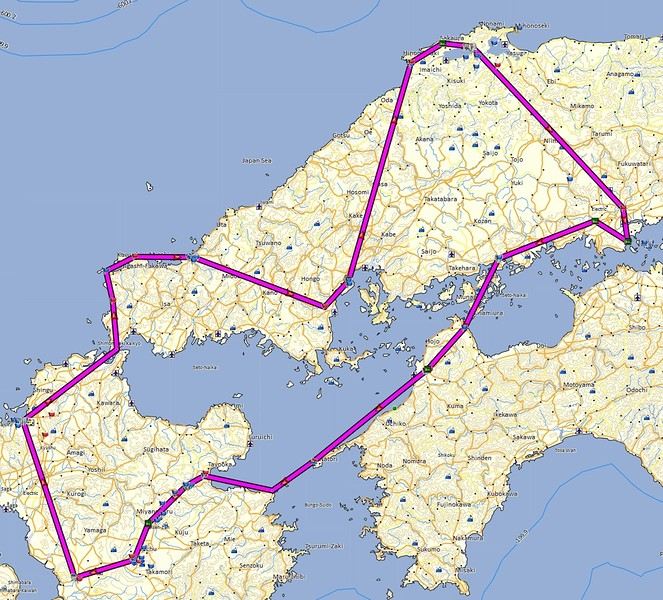
Here’s the route: Fukuoka - Hagi - Miyajima - Matsue - Okayama - Kurashiki - Matsuyama - Yufuin - Kurokawa - Kumamoto - Fukuoka
Here we gooo...
It’s been a while since I last posted... so I’m jumping back in with this amazing trip we took in October 2025:
We’re doing this trip with fellow traveler friends who, like us, have already been to Japan. That means we can aim for a different side of Japan, away from the usual tourist circuits. That’s why I opted to rent a car instead of relying on trains. I was drawn to the castles and the samurai-novel atmosphere.
When I plotted the sites I wanted to visit on Google Maps, it suggested a return route via the island of Shikoku, so it turned into a nice loop around the Seto Inland Sea between Kyushu, Chugoku, and Shikoku.
The trip will be just the four of us, doing it all independently. I rented a car from Budget in Fukuoka. Before heading over, I watched several videos to get an idea of what to expect—road signs, parking, and general driving behavior. In Japan, they drive on the left, but that’s not an issue since in Southern Africa we also drive on the “wrong side of the road,” so I’m used to it. For accommodations, after checking with two agencies, I decided to handle it myself. It saved a significant amount of money, and I was able to choose exactly what I wanted. I know I can be picky about the type of lodging I want, especially in Japan where you can really treat yourself. We stayed in some stunning ryokans, once in little cabins run by monks next to a temple, and more.
Here’s the route: Fukuoka - Hagi - Miyajima - Matsue - Okayama - Kurashiki - Matsuyama - Yufuin - Kurokawa - Kumamoto - Fukuoka
Here we gooo...
Back from 3 weeks in Guatemala on a self-drive trip.
Thanks Dédé for your feedback! 🙂
Mauritian Ti' punch
It was a surprise for me too 😉 🙂