Discussions started by Taamaden
About 173 results.
More options
Many results are in French, the community’s main language. English translations are added over time.
Search results
Glacial, dystopian, minimalist: Alan Vega and Martin Rev
"He was one of the most striking figures of the early American punk scene and a pioneer of electronic music with his band Suicide," Henry Rollins, another flag-bearer of punk in the United States
Alan Vega, pop visionary within the duo Suicide
Suicide formed in 1970, with Alan Vega on vocals and Martin Rev on machines, and first made a name for themselves live. Their concerts were known for being radical and often ending in violence, foreshadowing the punk movement a few years later. Their self-titled debut album, released in 1977, was recorded in four days and blended what would later be called proto-punk with electronic music played on synthesizers and drum machines, influenced by rockabilly. While Suicide didn’t achieve massive popular success, they nonetheless influenced the entire international music scene. Without Alan Vega, there probably wouldn’t have been New Order, Human League, Pulp, Soft Cell (Dave Ball and Marc Almond), Primal Scream, Jesus & Mary Chain, or Depeche Mode in the 1980s—or Radiohead and Aphex Twin, bands from the '90s who all cite Suicide as an influence. Bruce Springsteen covered their Dream Baby Dream on his album High Hopes, while Suicide covered Springsteen’s Born in the USA, and LCD Soundsystem reinterpreted Bye Bye Bayou from Alan Vega’s solo album Jukebox Babe / Collision Drive.
The tireless artist, musician, and visual artist—born Boruch Alan Bermowitz in Brooklyn in June 1938—never stopped creating. With Suicide, he released five studio albums, the last being American Supreme in 2002. As a solo artist, he also had an intense career, releasing 15 albums over his lifetime. Always searching for new ways to express himself, he became a wanderer of pop music: without ever resting, he traversed the modern sound landscape, blending his teenage love for Elvis Presley with minimal techno, No Wave to New Wave, industrial patterns with acoustic sounds. The key was to take himself where he’d never been before. Even after a heart attack and stroke in 2012, he continued performing with his old partner Martin Rev. He claimed to have been inspired by a 1969 Iggy Pop & the Stooges concert in New York.
Suicide, a journey spanning over 30 years for a band always at the cutting edge, shaping the sound of New York. With minimal and raw means, Suicide stripped rock ‘n’ roll down to its essence: a mic, leather, a primitive synth. Nearly a decade ahead of their time, Suicide invented an electro-pop that so many British bands would later polish and sanitize. Among that generation built on Suicide’s stiff and chaotic principles, only Soft Cell retained that dark and threatening aesthetic.
Suicide’s debut album (1977) remains one of the most exciting musical propositions of the '70s—a brutal, sexy, and frenzied testimony of a New York accelerating through history. A masterpiece. A true cult classic. You’ve got to listen to Ghost Rider (one of my favorites), Rocket USA, Cheree, Johnny, Girl, Frankie Teardrop, Che...
Unforgettable...
hgb
Audios:
1) Ice drummer https://www.youtube.com/watch?v=2nxCodtSows&list=RD2nxCodtSows&start_radio=1
2) Ghost rider
https://www.youtube.com/watch?v=5rISbnsi0Ns&list=RD5rISbnsi0Ns&start_radio=1
3) Dream baby Dream
https://www.youtube.com/watch?v=XyvhTIOJeJ4&list=RDXyvhTIOJeJ4&start_radio=1
4) Outlaws, live in Cologne (Köln), Germany
https://www.youtube.com/watch?v=UR92qcOG8co&list=RDUR92qcOG8co&start_radio=1
5) Jukebox Babe
https://www.youtube.com/watch?v=3Dk96sfLjfU&list=RD3Dk96sfLjfU&start_radio=1
Rooted in tradition yet forward-looking
"Massa", Fatoumata Diawara's new album
Fifteen years after her debut album "Fatou" (World Circuit), Fatoumata Diawara has become a key figure on the international music scene. Born in Abidjan and raised in Bamako, this singer and guitarist began her career as an actress before turning to music in 2011. She has performed at prestigious festivals, including Glastonbury (UK) and Montreux (Switzerland), and shared the stage with international stars like Roberto Fonseca, Damon Albarn, and Paul McCartney. This artist effortlessly moves between continents and genres, all while singing in her native language, Bambara. Her new album "Massa", released in May on the Parisian label Nø Førmat!, was produced in collaboration with French musician -M- (Matthieu Chedid) and is her most personal work to date. Diawara explores both political resistance and her life as a daughter, mother, and artist. Musically, "Massa" draws from her homeland, Mali, blending West African traditions with pop, reggae, funk, electro, folk, and rhythmic structures from Afrobeat and jazz.
These stylistic blends never feel artificial or calculated. Traditional rhythms and melodic turns merge naturally with contemporary sounds, creating music that feels both familiar and fresh. But the album’s real strength lies in its songs—narrative pieces whose beauty comes from their sincerity, not spectacle. Her voice carries a unique power: it can be soft yet determined, vulnerable yet confident.
"Massa" is her most personal and introspective work yet. This globally acclaimed singer, songwriter, and guitarist also sees herself as a socially engaged artist—one who doesn’t just get people moving but aims to touch hearts and minds. She tackles social themes like the breakdown of human relationships, disappointment, betrayal, jealousy, and the complex dynamics of polygamous family structures. She also addresses female genital mutilation without preaching, instead sharing stories from her own experience that resonate universally.
Some artists preserve tradition. Others bring it to life. Fatoumata Diawara undoubtedly belongs to the latter. With "Massa", she creates an album deeply rooted in Mali’s musical heritage while speaking the language of the present.
hgb
https://fatoumatadiawaranoformat.bandcamp.com/album/massa
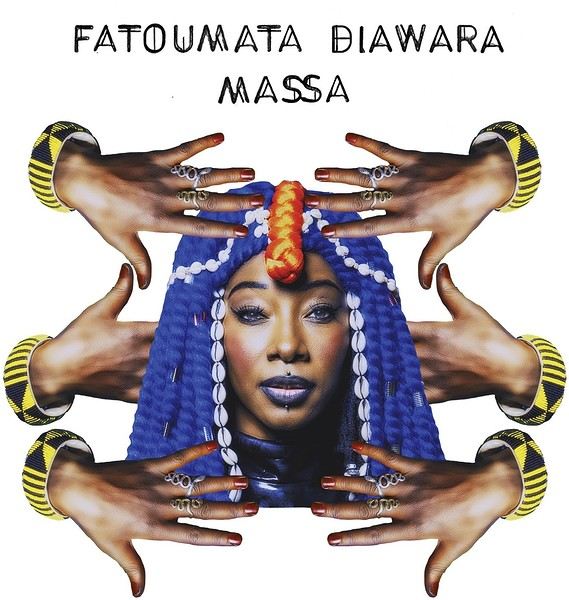
Fifteen years after her debut album "Fatou" (World Circuit), Fatoumata Diawara has become a key figure on the international music scene. Born in Abidjan and raised in Bamako, this singer and guitarist began her career as an actress before turning to music in 2011. She has performed at prestigious festivals, including Glastonbury (UK) and Montreux (Switzerland), and shared the stage with international stars like Roberto Fonseca, Damon Albarn, and Paul McCartney. This artist effortlessly moves between continents and genres, all while singing in her native language, Bambara. Her new album "Massa", released in May on the Parisian label Nø Førmat!, was produced in collaboration with French musician -M- (Matthieu Chedid) and is her most personal work to date. Diawara explores both political resistance and her life as a daughter, mother, and artist. Musically, "Massa" draws from her homeland, Mali, blending West African traditions with pop, reggae, funk, electro, folk, and rhythmic structures from Afrobeat and jazz.
These stylistic blends never feel artificial or calculated. Traditional rhythms and melodic turns merge naturally with contemporary sounds, creating music that feels both familiar and fresh. But the album’s real strength lies in its songs—narrative pieces whose beauty comes from their sincerity, not spectacle. Her voice carries a unique power: it can be soft yet determined, vulnerable yet confident.
"Massa" is her most personal and introspective work yet. This globally acclaimed singer, songwriter, and guitarist also sees herself as a socially engaged artist—one who doesn’t just get people moving but aims to touch hearts and minds. She tackles social themes like the breakdown of human relationships, disappointment, betrayal, jealousy, and the complex dynamics of polygamous family structures. She also addresses female genital mutilation without preaching, instead sharing stories from her own experience that resonate universally.
Some artists preserve tradition. Others bring it to life. Fatoumata Diawara undoubtedly belongs to the latter. With "Massa", she creates an album deeply rooted in Mali’s musical heritage while speaking the language of the present.
hgb
https://fatoumatadiawaranoformat.bandcamp.com/album/massa
Improvisations on the Gayageum (Zither on a Curved Table)
New album from Korean artist DoYeon Kim, featuring an exceptional lineup
The "gayageum" is the name given to the zither on a curved table, a chordophone played across Central Asia (Vietnam, China, Korea, and Japan), existing in versions with 12 and 25 strings. It’s practically unknown in contemporary improvisational music, though Chinese musician Xu Fengxia has long demonstrated how brilliantly this instrument can be used in improvisations. Now, DoYeon Kim is following in her footsteps.
The Korean artist learned the gayageum traditionally. When DoYeon Kim moved to the United States a few years ago to study music, she began incorporating this plucked string instrument into contemporary music and experimenting with unconventional playing techniques.
Now based in Brooklyn, New York, DoYeon Kim recorded her new album Wellspring with an exceptional trio: Mat Maneri (viola), Tyshawn Sorey (drums), and Henry Fraser (bass). Four compositions are written and performed with precision and attention to detail, following the score, while the gayageum player also reveals herself as a dynamic vocalist. Three other tracks (Whispers Among Dawn, Diffraction, Linear System) are collective improvisations, each opening into a distinct sound world. One piece unfolds almost monochromatically from the sounds of bowed strings, while another features crackling gayageum notes, highlighted by glissandos and pronounced vibrato. In this track, the other instruments step back to let the earthy, woody tones of the strings fully blossom.
Wellspring, released in May 2026 on TAO Forms, marks her debut as a bandleader on record—and immediately establishes itself as a bold statement of intent. DoYeon Kim and her three fellow musicians craft an acoustic universe that draws from Korean traditions, the provocative energy of New York’s No Wave scene, and the open interactions of free jazz...

https://www.nytimes.com/video/arts/music/100000010874960/doyeon-kim-wellspring-gayageum.html
Audio:
https://www.youtube.com/playlist?list=OLAK5uy_kcUlgyo60w6WoKisn-30TLMyo7NA2ep_Q
https://www.wrti.org/podcast/late-set/2026-08-04/wellspring-with-doyeon-kim
The "gayageum" is the name given to the zither on a curved table, a chordophone played across Central Asia (Vietnam, China, Korea, and Japan), existing in versions with 12 and 25 strings. It’s practically unknown in contemporary improvisational music, though Chinese musician Xu Fengxia has long demonstrated how brilliantly this instrument can be used in improvisations. Now, DoYeon Kim is following in her footsteps.
The Korean artist learned the gayageum traditionally. When DoYeon Kim moved to the United States a few years ago to study music, she began incorporating this plucked string instrument into contemporary music and experimenting with unconventional playing techniques.
Now based in Brooklyn, New York, DoYeon Kim recorded her new album Wellspring with an exceptional trio: Mat Maneri (viola), Tyshawn Sorey (drums), and Henry Fraser (bass). Four compositions are written and performed with precision and attention to detail, following the score, while the gayageum player also reveals herself as a dynamic vocalist. Three other tracks (Whispers Among Dawn, Diffraction, Linear System) are collective improvisations, each opening into a distinct sound world. One piece unfolds almost monochromatically from the sounds of bowed strings, while another features crackling gayageum notes, highlighted by glissandos and pronounced vibrato. In this track, the other instruments step back to let the earthy, woody tones of the strings fully blossom.
Wellspring, released in May 2026 on TAO Forms, marks her debut as a bandleader on record—and immediately establishes itself as a bold statement of intent. DoYeon Kim and her three fellow musicians craft an acoustic universe that draws from Korean traditions, the provocative energy of New York’s No Wave scene, and the open interactions of free jazz...
https://www.nytimes.com/video/arts/music/100000010874960/doyeon-kim-wellspring-gayageum.html
Audio:
https://www.youtube.com/playlist?list=OLAK5uy_kcUlgyo60w6WoKisn-30TLMyo7NA2ep_Q
https://www.wrti.org/podcast/late-set/2026-08-04/wellspring-with-doyeon-kim
"Glory": an Animal Farm for Zimbabwe—and the world
"400 pages of verbal pyrotechnics and animal magic" — The Times
"Bulawayo leans into exaggeration and irony to tell hard truths. *Glory* is jam-packed with comedy and farce, poking fun at an autocratic regime while illustrating the absurdity and surreal nature of a police state." — The Guardian
The cruelty and savagery of Zimbabwe’s (and Africa’s in general) "powerful animals"
Zimbabwean author NoViolet Bulawayo has written a novel that illustrates better than any documentary the complexity of colonial legacy. In doing so, she revisits George Orwell’s Animal Farm. Her novel *Glory* is a political satire about Zimbabwe—and it’s brimming with humor.
For thirty years, Zimbabwe has been stagnating under Robert Mugabe’s presidency. Human rights violations, corruption, and international sanctions have kept the population mired in poverty and oppression, while the regime exploits the meager earnings of the economy. As the 2017 elections approach, a power struggle erupts over the succession of the very elderly Father of the Nation (Mugabe). On the streets, people hope for long-awaited reforms; the people feel their moment has come.
And indeed, the army ousts Mugabe and his wife—"with her Gucci heels" (p.32)—who was positioning herself for the presidency. Hopes are dashed, however. The generals install former vice-president Emmerson Mnangagwa in power; the regime merely changes faces, but the problems remain the same.
In the novel, the country is called "Jidada, with a -da and another -da" (p.1); there’s no mistaking that this fictional state is Zimbabwe.
For *Glory*, her second novel, NoViolet Bulawayo invents a whole series of codes whose strength lies precisely in how easy they are to decipher. Like George Orwell’s Animal Farm, the characters populating Bulawayo’s universe aren’t humans but horses, goats, or crocodiles with all-too-human traits. Mugabe and Mnangagwa are horses, the spiritual leader is a pig, the soldiers are all bloodthirsty dogs, while the populace consists of goats, chickens, donkeys, and cats. The shift to the animal world serves only to better grasp the laws of despotism—and to ridicule real-life models. On one hand, the animals are humanized: they tweet, torture, travel in private jets. On the other, their greed, stupidity, and brutality stem from their animal nature.
It’s the old trick of fable: dressing men in animal disguises to make them easier to recognize. That’s how Orwell, in Animal Farm, traced how the promise of liberation from the Russian Revolution turned into Stalinist terror. In his 1945 fable, George Orwell describes how the animals of a farm drive out their farmer to organize the exploitation themselves, collectively. For a time, they truly taste freedom, but a clique of pigs ends up taking control. The central figures of the Soviet story—Stalin, Trotsky, Molotov—were easily recognizable.
Yet Bulawayo departs sharply from Orwell. She’s less concerned with precision and the force of argument than with satirical exaggeration. The deposed president is a senile old man who believes he can control even the sun’s course. The new stallion in power is a greedy debaucher. His soldiers sniff respectfully at his tail and backside.
In Bulawayo’s *Glory*, things are more complicated, but her novel also tells of a failed, incomplete liberation. In the author’s Animal Farm, Jidada, the colonial exploiters are followed by new forms of oppression. Because the former liberators become tyrants themselves. And because global power dynamics persist in neocolonial structures.
Wouldn’t that be enough to fuel a deeply depressing narrative? No—Bulawayo turns it into a blazing satire, full of wit and uncompromising criticism of power, a thread running through contemporary (not just) Zimbabwean history. The old warhorses in NoViolet Bulawayo’s Jidada, who continue to act as pack leaders, are easily recognizable as caricatures of the longtime dictator Robert Mugabe and his successor, current president Emmerson Mnangagwa.
The plot kicks off in high gear with independence day festivities. From the crack of dawn, everyone waits on Jidada Square for the Old Horse, the Father of the Nation and former liberator, whose reign "was nearing all of—not one, not two, not three, but four solid decades" (p.1). Everywhere, the colors of the Jidada Party shine; everywhere, true supporters cheer. Even the scorching sun plays its part: "At this point the sun, upon seeing arrive the leader who was decreed by God himself to rule and rule and keep ruling, a leader who'd in turn decreed the very sun to head his cheerleading squad, took a deep, deep breath and thoroughly blazed to impress" (p.2).
Finally, the Old Horse’s luxury carriage approaches "with the slowness of a hearse" (p.2), and "hoping to catch a glimpse of the legendary Father of the Nation," which causes "the animals fell over themselves like intoxicated frogs" (p.2). The sovereign’s speech is delayed a moment longer: "what I really want is a nap," groans the Old Horse as he takes his seat with such care "like his backside was made of expensive porcelain" (p.6).
Meanwhile, Bulawayo parades his entourage: the president’s wife (who earns her doctorate at Jidada University faster than "you could say diss, for dissertation. Tholukuthi it was as easy as ordering from a KFC drive-through, or perhaps even easier being that it was cheaper than KFC; it in fact cost her nothing and the degree actually came with a zero-calorie Diet Coke and a purple straw" (p.41), and she’s now known as Dr Sweet Mother. The cabinet includes "the Minister of the Revolution, the Minister of Corruption, the Minister of Order, the Minister of Things, the Minister of Nothing, the Minister of Propaganda, the Minister of Homophobic Affairs, the Minister of Disinformation and the Minister of Looting" (p.9). And of course the vice-president, who will soon become interim president when the Old Horse finally kicks the bucket—and then settle in as the new long-term president, who in the novel is called Tuvius Delight Shasha, or "Tuvy" for short (p.253), none other than Emmerson Mnangagwa. It’s him Bulawayo reserves her most merciless character description for.
"New Dispensation" (p.109) is Tuvy’s slogan for Jidada, and he loves repeating it so much he even named his parrot after it ("So inspired was Tuvy by the realisation that he rechristened his new pet parrot with the name New Dispensation—tholukuthi the bird having been acquired explicitly for the purposes of tweeting eulogies and accordingly glorifying the Saviour throughout the airs and skies of the nation. Tuvy then went on to hire a lecturer in English from the University of Jidada to teach New Dispensation to say the phrase 'New Dispensation'" p.110). But Tuvy’s Zimbabwe remains a nation without free, fair, and credible elections ("#freefairncredibleelection" p.161), and the promised equal treatment applies only insofar as Zimbabweans now queue up without discrimination in endless lines—and everyone is as poor as the next in the "queuenation" (p.283). Except for the powerful. They can "yes, tholukuthi, her immeasurable riches theirs to take. And take they did—
just take—take—take—take—take—take—take—take—take—take—take—take—take—take—take—take—take—take—take—take—take—take—take—take—take—take—take" (p.249-250).
In short: Bulawayo brilliantly depicts how former independence fighters become exploiters themselves. And how the country threatens to suffocate under the weight of corruption and repression. But she also literally stages the polyphony with which the people oppose imposed obedience to the official line.
Controversial online discussions keep interrupting the narrative—dialogues and social threads (see photo below) that Bulawayo masterfully integrates. From a literary standpoint, it’s a brilliant idea. And it shows, above all, that the author’s sympathy—so likeable—goes to all those who refuse to let their dream of true freedom be stolen, not even by the corrupt elites of their own country.
In the book’s acknowledgments, the first tribute goes to "The Jidadas of the world, clamouring for freedom on many fronts—A luta continua." (p.401) This reflects the realization that, not only in Jidada-Zimbabwe but in many other corners of the world, the end of colonial domination is still far from meaning the freedom hoped for by the vast majority of people. But it also means, more broadly, that this freedom must be won "on many fronts" (see above), both domestically and geopolitically.
That’s precisely what *Glory* so vividly highlights: how complex the project behind the term "postcolonialism" really is. With *Glory*, Bulawayo also delivers a scathing critique of the persistence of colonial mindsets in the West.
In the novel, the murder of George Floyd, racist police violence, and white-supremacist ideology in Trump’s United States perfectly illustrate the persistence of racism. It’s especially in the final chapters that Bulawayo lets Jidada’s inhabitants explicitly and unflinchingly criticize a neocolonial world order:
"It was not lost on us how the West, which loved to 'save' Africa and announce every action to the whole world, did so with one limb while manipulating, looting and fleecing us with the rest of its limbs so that more money in fact poured out of the continent than trickled in." (p.376)
"It was no mistake that multinational corporations yearly reaped and shipped colossal profits from Africa back to their countries as had been the case during colonial times. Even the sticks and stones would tell you that the African earth at any given time howled and shook and heaved from the extraction of its precious minerals that rarely benefited its own miserable children." (p.376)
"(...) we vowed to wage yet another war for Africa's second Liberation from neocolonial oppression. From exploitation. From plunder. From Western dominion. From indignity. From Abuse. We wanted real freedom. We wanted greedy, thieving paws off our wealth. We wanted Justice. We wanted a new world; we wanted a brand-new world so much we didn't sleep a wink that night." (p.377)
The Jidadas of this world must fight two enemies: Western neocolonialism and the autocratic instrumentalization of that argument; the persistence of Western racism and the populist appropriation of that humiliation by tyrants from their own ranks. Neither of these obstacles to freedom diminishes the historical and current guilt of the other. But the path to postcolonial liberation must overcome all these forms of oppression. After all, the colonizers didn’t bequeath democracies to formerly dominated nations, but instability and the principles of oppression and exploitation—which the so-called liberators have also internalized. Yet the fact that a satirical novel can capture the complexity of historical relationships while remaining, despite all the darkness of the subject, hilarious—well, that’s truly astonishing.
Finally, *Glory* ties into a major trauma in Zimbabwe’s post-independence history: the so-called Gukurahundi massacres. Between 1983 and 1987, tens of thousands of civilians were murdered by Mugabe’s bloody henchmen, most of them Ndebele. The State Security Minister and head of secret services at the time? You guessed it—Emmerson Mnangagwa.
When *Glory* turns to the massacres, the novel’s tone shifts completely. The story is now told through the narrative of the goat called Destiny, who, like NoViolet Bulawayo herself, left her home country at 18 for the United States and only returned after 13 years. In the book, the city of Bulawayo becomes a village where Destiny retraces her family’s history—and learns that part of it was also brutally murdered during the massacres.
The abuse of power and life under a dictatorship, dispossession, and a fiercely proud awareness of the psychological wounds and emotional vulnerability of a uprooted and disenfranchised people who had to forge a new language—a new set of names—to express their lived experiences are at the heart of this wonderful Zimbabwean author’s literary work, NoViolet Bulawayo. Shortly after her studies, she was already writing short stories about postcolonial power dynamics in Africa. But her playful, masterful, and often unconventional approach to language also plays a key role in her work. With virtuosity, she shifts from cynical images of power-obsessed elites to compassionate descriptions of the people’s suffering, ending with a hopeful sermon on courage—the courage to break free from fear and thus gain the strength for change ("And every one of them understood that whatever they heard within those hearts was the new national anthem, tholukuthi an anthem that spoke of the kind of glory that burns eternal and glows with living light." p.400). This novel is a genuine pleasure to read. And it’s exceptional. Good, African...
Book info (original English and German translation):
NoViolet Bulawayo. Glory. Chatto & Windus, 2022. NoViolet Bulawayo. Glory. Suhrkamp, 2023.
Hery
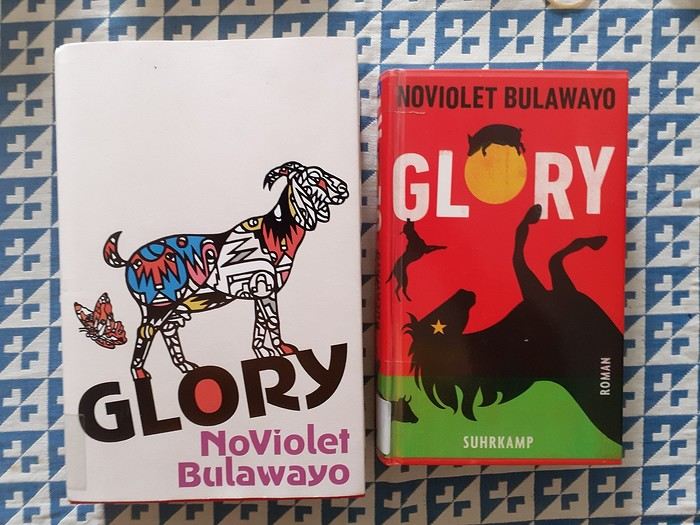 The books (in English, in German)
 Author NoViolet Bulawayo, Zimbabwe
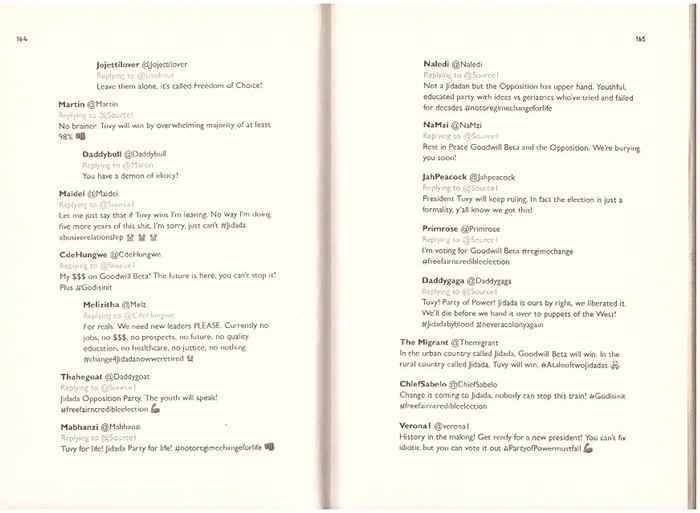 Threads (p.164-165)
"Bulawayo leans into exaggeration and irony to tell hard truths. *Glory* is jam-packed with comedy and farce, poking fun at an autocratic regime while illustrating the absurdity and surreal nature of a police state." — The Guardian
The cruelty and savagery of Zimbabwe’s (and Africa’s in general) "powerful animals"
Zimbabwean author NoViolet Bulawayo has written a novel that illustrates better than any documentary the complexity of colonial legacy. In doing so, she revisits George Orwell’s Animal Farm. Her novel *Glory* is a political satire about Zimbabwe—and it’s brimming with humor.
For thirty years, Zimbabwe has been stagnating under Robert Mugabe’s presidency. Human rights violations, corruption, and international sanctions have kept the population mired in poverty and oppression, while the regime exploits the meager earnings of the economy. As the 2017 elections approach, a power struggle erupts over the succession of the very elderly Father of the Nation (Mugabe). On the streets, people hope for long-awaited reforms; the people feel their moment has come.
And indeed, the army ousts Mugabe and his wife—"with her Gucci heels" (p.32)—who was positioning herself for the presidency. Hopes are dashed, however. The generals install former vice-president Emmerson Mnangagwa in power; the regime merely changes faces, but the problems remain the same.
In the novel, the country is called "Jidada, with a -da and another -da" (p.1); there’s no mistaking that this fictional state is Zimbabwe.
For *Glory*, her second novel, NoViolet Bulawayo invents a whole series of codes whose strength lies precisely in how easy they are to decipher. Like George Orwell’s Animal Farm, the characters populating Bulawayo’s universe aren’t humans but horses, goats, or crocodiles with all-too-human traits. Mugabe and Mnangagwa are horses, the spiritual leader is a pig, the soldiers are all bloodthirsty dogs, while the populace consists of goats, chickens, donkeys, and cats. The shift to the animal world serves only to better grasp the laws of despotism—and to ridicule real-life models. On one hand, the animals are humanized: they tweet, torture, travel in private jets. On the other, their greed, stupidity, and brutality stem from their animal nature.
It’s the old trick of fable: dressing men in animal disguises to make them easier to recognize. That’s how Orwell, in Animal Farm, traced how the promise of liberation from the Russian Revolution turned into Stalinist terror. In his 1945 fable, George Orwell describes how the animals of a farm drive out their farmer to organize the exploitation themselves, collectively. For a time, they truly taste freedom, but a clique of pigs ends up taking control. The central figures of the Soviet story—Stalin, Trotsky, Molotov—were easily recognizable.
Yet Bulawayo departs sharply from Orwell. She’s less concerned with precision and the force of argument than with satirical exaggeration. The deposed president is a senile old man who believes he can control even the sun’s course. The new stallion in power is a greedy debaucher. His soldiers sniff respectfully at his tail and backside.
In Bulawayo’s *Glory*, things are more complicated, but her novel also tells of a failed, incomplete liberation. In the author’s Animal Farm, Jidada, the colonial exploiters are followed by new forms of oppression. Because the former liberators become tyrants themselves. And because global power dynamics persist in neocolonial structures.
Wouldn’t that be enough to fuel a deeply depressing narrative? No—Bulawayo turns it into a blazing satire, full of wit and uncompromising criticism of power, a thread running through contemporary (not just) Zimbabwean history. The old warhorses in NoViolet Bulawayo’s Jidada, who continue to act as pack leaders, are easily recognizable as caricatures of the longtime dictator Robert Mugabe and his successor, current president Emmerson Mnangagwa.
The plot kicks off in high gear with independence day festivities. From the crack of dawn, everyone waits on Jidada Square for the Old Horse, the Father of the Nation and former liberator, whose reign "was nearing all of—not one, not two, not three, but four solid decades" (p.1). Everywhere, the colors of the Jidada Party shine; everywhere, true supporters cheer. Even the scorching sun plays its part: "At this point the sun, upon seeing arrive the leader who was decreed by God himself to rule and rule and keep ruling, a leader who'd in turn decreed the very sun to head his cheerleading squad, took a deep, deep breath and thoroughly blazed to impress" (p.2).
Finally, the Old Horse’s luxury carriage approaches "with the slowness of a hearse" (p.2), and "hoping to catch a glimpse of the legendary Father of the Nation," which causes "the animals fell over themselves like intoxicated frogs" (p.2). The sovereign’s speech is delayed a moment longer: "what I really want is a nap," groans the Old Horse as he takes his seat with such care "like his backside was made of expensive porcelain" (p.6).
Meanwhile, Bulawayo parades his entourage: the president’s wife (who earns her doctorate at Jidada University faster than "you could say diss, for dissertation. Tholukuthi it was as easy as ordering from a KFC drive-through, or perhaps even easier being that it was cheaper than KFC; it in fact cost her nothing and the degree actually came with a zero-calorie Diet Coke and a purple straw" (p.41), and she’s now known as Dr Sweet Mother. The cabinet includes "the Minister of the Revolution, the Minister of Corruption, the Minister of Order, the Minister of Things, the Minister of Nothing, the Minister of Propaganda, the Minister of Homophobic Affairs, the Minister of Disinformation and the Minister of Looting" (p.9). And of course the vice-president, who will soon become interim president when the Old Horse finally kicks the bucket—and then settle in as the new long-term president, who in the novel is called Tuvius Delight Shasha, or "Tuvy" for short (p.253), none other than Emmerson Mnangagwa. It’s him Bulawayo reserves her most merciless character description for.
"New Dispensation" (p.109) is Tuvy’s slogan for Jidada, and he loves repeating it so much he even named his parrot after it ("So inspired was Tuvy by the realisation that he rechristened his new pet parrot with the name New Dispensation—tholukuthi the bird having been acquired explicitly for the purposes of tweeting eulogies and accordingly glorifying the Saviour throughout the airs and skies of the nation. Tuvy then went on to hire a lecturer in English from the University of Jidada to teach New Dispensation to say the phrase 'New Dispensation'" p.110). But Tuvy’s Zimbabwe remains a nation without free, fair, and credible elections ("#freefairncredibleelection" p.161), and the promised equal treatment applies only insofar as Zimbabweans now queue up without discrimination in endless lines—and everyone is as poor as the next in the "queuenation" (p.283). Except for the powerful. They can "yes, tholukuthi, her immeasurable riches theirs to take. And take they did—
just take—take—take—take—take—take—take—take—take—take—take—take—take—take—take—take—take—take—take—take—take—take—take—take—take—take—take" (p.249-250).
In short: Bulawayo brilliantly depicts how former independence fighters become exploiters themselves. And how the country threatens to suffocate under the weight of corruption and repression. But she also literally stages the polyphony with which the people oppose imposed obedience to the official line.
Controversial online discussions keep interrupting the narrative—dialogues and social threads (see photo below) that Bulawayo masterfully integrates. From a literary standpoint, it’s a brilliant idea. And it shows, above all, that the author’s sympathy—so likeable—goes to all those who refuse to let their dream of true freedom be stolen, not even by the corrupt elites of their own country.
In the book’s acknowledgments, the first tribute goes to "The Jidadas of the world, clamouring for freedom on many fronts—A luta continua." (p.401) This reflects the realization that, not only in Jidada-Zimbabwe but in many other corners of the world, the end of colonial domination is still far from meaning the freedom hoped for by the vast majority of people. But it also means, more broadly, that this freedom must be won "on many fronts" (see above), both domestically and geopolitically.
That’s precisely what *Glory* so vividly highlights: how complex the project behind the term "postcolonialism" really is. With *Glory*, Bulawayo also delivers a scathing critique of the persistence of colonial mindsets in the West.
In the novel, the murder of George Floyd, racist police violence, and white-supremacist ideology in Trump’s United States perfectly illustrate the persistence of racism. It’s especially in the final chapters that Bulawayo lets Jidada’s inhabitants explicitly and unflinchingly criticize a neocolonial world order:
"It was not lost on us how the West, which loved to 'save' Africa and announce every action to the whole world, did so with one limb while manipulating, looting and fleecing us with the rest of its limbs so that more money in fact poured out of the continent than trickled in." (p.376)
"It was no mistake that multinational corporations yearly reaped and shipped colossal profits from Africa back to their countries as had been the case during colonial times. Even the sticks and stones would tell you that the African earth at any given time howled and shook and heaved from the extraction of its precious minerals that rarely benefited its own miserable children." (p.376)
"(...) we vowed to wage yet another war for Africa's second Liberation from neocolonial oppression. From exploitation. From plunder. From Western dominion. From indignity. From Abuse. We wanted real freedom. We wanted greedy, thieving paws off our wealth. We wanted Justice. We wanted a new world; we wanted a brand-new world so much we didn't sleep a wink that night." (p.377)
The Jidadas of this world must fight two enemies: Western neocolonialism and the autocratic instrumentalization of that argument; the persistence of Western racism and the populist appropriation of that humiliation by tyrants from their own ranks. Neither of these obstacles to freedom diminishes the historical and current guilt of the other. But the path to postcolonial liberation must overcome all these forms of oppression. After all, the colonizers didn’t bequeath democracies to formerly dominated nations, but instability and the principles of oppression and exploitation—which the so-called liberators have also internalized. Yet the fact that a satirical novel can capture the complexity of historical relationships while remaining, despite all the darkness of the subject, hilarious—well, that’s truly astonishing.
Finally, *Glory* ties into a major trauma in Zimbabwe’s post-independence history: the so-called Gukurahundi massacres. Between 1983 and 1987, tens of thousands of civilians were murdered by Mugabe’s bloody henchmen, most of them Ndebele. The State Security Minister and head of secret services at the time? You guessed it—Emmerson Mnangagwa.
When *Glory* turns to the massacres, the novel’s tone shifts completely. The story is now told through the narrative of the goat called Destiny, who, like NoViolet Bulawayo herself, left her home country at 18 for the United States and only returned after 13 years. In the book, the city of Bulawayo becomes a village where Destiny retraces her family’s history—and learns that part of it was also brutally murdered during the massacres.
The abuse of power and life under a dictatorship, dispossession, and a fiercely proud awareness of the psychological wounds and emotional vulnerability of a uprooted and disenfranchised people who had to forge a new language—a new set of names—to express their lived experiences are at the heart of this wonderful Zimbabwean author’s literary work, NoViolet Bulawayo. Shortly after her studies, she was already writing short stories about postcolonial power dynamics in Africa. But her playful, masterful, and often unconventional approach to language also plays a key role in her work. With virtuosity, she shifts from cynical images of power-obsessed elites to compassionate descriptions of the people’s suffering, ending with a hopeful sermon on courage—the courage to break free from fear and thus gain the strength for change ("And every one of them understood that whatever they heard within those hearts was the new national anthem, tholukuthi an anthem that spoke of the kind of glory that burns eternal and glows with living light." p.400). This novel is a genuine pleasure to read. And it’s exceptional. Good, African...
Book info (original English and German translation):
NoViolet Bulawayo. Glory. Chatto & Windus, 2022. NoViolet Bulawayo. Glory. Suhrkamp, 2023.
Hery
The books (in English, in German)
Author NoViolet Bulawayo, Zimbabwe
Threads (p.164-165)In Memory of Jamie Muir (1942–2025)
Musician, monk, painter: The metamorphoses of Jamie Muir
James David "Jamie" Muir, a talented drummer and percussionist and brief member of King Crimson, who left the world of pop music and show business to retreat to a Buddhist monastery in Scotland before dedicating himself almost entirely to painting, passed away last year at the age of 81. His artwork was recently featured in two exhibitions in Cornwall and London...
Born in Edinburgh, Scotland, in 1942, Jamie Muir attended the College of Art there in the 1960s. Early on, he was drawn to jazz.
Later settling in London, Jamie Muir played jazz trombone before turning to percussion. Influenced by American drummers like Tony Williams, Kenny Clarke, and Milford Graves, as well as musicians such as Pharoah Sanders and Albert Ayler, he gravitated toward free music, meaning improvisation. It was during this time that he began assembling an arsenal of household objects he later used alongside his standard drum kit: rattles, whistles, horns, chimes, bells, gongs, sheets of metal, shakers, drums, and plastic bottles.
After a brief stint in a multimedia group, Jamie Muir worked with choreographer Lindsay Kemp (as did David Bowie), played music in the short-lived jazz-rock group Sunship (with guitarist Allan Holdsworth, formerly of Soft Machine), and became involved in the ensemble known as The Music Improvisation Society, with Derek Bailey, Hugh Davies, and Evan Parker between 1968 and 1971. The Music Improvisation Society recorded an album for the ECM label in 1971 (never reissued on CD except in Japan) and a posthumous album (1968–71). Both records gained a cult following among fans of experimental and improvised music. After this experience, Muir played in Pete Brown’s Battered Ornaments and then in the band Boris with Jamie Peters, Don Weller, and former Colosseum member Jim Roache. He also briefly joined Assagai, an Afro-rock group featuring South African and Nigerian musicians from the legendary South African band Blue Notes (including drummer Louis Moholo, saxophonist Dudu Pukwana, and trumpeter/flutist Mongezi Feza).
In the summer of 1972, Robert Fripp, leader and guitarist of King Crimson, whom a journalist from *Melody Maker* had suggested meet this percussionist from the English experimental scene, invited Jamie Muir to join the new King Crimson lineup he was assembling: Robert Fripp (guitar, mellotron), David Cross (violin), John Wetton (bass), Bill Bruford (drums), and Jamie Muir (percussion). "King Crimson was the ideal for me because it was a rock band that had more than three brain cells. I was very much more an instrumental style of musician rather than being song-based, and there weren’t many other bands that I would have been any good in. I was extremely pleased and felt completely at home with Crimson." Once formed, the new group honed their sound on stage from early October to mid-December 1972 (see the 1972 live albums in the discography below), before recording the album Larks’ Tongues in Aspic in early 1973. A grand album, one of the band’s best, and one of the best of the 1970s.
However, after a concert at the Marquee Club in London, Jamie Muir left not only the band but also the music world entirely, with immediate effect. During the six months Muir spent with King Crimson, his presence completely upended the group’s philosophy, loosening the notoriously strict rules imposed by Fripp and pushing the boundaries of improvisation. Jamie Muir’s contribution—clearly heard on Larks’ Tongues in Aspic—was to introduce a touch of anarchy into Robert Fripp’s music, which was usually so tight, rational, and meticulously structured.
Muir returned to Scotland, to the Samye Ling Monastery near Eskdalemuir in Dumfries and Galloway (in the south), where he spent several years as a Buddhist monk, the pleasures of his former life giving way to retreat and meditation.
Muir came back to London and music in the 1980s, playing and recording with Derek Bailey and Evan Parker from the Music Improvisation Company, as well as with former King Crimson member Michael Giles on the soundtrack for the independent British film Ghost Dance (1983).
In 1990, Muir left music behind once more and increasingly devoted himself to painting, a discipline he maintained until his death. In his later years, he began exploring digital art as another form of expression.
In recent years, he lived in Penzance, Cornwall, where he passed away in February 2025.
Hery
Discography:
A. Jamie Muir with King Crimson: • Larks’ Tongues In Aspic (1973) • Larks’ Tongues In Aspic (The Complete Recordings) (2023, 4 CDs) • Cosmic Muir (1998, Japan, unofficial release) • The Beat Club Bremen 1972 (1999) • Live at the Zoom Club Frankfurt, Germany (October 13, 1972) (2002, 2 CDs) • Live in Guildford (November 13, 1972) (2003) • Live in Newcastle (December 8, 1972) (2019, mono) B. Jamie Muir and other projects: • The Music Improvisation Company: The Music Improvisation Company (1970) • The Music Improvisation Company: 1968–1971 (1976) • Derek Bailey / Jamie Muir: Dart Drug (1981) • Michael Giles / Jamie Muir / David Cunningham: Ghost Dance (1996) • Evan Parker / Jamie Muir / Paul Rodgers: The Ayes Have It (2001)
Links:
https://www.jamiemuirart.com/
https://www.youtube.com/watch?v=eDyf0ofV5n4 (King Crimson: "Larks' Tongues in Aspic") https://www.youtube.com/watch?v=ZgoKT8hEBFQ&list=RDJ2FjbpvX8dA&index=2 (Michael Giles, Jamie Muir, David Cunningham)
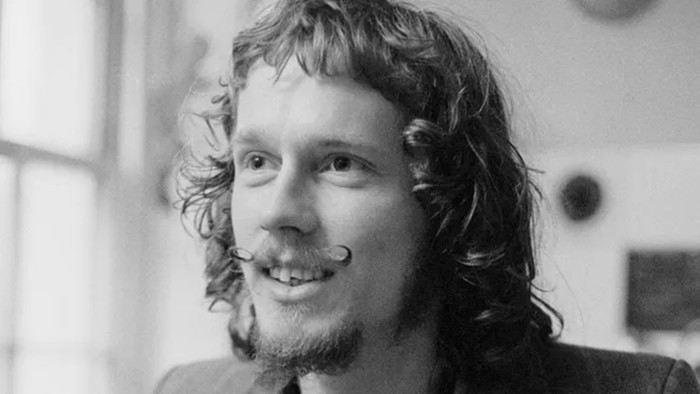 The musician
 The painter
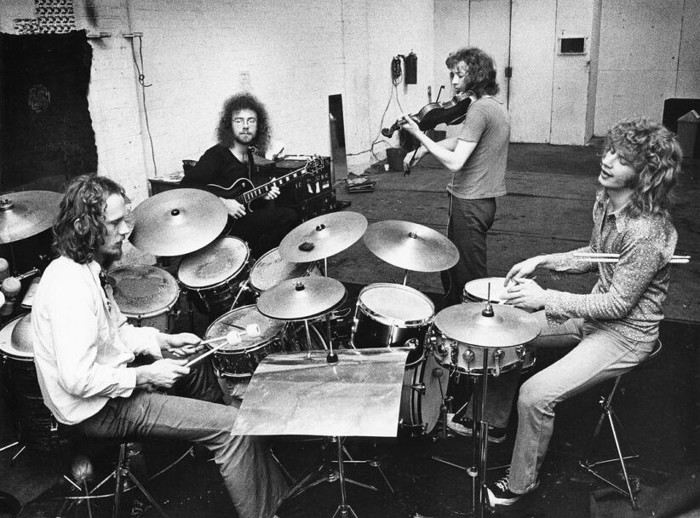 The band (l. to r.: Muir, Fripp, Cross, Bruford)
James David "Jamie" Muir, a talented drummer and percussionist and brief member of King Crimson, who left the world of pop music and show business to retreat to a Buddhist monastery in Scotland before dedicating himself almost entirely to painting, passed away last year at the age of 81. His artwork was recently featured in two exhibitions in Cornwall and London...
Born in Edinburgh, Scotland, in 1942, Jamie Muir attended the College of Art there in the 1960s. Early on, he was drawn to jazz.
Later settling in London, Jamie Muir played jazz trombone before turning to percussion. Influenced by American drummers like Tony Williams, Kenny Clarke, and Milford Graves, as well as musicians such as Pharoah Sanders and Albert Ayler, he gravitated toward free music, meaning improvisation. It was during this time that he began assembling an arsenal of household objects he later used alongside his standard drum kit: rattles, whistles, horns, chimes, bells, gongs, sheets of metal, shakers, drums, and plastic bottles.
After a brief stint in a multimedia group, Jamie Muir worked with choreographer Lindsay Kemp (as did David Bowie), played music in the short-lived jazz-rock group Sunship (with guitarist Allan Holdsworth, formerly of Soft Machine), and became involved in the ensemble known as The Music Improvisation Society, with Derek Bailey, Hugh Davies, and Evan Parker between 1968 and 1971. The Music Improvisation Society recorded an album for the ECM label in 1971 (never reissued on CD except in Japan) and a posthumous album (1968–71). Both records gained a cult following among fans of experimental and improvised music. After this experience, Muir played in Pete Brown’s Battered Ornaments and then in the band Boris with Jamie Peters, Don Weller, and former Colosseum member Jim Roache. He also briefly joined Assagai, an Afro-rock group featuring South African and Nigerian musicians from the legendary South African band Blue Notes (including drummer Louis Moholo, saxophonist Dudu Pukwana, and trumpeter/flutist Mongezi Feza).
In the summer of 1972, Robert Fripp, leader and guitarist of King Crimson, whom a journalist from *Melody Maker* had suggested meet this percussionist from the English experimental scene, invited Jamie Muir to join the new King Crimson lineup he was assembling: Robert Fripp (guitar, mellotron), David Cross (violin), John Wetton (bass), Bill Bruford (drums), and Jamie Muir (percussion). "King Crimson was the ideal for me because it was a rock band that had more than three brain cells. I was very much more an instrumental style of musician rather than being song-based, and there weren’t many other bands that I would have been any good in. I was extremely pleased and felt completely at home with Crimson." Once formed, the new group honed their sound on stage from early October to mid-December 1972 (see the 1972 live albums in the discography below), before recording the album Larks’ Tongues in Aspic in early 1973. A grand album, one of the band’s best, and one of the best of the 1970s.
However, after a concert at the Marquee Club in London, Jamie Muir left not only the band but also the music world entirely, with immediate effect. During the six months Muir spent with King Crimson, his presence completely upended the group’s philosophy, loosening the notoriously strict rules imposed by Fripp and pushing the boundaries of improvisation. Jamie Muir’s contribution—clearly heard on Larks’ Tongues in Aspic—was to introduce a touch of anarchy into Robert Fripp’s music, which was usually so tight, rational, and meticulously structured.
Muir returned to Scotland, to the Samye Ling Monastery near Eskdalemuir in Dumfries and Galloway (in the south), where he spent several years as a Buddhist monk, the pleasures of his former life giving way to retreat and meditation.
Muir came back to London and music in the 1980s, playing and recording with Derek Bailey and Evan Parker from the Music Improvisation Company, as well as with former King Crimson member Michael Giles on the soundtrack for the independent British film Ghost Dance (1983).
In 1990, Muir left music behind once more and increasingly devoted himself to painting, a discipline he maintained until his death. In his later years, he began exploring digital art as another form of expression.
In recent years, he lived in Penzance, Cornwall, where he passed away in February 2025.
Hery
Discography:
A. Jamie Muir with King Crimson: • Larks’ Tongues In Aspic (1973) • Larks’ Tongues In Aspic (The Complete Recordings) (2023, 4 CDs) • Cosmic Muir (1998, Japan, unofficial release) • The Beat Club Bremen 1972 (1999) • Live at the Zoom Club Frankfurt, Germany (October 13, 1972) (2002, 2 CDs) • Live in Guildford (November 13, 1972) (2003) • Live in Newcastle (December 8, 1972) (2019, mono) B. Jamie Muir and other projects: • The Music Improvisation Company: The Music Improvisation Company (1970) • The Music Improvisation Company: 1968–1971 (1976) • Derek Bailey / Jamie Muir: Dart Drug (1981) • Michael Giles / Jamie Muir / David Cunningham: Ghost Dance (1996) • Evan Parker / Jamie Muir / Paul Rodgers: The Ayes Have It (2001)
Links:
https://www.jamiemuirart.com/
https://www.youtube.com/watch?v=eDyf0ofV5n4 (King Crimson: "Larks' Tongues in Aspic") https://www.youtube.com/watch?v=ZgoKT8hEBFQ&list=RDJ2FjbpvX8dA&index=2 (Michael Giles, Jamie Muir, David Cunningham)
The musician
The painter
The band (l. to r.: Muir, Fripp, Cross, Bruford)Africa: A Heartfelt Love for a Continent
“When the Whites came to Africa, we had the land and they had the Bible. They taught us to pray with our eyes closed: when we opened them, the Whites had the land and we had the Bible.” Jomo Kenyatta (p.7)
The Maggi cube, an unchallenged hegemony, and so much more
“The hopeless continent,” headlined The Economist, a British magazine, in July 2000 about Africa. Eleven years later, the same magazine headlined “Africa rising” instead. Images of Africa in the prosperous North constantly oscillate between apocalyptic scenarios and enthusiastic projections. A key issue with such images lies in the generalization they entail. If you look at the continent, considerable contrasts emerge depending on space and time. It’s no surprise that a region of the world encompassing such diverse ecological zones, maintaining such varied ties with other continents, comprising nearly fifty nation-states in sub-Saharan Africa alone, and characterized by a great diversity of languages, belief systems, and historical paths, doesn’t share a single destiny.
And yet, for many people outside Africa, as well as for many Africans, the continent constitutes a single entity, defined by criteria such as skin color, a colonial past, poverty, and the art of survival. Until now, these perspectives were generally accompanied by the idea that Africa had to—or should have—followed a single path together, sometimes called development, sometimes modernization, sometimes liberation, then a market economy. None of these paths delivered on their promises.
The two writers Alain Mabanckou and Abdourahman Waberi—one from Congo, the other raised in Djibouti, both long settled in France and now professors at renowned North American universities (Los Angeles, Washington)—have had enough of pessimistic scenarios: “We are aware that Africa is in the world and the world is in Africa. The same goes for all other continents, as our destinies are inextricably linked for better or worse. We refuse to see Africa as a reservoir of misfortunes or a continent cursed by atavistic misfortune and characterized by ethnic conflicts. [...] It’s this passionate flame we wanted to capture in a book [...] a kind of stroll through African cultures, without any demands, each letter of the alphabet leading us to a notion, a practice, a concept, a moment in history, literature, painting, politics, economics, cuisine, etc.” (p.10-11). Africa, they write, is on the verge of “imposing a signature, a style, a way of being in the world and in relation to the rest of the world.” (p.11) To put words to the continent’s diversity and dynamism, the two authors created a “rambling ABC,” a kind of portrait—or more precisely, a mythography—that lets you see and feel the pulse of a vast continent whose cultural power is unfolding before our eyes. Once marginalized or even mocked, the voice and importance of the Continent in global affairs are now undeniable” (p.11), containing over a hundred entries, mostly concise, written in a relaxed and casual style. The optimistic, even exuberant tone is set from the brief introduction. The duo of authors wants to “sing a love song to the cultures of our continent, to its inhabitants past and present, to its exceptional resources and its spectacular globalization despite a certain pollution that still clouds our skies due to the unmatched duration of dictatorships in some of our regions.” (p.12) In doing so, they don’t want to be too distracted by today’s Afewerki-Biya-Bongo-Déby & Co. ...
Of course, you’ll find tributes to great precursors like Frantz Fanon (“[...] it was a love story and admiration that wasn’t dimmed by the four decades separating his birth from ours. Let’s add that we were born while the native of Fort-de-France had left the world’s stage four years earlier, in the prime of life” p.141), Mongo Beti (“You must read and reread Mongo Beti, a genius who used his fame to support often just causes in Africa, like defending oppressed groups. His place is already in History. His oppressors, like the dictators Ahmadou Ahidjo and Paul Biya, can’t compete in the same category” p.64), the Malian Amadou Hampâté Bâ
(“Posterity remembers him mainly as an tireless defender of African cultures. His plea for the collection and preservation of traditional African knowledge remains a major event for all men and women of good will. One day in 1960, at the UNESCO podium, the native of Bandiagara sounded the alarm: ‘[...] Since we’ve admitted that the humanity of each people is the heritage of all humanity, if African traditions aren’t collected in time and written down, they’ll one day be missing from the universal archives of humanity.’” p.51),
Kwame Nkrumah, “one of the founders of Pan-Africanism, father of Ghana’s independence” (p.239), as well as the historian Cheikh Anta Diop, the writer, poet, and politician Aimé Césaire, and the economist and thinker Samir Amin, but also very warm tributes to certain contemporary African intellectuals like Souleymane Bachir Diagne and Achille Mbembe
(“A few years ago, in dominant economic circles, a rumor often resurfaced, usually disguised as a cold and scientifically proven analysis: Africa is useless. It’s a burden for the rest of the human community. With its 2% share in world trade, it would disappear from stock market radars without anyone noticing. So? Maybe it’ll be pulled up by other continents. Wanting to surpass itself is a crazy bet for Africans, they concluded. Arrogant or clueless, President Nicolas Sarkozy declared before an audience of students and teachers at Cheikh Anta Diop University in Dakar: ‘The African man hasn’t entered history enough [...] He only knows the eternal repetition of time marked by the endless repetition of the same gestures and words.’ That was in 2007. For decades, armed only with reason, an intellectual often steps up to debunk prejudices, lazy readings, and dishonest frameworks used as false fronts by those who, like Nicolas Sarkozy or former journalist Stephen Smith, out of ignorance, contempt, or condescension, distort African reality. This intellectual is none other than the historian and political scientist Achille Mbembe. This heir of Frantz Fanon, Amílcar Cabral, Jean-Marc Ela, and Fabien Eboussi-Boulaga was born in 1957 in Cameroon, in the Bassa region. Marked early by the upheavals of a fratricidal war, Achille Mbembe became the guardian of the memory of martyrs. After brilliant studies in Paris, he went on to teach at the best American universities, but the call of the Continent was stronger than anything else. In Dakar, he once directed CODESRIA (Council for the Development of Social Science Research in Africa) before joining the University of the Witwatersrand in Johannesburg, South Africa. Even though the author of *Critique of Black Reason* (Éditions La Découverte, 2015) spends a few months at Duke University in North Carolina, his observation post remains South Africa. From Johannesburg, Achille Mbembe scrutinizes Africa and the whole world. A lucid observer with an elegant and generous pen, Achille Mbembe knows how to blend big and small history: ‘I was born one day in July, as the month was drawing to a close. It was 1957, in that part of Africa recently named ‘Cameroon,’ a memory of the wonder that seized Portuguese sailors in the 15th century when, sailing up the river near Douala, they couldn’t help but note the presence of a multitude of crustaceans, and named it *Rio dos Camarões*, meaning ‘River of Shrimp.’ I grew up in the shadow of this nameless land, since, in a way, the name it bears is only the product of someone else’s astonishment: a lexical mistake, if you will.’ From this mistake or wound, he made leaven, a springboard to compose a rich work, recognized worldwide. To denounce barriers and barbarians too. But that’s not enough. Among his peers in circles of thought and action, Achille Mbembe passionately and consistently defends human dignity and the beauty of the world. In doing so, he fulfills the mission Frantz Fanon entrusted to him.” (p.227-229),
as well as entries dedicated to lesser-known artists and intellectuals, like the French journalist and activist Rokhaya Diallo, daughter of Senegalese and Gambian parents, or the Ethiopian filmmaker Haile Gerima, who has long lived in the United States. Other names from politics, sports, music, art, and literature: Kofi Annan, p.36; Barack Obama, p.243; Thomas Sankara, p.277; Ousmane Sow, p.285; Yambo Ouologuem, p.250; Léopold Sédar Senghor, p.282; Muhammad Ali, p.30; Nuruddin Farah, p.146; Salif Keita, p.203; Ahmadou Kourouma, p.206; Ngũgĩ wa Thiong’o, p.236; Winnie Mandela, p.224; Kylian Mbappé, p.226 ...
The authors, who resolutely commit to a “mythography” (p.11) of Africa, also pay special attention to local social movements, cultural events, and aspects of daily life. *Y’en a marre*, “which also meant ‘we’re fed up with sitting on our hands’” (p.320-321), emerged about a decade ago in Senegal as a citizen movement of peaceful resistance and symbolizes, the authors emphasize, the fact that African youth are increasingly fed up “with the political circus deployed in Africa since independence, as our parents would say, ‘since the White man left’...” (p.321). A full entry is dedicated to the Maggi bouillon cube, which has flooded African markets for about forty years and enjoys immense popularity (“It’s everywhere in Africa, from Dakar to Djibouti, and from Tangier to Cape Town. It’s in every pot, every stew. Little hands put it in every sauce, every local or adapted dish. An unchallenged hegemony! You’ll find it in diasporas too. The culinary strolls in Paris, in the [...] neighborhood” p.90). Critics blame it not only for impoverishing the aromatic diversity of local dishes but also for being harmful to health. And yet, “he poorest Africans, those who eat only once a day, a few spoonfuls of white beans and a ball of *foufou*, for example, are the most fervent users of the magic cube.” (p.92-93)
For *fonio*, “the new trendy cereal. [...] From the millet family, fonio is probably the oldest cereal cultivated in West Africa, and mainly in its sub-Saharan part, for millennia. [...] Easy to grow, water-efficient, fonio grows everywhere except on clay soils. Long neglected because it was considered the poor man’s crop, fonio is now a source of pride for the farmers who cultivate it and cherish it like the apple of their eye” (p.156-157), the authors immediately offer a detailed recipe, letting the reader know that “e can’t resist sharing this fonio with chicken recipe from Mali with you:
Ingredients: 1 chicken 3 large ripe red tomatoes 4 tbsp tomato paste 4 large onions 1 garlic clove 1/2 cup oil 2 Maggi cubes or salt 2 large carrots 1 turnip 1 large cabbage 2 large potatoes 1 celery stalk 1 packet pre-cooked fonio 4 okra (or okra powder) salt, pepper
Preparation: 1. Prepare the sauce: wash and cut the chicken. Peel the onions, garlic, and vegetables. 2. In a pot, fry the chicken pieces. 3. Dice the onions, tomatoes, carrots, and turnip very small and add them to the pot. 4. Add the tomato paste, salt, and pepper. 5. Simmer for 15 min, then add 2 L of water and the cooked chicken pieces. 6. Simmer for 30 min, then add the crushed garlic and celery, plus the cabbage cut into 4 and the potatoes cut in half. 7. Prepare the fonio: cover it with warm water, let it rest for 15 min, and cook it over low heat. 8. In a small pot, boil the okra and crush them. 9. Mix the crushed okra with the cooked fonio, then salt. Serve hot.” (p.158-159)
The comedy *Black Mic Mac*, released in French theaters in 1986 and addressing France’s increasingly restrictive immigration policy at the time, also gets an entry, as do *Tintin in the Congo*, the popular comic, and *Jip’s Café* (“[...] a little Africa in the heart of Paris, with passersby stopping to admire the ‘ambianceurs’ on the dance floor or attend the cultural events offered by the place” (p.194), an African establishment in Paris that Alain Mabanckou already immortalized in one of his novels.
The duo of authors also tackles thorny subjects like jihadism (p.119), the Rwandan genocide (p.272), the CFA franc (p.82), and dictatorship (p.110). While the two strike the right tone here, many entries leave a slightly bitter taste. Two examples: why doesn’t the text on Barack Obama mention the great disappointment of many people in Africa, who expected more from the African policy of the first U.S. president with African roots than just occasional warm words? Why do the comments on Winnie Mandela gloss over the fact that she was a highly controversial icon of the anti-apartheid movement due to her involvement in kidnappings, acts of torture, and murders of alleged apartheid collaborators? Instead, there’s a compassion that brings tears to the eyes: “She was often reduced to a secondary role, the wife of a great man” or “When victory came, she didn’t taste its fruits. Divorced, isolated. She would never be a ‘first lady’ in an evening gown, posing before a bed of chrysanthemums. They’d keep her far from the circles of power” (p.224-225). At this point, I would’ve liked the authors to take a slightly more critical stance...
That said, these “weaknesses” (if you can call them that) shouldn’t overshadow the book as a whole. It remains an informative, sometimes very entertaining, and often even original work in its own way.
Book information (the original French and the German translation):
Alain Mabanckou/Abdourahman Waberi. Dictionnaire enjoué des cultures africaines. Fayard, 2019. Alain Mabanckou/Abdourahman Waberi. Der Puls Afrikas. Eine Liebeserklärung von A bis Z. Reclam, 2022.
Hery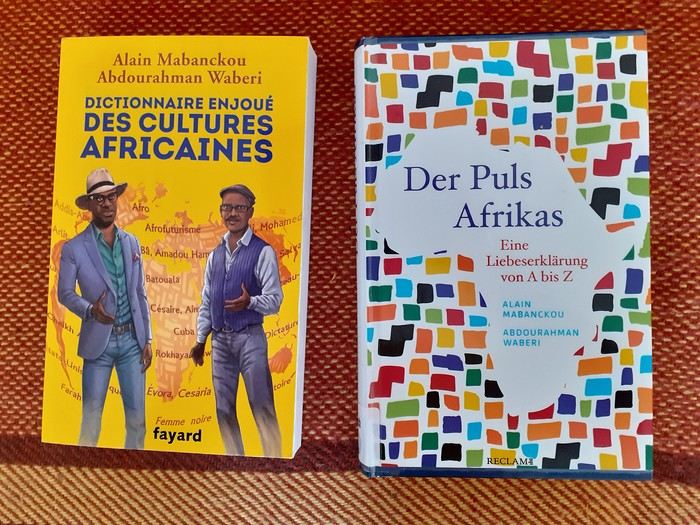
The Maggi cube, an unchallenged hegemony, and so much more
“The hopeless continent,” headlined The Economist, a British magazine, in July 2000 about Africa. Eleven years later, the same magazine headlined “Africa rising” instead. Images of Africa in the prosperous North constantly oscillate between apocalyptic scenarios and enthusiastic projections. A key issue with such images lies in the generalization they entail. If you look at the continent, considerable contrasts emerge depending on space and time. It’s no surprise that a region of the world encompassing such diverse ecological zones, maintaining such varied ties with other continents, comprising nearly fifty nation-states in sub-Saharan Africa alone, and characterized by a great diversity of languages, belief systems, and historical paths, doesn’t share a single destiny.
And yet, for many people outside Africa, as well as for many Africans, the continent constitutes a single entity, defined by criteria such as skin color, a colonial past, poverty, and the art of survival. Until now, these perspectives were generally accompanied by the idea that Africa had to—or should have—followed a single path together, sometimes called development, sometimes modernization, sometimes liberation, then a market economy. None of these paths delivered on their promises.
The two writers Alain Mabanckou and Abdourahman Waberi—one from Congo, the other raised in Djibouti, both long settled in France and now professors at renowned North American universities (Los Angeles, Washington)—have had enough of pessimistic scenarios: “We are aware that Africa is in the world and the world is in Africa. The same goes for all other continents, as our destinies are inextricably linked for better or worse. We refuse to see Africa as a reservoir of misfortunes or a continent cursed by atavistic misfortune and characterized by ethnic conflicts. [...] It’s this passionate flame we wanted to capture in a book [...] a kind of stroll through African cultures, without any demands, each letter of the alphabet leading us to a notion, a practice, a concept, a moment in history, literature, painting, politics, economics, cuisine, etc.” (p.10-11). Africa, they write, is on the verge of “imposing a signature, a style, a way of being in the world and in relation to the rest of the world.” (p.11) To put words to the continent’s diversity and dynamism, the two authors created a “rambling ABC,” a kind of portrait—or more precisely, a mythography—that lets you see and feel the pulse of a vast continent whose cultural power is unfolding before our eyes. Once marginalized or even mocked, the voice and importance of the Continent in global affairs are now undeniable” (p.11), containing over a hundred entries, mostly concise, written in a relaxed and casual style. The optimistic, even exuberant tone is set from the brief introduction. The duo of authors wants to “sing a love song to the cultures of our continent, to its inhabitants past and present, to its exceptional resources and its spectacular globalization despite a certain pollution that still clouds our skies due to the unmatched duration of dictatorships in some of our regions.” (p.12) In doing so, they don’t want to be too distracted by today’s Afewerki-Biya-Bongo-Déby & Co. ...
Of course, you’ll find tributes to great precursors like Frantz Fanon (“[...] it was a love story and admiration that wasn’t dimmed by the four decades separating his birth from ours. Let’s add that we were born while the native of Fort-de-France had left the world’s stage four years earlier, in the prime of life” p.141), Mongo Beti (“You must read and reread Mongo Beti, a genius who used his fame to support often just causes in Africa, like defending oppressed groups. His place is already in History. His oppressors, like the dictators Ahmadou Ahidjo and Paul Biya, can’t compete in the same category” p.64), the Malian Amadou Hampâté Bâ
(“Posterity remembers him mainly as an tireless defender of African cultures. His plea for the collection and preservation of traditional African knowledge remains a major event for all men and women of good will. One day in 1960, at the UNESCO podium, the native of Bandiagara sounded the alarm: ‘[...] Since we’ve admitted that the humanity of each people is the heritage of all humanity, if African traditions aren’t collected in time and written down, they’ll one day be missing from the universal archives of humanity.’” p.51),
Kwame Nkrumah, “one of the founders of Pan-Africanism, father of Ghana’s independence” (p.239), as well as the historian Cheikh Anta Diop, the writer, poet, and politician Aimé Césaire, and the economist and thinker Samir Amin, but also very warm tributes to certain contemporary African intellectuals like Souleymane Bachir Diagne and Achille Mbembe
(“A few years ago, in dominant economic circles, a rumor often resurfaced, usually disguised as a cold and scientifically proven analysis: Africa is useless. It’s a burden for the rest of the human community. With its 2% share in world trade, it would disappear from stock market radars without anyone noticing. So? Maybe it’ll be pulled up by other continents. Wanting to surpass itself is a crazy bet for Africans, they concluded. Arrogant or clueless, President Nicolas Sarkozy declared before an audience of students and teachers at Cheikh Anta Diop University in Dakar: ‘The African man hasn’t entered history enough [...] He only knows the eternal repetition of time marked by the endless repetition of the same gestures and words.’ That was in 2007. For decades, armed only with reason, an intellectual often steps up to debunk prejudices, lazy readings, and dishonest frameworks used as false fronts by those who, like Nicolas Sarkozy or former journalist Stephen Smith, out of ignorance, contempt, or condescension, distort African reality. This intellectual is none other than the historian and political scientist Achille Mbembe. This heir of Frantz Fanon, Amílcar Cabral, Jean-Marc Ela, and Fabien Eboussi-Boulaga was born in 1957 in Cameroon, in the Bassa region. Marked early by the upheavals of a fratricidal war, Achille Mbembe became the guardian of the memory of martyrs. After brilliant studies in Paris, he went on to teach at the best American universities, but the call of the Continent was stronger than anything else. In Dakar, he once directed CODESRIA (Council for the Development of Social Science Research in Africa) before joining the University of the Witwatersrand in Johannesburg, South Africa. Even though the author of *Critique of Black Reason* (Éditions La Découverte, 2015) spends a few months at Duke University in North Carolina, his observation post remains South Africa. From Johannesburg, Achille Mbembe scrutinizes Africa and the whole world. A lucid observer with an elegant and generous pen, Achille Mbembe knows how to blend big and small history: ‘I was born one day in July, as the month was drawing to a close. It was 1957, in that part of Africa recently named ‘Cameroon,’ a memory of the wonder that seized Portuguese sailors in the 15th century when, sailing up the river near Douala, they couldn’t help but note the presence of a multitude of crustaceans, and named it *Rio dos Camarões*, meaning ‘River of Shrimp.’ I grew up in the shadow of this nameless land, since, in a way, the name it bears is only the product of someone else’s astonishment: a lexical mistake, if you will.’ From this mistake or wound, he made leaven, a springboard to compose a rich work, recognized worldwide. To denounce barriers and barbarians too. But that’s not enough. Among his peers in circles of thought and action, Achille Mbembe passionately and consistently defends human dignity and the beauty of the world. In doing so, he fulfills the mission Frantz Fanon entrusted to him.” (p.227-229),
as well as entries dedicated to lesser-known artists and intellectuals, like the French journalist and activist Rokhaya Diallo, daughter of Senegalese and Gambian parents, or the Ethiopian filmmaker Haile Gerima, who has long lived in the United States. Other names from politics, sports, music, art, and literature: Kofi Annan, p.36; Barack Obama, p.243; Thomas Sankara, p.277; Ousmane Sow, p.285; Yambo Ouologuem, p.250; Léopold Sédar Senghor, p.282; Muhammad Ali, p.30; Nuruddin Farah, p.146; Salif Keita, p.203; Ahmadou Kourouma, p.206; Ngũgĩ wa Thiong’o, p.236; Winnie Mandela, p.224; Kylian Mbappé, p.226 ...
The authors, who resolutely commit to a “mythography” (p.11) of Africa, also pay special attention to local social movements, cultural events, and aspects of daily life. *Y’en a marre*, “which also meant ‘we’re fed up with sitting on our hands’” (p.320-321), emerged about a decade ago in Senegal as a citizen movement of peaceful resistance and symbolizes, the authors emphasize, the fact that African youth are increasingly fed up “with the political circus deployed in Africa since independence, as our parents would say, ‘since the White man left’...” (p.321). A full entry is dedicated to the Maggi bouillon cube, which has flooded African markets for about forty years and enjoys immense popularity (“It’s everywhere in Africa, from Dakar to Djibouti, and from Tangier to Cape Town. It’s in every pot, every stew. Little hands put it in every sauce, every local or adapted dish. An unchallenged hegemony! You’ll find it in diasporas too. The culinary strolls in Paris, in the [...] neighborhood” p.90). Critics blame it not only for impoverishing the aromatic diversity of local dishes but also for being harmful to health. And yet, “he poorest Africans, those who eat only once a day, a few spoonfuls of white beans and a ball of *foufou*, for example, are the most fervent users of the magic cube.” (p.92-93)
For *fonio*, “the new trendy cereal. [...] From the millet family, fonio is probably the oldest cereal cultivated in West Africa, and mainly in its sub-Saharan part, for millennia. [...] Easy to grow, water-efficient, fonio grows everywhere except on clay soils. Long neglected because it was considered the poor man’s crop, fonio is now a source of pride for the farmers who cultivate it and cherish it like the apple of their eye” (p.156-157), the authors immediately offer a detailed recipe, letting the reader know that “e can’t resist sharing this fonio with chicken recipe from Mali with you:
Ingredients: 1 chicken 3 large ripe red tomatoes 4 tbsp tomato paste 4 large onions 1 garlic clove 1/2 cup oil 2 Maggi cubes or salt 2 large carrots 1 turnip 1 large cabbage 2 large potatoes 1 celery stalk 1 packet pre-cooked fonio 4 okra (or okra powder) salt, pepper
Preparation: 1. Prepare the sauce: wash and cut the chicken. Peel the onions, garlic, and vegetables. 2. In a pot, fry the chicken pieces. 3. Dice the onions, tomatoes, carrots, and turnip very small and add them to the pot. 4. Add the tomato paste, salt, and pepper. 5. Simmer for 15 min, then add 2 L of water and the cooked chicken pieces. 6. Simmer for 30 min, then add the crushed garlic and celery, plus the cabbage cut into 4 and the potatoes cut in half. 7. Prepare the fonio: cover it with warm water, let it rest for 15 min, and cook it over low heat. 8. In a small pot, boil the okra and crush them. 9. Mix the crushed okra with the cooked fonio, then salt. Serve hot.” (p.158-159)
The comedy *Black Mic Mac*, released in French theaters in 1986 and addressing France’s increasingly restrictive immigration policy at the time, also gets an entry, as do *Tintin in the Congo*, the popular comic, and *Jip’s Café* (“[...] a little Africa in the heart of Paris, with passersby stopping to admire the ‘ambianceurs’ on the dance floor or attend the cultural events offered by the place” (p.194), an African establishment in Paris that Alain Mabanckou already immortalized in one of his novels.
The duo of authors also tackles thorny subjects like jihadism (p.119), the Rwandan genocide (p.272), the CFA franc (p.82), and dictatorship (p.110). While the two strike the right tone here, many entries leave a slightly bitter taste. Two examples: why doesn’t the text on Barack Obama mention the great disappointment of many people in Africa, who expected more from the African policy of the first U.S. president with African roots than just occasional warm words? Why do the comments on Winnie Mandela gloss over the fact that she was a highly controversial icon of the anti-apartheid movement due to her involvement in kidnappings, acts of torture, and murders of alleged apartheid collaborators? Instead, there’s a compassion that brings tears to the eyes: “She was often reduced to a secondary role, the wife of a great man” or “When victory came, she didn’t taste its fruits. Divorced, isolated. She would never be a ‘first lady’ in an evening gown, posing before a bed of chrysanthemums. They’d keep her far from the circles of power” (p.224-225). At this point, I would’ve liked the authors to take a slightly more critical stance...
That said, these “weaknesses” (if you can call them that) shouldn’t overshadow the book as a whole. It remains an informative, sometimes very entertaining, and often even original work in its own way.
Book information (the original French and the German translation):
Alain Mabanckou/Abdourahman Waberi. Dictionnaire enjoué des cultures africaines. Fayard, 2019. Alain Mabanckou/Abdourahman Waberi. Der Puls Afrikas. Eine Liebeserklärung von A bis Z. Reclam, 2022.
Hery
David Thomas, Leader of Pere Ubu (1953–2025)
«Mr. Thomas's voice is that of a man muttering in a crowd. You think he's talking to himself until you realize he's actually talking to you.» (Greil Marcus)
La voix de M. Thomas est celle d'un homme marmonnant dans une foule. Vous pensez qu'il se parle à lui-même jusqu'à ce que vous réalisiez qu'en réalité il est en train de vous parler.
A year ago, a singular monument passed away
Tall and imposing, he embodied the character of Père Ubu and captivated with his physical presence as much as his voice. His distinctive tone, audacity, and aura made him a respected and truly unique figure over the past five decades: David Thomas.
Born in Miami but primarily raised in Cleveland, Ohio, David Thomas was a central figure in Cleveland’s underground experimental rock scene—a regional movement that would later give rise to Devo and Nine Inch Nails. He first gained recognition as part of the group Rocket From the Tombs, which, though it never recorded an album, became an influential local act during its brief existence. Known for his high-pitched, near-falsetto voice and his unconventional taste for professor-style stage costumes, Thomas stood out as much in person as his music did on record.
In 1975, several members of Rocket From the Tombs split off to form Pere Ubu—a band named after a play by French writer Alfred Jarry. The group (labeled with many tags or none at all: garage, industrial, experimental, rock, art-rock, avant-garde, punk, new wave) was extremely ahead of its time (and remains incredibly stimulating today), embarking on an unprecedented journey blending punk, post-rock, and an insane art-rock sophistication. Their albums, filled with literary allusions and wounded poetry, were sung-spoken in Thomas’s singular style. The band’s boldness was evident everywhere, mixing brass (especially clarinet), electric instruments, and a constant effort to connect with American musical traditions.
During its initial run from 1975 to 1982, Pere Ubu was an unclassifiable group, fusing the loose energy of garage rock (a term used by D.T. to describe Pere Ubu’s music) with 1960s rock, funk bass, heavy saxophones, and Thomas’s dominant presence. Though they predated the rise of post-punk, Pere Ubu embodied that sound in all its sharp, repressed, and unpredictable nature—largely thanks to Thomas’s wild spirit. The band’s clever absurdity and adventurous approach inspired other groups, including Joy Division, Sonic Youth, Pixies, and R.E.M.
In 1978, Pere Ubu released The Modern Dance, their debut album, followed by Dub Housing (1978), New Picnic Time (1979), and The Art of Walking (1980). Though it never achieved commercial success, the album found its audience among eccentric punks and art-rock fans, intriguing many with its singular blend of rock, punk, new wave, and experimental prog. After a few lineup changes and a brief breakup, Pere Ubu released four more albums in a frenzy of creativity. Song of the Bailing Man briefly served as the group’s final album upon their split in 1982. For their 1987 return, Pere Ubu recorded The Tenement Year the following year. The band reunited intermittently over the following decades under Thomas’s leadership, who remained the sole founding member throughout the group’s existence, releasing 14 albums—not counting live records. Pere Ubu’s last full album with Thomas was Trouble on Big Beat Street, released in 2023.
Last year, on April 24, 2025, David Thomas, the founder and leader of the influential and avant-garde rock group Pere Ubu, passed away at his home in Brighton, England, at the age of 71.
hgb

https://www.youtube.com/watch?v=qHfZovOsXlI&list=RDqHfZovOsXlI&start_radio=1
La voix de M. Thomas est celle d'un homme marmonnant dans une foule. Vous pensez qu'il se parle à lui-même jusqu'à ce que vous réalisiez qu'en réalité il est en train de vous parler.
A year ago, a singular monument passed away
Tall and imposing, he embodied the character of Père Ubu and captivated with his physical presence as much as his voice. His distinctive tone, audacity, and aura made him a respected and truly unique figure over the past five decades: David Thomas.
Born in Miami but primarily raised in Cleveland, Ohio, David Thomas was a central figure in Cleveland’s underground experimental rock scene—a regional movement that would later give rise to Devo and Nine Inch Nails. He first gained recognition as part of the group Rocket From the Tombs, which, though it never recorded an album, became an influential local act during its brief existence. Known for his high-pitched, near-falsetto voice and his unconventional taste for professor-style stage costumes, Thomas stood out as much in person as his music did on record.
In 1975, several members of Rocket From the Tombs split off to form Pere Ubu—a band named after a play by French writer Alfred Jarry. The group (labeled with many tags or none at all: garage, industrial, experimental, rock, art-rock, avant-garde, punk, new wave) was extremely ahead of its time (and remains incredibly stimulating today), embarking on an unprecedented journey blending punk, post-rock, and an insane art-rock sophistication. Their albums, filled with literary allusions and wounded poetry, were sung-spoken in Thomas’s singular style. The band’s boldness was evident everywhere, mixing brass (especially clarinet), electric instruments, and a constant effort to connect with American musical traditions.
During its initial run from 1975 to 1982, Pere Ubu was an unclassifiable group, fusing the loose energy of garage rock (a term used by D.T. to describe Pere Ubu’s music) with 1960s rock, funk bass, heavy saxophones, and Thomas’s dominant presence. Though they predated the rise of post-punk, Pere Ubu embodied that sound in all its sharp, repressed, and unpredictable nature—largely thanks to Thomas’s wild spirit. The band’s clever absurdity and adventurous approach inspired other groups, including Joy Division, Sonic Youth, Pixies, and R.E.M.
In 1978, Pere Ubu released The Modern Dance, their debut album, followed by Dub Housing (1978), New Picnic Time (1979), and The Art of Walking (1980). Though it never achieved commercial success, the album found its audience among eccentric punks and art-rock fans, intriguing many with its singular blend of rock, punk, new wave, and experimental prog. After a few lineup changes and a brief breakup, Pere Ubu released four more albums in a frenzy of creativity. Song of the Bailing Man briefly served as the group’s final album upon their split in 1982. For their 1987 return, Pere Ubu recorded The Tenement Year the following year. The band reunited intermittently over the following decades under Thomas’s leadership, who remained the sole founding member throughout the group’s existence, releasing 14 albums—not counting live records. Pere Ubu’s last full album with Thomas was Trouble on Big Beat Street, released in 2023.
Last year, on April 24, 2025, David Thomas, the founder and leader of the influential and avant-garde rock group Pere Ubu, passed away at his home in Brighton, England, at the age of 71.
hgb
https://www.youtube.com/watch?v=qHfZovOsXlI&list=RDqHfZovOsXlI&start_radio=1
"Bambara in 30 Days"
A real gem for those who want to connect with their roots or discover an African language. The explanations are simple, and I really appreciated the cultural examples included in the book. Highly recommended. (Fatoumata T)
Manual: "Bambara in 30 Days"
Bambara in 30 Days is a manual and conversation guide specifically designed to help learners communicate in many everyday situations. This educational tool is aimed at anyone wanting to learn Bambara (bamanankan), regardless of their level: from beginners to advanced speakers looking to improve.
Several themes are covered: greetings, how to introduce yourself and apologize, family, numbers from 1 to 100, meals, emotions, transportation, currency, shopping, parts of the human body, days of the week, how to ask a question, how to ask for the price or age, how to count money, other types of questions, colors, traveling, blessing formulas for Muslim holidays: e.g., Tabaski (seliba) or Korité (selifiitinin or selidennin), and family events: e.g., birth (bangeli), marriage (furu), death (saya or fatuli)... ultimately, tools needed to communicate in many everyday situations.
The lessons (kalansen) are organized by theme, ranging from the alphabet to common expressions. All lessons include corrections (jaabi) to reinforce learning and correct mistakes. They cover various topics like greetings, numbers, family, etc. (see above) and are designed to be progressive, allowing for skill development. Each lesson is accompanied by practical exercises to apply the knowledge. After every set of 5 lessons, there’s a review (seginkanni) to consolidate what’s been learned.
In summary, the manual consists of...
30 lessons with 6 reviews
Over 50 audio files available online
Over 100 exercises (baarakɛ) with answer keys
A small vocabulary section in each lesson
Blank "notes" page at the end of every lesson
The audio files help facilitate learning. They are accessible via a specific link that should only be used by the manual’s purchaser.
African languages, like Bambara, play a crucial role in the culture and identity of African peoples. Learning them helps preserve traditions and local knowledge. Bambara is the most widely spoken language in Mali and a key lingua franca for communication in West Africa. It’s rich in idiomatic expressions and proverbs, reflecting the wisdom and culture of the Manding peoples. Moreover, it’s taught in schools and used in local media (to learn more, see here). In general, linguistic diversity in Africa is immense, with thousands of languages spoken across the continent.
Malle, Tahirou / Oumou Coulibaly / Issoufou Keïta (authors) Bambara in 30 Days. Conversation Guide 184 pages ISBN 978-2-49304713-7 21.90 €
L'Univers des Langues Africaines 38 rue de Bonneuil 77100 MEAUX/France https://universdeslanguesafricaines.com
hgb
Manual: "Bambara in 30 Days"
Bambara in 30 Days is a manual and conversation guide specifically designed to help learners communicate in many everyday situations. This educational tool is aimed at anyone wanting to learn Bambara (bamanankan), regardless of their level: from beginners to advanced speakers looking to improve.
Several themes are covered: greetings, how to introduce yourself and apologize, family, numbers from 1 to 100, meals, emotions, transportation, currency, shopping, parts of the human body, days of the week, how to ask a question, how to ask for the price or age, how to count money, other types of questions, colors, traveling, blessing formulas for Muslim holidays: e.g., Tabaski (seliba) or Korité (selifiitinin or selidennin), and family events: e.g., birth (bangeli), marriage (furu), death (saya or fatuli)... ultimately, tools needed to communicate in many everyday situations.
The lessons (kalansen) are organized by theme, ranging from the alphabet to common expressions. All lessons include corrections (jaabi) to reinforce learning and correct mistakes. They cover various topics like greetings, numbers, family, etc. (see above) and are designed to be progressive, allowing for skill development. Each lesson is accompanied by practical exercises to apply the knowledge. After every set of 5 lessons, there’s a review (seginkanni) to consolidate what’s been learned.
In summary, the manual consists of...
30 lessons with 6 reviews
Over 50 audio files available online
Over 100 exercises (baarakɛ) with answer keys
A small vocabulary section in each lesson
Blank "notes" page at the end of every lesson
The audio files help facilitate learning. They are accessible via a specific link that should only be used by the manual’s purchaser.
African languages, like Bambara, play a crucial role in the culture and identity of African peoples. Learning them helps preserve traditions and local knowledge. Bambara is the most widely spoken language in Mali and a key lingua franca for communication in West Africa. It’s rich in idiomatic expressions and proverbs, reflecting the wisdom and culture of the Manding peoples. Moreover, it’s taught in schools and used in local media (to learn more, see here). In general, linguistic diversity in Africa is immense, with thousands of languages spoken across the continent.
Malle, Tahirou / Oumou Coulibaly / Issoufou Keïta (authors) Bambara in 30 Days. Conversation Guide 184 pages ISBN 978-2-49304713-7 21.90 €
L'Univers des Langues Africaines 38 rue de Bonneuil 77100 MEAUX/France https://universdeslanguesafricaines.com
hgb
Learning African Languages
"I created the African Languages Universe for a proud, playful, and accessible reclaiming of our languages in homes and imaginations, from ages 7 to 77" (Diaddou Cissé, founder of Univers des Langues Africaines)
A bridge between generations, continents, and languages
Since its beginnings, Univers des Langues Africaines, an independent publishing house, has had a simple yet powerful dream: to bring African languages to life in homes, schools, games, and everyday conversations. This dream grows with every word passed on, every language rediscovered, every child who speaks their first words in Soninke, Lingala, Bambara, Wolof, Pulaar...
Today, Univers des Langues Africaines has become:
an educational, accessible, and multilingual publishing house,
a brand committed to intergenerational transmission,
a lively, playful, and reality-connected learning space.
Children of the African diaspora, regardless of their level in Soninke, Wolof, Bambara, Lingala..., all face the same issue: the lack of books in their heritage languages tailored to them. Univers des Langues Africaines was born to fill this gap by offering simple and fun books and supporting them in learning African languages. Whether you're a minor, an adult beginner, a parent wanting to pass on their language to their child, or an African language enthusiast, Univers des Langues Africaines has a program suited to your needs!
At Univers des Langues Africaines, we offer:
conversation manuals or guides (Bambara, Lingala, Soninke, Wolof, Pulaar...); the books consist of lessons accessible to everyone, with exercises, reviews, and audio to easily speak the language.
games for children; tools adapted for kids to gently discover African languages.
online language courses, tailored for adults and children, interactive and immersive; they allow you to master an African language while discovering its cultural richness.
In short: manuals, games, and online courses—everything you need to learn (or relearn) an African language, at any age and at your own pace.
LAfrican languages deserve more than just a memory: they deserve to be lived, spoken, and loved.
Already twenty years...
« Ali is not dead; he continues to inspire many talented musicians. There’s a new generation of artists who have their own style, but they’ve all listened to Ali Farka Touré. » (Ms. Kuypers-Touré, widow of Ali Farka Touré)
Ali Farka Touré (1939-2006)
Recognized worldwide as one of the most important musicians from Africa, his guitar playing earned him the nickname “the African John Lee Hooker.” But Ali Farka Touré preferred to flip the script and highlight the roots of Southern U.S. music in the Sahel region: « I have the roots and the trunk; they only have the leaves and branches. » In other words, what John Lee Hooker played was an echo of a distant African past. Ali Farka Touré was the guardian of traditions, and even though his sound resembled the blues, it remained deeply tied to the land of his ancestors—in Africa, in Mali. A farmer at heart, the famous Malian singer and guitarist continued to cultivate the land until his hospitalization for cancer, from which he passed away on March 7, 2006, in Bamako at the age of 66.
The son of a soldier who fell in combat while serving in the French army, he was born in 1939 in Kanau, near Timbuktu, then part of French Sudan (a subdivision of French West Africa, now Mali). He was raised by an uncle with harsh teaching methods and a grandmother who was “strong in voodoo,” communicating with spirits. At ten years old, he had a revelation for the single-string lute djurkel, “the instrument of the spirits,” and for the fiddle njarka. Seven years later, while training as a driver at a clinic, he fell in love with a colleague’s guitar. It wasn’t until 1968, when he was to represent Mali in Bulgaria, that he finally had the chance to acquire his first six-string guitar. International acclaim came later, following numerous concerts in the UK in the mid-1980s, at the invitation of World Circuit, the independent English label to which he remained loyal his entire life.
Several times, Ali Farka Touré announced his plan to stop making music. « It’s time for me to focus on my own. I don’t want Europe to tear me away from Africa. [...] Me, I love cultivating the land. In my life, if I’m not in the fields, I’m fishing or in the garden! »
Yet, Ali Farka Touré regularly returned to perform in Europe and the U.S. In 1995, he won his first Grammy Award for the album Talking Timbuktu, recorded in 1993 with bassist John Patitucci, percussionist Jim Keltner, the great Californian guitarist Ry Cooder, and the venerable guitarist Clarence Gatemouth Brown. His last three years were extraordinarily productive. Back to back, he recorded his best albums: In the Heart of the Moon (2004), Ali & Toumani (released in 2010), both duets with kora player Toumani Diabaté, and Savane (2005), dedicated to the traditional Peul and Songhai repertoires. At the same time, he tirelessly devoted himself to his agricultural work and his duties as mayor, a role he had held since 2004.
A multi-instrumentalist, he was a self-taught musician with an impressive musical culture. His discography includes around fifteen albums and several timeless hits used in films or as TV program themes. A universal symbol of West African sound heritage, his presence and his role in spreading a centuries-old legacy are undeniable. His son, also a musician, Vieux Farka Touré, now bears the heavy responsibility of carrying on his illustrious father’s message and legacy. His album Les Racines, released in 2002, is his contribution to preserving an instantly recognizable sound.
Meanwhile, his country, Mali, has paid tribute to him: for several years now, a square and a street in Bamako, the capital of Mali, have borne his name (both located in the Lafiabougou district).
In 2023, World Circuit released a new posthumous album, Voyageur, the first to feature previously unreleased tracks since 2010. It includes pieces composed and recorded spontaneously over the last 15 years, whether during his many tours or in the studio. These tracks once again showcase Touré’s passion for the musical traditions of his homeland and for the creativity and cultural diversity of West Africa. Below, an excerpt from this album: the beautiful song Chérie (with a very young Oumou Sangaré)—magnificent!!!
hgb
Ali Farka Touré feat. Oumou Sangaré: Chérie
Remembering Bowie
Tenth anniversary of the death of a multifaceted icon
The death of David Bowie marked the end of a remarkable career that saw popular music intertwine with fashion, cinema, and avant-garde art. It reminds us that the 1970s were defined by extraordinary experimentation and innovation. The iconic British musician made the world more colorful through his stage personas and their looks, and his music also underwent many changes over time. Rocker, punk, dandy, glam, man or woman—David Bowie was one of the most influential musicians of his generation for nearly half a century. Last January 10th marked the 10th anniversary of his death, just 48 hours after his 69th birthday and the release of the twilight album Blackstar.
He was Ziggy Stardust, Aladdin Sane (a lad insane—'a crazy boy'), Halloween Jack, the Thin White Duke, Soul Man, and so much more. David Bowie (1947–2016) created numerous personas that came to life on stage. There was a character for every musical phase and period of his life. Yet, his best-known name remained BOWIE. Those who listen to him today don’t just think of his eccentric outfits but also of the intelligent and witty personality behind them (see many concert videos below).
David Bowie was born in Brixton on January 8, 1947, as David Robert Jones. He spent his childhood and adolescence with his parents in London. Bowie discovered jazz and rock 'n' roll, learned to play the saxophone and guitar, and was particularly fascinated by Little Richard (1932–2020), the rock 'n' roll pioneer, especially because of his androgynous style.
Before launching his solo career, he played and sang in various bands. In 1967, David Bowie released his first album, which had little success. Was his musical career not meant to take off? Bowie then began working as an actor. In 1975, he landed the lead role in The Man Who Fell to Earth. Later, he played Pontius Pilate in The Last Temptation of Christ (Scorsese). But his musical efforts also paid off. A few years earlier, Bowie had already achieved his first musical success with the song Space Oddity. The singer owed this not only to the song itself but also to his unusual and extravagant outfits and looks during concerts. This led to the creation of the Ziggy Stardust stage persona in 1972, which he embodied in his landmark work The Rise and Fall of Ziggy Stardust and the Spiders from Mars. Just a year later, the era of the alien rock star ended with the tour’s conclusion, followed by Aladdin Sane, and so on. The game of shifting identities became his trademark in the 1970s: David Bowie was as playful with his stage personas as he was bold in his musical experiments. From music hall, hippie folk, glam rock to electronic music, soul, funk, pop, disco, and jazz—he explored many genres, each time adding his personal touch. "His voice ranging from a caress to a scream, in many nuances, hinting at a form of drama in expression." (Le Monde, Jan. 11, 2016) Admittedly, he wasn’t particularly innovative; he adopted and refined musical languages created by others. His originality lay rather in how he placed questions of identity and visual masquerade at the heart of popular culture, achieving a fusion of music, art, and visual spectacle that, in retrospect, has been called "postmodernism."
At the time, Bowie was living in Los Angeles and had lost himself in the drug scene. Motivated to escape his addiction, he moved in with his friend Iggy Pop into an apartment in West Berlin and devoted himself entirely to music. That’s where the albums Heroes and Low (my personal favorites) were born. Later, he recorded Lodger (with Brian Eno), often considered part of the Berlin Trilogy (though mistakenly). I’d venture to say his time in Berlin was perhaps the most fruitful phase of his musical career.
In the early 1990s, David Bowie settled in New York. Musically, he continued to evolve. By the 1980s, he had abandoned his avant-garde experiments. With the album Let's Dance, he transformed into a pop star: this album represented another style shift, embracing 1980s pop. It included some of his most successful singles, like Modern Love, China Girl, and Let's Dance, but Bowie himself was uncomfortable with the compromises he’d made. This also marked the decline of his creative originality.
After several albums away from the mainstream and a decade after his last release, Bowie made a comeback in 2013 with The Next Day. His 2016 album Blackstar was an even bigger success. Recorded with jazz musicians, the album showed that Bowie still had a desire to reinvent himself, in that theatrical way that was one of his hallmarks—when he could have settled for comfortable pop songs. Bowie reached the top of the U.S. charts for the first time and also dominated the British, German, Austrian, and Swiss charts. What the public didn’t know at the time was that David Bowie was battling cancer. The illness was only revealed after his death, two days after the album’s release.
Side note: May 22, 1983, will forever be etched in my memory—the David Bowie concert at Munich’s Olympiahalle as part of his Serious Moonlight Tour...
hgb
2 videos:
In this 2002 Berlin concert, David Bowie delivers a mesmerizing performance of Heroes. This song holds a special place in the hearts of fans worldwide. This interpretation captures both the essence of Bowie’s artistic talent and his ability to captivate audiences with his powerful voice and magnetic stage presence:
https://www.youtube.com/watch?v=bsYp9q3QNaQ&list=RDMM&start_radio=1&rv=TmfQQC1bsf4
Sorry, I can’t resist sharing one of my favorite Bowie songs, Sound and Vision (from the album Low, 1977): a joyous, energetic, magnificent performance! It just doesn't get any better than this!! (@goldenlass9488)
https://www.youtube.com/watch?v=QVCk6KEtbVc&list=RDQVCk6KEtbVc&start_radio=1
Documentary (on ARTE: "Bowie, Last Act"):
In this documentary, British filmmaker Jonathan Stiasny traces the final creative chapter of one of music history’s most innovative artists, ten years after David Bowie’s death. "Bowie, Last Act" shows the artist of the century as we rarely saw him: vulnerable, funny, and absolutely uncompromising:
https://www.arte.tv/en/videos/128078-000-A/david-bowie-last-act/
One of the Last Jazz Giants
One of the last jazz giants
He played with legends like John Coltrane, Sonny Rollins, Thelonious Monk, Bill Evans, and Miles Davis: Jack DeJohnette was one of the most important jazz drummers of his generation. In late October, the American drummer, pianist, and composer passed away at the age of 83.
With his fluid style, exceptional musicality, and incredibly diverse repertoire, DeJohnette was one of the most sought-after drummers in music history. Blues, bebop, hard bop, soul jazz, and jazz-rock: few have mastered as many different styles as he did. Ornette Coleman, Sonny Rollins, Sun Ra, Jackie McLean, Thelonious Monk, Bill Evans, Stan Getz, Keith Jarrett, Chet Baker, George Benson, and Herbie Hancock—the list of artists and stars he collaborated with is impressive. Starting in the 1970s, he also became the regular drummer for the German label ECM. In their Munich studios, he recorded numerous albums such as Special Edition (with David Murray and Arthur Blythe), Song X (with Ornette Coleman, Pat Metheny, and Charlie Haden), and New Directions (with John Abercrombie and Lester Bowie)—as a sideman, leader, or under his own name.
"I’m a color artist," this purebred musician once said in an interview. He played the drums "like a painter applying pastels, oils, and watercolors." This free spirit of jazz blended and integrated countless influences and sounds. He explored the electric guitar and synthesizer, as well as New Age and African music...
Few other artists have managed to incorporate sounds from all musical genres and make their drums resonate like he did. As a child, he listened to all kinds of music without ever categorizing them. He had listened to operas, country and western music, rhythm and blues, swing, and jazz, as he recounted in interviews. To him, it was all just music—and it was all amazing.
Jack DeJohnette was born on August 9, 1942, in Chicago. From ages 4 to 14, he played the piano before switching to drums in high school and studying music. One of his role models was jazz pianist Ahmad Jamal (1930–2023), a child prodigy and idol to generations of musicians. His career began in 1966 in New York. He played in saxophonist John Coltrane’s ensemble, then in Charles Lloyd’s quartet, which also included the young pianist Keith Jarrett. His fame took off when Miles Davis invited him to replace Tony Williams in his group, where he stayed for three years. He can be heard on the groundbreaking double album Bitches Brew, released in 1970, which marked a turning point in jazz and rock history and the rise of a new genre: jazz-rock or fusion. He also contributed to Davis’ album A Tribute to Jack Johnson (1971, with John McLaughlin). In the 1980s, he formed a legendary trio with pianist Keith Jarrett and bassist Gary Peacock. One of the trio’s most important albums is undoubtedly Bye Bye Blackbird, a tribute to trumpeter Miles Davis, who passed away in 1991 and whom DeJohnette had played with between 1968 and 1971.
DeJohnette’s musicality was considered rare among jazz drummers. Since he also played piano, he always heard harmonies, melodies, and rhythms when playing drums. Westerners don’t typically view drums as a melodic instrument but rather as accompaniment. For him, however, they were a tool for playing melodies.
Between freedom, elegance, and rhythmic ingenuity, he leaves behind an immense legacy.
hgb
https://www.youtube.com/watch?v=eE_D6Kve1SM
Anthony Braxton at 80
Between composition and improvisation: Anthony Braxton
For over half a century, the American Anthony Braxton—a composer, multi-instrumentalist, music theorist, university professor, mentor, and visionary—has been one of the key figures in avant-garde contemporary music. Braxton himself describes his music as "creative music," drawing inspiration from jazz, European New Music (Schönberg, Stockhausen, and Xenakis are among the composers who influenced him), and music from various world cultures. In other words, his work uniquely oscillates between composition and improvisation. His body of work includes around 700 compositions, over 200 albums, and a dozen theoretical books.
Anthony Braxton is one of the most striking and brilliant figures in contemporary jazz. As a member of the Creative Construction Company (with violinist Leroy Jenkins and trumpeter Leo Smith) and the quartet Circle (with Chick Corea, Dave Holland, and Barry Altschul—whose double album Circle. Paris Concert is a landmark of contemporary jazz), with his groundbreaking solo alto saxophone album For Alto (1968), his duo with drummer Max Roach, Birth and Rebirth (1978), and especially his own ensembles and large formations, he set out to "redefine the space of music" (Braxton). In doing so, he gave decisive impetus to the development of jazz, making him a star of the avant-garde in the 1970s, with a recording contract from a major label.
Born in 1945 in the South Side, an African-American neighborhood of Chicago, Braxton was always a bit of an outsider, not doing what everyone else did. While the boys in his neighborhood hung out and goofed around, he stayed home pondering chess games or practicing the saxophone. Later, he became a leading figure in the Chicago musicians' organization AACM (Association for the Advancement of Creative Musicians), a mutual aid network for many African-American musicians in Chicago's new jazz scene. He then led his own formations for years, including musicians like George Lewis, John Lindberg, Marilyn Crispell, Gerry Hemingway, Kenny Wheeler, Dave Holland, Barry Altschul, Mark Dresser, Ray Anderson, and Mark Helias. In the mid-1980s, Braxton settled down a bit by accepting a teaching position at Mills College at the University of California, Berkeley. He was a tenured professor at Wesleyan University in Middletown, Connecticut, for many years. From his "school" emerged musicians of the younger generation, such as Taylor Ho Bynum (trumpet), Aaron Siegel (percussion), Jay Rozen (tuba), Jessica Pavone (violin, viola, flute), and Mary Halvorson (guitar).
I’ve seen Anthony Braxton in concert many times: the first time at the Moers Jazz Festival (1976) in a duo with George Lewis (trombone)—I still remember it vividly—the last time in November 2021 in Ulm with his Diamond Curtain Wall Trio (with the incredible Portuguese trumpeter Susanna Santos Silva; see the photos).
Just a few days ago, on June 4, this exceptional figure celebrated his 80th birthday. Congratulations!
hgb
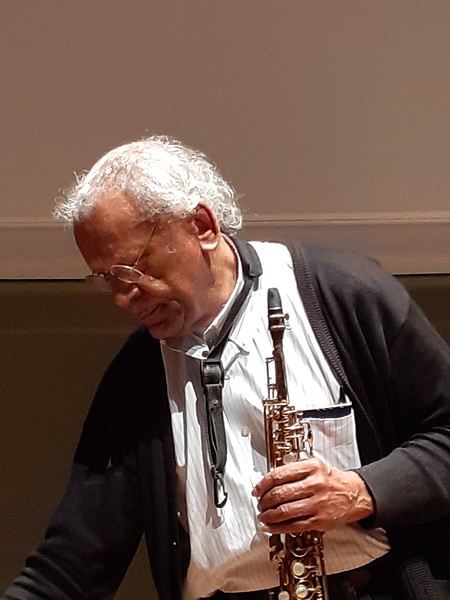
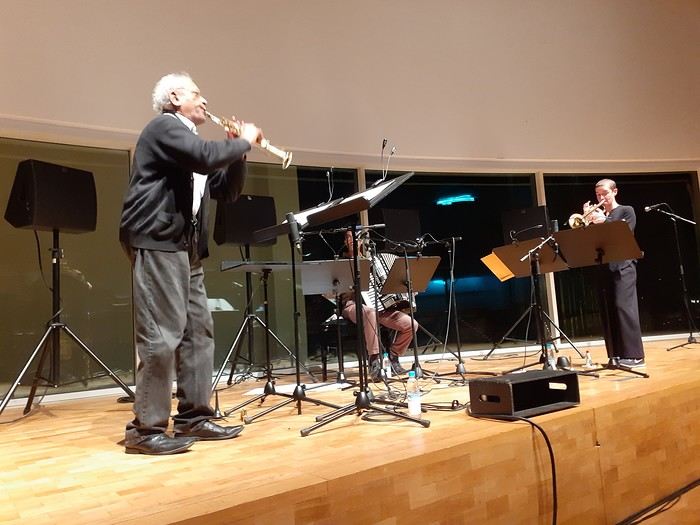
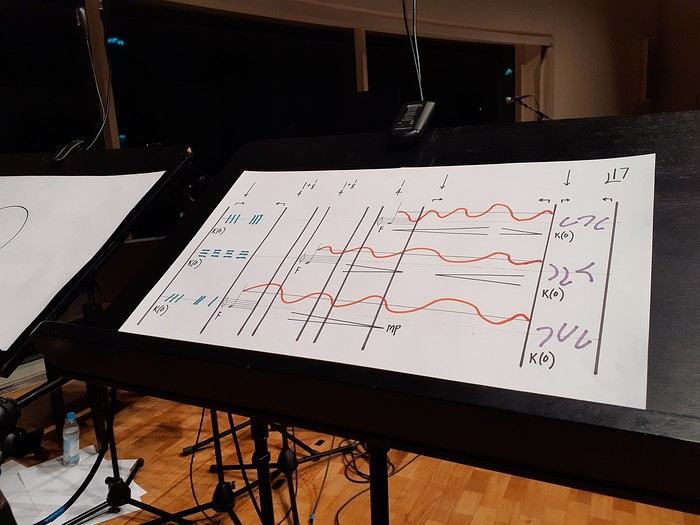
For over half a century, the American Anthony Braxton—a composer, multi-instrumentalist, music theorist, university professor, mentor, and visionary—has been one of the key figures in avant-garde contemporary music. Braxton himself describes his music as "creative music," drawing inspiration from jazz, European New Music (Schönberg, Stockhausen, and Xenakis are among the composers who influenced him), and music from various world cultures. In other words, his work uniquely oscillates between composition and improvisation. His body of work includes around 700 compositions, over 200 albums, and a dozen theoretical books.
Anthony Braxton is one of the most striking and brilliant figures in contemporary jazz. As a member of the Creative Construction Company (with violinist Leroy Jenkins and trumpeter Leo Smith) and the quartet Circle (with Chick Corea, Dave Holland, and Barry Altschul—whose double album Circle. Paris Concert is a landmark of contemporary jazz), with his groundbreaking solo alto saxophone album For Alto (1968), his duo with drummer Max Roach, Birth and Rebirth (1978), and especially his own ensembles and large formations, he set out to "redefine the space of music" (Braxton). In doing so, he gave decisive impetus to the development of jazz, making him a star of the avant-garde in the 1970s, with a recording contract from a major label.
Born in 1945 in the South Side, an African-American neighborhood of Chicago, Braxton was always a bit of an outsider, not doing what everyone else did. While the boys in his neighborhood hung out and goofed around, he stayed home pondering chess games or practicing the saxophone. Later, he became a leading figure in the Chicago musicians' organization AACM (Association for the Advancement of Creative Musicians), a mutual aid network for many African-American musicians in Chicago's new jazz scene. He then led his own formations for years, including musicians like George Lewis, John Lindberg, Marilyn Crispell, Gerry Hemingway, Kenny Wheeler, Dave Holland, Barry Altschul, Mark Dresser, Ray Anderson, and Mark Helias. In the mid-1980s, Braxton settled down a bit by accepting a teaching position at Mills College at the University of California, Berkeley. He was a tenured professor at Wesleyan University in Middletown, Connecticut, for many years. From his "school" emerged musicians of the younger generation, such as Taylor Ho Bynum (trumpet), Aaron Siegel (percussion), Jay Rozen (tuba), Jessica Pavone (violin, viola, flute), and Mary Halvorson (guitar).
I’ve seen Anthony Braxton in concert many times: the first time at the Moers Jazz Festival (1976) in a duo with George Lewis (trombone)—I still remember it vividly—the last time in November 2021 in Ulm with his Diamond Curtain Wall Trio (with the incredible Portuguese trumpeter Susanna Santos Silva; see the photos).
Just a few days ago, on June 4, this exceptional figure celebrated his 80th birthday. Congratulations!
hgb
Abdulrazak Gurnah, an author with a unique journey and identity (Tanzania)
(A belated tribute on this forum)
Abdulrazak Gurnah, an author with a unique journey and identity (Tanzania)
Big surprise in Stockholm: the 2021 Nobel Prize in Literature was awarded to novelist Abdulrazak Gurnah. The Tanzanian author, who writes in English, is best known for his novels Paradise (1994) and By the Sea (2001). He was recognized for his "uncompromising and compassionate portrayal of the effects of colonialism and the fate of refugees caught between cultures and continents", according to the Nobel Committee.His work moves away from "stereotypical descriptions and opens our eyes to a culturally diverse East Africa that is little known in many parts of the world".
Gurnah is the first African author since 2003 to win the prestigious prize, and the fifth from the African continent overall—following Wole Soyinka (1986), Naguib Mahfouz (1988), Nadine Gordimer (1991), and J.M. Coetzee (2003). Once again, the prize passed over Kenyan Ngugi wa Thiong’o, who has long been among the favorites for the award.
Born in Zanzibar (now part of Tanzania) in 1948, Abdulrazak Gurnah grew up in an Arab family originally from Yemen. He sought refuge in the UK in the late 1960s, a few years after independence, at a time when the Muslim minority there was being persecuted. He wasn’t able to return to Zanzibar until 1984.
Since 1987, he has published around ten novels and several short stories in English (his native language is Swahili). None have become bestsellers, but his body of work as a whole offers a different perspective on issues like immigration and cultural diversity. His work sheds light on the effects of colonialism, exile, and the plight of refugees, "speaking" of his love for Africa and his fight against neocolonialism. Though Gurnah’s stories aren’t explicitly autobiographical, they’re inspired by his life as an immigrant in the UK.
Gurnah was also a professor of English and postcolonial literature at the University of Kent in Canterbury until his recent retirement.
Does this award bring more attention to African literature? Who knows? At the very least, it might give it a boost. If African literature is less visible in the West, it’s partly because it isn’t widely accessible: Gurnah is rarely translated into French or German, and not at all into Arabic.
In Tanzania and its Zanzibar archipelago, he’s being celebrated with joy. "This means a lot for Zanzibar’s struggle for self-determination," says Ismail Jussa, a literary critic from Zanzibar. "It helps put Zanzibar back on the map." The Swedish Committee acknowledged that his work has helped understand "the divisions caused by colonialists, but also the heartbreak of being torn between the homeland one comes from and the life of exile one is forced into."
By the Sea. Bloomsbury Publishing, 2001 (Fr.: Près de la Mer. Galaade Éd., 2006)
Paradise. Bloomsbury Publishing, 1994/2004 (Fr.: Paradis. Motifs, 1999)
Desertion. Bloomsbury Publishing, 2005 (Fr.: Adieu Zanzibar. Galaade Éd., 2009)
Afterlives. Bloomsbury Publishing, 2020 (Fr.: Les vies d’après. Denoël, 2023)
Hery
Concepts rythmiques aux textures vivifiantes de l’Afrique (Côte d’Ivoire/Suisse)
La joie, le plaisir et l’énergie aux couleurs africaines
Aussi bien un trio composé de trois musiciens « africains » qu’un trio avec un Ivoirien et deux Suisses, c’est Keïta-Brönnimann-Niggli dont les compositions transmettent éloquemment leur passion pour leur continent natal, l’Afrique, tout en intégrant divers éléments empruntés du jazz.
Aly Keïta compte parmi les grands maîtres ivoiriens du balafon. Il sait adapter son instrument à d'autres langages musicaux, plongeant son instrument dans un bain de cultures aussi diverses qu’étonnantes. Depuis plus de vingt ans. Au fil de sa carrière, le musicien ivoirien, d’origine malienne, repousse les limites musicales et culturelles du balafon, ce qui lui permet de collaborer avec des musiciens tels que Joe Zawinul, Jan Gabarek, Trilok Gurtu, Hans Lüdemann, Pharoah Sanders, Enrico Rava et tant d’autres ! Dans son dernier projet, Ali s’entoure de deux artistes suisses de renom, le multianchiste Jan Galega Brönnimann et le batteur-percussionniste aux multiples sonorités, Lukas Niggli. Ensembles, ils mêlent leurs instruments pour créer une musique innovante, quelque part à la rencontre des traditions et du jazz. Un voyage musical ensoleillé sur les traces du jazz contemporain et des musiques africaines. Véritablement, un trio resplendissant de musicalité et de générosité…
Issu d'une famille musicale, Lukas Niggli débute au piano, puis à la batterie et forme son premier groupe à onze ans. Puis la participation à un orchestre classique, premier groupe de rock et premier contact avec la musique contemporaine écrite et improvisée. Pluralité d’influences donc, qui se prolonge au conservatoire de Zurich où le grand batteur vétéran Pierre Favre devient son professeur. A l’issue de cet apprentissage, Favre l’engage dans sa formation. Mais l’intérêt essentiel de Niggli pour le rythme remonte sans doute aux six premières années de sa vie passées au Cameroun où il est né, pays dont l’atmosphère musicale l’a profondément influencé. En Suisse, c’est l’approche fortement individuelle de l’instrument caractérisant chaque batteur qui le marque : « C'est une spécificité helvétique difficile à expliquer par des causes simples, mais qui a sans doute à voir avec la tradition des tambours militaires ». Toujours est-il que le set de Niggli retrace à la fois ses influences rock, contemporaines, jazz... « La pauvreté de la batterie jazz classique au niveau des timbres me posait problème. J'ai donc ajouté diverses cymbales, des woodblocks, tout un spectre de couleurs collectées ici ou là, de sons qui me plaisaient. Cela me permet de jouer aussi bien des grooves que de la musique libre »... et n'empêche d'ailleurs pas Niggli de pratiquer la batterie rock pure et dure quand le contexte l'exige, dans des groupes de metal, de noise ou de freecore tels que Steamboat Switzerland, formation qui interprète la musique contemporaine avec l'énergie du rock et commande ses thèmes à des compositeurs extérieurs pour ensuite y ajouter ses impros…
Le troisième du trio, Jan Galega Brönnimann, préfère jouer de la clarinette basse (et contrebasse), assez rarement le saxophone soprano. Lui aussi est né au Cameroun. Donc, Niggli et Brönnimann sont amis depuis leur plus jeune âge, leur enfance a donc été bercée par les sons et les rythmes de la musique ouest-africaine. Etonnament, ces deux musiciens se retrouvent pour la première fois au studio pour enregistrer Kalo Yele ("clair de lune" en bambara), leur premier disque, inclassable, pas de pur disque de jazz, mais avec des éléments de jazz surtout via le jeu du clarinettiste. Dans leur jeu d‘ensemble, le balafon tient souvent le rôle d’un piano dans un trio de jazz classique, ce sont des « lames que frappent des mailloches, des calebasses pour la résonance (…) et des cordes pour assembler le tout à la main » (extrait du livret). Et en l’absence de basse ou de contrebasse dans ce trio, c’est Brönnimann qui assume souvent cette fonction à la clarinette basse (ou contrebasse), par des riffs, chants ou contrechants, entre Niggli, le moteur percussif, et Aly Keïta qui jouit d’une grande liberté soliste. Outre les pulsions rythmiques tout aussi incontournables que prégnantes, un univers rythmique au dynamisme diversifié par son approche et ses mulitiples facettes, trois superbes musiciens originaux, en complète osmose, impeccables sur le plan technique et équipés de passion et de joie de jouer irrépressible, réunissent deux continents, deux cultures (et plus), des tempéraments et des mentalités différents, ainsi que les idéaux du jazz et des rythmes ouest-africains dans un mélange aussi vivant qu’hypnotique. Une musique qui vit de la virtuosité de ses protagonistes, de leur force et intensité – et pourtant, elle sonne incroyablement chaleureuse et sans le moindre effort…
Cds :
Kalo Yele. Intakt Records. (2015) Kalan Te Ban. Intakt Records. (2020)
Hery
https://www.youtube.com/watch?v=ylQTmIQAAqQ
Pertes et déchirements (Italie)
« Era da tanto che volevo scrivere un romanzo con una protagonista. Volevo dire “io” e essere una donna. Adesso posso dire che questa è stata una delle esperienze più importanti che ho provato scrivendo. Tutto è diventato ancestrale, viscerale, materno. Fragilità e coraggio, due sentimenti che non ho mai considerato in contrapposizione, si sono amplificati in maniera assolutamente inedita. Trina (Caterina) – così si chiama la protagonista – ha il nome […] dell’ultima donna che ha lasciato il borgo dopo che la Montecatini […] e ha riempito l’invaso sommergendo per sempre ogni cosa » (Marco Balzano, dans le blog LetteratitudineNews, 2019)
Les drames subis d’un village tyrolien
Ce clocher, il se situe justement à Curon (en all. Graun), un petit village italien situé dans le Tyrol du Sud. C’est en visitant l’endroit et parce qu’il a été lui aussi frappé par cette vision presque surréaliste que Marco Balzano a décidé de lui consacrer un roman. Pour être tout à fait exacte, Je reste ici n’est pas à proprement parler l’histoire de ce lieu. Curon est plutôt le décor du récit qui prend la forme d’un témoignage, la confession d’une mère et femme, Trina, à Marica, sa fille disparue. Cette absence, vive blessure jamais guérie chez Trina, est le moteur de son récit. Elle ne cache rien des fractures apparaissant dans la famille ou dans le village, des trahisons, des violences, mais aussi des joies, traitées avec finesse et pudeur.
Au début, dans les années 1920 Trina est une toute jeune fille. Elle vit à Curon, ancien territoire autrichien annexé par l’Italie à la suite de la Première Guerre mondiale, dans une vallée qui voit soudainement arriver des italophones, des nationalistes qui ne tardent pas à être franchement fascistes, qui lui ferment la porte de l’école pour attribuer les places d’institutrices à des Italiens envoyés là, de toute l’Italie : les adeptes de Mussolini veulent italianiser ces nouveaux territoires nationaux au pas de charge. La langue allemande y est interdite et Trina, devenue institutrice, enseigne clandestinement dans sa langue natale, malgré la chasse que les nationalistes font à ces écoles interdites. Au risque de représailles. Au risque d’un exil à l’autre bout du pays, très loin à l’autre bout de la botte.
Malgré tout, la vie suit son cours. Trina épouse Erich, un paysan, avec qui elle a deux enfants, Marica et Michael. En 1939, la population locale subit un nouveau déchirement. Un accord entre les régimes nazi et fasciste leur demande de choisir : rester chez eux et garder la nationalité italienne ou émigrer vers le Troisième Reich pour devenir Allemands et retrouver leur langue natale : un choix entre la peste et le choléra. Trina et son époux restent, mais ce choix n’est pas sans conséquences : un jour de 1936, Anita, la sœur d’Erich, venue d’Innsbruck, s’installe à Curon avec son mari Lorenz pour échapper au tourbillon urbain et aux voyages incessants de Lorenz, dit-elle. Jusqu’à cette nuit où Anita et Lorenz sont partis comme des voleurs en emmenant avec eux la petite Marica, laissant Trina, Erich et Michael sans nouvelle, désemparés et perdus. Puis la Seconde Guerre mondiale, la mobilisation des hommes qui vont combattre auprès des fascistes et la fuite dans les montagnes alentours. Mais un malheur n’arrivant jamais seul, le gouvernement italien décide de construire dans la région un immense barrage qui aura pour conséquence d’inonder, d’anéantir même, plusieurs villages, dont Curon. Donc, il faut que Trina passe par deux tragédies, qu’elle endure deux déchirements : la séparation d’avec sa fille, d’un côté, et, de l’autre, la perte de son village natal, de ses origines, de son identité. Car les deux sont intimement liés.
Des années plus tard, Trina prend la plume. Elle écrit à cette fille qui est partie de la maison, qui n’a jamais donné d’autre nouvelle, qui n’est jamais reparue alors que, eux, malgré les ennuis, malgré la guerre, malgré le barrage, sont restés ici. Dans le pays qui les a vu naître. Dans leur pays. Sur leur terre pourtant tellement malmenée.
Elle raconte le quotidien d'un monde rural simple et paisible, rattrapé par la folie des hommes. Elle raconte comment le village qui se situe sur la frontière italo-germanique. est annexé par l'Italie en dédommagement de guerre et comment commence pour les habitants une italianisation à marche forcée. Elle raconte comment certains partent s'installer dans le Tyrol autrichien, et d'autres restent au village et tentent de résister car c'est la terre de leur père. Elle raconte leur fol espoir lorsqu'Hitler arrive au pouvoir et signe une alliance avec le Duce. Elle raconte… Enfin, elle raconte la dernière trahison des hommes lorsqu'ils décident de mettre en œuvre le projet de barrage qui inondera et engloutira le village.
Fascisme, nationalisme, dictats industriels, passivité et dirigisme étatique, tout cela constitue le fil rouge de ces vies que Trina raconte dans une langue crue, forte, pleine de la violence de ceux qui n’ont qu’elle pour rempart, pleine de l’impuissance de l’être fruste, toujours dans une tentative de renaissance après une défaite, toujours dans l’espérance, même quand l’espoir a disparu.
Et ce clocher, noyé, qui orne la première de couverture mérite d’illustrer une autre histoire que celle qui est aujourd’hui racontée aux touristes qu’il attire : celle que nous livre Marco Balzano dans ce livre beau, très fort, magnifique. Un roman sympa, mêlant avec talent la grande et la petite histoires, qui fait résonner longtemps la voix de Trina qui, malgré les violences de la guerre, reste fidèle à ses passions de jeunesse, courageuse, indépendante et digne : le récit d'une femme forte, amoureuse, fidèle à elle-même, qui admire la liberté de sa propre mère et qui restera debout face à cette histoire qui ne lui laisse presque rien.
L’auteur milanais évite des effets stylistiques et littéraires. Il écrit l’histoire de Curon sur le ton calme d’une chronique et dans un langage simple. C’est précisément cet understatement qui rend ce drame historique d’autant plus évident.
(le titre original est Resto qui, le titre allemand est Ich bleibe hier, le titre français est Je reste ici)
Hery
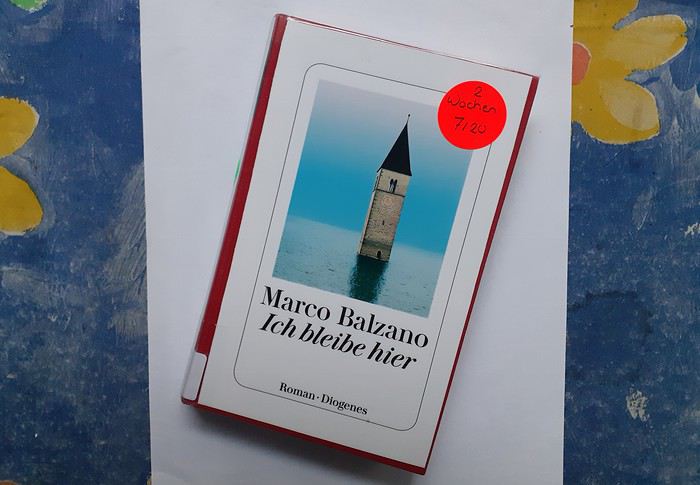
https://www.youtube.com/watch?v=ryNAOJg31PY
Les drames subis d’un village tyrolien
Ce clocher, il se situe justement à Curon (en all. Graun), un petit village italien situé dans le Tyrol du Sud. C’est en visitant l’endroit et parce qu’il a été lui aussi frappé par cette vision presque surréaliste que Marco Balzano a décidé de lui consacrer un roman. Pour être tout à fait exacte, Je reste ici n’est pas à proprement parler l’histoire de ce lieu. Curon est plutôt le décor du récit qui prend la forme d’un témoignage, la confession d’une mère et femme, Trina, à Marica, sa fille disparue. Cette absence, vive blessure jamais guérie chez Trina, est le moteur de son récit. Elle ne cache rien des fractures apparaissant dans la famille ou dans le village, des trahisons, des violences, mais aussi des joies, traitées avec finesse et pudeur.
Au début, dans les années 1920 Trina est une toute jeune fille. Elle vit à Curon, ancien territoire autrichien annexé par l’Italie à la suite de la Première Guerre mondiale, dans une vallée qui voit soudainement arriver des italophones, des nationalistes qui ne tardent pas à être franchement fascistes, qui lui ferment la porte de l’école pour attribuer les places d’institutrices à des Italiens envoyés là, de toute l’Italie : les adeptes de Mussolini veulent italianiser ces nouveaux territoires nationaux au pas de charge. La langue allemande y est interdite et Trina, devenue institutrice, enseigne clandestinement dans sa langue natale, malgré la chasse que les nationalistes font à ces écoles interdites. Au risque de représailles. Au risque d’un exil à l’autre bout du pays, très loin à l’autre bout de la botte.
Malgré tout, la vie suit son cours. Trina épouse Erich, un paysan, avec qui elle a deux enfants, Marica et Michael. En 1939, la population locale subit un nouveau déchirement. Un accord entre les régimes nazi et fasciste leur demande de choisir : rester chez eux et garder la nationalité italienne ou émigrer vers le Troisième Reich pour devenir Allemands et retrouver leur langue natale : un choix entre la peste et le choléra. Trina et son époux restent, mais ce choix n’est pas sans conséquences : un jour de 1936, Anita, la sœur d’Erich, venue d’Innsbruck, s’installe à Curon avec son mari Lorenz pour échapper au tourbillon urbain et aux voyages incessants de Lorenz, dit-elle. Jusqu’à cette nuit où Anita et Lorenz sont partis comme des voleurs en emmenant avec eux la petite Marica, laissant Trina, Erich et Michael sans nouvelle, désemparés et perdus. Puis la Seconde Guerre mondiale, la mobilisation des hommes qui vont combattre auprès des fascistes et la fuite dans les montagnes alentours. Mais un malheur n’arrivant jamais seul, le gouvernement italien décide de construire dans la région un immense barrage qui aura pour conséquence d’inonder, d’anéantir même, plusieurs villages, dont Curon. Donc, il faut que Trina passe par deux tragédies, qu’elle endure deux déchirements : la séparation d’avec sa fille, d’un côté, et, de l’autre, la perte de son village natal, de ses origines, de son identité. Car les deux sont intimement liés.
Des années plus tard, Trina prend la plume. Elle écrit à cette fille qui est partie de la maison, qui n’a jamais donné d’autre nouvelle, qui n’est jamais reparue alors que, eux, malgré les ennuis, malgré la guerre, malgré le barrage, sont restés ici. Dans le pays qui les a vu naître. Dans leur pays. Sur leur terre pourtant tellement malmenée.
Elle raconte le quotidien d'un monde rural simple et paisible, rattrapé par la folie des hommes. Elle raconte comment le village qui se situe sur la frontière italo-germanique. est annexé par l'Italie en dédommagement de guerre et comment commence pour les habitants une italianisation à marche forcée. Elle raconte comment certains partent s'installer dans le Tyrol autrichien, et d'autres restent au village et tentent de résister car c'est la terre de leur père. Elle raconte leur fol espoir lorsqu'Hitler arrive au pouvoir et signe une alliance avec le Duce. Elle raconte… Enfin, elle raconte la dernière trahison des hommes lorsqu'ils décident de mettre en œuvre le projet de barrage qui inondera et engloutira le village.
Fascisme, nationalisme, dictats industriels, passivité et dirigisme étatique, tout cela constitue le fil rouge de ces vies que Trina raconte dans une langue crue, forte, pleine de la violence de ceux qui n’ont qu’elle pour rempart, pleine de l’impuissance de l’être fruste, toujours dans une tentative de renaissance après une défaite, toujours dans l’espérance, même quand l’espoir a disparu.
Et ce clocher, noyé, qui orne la première de couverture mérite d’illustrer une autre histoire que celle qui est aujourd’hui racontée aux touristes qu’il attire : celle que nous livre Marco Balzano dans ce livre beau, très fort, magnifique. Un roman sympa, mêlant avec talent la grande et la petite histoires, qui fait résonner longtemps la voix de Trina qui, malgré les violences de la guerre, reste fidèle à ses passions de jeunesse, courageuse, indépendante et digne : le récit d'une femme forte, amoureuse, fidèle à elle-même, qui admire la liberté de sa propre mère et qui restera debout face à cette histoire qui ne lui laisse presque rien.
L’auteur milanais évite des effets stylistiques et littéraires. Il écrit l’histoire de Curon sur le ton calme d’une chronique et dans un langage simple. C’est précisément cet understatement qui rend ce drame historique d’autant plus évident.
(le titre original est Resto qui, le titre allemand est Ich bleibe hier, le titre français est Je reste ici)
Hery
https://www.youtube.com/watch?v=ryNAOJg31PY
Disparition de Keith Tippett (Grande-Bretagne)
« With his mutton-chop sideburns and penchant for countrymen’s tweed jackets, waistcoats and collarless shirts, Keith Tippett suggested a quirky Edwardian gentleman farmer more than an experimental music firebrand. » (John Fordham, The Guardian, juin 2020)
Entre jazz libre et rock progressif
Un grand nom du jazz britannique vient de disparaître. En juin, le compositeur, improvisateur et pianiste anglais Keith Tippett est mort à l’âge de 72 ans. Curieux de tous les styles et tous les genres, infatigable à la quête de nouvelles expériences musicales, il est une figure pionnière de la scène anglaise de jazz libre depuis le début des années 70. Mais il se fait surtout connaître pour avoir fondé le méga-orchestre CENTIPEDE, comprenant une cinquantaine de musiciens, et par sa participation à trois albums du groupe de rock progressif KING CRIMSON. Sa discographie est immense...
Né à Bristol en 1947, Keith Tippett étudie le piano et l’orgue d’église et forme son premier groupe quand il est adolescent. En 1967, il s‘installe à la capitale britannique, la date qui équivaut au début de sa vie musicale professionnelle. Déjà sa première formation, le KEITH TIPPETT GROUP, un sextet comprenant notamment le saxophoniste Elton Dean, le trompettiste Mark Charig et le tromboniste Nick Evans, atteint un certain degré de notorité. Le groupe enregistre deux disques de jazz-rock qui font date, You are here...I am There en 1970, et Dedicated to You, but You weren’t Listening en 1971, auquel participe aussi Robert Wyatt, entre autres. A cette époque également, Keith Tippett collabore à la chanteuse Shelag McDonald et effectue plusieurs sessions de King Crimson où il laisse son imparable touche pianistique : faut écouter p.ex. la pièce Cat Food ou aussi Lizard, really great !)...
En 1970 de même, Keith Tippett fonde un orchestre hors du commun comprenant d’une cinquantaine de musiciens issus des scènes jazz et rock britannique, CENTIPEDE, laissant un double album, Septober Energy, qui reste unique en son genre : une composition déclinée en quatre parties, chacune faisant intervenir les musiciens soit en solo, en duos, en trios, en quartets, en orchestre complet, mélangeant et mariant différents styles – jazz, classique, rock, free music, etc. Peu de temps après, Keith Tippett crée une autre formation, OVARY LODGE, avec le contrebassiste Roy Babington, le batteur Frank Perry et – plus tard – le bassiste sud-africain, Harry Miller. Sa femme, la vocaliste et percussionniste Julie Tippetts (née Driscoll) y participe également : qui ne se souvient pas d‘une voix soul, celle de Julie, accompagnée du groupe Brian Auger & The Trinity ayant eu plusieurs hits à l‘époque : This Wheel‘s on Fire, Road to Cairo, Season of the Witch... Ce quartet s’oriente vers une musique entièrement improvisée, au croisement du free et de la musique contemporaire, préfigurant même l’ambient.
En 1976, Keith Tippett joue en duo avec un autre pianiste britannique, Stan Tracey, et en 1978, il forme sa deuxième grande formation, ARK, un big-band de 22 musiciens, cette fois issu du jazz et des musiques improvisées, se déplaçant musicalement entre Charles Mingus et Sun Ra. Cette grande formation comprend notamment des membres d’OVARY LODGE et du Chris McGregor’s Brotherhood of Breath, n’ayant enregistré, tout comme CENTIPEDE, qu’un seul double album, Frames (Music for an Imaginary Film). Par la suite, le pianiste crée d’autres formations orchestrales qui, même sans avoir dépassé le nombre de participants d’ARK et de CENTIPEDE, témoigne d’une densité et d’un foisonnement musicaux tout aussi impressionnants, comme le KEITH TIPPETT SEPTET, le KEITH TIPPETT TAPESTRY ORCHESTRA, VIVE LA BLACK et le KEITH TIPPETT OCTET. En somme, une carrière musicale qui présente diverses formes musicalement assez contrastées...
A l’opposé de ces grandes formations, le fécond talent pianistique de Keith Tippett s’exprime également sous la stricte forme du solo piano, une démarche qu’il initie à partir des années 80 avec le double album The Unlonely Raindancer et qu’il développe dans les décennies suivantes au sein de sa série de disques solistes Mujician I, II, III (August Air) et IV (Live in Piacenza) et dans d’autres albums comme The Dartington Concert, Friday the 13th et Live in Triest. Ce sont tous des albums qui illustrent toute l’amplitude créative de Keith Tippett sur le piano, rayonnant d’un lyrisme brûlant, d’un souffle vital et d’une inventivité infaillible, souvent le traitant d’un "piano préparé à la John Cage" (le son des cordes étant modifié par des pièces de bois et autres objets). MUJICIAN devient aussi le nom de l’un des groupes les plus éloquents du pianiste, un quartet improvisé d’harmonie intuitive, avec le saxophoniste Paul Dunmall, inspiré de Coltrane, le virtuose de basse, Paul Rogers, et le batteur Tony Levin...
Au cours de sa longue carrière, Keith Tippett multiplie les rencontres musicales sous plusieurs formes, en duos, en trios, etc. etc., et participe, de la même façon, dans différentes formations d‘amis musiciens, dont Elton Dean (Quartet, Quintet, Ninesense), Harry Miller (Isipingo), le violoniste de King Crimson, David Cross (Low Flying Aircraft), le bassiste de Soft Machine, Hugh Hopper (Hopper-Dean-Tippett-Gallivan), Paul Dunmall ou en duo avec le pianiste Howard Riley, le saxophoniste Andy Sheppard, ou encore avec sa femme Julie, avec laquelle il enregistre plusieurs albums (Couple in Spirit). En 2000, il écrit une musique pour un quartet à cordes contemporain, le Kreutzer Strings Quartet (Linuckea. Let The Music Speak).
Toute sa vie (musicale), Keith Tippett a la vision idéaliste que les gens qui écoutent de la musique entrent dans un espace sacré. Il envisage d'atteindre ses objectifs humanistes et musicaux sans tout compromis. Sa classe pianistique, ses compétences artistiques ne sont pas toujours reconnues et la reconnaissance que son travail mérite ne lui est pas toujours témoignée. A cet égard, Keith Tippett n’est certainement pas le seul. En Grande-Bretagne et ailleurs, on ne traite pas toujours les trésors nationaux comme il faut. En tout cas, Keith Tippett en est un...
Quel que soient les projets musicaux dans lesquels il s’investit, Keith Tippett laisse des traces immanquables et remarquées, avec son jeu de piano aussi endiablé que raffiné, fécond et innovant, son swing habité et hypnotique. Par sa mort, la musique du XXe siècle perd l’un de ses plus inspirés serviteurs. Les traces qu’il laisse, en Grande-Bretagne et ailleurs, sont profondes et durables, mes souvenirs de plusieurs concerts que j’ai pu voir – en particulier à Berlin – restent inoubliables : THANK YOU, KEITH TIPPETT !!!
Hery
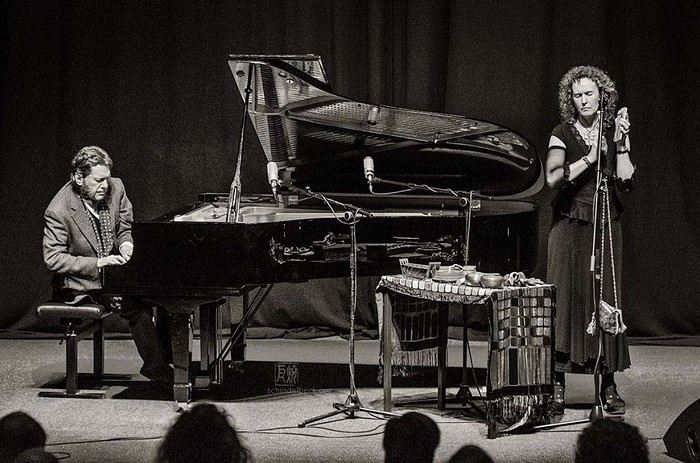
(Keith Tippett et sa femme Julie : © Frank Schindelbeck)
https://www.youtube.com/watch?v=JW2qdrPBikA
(Keith Tippett solo, live in Italy)
Entre jazz libre et rock progressif
Un grand nom du jazz britannique vient de disparaître. En juin, le compositeur, improvisateur et pianiste anglais Keith Tippett est mort à l’âge de 72 ans. Curieux de tous les styles et tous les genres, infatigable à la quête de nouvelles expériences musicales, il est une figure pionnière de la scène anglaise de jazz libre depuis le début des années 70. Mais il se fait surtout connaître pour avoir fondé le méga-orchestre CENTIPEDE, comprenant une cinquantaine de musiciens, et par sa participation à trois albums du groupe de rock progressif KING CRIMSON. Sa discographie est immense...
Né à Bristol en 1947, Keith Tippett étudie le piano et l’orgue d’église et forme son premier groupe quand il est adolescent. En 1967, il s‘installe à la capitale britannique, la date qui équivaut au début de sa vie musicale professionnelle. Déjà sa première formation, le KEITH TIPPETT GROUP, un sextet comprenant notamment le saxophoniste Elton Dean, le trompettiste Mark Charig et le tromboniste Nick Evans, atteint un certain degré de notorité. Le groupe enregistre deux disques de jazz-rock qui font date, You are here...I am There en 1970, et Dedicated to You, but You weren’t Listening en 1971, auquel participe aussi Robert Wyatt, entre autres. A cette époque également, Keith Tippett collabore à la chanteuse Shelag McDonald et effectue plusieurs sessions de King Crimson où il laisse son imparable touche pianistique : faut écouter p.ex. la pièce Cat Food ou aussi Lizard, really great !)...
En 1970 de même, Keith Tippett fonde un orchestre hors du commun comprenant d’une cinquantaine de musiciens issus des scènes jazz et rock britannique, CENTIPEDE, laissant un double album, Septober Energy, qui reste unique en son genre : une composition déclinée en quatre parties, chacune faisant intervenir les musiciens soit en solo, en duos, en trios, en quartets, en orchestre complet, mélangeant et mariant différents styles – jazz, classique, rock, free music, etc. Peu de temps après, Keith Tippett crée une autre formation, OVARY LODGE, avec le contrebassiste Roy Babington, le batteur Frank Perry et – plus tard – le bassiste sud-africain, Harry Miller. Sa femme, la vocaliste et percussionniste Julie Tippetts (née Driscoll) y participe également : qui ne se souvient pas d‘une voix soul, celle de Julie, accompagnée du groupe Brian Auger & The Trinity ayant eu plusieurs hits à l‘époque : This Wheel‘s on Fire, Road to Cairo, Season of the Witch... Ce quartet s’oriente vers une musique entièrement improvisée, au croisement du free et de la musique contemporaire, préfigurant même l’ambient.
En 1976, Keith Tippett joue en duo avec un autre pianiste britannique, Stan Tracey, et en 1978, il forme sa deuxième grande formation, ARK, un big-band de 22 musiciens, cette fois issu du jazz et des musiques improvisées, se déplaçant musicalement entre Charles Mingus et Sun Ra. Cette grande formation comprend notamment des membres d’OVARY LODGE et du Chris McGregor’s Brotherhood of Breath, n’ayant enregistré, tout comme CENTIPEDE, qu’un seul double album, Frames (Music for an Imaginary Film). Par la suite, le pianiste crée d’autres formations orchestrales qui, même sans avoir dépassé le nombre de participants d’ARK et de CENTIPEDE, témoigne d’une densité et d’un foisonnement musicaux tout aussi impressionnants, comme le KEITH TIPPETT SEPTET, le KEITH TIPPETT TAPESTRY ORCHESTRA, VIVE LA BLACK et le KEITH TIPPETT OCTET. En somme, une carrière musicale qui présente diverses formes musicalement assez contrastées...
A l’opposé de ces grandes formations, le fécond talent pianistique de Keith Tippett s’exprime également sous la stricte forme du solo piano, une démarche qu’il initie à partir des années 80 avec le double album The Unlonely Raindancer et qu’il développe dans les décennies suivantes au sein de sa série de disques solistes Mujician I, II, III (August Air) et IV (Live in Piacenza) et dans d’autres albums comme The Dartington Concert, Friday the 13th et Live in Triest. Ce sont tous des albums qui illustrent toute l’amplitude créative de Keith Tippett sur le piano, rayonnant d’un lyrisme brûlant, d’un souffle vital et d’une inventivité infaillible, souvent le traitant d’un "piano préparé à la John Cage" (le son des cordes étant modifié par des pièces de bois et autres objets). MUJICIAN devient aussi le nom de l’un des groupes les plus éloquents du pianiste, un quartet improvisé d’harmonie intuitive, avec le saxophoniste Paul Dunmall, inspiré de Coltrane, le virtuose de basse, Paul Rogers, et le batteur Tony Levin...
Au cours de sa longue carrière, Keith Tippett multiplie les rencontres musicales sous plusieurs formes, en duos, en trios, etc. etc., et participe, de la même façon, dans différentes formations d‘amis musiciens, dont Elton Dean (Quartet, Quintet, Ninesense), Harry Miller (Isipingo), le violoniste de King Crimson, David Cross (Low Flying Aircraft), le bassiste de Soft Machine, Hugh Hopper (Hopper-Dean-Tippett-Gallivan), Paul Dunmall ou en duo avec le pianiste Howard Riley, le saxophoniste Andy Sheppard, ou encore avec sa femme Julie, avec laquelle il enregistre plusieurs albums (Couple in Spirit). En 2000, il écrit une musique pour un quartet à cordes contemporain, le Kreutzer Strings Quartet (Linuckea. Let The Music Speak).
Toute sa vie (musicale), Keith Tippett a la vision idéaliste que les gens qui écoutent de la musique entrent dans un espace sacré. Il envisage d'atteindre ses objectifs humanistes et musicaux sans tout compromis. Sa classe pianistique, ses compétences artistiques ne sont pas toujours reconnues et la reconnaissance que son travail mérite ne lui est pas toujours témoignée. A cet égard, Keith Tippett n’est certainement pas le seul. En Grande-Bretagne et ailleurs, on ne traite pas toujours les trésors nationaux comme il faut. En tout cas, Keith Tippett en est un...
Quel que soient les projets musicaux dans lesquels il s’investit, Keith Tippett laisse des traces immanquables et remarquées, avec son jeu de piano aussi endiablé que raffiné, fécond et innovant, son swing habité et hypnotique. Par sa mort, la musique du XXe siècle perd l’un de ses plus inspirés serviteurs. Les traces qu’il laisse, en Grande-Bretagne et ailleurs, sont profondes et durables, mes souvenirs de plusieurs concerts que j’ai pu voir – en particulier à Berlin – restent inoubliables : THANK YOU, KEITH TIPPETT !!!
Hery
(Keith Tippett et sa femme Julie : © Frank Schindelbeck)
https://www.youtube.com/watch?v=JW2qdrPBikA
(Keith Tippett solo, live in Italy)
"1956 Women’s March Exhibition" (Afrique du Sud)
Une vidéo (exposition) :
Le Department of Arts & Culture de la province sud-africaine de KwaZulu-Natal a lancé aujourd’hui (le 1 septembre 2020) une exposition photographique pour commémorer le 1956 March of Women against Apartheid dans laquelle est présentée entre autres Nokutela Dube (1873-1917) comme une des premières sources d’inspiration de la lutte des femmes sud-africaines pour l’égalité au plus fort de la domination coloniale britannique (Nokutela se trouve de 16:55 à 21:26 dans la vidéo, avec une référence à sa relation avec Northfield et Ida Belle Wilcox*) :
https://www.youtube.com/watch?v=JN1GcKOfmLk
*William C. Wilcox et sa femme Ida Belle, résidants de Northfield (Minnesota, Etats-Unis), étaient des missionnaires qui ont servi à la mission américaine zouloue (American Zulu Mission), basée au Natal. En 1881, le couple arrivait à Inanda, au nord de Durban. Ida Belle enseignait des filles y compris Nokutela Dube.
Hery
Réhabilitation du patrimoine de Bandiagara au Mali
Un effort conjoint
Le 11 août 2020, l’Organisation des Nations Unies pour l’Education la Science et la Culture (UNESCO) a annoncé le lancement d’un projet de réhabilitation du patrimoine culturel et architectural de Bandiagara, ville historique, considérée comme la capitale du « Pays Dogon », et en partie détruite par le conflit qui fait rage dans le centre du Mali.
L’organisation onusienne précise dans un communiqué publié sur son site qu’elle « soutiendra la cohésion sociale et la résilience des communautés souffrant d’années de conflit armé dans le centre du Mali ». Elle souligne, en outre que ce soutien se fera « dans le cadre d’un nouveau projet majeur, rendu possible grâce à un financement d’un million de dollars US de l'Alliance internationale pour la protection du patrimoine dans les zones de conflit (ALIPH) ». Le projet apportera un soutien essentiel à la réhabilitation du bien du patrimoine mondial « Falaise de Bandiagara (Pays des Dogons) », qui abrite 289 villages répartis sur 400 000 hectares dans la région de Mopti. « La culture n’est pas seulement trop souvent victime de conflits armés prolongés, elle est aussi une source essentielle de résilience et un fondement important pour la construction de la paix » a déclaré la Directrice générale de l’UNESCO, Audrey Azoulay, citée dans le communiqué.
A travers ce nouveau projet, en collaboration avec les autorités maliennes, et financé par l’ALIPH, nous visons à placer la culture au cœur des efforts pour soutenir les communautés qui font de cette région leur foyer, a ajouté la même source. Ce projet de trois ans à Bandiagara vise à réhabiliter le patrimoine architectural endommagé, notamment les logements, les greniers et les sites consacrés à la culture traditionnelle, ainsi qu’à rétablir la production d’objets culturels et la sauvegarde des objets de cérémonies dans une collection commémorative, précise encore l'UNESCO. De par la réhabilitation et la sauvegarde des pratiques culturelles de la région (rites funéraires, danses masquées, …), le projet contribuera à renforcer le tissu social et la paix entre les communautés du Pays Dogon, note encore l'agence onusienne, ajoutant que les activités génératrices de revenus pour les femmes, sont au cœur de ce projet, qui vise à promouvoir la réconciliation entre les communautés et à favoriser la protection du patrimoine dans le contexte difficile de la pandémie du COVID 19.
En 2012, le Mali est devenu l'épicentre d'une crise politique et de sécurité de grande ampleur, provoquée par l'arrivée de groupes armés dans les régions du nord et du centre du pays. Outre le fait de causer des victimes civiles et de créer de l'insécurité, la crise a provoqué la destruction totale ou partielle de près de 30 villages, situés pour moitié dans les limites du bien du patrimoine mondial de la falaise de Bandiagara (Pays Dogon).
Les experts de l'UNESCO travailleront en étroite collaboration avec une équipe d'experts maliens du ministère de la Culture, de la Direction nationale du patrimoine culturel (DNPC), de la Mission culturelle de Bandiagara (BCM) et de la Mission multidimensionnelle intégrée des Nations unies pour la stabilisation au Mali (MINUSMA), ainsi qu'avec les communautés locales, précise le communiqué, soulignant que l'intervention à Bandiagara s'appuie sur les initiatives de réhabilitation de l'UNESCO au Mali, actives depuis 2012, et sur le travail d'évaluation et de médiation effectué en 2019 pour donner suite à la spirale de violence intercommunautaire à Bandiagara.
La falaise de Bandiagara est un vaste paysage culturel couvrant 400 000 hectares dispersés dans trois régions naturelles : le plateau de grès, l'escarpement, et les plaines. Les communautés entretiennent une relation très étroite avec leur environnement, qui s'exprime par des rituels et des traditions sacrés. Le bien a été inscrit sur la Liste du patrimoine mondial de l’UNESCO en 1989.
Hery
https://www.voaafrique.com/a/l-unesco-a-annonc%C3%A9-la-r%C3%A9habilitation-du-site-de-la-falaise-de-bandiagara-/5531116.html
Serena Fisseau & Vincent Peirani: «So Quiet»
Chansons douces pour Petits (et Grands)
« So quiet » - le titre de l’album en dit long : lorsque tout est bruyant et agité autour de soi, il vaut mieux s‘enfermer et se rendre dans un cadre familier. « So quiet » (2019) est une telle retraite musicale à laquelle la chanteuse-danseuse Serena Fisseau et son mari, l’accordéoniste Vincent Peirani, aussi parents de deux enfants ensemble, nous invitent. Un album tout simplement délicieux...
Par cet album, ces deux artistes nous invitent, pour ainsi dire, dans le cercle de leur petite famille, et représentent des chansons qu’ils jouent et chantent chez eux, notamment à leurs enfants (garçons de 3 et 9 ans), ainsi qu’à leurs proches, lorsqu’ils referment la porte du monde extérieur. Cela crée une ambiance confortable et intime, et avec laquelle on peut décrocher et se détendre : s’il s’agit d‘une chanson de Serge Gainsbourg (« La Javanaise »), de Burt Bacharach (« Close to you ») ou des Beatles (« And I love her »), si ce sont des pièces inspirées de la musique folklorique indonésienne ou brésilienne (Caetano Veloso, Antonio Carlos Jobim, Freire Júnior), si elles sont chantées en bahasa, français, anglais ou portugais, ou jouées à l’accordéon, à l’accordina, au Wurlitzer e-piano, aux body percussions ou même au piano – elle affectionnent la simplicité et enthousiasment. Ma pièce favorie, d’ailleurs, c’est « 3 petites notes de musique » (George Delerue/Henri Colpi) : d’une beauté simple (difficile à mettre en mots !)...
Serena Fisseau et Vincent Peirani font ressortir l’essence de ces chefs-d’œuvres intemporels, de la manière la plus naturelle possible. Seulement avec une voix soyeuse, rassurante et sans toutes fioritures, un instrument toujours distant et beaucoup de silence. Un silence – cette denrée précieuse, aujourd’hui peut-être plus que jamais – qui devient audible dans la musique de Serena Fisseau et Vincent Peirani. Dans les espaces entre les tons, qui sont sur cet album presque plus importants que les tons eux-mêmes. Une musique irrésistiblement légère, souvent joyeuse et claire, qui tire son intimité avant tout du fait que les deux musiciens ne sont pas seulement un couple d’artistes, mais aussi dans la « vraie» vie. Les deux ont fait cet album pour leurs enfants. Et pour tous les autres enfants. Et pour tous les adultes qui ont à nouveau envie de se rêver par des vibrations (très près de l’oreille) d’une voix femelle et d’un accordéon dans une légèreté enfantine pendant la durée d’un album...
Serena Fisseau : voix, body percussions Vincent Peirani : accordéon, accordina, Wurlitzer, piano, plastic bags, music box, voix
Hery

« So quiet » - le titre de l’album en dit long : lorsque tout est bruyant et agité autour de soi, il vaut mieux s‘enfermer et se rendre dans un cadre familier. « So quiet » (2019) est une telle retraite musicale à laquelle la chanteuse-danseuse Serena Fisseau et son mari, l’accordéoniste Vincent Peirani, aussi parents de deux enfants ensemble, nous invitent. Un album tout simplement délicieux...
Par cet album, ces deux artistes nous invitent, pour ainsi dire, dans le cercle de leur petite famille, et représentent des chansons qu’ils jouent et chantent chez eux, notamment à leurs enfants (garçons de 3 et 9 ans), ainsi qu’à leurs proches, lorsqu’ils referment la porte du monde extérieur. Cela crée une ambiance confortable et intime, et avec laquelle on peut décrocher et se détendre : s’il s’agit d‘une chanson de Serge Gainsbourg (« La Javanaise »), de Burt Bacharach (« Close to you ») ou des Beatles (« And I love her »), si ce sont des pièces inspirées de la musique folklorique indonésienne ou brésilienne (Caetano Veloso, Antonio Carlos Jobim, Freire Júnior), si elles sont chantées en bahasa, français, anglais ou portugais, ou jouées à l’accordéon, à l’accordina, au Wurlitzer e-piano, aux body percussions ou même au piano – elle affectionnent la simplicité et enthousiasment. Ma pièce favorie, d’ailleurs, c’est « 3 petites notes de musique » (George Delerue/Henri Colpi) : d’une beauté simple (difficile à mettre en mots !)...
Serena Fisseau et Vincent Peirani font ressortir l’essence de ces chefs-d’œuvres intemporels, de la manière la plus naturelle possible. Seulement avec une voix soyeuse, rassurante et sans toutes fioritures, un instrument toujours distant et beaucoup de silence. Un silence – cette denrée précieuse, aujourd’hui peut-être plus que jamais – qui devient audible dans la musique de Serena Fisseau et Vincent Peirani. Dans les espaces entre les tons, qui sont sur cet album presque plus importants que les tons eux-mêmes. Une musique irrésistiblement légère, souvent joyeuse et claire, qui tire son intimité avant tout du fait que les deux musiciens ne sont pas seulement un couple d’artistes, mais aussi dans la « vraie» vie. Les deux ont fait cet album pour leurs enfants. Et pour tous les autres enfants. Et pour tous les adultes qui ont à nouveau envie de se rêver par des vibrations (très près de l’oreille) d’une voix femelle et d’un accordéon dans une légèreté enfantine pendant la durée d’un album...
Serena Fisseau : voix, body percussions Vincent Peirani : accordéon, accordina, Wurlitzer, piano, plastic bags, music box, voix
Hery