Results for "boutique+ou+duty+|+55"
29129 results found.
Photos de pancartes et lanternes dans les villes de mes voyages English translation pending
Bonjour
je photographie des pancartes et lanternes dans chaque villes ou je passe
Hôtel Carabela Beach Resort à Punta Cana English translation pending
bonjour a ce qui en reviennent récament ou qui sont parti en 2008 pouvez vou me donner votre avis sur cette hotel q uelle boutique il contient, les chambres, et surtou la nouriture . En formule tou compris .merci
Hôtel Sol Cayo Guillermo: rénovations? English translation pending
bonjours, ou sont rendu les renovation au sol cayo guillermo, je regarde pour partir debut janvier mais j'aimerais bien savoir si les renovation seront terminer.
Fabrication sur mesure de grilles en fer forgé à Marrakech? English translation pending
Bonjour,
Connaissez-vs des endroits à Marrakech où l'on peut se faire faire sur mesure des grilles en fer forgé ? Les expédient-ils en France. Merci de votre réponse.
Connaissez-vs des endroits à Marrakech où l'on peut se faire faire sur mesure des grilles en fer forgé ? Les expédient-ils en France. Merci de votre réponse.
Essence à Koh Phi Phi? English translation pending
Bonjour, il y a-t'il un endroit ou se ravitailler en essence pour un bateau a moteur a Phi-Phi?
Hôtel avec chambres à ciel ouvert et tentes bédouines dans la région d'Alexandrie English translation pending
Bonjour à tous,
je suis à la recherche d'un boutique hotel sur Alexandrie et Region, dont la particularite est d'offrir des chambres à ciel ouvert ou couvertes par des tentures?
Quelqu'un pourrait m'aider?
D'avance, merci. 🙂
je suis à la recherche d'un boutique hotel sur Alexandrie et Region, dont la particularite est d'offrir des chambres à ciel ouvert ou couvertes par des tentures?
Quelqu'un pourrait m'aider?
D'avance, merci. 🙂
Recherche une vraie tente moustiquaire pour voyager à vélo English translation pending
Qui peut me dire où je peux trouver une vraie tente moustiquaire
(avec tapis de sol) ?
Les fabricants proposent des tentes qui ne couvrent que très
partiellement en moustiquaire.
Je souhaiterais trouver une tente igloo dont les quatre pans sont
en moustiquaire.
Merci
Merci
Randonnée avec chauffeur en Mongolie à l'été 2008 English translation pending
Nous arrivons en Mongolie le 10 ou 11 aout à Oulan Bator pour une semaine. Nous sommes 6 et voulons découvrir une région : randonnée avec chauffeur. Est-il préférable de réserver depuis la France un organisme ? Ou bien de le faire sur place en arrivant sachant que nous n'avons que 6 jours en Mongolie (nous reprenons le train pour Pekin le 17/08/2008). Est-il facile de trouver sur place facilement et vite pour pouvoir dès le lendemain de notre arrivée partir.
Le café d'Amélie Poulain à Paris English translation pending
Ça vaut le détour ou c'est une attrape-touristes?
Et Amélie y travaille quand? 🙂
Et Amélie y travaille quand? 🙂
Contact à Khajurao (Inde) English translation pending
l'un ou l'une de vous se rend-il (elle) a Khajurao (via Delhi - avion, sans doute) dans le mois qui vient ? au moins deux jours.
si c'etait pour la premiere fois, je peux expliquer les lieux et la procedure.
car je souhaite transmettre deux livres d'anglais a une petite fille que j'aide dans sa scolarite elle habite au centre du nouveau village.
merci d'avance.
car je souhaite transmettre deux livres d'anglais a une petite fille que j'aide dans sa scolarite elle habite au centre du nouveau village.
merci d'avance.
Tintin en Thaïlande? English translation pending
Quelqu'un sait où on peut trouver "Tintin en Thailande" ?
Lentilles oculaires, caméras et téléphone portables à Bangkok? English translation pending
A BKK :
1) les lentilles oculaires ou lunettes (j'ai vu l'adresse de Thuan, mais est-ce que les prix sont vraiment intéressants? Faut il apporter une ordonnance, ou peut-on simplement indiquer sa vue?)
2) les caméras
3) les téléphones portables
?????
Et si oui, où? Merci beaucoup !
Achats de tissus et bijoux à Madras English translation pending
Salut, quelqu'un pourrait il nous indiquer ou trouver des boutiques de tissus, et bijouteries, sur Madras ? Merci. Et un bon resto ?😏 A +
Cigares et cigarettes à la douane cubaine? English translation pending
bonsoir a tous
ou peut t on acheter des bons cigares a cuba et a combien ils sont et pour la douane ???
pour les cigarettes ou en trouve t on a combien est la cartouche
merci de vos reponses
Adresses de grossistes de jeans en Chine? English translation pending
Je cherche des adresses de fabricants ou grossistes en jeans mode...et si possible avec site internet et ou commande online ...
Merci d'avance ...
Acheter des bijoux en Inde English translation pending
POURRIEZ VOUS M INDIQUER OU TROUVER DES COPIES DE JOALIEREN INDE MERCI D AVANCE
Acheter un panneau solaire au Sénégal English translation pending
bjr savez vous ou je peux acheter un ou 2 panneaux solaire au Senegal pour alimenter un frigo un ventilo et un peu d'eclairage
Musique grecque English translation pending
Bonsoir à tous!
J'aimerais savoir où on peut trouver des enregistrements de bonne musique grecque, authentique, (genre pas avec du synthé et de la flûte traversière) et si par hasard vous connaîtriez des noms de chanteurs et chanteuses renommés, ou en tout cas apprécié des Hellènes.
Merci et bises!
V.
J'aimerais savoir où on peut trouver des enregistrements de bonne musique grecque, authentique, (genre pas avec du synthé et de la flûte traversière) et si par hasard vous connaîtriez des noms de chanteurs et chanteuses renommés, ou en tout cas apprécié des Hellènes.
Merci et bises!
V.
Magasinage à Puerto Plata et ses environs English translation pending
😉 Bonjour je me demandais ou sont situés les meilleurs endroits pour magasiner la bas pour nous et aussi pour rapporter des souvenirs et cadeaux ... a de bon prix mais bonne qualité quand meme et pas trop loin si c est possible et ou surtout ne pas aller non plus ..
on pars vendredi alors merci a l avance tourlou
on pars vendredi alors merci a l avance tourlou
Carte de crédit en voyage English translation pending
😮 Attention à tous ceux ou toutes celles qui pensent utiliser leur carte bleue visa pour régler les divers achats. Essayer d'éviter de l'utiliser à l'étranger et dans tous les pays hors France.
Dans la plupart des pays, lors du paiement on ne vous demande pas de code. On utilise la carte comme autrefois manuellement avec un appareil qui prend les empreintes de votre carte c'est-à-dire ses numéros. Je me suis fait avoir lors d'un dernier voyage en asie. A mon arrivée en France, j'ai consulté mon compte sur internet et je m'aperçoit que quelqu'un a certainement payé ses factures via internet (factures de télécomunications et achats divers). J'ai aussitôt été déposé une plainte au commissariat de police et ensuite été à ma banque pour bloquer mon compte et ma carte visa.
La police m'a dit que c'était très fréquent à l'étranger et qu'il ne fallait pas utiliser ce moyen de paiement car il prennent votre numéro de carte et font des achat sur internet.
Donc à éviter ! Prennez plutôt des travellers chèques.
Bon voyage !
Bangkok: drôle de pratique avec la police/armée et les passeports English translation pending
Hello,
un vendeur de la boutique du vieux campeur m'a conseillé pour la Thaïlande, de faire plusieurs photocopies de mon passeport car des policiers/militaires avaient de mauvaises intentions visant à récupérer du bacchiche en demandant le passeport aux touristes pour un soit-disant contrôle et puis le faisant passer de main en main avec à chaque fois des dollars à payer pour le récupérer.
Quelqu'un peut-il confirmer cette info?
Quelqu'un peut-il confirmer cette info?
Soleil en décembre? English translation pending
bonjour tout le monde,
ou peut-on trouver du beau soleil en décembre?
ou peut-on trouver du beau soleil en décembre?
Carte du Japon English translation pending
Bonjour, quelqu'un a une idée d'où je peux trouver une carte assez détaillée du japon en version papier ?
Merci Eric
Merci Eric
Billet Sri Lanka et bons plans English translation pending
C'est bizarre ou tout le monde est en vacances ou tres peu de gens sont allés au sri lanka car je n'ai eu qu'un mess !
Donc je recherche des infos sur le sri lanka pour y partir en fev. 2005 prix approx. du billet ce qu'on doit y voir et surtout ce que l'on ne doit pas aller voir car je n'aime pas perdre mon temps en vacances !
Tous les tuyaux sont les bienvenus, merci à tous !
Donc je recherche des infos sur le sri lanka pour y partir en fev. 2005 prix approx. du billet ce qu'on doit y voir et surtout ce que l'on ne doit pas aller voir car je n'aime pas perdre mon temps en vacances !
Tous les tuyaux sont les bienvenus, merci à tous !
Mamoudzou, Mayotte - December 2025
There exists a rare land where life expresses itself, a land where everything is destroyed, patched up, where everything is dirty and faded, yet paradoxically, each passing day is synonymous with light and joy. Seen from the sea, magnified by its translucent waters, the island is splendid; seen from inland, ochre and green dress a landscape one would wish to be pristine. As you approach the coast with the tides, countless boat wrecks never finish dying; returning from a hike, you know you’re nearing the city by the increasingly obvious proliferation of all kinds of trash. Overflowing the towns, makeshift homes made of corrugated iron stand here and there, wherever the eye lands; from a height, looking toward the horizon, you find the calm blue of the ocean and the beauty of infinity.
But where does all this corrugated iron come from? Blue, gray, red, or black, you find it pretty much everywhere—except, of course, on the island’s heights, where the heat is such that all life seems impossible. Yet, a few kilometers from the capital, more than an hour’s walk away, the corrugated iron is very much there, omnipresent, guaranteeing a land registry as hypothetical for us Europeans as it is very real for those who live there, far from civilization and comfort. I keep climbing. I’m precisely looking to meet these people who live on very little, if not nothing.
- Jéjé Mogné (Hello, sir in Shimahorais)! Where do you get water here, in this place? How do you drink, irrigate your plants?
- I wait for the rain. We have tanks that fill up well with each rainfall. But right now, it’s not raining much.
At the top of the next hill, lost in the bushes, it’s easier for me to guess the distant city, Mamoudzou, than the rest of the path, a remnant of a magnificent GR called the Island Tour, abandoned for the most part, sometimes maintained between two lost hamlets. The city, the pulse, water. Below, the ocean, running water, drinking water—despite regular interruptions; here, up high, an hour and a half’s walk away, tanks, arbitrariness. On other slopes, however, during another hike, I saw the water supply network, made of sturdy pipes tangled in the earth, right there by the path. It seems there are places where water climbs. Others not. Each to their own karma. In 2025. In a French department.
A path of misfortune, lost and regained, thanks to a sign, an inscription, or the compass’s directions. No one walks here anymore, except those who live here or come to harvest their crops. I remember that breathtaking hike in 2013, when I connected Bandrélé to Mamoudzou, passing by the peaks of Bénara (660m) and Bépilipili (643m), barely pausing at Tsararano and Vahibé: 34 km of intense effort on a rollercoaster path, along a trail that was still discernible. Today, it’s as if everything had disappeared. By also destroying the paths and vegetation, Chido* broke the last momentum of these cautious hikers: insecurity has made its way across the archipelago, and Sunday strolls are no longer the norm. Me, I keep going. I will have walked here and there during these three weeks to get an idea of the places, the people, the landscapes, and the superhuman effort required to move forward in over 40°C. To tell the truth, during my last hike, I cut my plans short and let myself be carried by a group of young people heading back to the city. The path is now just an inextricable network of small trails, the specter of Providence** comes to mind. True wisdom is knowing when to give up. I leave.
* A cyclone named "desire" (in Shona), which ravaged the island of Mayotte on December 14, 2024. ** June 2023, a very poorly prepared hike on Providence Island (Caribbean) from which I miraculously escaped.
On Petite-Terre, Marie takes me to visit some locals, white people who have lived there for a long time and make a living from their art; jewelry for her, all kinds of objects for him. We love this little shop, this oasis amid the chaos that embodies Dostoevsky’s phrase: "Beauty will save the world." It’s clean and tidy, beautiful, well-kept. Invariably, the question of insecurity resurfaces in the middle of the conversation. The woman says:
- I know someone who slipped in their bathtub. Still, I keep taking baths…
So, is this insecurity a myth or reality? I hear stories that are often true but sometimes seemingly exaggerated through the lens of misunderstanding and one-upmanship. Like that of this midwife assaulted one evening (it gets dark early) on her way home from work. Sometimes she was attacked on the path, dragged by the hair for several meters, sometimes she made it home, but it was her roommate who let the two men in. One version talks about a snatched phone and gratuitous violence, another about violence outright. In short, one thing is certain: walking around at night flaunting your phone isn’t a good idea, no more in Mamoudzou than in the rough neighborhoods of Nantes. Also, I played it safe: nothing flashy, nothing bling-bling, and always something to give if needed. I was never approached. It’s not easy to get a sense of the realities, between the hazy reports from journalists sensationalizing everything and the real lives of real people. But I know I can’t rely on these few ideas I’ve formed: I’m nobody, and above all, I don’t live here. What I do know, however, is that since my last visit to the island in 2017, over 80,000 babies have been born, and tens of thousands of immigrants have reached the archipelago’s shores. What’s also obvious is that poverty, hunger, and—let’s say it—indignity foster delinquency and insecurity. So, without taking journalists’ alarmist speeches at face value, we’ll try to keep in mind that a young person rendered orphaned by circumstances (parents expelled), poor and often hungry, involved more or less against their will in village wars and fueled by synthetic drugs*, will readily turn to violence when they truly have nothing to lose. We can trace the origin of this despair to the fact that in Mayotte, those without legal existence have virtually no hope of accessing anything.
* "Chimique" is a series of synthetic cannabinoids
Meanwhile, in the evening, it’s good to go home before the time of stone-throwing. From time to time, along the roads, gangs throw stones at vehicles and school buses, but mostly at police cars—almost all the white Dusters on the island! In front of the Mamoudzou police station, all parked vehicles—mostly Dusters—bear the scars of these attacks. Maybe it’s only at night that gangs unleash and all the burglaries happen? I saw nothing, heard nothing. I lived three weeks in a sort of bunker with no real access to outside light, protected by a fake wooden door doubled with a real metal door, both locked at all times. You don’t tempt fate. You endure it differently.
Today, extraordinarily, it’s raining. Yet, it’s the rainy season! But with my karma helping (what selfishness to want to walk dry when so many souls live off the rain) or is it climate change? The rain only falls once I’ve put on my horrible green pajamas. In front of the board outlining the program, I’m told that out of the six scheduled C-sections today (sic), they’ll probably only do two, maybe three. Because it’s raining. And when it rains, people don’t move around. Not for lack of will. Rather, for lack of means. And that ties into those sad days when the police patrol around the hospital: patients don’t come. They’ll come back tomorrow. To compensate, I’m happy at the thought of tackling the abscess program, but the sterilization unit is acting up and blocking the instrument trays. When it’s not the rain, it’s the unions. And when both finally quiet down, there’s always someone to find fault with the order of operations. You have to imagine an operating room where the question of urgency reigns supreme. Here, no surgery is scheduled more than 24 hours in advance—only emergencies, nothing but emergencies. So, following that reasonable adage that what’s done is no longer to be done, it’s sheer madness when the rain meets the interests of Force Ouvrière and the bad will of some combines with the laziness of others. To tell the truth, I’ve never seen so much energy expended to… do nothing. Hallucinating. But who am I, a small-time striver, an islander in my spare time, a temporary worker at the end of the world? I came, I saw, I was disappointed? Not really. Here again, I can’t judge a system in so little time. I can barely utter a few bitter words in front of obvious facts. But nothing will take away my joy of being here for three weeks. Here, they heal with somewhat outdated but still functional means. You do what you can with what you have, 8,000 km from the Métropole. Yes, the operating room doors hesitate, and the operating tables stutter, but in this blessed period, we lack neither medicines nor supplies. So we examine, anesthetize, and repair, far more undocumented people than French—if I may play with somewhat borderline statistics here; we deliver babies, dress wounds, and relieve pain in this hospital at the end of the world where neither white women nor Mahorais women would ever consider giving birth or getting treated.
What’s the solution? The obstetrician talks to the woman during a C-section under spinal anesthesia:
- Bouéni! (Madame, in Shimahorais) You need to think about tubal ligation. This is your fourth C-section. Your uterus is like tissue paper. Your next pregnancy will be very risky.
No answer. Culture. It’s all about culture. The funniest thing is that France also gets bogged down with the idea of other cultures’… cultures. The woman in question arrived illegally a few years ago to give birth to her first child. Since then, rejecting the very idea of contraception—her husband, for his part, will invoke God or Allah to refuse a vasectomy—she comes back every 12-14 months. And the obstetrician explains to me how his idea of making information about permanent contraception mandatory was deemed racist by associations. It’s always the same story. I suggest to the associations that they take charge of all these extra births, not only the medical costs but also the entire education, not just financial, of all these children doomed to live a life of misery on this forsaken archipelago. The probability that one of these offspring will emerge as a gifted, sensitive, and fiercely happy individual must truly be weighed against the degradation and abandonment that will invariably afflict the thousands of others living around him. In reality, simply mentioning a very real danger to the mother should be enough to impose sterilization. But we are a country whose greatness of soul is measured by the number of heads cut off to uphold the famous rights of man... Already a proponent at home of ending family allowances after the third child—you can’t subscribe to a certain idea of society and, at the same time, accept that tens of thousands of children are sacrificed on the altar of thoughtlessness and financial interest*—I will weakly advocate here for a controlled right to have children. Well, what will they say about me when I express the idea of imposing sterilization on women in irregular situations after the birth of their third child? National solidarity funds the noblest ideals? In Mayotte? Let’s be serious. It’s so much easier to hide behind the inalienable right of women to control their bodies than to acknowledge one’s own powerlessness to assume the consequences of such a policy. Because after 18 years of struggles as a second-class citizen, the young stateless person will have no choice but to live in hiding: faced with the impossibility of claiming birthright citizenship**, they will be deportable. In Mayotte, there aren’t enough schools, not enough housing, not enough projects for youth, not enough jobs, not enough money, not enough future… In Mayotte, an average of 5 children are born per woman. In reality, we never ask about the right of children to control their own lives.
* Single parent with 4 children: RSA at 1937 € + family allowances… ** Law of May 12, 2025 aiming to strengthen the conditions for accessing French nationality in Mayotte.
I live in the city in a clean apartment where air conditioning eases my aches and sweat, and where water flows abundantly, thanks to huge tanks that fill up between water cuts. On the hills of Koungou, I was struck by this image: there, women (a matriarchal society?) do the dishes in a miserable stream. Upstream of the same stream, the same image as downstream: disgusting water with bits of foam floating on it. A little further, however, there are taps with running water that children play with. Strange. In any case, water is a question. They tell me it’s drinkable; I doubt it. A system that’s regularly cut doesn’t seem reliable to me. In any case, I can’t help but think of the Canary Islands and their chronic water shortage, especially in Lanzarote. Without entering the debate on desalination plants—I’m quite ignorant about environmental repercussions—I’ll just say that in the Canary Islands, you can buy 8 L jugs of purified water for less than 2 €. Here, in Mayotte, the price of water—as is the price of gasoline—is the same everywhere: 0.65 € for a bottle of Cristaline (1 €/L)*. While I was walking up there with a couple of farmers shuttling between two remote spots, I know I hit the mark by offering them one of my two bottles I’d brought for the occasion.
* At home, we find Cristaline at 1.14 € for a 9 L pack, i.e., 0.13 € per liter.
Outside, everything is broken, abandoned, old, worn, torn, faded, heavy, dirty, forsaken. But life goes on. And that’s fascinating. At home, at 5:45 PM, people close their shutters and watch cable TV, sometimes late into the night, emptying the streets of any salutary clamor, unwittingly extinguishing the necessary pulse of life. At home, we die of boredom. In Mamoudzou, between two dying trash cans, metal frames laid on the ground are covered by the elements of a broken garden set. A bare concrete staircase, without railings, provides access to the upper floor of a dwelling. On the steps, you can read: Private space - Please take your trash with you. Metal rods protrude from the said dwelling. On the ground, it’s a festival of screws and nails… A cat passes by. It doesn’t look great. A madwoman crosses the street dancing. A slightly hurried driver brakes. A six- or seven-year-old boy comes out in his underwear from his low house made of corrugated iron. He smiles. He’s having fun doing acrobatic figures over an old mattress on the sidewalk. Forward roll, backward roll. You wonder if he eats enough. Different culture. Different customs.
I will remember for a long time this blinding morning light, a raw, vital, striking light. I almost forgot where I came from, the grayness and boredom of that continental European country where nothing really happens anymore. Here, I could join Camus, contemplating these people placed halfway between misery and the sun, resigned for the most part and, for the other part, not too unhappy with their lot. But the Mahorais discourse is unanimous: "France really screwed us over!" Today, more than half of the island’s inhabitants are undocumented; a tremendous amount of energy is spent expelling 20,000 to 25,000 of them each year; colossal sums are swallowed up to care for all these people, and the island is drifting. I talk with some gendarmes. One of them tells me:
- They intercept one kwassa* out of three… Can you explain to me why they can’t catch everyone? It’s 2025! Can’t they put the necessary boats in place?
Clearly, and this is also my opinion, this whole mess serves interests beyond us. For who can believe for a second that this glaring incompetence isn’t orchestrated? Shared interests between secret France and the Union of the Comoros? A desire to bring insecurity to its peak, either by the Comoros to eventually take back control of Mayotte, or by our own government, in a deliberate effort to see all the white people leave the archipelago and let the Mahorais fend for themselves? At one point, I’m even told about an extraordinary deposit beneath Mayotte’s soil, a promise of infinite wealth**. Not to infringe on human rights, to do some cleaning from time to time, to calm things down to avoid implosion, while waiting to go after this providential bounty? Decidedly, Mayotte hasn’t said its last word!
*What’s paradoxical is that in the early 2010s, to revive traditional fishing activity, the UN financed in Anjouan the construction of a factory to produce these light boats, 7-10m long and 1m wide, which largely served the interests of smugglers. This skiff owes its name to a Congolese dance known for being as rhythmic as it is jerky, much like the navigation experience offered during a crossing to Mayotte. ** A 2025 study revealed the existence of a gigantic magmatic reservoir located 23km beneath the archipelago. If the Icelandic experiment succeeds (Project KMT, see here), Mayotte will then possess almost unlimited energy.
Hell on earth. Paradise at sea. The world’s largest lagoon offering spectacular marine depths, Mayotte’s coral reef suffers less from the abundance of tourists* than from tropical storms**. So, let’s admit that Mayotte is best appreciated when approached from the lagoon. The heights are for old hands like me. The sea spray is rather for the snobs who shun the sun god Ra, risking too much exposure and ending up on sick leave for sunstroke! But I’m not exclusive: I twice don my snob attire and head out to tackle the waves, the seabeds, and the elusive. Because yes, underwater, we leave our landlubber reflexes behind, and flying over corals and other magnificent drop-offs, it’s as if we’re soaring, keeping in memory only what our eyes can store. Multicolored, even phosphorescent fish, sharks, rays, the immensity of the blue, and then, there, dolphins, just a few meters from me, underwater. Incredible.
* 70,000 tourists annually, mostly affinity tourism (links with family or an expatriate). ** Present almost at the water’s surface, the reefs were largely destroyed by Chido.
Paradise at sea? When you think that Mayotte comes from the Arabic Jazirat al Mawet—literally, Island of Death—because of its double coral barrier where many skiffs have run aground and continue to do so… Paradise. Eldorado. The Comoros now face an unprecedented influx of immigrants from the African Great Lakes. And Mayotte, for its part, continues to attract relentlessly, thanks to the evolution of the law*. In reality, whether hidden interests exist or not, France remains bound hand and foot by international, European, and French rules: it can’t do much. Barely has it boarded a kwassa when the one who flees by swimming cries attempted murder; barely has one been sent back to the Comoros when an association will look into their detention conditions and find a loophole; barely has one told a bouéni how her next pregnancy could be fatal when so-called human voices cry scandal.
* Regarding the Métropole, the rights of squatters and other bad payers against the notion of private property, legally violated in favor of the right to housing… ** You can read about France being condemned for its illegal practices of expelling Comorian minors. Inhumane treatment, arbitrary detention, collective expulsion.
Everyone forms their own idea of justice, and no one can claim a monopoly on good thinking. So, as long as I treat without prejudice, as long as my hands are sincerely guided by the love I bear for our humanity, I’ll allow myself to think what I think, understanding that I’m rather open to dialogue and that my opinions evolve with time and events. Today, Mayotte represents for me the failure of a model, a European one in this case, where opulence quickly meets its limits. For it’s not wrong to think that our society can’t share more than it produces, nor is it wrong to think that every human being has a right to their share of the pie; in Mayotte, you’ll find the proven result of our civilization: it doesn’t work. Exclusively financed by the right, the ideas of the left jam in Mayotte more than anywhere else: national solidarity coupled with a sense of guilt creates chaos. Political courage, or true social justice, would be to offer a future to those who have no choice—the one who’s already here, the child to be born—not to offer a present to those who can choose or to whom one can give keys to understanding—the woman of childbearing age, the candidate for exile. Ultimately, the Comoros’ coup d’état over France comes at the cost of many innocent victims, starting with the children*.
* Tens of thousands of deaths by drowning between Anjouan and Mayotte, tens of thousands of children left to fend for themselves and doomed to a non-existent future.
On the evening of the 31st, I go for my usual run and notice near a roundabout a fool in rags pedaling the wrong way. A police car passes by: the guy gets stopped. A rather quick identity check. The guy is taken away. Would he still be among us if he had ridden the right way? In the evening, the line is long in front of the club near the dock. Me, I’m just passing by, greeting my friends of the season, much more inclined to savor rest than to exhaust myself on an overheated dance floor. There, a man, thirty or forty years old, clearly in a world of his own, is searching the trash for something to eat. He’s barefoot. I console myself by thinking that at least he won’t die of cold. Out of ten children born in Mayotte, I can reasonably think that only one will be able to afford an existence that minimally meets any of our criteria.
It’s time to go home. After sweating and thinking so much about this gem of the Mozambique Channel, I spend peaceful hours by the pool at a hotel next to the airport. We checked out at 8 AM, and the flight is at 7 PM. The perfect opportunity to slack off and chat a bit more. I’m happy to get to know one of the co-pilots of tonight’s flight, staying at this hotel, while one of my flight attendant friends from this airline had already recommended me to the crew. But it’s not the captain’s day, who’s in a rather gloomy mood. I’ll travel in the back, up to the vertical of Cairo. Midnight has just struck; it’s January 2nd, my name day. Concerned about solving an unsolvable problem with a passenger, the crew asks me to give up my exit row seat and takes me to the front for the last four hours of the flight. In the end, the captain gave in? I laugh to myself: if there’s one thing I mustn’t forget, it’s that God never abandons me!
But where does all this corrugated iron come from? Blue, gray, red, or black, you find it pretty much everywhere—except, of course, on the island’s heights, where the heat is such that all life seems impossible. Yet, a few kilometers from the capital, more than an hour’s walk away, the corrugated iron is very much there, omnipresent, guaranteeing a land registry as hypothetical for us Europeans as it is very real for those who live there, far from civilization and comfort. I keep climbing. I’m precisely looking to meet these people who live on very little, if not nothing.
- Jéjé Mogné (Hello, sir in Shimahorais)! Where do you get water here, in this place? How do you drink, irrigate your plants?
- I wait for the rain. We have tanks that fill up well with each rainfall. But right now, it’s not raining much.
At the top of the next hill, lost in the bushes, it’s easier for me to guess the distant city, Mamoudzou, than the rest of the path, a remnant of a magnificent GR called the Island Tour, abandoned for the most part, sometimes maintained between two lost hamlets. The city, the pulse, water. Below, the ocean, running water, drinking water—despite regular interruptions; here, up high, an hour and a half’s walk away, tanks, arbitrariness. On other slopes, however, during another hike, I saw the water supply network, made of sturdy pipes tangled in the earth, right there by the path. It seems there are places where water climbs. Others not. Each to their own karma. In 2025. In a French department.
A path of misfortune, lost and regained, thanks to a sign, an inscription, or the compass’s directions. No one walks here anymore, except those who live here or come to harvest their crops. I remember that breathtaking hike in 2013, when I connected Bandrélé to Mamoudzou, passing by the peaks of Bénara (660m) and Bépilipili (643m), barely pausing at Tsararano and Vahibé: 34 km of intense effort on a rollercoaster path, along a trail that was still discernible. Today, it’s as if everything had disappeared. By also destroying the paths and vegetation, Chido* broke the last momentum of these cautious hikers: insecurity has made its way across the archipelago, and Sunday strolls are no longer the norm. Me, I keep going. I will have walked here and there during these three weeks to get an idea of the places, the people, the landscapes, and the superhuman effort required to move forward in over 40°C. To tell the truth, during my last hike, I cut my plans short and let myself be carried by a group of young people heading back to the city. The path is now just an inextricable network of small trails, the specter of Providence** comes to mind. True wisdom is knowing when to give up. I leave.
* A cyclone named "desire" (in Shona), which ravaged the island of Mayotte on December 14, 2024. ** June 2023, a very poorly prepared hike on Providence Island (Caribbean) from which I miraculously escaped.
On Petite-Terre, Marie takes me to visit some locals, white people who have lived there for a long time and make a living from their art; jewelry for her, all kinds of objects for him. We love this little shop, this oasis amid the chaos that embodies Dostoevsky’s phrase: "Beauty will save the world." It’s clean and tidy, beautiful, well-kept. Invariably, the question of insecurity resurfaces in the middle of the conversation. The woman says:
- I know someone who slipped in their bathtub. Still, I keep taking baths…
So, is this insecurity a myth or reality? I hear stories that are often true but sometimes seemingly exaggerated through the lens of misunderstanding and one-upmanship. Like that of this midwife assaulted one evening (it gets dark early) on her way home from work. Sometimes she was attacked on the path, dragged by the hair for several meters, sometimes she made it home, but it was her roommate who let the two men in. One version talks about a snatched phone and gratuitous violence, another about violence outright. In short, one thing is certain: walking around at night flaunting your phone isn’t a good idea, no more in Mamoudzou than in the rough neighborhoods of Nantes. Also, I played it safe: nothing flashy, nothing bling-bling, and always something to give if needed. I was never approached. It’s not easy to get a sense of the realities, between the hazy reports from journalists sensationalizing everything and the real lives of real people. But I know I can’t rely on these few ideas I’ve formed: I’m nobody, and above all, I don’t live here. What I do know, however, is that since my last visit to the island in 2017, over 80,000 babies have been born, and tens of thousands of immigrants have reached the archipelago’s shores. What’s also obvious is that poverty, hunger, and—let’s say it—indignity foster delinquency and insecurity. So, without taking journalists’ alarmist speeches at face value, we’ll try to keep in mind that a young person rendered orphaned by circumstances (parents expelled), poor and often hungry, involved more or less against their will in village wars and fueled by synthetic drugs*, will readily turn to violence when they truly have nothing to lose. We can trace the origin of this despair to the fact that in Mayotte, those without legal existence have virtually no hope of accessing anything.
* "Chimique" is a series of synthetic cannabinoids
Meanwhile, in the evening, it’s good to go home before the time of stone-throwing. From time to time, along the roads, gangs throw stones at vehicles and school buses, but mostly at police cars—almost all the white Dusters on the island! In front of the Mamoudzou police station, all parked vehicles—mostly Dusters—bear the scars of these attacks. Maybe it’s only at night that gangs unleash and all the burglaries happen? I saw nothing, heard nothing. I lived three weeks in a sort of bunker with no real access to outside light, protected by a fake wooden door doubled with a real metal door, both locked at all times. You don’t tempt fate. You endure it differently.
Today, extraordinarily, it’s raining. Yet, it’s the rainy season! But with my karma helping (what selfishness to want to walk dry when so many souls live off the rain) or is it climate change? The rain only falls once I’ve put on my horrible green pajamas. In front of the board outlining the program, I’m told that out of the six scheduled C-sections today (sic), they’ll probably only do two, maybe three. Because it’s raining. And when it rains, people don’t move around. Not for lack of will. Rather, for lack of means. And that ties into those sad days when the police patrol around the hospital: patients don’t come. They’ll come back tomorrow. To compensate, I’m happy at the thought of tackling the abscess program, but the sterilization unit is acting up and blocking the instrument trays. When it’s not the rain, it’s the unions. And when both finally quiet down, there’s always someone to find fault with the order of operations. You have to imagine an operating room where the question of urgency reigns supreme. Here, no surgery is scheduled more than 24 hours in advance—only emergencies, nothing but emergencies. So, following that reasonable adage that what’s done is no longer to be done, it’s sheer madness when the rain meets the interests of Force Ouvrière and the bad will of some combines with the laziness of others. To tell the truth, I’ve never seen so much energy expended to… do nothing. Hallucinating. But who am I, a small-time striver, an islander in my spare time, a temporary worker at the end of the world? I came, I saw, I was disappointed? Not really. Here again, I can’t judge a system in so little time. I can barely utter a few bitter words in front of obvious facts. But nothing will take away my joy of being here for three weeks. Here, they heal with somewhat outdated but still functional means. You do what you can with what you have, 8,000 km from the Métropole. Yes, the operating room doors hesitate, and the operating tables stutter, but in this blessed period, we lack neither medicines nor supplies. So we examine, anesthetize, and repair, far more undocumented people than French—if I may play with somewhat borderline statistics here; we deliver babies, dress wounds, and relieve pain in this hospital at the end of the world where neither white women nor Mahorais women would ever consider giving birth or getting treated.
What’s the solution? The obstetrician talks to the woman during a C-section under spinal anesthesia:
- Bouéni! (Madame, in Shimahorais) You need to think about tubal ligation. This is your fourth C-section. Your uterus is like tissue paper. Your next pregnancy will be very risky.
No answer. Culture. It’s all about culture. The funniest thing is that France also gets bogged down with the idea of other cultures’… cultures. The woman in question arrived illegally a few years ago to give birth to her first child. Since then, rejecting the very idea of contraception—her husband, for his part, will invoke God or Allah to refuse a vasectomy—she comes back every 12-14 months. And the obstetrician explains to me how his idea of making information about permanent contraception mandatory was deemed racist by associations. It’s always the same story. I suggest to the associations that they take charge of all these extra births, not only the medical costs but also the entire education, not just financial, of all these children doomed to live a life of misery on this forsaken archipelago. The probability that one of these offspring will emerge as a gifted, sensitive, and fiercely happy individual must truly be weighed against the degradation and abandonment that will invariably afflict the thousands of others living around him. In reality, simply mentioning a very real danger to the mother should be enough to impose sterilization. But we are a country whose greatness of soul is measured by the number of heads cut off to uphold the famous rights of man... Already a proponent at home of ending family allowances after the third child—you can’t subscribe to a certain idea of society and, at the same time, accept that tens of thousands of children are sacrificed on the altar of thoughtlessness and financial interest*—I will weakly advocate here for a controlled right to have children. Well, what will they say about me when I express the idea of imposing sterilization on women in irregular situations after the birth of their third child? National solidarity funds the noblest ideals? In Mayotte? Let’s be serious. It’s so much easier to hide behind the inalienable right of women to control their bodies than to acknowledge one’s own powerlessness to assume the consequences of such a policy. Because after 18 years of struggles as a second-class citizen, the young stateless person will have no choice but to live in hiding: faced with the impossibility of claiming birthright citizenship**, they will be deportable. In Mayotte, there aren’t enough schools, not enough housing, not enough projects for youth, not enough jobs, not enough money, not enough future… In Mayotte, an average of 5 children are born per woman. In reality, we never ask about the right of children to control their own lives.
* Single parent with 4 children: RSA at 1937 € + family allowances… ** Law of May 12, 2025 aiming to strengthen the conditions for accessing French nationality in Mayotte.
I live in the city in a clean apartment where air conditioning eases my aches and sweat, and where water flows abundantly, thanks to huge tanks that fill up between water cuts. On the hills of Koungou, I was struck by this image: there, women (a matriarchal society?) do the dishes in a miserable stream. Upstream of the same stream, the same image as downstream: disgusting water with bits of foam floating on it. A little further, however, there are taps with running water that children play with. Strange. In any case, water is a question. They tell me it’s drinkable; I doubt it. A system that’s regularly cut doesn’t seem reliable to me. In any case, I can’t help but think of the Canary Islands and their chronic water shortage, especially in Lanzarote. Without entering the debate on desalination plants—I’m quite ignorant about environmental repercussions—I’ll just say that in the Canary Islands, you can buy 8 L jugs of purified water for less than 2 €. Here, in Mayotte, the price of water—as is the price of gasoline—is the same everywhere: 0.65 € for a bottle of Cristaline (1 €/L)*. While I was walking up there with a couple of farmers shuttling between two remote spots, I know I hit the mark by offering them one of my two bottles I’d brought for the occasion.
* At home, we find Cristaline at 1.14 € for a 9 L pack, i.e., 0.13 € per liter.
Outside, everything is broken, abandoned, old, worn, torn, faded, heavy, dirty, forsaken. But life goes on. And that’s fascinating. At home, at 5:45 PM, people close their shutters and watch cable TV, sometimes late into the night, emptying the streets of any salutary clamor, unwittingly extinguishing the necessary pulse of life. At home, we die of boredom. In Mamoudzou, between two dying trash cans, metal frames laid on the ground are covered by the elements of a broken garden set. A bare concrete staircase, without railings, provides access to the upper floor of a dwelling. On the steps, you can read: Private space - Please take your trash with you. Metal rods protrude from the said dwelling. On the ground, it’s a festival of screws and nails… A cat passes by. It doesn’t look great. A madwoman crosses the street dancing. A slightly hurried driver brakes. A six- or seven-year-old boy comes out in his underwear from his low house made of corrugated iron. He smiles. He’s having fun doing acrobatic figures over an old mattress on the sidewalk. Forward roll, backward roll. You wonder if he eats enough. Different culture. Different customs.
I will remember for a long time this blinding morning light, a raw, vital, striking light. I almost forgot where I came from, the grayness and boredom of that continental European country where nothing really happens anymore. Here, I could join Camus, contemplating these people placed halfway between misery and the sun, resigned for the most part and, for the other part, not too unhappy with their lot. But the Mahorais discourse is unanimous: "France really screwed us over!" Today, more than half of the island’s inhabitants are undocumented; a tremendous amount of energy is spent expelling 20,000 to 25,000 of them each year; colossal sums are swallowed up to care for all these people, and the island is drifting. I talk with some gendarmes. One of them tells me:
- They intercept one kwassa* out of three… Can you explain to me why they can’t catch everyone? It’s 2025! Can’t they put the necessary boats in place?
Clearly, and this is also my opinion, this whole mess serves interests beyond us. For who can believe for a second that this glaring incompetence isn’t orchestrated? Shared interests between secret France and the Union of the Comoros? A desire to bring insecurity to its peak, either by the Comoros to eventually take back control of Mayotte, or by our own government, in a deliberate effort to see all the white people leave the archipelago and let the Mahorais fend for themselves? At one point, I’m even told about an extraordinary deposit beneath Mayotte’s soil, a promise of infinite wealth**. Not to infringe on human rights, to do some cleaning from time to time, to calm things down to avoid implosion, while waiting to go after this providential bounty? Decidedly, Mayotte hasn’t said its last word!
*What’s paradoxical is that in the early 2010s, to revive traditional fishing activity, the UN financed in Anjouan the construction of a factory to produce these light boats, 7-10m long and 1m wide, which largely served the interests of smugglers. This skiff owes its name to a Congolese dance known for being as rhythmic as it is jerky, much like the navigation experience offered during a crossing to Mayotte. ** A 2025 study revealed the existence of a gigantic magmatic reservoir located 23km beneath the archipelago. If the Icelandic experiment succeeds (Project KMT, see here), Mayotte will then possess almost unlimited energy.
Hell on earth. Paradise at sea. The world’s largest lagoon offering spectacular marine depths, Mayotte’s coral reef suffers less from the abundance of tourists* than from tropical storms**. So, let’s admit that Mayotte is best appreciated when approached from the lagoon. The heights are for old hands like me. The sea spray is rather for the snobs who shun the sun god Ra, risking too much exposure and ending up on sick leave for sunstroke! But I’m not exclusive: I twice don my snob attire and head out to tackle the waves, the seabeds, and the elusive. Because yes, underwater, we leave our landlubber reflexes behind, and flying over corals and other magnificent drop-offs, it’s as if we’re soaring, keeping in memory only what our eyes can store. Multicolored, even phosphorescent fish, sharks, rays, the immensity of the blue, and then, there, dolphins, just a few meters from me, underwater. Incredible.
* 70,000 tourists annually, mostly affinity tourism (links with family or an expatriate). ** Present almost at the water’s surface, the reefs were largely destroyed by Chido.
Paradise at sea? When you think that Mayotte comes from the Arabic Jazirat al Mawet—literally, Island of Death—because of its double coral barrier where many skiffs have run aground and continue to do so… Paradise. Eldorado. The Comoros now face an unprecedented influx of immigrants from the African Great Lakes. And Mayotte, for its part, continues to attract relentlessly, thanks to the evolution of the law*. In reality, whether hidden interests exist or not, France remains bound hand and foot by international, European, and French rules: it can’t do much. Barely has it boarded a kwassa when the one who flees by swimming cries attempted murder; barely has one been sent back to the Comoros when an association will look into their detention conditions and find a loophole; barely has one told a bouéni how her next pregnancy could be fatal when so-called human voices cry scandal.
* Regarding the Métropole, the rights of squatters and other bad payers against the notion of private property, legally violated in favor of the right to housing… ** You can read about France being condemned for its illegal practices of expelling Comorian minors. Inhumane treatment, arbitrary detention, collective expulsion.
Everyone forms their own idea of justice, and no one can claim a monopoly on good thinking. So, as long as I treat without prejudice, as long as my hands are sincerely guided by the love I bear for our humanity, I’ll allow myself to think what I think, understanding that I’m rather open to dialogue and that my opinions evolve with time and events. Today, Mayotte represents for me the failure of a model, a European one in this case, where opulence quickly meets its limits. For it’s not wrong to think that our society can’t share more than it produces, nor is it wrong to think that every human being has a right to their share of the pie; in Mayotte, you’ll find the proven result of our civilization: it doesn’t work. Exclusively financed by the right, the ideas of the left jam in Mayotte more than anywhere else: national solidarity coupled with a sense of guilt creates chaos. Political courage, or true social justice, would be to offer a future to those who have no choice—the one who’s already here, the child to be born—not to offer a present to those who can choose or to whom one can give keys to understanding—the woman of childbearing age, the candidate for exile. Ultimately, the Comoros’ coup d’état over France comes at the cost of many innocent victims, starting with the children*.
* Tens of thousands of deaths by drowning between Anjouan and Mayotte, tens of thousands of children left to fend for themselves and doomed to a non-existent future.
On the evening of the 31st, I go for my usual run and notice near a roundabout a fool in rags pedaling the wrong way. A police car passes by: the guy gets stopped. A rather quick identity check. The guy is taken away. Would he still be among us if he had ridden the right way? In the evening, the line is long in front of the club near the dock. Me, I’m just passing by, greeting my friends of the season, much more inclined to savor rest than to exhaust myself on an overheated dance floor. There, a man, thirty or forty years old, clearly in a world of his own, is searching the trash for something to eat. He’s barefoot. I console myself by thinking that at least he won’t die of cold. Out of ten children born in Mayotte, I can reasonably think that only one will be able to afford an existence that minimally meets any of our criteria.
It’s time to go home. After sweating and thinking so much about this gem of the Mozambique Channel, I spend peaceful hours by the pool at a hotel next to the airport. We checked out at 8 AM, and the flight is at 7 PM. The perfect opportunity to slack off and chat a bit more. I’m happy to get to know one of the co-pilots of tonight’s flight, staying at this hotel, while one of my flight attendant friends from this airline had already recommended me to the crew. But it’s not the captain’s day, who’s in a rather gloomy mood. I’ll travel in the back, up to the vertical of Cairo. Midnight has just struck; it’s January 2nd, my name day. Concerned about solving an unsolvable problem with a passenger, the crew asks me to give up my exit row seat and takes me to the front for the last four hours of the flight. In the end, the captain gave in? I laugh to myself: if there’s one thing I mustn’t forget, it’s that God never abandons me!
Magasins outlets à Herndon en Virginie English translation pending
Bonjour,
Je souhaiterai savoir ou je peux trouver des magasins outlets à Herndon pour acheter des vetements type marque ralph lauren à prix intéressant?
Merci pour votre retour
Je souhaiterai savoir ou je peux trouver des magasins outlets à Herndon pour acheter des vetements type marque ralph lauren à prix intéressant?
Merci pour votre retour
Paiement à bord avec la carte Costa English translation pending
Bonjour,
J' ai lu quelque part ....mais où?? que la carte bancaire pour charger la carte costa doit être une carte de crédit et non de débit (spécifié sur la cb sous les n°s) j' ai une carte mastercard spécifié débit 😊du crédit agricole , qui peut me renseigner si elle sera acceptée à la borne ??sinon, comment je vais faire car il est trop tard pour la faire changer.
Merci d' avance
Carte SIM pour appels internationaux et internet aux Philippines English translation pending
Bonjour,
Je fais encore appel à vos conseils: Où peut-on acheter une carte SIM pour appels internationaux et internet ? quels sont les prix et sont-ils les mêmes à l'aéroport et en ville? quel opérateur choisir? Merci par avance pour vos réponses
Larri
Je fais encore appel à vos conseils: Où peut-on acheter une carte SIM pour appels internationaux et internet ? quels sont les prix et sont-ils les mêmes à l'aéroport et en ville? quel opérateur choisir? Merci par avance pour vos réponses
Larri
Voyage en train à Bristol (England) English translation pending
Bonjour ou bonsoir
Je profite d'une journée bien maussade pour me remémorer mon court séjour (du lundi 8 au samedi 12 janvier 2019) à Bristol où le temps fut particulièrement ensoleillé 😉
J'y suis allé en train (146 Euro A/R) via Londres où l'Eurostar en provenance de Lille s'arrête à la gare de Saint Pancras. Le train pour Bristol part de la gare de Paddington à environ 4 ou 5 Km à l'Ouest. J'avais trois heures pour m'y rendre. Petit détour pour le déjeuner au restaurant végétarien le Ravi Shankar dans Drummond Street à côté de la gare d'Euston. Lunch buffet à volonté + un masala tea pour moins de 10£.
Promenade digestive via Tottenham Court Road et Oxford Street, Marble Arch et en zig zag par les rues bourgeoises et ses mews au Nord de Hyde Park en direction de Paddington station.
Après avoir quitté Londres le train file vers l'ouest et passe pas loin de l'aéroport d'Heathrow (si j'avais été en avion de Bruxelles à Bristol cela m'aurait coûté environ 200 Euro)
A l'arrivée à Bristol, une première indication : va y avoir de la couleur 😛 Par dessous la verrière de la gare j'aperçois sur une ligne de crête au Sud de la ville des maisons aux façades arrières peintes de couleurs différentes. J'en verrai d'autres plus tard et ailleurs.
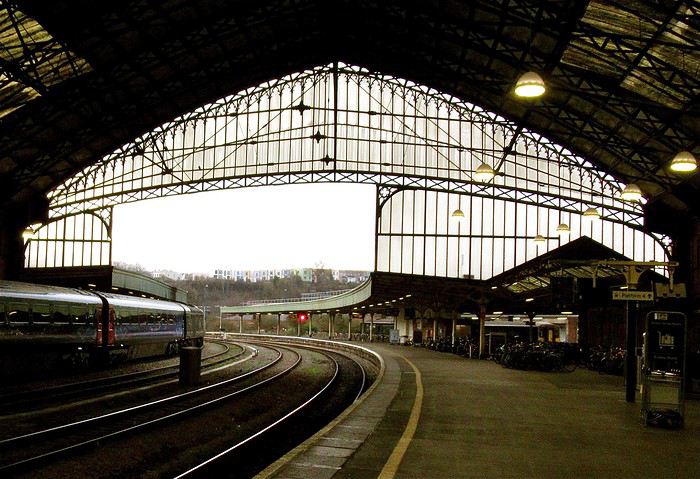
Il fait déjà nuit quand j'arrive à Bristol et je ne porte pas vraiment attention à l'architecture de la gare (qui s'avèrera par le suite sans réel intérêt) juste une photo, à la va vite, par dessus l'épaule et même par dessus la jambe si vous voyez ce que je veux dire 😇

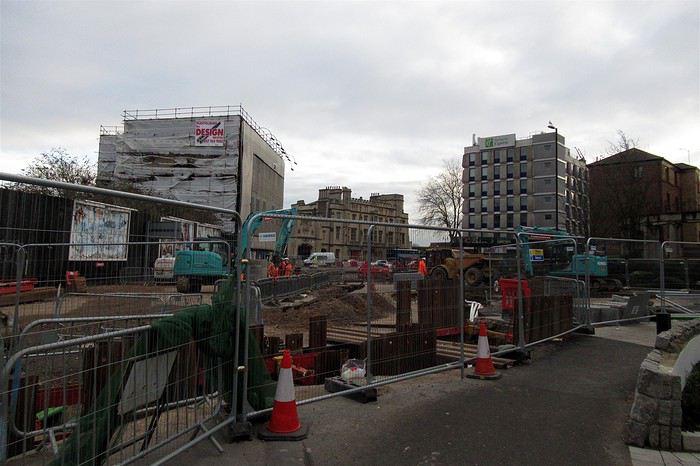
d'autant plus que je suis immédiatement confronté à une ville en travaux fort peu agréable pour les piétons.
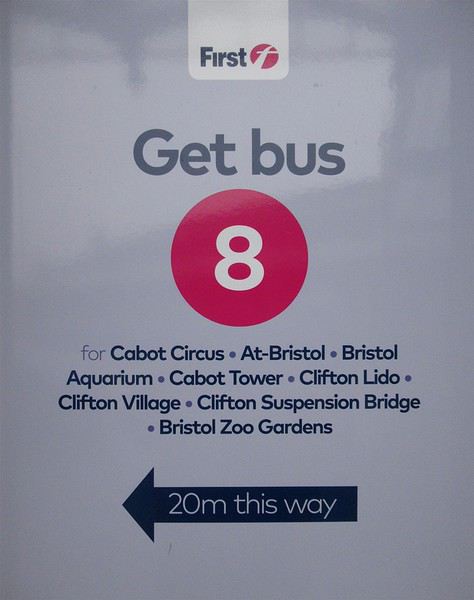
Pour vous éviter ces désagréments et si d'aventure il devait pleuvoir (ce qui est paraît-il relativement fréquent dans ce pays) je vous conseille de prendre juste à la sortie du bâtiment principal de la gare, sur le côté droit, le bus N°8 jusqu'à l'arrêt Bristol Aquarium.
Il me faut une petite demi-heure pour rejoindre le Milenium Square après être passé à hauteur de l'église St Mary Redcliff, sur le Redcliff Bascule Bridge, longé un côté du Queen Square et enfin emprunté le Pero's Bridge/passerelle. Mon hôtel est là, l'Ibis Bristol Centre (250£ pour 4 nuits sans petit déj.). J'avais réservé via Booking.com et demandé à avoir la dernière chambre au bout du couloir du dernier étage. Mes souhaits ont été pris en compte et je me réjouissais d'avoir une chambre calme d'autant plus que dans l'ascenseur il y avait cet avis
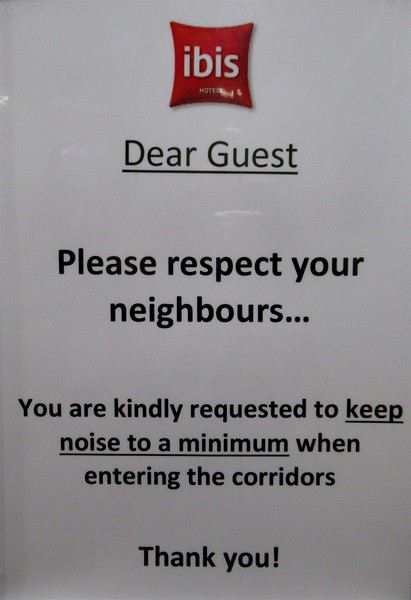
mais les gens ne comprennent pas ce que signifie ce qui est souligné et pensent que s'esclaffer au milieu de la nuit devant votre porte c'est respecter ses voisins 😕 J'ai suggéré au staff de l'hôtel de remplacer ce qu'ils avaient souligné par shut up mais ils m'ont dit que c'était un peu shocking alors j'ai proposé keep silence et ils ont trouvé que c'était effectivement un peu mieux.
Il fait peut être déjà nuit mais il n'est pas trop tard pour aller manger. J'avais repéré sur internet un endroit au charme indubitable et à la carte intéressante, le Cosy Club. Installé dans une ancienne banque du quartier central de Bristol. Je ne fut pas déçu.

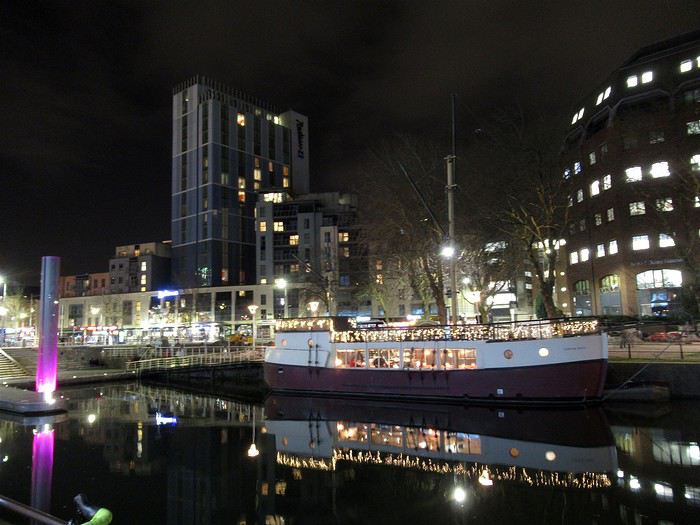
En rentrant vers l'hôtel j'ai flâné le longs des quais, nombreux dans cette ville portuaire au riche passé maritime.
Je profite d'une journée bien maussade pour me remémorer mon court séjour (du lundi 8 au samedi 12 janvier 2019) à Bristol où le temps fut particulièrement ensoleillé 😉
J'y suis allé en train (146 Euro A/R) via Londres où l'Eurostar en provenance de Lille s'arrête à la gare de Saint Pancras. Le train pour Bristol part de la gare de Paddington à environ 4 ou 5 Km à l'Ouest. J'avais trois heures pour m'y rendre. Petit détour pour le déjeuner au restaurant végétarien le Ravi Shankar dans Drummond Street à côté de la gare d'Euston. Lunch buffet à volonté + un masala tea pour moins de 10£.
Promenade digestive via Tottenham Court Road et Oxford Street, Marble Arch et en zig zag par les rues bourgeoises et ses mews au Nord de Hyde Park en direction de Paddington station.
Après avoir quitté Londres le train file vers l'ouest et passe pas loin de l'aéroport d'Heathrow (si j'avais été en avion de Bruxelles à Bristol cela m'aurait coûté environ 200 Euro)
A l'arrivée à Bristol, une première indication : va y avoir de la couleur 😛 Par dessous la verrière de la gare j'aperçois sur une ligne de crête au Sud de la ville des maisons aux façades arrières peintes de couleurs différentes. J'en verrai d'autres plus tard et ailleurs.
Il fait déjà nuit quand j'arrive à Bristol et je ne porte pas vraiment attention à l'architecture de la gare (qui s'avèrera par le suite sans réel intérêt) juste une photo, à la va vite, par dessus l'épaule et même par dessus la jambe si vous voyez ce que je veux dire 😇
d'autant plus que je suis immédiatement confronté à une ville en travaux fort peu agréable pour les piétons.
Pour vous éviter ces désagréments et si d'aventure il devait pleuvoir (ce qui est paraît-il relativement fréquent dans ce pays) je vous conseille de prendre juste à la sortie du bâtiment principal de la gare, sur le côté droit, le bus N°8 jusqu'à l'arrêt Bristol Aquarium.
Il me faut une petite demi-heure pour rejoindre le Milenium Square après être passé à hauteur de l'église St Mary Redcliff, sur le Redcliff Bascule Bridge, longé un côté du Queen Square et enfin emprunté le Pero's Bridge/passerelle. Mon hôtel est là, l'Ibis Bristol Centre (250£ pour 4 nuits sans petit déj.). J'avais réservé via Booking.com et demandé à avoir la dernière chambre au bout du couloir du dernier étage. Mes souhaits ont été pris en compte et je me réjouissais d'avoir une chambre calme d'autant plus que dans l'ascenseur il y avait cet avis
mais les gens ne comprennent pas ce que signifie ce qui est souligné et pensent que s'esclaffer au milieu de la nuit devant votre porte c'est respecter ses voisins 😕 J'ai suggéré au staff de l'hôtel de remplacer ce qu'ils avaient souligné par shut up mais ils m'ont dit que c'était un peu shocking alors j'ai proposé keep silence et ils ont trouvé que c'était effectivement un peu mieux.
Il fait peut être déjà nuit mais il n'est pas trop tard pour aller manger. J'avais repéré sur internet un endroit au charme indubitable et à la carte intéressante, le Cosy Club. Installé dans une ancienne banque du quartier central de Bristol. Je ne fut pas déçu.
En rentrant vers l'hôtel j'ai flâné le longs des quais, nombreux dans cette ville portuaire au riche passé maritime.
Premier voyage d'affaires en Chine English translation pending
Bonjour à tous,
Je suis responsable achat d'une boutique en France, nous souhaitons développer une toute nouvelle branche de notre société.
Je n'arrive pas via les sites à trouver une société capable de répondre à mes questions, peut être face à une demande croissante de personnes non sérieuses, les entreprises ne gèrent plus correctement les demandes...
Je souhaite donc me rendre sur place afin de rencontrer directement des personnes sérieuse, capable de répondre à nos projets.
Notre projet se compose de plusieurs éléments, une partie de déguisement taille adulte, adolescent, enfant, une partie de support pour ceux ci ( pour porter les costumes ) je ne peux en dévoiler plus afin de ne pas me faire piquer mon idée bien sur...
La question qui se pose vers quelle grande place commerciale me diriger ? étant donné qu'il s'agit de mon premier voyage en Chine je n'ai aucune idée de comment faire ni de comment cela va se passer !
Je comptais partir début Juin, est ce une bonne période ? je ne voudrai pas être au milieu des touristes peut être plus nombreux à cette période, je sais qu'il existe des marchés géants, faut il privilégier ceux ci, comment trouver un accompagnateur / traducteur fiable ?
Je remercie d'avance tous ceux qui pourrons m'aider, me diriger vers une solution ou proposition.
Je suis responsable achat d'une boutique en France, nous souhaitons développer une toute nouvelle branche de notre société.
Je n'arrive pas via les sites à trouver une société capable de répondre à mes questions, peut être face à une demande croissante de personnes non sérieuses, les entreprises ne gèrent plus correctement les demandes...
Je souhaite donc me rendre sur place afin de rencontrer directement des personnes sérieuse, capable de répondre à nos projets.
Notre projet se compose de plusieurs éléments, une partie de déguisement taille adulte, adolescent, enfant, une partie de support pour ceux ci ( pour porter les costumes ) je ne peux en dévoiler plus afin de ne pas me faire piquer mon idée bien sur...
La question qui se pose vers quelle grande place commerciale me diriger ? étant donné qu'il s'agit de mon premier voyage en Chine je n'ai aucune idée de comment faire ni de comment cela va se passer !
Je comptais partir début Juin, est ce une bonne période ? je ne voudrai pas être au milieu des touristes peut être plus nombreux à cette période, je sais qu'il existe des marchés géants, faut il privilégier ceux ci, comment trouver un accompagnateur / traducteur fiable ?
Je remercie d'avance tous ceux qui pourrons m'aider, me diriger vers une solution ou proposition.