Results for "Thiers+|+127"
5934 results found.
Des adresses pour de l'aide humanitaire English translation pending
Bonjour à vous tous,
Je vois que vous êtes nombreux à vouloir effectuer des chantiers humanitaires, monter des projets ou à vouloir vous investir réellemnt dans l'humanitaire. Et bien je peux, peut être, vous aider, mais vous avez jusqu'au 10 décembre car après je file au Sénégal et j'aurai moins de temps à vous consacrer.
Afin d'éviter de faire de la pub pour des asso en ligne. Je vous propose de m'envoyer un mail personnel, avec des questions assez précises pour que je puisse vous donner des adresses de site adaptées à vos demandes.
En attendant, je vous demande de réfléchir sur les raisons qui vous poussent à partir. Voyez-vous, cela me fait mal aux yeux lorsque je lis, je veux aider les pauvres 2, 3 mois et après je reviens faire mon bonhomme de chemin en France. Ok, c'est un expérience enrichissante, mais les pays en voie de développement ne doivent pas faire parti de nos caprices d'occidentaux ou même pire de nos loisirs de vacances. Je suis un peu dur, mais j'aimerai que cette exprérience se fasse à l'issue d'une grande réflexion, pour ne pas faire n'importe quoi, n'importe comment et sans continuité une fois de retour en France.
Voici quelques objectifs de réflexion : Prendre conscience de ma personnalité, de mes tendances et comportements dans mes relations avec les autres Prendre conscience de ces continents à la longue et riche histoire, des grandes étapes de l'évolution et des relations de ces continents avec l'Europe, de mon rôle en tant qu'acteur Prendre conscience de ce en quoi je crois et de comment je le vis Prendre conscience des besoins et des désirs que je cherche à satisfaire en voulant partir Prendre conscience de ce que je fais ici en France en matière de solidarité par rapport à ce que je veux faire là bas
Poser vous des questions, essayer d'y répondre de façon honnête même si votre réponse vous choque, car cela vous permettra d'avancer.
POURSUIVEZ VOS REVES ET VOS DESIRS, mais garder en tête que nous avons fait souvent plus de mal que de bien.
Conscientisation, responsabilisation pour un monde plus juste et solidaire.
Je vois que vous êtes nombreux à vouloir effectuer des chantiers humanitaires, monter des projets ou à vouloir vous investir réellemnt dans l'humanitaire. Et bien je peux, peut être, vous aider, mais vous avez jusqu'au 10 décembre car après je file au Sénégal et j'aurai moins de temps à vous consacrer.
Afin d'éviter de faire de la pub pour des asso en ligne. Je vous propose de m'envoyer un mail personnel, avec des questions assez précises pour que je puisse vous donner des adresses de site adaptées à vos demandes.
En attendant, je vous demande de réfléchir sur les raisons qui vous poussent à partir. Voyez-vous, cela me fait mal aux yeux lorsque je lis, je veux aider les pauvres 2, 3 mois et après je reviens faire mon bonhomme de chemin en France. Ok, c'est un expérience enrichissante, mais les pays en voie de développement ne doivent pas faire parti de nos caprices d'occidentaux ou même pire de nos loisirs de vacances. Je suis un peu dur, mais j'aimerai que cette exprérience se fasse à l'issue d'une grande réflexion, pour ne pas faire n'importe quoi, n'importe comment et sans continuité une fois de retour en France.
Voici quelques objectifs de réflexion : Prendre conscience de ma personnalité, de mes tendances et comportements dans mes relations avec les autres Prendre conscience de ces continents à la longue et riche histoire, des grandes étapes de l'évolution et des relations de ces continents avec l'Europe, de mon rôle en tant qu'acteur Prendre conscience de ce en quoi je crois et de comment je le vis Prendre conscience des besoins et des désirs que je cherche à satisfaire en voulant partir Prendre conscience de ce que je fais ici en France en matière de solidarité par rapport à ce que je veux faire là bas
Poser vous des questions, essayer d'y répondre de façon honnête même si votre réponse vous choque, car cela vous permettra d'avancer.
POURSUIVEZ VOS REVES ET VOS DESIRS, mais garder en tête que nous avons fait souvent plus de mal que de bien.
Conscientisation, responsabilisation pour un monde plus juste et solidaire.
Monter un projet humanitaire English translation pending
Salut tout le monde,
J'aimerais avec des amis monter un projet humanitaire.
La destination m'est égal par contre ce qui me plairait c'est d'aider à construire une école et plus tard aider: par exemple alphabetiser les enfants ou les sensibiliser à quelque chose qui m'est chére comme le theatre. Evidemment il faudrait que ce soit dans un pays francophone. Le probléme c'est qu'il faut qu'il y est une volonté locale pour fonder une école et je ne sais pas comment entrer en contact avec des gens sur place capable d'assurer le fonctionnement de l'école une fois celle-ci construite.
Merci de m'aider car j'ai plein d'idées et de projets mais je ne sais pas comment les réaliser.
Salut.😉
J'aimerais avec des amis monter un projet humanitaire.
La destination m'est égal par contre ce qui me plairait c'est d'aider à construire une école et plus tard aider: par exemple alphabetiser les enfants ou les sensibiliser à quelque chose qui m'est chére comme le theatre. Evidemment il faudrait que ce soit dans un pays francophone. Le probléme c'est qu'il faut qu'il y est une volonté locale pour fonder une école et je ne sais pas comment entrer en contact avec des gens sur place capable d'assurer le fonctionnement de l'école une fois celle-ci construite.
Merci de m'aider car j'ai plein d'idées et de projets mais je ne sais pas comment les réaliser.
Salut.😉
Préparer un tour d'Europe English translation pending
Salut à tous!🙂
Nous sommes 2 étudiantes bien décidées à découvrir l'Europe(Pays-bas, italie, allemagne, pologne....et pourquoi pas jusqu'à Moscou)!😊
Nous avons commencé à nous informer, mais ayant peu d'experience, il y a des questions non élucidées : papiers, péages, essence...🤪
Si quelqu'un peut nous renseigner(experience, liens internet, connaissances, astuces...), ce serait super sympa de nous en faire profiter!!!😉
Merci d'avance!!!!!🙂
2 étudiantes super motivées!!!!!!!😉
Nous sommes 2 étudiantes bien décidées à découvrir l'Europe(Pays-bas, italie, allemagne, pologne....et pourquoi pas jusqu'à Moscou)!😊
Nous avons commencé à nous informer, mais ayant peu d'experience, il y a des questions non élucidées : papiers, péages, essence...🤪
Si quelqu'un peut nous renseigner(experience, liens internet, connaissances, astuces...), ce serait super sympa de nous en faire profiter!!!😉
Merci d'avance!!!!!🙂
2 étudiantes super motivées!!!!!!!😉
Cirque et musique pour enfants handicapés English translation pending
Bonjour,
animateur diplomé et avec pas mal d'experience je me dirige maintenant vers le diplome d'educateur sportif pour personnes handicapées physique et mentale.
Pour pretendre a ce diplome il me faut un stage ou un emploi prealable prouvant que j'ai travailler avec ce public d'au moins quelques mois....qui pour l'instant n'es pas mon cas.
J'ai donc ecris a tous les IMP, IME, associations....etc de ma region et choux blanc.
Apres reflexion avec un ami on a decidé de partir en pays etranger sans destination en tete pour faire du benevolat avec des enfants handicâpés. Nous voulons leur apprendre le cirque ( moi ) et la percusion ou l'accordeon ( mon copain ).
Nous sommes en relationa avec pleins de structures pour trouver des subventions et autres mais ce qui nous manques ces l'endroit...
Si vous avez des pistes d'associations ou autres qui pourraient nous aider a partir.
Je vous remercie et a bientot
Quentin
animateur diplomé et avec pas mal d'experience je me dirige maintenant vers le diplome d'educateur sportif pour personnes handicapées physique et mentale.
Pour pretendre a ce diplome il me faut un stage ou un emploi prealable prouvant que j'ai travailler avec ce public d'au moins quelques mois....qui pour l'instant n'es pas mon cas.
J'ai donc ecris a tous les IMP, IME, associations....etc de ma region et choux blanc.
Apres reflexion avec un ami on a decidé de partir en pays etranger sans destination en tete pour faire du benevolat avec des enfants handicâpés. Nous voulons leur apprendre le cirque ( moi ) et la percusion ou l'accordeon ( mon copain ).
Nous sommes en relationa avec pleins de structures pour trouver des subventions et autres mais ce qui nous manques ces l'endroit...
Si vous avez des pistes d'associations ou autres qui pourraient nous aider a partir.
Je vous remercie et a bientot
Quentin
Traversée de l'Amérique centrale et du sud en voiture English translation pending
qui pourrait me donner le renseignement suivant.Peut-on acheter un véhicule aux Etats-Unis en tant que Français et passer sans problemes toutes les frontieres d'amérique centrale et du sud.
Argentine et Chili en bus? English translation pending
Hola!
J'aimerais savoir si c'est un bon plan de voyager en autobus au Chili et en Argentine malgré les distances: est-ce que cela revient à moins cher que l'avion? Et les paysages valent-ils la peine d'être parcourus en bus?
Est-ce faisable en 3 ou 4 semaines de séjour d'aller de Santiago de Chile à Ushuaia en bus et de remonter à Buenos Aires toujours en bus, tout en profitant de quelques étapes sur le chemin (Perito Moreno, Peninsula Valdez...)?
Et pour les chutes d'Iguazu depuis Buenos Aires: bus?
Gracias a todos los que pueden ayudarme. Hasta luego!
Sophie
J'aimerais savoir si c'est un bon plan de voyager en autobus au Chili et en Argentine malgré les distances: est-ce que cela revient à moins cher que l'avion? Et les paysages valent-ils la peine d'être parcourus en bus?
Est-ce faisable en 3 ou 4 semaines de séjour d'aller de Santiago de Chile à Ushuaia en bus et de remonter à Buenos Aires toujours en bus, tout en profitant de quelques étapes sur le chemin (Perito Moreno, Peninsula Valdez...)?
Et pour les chutes d'Iguazu depuis Buenos Aires: bus?
Gracias a todos los que pueden ayudarme. Hasta luego!
Sophie
Aide humanitaire sur 1 an en Afrique English translation pending
Bonjour à tous ! Voila j'ai 20 ans, je suis en études de communication à Liège en belgique... Etant un peu perdu quant à mon avenir, j'aimerai partir un an, en Afrique avec une assocation humanitaire dans le but d'aider la population locale. L'idée de découvrir une autre culture, une autre façon de vivre m'attire énormement 🙂
Alors si vous avez des projets, des idées, des sites ou des témoignages, n'hésitez surtout pas à me répondre car pour le moment j'ai beaucoup de mal à trouver qqchose de concret ! 🙁
Merci d'avance et à bientôt !
Alors si vous avez des projets, des idées, des sites ou des témoignages, n'hésitez surtout pas à me répondre car pour le moment j'ai beaucoup de mal à trouver qqchose de concret ! 🙁
Merci d'avance et à bientôt !
Budget moyen en Jordanie? English translation pending
Hello tlm,
J'aurai aimé savoir quel était le budget moyen pour un voyage de +/-9 nuits en Jordanie ? Il est préférable de loger où et à quel prix ? Qu'est ce qu'il coûte cher ?
Par ailleurs, pour ceux qui sont allé en Jordanie, qu'est ce qu'il n'est pas indispensable de visiter...étant donné qu'on ne passera qu'une dizaine de jours.
Toute adresse, info, conseil etc sont les bienvenue et d'avance je vous en remercie !
A+ Birzouki
J'aurai aimé savoir quel était le budget moyen pour un voyage de +/-9 nuits en Jordanie ? Il est préférable de loger où et à quel prix ? Qu'est ce qu'il coûte cher ?
Par ailleurs, pour ceux qui sont allé en Jordanie, qu'est ce qu'il n'est pas indispensable de visiter...étant donné qu'on ne passera qu'une dizaine de jours.
Toute adresse, info, conseil etc sont les bienvenue et d'avance je vous en remercie !
A+ Birzouki
Où dormir sur la côte en Malaisie? English translation pending
Bonjour à tous,
J'ai entendu dire qu'il n'était pas toujours simple de trouver de quoi dormir sur la cote Est de la péninsule Malaise...meme pour des bungalows.Je compte me rendre en avril 2004, surtout sur les iles (Perhentian, Redang, Kapas..).
Cela serait sympa de me fournir quelques tuyaux !!!!!
Merci beaucoup
J'ai entendu dire qu'il n'était pas toujours simple de trouver de quoi dormir sur la cote Est de la péninsule Malaise...meme pour des bungalows.Je compte me rendre en avril 2004, surtout sur les iles (Perhentian, Redang, Kapas..).
Cela serait sympa de me fournir quelques tuyaux !!!!!
Merci beaucoup
Un mois au Népal (été 2002) English translation pending
C'est début mai qu'avec Anne nous décidâmes de partir pour le Népal pendant nos vacances : 1 mois, un peu court à mon goût, mais le Népal étant assez petit, ça ira bien. Nous avions aussi envie (Anne surtout) de rencontrer et partager la vie de la population locale par le biais d'un chantier humanitaire d'une quinzaine de jours.
21 juillet C'est ainsi que je me retrouve ici à l'aéroport Charles de Gaule attendant tranquillement notre avion pour Katmandu faisant escale à Bahrayn et Abu-Dhabi où nous devions passer une nuit. Il faut dire que si le trajet était plutôt long (une 40aine d'heures) nous avions trouvé un vol pas cher (moins de 600€ allez retour). Contre toute attente, la journée est finalement riche en rencontres : Nous rencontrons Antoine et Marion deux autres étudiants qui font le même chantier 10 jours plus tard ! C'est à Abu-Dhabi, dans le superbe hôtel que Gulf Air a réservé pour nous, que nous rencontrons Senile un Népalais qui fait ses études en France dans l'hôtellerie. Dehors, le désert, des villas, encore des villas et du désert ; c'est la fournaise : 44°C alors qu'il fait déjà nuit ! Senile nous rassure, il fait moins chaud au Népal.
22 juillet C'est vrai ! Le lendemain soir, lorsque notre avion se pose à Katmandu au milieu de maisons qui nous semblent être des bidonvilles, il pleut : c'est la mousson. Drôle de choc que de passer d'un monde de désert et de luxe à un pays du tiers monde inondé par les pluies. Le taxi que nous prenons, nous met tout de suite au parfum : il pleut toute la journée, tous les jours. Bienvenue au Népal ! On trouve un hôtel correct pour 10$/jour à deux avec le petit dej. dans Thamel, le quartier touristique par excellence de la capitale. Il se révèlera par la suite, très cher par rapport à ses concurrents de même standing. Mais quand on débarque et que l'on ne connaît rien...
23 juillet Premier jour ! On part à la découverte de Katmandu, de jour et sous la pluie. Les marques du séisme de 1934 sont toujours présentes : les rues sont toutes plus ou moins défoncées, voir démunies de tous revêtement. Vous pouvez aisément imaginer ce que cela peut donner en période de mousson. Nous nous baladons au hasard des rues pendant que Antoine et Marion passent au service de l'immigration pour doubler leurs visas. Le midi, nous nous retrouvons dans Dubaï square, littéralement le quartier ou la place des palais, c'est payant lors de la première entrée.
  La pluie étant un peu tombée, nous apprécions mieux le quartier. Nous nous faisons rouler par un sadou (un homme saint et peinturluré pour l'occasion) avec qui nous prenons quelques photos puis nous réclame de l'argent. Encore un passage dans cette célèbre rue nommée « freak road », quelques photos dans le hipie temple, des propositions de dogue en tous genre et nous voilà 30 ans plus tôt, sur les traces de tous ces hippies qui se réunissaient ici. Si l'esprit traditionnel Népalais se trouve sans doute un peu plus loin, les occidentaux ont fortement marqué cette ville.
24 juillet Le matin, on va voir le président de l'association NIFC-Népal pour plus d' informations sur notre camp de travail, lui remettre notre don (150$ et je trouve ça beaucoup) et se faire expliquer le moyen d'y aller par nos propres moyens. En effet, le camp se situe à mi chemin entre Katmandu et Pokara notre prochaine étape. L'après-midi, on est parti visiter le grand stupa de Swayambhunath, couramment appelé « Monkey temple ».
  On fait l'aller et retour de Thamel à pieds ce qui nous permet de traverser d'autres quartiers. Le temps est plutôt dégagé et l'on a une belle vue sur Katmandu et les environs. On redescend par l'autre coté, à travers une sorte de monastère bien habitué aux touristes. De retour dans Thamel, on réserve auprès d'une agence de voyages des tickets de bus et une chambre pour Pokara pour environ 15€ le tout. Le soir, on mange dans un resto chic qui propose absolument de tout ! De la cuisine chinoise aux pizzas en passant par la cuisine mexicaine. Toute la cuisine du globe est réunie sur la carte à des prix défiant toute concurrence. (J'exagère sûrement, mais j'ai vraiment été scié) Finalement, on se décide pour des pizzas que l'on ne parviendra pas à finir : une pour deux aurait largement suffit !
25 juillet Longue journée que ce 25 juillet, on décide de partir pour Patan, et on y visite le Dubar Square et le musée. Il y a de quoi faire. Même à l'extérieur de Dubar square, des centaines (et je ne blague pas) de temples sont disséminé à travers toute la ville ! Nous rencontrons ainsi un temple de Shiva au moment d'une fête où la foule fait la queue pour déposer des offrandes. Pour la première fois, tout le monde ne parle pas anglais.
  Nous n'osons pas déranger de trop les nombreux participants : nous partons sans vraiment avoir compris. Dommage. Un gars parlant quelques mots de Français m'explique quelques bases sur les divinités Hindou : en fait, il y en a trois principaux, Brahmâ le créateur de l'univers, Vishnu le protecteur et Shiva le destructeur. La plupart des autres, même si elles peuvent avoir des particularités, étant des incarnations différentes de ces trois dieux.
  Les deux religions sont mêlées au Népal (Bouddhisme et Hindouisme), dans le sens où Bouddha peut être vu ici comme la neuvième incarnation de Vishnu pour les hindous. De même, tous les dieux hindous, peuvent être vus comme des formes de bouddha pour les bouddhistes. Bref, le peuple Népalais semble habitué à cohabiter avec les deux religions.
  En fin d'après-midi, on décide de prendre un taxi pour sortir de la ville en direction du sud pour voir un petit village nommé Bungamati. C'est déjà plus la campagne et les maisons sont toute typiques, l'ambiance plus décontractée (pas de rabatteur et autre marchand ambulant) et nous somme un peu regardé comme des bêtes curieuses. Les paysages sont somptueux. Sans autre commentaire. Le soir on fait développer nos deux premières pellicules.
26 juillet Aujourd'hui, on est parti visiter Bhaktapur toujours avec Marion et Antoine. L'entrée du village est excessivement chère comparé au coup de la vie locale (750RS) mais cela vaut tout de même le coup : en marchant dans la rue, et pour peu que l'on réussisse à oublier les fils électriques ainsi que les rares voitures, on se croirait réellement au moyen age népalais. J'adore ! On a par ailleurs eu l'occasion de voir des tibétains peignant des mandalas, des représentations du monde selon la culture bouddhique.
  J'ai aussi longuement discuté avec un commerçant qui vendait des poteries sur un marché : il vient d'un petit village dans la montagne, à cause de l'inondation il ne peut pas retourner chez lui mais me propose de s'y rendre dès que cela sera possible.
  Un peu déçu, je suis obligé de décliner l'offre : je fait partie d'un groupe et les grandes lignes de notre voyage sont déjà déterminées, notre prochaine étape sera Pokara. Nous échangeons nos adresses et il m'offre un bouddha en terre cuite sélectionné avec grand soin parmi ceux de son étalage. Le soir on rencontre un bijoutier qui va faire une expo en France fin Août début septembre et nous propose du boulot. Finalement, on trouve ça très louche.
27 juillet
La grasse matinée est au programme du jour ! En fin de matinée, nous nous rendons à Pashipatana un temple près d'une rivière sacrée où l'on brûle les morts. Un guide parlant assez mal le Français (c'est plus facile de le comprendre en anglais) nous explique le fonctionnement du temple. Nous poursuivons à pieds notre visite pour aller voir « Bognaht », un énorme stupa à 20 min du temple où nous mangeons sur les environs de 3h. En soirée, après avoir retiré nos billets de bus et d'hôtel pour Pokara, nous décidons d'aller dans un resto réputé pour son spectacle de danse : c'est kitch, cher, on n'aime pas. On fait nos aux revoirs à Marion et Antoine qui nous ont accompagné lors de la plupart des visites jusqu'alors : on veut passer quelques jours à Pokara avant le chantier humanitaire, eux non.
28 juillet On se lève très tôt pour prendre le bus pour Pokara qui doit quitter Katmandou vers 6h30 d'un quartier encore mal connu de nous. (En gros on ne savait pas d'où il partait et on n'avait pas envie de le rater) Finalement, on trouve facilement et le bus part vers 7h30. L'unique route n'est pas en très bon état et souvent traversée par des glissements de terrains dus aux pluies diluviennes de la semaine. D'ailleurs, on a eu de la chance, car elle était fermée les quelques jours précédents. Les paysages sont absolument magnifiques et la rivière que nous suivons un bon moment est chargée de boue et très tumultueuse. Les passages où la route à flanc de montagne et encore couverte d'une épaisse couche de boue nous rappelle qu'à la moindre erreur du chauffeur habitué à conduire ce bus poussif nous catapulterait au fond de ces profonds ravins. Ceci dit, ça roule assez bien et nous arrivons à notre destination vers 4h30 après 200km d'une route tortueuse. En sortant du bus et malgré une foule de rabatteurs toujours très oppressante, je me sens incroyablement calme et zen. On visite rapidement avant de se poser dans un resto près du lac : c'est superbe. Le restaurant offre un spectacle de danse traditionnelle à ses clients qui n'a vraiment rien à voir avec la veille !
29 juillet Après une grasse matinée, on loue des vélos et c'est parti pour une ballade vers la grotte aux chauves-souris.
  On s'égare un peu en partant, résultat on parcours le double de kilomètres pour l'aller. Le parcours est bien sympa, surtout au sortir de la ville. A la grotte, on nous donne une bougie chacun pour la visiter. Malgré nos pauvres bougies et une lampe électrique au fonctionnement aléatoire que l'on venait d'acheter, nous ne parvenons pas à trouver la sortie et nous décidons de rebrousser chemin. Qu'à cela ne tienne, on a vu les chauves-souris et notre balade à vélo était bien mieux que cette petite grotte. Le retour est tout en descente : 5km de bonheur.
  30 juillet
On est parti faire une petite ballade à pied sur les bords du lac. Le paysage est particulièrement magnifique et l'on décide de rentrer qu'une fois de l'autre côté. Le soir, on se refait un autre bon resto avec danseurs. 31 juillet On part vers 10h escalader une montagne surplombant Pokara à 1570m d' altitude. On fait la rencontre d'un groupe d'écoliers (oui oui, ici !) dont l'un nous montre quelques raccourcis, c'est sur sa route alors. On rentre plus tôt que prévu et je reste tranquillement installé dans un bar à lire notre guide. J'échange quelques paroles avec les serveurs : visiblement, c'est la saison creuse. Cela explique sans doute pourquoi nous avons pu avoir un bon hôtel pour seulement 2.8€/nuits pour une chambre triple. Le gérant très sympa nous propose un trek de deux jours vers un village retiré : Anne est peu sportive et demain nous partons pour Bholé le lieu de notre chantier.
1 Août Un dernier regard sur Pokara avant de partir à 7h vers un minuscule village : Bhorlé où l'on arrivera autour de 11h. Nous arrivons les premiers, le camp est désert. Les autres n'arriverons que bien plus tard dans l'après-midi sur le coup de 4h. En attendant, on visite les lieux, on passe dans le village et on traverse cet énorme pont suspendu, il fait au moins 300m de long. Lors de l'arrivée du reste du groupe, on refait la visite et on a même droit de goûter un bière Népalaise brassé ici même en quantité probablement inférieur a 20 litres. Elle est servie chaude, est d'un blanc laiteux et n'a qu'un lointain rapport avec ce que nous appelons une bière. Le soir, après une bonne platée de riz aux pommes de terres, curry et lentille : le Dhal Bat Takari (mot à mot, Lentille riz curry), on s'endort tous dans ce camp très spartiate.
2 au 7 Août Les journées au camp se suivent et se ressemblent : lever entre 6h30 et 7h, petit déj, puis on commence les travaux qui consistent pour le moment à remettre en état le chemin d'accès au camp qui fut détruit par un glissement de terrain. Par la suite, on a aménagé d'autre chemin, notamment l'accès à la rivière et planter des arbres afin d'éviter de futurs glissements de terrain. Le midi et le soir, certain préparent le repas par groupe de deux et à tour de rôle.
  C'est après une toilette dans le torrent que chacun vient engloutir sa portion de Dhal Bat ou parfois un plat un peu différent comme du riz frit ou même des Pancakes une fois. Nous avons eu l'occasion d'aller en ville quelques fois pour se réapprovisionner en lessive ou autres produits.
  Certains en profitent pour garder contact avec leurs proches dans des cybercafés, moi je m'achète un jeu de carrom de 1m20 de diagonale : la grosse galère à transporter :-). Quand la pluie se met à tomber, on ne peut rien faire, c'est la mousson et tout le monde est regroupé sous la bâche bleue et le bâtiment au toit troué qui nous sert de dortoir.
8 au 10 Août
 On profite de quelques jours de repos pour faire une escapade dans la jungle au beau milieu de « Chitwan Park ». Le programme est chargé : randonnée dans la jungle, safari à dos d'éléphant, balade en pirogue, visite de la réserve d'éléphants et du village du coin aux constructions bien différentes de Bhorlé.
  Dans le parc, les eaux de la rivière viennent juste de se retirer laissant les jardins couverts de boue et emportant quelques dizaines de mètres de berges ainsi que quelques maisons et hôtels.
  Malgré cela, la vie continue et les enfants jouent insouciants des problèmes que engendrés.

 11 au 14 Août
  De retour au camp avec quelques histoires à se raconter : si certains on flemmardé quelques jours, d'autres en ont profité pour faire des randonnées ou du rafting. Plus personne n'a vraiment envie de travailler et on attend tous la fin.
  Des débats s'engagent sur l'utilité de notre action et les flux d'argents. On se quittera sur une après-midi de fête au village : un concours de danse et de chant traditionnel est organisé, deux villages sont réunis. Il s'agit en fait d'un jeu de questions / réponses entre un homme et une femme et où chacun tentent de « moucher » gentiment l'autre sur fond musical. Les juges venus spécialement pour l'occasion sont visiblement d'un troisième village, ou plutôt de la ville : il sont bien mieux habillé que les autres.
  C'est aussi l'occasion pour les jeunes, de rencontrer une compagne, tout le monde finit par danser, l'ambiance est bon enfant, c'est très sympathique, mais on part demain.
15 au 18 Août Nous décidons de rentrer sur Katmandu un peu plus tôt que prévu à cause des troubles prochainement prévus. En effet, les maoïstes qui sont des opposants au régime en place organisent de temps à autre des manifestations qui peuvent être mouvementées.
  Par mesure de précaution, le gouvernement interdit à la circulation tout véhicule et nous nous rentrons sur la capitale. J'ai toujours avec moi le jeu de carrom que j'ai acheté au marché et je galère presque pour le transporter sur le toit d'un bus, à travers Katmandu puis Paris sans compter les aéroports ainsi que les trains français pour finir.
Fin
21 juillet
C'est ainsi que je me retrouve ici à l'aéroport Charles de Gaule attendant tranquillement notre avion pour Katmandu faisant escale à Bahrayn et Abu-Dhabi où nous devions passer une nuit. Il faut dire que si le trajet était plutôt long (une 40aine d'heures) nous avions trouvé un vol pas cher (moins de 600€ allez retour). Contre toute attente, la journée est finalement riche en rencontres : Nous rencontrons Antoine et Marion deux autres étudiants qui font le même chantier 10 jours plus tard ! C'est à Abu-Dhabi, dans le superbe hôtel que Gulf Air a réservé pour nous, que nous rencontrons Senile un Népalais qui fait ses études en France dans l'hôtellerie. Dehors, le désert, des villas, encore des villas et du désert ; c'est la fournaise : 44°C alors qu'il fait déjà nuit ! Senile nous rassure, il fait moins chaud au Népal.22 juillet
C'est vrai ! Le lendemain soir, lorsque notre avion se pose à Katmandu au milieu de maisons qui nous semblent être des bidonvilles, il pleut : c'est la mousson. Drôle de choc que de passer d'un monde de désert et de luxe à un pays du tiers monde inondé par les pluies. Le taxi que nous prenons, nous met tout de suite au parfum : il pleut toute la journée, tous les jours. Bienvenue au Népal ! On trouve un hôtel correct pour 10$/jour à deux avec le petit dej. dans Thamel, le quartier touristique par excellence de la capitale. Il se révèlera par la suite, très cher par rapport à ses concurrents de même standing. Mais quand on débarque et que l'on ne connaît rien...23 juillet
Premier jour ! On part à la découverte de Katmandu, de jour et sous la pluie. Les marques du séisme de 1934 sont toujours présentes : les rues sont toutes plus ou moins défoncées, voir démunies de tous revêtement. Vous pouvez aisément imaginer ce que cela peut donner en période de mousson. Nous nous baladons au hasard des rues pendant que Antoine et Marion passent au service de l'immigration pour doubler leurs visas. Le midi, nous nous retrouvons dans Dubaï square, littéralement le quartier ou la place des palais, c'est payant lors de la première entrée. La pluie étant un peu tombée, nous apprécions mieux le quartier. Nous nous faisons rouler par un sadou (un homme saint et peinturluré pour l'occasion) avec qui nous prenons quelques photos puis nous réclame de l'argent. Encore un passage dans cette célèbre rue nommée « freak road », quelques photos dans le hipie temple, des propositions de dogue en tous genre et nous voilà 30 ans plus tôt, sur les traces de tous ces hippies qui se réunissaient ici. Si l'esprit traditionnel Népalais se trouve sans doute un peu plus loin, les occidentaux ont fortement marqué cette ville.24 juillet
Le matin, on va voir le président de l'association NIFC-Népal pour plus d' informations sur notre camp de travail, lui remettre notre don (150$ et je trouve ça beaucoup) et se faire expliquer le moyen d'y aller par nos propres moyens. En effet, le camp se situe à mi chemin entre Katmandu et Pokara notre prochaine étape. L'après-midi, on est parti visiter le grand stupa de Swayambhunath, couramment appelé « Monkey temple ». On fait l'aller et retour de Thamel à pieds ce qui nous permet de traverser d'autres quartiers. Le temps est plutôt dégagé et l'on a une belle vue sur Katmandu et les environs. On redescend par l'autre coté, à travers une sorte de monastère bien habitué aux touristes. De retour dans Thamel, on réserve auprès d'une agence de voyages des tickets de bus et une chambre pour Pokara pour environ 15€ le tout. Le soir, on mange dans un resto chic qui propose absolument de tout ! De la cuisine chinoise aux pizzas en passant par la cuisine mexicaine. Toute la cuisine du globe est réunie sur la carte à des prix défiant toute concurrence. (J'exagère sûrement, mais j'ai vraiment été scié) Finalement, on se décide pour des pizzas que l'on ne parviendra pas à finir : une pour deux aurait largement suffit !25 juillet
Longue journée que ce 25 juillet, on décide de partir pour Patan, et on y visite le Dubar Square et le musée. Il y a de quoi faire. Même à l'extérieur de Dubar square, des centaines (et je ne blague pas) de temples sont disséminé à travers toute la ville ! Nous rencontrons ainsi un temple de Shiva au moment d'une fête où la foule fait la queue pour déposer des offrandes. Pour la première fois, tout le monde ne parle pas anglais. Nous n'osons pas déranger de trop les nombreux participants : nous partons sans vraiment avoir compris. Dommage. Un gars parlant quelques mots de Français m'explique quelques bases sur les divinités Hindou : en fait, il y en a trois principaux, Brahmâ le créateur de l'univers, Vishnu le protecteur et Shiva le destructeur. La plupart des autres, même si elles peuvent avoir des particularités, étant des incarnations différentes de ces trois dieux. Les deux religions sont mêlées au Népal (Bouddhisme et Hindouisme), dans le sens où Bouddha peut être vu ici comme la neuvième incarnation de Vishnu pour les hindous. De même, tous les dieux hindous, peuvent être vus comme des formes de bouddha pour les bouddhistes. Bref, le peuple Népalais semble habitué à cohabiter avec les deux religions. En fin d'après-midi, on décide de prendre un taxi pour sortir de la ville en direction du sud pour voir un petit village nommé Bungamati. C'est déjà plus la campagne et les maisons sont toute typiques, l'ambiance plus décontractée (pas de rabatteur et autre marchand ambulant) et nous somme un peu regardé comme des bêtes curieuses. Les paysages sont somptueux. Sans autre commentaire. Le soir on fait développer nos deux premières pellicules.26 juillet
Aujourd'hui, on est parti visiter Bhaktapur toujours avec Marion et Antoine. L'entrée du village est excessivement chère comparé au coup de la vie locale (750RS) mais cela vaut tout de même le coup : en marchant dans la rue, et pour peu que l'on réussisse à oublier les fils électriques ainsi que les rares voitures, on se croirait réellement au moyen age népalais. J'adore ! On a par ailleurs eu l'occasion de voir des tibétains peignant des mandalas, des représentations du monde selon la culture bouddhique. J'ai aussi longuement discuté avec un commerçant qui vendait des poteries sur un marché : il vient d'un petit village dans la montagne, à cause de l'inondation il ne peut pas retourner chez lui mais me propose de s'y rendre dès que cela sera possible. Un peu déçu, je suis obligé de décliner l'offre : je fait partie d'un groupe et les grandes lignes de notre voyage sont déjà déterminées, notre prochaine étape sera Pokara. Nous échangeons nos adresses et il m'offre un bouddha en terre cuite sélectionné avec grand soin parmi ceux de son étalage. Le soir on rencontre un bijoutier qui va faire une expo en France fin Août début septembre et nous propose du boulot. Finalement, on trouve ça très louche.27 juillet
La grasse matinée est au programme du jour ! En fin de matinée, nous nous rendons à Pashipatana un temple près d'une rivière sacrée où l'on brûle les morts. Un guide parlant assez mal le Français (c'est plus facile de le comprendre en anglais) nous explique le fonctionnement du temple. Nous poursuivons à pieds notre visite pour aller voir « Bognaht », un énorme stupa à 20 min du temple où nous mangeons sur les environs de 3h.
En soirée, après avoir retiré nos billets de bus et d'hôtel pour Pokara, nous décidons d'aller dans un resto réputé pour son spectacle de danse : c'est kitch, cher, on n'aime pas. On fait nos aux revoirs à Marion et Antoine qui nous ont accompagné lors de la plupart des visites jusqu'alors : on veut passer quelques jours à Pokara avant le chantier humanitaire, eux non.28 juillet
On se lève très tôt pour prendre le bus pour Pokara qui doit quitter Katmandou vers 6h30 d'un quartier encore mal connu de nous. (En gros on ne savait pas d'où il partait et on n'avait pas envie de le rater) Finalement, on trouve facilement et le bus part vers 7h30. L'unique route n'est pas en très bon état et souvent traversée par des glissements de terrains dus aux pluies diluviennes de la semaine. D'ailleurs, on a eu de la chance, car elle était fermée les quelques jours précédents. Les paysages sont absolument magnifiques et la rivière que nous suivons un bon moment est chargée de boue et très tumultueuse. Les passages où la route à flanc de montagne et encore couverte d'une épaisse couche de boue nous rappelle qu'à la moindre erreur du chauffeur habitué à conduire ce bus poussif nous catapulterait au fond de ces profonds ravins. Ceci dit, ça roule assez bien et nous arrivons à notre destination vers 4h30 après 200km d'une route tortueuse. En sortant du bus et malgré une foule de rabatteurs toujours très oppressante, je me sens incroyablement calme et zen. On visite rapidement avant de se poser dans un resto près du lac : c'est superbe. Le restaurant offre un spectacle de danse traditionnelle à ses clients qui n'a vraiment rien à voir avec la veille !29 juillet
Après une grasse matinée, on loue des vélos et c'est parti pour une ballade vers la grotte aux chauves-souris. On s'égare un peu en partant, résultat on parcours le double de kilomètres pour l'aller. Le parcours est bien sympa, surtout au sortir de la ville. A la grotte, on nous donne une bougie chacun pour la visiter. Malgré nos pauvres bougies et une lampe électrique au fonctionnement aléatoire que l'on venait d'acheter, nous ne parvenons pas à trouver la sortie et nous décidons de rebrousser chemin. Qu'à cela ne tienne, on a vu les chauves-souris et notre balade à vélo était bien mieux que cette petite grotte. Le retour est tout en descente : 5km de bonheur. 30 juilletOn est parti faire une petite ballade à pied sur les bords du lac. Le paysage est particulièrement magnifique et l'on décide de rentrer qu'une fois de l'autre côté. Le soir, on se refait un autre bon resto avec danseurs. 31 juillet
On part vers 10h escalader une montagne surplombant Pokara à 1570m d' altitude. On fait la rencontre d'un groupe d'écoliers (oui oui, ici !) dont l'un nous montre quelques raccourcis, c'est sur sa route alors. On rentre plus tôt que prévu et je reste tranquillement installé dans un bar à lire notre guide. J'échange quelques paroles avec les serveurs : visiblement, c'est la saison creuse. Cela explique sans doute pourquoi nous avons pu avoir un bon hôtel pour seulement 2.8€/nuits pour une chambre triple. Le gérant très sympa nous propose un trek de deux jours vers un village retiré : Anne est peu sportive et demain nous partons pour Bholé le lieu de notre chantier.1 Août
Un dernier regard sur Pokara avant de partir à 7h vers un minuscule village : Bhorlé où l'on arrivera autour de 11h. Nous arrivons les premiers, le camp est désert. Les autres n'arriverons que bien plus tard dans l'après-midi sur le coup de 4h. En attendant, on visite les lieux, on passe dans le village et on traverse cet énorme pont suspendu, il fait au moins 300m de long. Lors de l'arrivée du reste du groupe, on refait la visite et on a même droit de goûter un bière Népalaise brassé ici même en quantité probablement inférieur a 20 litres. Elle est servie chaude, est d'un blanc laiteux et n'a qu'un lointain rapport avec ce que nous appelons une bière. Le soir, après une bonne platée de riz aux pommes de terres, curry et lentille : le Dhal Bat Takari (mot à mot, Lentille riz curry), on s'endort tous dans ce camp très spartiate.2 au 7 Août
Les journées au camp se suivent et se ressemblent : lever entre 6h30 et 7h, petit déj, puis on commence les travaux qui consistent pour le moment à remettre en état le chemin d'accès au camp qui fut détruit par un glissement de terrain. Par la suite, on a aménagé d'autre chemin, notamment l'accès à la rivière et planter des arbres afin d'éviter de futurs glissements de terrain. Le midi et le soir, certain préparent le repas par groupe de deux et à tour de rôle. C'est après une toilette dans le torrent que chacun vient engloutir sa portion de Dhal Bat ou parfois un plat un peu différent comme du riz frit ou même des Pancakes une fois. Nous avons eu l'occasion d'aller en ville quelques fois pour se réapprovisionner en lessive ou autres produits. Certains en profitent pour garder contact avec leurs proches dans des cybercafés, moi je m'achète un jeu de carrom de 1m20 de diagonale : la grosse galère à transporter :-). Quand la pluie se met à tomber, on ne peut rien faire, c'est la mousson et tout le monde est regroupé sous la bâche bleue et le bâtiment au toit troué qui nous sert de dortoir.8 au 10 Août
On profite de quelques jours de repos pour faire une escapade dans la jungle au beau milieu de « Chitwan Park ». Le programme est chargé : randonnée dans la jungle, safari à dos d'éléphant, balade en pirogue, visite de la réserve d'éléphants et du village du coin aux constructions bien différentes de Bhorlé. Dans le parc, les eaux de la rivière viennent juste de se retirer laissant les jardins couverts de boue et emportant quelques dizaines de mètres de berges ainsi que quelques maisons et hôtels. Malgré cela, la vie continue et les enfants jouent insouciants des problèmes que engendrés. 11 au 14 Août De retour au camp avec quelques histoires à se raconter : si certains on flemmardé quelques jours, d'autres en ont profité pour faire des randonnées ou du rafting. Plus personne n'a vraiment envie de travailler et on attend tous la fin. Des débats s'engagent sur l'utilité de notre action et les flux d'argents. On se quittera sur une après-midi de fête au village : un concours de danse et de chant traditionnel est organisé, deux villages sont réunis. Il s'agit en fait d'un jeu de questions / réponses entre un homme et une femme et où chacun tentent de « moucher » gentiment l'autre sur fond musical. Les juges venus spécialement pour l'occasion sont visiblement d'un troisième village, ou plutôt de la ville : il sont bien mieux habillé que les autres. C'est aussi l'occasion pour les jeunes, de rencontrer une compagne, tout le monde finit par danser, l'ambiance est bon enfant, c'est très sympathique, mais on part demain.15 au 18 Août
Nous décidons de rentrer sur Katmandu un peu plus tôt que prévu à cause des troubles prochainement prévus. En effet, les maoïstes qui sont des opposants au régime en place organisent de temps à autre des manifestations qui peuvent être mouvementées. Par mesure de précaution, le gouvernement interdit à la circulation tout véhicule et nous nous rentrons sur la capitale. J'ai toujours avec moi le jeu de carrom que j'ai acheté au marché et je galère presque pour le transporter sur le toit d'un bus, à travers Katmandu puis Paris sans compter les aéroports ainsi que les trains français pour finir.Fin
Où, en Asie Sud-Est acheter des costumes de bonne qualité pas chers? English translation pending
Bonjour a tous,
J'aimerais avoir votre avis sur une destination. Ayant déjà effectué de multiple voyages de l'autre coté de l'atlantique je souhaiterais m'orienter vers un (ou des) pays asiatique(s). Mais je souhaiterais pour des besoins professionnelles me refaire une garde robe par la même occasion. Sachant que je compte partir minimum 1 mois quelle pays vous parait fournir le meilleure rapport qualité prix ? On parle souvent de la Thaïlande mais y a-t-il mieux ? Sacher que même me déplacer dans les endroits disons pas touristique ne fait pas peur bien au contraire pour moi c’est ça le voyage donc si vous avez des adresse …
Ne croyez pas non plus que je ne m’intéresse qu’a cet aspect là du voyage, mais je souhaite faire d’une pierre deux coups. Sinon pour ce qui est de mon voyage à proprement parlé grâce à ce forum j’ai déjà pu me faire une idée des immanquables et je vous en remercie.
Merci d’avance
Olivier
J'aimerais avoir votre avis sur une destination. Ayant déjà effectué de multiple voyages de l'autre coté de l'atlantique je souhaiterais m'orienter vers un (ou des) pays asiatique(s). Mais je souhaiterais pour des besoins professionnelles me refaire une garde robe par la même occasion. Sachant que je compte partir minimum 1 mois quelle pays vous parait fournir le meilleure rapport qualité prix ? On parle souvent de la Thaïlande mais y a-t-il mieux ? Sacher que même me déplacer dans les endroits disons pas touristique ne fait pas peur bien au contraire pour moi c’est ça le voyage donc si vous avez des adresse …
Ne croyez pas non plus que je ne m’intéresse qu’a cet aspect là du voyage, mais je souhaite faire d’une pierre deux coups. Sinon pour ce qui est de mon voyage à proprement parlé grâce à ce forum j’ai déjà pu me faire une idée des immanquables et je vous en remercie.
Merci d’avance
Olivier
Votre avis sur le lariam (séjour au Kenya) English translation pending
Dans 10 jours, nous partons au kenya pour un séjour plage. Nous hésitons à prendre le lariam contre la malaria à cause de ses effets secondaires, du court laps de temps qu'il nous reste avant de partir et parce qu'il n'est pas efficace à 100%
Qu'en pensez-vous ? Etes-vous partis là-bas avec ou sans protection?
Démarches pour l'obtention du visa en Iran? English translation pending
Salut,
je visiterai l'Iran en avril, mai 2003. Comment obtenir son visa le plus facilement et le moyen le moins cher ???
Merci a tous 😉.
je visiterai l'Iran en avril, mai 2003. Comment obtenir son visa le plus facilement et le moyen le moins cher ???
Merci a tous 😉.
Hôtel Copacabana - Riviera Maya English translation pending
Bonjour Voyageurs,
Étant un amateur du Mexique, je suis dans l'obligation (quel malheur!) de me rendre dans la région de la Riviera Maya au mois de janvier prochain.
Ayant réservé pour l'hotel Copacabana, si vous connaissez cet Hotel, j'apprécierais vos commentaires.
Merci à l'avance...
gringo
Étant un amateur du Mexique, je suis dans l'obligation (quel malheur!) de me rendre dans la région de la Riviera Maya au mois de janvier prochain.
Ayant réservé pour l'hotel Copacabana, si vous connaissez cet Hotel, j'apprécierais vos commentaires.
Merci à l'avance...
gringo
Mae Hong Son Loop by Motorcycle: 4 Days of Adventure, My Experience in Writing and Video
Hey everyone!
New to the forum, but not so new to Asia 😄
I’m Nico, from Switzerland, currently based in Bangkok. I love taking my motorcycle out to get lost in the mountains and small villages of Thailand, Laos, Vietnam, and more. I’ve been roaming around this area for a good fifteen years now, racking up quite a few kilometers—especially in northern Vietnam.
This time, I finally decided to tackle the Mae Hong Son Loop, clockwise. I’d been to Pai several times before, but oddly enough, I’d never done the full loop.
So, I’ll try to give you a little recap here, day by day, with the roads, stops, places worth checking out… and those that didn’t quite blow my mind 😅
I also filmed the trip, so I’ll post the corresponding video at the end of each day if that’s okay. If it’s not allowed here, just let me know, and I’ll remove them without any issue.
DAY 1 — Chiang Mai → Doi Inthanon → Mae Chaem → Khun Yuam
I left Chiang Mai after renting a Honda ADV 160 from Pop Motorbike. Not exactly an Africa Twin, but for what I had planned, it was more than enough.
Quick hotel note: I stayed at the Lanna Thaphae Hotel before leaving. Around 30 € per night, super well-located, and probably one of the most comfortable beds I’ve ever slept in. A crucial detail for any motorcycle road trip, obviously.
The plan for the day was pretty straightforward:
Head toward Doi Inthanon… and see what happens.
Flawless Swiss organization.
First stop along the way at Wachirathan Waterfall. A really nice waterfall, very easy to access, but don’t expect to channel your inner Indiana Jones—it’s crowded, touristy, and swimming isn’t allowed. Still, it’s a pretty stop along the way.
Next, up to Doi Inthanon.
The road climbs steeply, and my little 160cc started to realize that carrying my 80 kg to Thailand’s highest point probably wasn’t part of its youthful dreams. I was maxing out at 34 km/h in some spots.
But it made it. Good little bike.
The summit is nice—the forest is beautiful, and it’s cool—but I have to admit, it didn’t completely wow me. Glad I went, but not necessarily the highlight of the day for me.
Because then comes Route 1192.
And that’s *much* more my thing: small mountain roads, beautiful scenery, hardly any traffic… the kind of road where I usually start taking way too many unnecessary detours just because a little side road “looks fun.”
Stopped in Mae Chaem for a bite to eat, then headed to Khun Yuam to finish the day.
A little over 200 km in total.
Khun Yuam is… quiet.
*Very* quiet. 😅
A cute little market, a couple of cafés/restaurants, and zero chance of ending up in a club until 4 AM. But after a day on the bike, it was perfect.
Stayed at the Mit Khun Yuam Hotel, around 20 € for a small but very decent room.
All in all, a solid first day and a pretty relaxed start to the loop. Part of this leg is mostly about getting out of Chiang Mai and really diving into the mountains, in my opinion.
Because for me, the really interesting stuff starts over the next two days…
And a few slightly questionable route decisions will also make an appearance 😅
If anyone’s planning the Mae Hong Son Loop, feel free to ask your questions—I’d be happy to answer!
I also filmed this first day, so for those who’d rather see the roads and landscapes than read my rambling, here’s Day 1 😊
DAY 1 VIDEO
I’ll post the next part in the coming days with Day 2: Khun Yuam → Mae Surin → Mae Hong Son.
And that’s where it starts getting *really* fun. 😉
That’s all for now! Looking forward to contributing as much as I can to the forum!
Overweight Check for Converted Truck in South America
Hi Community,
We're heading to South America with our converted truck, which is a light vehicle (3,500 kg limit) that we’re shipping by boat in October this year (2026). But after weighing it, we’re at 4,500 kg. Based on your experience, do you think we’ll get stopped in South America (Uruguay, Paraguay, Argentina, Peru, Bolivia, and southern Brazil) because of this? Are there police checks for overweight vehicles? Has this happened to any of you?
Thanks in advance for your experiences and advice!
Les Megy Rozé Un Petit Voyage en Plus
We're heading to South America with our converted truck, which is a light vehicle (3,500 kg limit) that we’re shipping by boat in October this year (2026). But after weighing it, we’re at 4,500 kg. Based on your experience, do you think we’ll get stopped in South America (Uruguay, Paraguay, Argentina, Peru, Bolivia, and southern Brazil) because of this? Are there police checks for overweight vehicles? Has this happened to any of you?
Thanks in advance for your experiences and advice!
Les Megy Rozé Un Petit Voyage en Plus
Getting to Ko Chang from Cambodia without going through Bangkok
Hi everyone!
I’m heading back to Thailand in July 2026 with a stopover in Cambodia to visit the Angkor site.
After Angkor, I’ve booked a stay on Ko Chang island. Does anyone know if there are direct transport options from Cambodia to Ko Chang without having to go back through Bangkok? That would be amazing!!
I think there are, but I’d need more details!!
I went to Thailand in February 2025 and don’t remember having to apply for a visa—is that still the case now? And for Cambodia too?
Thanks so much!!!
Laurence from Bayonne
"Glory": an Animal Farm for Zimbabwe—and the world
"400 pages of verbal pyrotechnics and animal magic" — The Times
"Bulawayo leans into exaggeration and irony to tell hard truths. *Glory* is jam-packed with comedy and farce, poking fun at an autocratic regime while illustrating the absurdity and surreal nature of a police state." — The Guardian
The cruelty and savagery of Zimbabwe’s (and Africa’s in general) "powerful animals"
Zimbabwean author NoViolet Bulawayo has written a novel that illustrates better than any documentary the complexity of colonial legacy. In doing so, she revisits George Orwell’s Animal Farm. Her novel *Glory* is a political satire about Zimbabwe—and it’s brimming with humor.
For thirty years, Zimbabwe has been stagnating under Robert Mugabe’s presidency. Human rights violations, corruption, and international sanctions have kept the population mired in poverty and oppression, while the regime exploits the meager earnings of the economy. As the 2017 elections approach, a power struggle erupts over the succession of the very elderly Father of the Nation (Mugabe). On the streets, people hope for long-awaited reforms; the people feel their moment has come.
And indeed, the army ousts Mugabe and his wife—"with her Gucci heels" (p.32)—who was positioning herself for the presidency. Hopes are dashed, however. The generals install former vice-president Emmerson Mnangagwa in power; the regime merely changes faces, but the problems remain the same.
In the novel, the country is called "Jidada, with a -da and another -da" (p.1); there’s no mistaking that this fictional state is Zimbabwe.
For *Glory*, her second novel, NoViolet Bulawayo invents a whole series of codes whose strength lies precisely in how easy they are to decipher. Like George Orwell’s Animal Farm, the characters populating Bulawayo’s universe aren’t humans but horses, goats, or crocodiles with all-too-human traits. Mugabe and Mnangagwa are horses, the spiritual leader is a pig, the soldiers are all bloodthirsty dogs, while the populace consists of goats, chickens, donkeys, and cats. The shift to the animal world serves only to better grasp the laws of despotism—and to ridicule real-life models. On one hand, the animals are humanized: they tweet, torture, travel in private jets. On the other, their greed, stupidity, and brutality stem from their animal nature.
It’s the old trick of fable: dressing men in animal disguises to make them easier to recognize. That’s how Orwell, in Animal Farm, traced how the promise of liberation from the Russian Revolution turned into Stalinist terror. In his 1945 fable, George Orwell describes how the animals of a farm drive out their farmer to organize the exploitation themselves, collectively. For a time, they truly taste freedom, but a clique of pigs ends up taking control. The central figures of the Soviet story—Stalin, Trotsky, Molotov—were easily recognizable.
Yet Bulawayo departs sharply from Orwell. She’s less concerned with precision and the force of argument than with satirical exaggeration. The deposed president is a senile old man who believes he can control even the sun’s course. The new stallion in power is a greedy debaucher. His soldiers sniff respectfully at his tail and backside.
In Bulawayo’s *Glory*, things are more complicated, but her novel also tells of a failed, incomplete liberation. In the author’s Animal Farm, Jidada, the colonial exploiters are followed by new forms of oppression. Because the former liberators become tyrants themselves. And because global power dynamics persist in neocolonial structures.
Wouldn’t that be enough to fuel a deeply depressing narrative? No—Bulawayo turns it into a blazing satire, full of wit and uncompromising criticism of power, a thread running through contemporary (not just) Zimbabwean history. The old warhorses in NoViolet Bulawayo’s Jidada, who continue to act as pack leaders, are easily recognizable as caricatures of the longtime dictator Robert Mugabe and his successor, current president Emmerson Mnangagwa.
The plot kicks off in high gear with independence day festivities. From the crack of dawn, everyone waits on Jidada Square for the Old Horse, the Father of the Nation and former liberator, whose reign "was nearing all of—not one, not two, not three, but four solid decades" (p.1). Everywhere, the colors of the Jidada Party shine; everywhere, true supporters cheer. Even the scorching sun plays its part: "At this point the sun, upon seeing arrive the leader who was decreed by God himself to rule and rule and keep ruling, a leader who'd in turn decreed the very sun to head his cheerleading squad, took a deep, deep breath and thoroughly blazed to impress" (p.2).
Finally, the Old Horse’s luxury carriage approaches "with the slowness of a hearse" (p.2), and "hoping to catch a glimpse of the legendary Father of the Nation," which causes "the animals fell over themselves like intoxicated frogs" (p.2). The sovereign’s speech is delayed a moment longer: "what I really want is a nap," groans the Old Horse as he takes his seat with such care "like his backside was made of expensive porcelain" (p.6).
Meanwhile, Bulawayo parades his entourage: the president’s wife (who earns her doctorate at Jidada University faster than "you could say diss, for dissertation. Tholukuthi it was as easy as ordering from a KFC drive-through, or perhaps even easier being that it was cheaper than KFC; it in fact cost her nothing and the degree actually came with a zero-calorie Diet Coke and a purple straw" (p.41), and she’s now known as Dr Sweet Mother. The cabinet includes "the Minister of the Revolution, the Minister of Corruption, the Minister of Order, the Minister of Things, the Minister of Nothing, the Minister of Propaganda, the Minister of Homophobic Affairs, the Minister of Disinformation and the Minister of Looting" (p.9). And of course the vice-president, who will soon become interim president when the Old Horse finally kicks the bucket—and then settle in as the new long-term president, who in the novel is called Tuvius Delight Shasha, or "Tuvy" for short (p.253), none other than Emmerson Mnangagwa. It’s him Bulawayo reserves her most merciless character description for.
"New Dispensation" (p.109) is Tuvy’s slogan for Jidada, and he loves repeating it so much he even named his parrot after it ("So inspired was Tuvy by the realisation that he rechristened his new pet parrot with the name New Dispensation—tholukuthi the bird having been acquired explicitly for the purposes of tweeting eulogies and accordingly glorifying the Saviour throughout the airs and skies of the nation. Tuvy then went on to hire a lecturer in English from the University of Jidada to teach New Dispensation to say the phrase 'New Dispensation'" p.110). But Tuvy’s Zimbabwe remains a nation without free, fair, and credible elections ("#freefairncredibleelection" p.161), and the promised equal treatment applies only insofar as Zimbabweans now queue up without discrimination in endless lines—and everyone is as poor as the next in the "queuenation" (p.283). Except for the powerful. They can "yes, tholukuthi, her immeasurable riches theirs to take. And take they did—
just take—take—take—take—take—take—take—take—take—take—take—take—take—take—take—take—take—take—take—take—take—take—take—take—take—take—take" (p.249-250).
In short: Bulawayo brilliantly depicts how former independence fighters become exploiters themselves. And how the country threatens to suffocate under the weight of corruption and repression. But she also literally stages the polyphony with which the people oppose imposed obedience to the official line.
Controversial online discussions keep interrupting the narrative—dialogues and social threads (see photo below) that Bulawayo masterfully integrates. From a literary standpoint, it’s a brilliant idea. And it shows, above all, that the author’s sympathy—so likeable—goes to all those who refuse to let their dream of true freedom be stolen, not even by the corrupt elites of their own country.
In the book’s acknowledgments, the first tribute goes to "The Jidadas of the world, clamouring for freedom on many fronts—A luta continua." (p.401) This reflects the realization that, not only in Jidada-Zimbabwe but in many other corners of the world, the end of colonial domination is still far from meaning the freedom hoped for by the vast majority of people. But it also means, more broadly, that this freedom must be won "on many fronts" (see above), both domestically and geopolitically.
That’s precisely what *Glory* so vividly highlights: how complex the project behind the term "postcolonialism" really is. With *Glory*, Bulawayo also delivers a scathing critique of the persistence of colonial mindsets in the West.
In the novel, the murder of George Floyd, racist police violence, and white-supremacist ideology in Trump’s United States perfectly illustrate the persistence of racism. It’s especially in the final chapters that Bulawayo lets Jidada’s inhabitants explicitly and unflinchingly criticize a neocolonial world order:
"It was not lost on us how the West, which loved to 'save' Africa and announce every action to the whole world, did so with one limb while manipulating, looting and fleecing us with the rest of its limbs so that more money in fact poured out of the continent than trickled in." (p.376)
"It was no mistake that multinational corporations yearly reaped and shipped colossal profits from Africa back to their countries as had been the case during colonial times. Even the sticks and stones would tell you that the African earth at any given time howled and shook and heaved from the extraction of its precious minerals that rarely benefited its own miserable children." (p.376)
"(...) we vowed to wage yet another war for Africa's second Liberation from neocolonial oppression. From exploitation. From plunder. From Western dominion. From indignity. From Abuse. We wanted real freedom. We wanted greedy, thieving paws off our wealth. We wanted Justice. We wanted a new world; we wanted a brand-new world so much we didn't sleep a wink that night." (p.377)
The Jidadas of this world must fight two enemies: Western neocolonialism and the autocratic instrumentalization of that argument; the persistence of Western racism and the populist appropriation of that humiliation by tyrants from their own ranks. Neither of these obstacles to freedom diminishes the historical and current guilt of the other. But the path to postcolonial liberation must overcome all these forms of oppression. After all, the colonizers didn’t bequeath democracies to formerly dominated nations, but instability and the principles of oppression and exploitation—which the so-called liberators have also internalized. Yet the fact that a satirical novel can capture the complexity of historical relationships while remaining, despite all the darkness of the subject, hilarious—well, that’s truly astonishing.
Finally, *Glory* ties into a major trauma in Zimbabwe’s post-independence history: the so-called Gukurahundi massacres. Between 1983 and 1987, tens of thousands of civilians were murdered by Mugabe’s bloody henchmen, most of them Ndebele. The State Security Minister and head of secret services at the time? You guessed it—Emmerson Mnangagwa.
When *Glory* turns to the massacres, the novel’s tone shifts completely. The story is now told through the narrative of the goat called Destiny, who, like NoViolet Bulawayo herself, left her home country at 18 for the United States and only returned after 13 years. In the book, the city of Bulawayo becomes a village where Destiny retraces her family’s history—and learns that part of it was also brutally murdered during the massacres.
The abuse of power and life under a dictatorship, dispossession, and a fiercely proud awareness of the psychological wounds and emotional vulnerability of a uprooted and disenfranchised people who had to forge a new language—a new set of names—to express their lived experiences are at the heart of this wonderful Zimbabwean author’s literary work, NoViolet Bulawayo. Shortly after her studies, she was already writing short stories about postcolonial power dynamics in Africa. But her playful, masterful, and often unconventional approach to language also plays a key role in her work. With virtuosity, she shifts from cynical images of power-obsessed elites to compassionate descriptions of the people’s suffering, ending with a hopeful sermon on courage—the courage to break free from fear and thus gain the strength for change ("And every one of them understood that whatever they heard within those hearts was the new national anthem, tholukuthi an anthem that spoke of the kind of glory that burns eternal and glows with living light." p.400). This novel is a genuine pleasure to read. And it’s exceptional. Good, African...
Book info (original English and German translation):
NoViolet Bulawayo. Glory. Chatto & Windus, 2022. NoViolet Bulawayo. Glory. Suhrkamp, 2023.
Hery
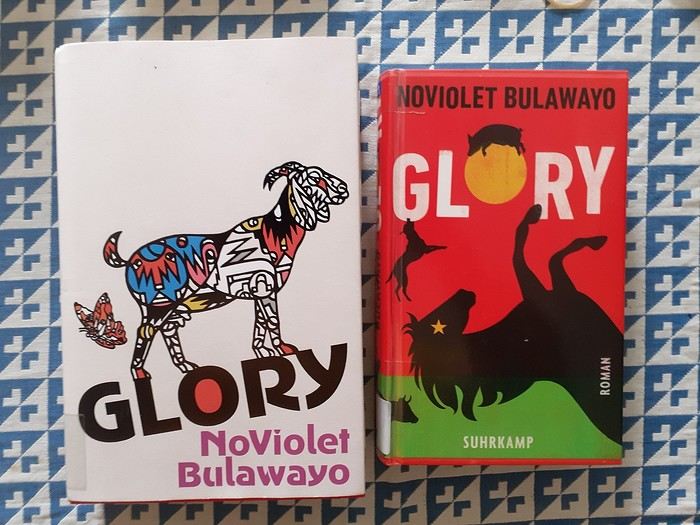 The books (in English, in German)
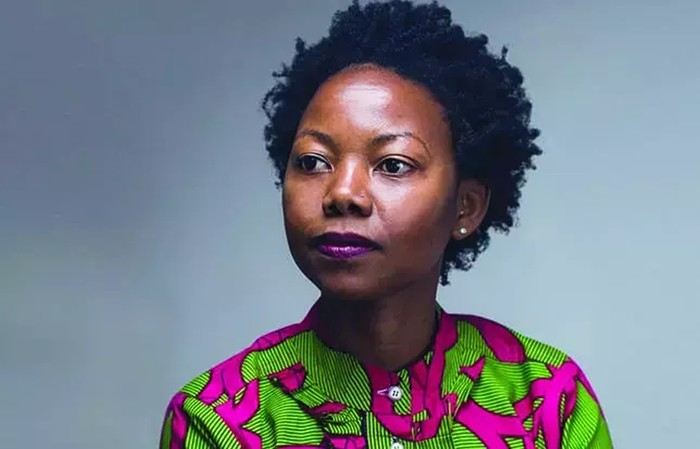 Author NoViolet Bulawayo, Zimbabwe
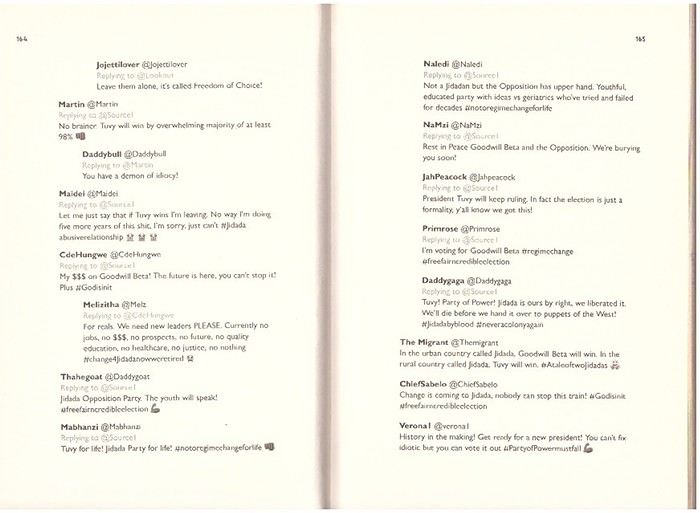 Threads (p.164-165)
"Bulawayo leans into exaggeration and irony to tell hard truths. *Glory* is jam-packed with comedy and farce, poking fun at an autocratic regime while illustrating the absurdity and surreal nature of a police state." — The Guardian
The cruelty and savagery of Zimbabwe’s (and Africa’s in general) "powerful animals"
Zimbabwean author NoViolet Bulawayo has written a novel that illustrates better than any documentary the complexity of colonial legacy. In doing so, she revisits George Orwell’s Animal Farm. Her novel *Glory* is a political satire about Zimbabwe—and it’s brimming with humor.
For thirty years, Zimbabwe has been stagnating under Robert Mugabe’s presidency. Human rights violations, corruption, and international sanctions have kept the population mired in poverty and oppression, while the regime exploits the meager earnings of the economy. As the 2017 elections approach, a power struggle erupts over the succession of the very elderly Father of the Nation (Mugabe). On the streets, people hope for long-awaited reforms; the people feel their moment has come.
And indeed, the army ousts Mugabe and his wife—"with her Gucci heels" (p.32)—who was positioning herself for the presidency. Hopes are dashed, however. The generals install former vice-president Emmerson Mnangagwa in power; the regime merely changes faces, but the problems remain the same.
In the novel, the country is called "Jidada, with a -da and another -da" (p.1); there’s no mistaking that this fictional state is Zimbabwe.
For *Glory*, her second novel, NoViolet Bulawayo invents a whole series of codes whose strength lies precisely in how easy they are to decipher. Like George Orwell’s Animal Farm, the characters populating Bulawayo’s universe aren’t humans but horses, goats, or crocodiles with all-too-human traits. Mugabe and Mnangagwa are horses, the spiritual leader is a pig, the soldiers are all bloodthirsty dogs, while the populace consists of goats, chickens, donkeys, and cats. The shift to the animal world serves only to better grasp the laws of despotism—and to ridicule real-life models. On one hand, the animals are humanized: they tweet, torture, travel in private jets. On the other, their greed, stupidity, and brutality stem from their animal nature.
It’s the old trick of fable: dressing men in animal disguises to make them easier to recognize. That’s how Orwell, in Animal Farm, traced how the promise of liberation from the Russian Revolution turned into Stalinist terror. In his 1945 fable, George Orwell describes how the animals of a farm drive out their farmer to organize the exploitation themselves, collectively. For a time, they truly taste freedom, but a clique of pigs ends up taking control. The central figures of the Soviet story—Stalin, Trotsky, Molotov—were easily recognizable.
Yet Bulawayo departs sharply from Orwell. She’s less concerned with precision and the force of argument than with satirical exaggeration. The deposed president is a senile old man who believes he can control even the sun’s course. The new stallion in power is a greedy debaucher. His soldiers sniff respectfully at his tail and backside.
In Bulawayo’s *Glory*, things are more complicated, but her novel also tells of a failed, incomplete liberation. In the author’s Animal Farm, Jidada, the colonial exploiters are followed by new forms of oppression. Because the former liberators become tyrants themselves. And because global power dynamics persist in neocolonial structures.
Wouldn’t that be enough to fuel a deeply depressing narrative? No—Bulawayo turns it into a blazing satire, full of wit and uncompromising criticism of power, a thread running through contemporary (not just) Zimbabwean history. The old warhorses in NoViolet Bulawayo’s Jidada, who continue to act as pack leaders, are easily recognizable as caricatures of the longtime dictator Robert Mugabe and his successor, current president Emmerson Mnangagwa.
The plot kicks off in high gear with independence day festivities. From the crack of dawn, everyone waits on Jidada Square for the Old Horse, the Father of the Nation and former liberator, whose reign "was nearing all of—not one, not two, not three, but four solid decades" (p.1). Everywhere, the colors of the Jidada Party shine; everywhere, true supporters cheer. Even the scorching sun plays its part: "At this point the sun, upon seeing arrive the leader who was decreed by God himself to rule and rule and keep ruling, a leader who'd in turn decreed the very sun to head his cheerleading squad, took a deep, deep breath and thoroughly blazed to impress" (p.2).
Finally, the Old Horse’s luxury carriage approaches "with the slowness of a hearse" (p.2), and "hoping to catch a glimpse of the legendary Father of the Nation," which causes "the animals fell over themselves like intoxicated frogs" (p.2). The sovereign’s speech is delayed a moment longer: "what I really want is a nap," groans the Old Horse as he takes his seat with such care "like his backside was made of expensive porcelain" (p.6).
Meanwhile, Bulawayo parades his entourage: the president’s wife (who earns her doctorate at Jidada University faster than "you could say diss, for dissertation. Tholukuthi it was as easy as ordering from a KFC drive-through, or perhaps even easier being that it was cheaper than KFC; it in fact cost her nothing and the degree actually came with a zero-calorie Diet Coke and a purple straw" (p.41), and she’s now known as Dr Sweet Mother. The cabinet includes "the Minister of the Revolution, the Minister of Corruption, the Minister of Order, the Minister of Things, the Minister of Nothing, the Minister of Propaganda, the Minister of Homophobic Affairs, the Minister of Disinformation and the Minister of Looting" (p.9). And of course the vice-president, who will soon become interim president when the Old Horse finally kicks the bucket—and then settle in as the new long-term president, who in the novel is called Tuvius Delight Shasha, or "Tuvy" for short (p.253), none other than Emmerson Mnangagwa. It’s him Bulawayo reserves her most merciless character description for.
"New Dispensation" (p.109) is Tuvy’s slogan for Jidada, and he loves repeating it so much he even named his parrot after it ("So inspired was Tuvy by the realisation that he rechristened his new pet parrot with the name New Dispensation—tholukuthi the bird having been acquired explicitly for the purposes of tweeting eulogies and accordingly glorifying the Saviour throughout the airs and skies of the nation. Tuvy then went on to hire a lecturer in English from the University of Jidada to teach New Dispensation to say the phrase 'New Dispensation'" p.110). But Tuvy’s Zimbabwe remains a nation without free, fair, and credible elections ("#freefairncredibleelection" p.161), and the promised equal treatment applies only insofar as Zimbabweans now queue up without discrimination in endless lines—and everyone is as poor as the next in the "queuenation" (p.283). Except for the powerful. They can "yes, tholukuthi, her immeasurable riches theirs to take. And take they did—
just take—take—take—take—take—take—take—take—take—take—take—take—take—take—take—take—take—take—take—take—take—take—take—take—take—take—take" (p.249-250).
In short: Bulawayo brilliantly depicts how former independence fighters become exploiters themselves. And how the country threatens to suffocate under the weight of corruption and repression. But she also literally stages the polyphony with which the people oppose imposed obedience to the official line.
Controversial online discussions keep interrupting the narrative—dialogues and social threads (see photo below) that Bulawayo masterfully integrates. From a literary standpoint, it’s a brilliant idea. And it shows, above all, that the author’s sympathy—so likeable—goes to all those who refuse to let their dream of true freedom be stolen, not even by the corrupt elites of their own country.
In the book’s acknowledgments, the first tribute goes to "The Jidadas of the world, clamouring for freedom on many fronts—A luta continua." (p.401) This reflects the realization that, not only in Jidada-Zimbabwe but in many other corners of the world, the end of colonial domination is still far from meaning the freedom hoped for by the vast majority of people. But it also means, more broadly, that this freedom must be won "on many fronts" (see above), both domestically and geopolitically.
That’s precisely what *Glory* so vividly highlights: how complex the project behind the term "postcolonialism" really is. With *Glory*, Bulawayo also delivers a scathing critique of the persistence of colonial mindsets in the West.
In the novel, the murder of George Floyd, racist police violence, and white-supremacist ideology in Trump’s United States perfectly illustrate the persistence of racism. It’s especially in the final chapters that Bulawayo lets Jidada’s inhabitants explicitly and unflinchingly criticize a neocolonial world order:
"It was not lost on us how the West, which loved to 'save' Africa and announce every action to the whole world, did so with one limb while manipulating, looting and fleecing us with the rest of its limbs so that more money in fact poured out of the continent than trickled in." (p.376)
"It was no mistake that multinational corporations yearly reaped and shipped colossal profits from Africa back to their countries as had been the case during colonial times. Even the sticks and stones would tell you that the African earth at any given time howled and shook and heaved from the extraction of its precious minerals that rarely benefited its own miserable children." (p.376)
"(...) we vowed to wage yet another war for Africa's second Liberation from neocolonial oppression. From exploitation. From plunder. From Western dominion. From indignity. From Abuse. We wanted real freedom. We wanted greedy, thieving paws off our wealth. We wanted Justice. We wanted a new world; we wanted a brand-new world so much we didn't sleep a wink that night." (p.377)
The Jidadas of this world must fight two enemies: Western neocolonialism and the autocratic instrumentalization of that argument; the persistence of Western racism and the populist appropriation of that humiliation by tyrants from their own ranks. Neither of these obstacles to freedom diminishes the historical and current guilt of the other. But the path to postcolonial liberation must overcome all these forms of oppression. After all, the colonizers didn’t bequeath democracies to formerly dominated nations, but instability and the principles of oppression and exploitation—which the so-called liberators have also internalized. Yet the fact that a satirical novel can capture the complexity of historical relationships while remaining, despite all the darkness of the subject, hilarious—well, that’s truly astonishing.
Finally, *Glory* ties into a major trauma in Zimbabwe’s post-independence history: the so-called Gukurahundi massacres. Between 1983 and 1987, tens of thousands of civilians were murdered by Mugabe’s bloody henchmen, most of them Ndebele. The State Security Minister and head of secret services at the time? You guessed it—Emmerson Mnangagwa.
When *Glory* turns to the massacres, the novel’s tone shifts completely. The story is now told through the narrative of the goat called Destiny, who, like NoViolet Bulawayo herself, left her home country at 18 for the United States and only returned after 13 years. In the book, the city of Bulawayo becomes a village where Destiny retraces her family’s history—and learns that part of it was also brutally murdered during the massacres.
The abuse of power and life under a dictatorship, dispossession, and a fiercely proud awareness of the psychological wounds and emotional vulnerability of a uprooted and disenfranchised people who had to forge a new language—a new set of names—to express their lived experiences are at the heart of this wonderful Zimbabwean author’s literary work, NoViolet Bulawayo. Shortly after her studies, she was already writing short stories about postcolonial power dynamics in Africa. But her playful, masterful, and often unconventional approach to language also plays a key role in her work. With virtuosity, she shifts from cynical images of power-obsessed elites to compassionate descriptions of the people’s suffering, ending with a hopeful sermon on courage—the courage to break free from fear and thus gain the strength for change ("And every one of them understood that whatever they heard within those hearts was the new national anthem, tholukuthi an anthem that spoke of the kind of glory that burns eternal and glows with living light." p.400). This novel is a genuine pleasure to read. And it’s exceptional. Good, African...
Book info (original English and German translation):
NoViolet Bulawayo. Glory. Chatto & Windus, 2022. NoViolet Bulawayo. Glory. Suhrkamp, 2023.
Hery
The books (in English, in German)
Author NoViolet Bulawayo, Zimbabwe
Threads (p.164-165)From Avignon to Casamance Without Flying
Hi there,
Last February, I made a trip using "public transport" from France to southern Senegal via Spain, Morocco, Western Sahara, and Mauritania.
It’s a journey of about 5,000 km, where I took trains (as far as Marrakech), ferries (to cross Gibraltar and then to reach Casamance from Dakar), and mostly buses on the long desert straightaways. I hadn’t planned any stops in advance or booked any hotels, except for the very first train to Spain, which left plenty of room for the unexpected. Why travel by land and sea? In recent years, flight-free travel has been gaining popularity. On social media, posts explaining how to cross Europe by train as quickly as possible go viral. Traveling without flying—and making sure people know about it—has become a great way to earn a badge of eco-responsibility: an essential totem for anyone wanting to prove both their dedication to the ecological cause and the wisdom of slow travel. I haven’t flown in years, and this journey to West Africa could easily be filed under "responsible travel." But it wouldn’t be honest to say that: in reality, it wasn’t really my aversion to flying that motivated this long trek. I see overland travel primarily as a way to experience the world’s geography at a grounded, earthly pace—the pace of the locals. Besides, I’ll be flying back, which disqualifies any claim to being a model of sustainability. So no eco-badge, and no adventurer’s badge either: you won’t find any heroic tales of camel rides in lost lands or mineral train wagons in this account (popular with influencers, the Mauritania iron ore train now attracts tourists from all over the world, turning "the experience" into something you "have to do at least once in your life"). This five-part story, written on the road, has no other ambition than to recount a journey through places and people, and to share the thoughts they inspire in me. As simply and, I hope, as humbly as possible.
I’m posting the episodes here, which you can also find on my blog (with more photos) at the following links:
Episode 1: Spain, from Avignon to Algeciras
Episode 2: Morocco, from Tangier to Tarfaya
Episode 3: Western Sahara, from Tarfaya to Guerguerat
Episode 4: Mauritania, from Guerguerat to Nouakchott
Episode 5: Senegal, from Rosso to Saloulou
To help those who might want to make the same trip, I’ve also put together a summary of the route with recommendations—you can read it at the end of the story and on the blog: From France to Senegal Without Flying: Route and Itinerary Recommendations
Happy reading, and safe travels!
Last February, I made a trip using "public transport" from France to southern Senegal via Spain, Morocco, Western Sahara, and Mauritania.
It’s a journey of about 5,000 km, where I took trains (as far as Marrakech), ferries (to cross Gibraltar and then to reach Casamance from Dakar), and mostly buses on the long desert straightaways. I hadn’t planned any stops in advance or booked any hotels, except for the very first train to Spain, which left plenty of room for the unexpected. Why travel by land and sea? In recent years, flight-free travel has been gaining popularity. On social media, posts explaining how to cross Europe by train as quickly as possible go viral. Traveling without flying—and making sure people know about it—has become a great way to earn a badge of eco-responsibility: an essential totem for anyone wanting to prove both their dedication to the ecological cause and the wisdom of slow travel. I haven’t flown in years, and this journey to West Africa could easily be filed under "responsible travel." But it wouldn’t be honest to say that: in reality, it wasn’t really my aversion to flying that motivated this long trek. I see overland travel primarily as a way to experience the world’s geography at a grounded, earthly pace—the pace of the locals. Besides, I’ll be flying back, which disqualifies any claim to being a model of sustainability. So no eco-badge, and no adventurer’s badge either: you won’t find any heroic tales of camel rides in lost lands or mineral train wagons in this account (popular with influencers, the Mauritania iron ore train now attracts tourists from all over the world, turning "the experience" into something you "have to do at least once in your life"). This five-part story, written on the road, has no other ambition than to recount a journey through places and people, and to share the thoughts they inspire in me. As simply and, I hope, as humbly as possible.
I’m posting the episodes here, which you can also find on my blog (with more photos) at the following links:
Episode 1: Spain, from Avignon to Algeciras
Episode 2: Morocco, from Tangier to Tarfaya
Episode 3: Western Sahara, from Tarfaya to Guerguerat
Episode 4: Mauritania, from Guerguerat to Nouakchott
Episode 5: Senegal, from Rosso to Saloulou
To help those who might want to make the same trip, I’ve also put together a summary of the route with recommendations—you can read it at the end of the story and on the blog: From France to Senegal Without Flying: Route and Itinerary Recommendations
Happy reading, and safe travels!
A Bold Combo: Southern Peru, Bolivia, and Northern Chile
Hello everyone,
For our latest 3-week family trip (yes, the kids are growing up, and two of them are about to enter the working world), we’re heading to South America! For our first time on this continent, I had planned a classic 3-week loop in Peru.
But since we won’t be returning to this part of the world anytime soon, I thought: why not follow in the footsteps of Franck, aka Bibouns51, who, in 18 days, didn’t just stick to Peru but also added two of the planet’s most stunning landscapes to his itinerary... the Salar de Uyuni in Bolivia and its neighbor, the fabulous Atacama Desert in northern Chile !!
So, I set about the tricky task of limiting the regions we’d visit in Peru to those we considered must-sees, to avoid rushing too much. The visit schedules were optimized, including several comfortable overnight buses that have the huge advantage of letting us hop between regions.
So, we’re off on a somewhat adventurous trip with three domestic flights (two on the first day and one on the last), two overnight buses for quick hops, several car rentals, the services of a few drivers to make the trip more comfortable, and even a tour operator for crossing the Salar...
Our main concern is altitude sickness, and we’re bringing Diamox, aspirin, etc., just in case.
Our second worry before departure was not even getting off the ground... Yes, for once, we’re leaving from France—Marseille, to be exact. The week before our departure, with the surprise air traffic controllers’ strike, I remembered why we usually prefer to leave from abroad, like Turin or Barcelona... In the end, it wasn’t the air traffic controllers who made us nervous but the early July wildfires that paralyzed the airport a few days before our departure. Fortunately, the fires were quickly brought under control, and on the big day, everything was smooth sailing!
Detailed itinerary (which changed on Day 1 due to departure hiccups): Day 0: Flight Marseille - Madrid - Lima PERU Theoretical and abandoned Day 1: Flight Lima - Cuzco and visit Cuzco (Puka Pukara, Tambomachay, Cristo Blanco Observatory, Sacsayhuaman sunset) - Night in Cuzco Day 2: Taxi -> Chinchero - Moray - Maras Salt Mines - Ollantaytambo - Train to Aguas Calientes Day 3: Machu Picchu - Return train to Ollantaytambo Day 4: 2-day taxi -> Pisac - Tipon - Andahuaylillas - Huaro - Night in San Pedro Day 5: Palcoyo - Checacupe - Vinicunca - Return and night in Cuzco Day 6: Day in Cuzco (catch-up on Sacsayhuaman, San Blas district, Temple of the Sun) - Overnight bus to Arequipa Day 7: Rental car -> On the road to Colca Canyon, night in Cabanaconde Day 8: Descent to the bottom of Colca Canyon, night at Oasis Sangalle Day 9: Ascent from the canyon - Maca - Chivay - Return and night in Arequipa Day 10: Visit Arequipa (Santa Catalina Convent, La Recoleta Church and Monastery, La Compañía Church, Cathedral) - Overnight bus to Puno Day 11: Lake Titicaca - Night in Puno BOLIVIA Day 12: Shared taxi -> Road to La Paz, visit downtown La Paz - Night 1 in La Paz Day 13: Moon Valley and Las Animas Valley - Night 2 in La Paz Day 14: Day in La Paz - Night 3 in La Paz Day 15: Flight to Uyuni - Day 1 of Salar de Uyuni tour - Night at the edge of the Salar Day 16: Crossing the Lipez region and lagoons - Night near Laguna Colorada Day 17: Sol de Mañana CHILE Day 17 cont.: Pre-booked transfer to SPDA - 4x4 rental - Pukara de Quitor - Stargazing tour - Night 1 in SPDA Day 18: Death Valley and Moon Valley - Night 2 in SPDA Day 19: Miscanti and Miniques Lagoons, Salar de Aguas Calientes and its Piedra Roja, Tebenquiche Lagoon and Quebrada del Diablo - Night 3 in SPDA Day 20: Rainbow Valley and swim in the Puritama River - Night 4 in SPDA Day 21: Tebenquiche Lagoon - Bus to Calama - Flight to Santiago Day 22: Return Santiago - Madrid - Marseille
Day 0 - 11/07: Destination Lima
Our first flight from Marseille went smoothly to our Iberia layover in Madrid.
In Madrid, just after getting off the plane around 8 PM, and as we were walking through the terminal, we got a rude awakening!!
We saw the word "Cancelled" next to our flight number on the display boards. Thinking it must be a glitch, we checked another screen, but the system was stubborn, and the same dreaded word appeared !
So, we headed to the Iberia counter, where an agent confirmed that our Friday evening flight was canceled and rescheduled for the next morning. The reason? A breakdown and no replacement plane, even though we were in Madrid, Iberia’s home base!
To make matters worse, I remembered our super-tight schedule, planned to the minute, with no buffer day in Lima. Since I’m a bit phobic of megacities and hadn’t found anything appealing in the Peruvian capital in our guidebooks, we’d planned to leave Lima as soon as possible for Cusco, the heart of the Sacred Valley, to spend our first day there.
Bad idea, because we already knew the 4-hour buffer wouldn’t be enough, and we’d miss the domestic flight, which was, of course, non-refundable and non-changeable. So, we had to call LATAM from Madrid to find another flight for Saturday evening and negotiate a rate to recover some of our initial outlay.
After an hour on the phone with customer service, several endless holds, and three failed attempts to dictate our credit card number over the phone to a Spaniard speaking English with a thick accent, we finally managed to confirm the transaction, securing our new flight tickets for a moderate extra cost of just 150 € total.
At first, we were pretty bummed about losing a day and incurring extra fees to reschedule the domestic flight, but then, when we learned from an Iberia customer service rep that we’d receive the max compensation of 600 € per traveler, we even ended up grinning... because 3000 € in refunds for only losing the first day in Cusco? We’d sign up for that 10 times over!!
Iberia then took care of us, putting us up in a hotel where we had dinner before a short 5-hour night and an early morning departure. I took the opportunity to improvise a quick day of sightseeing in Lima, focusing on the Barranco and Miraflores districts.
For our latest 3-week family trip (yes, the kids are growing up, and two of them are about to enter the working world), we’re heading to South America! For our first time on this continent, I had planned a classic 3-week loop in Peru.
But since we won’t be returning to this part of the world anytime soon, I thought: why not follow in the footsteps of Franck, aka Bibouns51, who, in 18 days, didn’t just stick to Peru but also added two of the planet’s most stunning landscapes to his itinerary... the Salar de Uyuni in Bolivia and its neighbor, the fabulous Atacama Desert in northern Chile !!
So, I set about the tricky task of limiting the regions we’d visit in Peru to those we considered must-sees, to avoid rushing too much. The visit schedules were optimized, including several comfortable overnight buses that have the huge advantage of letting us hop between regions.
So, we’re off on a somewhat adventurous trip with three domestic flights (two on the first day and one on the last), two overnight buses for quick hops, several car rentals, the services of a few drivers to make the trip more comfortable, and even a tour operator for crossing the Salar...
Our main concern is altitude sickness, and we’re bringing Diamox, aspirin, etc., just in case.
Our second worry before departure was not even getting off the ground... Yes, for once, we’re leaving from France—Marseille, to be exact. The week before our departure, with the surprise air traffic controllers’ strike, I remembered why we usually prefer to leave from abroad, like Turin or Barcelona... In the end, it wasn’t the air traffic controllers who made us nervous but the early July wildfires that paralyzed the airport a few days before our departure. Fortunately, the fires were quickly brought under control, and on the big day, everything was smooth sailing!
Detailed itinerary (which changed on Day 1 due to departure hiccups): Day 0: Flight Marseille - Madrid - Lima PERU Theoretical and abandoned Day 1: Flight Lima - Cuzco and visit Cuzco (Puka Pukara, Tambomachay, Cristo Blanco Observatory, Sacsayhuaman sunset) - Night in Cuzco Day 2: Taxi -> Chinchero - Moray - Maras Salt Mines - Ollantaytambo - Train to Aguas Calientes Day 3: Machu Picchu - Return train to Ollantaytambo Day 4: 2-day taxi -> Pisac - Tipon - Andahuaylillas - Huaro - Night in San Pedro Day 5: Palcoyo - Checacupe - Vinicunca - Return and night in Cuzco Day 6: Day in Cuzco (catch-up on Sacsayhuaman, San Blas district, Temple of the Sun) - Overnight bus to Arequipa Day 7: Rental car -> On the road to Colca Canyon, night in Cabanaconde Day 8: Descent to the bottom of Colca Canyon, night at Oasis Sangalle Day 9: Ascent from the canyon - Maca - Chivay - Return and night in Arequipa Day 10: Visit Arequipa (Santa Catalina Convent, La Recoleta Church and Monastery, La Compañía Church, Cathedral) - Overnight bus to Puno Day 11: Lake Titicaca - Night in Puno BOLIVIA Day 12: Shared taxi -> Road to La Paz, visit downtown La Paz - Night 1 in La Paz Day 13: Moon Valley and Las Animas Valley - Night 2 in La Paz Day 14: Day in La Paz - Night 3 in La Paz Day 15: Flight to Uyuni - Day 1 of Salar de Uyuni tour - Night at the edge of the Salar Day 16: Crossing the Lipez region and lagoons - Night near Laguna Colorada Day 17: Sol de Mañana CHILE Day 17 cont.: Pre-booked transfer to SPDA - 4x4 rental - Pukara de Quitor - Stargazing tour - Night 1 in SPDA Day 18: Death Valley and Moon Valley - Night 2 in SPDA Day 19: Miscanti and Miniques Lagoons, Salar de Aguas Calientes and its Piedra Roja, Tebenquiche Lagoon and Quebrada del Diablo - Night 3 in SPDA Day 20: Rainbow Valley and swim in the Puritama River - Night 4 in SPDA Day 21: Tebenquiche Lagoon - Bus to Calama - Flight to Santiago Day 22: Return Santiago - Madrid - Marseille
Day 0 - 11/07: Destination Lima
Our first flight from Marseille went smoothly to our Iberia layover in Madrid.
In Madrid, just after getting off the plane around 8 PM, and as we were walking through the terminal, we got a rude awakening!!
We saw the word "Cancelled" next to our flight number on the display boards. Thinking it must be a glitch, we checked another screen, but the system was stubborn, and the same dreaded word appeared !
So, we headed to the Iberia counter, where an agent confirmed that our Friday evening flight was canceled and rescheduled for the next morning. The reason? A breakdown and no replacement plane, even though we were in Madrid, Iberia’s home base!
To make matters worse, I remembered our super-tight schedule, planned to the minute, with no buffer day in Lima. Since I’m a bit phobic of megacities and hadn’t found anything appealing in the Peruvian capital in our guidebooks, we’d planned to leave Lima as soon as possible for Cusco, the heart of the Sacred Valley, to spend our first day there.
Bad idea, because we already knew the 4-hour buffer wouldn’t be enough, and we’d miss the domestic flight, which was, of course, non-refundable and non-changeable. So, we had to call LATAM from Madrid to find another flight for Saturday evening and negotiate a rate to recover some of our initial outlay.
After an hour on the phone with customer service, several endless holds, and three failed attempts to dictate our credit card number over the phone to a Spaniard speaking English with a thick accent, we finally managed to confirm the transaction, securing our new flight tickets for a moderate extra cost of just 150 € total.
At first, we were pretty bummed about losing a day and incurring extra fees to reschedule the domestic flight, but then, when we learned from an Iberia customer service rep that we’d receive the max compensation of 600 € per traveler, we even ended up grinning... because 3000 € in refunds for only losing the first day in Cusco? We’d sign up for that 10 times over!!
Iberia then took care of us, putting us up in a hotel where we had dinner before a short 5-hour night and an early morning departure. I took the opportunity to improvise a quick day of sightseeing in Lima, focusing on the Barranco and Miraflores districts.
Qatar Airways: cancellation and incomplete rescheduling
So, even before starting my explanation, I’d like to introduce myself since this is my first post on the forum :) I’m Jérôme, a huge Asia enthusiast, and I’m currently in the process of moving to Japan with my family in 2028.
Now, onto the topic :)
We’re a family of four traveling together to Seoul, with two separate bookings.
Our original itinerary was: Madrid → Doha → Seoul (March 23–24)
The issue is that our entire outbound flight was canceled, and the airline simply rescheduled the Madrid → Doha leg. Now we’re left with an incomplete journey, with no solution to reach our final destination (Seoul).
Since then:
- Can’t modify flights online (technical error every time) - Can’t get help via chat or WhatsApp - Phone support is unreachable, and the usual French number isn’t working right now
We don’t want a refund. We just want to be rerouted to Seoul, as our original ticket promised.
We’re flexible:
- On dates (we can leave on March 21 or 22 instead of the 23rd) - On the itinerary (different layovers if needed)
Have any of you dealt with this before? Do you know how to unlock a booking in this case or get a rerouting? We’re considering going straight to the airport to resolve it at the Qatar Airways counter....
Thanks so much for your help! 😊
Now, onto the topic :)
We’re a family of four traveling together to Seoul, with two separate bookings.
Our original itinerary was: Madrid → Doha → Seoul (March 23–24)
The issue is that our entire outbound flight was canceled, and the airline simply rescheduled the Madrid → Doha leg. Now we’re left with an incomplete journey, with no solution to reach our final destination (Seoul).
Since then:
- Can’t modify flights online (technical error every time) - Can’t get help via chat or WhatsApp - Phone support is unreachable, and the usual French number isn’t working right now
We don’t want a refund. We just want to be rerouted to Seoul, as our original ticket promised.
We’re flexible:
- On dates (we can leave on March 21 or 22 instead of the 23rd) - On the itinerary (different layovers if needed)
Have any of you dealt with this before? Do you know how to unlock a booking in this case or get a rerouting? We’re considering going straight to the airport to resolve it at the Qatar Airways counter....
Thanks so much for your help! 😊
Airports in the Persian Gulf Emirates
Hi,
Right now, with the war raging in Iran and affecting all the neighboring countries of the Persian Gulf, many airports are completely closed to all traffic.
Several airlines like Qatar Airways, Emirates, and others have almost completely halted their operations.
Whether in the Middle East or Africa, many travelers are stranded—maybe for a long time... A heartfelt thought for them and the struggles this will cause.
Four months ago, I was in Kenya with a flight booked through Qatar Airways... I can’t even imagine how I’d react if I were stuck there now. ??
Wishing all these travelers courage, patience, and success in making it back home.
...
Doha Airport on October 21, 2025:
...
Right now, with the war raging in Iran and affecting all the neighboring countries of the Persian Gulf, many airports are completely closed to all traffic.
Several airlines like Qatar Airways, Emirates, and others have almost completely halted their operations.
Whether in the Middle East or Africa, many travelers are stranded—maybe for a long time... A heartfelt thought for them and the struggles this will cause.
Four months ago, I was in Kenya with a flight booked through Qatar Airways... I can’t even imagine how I’d react if I were stuck there now. ??
Wishing all these travelers courage, patience, and success in making it back home.
...
Doha Airport on October 21, 2025:
...
From the Awakening to Travel to Morocco in the 90s
As I’ve mentioned elsewhere, I inherited my love of travel from my parents and some of my grandparents. A strong passion, but one that was unfortunately limited by our family’s modest resources. Back then, living in northern Alsace, a simple trip to the southern part of the region—with the Wine Route as our destination—felt like an extraordinary journey to a land of plenty for the little boy I was in the late 60s and early 70s.
Everything seemed so huge when you were still just a kid.
Back then, I was overwhelmed by countless sensations—I was already highly sensitive, with a keen mind and a nose and taste buds that were developing like a pro’s. Which, as I’d later realize, wasn’t always an advantage.
Those magical days always began with a gentle late-spring or midsummer morning. The interior of the white Peugeot 404, license plate 210 LZ 67, had already soaked up the sun before the engine purred to life, and the cabin gave off a scent I could still recognize today—a fragrance I found so pleasant. Back then, I had no idea it was just the smell of warm plastic from the car’s interior. Yes, the scents of the 404 on sunny days became my madeleine de Proust... What’s more, the whole family was unusually cheerful because those moments of relaxation and leisure were rare. Everyone worked, and no one had an easy job or was well paid. Without the *Trente Glorieuses*, these experiences might never have happened.
Once we crossed the canton’s borders, I felt like I was light-years away from my everyday surroundings, and every kilometer plunged me deeper into *terra incognita*. It was thrilling. Far from my so-called "medium-sized" town, wheat fields, cornfields, and cabbage patches stretched out, punctuated by tall poles connected by long wires and topped with vegetation—like giant clotheslines without laundry, where magical beanstalks might grow to touch the sky. Back then, I was still far from tasting their product, which was simply beer. At the time, there was still a significant local hop production. Fun fact: it wasn’t until 2002 that Anglo-Saxon scientists proved hops and cannabis belong to the same biological family.
After the fields, the landscape took another step up as it rolled past the little boy’s eyes, often glued to the windows. First came modest hills, then a succession of rolling slopes that soon formed an unbroken chain. Their 700 meters in altitude felt like Himalayan peaks to me—impressive, inert giants, a whole new world. Gazing at them, an intense emotion welled up somewhere between my stomach and lungs, nearly taking my breath away. What mysteries, what treasures did these heights hold? And then there were the cherries on top—the crowning touch that made the scene even more magical: proud, majestic castles perched on the summits like impassive sentinels. Monuments from the past, yet firmly rooted in the present on their rocky spurs. The little boy’s eyes sparkled—he’d been given a castle for Christmas, complete with battlements, towers, a drawbridge, and fully armed knights. He’d watched and lived *Ivanhoe* on the only French TV channel that existed back then.
Only once did my paternal grandfather join us on one of these trips. A tall, intelligent man with a face that could shift from stern to mischievous, clearly full of humor and charisma. Sadly, his relationship with alcohol had taken a toll on his life and, by extension, those of his loved ones. He had a strong personality—if his boss crossed the line, he wouldn’t hesitate to punch him, which meant he went through a lot of different jobs. Back then, you could quit one job and easily find another. It was quite something to see him in his final stages, hallucinating pink elephants and even drinking perfume when he had nothing else left. The last time I saw him, he’d slipped away from the doctors and nurses while hospitalized in pretty bad shape—at least, I assume his liver was the issue. We were sitting down for a family lunch when the door burst open, and there he stood in his pajamas, eyes twinkling with mischief, clearly pleased with the dramatic entrance. That theatrical moment didn’t spare us from burying him a few months later at the age of 71. One day, my mother told me the family doctor had quietly remarked that it was a shame—with his robust constitution, he could’ve lived to be a hundred. Yes, the family doctor—this was the man who’d come treat you any day, at almost any hour, just for a phone call. It really existed, it’s not a myth!
That day, his wife—my paternal grandmother—was also along for the ride. Everyone agreed that Jeannette was a good woman. She worked as a waitress at *Le Tigre*, the biggest brasserie in town, right in the center. Most customers preferred to be served by her, including local dignitaries and even the mayor. As a kid, I didn’t find her very fun, open, or warm—she seemed a bit stern. Back then, women in their fifties already had the face and build of grandmothers. Same went for men, don’t get me wrong. I had no idea about the struggles she faced because of her husband. I didn’t know that 30 years earlier, she’d had to flee Alsace while pregnant, under threat from Nazi fighter-bombers. I didn’t know she’d had several miscarriages, and that my father—her only surviving child, born prematurely in March 1940 at the other end of France—weighed less than a kilo at birth and was so tiny he could fit in a shoebox. Hard to imagine he’d grow into a strapping man nearly 1.80 meters tall, tipping the scales at 100 kilos. When you come back from summer camp in early August and ask why she didn’t pick you up with your parents, and they gently tell you she’s "in heaven," you don’t realize she passed away at 54 after suffering greatly from stomach cancer that had spread.
Back to that family outing, that enchanted parenthesis. I even remembered where we’d had lunch when I passed through Dambach-la-Ville decades later. One of those charming, flower-filled towns Alsace produces in abundance—and preserves so well. This one sits high on a hill, and I was a bit stunned on the parking lot because the view stretched far, revealing the Alsace plain below—its fields, villages, hills, and forests. The world seemed so vast and enticing that day, even though I was only glimpsing a tiny fraction of it.
The region was already very touristy, but I wouldn’t notice the downsides until much later. That Sunday noon, I discovered a large restaurant filled with diners. I can still see the enormous piece of meat they served me, decorated with a little wooden skewer topped with a flag. I kept that one for a long time. Those were the golden days of rich, flowing, thick sauces—so flavorful—and the era of the world’s best fries, made on the spot with the best potatoes. To top it off, I was *exceptionally* allowed a small bottle of apple juice, Orangina, or—even better if possible—Sinalco. Yes, Sinalco—like Orangina, but better. A brand that must’ve disappeared in the 70s, but why, and what a shame! Since then, Orangina’s little bubbles have taken the brand to the other side of the planet—it’s now Japanese.
Year after year, I’d eagerly await that ecstatic moment when the most beautiful castle in Alsace, the Haut-Koenigsbourg, appeared in my field of vision. The perfect model, the archetype that blended into the landscape at the height of a child’s dreams. The trip home always felt like a reality check—less jarring than an alarm clock, but more diffuse and melancholic. From then on, there was only one wish: *When do we leave again?*
Those magical days always began with a gentle late-spring or midsummer morning. The interior of the white Peugeot 404, license plate 210 LZ 67, had already soaked up the sun before the engine purred to life, and the cabin gave off a scent I could still recognize today—a fragrance I found so pleasant. Back then, I had no idea it was just the smell of warm plastic from the car’s interior. Yes, the scents of the 404 on sunny days became my madeleine de Proust... What’s more, the whole family was unusually cheerful because those moments of relaxation and leisure were rare. Everyone worked, and no one had an easy job or was well paid. Without the *Trente Glorieuses*, these experiences might never have happened.
Once we crossed the canton’s borders, I felt like I was light-years away from my everyday surroundings, and every kilometer plunged me deeper into *terra incognita*. It was thrilling. Far from my so-called "medium-sized" town, wheat fields, cornfields, and cabbage patches stretched out, punctuated by tall poles connected by long wires and topped with vegetation—like giant clotheslines without laundry, where magical beanstalks might grow to touch the sky. Back then, I was still far from tasting their product, which was simply beer. At the time, there was still a significant local hop production. Fun fact: it wasn’t until 2002 that Anglo-Saxon scientists proved hops and cannabis belong to the same biological family.
After the fields, the landscape took another step up as it rolled past the little boy’s eyes, often glued to the windows. First came modest hills, then a succession of rolling slopes that soon formed an unbroken chain. Their 700 meters in altitude felt like Himalayan peaks to me—impressive, inert giants, a whole new world. Gazing at them, an intense emotion welled up somewhere between my stomach and lungs, nearly taking my breath away. What mysteries, what treasures did these heights hold? And then there were the cherries on top—the crowning touch that made the scene even more magical: proud, majestic castles perched on the summits like impassive sentinels. Monuments from the past, yet firmly rooted in the present on their rocky spurs. The little boy’s eyes sparkled—he’d been given a castle for Christmas, complete with battlements, towers, a drawbridge, and fully armed knights. He’d watched and lived *Ivanhoe* on the only French TV channel that existed back then.
Only once did my paternal grandfather join us on one of these trips. A tall, intelligent man with a face that could shift from stern to mischievous, clearly full of humor and charisma. Sadly, his relationship with alcohol had taken a toll on his life and, by extension, those of his loved ones. He had a strong personality—if his boss crossed the line, he wouldn’t hesitate to punch him, which meant he went through a lot of different jobs. Back then, you could quit one job and easily find another. It was quite something to see him in his final stages, hallucinating pink elephants and even drinking perfume when he had nothing else left. The last time I saw him, he’d slipped away from the doctors and nurses while hospitalized in pretty bad shape—at least, I assume his liver was the issue. We were sitting down for a family lunch when the door burst open, and there he stood in his pajamas, eyes twinkling with mischief, clearly pleased with the dramatic entrance. That theatrical moment didn’t spare us from burying him a few months later at the age of 71. One day, my mother told me the family doctor had quietly remarked that it was a shame—with his robust constitution, he could’ve lived to be a hundred. Yes, the family doctor—this was the man who’d come treat you any day, at almost any hour, just for a phone call. It really existed, it’s not a myth!
That day, his wife—my paternal grandmother—was also along for the ride. Everyone agreed that Jeannette was a good woman. She worked as a waitress at *Le Tigre*, the biggest brasserie in town, right in the center. Most customers preferred to be served by her, including local dignitaries and even the mayor. As a kid, I didn’t find her very fun, open, or warm—she seemed a bit stern. Back then, women in their fifties already had the face and build of grandmothers. Same went for men, don’t get me wrong. I had no idea about the struggles she faced because of her husband. I didn’t know that 30 years earlier, she’d had to flee Alsace while pregnant, under threat from Nazi fighter-bombers. I didn’t know she’d had several miscarriages, and that my father—her only surviving child, born prematurely in March 1940 at the other end of France—weighed less than a kilo at birth and was so tiny he could fit in a shoebox. Hard to imagine he’d grow into a strapping man nearly 1.80 meters tall, tipping the scales at 100 kilos. When you come back from summer camp in early August and ask why she didn’t pick you up with your parents, and they gently tell you she’s "in heaven," you don’t realize she passed away at 54 after suffering greatly from stomach cancer that had spread.
Back to that family outing, that enchanted parenthesis. I even remembered where we’d had lunch when I passed through Dambach-la-Ville decades later. One of those charming, flower-filled towns Alsace produces in abundance—and preserves so well. This one sits high on a hill, and I was a bit stunned on the parking lot because the view stretched far, revealing the Alsace plain below—its fields, villages, hills, and forests. The world seemed so vast and enticing that day, even though I was only glimpsing a tiny fraction of it.
The region was already very touristy, but I wouldn’t notice the downsides until much later. That Sunday noon, I discovered a large restaurant filled with diners. I can still see the enormous piece of meat they served me, decorated with a little wooden skewer topped with a flag. I kept that one for a long time. Those were the golden days of rich, flowing, thick sauces—so flavorful—and the era of the world’s best fries, made on the spot with the best potatoes. To top it off, I was *exceptionally* allowed a small bottle of apple juice, Orangina, or—even better if possible—Sinalco. Yes, Sinalco—like Orangina, but better. A brand that must’ve disappeared in the 70s, but why, and what a shame! Since then, Orangina’s little bubbles have taken the brand to the other side of the planet—it’s now Japanese.
Year after year, I’d eagerly await that ecstatic moment when the most beautiful castle in Alsace, the Haut-Koenigsbourg, appeared in my field of vision. The perfect model, the archetype that blended into the landscape at the height of a child’s dreams. The trip home always felt like a reality check—less jarring than an alarm clock, but more diffuse and melancholic. From then on, there was only one wish: *When do we leave again?*
Societal Evolution
Hello everyone,
It’s something we often notice in this forum—and many others—this behavioral shift.
A long-time member, or even a new one, asks a question. They get one or more answers, some brief, some detailed, and then... nothing???
Not even a simple thank you!!!
From what I’ve gathered, if the answers don’t align with what they wanted to hear, it seems natural for the asker to just disappear!! 😕 Unless—(and I fear this is the case)—basic politeness is no longer part of our society????
Please forgive my little rant.
Wishing everyone all the best. Cheers,
Puma2A

...
It’s something we often notice in this forum—and many others—this behavioral shift.
A long-time member, or even a new one, asks a question. They get one or more answers, some brief, some detailed, and then... nothing???
Not even a simple thank you!!!
From what I’ve gathered, if the answers don’t align with what they wanted to hear, it seems natural for the asker to just disappear!! 😕 Unless—(and I fear this is the case)—basic politeness is no longer part of our society????
Please forgive my little rant.
Wishing everyone all the best. Cheers,
Puma2A
...
Trip to Thailand and Laos
Hello! 🙂
January 2026 Here we go again for new adventures and the pleasure of sharing them with you here! First of all, I’d like to thank everyone who helped me with the preparations, even with some last-minute improvisations just days before departure. Thanks to Montagnard74, Jojoone1, Songsam, Attila, Dennis2, NadegerFERM, and the authors whose travel journals about Laos inspired me (Montagnard74, Muriel18, Mavietongs...).
In this story, written by Richard and illustrated by me, we’ll tell you about the journey of four friends: Catherine, Richard, Nathalie, and Bruno. A reinvented but overall successful trip, filled with discoveries and surprises, the scents of spices and frangipani flowers, (too) spicy food, sunsets, and... one big mess.
January 2026 Here we go again for new adventures and the pleasure of sharing them with you here! First of all, I’d like to thank everyone who helped me with the preparations, even with some last-minute improvisations just days before departure. Thanks to Montagnard74, Jojoone1, Songsam, Attila, Dennis2, NadegerFERM, and the authors whose travel journals about Laos inspired me (Montagnard74, Muriel18, Mavietongs...).
In this story, written by Richard and illustrated by me, we’ll tell you about the journey of four friends: Catherine, Richard, Nathalie, and Bruno. A reinvented but overall successful trip, filled with discoveries and surprises, the scents of spices and frangipani flowers, (too) spicy food, sunsets, and... one big mess.
Feedback on two-week trip to Bangkok - Chiang Mai - Phuket
Hello,
I’m heading to Thailand for two weeks at the end of February with my family. I went there 20 years ago.
I’d love your thoughts on a relaxed two-week trip that lets me show my kids the joys of travel while also taking time to unwind (after all, it *is* vacation! :))
I’m planning to spend 2 days in Bangkok, then take the overnight train to Chiang Mai (so my kids can experience that) and stay for 2-3 nights. After that, I’ll fly to Phuket for a few nights, then head to Koh Lanta for a few days before returning to Phuket to make my way back to Bangkok for the last two days before departure.
Tons of people travel for two weeks during this time—any recommendations? So far, I only have my round-trip flight ticket to Bangkok.
Thanks in advance!
Review of an Aegean Sea cruise on Ponant's Bougainville from November 1-8, 2025
Hello everyone,
If you'd like, I invite you to join me for a week-long cruise to northern Greece, visiting ports that are often less crowded with cruise ships.
Itinerary: Athens, Skiathos, Volos, Thessaloniki, Kavala, Limnos, Hydra, Athens
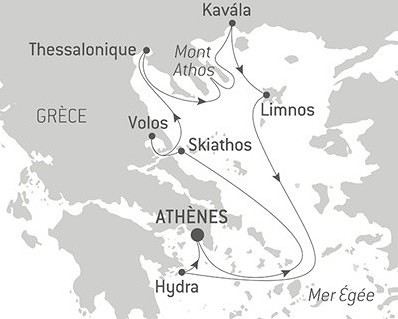
If you'd like, I invite you to join me for a week-long cruise to northern Greece, visiting ports that are often less crowded with cruise ships.
Itinerary: Athens, Skiathos, Volos, Thessaloniki, Kavala, Limnos, Hydra, Athens
How do you feel about coming back to France?
Hi there, I’ve been traveling for 18 years now, at least 6 months a year, and as the years go by, I actually enjoy coming back to France more and more—a feeling I struggled with at first. I mean, we always think the grass is greener elsewhere.
But in the end, I find meaning in that saying about how there’s no place like home. I still love traveling just as much, but now my trips are shorter, and I enjoy spending more time in our beautiful country, even though I don’t hesitate to criticize it.
How about you? How do you handle coming back from your travels?
A summer in the sun in... Iceland!!
Ah, Iceland and us—it’s quite the story, or rather, a long wait... The first time we considered going was already 7-8 years ago, after reading travel journals describing breathtaking landscapes, countless active and dormant volcanoes, glaciers, and waterfalls with extraordinary flows. In short, this island, made of fire and ice, right at Europe’s doorstep with its own unique culture, had nothing but advantages, and it was urgent to visit without delay 😇
My *Routard* guidebook is actually from 2016. So why did Iceland make us wait so long before we finally gave in to its charms? Yes, why indeed?
Simply because reading other travel journals revealed the cost of living there—and especially the harsh climate, even in the middle of July 🤪! Some journals described entire weeks of rain and foggy weather, making it tricky to explore the island. The budget wasn’t spared either, because in the most touristy areas, especially in the south and around Myvatn, accommodation prices are downright indecent—even outright robbery. 😕
Plus, in the Highlands, there’s literally no permanent lodging, and the only way to spend several nights there is to camp. And camping in winter conditions wasn’t exactly part of our plans... 😄
So, year after year, this trip kept getting postponed...
until August 2023, when prices for Southern Africa, North or South America, or even Asia were all way too high for summer 2024!
That’s when I turned my attention back to the Land of Fire and Ice and scoured all the comparison sites for the best accommodation deals across the country. Planning for 20 nights, I found 13 nights in "proper" lodging for 5 people at an average cost of under 200 €! A miracle, considering that in the southern glacier region, around Vik or Myvatn, prices range from 300 to 1000 € per night 😮 😮!
Still, that means we’ll have to camp for 7 nights, mostly in the Highlands, near Askja or Landmannalaugar. 😎
For once, I built the daily itinerary entirely around the decently priced lodgings I found 11 months in advance! The shortage of places to stay in some areas forced me to plan a few long transition days and make some tough choices. No big deal, though—there’s so much to do on this island 🙂!
Once the main itinerary was set, everyone agreed to the plan: 2/3 in proper lodging and 1/3 camping, even the most camping-averse among us! *Follow my gaze...*
By the time we bought the flight tickets, I had to tweak the itinerary a bit because one or two places were already booked! Plus, it was impossible to wait for a more refined plan to adjust reservations, since almost all bookings are non-refundable!! The harsh law of supply and demand...
For the car rental, we booked a Hyundai Tucson, approved for the Highlands, from Lava Car Rental—a company I’d read good reviews about in a Facebook group—for a cool 2500 € with full insurance. A real 4x4, like a Defender, would’ve been more than double...! Welcome to Iceland 😕...
Activities and excursions also required some tough choices. We had two must-dos: whale watching in Húsavík (60 € pp on Getyourguide) and a Glacier and Summer Treasure Glacier Walk with BlueIceland (165 € pp with discount codes on Getyourguide).
For the baths, we skipped the Blue Lagoon—too expensive—in favor of the Secret Lagoon and the Myvatn Baths, the Blue Lagoon’s equivalent but half the price.
Two baths for the price of one... and even more, since I spotted several free hot-water swimming spots.
Itinerary: Day 1: Arrival in Reykjavik - Hraunfossar Waterfall - Surtshellir Cave Day 2: Grábrók Crater - Snæfellsnes Peninsula Day 3: Stykkishólmur - Sturlungalaug Hot Springs Day 4: Northwest Coast - Akureyri - Goðafoss Day 5: Myvatn Day 6: Myvatn - Dettifoss - Selfoss - Rauðhólar Day 7: Húsavík Whale Watching - Dettifoss - Selfoss Day 8: Stuðlagil Canyon - Seyðisfjörður Day 9: Puffin colony - Störurð Hike Day 10: Hengifoss - East Fjords, Mjóifjörður Day 11: Viking Village - Jökulsárlón - Fjallsárlón Day 12: Glacier Excursion - Svartifoss Day 13: Fjaðrárgljúfur Canyon - Vík Day 14: Þakgil - Lava Show Vík Day 15: Southern Waterfalls Day Day 16: Landmannalaugar - Skalli Hike Day 17: Landmannalaugar - Bláhnjúkur - Brennisteinsalda Day 18: Secret Lagoon, Kerlingarfjöll, and Gullfoss Day 19: Geysir - Reykjavik Day 20: Bruarfoss - Þingvellir - Kerid Crater - Krýsuvík Geothermal Area Day 21: Reykjanes Peninsula
Friday, July 5, 2024, is our last workday before driving up to Alsace overnight to leave the cockers at Grandpa’s for boarding. Then, at 1:30 AM, we’ll head to Frankfurt, where a direct flight to Iceland awaits.
We arrive at 4 AM. Since we leave at 7 AM, the "night" will only last the equivalent of a 30-minute nap 🤪... just enough to get us in the road-trip mood 😏!!
My *Routard* guidebook is actually from 2016. So why did Iceland make us wait so long before we finally gave in to its charms? Yes, why indeed?
Simply because reading other travel journals revealed the cost of living there—and especially the harsh climate, even in the middle of July 🤪! Some journals described entire weeks of rain and foggy weather, making it tricky to explore the island. The budget wasn’t spared either, because in the most touristy areas, especially in the south and around Myvatn, accommodation prices are downright indecent—even outright robbery. 😕
Plus, in the Highlands, there’s literally no permanent lodging, and the only way to spend several nights there is to camp. And camping in winter conditions wasn’t exactly part of our plans... 😄
So, year after year, this trip kept getting postponed...
until August 2023, when prices for Southern Africa, North or South America, or even Asia were all way too high for summer 2024!
That’s when I turned my attention back to the Land of Fire and Ice and scoured all the comparison sites for the best accommodation deals across the country. Planning for 20 nights, I found 13 nights in "proper" lodging for 5 people at an average cost of under 200 €! A miracle, considering that in the southern glacier region, around Vik or Myvatn, prices range from 300 to 1000 € per night 😮 😮!
Still, that means we’ll have to camp for 7 nights, mostly in the Highlands, near Askja or Landmannalaugar. 😎
For once, I built the daily itinerary entirely around the decently priced lodgings I found 11 months in advance! The shortage of places to stay in some areas forced me to plan a few long transition days and make some tough choices. No big deal, though—there’s so much to do on this island 🙂!
Once the main itinerary was set, everyone agreed to the plan: 2/3 in proper lodging and 1/3 camping, even the most camping-averse among us! *Follow my gaze...*
By the time we bought the flight tickets, I had to tweak the itinerary a bit because one or two places were already booked! Plus, it was impossible to wait for a more refined plan to adjust reservations, since almost all bookings are non-refundable!! The harsh law of supply and demand...
For the car rental, we booked a Hyundai Tucson, approved for the Highlands, from Lava Car Rental—a company I’d read good reviews about in a Facebook group—for a cool 2500 € with full insurance. A real 4x4, like a Defender, would’ve been more than double...! Welcome to Iceland 😕...
Activities and excursions also required some tough choices. We had two must-dos: whale watching in Húsavík (60 € pp on Getyourguide) and a Glacier and Summer Treasure Glacier Walk with BlueIceland (165 € pp with discount codes on Getyourguide).
For the baths, we skipped the Blue Lagoon—too expensive—in favor of the Secret Lagoon and the Myvatn Baths, the Blue Lagoon’s equivalent but half the price.
Two baths for the price of one... and even more, since I spotted several free hot-water swimming spots.
Itinerary: Day 1: Arrival in Reykjavik - Hraunfossar Waterfall - Surtshellir Cave Day 2: Grábrók Crater - Snæfellsnes Peninsula Day 3: Stykkishólmur - Sturlungalaug Hot Springs Day 4: Northwest Coast - Akureyri - Goðafoss Day 5: Myvatn Day 6: Myvatn - Dettifoss - Selfoss - Rauðhólar Day 7: Húsavík Whale Watching - Dettifoss - Selfoss Day 8: Stuðlagil Canyon - Seyðisfjörður Day 9: Puffin colony - Störurð Hike Day 10: Hengifoss - East Fjords, Mjóifjörður Day 11: Viking Village - Jökulsárlón - Fjallsárlón Day 12: Glacier Excursion - Svartifoss Day 13: Fjaðrárgljúfur Canyon - Vík Day 14: Þakgil - Lava Show Vík Day 15: Southern Waterfalls Day Day 16: Landmannalaugar - Skalli Hike Day 17: Landmannalaugar - Bláhnjúkur - Brennisteinsalda Day 18: Secret Lagoon, Kerlingarfjöll, and Gullfoss Day 19: Geysir - Reykjavik Day 20: Bruarfoss - Þingvellir - Kerid Crater - Krýsuvík Geothermal Area Day 21: Reykjanes Peninsula
Friday, July 5, 2024, is our last workday before driving up to Alsace overnight to leave the cockers at Grandpa’s for boarding. Then, at 1:30 AM, we’ll head to Frankfurt, where a direct flight to Iceland awaits.
We arrive at 4 AM. Since we leave at 7 AM, the "night" will only last the equivalent of a 30-minute nap 🤪... just enough to get us in the road-trip mood 😏!!
Mauritian Ti' Punch
The recipe for the cocktail: endless beaches, a dazzling palette of colors, some breathtaking hikes, and excellent cuisine...
For the tasting, follow along in the pages of this travel journal! 😉
Don’t forget your hiking shoes, a swimsuit, sunscreen, but also a sweater, your driver’s license, and your credit card...
Just over 11 hours of flight, and we’ll be setting foot on Mauritian soil!
For the tasting, follow along in the pages of this travel journal! 😉
Don’t forget your hiking shoes, a swimsuit, sunscreen, but also a sweater, your driver’s license, and your credit card...
Just over 11 hours of flight, and we’ll be setting foot on Mauritian soil!