Results for "bazar+et+Istanbul+|+123+>+233"
6766 results found.
Rencontre à Nandrin (Belgique) le 9 juillet 2005 English translation pending
La rencontre parisienne du 30 mai a accouché d'une nouvelle occasion de se retrouver et d'accueillir de nouvelles frimousses liées à des pseudos sympas ou farfelus.
Je n'ai pas encore trop d'idées sur le programme des festivités mais je vous tiens au courant de l'évolution des choses et j'ouvre la liste des participants avec mon cher prof de photo et sa moitié, j'ai nommé :
VILCANOTA & FRANCOISE
J'espère que vous viendrez nombreux et que cette liste s'allongera très vite.
Pour info, Nandrin se situe à 22 kms de Liège, c'est à la porte des Ardennes Belges. C'est un village de campagne et ma maison est un peu difficile à trouver mais l'itinéraire sera bien flêché car j'entends déjà d'ici certaines mauvaises langues qui vous diront que quand j'explique comment faire pour y arriver, c'est encore pire pour la trouver...😠 hein Marie!!!
Je n'ai pas encore trop d'idées sur le programme des festivités mais je vous tiens au courant de l'évolution des choses et j'ouvre la liste des participants avec mon cher prof de photo et sa moitié, j'ai nommé :
VILCANOTA & FRANCOISE
J'espère que vous viendrez nombreux et que cette liste s'allongera très vite.
Pour info, Nandrin se situe à 22 kms de Liège, c'est à la porte des Ardennes Belges. C'est un village de campagne et ma maison est un peu difficile à trouver mais l'itinéraire sera bien flêché car j'entends déjà d'ici certaines mauvaises langues qui vous diront que quand j'explique comment faire pour y arriver, c'est encore pire pour la trouver...😠 hein Marie!!!
Il etait une fois Parvat en Iran... English translation pending
Tout d'abord, un enoooorme merci pour vos supers messages qui me font chaud au coeur (voir il etait une fois en Turquie, puis mes mails prives que je ne sais repondre personnellement a tous car ca prend 5 minutes pour ouvrir une page dans ces contrees) Je n'oublierai pas le bonjour a Iraj JL, et continuez de m'envoyer des mails, c'est si agreable de vous lire...
Donc, arrives a Dogubayazit en Turquie, nous avons suivi les traces de Trekkerbeub, et avons visiter le palais d'Ishak Pasa, avec le mont Ararat enneige en arriere plan... MONUMENTAL!!! Vraiment grandiose!
L'apres midi, en route pour l'Iran border... Je mets mon foulard sur la tete (je sens qu'il va m'emmerder ce foulard...) et comme nous sommes dimanche, le passage se fait rapidement, specialement pour nous touristes occidentaux 🙂
(break clop dehors qui ne dure pas longtemps car comme je suis E.T. c'est parfois derangeant;))
🙂
(break clop dehors qui ne dure pas longtemps car comme je suis E.T. c'est parfois derangeant;))
Donc nous voila en Iran!!! Taxi collectif pour Bazargan, et retaxi pour Maku, ou nous décidons de nous arrêter une nuit pour nous reposer de la nuit précédente en bus. On trouve un hôtel, pas cher du tout... L'équivalent d'un euro par pers. mais euh... Quelle affreuse chambre, et quelle puanteur dans la salle d’eau ! Pas de douche, juste un évier et deux "tuvalet" à l’odeur épouvantable. Pour se laver, toute une histoire, heureusement que je ne voyage pas seule, Pili vient tenir la porte de la salle d’eau vu qu’elle ne ferme pas. Dorénavant je crois qu’on s'offrira un hôtel au double du prix !Petite balade dans Maku… Je m'achète un fin manteau noir et long pour être en accord avec la loi du pays, puis petit dîner... Kebab et pain, et dodo.
18/4
Bus pour Tabriz. Enfin l'hotel est bien clean, (6 euros pour nous trois) avec des douches bien chaudes. On se balade dans la ville, je m'achete un foulard tout fin et pas chaud dans le bazar (superbe avec ses 35 km de galeries) ou nous nous arretons dans un bui bui pour que je puisse gouter enfin un qaylan. (narguileh) L'endroit est minuscule, serres comme des baudets, on essaie de boire le chai comme ici, avec un morceau de sucre en bouche, on sirote le the brulant. Pas mal le qaylan, mais je prefere le tabac a la pomme. Je regle l'adition, 50 centimes d'euros pour le narguileh et 6 thes...
Petit bonjour a Nasser de l'office du tourisme, qui fait merveilleusement son boulot... Au soir dans un resto, nous faisons connaissance de Shalaleh et Majit qui parlent bien l'anglais. Nous quittons le resto ensemble, et avant d'aller se balader dans le parc Elboli, Shalaleh passe en vitesse chez elle mettre un chador, car comme elle et Majit n'ont aucun lien de parente, elle a peur de se faire prendre, ils risquent gros tous les deux... Cela fait 6 ans qu'ils sont amis, mais ils ne pourront jamais se marier, le pere de Shalaleh ne veut pas de Majit comme gendre... Alors tant qu'elle etudie, elle habite Tabriz alors que ses parents vivent a Orumiyeh, elle continue a voir son cher et tendre, elle a presque fini ses etudes d'ingenieur en electronique, et va commencer l'informatique... On se boit un the en fumant un qaylan a la pomme, et grimpons au point de vue. La ville toute illuminee, le palais converti en resto au milieu de l'étang, les fontaines eclairees de spots verts jaunes ou oranges, on passe vraiment une délicieuse soiree...
Donc, arrives a Dogubayazit en Turquie, nous avons suivi les traces de Trekkerbeub, et avons visiter le palais d'Ishak Pasa, avec le mont Ararat enneige en arriere plan... MONUMENTAL!!! Vraiment grandiose!
L'apres midi, en route pour l'Iran border... Je mets mon foulard sur la tete (je sens qu'il va m'emmerder ce foulard...) et comme nous sommes dimanche, le passage se fait rapidement, specialement pour nous touristes occidentaux
🙂
(break clop dehors qui ne dure pas longtemps car comme je suis E.T. c'est parfois derangeant;))Donc nous voila en Iran!!! Taxi collectif pour Bazargan, et retaxi pour Maku, ou nous décidons de nous arrêter une nuit pour nous reposer de la nuit précédente en bus. On trouve un hôtel, pas cher du tout... L'équivalent d'un euro par pers. mais euh... Quelle affreuse chambre, et quelle puanteur dans la salle d’eau ! Pas de douche, juste un évier et deux "tuvalet" à l’odeur épouvantable. Pour se laver, toute une histoire, heureusement que je ne voyage pas seule, Pili vient tenir la porte de la salle d’eau vu qu’elle ne ferme pas. Dorénavant je crois qu’on s'offrira un hôtel au double du prix !Petite balade dans Maku… Je m'achète un fin manteau noir et long pour être en accord avec la loi du pays, puis petit dîner... Kebab et pain, et dodo.
18/4
Bus pour Tabriz. Enfin l'hotel est bien clean, (6 euros pour nous trois) avec des douches bien chaudes. On se balade dans la ville, je m'achete un foulard tout fin et pas chaud dans le bazar (superbe avec ses 35 km de galeries) ou nous nous arretons dans un bui bui pour que je puisse gouter enfin un qaylan. (narguileh) L'endroit est minuscule, serres comme des baudets, on essaie de boire le chai comme ici, avec un morceau de sucre en bouche, on sirote le the brulant. Pas mal le qaylan, mais je prefere le tabac a la pomme. Je regle l'adition, 50 centimes d'euros pour le narguileh et 6 thes...
Petit bonjour a Nasser de l'office du tourisme, qui fait merveilleusement son boulot... Au soir dans un resto, nous faisons connaissance de Shalaleh et Majit qui parlent bien l'anglais. Nous quittons le resto ensemble, et avant d'aller se balader dans le parc Elboli, Shalaleh passe en vitesse chez elle mettre un chador, car comme elle et Majit n'ont aucun lien de parente, elle a peur de se faire prendre, ils risquent gros tous les deux... Cela fait 6 ans qu'ils sont amis, mais ils ne pourront jamais se marier, le pere de Shalaleh ne veut pas de Majit comme gendre... Alors tant qu'elle etudie, elle habite Tabriz alors que ses parents vivent a Orumiyeh, elle continue a voir son cher et tendre, elle a presque fini ses etudes d'ingenieur en electronique, et va commencer l'informatique... On se boit un the en fumant un qaylan a la pomme, et grimpons au point de vue. La ville toute illuminee, le palais converti en resto au milieu de l'étang, les fontaines eclairees de spots verts jaunes ou oranges, on passe vraiment une délicieuse soiree...
taxe aéroport au départ de Delhi vers Paris? English translation pending
j'ai pas encore atterri que déjà je pense au retour ! si qqun peut me dire le montant de la taxe à payer à l'aéroport au moment de partir... j'ai eu des infos contradictoires...
merci
merci
où acheter des vêtements en arrivant à Delhi English translation pending
encore une petite question : ne sachant quoi prendre comme vêtement pour m'habiller sans choquer, sans crever de chaud, etc. je voudrais acheter sur place dès mon arrivée à delhi.
alors quoi ? où ? à quel prix (en arrivant je n'aurai aucun ordre de grandeur des prix..) ?
merci merci !
alors quoi ? où ? à quel prix (en arrivant je n'aurai aucun ordre de grandeur des prix..) ?
merci merci !
Chang Rai... Ca vaut le coup??? English translation pending
Salut Salut!!!
Je suis a Chang Mai en ce moment... Je me suis fais un bon trekking de 3 jours dans la region de Pai, et visite les temples du coin.
Maintenant il ne me reste que deux ou trois jours avant de redescendre vers Bangkok... J'hesite a rester encore a Chang Mai et me prendre une journee de cours de cuisine thailandaise + shopping au Night market, ou bien me prendre un bus vers Chang Rai, voir une bus vers Tathon et descendre sur Chang Rai en bateau... Est ce que Chang Rai vaut le coup? Qu'y a t il a voir la bas? Ca ne serait juste que pour deux jours... Mon guide Lonely Planet ne me dit pas grand chose sur Chang Rai...
Qu'est ce que vous en pensez? Chang Rai vaut il le deplacement (pour deux jours uniquement) ou vaut il mieux rester plus longtemps du cote de Chang Mai?
Merci pour vos conseils!
Yann
Bolivie: Pourquoi ca coince! English translation pending
Bonjour a tous .....  Dimanche matin, sur la route de Sucre ( il n y a plus de service de bus ), 1000 camions bloqués a Sucre.
Pour quoi tant de probleme et tant de violence en Bolivie ? Simple ? Non, la Bolivie est le pays le plus pauvre de toute l'Amerique mais pourtant la Bolivie est aussi un pays d'une richesse incalculable tant dans le domaine du gaz que dans le secteur minier.
A la Paz, on vous servira dans une assiette en aluminium un "pollo dorado" pour 6 bolivianos ( 1 USD ) . Pourtant ce que gagnera le dueño du boui-boui lui servira a peine pour s'acheter ses bombones de gaz qui lui coute 22, 5 bolivianos et qu'il aura vidé en 3 jours. La Bolivie c'est la deuxieme réserve de gaz de l'Amerique du sud et pourtant faire cuire ses oeufs est devenu un luxe !
La Bolivie est le pays le plus pauvre de toute l Amerique, avec ses 9 millions d habitants dont les 70 % vivent en dessous du seuil de la misere. Pourtant la vente des reserves de gaz pourrait la convertir avec une population aussi basse en un Koweit sud americain avec un PNB par habitant superieur aux pays europeens.
D'apres l'analyste Cayetano Llovet, "Mesa s'appuit sur un modele politique depassé. Mais maintenant rentrent dans le jeux de nouveaux acteurs politiques qui jusqu'a present n'etaient pas arrives a se faire entendre". D'autre part le sociologue de la Paz, Alvaro García Linera analyse la pauvreté dans laquelle vit le pays comme consequence de la structure politique du pays. Aujourd hui cette structure est remise en doute.
D'apres García Linera, aujourd'hui la pays suit cette " logique d'enclave coloniale mise en place du temps de la presence espagnole " Autrefois le pays etait pille par les espagnols ...or, pierres precieuses, minerais, argent...... maintenant c est le pillage du gaz par des multinationales ..
En 1924, l'americaine Standard Oil découvre la premiere réserve en Bolivie mais décide "d'oublier d'informer" le gouvernement bolivien et commence a exporter sans payer aucune taxe. En 1937, la Standard Oil est expulsé, Le gouvernement étatise les puits et les terrains et crée les "Yacimientos Petrolíferos Fiscales Bolivianos". Mais dans les annees 90 le president Gonzalo Sánchez de Lozada ferme les YPFB et offre de nouveau les puits a des compagnies privees etrangeres. Les benefices du gazoduc qui exporte le gaz au Bresil ont ete uniquement pour la compagnie Enron des EEUU. ( super bonne compagnie qui a fait la une avec sa faillite frauduleuse). A cette epoque le négoce de l'export du petrole laisse a peine un dollar a l'état pour 24 dollars qui sont laissés a l'entreprise exportatrice.
D'autres compagnies petrolieres decouvrent ensuite dans ces annees 90 des poches de gaz dans le sud du pays qui font passer les reserves de 5 a 52 millions de pieds cubiques. Mais la situation du bolivien et de la bolivienne ne change pas pour autant.
A Tarija, ( allez y voir ) ou se concentrent les 85% des reserves de gaz du pays, les milliers de personnes qui y vivent continuent toujours a aller chercher du bois pour cuisiner et chauffer leurs taudis. De meme, depuis la privatisation de l'eau, l utilisation et la consommation de l'eau potable a la maison est devenu quelque chose de luxueux et au dessus des moyens de la grande majorite de la population. Sixto Pati Pérez, cordonier a El Alto a du payer 450 USD pour l installation de l eau chez lui ... ( il gagne 2 USD par jour ! ) ...
Ah j'oubliais de dire que la compagnie de distribution de l eau a été vendu a Suez-Lyonnaise des Eaux....cette societe est tres appreciée ici, vous pouvez vous imaginer a quelle point !
La situation bolivienne est compliquée et l'ultraliberalisme partiquée depuis 18 ans n'a rien résolu, bien au contraire..... qui a raison ? personne ou plutot c'est une sucession d'erreurs depuis des annees, une corruption a pouvoir la faire figurer dans le guiness....des conflits d'interets, entre indigenes, entre narcotraficants profitant de la vacance du pouvoir et de l Etat dans la province de Santa Cruz pour en faire leur domaine...et s'occupant aujourd'hui de tout, de donner du travail jusqu'a résoudre les problemes sociaux de cette province.
Qui est le "mechant" dans l affaire ? tout le monde et personne a la fois, le president Mesa en poste ? elu par les siens, est il corrompu ? en tout cas bien moins que ces predecesseurs ? les narcos qui font du negoce et qui sort de la pauvrete leur province mais qui transforme tous leurs paysans en cocaleros ? Les syndicaliste routiers: les camioneros qui profite du bazar pour revendiquer leurs droits ? Les Multinationales y compris Suez, qui profitent de la faiblesse du pouvoir pour pouvoir en faire profiter leurs actionnaires et permettre a leurs societes de pouvoir acheter d'autres societes dans le tiers monde ?
A vous de repondre ! En tout cas, en ce moment la Bolivie Change ! en bien ou en mal ? je ne sais pas, mais en tout ca elle change en autre chose !
Ce soir (dimanche) a 19h00, allocution du president a la television ...nous nous dirigeons vers une preuve de force, si le president demande a l'armee de débloquer les routes ca peut tres mal tourner.
A bientot !
Herge !
Dimanche matin, sur la route de Sucre ( il n y a plus de service de bus ), 1000 camions bloqués a Sucre.Pour quoi tant de probleme et tant de violence en Bolivie ? Simple ? Non, la Bolivie est le pays le plus pauvre de toute l'Amerique mais pourtant la Bolivie est aussi un pays d'une richesse incalculable tant dans le domaine du gaz que dans le secteur minier.
A la Paz, on vous servira dans une assiette en aluminium un "pollo dorado" pour 6 bolivianos ( 1 USD ) . Pourtant ce que gagnera le dueño du boui-boui lui servira a peine pour s'acheter ses bombones de gaz qui lui coute 22, 5 bolivianos et qu'il aura vidé en 3 jours. La Bolivie c'est la deuxieme réserve de gaz de l'Amerique du sud et pourtant faire cuire ses oeufs est devenu un luxe !
La Bolivie est le pays le plus pauvre de toute l Amerique, avec ses 9 millions d habitants dont les 70 % vivent en dessous du seuil de la misere. Pourtant la vente des reserves de gaz pourrait la convertir avec une population aussi basse en un Koweit sud americain avec un PNB par habitant superieur aux pays europeens.
D'apres l'analyste Cayetano Llovet, "Mesa s'appuit sur un modele politique depassé. Mais maintenant rentrent dans le jeux de nouveaux acteurs politiques qui jusqu'a present n'etaient pas arrives a se faire entendre". D'autre part le sociologue de la Paz, Alvaro García Linera analyse la pauvreté dans laquelle vit le pays comme consequence de la structure politique du pays. Aujourd hui cette structure est remise en doute.
D'apres García Linera, aujourd'hui la pays suit cette " logique d'enclave coloniale mise en place du temps de la presence espagnole " Autrefois le pays etait pille par les espagnols ...or, pierres precieuses, minerais, argent...... maintenant c est le pillage du gaz par des multinationales ..
En 1924, l'americaine Standard Oil découvre la premiere réserve en Bolivie mais décide "d'oublier d'informer" le gouvernement bolivien et commence a exporter sans payer aucune taxe. En 1937, la Standard Oil est expulsé, Le gouvernement étatise les puits et les terrains et crée les "Yacimientos Petrolíferos Fiscales Bolivianos". Mais dans les annees 90 le president Gonzalo Sánchez de Lozada ferme les YPFB et offre de nouveau les puits a des compagnies privees etrangeres. Les benefices du gazoduc qui exporte le gaz au Bresil ont ete uniquement pour la compagnie Enron des EEUU. ( super bonne compagnie qui a fait la une avec sa faillite frauduleuse). A cette epoque le négoce de l'export du petrole laisse a peine un dollar a l'état pour 24 dollars qui sont laissés a l'entreprise exportatrice.
D'autres compagnies petrolieres decouvrent ensuite dans ces annees 90 des poches de gaz dans le sud du pays qui font passer les reserves de 5 a 52 millions de pieds cubiques. Mais la situation du bolivien et de la bolivienne ne change pas pour autant.
A Tarija, ( allez y voir ) ou se concentrent les 85% des reserves de gaz du pays, les milliers de personnes qui y vivent continuent toujours a aller chercher du bois pour cuisiner et chauffer leurs taudis. De meme, depuis la privatisation de l'eau, l utilisation et la consommation de l'eau potable a la maison est devenu quelque chose de luxueux et au dessus des moyens de la grande majorite de la population. Sixto Pati Pérez, cordonier a El Alto a du payer 450 USD pour l installation de l eau chez lui ... ( il gagne 2 USD par jour ! ) ...
Ah j'oubliais de dire que la compagnie de distribution de l eau a été vendu a Suez-Lyonnaise des Eaux....cette societe est tres appreciée ici, vous pouvez vous imaginer a quelle point !
La situation bolivienne est compliquée et l'ultraliberalisme partiquée depuis 18 ans n'a rien résolu, bien au contraire..... qui a raison ? personne ou plutot c'est une sucession d'erreurs depuis des annees, une corruption a pouvoir la faire figurer dans le guiness....des conflits d'interets, entre indigenes, entre narcotraficants profitant de la vacance du pouvoir et de l Etat dans la province de Santa Cruz pour en faire leur domaine...et s'occupant aujourd'hui de tout, de donner du travail jusqu'a résoudre les problemes sociaux de cette province.
Qui est le "mechant" dans l affaire ? tout le monde et personne a la fois, le president Mesa en poste ? elu par les siens, est il corrompu ? en tout cas bien moins que ces predecesseurs ? les narcos qui font du negoce et qui sort de la pauvrete leur province mais qui transforme tous leurs paysans en cocaleros ? Les syndicaliste routiers: les camioneros qui profite du bazar pour revendiquer leurs droits ? Les Multinationales y compris Suez, qui profitent de la faiblesse du pouvoir pour pouvoir en faire profiter leurs actionnaires et permettre a leurs societes de pouvoir acheter d'autres societes dans le tiers monde ?
A vous de repondre ! En tout cas, en ce moment la Bolivie Change ! en bien ou en mal ? je ne sais pas, mais en tout ca elle change en autre chose !
Ce soir (dimanche) a 19h00, allocution du president a la television ...nous nous dirigeons vers une preuve de force, si le president demande a l'armee de débloquer les routes ca peut tres mal tourner.
A bientot !
Herge !
sud marocain fin decembre English translation pending
Pour un premier voyage au Maroc, j'envisage soit un autotour (TO à choisir, que pensez-vous du comptoir du Maroc)😄), soit le circuit suivant:
Ce n'est encore qu'une ébauche que je compte bien améliorer avec vos conseils.
J1: Arrivée à MARRAKECH. J2: MARRAKECH-SKOURA via OUARZAZATE. J3: vallée du Dadès et gorges du Todgha J4: TINEGHIR-MERZOUGA J5: EXCUSRIONS à partir de Merzouga. J6: Merzouga-Rissani- Alnif-tansikht-zagora J7: vallee du draa zagora-Ouarzazate J8: Ouarzazate- Marakkech j9: Marrakeck J10: Retour Orly
Est ce raisonnable compte tenu des distances? Comment sont les routes en décembre? Est-ce OK avec une voitire de location ou le 4x4 est-il indispensable? Quelles étapes conseillez-vous pour l'hébergement?
Merci à l'avance de vos suggestions
Ce n'est encore qu'une ébauche que je compte bien améliorer avec vos conseils.
J1: Arrivée à MARRAKECH. J2: MARRAKECH-SKOURA via OUARZAZATE. J3: vallée du Dadès et gorges du Todgha J4: TINEGHIR-MERZOUGA J5: EXCUSRIONS à partir de Merzouga. J6: Merzouga-Rissani- Alnif-tansikht-zagora J7: vallee du draa zagora-Ouarzazate J8: Ouarzazate- Marakkech j9: Marrakeck J10: Retour Orly
Est ce raisonnable compte tenu des distances? Comment sont les routes en décembre? Est-ce OK avec une voitire de location ou le 4x4 est-il indispensable? Quelles étapes conseillez-vous pour l'hébergement?
Merci à l'avance de vos suggestions
Le routard: une caricature? English translation pending
je lis les messages de vf depuis quleques temps... c est super de voir autant de personnes curieuses, ouvertes et tolerantes..... je partage a 100 % la philosophie du voyage ''routard'' ... et oui ! je suis aussi une gentille voyageuse et pas une mechante touriste.... oui bon la, je caricature mais c est pour introduire ma reflexion !
ben oui, je trouve que toute cette fraicheur, cet enthousiasme pour la decouverte d autres cultures, d autres mentalites c est vraiment tres beau mais parfois ca m agace aussi..... je n aime pas les generalites et il ne s agit pas ici d en faire mais PARFOIS justement, je trouve certaines reflexions vraiment tres naives et tres caricaturales ! non la societe occidentale n est pas faite que de gens stresses, inhospitaliers, agressifs, qui ne revent plus etc.... et certains vfistes en sont la preuve ! ou alors ils se metamorphosent au moment ou ils franchissent la frontiere !?.........peut etre !!! ....un jour, en tunisie, je discutais avec un algerien qui trouvais que les occcidentaux se LIQUEFIAIENT quand ils etaient a l etranger.... j ai trouve ce mot extraordinairement vrai ! oui, nous nous liquefions, qu on soit ''touriste'' ou ''voyageur''.... on entre dans une espece de beatitude heureuse et on se met a aprrecier tout ce qu on voit y compris le chat errant malade tout pouilleux sur un mur en crete... la quete d authenticite nous fait perdre les pedales... arretons de tout trouver beau parce que c est ce qu on attend.... non les autochtones ne sont pas tous accueillants, gentils.... ''ils sont pauvres et sont tres genereux en meme temps, ce sont des gens si simples''.... c est pour moi des paroles terribles !!!!!! elles sont le comble du routard qui voit le monde a travers un voile de douces et naives utopies !!! pour en avoir rencontre, il existe des routards-touristes qui finissent par croire qu ils voient ce qu ils voulaient voir......... en quete de cliches, ils vont la ou ils veulent aller.... parce que ca fait tres bien de dire qu on a fabrique son djembe avec un rasta dans un 'tout petit village d afrique sans touristes... je sais pas mais moi ca me derange....
un voyage c est beau mais c est aussi tres triste.... alors il ne faut pas se liquefier et trouver que tout est extraordinaire par respect pour ceux qui vivent la-bas et qui pensent que c est nous, les occidentaux, qui avons une vie extraordinaire (-ment confortable).
voila, c est le danger qui guette le routard, trop heureux de partir, sur de voir des choses magnifiques, le sourire en toutes circonstances....
je veux garder les yeux ouverts sur ce que je vois... je veux rester lucide, je ne veux pas aller dans un pays pour dire apres que je l ai FAIT, je ne veux pas decorer mon appart avec pleins de choses exotiques, je ne veux pas trouver que les gens sont pittoresques, je n ai pas envie de prendre en photo les gens que je rencontre.... je veux les laisser la ou ils sont pour ne pas vouloir tout posseder... je veux laisser vivre le fosse qui existe entre eux et moi parce qu il est ineffacable et je ne veux pas jouer ni me deguiser en eux... c est comme ca qu on arrete de ''faire des rencontres'' pour se faire des vrais amis et s enrichir vraiment de l autre et pas de ce qu il represente.
bon bref, tout ca pour dire que je trouve ce forum tres interessant mais que parfois on decouvre sous des identites de voyageurs, de vrais touristes........
est ce que vous trouvez que j exagere ou bien partagez vous mon point de vue ?????
Retour du Melia Tropical English translation pending
😕 Snif, snif....
je suis de retour après 1 semaine au Mélia Tropical de PUNTA CANA....
à mon tour de raconter....
voyage avec N .F. sur CORSAIR du moins on pensait......
arrivée le 27/11 à l'aéroport 2h avant l'embarquement ( billet en grand large)
là on nous annonce problème d'avion, pas de vol en 747 corsair, déclassement en classe éco car 2 charter de remplacement... un polonais et un portuguais bonjour l'ambiance....
bref ça commence fort mais pas trop de retard et vol en B 767 polonais pas trop désagréable.....
arrivée à PUNTA CANA le soir et embarquement dans des bus pour l'hotel.
le MELIA est divisé en 2, caribe et tropical.nous étions au TROPICAL.
un peu le bazar à l'arrivée, il faut se débrouiller seul car N.F. vous laisse dans le hall et basta, mais le personnel est tellement sympa ....
on prend 1 petit train pour acceder aux chambres via le parc et là....on est abasourdi par ce paysage magnifique.....
nous étions au bloc 6, à conseiller car à mi chemin entre le hall et la plage.
chambre confortable, rien à dire meme si ça commence à vieillir un peu....on entend un peu les voisins et la clim....mais ça reste tout à fait un belle chambre
conseils : louer le coffre, vous serez cool.... 2 usd par jour
demander 1 chambre à l'étage ça evitera d'entendre les bruits des talons le soir ou la nuit....
le lendemain matin, découverte des installations : 2 piscines extraordinaires aves végétation et bars....
une plage superbe bordée de cocotiers et une eau à 28/ 29, salle de gym complete avec sauna, restos de plage en service buffet pour petit dejeuner et repas du midi super cool....
bref pas déçu du tout et heureux tout plein...
le soir restos à réserver par téléphone, tous bon et copieux sauf le chinois à fuir....
ambiance musicale dans le hall, près du bar... casino, spectacle tous les soirs de qualité, salle multimédia pour utiliser internet par cartes payantes car le téléphone c'est l'enfer.....
nous n'avons pas excurtionné car le temps de profiter de tout le resort ça vous occupe pas mal....
pour résumer on en a pris plein les yeux avec un personnel d'une gentillesse extraordinaire....
nos plus belles vacances dans une ambiance cool mais classe aussi, le reve pour décompresser et se laisser vivre en amoureux....
merci à ceux qui m' ont renseigné sur le forum.....
un dernier mot... le voyage retour a été super en b 747, grand large, on vous conseille .....
merci aux dominicains pour cet accueil formidable, on adore .....😕
je suis de retour après 1 semaine au Mélia Tropical de PUNTA CANA....
à mon tour de raconter....
voyage avec N .F. sur CORSAIR du moins on pensait......
arrivée le 27/11 à l'aéroport 2h avant l'embarquement ( billet en grand large)
là on nous annonce problème d'avion, pas de vol en 747 corsair, déclassement en classe éco car 2 charter de remplacement... un polonais et un portuguais bonjour l'ambiance....
bref ça commence fort mais pas trop de retard et vol en B 767 polonais pas trop désagréable.....
arrivée à PUNTA CANA le soir et embarquement dans des bus pour l'hotel.
le MELIA est divisé en 2, caribe et tropical.nous étions au TROPICAL.
un peu le bazar à l'arrivée, il faut se débrouiller seul car N.F. vous laisse dans le hall et basta, mais le personnel est tellement sympa ....
on prend 1 petit train pour acceder aux chambres via le parc et là....on est abasourdi par ce paysage magnifique.....
nous étions au bloc 6, à conseiller car à mi chemin entre le hall et la plage.
chambre confortable, rien à dire meme si ça commence à vieillir un peu....on entend un peu les voisins et la clim....mais ça reste tout à fait un belle chambre
conseils : louer le coffre, vous serez cool.... 2 usd par jour
demander 1 chambre à l'étage ça evitera d'entendre les bruits des talons le soir ou la nuit....
le lendemain matin, découverte des installations : 2 piscines extraordinaires aves végétation et bars....
une plage superbe bordée de cocotiers et une eau à 28/ 29, salle de gym complete avec sauna, restos de plage en service buffet pour petit dejeuner et repas du midi super cool....
bref pas déçu du tout et heureux tout plein...
le soir restos à réserver par téléphone, tous bon et copieux sauf le chinois à fuir....
ambiance musicale dans le hall, près du bar... casino, spectacle tous les soirs de qualité, salle multimédia pour utiliser internet par cartes payantes car le téléphone c'est l'enfer.....
nous n'avons pas excurtionné car le temps de profiter de tout le resort ça vous occupe pas mal....
pour résumer on en a pris plein les yeux avec un personnel d'une gentillesse extraordinaire....
nos plus belles vacances dans une ambiance cool mais classe aussi, le reve pour décompresser et se laisser vivre en amoureux....
merci à ceux qui m' ont renseigné sur le forum.....
un dernier mot... le voyage retour a été super en b 747, grand large, on vous conseille .....
merci aux dominicains pour cet accueil formidable, on adore .....😕
Ethnies en Iran English translation pending
Bonjour,
Partant quelques semaines en Iran dès fin octobre, j'ai quelques questions sur cete destination:
1- je souhaiterai approcher quelques ethnies nomades tels que Lor, Bakthiari, Qashgai aux alentours de Shar-e Kord, Firuz Abad, Yasuj. Est-ce que certains d'entre vous ont déjà réaliser ce genre de choses en individuel voire auprès d'un guide locale ?
2- Je recherche des infos sur la route Machhad - Yazd via Tabas.
3- Je cherche enfin à localiser un village nommé Toups dans le Sistan ou le Baluchestan. Toups est la légende de la photo
Merci,
Herve
Partant quelques semaines en Iran dès fin octobre, j'ai quelques questions sur cete destination:
1- je souhaiterai approcher quelques ethnies nomades tels que Lor, Bakthiari, Qashgai aux alentours de Shar-e Kord, Firuz Abad, Yasuj. Est-ce que certains d'entre vous ont déjà réaliser ce genre de choses en individuel voire auprès d'un guide locale ?
2- Je recherche des infos sur la route Machhad - Yazd via Tabas.
3- Je cherche enfin à localiser un village nommé Toups dans le Sistan ou le Baluchestan. Toups est la légende de la photo
Merci,
Herve
Circuit rêve californien avec Nouvelles Frontières English translation pending
Hello
qq1 a-t-il deja effectue le voyage intitulé Reve Californien vendu chez Nouvelles Frontieres?
Je serai interessee pour le prendre. Il m'a l'air assez complet. Je voulais savoir quelle est la societe sur place qui organise ce trip, histoire de voir un peu sur le net et d'avoir plus de precisions. Etiez-vous satisfait? Est-il possible de devier la route initialement prevue pour aller au Joshua national park par exemple (pas prevu mais sur le chemin du trajet décrit). Merci d'avance pour vos reponses
fanny
qq1 a-t-il deja effectue le voyage intitulé Reve Californien vendu chez Nouvelles Frontieres?
Je serai interessee pour le prendre. Il m'a l'air assez complet. Je voulais savoir quelle est la societe sur place qui organise ce trip, histoire de voir un peu sur le net et d'avoir plus de precisions. Etiez-vous satisfait? Est-il possible de devier la route initialement prevue pour aller au Joshua national park par exemple (pas prevu mais sur le chemin du trajet décrit). Merci d'avance pour vos reponses
fanny
Périodes menstruelles dans un tour du monde English translation pending
Bonjour!
Voilà je me prépare à partir 12 mois pour le tour du monde (europe/asie/amérique sud nord) et une question me chiffonne; comment faire pour les périodes rouges? Il y a t'il des tampons partout ou faut-il en prendre X paquets??
merci beaucoup!
Voilà je me prépare à partir 12 mois pour le tour du monde (europe/asie/amérique sud nord) et une question me chiffonne; comment faire pour les périodes rouges? Il y a t'il des tampons partout ou faut-il en prendre X paquets??
merci beaucoup!
Musique donnant le moral! English translation pending
A tous ce qui le forum redonne le moral, je vous conseil une autre methode la musique. Moi quand j'ai pas le moral je me mets un bon morceau et op je reparts (je ne fais pas de pub pour une celebre marque de friandise🤪).
Vous devez avoir quelques bons morceaux faites nous les partager!! Moi rien de mieux que le Ska avec des groupes telque ska-p ou yela mela (ou melo oups!!!) ou encore walter olmos et pk pas terminer avec un bon sbrena krila!!😎
a+ et bonne ZIC!!!!!!!!!
a+ et bonne ZIC!!!!!!!!!
Vingt jours en Haryana, Punjab, Rajasthan English translation pending
13 juillet 2003 Paris
Air India. 7h de retard, le réservoir s'est vidé sur le sol de Roissy 🙁
14 juillet 2003
... la musique qui marche au pas cela ne me regarde pas...
Léger flottement pour le transit à Mumbai mais je dégotte enfin un avion pour Delhi. Il faut que je pense, pour l'année prochaine, à trouver un avion Mumbai Jodhpur. Je repère un touriste isolé. Delhi, environ 11h du matin. Je récupère mon sac à dos et mon touriste solitaire. Il est américain - Did you book an hotel ? - Non, il n'a rien prévu. - We can share a prepaid taxi and go to my hotel in Paharganj ? - Parfait. J'arrive avec Chris, j'ai de quoi donner un bon pourboire à notre chauffeur, un Sikh, et j'apporte un client comme promis à Surender Mohan (Sone pê Suhaga...). Pour 250 rps, à Delhi, la chambre est correcte. L'accueil est toujours bon, les deux frères et les employés toujours prêts à rendre service. Le Hare Krishna roof top restaurant à 250m sur la droite en débouchant dans Main Bazar me convient parfaitement. 15 juillet 13h Je vais à pied à la New Delhi Station. Les gens sont bien sages, la queue est parfaite, je ne vois qu'une seule tête. Je prend un ticket pour Kurukshetra, ville sainte de l'Haryana (te souvient-il des conseils prodigués par Krishna à Arjuna avant la grande castagne familiale ?) sise à 157 km au Nord de Delhi. Petit problème pour entrer dans le train. Bousculade de première, je perds mon clip solaire sans m'en rendre compte. Les gadgets pour playboy ne sont pas faits pour moi, je le savais depuis longtemps. Par contre, j'ai trouvé un siège. Quelques échanges un peu courts avec mes sympathiques voisins. je ferais bien de récupérer mon Hindi pour converser un peu plus... Arrivée à Kurukshetra. Je sors de la gare. J'achète un paquet de "Four Square", attention fumer du tabac nuit gravement à la santé. D'un autre côté, produire beaucoup de fumée à la tombée du jour protège du palu... Pas le temps de tirer deux bouffées qu'un local me demande où je veux aller. - Birla Mandir ? -. Autour de ce temple je sais qu' il est possible de trouver des dharamsalas. Il me propulse dans un rickshaw collectif et de dire au chauffeur - Birla Mandir, 5 rps -. Finie la cigarette reposante, la vie trépidante reprend. Bien, je suis face au temple. Une rue à gauche, une rue à droite. Droite, gauche, gauche droite... Prenons celle de droite. Un banc, deux chaises et quelques rudes travailleurs papotant gentiment devant le petit bureau de poste. - Äie, baithie ! - C'est demandé si gentiment que j'accepte volontiers la chaise qui m'est offerte. - Chaï pijie ! - Et un thé indien pour le touriste. En plus j'ai l'autorisation de boire aussi une cigarette (en Inde nous ne fumons pas, nous buvons la cigarette). Après quelques échanges, mon Hindi me revient, Om Parkash Garag, le chef du bureau de poste, boudha souriant, serein, je dirais même satisfait, m'accompagne au Jat Dharamsala qui se trouve juste derrière le bureau le poste. Visite de deux parmi les 471 chambres. Il est possible de choisir le dortoir. Tant que je ne dépasse pas 150 rps je peux m'offrir du luxe : fan et cooler, salle de bain spacieuse, de quoi accrocher ma moustiquaire, parfait. Allons remplir les formalités, passeport, visa... Le directeur, est du genre discret, bel homme avec un petit air malain. Il ne dit pas un mot. Il m'avouera plus tard qu'il comprend ce que nous disons mais qu'il préfère ne pas parler un mauvais anglais. Bon, il est temps de s'installer, moustiquaire, petite douche, fringues propres et me voilà dehors. Je m'offre une balade derrière le Birla Mandir. Là, un immense réservoir, le Brahma Samovar. Ce calme à la tombée de la nuit, cette immense étendue d'eau sacrée, tous ces gens qui flanent en papotant silencieusement, cette douce luminosité, je m'asseoie au bord de l'eau pour me rafraichir de cette paix partagée. Un étudiant, Kurukshetra abrite une université fameuse en Inde, me demande l'autorisation de me parler. Thick hai. Sujet assez commun : en gros le passé n'existe plus, le présent c'est tout juste, mais l'avenir ça compte un max. Bof, moi la philo... A peine le temps de lui expliquer que j'appartiens déjà au passé qu'il s'en va en se demandant s'il m'a bien rencontré. Bien, prenons la rue que j'ai délaissée à mon arrivée. Un petit Dhaba (en Hindi, une gargotte peut aussi s'appeler hotel...), son nom - Celebrate - attire mon attention. J'entre, namaste, et je découvre l'aubergiste, Sudesh, une fort belle femme. Phd de Sanskrit qu'elle est ! Je la sens un peu conservatrice. Néanmoins, je tente une légère approche (en Inde restons très très léger...). Conversation bien aimable. Diner très indien. Dodo. 16 juillet Kurukshetra Sucreries et chaï au petit déj chez le chaïwala d'à côté. Mon postier favori demande à un jeune garçon de m'accompagner au Panorama, un museum des sciences avec plein de gadgets pour faire des expériences de physique très divertissantes. Bon, passons au Shri Krishna museum lequel mérite bien deux bonnes heures. En plus des rappels nombreux au fameux sermon de Krishna à Arjun before le célèbre bain de sang (lisez la Bhagavad Gîtâ traduite du sanskrit par Anne-Marie Esnoul et Olivier Lacombe chez Points / Sagesses) plein de petites choses passionnantes à découvrir (non, je n'ai pas d'appareil photo, il va falloir vous déplacer...). C'est pas tout ça, le déjeuner m'attend... chez mon aimable Sudesh. Un moment délicieux à papoter tous les deux... Amateurs de vieilles pierres vous pouvez visiter, comme moi dans l'après-midi, le Sheikh Chehli Jalal Mausoleum. Un musée qui parle, entre autres, des récentes découvertes dans la mer au bord de la ville sainte de Dwarka (ville très agréable et paisible), Gujarat. C'est trop fort, Bhujh me revient. Bhujh, je pleure en revoyant le marché aux légumes, ses petites ruelles autour, ce barbier fraternel qui m'arrêta en me prenant par le coude pour me montrer les photos des touristes qu'il avait tant aimés. Même toi le gars avec qui je m'engueulais violemment dans la Guest house, même toi, j'aimerais te revoir pour qu'on se frotte encore un peu. Vous pensez que Dieu existe (la question est trop complexe pour ma petite tête) ? Où est-il celui qui a permis ce tremblement de terre violent et terriblement injuste ? Gros sur la patate... Visite d'un petit temple, les gamins s'amusent comme des petits fous dans le bassin. Retour au Birla mandir. Waouh, un touriste ! Il vient de Toronto. Bon, nous sommes là pour s'entraider. Je lui raconte la ville, il m'écoute poliment (ça change de la plupart des autres lesquels, en général, sourds à tout conseil occidental, préfèrent écouter les aimables garçons des rues qui leur préparent des entubages de première bourre. Rien de tel que sa propre expérience, non ?). Puis il me remercie, précisant au passage qu'il est originaire de Kurukshetra. Elle est bien bonne. Garag, notre postier, m'invite à prendre un pot chez lui. Famille très sympa. Bon, c'est pas tout ça, le devoir nous attend. Bus pour Joytisara, son et lumière... eh oui, toujours la même histoire, Krishna, Arjuna... mais en Hindi. Je m'accroche un peu et je décide rapidement de ne regarder que les images, les lumières en fait. Beaucoup de bruits et de fureurs... C'est décidé, je m'inscris aux Langues O dès la rentrée. Retour au bercail après avoir dîné dans une petite gargotte le long de la rue principale. Super bon ! Je dois indiquer aux touristes nécessiteux que le Jat Dharamsala sert 1000 repas gratuits et ceci deux fois par jour, midi et soir. 17 juillet Kurukshetra. Adieux, départ et arrivée à Fada City. Re-sucreries et chaï pour y faire trempette. Mon ami le postier insiste (il m'enverra par la suite des documents et téléphonera plusieurs fois à Paris) pour que je lui fasse une lettre en vue d'obtenir un visa... de 6 mois ! Que va en penser Sarkosette ? Petit tour pour les adieux et les cadeaux. - Ah, ma chère Sudesh, je suis bien triste (tiens, un petit flacon de parfum) - Et moi donc - dit-elle en me servant mon masala dosai. Essuyons les larmes, rickshaw pour Pipli où le bus pour Chandigarh devrait me prendre (à moins que ce ne soit l'inverse ?). Votre immense culture vous rappelle au souvenir du Fada, Le Corbusier qui a, entre autres divertissements, dessiné les plans de cette immense ville, capitale de deux états de l'Inde, l'Haryana et le Punjab. Ne faites pas comme moi, travaillez les itinéraires des bus, ça vous économisera du temps et de l'argent. Je vais au Panchayat Bhavan. Ma religion m'interdisant de dépasser les 150 roupies, je prend une chambre à 80 avec douche commune. Pas extraordinaire mais, moi, du moment que je peux installer ma moustiquaire... En bas, au resto de l'hôtel, thali à 20 roupies, excellent. 18 juillet Chandigarh Rock garden, un immense et magnifique jardin "à la facteur Cheval". Rien que pour croiser de jeunes indiennes prise en flagrant délit d'amour, se cachant dans les bras de l'heureux élu à mon passage, la visite vaut le coup. J'étais seul. La cafétaria propose des patisseries qu'elle n'a pas en stock et les paquets de biscuits ont, depuis longtemps, dépassé la date prescrite. La dame du bureau d'India Airlines est très aimable et très serviable. Si si, j'insiste. 19 juillet. Vers McLeodganj. 20-21 supporter McLeodganj... Espérant ne pas mourir complètement idiot, sur ma liste de villes possibles, j'ai inscrit celle-ci, un peu inquiet à l'idée de m'ensuquer dans un club à touristes. Chandigarh, Main bus stand. Je prend le bus 8 à la plate-forme 37 pour aller au bus stand 43. Je ne paye rien, gratuit ? Là je trouve un bus pour Dharamsala. Il est encore temps de revenir en arrière... Mais non, je m'enferre. Pour l'instant, tout va bien. Mais dans les derniers kilomètres le temps se gâte, il commence à pleuvoir sérieux. Changement de bus pour la montée à McLeodganj et l'arrivée : de rares rues avec des boutiques pour westerns dans tous les coins, des cowboys fonçant en moto dans ces chemins faits pour les vaches, les piétons et les enfants. J'ai envie de repartir mais je suis trempé. Deux jours pour sécher les vêtements... Pushkar, une nuit dans cette jolie ville m'avait largement comblé, Pushkar McLeodganj même conbat ! Deux villes qui sont superbes à 6h le matin, une bonne partie des touristes étant occupée à cuver la Kingfisher ou à se repérer dans la fumée des pétards. Non, ce n'est pas l'Inde et je n'aime vraiment pas du tout. Jame, Kashmiri, vendeur de bijoux (explique moi, avec ce que tu gagnes, où tu trouves de quoi manger, Jame ? Tu m'as l'air d'avoir une bien petite tension...) en face du Kailash, va faire de gros progrès aux échecs... s'il arrête de se déconcentrer en matant les mignonnes. Richard a une bien jolie petite fille et semble bien s'occuper des enfants du coin. Bon coeur. Fred, il a passé un an dans le coin il y a trois années de cela, est bien décu de ce que c'est devenu. Un frère d'amazonie passe dans la rue arborant un Tee shirt "Puerto Maldonado"... se demandant ce qu'il peut bien faire dans ce bled. Souvenirs... Petit tour entre deux averses en direction de Bhagsunath (un vrai de vrai, bien éclairé, dirait en prenant un air détaché "Bhagsu", j'suis du coin, quoi...). Bonne promenade. Du positif ? Des locaux gentils. Le Kailash hotel, personnel sympathique, mais construction un peu légère (vibrrrations quand les gens passent dans le couloir); Shambala, bon carott juice, laissez-vous tenter par la patisserie; Shangrila, à côté, très bon vegetable chowmein; McLleo, bonne cuisine indienne pour touriste et soirée éducative pour des enfants sikhs lesquels étaient là avec leurs parents : parmi quatre touristes très limites, l'un, avachi, les jambes dans l'allée, buvant sa bierre au goulot. Plus fréquent qu'on peut le penser. Tiens on vient de me conter la délicatesse de certains qui ont le bon goût, à Leh, Manali ou ailleurs, de déclarer de fausses pertes de lecteurs de CD (ou autres ustensiles) dans l'hotel où ils sont descendus, causant stupidement de gros torts à beaucoup de monde. De quoi pleurer, non ? J'ai revu ma compagne de trois jours de l'été 99, Hannah, une sacrée voyageuse. - Toi Hannah ? - Toi Jacques ? - Te souviens-tu de Kahjuraho, Agra, Mathura ? J'en soupire rien que d'y penser. Hannah est, depuis 2000, tour leader pour une agence hollandaise. Te revoir m'a mis du baume au coeur. Plus tard, à Amritsar, Karl de Manchester me dira que Dharamsala, Kotwali Bazar, aurait gardé un peu plus de son authenticité. Je précise que pour descendre à Kotwali bazar point n'est besoin d'attendre le bus. Pour une roupie de plus vous pouvez partager une jeep avec les gens du coin (un court moment d'indianité ne peut pas faire de mal, n'est-ce pas ?). Trois raisons valables pour justifier un tour à MacTruc 1) rencontrer éventuellement Hannah 2) vouloir méditer sévère avec les moines du château 3) savourer le bonheur intense de quitter MacMachin 22 juillet Echappée vers Amritsar Ouf, les vêtements sont secs, je suis libre ! Vivement le soleil d'Amritsar ! Lever 5h30, que cette ville est belle à cette heure là ! Attente du bus pour Manali, changement à Dharamsala pour celui de Pathankot. La route est très belle qui va vers l'Inde, la vraie. Pathankot. Je vais à pied du bus stand à la railway station. 1 km en plein cagna. Les rickshaw-valas ne me harcèlent pas outre mesure. Je dirais même qu'ils ont un certain sens de l'humour. Bref, la ville me semble déliceusement indienne, peu dégradée par le tourisme. Un bol d'air pur après les trois jours précédents. Je prend la file pour acheter mon ticket de train. Un jeune indien me passe devant. Sympa, je lui laisse trois secondes pour savourer l'intense bonheur de sa courte victoire. Une main ferme sur l'épaule droite, il se retourne et, dans le genre - just call me Uncle-ji - je lui fais un signe très convaincant comme quoi il serait bon de revenir un cran en arrière. Dans le doute il préfère se remettre derrière moi. Les vieux assis sur les bancs, accrochés à leur canne, jubilent, admiratifs. Non mais ! Rahul, mon nouveau et jeune, 21 ans, copain, partage mes cigarettes à la sortie de la gare (quelques jours plus tard, un policier, alors que nous fumions dans la police station d'Anoopgarh, m'a confié que fumer dans un espace public pouvait rapporter 1000 roupies d'amende et un mois de prison...). Rahul est vendeur dans un magasin de voitures et il en est très fier. Il prend le train lui aussi pour Amritsar car il doit porter une lettre importante dans une banque. Bousculade pour la montée dans le train. Rahul est trop tendre pour se battre pour un siège, et pas stratège pour un sou. Petit plaisir trop rare, une petite main me tripote la fesse droite. Quelle est la ravissante conquérante de mon joli postérieur (plein de taches de rousseurs) ? Mince, une vielle fripée qui tente de me faire la poche arrière. Un vrai serpent, elle se faufile avec sa fille, décue ne pas avoir réussi son affaire. Enfin, après 45 minutes de station debout nous trouvons un siège. Une famille indienne complète les quatres banquettes. En face de moi, en ordre décroissant de taille de la droite vers la gauche, trois jeunes filles de 18 à 15 ans, fort belles ma foi, et le petit frère qui dort, sa tête posée sur les cuisses de sa plus jeune soeur. Vous savez comment elles sont à cette âge là ? Pouffant de rire au moindre de mes gestes, répondant volontiers à mes sourires charmeurs (le satyre du 18ème qu'on m'appelle), voyage agréable... 22 juillet 16h environ, arrivée à Amritsar A la sortie je m'achète des cigarettes. Une accorte jeune femme aux formes généreuses me demande si je cherche quelque chose de précis. Je vois très bien ce qu'elle veut dire. Ma foi... Tout de même, je ne peux pas laisser Rahul sur le carreau pour la bagatelle. Je refuse, un peu à regret. Bof, elle avait bien le genre à faire payer ses charmes. Trop jeune pour ça (moi, pas elle !). Bon, nous décidons de nous séparer un instant. Rahul va à sa banque, moi à la Tourist guest house où il me rejoindra plus tard. Discussion acharnée avec un rickshaw-vala. - Tis rupae - Moi, je reste naturel, je fais le con, celui qui comprend mal l'Hindi - Tin rupae ? Ok -. Entre trente et trois roupies il y a de quoi bargainer. Nous étions arrivés à 20, en pleine descente, quand une voix s'élève - Patch ! -. Un rickshaw à pédale vient casser la baraque du mien en proposant cinq roupies. Triste qu'il est. Je lui pose une main fraternelle sur l'épaule - Das rupae ? - - Ok pour dix roupies -. Arrivé à l'hôtel je lui donne dix puis cinq de consolation. Tout le monde est content. Dépaquetage, installation de la moustiquaire (le coin semble propice aux folles activités de la femelle anophèle), petite douche et réception de Rahul revenu de la banque. Nous sortons, prenons une petite rue sur la gauche et entrons dans un dhaba pour nous faire une petite parantha (pensée émue pour Sandrine). Retour dans ma chambre, babillages entre garçons et adieu après échange d'adresses e-mail. Les gens de la guest house sont très accueillants, les moustiques et les puces aussi. Sam, un australien qui voyage depuis un an dit qu'il a perdu 20 kilos. Ca lui va plutôt bien. Kingfisher light et blabla avec Karl de Manchester, rasta blanc, musicien, accousticien et grand agnostique devant l'éternel. Curieux de tout qu'il est, surtout de l'Inde. Il n'y a pas que le blaireau du 10 Downing street en Angleterre, dieu merci ! 23 juillet Amritsar. La théorie de la mouche. Lessive, causette, Wagha Border (250 roupies) avec un jeune couple israélien. Je découvre au passage à quoi peuvent bien servir ces rouleaux de papier que les touristes trimballent avec eux : à éponger la sueur. Pas bête ma foi. Belle démonstration d'un nationalisme indien très agressif (nous le savions déjà, hélas !). Un homme danse, il est superbe, à la gloire de son pays, Bharat Mata-ji ! A la sortie des femmes entourent notre jeune amie, la touchent, gloussent avec elle. Bonne ambiance pour cette belle soirée. Retour à la guest house. Je rencontre un Punjabi. Je lui demande quelle ville je pourrais bien visiter au Punjab. Malout bien sûr. - Où habites-tu ? - Malout pardi ! - C'est décidé, sur la route vers le Rajasthan, Malout suivra Faridkot (prononcer Fridkôt). En discutant, Karl et moi tombons d'accord sur cette façon de voyager : fixer la carte de géo accrochée au mur. Attendre qu'une mouche se pose dessus. Plutôt que de l'écraser dégoulinante en une trace sanguinolante couvrant le chemin entre Amritsar et Ludhiana (conseil : empruntez à un jeune couple israélien le papier qui sert à éponger la sueur), repérez l'endroit qu'elle vient de désigner. Là vous avez la prochaine étape de votre voyage. Arrivée de Chris, un australien bien fatigué. Un baroudeur qui travaille de droite à gauche, la Chine, le Pérou, n'importe où dans ce vaste monde. Beau mec, la trentaine récente, léger accent du bush (désolé pour ce gros mot). Il va travailler au Pakistan. A demain, moi je vais faire dodo. 24 juillet Amritsar Longue, très longue et imprécise ballade avec Chris. Golden Temple puis le pélerinage au Jalawallian Barg où the fucking general Dyer donna l'ordre à la troupe de tirer sur une foule démunie. Entre ceux qui tombèrent sous les balles des colonisateurs et ceux qui se jetèrent dans le puit ce fut un véritable massacre. Depuis, la couronne britannique, égale à elle-même, a blanchi ce grand homme. Les nations riches, les nôtres, ont astucieusement massacré et continuent de massacrer directement ou indirectement, avec l'aide, très souvent, sinon la bénédiction ou le silence, de notre très sainte mère l'Eglise, bon nombre de populations pour leur piquer leurs richesses. C'est seulement un coup de pot que les francais ont perdu la bataille des Indes contre les anglais. Sinon, nous aurions certainement trouvé un bon BBS (béret baguette saucisson) pour cette sale besogne. Bon, retour laborieux à la Guest House et repas au Crystal. Air conditionné, très peu pour moi. Le riz à la vapeur de Chis est surprenant : 70 roupies, plus d'une journée de travail ! Franchement surfait. Préparation du départ et dodo. 25 Juillet - Amritsar Faridkot Mukstar Malout... Petit déjeuner. Michaela, une jeune et jolie teutonne arrive, 30 ans, fort bien faite de sa personne, joli sourire, très aimable, facile à faire rire malgré sa fatigue et son envie de prendre une douche. Je reste ? Allons, la route m'appelle, je la retrouverai, peut-être à Jaisalmer. Un peu tristounet tout de même.
Avec ma gueule de métèque, de juif errant de pâtre grec et mes cheveux aux quatre vents...
Faridkot à la recherche d'une chambre. Soit le Sanduz, 600 roupies, soit un Dharamsala, 30 roupies. Rien ne me convient, retour au bus stand. Un bus m'attend. Je suis très mal assis tourné vers le fond du bus. Que vois-je ? Une femme ! Hélas, assise à côté d'un beau Sikh (ils sont plutot costauds et pas du genre à badiner avec l'amour. Je me souviens d'avoir été confronté au choix délicieux de laisser tomber ma Babita d'amour ou de me faire trancher la gorge. Je suis toujours aussi lâche mais bien content d'être encore vivant...). Le bus fait une courte halte. Le beau Punjabi descend... seul. Petit signe discret à la dame... qui acquiesce. C'est mon jour. Mon dieu qu'elle est belle ! Elle parle un anglais parfait de cette voix envoutante qui laisse son homme pantelant. Je n'entend pas bien lui dis-je. Elle accepte que j'approche mon oreille de sa bouche (sa bouche, ses lèvres, ses yeux...). Elle est actrice me dit-elle. Par contre, mauvaise musique, elle est mariée. Pire, elle a choisi son homme et vice-versa. Je lui dit - Apki Boli bahut mithi hai aur Ap bahut sundar hai (votre voix est du miel et vous êtes vraiment très jolie) -. Elle arrive à rougir comme le font si bien les dames de bonne compagnie. Changement de bus a Mukstar. Plein de places libres. Je lui demande si elle veut toujours de moi. Oui dit-elle. Quel bonheur ! Hélas, certains jours, les bus indiens roulent beaucoup trop vite. Malout (pas ma loutte, Malout !) arrive. Nous descendons. Ma compagne hèle un rickshaw pour moi, fixe le prix et m'achève delicieusement - au cas où vous auriez des problèmes, mon numéro de téléphone est... -
... avec mes yeux tout délavés qui me donnent l'air de rêver moi qui ne rêve plus souvent... et je serai prince de sang rêveur ou bien adolescent comme il te plaira de choisir...
Malout. Mieux vaut connaître l'Hindi, surtout quand ils parlent Punjabi, la ville n'étant pas, mais vraiment pas, préparée au tourisme. Ville très moderne, très active avec une Wellfare association (Edward Ganj) très efficace. Edward Ganj Guest house, le super luxe à 125 roupies. Le Malwa hotel, sur GT road près des cinémas, le top des pure veg et pas cher du tout. Les gars de la Traifik Police logent aussi à la guest house, de gais lurons qui se marrent comme des collégiens en regardant les demoiselles danser à la télé (conservant avec peine leur lolos dans la trop petite pièce de tissus qui sert a cà). Bon, je ne vais pas attendre que ça tombe. Allons faire la lessive et remettons-nous aux cassettes d'hindi ! Pour l'instant, après 2 semaines, je tourne à pas loin de 8 euros par jour tout compris. Je ne peux pas me priver tout le temps de Kingfisher light ni de bons restaurants, quand même (et parfois, une petite piece au Ricksaw, quand il est sympa...). 26 juillet Malout Recherche d'une brosse à lessive, celle que j'ai achetée à Guayaramerim (Bolivie du Nord-Est) est restée en rade à Amritsar. Dans la supérette du coin personne ne parle anglais et je ne connais pas le mot en hindi. Tiens une brosse à dent. J'en prend une, fais semblant de me frotter le torse avec... Lumière ! Le gars se précipite sur une échelle, là je suis très inquiet, monte au premier, farfouille et redescend avec une brosse... à lessive. Enfin, le nom est écrit sur l'emballage : Deluxe Cloth Brush. Du Punjabi, probablement. 10 roupies. J'invite Surender, mon VRP d'Amritsar, au Malwa. Nous parlons de son travail. Il me dit, Malout est une petite ville, les salaires ne sont pas bien gros, beaucoup moins qu'à Ludhiana, par exemple. 5000 roupies par mois, mais il est content de sa vie. Heureux homme ! Bouffe plus qu'excellente mais, comme tous les indiens, il mange trop vite pour moi. Bien sûr, il insiste pour payer. Rien à faire, c'est lui qui gagne. Dodo. 27 juillet - Malout toujours Malout Je glande, petite causette mi-hindi mi-english. Et là arrive Goldy, mon Sikh à moi, mon pote le géant débonnaire grand-ouvreur-de-kingfischer-avec les dents-s'il vous plaît. Finis les problèmes d'hôtel à Fridkôt ! L'année prochaine, Delhi Fridkôt direct, dodo chez lui, pêche, alcools variées et divers autres péchés en perspectives. Grave de chez grave. Mes demoiselles chéries, il est grand, fort, beau avec un coeur en or, mon Goldy. Vous voulez que vous donne son numero de téléphone ? Surender m'a invité à dîner chez lui, j'apporte gulab jamon et rasgullah. Fallait pas, mais si, mais si. Je découvre le Kakri. Servir frais avec un filet de citron et un peu de sel au cas où. Simple, pas cher et très bon. Nous discutons de son prochain trajet de représentant en articles pour tracteur (Om Auto Store sur Gt road). J'entend Anoopgarh. Tilt - Tu es Punjabi et ma soeur est Rajasthani : je t'attends à Anoopgarh pour le 4 au soir et, là, je suis chez moi (rires), je t'invite pour dîner. Thick hai ! - La mouche vient de frapper sans prévenir. Je n'ai pas regardé ma carte de géo. Frimeur, j'ai laissé le Indian Handbook, le top des guides et de loin, à la maison : l'Inde ? Les doigts dans le nez mon pote ! Attendons la suite... 28 juillet. Repos à... Malout Mise à mort du temps qui passe et achat de fausses ray ban à 250 roupies. 29 Juillet - Malout/Punjab vers Anoopghar/Rajasthan Adieu Punjab ! Etat très très busy, riche, avec de belles récoltes et des gens travailleurs qui ne savent pas ce qu'est le tourisme destructeur. Heureux indiens ! Pour aller au garh d'Anoop deux possibilités, dirait la mouche : Malout, Dabwali, Suratgarh, Anoopgarh; Malout, Abohar, Ganganagarh, Anoopgarh. La première ligne de jeu imposant de prendre un rickshaw à Dabwali pour passer, semble-t-il, du bus stand du Punjab à celui de l'Haryana, je choisi la route la plus simple. Attention, prononcez bien Abohar, sinon vous allez rater le premier bus comme moi. Ceci dit, à quelque chose malheur est bon : j'ai eu les autres bus dans l'ordre à la seconde près. Me voici à Anoopgarh. Petite ballade (pourquoi ils me regardent tous comme ça ?), 800 m, du bus stand à la Pawan Guest house. 150 roupies la chambre. Moyen mais ca va. Douche, trempette pour le linge, sieste puis petit tour dehors. Un médecin m'interpelle de son échoppe. Il est catholique. Changgeet est son surnom. Il me conduit, quel succès je me paye dans cette ville, à la boutique de son frère médecin, lui aussi, et nous faisons causette. Voilà trois heures que je suis arrivé qu'une moto arrive me signalant que quelqu'un m'attend à la guest house. Allons-y ! Là, je suis invité à entrer dans une chambre. Un très beau jeune homme, l'air très futé, est installé nonchalamment, élégant dans sa posture négligée, sur un lit. En face, le patron de la guest house. Passeport ! Thick hai ! - Que faites-vous à Anoopgarh ? - Dans un anglais impeccable. J'ai bien envie de répondre que je n'en sais rien moi-même mais l'ambiance n'a pas l'air à la plaisanterie. - Je veux visiter le site de Kalibanga - Amusé mon James Bond - Et vous venez à 15 km de la frontière pakistanaise pour visiter un site qui se trouve à 110 km a l'Est ? - Pas amusé du tout que je suis. - Je ne savais pas, je n'ai pas regardé la carte (bien fait dit la mouche). De plus, j'ai invité mon ami de Malout à venir dîner dans une semaine -. Silence. - Quand avez-vous l'intention de visiter Kalibanga ? - Demain ou le jour suivant -. Là il parle en Hindi au proprio. J'arrive à comprendre le plus important - ... après demain le Chief Minister du Rajasthan vient a Anoopgarh - Ni une ni deux je propose après-demain. Sourire chez 007. On fraternise, il a 27 ans, il est officier de police et travaille en coopération avec la SBF (security border force) et il est très busy busy. Bon, on reste en contact ? Dîner chez le frère de Changgeet puis, malgré les propositions de passer la nuit chez lui, retour en moto à la Pawan GH. Dodo serein (après le brossage de dents, bien entendu). 30 Juillet - Anoopghar. Police station, chaï, samosa... Petit déjeuner, brossage de dents comme après chaque repas, puis visite à la Police station. Mon passeport intéresse tout le monde, mon billet de 50 euros, 2500 roupies, est épluché sur toutes les coutures. Chai, samosa, ek samosa, do samose. Causette - J'ai un copain à Bikaner, Himmat Singh Shekkawat ... - Crise de rires mais respect chez ce policier. On ne dit pas, semble-t-il, Himmat Singh Shekkawat mais Himmat Shekkawat Singh. - Et je suis moi-même un Shekkawat -. Bon, ayant parlé de mon (très puissant) ami je suis définitivement dans les petits papiers de la police. J'offre une cigarette, il accepte tout en m'expliquant comment la loi vient d'être renforcée, 1000 roupies et jusqu'à 1 mois de prison (là, à mon avis, c'est quand vous fumez dans une station de police). Je vais pour partir. - Mais non. Venez dire bonjour au Chef du secteur ! -. Bon, là je retrouve James. - Coucou comment vas-tu ? - First class ! - Le chef est amusé - Comme ca, ce monsieur gagne sa vie en jouant aux cartes ? - Il me sert la main, - nice to meet you - Au revoir -. Bon, je peux partir ? - Pas du tout mon bon ! Nous avons une jeep de service, permettez-nous ! - Confortable. Ceci a pris tout de même une matinée entière. Bien, y a pas que la police dans la vie. Découverte du Shiv Mishthan Bandar où je mange bon pour pas cher. Marcher dans Anoopgarh n'est pas chose aisée. Bien obligé de m'arrêter quand quelqu'un me souhaite la bienvenue. La vie est bien dure. Dame, touriste, c'est pas un métier facile qu'on fait là ! Bon, le soir arrive, Changgeet m'amène au Aashish Cold (cool ?) Café. Super sympa. Masala dosai et petit coca, 23 roupies. Je donne 25 et relance de 2 roupies pour le pourboire. Tordus de rires qu'ils sont ! Comment est-ce possible de vouloir payer plus cher ? Et là je réalise que je suis le premier touriste dans cette ville (en tout cas, depuis très longtemps). Je leur explique que je suis content et c'est ainsi que nous avons l'habitude de manifester notre plaisir d'avoir été bien servis. Je rencontre Lallit Chabra un jeune enseignant qui m'invite à visiter son école, après-demain, si possible. Dîner, brosse a dents, douche, dodo. 31 Juillet - Anoopgarh Kalibanga Anoopgarh Mes copains de la police station vont être contents : je prend le bus pour Pilibanga vers 6 h du matin. Attention, arrivés là, évitez les jeeps pour Kalibanga (30 roupies pour 6 km c'est du gangstérisme qu'il ne faut pas encourager); le bus pour Jensen (phonétique ?) vous dépose devant le museum de Kalibanga pour 3 roupies. D'autres bus vous amènent, pour le même prix, à un carrefour. Là, vous prenez la route à gauche et marchez 1 petit kilomètre pour arriver au musée. Deux galeries à visiter pour 2 roupies, dont une de photos, surtout de Chittorgarh. Ensuite, visite du vieux village, visite commentée dans un anglais très approximatif. Beau chantier ma foi ! Je rapporte une vieille pierre et un bout de bracelet (5000 ans). Je suis quand même épaté qu'un pays plutôt pauvre, comparé à la France, crée des institutions chargées de découvrir et protéger le partrimoine du pays. Peut-être pourrions-nous en parler à nos politiciens ? Créer un ministère... qu'on pourrait appeler ministère de la culture, par exemple ? Un gars du coin me propose ensuite un petit chaï et me ramène en moto à Pilibanga. Place assise dans le bus, sur la gauche près de la fenêtre. Le bus fait une halte. Je pose ma casquette sur mon siège côté fenêtre et vais acheter une bouteille d'eau minérale. Je reviens dans la minute : deux donzelles pas très classe sont assises à ma place. Plus de casquette. Je leur explique le problème. Pas de réponse. J'insiste, toujours rien. Grosse colère, pétage de plombs sévère - Mai police bulata hu ! -. Je prend la grande par le bras gauche - Jao ! -. Elles se cassent toutes les deux et, miracle, ma casquette tombe d'entre les jambes de celle qui était assise sur le siège à côté du mien. Un Monsieur me prend doucement par les épaules et me dit que ce n'est pas très bon pour la "blood pressure". Il a raison. Reprenons notre calme. Bon, retour a Anupgarh, le Chief Minister est parti, je peux entrer dans la ville. Fin de journée tranquille. 1 Aout - Anoopargh Le train train quotidien, petit déjeuner chez Aashish, retour à la guest house sans oublier de saluer mon ami Changeet, brossage de dents, petite douche, j'en passe et des meilleurs. Je sors, il fait très beau, et marche en direction du bus stand. Après 600m je découvre, sur ma gauche, l'école publique de mon nouvel ami, Lallit Chabra. Accueil du directeur dans son grand bureau. Sur le mur, de grandes images et ou photographies représentant les grands hommes de cette nation, les freedom fighters étant volontiers représentés le revolver à la main. Visite de toutes les classes. Séance géante d'autographes entouré par une multitude de bambins et bambines, 8/13 ans, complètement exités. Quelle ambiance ! Vers 17h, sur la télé de la clinique, nous découvrons que Jony Woqr (prononcer jony walker), le célèbre Charles Trenet indien, vient de mourrir après une vie trépidante bien remplie. En fin d'après-midi emplettes au marché. Nous achetons des khumbis (champignons), du kakri et autres légumes. Les pommes, au fil des ans, sont de plus en plus inaccessibles : 50 rps le kg de la moins bonne qualité; 120 celles d'Australie. Dîner chez Changgeet. Les familles catholiques semblent plus ouvertes que celles Hindous ou musulmanes. Je n'ai jamais vu, en Inde, des jeunes femmes d'une famille Hindou ou musulmane être autorisées à partager ainsi la soirée avec un étranger et surtout se montrer aussi proches, intéressées, enjouées... Retour en moto à la guest house. 2 Aout - Anoopgarh encore Anoopgarh... Je vous passe le petit déjeuner, le brossage..., la douche. Changgeet n'est pas encore arrivé. Comme son aide ne parle pas anglais, je vais chez le voisin, réparateur de vélo. Faut bien s'occuper, non ? La réparation d'une crevaison de vélo n'est pas donnée : 5 rps (à ce prix là autant réparer soi-même). Mon nouvel ami décide d'assembler une roue de motocyclette à partir d'un moyeu, d'une jante et des rayons. Fascinant, vous ne trouvez pas ? Changgeet arrive. Nous allons visiter l'école privée où va son rejeton. Là, çà coûte les yeux de la tête, 6000 rps par an. Deux enfants, 12000 rps donc. Considérez qu'un instituteur en milieu de carrière touche environ 5000 rps par mois et vous allez sans doute choisir l'école de la liberté, de la fraternité et de l'égalité... Des autographes, certes, mais les enfants sont plus réservés que ceux l'école publique. Un nouvel objectif, un challenge, se profile : obtenir de visiter demain le collège de jeunes filles (femmes, puisqu'entre 17 et 21 ans). Ce devrait être délicieux, non ? 3 Aout - Mon dieu, un étranger dans ma ville ! Bon, le cérémonial du matin est passé, je fini de prendre ma douche que l'on frappe à ma porte. Ils le savent, pourtant, que j'ai mes heures pour recevoir. Pas content, complètement nu, j'ouvre la porte en me cachant un peu. Un gars en uniforme, il semble gêné, me fait signe qu'il va m'attendre en bas... avec mon passeport. Bon, je me couvre et vais à la réception. Mon gars est là, assis à côté d'un notable vêtu d'une chola-pyjama, le chef en apparence. L'uniforme parle anglais, "forbidden", "authorization", ce qui fait quand même deux mots, alors que le boss lui n'a pas l'air de parler autre chose que l'hindi. Bon, je réalise que ne devrais pas être dans cette ville. Mais qui sont-ils ? Je termine ma toilette puis je vais chez Changgeet. Mes deux lascars sont en train de sortir de la boutique. L'aide est incapable (il ne veut pas ?) de m'expliquer ce qui se passe. Changgeet arrive, discute avec lui et m'apprend qu'il est attendu au bureau du C.I.D., central inquiry department. Il hésite à s'y rendre mais je lui conseille fermement d'obéir. Quand il revient, il est pâle, très inquiet. Le chef du C.I.D., celui qui a mis cinq jours pour découvrir qu'un terroriste potentiel trainait dans la ville et posait peut-être des bombes dans les écoles (l'Inde peut être inquiète pour sa sécurité), le super James Bond l'a bien prévenu : si je ne quitte pas la ville rapidement, il causera de gros problèmes à moi-même, au proprio de la guest house et, surtout, à Changgeet. En effet, comment a-t-il pu oser me faire visiter des familles... catholiques ? Là, ça sent trop le roussi. Je bats tous mes records : en moins de 30 minutes j'ai packé, trouvé un rikshaw pour le bus stand (3rps !) et choppé le bus de Bikaner qui sortait de la gare. L'arrivée au government bus stand de Bikaner vue par le rickshaw-vala. - Une barbe et des chevaux blancs qui sortent du bus. Un sac à dos ? Je me vois bien une petite commission dans un hotel à 100 rps près de la railway station. Chic ! Sir, I have cheap good hotels near railway station. 30 rps - Thanks, I have already an hotel just there on the other side of the road, the Sagar - No sir, not possible, too much expensive for you (1200 rps) - So I will go to the next one, the Laxmi Niwas Palace - J'ai le bonheur d'y être aussi un invité - No, no Sir, more impossible (200$) - So, I will try the Sagar - Et je traverse la route en direction du Sagar (je sais que ce bon Dinesh ne voudra pas que je paye, mais d'un autre côté, si je vais ailleurs, il sera fâché contre moi). Mon aimable rickshaw-vala n'a toujours pas compris comment je pouvais m'offrir un tel luxe. Comme disait mon très libéral de paternel - Bof, c'est bien connu, ces beatnicks, ils cachent des dollars dans leurs cheveux - Le premier tier de mon voyage, exploration en solitaire, vient de s'achever. Je ne pourrai pas inviter mon ami Surender de Malout (je lui donné un coup de téléphone à la Pawan GH). Direction vers le confort, ma famille de Bikaner puis, après Raksha Bhandan, le jour des frères et des soeurs le 12 août, celle de Jaisalmer. Plus question, d'ici le 1er septembre, la date d'arrivée de ma femme à Delhi, de payer une chambre d'hôtel. Il sera impossible de payer la blanchisserie, le restaurant, voir les coups de téléphone pour la France (même pour cela je vais devoir me battre !). L'hospitalité indienne... Mon calcul de coût journalier va donc s'arrêter là : tout compris, je suis exactement à 349 roupies par jour. Faut dire que je me suis pas privé...
Ce qui reste de ces vingt jours
Trois villes qui garderont longtemps leur authenticité : Kurukshetra, son Jat Dharamsala, le restaurant Celebrate et Sudesh, le Brahma Samovar et Omparkash Garag, le postier si aidant; sans oublier tous ces gens sympathiques que j'y ai rencontrés. Pas une ombre au tableau ! Malout, la Edward Ganj Wellfare Association, avec sa Guest house et ses autres activités de bienfaisance, le Malwa hotel, restaurant top de top, ma princesse, Surender Khurana mon ami VRP, les gais lurons de la traffic police et tous ces gens adorables. Anoopgarh et tous ses habitants sauf un (trouvez lequel). C'était trop facile d'aimer : quand vous êtes la vedette du village, avec tous ces curieux de vous connaître, si gentils... Ne faisons pas de jaloux : en face du Bus stand vous trouverez une guest house offrant les prix habituels du marché (250 pour une non ac; 450 pour une ac en ajoutant deux chambres dans ou à côté du Aashish cool Café. Belles chambres);
Plus que 53 jours de vacances ! du 3 août au 1er septembre, la vie de pacha au Rajasthan chez mes soeurs et mes frères; je vais goûter à nouveau au bang du Shiva temple, le meilleur et de loin; partager l'opium et le chaï au petit matin avec mon vieil ami qui ne parle pas un mot d'anglais (ce qu'on peut causer tous les deux... avec les yeux); boire de la Kingfisher light plus que de coutume; tuer le temps avec mes amis du fort et, quasiment, redevenir un vrai touriste. du 1er au 23 septembre, avec ma femme (Delhi, Bikaner, Jaisalmer, Jodhpur, Agra, Orchha, Khajuraho, Delhi, Paris).
Remerciements à François et à son équipe; à Sandrine, tendre mère poule pour les poussins voyageurs; à vous qui avez lu jusqu'au bout ce verbiage impolitiquement et non socialement correct (n'est-ce-pas, Christine, mon ange au coeur pur ?) et, surtout à tous les amis indiens et à tous ces touristes qui ont accepté, malgré mon caractère, de me tenir parfois compagnie.
... la musique qui marche au pas cela ne me regarde pas...
Léger flottement pour le transit à Mumbai mais je dégotte enfin un avion pour Delhi. Il faut que je pense, pour l'année prochaine, à trouver un avion Mumbai Jodhpur. Je repère un touriste isolé. Delhi, environ 11h du matin. Je récupère mon sac à dos et mon touriste solitaire. Il est américain - Did you book an hotel ? - Non, il n'a rien prévu. - We can share a prepaid taxi and go to my hotel in Paharganj ? - Parfait. J'arrive avec Chris, j'ai de quoi donner un bon pourboire à notre chauffeur, un Sikh, et j'apporte un client comme promis à Surender Mohan (Sone pê Suhaga...). Pour 250 rps, à Delhi, la chambre est correcte. L'accueil est toujours bon, les deux frères et les employés toujours prêts à rendre service. Le Hare Krishna roof top restaurant à 250m sur la droite en débouchant dans Main Bazar me convient parfaitement. 15 juillet 13h Je vais à pied à la New Delhi Station. Les gens sont bien sages, la queue est parfaite, je ne vois qu'une seule tête. Je prend un ticket pour Kurukshetra, ville sainte de l'Haryana (te souvient-il des conseils prodigués par Krishna à Arjuna avant la grande castagne familiale ?) sise à 157 km au Nord de Delhi. Petit problème pour entrer dans le train. Bousculade de première, je perds mon clip solaire sans m'en rendre compte. Les gadgets pour playboy ne sont pas faits pour moi, je le savais depuis longtemps. Par contre, j'ai trouvé un siège. Quelques échanges un peu courts avec mes sympathiques voisins. je ferais bien de récupérer mon Hindi pour converser un peu plus... Arrivée à Kurukshetra. Je sors de la gare. J'achète un paquet de "Four Square", attention fumer du tabac nuit gravement à la santé. D'un autre côté, produire beaucoup de fumée à la tombée du jour protège du palu... Pas le temps de tirer deux bouffées qu'un local me demande où je veux aller. - Birla Mandir ? -. Autour de ce temple je sais qu' il est possible de trouver des dharamsalas. Il me propulse dans un rickshaw collectif et de dire au chauffeur - Birla Mandir, 5 rps -. Finie la cigarette reposante, la vie trépidante reprend. Bien, je suis face au temple. Une rue à gauche, une rue à droite. Droite, gauche, gauche droite... Prenons celle de droite. Un banc, deux chaises et quelques rudes travailleurs papotant gentiment devant le petit bureau de poste. - Äie, baithie ! - C'est demandé si gentiment que j'accepte volontiers la chaise qui m'est offerte. - Chaï pijie ! - Et un thé indien pour le touriste. En plus j'ai l'autorisation de boire aussi une cigarette (en Inde nous ne fumons pas, nous buvons la cigarette). Après quelques échanges, mon Hindi me revient, Om Parkash Garag, le chef du bureau de poste, boudha souriant, serein, je dirais même satisfait, m'accompagne au Jat Dharamsala qui se trouve juste derrière le bureau le poste. Visite de deux parmi les 471 chambres. Il est possible de choisir le dortoir. Tant que je ne dépasse pas 150 rps je peux m'offrir du luxe : fan et cooler, salle de bain spacieuse, de quoi accrocher ma moustiquaire, parfait. Allons remplir les formalités, passeport, visa... Le directeur, est du genre discret, bel homme avec un petit air malain. Il ne dit pas un mot. Il m'avouera plus tard qu'il comprend ce que nous disons mais qu'il préfère ne pas parler un mauvais anglais. Bon, il est temps de s'installer, moustiquaire, petite douche, fringues propres et me voilà dehors. Je m'offre une balade derrière le Birla Mandir. Là, un immense réservoir, le Brahma Samovar. Ce calme à la tombée de la nuit, cette immense étendue d'eau sacrée, tous ces gens qui flanent en papotant silencieusement, cette douce luminosité, je m'asseoie au bord de l'eau pour me rafraichir de cette paix partagée. Un étudiant, Kurukshetra abrite une université fameuse en Inde, me demande l'autorisation de me parler. Thick hai. Sujet assez commun : en gros le passé n'existe plus, le présent c'est tout juste, mais l'avenir ça compte un max. Bof, moi la philo... A peine le temps de lui expliquer que j'appartiens déjà au passé qu'il s'en va en se demandant s'il m'a bien rencontré. Bien, prenons la rue que j'ai délaissée à mon arrivée. Un petit Dhaba (en Hindi, une gargotte peut aussi s'appeler hotel...), son nom - Celebrate - attire mon attention. J'entre, namaste, et je découvre l'aubergiste, Sudesh, une fort belle femme. Phd de Sanskrit qu'elle est ! Je la sens un peu conservatrice. Néanmoins, je tente une légère approche (en Inde restons très très léger...). Conversation bien aimable. Diner très indien. Dodo. 16 juillet Kurukshetra Sucreries et chaï au petit déj chez le chaïwala d'à côté. Mon postier favori demande à un jeune garçon de m'accompagner au Panorama, un museum des sciences avec plein de gadgets pour faire des expériences de physique très divertissantes. Bon, passons au Shri Krishna museum lequel mérite bien deux bonnes heures. En plus des rappels nombreux au fameux sermon de Krishna à Arjun before le célèbre bain de sang (lisez la Bhagavad Gîtâ traduite du sanskrit par Anne-Marie Esnoul et Olivier Lacombe chez Points / Sagesses) plein de petites choses passionnantes à découvrir (non, je n'ai pas d'appareil photo, il va falloir vous déplacer...). C'est pas tout ça, le déjeuner m'attend... chez mon aimable Sudesh. Un moment délicieux à papoter tous les deux... Amateurs de vieilles pierres vous pouvez visiter, comme moi dans l'après-midi, le Sheikh Chehli Jalal Mausoleum. Un musée qui parle, entre autres, des récentes découvertes dans la mer au bord de la ville sainte de Dwarka (ville très agréable et paisible), Gujarat. C'est trop fort, Bhujh me revient. Bhujh, je pleure en revoyant le marché aux légumes, ses petites ruelles autour, ce barbier fraternel qui m'arrêta en me prenant par le coude pour me montrer les photos des touristes qu'il avait tant aimés. Même toi le gars avec qui je m'engueulais violemment dans la Guest house, même toi, j'aimerais te revoir pour qu'on se frotte encore un peu. Vous pensez que Dieu existe (la question est trop complexe pour ma petite tête) ? Où est-il celui qui a permis ce tremblement de terre violent et terriblement injuste ? Gros sur la patate... Visite d'un petit temple, les gamins s'amusent comme des petits fous dans le bassin. Retour au Birla mandir. Waouh, un touriste ! Il vient de Toronto. Bon, nous sommes là pour s'entraider. Je lui raconte la ville, il m'écoute poliment (ça change de la plupart des autres lesquels, en général, sourds à tout conseil occidental, préfèrent écouter les aimables garçons des rues qui leur préparent des entubages de première bourre. Rien de tel que sa propre expérience, non ?). Puis il me remercie, précisant au passage qu'il est originaire de Kurukshetra. Elle est bien bonne. Garag, notre postier, m'invite à prendre un pot chez lui. Famille très sympa. Bon, c'est pas tout ça, le devoir nous attend. Bus pour Joytisara, son et lumière... eh oui, toujours la même histoire, Krishna, Arjuna... mais en Hindi. Je m'accroche un peu et je décide rapidement de ne regarder que les images, les lumières en fait. Beaucoup de bruits et de fureurs... C'est décidé, je m'inscris aux Langues O dès la rentrée. Retour au bercail après avoir dîné dans une petite gargotte le long de la rue principale. Super bon ! Je dois indiquer aux touristes nécessiteux que le Jat Dharamsala sert 1000 repas gratuits et ceci deux fois par jour, midi et soir. 17 juillet Kurukshetra. Adieux, départ et arrivée à Fada City. Re-sucreries et chaï pour y faire trempette. Mon ami le postier insiste (il m'enverra par la suite des documents et téléphonera plusieurs fois à Paris) pour que je lui fasse une lettre en vue d'obtenir un visa... de 6 mois ! Que va en penser Sarkosette ? Petit tour pour les adieux et les cadeaux. - Ah, ma chère Sudesh, je suis bien triste (tiens, un petit flacon de parfum) - Et moi donc - dit-elle en me servant mon masala dosai. Essuyons les larmes, rickshaw pour Pipli où le bus pour Chandigarh devrait me prendre (à moins que ce ne soit l'inverse ?). Votre immense culture vous rappelle au souvenir du Fada, Le Corbusier qui a, entre autres divertissements, dessiné les plans de cette immense ville, capitale de deux états de l'Inde, l'Haryana et le Punjab. Ne faites pas comme moi, travaillez les itinéraires des bus, ça vous économisera du temps et de l'argent. Je vais au Panchayat Bhavan. Ma religion m'interdisant de dépasser les 150 roupies, je prend une chambre à 80 avec douche commune. Pas extraordinaire mais, moi, du moment que je peux installer ma moustiquaire... En bas, au resto de l'hôtel, thali à 20 roupies, excellent. 18 juillet Chandigarh Rock garden, un immense et magnifique jardin "à la facteur Cheval". Rien que pour croiser de jeunes indiennes prise en flagrant délit d'amour, se cachant dans les bras de l'heureux élu à mon passage, la visite vaut le coup. J'étais seul. La cafétaria propose des patisseries qu'elle n'a pas en stock et les paquets de biscuits ont, depuis longtemps, dépassé la date prescrite. La dame du bureau d'India Airlines est très aimable et très serviable. Si si, j'insiste. 19 juillet. Vers McLeodganj. 20-21 supporter McLeodganj... Espérant ne pas mourir complètement idiot, sur ma liste de villes possibles, j'ai inscrit celle-ci, un peu inquiet à l'idée de m'ensuquer dans un club à touristes. Chandigarh, Main bus stand. Je prend le bus 8 à la plate-forme 37 pour aller au bus stand 43. Je ne paye rien, gratuit ? Là je trouve un bus pour Dharamsala. Il est encore temps de revenir en arrière... Mais non, je m'enferre. Pour l'instant, tout va bien. Mais dans les derniers kilomètres le temps se gâte, il commence à pleuvoir sérieux. Changement de bus pour la montée à McLeodganj et l'arrivée : de rares rues avec des boutiques pour westerns dans tous les coins, des cowboys fonçant en moto dans ces chemins faits pour les vaches, les piétons et les enfants. J'ai envie de repartir mais je suis trempé. Deux jours pour sécher les vêtements... Pushkar, une nuit dans cette jolie ville m'avait largement comblé, Pushkar McLeodganj même conbat ! Deux villes qui sont superbes à 6h le matin, une bonne partie des touristes étant occupée à cuver la Kingfisher ou à se repérer dans la fumée des pétards. Non, ce n'est pas l'Inde et je n'aime vraiment pas du tout. Jame, Kashmiri, vendeur de bijoux (explique moi, avec ce que tu gagnes, où tu trouves de quoi manger, Jame ? Tu m'as l'air d'avoir une bien petite tension...) en face du Kailash, va faire de gros progrès aux échecs... s'il arrête de se déconcentrer en matant les mignonnes. Richard a une bien jolie petite fille et semble bien s'occuper des enfants du coin. Bon coeur. Fred, il a passé un an dans le coin il y a trois années de cela, est bien décu de ce que c'est devenu. Un frère d'amazonie passe dans la rue arborant un Tee shirt "Puerto Maldonado"... se demandant ce qu'il peut bien faire dans ce bled. Souvenirs... Petit tour entre deux averses en direction de Bhagsunath (un vrai de vrai, bien éclairé, dirait en prenant un air détaché "Bhagsu", j'suis du coin, quoi...). Bonne promenade. Du positif ? Des locaux gentils. Le Kailash hotel, personnel sympathique, mais construction un peu légère (vibrrrations quand les gens passent dans le couloir); Shambala, bon carott juice, laissez-vous tenter par la patisserie; Shangrila, à côté, très bon vegetable chowmein; McLleo, bonne cuisine indienne pour touriste et soirée éducative pour des enfants sikhs lesquels étaient là avec leurs parents : parmi quatre touristes très limites, l'un, avachi, les jambes dans l'allée, buvant sa bierre au goulot. Plus fréquent qu'on peut le penser. Tiens on vient de me conter la délicatesse de certains qui ont le bon goût, à Leh, Manali ou ailleurs, de déclarer de fausses pertes de lecteurs de CD (ou autres ustensiles) dans l'hotel où ils sont descendus, causant stupidement de gros torts à beaucoup de monde. De quoi pleurer, non ? J'ai revu ma compagne de trois jours de l'été 99, Hannah, une sacrée voyageuse. - Toi Hannah ? - Toi Jacques ? - Te souviens-tu de Kahjuraho, Agra, Mathura ? J'en soupire rien que d'y penser. Hannah est, depuis 2000, tour leader pour une agence hollandaise. Te revoir m'a mis du baume au coeur. Plus tard, à Amritsar, Karl de Manchester me dira que Dharamsala, Kotwali Bazar, aurait gardé un peu plus de son authenticité. Je précise que pour descendre à Kotwali bazar point n'est besoin d'attendre le bus. Pour une roupie de plus vous pouvez partager une jeep avec les gens du coin (un court moment d'indianité ne peut pas faire de mal, n'est-ce pas ?). Trois raisons valables pour justifier un tour à MacTruc 1) rencontrer éventuellement Hannah 2) vouloir méditer sévère avec les moines du château 3) savourer le bonheur intense de quitter MacMachin 22 juillet Echappée vers Amritsar Ouf, les vêtements sont secs, je suis libre ! Vivement le soleil d'Amritsar ! Lever 5h30, que cette ville est belle à cette heure là ! Attente du bus pour Manali, changement à Dharamsala pour celui de Pathankot. La route est très belle qui va vers l'Inde, la vraie. Pathankot. Je vais à pied du bus stand à la railway station. 1 km en plein cagna. Les rickshaw-valas ne me harcèlent pas outre mesure. Je dirais même qu'ils ont un certain sens de l'humour. Bref, la ville me semble déliceusement indienne, peu dégradée par le tourisme. Un bol d'air pur après les trois jours précédents. Je prend la file pour acheter mon ticket de train. Un jeune indien me passe devant. Sympa, je lui laisse trois secondes pour savourer l'intense bonheur de sa courte victoire. Une main ferme sur l'épaule droite, il se retourne et, dans le genre - just call me Uncle-ji - je lui fais un signe très convaincant comme quoi il serait bon de revenir un cran en arrière. Dans le doute il préfère se remettre derrière moi. Les vieux assis sur les bancs, accrochés à leur canne, jubilent, admiratifs. Non mais ! Rahul, mon nouveau et jeune, 21 ans, copain, partage mes cigarettes à la sortie de la gare (quelques jours plus tard, un policier, alors que nous fumions dans la police station d'Anoopgarh, m'a confié que fumer dans un espace public pouvait rapporter 1000 roupies d'amende et un mois de prison...). Rahul est vendeur dans un magasin de voitures et il en est très fier. Il prend le train lui aussi pour Amritsar car il doit porter une lettre importante dans une banque. Bousculade pour la montée dans le train. Rahul est trop tendre pour se battre pour un siège, et pas stratège pour un sou. Petit plaisir trop rare, une petite main me tripote la fesse droite. Quelle est la ravissante conquérante de mon joli postérieur (plein de taches de rousseurs) ? Mince, une vielle fripée qui tente de me faire la poche arrière. Un vrai serpent, elle se faufile avec sa fille, décue ne pas avoir réussi son affaire. Enfin, après 45 minutes de station debout nous trouvons un siège. Une famille indienne complète les quatres banquettes. En face de moi, en ordre décroissant de taille de la droite vers la gauche, trois jeunes filles de 18 à 15 ans, fort belles ma foi, et le petit frère qui dort, sa tête posée sur les cuisses de sa plus jeune soeur. Vous savez comment elles sont à cette âge là ? Pouffant de rire au moindre de mes gestes, répondant volontiers à mes sourires charmeurs (le satyre du 18ème qu'on m'appelle), voyage agréable... 22 juillet 16h environ, arrivée à Amritsar A la sortie je m'achète des cigarettes. Une accorte jeune femme aux formes généreuses me demande si je cherche quelque chose de précis. Je vois très bien ce qu'elle veut dire. Ma foi... Tout de même, je ne peux pas laisser Rahul sur le carreau pour la bagatelle. Je refuse, un peu à regret. Bof, elle avait bien le genre à faire payer ses charmes. Trop jeune pour ça (moi, pas elle !). Bon, nous décidons de nous séparer un instant. Rahul va à sa banque, moi à la Tourist guest house où il me rejoindra plus tard. Discussion acharnée avec un rickshaw-vala. - Tis rupae - Moi, je reste naturel, je fais le con, celui qui comprend mal l'Hindi - Tin rupae ? Ok -. Entre trente et trois roupies il y a de quoi bargainer. Nous étions arrivés à 20, en pleine descente, quand une voix s'élève - Patch ! -. Un rickshaw à pédale vient casser la baraque du mien en proposant cinq roupies. Triste qu'il est. Je lui pose une main fraternelle sur l'épaule - Das rupae ? - - Ok pour dix roupies -. Arrivé à l'hôtel je lui donne dix puis cinq de consolation. Tout le monde est content. Dépaquetage, installation de la moustiquaire (le coin semble propice aux folles activités de la femelle anophèle), petite douche et réception de Rahul revenu de la banque. Nous sortons, prenons une petite rue sur la gauche et entrons dans un dhaba pour nous faire une petite parantha (pensée émue pour Sandrine). Retour dans ma chambre, babillages entre garçons et adieu après échange d'adresses e-mail. Les gens de la guest house sont très accueillants, les moustiques et les puces aussi. Sam, un australien qui voyage depuis un an dit qu'il a perdu 20 kilos. Ca lui va plutôt bien. Kingfisher light et blabla avec Karl de Manchester, rasta blanc, musicien, accousticien et grand agnostique devant l'éternel. Curieux de tout qu'il est, surtout de l'Inde. Il n'y a pas que le blaireau du 10 Downing street en Angleterre, dieu merci ! 23 juillet Amritsar. La théorie de la mouche. Lessive, causette, Wagha Border (250 roupies) avec un jeune couple israélien. Je découvre au passage à quoi peuvent bien servir ces rouleaux de papier que les touristes trimballent avec eux : à éponger la sueur. Pas bête ma foi. Belle démonstration d'un nationalisme indien très agressif (nous le savions déjà, hélas !). Un homme danse, il est superbe, à la gloire de son pays, Bharat Mata-ji ! A la sortie des femmes entourent notre jeune amie, la touchent, gloussent avec elle. Bonne ambiance pour cette belle soirée. Retour à la guest house. Je rencontre un Punjabi. Je lui demande quelle ville je pourrais bien visiter au Punjab. Malout bien sûr. - Où habites-tu ? - Malout pardi ! - C'est décidé, sur la route vers le Rajasthan, Malout suivra Faridkot (prononcer Fridkôt). En discutant, Karl et moi tombons d'accord sur cette façon de voyager : fixer la carte de géo accrochée au mur. Attendre qu'une mouche se pose dessus. Plutôt que de l'écraser dégoulinante en une trace sanguinolante couvrant le chemin entre Amritsar et Ludhiana (conseil : empruntez à un jeune couple israélien le papier qui sert à éponger la sueur), repérez l'endroit qu'elle vient de désigner. Là vous avez la prochaine étape de votre voyage. Arrivée de Chris, un australien bien fatigué. Un baroudeur qui travaille de droite à gauche, la Chine, le Pérou, n'importe où dans ce vaste monde. Beau mec, la trentaine récente, léger accent du bush (désolé pour ce gros mot). Il va travailler au Pakistan. A demain, moi je vais faire dodo. 24 juillet Amritsar Longue, très longue et imprécise ballade avec Chris. Golden Temple puis le pélerinage au Jalawallian Barg où the fucking general Dyer donna l'ordre à la troupe de tirer sur une foule démunie. Entre ceux qui tombèrent sous les balles des colonisateurs et ceux qui se jetèrent dans le puit ce fut un véritable massacre. Depuis, la couronne britannique, égale à elle-même, a blanchi ce grand homme. Les nations riches, les nôtres, ont astucieusement massacré et continuent de massacrer directement ou indirectement, avec l'aide, très souvent, sinon la bénédiction ou le silence, de notre très sainte mère l'Eglise, bon nombre de populations pour leur piquer leurs richesses. C'est seulement un coup de pot que les francais ont perdu la bataille des Indes contre les anglais. Sinon, nous aurions certainement trouvé un bon BBS (béret baguette saucisson) pour cette sale besogne. Bon, retour laborieux à la Guest House et repas au Crystal. Air conditionné, très peu pour moi. Le riz à la vapeur de Chis est surprenant : 70 roupies, plus d'une journée de travail ! Franchement surfait. Préparation du départ et dodo. 25 Juillet - Amritsar Faridkot Mukstar Malout... Petit déjeuner. Michaela, une jeune et jolie teutonne arrive, 30 ans, fort bien faite de sa personne, joli sourire, très aimable, facile à faire rire malgré sa fatigue et son envie de prendre une douche. Je reste ? Allons, la route m'appelle, je la retrouverai, peut-être à Jaisalmer. Un peu tristounet tout de même.
Avec ma gueule de métèque, de juif errant de pâtre grec et mes cheveux aux quatre vents...
Faridkot à la recherche d'une chambre. Soit le Sanduz, 600 roupies, soit un Dharamsala, 30 roupies. Rien ne me convient, retour au bus stand. Un bus m'attend. Je suis très mal assis tourné vers le fond du bus. Que vois-je ? Une femme ! Hélas, assise à côté d'un beau Sikh (ils sont plutot costauds et pas du genre à badiner avec l'amour. Je me souviens d'avoir été confronté au choix délicieux de laisser tomber ma Babita d'amour ou de me faire trancher la gorge. Je suis toujours aussi lâche mais bien content d'être encore vivant...). Le bus fait une courte halte. Le beau Punjabi descend... seul. Petit signe discret à la dame... qui acquiesce. C'est mon jour. Mon dieu qu'elle est belle ! Elle parle un anglais parfait de cette voix envoutante qui laisse son homme pantelant. Je n'entend pas bien lui dis-je. Elle accepte que j'approche mon oreille de sa bouche (sa bouche, ses lèvres, ses yeux...). Elle est actrice me dit-elle. Par contre, mauvaise musique, elle est mariée. Pire, elle a choisi son homme et vice-versa. Je lui dit - Apki Boli bahut mithi hai aur Ap bahut sundar hai (votre voix est du miel et vous êtes vraiment très jolie) -. Elle arrive à rougir comme le font si bien les dames de bonne compagnie. Changement de bus a Mukstar. Plein de places libres. Je lui demande si elle veut toujours de moi. Oui dit-elle. Quel bonheur ! Hélas, certains jours, les bus indiens roulent beaucoup trop vite. Malout (pas ma loutte, Malout !) arrive. Nous descendons. Ma compagne hèle un rickshaw pour moi, fixe le prix et m'achève delicieusement - au cas où vous auriez des problèmes, mon numéro de téléphone est... -
... avec mes yeux tout délavés qui me donnent l'air de rêver moi qui ne rêve plus souvent... et je serai prince de sang rêveur ou bien adolescent comme il te plaira de choisir...
Malout. Mieux vaut connaître l'Hindi, surtout quand ils parlent Punjabi, la ville n'étant pas, mais vraiment pas, préparée au tourisme. Ville très moderne, très active avec une Wellfare association (Edward Ganj) très efficace. Edward Ganj Guest house, le super luxe à 125 roupies. Le Malwa hotel, sur GT road près des cinémas, le top des pure veg et pas cher du tout. Les gars de la Traifik Police logent aussi à la guest house, de gais lurons qui se marrent comme des collégiens en regardant les demoiselles danser à la télé (conservant avec peine leur lolos dans la trop petite pièce de tissus qui sert a cà). Bon, je ne vais pas attendre que ça tombe. Allons faire la lessive et remettons-nous aux cassettes d'hindi ! Pour l'instant, après 2 semaines, je tourne à pas loin de 8 euros par jour tout compris. Je ne peux pas me priver tout le temps de Kingfisher light ni de bons restaurants, quand même (et parfois, une petite piece au Ricksaw, quand il est sympa...). 26 juillet Malout Recherche d'une brosse à lessive, celle que j'ai achetée à Guayaramerim (Bolivie du Nord-Est) est restée en rade à Amritsar. Dans la supérette du coin personne ne parle anglais et je ne connais pas le mot en hindi. Tiens une brosse à dent. J'en prend une, fais semblant de me frotter le torse avec... Lumière ! Le gars se précipite sur une échelle, là je suis très inquiet, monte au premier, farfouille et redescend avec une brosse... à lessive. Enfin, le nom est écrit sur l'emballage : Deluxe Cloth Brush. Du Punjabi, probablement. 10 roupies. J'invite Surender, mon VRP d'Amritsar, au Malwa. Nous parlons de son travail. Il me dit, Malout est une petite ville, les salaires ne sont pas bien gros, beaucoup moins qu'à Ludhiana, par exemple. 5000 roupies par mois, mais il est content de sa vie. Heureux homme ! Bouffe plus qu'excellente mais, comme tous les indiens, il mange trop vite pour moi. Bien sûr, il insiste pour payer. Rien à faire, c'est lui qui gagne. Dodo. 27 juillet - Malout toujours Malout Je glande, petite causette mi-hindi mi-english. Et là arrive Goldy, mon Sikh à moi, mon pote le géant débonnaire grand-ouvreur-de-kingfischer-avec les dents-s'il vous plaît. Finis les problèmes d'hôtel à Fridkôt ! L'année prochaine, Delhi Fridkôt direct, dodo chez lui, pêche, alcools variées et divers autres péchés en perspectives. Grave de chez grave. Mes demoiselles chéries, il est grand, fort, beau avec un coeur en or, mon Goldy. Vous voulez que vous donne son numero de téléphone ? Surender m'a invité à dîner chez lui, j'apporte gulab jamon et rasgullah. Fallait pas, mais si, mais si. Je découvre le Kakri. Servir frais avec un filet de citron et un peu de sel au cas où. Simple, pas cher et très bon. Nous discutons de son prochain trajet de représentant en articles pour tracteur (Om Auto Store sur Gt road). J'entend Anoopgarh. Tilt - Tu es Punjabi et ma soeur est Rajasthani : je t'attends à Anoopgarh pour le 4 au soir et, là, je suis chez moi (rires), je t'invite pour dîner. Thick hai ! - La mouche vient de frapper sans prévenir. Je n'ai pas regardé ma carte de géo. Frimeur, j'ai laissé le Indian Handbook, le top des guides et de loin, à la maison : l'Inde ? Les doigts dans le nez mon pote ! Attendons la suite... 28 juillet. Repos à... Malout Mise à mort du temps qui passe et achat de fausses ray ban à 250 roupies. 29 Juillet - Malout/Punjab vers Anoopghar/Rajasthan Adieu Punjab ! Etat très très busy, riche, avec de belles récoltes et des gens travailleurs qui ne savent pas ce qu'est le tourisme destructeur. Heureux indiens ! Pour aller au garh d'Anoop deux possibilités, dirait la mouche : Malout, Dabwali, Suratgarh, Anoopgarh; Malout, Abohar, Ganganagarh, Anoopgarh. La première ligne de jeu imposant de prendre un rickshaw à Dabwali pour passer, semble-t-il, du bus stand du Punjab à celui de l'Haryana, je choisi la route la plus simple. Attention, prononcez bien Abohar, sinon vous allez rater le premier bus comme moi. Ceci dit, à quelque chose malheur est bon : j'ai eu les autres bus dans l'ordre à la seconde près. Me voici à Anoopgarh. Petite ballade (pourquoi ils me regardent tous comme ça ?), 800 m, du bus stand à la Pawan Guest house. 150 roupies la chambre. Moyen mais ca va. Douche, trempette pour le linge, sieste puis petit tour dehors. Un médecin m'interpelle de son échoppe. Il est catholique. Changgeet est son surnom. Il me conduit, quel succès je me paye dans cette ville, à la boutique de son frère médecin, lui aussi, et nous faisons causette. Voilà trois heures que je suis arrivé qu'une moto arrive me signalant que quelqu'un m'attend à la guest house. Allons-y ! Là, je suis invité à entrer dans une chambre. Un très beau jeune homme, l'air très futé, est installé nonchalamment, élégant dans sa posture négligée, sur un lit. En face, le patron de la guest house. Passeport ! Thick hai ! - Que faites-vous à Anoopgarh ? - Dans un anglais impeccable. J'ai bien envie de répondre que je n'en sais rien moi-même mais l'ambiance n'a pas l'air à la plaisanterie. - Je veux visiter le site de Kalibanga - Amusé mon James Bond - Et vous venez à 15 km de la frontière pakistanaise pour visiter un site qui se trouve à 110 km a l'Est ? - Pas amusé du tout que je suis. - Je ne savais pas, je n'ai pas regardé la carte (bien fait dit la mouche). De plus, j'ai invité mon ami de Malout à venir dîner dans une semaine -. Silence. - Quand avez-vous l'intention de visiter Kalibanga ? - Demain ou le jour suivant -. Là il parle en Hindi au proprio. J'arrive à comprendre le plus important - ... après demain le Chief Minister du Rajasthan vient a Anoopgarh - Ni une ni deux je propose après-demain. Sourire chez 007. On fraternise, il a 27 ans, il est officier de police et travaille en coopération avec la SBF (security border force) et il est très busy busy. Bon, on reste en contact ? Dîner chez le frère de Changgeet puis, malgré les propositions de passer la nuit chez lui, retour en moto à la Pawan GH. Dodo serein (après le brossage de dents, bien entendu). 30 Juillet - Anoopghar. Police station, chaï, samosa... Petit déjeuner, brossage de dents comme après chaque repas, puis visite à la Police station. Mon passeport intéresse tout le monde, mon billet de 50 euros, 2500 roupies, est épluché sur toutes les coutures. Chai, samosa, ek samosa, do samose. Causette - J'ai un copain à Bikaner, Himmat Singh Shekkawat ... - Crise de rires mais respect chez ce policier. On ne dit pas, semble-t-il, Himmat Singh Shekkawat mais Himmat Shekkawat Singh. - Et je suis moi-même un Shekkawat -. Bon, ayant parlé de mon (très puissant) ami je suis définitivement dans les petits papiers de la police. J'offre une cigarette, il accepte tout en m'expliquant comment la loi vient d'être renforcée, 1000 roupies et jusqu'à 1 mois de prison (là, à mon avis, c'est quand vous fumez dans une station de police). Je vais pour partir. - Mais non. Venez dire bonjour au Chef du secteur ! -. Bon, là je retrouve James. - Coucou comment vas-tu ? - First class ! - Le chef est amusé - Comme ca, ce monsieur gagne sa vie en jouant aux cartes ? - Il me sert la main, - nice to meet you - Au revoir -. Bon, je peux partir ? - Pas du tout mon bon ! Nous avons une jeep de service, permettez-nous ! - Confortable. Ceci a pris tout de même une matinée entière. Bien, y a pas que la police dans la vie. Découverte du Shiv Mishthan Bandar où je mange bon pour pas cher. Marcher dans Anoopgarh n'est pas chose aisée. Bien obligé de m'arrêter quand quelqu'un me souhaite la bienvenue. La vie est bien dure. Dame, touriste, c'est pas un métier facile qu'on fait là ! Bon, le soir arrive, Changgeet m'amène au Aashish Cold (cool ?) Café. Super sympa. Masala dosai et petit coca, 23 roupies. Je donne 25 et relance de 2 roupies pour le pourboire. Tordus de rires qu'ils sont ! Comment est-ce possible de vouloir payer plus cher ? Et là je réalise que je suis le premier touriste dans cette ville (en tout cas, depuis très longtemps). Je leur explique que je suis content et c'est ainsi que nous avons l'habitude de manifester notre plaisir d'avoir été bien servis. Je rencontre Lallit Chabra un jeune enseignant qui m'invite à visiter son école, après-demain, si possible. Dîner, brosse a dents, douche, dodo. 31 Juillet - Anoopgarh Kalibanga Anoopgarh Mes copains de la police station vont être contents : je prend le bus pour Pilibanga vers 6 h du matin. Attention, arrivés là, évitez les jeeps pour Kalibanga (30 roupies pour 6 km c'est du gangstérisme qu'il ne faut pas encourager); le bus pour Jensen (phonétique ?) vous dépose devant le museum de Kalibanga pour 3 roupies. D'autres bus vous amènent, pour le même prix, à un carrefour. Là, vous prenez la route à gauche et marchez 1 petit kilomètre pour arriver au musée. Deux galeries à visiter pour 2 roupies, dont une de photos, surtout de Chittorgarh. Ensuite, visite du vieux village, visite commentée dans un anglais très approximatif. Beau chantier ma foi ! Je rapporte une vieille pierre et un bout de bracelet (5000 ans). Je suis quand même épaté qu'un pays plutôt pauvre, comparé à la France, crée des institutions chargées de découvrir et protéger le partrimoine du pays. Peut-être pourrions-nous en parler à nos politiciens ? Créer un ministère... qu'on pourrait appeler ministère de la culture, par exemple ? Un gars du coin me propose ensuite un petit chaï et me ramène en moto à Pilibanga. Place assise dans le bus, sur la gauche près de la fenêtre. Le bus fait une halte. Je pose ma casquette sur mon siège côté fenêtre et vais acheter une bouteille d'eau minérale. Je reviens dans la minute : deux donzelles pas très classe sont assises à ma place. Plus de casquette. Je leur explique le problème. Pas de réponse. J'insiste, toujours rien. Grosse colère, pétage de plombs sévère - Mai police bulata hu ! -. Je prend la grande par le bras gauche - Jao ! -. Elles se cassent toutes les deux et, miracle, ma casquette tombe d'entre les jambes de celle qui était assise sur le siège à côté du mien. Un Monsieur me prend doucement par les épaules et me dit que ce n'est pas très bon pour la "blood pressure". Il a raison. Reprenons notre calme. Bon, retour a Anupgarh, le Chief Minister est parti, je peux entrer dans la ville. Fin de journée tranquille. 1 Aout - Anoopargh Le train train quotidien, petit déjeuner chez Aashish, retour à la guest house sans oublier de saluer mon ami Changeet, brossage de dents, petite douche, j'en passe et des meilleurs. Je sors, il fait très beau, et marche en direction du bus stand. Après 600m je découvre, sur ma gauche, l'école publique de mon nouvel ami, Lallit Chabra. Accueil du directeur dans son grand bureau. Sur le mur, de grandes images et ou photographies représentant les grands hommes de cette nation, les freedom fighters étant volontiers représentés le revolver à la main. Visite de toutes les classes. Séance géante d'autographes entouré par une multitude de bambins et bambines, 8/13 ans, complètement exités. Quelle ambiance ! Vers 17h, sur la télé de la clinique, nous découvrons que Jony Woqr (prononcer jony walker), le célèbre Charles Trenet indien, vient de mourrir après une vie trépidante bien remplie. En fin d'après-midi emplettes au marché. Nous achetons des khumbis (champignons), du kakri et autres légumes. Les pommes, au fil des ans, sont de plus en plus inaccessibles : 50 rps le kg de la moins bonne qualité; 120 celles d'Australie. Dîner chez Changgeet. Les familles catholiques semblent plus ouvertes que celles Hindous ou musulmanes. Je n'ai jamais vu, en Inde, des jeunes femmes d'une famille Hindou ou musulmane être autorisées à partager ainsi la soirée avec un étranger et surtout se montrer aussi proches, intéressées, enjouées... Retour en moto à la guest house. 2 Aout - Anoopgarh encore Anoopgarh... Je vous passe le petit déjeuner, le brossage..., la douche. Changgeet n'est pas encore arrivé. Comme son aide ne parle pas anglais, je vais chez le voisin, réparateur de vélo. Faut bien s'occuper, non ? La réparation d'une crevaison de vélo n'est pas donnée : 5 rps (à ce prix là autant réparer soi-même). Mon nouvel ami décide d'assembler une roue de motocyclette à partir d'un moyeu, d'une jante et des rayons. Fascinant, vous ne trouvez pas ? Changgeet arrive. Nous allons visiter l'école privée où va son rejeton. Là, çà coûte les yeux de la tête, 6000 rps par an. Deux enfants, 12000 rps donc. Considérez qu'un instituteur en milieu de carrière touche environ 5000 rps par mois et vous allez sans doute choisir l'école de la liberté, de la fraternité et de l'égalité... Des autographes, certes, mais les enfants sont plus réservés que ceux l'école publique. Un nouvel objectif, un challenge, se profile : obtenir de visiter demain le collège de jeunes filles (femmes, puisqu'entre 17 et 21 ans). Ce devrait être délicieux, non ? 3 Aout - Mon dieu, un étranger dans ma ville ! Bon, le cérémonial du matin est passé, je fini de prendre ma douche que l'on frappe à ma porte. Ils le savent, pourtant, que j'ai mes heures pour recevoir. Pas content, complètement nu, j'ouvre la porte en me cachant un peu. Un gars en uniforme, il semble gêné, me fait signe qu'il va m'attendre en bas... avec mon passeport. Bon, je me couvre et vais à la réception. Mon gars est là, assis à côté d'un notable vêtu d'une chola-pyjama, le chef en apparence. L'uniforme parle anglais, "forbidden", "authorization", ce qui fait quand même deux mots, alors que le boss lui n'a pas l'air de parler autre chose que l'hindi. Bon, je réalise que ne devrais pas être dans cette ville. Mais qui sont-ils ? Je termine ma toilette puis je vais chez Changgeet. Mes deux lascars sont en train de sortir de la boutique. L'aide est incapable (il ne veut pas ?) de m'expliquer ce qui se passe. Changgeet arrive, discute avec lui et m'apprend qu'il est attendu au bureau du C.I.D., central inquiry department. Il hésite à s'y rendre mais je lui conseille fermement d'obéir. Quand il revient, il est pâle, très inquiet. Le chef du C.I.D., celui qui a mis cinq jours pour découvrir qu'un terroriste potentiel trainait dans la ville et posait peut-être des bombes dans les écoles (l'Inde peut être inquiète pour sa sécurité), le super James Bond l'a bien prévenu : si je ne quitte pas la ville rapidement, il causera de gros problèmes à moi-même, au proprio de la guest house et, surtout, à Changgeet. En effet, comment a-t-il pu oser me faire visiter des familles... catholiques ? Là, ça sent trop le roussi. Je bats tous mes records : en moins de 30 minutes j'ai packé, trouvé un rikshaw pour le bus stand (3rps !) et choppé le bus de Bikaner qui sortait de la gare. L'arrivée au government bus stand de Bikaner vue par le rickshaw-vala. - Une barbe et des chevaux blancs qui sortent du bus. Un sac à dos ? Je me vois bien une petite commission dans un hotel à 100 rps près de la railway station. Chic ! Sir, I have cheap good hotels near railway station. 30 rps - Thanks, I have already an hotel just there on the other side of the road, the Sagar - No sir, not possible, too much expensive for you (1200 rps) - So I will go to the next one, the Laxmi Niwas Palace - J'ai le bonheur d'y être aussi un invité - No, no Sir, more impossible (200$) - So, I will try the Sagar - Et je traverse la route en direction du Sagar (je sais que ce bon Dinesh ne voudra pas que je paye, mais d'un autre côté, si je vais ailleurs, il sera fâché contre moi). Mon aimable rickshaw-vala n'a toujours pas compris comment je pouvais m'offrir un tel luxe. Comme disait mon très libéral de paternel - Bof, c'est bien connu, ces beatnicks, ils cachent des dollars dans leurs cheveux - Le premier tier de mon voyage, exploration en solitaire, vient de s'achever. Je ne pourrai pas inviter mon ami Surender de Malout (je lui donné un coup de téléphone à la Pawan GH). Direction vers le confort, ma famille de Bikaner puis, après Raksha Bhandan, le jour des frères et des soeurs le 12 août, celle de Jaisalmer. Plus question, d'ici le 1er septembre, la date d'arrivée de ma femme à Delhi, de payer une chambre d'hôtel. Il sera impossible de payer la blanchisserie, le restaurant, voir les coups de téléphone pour la France (même pour cela je vais devoir me battre !). L'hospitalité indienne... Mon calcul de coût journalier va donc s'arrêter là : tout compris, je suis exactement à 349 roupies par jour. Faut dire que je me suis pas privé...
Ce qui reste de ces vingt jours
Trois villes qui garderont longtemps leur authenticité : Kurukshetra, son Jat Dharamsala, le restaurant Celebrate et Sudesh, le Brahma Samovar et Omparkash Garag, le postier si aidant; sans oublier tous ces gens sympathiques que j'y ai rencontrés. Pas une ombre au tableau ! Malout, la Edward Ganj Wellfare Association, avec sa Guest house et ses autres activités de bienfaisance, le Malwa hotel, restaurant top de top, ma princesse, Surender Khurana mon ami VRP, les gais lurons de la traffic police et tous ces gens adorables. Anoopgarh et tous ses habitants sauf un (trouvez lequel). C'était trop facile d'aimer : quand vous êtes la vedette du village, avec tous ces curieux de vous connaître, si gentils... Ne faisons pas de jaloux : en face du Bus stand vous trouverez une guest house offrant les prix habituels du marché (250 pour une non ac; 450 pour une ac en ajoutant deux chambres dans ou à côté du Aashish cool Café. Belles chambres);
Plus que 53 jours de vacances ! du 3 août au 1er septembre, la vie de pacha au Rajasthan chez mes soeurs et mes frères; je vais goûter à nouveau au bang du Shiva temple, le meilleur et de loin; partager l'opium et le chaï au petit matin avec mon vieil ami qui ne parle pas un mot d'anglais (ce qu'on peut causer tous les deux... avec les yeux); boire de la Kingfisher light plus que de coutume; tuer le temps avec mes amis du fort et, quasiment, redevenir un vrai touriste. du 1er au 23 septembre, avec ma femme (Delhi, Bikaner, Jaisalmer, Jodhpur, Agra, Orchha, Khajuraho, Delhi, Paris).
Remerciements à François et à son équipe; à Sandrine, tendre mère poule pour les poussins voyageurs; à vous qui avez lu jusqu'au bout ce verbiage impolitiquement et non socialement correct (n'est-ce-pas, Christine, mon ange au coeur pur ?) et, surtout à tous les amis indiens et à tous ces touristes qui ont accepté, malgré mon caractère, de me tenir parfois compagnie.
Delhi - hôtel bon rapport qualité/prix - max 60$CAN English translation pending
Bonjour,
Je dois me rendre à Delhi en novembre pour un séjour de 5 semaines en Inde du nord. J'arrive 2 jours avant mon groupe et j'aimerais vraiment un petit hôtel propre avec salle de bain, central. Y a-t-il parmi vous des gens qui pourraient me conseiller sur le choix de mon hôtel? Je voudrais payer au maximum 60$CAN la nuitée mais pour une perle je suis prêt à payer jusqu'à 80$CAN.
PS. Je ne suis pas vraiment au courant des prix des hôtels à Delhi.
Merci d'avance.
Je dois me rendre à Delhi en novembre pour un séjour de 5 semaines en Inde du nord. J'arrive 2 jours avant mon groupe et j'aimerais vraiment un petit hôtel propre avec salle de bain, central. Y a-t-il parmi vous des gens qui pourraient me conseiller sur le choix de mon hôtel? Je voudrais payer au maximum 60$CAN la nuitée mais pour une perle je suis prêt à payer jusqu'à 80$CAN.
PS. Je ne suis pas vraiment au courant des prix des hôtels à Delhi.
Merci d'avance.
Paludisme en Thaïlande? English translation pending
Salut a tous,
Bon, j'ai deja vu passer des debats sur le traitement anti-palu en Thailande (avec entre autres l'option ne rien prendre) mais je me pose la question pour un sejour de 3 semaines mi-octobre. En projet, l'est pour voir les temples Khmers a la frontiere avec le Cambodge, le nord et nord-est (chiang Mai et mekong) puis les iles du sud.
Si je suis la liste des pays par type (I, II et III) du chu de rouen (http://www.chu-rouen.fr/cap/palulist.html) : pour le centre et les villes : pas de traitement le sud : groupe I -> traitement preventif : Nivaquine le sud-ouest : groupe II -> traitement preventif : Savarine les zones frontalieres : groupe III -> traitement preventif : Lariam
Sur le site de l'institut pasteur, ils sont un peu moins bavard mais parlent de zone 1 et 3 dans le sud du pays
Alors, je prends quoi ???!!!🤪
Merci beaucoup pour vos conseils de voyageurs.
Bon, j'ai deja vu passer des debats sur le traitement anti-palu en Thailande (avec entre autres l'option ne rien prendre) mais je me pose la question pour un sejour de 3 semaines mi-octobre. En projet, l'est pour voir les temples Khmers a la frontiere avec le Cambodge, le nord et nord-est (chiang Mai et mekong) puis les iles du sud.
Si je suis la liste des pays par type (I, II et III) du chu de rouen (http://www.chu-rouen.fr/cap/palulist.html) : pour le centre et les villes : pas de traitement le sud : groupe I -> traitement preventif : Nivaquine le sud-ouest : groupe II -> traitement preventif : Savarine les zones frontalieres : groupe III -> traitement preventif : Lariam
Sur le site de l'institut pasteur, ils sont un peu moins bavard mais parlent de zone 1 et 3 dans le sud du pays
Alors, je prends quoi ???!!!🤪
Merci beaucoup pour vos conseils de voyageurs.
April 2026 Theme Discussion: Feeling Peachy?
Hey there!
This is the spot where we can chill and chat about fishing at sea worldwide 😊
Here are two charming fishermen taking a well-deserved break near Zanzibar!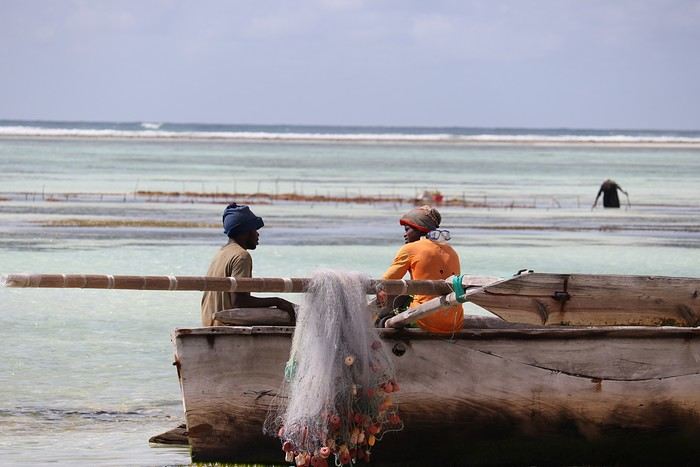
This is the spot where we can chill and chat about fishing at sea worldwide 😊
Here are two charming fishermen taking a well-deserved break near Zanzibar!
Costa Rica: The dry season isn't what it used to be!
Introduction:
For years, I’ve heard about Costa Rica, which seems like a country "made for me"—nature, not cities.
I almost went in 2019, but a family issue made me cancel.
Initially, I wanted to spend at least three weeks there, planning to go in our summer despite it being the rainy season. Then I realized what I wanted to do could fit into two weeks, so I ended up going in February.
Plus, January’s weather was so awful that some sunshine should do me good.
I found a flight at a decent price, but with two downsides.
The first is that it leaves from Paris CDG, and the second is that it’s with Air France—a airline I’d sworn off after my misadventures with them back in 2008. We’ll see how it goes!
Mamoudzou, Mayotte - December 2025
There exists a rare land where life expresses itself, a land where everything is destroyed, patched up, where everything is dirty and faded, yet paradoxically, each passing day is synonymous with light and joy. Seen from the sea, magnified by its translucent waters, the island is splendid; seen from inland, ochre and green dress a landscape one would wish to be pristine. As you approach the coast with the tides, countless boat wrecks never finish dying; returning from a hike, you know you’re nearing the city by the increasingly obvious proliferation of all kinds of trash. Overflowing the towns, makeshift homes made of corrugated iron stand here and there, wherever the eye lands; from a height, looking toward the horizon, you find the calm blue of the ocean and the beauty of infinity.
But where does all this corrugated iron come from? Blue, gray, red, or black, you find it pretty much everywhere—except, of course, on the island’s heights, where the heat is such that all life seems impossible. Yet, a few kilometers from the capital, more than an hour’s walk away, the corrugated iron is very much there, omnipresent, guaranteeing a land registry as hypothetical for us Europeans as it is very real for those who live there, far from civilization and comfort. I keep climbing. I’m precisely looking to meet these people who live on very little, if not nothing.
- Jéjé Mogné (Hello, sir in Shimahorais)! Where do you get water here, in this place? How do you drink, irrigate your plants?
- I wait for the rain. We have tanks that fill up well with each rainfall. But right now, it’s not raining much.
At the top of the next hill, lost in the bushes, it’s easier for me to guess the distant city, Mamoudzou, than the rest of the path, a remnant of a magnificent GR called the Island Tour, abandoned for the most part, sometimes maintained between two lost hamlets. The city, the pulse, water. Below, the ocean, running water, drinking water—despite regular interruptions; here, up high, an hour and a half’s walk away, tanks, arbitrariness. On other slopes, however, during another hike, I saw the water supply network, made of sturdy pipes tangled in the earth, right there by the path. It seems there are places where water climbs. Others not. Each to their own karma. In 2025. In a French department.
A path of misfortune, lost and regained, thanks to a sign, an inscription, or the compass’s directions. No one walks here anymore, except those who live here or come to harvest their crops. I remember that breathtaking hike in 2013, when I connected Bandrélé to Mamoudzou, passing by the peaks of Bénara (660m) and Bépilipili (643m), barely pausing at Tsararano and Vahibé: 34 km of intense effort on a rollercoaster path, along a trail that was still discernible. Today, it’s as if everything had disappeared. By also destroying the paths and vegetation, Chido* broke the last momentum of these cautious hikers: insecurity has made its way across the archipelago, and Sunday strolls are no longer the norm. Me, I keep going. I will have walked here and there during these three weeks to get an idea of the places, the people, the landscapes, and the superhuman effort required to move forward in over 40°C. To tell the truth, during my last hike, I cut my plans short and let myself be carried by a group of young people heading back to the city. The path is now just an inextricable network of small trails, the specter of Providence** comes to mind. True wisdom is knowing when to give up. I leave.
* A cyclone named "desire" (in Shona), which ravaged the island of Mayotte on December 14, 2024. ** June 2023, a very poorly prepared hike on Providence Island (Caribbean) from which I miraculously escaped.
On Petite-Terre, Marie takes me to visit some locals, white people who have lived there for a long time and make a living from their art; jewelry for her, all kinds of objects for him. We love this little shop, this oasis amid the chaos that embodies Dostoevsky’s phrase: "Beauty will save the world." It’s clean and tidy, beautiful, well-kept. Invariably, the question of insecurity resurfaces in the middle of the conversation. The woman says:
- I know someone who slipped in their bathtub. Still, I keep taking baths…
So, is this insecurity a myth or reality? I hear stories that are often true but sometimes seemingly exaggerated through the lens of misunderstanding and one-upmanship. Like that of this midwife assaulted one evening (it gets dark early) on her way home from work. Sometimes she was attacked on the path, dragged by the hair for several meters, sometimes she made it home, but it was her roommate who let the two men in. One version talks about a snatched phone and gratuitous violence, another about violence outright. In short, one thing is certain: walking around at night flaunting your phone isn’t a good idea, no more in Mamoudzou than in the rough neighborhoods of Nantes. Also, I played it safe: nothing flashy, nothing bling-bling, and always something to give if needed. I was never approached. It’s not easy to get a sense of the realities, between the hazy reports from journalists sensationalizing everything and the real lives of real people. But I know I can’t rely on these few ideas I’ve formed: I’m nobody, and above all, I don’t live here. What I do know, however, is that since my last visit to the island in 2017, over 80,000 babies have been born, and tens of thousands of immigrants have reached the archipelago’s shores. What’s also obvious is that poverty, hunger, and—let’s say it—indignity foster delinquency and insecurity. So, without taking journalists’ alarmist speeches at face value, we’ll try to keep in mind that a young person rendered orphaned by circumstances (parents expelled), poor and often hungry, involved more or less against their will in village wars and fueled by synthetic drugs*, will readily turn to violence when they truly have nothing to lose. We can trace the origin of this despair to the fact that in Mayotte, those without legal existence have virtually no hope of accessing anything.
* "Chimique" is a series of synthetic cannabinoids
Meanwhile, in the evening, it’s good to go home before the time of stone-throwing. From time to time, along the roads, gangs throw stones at vehicles and school buses, but mostly at police cars—almost all the white Dusters on the island! In front of the Mamoudzou police station, all parked vehicles—mostly Dusters—bear the scars of these attacks. Maybe it’s only at night that gangs unleash and all the burglaries happen? I saw nothing, heard nothing. I lived three weeks in a sort of bunker with no real access to outside light, protected by a fake wooden door doubled with a real metal door, both locked at all times. You don’t tempt fate. You endure it differently.
Today, extraordinarily, it’s raining. Yet, it’s the rainy season! But with my karma helping (what selfishness to want to walk dry when so many souls live off the rain) or is it climate change? The rain only falls once I’ve put on my horrible green pajamas. In front of the board outlining the program, I’m told that out of the six scheduled C-sections today (sic), they’ll probably only do two, maybe three. Because it’s raining. And when it rains, people don’t move around. Not for lack of will. Rather, for lack of means. And that ties into those sad days when the police patrol around the hospital: patients don’t come. They’ll come back tomorrow. To compensate, I’m happy at the thought of tackling the abscess program, but the sterilization unit is acting up and blocking the instrument trays. When it’s not the rain, it’s the unions. And when both finally quiet down, there’s always someone to find fault with the order of operations. You have to imagine an operating room where the question of urgency reigns supreme. Here, no surgery is scheduled more than 24 hours in advance—only emergencies, nothing but emergencies. So, following that reasonable adage that what’s done is no longer to be done, it’s sheer madness when the rain meets the interests of Force Ouvrière and the bad will of some combines with the laziness of others. To tell the truth, I’ve never seen so much energy expended to… do nothing. Hallucinating. But who am I, a small-time striver, an islander in my spare time, a temporary worker at the end of the world? I came, I saw, I was disappointed? Not really. Here again, I can’t judge a system in so little time. I can barely utter a few bitter words in front of obvious facts. But nothing will take away my joy of being here for three weeks. Here, they heal with somewhat outdated but still functional means. You do what you can with what you have, 8,000 km from the Métropole. Yes, the operating room doors hesitate, and the operating tables stutter, but in this blessed period, we lack neither medicines nor supplies. So we examine, anesthetize, and repair, far more undocumented people than French—if I may play with somewhat borderline statistics here; we deliver babies, dress wounds, and relieve pain in this hospital at the end of the world where neither white women nor Mahorais women would ever consider giving birth or getting treated.
What’s the solution? The obstetrician talks to the woman during a C-section under spinal anesthesia:
- Bouéni! (Madame, in Shimahorais) You need to think about tubal ligation. This is your fourth C-section. Your uterus is like tissue paper. Your next pregnancy will be very risky.
No answer. Culture. It’s all about culture. The funniest thing is that France also gets bogged down with the idea of other cultures’… cultures. The woman in question arrived illegally a few years ago to give birth to her first child. Since then, rejecting the very idea of contraception—her husband, for his part, will invoke God or Allah to refuse a vasectomy—she comes back every 12-14 months. And the obstetrician explains to me how his idea of making information about permanent contraception mandatory was deemed racist by associations. It’s always the same story. I suggest to the associations that they take charge of all these extra births, not only the medical costs but also the entire education, not just financial, of all these children doomed to live a life of misery on this forsaken archipelago. The probability that one of these offspring will emerge as a gifted, sensitive, and fiercely happy individual must truly be weighed against the degradation and abandonment that will invariably afflict the thousands of others living around him. In reality, simply mentioning a very real danger to the mother should be enough to impose sterilization. But we are a country whose greatness of soul is measured by the number of heads cut off to uphold the famous rights of man... Already a proponent at home of ending family allowances after the third child—you can’t subscribe to a certain idea of society and, at the same time, accept that tens of thousands of children are sacrificed on the altar of thoughtlessness and financial interest*—I will weakly advocate here for a controlled right to have children. Well, what will they say about me when I express the idea of imposing sterilization on women in irregular situations after the birth of their third child? National solidarity funds the noblest ideals? In Mayotte? Let’s be serious. It’s so much easier to hide behind the inalienable right of women to control their bodies than to acknowledge one’s own powerlessness to assume the consequences of such a policy. Because after 18 years of struggles as a second-class citizen, the young stateless person will have no choice but to live in hiding: faced with the impossibility of claiming birthright citizenship**, they will be deportable. In Mayotte, there aren’t enough schools, not enough housing, not enough projects for youth, not enough jobs, not enough money, not enough future… In Mayotte, an average of 5 children are born per woman. In reality, we never ask about the right of children to control their own lives.
* Single parent with 4 children: RSA at 1937 € + family allowances… ** Law of May 12, 2025 aiming to strengthen the conditions for accessing French nationality in Mayotte.
I live in the city in a clean apartment where air conditioning eases my aches and sweat, and where water flows abundantly, thanks to huge tanks that fill up between water cuts. On the hills of Koungou, I was struck by this image: there, women (a matriarchal society?) do the dishes in a miserable stream. Upstream of the same stream, the same image as downstream: disgusting water with bits of foam floating on it. A little further, however, there are taps with running water that children play with. Strange. In any case, water is a question. They tell me it’s drinkable; I doubt it. A system that’s regularly cut doesn’t seem reliable to me. In any case, I can’t help but think of the Canary Islands and their chronic water shortage, especially in Lanzarote. Without entering the debate on desalination plants—I’m quite ignorant about environmental repercussions—I’ll just say that in the Canary Islands, you can buy 8 L jugs of purified water for less than 2 €. Here, in Mayotte, the price of water—as is the price of gasoline—is the same everywhere: 0.65 € for a bottle of Cristaline (1 €/L)*. While I was walking up there with a couple of farmers shuttling between two remote spots, I know I hit the mark by offering them one of my two bottles I’d brought for the occasion.
* At home, we find Cristaline at 1.14 € for a 9 L pack, i.e., 0.13 € per liter.
Outside, everything is broken, abandoned, old, worn, torn, faded, heavy, dirty, forsaken. But life goes on. And that’s fascinating. At home, at 5:45 PM, people close their shutters and watch cable TV, sometimes late into the night, emptying the streets of any salutary clamor, unwittingly extinguishing the necessary pulse of life. At home, we die of boredom. In Mamoudzou, between two dying trash cans, metal frames laid on the ground are covered by the elements of a broken garden set. A bare concrete staircase, without railings, provides access to the upper floor of a dwelling. On the steps, you can read: Private space - Please take your trash with you. Metal rods protrude from the said dwelling. On the ground, it’s a festival of screws and nails… A cat passes by. It doesn’t look great. A madwoman crosses the street dancing. A slightly hurried driver brakes. A six- or seven-year-old boy comes out in his underwear from his low house made of corrugated iron. He smiles. He’s having fun doing acrobatic figures over an old mattress on the sidewalk. Forward roll, backward roll. You wonder if he eats enough. Different culture. Different customs.
I will remember for a long time this blinding morning light, a raw, vital, striking light. I almost forgot where I came from, the grayness and boredom of that continental European country where nothing really happens anymore. Here, I could join Camus, contemplating these people placed halfway between misery and the sun, resigned for the most part and, for the other part, not too unhappy with their lot. But the Mahorais discourse is unanimous: "France really screwed us over!" Today, more than half of the island’s inhabitants are undocumented; a tremendous amount of energy is spent expelling 20,000 to 25,000 of them each year; colossal sums are swallowed up to care for all these people, and the island is drifting. I talk with some gendarmes. One of them tells me:
- They intercept one kwassa* out of three… Can you explain to me why they can’t catch everyone? It’s 2025! Can’t they put the necessary boats in place?
Clearly, and this is also my opinion, this whole mess serves interests beyond us. For who can believe for a second that this glaring incompetence isn’t orchestrated? Shared interests between secret France and the Union of the Comoros? A desire to bring insecurity to its peak, either by the Comoros to eventually take back control of Mayotte, or by our own government, in a deliberate effort to see all the white people leave the archipelago and let the Mahorais fend for themselves? At one point, I’m even told about an extraordinary deposit beneath Mayotte’s soil, a promise of infinite wealth**. Not to infringe on human rights, to do some cleaning from time to time, to calm things down to avoid implosion, while waiting to go after this providential bounty? Decidedly, Mayotte hasn’t said its last word!
*What’s paradoxical is that in the early 2010s, to revive traditional fishing activity, the UN financed in Anjouan the construction of a factory to produce these light boats, 7-10m long and 1m wide, which largely served the interests of smugglers. This skiff owes its name to a Congolese dance known for being as rhythmic as it is jerky, much like the navigation experience offered during a crossing to Mayotte. ** A 2025 study revealed the existence of a gigantic magmatic reservoir located 23km beneath the archipelago. If the Icelandic experiment succeeds (Project KMT, see here), Mayotte will then possess almost unlimited energy.
Hell on earth. Paradise at sea. The world’s largest lagoon offering spectacular marine depths, Mayotte’s coral reef suffers less from the abundance of tourists* than from tropical storms**. So, let’s admit that Mayotte is best appreciated when approached from the lagoon. The heights are for old hands like me. The sea spray is rather for the snobs who shun the sun god Ra, risking too much exposure and ending up on sick leave for sunstroke! But I’m not exclusive: I twice don my snob attire and head out to tackle the waves, the seabeds, and the elusive. Because yes, underwater, we leave our landlubber reflexes behind, and flying over corals and other magnificent drop-offs, it’s as if we’re soaring, keeping in memory only what our eyes can store. Multicolored, even phosphorescent fish, sharks, rays, the immensity of the blue, and then, there, dolphins, just a few meters from me, underwater. Incredible.
* 70,000 tourists annually, mostly affinity tourism (links with family or an expatriate). ** Present almost at the water’s surface, the reefs were largely destroyed by Chido.
Paradise at sea? When you think that Mayotte comes from the Arabic Jazirat al Mawet—literally, Island of Death—because of its double coral barrier where many skiffs have run aground and continue to do so… Paradise. Eldorado. The Comoros now face an unprecedented influx of immigrants from the African Great Lakes. And Mayotte, for its part, continues to attract relentlessly, thanks to the evolution of the law*. In reality, whether hidden interests exist or not, France remains bound hand and foot by international, European, and French rules: it can’t do much. Barely has it boarded a kwassa when the one who flees by swimming cries attempted murder; barely has one been sent back to the Comoros when an association will look into their detention conditions and find a loophole; barely has one told a bouéni how her next pregnancy could be fatal when so-called human voices cry scandal.
* Regarding the Métropole, the rights of squatters and other bad payers against the notion of private property, legally violated in favor of the right to housing… ** You can read about France being condemned for its illegal practices of expelling Comorian minors. Inhumane treatment, arbitrary detention, collective expulsion.
Everyone forms their own idea of justice, and no one can claim a monopoly on good thinking. So, as long as I treat without prejudice, as long as my hands are sincerely guided by the love I bear for our humanity, I’ll allow myself to think what I think, understanding that I’m rather open to dialogue and that my opinions evolve with time and events. Today, Mayotte represents for me the failure of a model, a European one in this case, where opulence quickly meets its limits. For it’s not wrong to think that our society can’t share more than it produces, nor is it wrong to think that every human being has a right to their share of the pie; in Mayotte, you’ll find the proven result of our civilization: it doesn’t work. Exclusively financed by the right, the ideas of the left jam in Mayotte more than anywhere else: national solidarity coupled with a sense of guilt creates chaos. Political courage, or true social justice, would be to offer a future to those who have no choice—the one who’s already here, the child to be born—not to offer a present to those who can choose or to whom one can give keys to understanding—the woman of childbearing age, the candidate for exile. Ultimately, the Comoros’ coup d’état over France comes at the cost of many innocent victims, starting with the children*.
* Tens of thousands of deaths by drowning between Anjouan and Mayotte, tens of thousands of children left to fend for themselves and doomed to a non-existent future.
On the evening of the 31st, I go for my usual run and notice near a roundabout a fool in rags pedaling the wrong way. A police car passes by: the guy gets stopped. A rather quick identity check. The guy is taken away. Would he still be among us if he had ridden the right way? In the evening, the line is long in front of the club near the dock. Me, I’m just passing by, greeting my friends of the season, much more inclined to savor rest than to exhaust myself on an overheated dance floor. There, a man, thirty or forty years old, clearly in a world of his own, is searching the trash for something to eat. He’s barefoot. I console myself by thinking that at least he won’t die of cold. Out of ten children born in Mayotte, I can reasonably think that only one will be able to afford an existence that minimally meets any of our criteria.
It’s time to go home. After sweating and thinking so much about this gem of the Mozambique Channel, I spend peaceful hours by the pool at a hotel next to the airport. We checked out at 8 AM, and the flight is at 7 PM. The perfect opportunity to slack off and chat a bit more. I’m happy to get to know one of the co-pilots of tonight’s flight, staying at this hotel, while one of my flight attendant friends from this airline had already recommended me to the crew. But it’s not the captain’s day, who’s in a rather gloomy mood. I’ll travel in the back, up to the vertical of Cairo. Midnight has just struck; it’s January 2nd, my name day. Concerned about solving an unsolvable problem with a passenger, the crew asks me to give up my exit row seat and takes me to the front for the last four hours of the flight. In the end, the captain gave in? I laugh to myself: if there’s one thing I mustn’t forget, it’s that God never abandons me!
But where does all this corrugated iron come from? Blue, gray, red, or black, you find it pretty much everywhere—except, of course, on the island’s heights, where the heat is such that all life seems impossible. Yet, a few kilometers from the capital, more than an hour’s walk away, the corrugated iron is very much there, omnipresent, guaranteeing a land registry as hypothetical for us Europeans as it is very real for those who live there, far from civilization and comfort. I keep climbing. I’m precisely looking to meet these people who live on very little, if not nothing.
- Jéjé Mogné (Hello, sir in Shimahorais)! Where do you get water here, in this place? How do you drink, irrigate your plants?
- I wait for the rain. We have tanks that fill up well with each rainfall. But right now, it’s not raining much.
At the top of the next hill, lost in the bushes, it’s easier for me to guess the distant city, Mamoudzou, than the rest of the path, a remnant of a magnificent GR called the Island Tour, abandoned for the most part, sometimes maintained between two lost hamlets. The city, the pulse, water. Below, the ocean, running water, drinking water—despite regular interruptions; here, up high, an hour and a half’s walk away, tanks, arbitrariness. On other slopes, however, during another hike, I saw the water supply network, made of sturdy pipes tangled in the earth, right there by the path. It seems there are places where water climbs. Others not. Each to their own karma. In 2025. In a French department.
A path of misfortune, lost and regained, thanks to a sign, an inscription, or the compass’s directions. No one walks here anymore, except those who live here or come to harvest their crops. I remember that breathtaking hike in 2013, when I connected Bandrélé to Mamoudzou, passing by the peaks of Bénara (660m) and Bépilipili (643m), barely pausing at Tsararano and Vahibé: 34 km of intense effort on a rollercoaster path, along a trail that was still discernible. Today, it’s as if everything had disappeared. By also destroying the paths and vegetation, Chido* broke the last momentum of these cautious hikers: insecurity has made its way across the archipelago, and Sunday strolls are no longer the norm. Me, I keep going. I will have walked here and there during these three weeks to get an idea of the places, the people, the landscapes, and the superhuman effort required to move forward in over 40°C. To tell the truth, during my last hike, I cut my plans short and let myself be carried by a group of young people heading back to the city. The path is now just an inextricable network of small trails, the specter of Providence** comes to mind. True wisdom is knowing when to give up. I leave.
* A cyclone named "desire" (in Shona), which ravaged the island of Mayotte on December 14, 2024. ** June 2023, a very poorly prepared hike on Providence Island (Caribbean) from which I miraculously escaped.
On Petite-Terre, Marie takes me to visit some locals, white people who have lived there for a long time and make a living from their art; jewelry for her, all kinds of objects for him. We love this little shop, this oasis amid the chaos that embodies Dostoevsky’s phrase: "Beauty will save the world." It’s clean and tidy, beautiful, well-kept. Invariably, the question of insecurity resurfaces in the middle of the conversation. The woman says:
- I know someone who slipped in their bathtub. Still, I keep taking baths…
So, is this insecurity a myth or reality? I hear stories that are often true but sometimes seemingly exaggerated through the lens of misunderstanding and one-upmanship. Like that of this midwife assaulted one evening (it gets dark early) on her way home from work. Sometimes she was attacked on the path, dragged by the hair for several meters, sometimes she made it home, but it was her roommate who let the two men in. One version talks about a snatched phone and gratuitous violence, another about violence outright. In short, one thing is certain: walking around at night flaunting your phone isn’t a good idea, no more in Mamoudzou than in the rough neighborhoods of Nantes. Also, I played it safe: nothing flashy, nothing bling-bling, and always something to give if needed. I was never approached. It’s not easy to get a sense of the realities, between the hazy reports from journalists sensationalizing everything and the real lives of real people. But I know I can’t rely on these few ideas I’ve formed: I’m nobody, and above all, I don’t live here. What I do know, however, is that since my last visit to the island in 2017, over 80,000 babies have been born, and tens of thousands of immigrants have reached the archipelago’s shores. What’s also obvious is that poverty, hunger, and—let’s say it—indignity foster delinquency and insecurity. So, without taking journalists’ alarmist speeches at face value, we’ll try to keep in mind that a young person rendered orphaned by circumstances (parents expelled), poor and often hungry, involved more or less against their will in village wars and fueled by synthetic drugs*, will readily turn to violence when they truly have nothing to lose. We can trace the origin of this despair to the fact that in Mayotte, those without legal existence have virtually no hope of accessing anything.
* "Chimique" is a series of synthetic cannabinoids
Meanwhile, in the evening, it’s good to go home before the time of stone-throwing. From time to time, along the roads, gangs throw stones at vehicles and school buses, but mostly at police cars—almost all the white Dusters on the island! In front of the Mamoudzou police station, all parked vehicles—mostly Dusters—bear the scars of these attacks. Maybe it’s only at night that gangs unleash and all the burglaries happen? I saw nothing, heard nothing. I lived three weeks in a sort of bunker with no real access to outside light, protected by a fake wooden door doubled with a real metal door, both locked at all times. You don’t tempt fate. You endure it differently.
Today, extraordinarily, it’s raining. Yet, it’s the rainy season! But with my karma helping (what selfishness to want to walk dry when so many souls live off the rain) or is it climate change? The rain only falls once I’ve put on my horrible green pajamas. In front of the board outlining the program, I’m told that out of the six scheduled C-sections today (sic), they’ll probably only do two, maybe three. Because it’s raining. And when it rains, people don’t move around. Not for lack of will. Rather, for lack of means. And that ties into those sad days when the police patrol around the hospital: patients don’t come. They’ll come back tomorrow. To compensate, I’m happy at the thought of tackling the abscess program, but the sterilization unit is acting up and blocking the instrument trays. When it’s not the rain, it’s the unions. And when both finally quiet down, there’s always someone to find fault with the order of operations. You have to imagine an operating room where the question of urgency reigns supreme. Here, no surgery is scheduled more than 24 hours in advance—only emergencies, nothing but emergencies. So, following that reasonable adage that what’s done is no longer to be done, it’s sheer madness when the rain meets the interests of Force Ouvrière and the bad will of some combines with the laziness of others. To tell the truth, I’ve never seen so much energy expended to… do nothing. Hallucinating. But who am I, a small-time striver, an islander in my spare time, a temporary worker at the end of the world? I came, I saw, I was disappointed? Not really. Here again, I can’t judge a system in so little time. I can barely utter a few bitter words in front of obvious facts. But nothing will take away my joy of being here for three weeks. Here, they heal with somewhat outdated but still functional means. You do what you can with what you have, 8,000 km from the Métropole. Yes, the operating room doors hesitate, and the operating tables stutter, but in this blessed period, we lack neither medicines nor supplies. So we examine, anesthetize, and repair, far more undocumented people than French—if I may play with somewhat borderline statistics here; we deliver babies, dress wounds, and relieve pain in this hospital at the end of the world where neither white women nor Mahorais women would ever consider giving birth or getting treated.
What’s the solution? The obstetrician talks to the woman during a C-section under spinal anesthesia:
- Bouéni! (Madame, in Shimahorais) You need to think about tubal ligation. This is your fourth C-section. Your uterus is like tissue paper. Your next pregnancy will be very risky.
No answer. Culture. It’s all about culture. The funniest thing is that France also gets bogged down with the idea of other cultures’… cultures. The woman in question arrived illegally a few years ago to give birth to her first child. Since then, rejecting the very idea of contraception—her husband, for his part, will invoke God or Allah to refuse a vasectomy—she comes back every 12-14 months. And the obstetrician explains to me how his idea of making information about permanent contraception mandatory was deemed racist by associations. It’s always the same story. I suggest to the associations that they take charge of all these extra births, not only the medical costs but also the entire education, not just financial, of all these children doomed to live a life of misery on this forsaken archipelago. The probability that one of these offspring will emerge as a gifted, sensitive, and fiercely happy individual must truly be weighed against the degradation and abandonment that will invariably afflict the thousands of others living around him. In reality, simply mentioning a very real danger to the mother should be enough to impose sterilization. But we are a country whose greatness of soul is measured by the number of heads cut off to uphold the famous rights of man... Already a proponent at home of ending family allowances after the third child—you can’t subscribe to a certain idea of society and, at the same time, accept that tens of thousands of children are sacrificed on the altar of thoughtlessness and financial interest*—I will weakly advocate here for a controlled right to have children. Well, what will they say about me when I express the idea of imposing sterilization on women in irregular situations after the birth of their third child? National solidarity funds the noblest ideals? In Mayotte? Let’s be serious. It’s so much easier to hide behind the inalienable right of women to control their bodies than to acknowledge one’s own powerlessness to assume the consequences of such a policy. Because after 18 years of struggles as a second-class citizen, the young stateless person will have no choice but to live in hiding: faced with the impossibility of claiming birthright citizenship**, they will be deportable. In Mayotte, there aren’t enough schools, not enough housing, not enough projects for youth, not enough jobs, not enough money, not enough future… In Mayotte, an average of 5 children are born per woman. In reality, we never ask about the right of children to control their own lives.
* Single parent with 4 children: RSA at 1937 € + family allowances… ** Law of May 12, 2025 aiming to strengthen the conditions for accessing French nationality in Mayotte.
I live in the city in a clean apartment where air conditioning eases my aches and sweat, and where water flows abundantly, thanks to huge tanks that fill up between water cuts. On the hills of Koungou, I was struck by this image: there, women (a matriarchal society?) do the dishes in a miserable stream. Upstream of the same stream, the same image as downstream: disgusting water with bits of foam floating on it. A little further, however, there are taps with running water that children play with. Strange. In any case, water is a question. They tell me it’s drinkable; I doubt it. A system that’s regularly cut doesn’t seem reliable to me. In any case, I can’t help but think of the Canary Islands and their chronic water shortage, especially in Lanzarote. Without entering the debate on desalination plants—I’m quite ignorant about environmental repercussions—I’ll just say that in the Canary Islands, you can buy 8 L jugs of purified water for less than 2 €. Here, in Mayotte, the price of water—as is the price of gasoline—is the same everywhere: 0.65 € for a bottle of Cristaline (1 €/L)*. While I was walking up there with a couple of farmers shuttling between two remote spots, I know I hit the mark by offering them one of my two bottles I’d brought for the occasion.
* At home, we find Cristaline at 1.14 € for a 9 L pack, i.e., 0.13 € per liter.
Outside, everything is broken, abandoned, old, worn, torn, faded, heavy, dirty, forsaken. But life goes on. And that’s fascinating. At home, at 5:45 PM, people close their shutters and watch cable TV, sometimes late into the night, emptying the streets of any salutary clamor, unwittingly extinguishing the necessary pulse of life. At home, we die of boredom. In Mamoudzou, between two dying trash cans, metal frames laid on the ground are covered by the elements of a broken garden set. A bare concrete staircase, without railings, provides access to the upper floor of a dwelling. On the steps, you can read: Private space - Please take your trash with you. Metal rods protrude from the said dwelling. On the ground, it’s a festival of screws and nails… A cat passes by. It doesn’t look great. A madwoman crosses the street dancing. A slightly hurried driver brakes. A six- or seven-year-old boy comes out in his underwear from his low house made of corrugated iron. He smiles. He’s having fun doing acrobatic figures over an old mattress on the sidewalk. Forward roll, backward roll. You wonder if he eats enough. Different culture. Different customs.
I will remember for a long time this blinding morning light, a raw, vital, striking light. I almost forgot where I came from, the grayness and boredom of that continental European country where nothing really happens anymore. Here, I could join Camus, contemplating these people placed halfway between misery and the sun, resigned for the most part and, for the other part, not too unhappy with their lot. But the Mahorais discourse is unanimous: "France really screwed us over!" Today, more than half of the island’s inhabitants are undocumented; a tremendous amount of energy is spent expelling 20,000 to 25,000 of them each year; colossal sums are swallowed up to care for all these people, and the island is drifting. I talk with some gendarmes. One of them tells me:
- They intercept one kwassa* out of three… Can you explain to me why they can’t catch everyone? It’s 2025! Can’t they put the necessary boats in place?
Clearly, and this is also my opinion, this whole mess serves interests beyond us. For who can believe for a second that this glaring incompetence isn’t orchestrated? Shared interests between secret France and the Union of the Comoros? A desire to bring insecurity to its peak, either by the Comoros to eventually take back control of Mayotte, or by our own government, in a deliberate effort to see all the white people leave the archipelago and let the Mahorais fend for themselves? At one point, I’m even told about an extraordinary deposit beneath Mayotte’s soil, a promise of infinite wealth**. Not to infringe on human rights, to do some cleaning from time to time, to calm things down to avoid implosion, while waiting to go after this providential bounty? Decidedly, Mayotte hasn’t said its last word!
*What’s paradoxical is that in the early 2010s, to revive traditional fishing activity, the UN financed in Anjouan the construction of a factory to produce these light boats, 7-10m long and 1m wide, which largely served the interests of smugglers. This skiff owes its name to a Congolese dance known for being as rhythmic as it is jerky, much like the navigation experience offered during a crossing to Mayotte. ** A 2025 study revealed the existence of a gigantic magmatic reservoir located 23km beneath the archipelago. If the Icelandic experiment succeeds (Project KMT, see here), Mayotte will then possess almost unlimited energy.
Hell on earth. Paradise at sea. The world’s largest lagoon offering spectacular marine depths, Mayotte’s coral reef suffers less from the abundance of tourists* than from tropical storms**. So, let’s admit that Mayotte is best appreciated when approached from the lagoon. The heights are for old hands like me. The sea spray is rather for the snobs who shun the sun god Ra, risking too much exposure and ending up on sick leave for sunstroke! But I’m not exclusive: I twice don my snob attire and head out to tackle the waves, the seabeds, and the elusive. Because yes, underwater, we leave our landlubber reflexes behind, and flying over corals and other magnificent drop-offs, it’s as if we’re soaring, keeping in memory only what our eyes can store. Multicolored, even phosphorescent fish, sharks, rays, the immensity of the blue, and then, there, dolphins, just a few meters from me, underwater. Incredible.
* 70,000 tourists annually, mostly affinity tourism (links with family or an expatriate). ** Present almost at the water’s surface, the reefs were largely destroyed by Chido.
Paradise at sea? When you think that Mayotte comes from the Arabic Jazirat al Mawet—literally, Island of Death—because of its double coral barrier where many skiffs have run aground and continue to do so… Paradise. Eldorado. The Comoros now face an unprecedented influx of immigrants from the African Great Lakes. And Mayotte, for its part, continues to attract relentlessly, thanks to the evolution of the law*. In reality, whether hidden interests exist or not, France remains bound hand and foot by international, European, and French rules: it can’t do much. Barely has it boarded a kwassa when the one who flees by swimming cries attempted murder; barely has one been sent back to the Comoros when an association will look into their detention conditions and find a loophole; barely has one told a bouéni how her next pregnancy could be fatal when so-called human voices cry scandal.
* Regarding the Métropole, the rights of squatters and other bad payers against the notion of private property, legally violated in favor of the right to housing… ** You can read about France being condemned for its illegal practices of expelling Comorian minors. Inhumane treatment, arbitrary detention, collective expulsion.
Everyone forms their own idea of justice, and no one can claim a monopoly on good thinking. So, as long as I treat without prejudice, as long as my hands are sincerely guided by the love I bear for our humanity, I’ll allow myself to think what I think, understanding that I’m rather open to dialogue and that my opinions evolve with time and events. Today, Mayotte represents for me the failure of a model, a European one in this case, where opulence quickly meets its limits. For it’s not wrong to think that our society can’t share more than it produces, nor is it wrong to think that every human being has a right to their share of the pie; in Mayotte, you’ll find the proven result of our civilization: it doesn’t work. Exclusively financed by the right, the ideas of the left jam in Mayotte more than anywhere else: national solidarity coupled with a sense of guilt creates chaos. Political courage, or true social justice, would be to offer a future to those who have no choice—the one who’s already here, the child to be born—not to offer a present to those who can choose or to whom one can give keys to understanding—the woman of childbearing age, the candidate for exile. Ultimately, the Comoros’ coup d’état over France comes at the cost of many innocent victims, starting with the children*.
* Tens of thousands of deaths by drowning between Anjouan and Mayotte, tens of thousands of children left to fend for themselves and doomed to a non-existent future.
On the evening of the 31st, I go for my usual run and notice near a roundabout a fool in rags pedaling the wrong way. A police car passes by: the guy gets stopped. A rather quick identity check. The guy is taken away. Would he still be among us if he had ridden the right way? In the evening, the line is long in front of the club near the dock. Me, I’m just passing by, greeting my friends of the season, much more inclined to savor rest than to exhaust myself on an overheated dance floor. There, a man, thirty or forty years old, clearly in a world of his own, is searching the trash for something to eat. He’s barefoot. I console myself by thinking that at least he won’t die of cold. Out of ten children born in Mayotte, I can reasonably think that only one will be able to afford an existence that minimally meets any of our criteria.
It’s time to go home. After sweating and thinking so much about this gem of the Mozambique Channel, I spend peaceful hours by the pool at a hotel next to the airport. We checked out at 8 AM, and the flight is at 7 PM. The perfect opportunity to slack off and chat a bit more. I’m happy to get to know one of the co-pilots of tonight’s flight, staying at this hotel, while one of my flight attendant friends from this airline had already recommended me to the crew. But it’s not the captain’s day, who’s in a rather gloomy mood. I’ll travel in the back, up to the vertical of Cairo. Midnight has just struck; it’s January 2nd, my name day. Concerned about solving an unsolvable problem with a passenger, the crew asks me to give up my exit row seat and takes me to the front for the last four hours of the flight. In the end, the captain gave in? I laugh to myself: if there’s one thing I mustn’t forget, it’s that God never abandons me!
Lisbon/Galveston Transatlantic Review – NCL Viva in The Haven
Hi everyone,
Okay, here I go—I haven’t done a cruise review in ages, and even longer since I’ve posted one on this forum. So, this is kinda your fault, Catherine, if I’m getting back into it... I just hope I haven’t lost my touch!
It’s a transatlantic cruise, so there are a lot of sea days. That means this review will mostly focus on the ship, especially the "Haven" section, which doesn’t get much coverage on this forum. There’ll definitely be some comparisons with MSC’s Yacht Club, since they’re direct competitors.
This will be my third cruise with NCL—a company I really love—but my first in The Haven.
My two previous cruises were on smaller ships: the NCL Sun for the Chilean fjords and the NCL Spirit in February 2025 in Asia, departing from Taiwan and arriving in Korea. I *loved* the Spirit.
Alright, let’s get started!
This trip was booked almost last-minute in early October for late November, after I had to cut short my August trip for medical reasons.
At first, when I looked at this cruise, I hadn’t specifically decided to go for The Haven. I wanted a relaxing cruise but still with destinations I hadn’t been to before. I kinda stumbled upon this one, and the itinerary appealed to me. I also found the balcony cabin price pretty good—around 2800 € for a balcony cabin (for two), all-inclusive package included. Not including flights, of course. In the end, we decided to try The Haven (obviously not the same price), but I think we got a great deal for the promised perks.
Itinerary: Departure from Lisbon, arrival in Galveston, Texas. Stops: St. Martin, St. Thomas, La Romana, Cabo Rojo, Falmouth in Jamaica.
It’s a transatlantic cruise, so there are a lot of sea days. That means this review will mostly focus on the ship, especially the "Haven" section, which doesn’t get much coverage on this forum. There’ll definitely be some comparisons with MSC’s Yacht Club, since they’re direct competitors.
This will be my third cruise with NCL—a company I really love—but my first in The Haven.
My two previous cruises were on smaller ships: the NCL Sun for the Chilean fjords and the NCL Spirit in February 2025 in Asia, departing from Taiwan and arriving in Korea. I *loved* the Spirit.
Alright, let’s get started!
This trip was booked almost last-minute in early October for late November, after I had to cut short my August trip for medical reasons.
At first, when I looked at this cruise, I hadn’t specifically decided to go for The Haven. I wanted a relaxing cruise but still with destinations I hadn’t been to before. I kinda stumbled upon this one, and the itinerary appealed to me. I also found the balcony cabin price pretty good—around 2800 € for a balcony cabin (for two), all-inclusive package included. Not including flights, of course. In the end, we decided to try The Haven (obviously not the same price), but I think we got a great deal for the promised perks.
Itinerary: Departure from Lisbon, arrival in Galveston, Texas. Stops: St. Martin, St. Thomas, La Romana, Cabo Rojo, Falmouth in Jamaica.
Review of an Aegean Sea cruise on Ponant's Bougainville from November 1-8, 2025
Hello everyone,
If you'd like, I invite you to join me for a week-long cruise to northern Greece, visiting ports that are often less crowded with cruise ships.
Itinerary: Athens, Skiathos, Volos, Thessaloniki, Kavala, Limnos, Hydra, Athens
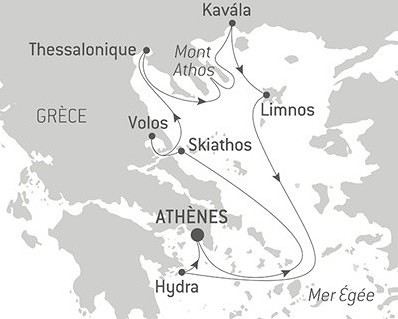
If you'd like, I invite you to join me for a week-long cruise to northern Greece, visiting ports that are often less crowded with cruise ships.
Itinerary: Athens, Skiathos, Volos, Thessaloniki, Kavala, Limnos, Hydra, Athens
Trip Report: Silk Road Journey in China
Hi everyone,
This trip report covers a journey along the Silk Road in China (see detailed description below) undertaken in October 2025. The goal isn’t to recount the trip but to provide information that might help those who want to take a similar journey. Much of the information is valid for any trip to China.
Who we are: a retired couple, aged 63 and 65 (age gives discounts on entry to various sites and museums in China, which is why I won’t list prices here—I don’t know them, but you can easily find them online). We’re used to traveling independently. We speak English, which is the only foreign language spoken in China, though by very few people. I speak and read a little Chinese, which helped, but you can easily get by without it (without any English at all, I think it would be more difficult).
Period: We arrived just after "Golden Week," when all of China is on vacation, and after the summer, when schools are out, so we encountered very few tourists (99.99% of whom were Chinese). Our experience with booking visits in advance (which we didn’t need to do) isn’t representative for those who want to travel in the summer! The October-November period was perfect for our trip—it wasn’t too hot or too cold (one day of snow on the Tibetan Plateau), though it was only a few degrees on the Tibetan part, with altitudes between 2,000 and 3,000 meters. The trees were beautifully colored.
General remarks: Everyone we dealt with was very kind and perfectly honest. If you order a meal without really understanding what to do and the person modifies your order, trust them—the result is what you need. If a taxi driver signals that they’ll wait for you to finish your visit and pick you up afterward, trust them. It means there aren’t many taxis where you are, and it’ll be more convenient. For prices at street vendors, we always found the right ballpark, and sometimes they even added a little extra to please us. A taxi driver treated us to lunch, and an employee drove us back to the hotel after a visit because there were no taxis. If you struggle to buy a ticket online because there’s no counter, someone will come to help. People even spontaneously ask if everything’s okay and if you need anything.
Everywhere we went was very clean, including restrooms (trains, stations, hotels, museums, tourist sites) and streets. The old stereotypes about this no longer apply.
The trip can be challenging for those who have difficulty walking. The distances to cover on foot in stations, to access sites, and within the sites themselves can sometimes be really long.
We used the Lonely Planet guide in English (published at the end of August 2025) a little for preparation, but mostly relied on the internet.
Before leaving: No visa is needed for French citizens for stays under 30 days. You get a stamp on your passport upon arrival and departure, and the formalities themselves are very quick in both directions (excluding any potential queues). Just a photo and fingerprints upon arrival, and welcome to China’s facial recognition system.
Money: All your payments (see below) will go through your Visa card—there will be hundreds, including many payments of 20 cents to a few euros. So, you need an international option that allows unlimited card transactions. Since cash is rarely needed, the allowed number of ATM withdrawals can be low. We made 3 withdrawals totaling 800 € for a month and could have managed with just 2. The exchange rate charged on our Visa card was 12 € for 100 RMB (yuan).
Install the following apps on your smartphone before leaving (otherwise, you’ll only have access to the Chinese versions, if available): - Alipay, which is used to pay everywhere in China (details below). You need to link it to your credit card, then provide proof of identity by uploading a passport photo and completing a facial recognition session. Alipay gives access to Didi (China’s Uber), public transport (metro/bus), and can also translate phrases. - WeChat (Weixin in Chinese, pronounced *weishin*), which is also used for payments but also replaces WhatsApp. Unfortunately, to activate your account, you need someone who already has WeChat to sponsor you (preferably a Chinese person). We asked someone at our first accommodations to do this—no problem. By sharing your WeChat number with accommodations, they can send you messages that are automatically translated, and you can communicate with people thanks to the translation (translation to French is very poor; it’s much better in English, but unfortunately, WeChat detects your phone’s language). Alipay and WeChat are accepted almost everywhere, but some places only accept WeChat. - Amap, the international version of Baidu Maps, which replaces Google Maps (not at all up-to-date in China). The English names of hotels often have little to do with the Chinese names except for a phonetic resemblance. To find them on Amap, it’s best to copy the Chinese name found on your Trip reservation under "show address in Chinese." - A VPN. We had CyberGhost, which didn’t work, but according to other travelers, NordVPN and Windscribe do. Without a VPN, you can’t access Google services, on WhatsApp you can send and receive text but not photos, and you can’t send or receive emails on Gmail addresses. We managed without a VPN by using Firefox as a browser and Bing as a search engine. - Trip, for booking trains and accommodations, and buying some tickets. It’s the equivalent of Booking for accommodations, but Booking has very few listings in China, while Trip has hundreds in every city. Most hotels and trains are exchangeable and refundable until the day before, with no or minimal fees.
You don’t need contactless (NFC) payment on your phone. Either you scan a barcode and enter the amount to pay, or you display a barcode, and they scan it with a scanner, and the amount is deducted directly.
Upon arrival: - Buy a Chinese SIM card: 100 RMB for 300 GB of data and several hours of talk time (we didn’t use it). Set the Chinese number as a reference on Alipay, WeChat, and Amap. - Find someone to sponsor you on WeChat.
Transportation: - **Plane**: China Eastern, Paris-Canton then Canton-Urumqi on the way out, and Xian-Canton then Canton-Paris on the way back. International flights were smooth, but the schedules for the two domestic flights were changed. It was fine on the way out because we had some leeway, but on the way back, we were notified the morning of that our flight was canceled and replaced with one that didn’t allow for the connection. We called and changed to an earlier flight (I think we were lucky to find available seats). - **Train**: Most long distances were covered by high-speed trains (called D or G in China) at 240 or 300 km/h. Second class is perfect—just as comfortable and clean as our TGVs. The only advantage of first class is the wider seats for larger people, but the downside is that seats are often booked in advance and thus less available. You can book trains long in advance on Trip, but they only go on sale in China 15 days before departure, so that’s when you’ll know if you have a ticket. Initially, we booked first class, but there were no seats available on the day, so we ended up booking everything in second class, which was perfect. There’s no paper ticket—if you’ve bought one, you go to the station, show your passport, and enter. You do the same to access the platform 15 minutes before the train, and that’s it. Our train was canceled twice, but no problem—we went to the ticket counter, got a refund, and were offered a replacement. It didn’t delay us by more than an hour (maybe it would be harder in peak season). For prices, check Trip.com, but it’s significantly cheaper than in France. - **Bus**: We took the bus between Xining and Tongren, Tongren to Xiahe, and Hezuo to Lanzhou—about 3 hours each time for 200 km, 6 € per person, and departures were right on time. - **Taxi**: For trips between the station and hotel, or hotel and visits. If you take a Didi via the Alipay app, you activate your location, enter your destination, and it offers several taxis. You accept, and you get the car’s license plate and its real-time position on the map. When you get in, the driver often asks for the last four digits of your phone number to confirm. Otherwise, you go to the taxi stand outside the station. The price per kilometer is around 20 cents, so for a 30 km trip from the station to the hotel, you’ll pay about 6 €. We never tried to save more by taking local buses, but since the metro in Xian costs 25 cents per trip, it’s probably in the same ballpark. Amap provides public transport routes like Google Maps. - **Driver**: We hired a taxi/driver for the day several times for sightseeing. Prices ranged from 350 to 1,000 RMB (the most expensive was arranged through the Sofitel Xining concierge) for trips ranging from a few hours to a full day, sometimes covering over 300 km (see the detailed trip description).
Accommodations: All booked in advance on Trip, but several were changed during the trip. Off-season, there were no issues. We mostly stayed in upscale places, but in China, that means 50 to 60 € per night in the most central or convenient neighborhood. Note: Almost all hotels have a 5/5 rating on Trip, but it seems the Chinese avoid giving lower ratings to be polite. So, you have to read the comments to realize that in France, we might have given a 2 or 3!
Food: At the table, you’re served hot water or a hot infusion, presumably made with purified water. We never got sick from drinking it, but don’t drink tap water. Purified or mineral water is easy to find.
In restaurants, you can manage by pointing to the dish you want from another diner, on the wall where there are photos, or on the menu with pictures. The food in the region isn’t often spicy, and people usually ask or signal before adding the red spicy sauce, so you should be able to handle it if you don’t like chili at all.
The "fake old quarters" in several cities are great places to find all kinds of restaurants (see detailed trip below).
Like Google Maps, Amap can show you nearby restaurants.
Shopping: For dried fruits, buy them in Turfan—you won’t find the same variety and quality even in Xian. Generally, if you like something, buy it. If you wait, you might not find it outside the region where you are.
In Xian, there’s a "Tea City" where you can find all kinds of tea (from cheap to very expensive).
The trip in more detail: I won’t dwell on the beauty or interest of the sites here since that’s a matter of personal taste. However, I will do so for lesser-known places to give an idea to those who might be interested.
For many sites, there are shuttles (sometimes not included in the ticket price but costing around 1 €) that take you to the interesting spots. We always took them—it saves you from walking past countless shops or along uninteresting paths.
- **Urumqi**: We spent only one night there, arriving in the middle of the afternoon and leaving the next morning. We stayed at the Dana Hotel in the bazaar. Given the size of the city, it’s a good option because I don’t think there are many other interesting places. The bazaar is brand new and not at all "typical" (Turfan’s bazaar is infinitely more interesting), but the dining area is very nice.
- **Turfan**: Stayed at the New Dap Hostel, which was great. The neighborhood is nice, not far from the city, and easy to find food. The museum is closed until 2026 (Amap provides museum hours and closures). We took a day trip (for the two of us) with a driver to the Bezeklik Caves, Flaming Mountains, the abandoned city of Gaochang, the Tuyuk Village Museum, and the Emin Minaret for 500 RMB from 9 AM to 8 PM (arranged by the hostel). The landscape during the excursion was quite fabulous. We also visited the Karez Museum and the abandoned city of Jiaohe on our own the next day. At this time of year, the sun sets around 6 PM, and there’s often haze after 5 PM, so for Jiaohe, for example, which takes about 3 hours to visit, it’s best to be there by 1 or 2 PM at the latest.
The Dahua Market area is perfect for dried fruits (including the famous grapes), and you can eat there among locals in their traditional costumes. Next to it, there are buildings full of shops selling made-in-China items—it kept us busy for a good half-day, if not more.
- **Dunhuang**: Stayed in a guesthouse near the dunes—the city center isn’t far but seems quite artificial. Visited the dunes, with a ticket valid for 3 days. Lots of Chinese tourists—very typical and interesting from an ethnological perspective 😊. We got up early one morning to climb the highest dune, just beyond the one everyone goes to. It’s a bit long and tiring, but the view is worth it. Visited the Mogao Caves, buying the ticket on-site (no chance in season without booking in advance). We met two other French people and got a French-speaking guide (by pretending not to understand English). It was really worth it—a group of 4 instead of 20, and they took their time (2 hours) for the visit. We took a day trip to the Yulin Caves (2.5 hours by road and 160 km one way) with a driver for 350 RMB. We liked it a lot, but if the Mogao Caves are enough for you, it’s not very different.
- **Jiayuguan**: Stayed in a city-center hotel. Visited the Wei and Jin tombs (actually just one)—that’s where we were told the taxi should wait to take us back to the city. We went down into a crypt with lots of decorated bricks from the 3rd century. We really liked it, but it’s not as spectacular as the fort if you’re not a fan. Visited the Jiayuguan Fort and, with the same ticket, climbed a small section of the Great Wall 10 km away. Plan at least 3 good hours for all this—there’s plenty to see.
- **Zhangye**: Stayed at The Silk Road Travelers Hostel, rustic but very nice and organizes excursions. Visited the Danxia (colored mountains)—just as spectacular as the photos. You can easily spend 3 hours there, so plan to finish before sunset to avoid the haze (you can always stay longer for the sunset if the weather’s nice). The next day, visited the Mati Si Temple in the cliff. The 10,000 Buddha Caves are under renovation, but the setting and the main temple are well worth the visit (the paths through the cliff tunnels must be hellish in peak season). You can probably organize these two excursions yourself by asking any taxi driver. Also visited the Giant Buddha Temple in the city center—really worth it.
- **Xining**: Stayed in a city-center hotel. Visited the Tibetan Medicine Museum to see the world’s largest thangka (1 km long), made over 40 years by renowned artists. It’s absolutely magnificent, on par with the virtuosity (but over 1 km) of the thangkas painted by famous artists in Xiahe (see below). Hired a female taxi driver for the day to visit Kumbum Monastery (Ta’er Si in Chinese) and the Danxia area in Guide, 50 km beyond the monastery. It’s less spectacular than Zhangye’s Danxia, but we really liked it (including the journey’s landscape). The next day, visited the old Ming-era Qutan Monastery—no visitors, with beautiful murals (half under renovation). Accessible by train to Haidong or Ledu, then a taxi. Xining’s mosque is of no interest, but there’s a pedestrian street with food stalls nearby that’s very nice.
- **Tongren**: Stayed near the main monastery. Visited Longwu Monastery (several hours), with lots of nice shops along the street leading to it. Then visited Wutun Monastery, which is less lively but beautiful and close to thangka workshops. You can go in and watch the painters at work. For a thangka made by a renowned artist, count about a year of work for 1 m² and around 10,000 €.
- **Xiahe**: Stayed in a city-center hotel. Visited Labrang Monastery—very nice but not as much as Tongren’s because many halls were closed. I think it’s better to go in season and take an English-guided tour (but it’s still worth the trip, even off-season).
- **Langmusi**: Took a taxi, but you can also take a bus (though very early in the morning and longer). Particularly beautiful for us because we woke up to bright sunshine and 5 cm of snow everywhere. Visited the two temples (really nice) and did the classic hike in the gorges starting at the Fairy Cave. For those interested, we continued along the canyon path, and after the meadow where marmots are clearly visible in summer, we climbed toward a pass on the left at 3,800 meters. The view of Langmusi and, above all, the vast grasslands and distant mountains was fabulous (3 hours round trip from the temple). You could probably reach the 4,000-meter summit by continuing up the valley instead of turning left, but according to guides, it’s better to count 7 hours round trip (no technical difficulty). You can leave Langmusi by bus, but off-season, you first have to take a taxi to a stop outside the city and wait for the bus. We didn’t try and took a taxi to Hezuo instead.
Note on this region: A high-speed train is under construction from Xining to Langmusi and beyond (never seen such an impressive construction site!). When it’s operational (in one or two years, I think), access to the area will be revolutionized, and perhaps some of the charm will be lost.
- **Hezuo**: Stopped on the way from Langmusi to Lanzhou. Visited the Milarepa Pagoda, entirely destroyed during the Cultural Revolution and since rebuilt. We liked it since we were passing through, but it doesn’t necessarily justify a long detour.
- **Lanzhou**: Reached by one of the many buses from Hezuo. Stayed in the "fake old quarter," which is extremely pleasant, especially in the evening with restaurants, groups of Chinese women dancing to loud music, etc. Visited Bingling Si with a driver, 120 km away—the landscape and site are absolutely magnificent, with no one around at our time of year. Visited the Gansu Museum (where the famous Flying Horse is, but it’s a replica). We bought the ticket on entry, but in season, you probably need to book in advance.
- **Yinchuan**: Stayed in the city center. A city we discovered by chance in the Lonely Planet—worth it if you have time. On the way, we stopped for a few hours in Zhongwei, where there’s an incredible Taoist temple (I’ll let you be surprised). Visited the Western Xia tombs—we took the short option, which visits Tomb 3. We think the others are similar but less impressive. The surrounding landscape and site are quite spectacular. Visited the film sets (really fun if you like Chinese movies), the short but interesting Ningxia Museum, and finally the modern art museum. The architecture is avant-garde, and there are some beautiful works (we like it, but it’s far from the center—hire a driver who waits, or you might have to wait for an employee to offer a ride back).
- **Tianshui**: Stayed in the suburbs, but you should find a hotel near the "fake old quarter" between the Fu Xi Temples and the Taoist temple—it’s a very nice area, and the two temples (especially the Taoist one) are within walking distance. Visited the Maijishan Caves—the ticket includes the shuttle to get there. Took a taxi from Lanzhou for about 10 € in 45 minutes. We found these caves fabulous.
- **Xi’an**: Stayed 500 meters from the Bell Tower at Hantang Inn—very convenient. We’d been before, so we didn’t revisit the Terracotta Army. The calligraphy district is worth it, as is the Muslim Quarter, though it’s very touristy. The area indicated on the Lonely Planet’s walking tour near the old fruit and vegetable market isn’t very interesting. To buy tea, you can go to the Northwest International Tea City, with dozens of shops. We chose one at random, tasted, and bought various teas. There’s everything from cheap to extremely expensive, but you can find reasonable prices even in seemingly luxurious shops. Along the street north of this area, there are large stores with tons of Chinese goods selling dishes, wedding items, etc. We spent hours there. In the city center, there are only malls with more or less international brands.
- **Longmen Grottoes**: Visited as a round trip by high-speed train from Xian—1 hour 15 minutes to Longmen’s high-speed train station, and the site entrance is 15 minutes by taxi.
We didn’t go to Mount Hua Shan, but there’s a high-speed train station nearby, and there were people on the train who were clearly going there. So, you can probably do this excursion in a day from Xian as well.
Conclusion: We hope this report makes you want to go or helps you if you’re already planning to. If you have questions that you can’t find the answer to by searching properly online and we can answer, don’t hesitate.
This trip report covers a journey along the Silk Road in China (see detailed description below) undertaken in October 2025. The goal isn’t to recount the trip but to provide information that might help those who want to take a similar journey. Much of the information is valid for any trip to China.
Who we are: a retired couple, aged 63 and 65 (age gives discounts on entry to various sites and museums in China, which is why I won’t list prices here—I don’t know them, but you can easily find them online). We’re used to traveling independently. We speak English, which is the only foreign language spoken in China, though by very few people. I speak and read a little Chinese, which helped, but you can easily get by without it (without any English at all, I think it would be more difficult).
Period: We arrived just after "Golden Week," when all of China is on vacation, and after the summer, when schools are out, so we encountered very few tourists (99.99% of whom were Chinese). Our experience with booking visits in advance (which we didn’t need to do) isn’t representative for those who want to travel in the summer! The October-November period was perfect for our trip—it wasn’t too hot or too cold (one day of snow on the Tibetan Plateau), though it was only a few degrees on the Tibetan part, with altitudes between 2,000 and 3,000 meters. The trees were beautifully colored.
General remarks: Everyone we dealt with was very kind and perfectly honest. If you order a meal without really understanding what to do and the person modifies your order, trust them—the result is what you need. If a taxi driver signals that they’ll wait for you to finish your visit and pick you up afterward, trust them. It means there aren’t many taxis where you are, and it’ll be more convenient. For prices at street vendors, we always found the right ballpark, and sometimes they even added a little extra to please us. A taxi driver treated us to lunch, and an employee drove us back to the hotel after a visit because there were no taxis. If you struggle to buy a ticket online because there’s no counter, someone will come to help. People even spontaneously ask if everything’s okay and if you need anything.
Everywhere we went was very clean, including restrooms (trains, stations, hotels, museums, tourist sites) and streets. The old stereotypes about this no longer apply.
The trip can be challenging for those who have difficulty walking. The distances to cover on foot in stations, to access sites, and within the sites themselves can sometimes be really long.
We used the Lonely Planet guide in English (published at the end of August 2025) a little for preparation, but mostly relied on the internet.
Before leaving: No visa is needed for French citizens for stays under 30 days. You get a stamp on your passport upon arrival and departure, and the formalities themselves are very quick in both directions (excluding any potential queues). Just a photo and fingerprints upon arrival, and welcome to China’s facial recognition system.
Money: All your payments (see below) will go through your Visa card—there will be hundreds, including many payments of 20 cents to a few euros. So, you need an international option that allows unlimited card transactions. Since cash is rarely needed, the allowed number of ATM withdrawals can be low. We made 3 withdrawals totaling 800 € for a month and could have managed with just 2. The exchange rate charged on our Visa card was 12 € for 100 RMB (yuan).
Install the following apps on your smartphone before leaving (otherwise, you’ll only have access to the Chinese versions, if available): - Alipay, which is used to pay everywhere in China (details below). You need to link it to your credit card, then provide proof of identity by uploading a passport photo and completing a facial recognition session. Alipay gives access to Didi (China’s Uber), public transport (metro/bus), and can also translate phrases. - WeChat (Weixin in Chinese, pronounced *weishin*), which is also used for payments but also replaces WhatsApp. Unfortunately, to activate your account, you need someone who already has WeChat to sponsor you (preferably a Chinese person). We asked someone at our first accommodations to do this—no problem. By sharing your WeChat number with accommodations, they can send you messages that are automatically translated, and you can communicate with people thanks to the translation (translation to French is very poor; it’s much better in English, but unfortunately, WeChat detects your phone’s language). Alipay and WeChat are accepted almost everywhere, but some places only accept WeChat. - Amap, the international version of Baidu Maps, which replaces Google Maps (not at all up-to-date in China). The English names of hotels often have little to do with the Chinese names except for a phonetic resemblance. To find them on Amap, it’s best to copy the Chinese name found on your Trip reservation under "show address in Chinese." - A VPN. We had CyberGhost, which didn’t work, but according to other travelers, NordVPN and Windscribe do. Without a VPN, you can’t access Google services, on WhatsApp you can send and receive text but not photos, and you can’t send or receive emails on Gmail addresses. We managed without a VPN by using Firefox as a browser and Bing as a search engine. - Trip, for booking trains and accommodations, and buying some tickets. It’s the equivalent of Booking for accommodations, but Booking has very few listings in China, while Trip has hundreds in every city. Most hotels and trains are exchangeable and refundable until the day before, with no or minimal fees.
You don’t need contactless (NFC) payment on your phone. Either you scan a barcode and enter the amount to pay, or you display a barcode, and they scan it with a scanner, and the amount is deducted directly.
Upon arrival: - Buy a Chinese SIM card: 100 RMB for 300 GB of data and several hours of talk time (we didn’t use it). Set the Chinese number as a reference on Alipay, WeChat, and Amap. - Find someone to sponsor you on WeChat.
Transportation: - **Plane**: China Eastern, Paris-Canton then Canton-Urumqi on the way out, and Xian-Canton then Canton-Paris on the way back. International flights were smooth, but the schedules for the two domestic flights were changed. It was fine on the way out because we had some leeway, but on the way back, we were notified the morning of that our flight was canceled and replaced with one that didn’t allow for the connection. We called and changed to an earlier flight (I think we were lucky to find available seats). - **Train**: Most long distances were covered by high-speed trains (called D or G in China) at 240 or 300 km/h. Second class is perfect—just as comfortable and clean as our TGVs. The only advantage of first class is the wider seats for larger people, but the downside is that seats are often booked in advance and thus less available. You can book trains long in advance on Trip, but they only go on sale in China 15 days before departure, so that’s when you’ll know if you have a ticket. Initially, we booked first class, but there were no seats available on the day, so we ended up booking everything in second class, which was perfect. There’s no paper ticket—if you’ve bought one, you go to the station, show your passport, and enter. You do the same to access the platform 15 minutes before the train, and that’s it. Our train was canceled twice, but no problem—we went to the ticket counter, got a refund, and were offered a replacement. It didn’t delay us by more than an hour (maybe it would be harder in peak season). For prices, check Trip.com, but it’s significantly cheaper than in France. - **Bus**: We took the bus between Xining and Tongren, Tongren to Xiahe, and Hezuo to Lanzhou—about 3 hours each time for 200 km, 6 € per person, and departures were right on time. - **Taxi**: For trips between the station and hotel, or hotel and visits. If you take a Didi via the Alipay app, you activate your location, enter your destination, and it offers several taxis. You accept, and you get the car’s license plate and its real-time position on the map. When you get in, the driver often asks for the last four digits of your phone number to confirm. Otherwise, you go to the taxi stand outside the station. The price per kilometer is around 20 cents, so for a 30 km trip from the station to the hotel, you’ll pay about 6 €. We never tried to save more by taking local buses, but since the metro in Xian costs 25 cents per trip, it’s probably in the same ballpark. Amap provides public transport routes like Google Maps. - **Driver**: We hired a taxi/driver for the day several times for sightseeing. Prices ranged from 350 to 1,000 RMB (the most expensive was arranged through the Sofitel Xining concierge) for trips ranging from a few hours to a full day, sometimes covering over 300 km (see the detailed trip description).
Accommodations: All booked in advance on Trip, but several were changed during the trip. Off-season, there were no issues. We mostly stayed in upscale places, but in China, that means 50 to 60 € per night in the most central or convenient neighborhood. Note: Almost all hotels have a 5/5 rating on Trip, but it seems the Chinese avoid giving lower ratings to be polite. So, you have to read the comments to realize that in France, we might have given a 2 or 3!
Food: At the table, you’re served hot water or a hot infusion, presumably made with purified water. We never got sick from drinking it, but don’t drink tap water. Purified or mineral water is easy to find.
In restaurants, you can manage by pointing to the dish you want from another diner, on the wall where there are photos, or on the menu with pictures. The food in the region isn’t often spicy, and people usually ask or signal before adding the red spicy sauce, so you should be able to handle it if you don’t like chili at all.
The "fake old quarters" in several cities are great places to find all kinds of restaurants (see detailed trip below).
Like Google Maps, Amap can show you nearby restaurants.
Shopping: For dried fruits, buy them in Turfan—you won’t find the same variety and quality even in Xian. Generally, if you like something, buy it. If you wait, you might not find it outside the region where you are.
In Xian, there’s a "Tea City" where you can find all kinds of tea (from cheap to very expensive).
The trip in more detail: I won’t dwell on the beauty or interest of the sites here since that’s a matter of personal taste. However, I will do so for lesser-known places to give an idea to those who might be interested.
For many sites, there are shuttles (sometimes not included in the ticket price but costing around 1 €) that take you to the interesting spots. We always took them—it saves you from walking past countless shops or along uninteresting paths.
- **Urumqi**: We spent only one night there, arriving in the middle of the afternoon and leaving the next morning. We stayed at the Dana Hotel in the bazaar. Given the size of the city, it’s a good option because I don’t think there are many other interesting places. The bazaar is brand new and not at all "typical" (Turfan’s bazaar is infinitely more interesting), but the dining area is very nice.
- **Turfan**: Stayed at the New Dap Hostel, which was great. The neighborhood is nice, not far from the city, and easy to find food. The museum is closed until 2026 (Amap provides museum hours and closures). We took a day trip (for the two of us) with a driver to the Bezeklik Caves, Flaming Mountains, the abandoned city of Gaochang, the Tuyuk Village Museum, and the Emin Minaret for 500 RMB from 9 AM to 8 PM (arranged by the hostel). The landscape during the excursion was quite fabulous. We also visited the Karez Museum and the abandoned city of Jiaohe on our own the next day. At this time of year, the sun sets around 6 PM, and there’s often haze after 5 PM, so for Jiaohe, for example, which takes about 3 hours to visit, it’s best to be there by 1 or 2 PM at the latest.
The Dahua Market area is perfect for dried fruits (including the famous grapes), and you can eat there among locals in their traditional costumes. Next to it, there are buildings full of shops selling made-in-China items—it kept us busy for a good half-day, if not more.
- **Dunhuang**: Stayed in a guesthouse near the dunes—the city center isn’t far but seems quite artificial. Visited the dunes, with a ticket valid for 3 days. Lots of Chinese tourists—very typical and interesting from an ethnological perspective 😊. We got up early one morning to climb the highest dune, just beyond the one everyone goes to. It’s a bit long and tiring, but the view is worth it. Visited the Mogao Caves, buying the ticket on-site (no chance in season without booking in advance). We met two other French people and got a French-speaking guide (by pretending not to understand English). It was really worth it—a group of 4 instead of 20, and they took their time (2 hours) for the visit. We took a day trip to the Yulin Caves (2.5 hours by road and 160 km one way) with a driver for 350 RMB. We liked it a lot, but if the Mogao Caves are enough for you, it’s not very different.
- **Jiayuguan**: Stayed in a city-center hotel. Visited the Wei and Jin tombs (actually just one)—that’s where we were told the taxi should wait to take us back to the city. We went down into a crypt with lots of decorated bricks from the 3rd century. We really liked it, but it’s not as spectacular as the fort if you’re not a fan. Visited the Jiayuguan Fort and, with the same ticket, climbed a small section of the Great Wall 10 km away. Plan at least 3 good hours for all this—there’s plenty to see.
- **Zhangye**: Stayed at The Silk Road Travelers Hostel, rustic but very nice and organizes excursions. Visited the Danxia (colored mountains)—just as spectacular as the photos. You can easily spend 3 hours there, so plan to finish before sunset to avoid the haze (you can always stay longer for the sunset if the weather’s nice). The next day, visited the Mati Si Temple in the cliff. The 10,000 Buddha Caves are under renovation, but the setting and the main temple are well worth the visit (the paths through the cliff tunnels must be hellish in peak season). You can probably organize these two excursions yourself by asking any taxi driver. Also visited the Giant Buddha Temple in the city center—really worth it.
- **Xining**: Stayed in a city-center hotel. Visited the Tibetan Medicine Museum to see the world’s largest thangka (1 km long), made over 40 years by renowned artists. It’s absolutely magnificent, on par with the virtuosity (but over 1 km) of the thangkas painted by famous artists in Xiahe (see below). Hired a female taxi driver for the day to visit Kumbum Monastery (Ta’er Si in Chinese) and the Danxia area in Guide, 50 km beyond the monastery. It’s less spectacular than Zhangye’s Danxia, but we really liked it (including the journey’s landscape). The next day, visited the old Ming-era Qutan Monastery—no visitors, with beautiful murals (half under renovation). Accessible by train to Haidong or Ledu, then a taxi. Xining’s mosque is of no interest, but there’s a pedestrian street with food stalls nearby that’s very nice.
- **Tongren**: Stayed near the main monastery. Visited Longwu Monastery (several hours), with lots of nice shops along the street leading to it. Then visited Wutun Monastery, which is less lively but beautiful and close to thangka workshops. You can go in and watch the painters at work. For a thangka made by a renowned artist, count about a year of work for 1 m² and around 10,000 €.
- **Xiahe**: Stayed in a city-center hotel. Visited Labrang Monastery—very nice but not as much as Tongren’s because many halls were closed. I think it’s better to go in season and take an English-guided tour (but it’s still worth the trip, even off-season).
- **Langmusi**: Took a taxi, but you can also take a bus (though very early in the morning and longer). Particularly beautiful for us because we woke up to bright sunshine and 5 cm of snow everywhere. Visited the two temples (really nice) and did the classic hike in the gorges starting at the Fairy Cave. For those interested, we continued along the canyon path, and after the meadow where marmots are clearly visible in summer, we climbed toward a pass on the left at 3,800 meters. The view of Langmusi and, above all, the vast grasslands and distant mountains was fabulous (3 hours round trip from the temple). You could probably reach the 4,000-meter summit by continuing up the valley instead of turning left, but according to guides, it’s better to count 7 hours round trip (no technical difficulty). You can leave Langmusi by bus, but off-season, you first have to take a taxi to a stop outside the city and wait for the bus. We didn’t try and took a taxi to Hezuo instead.
Note on this region: A high-speed train is under construction from Xining to Langmusi and beyond (never seen such an impressive construction site!). When it’s operational (in one or two years, I think), access to the area will be revolutionized, and perhaps some of the charm will be lost.
- **Hezuo**: Stopped on the way from Langmusi to Lanzhou. Visited the Milarepa Pagoda, entirely destroyed during the Cultural Revolution and since rebuilt. We liked it since we were passing through, but it doesn’t necessarily justify a long detour.
- **Lanzhou**: Reached by one of the many buses from Hezuo. Stayed in the "fake old quarter," which is extremely pleasant, especially in the evening with restaurants, groups of Chinese women dancing to loud music, etc. Visited Bingling Si with a driver, 120 km away—the landscape and site are absolutely magnificent, with no one around at our time of year. Visited the Gansu Museum (where the famous Flying Horse is, but it’s a replica). We bought the ticket on entry, but in season, you probably need to book in advance.
- **Yinchuan**: Stayed in the city center. A city we discovered by chance in the Lonely Planet—worth it if you have time. On the way, we stopped for a few hours in Zhongwei, where there’s an incredible Taoist temple (I’ll let you be surprised). Visited the Western Xia tombs—we took the short option, which visits Tomb 3. We think the others are similar but less impressive. The surrounding landscape and site are quite spectacular. Visited the film sets (really fun if you like Chinese movies), the short but interesting Ningxia Museum, and finally the modern art museum. The architecture is avant-garde, and there are some beautiful works (we like it, but it’s far from the center—hire a driver who waits, or you might have to wait for an employee to offer a ride back).
- **Tianshui**: Stayed in the suburbs, but you should find a hotel near the "fake old quarter" between the Fu Xi Temples and the Taoist temple—it’s a very nice area, and the two temples (especially the Taoist one) are within walking distance. Visited the Maijishan Caves—the ticket includes the shuttle to get there. Took a taxi from Lanzhou for about 10 € in 45 minutes. We found these caves fabulous.
- **Xi’an**: Stayed 500 meters from the Bell Tower at Hantang Inn—very convenient. We’d been before, so we didn’t revisit the Terracotta Army. The calligraphy district is worth it, as is the Muslim Quarter, though it’s very touristy. The area indicated on the Lonely Planet’s walking tour near the old fruit and vegetable market isn’t very interesting. To buy tea, you can go to the Northwest International Tea City, with dozens of shops. We chose one at random, tasted, and bought various teas. There’s everything from cheap to extremely expensive, but you can find reasonable prices even in seemingly luxurious shops. Along the street north of this area, there are large stores with tons of Chinese goods selling dishes, wedding items, etc. We spent hours there. In the city center, there are only malls with more or less international brands.
- **Longmen Grottoes**: Visited as a round trip by high-speed train from Xian—1 hour 15 minutes to Longmen’s high-speed train station, and the site entrance is 15 minutes by taxi.
We didn’t go to Mount Hua Shan, but there’s a high-speed train station nearby, and there were people on the train who were clearly going there. So, you can probably do this excursion in a day from Xian as well.
Conclusion: We hope this report makes you want to go or helps you if you’re already planning to. If you have questions that you can’t find the answer to by searching properly online and we can answer, don’t hesitate.
10 days in Kerala with kids for New Year's Eve 2025
Hello everyone!
What a pleasure to be back on this forum after all these years… Goodness, we’re clearly far from the days of backpacking solo and carefree! Today, I’m well and truly "tied down," with two adorable little anchors—ages 3 and 5½—keeping me on my toes 😊
But here we are, finally mustering the courage to dive back into adventure, backpacks and all… this time as a family!
We know traveling with young kids won’t be a walk in the park, but we’re ready to adapt. And for that, I’ll need your brilliant advice!
Here’s our plan:
We’ve got our tickets for Kochi, from December 28 to January 5, 2026.
From my research, I’ve seen that this period is super lively in Kochi, with lots of festivities. I’ve also read that despite the crowds, it’s generally pretty "kids-friendly." Can any of you confirm this?
I figure it’d be a shame to miss all the fun, especially if there are parades (with or without elephants… even if I’m not a fan of the concept, I know my kids would be amazed…).
As for the itinerary, I’m still a bit unsure.
Since New Year’s Eve falls right in the middle of our trip, it complicates the idea of doing a loop around Kerala. Here’s what I’m considering so far:
December 28: Arrival in Kochi, then we’d head straight to Marari Beach (or a similar beach) to settle in and let the kids get their bearings.
December 30: Houseboat cruise in Alleppey
December 31: Back to Kochi, to enjoy the New Year’s festivities
We’d stay in Kochi until January 1 or 2, then head to Munroe Island for a few more relaxing days before heading home
January 5: Flight back to France
My big question: Is spending New Year’s Eve in Kochi with kids a good idea? Or should we arrive, then leave the city quickly to avoid the crowds? Thanks in advance for your feedback, experiences, and tips. I’m all ears for any suggestions to make this first (real) family trip as smooth as possible 😊
December 28: Arrival in Kochi, then we’d head straight to Marari Beach (or a similar beach) to settle in and let the kids get their bearings.
December 30: Houseboat cruise in Alleppey
December 31: Back to Kochi, to enjoy the New Year’s festivities
We’d stay in Kochi until January 1 or 2, then head to Munroe Island for a few more relaxing days before heading home
January 5: Flight back to France
My big question: Is spending New Year’s Eve in Kochi with kids a good idea? Or should we arrive, then leave the city quickly to avoid the crowds? Thanks in advance for your feedback, experiences, and tips. I’m all ears for any suggestions to make this first (real) family trip as smooth as possible 😊
A Scandinavian Tour - Summer 2025
Off on new adventures!!!
For my wife’s 60th birthday, I’m really making her happy. While I usually pick warm, sunny destinations, she’s more tempted by places where you don’t suffer from the heat.
So, it’s off to Norway!! A real challenge for me—a southern guy who’s as cold-sensitive as they come.
I keep telling anyone who’ll listen (well, just myself, really) that these aren’t the countries for me, that rain will be our travel companion, that we’ll have to face polar bears, navigate between icebergs, that there are still Vikings around, and all sorts of other things.
Of course, not wanting to make it easy, we’re driving from the Lyon area where we live.
Friends who’ve visited the country told us it’s pretty expensive to eat out (among other things), so we’re bringing supplies—especially enough for apéritifs the whole trip!!!
It’s not a camper van, but a "hotel-car" we’ll be doing! We’ll see how it goes!
As usual, I’ll try to narrate the journey with my two-cent comments, plus some little tips to avoid our mistakes—assuming I don’t lose any fingers to the cold!
Every night, I’ll count them to make sure I still have all ten! We’re not in *Ch’tis* territory but even farther Noooorth (as Galabru would say).
Note that I’m traveling with a synovial effusion in my knee! The old man’s not in great shape!!
Here we go!!
PS: As always, I’m a filmmaker, so I’ve made an effort with a few photos from my phone.
PS: As always, I’m a filmmaker, so I’ve made an effort with a few photos from my phone.
The (Almost) Tour of the Dominican Republic - April 2025
Another fresh travel journal!
The context: For my 60th birthday, I had planned to take my family (kids + partners) for a week in Gran Canaria, at an all-inclusive hotel, but with the firm intention of exploring and hiking. The deal was to meet up at least in the evenings to spend time together, if my pace didn’t suit them. Personally, I’m not into beaches and lazing around, but my daughter-in-law is pretty cool. We were going to be together, do what we liked, and all would be well. Unfortunately, five days before departure, my mother-in-law passed away, and of course, we had to cancel everything. I was able to get a refund for a lot of things, including the hotel despite missing the free cancellation deadline (really cool of them), and I got a one-year credit for the full price of the flight tickets. So, we tried to plan the same thing for my kids, but with their schedules, we couldn’t find a date. I had to find a destination served by Iberia, far enough to use up my credit. We don’t know the Caribbean, we needed sun and a bit of rest, so the Dominican Republic won out. But no way were we going to mess up by staying in an all-inclusive hotel and only visiting the island’s paradise beaches… (we’ll get back to that). So, as usual, I put together a little road trip with a rental car.
Here we go!!!!
Day 1: Crossing the Atlantic Super early departure for Lyon-Saint Exupéry Airport. A 3-hour layover in Madrid (my wife’s had enough of flight delays, so I played it safe). Flight to Santo Domingo without any issues. The luggage arrived, the driver I’d booked was there, everything went smoothly. We got to our hotel in the Zona Colonial around 4 PM. Bad luck—it’s on a cute little square where there was supposed to be neighborhood activity in the evening. It’s completely under construction! Too bad! We decided to head to the Malecón, a sort of local Promenade des Anglais, except there are no English people. It’s nice, safe, spacious, and by the ocean. We walked for a while, and as happy hour rolled around, I started my training as an intern in rum-based cocktails. A mojito, classic, but it’s amazing to be sipping the drink in the warmth, right by the big blue. On the way back to the hotel, we grabbed some bananas, ate them in the room, and then bedtime.
The plus: We actually left! The minus: There isn’t one
The context: For my 60th birthday, I had planned to take my family (kids + partners) for a week in Gran Canaria, at an all-inclusive hotel, but with the firm intention of exploring and hiking. The deal was to meet up at least in the evenings to spend time together, if my pace didn’t suit them. Personally, I’m not into beaches and lazing around, but my daughter-in-law is pretty cool. We were going to be together, do what we liked, and all would be well. Unfortunately, five days before departure, my mother-in-law passed away, and of course, we had to cancel everything. I was able to get a refund for a lot of things, including the hotel despite missing the free cancellation deadline (really cool of them), and I got a one-year credit for the full price of the flight tickets. So, we tried to plan the same thing for my kids, but with their schedules, we couldn’t find a date. I had to find a destination served by Iberia, far enough to use up my credit. We don’t know the Caribbean, we needed sun and a bit of rest, so the Dominican Republic won out. But no way were we going to mess up by staying in an all-inclusive hotel and only visiting the island’s paradise beaches… (we’ll get back to that). So, as usual, I put together a little road trip with a rental car.
Here we go!!!!
Day 1: Crossing the Atlantic Super early departure for Lyon-Saint Exupéry Airport. A 3-hour layover in Madrid (my wife’s had enough of flight delays, so I played it safe). Flight to Santo Domingo without any issues. The luggage arrived, the driver I’d booked was there, everything went smoothly. We got to our hotel in the Zona Colonial around 4 PM. Bad luck—it’s on a cute little square where there was supposed to be neighborhood activity in the evening. It’s completely under construction! Too bad! We decided to head to the Malecón, a sort of local Promenade des Anglais, except there are no English people. It’s nice, safe, spacious, and by the ocean. We walked for a while, and as happy hour rolled around, I started my training as an intern in rum-based cocktails. A mojito, classic, but it’s amazing to be sipping the drink in the warmth, right by the big blue. On the way back to the hotel, we grabbed some bananas, ate them in the room, and then bedtime.
The plus: We actually left! The minus: There isn’t one
15 days in Texas in October 2022
Ah! This trip to Texas, postponed so many times because of Covid. I wanted to discover this state, but not in the summer due to the temperatures.
I’ll try to dig into my memories since I didn’t take any notes.
Day 1: Departure
Early morning flight from Lyon to Frankfurt (I often fly with Lufthansa). We only have a 50-minute layover, but I trust German organization—it’s not just talk, since it took us only 30 minutes to get to the boarding gate. Arriving in Houston, we’re excited because it’s been 3 years since we last visited the USA, and we’ve missed it.
Everything goes smoothly with the formalities and the car rental, so 1.5 hours after landing, I park near Sam Houston Park to start our discovery. The park is pretty, clean, and has the unique feature of housing some well-preserved Victorian houses. The sun is shining, and it’s always fun to see old wooden houses surrounded by gleaming skyscrapers. A quick drive to the Rothko Chapel, which is dedicated to all faiths. There are also modern artworks in an annex building and outside. Then we head to Pasadena to reach our hotel and go to bed since we’ve been awake for a while!
Hotel: A classic Days Inn. It’s standard, but the beds are comfortable, and it’s a quiet place. The + of the day: We're back in the USA The -: Nothing
Day 2: NASA and then Galveston
Of course, we wake up super early. A quick trip to the nearby Walmart for the usual small purchases. Surprise—I can’t buy a bottle of California white wine because in Texas, there are set hours for buying alcohol. Talk about a bummer for my apéro! Next, we head to Kemah, a small, hyper-touristy port where everything is kitschy but clean and nice. It’s a bit overdone, but since NASA doesn’t open until 10 AM and it’s still early, we might as well enjoy the good weather in a pleasant spot.
We arrive at the NASA Houston center without any issues. It’s smaller than the one in Florida and organized a bit differently. There are trains that take passengers to the different sites, but you need to get tickets (included in the price), and once you’ve finished visiting one site, you have to return to the center to get a ticket for another. Not very practical.
We choose to visit the training center and the rockets, skipping the control room, which, based on the photos, looks like the one at Cape Canaveral. The training center is a cool place because it’s still in use. Engineers are working on machines and computers. We don’t see any astronauts training, but we see the space chair, the shuttle’s robotic arm, and lots of gadgets—this hangar is like Gyro Gearloose’s or Doc’s domain!
Next, we head to the rocket hangar, featuring the Saturn V, the same one as at Cape Canaveral. Finally, we wrap up our tour by returning to the center, where a Boeing 747 with a shuttle attached to its back dominates the outside. We can visit the shuttle, and we don’t miss the chance.
A few exhibits inside complete the experience and satisfy our thirst for knowledge. I love the space exploration era, and gotta say, the Americans do it right. Then we drive to Galveston, about 100 km away. Why Galveston? It’s by the sea, so swimming in late October isn’t unpleasant, and there’s a neighborhood called East End Historic District filled with stunning Victorian houses, each more beautiful than the last. Plus, it’s Halloween season, so the decorations are over the top! They really go all out!
Madame takes a swim, but I find the water too cold for my taste. Apéro (they didn’t trick me twice—I had time to go back to another Walmart!) Dinner + bedtime
Hotel: A classic Quality Inn. No issues. The +: NASA, even if it’s smaller than Cape Canaveral The -: I would’ve preferred the water in the Gulf of Mexico to be a bit warmer
Day 1: Departure
Early morning flight from Lyon to Frankfurt (I often fly with Lufthansa). We only have a 50-minute layover, but I trust German organization—it’s not just talk, since it took us only 30 minutes to get to the boarding gate. Arriving in Houston, we’re excited because it’s been 3 years since we last visited the USA, and we’ve missed it.
Everything goes smoothly with the formalities and the car rental, so 1.5 hours after landing, I park near Sam Houston Park to start our discovery. The park is pretty, clean, and has the unique feature of housing some well-preserved Victorian houses. The sun is shining, and it’s always fun to see old wooden houses surrounded by gleaming skyscrapers. A quick drive to the Rothko Chapel, which is dedicated to all faiths. There are also modern artworks in an annex building and outside. Then we head to Pasadena to reach our hotel and go to bed since we’ve been awake for a while!
Hotel: A classic Days Inn. It’s standard, but the beds are comfortable, and it’s a quiet place. The + of the day: We're back in the USA The -: Nothing
Day 2: NASA and then Galveston
Of course, we wake up super early. A quick trip to the nearby Walmart for the usual small purchases. Surprise—I can’t buy a bottle of California white wine because in Texas, there are set hours for buying alcohol. Talk about a bummer for my apéro! Next, we head to Kemah, a small, hyper-touristy port where everything is kitschy but clean and nice. It’s a bit overdone, but since NASA doesn’t open until 10 AM and it’s still early, we might as well enjoy the good weather in a pleasant spot.
We arrive at the NASA Houston center without any issues. It’s smaller than the one in Florida and organized a bit differently. There are trains that take passengers to the different sites, but you need to get tickets (included in the price), and once you’ve finished visiting one site, you have to return to the center to get a ticket for another. Not very practical.
We choose to visit the training center and the rockets, skipping the control room, which, based on the photos, looks like the one at Cape Canaveral. The training center is a cool place because it’s still in use. Engineers are working on machines and computers. We don’t see any astronauts training, but we see the space chair, the shuttle’s robotic arm, and lots of gadgets—this hangar is like Gyro Gearloose’s or Doc’s domain!
Next, we head to the rocket hangar, featuring the Saturn V, the same one as at Cape Canaveral. Finally, we wrap up our tour by returning to the center, where a Boeing 747 with a shuttle attached to its back dominates the outside. We can visit the shuttle, and we don’t miss the chance.
A few exhibits inside complete the experience and satisfy our thirst for knowledge. I love the space exploration era, and gotta say, the Americans do it right. Then we drive to Galveston, about 100 km away. Why Galveston? It’s by the sea, so swimming in late October isn’t unpleasant, and there’s a neighborhood called East End Historic District filled with stunning Victorian houses, each more beautiful than the last. Plus, it’s Halloween season, so the decorations are over the top! They really go all out!
Madame takes a swim, but I find the water too cold for my taste. Apéro (they didn’t trick me twice—I had time to go back to another Walmart!) Dinner + bedtime
Hotel: A classic Quality Inn. No issues. The +: NASA, even if it’s smaller than Cape Canaveral The -: I would’ve preferred the water in the Gulf of Mexico to be a bit warmer
3 weeks in Colombia (August 2023)
Why Colombia?
It's quite simple. For the past few years, my daughter has been living with a Colombian from Bogotá. The idea was to discover his country, meet his family, and do part of the trip all four of us together.
We’re heading out first as scouts, then they’ll join us to continue the journey.
The itinerary was shared in another post—now it’s time for the impressions.
No photos, as for me, it’s video and nothing more!
Day 1: The big departure What was planned: A flight from Lyon Saint-Exupéry late morning heading to Frankfurt. Two hours of waiting in Frankfurt (just enough time to eat a pretzel!!) and then off to Bogotá for an arrival around 7 PM local time. I hadn’t done the Check-Mig (to be done 72 hours before the flight). I did it on my phone, giving a fake arrival date in Colombia, and the attendant told me there wouldn’t be any issues in Bogotá. Actually, two hours of delay at departure in Lyon because a sick passenger was on the plane—they had to evacuate him, and the ambulance that was supposed to be there didn’t have permission to come near the plane. Ah, French administrative formalities!!!!! Flight to Frankfurt with Lufthansa went smoothly. A sprint through the airport—very well organized. Connection secured, so we boarded the plane, and two hours later than scheduled, we took off for an 11-hour flight! Arrival in Bogotá, and the immigration process took over an hour and a half because of the crowds. However, no issues with the Check-Mig—they barely glanced at it. Our daughter’s father-in-law ended up waiting over 3 hours at the airport because of this!!! Surprise: No luggage. Luckily, we had packed essentials in our carry-ons! Quick administrative paperwork, and Lufthansa informed me our bags would be on the next flight, so no big deal. Off to our hotel in La Candelaria and a good night’s rest.
The plus: We’re in Bogotá! The minus: Flight delays are becoming more and more common.
Day 1: The big departure What was planned: A flight from Lyon Saint-Exupéry late morning heading to Frankfurt. Two hours of waiting in Frankfurt (just enough time to eat a pretzel!!) and then off to Bogotá for an arrival around 7 PM local time. I hadn’t done the Check-Mig (to be done 72 hours before the flight). I did it on my phone, giving a fake arrival date in Colombia, and the attendant told me there wouldn’t be any issues in Bogotá. Actually, two hours of delay at departure in Lyon because a sick passenger was on the plane—they had to evacuate him, and the ambulance that was supposed to be there didn’t have permission to come near the plane. Ah, French administrative formalities!!!!! Flight to Frankfurt with Lufthansa went smoothly. A sprint through the airport—very well organized. Connection secured, so we boarded the plane, and two hours later than scheduled, we took off for an 11-hour flight! Arrival in Bogotá, and the immigration process took over an hour and a half because of the crowds. However, no issues with the Check-Mig—they barely glanced at it. Our daughter’s father-in-law ended up waiting over 3 hours at the airport because of this!!! Surprise: No luggage. Luckily, we had packed essentials in our carry-ons! Quick administrative paperwork, and Lufthansa informed me our bags would be on the next flight, so no big deal. Off to our hotel in La Candelaria and a good night’s rest.
The plus: We’re in Bogotá! The minus: Flight delays are becoming more and more common.
Unusual trip to Rajasthan November 2022
Friday, November 4
My flight Barcelona - Abu Dhabi - Delhi went smoothly, it’s on time, and here I am back in India after 3 long years.
As I step off the plane, we head toward customs. It’s 3 AM, I’m tired but happy. The huge customs hall is below ground level and buzzing with people who’ve just arrived. In the end, they’re well organized—Indians to the left, foreigners to the right, and all along the hall, the customs officers’ posts, who remain very zen despite the crowd. It took me less than 2 hours to get out of the airport, which was pretty quick.
For this return trip, I got in touch with a driver from the "Lovers of India" group who was supposed to take me from the airport to Udaipur, passing through non-touristy villages like I love. This French-speaking driver had convinced me to travel by car, which was supposed to make moving from village to village easier. Two or three days before departure, I receive a message from the driver saying he was sick with a cold and sending another driver, his very kind brother who knows Rajasthan well but doesn’t speak French. I’m a bit disappointed by this message and doubtful about the driver’s sincerity, but I don’t have time to find another driver, so I stick to my plans, though I’m not at ease.
At the exit, the driver hasn’t arrived, and I wait half an hour before seeing him show up with a big smile, "Namaste." We don’t waste time and head to the car, which is clean and new.
We get to know each other in the car and hit the road toward Alwar. Along the way, we stop for lunch and to taste my first masala chai, which wakes up my taste buds.
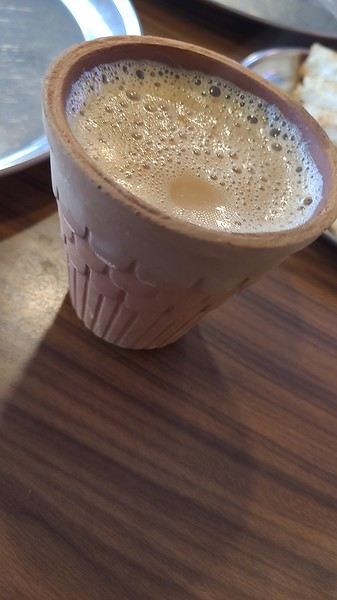
I doze off during the drive, and we arrive at the Atlantic Hotel in Alwar at 10:30 AM. My room is on the ground floor, and I settle in quickly. The Wi-Fi isn’t working, but the staff do everything they can to fix it. At noon, Gajender, the driver, suggests visiting the Qila Fort, which is on the heights of Alwar. The fort is closed for restoration, but safari tours are offered—jeep, guide, driver, and visit for 1600 Rs.
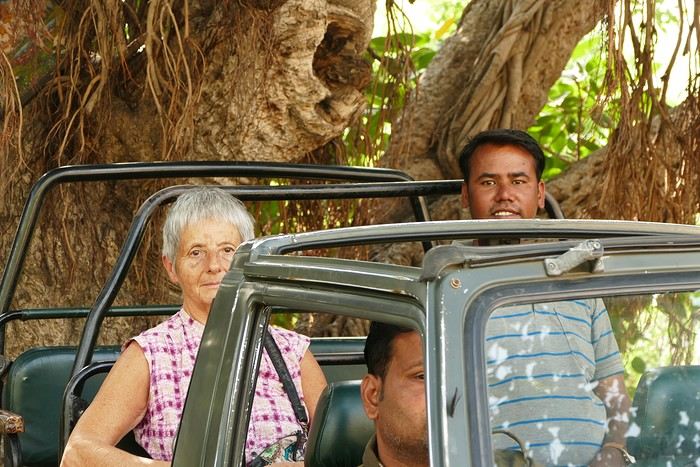
We follow the great wall, which is impressive—the second largest in India and the third in the world.
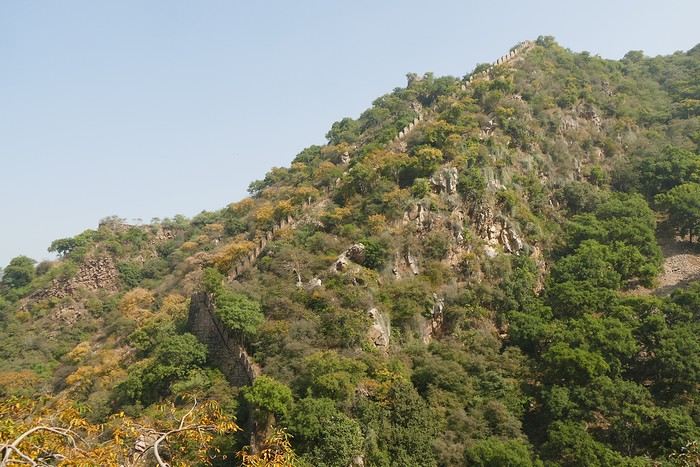
We spot peacocks and monkeys.
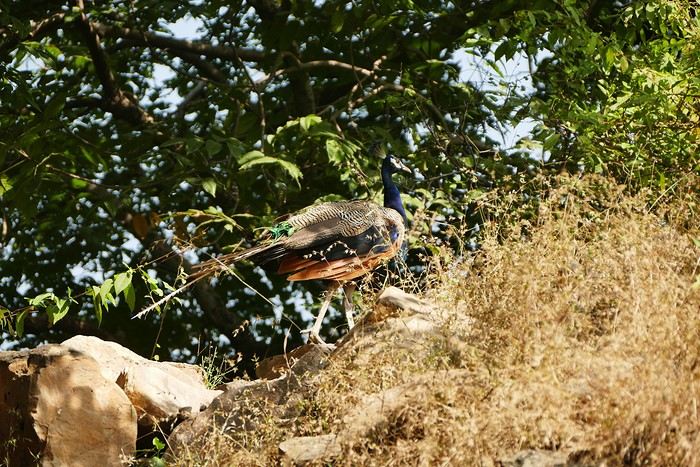
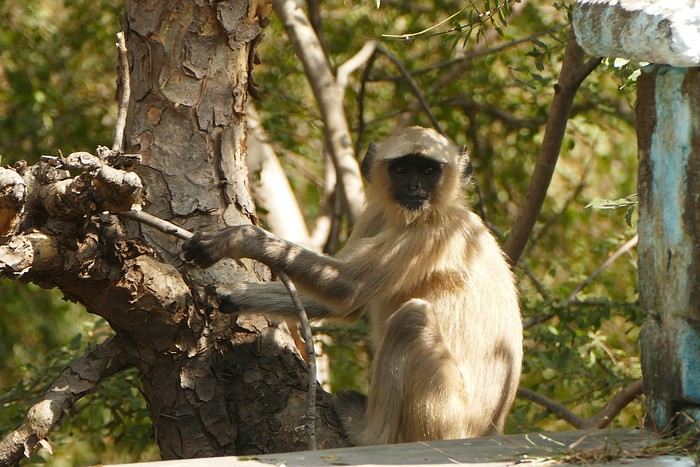
The guide shows me an old stepwell lost in nature. It’s always my thing to check out these baoris, which can be stunning, but this one isn’t anything special. We arrive at the palace overlooking the city.
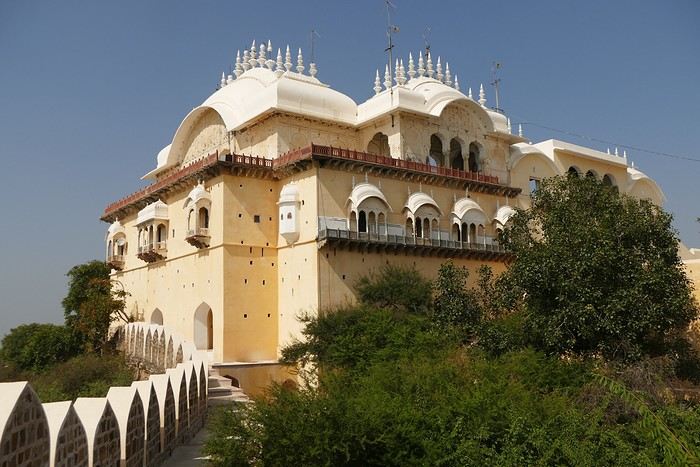
We walk around the palace, and I discover another stepwell that’s not worth lingering over.
The tour is over, and I had a great time despite the fatigue. We head back down to Alwar, near the City Palace, which has been turned into administrative offices. Gaju (the driver’s nickname) finds a parking spot near a dhaba where we have lunch (paneer masala, chapatis, chai)—it’s delicious. With my energy restored, we head to the palace. On the top floor is a museum that I visit.
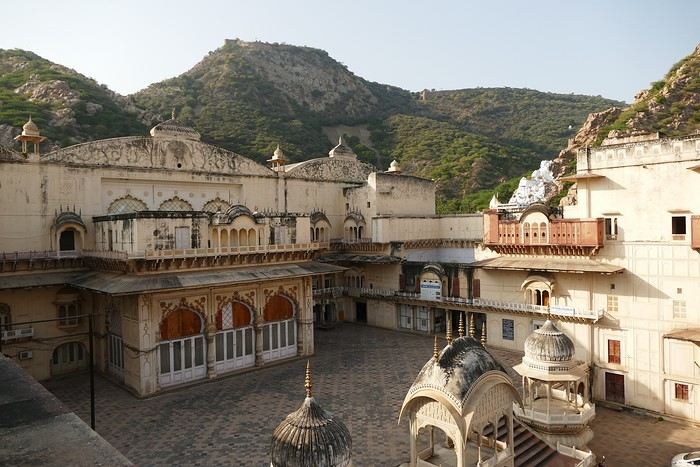
At the exit of the museum, we have to go back down and walk around the palace to get to the Moosi Maharani Chhatri. I’ve been here once before and really liked it, and the place is still the same—calm and relaxing.
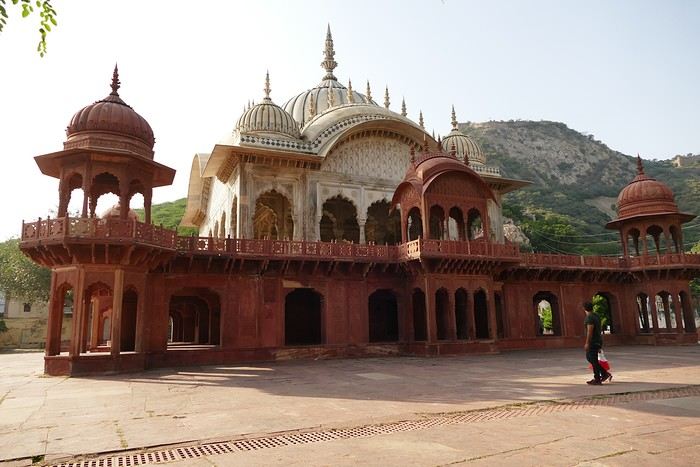
"This monument is the most artistic in Alwar and also the most royal, filled with fascinating history. Maharaja Vinay Singh of Alwar built this two-story cenotaph in 1815 in memory of his father, Maharaja Bakhtawar Singh. It’s also known as Moosi Maharani ki Chhatri, named after the king’s mistress, who performed sati upon his death. After the sati, she was accepted as the king’s wife. It’s an elegant monument, shaped like a flower and built with a mix of brown sandstone and white marble. The first floor is made of sandstone, while the upper floor and the chhatris (cenotaphs) are in white marble. Its sculpted pavilion has dome-shaped arches with intricate lace-like and exquisite floral patterns. There are complex motifs that shine brightly in the sunlight. The colorful circular ceiling is an important part of Moosi Maharani Ki Chhatri and is adorned with faded gold-leaf paintings of mythological figures and scenes. The footprints of Maharaja and Moosi Rani are engraved in marble inside the cenotaph, and locals pay their respects to them."
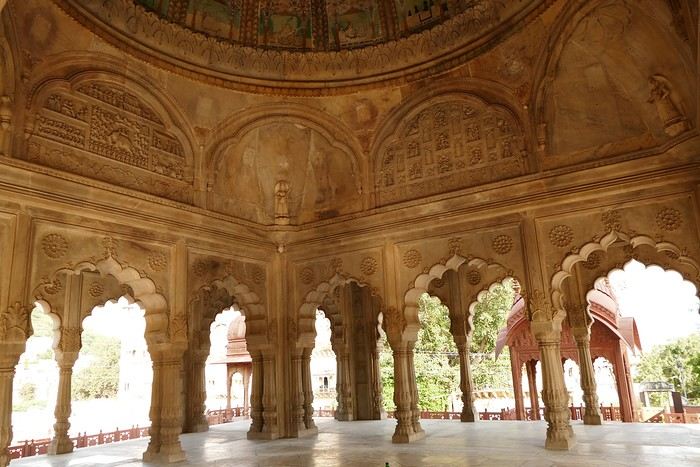
Near the chhatri, there’s a large water reservoir with a magnificent view. The place is peaceful and relaxing, and I stay here for a while, contemplating and daydreaming before heading back to the hotel for some well-deserved rest. The Wi-Fi is working now. I’m the only foreign guest, and since my room is near the entrance, I’ll be well taken care of throughout my stay.
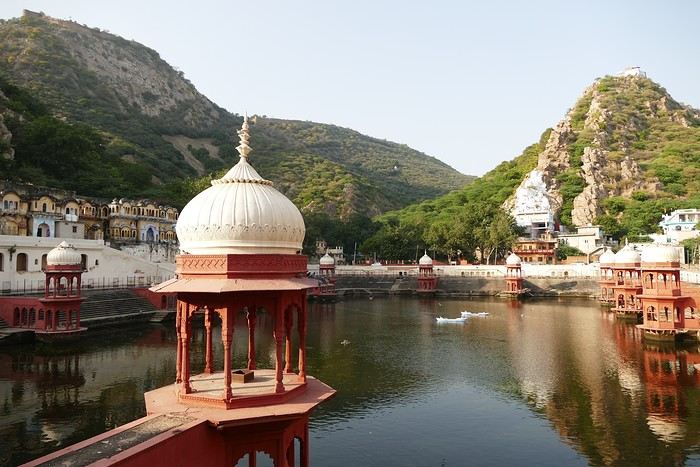
I doze off during the drive, and we arrive at the Atlantic Hotel in Alwar at 10:30 AM. My room is on the ground floor, and I settle in quickly. The Wi-Fi isn’t working, but the staff do everything they can to fix it. At noon, Gajender, the driver, suggests visiting the Qila Fort, which is on the heights of Alwar. The fort is closed for restoration, but safari tours are offered—jeep, guide, driver, and visit for 1600 Rs.
We follow the great wall, which is impressive—the second largest in India and the third in the world.
We spot peacocks and monkeys.
The guide shows me an old stepwell lost in nature. It’s always my thing to check out these baoris, which can be stunning, but this one isn’t anything special. We arrive at the palace overlooking the city.
We walk around the palace, and I discover another stepwell that’s not worth lingering over.
The tour is over, and I had a great time despite the fatigue. We head back down to Alwar, near the City Palace, which has been turned into administrative offices. Gaju (the driver’s nickname) finds a parking spot near a dhaba where we have lunch (paneer masala, chapatis, chai)—it’s delicious. With my energy restored, we head to the palace. On the top floor is a museum that I visit.
At the exit of the museum, we have to go back down and walk around the palace to get to the Moosi Maharani Chhatri. I’ve been here once before and really liked it, and the place is still the same—calm and relaxing.
"This monument is the most artistic in Alwar and also the most royal, filled with fascinating history. Maharaja Vinay Singh of Alwar built this two-story cenotaph in 1815 in memory of his father, Maharaja Bakhtawar Singh. It’s also known as Moosi Maharani ki Chhatri, named after the king’s mistress, who performed sati upon his death. After the sati, she was accepted as the king’s wife. It’s an elegant monument, shaped like a flower and built with a mix of brown sandstone and white marble. The first floor is made of sandstone, while the upper floor and the chhatris (cenotaphs) are in white marble. Its sculpted pavilion has dome-shaped arches with intricate lace-like and exquisite floral patterns. There are complex motifs that shine brightly in the sunlight. The colorful circular ceiling is an important part of Moosi Maharani Ki Chhatri and is adorned with faded gold-leaf paintings of mythological figures and scenes. The footprints of Maharaja and Moosi Rani are engraved in marble inside the cenotaph, and locals pay their respects to them."
Near the chhatri, there’s a large water reservoir with a magnificent view. The place is peaceful and relaxing, and I stay here for a while, contemplating and daydreaming before heading back to the hotel for some well-deserved rest. The Wi-Fi is working now. I’m the only foreign guest, and since my room is near the entrance, I’ll be well taken care of throughout my stay.
Oman for backpackers: trip report
So happy to be back with you all that I’m rushing to share my trip report!
We chose to stay exactly 14 days to avoid paying for a visa. As a result, we didn’t have time to explore the south—we’ll be back because Oman is a great destination in January. Temperatures were a perfect 25–27°C during the day. No rain for us, but it can happen.
We bought the *Évasion Oman* guidebook. We started with the Jebels (the mountains), abandoned villages, then the desert, wadis along the coast, and finished in the capital. For us, it was easier to go from cold (2,000 meters, after all) to hot before returning to our freezing Normandy in January.
The people were incredibly welcoming and lovely. We camped in natural camping areas where you can make a fire (free, no facilities or water). Easy to find—just search "camping" on Google Maps (an essential app). We traveled as a group of five and rented a 4x4 seven-seater from Europcar before leaving (price included our insurance): 800 euros for 14 days. Essential for getting everywhere, as there are lots of dirt tracks. We brought our camping gear from France since the baggage allowance is 30 kg. Oh, and also two liters of rum and a box of white wine—also essential.
Food was tricky if you don’t like spicy dishes or just chicken. You have to eat at international restaurants, which cost about the same as back home. We’d packed vacuum-sealed meat for the first three days and a few cans. For beaches, stick to the ones marked on Google for swimming—otherwise, they can be dirty and full of oil.
We arrived at 6:30 AM, bought a SIM card (make sure to remove yours before arriving and tape it to the back of your phone), exchanged money (not great rates at the airport—better in malls or souks; no exchanges in banks), and picked up the car. Then we headed to a Carrefour supermarket, but it was closed. We drove to Jebel Al Akhdar, the Sayq Plateau, where we found markets along the way. There are also bazaar shops where you can get gas bottles—they’re everywhere in mid-sized towns. There are even hypermarkets.
We hiked the well-marked old Sayq trail (red and white markings). Our return was improvised. We camped on the plateau and got cold—bring 0°C sleeping bags! The next day, we visited the abandoned villages of Wadi Bani Habib: juniper forests, canyon viewpoints. Then Birkat Al Maws on the way down—a beautiful palm grove. Next, Nizwa Hotel. The beds were really hard there—ask to see the rooms and test the beds before booking. There’s always availability, with prices starting at 35 euros for two.
On the third day, we went to Jebel Shams. Hiked along the canyon starting from Ghul, then descended. Camped on the road to Balha Fortress, which we visited the next morning (stunning!). Then we explored Nizwa before heading to the Wahiba Desert. Camped along the way, then drove to our accommodation: two days in the desert. We found the Thousand Nights Camp 40% cheaper a month before. Note: you have to leave by 1 PM in a convoy to reach the hotel.
On the sixth day, we hiked in the desert on our own because the activity prices were outrageous.
On the seventh day, we headed to a wadi, Bani Khalid, then to Sur, a seaside hotel. We booked just one room for five of us—hotel apartments are huge, and since we had our camping mattresses, it wasn’t a problem to set up in the living room. There’s even a kitchen. In cities, camping spots are poorly located—near intersections, etc.
Beach time and sightseeing on the eighth day, then we drove to the white sand beach in Fins, where we stayed for two nights (we left the tents set up but empty). This was our favorite campsite—go all the way to the end of the road, there’s a small cove and a stunning spot.
On the ninth day, we visited Wadi Shab and the Salma Plateau to find the tombs. The hike up from Fins was way too long—probably better to take the route suggested in the guidebook for a round trip. Meh, no one really enjoyed it.
On the tenth day, we went to Wadi Al Arbiyyin and drove to Seeb Al Mouj to book a diving trip. Stayed at Al Ferdous Hotel Apartments until the end—well-located for visiting Muscat and a great value. Just make sure to check the room first, as some beds are very hard and others aren’t.
Eleventh day: diving and beach time.
Twelfth day: visited the Grand Mosque (unlucky—first day it became paid, and not just a little: 8 OMR). Then explored the old city.
Thirteenth day: the Grand Opera and beach at The Village, where we found a great pizzeria: pizzawifi.com.
Fourteenth day: And that’s it—back home, thrilled to have discovered this magical country. We’ll be back!
We bought the *Évasion Oman* guidebook. We started with the Jebels (the mountains), abandoned villages, then the desert, wadis along the coast, and finished in the capital. For us, it was easier to go from cold (2,000 meters, after all) to hot before returning to our freezing Normandy in January.
The people were incredibly welcoming and lovely. We camped in natural camping areas where you can make a fire (free, no facilities or water). Easy to find—just search "camping" on Google Maps (an essential app). We traveled as a group of five and rented a 4x4 seven-seater from Europcar before leaving (price included our insurance): 800 euros for 14 days. Essential for getting everywhere, as there are lots of dirt tracks. We brought our camping gear from France since the baggage allowance is 30 kg. Oh, and also two liters of rum and a box of white wine—also essential.
Food was tricky if you don’t like spicy dishes or just chicken. You have to eat at international restaurants, which cost about the same as back home. We’d packed vacuum-sealed meat for the first three days and a few cans. For beaches, stick to the ones marked on Google for swimming—otherwise, they can be dirty and full of oil.
We arrived at 6:30 AM, bought a SIM card (make sure to remove yours before arriving and tape it to the back of your phone), exchanged money (not great rates at the airport—better in malls or souks; no exchanges in banks), and picked up the car. Then we headed to a Carrefour supermarket, but it was closed. We drove to Jebel Al Akhdar, the Sayq Plateau, where we found markets along the way. There are also bazaar shops where you can get gas bottles—they’re everywhere in mid-sized towns. There are even hypermarkets.
We hiked the well-marked old Sayq trail (red and white markings). Our return was improvised. We camped on the plateau and got cold—bring 0°C sleeping bags! The next day, we visited the abandoned villages of Wadi Bani Habib: juniper forests, canyon viewpoints. Then Birkat Al Maws on the way down—a beautiful palm grove. Next, Nizwa Hotel. The beds were really hard there—ask to see the rooms and test the beds before booking. There’s always availability, with prices starting at 35 euros for two.
On the third day, we went to Jebel Shams. Hiked along the canyon starting from Ghul, then descended. Camped on the road to Balha Fortress, which we visited the next morning (stunning!). Then we explored Nizwa before heading to the Wahiba Desert. Camped along the way, then drove to our accommodation: two days in the desert. We found the Thousand Nights Camp 40% cheaper a month before. Note: you have to leave by 1 PM in a convoy to reach the hotel.
On the sixth day, we hiked in the desert on our own because the activity prices were outrageous.
On the seventh day, we headed to a wadi, Bani Khalid, then to Sur, a seaside hotel. We booked just one room for five of us—hotel apartments are huge, and since we had our camping mattresses, it wasn’t a problem to set up in the living room. There’s even a kitchen. In cities, camping spots are poorly located—near intersections, etc.
Beach time and sightseeing on the eighth day, then we drove to the white sand beach in Fins, where we stayed for two nights (we left the tents set up but empty). This was our favorite campsite—go all the way to the end of the road, there’s a small cove and a stunning spot.
On the ninth day, we visited Wadi Shab and the Salma Plateau to find the tombs. The hike up from Fins was way too long—probably better to take the route suggested in the guidebook for a round trip. Meh, no one really enjoyed it.
On the tenth day, we went to Wadi Al Arbiyyin and drove to Seeb Al Mouj to book a diving trip. Stayed at Al Ferdous Hotel Apartments until the end—well-located for visiting Muscat and a great value. Just make sure to check the room first, as some beds are very hard and others aren’t.
Eleventh day: diving and beach time.
Twelfth day: visited the Grand Mosque (unlucky—first day it became paid, and not just a little: 8 OMR). Then explored the old city.
Thirteenth day: the Grand Opera and beach at The Village, where we found a great pizzeria: pizzawifi.com.
Fourteenth day: And that’s it—back home, thrilled to have discovered this magical country. We’ll be back!
Northern Chile, Andean impressions.
Alright, this year, we're heading back to South America!
The initial plan was to retrace the route we imagined in the summer of 2020: a trip to northern Argentina starting from Córdoba.
Unfortunately, the flight to Córdoba no longer exists, and airfares to Javier Milei’s country are both outrageously priced and involve multiple layovers.
So, I tweaked Google Flights every which way and finally found a flight within my budget—departing from Clermont-Ferrand!
Not to Argentina, though...
Our transatlantic flight will cross the snow-capped Andes, landing in Santiago, Chile, with a return from Lima!
In between, two domestic flights and a big road trip loop starting from the coastal city of Arica to explore the treasures of northern Chile.
Our mode of transport: a pseudo 4x4 that won’t take us through sand dunes or devilish tracks but will let us tackle the entire secondary network, including unpaved main roads, while still being insured.
Is the suitcase packed with all-season clothes?
Are the driver’s license and passport ready?
Bank cards and a few euros too?
Off we go for just over 3 weeks of southern wanderings!
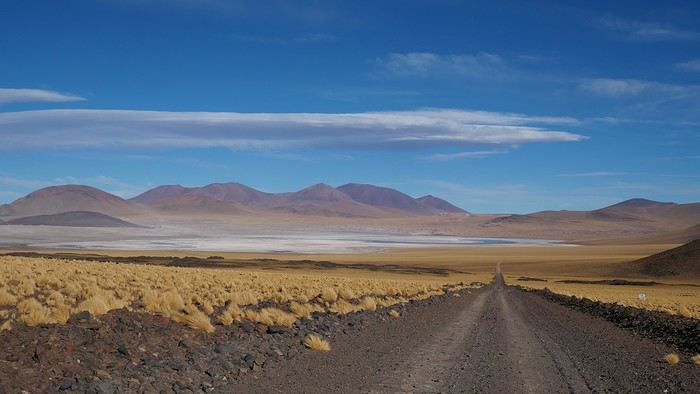
--/--
To keep all my esteemed readers on track, here are a few maps outlining the Arica-Arica loop!
1- From Arica to San Pedro de Atacama via Pica and the Salar de Huasco
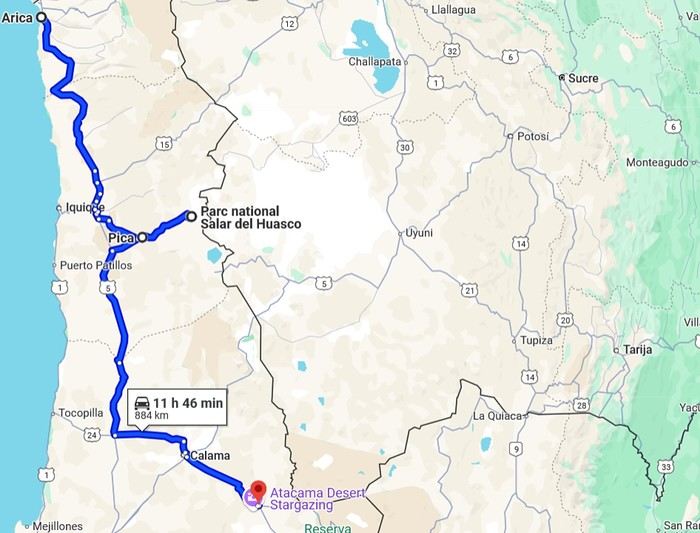 2- Around San Pedro
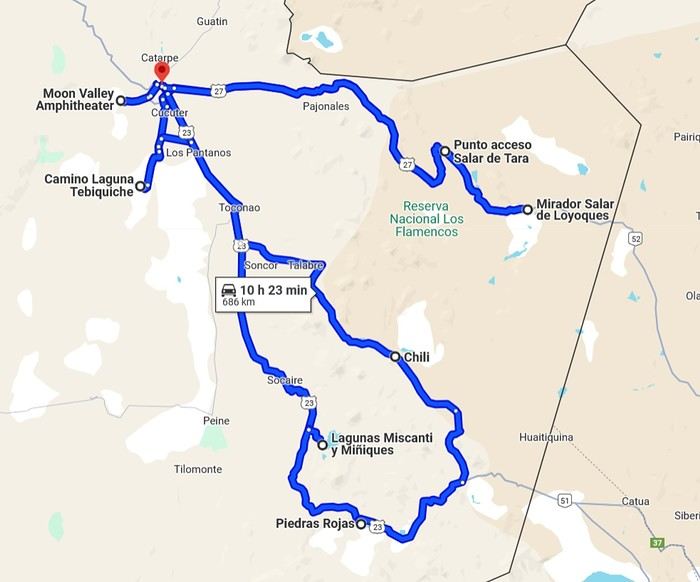
3- From San Pedro to Cariquima
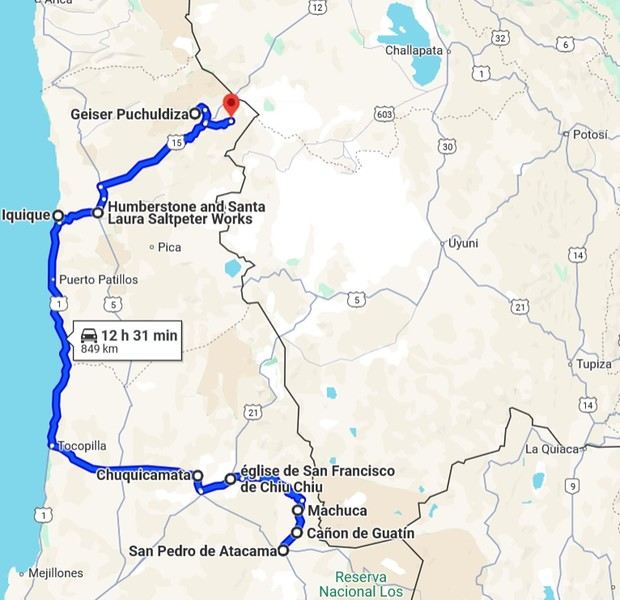
4- From Cariquima to Putre
5 - From Putre to Arica
Gas stations in this part of Chile are located in Arica, Iquique, Pozo Almonte, Pica, Calama, and San Pedro de Atacama.
The initial plan was to retrace the route we imagined in the summer of 2020: a trip to northern Argentina starting from Córdoba.
Unfortunately, the flight to Córdoba no longer exists, and airfares to Javier Milei’s country are both outrageously priced and involve multiple layovers.
So, I tweaked Google Flights every which way and finally found a flight within my budget—departing from Clermont-Ferrand!
Not to Argentina, though...
Our transatlantic flight will cross the snow-capped Andes, landing in Santiago, Chile, with a return from Lima!
In between, two domestic flights and a big road trip loop starting from the coastal city of Arica to explore the treasures of northern Chile.
Our mode of transport: a pseudo 4x4 that won’t take us through sand dunes or devilish tracks but will let us tackle the entire secondary network, including unpaved main roads, while still being insured.
Is the suitcase packed with all-season clothes?
Are the driver’s license and passport ready?
Bank cards and a few euros too?
Off we go for just over 3 weeks of southern wanderings!
--/--
To keep all my esteemed readers on track, here are a few maps outlining the Arica-Arica loop!
1- From Arica to San Pedro de Atacama via Pica and the Salar de Huasco
2- Around San Pedro3- From San Pedro to Cariquima
4- From Cariquima to Putre
5 - From Putre to Arica
Gas stations in this part of Chile are located in Arica, Iquique, Pozo Almonte, Pica, Calama, and San Pedro de Atacama.