Results for "Arrée+|+127"
68359 results found.
Voyager en train de Québec à Vancouver English translation pending
Allô !
Nous projetons un voyage vers Vancouver à partir de la ville de Québec et en train, vers le mois d'avril. Une passe de train est à cette période 300 $ moins cher qu'en haute saison. Nous voulons faire un arrêt à Jasper. Nous projetons de faire une partie du trajet de retour en avion, Vancouver-Toronto, puis de reprendre le train jusqu'à Québec. Pendant nos trois semaines à Vancouver, nous voudrions faire un saut jusqu'à San Francisco. Ce voyage devait se faire pendant les Fêtes, mais une jambe cassée a changé les projets. Maintenant, j'ai beaucoup de temps pour faire des recherches sur ce voyage qui ne sera retardé que de deux ou trois mois.
Donc, je cherche des infos sur -comment se passe un voyage en train - hôtels à Vancouver - quoi faire à Jasper - un saut à San Francisco est-il imaginable ?
Merci pour vos réponses.
Nous projetons un voyage vers Vancouver à partir de la ville de Québec et en train, vers le mois d'avril. Une passe de train est à cette période 300 $ moins cher qu'en haute saison. Nous voulons faire un arrêt à Jasper. Nous projetons de faire une partie du trajet de retour en avion, Vancouver-Toronto, puis de reprendre le train jusqu'à Québec. Pendant nos trois semaines à Vancouver, nous voudrions faire un saut jusqu'à San Francisco. Ce voyage devait se faire pendant les Fêtes, mais une jambe cassée a changé les projets. Maintenant, j'ai beaucoup de temps pour faire des recherches sur ce voyage qui ne sera retardé que de deux ou trois mois.
Donc, je cherche des infos sur -comment se passe un voyage en train - hôtels à Vancouver - quoi faire à Jasper - un saut à San Francisco est-il imaginable ?
Merci pour vos réponses.
New adventures from Perpignan to Ranchi (Jharkhand)
March 2nd — Departure by bus from Latour at 6:50 AM. The journey isn’t direct: we pass through Elne then Corneilla. In Perpignan, I switch to a BlablaBus heading to Barcelona’s northern bus station. Before reaching Le Perthus, French police stop us to check IDs. Several people aren’t in order, but after about fifteen minutes, we’re on our way again. We’re checked again at La Jonquera: this time, the wait lasts almost forty-five minutes while police identify those in violation and wait for a vehicle to pick them up. The driver then tries to make up for lost time; we finally arrive at our destination half an hour late.
I quickly head to the Arc de Triomphe metro station, located 200 meters away: you have to cross the bridge along the bus parking lot, then walk through a large garden; the station is on the right before the garden entrance. The trip to the airport isn’t direct: I have to change at Tomasso and take the line to the airport, where I arrive at 1 PM.
At the Emirates counter, I learn my flight was just canceled due to the war in Iran; they offer me another flight for the next day. I have to wait at the airport until 7 PM before being taken to a hotel; the next morning, I’ll take a flight to Vienna (with an 8-hour layover), then an Air India flight to Delhi, and finally a flight to Kolkata. I agree: I don’t know Vienna, so it’ll be an unexpected discovery.
At 7 PM, a small group is taken to the hotel, 35 minutes from the airport, where we’re served a light dinner upon arrival.
March 3rd — A taxi picks me up at 6:30 AM; the flight to Vienna takes off at 9:30 AM and arrives at noon. I’m free until 7 PM; the metro is direct to the city center. The weather is pleasant and not too cold, luckily, since my clothes are light.
When I exit the metro, I spot the St. Stephen’s Cathedral tower in the distance and approach it: the roof, made of glazed tiles, is remarkable.
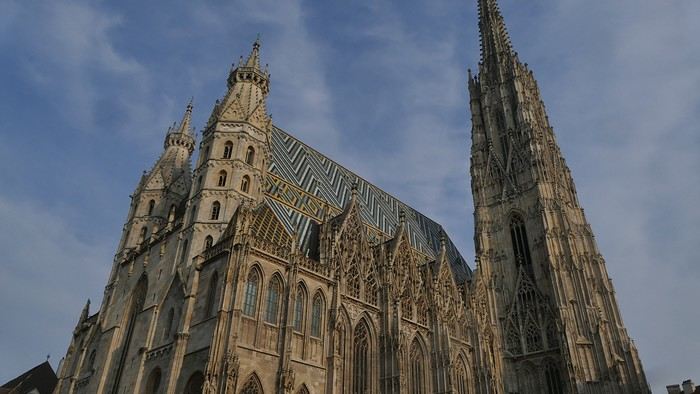
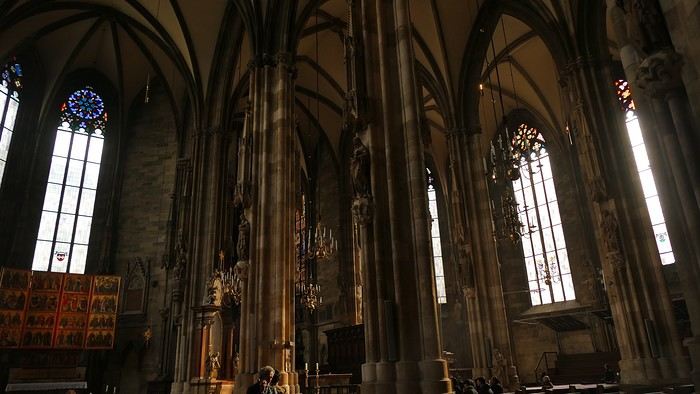
Entry is free, and the interior, a mix of Gothic and Baroque styles in the center, is stunning.
Not far from there is St. Anne’s Church
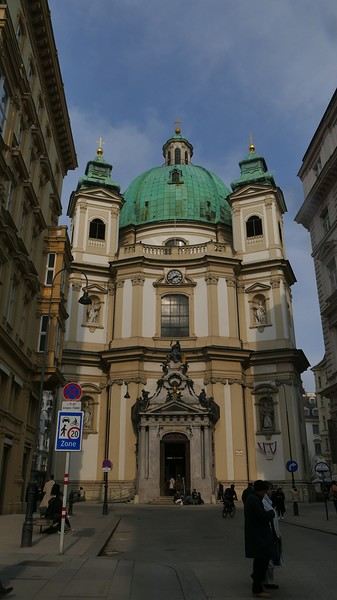
, also Baroque, adorned with beautiful frescoes
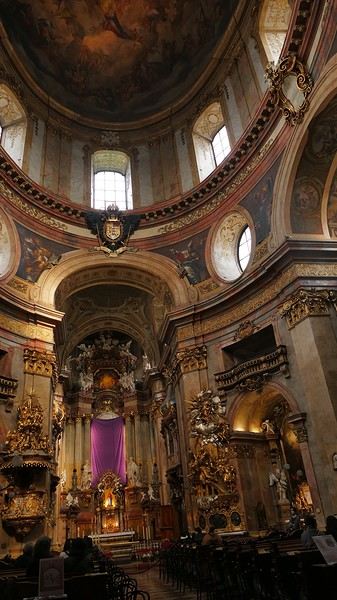
—a music concert adds an enchanting atmosphere to the visit. I continue my walk at random through the pedestrian streets lined with magnificent buildings: I’m charmed by the city.
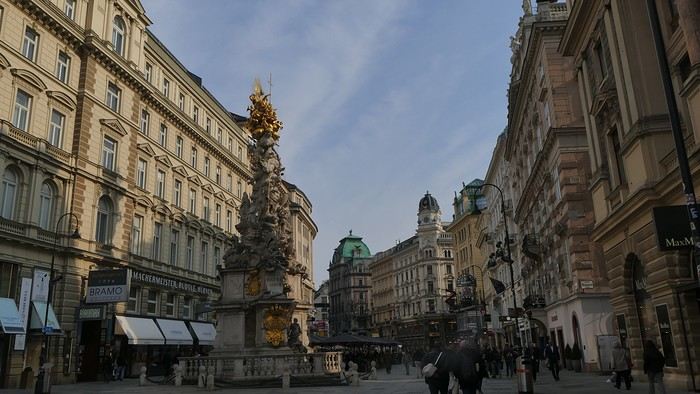
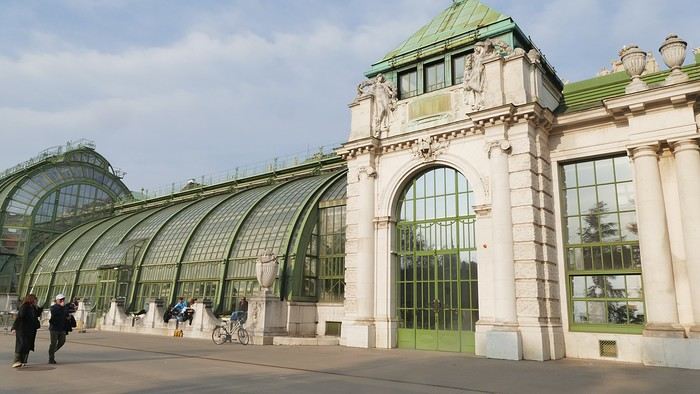
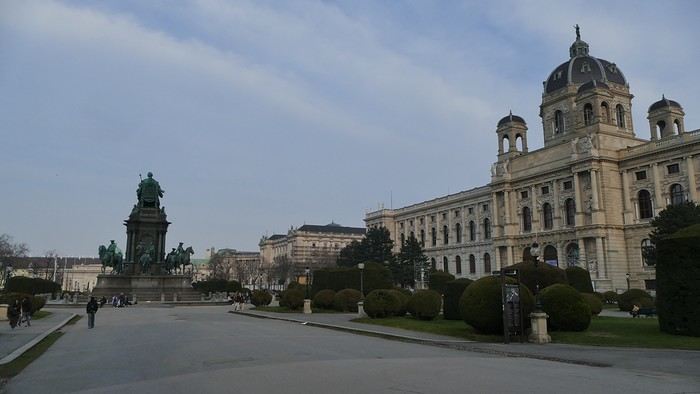
Before heading back to the airport, I stop at a lovely tea salon. My flight will eventually leave with a delay.
Wednesday, March 4th — Delhi and a little luggage scare We arrive in Delhi shortly after noon. Immigration is quick, and good news: my bag was checked through from Barcelona to Kolkata. I head to the connecting terminal and arrive half an hour before boarding: the flight goes smoothly. Upon arrival, the luggage comes out quickly… except mine. After filing a report, I’m told my bag is in Delhi—I have to retrieve it before taking another flight. I didn’t know (or had forgotten): with the delays, I wouldn’t have had time to pick it up and make the connection.
I take a taxi to the Ichamati Hotel. The welcome is warm, and the room is clean but very small. Without my bag, I feel a bit lost—I have nothing to change into.
Tonight, I’m dining with Raja and his friends at a beautiful restaurant, an old colonial house turned into a hotel.
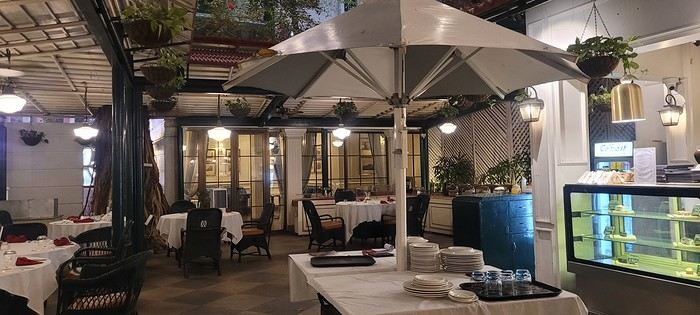
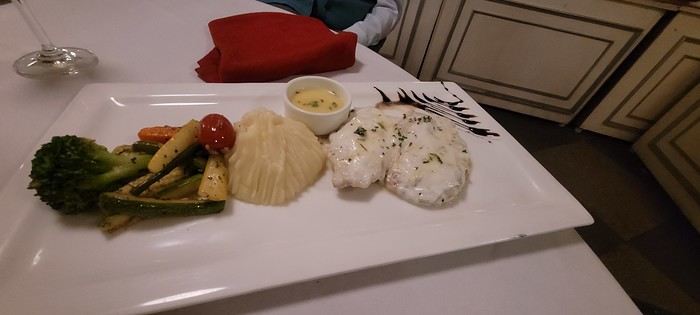
We’re happy to see each other and have a comforting evening together.
I quickly head to the Arc de Triomphe metro station, located 200 meters away: you have to cross the bridge along the bus parking lot, then walk through a large garden; the station is on the right before the garden entrance. The trip to the airport isn’t direct: I have to change at Tomasso and take the line to the airport, where I arrive at 1 PM.
At the Emirates counter, I learn my flight was just canceled due to the war in Iran; they offer me another flight for the next day. I have to wait at the airport until 7 PM before being taken to a hotel; the next morning, I’ll take a flight to Vienna (with an 8-hour layover), then an Air India flight to Delhi, and finally a flight to Kolkata. I agree: I don’t know Vienna, so it’ll be an unexpected discovery.
At 7 PM, a small group is taken to the hotel, 35 minutes from the airport, where we’re served a light dinner upon arrival.
March 3rd — A taxi picks me up at 6:30 AM; the flight to Vienna takes off at 9:30 AM and arrives at noon. I’m free until 7 PM; the metro is direct to the city center. The weather is pleasant and not too cold, luckily, since my clothes are light.
When I exit the metro, I spot the St. Stephen’s Cathedral tower in the distance and approach it: the roof, made of glazed tiles, is remarkable.
Entry is free, and the interior, a mix of Gothic and Baroque styles in the center, is stunning.
Not far from there is St. Anne’s Church
, also Baroque, adorned with beautiful frescoes
—a music concert adds an enchanting atmosphere to the visit. I continue my walk at random through the pedestrian streets lined with magnificent buildings: I’m charmed by the city.
Before heading back to the airport, I stop at a lovely tea salon. My flight will eventually leave with a delay.
Wednesday, March 4th — Delhi and a little luggage scare We arrive in Delhi shortly after noon. Immigration is quick, and good news: my bag was checked through from Barcelona to Kolkata. I head to the connecting terminal and arrive half an hour before boarding: the flight goes smoothly. Upon arrival, the luggage comes out quickly… except mine. After filing a report, I’m told my bag is in Delhi—I have to retrieve it before taking another flight. I didn’t know (or had forgotten): with the delays, I wouldn’t have had time to pick it up and make the connection.
I take a taxi to the Ichamati Hotel. The welcome is warm, and the room is clean but very small. Without my bag, I feel a bit lost—I have nothing to change into.
Tonight, I’m dining with Raja and his friends at a beautiful restaurant, an old colonial house turned into a hotel.
We’re happy to see each other and have a comforting evening together.
Understanding the World
hello to all travelers with their eyes wide open to the desert...
I’ve always wondered what I was "doing" on this earth. And why my father, who died a few months after I was born—a former youngest French resistance fighter—joined the First Saharan Motorized Company in Atar and spent the rest of his life repairing army engines in Algeria, Mauritania, Senegal, Mali (which didn’t exist under that name back then), Morocco, and finally Algeria, where my mother was born and raised. (Believe me, it’s not "cool" being the child of a soldier in a country occupied by France, and even less so the child of a "pied-noir.") Of course, I never got an answer: the dead don’t talk, and the army doesn’t either. But here’s the thing—I had photos... So naturally, one day I hit the road. I wanted to see, to understand. It’s thanks to VF that I was able to do a little research on crossing the Morocco-Mauritania border, and I’m grateful to its members, just as I’m grateful to all those who welcomed me on the road for 14 years. For the past few weeks, I’ve been wondering if I should talk about this or not... It turns out the Mauritanians changed my life by asking for my help... And that started as early as February 2012... (Did I owe them something? No answer to that question.) Ah, the irony—they saw me coming. But when you’re handed sick children and begged to do something, what would you have done? I’d worked in a hospital, so I knew a bit about the rules to follow. I didn’t hesitate. And well, over all these years, I met doctors, surgeons, and together we organized care, evacuations of children, training for surgeons—even trying to stop children from having to travel outside their country. It was never easy. I’d like to thank those who supported us, as well as *La Chaîne de l’Espoir*, *La Fondation Face au Monde*, and everyone who built bridges between our two countries. Unfortunately, despite the constant efforts of Mauritanian doctors and surgeons, some children couldn’t be helped in time. Today, I want to talk about four siblings—orphans of their mother—suffering from congenital glaucoma causing irreversible blindness. Their case was entrusted to me in 2020, just weeks before the big lockdown. We couldn’t do anything for them then, but when their father asked me for a gift, I rushed to my computer and wrote a story. Through a tale, the children take a great journey, explore their country, and fulfill a dream. I never thought this book would be published—it was, in 2023. This book pays tribute to Mauritania. It’s a message for those who know nothing about the hardships of life there, carrying both the harshness and beauty of an immense desert where you can travel by 4x4, bike, on foot, or by camel in complete safety. It bears witness to the kindness of Mauritanians toward travelers. As a woman traveling alone in my vehicle—a now-rusted old Mercedes that no longer runs—I had the most beautiful encounters of my life there (I’ve seen other parts of the world...). The blind children of Choum, Atar, Nouadhibou, and Nouakchott will forever be in my heart. Volunteer readers transcribed the book into a free audio version for the visually impaired. It’s available in sound libraries in France, the *Fondation Valentin Haüy*, and the Swiss Romande library. I made my last trip to Mauritania in my old 4x4 to distribute the book everywhere, especially to its heroes and the school for the visually impaired in Nouakchott. After that, I thought it was time to close the chapter because I no longer have the means or the strength to travel. My publishers chose this title for it: *The Blue Eyes of the Desert*. This publication helped a mission of Swiss volunteer ophthalmologists come to operate on glaucomas in Mauritania. I’m thrilled because they come back every year! This adventure is ending, yes—everything must come to an end—but ultimately, it was born here, on the VF site!! So yes, I had to say it: THANK YOU!!!!!
I’ve always wondered what I was "doing" on this earth. And why my father, who died a few months after I was born—a former youngest French resistance fighter—joined the First Saharan Motorized Company in Atar and spent the rest of his life repairing army engines in Algeria, Mauritania, Senegal, Mali (which didn’t exist under that name back then), Morocco, and finally Algeria, where my mother was born and raised. (Believe me, it’s not "cool" being the child of a soldier in a country occupied by France, and even less so the child of a "pied-noir.") Of course, I never got an answer: the dead don’t talk, and the army doesn’t either. But here’s the thing—I had photos... So naturally, one day I hit the road. I wanted to see, to understand. It’s thanks to VF that I was able to do a little research on crossing the Morocco-Mauritania border, and I’m grateful to its members, just as I’m grateful to all those who welcomed me on the road for 14 years. For the past few weeks, I’ve been wondering if I should talk about this or not... It turns out the Mauritanians changed my life by asking for my help... And that started as early as February 2012... (Did I owe them something? No answer to that question.) Ah, the irony—they saw me coming. But when you’re handed sick children and begged to do something, what would you have done? I’d worked in a hospital, so I knew a bit about the rules to follow. I didn’t hesitate. And well, over all these years, I met doctors, surgeons, and together we organized care, evacuations of children, training for surgeons—even trying to stop children from having to travel outside their country. It was never easy. I’d like to thank those who supported us, as well as *La Chaîne de l’Espoir*, *La Fondation Face au Monde*, and everyone who built bridges between our two countries. Unfortunately, despite the constant efforts of Mauritanian doctors and surgeons, some children couldn’t be helped in time. Today, I want to talk about four siblings—orphans of their mother—suffering from congenital glaucoma causing irreversible blindness. Their case was entrusted to me in 2020, just weeks before the big lockdown. We couldn’t do anything for them then, but when their father asked me for a gift, I rushed to my computer and wrote a story. Through a tale, the children take a great journey, explore their country, and fulfill a dream. I never thought this book would be published—it was, in 2023. This book pays tribute to Mauritania. It’s a message for those who know nothing about the hardships of life there, carrying both the harshness and beauty of an immense desert where you can travel by 4x4, bike, on foot, or by camel in complete safety. It bears witness to the kindness of Mauritanians toward travelers. As a woman traveling alone in my vehicle—a now-rusted old Mercedes that no longer runs—I had the most beautiful encounters of my life there (I’ve seen other parts of the world...). The blind children of Choum, Atar, Nouadhibou, and Nouakchott will forever be in my heart. Volunteer readers transcribed the book into a free audio version for the visually impaired. It’s available in sound libraries in France, the *Fondation Valentin Haüy*, and the Swiss Romande library. I made my last trip to Mauritania in my old 4x4 to distribute the book everywhere, especially to its heroes and the school for the visually impaired in Nouakchott. After that, I thought it was time to close the chapter because I no longer have the means or the strength to travel. My publishers chose this title for it: *The Blue Eyes of the Desert*. This publication helped a mission of Swiss volunteer ophthalmologists come to operate on glaucomas in Mauritania. I’m thrilled because they come back every year! This adventure is ending, yes—everything must come to an end—but ultimately, it was born here, on the VF site!! So yes, I had to say it: THANK YOU!!!!!
Questions about travel times and airline for Nepal circuit with Capitales Tours
Hello,
I’m interested in the 10-day/8-night "Discover Nepal" tour offered by Capitales Tours, among others. For Day 4, it lists Kathmandu-Mugling-Pokhara as 200 km and 8/9 hours of travel. Is this duration due to the road conditions? I assume the stop in Mugling for lunch is included in the travel time.
For Pokhara-Chitwan, only the distance is mentioned: 160 km. Should I expect a long bus ride there as well?
The proposed flights would be with AIR-INDIA via DELHI. We had issues with AIR-INDIA before—they denied us boarding for Paris even though we arrived at the airport more than 3 hours early. There was no specific counter for PARIS; the counters were for all destinations, and we waited in line for over 2.5 hours only to be told "too late"... Thanks for your advice: Mum49 Is it still like this?
I’m interested in the 10-day/8-night "Discover Nepal" tour offered by Capitales Tours, among others. For Day 4, it lists Kathmandu-Mugling-Pokhara as 200 km and 8/9 hours of travel. Is this duration due to the road conditions? I assume the stop in Mugling for lunch is included in the travel time.
For Pokhara-Chitwan, only the distance is mentioned: 160 km. Should I expect a long bus ride there as well?
The proposed flights would be with AIR-INDIA via DELHI. We had issues with AIR-INDIA before—they denied us boarding for Paris even though we arrived at the airport more than 3 hours early. There was no specific counter for PARIS; the counters were for all destinations, and we waited in line for over 2.5 hours only to be told "too late"... Thanks for your advice: Mum49 Is it still like this?
Which routes to take and which hikes to do in the Bernese Oberland?
Hello,
We’re planning a short trip at the end of July to explore the legendary mountains and valleys of the Bernese Oberland: round trip from Nancy (Swiss highway vignette planned), 2 nights in a room with a small kitchen in Adelboden, then 2 nights in a hotel at the Gletscherblick in Grindelwald, both with half-board included. Could you share some tips on the best road routes to take, as well as some walking hikes (we’re not as fit as we used to be, so nothing longer than 2-3 hours)? Maybe also 1 or 2 cable car rides—I was thinking of Oeschinensee Lake above Kandersteg and the First gondola above Grindelwald for better panoramic views of the Eiger, Mönch, and Jungfrau... all while keeping it doable with our schedule. We’ve ruled out the "premium" trip up to the Jungfraujoch for this time. I’m also guessing that paying to access Wengen or Mürren only makes sense if we’re staying there for a few days, right? - Is the road through the narrow valley of the White Lütschine toward Lauterbrunnen and beyond still worth it in terms of views and scenery?
On the way back, if we have a little time to explore Bern’s historic old town, what’s the best parking plan for a 1- or 2-hour stop?
Thanks in advance for your advice, fellow travelers familiar with this beautiful region! 😉
We’re planning a short trip at the end of July to explore the legendary mountains and valleys of the Bernese Oberland: round trip from Nancy (Swiss highway vignette planned), 2 nights in a room with a small kitchen in Adelboden, then 2 nights in a hotel at the Gletscherblick in Grindelwald, both with half-board included. Could you share some tips on the best road routes to take, as well as some walking hikes (we’re not as fit as we used to be, so nothing longer than 2-3 hours)? Maybe also 1 or 2 cable car rides—I was thinking of Oeschinensee Lake above Kandersteg and the First gondola above Grindelwald for better panoramic views of the Eiger, Mönch, and Jungfrau... all while keeping it doable with our schedule. We’ve ruled out the "premium" trip up to the Jungfraujoch for this time. I’m also guessing that paying to access Wengen or Mürren only makes sense if we’re staying there for a few days, right? - Is the road through the narrow valley of the White Lütschine toward Lauterbrunnen and beyond still worth it in terms of views and scenery?
On the way back, if we have a little time to explore Bern’s historic old town, what’s the best parking plan for a 1- or 2-hour stop?
Thanks in advance for your advice, fellow travelers familiar with this beautiful region! 😉
Bac Ha
Hi there,
we’ll be in Mai Chau in June and we’re thinking of heading to Sapa, but first spending a few days in Bac Ha to do some hiking and explore the area.
Is this a good idea for those who’ve been there?
How do you get there?
Thanks for your feedback.
Looking forward to hearing from you.
Cédric.
"Glory": an Animal Farm for Zimbabwe—and the world
"400 pages of verbal pyrotechnics and animal magic" — The Times
"Bulawayo leans into exaggeration and irony to tell hard truths. *Glory* is jam-packed with comedy and farce, poking fun at an autocratic regime while illustrating the absurdity and surreal nature of a police state." — The Guardian
The cruelty and savagery of Zimbabwe’s (and Africa’s in general) "powerful animals"
Zimbabwean author NoViolet Bulawayo has written a novel that illustrates better than any documentary the complexity of colonial legacy. In doing so, she revisits George Orwell’s Animal Farm. Her novel *Glory* is a political satire about Zimbabwe—and it’s brimming with humor.
For thirty years, Zimbabwe has been stagnating under Robert Mugabe’s presidency. Human rights violations, corruption, and international sanctions have kept the population mired in poverty and oppression, while the regime exploits the meager earnings of the economy. As the 2017 elections approach, a power struggle erupts over the succession of the very elderly Father of the Nation (Mugabe). On the streets, people hope for long-awaited reforms; the people feel their moment has come.
And indeed, the army ousts Mugabe and his wife—"with her Gucci heels" (p.32)—who was positioning herself for the presidency. Hopes are dashed, however. The generals install former vice-president Emmerson Mnangagwa in power; the regime merely changes faces, but the problems remain the same.
In the novel, the country is called "Jidada, with a -da and another -da" (p.1); there’s no mistaking that this fictional state is Zimbabwe.
For *Glory*, her second novel, NoViolet Bulawayo invents a whole series of codes whose strength lies precisely in how easy they are to decipher. Like George Orwell’s Animal Farm, the characters populating Bulawayo’s universe aren’t humans but horses, goats, or crocodiles with all-too-human traits. Mugabe and Mnangagwa are horses, the spiritual leader is a pig, the soldiers are all bloodthirsty dogs, while the populace consists of goats, chickens, donkeys, and cats. The shift to the animal world serves only to better grasp the laws of despotism—and to ridicule real-life models. On one hand, the animals are humanized: they tweet, torture, travel in private jets. On the other, their greed, stupidity, and brutality stem from their animal nature.
It’s the old trick of fable: dressing men in animal disguises to make them easier to recognize. That’s how Orwell, in Animal Farm, traced how the promise of liberation from the Russian Revolution turned into Stalinist terror. In his 1945 fable, George Orwell describes how the animals of a farm drive out their farmer to organize the exploitation themselves, collectively. For a time, they truly taste freedom, but a clique of pigs ends up taking control. The central figures of the Soviet story—Stalin, Trotsky, Molotov—were easily recognizable.
Yet Bulawayo departs sharply from Orwell. She’s less concerned with precision and the force of argument than with satirical exaggeration. The deposed president is a senile old man who believes he can control even the sun’s course. The new stallion in power is a greedy debaucher. His soldiers sniff respectfully at his tail and backside.
In Bulawayo’s *Glory*, things are more complicated, but her novel also tells of a failed, incomplete liberation. In the author’s Animal Farm, Jidada, the colonial exploiters are followed by new forms of oppression. Because the former liberators become tyrants themselves. And because global power dynamics persist in neocolonial structures.
Wouldn’t that be enough to fuel a deeply depressing narrative? No—Bulawayo turns it into a blazing satire, full of wit and uncompromising criticism of power, a thread running through contemporary (not just) Zimbabwean history. The old warhorses in NoViolet Bulawayo’s Jidada, who continue to act as pack leaders, are easily recognizable as caricatures of the longtime dictator Robert Mugabe and his successor, current president Emmerson Mnangagwa.
The plot kicks off in high gear with independence day festivities. From the crack of dawn, everyone waits on Jidada Square for the Old Horse, the Father of the Nation and former liberator, whose reign "was nearing all of—not one, not two, not three, but four solid decades" (p.1). Everywhere, the colors of the Jidada Party shine; everywhere, true supporters cheer. Even the scorching sun plays its part: "At this point the sun, upon seeing arrive the leader who was decreed by God himself to rule and rule and keep ruling, a leader who'd in turn decreed the very sun to head his cheerleading squad, took a deep, deep breath and thoroughly blazed to impress" (p.2).
Finally, the Old Horse’s luxury carriage approaches "with the slowness of a hearse" (p.2), and "hoping to catch a glimpse of the legendary Father of the Nation," which causes "the animals fell over themselves like intoxicated frogs" (p.2). The sovereign’s speech is delayed a moment longer: "what I really want is a nap," groans the Old Horse as he takes his seat with such care "like his backside was made of expensive porcelain" (p.6).
Meanwhile, Bulawayo parades his entourage: the president’s wife (who earns her doctorate at Jidada University faster than "you could say diss, for dissertation. Tholukuthi it was as easy as ordering from a KFC drive-through, or perhaps even easier being that it was cheaper than KFC; it in fact cost her nothing and the degree actually came with a zero-calorie Diet Coke and a purple straw" (p.41), and she’s now known as Dr Sweet Mother. The cabinet includes "the Minister of the Revolution, the Minister of Corruption, the Minister of Order, the Minister of Things, the Minister of Nothing, the Minister of Propaganda, the Minister of Homophobic Affairs, the Minister of Disinformation and the Minister of Looting" (p.9). And of course the vice-president, who will soon become interim president when the Old Horse finally kicks the bucket—and then settle in as the new long-term president, who in the novel is called Tuvius Delight Shasha, or "Tuvy" for short (p.253), none other than Emmerson Mnangagwa. It’s him Bulawayo reserves her most merciless character description for.
"New Dispensation" (p.109) is Tuvy’s slogan for Jidada, and he loves repeating it so much he even named his parrot after it ("So inspired was Tuvy by the realisation that he rechristened his new pet parrot with the name New Dispensation—tholukuthi the bird having been acquired explicitly for the purposes of tweeting eulogies and accordingly glorifying the Saviour throughout the airs and skies of the nation. Tuvy then went on to hire a lecturer in English from the University of Jidada to teach New Dispensation to say the phrase 'New Dispensation'" p.110). But Tuvy’s Zimbabwe remains a nation without free, fair, and credible elections ("#freefairncredibleelection" p.161), and the promised equal treatment applies only insofar as Zimbabweans now queue up without discrimination in endless lines—and everyone is as poor as the next in the "queuenation" (p.283). Except for the powerful. They can "yes, tholukuthi, her immeasurable riches theirs to take. And take they did—
just take—take—take—take—take—take—take—take—take—take—take—take—take—take—take—take—take—take—take—take—take—take—take—take—take—take—take" (p.249-250).
In short: Bulawayo brilliantly depicts how former independence fighters become exploiters themselves. And how the country threatens to suffocate under the weight of corruption and repression. But she also literally stages the polyphony with which the people oppose imposed obedience to the official line.
Controversial online discussions keep interrupting the narrative—dialogues and social threads (see photo below) that Bulawayo masterfully integrates. From a literary standpoint, it’s a brilliant idea. And it shows, above all, that the author’s sympathy—so likeable—goes to all those who refuse to let their dream of true freedom be stolen, not even by the corrupt elites of their own country.
In the book’s acknowledgments, the first tribute goes to "The Jidadas of the world, clamouring for freedom on many fronts—A luta continua." (p.401) This reflects the realization that, not only in Jidada-Zimbabwe but in many other corners of the world, the end of colonial domination is still far from meaning the freedom hoped for by the vast majority of people. But it also means, more broadly, that this freedom must be won "on many fronts" (see above), both domestically and geopolitically.
That’s precisely what *Glory* so vividly highlights: how complex the project behind the term "postcolonialism" really is. With *Glory*, Bulawayo also delivers a scathing critique of the persistence of colonial mindsets in the West.
In the novel, the murder of George Floyd, racist police violence, and white-supremacist ideology in Trump’s United States perfectly illustrate the persistence of racism. It’s especially in the final chapters that Bulawayo lets Jidada’s inhabitants explicitly and unflinchingly criticize a neocolonial world order:
"It was not lost on us how the West, which loved to 'save' Africa and announce every action to the whole world, did so with one limb while manipulating, looting and fleecing us with the rest of its limbs so that more money in fact poured out of the continent than trickled in." (p.376)
"It was no mistake that multinational corporations yearly reaped and shipped colossal profits from Africa back to their countries as had been the case during colonial times. Even the sticks and stones would tell you that the African earth at any given time howled and shook and heaved from the extraction of its precious minerals that rarely benefited its own miserable children." (p.376)
"(...) we vowed to wage yet another war for Africa's second Liberation from neocolonial oppression. From exploitation. From plunder. From Western dominion. From indignity. From Abuse. We wanted real freedom. We wanted greedy, thieving paws off our wealth. We wanted Justice. We wanted a new world; we wanted a brand-new world so much we didn't sleep a wink that night." (p.377)
The Jidadas of this world must fight two enemies: Western neocolonialism and the autocratic instrumentalization of that argument; the persistence of Western racism and the populist appropriation of that humiliation by tyrants from their own ranks. Neither of these obstacles to freedom diminishes the historical and current guilt of the other. But the path to postcolonial liberation must overcome all these forms of oppression. After all, the colonizers didn’t bequeath democracies to formerly dominated nations, but instability and the principles of oppression and exploitation—which the so-called liberators have also internalized. Yet the fact that a satirical novel can capture the complexity of historical relationships while remaining, despite all the darkness of the subject, hilarious—well, that’s truly astonishing.
Finally, *Glory* ties into a major trauma in Zimbabwe’s post-independence history: the so-called Gukurahundi massacres. Between 1983 and 1987, tens of thousands of civilians were murdered by Mugabe’s bloody henchmen, most of them Ndebele. The State Security Minister and head of secret services at the time? You guessed it—Emmerson Mnangagwa.
When *Glory* turns to the massacres, the novel’s tone shifts completely. The story is now told through the narrative of the goat called Destiny, who, like NoViolet Bulawayo herself, left her home country at 18 for the United States and only returned after 13 years. In the book, the city of Bulawayo becomes a village where Destiny retraces her family’s history—and learns that part of it was also brutally murdered during the massacres.
The abuse of power and life under a dictatorship, dispossession, and a fiercely proud awareness of the psychological wounds and emotional vulnerability of a uprooted and disenfranchised people who had to forge a new language—a new set of names—to express their lived experiences are at the heart of this wonderful Zimbabwean author’s literary work, NoViolet Bulawayo. Shortly after her studies, she was already writing short stories about postcolonial power dynamics in Africa. But her playful, masterful, and often unconventional approach to language also plays a key role in her work. With virtuosity, she shifts from cynical images of power-obsessed elites to compassionate descriptions of the people’s suffering, ending with a hopeful sermon on courage—the courage to break free from fear and thus gain the strength for change ("And every one of them understood that whatever they heard within those hearts was the new national anthem, tholukuthi an anthem that spoke of the kind of glory that burns eternal and glows with living light." p.400). This novel is a genuine pleasure to read. And it’s exceptional. Good, African...
Book info (original English and German translation):
NoViolet Bulawayo. Glory. Chatto & Windus, 2022. NoViolet Bulawayo. Glory. Suhrkamp, 2023.
Hery
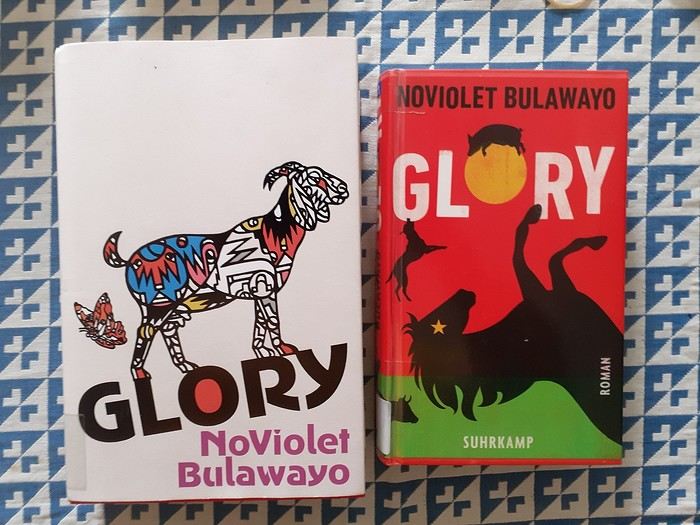 The books (in English, in German)
 Author NoViolet Bulawayo, Zimbabwe
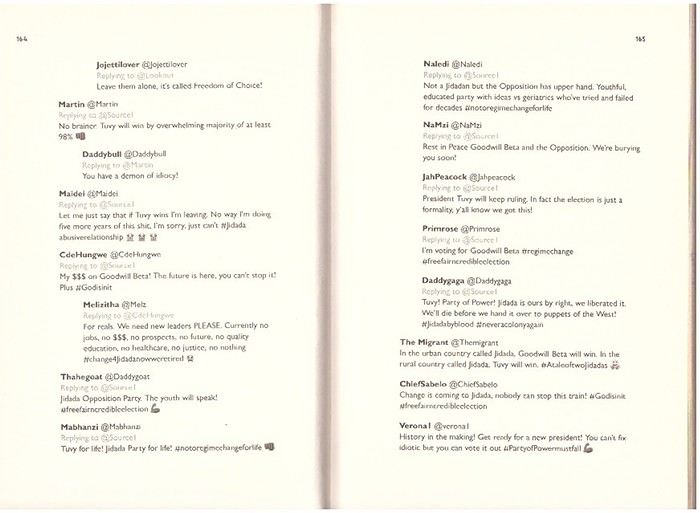 Threads (p.164-165)
"Bulawayo leans into exaggeration and irony to tell hard truths. *Glory* is jam-packed with comedy and farce, poking fun at an autocratic regime while illustrating the absurdity and surreal nature of a police state." — The Guardian
The cruelty and savagery of Zimbabwe’s (and Africa’s in general) "powerful animals"
Zimbabwean author NoViolet Bulawayo has written a novel that illustrates better than any documentary the complexity of colonial legacy. In doing so, she revisits George Orwell’s Animal Farm. Her novel *Glory* is a political satire about Zimbabwe—and it’s brimming with humor.
For thirty years, Zimbabwe has been stagnating under Robert Mugabe’s presidency. Human rights violations, corruption, and international sanctions have kept the population mired in poverty and oppression, while the regime exploits the meager earnings of the economy. As the 2017 elections approach, a power struggle erupts over the succession of the very elderly Father of the Nation (Mugabe). On the streets, people hope for long-awaited reforms; the people feel their moment has come.
And indeed, the army ousts Mugabe and his wife—"with her Gucci heels" (p.32)—who was positioning herself for the presidency. Hopes are dashed, however. The generals install former vice-president Emmerson Mnangagwa in power; the regime merely changes faces, but the problems remain the same.
In the novel, the country is called "Jidada, with a -da and another -da" (p.1); there’s no mistaking that this fictional state is Zimbabwe.
For *Glory*, her second novel, NoViolet Bulawayo invents a whole series of codes whose strength lies precisely in how easy they are to decipher. Like George Orwell’s Animal Farm, the characters populating Bulawayo’s universe aren’t humans but horses, goats, or crocodiles with all-too-human traits. Mugabe and Mnangagwa are horses, the spiritual leader is a pig, the soldiers are all bloodthirsty dogs, while the populace consists of goats, chickens, donkeys, and cats. The shift to the animal world serves only to better grasp the laws of despotism—and to ridicule real-life models. On one hand, the animals are humanized: they tweet, torture, travel in private jets. On the other, their greed, stupidity, and brutality stem from their animal nature.
It’s the old trick of fable: dressing men in animal disguises to make them easier to recognize. That’s how Orwell, in Animal Farm, traced how the promise of liberation from the Russian Revolution turned into Stalinist terror. In his 1945 fable, George Orwell describes how the animals of a farm drive out their farmer to organize the exploitation themselves, collectively. For a time, they truly taste freedom, but a clique of pigs ends up taking control. The central figures of the Soviet story—Stalin, Trotsky, Molotov—were easily recognizable.
Yet Bulawayo departs sharply from Orwell. She’s less concerned with precision and the force of argument than with satirical exaggeration. The deposed president is a senile old man who believes he can control even the sun’s course. The new stallion in power is a greedy debaucher. His soldiers sniff respectfully at his tail and backside.
In Bulawayo’s *Glory*, things are more complicated, but her novel also tells of a failed, incomplete liberation. In the author’s Animal Farm, Jidada, the colonial exploiters are followed by new forms of oppression. Because the former liberators become tyrants themselves. And because global power dynamics persist in neocolonial structures.
Wouldn’t that be enough to fuel a deeply depressing narrative? No—Bulawayo turns it into a blazing satire, full of wit and uncompromising criticism of power, a thread running through contemporary (not just) Zimbabwean history. The old warhorses in NoViolet Bulawayo’s Jidada, who continue to act as pack leaders, are easily recognizable as caricatures of the longtime dictator Robert Mugabe and his successor, current president Emmerson Mnangagwa.
The plot kicks off in high gear with independence day festivities. From the crack of dawn, everyone waits on Jidada Square for the Old Horse, the Father of the Nation and former liberator, whose reign "was nearing all of—not one, not two, not three, but four solid decades" (p.1). Everywhere, the colors of the Jidada Party shine; everywhere, true supporters cheer. Even the scorching sun plays its part: "At this point the sun, upon seeing arrive the leader who was decreed by God himself to rule and rule and keep ruling, a leader who'd in turn decreed the very sun to head his cheerleading squad, took a deep, deep breath and thoroughly blazed to impress" (p.2).
Finally, the Old Horse’s luxury carriage approaches "with the slowness of a hearse" (p.2), and "hoping to catch a glimpse of the legendary Father of the Nation," which causes "the animals fell over themselves like intoxicated frogs" (p.2). The sovereign’s speech is delayed a moment longer: "what I really want is a nap," groans the Old Horse as he takes his seat with such care "like his backside was made of expensive porcelain" (p.6).
Meanwhile, Bulawayo parades his entourage: the president’s wife (who earns her doctorate at Jidada University faster than "you could say diss, for dissertation. Tholukuthi it was as easy as ordering from a KFC drive-through, or perhaps even easier being that it was cheaper than KFC; it in fact cost her nothing and the degree actually came with a zero-calorie Diet Coke and a purple straw" (p.41), and she’s now known as Dr Sweet Mother. The cabinet includes "the Minister of the Revolution, the Minister of Corruption, the Minister of Order, the Minister of Things, the Minister of Nothing, the Minister of Propaganda, the Minister of Homophobic Affairs, the Minister of Disinformation and the Minister of Looting" (p.9). And of course the vice-president, who will soon become interim president when the Old Horse finally kicks the bucket—and then settle in as the new long-term president, who in the novel is called Tuvius Delight Shasha, or "Tuvy" for short (p.253), none other than Emmerson Mnangagwa. It’s him Bulawayo reserves her most merciless character description for.
"New Dispensation" (p.109) is Tuvy’s slogan for Jidada, and he loves repeating it so much he even named his parrot after it ("So inspired was Tuvy by the realisation that he rechristened his new pet parrot with the name New Dispensation—tholukuthi the bird having been acquired explicitly for the purposes of tweeting eulogies and accordingly glorifying the Saviour throughout the airs and skies of the nation. Tuvy then went on to hire a lecturer in English from the University of Jidada to teach New Dispensation to say the phrase 'New Dispensation'" p.110). But Tuvy’s Zimbabwe remains a nation without free, fair, and credible elections ("#freefairncredibleelection" p.161), and the promised equal treatment applies only insofar as Zimbabweans now queue up without discrimination in endless lines—and everyone is as poor as the next in the "queuenation" (p.283). Except for the powerful. They can "yes, tholukuthi, her immeasurable riches theirs to take. And take they did—
just take—take—take—take—take—take—take—take—take—take—take—take—take—take—take—take—take—take—take—take—take—take—take—take—take—take—take" (p.249-250).
In short: Bulawayo brilliantly depicts how former independence fighters become exploiters themselves. And how the country threatens to suffocate under the weight of corruption and repression. But she also literally stages the polyphony with which the people oppose imposed obedience to the official line.
Controversial online discussions keep interrupting the narrative—dialogues and social threads (see photo below) that Bulawayo masterfully integrates. From a literary standpoint, it’s a brilliant idea. And it shows, above all, that the author’s sympathy—so likeable—goes to all those who refuse to let their dream of true freedom be stolen, not even by the corrupt elites of their own country.
In the book’s acknowledgments, the first tribute goes to "The Jidadas of the world, clamouring for freedom on many fronts—A luta continua." (p.401) This reflects the realization that, not only in Jidada-Zimbabwe but in many other corners of the world, the end of colonial domination is still far from meaning the freedom hoped for by the vast majority of people. But it also means, more broadly, that this freedom must be won "on many fronts" (see above), both domestically and geopolitically.
That’s precisely what *Glory* so vividly highlights: how complex the project behind the term "postcolonialism" really is. With *Glory*, Bulawayo also delivers a scathing critique of the persistence of colonial mindsets in the West.
In the novel, the murder of George Floyd, racist police violence, and white-supremacist ideology in Trump’s United States perfectly illustrate the persistence of racism. It’s especially in the final chapters that Bulawayo lets Jidada’s inhabitants explicitly and unflinchingly criticize a neocolonial world order:
"It was not lost on us how the West, which loved to 'save' Africa and announce every action to the whole world, did so with one limb while manipulating, looting and fleecing us with the rest of its limbs so that more money in fact poured out of the continent than trickled in." (p.376)
"It was no mistake that multinational corporations yearly reaped and shipped colossal profits from Africa back to their countries as had been the case during colonial times. Even the sticks and stones would tell you that the African earth at any given time howled and shook and heaved from the extraction of its precious minerals that rarely benefited its own miserable children." (p.376)
"(...) we vowed to wage yet another war for Africa's second Liberation from neocolonial oppression. From exploitation. From plunder. From Western dominion. From indignity. From Abuse. We wanted real freedom. We wanted greedy, thieving paws off our wealth. We wanted Justice. We wanted a new world; we wanted a brand-new world so much we didn't sleep a wink that night." (p.377)
The Jidadas of this world must fight two enemies: Western neocolonialism and the autocratic instrumentalization of that argument; the persistence of Western racism and the populist appropriation of that humiliation by tyrants from their own ranks. Neither of these obstacles to freedom diminishes the historical and current guilt of the other. But the path to postcolonial liberation must overcome all these forms of oppression. After all, the colonizers didn’t bequeath democracies to formerly dominated nations, but instability and the principles of oppression and exploitation—which the so-called liberators have also internalized. Yet the fact that a satirical novel can capture the complexity of historical relationships while remaining, despite all the darkness of the subject, hilarious—well, that’s truly astonishing.
Finally, *Glory* ties into a major trauma in Zimbabwe’s post-independence history: the so-called Gukurahundi massacres. Between 1983 and 1987, tens of thousands of civilians were murdered by Mugabe’s bloody henchmen, most of them Ndebele. The State Security Minister and head of secret services at the time? You guessed it—Emmerson Mnangagwa.
When *Glory* turns to the massacres, the novel’s tone shifts completely. The story is now told through the narrative of the goat called Destiny, who, like NoViolet Bulawayo herself, left her home country at 18 for the United States and only returned after 13 years. In the book, the city of Bulawayo becomes a village where Destiny retraces her family’s history—and learns that part of it was also brutally murdered during the massacres.
The abuse of power and life under a dictatorship, dispossession, and a fiercely proud awareness of the psychological wounds and emotional vulnerability of a uprooted and disenfranchised people who had to forge a new language—a new set of names—to express their lived experiences are at the heart of this wonderful Zimbabwean author’s literary work, NoViolet Bulawayo. Shortly after her studies, she was already writing short stories about postcolonial power dynamics in Africa. But her playful, masterful, and often unconventional approach to language also plays a key role in her work. With virtuosity, she shifts from cynical images of power-obsessed elites to compassionate descriptions of the people’s suffering, ending with a hopeful sermon on courage—the courage to break free from fear and thus gain the strength for change ("And every one of them understood that whatever they heard within those hearts was the new national anthem, tholukuthi an anthem that spoke of the kind of glory that burns eternal and glows with living light." p.400). This novel is a genuine pleasure to read. And it’s exceptional. Good, African...
Book info (original English and German translation):
NoViolet Bulawayo. Glory. Chatto & Windus, 2022. NoViolet Bulawayo. Glory. Suhrkamp, 2023.
Hery
The books (in English, in German)
Author NoViolet Bulawayo, Zimbabwe
Threads (p.164-165)Is Lecce a good base for exploring Puglia?
Hello,
We’re heading to Puglia at the end of May. We’re a senior couple. We arrive in Bari, where we’ve booked accommodation for 2 nights. We’ve rented a car.
Day 1: Bari
Day 2: Polignano a Mare – Monopoli
Day 3: Ostuni – Brindisi
Day 4: Lecce
Day 5 & 6: Exploring the coast from Otranto to Santa Maria di Leuca
Day 7 & 8: Gallipoli area
Day 9 & 10: Matera
We’re considering renting a place near Lecce for 5 days and using it as a base to explore the region.
Thanks for your thoughts!
Best regards, Jean Michel
We’re considering renting a place near Lecce for 5 days and using it as a base to explore the region.
Thanks for your thoughts!
Best regards, Jean Michel
Tips for Northern Morocco Itinerary
Good evening, everyone!
I’m reaching out to gather your thoughts on an itinerary (10 days... or more?) I’d like to do at the beginning of June 🙂.
Just so you know, I’m planning to do this trip solo (25 years old), using only public transport and just a backpack. I’ve already been to Marrakech and climbed Mount Toubkal two years ago...
I’ll be arriving in Tangier. Day 1-2: Explore the city center, hike around Cap Spartel... Day 3: Stop in Tetouan Day 4-5-6: Chefchaouen and a day hike in the Rif Mountains Day 6-7: Discover the city of Fes (I’ve heard so many great things!!) Day 8: Stop in Meknes and possibly visit the historic site of Volubilis Day 9-10: Rabat (I’ve heard mixed things... some good, some bad) After that, I have the choice of heading back to Tangier for my return flight... or going down to Agadir (also a possible return flight) and extending my trip by 5 days :)
From what I can tell, everything is well connected by bus (CTM) or train (ONCF). Another question: Is the vibe in Moroccan youth hostels for meeting people the same as what you’d find in Western Europe?
Thanks in advance for your replies and your kindness! 😊
I’m reaching out to gather your thoughts on an itinerary (10 days... or more?) I’d like to do at the beginning of June 🙂.
Just so you know, I’m planning to do this trip solo (25 years old), using only public transport and just a backpack. I’ve already been to Marrakech and climbed Mount Toubkal two years ago...
I’ll be arriving in Tangier. Day 1-2: Explore the city center, hike around Cap Spartel... Day 3: Stop in Tetouan Day 4-5-6: Chefchaouen and a day hike in the Rif Mountains Day 6-7: Discover the city of Fes (I’ve heard so many great things!!) Day 8: Stop in Meknes and possibly visit the historic site of Volubilis Day 9-10: Rabat (I’ve heard mixed things... some good, some bad) After that, I have the choice of heading back to Tangier for my return flight... or going down to Agadir (also a possible return flight) and extending my trip by 5 days :)
From what I can tell, everything is well connected by bus (CTM) or train (ONCF). Another question: Is the vibe in Moroccan youth hostels for meeting people the same as what you’d find in Western Europe?
Thanks in advance for your replies and your kindness! 😊
Marrakech: Is there a bus between the medina and Guéliz?
Is there a bus between Djema el Fna square and Guéliz? Where do you catch it?
Change: at Djema el Fna square or go to Bld Mohamed V?
Thanks!
Xi'an: My impressions from 10 years ago
It's raining in Xi'an, and I'm taking the opportunity to jot down a few notes. Don’t bother reading everything—I’m mostly writing this for my mom, who’s hungry for details and keeps track of my trip on the map of China and on Google.
We took a high-speed train from Beijing to Xi'an, which is in the middle of China, about 1,300 km away. The journey takes around 6 hours. The landscapes are flat and quite dry. I didn’t see any individual houses in this country. In the cultivated areas, there are clusters of properties all built on the same model: a square of walls with a built-up section leaning against the back wall. We passed through gigantic cities, each time feeling like we were arriving in Manhattan. After spending several weeks in Siberia, one of the least populated regions in the world, the contrast is harsh. Xi'an isn’t some small backwater where a farmer discovered the Terracotta Army in 1974—it’s a metropolis of 9 million people. The city center is enclosed by a rectangular wall, the best-preserved in the world. An evening stroll through the old town is a source of amazement at every step. First, there are crowds everywhere—you could say that wherever we went in China, there was a lively atmosphere. The illuminations on the wall and the ancient buildings are stunning. Most people wear sneakers, in all colors, which might be explained by the long distances they have to cover.
We first stopped by a public park where there was a dog owners' club. All the dogs were having a blast together. The Chinese love beautiful dogs, often long-haired breeds like Samoyeds, Scottish Collies, Saint Bernards—what about the others? Do they eat them?
The Chinese adore fish—they’re everywhere: aquariums in restaurants and hotels, ponds. A small clay pot in front of a shop, and boom—three goldfish inside. Poor things!
Next, we saw groups of people squatting on the ground making fires. It was the eve of the Qingming Festival, and it’s a custom to buy fake money to burn as an offering to ancestors. On another square, people were flying kites. It looked like they were soaring kilometers into the sky and getting tangled, but they untangled themselves and kept flying... We then found a street overflowing with street food stalls, packed with a noisy, bustling crowd. Lots of skewers of unidentified animals—or worse, according to Claude, unidentified *parts* of animals. I tried a few specialties but stuck to the sweet stuff. We eventually found some nougat that was good, and with our usual bananas—which are delicious in China—we made a meal of it. Of course, we visited the Terracotta Army. It took us 3 hours to get there. At the information center in the train station, I asked which bus to take. I showed a photo of the buried soldiers, and the young woman looked at me with a bewildered, desperate expression. It was like showing the Eiffel Tower to an information desk at Gare de Lyon... She finally wrote down a number on a piece of paper and sent us 34 km back to our starting point. We got to admire the outskirts: endless rows of 40-story buildings. It’s terrifying... If this were in France, we’d immediately wonder about crime in this kind of housing, but apparently, that’s not associated with it in China. In fact, we ask ourselves a lot of questions, and this dive into a world we struggle to understand raises so many. I try to find answers on Bing, but there’s not much out there. I can’t wait to get Google back.
Next, we saw groups of people squatting on the ground making fires. It was the eve of the Qingming Festival, and it’s a custom to buy fake money to burn as an offering to ancestors. On another square, people were flying kites. It looked like they were soaring kilometers into the sky and getting tangled, but they untangled themselves and kept flying... We then found a street overflowing with street food stalls, packed with a noisy, bustling crowd. Lots of skewers of unidentified animals—or worse, according to Claude, unidentified *parts* of animals. I tried a few specialties but stuck to the sweet stuff. We eventually found some nougat that was good, and with our usual bananas—which are delicious in China—we made a meal of it. Of course, we visited the Terracotta Army. It took us 3 hours to get there. At the information center in the train station, I asked which bus to take. I showed a photo of the buried soldiers, and the young woman looked at me with a bewildered, desperate expression. It was like showing the Eiffel Tower to an information desk at Gare de Lyon... She finally wrote down a number on a piece of paper and sent us 34 km back to our starting point. We got to admire the outskirts: endless rows of 40-story buildings. It’s terrifying... If this were in France, we’d immediately wonder about crime in this kind of housing, but apparently, that’s not associated with it in China. In fact, we ask ourselves a lot of questions, and this dive into a world we struggle to understand raises so many. I try to find answers on Bing, but there’s not much out there. I can’t wait to get Google back.
VSF Fahrrad TX 1000 trekking bike
The VSF Fahrradmanufaktur TX-1000 trekking bike features a chromoly steel frame and fork (25CrMo4 double-butted tubes). This "grand tourer" is designed to support a maximum load of 170 kg. Robust, comfortable, and secure components
The bike also comes with ergonomic Ergon components: a Brooks B17 leather saddle, LED lights (powered by a dynamo), and the SON 28 dynamo, which is particularly efficient at low speeds. It powers the 205-lumen Supernova E3 Pro 2 headlight, which stays on after stopping (for 5 minutes thanks to the parking light function), just like the rear light.
- The VSF Fahrradmanufaktur TX-1000 trekking bike is equipped with Schwalbe Marathon Mondial tires and a Rohloff hub. These tires handle any terrain, from well-maintained paths to rough trails. Their sturdy casing and built-in reinforcement nearly eliminate the risk of punctures. Hydraulic disc brakes.
It’s got about 7,000 km on it, from 2021. Unfortunately, it no longer fulfills its travel purpose due to my own doing. New value: 4,800 €. Selling for 1,990 €.
It’s got about 7,000 km on it, from 2021. Unfortunately, it no longer fulfills its travel purpose due to my own doing. New value: 4,800 €. Selling for 1,990 €.
Layover in Gothenburg
Hi there,
In June we’re taking a cruise called "Pearls of the Baltic" on board Renaissance CFC Cruises—with stops in Kiel (Germany), Gdańsk (Poland), Rønne (Bornholm), Copenhagen (Denmark), and Gothenburg (Sweden).
This layover in Gothenburg doesn’t really inspire me—could you tell me what’s worth seeing? Are there locals offering excursions around the area by van right when you leave the port, like you often see on Caribbean cruises?
I saw there’s a hop-on hop-off bus, but I’m not sure if there’s a stop near the terminal.
What are your suggestions? Thanks in advance! Best regards,
This layover in Gothenburg doesn’t really inspire me—could you tell me what’s worth seeing? Are there locals offering excursions around the area by van right when you leave the port, like you often see on Caribbean cruises?
I saw there’s a hop-on hop-off bus, but I’m not sure if there’s a stop near the terminal.
What are your suggestions? Thanks in advance! Best regards,
City Sightseeing tour bus in Copenhagen
Hi! On June 10th, we’re heading off on a 10-day Baltic Sea cruise with CFC Cruises’ *Renaissance*. We’ll be stopping in Copenhagen, and we’re planning to take the City Sightseeing hop-on hop-off buses to explore the city with multiple stops. Could anyone tell me which quay cruise ships usually dock at and how to get from the quay to the nearest stop to board the tour bus? Thanks for your tips and suggestions!
Car rental insurance in Greece
Hi,
I’m renting a car in Greece (Heraklion).
Should I get extra insurance?
What’s driving like with the Greeks?
Thanks for any tips!
Marrakech: taxi from the airport, what's the fare?
Mid-May: arriving alone (so, a "petit taxi"?) at Marrakech airport around 4:30 PM,
is it advisable to take a taxi at the airport (cost?) or is it wiser to book one through the hotel before departure (which would cost me 20 €)?
I think I’ve seen lower fares elsewhere (12 €?).
Destination: Riad Sijane near Djemaa El Fna square. Thanks!
What to see in Hong Kong?
Hi there!
I’ll be in Hong Kong from December 31 to January 3, 2027.
Any recommendations for things to see or do?
I’ll be staying in the Kowloon district.
I’d love to visit Lantau Island—what’s the best way to get there? And would you recommend buying a skip-the-line ticket for the cable car? Also, is there an entry fee for the Big Buddha?
I’ll be in Hong Kong from December 31 to January 3, 2027.
Any recommendations for things to see or do?
I’ll be staying in the Kowloon district.
I’d love to visit Lantau Island—what’s the best way to get there? And would you recommend buying a skip-the-line ticket for the cable car? Also, is there an entry fee for the Big Buddha?
Already twenty years...
« Ali is not dead; he continues to inspire many talented musicians. There’s a new generation of artists who have their own style, but they’ve all listened to Ali Farka Touré. » (Ms. Kuypers-Touré, widow of Ali Farka Touré)
Ali Farka Touré (1939-2006)
Recognized worldwide as one of the most important musicians from Africa, his guitar playing earned him the nickname “the African John Lee Hooker.” But Ali Farka Touré preferred to flip the script and highlight the roots of Southern U.S. music in the Sahel region: « I have the roots and the trunk; they only have the leaves and branches. » In other words, what John Lee Hooker played was an echo of a distant African past. Ali Farka Touré was the guardian of traditions, and even though his sound resembled the blues, it remained deeply tied to the land of his ancestors—in Africa, in Mali. A farmer at heart, the famous Malian singer and guitarist continued to cultivate the land until his hospitalization for cancer, from which he passed away on March 7, 2006, in Bamako at the age of 66.
The son of a soldier who fell in combat while serving in the French army, he was born in 1939 in Kanau, near Timbuktu, then part of French Sudan (a subdivision of French West Africa, now Mali). He was raised by an uncle with harsh teaching methods and a grandmother who was “strong in voodoo,” communicating with spirits. At ten years old, he had a revelation for the single-string lute djurkel, “the instrument of the spirits,” and for the fiddle njarka. Seven years later, while training as a driver at a clinic, he fell in love with a colleague’s guitar. It wasn’t until 1968, when he was to represent Mali in Bulgaria, that he finally had the chance to acquire his first six-string guitar. International acclaim came later, following numerous concerts in the UK in the mid-1980s, at the invitation of World Circuit, the independent English label to which he remained loyal his entire life.
Several times, Ali Farka Touré announced his plan to stop making music. « It’s time for me to focus on my own. I don’t want Europe to tear me away from Africa. [...] Me, I love cultivating the land. In my life, if I’m not in the fields, I’m fishing or in the garden! »
Yet, Ali Farka Touré regularly returned to perform in Europe and the U.S. In 1995, he won his first Grammy Award for the album Talking Timbuktu, recorded in 1993 with bassist John Patitucci, percussionist Jim Keltner, the great Californian guitarist Ry Cooder, and the venerable guitarist Clarence Gatemouth Brown. His last three years were extraordinarily productive. Back to back, he recorded his best albums: In the Heart of the Moon (2004), Ali & Toumani (released in 2010), both duets with kora player Toumani Diabaté, and Savane (2005), dedicated to the traditional Peul and Songhai repertoires. At the same time, he tirelessly devoted himself to his agricultural work and his duties as mayor, a role he had held since 2004.
A multi-instrumentalist, he was a self-taught musician with an impressive musical culture. His discography includes around fifteen albums and several timeless hits used in films or as TV program themes. A universal symbol of West African sound heritage, his presence and his role in spreading a centuries-old legacy are undeniable. His son, also a musician, Vieux Farka Touré, now bears the heavy responsibility of carrying on his illustrious father’s message and legacy. His album Les Racines, released in 2002, is his contribution to preserving an instantly recognizable sound.
Meanwhile, his country, Mali, has paid tribute to him: for several years now, a square and a street in Bamako, the capital of Mali, have borne his name (both located in the Lafiabougou district).
In 2023, World Circuit released a new posthumous album, Voyageur, the first to feature previously unreleased tracks since 2010. It includes pieces composed and recorded spontaneously over the last 15 years, whether during his many tours or in the studio. These tracks once again showcase Touré’s passion for the musical traditions of his homeland and for the creativity and cultural diversity of West Africa. Below, an excerpt from this album: the beautiful song Chérie (with a very young Oumou Sangaré)—magnificent!!!
hgb
Ali Farka Touré feat. Oumou Sangaré: Chérie
Ali Farka Touré (1939-2006)
Recognized worldwide as one of the most important musicians from Africa, his guitar playing earned him the nickname “the African John Lee Hooker.” But Ali Farka Touré preferred to flip the script and highlight the roots of Southern U.S. music in the Sahel region: « I have the roots and the trunk; they only have the leaves and branches. » In other words, what John Lee Hooker played was an echo of a distant African past. Ali Farka Touré was the guardian of traditions, and even though his sound resembled the blues, it remained deeply tied to the land of his ancestors—in Africa, in Mali. A farmer at heart, the famous Malian singer and guitarist continued to cultivate the land until his hospitalization for cancer, from which he passed away on March 7, 2006, in Bamako at the age of 66.
The son of a soldier who fell in combat while serving in the French army, he was born in 1939 in Kanau, near Timbuktu, then part of French Sudan (a subdivision of French West Africa, now Mali). He was raised by an uncle with harsh teaching methods and a grandmother who was “strong in voodoo,” communicating with spirits. At ten years old, he had a revelation for the single-string lute djurkel, “the instrument of the spirits,” and for the fiddle njarka. Seven years later, while training as a driver at a clinic, he fell in love with a colleague’s guitar. It wasn’t until 1968, when he was to represent Mali in Bulgaria, that he finally had the chance to acquire his first six-string guitar. International acclaim came later, following numerous concerts in the UK in the mid-1980s, at the invitation of World Circuit, the independent English label to which he remained loyal his entire life.
Several times, Ali Farka Touré announced his plan to stop making music. « It’s time for me to focus on my own. I don’t want Europe to tear me away from Africa. [...] Me, I love cultivating the land. In my life, if I’m not in the fields, I’m fishing or in the garden! »
Yet, Ali Farka Touré regularly returned to perform in Europe and the U.S. In 1995, he won his first Grammy Award for the album Talking Timbuktu, recorded in 1993 with bassist John Patitucci, percussionist Jim Keltner, the great Californian guitarist Ry Cooder, and the venerable guitarist Clarence Gatemouth Brown. His last three years were extraordinarily productive. Back to back, he recorded his best albums: In the Heart of the Moon (2004), Ali & Toumani (released in 2010), both duets with kora player Toumani Diabaté, and Savane (2005), dedicated to the traditional Peul and Songhai repertoires. At the same time, he tirelessly devoted himself to his agricultural work and his duties as mayor, a role he had held since 2004.
A multi-instrumentalist, he was a self-taught musician with an impressive musical culture. His discography includes around fifteen albums and several timeless hits used in films or as TV program themes. A universal symbol of West African sound heritage, his presence and his role in spreading a centuries-old legacy are undeniable. His son, also a musician, Vieux Farka Touré, now bears the heavy responsibility of carrying on his illustrious father’s message and legacy. His album Les Racines, released in 2002, is his contribution to preserving an instantly recognizable sound.
Meanwhile, his country, Mali, has paid tribute to him: for several years now, a square and a street in Bamako, the capital of Mali, have borne his name (both located in the Lafiabougou district).
In 2023, World Circuit released a new posthumous album, Voyageur, the first to feature previously unreleased tracks since 2010. It includes pieces composed and recorded spontaneously over the last 15 years, whether during his many tours or in the studio. These tracks once again showcase Touré’s passion for the musical traditions of his homeland and for the creativity and cultural diversity of West Africa. Below, an excerpt from this album: the beautiful song Chérie (with a very young Oumou Sangaré)—magnificent!!!
hgb
Ali Farka Touré feat. Oumou Sangaré: Chérie
Memphis Tour Egypt: Major Disappointment
After a perfect first experience as a couple with Memphis Tour in 2020—where we left an outstanding review—we’ve just returned from Egypt with our family of six plus a baby, and we have numerous complaints:
On the day our cruise was supposed to depart, the boat stayed docked in Aswan for over 24 hours without starting the Nile navigation as scheduled. We only left the next day at 3:30 PM for a quick stop/visit to Kom Ombo at 6:00 PM, followed by nighttime navigation until arriving in Esna at 2:00 AM!
The next day, we departed at 9:30 AM and arrived around noon in Luxor, where the boat docked in the middle of nowhere, 12 km from the city center!
In the end, we were charged for 4 days on the magnificent Nile but only got a maximum of 5 hours and 45 minutes of daytime navigation!
And, to top it off, there was no stop in Edfu—meaning no carriage ride to the Temple of Edfu, which was advertised as one of Egypt’s largest and best-preserved temples. Instead, without informing us, they replaced it with a visit to Esna.
During a West Bank visit in Luxor, we had to wait for our kids, who were with another guide for a longer tour. When our guide contacted Memphis Tour, they refused to let us visit the Temple of Medinet Habu (just 5 € away) on our own! We were forced to go through them and pay 25 € per person.
Instead of letting us wait in front of the temple for our kids and the other guide, they dropped us off alone for a full hour in what they called an "alabaster factory"—which was just the usual overpriced tourist shop where all guides take you.
I’ll skip the overly simplistic meal at Philae: grilled chicken and rice with no dessert or coffee. And the amateurish organization where the guide on the boat wasn’t even informed about the next day’s exact program.
Finally, despite our repeated priority requests and Memphis Tour’s promises during booking, there was no baby car seat provided for several long trips—even though the traffic is certainly colorful but not always reassuring.
Nor was the promised baby bed available on the boat—only a third adult bed. We had to insist strongly to get one.
Even though the complimentary carriage and felucca rides in Luxor were nice, they don’t make up for everything else.
This is despite the skills and kindness of the guides and boat staff.
Since 2020, we’ve sent several groups of friends to Memphis Tour for their Egyptian trips, but that definitely won’t happen again in the future.
Too bad
On the day our cruise was supposed to depart, the boat stayed docked in Aswan for over 24 hours without starting the Nile navigation as scheduled. We only left the next day at 3:30 PM for a quick stop/visit to Kom Ombo at 6:00 PM, followed by nighttime navigation until arriving in Esna at 2:00 AM!
The next day, we departed at 9:30 AM and arrived around noon in Luxor, where the boat docked in the middle of nowhere, 12 km from the city center!
In the end, we were charged for 4 days on the magnificent Nile but only got a maximum of 5 hours and 45 minutes of daytime navigation!
And, to top it off, there was no stop in Edfu—meaning no carriage ride to the Temple of Edfu, which was advertised as one of Egypt’s largest and best-preserved temples. Instead, without informing us, they replaced it with a visit to Esna.
During a West Bank visit in Luxor, we had to wait for our kids, who were with another guide for a longer tour. When our guide contacted Memphis Tour, they refused to let us visit the Temple of Medinet Habu (just 5 € away) on our own! We were forced to go through them and pay 25 € per person.
Instead of letting us wait in front of the temple for our kids and the other guide, they dropped us off alone for a full hour in what they called an "alabaster factory"—which was just the usual overpriced tourist shop where all guides take you.
I’ll skip the overly simplistic meal at Philae: grilled chicken and rice with no dessert or coffee. And the amateurish organization where the guide on the boat wasn’t even informed about the next day’s exact program.
Finally, despite our repeated priority requests and Memphis Tour’s promises during booking, there was no baby car seat provided for several long trips—even though the traffic is certainly colorful but not always reassuring.
Nor was the promised baby bed available on the boat—only a third adult bed. We had to insist strongly to get one.
Even though the complimentary carriage and felucca rides in Luxor were nice, they don’t make up for everything else.
This is despite the skills and kindness of the guides and boat staff.
Since 2020, we’ve sent several groups of friends to Memphis Tour for their Egyptian trips, but that definitely won’t happen again in the future.
Too bad
Have you attended the Nadir Divan Beghi Madrasa show in Bukhara?
Hi,
Did you attend the show at the Nadir Divan Begi Madrasa in Bukhara? What are the details for booking? Thanks in advance.
Have a great day and happy travels!
Danielle
Two weeks in Santo Antão and São Vicente – trip report
Hi everyone!
The forum has been a huge help during my moments of doubt, and since Cape Verde isn’t a destination with many discussions, I felt I had to share my trip report 🙂
First, the EASE: I could never validate it from my phone—I tried 50 times without success, and on the computer, it worked the first time. Then, Cabo Verde Airlines: forget online check-in. I went to the airport early to get my window seat (and in the end, the plane wasn’t full—I had three seats to myself, so I could finish my night peacefully). No in-flight entertainment for those who don’t sleep on planes.
Monday 9: Flight + arrival at Antonio’s (Oia Mindelo Guesthouse). Antonio’s apartment is up on the hill, but really, it’s only a 10-minute walk to the beach and 10 minutes to the city center (depending on where in the center). He picked me up at the airport (1000$). I continued relaxing by doing... nothing on the beach. Dinner in town at Café Mindelo: a pretty place, but otherwise meh—expensive and not necessarily good (2100$ for a beer and a fish that didn’t seem freshly caught as advertised). Tuesday 10: Antonio offered to do a tour of the island (for cheap), and we left with his other guests (a lovely English couple, 76 and 77 years old). Stops at Salamansa (I felt something special on that beach—I could’ve stayed there for an hour doing nothing), then another scenic spot, a restaurant, and Baias das Gatas (I took a quick dip, but to me, it had less charm than Salamansa). Then we crossed the island to return to São Pedro (beautiful but windy; the village looks cute). Exhausted, I went to bed early because of the ferry to Santo Antão the next day. Wednesday 11: Antonio took me to the ferry, and we’ll see each other again since he’s hosting me at his aunt’s place during Carnival. On the ferry, I had a Booking.com reservation for what I thought was in Ribeira Grande (the town), but it was actually *in* the ribeira—specifically in Manta Velha (aluguer to Cruzinha ~600$). I thought I’d fallen into a hole, but I ended up loving it—Casa Familiar Gilda. Gilda is a divine cook (dinner for 1000$—don’t eat lunch, or there won’t be room), the village has a typical rural Santo Antão vibe, the place has great energy, and you can get around easily by aluguer. Thursday 12: I left early by aluguer to Ribeira Grande (250$), then another aluguer to Ponta do Sol (100$)—a sleepy beauty at that hour—to do the Ponta do Sol-Cruzinha hike, finishing in Cha de Igreja. Departure at 8:22 AM from the cemetery in Ponta do Sol, passing through Fontainhas (those doing it the other way will have a fabulous climb at the end 😏), and let’s go! I loved this glimpse of rural life—past or present—the sea is stunning, and we were shaded most of the way (though it goes up and down, it’s manageable). The arrival at Cha de Mar is breathtaking, and Cruzinha is a charming little town (arrived at 12:30 PM). I’d brought my swimsuit after reading there was a beach, but I packed it back up—too many waves and big pebbles. I continued to Cha de Igreja (25 more minutes) after a short break (ask for the path that doesn’t go by the road). It’s adorable with its church square (you don’t see this layout much elsewhere). I might’ve stayed longer to enjoy the place, but a taxi driver asked if I wanted to return to Manta Velha (1000$), and like a fool, I said yes (it was 2:30 PM—I could’ve waited for the 4:30 PM aluguer for 100$, but oh well). But since I still had energy, I decided to see if I could find a grog distillery. I ran into a French guy arriving at Gilda’s, and we ended up talking to Rodrigo, who explained everything from A to Z about how they make grog (the simple cane juice is amazingly good—but the work is clearly tough). Friday 13: Transfer to Xoxo on Djalma’s advice 😉, where I’d booked a room at Casa Xoxo. I did the hike to Rabo Crusto... it’s tough, but I kept quiet when I saw a pregnant woman doing it with her two little ones 😄. There’s also a distillery I didn’t linger in, and I took a tea break with that wonderful landscape before heading back. I couldn’t find the path Jean-Michel had told me about (take a right at the village entrance), so I went back down to the water reservoir to turn off and take the waterfall path (anyone can point it out if needed). The bedding at Casa Xoxo was perfect, but the dinner atmosphere was less family-like. Saturday 14: No one at Casa Xoxo could tell me when the aluguer passed, so I scarfed down my breakfast and headed down a bit. I found one (not sure if he’d planned to work, but there were three of us, so he left). Arrived in Ribeira Grande, an aluguer driver told me the coastal road to Porto Novo was closed and we had to take the Corde road—but no one was leaving, so we’d have to charter... Sometimes, you just have to say it: aluguer drivers say there’s no ride just to make you pay the private price (3500$). But this time, it was true! With another French couple, we wanted to go to Tarrafal. Our driver called the Porto Novo-Tarrafal aluguer to wait for us. The Corde road is stunning—more different landscapes (thorny forest, misty peaks...). Changed aluguers in Porto Novo and headed to Tarrafal. Another world—lunar landscape on the way. Arrived in Tarrafal and relaxed. Sunday 15: Hike from Tarrafal to Monte Trigo, left at 8 AM, and I’m glad I did—I was in the shade until about 9:30 AM, then the sun got strong. Beautiful walk, arrived in Monte Trigo around 11:30 AM. The people weren’t particularly friendly, but oh well. Swam at the little beach in Monte Trigo (the water is *so* good). I waited for other French people who had “booked” a boat for the return. Came back with Javi (50 min—1000$ each), who lent us masks and snorkels for some snorkeling. Had grog with Ludo, Estelle’s husband, who was waiting at the bar, then filled my grog bottle at the *mercearia*. I admit, it’s delicious, but I don’t remember much of that evening 😇🤪. Except Javi put on a show saying he’d been robbed, had no money, and needed to pay the boat owner, etc. People paid again (apparently not me, since Ludo, Estelle, and I arrived at the restaurant after Javi’s drama). FYI, Javi does this often—my host had warned the couple renting the other room to watch out for him because he scams people for money. So Javi is 35 with hazel/special-colored eyes. But if you don’t repay the “service,” the day was still great. Monday 16: Several of us were taking the late-afternoon boat, so we chartered an aluguer (7000$) to avoid the 6 AM one—trip—boat to Mindelo. Antonio picked me up at the ferry, and boom—Carnival! I found a spot on Rua de Lisboa. My neighbor was from Santo Antão just for Carnival, spoke French, and explained that last year’s Carnival started 3 hours late because a float couldn’t fit under the power lines 😏 (like they don’t know the height by now hahaha). On Monday, it’s the teachers (nice—kind of a warm-up) and the Madingas. Once they passed my spot, I followed them along the route—I LOVED it! By midnight, they still hadn’t reached Praça Nova, and the police told them to speed up, but I loved that energy! Tuesday 17—Mardi Gras: Beach day, then Carnival! Antonio had bought me a seated ticket just in case (300$). Ended up in front of a punch stand, where I ran into two French women I’d met in Manta Velha. Two guys from Mindelo talked to us, and we did Carnival with them. And what was bound to happen, happened: a float couldn’t pass because... it was taller than the power lines 😏😏😏. The dancers kept dancing while the crowd tried to lift the cable. Finally, a guy in a tree climbed higher and used a pole to lift it... and the parade could continue 😉. Around 12:30–1:30 AM, when the concert was supposed to start, the power went out. I went home and later learned the concert started around 3 AM. Wednesday 18: I went home because I was taking the boat back to Santo Antão, heading to Casa Familiar Gilda. Walked the loop from Manta Velha. Thursday 19: Left early for Ribeira da Paul to do the loop to Sandra’s House. It’s truly breathtaking! Back at Gilda’s, I chilled. I wanted to go to Sinagoga’s natural pools, but the hike had worn me out. Friday 20: Return to Mindelo on the red company’s ferry—no comparison: way more comfortable than the blue company’s, especially for someone prone to seasickness. Beach. Exhausted, I struggled to sleep because the shop on the ground floor of my rental had a party until 3 AM (and the windows aren’t double-glazed—*hi*—but that’s common in Mindelo). Saturday 21: Ran into Estelle and Ludo by chance (the city’s small), and we arranged to share a taxi the next day since we had the same return flight. Beach (I tried Lazaretto Beach, but nope—not great—dead fish + weird smell = bad signs). So Laginhia was fine, and in the evening, a restaurant with singers, then Caravelle (the ground-floor shop didn’t bother me since I got home when they were saying goodbye 😏). Too bad—I dance salsa, bachata, kompa, zouk, but not kizomba hahaha, but it was still fun. Sunday 22: Took a taxi with Ludo and Estelle (1200$). Arrived *ages* before takeoff (no exchange office—get escudos in town if you have any left). Boom—CDG, boom—RER... home.
There you go—a super long trip report. Not sure if it’ll help, but the digital detox was amazing. These two islands are very different but so beautiful. I only got a glimpse, but they’re worth the trip. I was lucky to see Carnival (what joy in that city!) and happy the Cambodia ticket (my first idea) was way too expensive 😉
First, the EASE: I could never validate it from my phone—I tried 50 times without success, and on the computer, it worked the first time. Then, Cabo Verde Airlines: forget online check-in. I went to the airport early to get my window seat (and in the end, the plane wasn’t full—I had three seats to myself, so I could finish my night peacefully). No in-flight entertainment for those who don’t sleep on planes.
Monday 9: Flight + arrival at Antonio’s (Oia Mindelo Guesthouse). Antonio’s apartment is up on the hill, but really, it’s only a 10-minute walk to the beach and 10 minutes to the city center (depending on where in the center). He picked me up at the airport (1000$). I continued relaxing by doing... nothing on the beach. Dinner in town at Café Mindelo: a pretty place, but otherwise meh—expensive and not necessarily good (2100$ for a beer and a fish that didn’t seem freshly caught as advertised). Tuesday 10: Antonio offered to do a tour of the island (for cheap), and we left with his other guests (a lovely English couple, 76 and 77 years old). Stops at Salamansa (I felt something special on that beach—I could’ve stayed there for an hour doing nothing), then another scenic spot, a restaurant, and Baias das Gatas (I took a quick dip, but to me, it had less charm than Salamansa). Then we crossed the island to return to São Pedro (beautiful but windy; the village looks cute). Exhausted, I went to bed early because of the ferry to Santo Antão the next day. Wednesday 11: Antonio took me to the ferry, and we’ll see each other again since he’s hosting me at his aunt’s place during Carnival. On the ferry, I had a Booking.com reservation for what I thought was in Ribeira Grande (the town), but it was actually *in* the ribeira—specifically in Manta Velha (aluguer to Cruzinha ~600$). I thought I’d fallen into a hole, but I ended up loving it—Casa Familiar Gilda. Gilda is a divine cook (dinner for 1000$—don’t eat lunch, or there won’t be room), the village has a typical rural Santo Antão vibe, the place has great energy, and you can get around easily by aluguer. Thursday 12: I left early by aluguer to Ribeira Grande (250$), then another aluguer to Ponta do Sol (100$)—a sleepy beauty at that hour—to do the Ponta do Sol-Cruzinha hike, finishing in Cha de Igreja. Departure at 8:22 AM from the cemetery in Ponta do Sol, passing through Fontainhas (those doing it the other way will have a fabulous climb at the end 😏), and let’s go! I loved this glimpse of rural life—past or present—the sea is stunning, and we were shaded most of the way (though it goes up and down, it’s manageable). The arrival at Cha de Mar is breathtaking, and Cruzinha is a charming little town (arrived at 12:30 PM). I’d brought my swimsuit after reading there was a beach, but I packed it back up—too many waves and big pebbles. I continued to Cha de Igreja (25 more minutes) after a short break (ask for the path that doesn’t go by the road). It’s adorable with its church square (you don’t see this layout much elsewhere). I might’ve stayed longer to enjoy the place, but a taxi driver asked if I wanted to return to Manta Velha (1000$), and like a fool, I said yes (it was 2:30 PM—I could’ve waited for the 4:30 PM aluguer for 100$, but oh well). But since I still had energy, I decided to see if I could find a grog distillery. I ran into a French guy arriving at Gilda’s, and we ended up talking to Rodrigo, who explained everything from A to Z about how they make grog (the simple cane juice is amazingly good—but the work is clearly tough). Friday 13: Transfer to Xoxo on Djalma’s advice 😉, where I’d booked a room at Casa Xoxo. I did the hike to Rabo Crusto... it’s tough, but I kept quiet when I saw a pregnant woman doing it with her two little ones 😄. There’s also a distillery I didn’t linger in, and I took a tea break with that wonderful landscape before heading back. I couldn’t find the path Jean-Michel had told me about (take a right at the village entrance), so I went back down to the water reservoir to turn off and take the waterfall path (anyone can point it out if needed). The bedding at Casa Xoxo was perfect, but the dinner atmosphere was less family-like. Saturday 14: No one at Casa Xoxo could tell me when the aluguer passed, so I scarfed down my breakfast and headed down a bit. I found one (not sure if he’d planned to work, but there were three of us, so he left). Arrived in Ribeira Grande, an aluguer driver told me the coastal road to Porto Novo was closed and we had to take the Corde road—but no one was leaving, so we’d have to charter... Sometimes, you just have to say it: aluguer drivers say there’s no ride just to make you pay the private price (3500$). But this time, it was true! With another French couple, we wanted to go to Tarrafal. Our driver called the Porto Novo-Tarrafal aluguer to wait for us. The Corde road is stunning—more different landscapes (thorny forest, misty peaks...). Changed aluguers in Porto Novo and headed to Tarrafal. Another world—lunar landscape on the way. Arrived in Tarrafal and relaxed. Sunday 15: Hike from Tarrafal to Monte Trigo, left at 8 AM, and I’m glad I did—I was in the shade until about 9:30 AM, then the sun got strong. Beautiful walk, arrived in Monte Trigo around 11:30 AM. The people weren’t particularly friendly, but oh well. Swam at the little beach in Monte Trigo (the water is *so* good). I waited for other French people who had “booked” a boat for the return. Came back with Javi (50 min—1000$ each), who lent us masks and snorkels for some snorkeling. Had grog with Ludo, Estelle’s husband, who was waiting at the bar, then filled my grog bottle at the *mercearia*. I admit, it’s delicious, but I don’t remember much of that evening 😇🤪. Except Javi put on a show saying he’d been robbed, had no money, and needed to pay the boat owner, etc. People paid again (apparently not me, since Ludo, Estelle, and I arrived at the restaurant after Javi’s drama). FYI, Javi does this often—my host had warned the couple renting the other room to watch out for him because he scams people for money. So Javi is 35 with hazel/special-colored eyes. But if you don’t repay the “service,” the day was still great. Monday 16: Several of us were taking the late-afternoon boat, so we chartered an aluguer (7000$) to avoid the 6 AM one—trip—boat to Mindelo. Antonio picked me up at the ferry, and boom—Carnival! I found a spot on Rua de Lisboa. My neighbor was from Santo Antão just for Carnival, spoke French, and explained that last year’s Carnival started 3 hours late because a float couldn’t fit under the power lines 😏 (like they don’t know the height by now hahaha). On Monday, it’s the teachers (nice—kind of a warm-up) and the Madingas. Once they passed my spot, I followed them along the route—I LOVED it! By midnight, they still hadn’t reached Praça Nova, and the police told them to speed up, but I loved that energy! Tuesday 17—Mardi Gras: Beach day, then Carnival! Antonio had bought me a seated ticket just in case (300$). Ended up in front of a punch stand, where I ran into two French women I’d met in Manta Velha. Two guys from Mindelo talked to us, and we did Carnival with them. And what was bound to happen, happened: a float couldn’t pass because... it was taller than the power lines 😏😏😏. The dancers kept dancing while the crowd tried to lift the cable. Finally, a guy in a tree climbed higher and used a pole to lift it... and the parade could continue 😉. Around 12:30–1:30 AM, when the concert was supposed to start, the power went out. I went home and later learned the concert started around 3 AM. Wednesday 18: I went home because I was taking the boat back to Santo Antão, heading to Casa Familiar Gilda. Walked the loop from Manta Velha. Thursday 19: Left early for Ribeira da Paul to do the loop to Sandra’s House. It’s truly breathtaking! Back at Gilda’s, I chilled. I wanted to go to Sinagoga’s natural pools, but the hike had worn me out. Friday 20: Return to Mindelo on the red company’s ferry—no comparison: way more comfortable than the blue company’s, especially for someone prone to seasickness. Beach. Exhausted, I struggled to sleep because the shop on the ground floor of my rental had a party until 3 AM (and the windows aren’t double-glazed—*hi*—but that’s common in Mindelo). Saturday 21: Ran into Estelle and Ludo by chance (the city’s small), and we arranged to share a taxi the next day since we had the same return flight. Beach (I tried Lazaretto Beach, but nope—not great—dead fish + weird smell = bad signs). So Laginhia was fine, and in the evening, a restaurant with singers, then Caravelle (the ground-floor shop didn’t bother me since I got home when they were saying goodbye 😏). Too bad—I dance salsa, bachata, kompa, zouk, but not kizomba hahaha, but it was still fun. Sunday 22: Took a taxi with Ludo and Estelle (1200$). Arrived *ages* before takeoff (no exchange office—get escudos in town if you have any left). Boom—CDG, boom—RER... home.
There you go—a super long trip report. Not sure if it’ll help, but the digital detox was amazing. These two islands are very different but so beautiful. I only got a glimpse, but they’re worth the trip. I was lucky to see Carnival (what joy in that city!) and happy the Cambodia ticket (my first idea) was way too expensive 😉
Which Nile cruise should we take?
Hi there,
I’m looking for a cruise for two adults over 75 (with meals included, etc.) to visit Egypt—specifically the pyramids along the Nile and the Cairo museum. Looking forward to reading about other travelers’ experiences.
Thanks.
Unlikely California and Nevada Spots for Artists
Hi there, after 5 trips to the American West, where should we go in May 2025? My last stay in SF ended badly for me (diabetes flare-up, hospitalization after returning to France), but my wife insists on SF and places we haven’t seen yet... so I’ve decided to skip the big parks and head for some offbeat spots instead...
So, SF, then south to the crossroads where James Dean died. No luck—roadworks everywhere, impossible to stop—but I’d noted we could check out the San Andreas Fault near Parkfield and its bar before heading to Bakersfield.


Trip report: Cayenne - Macapá - Belém
I’ve seen some info about this route, but not nearly enough, so I thought I’d share what I did for anyone interested.
Cayenne - Saint-Georges: From Cayenne’s bus station, the TIG No. 8 bus goes to Saint-Georges. It’s a minibus run by a contractor you can call ahead to reserve a seat. I managed to get a spot the same day. It was parked on the other side of the river, across from the main bus stops. Price: 40 €, departures at 7 AM, 9 AM, 11 AM, and 3 PM except Sundays, depending on driver availability.
Saint-Georges - Oiapoque: Once in Saint-Georges, cross the river by canoe for 10 €. The canoe made a first stop on the opposite bank, then a second in the center of Oiapoque. To enter Brazil, you’ll need to get your passport stamped. This can be done at the federal police station, less than 1 km from the dock, heading into Oiapoque.
Oiapoque - Macapá: From Oiapoque, there are buses or taxis. Not knowing when the next bus would come, I didn’t want to wait, so I went back to the dock and took a 4x4, a kind of shared taxi, for 250 reals. I left around 4 PM and arrived at 2 AM in Macapá. If I had to do it again, I’d take the bus—apparently, it has reclining seats and travels overnight to arrive the next morning.
Macapá - Santana You need to get to Santana to take the ferry to Belém—tricky on a Sunday... After waiting for a bus that was taking forever, I took a *carretera pirata* (unofficial taxi) on the advice of a local Brazilian. It took me to Santana for 10 reals (vs. 5 for the bus). The ride takes about 15 minutes from Macapá to Santana’s port. You can do this the same morning.
Santana - Belém I bought tickets directly at the port when I arrived from one of the many agencies. I slept in a no-frills little hotel right by the port, run by a charming elderly couple, and boarded the next day at 9 AM. You’ll need a hammock to sleep if you’re not taking a cabin. The fare is 250 reals—it’s listed as 300, but they gave me a "discount" without me even asking. The trip takes 24 hours to Belém. There’s a small snack bar for those who didn’t have time to pack food.
Article on the topic (in French): https://la1ere.franceinfo.fr/guyane/macapa-belem-au-fil-de-l-amazone-1302076.html
Hope this helps someone avoid some of the hassle I went through!
Cayenne - Saint-Georges: From Cayenne’s bus station, the TIG No. 8 bus goes to Saint-Georges. It’s a minibus run by a contractor you can call ahead to reserve a seat. I managed to get a spot the same day. It was parked on the other side of the river, across from the main bus stops. Price: 40 €, departures at 7 AM, 9 AM, 11 AM, and 3 PM except Sundays, depending on driver availability.
Saint-Georges - Oiapoque: Once in Saint-Georges, cross the river by canoe for 10 €. The canoe made a first stop on the opposite bank, then a second in the center of Oiapoque. To enter Brazil, you’ll need to get your passport stamped. This can be done at the federal police station, less than 1 km from the dock, heading into Oiapoque.
Oiapoque - Macapá: From Oiapoque, there are buses or taxis. Not knowing when the next bus would come, I didn’t want to wait, so I went back to the dock and took a 4x4, a kind of shared taxi, for 250 reals. I left around 4 PM and arrived at 2 AM in Macapá. If I had to do it again, I’d take the bus—apparently, it has reclining seats and travels overnight to arrive the next morning.
Macapá - Santana You need to get to Santana to take the ferry to Belém—tricky on a Sunday... After waiting for a bus that was taking forever, I took a *carretera pirata* (unofficial taxi) on the advice of a local Brazilian. It took me to Santana for 10 reals (vs. 5 for the bus). The ride takes about 15 minutes from Macapá to Santana’s port. You can do this the same morning.
Santana - Belém I bought tickets directly at the port when I arrived from one of the many agencies. I slept in a no-frills little hotel right by the port, run by a charming elderly couple, and boarded the next day at 9 AM. You’ll need a hammock to sleep if you’re not taking a cabin. The fare is 250 reals—it’s listed as 300, but they gave me a "discount" without me even asking. The trip takes 24 hours to Belém. There’s a small snack bar for those who didn’t have time to pack food.
Article on the topic (in French): https://la1ere.franceinfo.fr/guyane/macapa-belem-au-fil-de-l-amazone-1302076.html
Hope this helps someone avoid some of the hassle I went through!
Questions about traveling in Vietnam without mass tourism after 30 years
Hello.
In 1996, we crossed Vietnam from Saigon to Hanoi by motorbike—Minsk bikes we bought in Saigon. I haven’t been back since, and it seems like a lot has changed.
- We’re heading to the south (well, the north and center) with the family in July-August (3 people).
- Is the road network more developed now? Back then, there was only National Route 1 from south to north. I’m thinking of renting a car this time (no motorbike with the family—though in ’96, they had a Jawa sidecar for sale, and we hesitated… maybe it’s for the best).
- Is Halong Bay really something to avoid because of overtourism? Even back then, it was pretty crowded. Is there a less touristy alternative?
- We’ll be traveling from Hanoi down to Danang (the only city we didn’t stop in back in ’96). Even though it’s a bit overhyped in a Chinese-tourist kind of way (from what I’ve read), we’re only going for the beach—pure relaxation for 7 days. The beaches are stunning, and I know the South China Sea is warm like coffee.
- Then, we’ll visit Hoi An, where I stopped in ’96. It was already popular with backpackers back then, but no glowing boats or all the touristy fuss!
- After that, Hue, where I have great memories—it’s a beautiful city.
- And also the nature around Ninh Binh, followed by 2-3 days in Hanoi.
That’s the plan. I’d love to hear any tips to avoid mass tourism, and if anyone’s done this before: - Is it possible to rent a car in Danang and drop it off in Hanoi?
Thanks, and long live the Nam! !
- We’re heading to the south (well, the north and center) with the family in July-August (3 people).
- Is the road network more developed now? Back then, there was only National Route 1 from south to north. I’m thinking of renting a car this time (no motorbike with the family—though in ’96, they had a Jawa sidecar for sale, and we hesitated… maybe it’s for the best).
- Is Halong Bay really something to avoid because of overtourism? Even back then, it was pretty crowded. Is there a less touristy alternative?
- We’ll be traveling from Hanoi down to Danang (the only city we didn’t stop in back in ’96). Even though it’s a bit overhyped in a Chinese-tourist kind of way (from what I’ve read), we’re only going for the beach—pure relaxation for 7 days. The beaches are stunning, and I know the South China Sea is warm like coffee.
- Then, we’ll visit Hoi An, where I stopped in ’96. It was already popular with backpackers back then, but no glowing boats or all the touristy fuss!
- After that, Hue, where I have great memories—it’s a beautiful city.
- And also the nature around Ninh Binh, followed by 2-3 days in Hanoi.
That’s the plan. I’d love to hear any tips to avoid mass tourism, and if anyone’s done this before: - Is it possible to rent a car in Danang and drop it off in Hanoi?
Thanks, and long live the Nam! !
Everest Base Camp & Gokyo Lakes Trek: Are guides absolutely mandatory?
Hi everyone,
We’re heading out in March for this trek. We’re used to hiking and long-distance treks, but this’ll be our first time in Nepal.
QUESTION: People from Nepal are telling us it’s MANDATORY to have guides! Is this true, or is it just agencies trying to get work for their staff?
The Lonely Planet says: "In April 2023, the government announced that every trekker would need to hire the services of a porter or a licensed guide to obtain the TIMS permit. The law isn’t enforced, and by 2025, there were no longer any obligations for teahouse treks."
What do you think? What’s your experience? Thanks for your feedback.
We’re heading out in March for this trek. We’re used to hiking and long-distance treks, but this’ll be our first time in Nepal.
QUESTION: People from Nepal are telling us it’s MANDATORY to have guides! Is this true, or is it just agencies trying to get work for their staff?
The Lonely Planet says: "In April 2023, the government announced that every trekker would need to hire the services of a porter or a licensed guide to obtain the TIMS permit. The law isn’t enforced, and by 2025, there were no longer any obligations for teahouse treks."
What do you think? What’s your experience? Thanks for your feedback.
Is there a ferry from Pam/Fam Island to Sorong?
Hi there,
I’m looking for information about a ferry that runs between Pam (or Fam) Island and Sorong every Saturday morning. We’re traveling in February–March.
It’s been tough to find precise details, especially whether it still exists!
If you have any info on this ferry, thanks in advance!
Evelyne
Where to stay in the Togian Islands?
Hi everyone,
I’ve been browsing accommodation sites for the Togian Islands for a few days now.
It’s a bit overwhelming—there are so many options and islands—so I was wondering what the forum members’ favorite spots have been.
We’ll be there for 5-6 days, and we’ll be making the crossing (Gorontalo -> Ampana or the other way around, not sure yet). I’m thinking it might be possible to stop in Bomba or Kadidiri and then Malenge?
We’re looking for simple places to stay—we’re not into luxury resorts. Small beach bungalows would be amazing. Also, one of my kids wants to get their diving certification, so if there’s an option with an accessible dive center, that’d be a plus (though not a must—priority is the scenery, proximity to magical spots, and an authentic vibe).
Thanks for your tips—I’m looking forward to reading your replies!
It’s a bit overwhelming—there are so many options and islands—so I was wondering what the forum members’ favorite spots have been.
We’ll be there for 5-6 days, and we’ll be making the crossing (Gorontalo -> Ampana or the other way around, not sure yet). I’m thinking it might be possible to stop in Bomba or Kadidiri and then Malenge?
We’re looking for simple places to stay—we’re not into luxury resorts. Small beach bungalows would be amazing. Also, one of my kids wants to get their diving certification, so if there’s an option with an accessible dive center, that’d be a plus (though not a must—priority is the scenery, proximity to magical spots, and an authentic vibe).
Thanks for your tips—I’m looking forward to reading your replies!
Feedback on 1-month China itinerary
Hi there,
I’d love to get some feedback on our 30-day / 29-night itinerary in China. We’ll be there in September as a family with two kids (6 and 10 years old). Do you think I should cut a few nights between Wulingyuan (Avatar Mountain) and Yangshuo? I’ve planned 15 nights total there. We’ll be on a round-the-world trip starting May 2026 and will need to do schoolwork with the kids. Hoping to fit it in during train rides!! Ever since I started planning this China itinerary, I’ve been discovering completely mind-blowing places I’d never heard of before—30 days feels way too short for China!!!
Here’s our itinerary:
Beijing - 4 nights Forbidden City Great Wall of China Temple of Heaven
Xi’an - 3 nights Terracotta Army Muslim Quarter & Great Mosque
Chengdu - 3 nights Zoo - Research Base of Giant Panda Breeding Wenshu Yuan Temple
Wulingyuan (Avatar Mountain) - 3 nights "Avatar Mountains"
Zhangjiajie - 2 nights Tianmen Mountain
Furong Town - 2 nights
Fenghuang - 2 nights
Guilin - 2 nights Chuanshan Park Guilin Yaoshan Scenic Attraction Reed Flute Cave
Yangshuo - 4 nights Biking along the Yulong River Moon Hill Ruyi Peak Xianggong Hill
Shanghai - 4 nights Shanghai Disneyland Yu Garden / Yuyuan Garden Yuyuan Bazaar
Thanks! Cédric
I’d love to get some feedback on our 30-day / 29-night itinerary in China. We’ll be there in September as a family with two kids (6 and 10 years old). Do you think I should cut a few nights between Wulingyuan (Avatar Mountain) and Yangshuo? I’ve planned 15 nights total there. We’ll be on a round-the-world trip starting May 2026 and will need to do schoolwork with the kids. Hoping to fit it in during train rides!! Ever since I started planning this China itinerary, I’ve been discovering completely mind-blowing places I’d never heard of before—30 days feels way too short for China!!!
Here’s our itinerary:
Beijing - 4 nights Forbidden City Great Wall of China Temple of Heaven
Xi’an - 3 nights Terracotta Army Muslim Quarter & Great Mosque
Chengdu - 3 nights Zoo - Research Base of Giant Panda Breeding Wenshu Yuan Temple
Wulingyuan (Avatar Mountain) - 3 nights "Avatar Mountains"
Zhangjiajie - 2 nights Tianmen Mountain
Furong Town - 2 nights
Fenghuang - 2 nights
Guilin - 2 nights Chuanshan Park Guilin Yaoshan Scenic Attraction Reed Flute Cave
Yangshuo - 4 nights Biking along the Yulong River Moon Hill Ruyi Peak Xianggong Hill
Shanghai - 4 nights Shanghai Disneyland Yu Garden / Yuyuan Garden Yuyuan Bazaar
Thanks! Cédric
Cycling from Lille to Nordkapp: advice on my route
Hi there,
I’m planning the route to cycle from Lille to Nordkapp with my partner.
Duration: 3 months, from May 1st to July 31st, 2026.
In the attached details below, I need to add some "non-riding" days (rest days, basically).
So I’m looking to "shorten" the trip by taking ferries or trains for some stretches. Which areas could I skip?
Thanks in advance for your great tips.
Have a good evening.
https://www.komoot.com/fr-fr/collection/4023980/-lille-cap-nord-1er-mai-au-31-juillet-2026?ref=collection