Results for "ferry"
31472 results found.
Bangkok - Chiang Mai - Koh Samui in summer
Hi everyone, I’ve spent two solid months reading the Lonely Planet and pretty much every post about Thailand here, plus French and English blogs. Now I’d love to get your expert opinions on our itinerary.
We’re heading off in August 2025 with our 7-year-old daughter. We only have a maximum of three weeks off, and I’m keeping an eye on flight prices before booking (1400 € per person really stings 😕).
So here’s what I’ve planned—let me know if you spot any major issues or if I’ve been way too "optimistic."
D1 - Arrival in Bangkok / rest, quick visit, overnight stay D2 - More temple visits, etc. D3 - Morning flight to Chiang Mai D4 - More Chiang Mai sightseeing D5 - Day trip to Chiang Rai (guided tour to book: blue and white temple), return to Chiang Mai late in the evening D6 - More Chiang Mai visits / Elephant Nature Park in the afternoon D7 - Morning flight to Koh Samui, sightseeing D8 to D10 - More Koh Samui visits D11 to D13 - Ferry to Koh Phangan D14 to D15 - Ferry to Koh Tao D16 - Return to Koh Samui, then flight to Bangkok D17 - Day trip to Ayutthaya, return to Bangkok in the evening D18 - Flight back to France :(
I know a lot of you recommend heading straight to Chiang Mai to recover from the international flight, but my partner and I NEVER sleep on planes (personally, I’ve been flying to Taiwan since I was little and have never slept more than an hour on a 14-hour flight...), so it’s essential for us to rest upon arrival . That’s also why I opted for domestic flights instead of the sleeper train—I know we’d lose over 10 hours and wouldn’t be able to rest properly in those conditions. And I’m sure you’ll also say BKK > North > South is too much for three weeks, but I really want to see as much as possible. Given how much the flights will cost, I’m not sure when we’ll be able to come back 🏴☠️.
So, questions: 1. Since we’ll only be in Bangkok for a maximum of two nights and need to easily reach the airport with luggage (and a child), which neighborhood should we prioritize? We’d love to experience the evening vibe of Asian night markets, ideally within walking distance of the hotel or just a few metro stops away. I’ve looked at Chinatown, but the BTS seems far... Should we go for somewhere near BTS Saphan Taksin or BTS Krungthonburi? But is the area lively in the evening with food courts, etc.? We’d also like to treat ourselves to a hotel with a pool.
2. Have we planned too many days in the south? Should I skip Koh Tao and just do Koh Samui + Koh Phangan? My partner and daughter aren’t strong swimmers, so we’re looking for beautiful beaches without too much current. Crowded beaches don’t bother us—we just want stunning turquoise waters without killer waves . Going all the way to Koh Tao and then back to Koh Samui to catch the flight to Bangkok seems too stressful. Is it still possible these days (I haven’t seen any recent posts on this) to head to Koh Samui in August and decide on the spot how many nights to spend in Koh Phangan or Koh Tao based on how we feel, booking hotels as we go? Or is that too risky?
If you have any better suggestions for fitting all this in while reducing internal flights, I’m all ears for your great tips
D1 - Arrival in Bangkok / rest, quick visit, overnight stay D2 - More temple visits, etc. D3 - Morning flight to Chiang Mai D4 - More Chiang Mai sightseeing D5 - Day trip to Chiang Rai (guided tour to book: blue and white temple), return to Chiang Mai late in the evening D6 - More Chiang Mai visits / Elephant Nature Park in the afternoon D7 - Morning flight to Koh Samui, sightseeing D8 to D10 - More Koh Samui visits D11 to D13 - Ferry to Koh Phangan D14 to D15 - Ferry to Koh Tao D16 - Return to Koh Samui, then flight to Bangkok D17 - Day trip to Ayutthaya, return to Bangkok in the evening D18 - Flight back to France :(
I know a lot of you recommend heading straight to Chiang Mai to recover from the international flight, but my partner and I NEVER sleep on planes (personally, I’ve been flying to Taiwan since I was little and have never slept more than an hour on a 14-hour flight...), so it’s essential for us to rest upon arrival . That’s also why I opted for domestic flights instead of the sleeper train—I know we’d lose over 10 hours and wouldn’t be able to rest properly in those conditions. And I’m sure you’ll also say BKK > North > South is too much for three weeks, but I really want to see as much as possible. Given how much the flights will cost, I’m not sure when we’ll be able to come back 🏴☠️.
So, questions: 1. Since we’ll only be in Bangkok for a maximum of two nights and need to easily reach the airport with luggage (and a child), which neighborhood should we prioritize? We’d love to experience the evening vibe of Asian night markets, ideally within walking distance of the hotel or just a few metro stops away. I’ve looked at Chinatown, but the BTS seems far... Should we go for somewhere near BTS Saphan Taksin or BTS Krungthonburi? But is the area lively in the evening with food courts, etc.? We’d also like to treat ourselves to a hotel with a pool.
2. Have we planned too many days in the south? Should I skip Koh Tao and just do Koh Samui + Koh Phangan? My partner and daughter aren’t strong swimmers, so we’re looking for beautiful beaches without too much current. Crowded beaches don’t bother us—we just want stunning turquoise waters without killer waves . Going all the way to Koh Tao and then back to Koh Samui to catch the flight to Bangkok seems too stressful. Is it still possible these days (I haven’t seen any recent posts on this) to head to Koh Samui in August and decide on the spot how many nights to spend in Koh Phangan or Koh Tao based on how we feel, booking hotels as we go? Or is that too risky?
If you have any better suggestions for fitting all this in while reducing internal flights, I’m all ears for your great tips
Recap of 6 weeks in Sumatra April-May 2024
Sumatra at a leisurely pace, from mid-April to the end of May—pure bliss!
Outbound/inbound flight to Kuala Lumpur to reach Medan, then our stops: Medan - Berastaggi - Toba / Ambarita - Ketambe - Pulau Nias / Teluk Dalam - Bukittinggi - Harau Valley - Padang / Rimba.
A journey shaped by the ethnic groups: the Bataks around Berastaggi and Toba, the Ono Niha on Nias Island, and the Minangkabaus starting from Bukittinggi. Christians in the north and Muslims in a matrilineal society at the end of the trip. Rare animals in their natural habitat, orangutans in the canopy and hawksbill turtles within snorkeling distance.
Though Sumatra isn’t a hotspot for Western tourists, it’s incredibly easy to explore Indonesia’s largest island.
Since there were four of us and the journeys are very long (avg. 30 km/h), we opted for taxis between regions and rented scooters on-site; 3 days trekking in the primary forest of Gunung Leuser and guesthouses for accommodation the rest of the time, meals at local warungs.
As I struggled to find info on Nias Island before our trip (thanks to Filemich for reassuring me about this stop), I’ll focus on this destination!
We took an overnight ferry (https://www.wjl-line.com) from Sibolga to Teluk Dalam, in a 4-person cabin, and stayed at Taman Baloho Indah guesthouse, a bit outside the town and by the Indian Ocean—I highly recommend it. You can reach Erwin, the owner (a name from Dutch colonization), via WhatsApp at +62 812 6074 2874. He rents scooters and can also take you fishing if you ask, then you get to enjoy the fish cooked by his wife.
Thanks to our guide Nitra (WhatsApp: +62 822 1383 9300), a young woman passionate about her history, we explored the east coast to visit a megalithic site, then crisscrossed the island’s interior for several days, from village to village, all still very traditional. She lives in Bawomataluo, the most famous of them. She was our gateway to her world, its rituals, and customs. We spent a week on the island—absolute heaven!
Don’t hesitate to ask me about places, accommodations, or contacts for taxis or guides from our long stay—I’d be happy to answer!
Holiday in Santo Antão, Cape Verde
Hi there,
We’ve just returned from 15 days in Cape Verde, including 8 days of hiking in Santo Antão. It was a fantastic trip with great weather and heat that stayed manageable. Everything was organized by a highly competent local agency that really listened to our requests. I’m happy to share more details about the hikes, hotels, etc. if you’d like!
Because of a miscalculation on extra costs (non-hotel expenses and transfers), I’ve got 18,000 escudos left—I’d be more than happy to exchange them for a more widely used currency!
We’ve just returned from 15 days in Cape Verde, including 8 days of hiking in Santo Antão. It was a fantastic trip with great weather and heat that stayed manageable. Everything was organized by a highly competent local agency that really listened to our requests. I’m happy to share more details about the hikes, hotels, etc. if you’d like!
Because of a miscalculation on extra costs (non-hotel expenses and transfers), I’ve got 18,000 escudos left—I’d be more than happy to exchange them for a more widely used currency!
From Lot-et-Garonne to the North Cape
Hi there,
Last spring, I set off from Villeréal (47) on a road bike and reached the North Cape after 6 weeks of cycling.
I had a particular concept: I’d cycle each stage (averaging 140 km) and then return to the starting point either by carpooling, hitchhiking (not often), bus, or train. I’d meet up with my van (a Trafic) and then drive the same stage to eat and sleep there.
This approach let me choose where I stayed for the night and, most importantly, ride the distance I wanted—my longest stage was 217 km—without carrying any weight, since I can’t imagine doing a fully self-supported bike trip.
I did a first 3-week stretch that took me to the top of Denmark using this method. Then I drove back to Hamburg in my van, left it there, and flew back to Bordeaux.
I spent two weeks at home because my autistic son was staying with me, then my wife and I flew to Hamburg. We picked up the van and drove back to the top of Denmark to catch a ferry to Oslo.
For this second leg, my wife drove the Trafic, and we met up along the stages, which allowed me to focus solely on my ride.
I chose to go through Sweden—it would’ve been much more complicated going up through Norway because of all the tunnels, frequent small ferries to cross the fjords, and a lot more elevation gain.
I had favorable winds most of the time, a few hiccups, but overall everything went smoothly, and I stuck to my route and schedule.
I kept a travel journal on My Atlas—here’s the link: https://www.myatlas.com/danielcramay/du-47-au-cap-nord
14-Day Trip Report to Milos and Kimolos in September-October 2021
14-Day Trip Report to Milos and Kimolos in September-October 2021
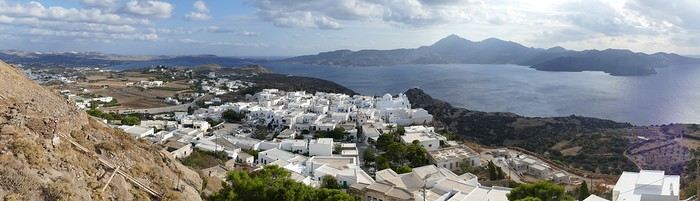
The village of Plaka in Milos
It was with great pleasure that we finally reconnected with our old habits as inveterate travelers! Greece, and more specifically the Greek islands, was the natural choice for us. After having already visited many Greek islands during around 18 trips, we decided to revisit islands we had seen over 40 years ago, like Milos, where our memories were extremely hazy. Our route was well-planned and familiar: a low-cost flight from Basel-Mulhouse to Athens, then a traditional ferry from Piraeus to Milos. Taking a speedboat, which is faster, would have forced us to spend a night in Piraeus. Plus, we felt that the traditional ferry was part of the journey, and with good weather, spending eight hours on deck wasn’t unpleasant at all. Watching the docking maneuvers with the comings and goings of trucks and cars, observing the passengers, reading a book, or admiring the scenery—all of that is part of the travel experience. Milos Island: Accommodation in Adamas We arrived quite late, around 11 PM, in Adamas, the port of Milos. No worries—the friendly couple managing the apartment was waiting for us, and it was just a 10-minute walk from the port. The first two days were spent unwinding, with swimming at the nearby beach, strolling through Adamas, and relaxing.
Discovering Plaka On the third day, we took the path along the small beach west of town toward a French military cemetery! A historical reminder of our presence here during the Crimean War, among others. The path climbs toward a beacon perched on top of a hill before disappearing into the scrubland. We returned to Adamas for lunch on our terrace.
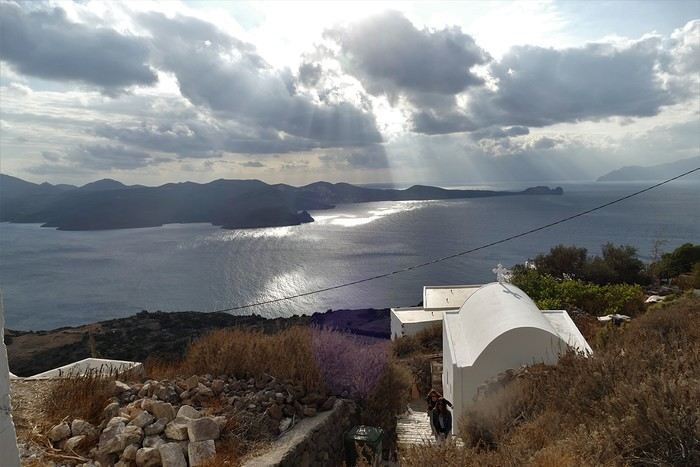
In the afternoon, we visited the hilltop village of Plaka by bus from Adamas. Plaka is the original old town, dominated by a church and, even higher up, the ruins of the Kastro. The view is magnificent. We stopped at a pastry shop in the village to enjoy excellent orange cakes and baklavas. Back in Adamas, we checked out car rental agencies to be more mobile, though the bus network seemed quite extensive. It costs around 40 € per day, plus 8 € if you want to significantly reduce the deductible. Port of Klima.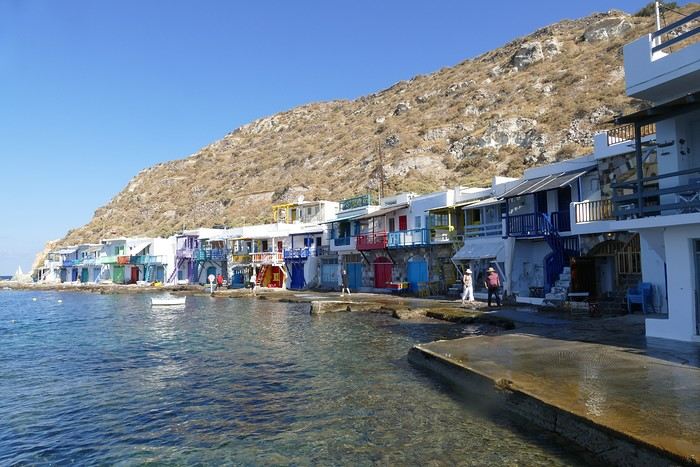
Yesterday’s weather was quite mixed with lots of clouds, but today the sun is shining again. We drove to the small port of Klima, famous for its boat garages called "sirmatas." It’s true that in the morning sun, these boat garages carved into the volcanic tuff are beautifully lit, turning the village into a colorful mosaic. Above the village, a path climbs directly to the magnificent Roman theater overlooking the surroundings and the sea.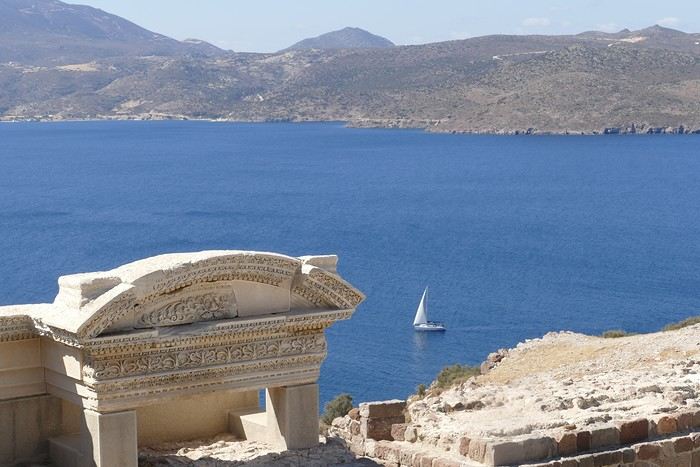 Following the well-marked path, we reached the road leading 200 meters down to the catacombs. It’s an impressive complex of 3rd and 4th-century catacombs, though only a small part is open to visitors—it’s still very moving. In the mid-afternoon, we got back in the car to visit the tiny ports of Firopotamos and Mandraki, which also have their colorful sirmatas. We took the opportunity to swim at the small beach in Mandraki, where the water was warm and calm.
Mandraki Port. We had a decent dinner at a seaside restaurant in Adamas, though you have to be selective—we had a bad experience at Kynigos on the second night!
Moving to Polonia in Eastern Milos, Sarakiniko Site
Following the well-marked path, we reached the road leading 200 meters down to the catacombs. It’s an impressive complex of 3rd and 4th-century catacombs, though only a small part is open to visitors—it’s still very moving. In the mid-afternoon, we got back in the car to visit the tiny ports of Firopotamos and Mandraki, which also have their colorful sirmatas. We took the opportunity to swim at the small beach in Mandraki, where the water was warm and calm.
Mandraki Port. We had a decent dinner at a seaside restaurant in Adamas, though you have to be selective—we had a bad experience at Kynigos on the second night!
Moving to Polonia in Eastern Milos, Sarakiniko Site
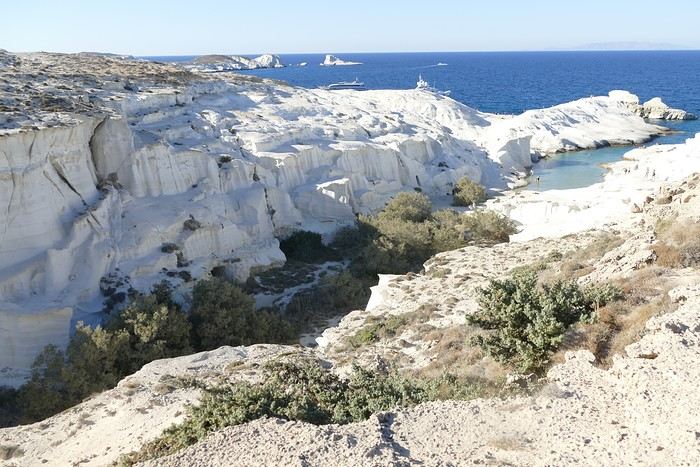
The Sarakiniko site We left Adamas for a second stay on Milos, this time in Polonia. The rental Panda was packed with the four of us and our luggage! Our apartment was in a beautiful house surrounded by a grove, so our lovely terrace was well-shaded. Luckily, there was a small beach nearby, and we went for a swim right away. Apart from us, there were only three other swimmers—definitely the end of the season!
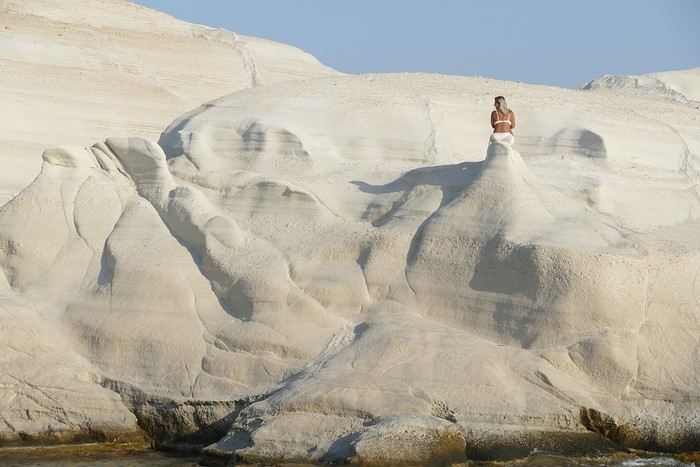
"Fairy chimney"! In the afternoon, we visited the famous Sarakiniko site, Milos’ emblematic spot. Judging by the number of cars in the parking lot, we wouldn’t be alone. As we approached, we heard an indefinable rock/punk/metal music: some young people had brought a sound system and a foghorn and were having fun diving off a fairly high cliff to impress the crowd. It definitely spoiled the visit. Most spots were taken by couples busy taking selfies, so getting photos of the site without tourists was impossible. Still, the site is magnificent, with its white cliffs looking like they’re covered in whipped cream! The sun was still very bright, reflecting strongly off the cliffs, making photography difficult due to the excessive brightness. We had a fish dinner in Polonia at the Enalion restaurant: while the octopus and squid were good, the fish soup tasted more like vegetable soup with a few fish crumbs—too bad.
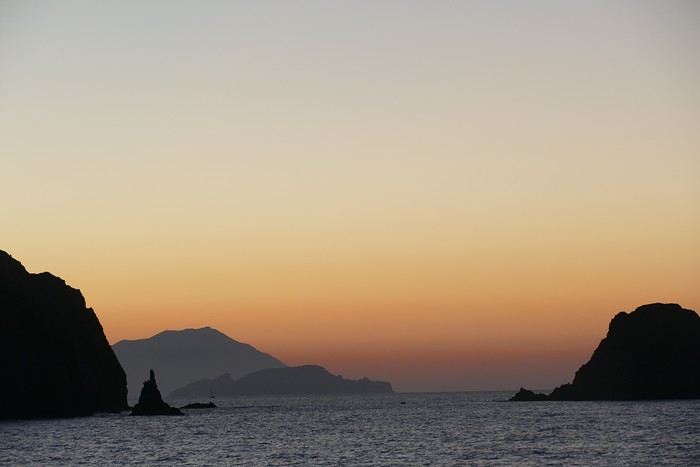
Sunset in Polonia
Ports of Papafranga and Mytikos We continued our exploration of Milos with the Papafranga gorge, a narrow and deep gorge that opens to the sea, where the water is a stunning color. Access via an unstable and dangerous path is prohibited, but that didn’t stop a couple of tourists in flip-flops from venturing in!!! We then swam in the tiny, calm, and sheltered cove of the small port of Mytikos. We returned to Polonia for lunch at Alkis: excellent moussaka. In the late afternoon, Pat and I went out to take some photos just before sunset near the Agios Nikolaos chapel, the beacon, and the new Petakoudia neighborhood next to Polonia to the north.
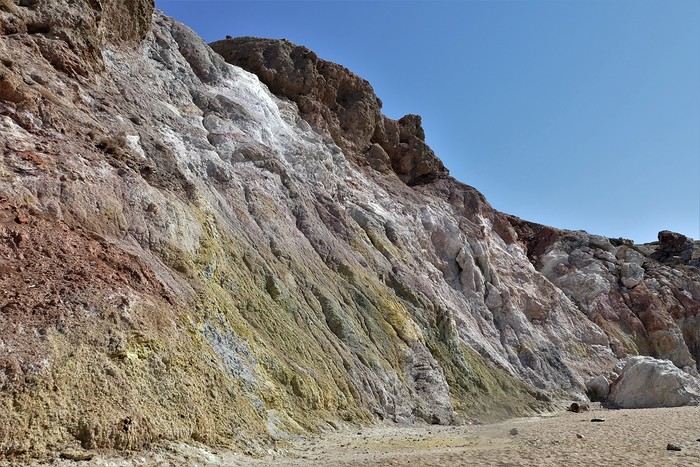
Paleochori Beach
Toward the Multicolored Beach of Paleochori Another sunny day: we still had to discover Paleochori Beach in the south of the island. It was 10:30 AM, and the beach was almost deserted! The water was pleasant, though a bit chilly when we first entered. The beach is bordered by a cliff that, in some places, displays a beautiful multicolored palette. We returned to Polonia in the late afternoon, and Pat and I headed toward Vouddhia Beach south of Polonia—bad choice. The beach is surrounded by a huge mining site served by a dusty road where lines of trucks loaded with ore cross paths. It’s the other side of the coin, and Greece still has progress to make in this area. Dinner at Alki’s was just as good as always. Return to the Sarakiniko Site Early this morning, Pat and I went back to the Sarakiniko site, hoping to take photos in better conditions. While there were fewer people, the parking lot was still full because sunrise is a must in Milos. Still, the conditions were good, and the sunrise spectators left quickly once the sun had risen above the horizon. During the day, an increasingly strong wind cooled the atmosphere, making swimming less enjoyable. Departure for Kimolos Island We changed islands and left Milos for Kimolos, a nearby island—just a 30-minute trip from Polonia’s port. Our apartment was at the entrance of the hilltop village. It’s a village with typical Cycladic architecture, featuring the remains of an old kastro, a few old churches, and windmill towers perched on the hill. We dined in a tiny tavern where the small outdoor tables were squeezed against the walls to let passersby through! As soon as the sun disappeared, it got cold, especially because of the wind. Ports of Kara and Goupa This morning, we explored the small hamlets of Kara and Goupa by Rema Beach, east of the main port. There, we found the sirmatas again—those boat garages partly carved into the volcanic tuff. The path winds between several sirmatas before climbing back up to the Praça road to return to the apartment.
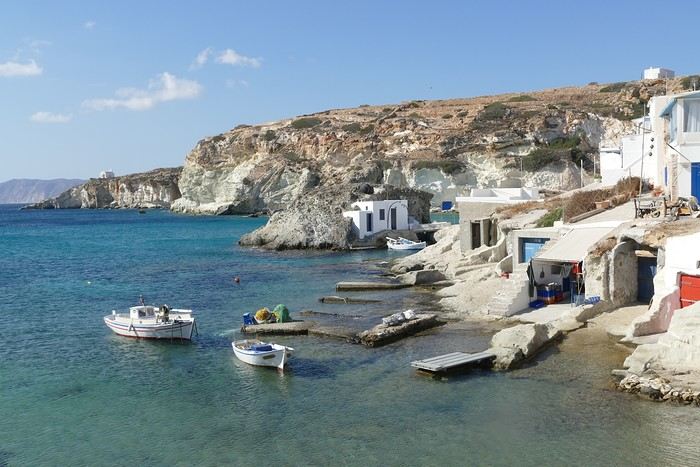
Ports of Kara and Goupa
In the afternoon, we strolled through town, and Pat and I climbed the hill overlooking the village to get a closer look at the few more or less ruined windmills dotting the ridge. Only one mill still had its complete mechanism in place under the roof; the others were empty. The view over the village, port, and sea was beautiful. That evening, we tried another restaurant in the village center, Kali Kardia Bohoris, which was well-frequented by locals, and we didn’t regret it: delicious food, efficient and friendly service, and reasonable prices.
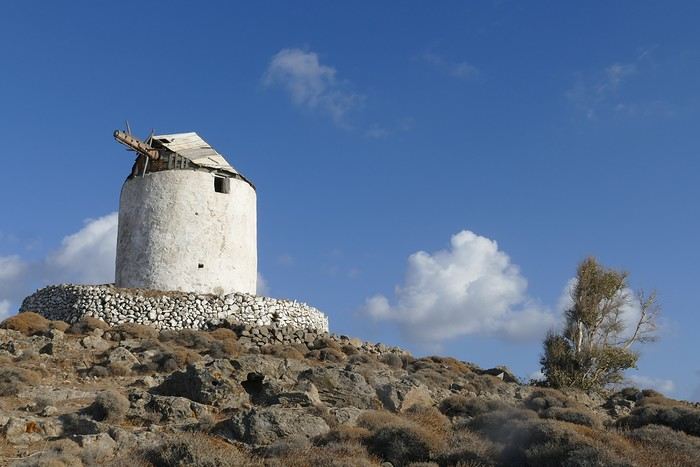
The Kastro Mill
Toward Aliki Beach We walked to Aliki Beach, west of the main village. It’s a large sandy beach shaded by tamarisk trees, but the strong wind prevented us from enjoying it. In the afternoon, I set off on a hike toward the fairy chimney at Skiadi (1.5 hours one way). The paths were very well-marked with signs indicating the trail number and the time to reach the destination. The countryside was beautiful but very dry at this time of year, and as always in Greece, many white chapels dotted the landscape. The numerous dry stone walls testify to the immense labor done by the island’s inhabitants over the centuries! For our last day in Kimolos, we decided to visit the beautiful Praça Beach, one of the most beautiful according to the guides! To get there, we took a path through the interior before joining the paved road near a large dump overflowing with various waste. It’s the flip side of the scenery, and Greece still has progress to make in this area. In the end, Praça Beach left us underwhelmed. The environment, marred by mining operations, detracts from the charm of the beautiful sandy beach. End of the Trip, Return to Piraeus and France And that’s it—we took the Zanteferries ferry back to Piraeus, arriving after a calm and sunny 10-hour journey. We had dinner at Souvlaki Street on the port and spent a good night at the Faros I Hotel in Piraeus—a great spot, close to the port, very clean, and reasonably priced. We flew from Athens to Basel-Mulhouse EuroAirport without any issues. N.B. Budget: around 1850 € all included for 14 days per couple The photo album is available by clicking this link: https://photos.app.goo.gl/wRpxRipg4erpzGj99
The village of Plaka in Milos
It was with great pleasure that we finally reconnected with our old habits as inveterate travelers! Greece, and more specifically the Greek islands, was the natural choice for us. After having already visited many Greek islands during around 18 trips, we decided to revisit islands we had seen over 40 years ago, like Milos, where our memories were extremely hazy. Our route was well-planned and familiar: a low-cost flight from Basel-Mulhouse to Athens, then a traditional ferry from Piraeus to Milos. Taking a speedboat, which is faster, would have forced us to spend a night in Piraeus. Plus, we felt that the traditional ferry was part of the journey, and with good weather, spending eight hours on deck wasn’t unpleasant at all. Watching the docking maneuvers with the comings and goings of trucks and cars, observing the passengers, reading a book, or admiring the scenery—all of that is part of the travel experience. Milos Island: Accommodation in Adamas We arrived quite late, around 11 PM, in Adamas, the port of Milos. No worries—the friendly couple managing the apartment was waiting for us, and it was just a 10-minute walk from the port. The first two days were spent unwinding, with swimming at the nearby beach, strolling through Adamas, and relaxing.
Discovering Plaka On the third day, we took the path along the small beach west of town toward a French military cemetery! A historical reminder of our presence here during the Crimean War, among others. The path climbs toward a beacon perched on top of a hill before disappearing into the scrubland. We returned to Adamas for lunch on our terrace.
In the afternoon, we visited the hilltop village of Plaka by bus from Adamas. Plaka is the original old town, dominated by a church and, even higher up, the ruins of the Kastro. The view is magnificent. We stopped at a pastry shop in the village to enjoy excellent orange cakes and baklavas. Back in Adamas, we checked out car rental agencies to be more mobile, though the bus network seemed quite extensive. It costs around 40 € per day, plus 8 € if you want to significantly reduce the deductible. Port of Klima.
Yesterday’s weather was quite mixed with lots of clouds, but today the sun is shining again. We drove to the small port of Klima, famous for its boat garages called "sirmatas." It’s true that in the morning sun, these boat garages carved into the volcanic tuff are beautifully lit, turning the village into a colorful mosaic. Above the village, a path climbs directly to the magnificent Roman theater overlooking the surroundings and the sea.
Following the well-marked path, we reached the road leading 200 meters down to the catacombs. It’s an impressive complex of 3rd and 4th-century catacombs, though only a small part is open to visitors—it’s still very moving. In the mid-afternoon, we got back in the car to visit the tiny ports of Firopotamos and Mandraki, which also have their colorful sirmatas. We took the opportunity to swim at the small beach in Mandraki, where the water was warm and calm.
Mandraki Port. We had a decent dinner at a seaside restaurant in Adamas, though you have to be selective—we had a bad experience at Kynigos on the second night!
Moving to Polonia in Eastern Milos, Sarakiniko SiteThe Sarakiniko site We left Adamas for a second stay on Milos, this time in Polonia. The rental Panda was packed with the four of us and our luggage! Our apartment was in a beautiful house surrounded by a grove, so our lovely terrace was well-shaded. Luckily, there was a small beach nearby, and we went for a swim right away. Apart from us, there were only three other swimmers—definitely the end of the season!
"Fairy chimney"! In the afternoon, we visited the famous Sarakiniko site, Milos’ emblematic spot. Judging by the number of cars in the parking lot, we wouldn’t be alone. As we approached, we heard an indefinable rock/punk/metal music: some young people had brought a sound system and a foghorn and were having fun diving off a fairly high cliff to impress the crowd. It definitely spoiled the visit. Most spots were taken by couples busy taking selfies, so getting photos of the site without tourists was impossible. Still, the site is magnificent, with its white cliffs looking like they’re covered in whipped cream! The sun was still very bright, reflecting strongly off the cliffs, making photography difficult due to the excessive brightness. We had a fish dinner in Polonia at the Enalion restaurant: while the octopus and squid were good, the fish soup tasted more like vegetable soup with a few fish crumbs—too bad.
Sunset in Polonia
Ports of Papafranga and Mytikos We continued our exploration of Milos with the Papafranga gorge, a narrow and deep gorge that opens to the sea, where the water is a stunning color. Access via an unstable and dangerous path is prohibited, but that didn’t stop a couple of tourists in flip-flops from venturing in!!! We then swam in the tiny, calm, and sheltered cove of the small port of Mytikos. We returned to Polonia for lunch at Alkis: excellent moussaka. In the late afternoon, Pat and I went out to take some photos just before sunset near the Agios Nikolaos chapel, the beacon, and the new Petakoudia neighborhood next to Polonia to the north.
Paleochori Beach
Toward the Multicolored Beach of Paleochori Another sunny day: we still had to discover Paleochori Beach in the south of the island. It was 10:30 AM, and the beach was almost deserted! The water was pleasant, though a bit chilly when we first entered. The beach is bordered by a cliff that, in some places, displays a beautiful multicolored palette. We returned to Polonia in the late afternoon, and Pat and I headed toward Vouddhia Beach south of Polonia—bad choice. The beach is surrounded by a huge mining site served by a dusty road where lines of trucks loaded with ore cross paths. It’s the other side of the coin, and Greece still has progress to make in this area. Dinner at Alki’s was just as good as always. Return to the Sarakiniko Site Early this morning, Pat and I went back to the Sarakiniko site, hoping to take photos in better conditions. While there were fewer people, the parking lot was still full because sunrise is a must in Milos. Still, the conditions were good, and the sunrise spectators left quickly once the sun had risen above the horizon. During the day, an increasingly strong wind cooled the atmosphere, making swimming less enjoyable. Departure for Kimolos Island We changed islands and left Milos for Kimolos, a nearby island—just a 30-minute trip from Polonia’s port. Our apartment was at the entrance of the hilltop village. It’s a village with typical Cycladic architecture, featuring the remains of an old kastro, a few old churches, and windmill towers perched on the hill. We dined in a tiny tavern where the small outdoor tables were squeezed against the walls to let passersby through! As soon as the sun disappeared, it got cold, especially because of the wind. Ports of Kara and Goupa This morning, we explored the small hamlets of Kara and Goupa by Rema Beach, east of the main port. There, we found the sirmatas again—those boat garages partly carved into the volcanic tuff. The path winds between several sirmatas before climbing back up to the Praça road to return to the apartment.
Ports of Kara and Goupa
In the afternoon, we strolled through town, and Pat and I climbed the hill overlooking the village to get a closer look at the few more or less ruined windmills dotting the ridge. Only one mill still had its complete mechanism in place under the roof; the others were empty. The view over the village, port, and sea was beautiful. That evening, we tried another restaurant in the village center, Kali Kardia Bohoris, which was well-frequented by locals, and we didn’t regret it: delicious food, efficient and friendly service, and reasonable prices.
The Kastro Mill
Toward Aliki Beach We walked to Aliki Beach, west of the main village. It’s a large sandy beach shaded by tamarisk trees, but the strong wind prevented us from enjoying it. In the afternoon, I set off on a hike toward the fairy chimney at Skiadi (1.5 hours one way). The paths were very well-marked with signs indicating the trail number and the time to reach the destination. The countryside was beautiful but very dry at this time of year, and as always in Greece, many white chapels dotted the landscape. The numerous dry stone walls testify to the immense labor done by the island’s inhabitants over the centuries! For our last day in Kimolos, we decided to visit the beautiful Praça Beach, one of the most beautiful according to the guides! To get there, we took a path through the interior before joining the paved road near a large dump overflowing with various waste. It’s the flip side of the scenery, and Greece still has progress to make in this area. In the end, Praça Beach left us underwhelmed. The environment, marred by mining operations, detracts from the charm of the beautiful sandy beach. End of the Trip, Return to Piraeus and France And that’s it—we took the Zanteferries ferry back to Piraeus, arriving after a calm and sunny 10-hour journey. We had dinner at Souvlaki Street on the port and spent a good night at the Faros I Hotel in Piraeus—a great spot, close to the port, very clean, and reasonably priced. We flew from Athens to Basel-Mulhouse EuroAirport without any issues. N.B. Budget: around 1850 € all included for 14 days per couple The photo album is available by clicking this link: https://photos.app.goo.gl/wRpxRipg4erpzGj99
Crossing Panay and Negros to reach Cebu with kids
Hi everyone!
We’re spending a month in the Philippines from mid-December to mid-January. We’ll be taking a flight from Cebu to Boracay for some kitesurfing. After that, we were thinking of heading back to Cebu Island via public transport or taxi, crossing Panay and Negros, and then going to Moalboal, Bantayan, and Malapascua.
Do you think it’s worth crossing Panay and Negros? We’ve heard there were floods on Negros, and Google Maps shows that the volcano on Negros is erupting, so I don’t think hiking it is an option. We have two kids with us, ages 10 and 7.
Thanks for sharing your experiences!
Magali
Ferry crossing from France or Spain to Morocco
Hi everyone, we’d like to go to Morocco for the first time around April, preferably from France or Spain. Which departure port would you recommend, and for arrival in Morocco, are there any ports that are better? I’ve read that some arrival ports aren’t very safe. Thanks for your advice!
Which islands to visit in the Philippines?
hi
we want to visit the Philippines in January but we’re not sure where to go—there are so many islands!
We’d also love some advice on where to land.
I’ve checked a few discussions, but they’re not recent.
thanks for your help
Visa issues with a Paris - Kuala Lumpur / Bangkok - Paris ticket
Hi everyone, I’d like to take a trip from France to Malaysia and Thailand like this:
Paris to Kuala Lumpur Kuala Lumpur to Langkawi
Langkawi to Koh Lipe
Bangkok to Paris
I’m wondering if I’ll run into any visa issues on arrival since I won’t have an outbound flight ticket from Malaysia and I won’t have an inbound flight ticket to Thailand. If you’ve got any tips or have done this trip before, I’d really appreciate your help.
Thanks so much.
Paris to Kuala Lumpur Kuala Lumpur to Langkawi
Langkawi to Koh Lipe
Bangkok to Paris
I’m wondering if I’ll run into any visa issues on arrival since I won’t have an outbound flight ticket from Malaysia and I won’t have an inbound flight ticket to Thailand. If you’ve got any tips or have done this trip before, I’d really appreciate your help.
Thanks so much.
Riding the Transamazonian by motorcycle: road conditions?
Hi there,
I’m planning to ride from Manaus to Lábrea via Humaitá and then continue along the Transamazonian from Lábrea to João Pessoa by motorcycle. I’m looking for recent info on the condition of this route (paved sections, dirt tracks, etc.). Thanks for any tips you can share!
I’m planning to ride from Manaus to Lábrea via Humaitá and then continue along the Transamazonian from Lábrea to João Pessoa by motorcycle. I’m looking for recent info on the condition of this route (paved sections, dirt tracks, etc.). Thanks for any tips you can share!
31-Day Japan Itinerary: From Kyushu to Tokyo
Hello everyone, what a pleasure to be back on this forum!
My partner and I are heading to Japan for the first time from mid-December to mid-January for 31 days. It’s a long-held dream we’ve been saving for over two years, and we want to enjoy ourselves while also being mindful of our budget for parts of the trip. We’d love to explore Tokyo, but we’ve chosen to spend more time in nature. My partner plans to get his driver’s license translated locally so we can rent a car. We’ve heard from friends who’ve been that Japan isn’t the best place for improvisation, so we’ve tried to allow plenty of time in each location to avoid rushing. Still, I’d love to hear your thoughts on the itinerary we’ve planned—whether it’s feasible in terms of travel and how interesting it seems. Given the recent increase in the JR Pass price and the fact that we’ll spend about ten days on Goto, Ojika, and Yakushima (where the JR Pass doesn’t cover travel), we don’t think it’s worth it for us. Instead, we’re planning to take the train from Tokyo to Fukuoka and then use buses and ferries for the rest of Kyushu. Here’s our itinerary:
1- December 13 / Arrival in Tokyo, one night in Tokyo, then departure for Fukuoka by train on the morning of the 14th.
2 - December 14-16 / 2 nights in Fukuoka, sightseeing, then departure on the evening/night of the 16th by ferry to Ojika Islands.
3 - December 17-21 / 4 nights on Ojika, cycling and exploring, then departure on the 21st by ferry to Fukue on the Goto Islands.
4 - December 21-24 / 3 nights on the Goto Islands, renting a car to explore, maybe a trip to Hisaka. Departure for Nagasaki by ferry on the morning of the 24th.
5- December 24-26 / 2 nights in Nagasaki, visiting the city and memorials, possibly the hot springs in Unzen. Departure on the evening of the 26th by bus or ferry (?) to Kumamoto.
6- December 26-29 / 3 nights in Kumamoto, sightseeing, day trip by car to Mount Aso and surrounding areas. Departure on the 29th in the late afternoon by bus to Kagoshima, overnight in Kagoshima.
7- December 30 to January 2 / Morning departure by ferry to Yakushima for 3 nights, hiking and exploring the island. Departure on January 2 on the only ferry (?) in the early afternoon back to Kagoshima.
8- January 2 to 5 / Uncertain leg... We’d like to spend the night of the 4th to the 5th at a ryokan in Kurokawa Onsen and then head back to Fukuoka and Tokyo by train on the 5th. From the 2nd to the 4th, since we’ll arrive in Kagoshima in the late afternoon, we thought we could head back up to Kumamoto by train or bus—going to Yufuin or Beppu would take much longer and leave us with very little time. But is it worth staying another 2 nights in Kumamoto to explore the area, given we’ll already be there for 3 days from December 26-29? Or should we stay in Kagoshima and head up to Kurokawa Onsen on the afternoon of the 4th for our overnight stay?
9- January 5 to 13, Tokyo and its endless things to do and see, then back to France!
If you have any advice on any of these stops, we’d love to hear it! Have a wonderful day.
My partner and I are heading to Japan for the first time from mid-December to mid-January for 31 days. It’s a long-held dream we’ve been saving for over two years, and we want to enjoy ourselves while also being mindful of our budget for parts of the trip. We’d love to explore Tokyo, but we’ve chosen to spend more time in nature. My partner plans to get his driver’s license translated locally so we can rent a car. We’ve heard from friends who’ve been that Japan isn’t the best place for improvisation, so we’ve tried to allow plenty of time in each location to avoid rushing. Still, I’d love to hear your thoughts on the itinerary we’ve planned—whether it’s feasible in terms of travel and how interesting it seems. Given the recent increase in the JR Pass price and the fact that we’ll spend about ten days on Goto, Ojika, and Yakushima (where the JR Pass doesn’t cover travel), we don’t think it’s worth it for us. Instead, we’re planning to take the train from Tokyo to Fukuoka and then use buses and ferries for the rest of Kyushu. Here’s our itinerary:
1- December 13 / Arrival in Tokyo, one night in Tokyo, then departure for Fukuoka by train on the morning of the 14th.
2 - December 14-16 / 2 nights in Fukuoka, sightseeing, then departure on the evening/night of the 16th by ferry to Ojika Islands.
3 - December 17-21 / 4 nights on Ojika, cycling and exploring, then departure on the 21st by ferry to Fukue on the Goto Islands.
4 - December 21-24 / 3 nights on the Goto Islands, renting a car to explore, maybe a trip to Hisaka. Departure for Nagasaki by ferry on the morning of the 24th.
5- December 24-26 / 2 nights in Nagasaki, visiting the city and memorials, possibly the hot springs in Unzen. Departure on the evening of the 26th by bus or ferry (?) to Kumamoto.
6- December 26-29 / 3 nights in Kumamoto, sightseeing, day trip by car to Mount Aso and surrounding areas. Departure on the 29th in the late afternoon by bus to Kagoshima, overnight in Kagoshima.
7- December 30 to January 2 / Morning departure by ferry to Yakushima for 3 nights, hiking and exploring the island. Departure on January 2 on the only ferry (?) in the early afternoon back to Kagoshima.
8- January 2 to 5 / Uncertain leg... We’d like to spend the night of the 4th to the 5th at a ryokan in Kurokawa Onsen and then head back to Fukuoka and Tokyo by train on the 5th. From the 2nd to the 4th, since we’ll arrive in Kagoshima in the late afternoon, we thought we could head back up to Kumamoto by train or bus—going to Yufuin or Beppu would take much longer and leave us with very little time. But is it worth staying another 2 nights in Kumamoto to explore the area, given we’ll already be there for 3 days from December 26-29? Or should we stay in Kagoshima and head up to Kurokawa Onsen on the afternoon of the 4th for our overnight stay?
9- January 5 to 13, Tokyo and its endless things to do and see, then back to France!
If you have any advice on any of these stops, we’d love to hear it! Have a wonderful day.
17-day itinerary: Québec, Gaspésie, and Saguenay
Hi there,
We’re heading to Québec from July 7 to 24, 2025, and we’d love some advice on our itinerary. We’re flying in and out of Montréal and want to visit Montréal, Québec City, Parc de la Gaspésie, and the Saguenay Fjord. What do you think would be the best route to make the most of these spots without racking up too many kilometers each day? Thanks in advance for your help! Catherine
We’re heading to Québec from July 7 to 24, 2025, and we’d love some advice on our itinerary. We’re flying in and out of Montréal and want to visit Montréal, Québec City, Parc de la Gaspésie, and the Saguenay Fjord. What do you think would be the best route to make the most of these spots without racking up too many kilometers each day? Thanks in advance for your help! Catherine
Dream Islands: Greece, French Polynesia, Mauritius...
Hello,
Who among us hasn’t dreamed of having a ticket to Tahiti, Bora Bora, or the Marquesas in their pocket—preferably a one-way ticket to “paradise”?
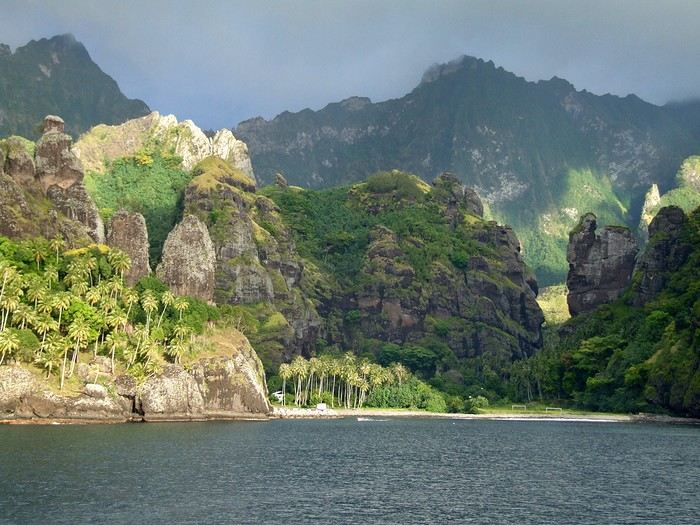 Idyllic landscape of a dream island, but difficult to access: the Bay of Virgins in Fatu Hiva, Marquesas Islands
Among the values conveyed by literature, tourism, and advertising is the quest for “elsewhere,” for a change of scenery, in the truest sense of the word—that is, the need to leave one’s country. This need for otherness, for difference, is projected onto dreamlike, idealized, even mythicized places. In our imaginary world, the island is often that place.
Yet we forget that islands have also been ideal prisons. The examples are numerous: Elba and Saint Helena, Alcatraz and Poulo Condor, If and Yeu, the Devil’s Islands and Leros. The latter, located in Greece in the Dodecanese, hosted a sinister forced labor camp during the colonels’ dictatorship as well as a psychiatric hospital. Despite the beauty of its bay, tourism has remained marginal there due to its bad reputation, unlike the neighboring island of Patmos.
I’d like to share a selection of about a dozen islands from across the world’s seas and oceans. For dreaming...
°°°°°°°°°°°°°°°
SANTORINI
July 27, 1967
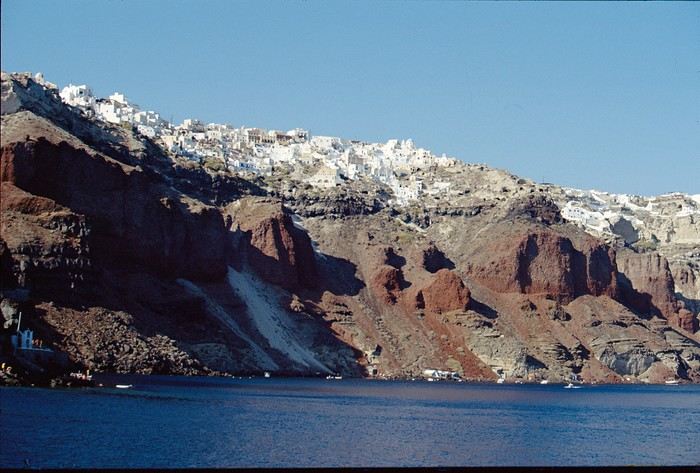
At dawn, the ferry from Agios Nikolaos (Crete) enters the immense caldera of Santorini. From the ship’s deck, Rainer, my travel companion, and I are left in awe by the sight of these towering, multicolored cliffs looming over us. We disembark and begin the steep climb on foot via the winding mule path up to the village of Fira, the capital perched above the cliff. Though it’s still very early, we head to the youth hostel. There wasn’t a soul in the alleys that morning—or rather, there were only cats! I have a fond memory of that encounter with Santorini: a sensory shock, a breathtaking volcanic site, a harmony of blue, ochre-red, and white. A welcoming island, as it was traditional to welcome the xénou, an island that hadn’t yet fully recovered from the terrible 1956 earthquake, a Cycladic architectural marvel where local life was still preserved.
It’s easy to see why, in antiquity, the island was named Kallisté (καλλίστη), “the most beautiful,” as it’s nearly impossible to resist gazing at this landscape shaped by tectonic forces. Indeed, a massive volcanic cataclysm—the Minoan eruption—shaped this scenery in the 17th century BCE, creating a caldera that was quickly filled by the sea. The enormous tsunamis that followed reached Crete, leading to the disappearance of the Minoan civilization.
A cliffside path along the caldera leads us to the peaceful village of Oia, at the northern tip of the island. Blue-domed churches and flower-filled villages with whitewashed houses line the way. This walk is a continuous marvel, offering splendid views of the caldera and the neighboring islands formed by the breakup of the ancient volcano (Thirissa, Nea Kameni). Oia is a large, picturesque village, like Fira perched on the cliff’s edge, which was severely damaged by the 1956 earthquake, and its scars are still visible. Its cave-like houses with vaulted roofs haven’t yet been turned into luxury hotels or shops. Absolute tranquility reigns here.
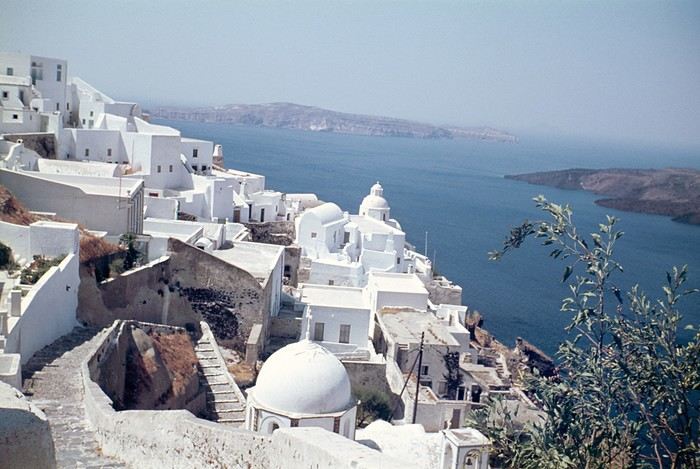 Oia in 1967—a peaceful village overlooking the caldera. But where are the pools and trendy bars?
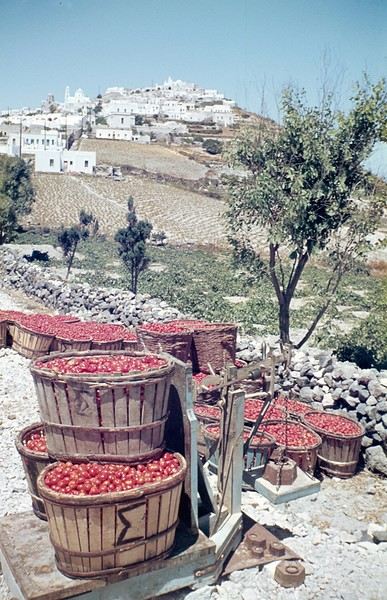
A lush countryside covered in olive trees and vineyards welcomes us for a pleasant hike, interrupted by the kindness of a friendly islander who gives us a lift in his truck for a few kilometers. He’s off to harvest his tomatoes, which he grows at the foot of Pyrgos Hill. The delicious little cherry tomato of Santorini earned an EU Protected Designation of Origin (PDO) in 2013. We climb up to the village of Pyrgos, perched on a hill and dominated by the elegant bell tower of its church. Finally, we reach the black sand beach of Kamari on the island’s eastern coast to enjoy a swim.
{...} To be continued

°°°°°°°°°°°°°°°°°
RAIVAVAE (French Polynesia)
November 15, 2007
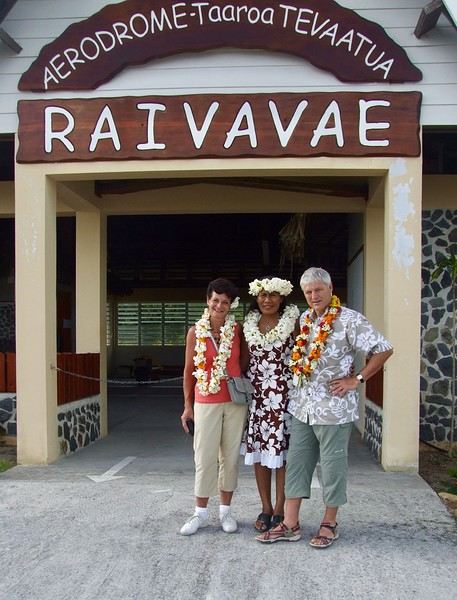
Éléonore from Pension Tama welcomes us with traditional flower leis, as if she’d been waiting for old friends she hadn’t seen in ages. The small airport terminal is lively, the atmosphere warm—people hugging, rejoicing in reunions, all under kilos of flowers. Then, just as quickly, the place empties until the next flight... in a few days.
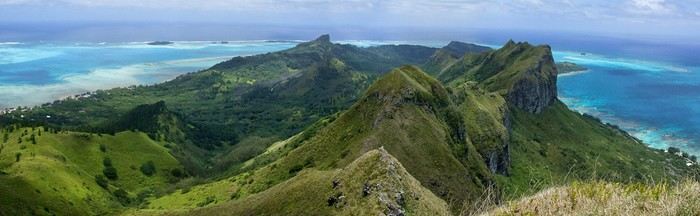
In the Austral Islands, a ninety-minute flight from Tahiti, Raivavae is a world away from the frenetic pace of Papeete or the tourist crowds of the Leeward Islands. The true paradise of the South Seas can still be savored here—it’s a bit like Bora Bora half a century ago. Our first feeling upon arriving on this island is wonder, with smiles that could melt even the gloomiest among us, landscapes so stunning they take your breath away, and above all, a sense of disorientation and fulfillment. Picture a mountainous island, about ten kilometers by three and a half, encircled by a coral reef and wild motu, cradling a lagoon with shades of blue that would make Bora Bora green with envy.
The roughly one thousand inhabitants of Raivavae are spread across four villages around the island. Children are everywhere, as is typical in Polynesia, and they greet you with open, genuine smiles. Here, ancestral values have survived progress. The predominantly Protestant population is very devout, as evidenced by the several temples built across the island. Religious fervor sets the rhythm of daily life. Sundays are reserved for worship and Sunday school (catechism). Work is forbidden on that day, and tourist activities are suspended. These rules are strict and respected.
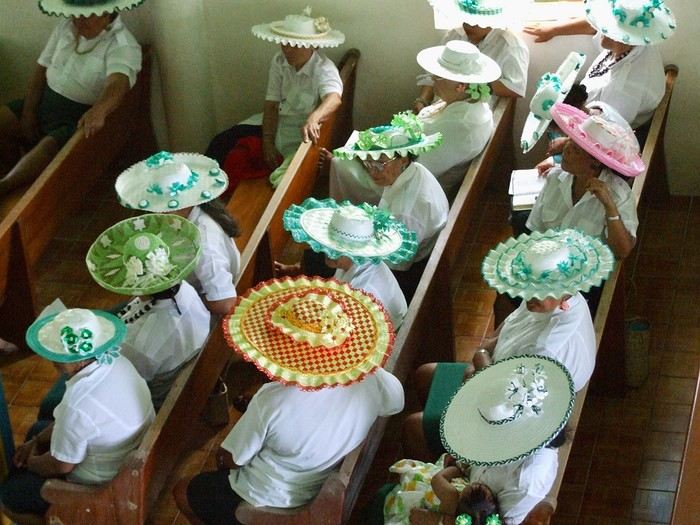 Hat contest for the worship celebration
Yet a sense of resignation is ever-present. The people of Raivavae know they are—and will remain—isolated. Despite the construction of an airstrip in 2004 and a few weekly flights to Tahiti and its nearest neighbor, Tubuai (200 km away), the island remains on the fringes of the world. One painful aspect is the separation of children from their parents when they leave for middle school in Tubuai starting in fifth grade. Television brings daily images of a world the islanders will likely never know, but one they often aspire to.
We are privileged. We have the pristine white-sand beaches of the motu and some of the most beautiful bays in Polynesia all to ourselves. The jewel in the crown, the island’s emblematic spot, is the “motu-pool,” about twenty minutes by boat. A natural, exquisite basin with crystal-clear water, gradients of blue, and white sand. And best of all, there’s almost no one there. In fact, lounging on the beach is frowned upon, especially for young women. Religion looks very unfavorably on sunbathing and lazing around. And yet, everything here leans toward that philosophy of life.
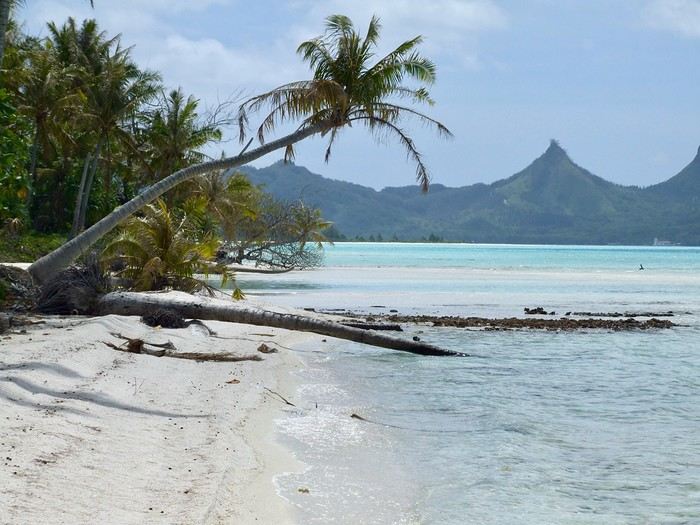
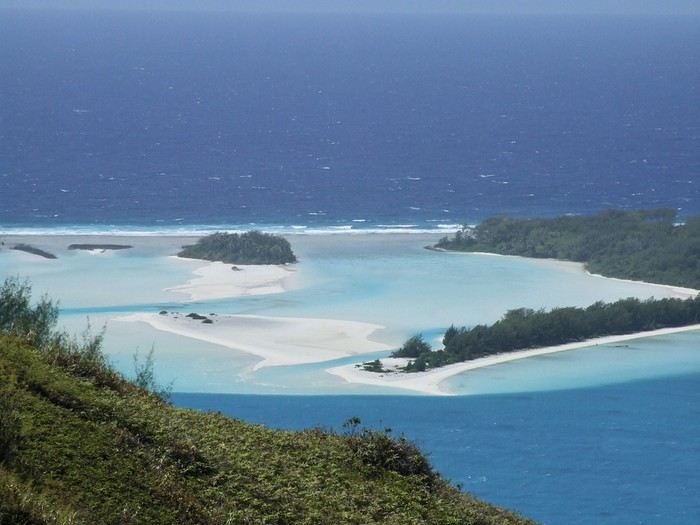 The "motu-pool"
{...} To be continued
Who among us hasn’t dreamed of having a ticket to Tahiti, Bora Bora, or the Marquesas in their pocket—preferably a one-way ticket to “paradise”?
Idyllic landscape of a dream island, but difficult to access: the Bay of Virgins in Fatu Hiva, Marquesas IslandsAmong the values conveyed by literature, tourism, and advertising is the quest for “elsewhere,” for a change of scenery, in the truest sense of the word—that is, the need to leave one’s country. This need for otherness, for difference, is projected onto dreamlike, idealized, even mythicized places. In our imaginary world, the island is often that place.
Yet we forget that islands have also been ideal prisons. The examples are numerous: Elba and Saint Helena, Alcatraz and Poulo Condor, If and Yeu, the Devil’s Islands and Leros. The latter, located in Greece in the Dodecanese, hosted a sinister forced labor camp during the colonels’ dictatorship as well as a psychiatric hospital. Despite the beauty of its bay, tourism has remained marginal there due to its bad reputation, unlike the neighboring island of Patmos.
I’d like to share a selection of about a dozen islands from across the world’s seas and oceans. For dreaming...
°°°°°°°°°°°°°°°
SANTORINI
July 27, 1967
At dawn, the ferry from Agios Nikolaos (Crete) enters the immense caldera of Santorini. From the ship’s deck, Rainer, my travel companion, and I are left in awe by the sight of these towering, multicolored cliffs looming over us. We disembark and begin the steep climb on foot via the winding mule path up to the village of Fira, the capital perched above the cliff. Though it’s still very early, we head to the youth hostel. There wasn’t a soul in the alleys that morning—or rather, there were only cats! I have a fond memory of that encounter with Santorini: a sensory shock, a breathtaking volcanic site, a harmony of blue, ochre-red, and white. A welcoming island, as it was traditional to welcome the xénou, an island that hadn’t yet fully recovered from the terrible 1956 earthquake, a Cycladic architectural marvel where local life was still preserved.
It’s easy to see why, in antiquity, the island was named Kallisté (καλλίστη), “the most beautiful,” as it’s nearly impossible to resist gazing at this landscape shaped by tectonic forces. Indeed, a massive volcanic cataclysm—the Minoan eruption—shaped this scenery in the 17th century BCE, creating a caldera that was quickly filled by the sea. The enormous tsunamis that followed reached Crete, leading to the disappearance of the Minoan civilization.
A cliffside path along the caldera leads us to the peaceful village of Oia, at the northern tip of the island. Blue-domed churches and flower-filled villages with whitewashed houses line the way. This walk is a continuous marvel, offering splendid views of the caldera and the neighboring islands formed by the breakup of the ancient volcano (Thirissa, Nea Kameni). Oia is a large, picturesque village, like Fira perched on the cliff’s edge, which was severely damaged by the 1956 earthquake, and its scars are still visible. Its cave-like houses with vaulted roofs haven’t yet been turned into luxury hotels or shops. Absolute tranquility reigns here.
Oia in 1967—a peaceful village overlooking the caldera. But where are the pools and trendy bars?A lush countryside covered in olive trees and vineyards welcomes us for a pleasant hike, interrupted by the kindness of a friendly islander who gives us a lift in his truck for a few kilometers. He’s off to harvest his tomatoes, which he grows at the foot of Pyrgos Hill. The delicious little cherry tomato of Santorini earned an EU Protected Designation of Origin (PDO) in 2013. We climb up to the village of Pyrgos, perched on a hill and dominated by the elegant bell tower of its church. Finally, we reach the black sand beach of Kamari on the island’s eastern coast to enjoy a swim.
{...} To be continued
°°°°°°°°°°°°°°°°°
RAIVAVAE (French Polynesia)
November 15, 2007
Éléonore from Pension Tama welcomes us with traditional flower leis, as if she’d been waiting for old friends she hadn’t seen in ages. The small airport terminal is lively, the atmosphere warm—people hugging, rejoicing in reunions, all under kilos of flowers. Then, just as quickly, the place empties until the next flight... in a few days.
In the Austral Islands, a ninety-minute flight from Tahiti, Raivavae is a world away from the frenetic pace of Papeete or the tourist crowds of the Leeward Islands. The true paradise of the South Seas can still be savored here—it’s a bit like Bora Bora half a century ago. Our first feeling upon arriving on this island is wonder, with smiles that could melt even the gloomiest among us, landscapes so stunning they take your breath away, and above all, a sense of disorientation and fulfillment. Picture a mountainous island, about ten kilometers by three and a half, encircled by a coral reef and wild motu, cradling a lagoon with shades of blue that would make Bora Bora green with envy.
The roughly one thousand inhabitants of Raivavae are spread across four villages around the island. Children are everywhere, as is typical in Polynesia, and they greet you with open, genuine smiles. Here, ancestral values have survived progress. The predominantly Protestant population is very devout, as evidenced by the several temples built across the island. Religious fervor sets the rhythm of daily life. Sundays are reserved for worship and Sunday school (catechism). Work is forbidden on that day, and tourist activities are suspended. These rules are strict and respected.
Hat contest for the worship celebrationYet a sense of resignation is ever-present. The people of Raivavae know they are—and will remain—isolated. Despite the construction of an airstrip in 2004 and a few weekly flights to Tahiti and its nearest neighbor, Tubuai (200 km away), the island remains on the fringes of the world. One painful aspect is the separation of children from their parents when they leave for middle school in Tubuai starting in fifth grade. Television brings daily images of a world the islanders will likely never know, but one they often aspire to.
We are privileged. We have the pristine white-sand beaches of the motu and some of the most beautiful bays in Polynesia all to ourselves. The jewel in the crown, the island’s emblematic spot, is the “motu-pool,” about twenty minutes by boat. A natural, exquisite basin with crystal-clear water, gradients of blue, and white sand. And best of all, there’s almost no one there. In fact, lounging on the beach is frowned upon, especially for young women. Religion looks very unfavorably on sunbathing and lazing around. And yet, everything here leans toward that philosophy of life.
The "motu-pool"{...} To be continued
Laos and Cambodia from late December to early February
Hi there,
I’ll be in Laos and then Cambodia from mid-to-late December until early February.
I haven’t been to Laos before, but I already know Cambodia.
I plan to arrive via northern Thailand and leave from Bangkok (it’s a question of flight prices).
I’m used to traveling by local transport and staying in simple guesthouses, with internal flights if needed. Sightseeing, exploring, and connecting with locals are my priorities.
If anyone’s interested in joining for part or all of this trip, we can chat and discuss. I only have a rough itinerary so far.
See you soon,
Francoise
9-day road trip from Melbourne to Sydney
Hi everyone,
What great news to read that Voyage Forum is back up and running—I’m so happy! 🙂 I need some advice for a trip we’re planning in 2025: New Caledonia and Australia.
We’ll arrive in Australia on September 1, 2025, and the plan is to spend 2 nights in Melbourne to explore the city, then rent a car to drive from Melbourne to Sydney, where we’ll arrive on September 12. Unfortunately, we won’t have time for the Great Ocean Road
I’ve checked several blogs for this route and here’s the itinerary I’ve put together:
9/4: Melbourne to Philip Island (140 km) – 1 night 9/5: Philip Island to Wilsons Promontory National Park – 2 nights 9/7: Raymond Island (free ferry to cross a 200 m sea channel) – Lakes Entrance – 1 night 9/8: Drive to Narooma (stop at Quarry Beach) – 1 night at "Bodalla Park Forest Rest Area" 9/9: Batemans Bay – Pebbly Beach – Dolphin Point – Jervis Bay – 1 night (to be found) 9/10: Jervis Bay and surroundings – 1 night at Bendeela Picnic Area 9/11: Blue Mountains National Park (1 hour from Sydney) – 1 night (to be found) 9/12: Arrival in Sydney
I know we won’t be able to see everything, and this 9-day route is just a starting point. The goal is to avoid rushing—if we see a place we like, we’ll stop, even if it means seeing less. A vacation where we don’t watch the clock too much! 🙂 Does this route (a mix of several blogs where not all stops are noted) seem realistic or too ambitious? Are there certain spots that are more worth prioritizing over the ones I’ve listed? For example, in one of the blogs I read, travelers skipped Blue Mountains National Park because they chose another site (which I’ve forgotten 😎).
For accommodation, we’ll likely be camping (free or paid), so if you have any suggestions, I’d love to hear them! 😎
Our arrival in Sydney on September 12 depends on my hope to participate in the marathon on September 15, 2025. After that, we’ll leave Sydney on September 17 for Ayers Rock.
Thanks in advance for your tips and ideas—it’s always tricky to plan a route from a distance when time is limited.
And long live this site, which I’ve missed so much since 2020! 😎🙂
We’ll arrive in Australia on September 1, 2025, and the plan is to spend 2 nights in Melbourne to explore the city, then rent a car to drive from Melbourne to Sydney, where we’ll arrive on September 12. Unfortunately, we won’t have time for the Great Ocean Road
I’ve checked several blogs for this route and here’s the itinerary I’ve put together:
9/4: Melbourne to Philip Island (140 km) – 1 night 9/5: Philip Island to Wilsons Promontory National Park – 2 nights 9/7: Raymond Island (free ferry to cross a 200 m sea channel) – Lakes Entrance – 1 night 9/8: Drive to Narooma (stop at Quarry Beach) – 1 night at "Bodalla Park Forest Rest Area" 9/9: Batemans Bay – Pebbly Beach – Dolphin Point – Jervis Bay – 1 night (to be found) 9/10: Jervis Bay and surroundings – 1 night at Bendeela Picnic Area 9/11: Blue Mountains National Park (1 hour from Sydney) – 1 night (to be found) 9/12: Arrival in Sydney
I know we won’t be able to see everything, and this 9-day route is just a starting point. The goal is to avoid rushing—if we see a place we like, we’ll stop, even if it means seeing less. A vacation where we don’t watch the clock too much! 🙂 Does this route (a mix of several blogs where not all stops are noted) seem realistic or too ambitious? Are there certain spots that are more worth prioritizing over the ones I’ve listed? For example, in one of the blogs I read, travelers skipped Blue Mountains National Park because they chose another site (which I’ve forgotten 😎).
For accommodation, we’ll likely be camping (free or paid), so if you have any suggestions, I’d love to hear them! 😎
Our arrival in Sydney on September 12 depends on my hope to participate in the marathon on September 15, 2025. After that, we’ll leave Sydney on September 17 for Ayers Rock.
Thanks in advance for your tips and ideas—it’s always tricky to plan a route from a distance when time is limited.
And long live this site, which I’ve missed so much since 2020! 😎🙂
Transport: Kuala Lumpur to Malacca, Penang to Cameron Highlands, and Cameron Highlands to Pangkor
Hi everyone,
I’m currently planning a trip to Malaysia for January 2025.
I’ve got three transport questions for you all!
1: I arrive at 3 PM at Kuala Lumpur Airport and plan to take a direct bus to Malacca. Is booking a bus for 5 PM feasible, or is it too tight after collecting luggage? And which platform is the most reliable? Redbus, 12GO Asia, Rome2RIO, busonlineticket? Or can I buy a ticket on the spot without a reservation? Is that too risky? Alternatively, is it better to take a Grab? I saw the fare was around 60 €. Can you confirm this price? And is it easy to find a Grab from the airport for this distance?
2: Penang to Cameron Highlands (Tanah Rata) route—I saw there’s a direct bus that takes 5 hours. Can you confirm this? And is this duration realistic?
3: Cameron Highlands to Pangkor: This one’s tricky... The best I’ve found is 2 buses + a ferry + a taxi. Do you have a better suggestion?
Thanks for your help! Guy
1: I arrive at 3 PM at Kuala Lumpur Airport and plan to take a direct bus to Malacca. Is booking a bus for 5 PM feasible, or is it too tight after collecting luggage? And which platform is the most reliable? Redbus, 12GO Asia, Rome2RIO, busonlineticket? Or can I buy a ticket on the spot without a reservation? Is that too risky? Alternatively, is it better to take a Grab? I saw the fare was around 60 €. Can you confirm this price? And is it easy to find a Grab from the airport for this distance?
2: Penang to Cameron Highlands (Tanah Rata) route—I saw there’s a direct bus that takes 5 hours. Can you confirm this? And is this duration realistic?
3: Cameron Highlands to Pangkor: This one’s tricky... The best I’ve found is 2 buses + a ferry + a taxi. Do you have a better suggestion?
Thanks for your help! Guy
Carretera Austral Road Trip from Puerto Montt to Caleta Tortel (Chile) by 4x4: A Few Questions
Hello,
I’ve planned a 3.5-week trip to Chile in February/March 2025, with the goal of driving the Carretera Austral from Puerto Montt to Caleta Tortel in a rented 4x4. The itinerary is set, accommodations are booked, and the 4x4 is reserved. We could still tweak things a bit, but it’s getting harder to find available lodging in some spots.
Here’s the planned route: - 1 night in Puerto Montt on arrival day - 2 nights in Castro (Chiloé Island) - 2 nights near Ensenada - 1 night in Horniporén - 1 night in Chaitén - 3 nights in Puyuhuapi - 2 nights in Coyhaique - 3 nights between Puerto Bertrand and Cochrane - 2 nights in Caleta Tortel - 3 nights in Puerto Guadal - 1 night in Chile Chico (to take the ferry across the lake) - 1 night in Villa Cerro Castillo before flying out from Balmaceda
I have a few questions about the activities we’d like to do:
The **Marble Caves**: I’d love an option that lets us "go inside" them. From what I’ve read, this depends on the water level, wind, and type of boat. Any tips or advice? We’d like to do an **excursion to see condors**. We were thinking of doing this while in Coyhaique (we’re staying 2 nights). Has anyone done this? With which agency? We’re spending 3 nights between Puerto Bertrand and Cochrane. The idea is to **explore the vast Patagonia Park and its wildlife**. But I’m not sure where to start. Any recommendations for day hikes or itineraries? I read somewhere that you can do a day trip with a guide that includes a boat ride on Lake Cochrane, but I can’t find the booking info. An agency for **glacier exploration** (we were thinking of **Lake Leones Glacier**). I contacted Ruta León but haven’t heard back. Any agencies to recommend?
Thanks so much! Pascale
I’ve planned a 3.5-week trip to Chile in February/March 2025, with the goal of driving the Carretera Austral from Puerto Montt to Caleta Tortel in a rented 4x4. The itinerary is set, accommodations are booked, and the 4x4 is reserved. We could still tweak things a bit, but it’s getting harder to find available lodging in some spots.
Here’s the planned route: - 1 night in Puerto Montt on arrival day - 2 nights in Castro (Chiloé Island) - 2 nights near Ensenada - 1 night in Horniporén - 1 night in Chaitén - 3 nights in Puyuhuapi - 2 nights in Coyhaique - 3 nights between Puerto Bertrand and Cochrane - 2 nights in Caleta Tortel - 3 nights in Puerto Guadal - 1 night in Chile Chico (to take the ferry across the lake) - 1 night in Villa Cerro Castillo before flying out from Balmaceda
I have a few questions about the activities we’d like to do:
The **Marble Caves**: I’d love an option that lets us "go inside" them. From what I’ve read, this depends on the water level, wind, and type of boat. Any tips or advice? We’d like to do an **excursion to see condors**. We were thinking of doing this while in Coyhaique (we’re staying 2 nights). Has anyone done this? With which agency? We’re spending 3 nights between Puerto Bertrand and Cochrane. The idea is to **explore the vast Patagonia Park and its wildlife**. But I’m not sure where to start. Any recommendations for day hikes or itineraries? I read somewhere that you can do a day trip with a guide that includes a boat ride on Lake Cochrane, but I can’t find the booking info. An agency for **glacier exploration** (we were thinking of **Lake Leones Glacier**). I contacted Ruta León but haven’t heard back. Any agencies to recommend?
Thanks so much! Pascale
Départ de Naples en famille: Pouilles et/ou côte Amalfitaine English translation pending
Bonjour,
sauf nouvelles restrictions, nous devrions partir en famille dans le sud de l'Italie, du 18 au 30 octobre. A l'origine, on cherchait à aller dans les Pouilles, de peur que la côte amalfitaine soit trop touristique. Mais finalement, nous n'avons pas trouvé de vol intéressant pour Bari ou Brindisi, et le Covid a sans doute également rebattu les cartes en termes de fréquentation sur les lieux très touristiques. Nous nous poserons à Naples le 18 au soir et partirons le 30 au matin. Nous sommes 2 adultes et 2 enfants de 9 et 5 ans.
Nous sommes un peu perdus au niveau de l'itinéraire à faire, tant il y a à voir et à faire! On fait le choix de ne pas visiter Naples. Bien que cela puisse plaire aux parents, on se dit que les enfants n'y trouveront pas leur compte, et qu'on trouvera d'autres villes de taille plus humaine.
Si nous avions 3 semaines, ce qui n'est pas le cas, voici ce qu'on a retenu comme lieux possibles où loger 1,2 ou 3 nuits, mais il faudra faire des choix:
-Ischia et Procida (par exemple 2 nuits à Ischia, et peut-être stop d'une demi journée à Procida sur le trajet ferry en provenance de Naples)
-Le Vesuve et Pompéi (si on le fait, visite guidée pour les enfants, sinon on les connait, il vont en avoir marre 😏). A l'origine on n'avait pas vraiment mis ces 2 endroits dans notre itinéraire, de peur que ce soit trop "disneyland". Mais on se pose tout de même la question...
-La côte Amalfitaine, en tout cas de Positano a Salerno
- Matera (on y tient, 2 nuits par exemple)
- Les Pouilles "nord" de Polignano a mare à Ostuni (3 nuits par exemple)
- Les Pouilles "sud" autour de Lecce et Otranto (3 nuits par exemple)
Pour un premier voyage en italie, avec des enfants qui ne veulent pas non plus passer leur vie en voiture, quelles seraient selon vous les endroits immanquables?
Je sais que ma question est pour l'instant vague, mais j'espère qu'au fil des échanges, cela me permettra d'affiner, de savoir à quoi m'attendre, mais également de savoir moi-même ce que j'attends de ce voyage!
sauf nouvelles restrictions, nous devrions partir en famille dans le sud de l'Italie, du 18 au 30 octobre. A l'origine, on cherchait à aller dans les Pouilles, de peur que la côte amalfitaine soit trop touristique. Mais finalement, nous n'avons pas trouvé de vol intéressant pour Bari ou Brindisi, et le Covid a sans doute également rebattu les cartes en termes de fréquentation sur les lieux très touristiques. Nous nous poserons à Naples le 18 au soir et partirons le 30 au matin. Nous sommes 2 adultes et 2 enfants de 9 et 5 ans.
Nous sommes un peu perdus au niveau de l'itinéraire à faire, tant il y a à voir et à faire! On fait le choix de ne pas visiter Naples. Bien que cela puisse plaire aux parents, on se dit que les enfants n'y trouveront pas leur compte, et qu'on trouvera d'autres villes de taille plus humaine.
Si nous avions 3 semaines, ce qui n'est pas le cas, voici ce qu'on a retenu comme lieux possibles où loger 1,2 ou 3 nuits, mais il faudra faire des choix:
-Ischia et Procida (par exemple 2 nuits à Ischia, et peut-être stop d'une demi journée à Procida sur le trajet ferry en provenance de Naples)
-Le Vesuve et Pompéi (si on le fait, visite guidée pour les enfants, sinon on les connait, il vont en avoir marre 😏). A l'origine on n'avait pas vraiment mis ces 2 endroits dans notre itinéraire, de peur que ce soit trop "disneyland". Mais on se pose tout de même la question...
-La côte Amalfitaine, en tout cas de Positano a Salerno
- Matera (on y tient, 2 nuits par exemple)
- Les Pouilles "nord" de Polignano a mare à Ostuni (3 nuits par exemple)
- Les Pouilles "sud" autour de Lecce et Otranto (3 nuits par exemple)
Pour un premier voyage en italie, avec des enfants qui ne veulent pas non plus passer leur vie en voiture, quelles seraient selon vous les endroits immanquables?
Je sais que ma question est pour l'instant vague, mais j'espère qu'au fil des échanges, cela me permettra d'affiner, de savoir à quoi m'attendre, mais également de savoir moi-même ce que j'attends de ce voyage!
Road trip en famille au Danemark et en Suède English translation pending
Bonjour à tous,
Nous désirons partir en Aout 2021 pour un road-trip au Danemark et en Suède. Nous partons du sud-ouest de la France en voiture et sommes une famille de trois (papa, maman et un petit garçon de 5ans). Je souhaiterai avoir vos avis concernant notre planning… il est encore en construction, bien sur :-)
J+1 : départ de notre maison pour la lorraine (famille) J+2 : Trajet vers Hambourg - nuit sur place J+3 : trajet vers Naestved - Arrêt à Odense pour visite - Nuit à Naestved J+4 : Campadventure avec la tour forest à Ronnede + balade au alentour - Nuit à Naestved J+5 : Trajet vers copenhague en passant par Roskilde - Nuit Copenhague J+6 : Copenhague J+7 : Copenhague J+8 : Riviera Danoise - Nuit Copenhague J+9 : Trajet vers goteberg visite - nuit à Kungsbacka J+10 : Fjallbacka + tanum + balade cote J+11 : excursion sur une des iles de Goteberg J+12 : Jour off - en réflexion - une journée tranquille ... J+13 : Trajet vers Mols Bjerge via ferry - Nuit Mols Bjerge J+14 : Aarhus visite - nuit Mols Bjerge J+15 : Trajet vers Ribe - sur le chemin, journée à Legoland J+16 et J+17 : Farniente + plage + balade cote J+18 : retour vers Hanovre J+19 : retour en lorraine
Qu'en pensez-vous ? est-ce trop intense ? Notre fils supporte très bien les longs trajets et aime la nature, la plage et les jeux :-)
Dans l'attente de vos remarques et suggestions, n'hésitez surtout pas si nos choix ne vous semble pas judicieux ou si nous ratons des lieux essentiels!! Concernant nos étapes si vous avez des bonnes adresses de choses à faire avec un enfant, je pense notamment à Copenhague ou Aarhus... nous sommes preneurs ;).
D'avance Merci, Cordialement,
Nous désirons partir en Aout 2021 pour un road-trip au Danemark et en Suède. Nous partons du sud-ouest de la France en voiture et sommes une famille de trois (papa, maman et un petit garçon de 5ans). Je souhaiterai avoir vos avis concernant notre planning… il est encore en construction, bien sur :-)
J+1 : départ de notre maison pour la lorraine (famille) J+2 : Trajet vers Hambourg - nuit sur place J+3 : trajet vers Naestved - Arrêt à Odense pour visite - Nuit à Naestved J+4 : Campadventure avec la tour forest à Ronnede + balade au alentour - Nuit à Naestved J+5 : Trajet vers copenhague en passant par Roskilde - Nuit Copenhague J+6 : Copenhague J+7 : Copenhague J+8 : Riviera Danoise - Nuit Copenhague J+9 : Trajet vers goteberg visite - nuit à Kungsbacka J+10 : Fjallbacka + tanum + balade cote J+11 : excursion sur une des iles de Goteberg J+12 : Jour off - en réflexion - une journée tranquille ... J+13 : Trajet vers Mols Bjerge via ferry - Nuit Mols Bjerge J+14 : Aarhus visite - nuit Mols Bjerge J+15 : Trajet vers Ribe - sur le chemin, journée à Legoland J+16 et J+17 : Farniente + plage + balade cote J+18 : retour vers Hanovre J+19 : retour en lorraine
Qu'en pensez-vous ? est-ce trop intense ? Notre fils supporte très bien les longs trajets et aime la nature, la plage et les jeux :-)
Dans l'attente de vos remarques et suggestions, n'hésitez surtout pas si nos choix ne vous semble pas judicieux ou si nous ratons des lieux essentiels!! Concernant nos étapes si vous avez des bonnes adresses de choses à faire avec un enfant, je pense notamment à Copenhague ou Aarhus... nous sommes preneurs ;).
D'avance Merci, Cordialement,
Voyage îles Eoliennes et ses volcans en octobre English translation pending
Hello tous🙂,
Pour notre voyage d'octobre nous avons cherché une destination accessible facile pour nous et "motivante" (comme le Botswana est inaccessible pour le moment). Après avoir sillonné la Méditerranée et l'Atlantique nord nous avons jeté notre dévolu sur les îles Eoliennes avec comme fil conducteur les volcans.
En gros voici ce que cela pourrait donner, c'est un premier jet:
21/10 vol CDG - Catane puis transfert à Milazzo (Eolian, Eolnet) - nuit Milazzo, où
22/10 Ferry matinal vers Stromboli (6h ou 7h10) - ascension Stromboli fin de journée (Magmatrek) - nuit Stromboli, où ?
23/10 Suite visite Stromboli avec deuxième chance pour l'ascension si pas fait la veille - nuit Stromboli
24/10 Ferry Stromboli - Lipari (7h15 ou 10h15) - visite Lipari - location voiture ou vélo électrique - nuit Lipari où ?
25/10 Excursion Vulcano - horaire ferry ou navette ?
26/10 Ferry - Lipari - Milazzo - location de voiture et on se rapprocherait de l'Etna, où loger ?
27/0 Ascension Etna, Etna 3340 ou ??? - nuit Catane, où?
28/10 Vol à 10h pour la France
C'est serré, mais jouable ?
Est-ce que vous feriez Vulcano en excursion ou vaut-il mieux faire Lipari - Vulcano et dormir à Vulcano pour en repartir le lendemain pour Milazzo ?
Avez-vous un agence à recommander pour le Stromboli (ou c'est Magmatrek la mieux) ? Pareil pour l'ascension de l'Etna ? Lipari louer une voiture bonne idée ?
Comme c'est un plan B je n'ai pas pu faire autant de recherches que d'habitude je suis preneur de tous conseils ou avis.😛
Par avance merci🙂
Pour notre voyage d'octobre nous avons cherché une destination accessible facile pour nous et "motivante" (comme le Botswana est inaccessible pour le moment). Après avoir sillonné la Méditerranée et l'Atlantique nord nous avons jeté notre dévolu sur les îles Eoliennes avec comme fil conducteur les volcans.
En gros voici ce que cela pourrait donner, c'est un premier jet:
21/10 vol CDG - Catane puis transfert à Milazzo (Eolian, Eolnet) - nuit Milazzo, où
22/10 Ferry matinal vers Stromboli (6h ou 7h10) - ascension Stromboli fin de journée (Magmatrek) - nuit Stromboli, où ?
23/10 Suite visite Stromboli avec deuxième chance pour l'ascension si pas fait la veille - nuit Stromboli
24/10 Ferry Stromboli - Lipari (7h15 ou 10h15) - visite Lipari - location voiture ou vélo électrique - nuit Lipari où ?
25/10 Excursion Vulcano - horaire ferry ou navette ?
26/10 Ferry - Lipari - Milazzo - location de voiture et on se rapprocherait de l'Etna, où loger ?
27/0 Ascension Etna, Etna 3340 ou ??? - nuit Catane, où?
28/10 Vol à 10h pour la France
C'est serré, mais jouable ?
Est-ce que vous feriez Vulcano en excursion ou vaut-il mieux faire Lipari - Vulcano et dormir à Vulcano pour en repartir le lendemain pour Milazzo ?
Avez-vous un agence à recommander pour le Stromboli (ou c'est Magmatrek la mieux) ? Pareil pour l'ascension de l'Etna ? Lipari louer une voiture bonne idée ?
Comme c'est un plan B je n'ai pas pu faire autant de recherches que d'habitude je suis preneur de tous conseils ou avis.😛
Par avance merci🙂
Louer une voiture à l'île d'Andros English translation pending
Bonjour nous sommes du Canada et nous prévoyons visiter l'île d'Andros en août-septembre 2021.Premièrement j'aimerais savoir quel genre de véhicule louer sur l'île? Comment sont les chemins?On écrit que ce n'est pas tous asphalté.Merci
Hurtigruten dans la tempête English translation pending
Hurtigruten risque de payer cher son redémarrage (prématuré ?) des croisières.
Le PDG a du démissionner et maintenant, la compagnie fait l'objet de poursuites judiciaires pour sa gestion de la crise.
Parking à Venise English translation pending
Bonjour
je suis de passage vers Venise cette fin de semaine et pense m’arrêter pour faire un tour dans la ville.
Je cherche un parking.
Est ce que tous les parkings de centre ville demande les clés ? et pourquoi ?
j'ai du matériel dans ma voiture et donc je suis assez réticente sur ce sujet. Est ce qu'il y aurait un parking non concerné par le dépôt des clés ?
L'autre solution serait de trouver un hôtel avec parking...
Si l'un des lecteurs de ce post peut me renseigner ce serait sympa.
Merci beaucoup pour votre aide
Les Cyclades en juillet: Anafi, Amorgos, Astypaléa English translation pending
GENESE
Comme tous, le COVID a chamboulé nos plans. Normalement nous devions aller à Madagascar pendant un mois, projet reporté à l’année prochaine. Seulement, n’ayant jamais arrêté de travailler, malgré le confinement et le Covid j’avais réellement besoin de faire une « pause ».
Souhaitant limiter les risques de restrictions de déplacements nous ne quitterons pas l’Europe en nous centrant sur des endroits que nous avons toujours voulu visiter, mais habituellement trop fréquentés pour nous. Il y avait la Suisse avec ses montagnes et ses trains de légende, l’Islande et les îles Grecques.
Au final c’est l’attrait du soleil qui l’a emporté … enfin surtout auprès de madame ! Nous avions « entrevu » Santorin et Myconos lors d’une croisière en méditerranée en 2007 avec les enfants. Nous avions adoré … sauf la fréquentation !
Le premier élément à choisir est le point d’entrée, accessible en avion. Il y a Santorin et Myconos dans les Cyclades. Comme je rêvais de revoir la caldera de Santorin, le choix fut rapide. Ensuite je voulais des îles peu fréquentées ne nécessitant pas de trop long trajet en ferry. Sur 2 semaines 3 îles m’a paru être le bon choix. Avec le recul je confirme que c’est un bon dosage. Je me suis beaucoup servi du site Hellenica et Cycladen.be, qui sont très bien, pour faire mes choix.
La première sera Anafi, dans la catégorie « peu fréquentée » elle est très bien placée, en plus elle est petite, montagneuse et avec de belles plages. Une des raisons de sa faible fréquentation est le peu de liaison maritimes, ce sera donc à partir de cette contrainte que s’articulera le voyage.
Le second choix sera Astypalea car il y a un aéroport pour repartir, en plus c’est aussi une île peu fréquentée par les étrangers. Elle fait partie des Dodécanèse mais géographique se trouve proche des Cyclades.
Amorgos se glissera très naturellement entre les deux.
Une fois le planning établi j’ai réservé les vols chez Volotea qui a le bon goût de partir de Strasbourg … mauvais choix car les vols seront annulés 2 semaines plus tard.🏴☠️ Je me suis retourné vers Easy Jet qui part de Bâle Mulhouse, finalement tout aussi proche de chez nous que Strasbourg. Il faut dire qu’en Alsace nous avons la chance d’avoir pas mal d’aéroports dans un rayon de 3 heures autour de chez nous (en plus des deux précités il y a surtout Zurich et Frankfurt). Nous ferons donc BSL – Athènes – Santorin puis Astypalea – Athènes – BSL.
J’ai réservé par internet en direct les pensions : Villa Kalamiotissa pour Anafi Emprostiada Traditional Guest House et Pano Gitonia pour Amorgos Studio Killindra pour Astypalea Je réserve aussi une voiture à Amorgos puisque l’île est assez grande … et au final, suite à un échange avec mon logeur, également à Anafi.
Le roadbook sera assez rapide à établir … tant mieux car je n’ai que très peu de temps disponible, relancer mon entreprise suite au Covid-19 a accaparé tout mon temps.
En voiture ... pour ceux qui veulent 🙂
Comme tous, le COVID a chamboulé nos plans. Normalement nous devions aller à Madagascar pendant un mois, projet reporté à l’année prochaine. Seulement, n’ayant jamais arrêté de travailler, malgré le confinement et le Covid j’avais réellement besoin de faire une « pause ».
Souhaitant limiter les risques de restrictions de déplacements nous ne quitterons pas l’Europe en nous centrant sur des endroits que nous avons toujours voulu visiter, mais habituellement trop fréquentés pour nous. Il y avait la Suisse avec ses montagnes et ses trains de légende, l’Islande et les îles Grecques.
Au final c’est l’attrait du soleil qui l’a emporté … enfin surtout auprès de madame ! Nous avions « entrevu » Santorin et Myconos lors d’une croisière en méditerranée en 2007 avec les enfants. Nous avions adoré … sauf la fréquentation !
Le premier élément à choisir est le point d’entrée, accessible en avion. Il y a Santorin et Myconos dans les Cyclades. Comme je rêvais de revoir la caldera de Santorin, le choix fut rapide. Ensuite je voulais des îles peu fréquentées ne nécessitant pas de trop long trajet en ferry. Sur 2 semaines 3 îles m’a paru être le bon choix. Avec le recul je confirme que c’est un bon dosage. Je me suis beaucoup servi du site Hellenica et Cycladen.be, qui sont très bien, pour faire mes choix.
La première sera Anafi, dans la catégorie « peu fréquentée » elle est très bien placée, en plus elle est petite, montagneuse et avec de belles plages. Une des raisons de sa faible fréquentation est le peu de liaison maritimes, ce sera donc à partir de cette contrainte que s’articulera le voyage.
Le second choix sera Astypalea car il y a un aéroport pour repartir, en plus c’est aussi une île peu fréquentée par les étrangers. Elle fait partie des Dodécanèse mais géographique se trouve proche des Cyclades.
Amorgos se glissera très naturellement entre les deux.
Une fois le planning établi j’ai réservé les vols chez Volotea qui a le bon goût de partir de Strasbourg … mauvais choix car les vols seront annulés 2 semaines plus tard.🏴☠️ Je me suis retourné vers Easy Jet qui part de Bâle Mulhouse, finalement tout aussi proche de chez nous que Strasbourg. Il faut dire qu’en Alsace nous avons la chance d’avoir pas mal d’aéroports dans un rayon de 3 heures autour de chez nous (en plus des deux précités il y a surtout Zurich et Frankfurt). Nous ferons donc BSL – Athènes – Santorin puis Astypalea – Athènes – BSL.
J’ai réservé par internet en direct les pensions : Villa Kalamiotissa pour Anafi Emprostiada Traditional Guest House et Pano Gitonia pour Amorgos Studio Killindra pour Astypalea Je réserve aussi une voiture à Amorgos puisque l’île est assez grande … et au final, suite à un échange avec mon logeur, également à Anafi.
Le roadbook sera assez rapide à établir … tant mieux car je n’ai que très peu de temps disponible, relancer mon entreprise suite au Covid-19 a accaparé tout mon temps.
En voiture ... pour ceux qui veulent 🙂
Getting to Khartoum (Sudan) and then traveling down the Nile to Luxor (Egypt)
Hi there,
I’m planning—when it becomes possible again—to head to Khartoum and then travel down the Nile to Luxor.
I have a few questions:
For the Sudanese visa, it says I need proof of accommodation bookings for the entire stay. Is there another way to get it, because I really don’t want to book everything in advance.
About how long (just transport time, not sightseeing) does it take to get between these two cities?
Are all the connections manageable by public transport?
Thanks.
I’m planning—when it becomes possible again—to head to Khartoum and then travel down the Nile to Luxor.
I have a few questions:
For the Sudanese visa, it says I need proof of accommodation bookings for the entire stay. Is there another way to get it, because I really don’t want to book everything in advance.
About how long (just transport time, not sightseeing) does it take to get between these two cities?
Are all the connections manageable by public transport?
Thanks.
Trajet Corfou - Olympie et état des routes English translation pending
Bonjour à tous,
Nous préparons un petit road-trip de 3 semaines en Grèce pour septembre avec mon compagnon. Nous allons rouler pas mal ( trajet de 1h à 4h30 par jour). Le hic, sera que je suis le seul pilote !
De ce fait, je suis à la recherche de tuyaux pour réduire ces temps de trajets au max.
Auriez-vous un bon plan à nous conseiller pour faire CORFOU / OLYMPIE ? Pour le moment, nous sommes sur le combot voiture / bateau, mais le trajet compte "encore", 4h de conduite !
Par ailleurs, que pensez-vous de la "difficulté" ou non de conduire en Grèce ? ( état des route, conduite des Grecs, temps de trajet, ...)
Un grand merci ;-)
Nous préparons un petit road-trip de 3 semaines en Grèce pour septembre avec mon compagnon. Nous allons rouler pas mal ( trajet de 1h à 4h30 par jour). Le hic, sera que je suis le seul pilote !
De ce fait, je suis à la recherche de tuyaux pour réduire ces temps de trajets au max.
Auriez-vous un bon plan à nous conseiller pour faire CORFOU / OLYMPIE ? Pour le moment, nous sommes sur le combot voiture / bateau, mais le trajet compte "encore", 4h de conduite !
Par ailleurs, que pensez-vous de la "difficulté" ou non de conduire en Grèce ? ( état des route, conduite des Grecs, temps de trajet, ...)
Un grand merci ;-)
Petit coin de nature à Istanbul English translation pending
Bonjour y aurait il des petit coin de nature tranquille (voir même sauvage a voir ?
Questions sur le tourisme aux Philippines English translation pending
Bonsoir,
quelques petites questions. Si quelqu'un à une ou plusieurs réponses, c'est avec plaisir que je les lirais.
- Le tourisme représente quel pourcentage du PIB des Philippines ?
- Est-ce que vous savez combien de personnes travaillent dans la branche touristique aux Philippines ?
- Je lis, un peu partout, qu'il arrive assez souvent que les transports en commun aient un peu, voir beaucoup de retard. Si vous deviez vous déplacer d'un point A à un point B et que ce trajet requière plusieurs transports publics. Est-ce que vous prenez vos billets, un à la fois, par étape ? Ou est-ce que vous prenez tout vos billets en même temps ? Exemple aller de Cebu à Pandan, il y a des bus et des ferrys.
- Je regarde des vlogs sur Youtube. Je vois que dans les principaux endroits, comme Manille, Cebu, la plupart des gens portent un masque. Par contre, j'ai l'impression qu'ailleurs, c'est nettement moins populaire. Est-ce que je me trompe ? (j'ai regardé la courbes des nouveaux cas journaliers concernant la Covid-19, c'est pas joie en ce moment aux Philippines).
Merci aux personnes qui prendront le temps de me répondre.
Une belle fin de soirée à vous.
quelques petites questions. Si quelqu'un à une ou plusieurs réponses, c'est avec plaisir que je les lirais.
- Le tourisme représente quel pourcentage du PIB des Philippines ?
- Est-ce que vous savez combien de personnes travaillent dans la branche touristique aux Philippines ?
- Je lis, un peu partout, qu'il arrive assez souvent que les transports en commun aient un peu, voir beaucoup de retard. Si vous deviez vous déplacer d'un point A à un point B et que ce trajet requière plusieurs transports publics. Est-ce que vous prenez vos billets, un à la fois, par étape ? Ou est-ce que vous prenez tout vos billets en même temps ? Exemple aller de Cebu à Pandan, il y a des bus et des ferrys.
- Je regarde des vlogs sur Youtube. Je vois que dans les principaux endroits, comme Manille, Cebu, la plupart des gens portent un masque. Par contre, j'ai l'impression qu'ailleurs, c'est nettement moins populaire. Est-ce que je me trompe ? (j'ai regardé la courbes des nouveaux cas journaliers concernant la Covid-19, c'est pas joie en ce moment aux Philippines).
Merci aux personnes qui prendront le temps de me répondre.
Une belle fin de soirée à vous.
Compagnies aériennes en faillite English translation pending
Bonjour,
J'essaie, sur le site Rallybel.com, de tenir à jour les compagnies aériennes du monde entier.
Afin de vous éviter des déboires ou des déceptions lors de vos voyages, j'essaie actuellement de mettre un accent particulier sur la mise à jour des arrêts d'activités par les compagnies aériennes (faillite, mise en concordat, ...).
Si vous constatez des erreurs (compagnies non mentionnées comme étant à l'arrêt ou inversément), un petit signe sera le bienvenu.
Dans l'intérêt de tous.
Amendes et pénalités après le 30 juillet 2020 en cas de visa expiré (Philippines) English translation pending

Bonjour, Viens de trouver cela : Tous les étrangers dont le visa a expiré du 17 mars au 31 mai 2020 sont autorisés à déposer leur demande de visa et leurs transactions sans amendes et pénalités à condition que lesdites transactions soient déposées du 1er juin au 30 juillet 2020 .
https://m.facebook.com/112866830357734/photos/a.112921383685612/156604379317312/?type=3&theater#
https://m.facebook.com/Bureau-of-Immigration-Cebu-District-Office-112866830357734/
Qui confirme ? MERCI !