Results for "Laon+|+127"
17187 results found.
Trek 3000m avec enfant de trois ans en Inde English translation pending
Nous envisageons un trek dans le nord de l'Inde avec notre petite fille Aruni, qui aura 3 ans à ce moment là.
Le profil du voyage est : 2 semaines entre 2000 et 4000 m d'altitude avec un cheval pour le portage.
Nous aimerions avoir des échanges avec des familles ayant eu ce type d'expérience ( particulièrement concernant l'effet de l'altitude sur un petit enfant ).
merci, patrice&sheela
😏
Climat en Iran English translation pending
Bonjour à tous !
Nous souhaitons partir en Iran pour 3 semaines vers mi-novembre jusqu'à la première semaine de décembre.
Qu'en est-il sur le plan du climat à cette période ? N'est-ce pas trop froid ?
Quelle est la meilleure période pour visiter le pays ?
Autre info à demander : est-on vraiment obligé de payer 3 nuits d'hotel d'avance pour obtenir son visa ?
Merci à toutes et à tous pour vos conseils et vos retours d'expérience !
Stéphane
Oman, at the edge of the sands and the horizon

If I close my eyes and think of the Sultanate of Oman, I first smell a light scent of incense, feel the warmth of a sunbeam on my skin, before sand slips through my fingers. I taste the sweetness of a date, a real candy, then the flavor of coffee with a hint of cardamom and rosewater... I hear the desert wind whistling in my ears, the distant call of a muezzin, then the murmur of water. I open my eyes to see smiles, welcoming gestures, a turquoise sea, rocks ranging from ochre to purple, deep wadis where torrents burst forth, orange dunes, white sandy beaches where tiny crabs scurry at full speed. I see incredible oases emerging between arid mountains. I see abandoned villages that I’d dream were full of life, imposing fortresses overlooking valleys, and lively souks where offers are delicate and negotiation is a mutual courtesy.
All that, and so much more.
This is what I tried to capture in my illustrated travel journal, which I’ll fill in here and there with photos. I drew this journal “cold,” after my return (actually, I made it this summer, while our trip was last winter). It’s a pretty special format—I bought it in Japan without really knowing what I’d do with it. Well, it found its purpose! Below is a photo of this accordion-style journal: here, it’s only partially open, because when fully unfolded, it’s 5 meters long!
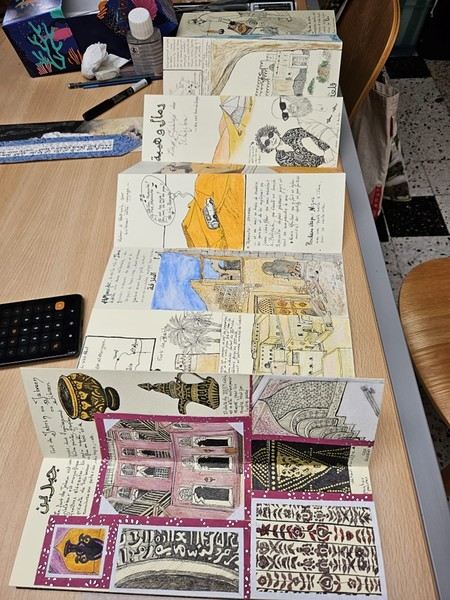
For drawing enthusiasts: The accordion format is both a constraint (each sheet is 9 cm x 27 cm) and a freedom (you can create a fresco). The paper is also a bit special: it doesn’t allow for fine lines, but it takes ink well (liner pen). However, everything has to be done almost in one go (with a very light pencil sketch) because it erases poorly. It absorbs too much water for coloring with markers or watercolors (unless you avoid soaking it), but it works well with oil pastels and their use with a brush and solvent. Since it’s yellowish, it allowed me to create contrasts even with white pastel.
 On the right, the "welcome marker"—those dates offered everywhere as a sign of hospitality. On the left, a tribute to those stunning doors worn by time, admired all over the old quarters, including the abandoned ones.
Oman is one of the world’s largest producers of frankincense resin. Incense burners are everywhere, from the simplest clay ones to the most precious handcrafted silver ones...
 Hospitality will often lead you to accept a small coffee, an "Omani coffee," very light, subtly flavored with cardamom, maybe a touch of saffron, and occasionally rosewater.
Here, I’ve depicted a man in the common everyday attire of Omanis: the dishdasha, mostly white (during the week and daytime; colors are more common in the evening or on Fridays and Saturdays). While you’ll see some men dressed in Western clothes, they’re very few. The white dishdasha is truly the shared attire of all men. The dishdasha, which has no hood, is distinguished by a small pom-pom attached to the collar, the furakha, which is soaked in perfume. And believe me, Omanis go overboard with it! "It smells like the pom-pom" is an expression that’s now part of our shared language, my husband and I.
Another must of men’s attire is the kuma, a small round head covering, usually white with brightly colored patterns. The keffiyeh is also worn (but without the cord called an agal in Arab countries), and it’s mostly worn by those with roots in the desert, from what I understood.
And what about the women, you might ask? Some are veiled, some in full black (but not a burka—more like a chador + abaya), due to the influence of Saudi Arabia and the United Arab Emirates, whereas the traditional outfit used to be a layering of very colorful dresses. Most of the women we saw wore neutral clothing, a plain veil over their hair, but with their faces uncovered. We also saw many saris and colorful veils—don’t forget that 40% of the population consists of Indian, Nepalese, and Bangladeshi immigrants, who work a lot in tourism, hospitality, restaurants, services, and construction.
Just to clarify, as a tourist, there’s no pressure to wear a veil, and never any disapproving looks. Of course, you’ll save the mini shorts, plunging necklines, bare shoulders, and midriffs for the hotel terrace—but I’d say that’s the same for men and women, and with the sun being strong, it’s better for your skin too.
Here’s the introduction! In the next post, I’ll tell you about my itinerary, and we can dive in!
Hospitality will often lead you to accept a small coffee, an "Omani coffee," very light, subtly flavored with cardamom, maybe a touch of saffron, and occasionally rosewater.
Here, I’ve depicted a man in the common everyday attire of Omanis: the dishdasha, mostly white (during the week and daytime; colors are more common in the evening or on Fridays and Saturdays). While you’ll see some men dressed in Western clothes, they’re very few. The white dishdasha is truly the shared attire of all men. The dishdasha, which has no hood, is distinguished by a small pom-pom attached to the collar, the furakha, which is soaked in perfume. And believe me, Omanis go overboard with it! "It smells like the pom-pom" is an expression that’s now part of our shared language, my husband and I.
Another must of men’s attire is the kuma, a small round head covering, usually white with brightly colored patterns. The keffiyeh is also worn (but without the cord called an agal in Arab countries), and it’s mostly worn by those with roots in the desert, from what I understood.
And what about the women, you might ask? Some are veiled, some in full black (but not a burka—more like a chador + abaya), due to the influence of Saudi Arabia and the United Arab Emirates, whereas the traditional outfit used to be a layering of very colorful dresses. Most of the women we saw wore neutral clothing, a plain veil over their hair, but with their faces uncovered. We also saw many saris and colorful veils—don’t forget that 40% of the population consists of Indian, Nepalese, and Bangladeshi immigrants, who work a lot in tourism, hospitality, restaurants, services, and construction.
Just to clarify, as a tourist, there’s no pressure to wear a veil, and never any disapproving looks. Of course, you’ll save the mini shorts, plunging necklines, bare shoulders, and midriffs for the hotel terrace—but I’d say that’s the same for men and women, and with the sun being strong, it’s better for your skin too.
Here’s the introduction! In the next post, I’ll tell you about my itinerary, and we can dive in!Densha Otaku - A Southern Loop
Here’s my second travel journal since my 2017 one. You can check it out here if you’d like: https://voyageforum.com/forum/densha-otaku-passion-japonaise-d9177495/
This was my first trip back to Japan since the COVID lockdown. Between 2017 (with a short visit in 2018) and 2024, a lot has unfortunately changed. Economic and demographic shifts have led—and will continue to lead—to the closure of many rural railway lines. Fewer residents, fewer travelers, rising operating costs, staffing shortages, and increasingly precarious funding. Then there’s the ever-growing number of tourists who damage everything in their path and frustrate locals. Fortunately, there are still plenty of ways to escape the crowds, even if you do run into groups of Chinese tourists arriving by bus at the Mino Railway Museum or aboard a Kiha 120 crossing the Izumo-Sakane switchback. (Oops, spoiler alert—that’s for my 2025 travel journal.) We’ll see if PM Takaichi has as much success on the ground as he does in his speeches.
I’m lucky to love remote regions and places most tourists don’t know about. Taking public transport—mostly trains—and living like the locals do. That’s what my trips are all about. Those who’ve followed me on these pages know I love trains, especially older ones. These are becoming rarer in regular service, and Japan still isn’t ready to allow even certified museums to run historic trains on public lines, unlike many other countries. I even have my own license to drive historic trams, despite being an IT specialist in my day job. You’ll find some comments that clearly reflect my opinions and experience with the operation and rolling stock of certain lines—sometimes positive, sometimes not.
My trips are always intense. This isn’t about relaxing. It’s about discovering, blending in with locals, being welcomed by associations and museums, and uncovering things most people wouldn’t even imagine exist halfway across the world.
Sorry for the long intro.
This was my first trip back to Japan since the COVID lockdown. Between 2017 (with a short visit in 2018) and 2024, a lot has unfortunately changed. Economic and demographic shifts have led—and will continue to lead—to the closure of many rural railway lines. Fewer residents, fewer travelers, rising operating costs, staffing shortages, and increasingly precarious funding. Then there’s the ever-growing number of tourists who damage everything in their path and frustrate locals. Fortunately, there are still plenty of ways to escape the crowds, even if you do run into groups of Chinese tourists arriving by bus at the Mino Railway Museum or aboard a Kiha 120 crossing the Izumo-Sakane switchback. (Oops, spoiler alert—that’s for my 2025 travel journal.) We’ll see if PM Takaichi has as much success on the ground as he does in his speeches.
I’m lucky to love remote regions and places most tourists don’t know about. Taking public transport—mostly trains—and living like the locals do. That’s what my trips are all about. Those who’ve followed me on these pages know I love trains, especially older ones. These are becoming rarer in regular service, and Japan still isn’t ready to allow even certified museums to run historic trains on public lines, unlike many other countries. I even have my own license to drive historic trams, despite being an IT specialist in my day job. You’ll find some comments that clearly reflect my opinions and experience with the operation and rolling stock of certain lines—sometimes positive, sometimes not.
My trips are always intense. This isn’t about relaxing. It’s about discovering, blending in with locals, being welcomed by associations and museums, and uncovering things most people wouldn’t even imagine exist halfway across the world.
Sorry for the long intro.
South Africa in safari mode: February/March 2026
Hi everyone,
With my girlfriend Christelle, we’ve chosen South Africa for our first trip to Southern Africa, focusing on safaris—after a long debate with a Cape Town/Kruger combo. But that would’ve meant cutting out St Lucia, which would’ve been harder to fit into another trip. And St Lucia—thanks to Michel and all those travel journals—we really wanted to go there.
So our 11-night itinerary ended up like this, mostly shaped by school holidays: - 3 nights in St Lucia - 1 night in Hluhluwe - 1 night at Mkhaya Game Reserve (Eswatini) - 1 night at Hlane Royal National Park (Eswatini) - 3 nights in Kruger (Berg en Dal / Satara / Tamboti) - 1 night at Shindzela Tented Camp in the Timbavati private reserve - 1 final night in Kruger at Lower Sabie
All of this in the off-season and rainy season, just a month after catastrophic floods that killed over 150 people and seriously damaged Kruger’s infrastructure.
I’ll jump straight to St Lucia and skip the loooong journey to get there (with a layover in Frankfurt, landing in Johannesburg, a domestic flight to Durban, and the rest by rental SUV—First Car Rental, perfect, no complaints).
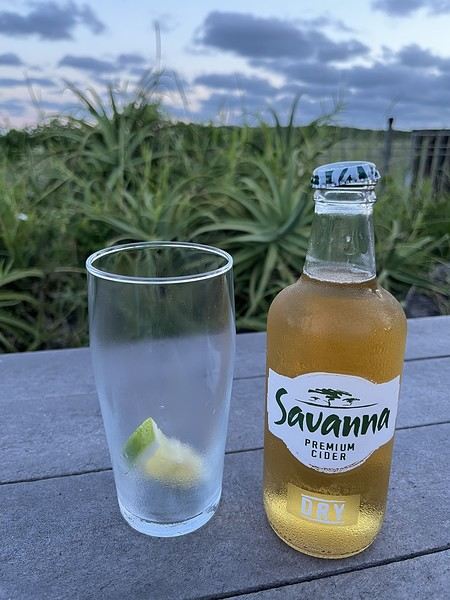
To motivate readers—especially some familiar faces here—I’ll drop in a first photo.
With my girlfriend Christelle, we’ve chosen South Africa for our first trip to Southern Africa, focusing on safaris—after a long debate with a Cape Town/Kruger combo. But that would’ve meant cutting out St Lucia, which would’ve been harder to fit into another trip. And St Lucia—thanks to Michel and all those travel journals—we really wanted to go there.
So our 11-night itinerary ended up like this, mostly shaped by school holidays: - 3 nights in St Lucia - 1 night in Hluhluwe - 1 night at Mkhaya Game Reserve (Eswatini) - 1 night at Hlane Royal National Park (Eswatini) - 3 nights in Kruger (Berg en Dal / Satara / Tamboti) - 1 night at Shindzela Tented Camp in the Timbavati private reserve - 1 final night in Kruger at Lower Sabie
All of this in the off-season and rainy season, just a month after catastrophic floods that killed over 150 people and seriously damaged Kruger’s infrastructure.
I’ll jump straight to St Lucia and skip the loooong journey to get there (with a layover in Frankfurt, landing in Johannesburg, a domestic flight to Durban, and the rest by rental SUV—First Car Rental, perfect, no complaints).
To motivate readers—especially some familiar faces here—I’ll drop in a first photo.
Tips for a 20-day family itinerary in the American West in 2028
Hello everyone,
After our first trip as a young couple to the West in 2007 (yes, that doesn’t make us any younger!), we’re planning to go back in 2028, but this time as a family of four! (We have two boys who’ll be 5½ and 13 years old in the summer of 2028.)
Our plan is to combine a few big cities (SF and LA, maybe San Diego) with national parks and state parks, mostly! Ideally, we’d like to leave at the end of June and head back to France around July 19–20, so we can enjoy the first week of the Olympic Games in Los Angeles.
Since we already did the "loop" in 2007, there are must-see places we absolutely want to revisit—and especially share with our kids: Bryce Canyon, Yosemite, and above all, the Grand Canyon, which is still the most incredible thing I’ve ever seen on Earth!
On the other hand, some places didn’t leave a big impression on us for various reasons, so we’re not making them a priority: Antelope Canyon, Monument Valley, for example.
We’re planning ahead, but might as well be smart about it😏
Do you have any tips for a fun and doable itinerary over about 20–25 days with kids, without rushing?
Thanks in advance for your feedback😉
After our first trip as a young couple to the West in 2007 (yes, that doesn’t make us any younger!), we’re planning to go back in 2028, but this time as a family of four! (We have two boys who’ll be 5½ and 13 years old in the summer of 2028.)
Our plan is to combine a few big cities (SF and LA, maybe San Diego) with national parks and state parks, mostly! Ideally, we’d like to leave at the end of June and head back to France around July 19–20, so we can enjoy the first week of the Olympic Games in Los Angeles.
Since we already did the "loop" in 2007, there are must-see places we absolutely want to revisit—and especially share with our kids: Bryce Canyon, Yosemite, and above all, the Grand Canyon, which is still the most incredible thing I’ve ever seen on Earth!
On the other hand, some places didn’t leave a big impression on us for various reasons, so we’re not making them a priority: Antelope Canyon, Monument Valley, for example.
We’re planning ahead, but might as well be smart about it😏
Do you have any tips for a fun and doable itinerary over about 20–25 days with kids, without rushing?
Thanks in advance for your feedback😉
Upcoming Jet Fuel Shortage in Vietnam and Sri Lanka
Hi!
Sri Lanka has announced it could run out of fuel in the coming weeks if the Strait of Hormuz remains blocked. The government has implemented a mandatory four-day workweek to save oil, and there are long lines at gas stations due to fears of an early shortage.
In Vietnam, the government has warned all airlines that flights will need to be reduced due to a lack of kerosene. The country imports two-thirds of its jet fuel from China and Thailand, but both countries have now banned exports out of fear of domestic shortages.
The state is asking airlines to plan ahead and park aircraft to drastically reduce operations, starting with domestic flights and then international ones. International carriers will also need to cut back on their rotations.
This will begin in the coming days. 🙁
A Bold Combo: Southern Peru, Bolivia, and Northern Chile
Hello everyone,
For our latest 3-week family trip (yes, the kids are growing up, and two of them are about to enter the working world), we’re heading to South America! For our first time on this continent, I had planned a classic 3-week loop in Peru.
But since we won’t be returning to this part of the world anytime soon, I thought: why not follow in the footsteps of Franck, aka Bibouns51, who, in 18 days, didn’t just stick to Peru but also added two of the planet’s most stunning landscapes to his itinerary... the Salar de Uyuni in Bolivia and its neighbor, the fabulous Atacama Desert in northern Chile !!
So, I set about the tricky task of limiting the regions we’d visit in Peru to those we considered must-sees, to avoid rushing too much. The visit schedules were optimized, including several comfortable overnight buses that have the huge advantage of letting us hop between regions.
So, we’re off on a somewhat adventurous trip with three domestic flights (two on the first day and one on the last), two overnight buses for quick hops, several car rentals, the services of a few drivers to make the trip more comfortable, and even a tour operator for crossing the Salar...
Our main concern is altitude sickness, and we’re bringing Diamox, aspirin, etc., just in case.
Our second worry before departure was not even getting off the ground... Yes, for once, we’re leaving from France—Marseille, to be exact. The week before our departure, with the surprise air traffic controllers’ strike, I remembered why we usually prefer to leave from abroad, like Turin or Barcelona... In the end, it wasn’t the air traffic controllers who made us nervous but the early July wildfires that paralyzed the airport a few days before our departure. Fortunately, the fires were quickly brought under control, and on the big day, everything was smooth sailing!
Detailed itinerary (which changed on Day 1 due to departure hiccups): Day 0: Flight Marseille - Madrid - Lima PERU Theoretical and abandoned Day 1: Flight Lima - Cuzco and visit Cuzco (Puka Pukara, Tambomachay, Cristo Blanco Observatory, Sacsayhuaman sunset) - Night in Cuzco Day 2: Taxi -> Chinchero - Moray - Maras Salt Mines - Ollantaytambo - Train to Aguas Calientes Day 3: Machu Picchu - Return train to Ollantaytambo Day 4: 2-day taxi -> Pisac - Tipon - Andahuaylillas - Huaro - Night in San Pedro Day 5: Palcoyo - Checacupe - Vinicunca - Return and night in Cuzco Day 6: Day in Cuzco (catch-up on Sacsayhuaman, San Blas district, Temple of the Sun) - Overnight bus to Arequipa Day 7: Rental car -> On the road to Colca Canyon, night in Cabanaconde Day 8: Descent to the bottom of Colca Canyon, night at Oasis Sangalle Day 9: Ascent from the canyon - Maca - Chivay - Return and night in Arequipa Day 10: Visit Arequipa (Santa Catalina Convent, La Recoleta Church and Monastery, La Compañía Church, Cathedral) - Overnight bus to Puno Day 11: Lake Titicaca - Night in Puno BOLIVIA Day 12: Shared taxi -> Road to La Paz, visit downtown La Paz - Night 1 in La Paz Day 13: Moon Valley and Las Animas Valley - Night 2 in La Paz Day 14: Day in La Paz - Night 3 in La Paz Day 15: Flight to Uyuni - Day 1 of Salar de Uyuni tour - Night at the edge of the Salar Day 16: Crossing the Lipez region and lagoons - Night near Laguna Colorada Day 17: Sol de Mañana CHILE Day 17 cont.: Pre-booked transfer to SPDA - 4x4 rental - Pukara de Quitor - Stargazing tour - Night 1 in SPDA Day 18: Death Valley and Moon Valley - Night 2 in SPDA Day 19: Miscanti and Miniques Lagoons, Salar de Aguas Calientes and its Piedra Roja, Tebenquiche Lagoon and Quebrada del Diablo - Night 3 in SPDA Day 20: Rainbow Valley and swim in the Puritama River - Night 4 in SPDA Day 21: Tebenquiche Lagoon - Bus to Calama - Flight to Santiago Day 22: Return Santiago - Madrid - Marseille
Day 0 - 11/07: Destination Lima
Our first flight from Marseille went smoothly to our Iberia layover in Madrid.
In Madrid, just after getting off the plane around 8 PM, and as we were walking through the terminal, we got a rude awakening!!
We saw the word "Cancelled" next to our flight number on the display boards. Thinking it must be a glitch, we checked another screen, but the system was stubborn, and the same dreaded word appeared !
So, we headed to the Iberia counter, where an agent confirmed that our Friday evening flight was canceled and rescheduled for the next morning. The reason? A breakdown and no replacement plane, even though we were in Madrid, Iberia’s home base!
To make matters worse, I remembered our super-tight schedule, planned to the minute, with no buffer day in Lima. Since I’m a bit phobic of megacities and hadn’t found anything appealing in the Peruvian capital in our guidebooks, we’d planned to leave Lima as soon as possible for Cusco, the heart of the Sacred Valley, to spend our first day there.
Bad idea, because we already knew the 4-hour buffer wouldn’t be enough, and we’d miss the domestic flight, which was, of course, non-refundable and non-changeable. So, we had to call LATAM from Madrid to find another flight for Saturday evening and negotiate a rate to recover some of our initial outlay.
After an hour on the phone with customer service, several endless holds, and three failed attempts to dictate our credit card number over the phone to a Spaniard speaking English with a thick accent, we finally managed to confirm the transaction, securing our new flight tickets for a moderate extra cost of just 150 € total.
At first, we were pretty bummed about losing a day and incurring extra fees to reschedule the domestic flight, but then, when we learned from an Iberia customer service rep that we’d receive the max compensation of 600 € per traveler, we even ended up grinning... because 3000 € in refunds for only losing the first day in Cusco? We’d sign up for that 10 times over!!
Iberia then took care of us, putting us up in a hotel where we had dinner before a short 5-hour night and an early morning departure. I took the opportunity to improvise a quick day of sightseeing in Lima, focusing on the Barranco and Miraflores districts.
For our latest 3-week family trip (yes, the kids are growing up, and two of them are about to enter the working world), we’re heading to South America! For our first time on this continent, I had planned a classic 3-week loop in Peru.
But since we won’t be returning to this part of the world anytime soon, I thought: why not follow in the footsteps of Franck, aka Bibouns51, who, in 18 days, didn’t just stick to Peru but also added two of the planet’s most stunning landscapes to his itinerary... the Salar de Uyuni in Bolivia and its neighbor, the fabulous Atacama Desert in northern Chile !!
So, I set about the tricky task of limiting the regions we’d visit in Peru to those we considered must-sees, to avoid rushing too much. The visit schedules were optimized, including several comfortable overnight buses that have the huge advantage of letting us hop between regions.
So, we’re off on a somewhat adventurous trip with three domestic flights (two on the first day and one on the last), two overnight buses for quick hops, several car rentals, the services of a few drivers to make the trip more comfortable, and even a tour operator for crossing the Salar...
Our main concern is altitude sickness, and we’re bringing Diamox, aspirin, etc., just in case.
Our second worry before departure was not even getting off the ground... Yes, for once, we’re leaving from France—Marseille, to be exact. The week before our departure, with the surprise air traffic controllers’ strike, I remembered why we usually prefer to leave from abroad, like Turin or Barcelona... In the end, it wasn’t the air traffic controllers who made us nervous but the early July wildfires that paralyzed the airport a few days before our departure. Fortunately, the fires were quickly brought under control, and on the big day, everything was smooth sailing!
Detailed itinerary (which changed on Day 1 due to departure hiccups): Day 0: Flight Marseille - Madrid - Lima PERU Theoretical and abandoned Day 1: Flight Lima - Cuzco and visit Cuzco (Puka Pukara, Tambomachay, Cristo Blanco Observatory, Sacsayhuaman sunset) - Night in Cuzco Day 2: Taxi -> Chinchero - Moray - Maras Salt Mines - Ollantaytambo - Train to Aguas Calientes Day 3: Machu Picchu - Return train to Ollantaytambo Day 4: 2-day taxi -> Pisac - Tipon - Andahuaylillas - Huaro - Night in San Pedro Day 5: Palcoyo - Checacupe - Vinicunca - Return and night in Cuzco Day 6: Day in Cuzco (catch-up on Sacsayhuaman, San Blas district, Temple of the Sun) - Overnight bus to Arequipa Day 7: Rental car -> On the road to Colca Canyon, night in Cabanaconde Day 8: Descent to the bottom of Colca Canyon, night at Oasis Sangalle Day 9: Ascent from the canyon - Maca - Chivay - Return and night in Arequipa Day 10: Visit Arequipa (Santa Catalina Convent, La Recoleta Church and Monastery, La Compañía Church, Cathedral) - Overnight bus to Puno Day 11: Lake Titicaca - Night in Puno BOLIVIA Day 12: Shared taxi -> Road to La Paz, visit downtown La Paz - Night 1 in La Paz Day 13: Moon Valley and Las Animas Valley - Night 2 in La Paz Day 14: Day in La Paz - Night 3 in La Paz Day 15: Flight to Uyuni - Day 1 of Salar de Uyuni tour - Night at the edge of the Salar Day 16: Crossing the Lipez region and lagoons - Night near Laguna Colorada Day 17: Sol de Mañana CHILE Day 17 cont.: Pre-booked transfer to SPDA - 4x4 rental - Pukara de Quitor - Stargazing tour - Night 1 in SPDA Day 18: Death Valley and Moon Valley - Night 2 in SPDA Day 19: Miscanti and Miniques Lagoons, Salar de Aguas Calientes and its Piedra Roja, Tebenquiche Lagoon and Quebrada del Diablo - Night 3 in SPDA Day 20: Rainbow Valley and swim in the Puritama River - Night 4 in SPDA Day 21: Tebenquiche Lagoon - Bus to Calama - Flight to Santiago Day 22: Return Santiago - Madrid - Marseille
Day 0 - 11/07: Destination Lima
Our first flight from Marseille went smoothly to our Iberia layover in Madrid.
In Madrid, just after getting off the plane around 8 PM, and as we were walking through the terminal, we got a rude awakening!!
We saw the word "Cancelled" next to our flight number on the display boards. Thinking it must be a glitch, we checked another screen, but the system was stubborn, and the same dreaded word appeared !
So, we headed to the Iberia counter, where an agent confirmed that our Friday evening flight was canceled and rescheduled for the next morning. The reason? A breakdown and no replacement plane, even though we were in Madrid, Iberia’s home base!
To make matters worse, I remembered our super-tight schedule, planned to the minute, with no buffer day in Lima. Since I’m a bit phobic of megacities and hadn’t found anything appealing in the Peruvian capital in our guidebooks, we’d planned to leave Lima as soon as possible for Cusco, the heart of the Sacred Valley, to spend our first day there.
Bad idea, because we already knew the 4-hour buffer wouldn’t be enough, and we’d miss the domestic flight, which was, of course, non-refundable and non-changeable. So, we had to call LATAM from Madrid to find another flight for Saturday evening and negotiate a rate to recover some of our initial outlay.
After an hour on the phone with customer service, several endless holds, and three failed attempts to dictate our credit card number over the phone to a Spaniard speaking English with a thick accent, we finally managed to confirm the transaction, securing our new flight tickets for a moderate extra cost of just 150 € total.
At first, we were pretty bummed about losing a day and incurring extra fees to reschedule the domestic flight, but then, when we learned from an Iberia customer service rep that we’d receive the max compensation of 600 € per traveler, we even ended up grinning... because 3000 € in refunds for only losing the first day in Cusco? We’d sign up for that 10 times over!!
Iberia then took care of us, putting us up in a hotel where we had dinner before a short 5-hour night and an early morning departure. I took the opportunity to improvise a quick day of sightseeing in Lima, focusing on the Barranco and Miraflores districts.
On the Roads of Costa Rica
Hello everyone, I’m happy to welcome you to this new travel journal.
We’re heading to Costa Rica together—a Central American destination that dreams are made of for many French travelers and attracts crowds from France.
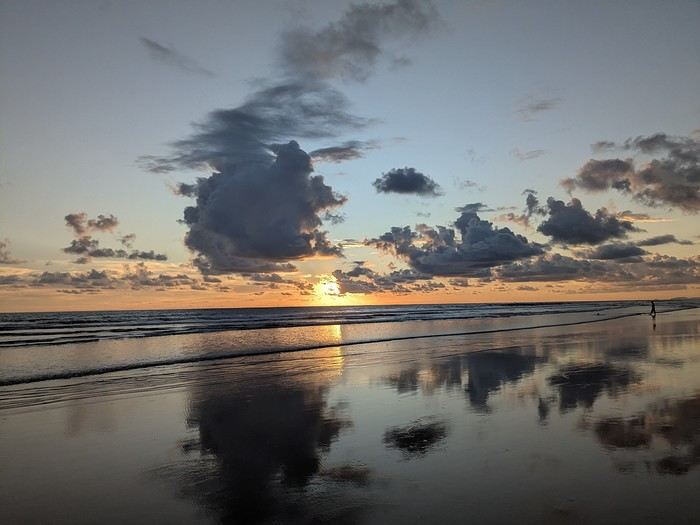
It was the country’s wild nature and safety that convinced us to go, since we’re traveling with our 7-year-old little one. We didn’t have much vacation time in February 2026 (only 12 days), so we optimized as much as possible.
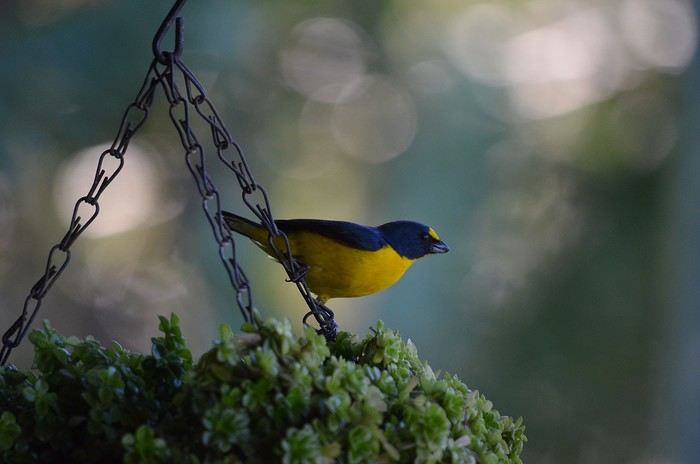
Here’s the itinerary: Wednesday, February 11: Flight from Marseille to San Jose via Paris and Atlanta Thursday, February 12: Pick up the car, drive to Poas Volcano, visit La Paz Waterfall Gardens Friday, February 13: Poas Volcano and drive to Manuel Antonio Saturday, February 14: Manuel Antonio National Park Sunday, February 15: Nauyaca Waterfall and Playa Linda Monday, February 16: Drive to Monte Verde and Santa Elena Reserve Tuesday, February 17: El Tigre Waterfall Reserve and Treetopia Park Wednesday, February 18: Monte Verde Reserve with a guide and drive to La Fortuna Thursday, February 19: Sloth guided tour, Observatory Lodge Park Friday, February 20: Arenal Volcano National Park, Termalistas del Arenal hot springs, and night tour Saturday, February 21: Return to San Jose, flight to Paris via Atlanta Sunday, February 22: Arrival in Paris and flight to Marseille. That gives us a solid 9 days in the country.
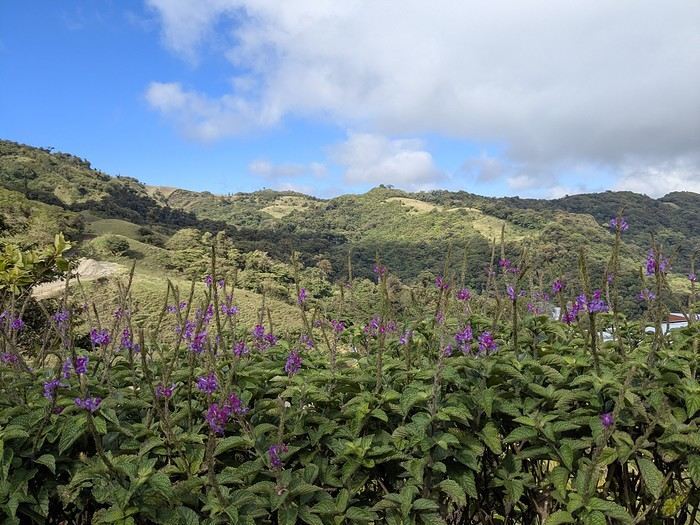
Budget breakdown: Costa Rica is an expensive country, but no more so than France. However, almost all hikes and waterfalls are paid entry, which can really add up. For meals, sodas (6–10 €) are cheaper than restaurants (10–20 € per dish).
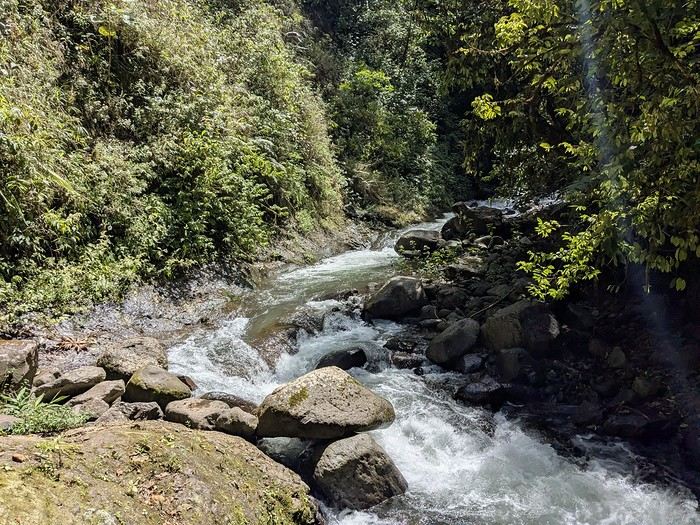
Flights: We chose Delta Airlines for the price: Marseille to San Jose was 740 € per person (modifiable, with checked baggage and seat selection included). Other direct flights from Europe were priced between 1200 € and 1600 € with more restrictive conditions. That’s 2220 € for the family.
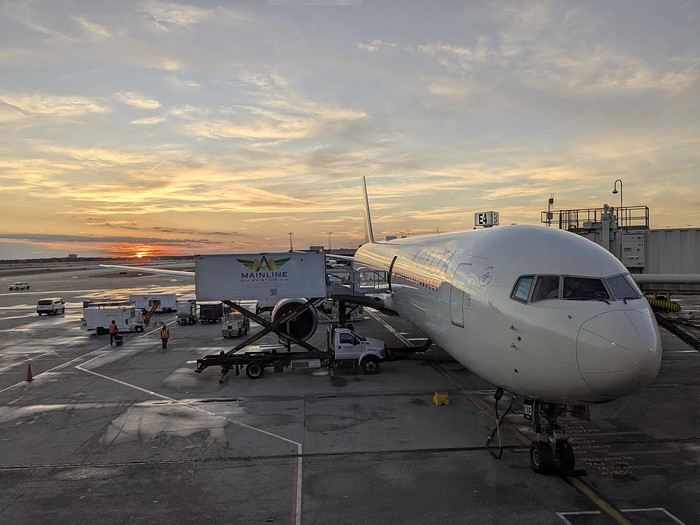
Accommodations: Alajuela, first night: 139 € (1 night) at Rodeo Estancia Boutique Hotel, with personalized airport pickup, transfer to the hotel, and a briefing from Vert Costa Rica agency the next day. Poas: 66 € (1 night) at Cabañas Tierra Fértil (entire apartment). Manuel Antonio: 394 € (3 nights) at La Palapa Ecolodge (hotel in the jungle). Monte Verde: Chalet Aloha Monteverde Cloud Forest (2 bedrooms): 125 € (2 nights). La Fortuna: Arenal Dream Garden (1 bedroom): 217 € (3 nights). Total: 941 €.
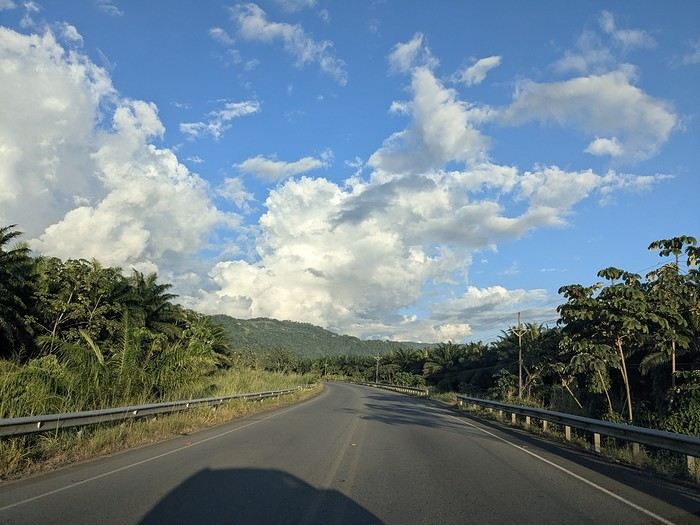
Car rental: I went through Vert Costa Rica agency (Vincent is a French expat who set up the agency in Costa Rica and makes great YouTube videos with useful tips). I rented a 4x4 that was delivered to the hotel the day after arrival and returned at the airport before the flight. The total was 772 €, including full insurance (zero deductible), a child seat, and a phone with a Costa Rican SIM and WhatsApp. The rental company was Poas Rent a Car. The vehicle was well-maintained—no complaints. Gas: 100 € for the whole trip (3 fill-ups).
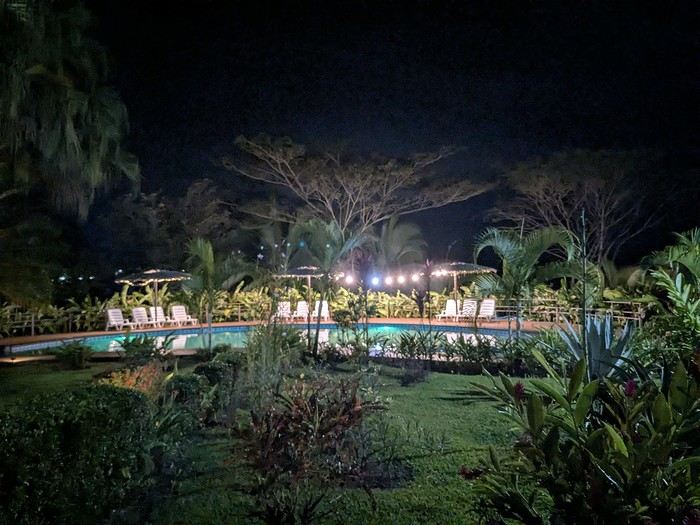
Activities: To get discounts, I bought the pass offered by Vincent, which paid for itself after just one activity. It cost me 30 € (promo since I rented the car through him). Prices are for 3 people. I’ve added stars to rate them: La Paz Waterfall Gardens ****: 112 € Poas Volcano National Park *: 33 € Manuel Antonio National Park ****: 35 € Nauyaca Waterfall ***: 25 € Santa Elena Reserve **: 45 € El Tigre Waterfall Reserve ****: 141 € (with meal) Treetopia (ziplining, suspension bridges) **: 250 € Guided tour of Monte Verde Reserve ***: 113 € Sloth guided tour (with breakfast) ***: 115 € Arenal Observatory Lodge (with meal) ****: 102 € Arenal Volcano National Park *: 34 € Termalistas del Arenal ****: 20 € Night tour ***: 116 € Total: 1171 €.
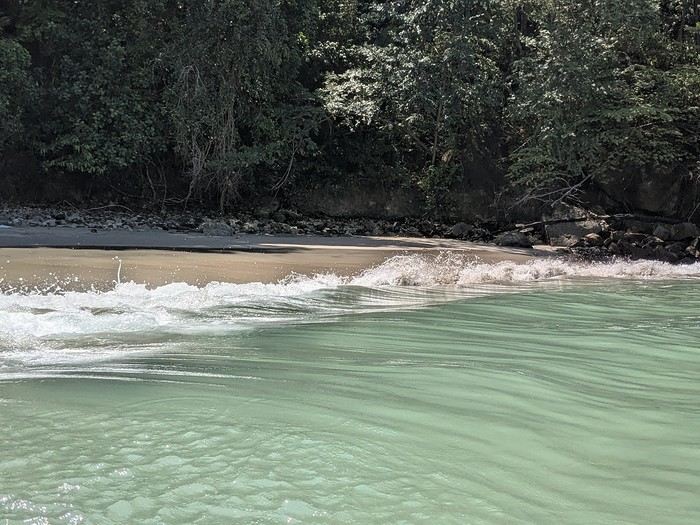
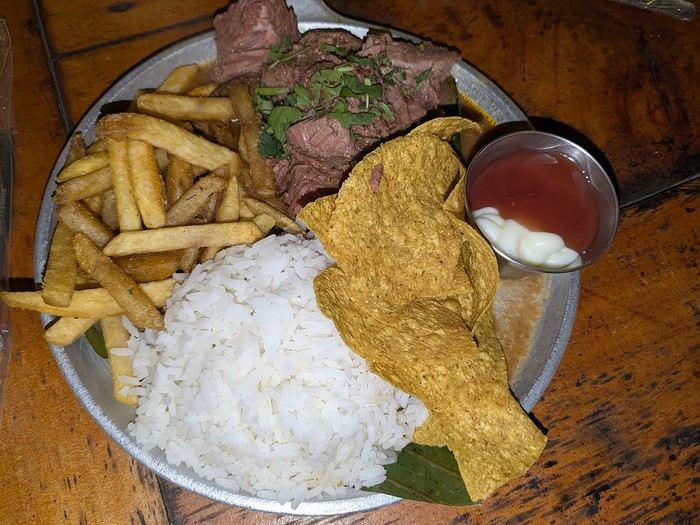
Meals: 600 € My favorite restaurants: Poas: Food court Mercaditas in Fraijanes Manuel Antonio (near La Palapa): La Langosta and also El Patio Near Nauyaca Waterfall: Ricar2 el Avión Between Manuel Antonio and Monte Verde: Soda D’Calle Santa Elena: HG’s Food Guadalupe (between Monte Verde and La Fortuna): Soda Río Piedras Arenal Observatory Lodge restaurant Arenal Oasis Ecolodge restaurant
Other expenses: 300 € (groceries for breakfast, drinks, ice cream, souvenirs, etc.) Total overall: 6065 € (about 2020 € per person).
Now, here’s the day-by-day account of this beautiful trip.
https://voyageforum.com/images/posts/small/1772295011-z8mILBEUXHU8Ajz.jpg
It was the country’s wild nature and safety that convinced us to go, since we’re traveling with our 7-year-old little one. We didn’t have much vacation time in February 2026 (only 12 days), so we optimized as much as possible.
Here’s the itinerary: Wednesday, February 11: Flight from Marseille to San Jose via Paris and Atlanta Thursday, February 12: Pick up the car, drive to Poas Volcano, visit La Paz Waterfall Gardens Friday, February 13: Poas Volcano and drive to Manuel Antonio Saturday, February 14: Manuel Antonio National Park Sunday, February 15: Nauyaca Waterfall and Playa Linda Monday, February 16: Drive to Monte Verde and Santa Elena Reserve Tuesday, February 17: El Tigre Waterfall Reserve and Treetopia Park Wednesday, February 18: Monte Verde Reserve with a guide and drive to La Fortuna Thursday, February 19: Sloth guided tour, Observatory Lodge Park Friday, February 20: Arenal Volcano National Park, Termalistas del Arenal hot springs, and night tour Saturday, February 21: Return to San Jose, flight to Paris via Atlanta Sunday, February 22: Arrival in Paris and flight to Marseille. That gives us a solid 9 days in the country.
Budget breakdown: Costa Rica is an expensive country, but no more so than France. However, almost all hikes and waterfalls are paid entry, which can really add up. For meals, sodas (6–10 €) are cheaper than restaurants (10–20 € per dish).
Flights: We chose Delta Airlines for the price: Marseille to San Jose was 740 € per person (modifiable, with checked baggage and seat selection included). Other direct flights from Europe were priced between 1200 € and 1600 € with more restrictive conditions. That’s 2220 € for the family.
Accommodations: Alajuela, first night: 139 € (1 night) at Rodeo Estancia Boutique Hotel, with personalized airport pickup, transfer to the hotel, and a briefing from Vert Costa Rica agency the next day. Poas: 66 € (1 night) at Cabañas Tierra Fértil (entire apartment). Manuel Antonio: 394 € (3 nights) at La Palapa Ecolodge (hotel in the jungle). Monte Verde: Chalet Aloha Monteverde Cloud Forest (2 bedrooms): 125 € (2 nights). La Fortuna: Arenal Dream Garden (1 bedroom): 217 € (3 nights). Total: 941 €.
Car rental: I went through Vert Costa Rica agency (Vincent is a French expat who set up the agency in Costa Rica and makes great YouTube videos with useful tips). I rented a 4x4 that was delivered to the hotel the day after arrival and returned at the airport before the flight. The total was 772 €, including full insurance (zero deductible), a child seat, and a phone with a Costa Rican SIM and WhatsApp. The rental company was Poas Rent a Car. The vehicle was well-maintained—no complaints. Gas: 100 € for the whole trip (3 fill-ups).
Activities: To get discounts, I bought the pass offered by Vincent, which paid for itself after just one activity. It cost me 30 € (promo since I rented the car through him). Prices are for 3 people. I’ve added stars to rate them: La Paz Waterfall Gardens ****: 112 € Poas Volcano National Park *: 33 € Manuel Antonio National Park ****: 35 € Nauyaca Waterfall ***: 25 € Santa Elena Reserve **: 45 € El Tigre Waterfall Reserve ****: 141 € (with meal) Treetopia (ziplining, suspension bridges) **: 250 € Guided tour of Monte Verde Reserve ***: 113 € Sloth guided tour (with breakfast) ***: 115 € Arenal Observatory Lodge (with meal) ****: 102 € Arenal Volcano National Park *: 34 € Termalistas del Arenal ****: 20 € Night tour ***: 116 € Total: 1171 €.
Meals: 600 € My favorite restaurants: Poas: Food court Mercaditas in Fraijanes Manuel Antonio (near La Palapa): La Langosta and also El Patio Near Nauyaca Waterfall: Ricar2 el Avión Between Manuel Antonio and Monte Verde: Soda D’Calle Santa Elena: HG’s Food Guadalupe (between Monte Verde and La Fortuna): Soda Río Piedras Arenal Observatory Lodge restaurant Arenal Oasis Ecolodge restaurant
Other expenses: 300 € (groceries for breakfast, drinks, ice cream, souvenirs, etc.) Total overall: 6065 € (about 2020 € per person).
Now, here’s the day-by-day account of this beautiful trip.
https://voyageforum.com/images/posts/small/1772295011-z8mILBEUXHU8Ajz.jpg
Where to stay near Port-Saint-Louis-du-Rhône?
Hi,
Our son, currently in Central America, will board a sailboat on 04/16 to cross the Atlantic. He’s expected to arrive around 05/31 in Port-Saint-Louis-du-Rhône, and we’d like to welcome him on the day he arrives.
I’m looking for accommodation in the area for a few days around that date, from which we can explore the Camargue. We’ll be bringing our e-bikes.
Could you tell me which towns to look in and which areas to avoid, please? I think Port-Saint-Louis isn’t a great option if we want to avoid the toll for the ferry every time we leave by car.
Thanks for your tips.
Claire
PS: Are there a lot of mosquitoes in late May/early June?
PS: Are there a lot of mosquitoes in late May/early June?
From the Awakening to Travel to Morocco in the 90s
As I’ve mentioned elsewhere, I inherited my love of travel from my parents and some of my grandparents. A strong passion, but one that was unfortunately limited by our family’s modest resources. Back then, living in northern Alsace, a simple trip to the southern part of the region—with the Wine Route as our destination—felt like an extraordinary journey to a land of plenty for the little boy I was in the late 60s and early 70s.
Everything seemed so huge when you were still just a kid.
Back then, I was overwhelmed by countless sensations—I was already highly sensitive, with a keen mind and a nose and taste buds that were developing like a pro’s. Which, as I’d later realize, wasn’t always an advantage.
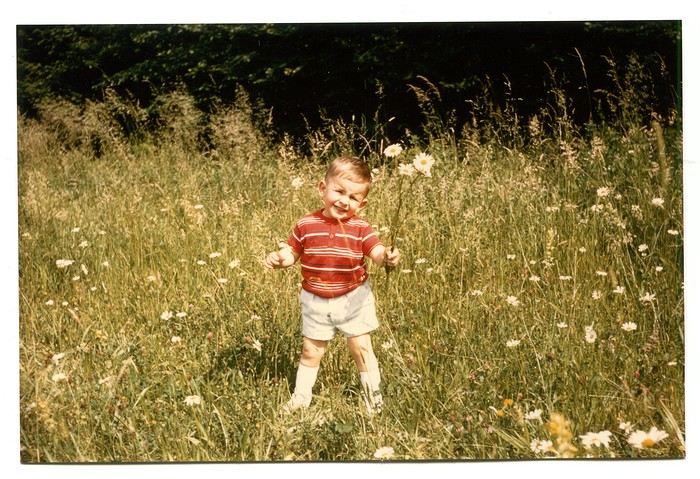
Those magical days always began with a gentle late-spring or midsummer morning. The interior of the white Peugeot 404, license plate 210 LZ 67, had already soaked up the sun before the engine purred to life, and the cabin gave off a scent I could still recognize today—a fragrance I found so pleasant. Back then, I had no idea it was just the smell of warm plastic from the car’s interior. Yes, the scents of the 404 on sunny days became my madeleine de Proust... What’s more, the whole family was unusually cheerful because those moments of relaxation and leisure were rare. Everyone worked, and no one had an easy job or was well paid. Without the *Trente Glorieuses*, these experiences might never have happened.
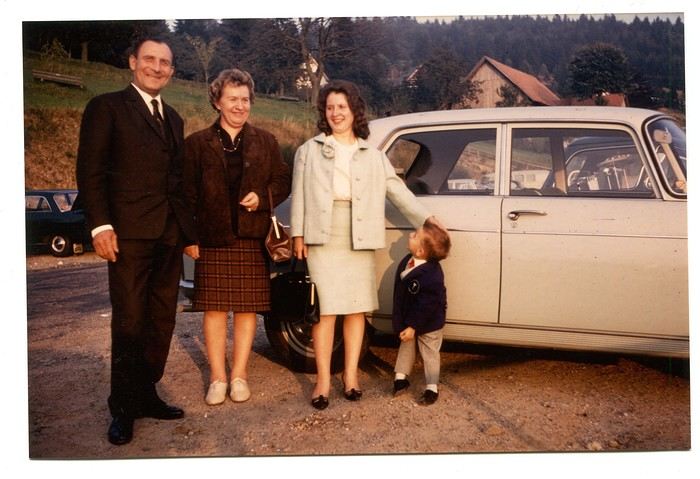
Once we crossed the canton’s borders, I felt like I was light-years away from my everyday surroundings, and every kilometer plunged me deeper into *terra incognita*. It was thrilling. Far from my so-called "medium-sized" town, wheat fields, cornfields, and cabbage patches stretched out, punctuated by tall poles connected by long wires and topped with vegetation—like giant clotheslines without laundry, where magical beanstalks might grow to touch the sky. Back then, I was still far from tasting their product, which was simply beer. At the time, there was still a significant local hop production. Fun fact: it wasn’t until 2002 that Anglo-Saxon scientists proved hops and cannabis belong to the same biological family.
After the fields, the landscape took another step up as it rolled past the little boy’s eyes, often glued to the windows. First came modest hills, then a succession of rolling slopes that soon formed an unbroken chain. Their 700 meters in altitude felt like Himalayan peaks to me—impressive, inert giants, a whole new world. Gazing at them, an intense emotion welled up somewhere between my stomach and lungs, nearly taking my breath away. What mysteries, what treasures did these heights hold? And then there were the cherries on top—the crowning touch that made the scene even more magical: proud, majestic castles perched on the summits like impassive sentinels. Monuments from the past, yet firmly rooted in the present on their rocky spurs. The little boy’s eyes sparkled—he’d been given a castle for Christmas, complete with battlements, towers, a drawbridge, and fully armed knights. He’d watched and lived *Ivanhoe* on the only French TV channel that existed back then.
Only once did my paternal grandfather join us on one of these trips. A tall, intelligent man with a face that could shift from stern to mischievous, clearly full of humor and charisma. Sadly, his relationship with alcohol had taken a toll on his life and, by extension, those of his loved ones. He had a strong personality—if his boss crossed the line, he wouldn’t hesitate to punch him, which meant he went through a lot of different jobs. Back then, you could quit one job and easily find another. It was quite something to see him in his final stages, hallucinating pink elephants and even drinking perfume when he had nothing else left. The last time I saw him, he’d slipped away from the doctors and nurses while hospitalized in pretty bad shape—at least, I assume his liver was the issue. We were sitting down for a family lunch when the door burst open, and there he stood in his pajamas, eyes twinkling with mischief, clearly pleased with the dramatic entrance. That theatrical moment didn’t spare us from burying him a few months later at the age of 71. One day, my mother told me the family doctor had quietly remarked that it was a shame—with his robust constitution, he could’ve lived to be a hundred. Yes, the family doctor—this was the man who’d come treat you any day, at almost any hour, just for a phone call. It really existed, it’s not a myth!
That day, his wife—my paternal grandmother—was also along for the ride. Everyone agreed that Jeannette was a good woman. She worked as a waitress at *Le Tigre*, the biggest brasserie in town, right in the center. Most customers preferred to be served by her, including local dignitaries and even the mayor. As a kid, I didn’t find her very fun, open, or warm—she seemed a bit stern. Back then, women in their fifties already had the face and build of grandmothers. Same went for men, don’t get me wrong. I had no idea about the struggles she faced because of her husband. I didn’t know that 30 years earlier, she’d had to flee Alsace while pregnant, under threat from Nazi fighter-bombers. I didn’t know she’d had several miscarriages, and that my father—her only surviving child, born prematurely in March 1940 at the other end of France—weighed less than a kilo at birth and was so tiny he could fit in a shoebox. Hard to imagine he’d grow into a strapping man nearly 1.80 meters tall, tipping the scales at 100 kilos. When you come back from summer camp in early August and ask why she didn’t pick you up with your parents, and they gently tell you she’s "in heaven," you don’t realize she passed away at 54 after suffering greatly from stomach cancer that had spread.
Back to that family outing, that enchanted parenthesis. I even remembered where we’d had lunch when I passed through Dambach-la-Ville decades later. One of those charming, flower-filled towns Alsace produces in abundance—and preserves so well. This one sits high on a hill, and I was a bit stunned on the parking lot because the view stretched far, revealing the Alsace plain below—its fields, villages, hills, and forests. The world seemed so vast and enticing that day, even though I was only glimpsing a tiny fraction of it.
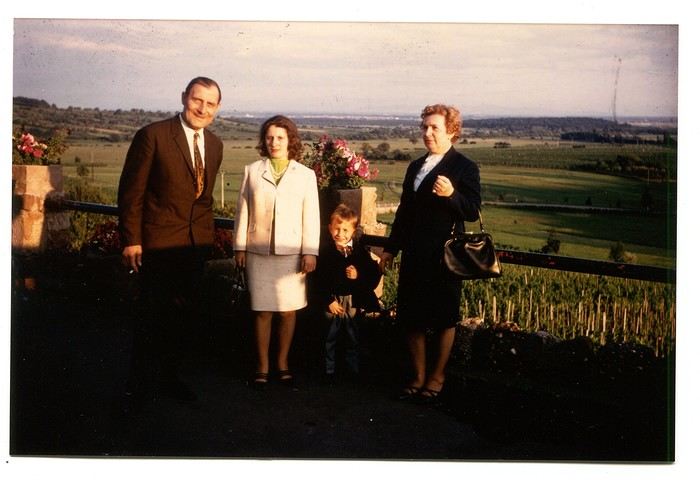
The region was already very touristy, but I wouldn’t notice the downsides until much later. That Sunday noon, I discovered a large restaurant filled with diners. I can still see the enormous piece of meat they served me, decorated with a little wooden skewer topped with a flag. I kept that one for a long time. Those were the golden days of rich, flowing, thick sauces—so flavorful—and the era of the world’s best fries, made on the spot with the best potatoes. To top it off, I was *exceptionally* allowed a small bottle of apple juice, Orangina, or—even better if possible—Sinalco. Yes, Sinalco—like Orangina, but better. A brand that must’ve disappeared in the 70s, but why, and what a shame! Since then, Orangina’s little bubbles have taken the brand to the other side of the planet—it’s now Japanese.
Year after year, I’d eagerly await that ecstatic moment when the most beautiful castle in Alsace, the Haut-Koenigsbourg, appeared in my field of vision. The perfect model, the archetype that blended into the landscape at the height of a child’s dreams. The trip home always felt like a reality check—less jarring than an alarm clock, but more diffuse and melancholic. From then on, there was only one wish: *When do we leave again?*
Those magical days always began with a gentle late-spring or midsummer morning. The interior of the white Peugeot 404, license plate 210 LZ 67, had already soaked up the sun before the engine purred to life, and the cabin gave off a scent I could still recognize today—a fragrance I found so pleasant. Back then, I had no idea it was just the smell of warm plastic from the car’s interior. Yes, the scents of the 404 on sunny days became my madeleine de Proust... What’s more, the whole family was unusually cheerful because those moments of relaxation and leisure were rare. Everyone worked, and no one had an easy job or was well paid. Without the *Trente Glorieuses*, these experiences might never have happened.
Once we crossed the canton’s borders, I felt like I was light-years away from my everyday surroundings, and every kilometer plunged me deeper into *terra incognita*. It was thrilling. Far from my so-called "medium-sized" town, wheat fields, cornfields, and cabbage patches stretched out, punctuated by tall poles connected by long wires and topped with vegetation—like giant clotheslines without laundry, where magical beanstalks might grow to touch the sky. Back then, I was still far from tasting their product, which was simply beer. At the time, there was still a significant local hop production. Fun fact: it wasn’t until 2002 that Anglo-Saxon scientists proved hops and cannabis belong to the same biological family.
After the fields, the landscape took another step up as it rolled past the little boy’s eyes, often glued to the windows. First came modest hills, then a succession of rolling slopes that soon formed an unbroken chain. Their 700 meters in altitude felt like Himalayan peaks to me—impressive, inert giants, a whole new world. Gazing at them, an intense emotion welled up somewhere between my stomach and lungs, nearly taking my breath away. What mysteries, what treasures did these heights hold? And then there were the cherries on top—the crowning touch that made the scene even more magical: proud, majestic castles perched on the summits like impassive sentinels. Monuments from the past, yet firmly rooted in the present on their rocky spurs. The little boy’s eyes sparkled—he’d been given a castle for Christmas, complete with battlements, towers, a drawbridge, and fully armed knights. He’d watched and lived *Ivanhoe* on the only French TV channel that existed back then.
Only once did my paternal grandfather join us on one of these trips. A tall, intelligent man with a face that could shift from stern to mischievous, clearly full of humor and charisma. Sadly, his relationship with alcohol had taken a toll on his life and, by extension, those of his loved ones. He had a strong personality—if his boss crossed the line, he wouldn’t hesitate to punch him, which meant he went through a lot of different jobs. Back then, you could quit one job and easily find another. It was quite something to see him in his final stages, hallucinating pink elephants and even drinking perfume when he had nothing else left. The last time I saw him, he’d slipped away from the doctors and nurses while hospitalized in pretty bad shape—at least, I assume his liver was the issue. We were sitting down for a family lunch when the door burst open, and there he stood in his pajamas, eyes twinkling with mischief, clearly pleased with the dramatic entrance. That theatrical moment didn’t spare us from burying him a few months later at the age of 71. One day, my mother told me the family doctor had quietly remarked that it was a shame—with his robust constitution, he could’ve lived to be a hundred. Yes, the family doctor—this was the man who’d come treat you any day, at almost any hour, just for a phone call. It really existed, it’s not a myth!
That day, his wife—my paternal grandmother—was also along for the ride. Everyone agreed that Jeannette was a good woman. She worked as a waitress at *Le Tigre*, the biggest brasserie in town, right in the center. Most customers preferred to be served by her, including local dignitaries and even the mayor. As a kid, I didn’t find her very fun, open, or warm—she seemed a bit stern. Back then, women in their fifties already had the face and build of grandmothers. Same went for men, don’t get me wrong. I had no idea about the struggles she faced because of her husband. I didn’t know that 30 years earlier, she’d had to flee Alsace while pregnant, under threat from Nazi fighter-bombers. I didn’t know she’d had several miscarriages, and that my father—her only surviving child, born prematurely in March 1940 at the other end of France—weighed less than a kilo at birth and was so tiny he could fit in a shoebox. Hard to imagine he’d grow into a strapping man nearly 1.80 meters tall, tipping the scales at 100 kilos. When you come back from summer camp in early August and ask why she didn’t pick you up with your parents, and they gently tell you she’s "in heaven," you don’t realize she passed away at 54 after suffering greatly from stomach cancer that had spread.
Back to that family outing, that enchanted parenthesis. I even remembered where we’d had lunch when I passed through Dambach-la-Ville decades later. One of those charming, flower-filled towns Alsace produces in abundance—and preserves so well. This one sits high on a hill, and I was a bit stunned on the parking lot because the view stretched far, revealing the Alsace plain below—its fields, villages, hills, and forests. The world seemed so vast and enticing that day, even though I was only glimpsing a tiny fraction of it.
The region was already very touristy, but I wouldn’t notice the downsides until much later. That Sunday noon, I discovered a large restaurant filled with diners. I can still see the enormous piece of meat they served me, decorated with a little wooden skewer topped with a flag. I kept that one for a long time. Those were the golden days of rich, flowing, thick sauces—so flavorful—and the era of the world’s best fries, made on the spot with the best potatoes. To top it off, I was *exceptionally* allowed a small bottle of apple juice, Orangina, or—even better if possible—Sinalco. Yes, Sinalco—like Orangina, but better. A brand that must’ve disappeared in the 70s, but why, and what a shame! Since then, Orangina’s little bubbles have taken the brand to the other side of the planet—it’s now Japanese.
Year after year, I’d eagerly await that ecstatic moment when the most beautiful castle in Alsace, the Haut-Koenigsbourg, appeared in my field of vision. The perfect model, the archetype that blended into the landscape at the height of a child’s dreams. The trip home always felt like a reality check—less jarring than an alarm clock, but more diffuse and melancholic. From then on, there was only one wish: *When do we leave again?*
Some trips are born twice - Peru April - May 2025
Some trips are born twice.
Ours was supposed to happen in 2020. Everything was ready: the itinerary, the flight tickets, hotel reservations and Machu Picchu, the rental car, dreams of high altitudes and wide-open spaces. And then the world stopped.
Like so many other plans, our trip to Peru was put on hold. Disappointment was followed by a more concrete reality: paperwork, endless back-and-forth, and battles to recover some of the costs we’d already paid.
The years went by. Life moved on, with its shifting priorities and unexpected twists. Rescheduling this trip wasn’t possible until 2025.
The itinerary stayed mostly true to what we’d imagined five years earlier. One major difference, though—in 2020, we’d planned to rent a car and explore the roads completely independently. Most importantly, we hadn’t included the three-day Ausangate trek, due to lack of time.
For 2025, our plans evolved. 4x4 rental prices had skyrocketed, and when we looked at our schedule more closely, we realized quite a few days didn’t actually need a vehicle. So we made a different choice and opted for private drivers instead. A decision we never regretted. Always punctual, thoughtful, and available... they were so much more than just drivers.
All our reservations were made in January, except for the trek, which we booked in February.
Finding reliable drivers on our own was tough, so we asked Laurent from Tout Pérou to handle it for us. Going through Tout Pérou also gave us a discount on the train ride to Aguas Calientes, so Laurent booked those tickets too. He also bought our Machu Picchu entrance tickets at the same price we would’ve paid on the official website. When comparing domestic flight prices, we found it was cheaper to book from Peru, so Laurent took care of those as well.
This time, nothing was going to stop us. Peru was waiting. And we were ready. 🙂
Ours was supposed to happen in 2020. Everything was ready: the itinerary, the flight tickets, hotel reservations and Machu Picchu, the rental car, dreams of high altitudes and wide-open spaces. And then the world stopped.
Like so many other plans, our trip to Peru was put on hold. Disappointment was followed by a more concrete reality: paperwork, endless back-and-forth, and battles to recover some of the costs we’d already paid.
The years went by. Life moved on, with its shifting priorities and unexpected twists. Rescheduling this trip wasn’t possible until 2025.
The itinerary stayed mostly true to what we’d imagined five years earlier. One major difference, though—in 2020, we’d planned to rent a car and explore the roads completely independently. Most importantly, we hadn’t included the three-day Ausangate trek, due to lack of time.
For 2025, our plans evolved. 4x4 rental prices had skyrocketed, and when we looked at our schedule more closely, we realized quite a few days didn’t actually need a vehicle. So we made a different choice and opted for private drivers instead. A decision we never regretted. Always punctual, thoughtful, and available... they were so much more than just drivers.
All our reservations were made in January, except for the trek, which we booked in February.
Finding reliable drivers on our own was tough, so we asked Laurent from Tout Pérou to handle it for us. Going through Tout Pérou also gave us a discount on the train ride to Aguas Calientes, so Laurent booked those tickets too. He also bought our Machu Picchu entrance tickets at the same price we would’ve paid on the official website. When comparing domestic flight prices, we found it was cheaper to book from Peru, so Laurent took care of those as well.
This time, nothing was going to stop us. Peru was waiting. And we were ready. 🙂
Back to RUAHA and SELOUS (Southern Tanzania).
...
" We’re ALL different, and so are our expectations when it comes to travel or leisure ". There are—without a doubt—as many ways to experience a trip as there are travelers!! For the two of us, it’s only our love of wild nature that guides us to East Africa. The stated goal of this trip was purely wildlife-focused, and NOT about discovering the country or its people.
...
Hello everyone,
Previously, I shared the account of a trip/safari in southern Tanzania in June 2024, in the Mikumi and Selous reserves.
This time, still in southern Tanzania, I invite you to join us in Ruaha National Park. (Then, depending on the number of images allowed in my quota, at the end of my story, we’ll return to Selous for the second part of the same trip.)
- This trip/safari took place in November 2022. - Our flight started in Marseille, heading to Addis Ababa, then Dar es Salaam (via Ethiopian Airlines). In Dar, we spent one night at a hotel near the airfield.
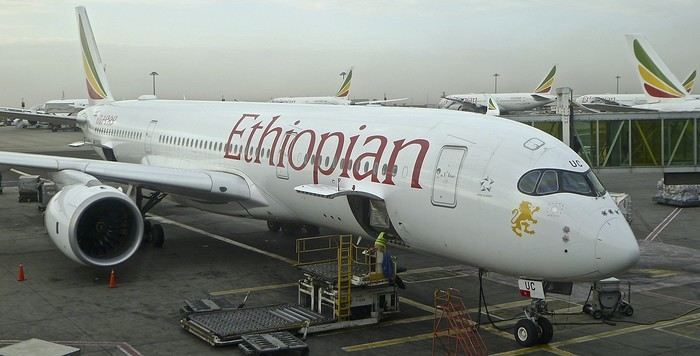
-1- During the layover in Addis Ababa. The Airbus A-350 in the early morning mist.
Reminder: Click on each image to enlarge it, if needed. .
From Dar es Salaam, if you want to go by road to Ruaha, it’ll take a very long and tiring day. 🤪
On previous trips, we’ve always taken a bush plane for this route. In this case, it took just over an hour and a half, with two short intermediate stops to drop off passengers at other bush airstrips.
Since I’m also passionate about aviation, I love these flights where you can admire the landscapes from low altitude while sitting right behind the pilot 🙂.
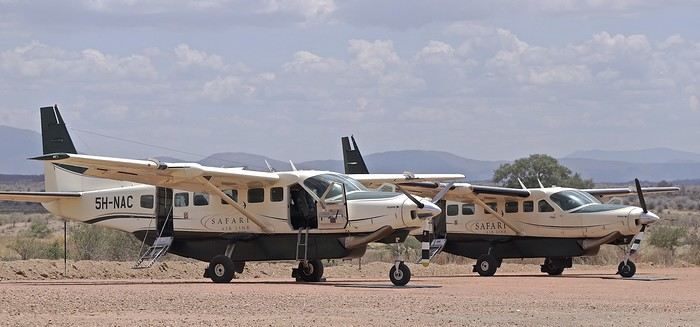
-2- These routes mainly use Cessna 208 Caravans.
At the Msembe airstrip, we’re greeted around 1:30 PM by a guide and a driver from our chosen lodge. They brought a picnic basket, which we enjoy at a nearby picnic area. We’re by the Ruaha River, completely dry—it’s scorching hot.
-3- The first mammals we encounter are a pair of female impalas, accompanied by a young male.
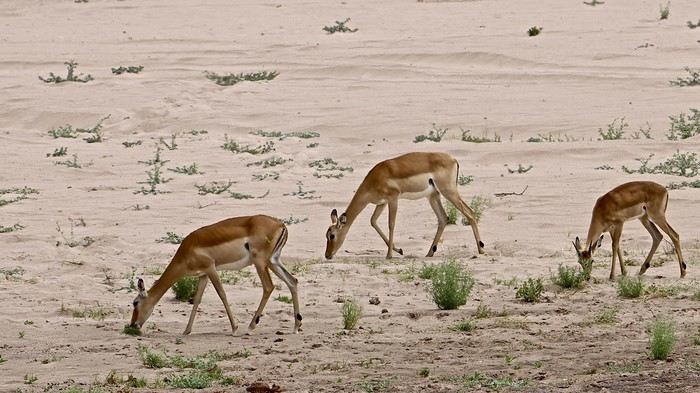
Reminder: Click on the image to view it in larger size. 😉
-4- To save the hippopotamus populations from certain death, rangers had to dig holes in the sand with bulldozers. Fortunately, water is present beneath the sand layer.
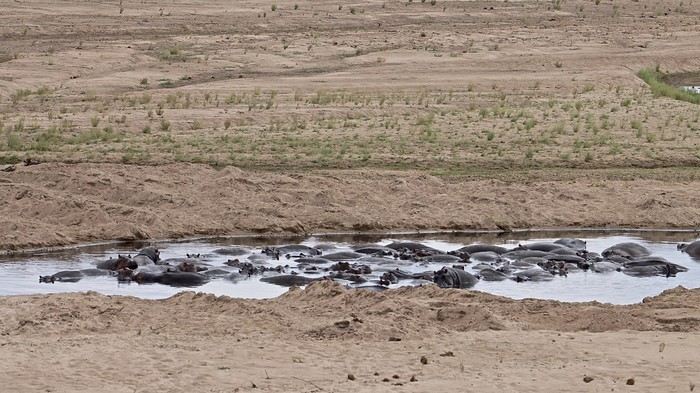
-5- This crocodile doesn’t seem to have been accepted as a swimming neighbor by the hippos...
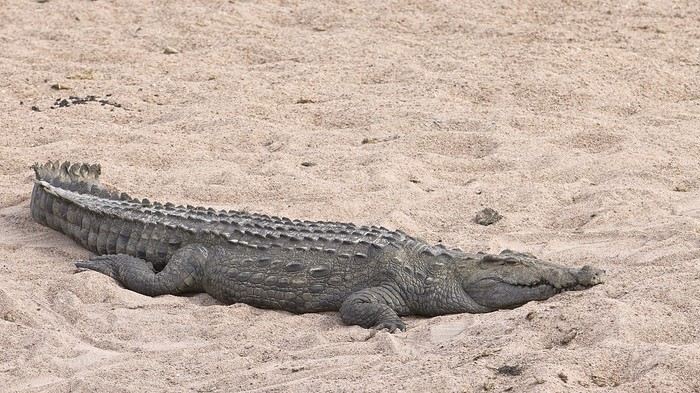
We’ll explore along the river for 2-3 hours before crossing it at a ford toward the southern part of the reserve.
-6- The typical landscape of Ruaha, with its many baobabs.
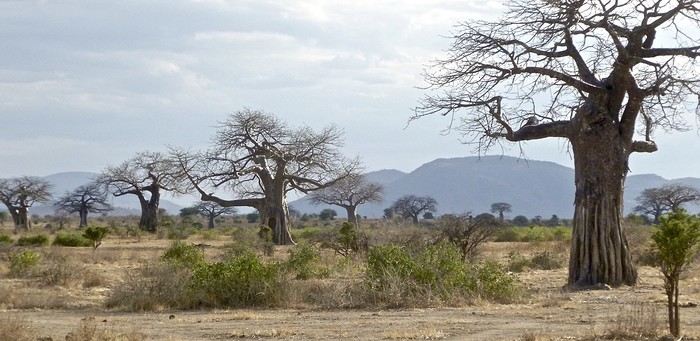
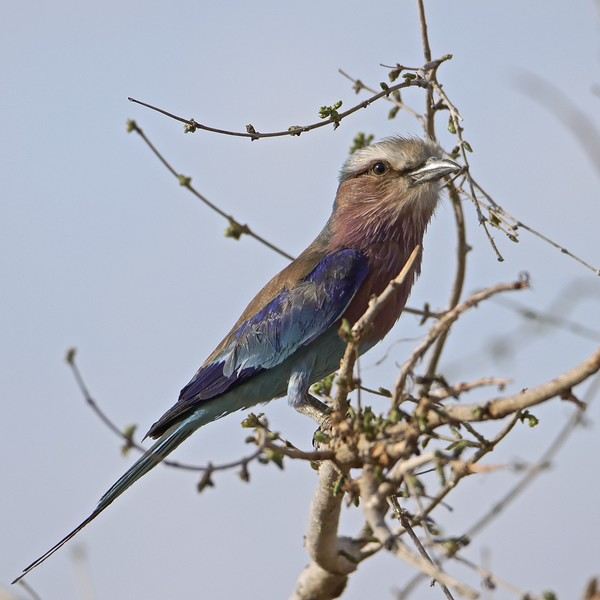
-7- My buddy the R.L.B. is also here to welcome me.... 🙂 🙂
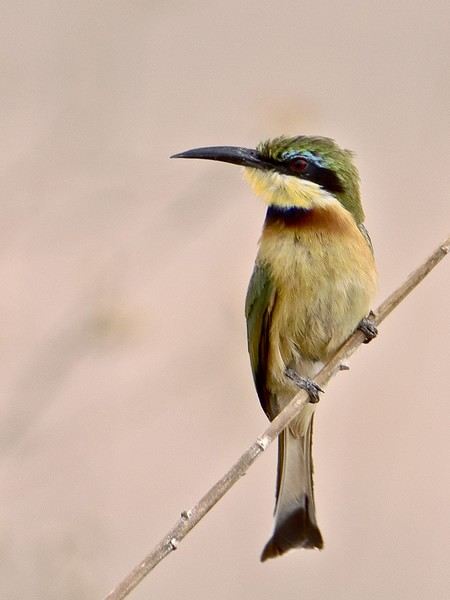
-8- As well as this little bee-eater... 😎
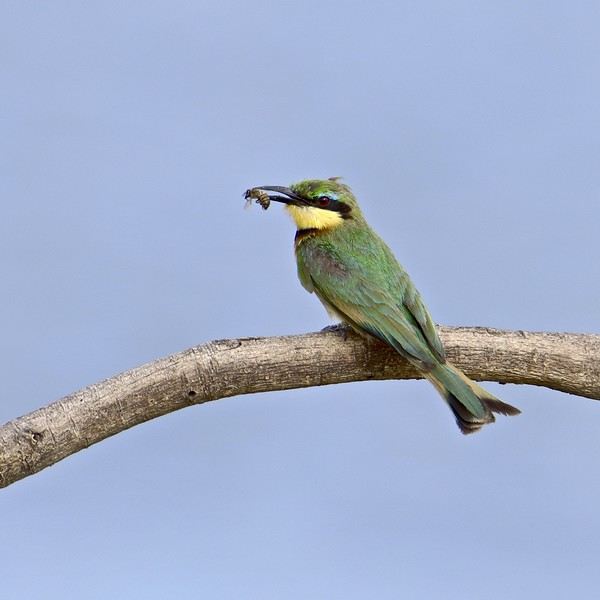
-9- ...which reminds us of the origin of its name...!
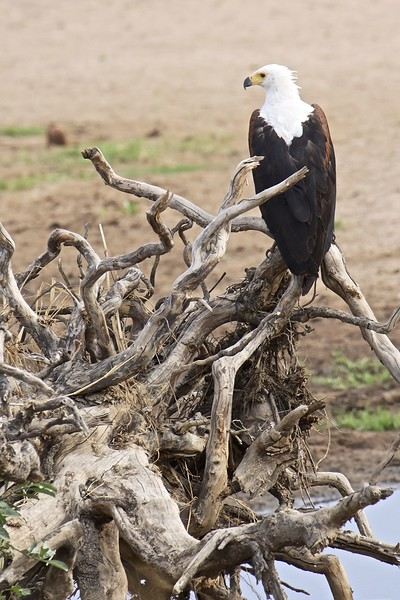
-10- Above a rare waterhole, a fish eagle keeps watch for fish...
...
*** Please wait until the end of the story for any questions or to share your own experiences in Ruaha. (Or via PM.) Thanks in advance for keeping this account smooth and enjoyable. 😉
...
*** I’m not an ornithologist, but birds are an important and unavoidable part of safari discoveries. You’ll find quite a few in the images of my story. 😎
...
" We’re ALL different, and so are our expectations when it comes to travel or leisure ". There are—without a doubt—as many ways to experience a trip as there are travelers!! For the two of us, it’s only our love of wild nature that guides us to East Africa. The stated goal of this trip was purely wildlife-focused, and NOT about discovering the country or its people.
...
Hello everyone,
Previously, I shared the account of a trip/safari in southern Tanzania in June 2024, in the Mikumi and Selous reserves.
This time, still in southern Tanzania, I invite you to join us in Ruaha National Park. (Then, depending on the number of images allowed in my quota, at the end of my story, we’ll return to Selous for the second part of the same trip.)
- This trip/safari took place in November 2022. - Our flight started in Marseille, heading to Addis Ababa, then Dar es Salaam (via Ethiopian Airlines). In Dar, we spent one night at a hotel near the airfield.
-1- During the layover in Addis Ababa. The Airbus A-350 in the early morning mist.
Reminder: Click on each image to enlarge it, if needed. .
From Dar es Salaam, if you want to go by road to Ruaha, it’ll take a very long and tiring day. 🤪
On previous trips, we’ve always taken a bush plane for this route. In this case, it took just over an hour and a half, with two short intermediate stops to drop off passengers at other bush airstrips.
Since I’m also passionate about aviation, I love these flights where you can admire the landscapes from low altitude while sitting right behind the pilot 🙂.
-2- These routes mainly use Cessna 208 Caravans.
At the Msembe airstrip, we’re greeted around 1:30 PM by a guide and a driver from our chosen lodge. They brought a picnic basket, which we enjoy at a nearby picnic area. We’re by the Ruaha River, completely dry—it’s scorching hot.
-3- The first mammals we encounter are a pair of female impalas, accompanied by a young male.
Reminder: Click on the image to view it in larger size. 😉
-4- To save the hippopotamus populations from certain death, rangers had to dig holes in the sand with bulldozers. Fortunately, water is present beneath the sand layer.
-5- This crocodile doesn’t seem to have been accepted as a swimming neighbor by the hippos...
We’ll explore along the river for 2-3 hours before crossing it at a ford toward the southern part of the reserve.
-6- The typical landscape of Ruaha, with its many baobabs.
-7- My buddy the R.L.B. is also here to welcome me.... 🙂 🙂
-8- As well as this little bee-eater... 😎
-9- ...which reminds us of the origin of its name...!
-10- Above a rare waterhole, a fish eagle keeps watch for fish...
...
*** Please wait until the end of the story for any questions or to share your own experiences in Ruaha. (Or via PM.) Thanks in advance for keeping this account smooth and enjoyable. 😉
...
*** I’m not an ornithologist, but birds are an important and unavoidable part of safari discoveries. You’ll find quite a few in the images of my story. 😎
...
Cost of a trip to Egypt
Hi there,
I’m traveling solo to Egypt. Could you give me a rough idea of the budget for:
meals
hotels
taxis including tips
visits...
Just an estimate, of course.
For 15 days, what would the price range be, considering there’s an overnight train and a Nile cruise?
I’d like to compare with a travel agency. Is it more worthwhile to go through an agency despite the downsides of group travel?
Otherwise, if a travel buddy is interested in this country, why not?
Thanks a lot!
Everest Base Camp & Gokyo Lakes Trek: Are guides absolutely mandatory?
Hi everyone,
We’re heading out in March for this trek. We’re used to hiking and long-distance treks, but this’ll be our first time in Nepal.
QUESTION: People from Nepal are telling us it’s MANDATORY to have guides! Is this true, or is it just agencies trying to get work for their staff?
The Lonely Planet says: "In April 2023, the government announced that every trekker would need to hire the services of a porter or a licensed guide to obtain the TIMS permit. The law isn’t enforced, and by 2025, there were no longer any obligations for teahouse treks."
What do you think? What’s your experience? Thanks for your feedback.
We’re heading out in March for this trek. We’re used to hiking and long-distance treks, but this’ll be our first time in Nepal.
QUESTION: People from Nepal are telling us it’s MANDATORY to have guides! Is this true, or is it just agencies trying to get work for their staff?
The Lonely Planet says: "In April 2023, the government announced that every trekker would need to hire the services of a porter or a licensed guide to obtain the TIMS permit. The law isn’t enforced, and by 2025, there were no longer any obligations for teahouse treks."
What do you think? What’s your experience? Thanks for your feedback.
Visa for multiple border crossings in Zambia and Zimbabwe
Hello, HAPPY NEW YEAR 2026!
We’re heading back in October for a trip through Botswana, Zambia, and Zimbabwe.
I have a question: for our route, we’ll need to cross the Zambia and Zimbabwe borders twice each. From experience, I know we won’t have any issues with Botswana.
But for the other two countries, I can’t find a clear answer.
All your tips are welcome!
Thanks for your replies
Thanks for your replies
What routes for Kruger?
Hi everyone again 🙂
I was thinking of continuing the questions from my first post, but since the title was changed... I’m starting a new thread
The plane should land on Saturday around 11 AM. After collecting luggage and the car, I think we’ll leave the airport between 1 and 2 PM. Question #1: Where should we stop along the way, allowing some buffer time so we don’t end up driving at night if the flight is delayed? (The idea isn’t to sightsee but just to take a break while making progress toward Kruger.)
We’ll spend part of Sunday, Monday, Tuesday, Wednesday, and Thursday (a little over 4 days) in Kruger. Questions #2 and beyond: What route should we take? I’ve considered two options: either enter from the south (Malelane Gate?) and head north up to the Olifants area to exit at Orpen Gate. How many accommodations should we book in this case, and where? Or enter at Orpen Gate and exit near Hazyview (or the other way around, and near Hazyview, should it be Paul Kruger Gate or Phabeni?). In this case, it would allow us to spend 2 nights in one place and 2 in another, but we’d skip the south (or is it possible to visit it in a day?) Well, for accommodations (accessible by sedan), all suggestions are welcome… but I’ve checked October availability, and there aren’t many left 😕 I plan to spend Thursday in the park and exit before it closes to sleep outside, which would save time the next day for the drive to the airport. I was thinking of Hazyview (again, no sightseeing since we already visited the area in 2009), but do you have another/better idea?
For clarity, here’s a summary of the Kruger part: Day 1: Arrival in Johannesburg and drive to ? Day 2: Enter Kruger (likely late morning or early afternoon) Days 3, 4, and 5: Kruger with exit at the end of Day 5 Day 6: Drive to the airport for the Cape Town and surrounds portion
Regarding Kruger bookings, it seems (I lost my old notes when my hard drive crashed—I backed up work documents but not vacation ones, what a mess!) that you can monitor reservations, and if a preferred accommodation becomes available, you can book it and cancel the old one. Is that still the case? (And is it easy to do?)
Thanks in advance for your answers. I’m off to reread travel journals about Cape Town and will probably be back with more questions (the accommodation availability issue seems less urgent there, so less of a priority).
I was thinking of continuing the questions from my first post, but since the title was changed... I’m starting a new thread
The plane should land on Saturday around 11 AM. After collecting luggage and the car, I think we’ll leave the airport between 1 and 2 PM. Question #1: Where should we stop along the way, allowing some buffer time so we don’t end up driving at night if the flight is delayed? (The idea isn’t to sightsee but just to take a break while making progress toward Kruger.)
We’ll spend part of Sunday, Monday, Tuesday, Wednesday, and Thursday (a little over 4 days) in Kruger. Questions #2 and beyond: What route should we take? I’ve considered two options: either enter from the south (Malelane Gate?) and head north up to the Olifants area to exit at Orpen Gate. How many accommodations should we book in this case, and where? Or enter at Orpen Gate and exit near Hazyview (or the other way around, and near Hazyview, should it be Paul Kruger Gate or Phabeni?). In this case, it would allow us to spend 2 nights in one place and 2 in another, but we’d skip the south (or is it possible to visit it in a day?) Well, for accommodations (accessible by sedan), all suggestions are welcome… but I’ve checked October availability, and there aren’t many left 😕 I plan to spend Thursday in the park and exit before it closes to sleep outside, which would save time the next day for the drive to the airport. I was thinking of Hazyview (again, no sightseeing since we already visited the area in 2009), but do you have another/better idea?
For clarity, here’s a summary of the Kruger part: Day 1: Arrival in Johannesburg and drive to ? Day 2: Enter Kruger (likely late morning or early afternoon) Days 3, 4, and 5: Kruger with exit at the end of Day 5 Day 6: Drive to the airport for the Cape Town and surrounds portion
Regarding Kruger bookings, it seems (I lost my old notes when my hard drive crashed—I backed up work documents but not vacation ones, what a mess!) that you can monitor reservations, and if a preferred accommodation becomes available, you can book it and cancel the old one. Is that still the case? (And is it easy to do?)
Thanks in advance for your answers. I’m off to reread travel journals about Cape Town and will probably be back with more questions (the accommodation availability issue seems less urgent there, so less of a priority).
Looking for info on a campervan road trip in Eastern Europe
Hi everyone,
I’m planning a campervan road trip and would love some tips from those who know these countries: Slovenia, Bosnia and Herzegovina, Croatia, Montenegro, and Slovenia again. At the moment, nothing’s set in stone, but for example, is it better to visit Slovenia or Bosnia? My preferences lean toward landscapes (rivers, sea, lakes)—basically anywhere there’s water! :) Wild camping, cheap or even free spots, and a *very* tight budget—it’s the discovery, curiosity, and meeting locals that drive me. I’ll visit cities and sites only if access is easy (by bike, for example, or by train from an affordable campsite) and if visitors aren’t treated like cash cows. Just reasonable stuff, really. So, any advice is welcome—like swimming spots or easy hikes along coasts or rivers. I love caves and offbeat visits (salt mines in Poland, La Roque Saint-Christophe in France, etc.). Castles and old ruins? Not really my thing... Thanks for your help! Sylvia
I’m planning a campervan road trip and would love some tips from those who know these countries: Slovenia, Bosnia and Herzegovina, Croatia, Montenegro, and Slovenia again. At the moment, nothing’s set in stone, but for example, is it better to visit Slovenia or Bosnia? My preferences lean toward landscapes (rivers, sea, lakes)—basically anywhere there’s water! :) Wild camping, cheap or even free spots, and a *very* tight budget—it’s the discovery, curiosity, and meeting locals that drive me. I’ll visit cities and sites only if access is easy (by bike, for example, or by train from an affordable campsite) and if visitors aren’t treated like cash cows. Just reasonable stuff, really. So, any advice is welcome—like swimming spots or easy hikes along coasts or rivers. I love caves and offbeat visits (salt mines in Poland, La Roque Saint-Christophe in France, etc.). Castles and old ruins? Not really my thing... Thanks for your help! Sylvia
Trip to Morocco in September-October 2025, in our camper van
Hi everyone,
We’re just back from a month-long trip to Morocco in our camper van.
After crossing France (we left from the Nantes area) and Spain, we arrived in Algeciras where we bought our boat tickets to Tangier. When we got to Tangier, as we were going through customs, you can imagine our surprise when the customs officer took our road map of Morocco and pointed out the label "Western Sahara" (just like in the forum’s destination section, by the way!).
He wanted it to say "Moroccan Sahara" instead!!! But there was nothing we could do—it was an old map... He wouldn’t listen, and after long discussions with the other (younger) customs officers, he finally gave it back and let us through... Unbelievable! Later, we heard that other travelers had their maps confiscated outright.
So, hide it well if you want to keep yours!!!
Anyway, we skirted around Tangier’s suburbs—pretty grim—and finally arrived in Asilah.
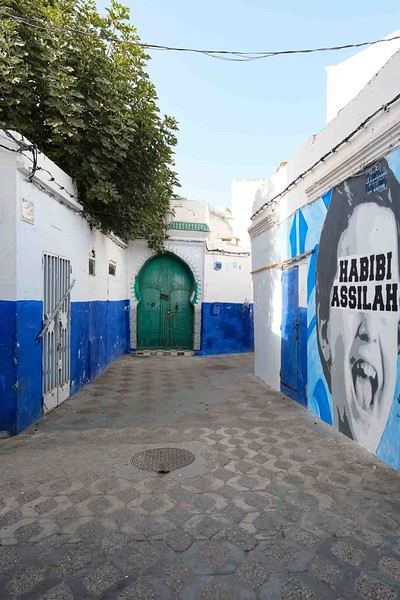
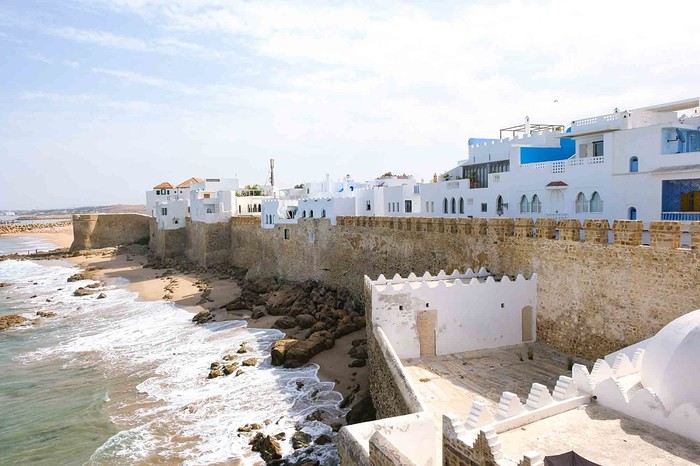
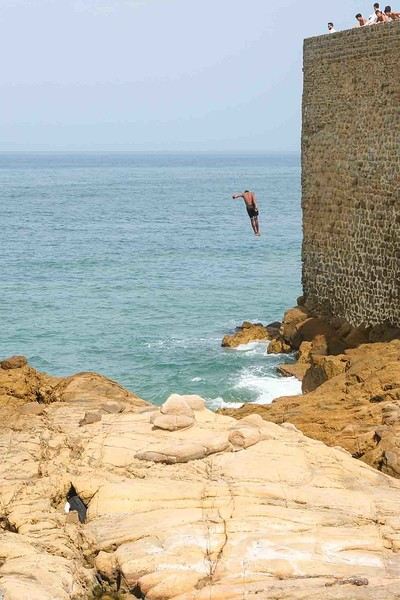
Following the coast and the long promenade along the beach, we reached the campsite. It was a bit crowded, not much shade, but it wasn’t far from the medina or the beach, and it wasn’t expensive. There’s some life here: Moroccan families seem to live on-site, in tents or basic bungalows. A woman was cooking tagine on a brazier—we were right in the atmosphere! The night was quiet, and we slept well. We set off on foot, walking along the seafront to the medina... We’d already been here in 2009. It was less touristy back then! Still, at this early hour, the little streets inside were very quiet. The walls had been freshly whitewashed, and there were even more murals than before. Around 11:30 AM, we strolled along the ramparts by the sea. There was a nice breeze! And a lot more people around. We enjoyed a milkshake on the terrace of a café overlooking the beach that stretches out at the foot of the medina. Some young guys were having fun diving off the rocks—and even off the top of the wall!
Anyway, we skirted around Tangier’s suburbs—pretty grim—and finally arrived in Asilah.
Following the coast and the long promenade along the beach, we reached the campsite. It was a bit crowded, not much shade, but it wasn’t far from the medina or the beach, and it wasn’t expensive. There’s some life here: Moroccan families seem to live on-site, in tents or basic bungalows. A woman was cooking tagine on a brazier—we were right in the atmosphere! The night was quiet, and we slept well. We set off on foot, walking along the seafront to the medina... We’d already been here in 2009. It was less touristy back then! Still, at this early hour, the little streets inside were very quiet. The walls had been freshly whitewashed, and there were even more murals than before. Around 11:30 AM, we strolled along the ramparts by the sea. There was a nice breeze! And a lot more people around. We enjoyed a milkshake on the terrace of a café overlooking the beach that stretches out at the foot of the medina. Some young guys were having fun diving off the rocks—and even off the top of the wall!
Photo Required for All Visitors to the U.S. (Entry and Exit)
Hi North America forum crew,
Just a little post that might interest some of you:
Travelers to the United States | Photo Now Mandatory Upon Entry and Exit | La Presse
Martine from DD in Arizona and New Mexico
Good evening everyone! 🙂
We’re back from our September 2025 road trip, this time to explore Arizona and New Mexico, and it’s time for me to start my travel journal—especially since everything’s already booked for another trip in September 2026 (to California), and I need to get started on the planning.
I was a little worried this new visit to Uncle Sam’s country might not be as "wow" as the others, but we still discovered some incredible places.
For those who don’t know us, we’re a couple in our seventies who speak very little English, but that didn’t stop us from fully enjoying our stay.
For this 6th road trip in the U.S., we spent 21 nights there, drove 4,160 km by car, and walked nearly 160 km in a loop starting from Phoenix.
We’d been to Arizona before (but not this side) and never to New Mexico. This whole road trip was a huge discovery for us.
In the prices mentioned (some in euros, others in dollars), bank fees and exchange charges are included. The flights, car rental, and parking were all paid for in December 2024 when we booked.
We’d downloaded the MPC (Mobile Passport Control) app, but there wasn’t a dedicated line at Phoenix Airport. Still, we got through quickly with friendly, smiling agents.
I don’t drive at all (I hate it), so the stops were chosen based on activities but also, for some, to limit daily mileage for the sole driver. The kilometers listed in the itinerary are the daily distances.
We traveled from September 9th to 22nd, unfortunately once again without our dear friends Mimi and Maumau.
The itinerary
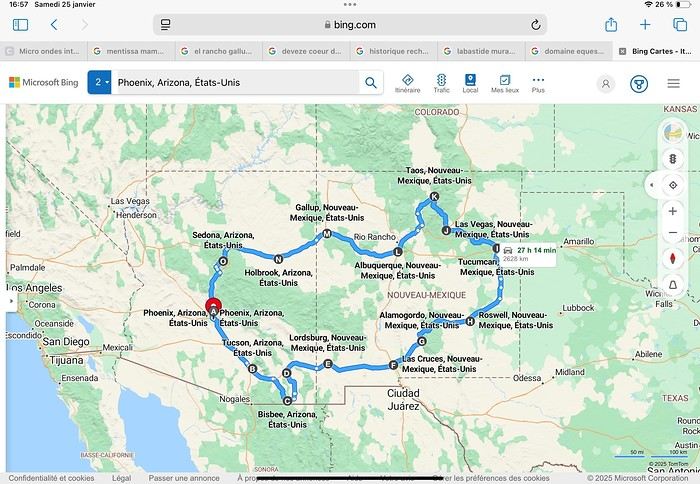
Day 1: Flight Marseille-Paris-Phoenix, then Gold Canyon (133 km) Day 2: Tucson (271 km) Lost Dutchman State Park Day 3: Tucson (155 km) Day 4: Tucson (34 km) Day 5: Bisbee (182 km) Day 6: Lordsburg (345 km) Day 7: Las Cruces (253 km) Day 8: Alamogordo (162 km) Day 9: Roswell (264 km) Day 10: Tucumcari (369 km) Day 11: Las Vegas (281 km) – the one in New Mexico Day 12: Taos (213 km) Day 13: Santa Fe (224 km) Day 14: Albuquerque (123 km) Day 15: Gallup (246 km) Day 16: Holbrook (224 km) Day 17: Flagstaff (179 km) Day 18: Sedona (118 km) Day 19: Sedona (48 km) Day 20: Sedona (41 km) Day 21: Phoenix (256 km) Day 22: Phoenix Airport (35 km)
📊 **Budget**: A little over 7,500 € for both of us, all included. The exchange rate was in our favor (1.17 dollars to 1 €). 📊 **Flights**: Marseille-Paris Charles de Gaulle-Phoenix: 1,787 € for two, with one checked bag each (Air France) 📊 **ESTA**: $42 📊 **America the Beautiful Pass**: $80 📊 **Parking**: 134 € (super eco at Marseille) 📊 **Car rental (Hertz)**: 865 €. Since there were no SUVs left in the reserved category (Nissan Rogue), we got an upgrade (4x4 Ford Explorer). We booked through Air France (15% discount). We’d originally reserved it in December for 1,140 €, but since prices dropped in March, we canceled and rebooked for 865 €. Hertz offers a free Hertz Gold Plus Rewards program, which gives you priority counter service when picking up the car. 📊 **Accommodation**: 2,400 € We stayed in hotels and motels of varying standards (from 60 to 203 € per night, depending on the city), all booked through Booking.com or Hotels.com. Out of 21 nights, only two didn’t include breakfast in the price. Booking.com sometimes offers slightly cheaper rates if you book by phone using the mobile app, and our Genius 3 status on the site also got us some preferential rates. 📊 **Supplementary insurance**: AVA 200 € for medical care if needed 📊 **Cash**: $2,078. We left with 1,000 € exchanged before departure and made two withdrawals of $500. This cash covered: - Evening restaurants and tips - Midday picnics - Gas: $298 for 4,160 km - Museum and private park entries (per person): - Lost Dutchman: $10 - Arizona-Sonora Desert Museum: $28 - Bird Cage Theater: $16 - Tombstone Shootout: $8 - New Mexico Farm & Ranch Museum: $12 - Roswell International UFO Museum: $5 - Billy the Kid Museum: $7 - Rancho de Taos: $22 - West Fork Oak Creek Trail entry: $15 We got a few discounts thanks to our senior age (+65). - Souvenirs and little treats
Like on our previous road trips, we didn’t rent a GPS. We got around using offline GPS apps Here WeGo and Organic Maps, with maps of the states we visited downloaded before we left (on our phones).
❤️❤️❤️ **Highlights** (there are so many!) 📍 Goldfield Ghost Town (even if it’s a reconstruction) 📍 The standing army of Saguaro cacti at Saguaro National Park West 📍 Diving into the cowboy universe of Tombstone 📍 The welcome from Rick and Henry at our guesthouse in Bisbee (Garden at Mile High Ranch) 📍 The tangled rocks of Chiricahua National Monument 📍 The flavored pistachios from Dwayne’s Fresh Jerky and Mac Ginnis Pistachioland 📍 Restaurants: La Posta (Las Cruces), Diner 66 (Albuquerque), and the Haunted Hamburger (Jerome) 📍 The old plazas of New Mexico 📍 The solitude and beauty of the white dunes at White Sands National Park 📍 Stepping back in time at the Billy the Kid Museum (Fort Stanton) 📍 Sections of historic Route 66 and the old motels of Tucumcari, especially at night when all the neon lights are on 📍 Taos Pueblo and diving into Native American culture 📍 After the Rio Grande Bridge, the descent via NM 567 to the very bottom of the Rio Grande Gorge, then the road along the riverbanks to Taos 📍 The tranquility of the Chimayo Sanctuary 📍 Discovering the ingenious native dwellings at Bandelier National Monument and Walnut Canyon National Park 📍 The small towns along the Turquoise Trail 📍 The red rocks of Red Rock Park and the Painted Desert 📍 The extraordinary colors of the petrified trees at Petrified Forest National Park 📍 Sedona, its red rocks, and the reward of the viewpoints at the end of hikes (Devil’s Bridge, The Subway, and West Fork Oak Creek) 📍 The immersion in Mexico when visiting Tlaquepaque 📍 The almost-ghost town of Jerome and its terraced streets 📍 The incredible kindness of Americans, always ready to help and up for a chat ❤️
☹️☹️☹️ **Flops** (there are very few) 📍 Several museums and churches being closed, so we couldn’t visit them 📍 Some museums and visitor centers opening late (10 AM) and closing early (4 PM) 📍 A 64 € phone roaming charge because we got near the Mexican border and picked up their cell tower 📍 The outrageous price ($5.99) for a gallon of gas at the Shell near Phoenix Airport
I hope this helps! Anyway, thanks for reading my long post. Don’t hesitate to reach out, even via PM, if you see I haven’t replied and you’d like more details. Have a great evening, everyone! 🙂
We’re back from our September 2025 road trip, this time to explore Arizona and New Mexico, and it’s time for me to start my travel journal—especially since everything’s already booked for another trip in September 2026 (to California), and I need to get started on the planning.
I was a little worried this new visit to Uncle Sam’s country might not be as "wow" as the others, but we still discovered some incredible places.
For those who don’t know us, we’re a couple in our seventies who speak very little English, but that didn’t stop us from fully enjoying our stay.
For this 6th road trip in the U.S., we spent 21 nights there, drove 4,160 km by car, and walked nearly 160 km in a loop starting from Phoenix.
We’d been to Arizona before (but not this side) and never to New Mexico. This whole road trip was a huge discovery for us.
In the prices mentioned (some in euros, others in dollars), bank fees and exchange charges are included. The flights, car rental, and parking were all paid for in December 2024 when we booked.
We’d downloaded the MPC (Mobile Passport Control) app, but there wasn’t a dedicated line at Phoenix Airport. Still, we got through quickly with friendly, smiling agents.
I don’t drive at all (I hate it), so the stops were chosen based on activities but also, for some, to limit daily mileage for the sole driver. The kilometers listed in the itinerary are the daily distances.
We traveled from September 9th to 22nd, unfortunately once again without our dear friends Mimi and Maumau.
The itinerary
Day 1: Flight Marseille-Paris-Phoenix, then Gold Canyon (133 km) Day 2: Tucson (271 km) Lost Dutchman State Park Day 3: Tucson (155 km) Day 4: Tucson (34 km) Day 5: Bisbee (182 km) Day 6: Lordsburg (345 km) Day 7: Las Cruces (253 km) Day 8: Alamogordo (162 km) Day 9: Roswell (264 km) Day 10: Tucumcari (369 km) Day 11: Las Vegas (281 km) – the one in New Mexico Day 12: Taos (213 km) Day 13: Santa Fe (224 km) Day 14: Albuquerque (123 km) Day 15: Gallup (246 km) Day 16: Holbrook (224 km) Day 17: Flagstaff (179 km) Day 18: Sedona (118 km) Day 19: Sedona (48 km) Day 20: Sedona (41 km) Day 21: Phoenix (256 km) Day 22: Phoenix Airport (35 km)
📊 **Budget**: A little over 7,500 € for both of us, all included. The exchange rate was in our favor (1.17 dollars to 1 €). 📊 **Flights**: Marseille-Paris Charles de Gaulle-Phoenix: 1,787 € for two, with one checked bag each (Air France) 📊 **ESTA**: $42 📊 **America the Beautiful Pass**: $80 📊 **Parking**: 134 € (super eco at Marseille) 📊 **Car rental (Hertz)**: 865 €. Since there were no SUVs left in the reserved category (Nissan Rogue), we got an upgrade (4x4 Ford Explorer). We booked through Air France (15% discount). We’d originally reserved it in December for 1,140 €, but since prices dropped in March, we canceled and rebooked for 865 €. Hertz offers a free Hertz Gold Plus Rewards program, which gives you priority counter service when picking up the car. 📊 **Accommodation**: 2,400 € We stayed in hotels and motels of varying standards (from 60 to 203 € per night, depending on the city), all booked through Booking.com or Hotels.com. Out of 21 nights, only two didn’t include breakfast in the price. Booking.com sometimes offers slightly cheaper rates if you book by phone using the mobile app, and our Genius 3 status on the site also got us some preferential rates. 📊 **Supplementary insurance**: AVA 200 € for medical care if needed 📊 **Cash**: $2,078. We left with 1,000 € exchanged before departure and made two withdrawals of $500. This cash covered: - Evening restaurants and tips - Midday picnics - Gas: $298 for 4,160 km - Museum and private park entries (per person): - Lost Dutchman: $10 - Arizona-Sonora Desert Museum: $28 - Bird Cage Theater: $16 - Tombstone Shootout: $8 - New Mexico Farm & Ranch Museum: $12 - Roswell International UFO Museum: $5 - Billy the Kid Museum: $7 - Rancho de Taos: $22 - West Fork Oak Creek Trail entry: $15 We got a few discounts thanks to our senior age (+65). - Souvenirs and little treats
Like on our previous road trips, we didn’t rent a GPS. We got around using offline GPS apps Here WeGo and Organic Maps, with maps of the states we visited downloaded before we left (on our phones).
❤️❤️❤️ **Highlights** (there are so many!) 📍 Goldfield Ghost Town (even if it’s a reconstruction) 📍 The standing army of Saguaro cacti at Saguaro National Park West 📍 Diving into the cowboy universe of Tombstone 📍 The welcome from Rick and Henry at our guesthouse in Bisbee (Garden at Mile High Ranch) 📍 The tangled rocks of Chiricahua National Monument 📍 The flavored pistachios from Dwayne’s Fresh Jerky and Mac Ginnis Pistachioland 📍 Restaurants: La Posta (Las Cruces), Diner 66 (Albuquerque), and the Haunted Hamburger (Jerome) 📍 The old plazas of New Mexico 📍 The solitude and beauty of the white dunes at White Sands National Park 📍 Stepping back in time at the Billy the Kid Museum (Fort Stanton) 📍 Sections of historic Route 66 and the old motels of Tucumcari, especially at night when all the neon lights are on 📍 Taos Pueblo and diving into Native American culture 📍 After the Rio Grande Bridge, the descent via NM 567 to the very bottom of the Rio Grande Gorge, then the road along the riverbanks to Taos 📍 The tranquility of the Chimayo Sanctuary 📍 Discovering the ingenious native dwellings at Bandelier National Monument and Walnut Canyon National Park 📍 The small towns along the Turquoise Trail 📍 The red rocks of Red Rock Park and the Painted Desert 📍 The extraordinary colors of the petrified trees at Petrified Forest National Park 📍 Sedona, its red rocks, and the reward of the viewpoints at the end of hikes (Devil’s Bridge, The Subway, and West Fork Oak Creek) 📍 The immersion in Mexico when visiting Tlaquepaque 📍 The almost-ghost town of Jerome and its terraced streets 📍 The incredible kindness of Americans, always ready to help and up for a chat ❤️
☹️☹️☹️ **Flops** (there are very few) 📍 Several museums and churches being closed, so we couldn’t visit them 📍 Some museums and visitor centers opening late (10 AM) and closing early (4 PM) 📍 A 64 € phone roaming charge because we got near the Mexican border and picked up their cell tower 📍 The outrageous price ($5.99) for a gallon of gas at the Shell near Phoenix Airport
I hope this helps! Anyway, thanks for reading my long post. Don’t hesitate to reach out, even via PM, if you see I haven’t replied and you’d like more details. Have a great evening, everyone! 🙂
Annapurna Circuit trek: when to book accommodations?
hi,
we’d like to do a trek in Nepal, and we’re thinking of the Annapurna Circuit—it’s cheaper than the Everest trek.
Our plan is to do it without a guide or porter. We’re used to the mountains, not so much to high altitude, but if we acclimate well, there’s no reason it should go wrong ;)
No guide = handling permits, transport, and accommodation on our own...
So my question is: is it possible to book lodges in advance before departure? Or, even better, day by day?
I’ve read some older posts, so I’m asking again to get up-to-date info on what’s happening now. We’re planning to go mid-November 2026 or March 2027.
Thanks for your tips! :)
No guide = handling permits, transport, and accommodation on our own...
So my question is: is it possible to book lodges in advance before departure? Or, even better, day by day?
I’ve read some older posts, so I’m asking again to get up-to-date info on what’s happening now. We’re planning to go mid-November 2026 or March 2027.
Thanks for your tips! :)
Unsure about destinations in Northern and Eastern India
Hi everyone! 🙂
My partner (who’s a teacher—hence the summer holidays) and I are heading to Eastern India for 23 days in July. This is my 5th trip to India, but her first.
We fly into Delhi on July 7th and leave from Delhi on the 23rd (since our flight to Kolkata arrived late at night, and I wanted to show Agra and Varanasi to my partner).
We love getting off the beaten track and meeting people, so we’ll mostly be taking the train.
Here’s what we’re planning:
- **DELHI**: 1 night on the way (short because the plane is supposed to land at 01:55), then we take the train at 13:00 - **GWALIOR**: 3 nights, including a day trip to **AGRA** by train to see the Taj Mahal and the Red Fort (I find Agra too touristy to stay overnight). Otherwise, in Gwalior, the Fort, the temples, the Man Mandir Palace, and the Jai Vilas Palace if we have time. - **ORCHHA**: 2 nights... *maybe skip this to spend more time in VARANASI?* - **VARANASI**: overnight train + 3 nights, the Ghats, temples... maybe a day trip to **SARNATH**. - **KOLKATA**: overnight train + 3 nights. Maybe a countryside excursion to the ashram in Channa. *- Here we’re hesitating over 2 nights: either 2 nights in **SHANTINIKETAN** with a visit to **CHANNA** on the way, or a 2-day excursion to the **SUNDARBAN** nature park. But is it worth it in July during the monsoon?* - **PURI**: overnight train + 4 nights. *We’re planning to do everything from Puri, as it seems nicer than staying in BHUBANESWAR. What do you think?* Visit **KONARK** and **CHILIKA LAKE**. *Is it worth visiting Chilika Lake this season? Another question: can you swim in Puri, or is it too dangerous (waves)?* - Train to **BHUBANESWAR**, then a flight from BHUBANESWAR to **DELHI**, - 2 nights in **DELHI**, visiting Jama Masjid, and *either Humayun’s Tomb, Safdarjung’s Tomb, or Qutb Minar.*
Back to Paris. Total: 23 nights.
What do you think of these choices? What about the options we’re still unsure about *(in bold/italics)*? Thanks so much! 🙂
We fly into Delhi on July 7th and leave from Delhi on the 23rd (since our flight to Kolkata arrived late at night, and I wanted to show Agra and Varanasi to my partner).
We love getting off the beaten track and meeting people, so we’ll mostly be taking the train.
Here’s what we’re planning:
- **DELHI**: 1 night on the way (short because the plane is supposed to land at 01:55), then we take the train at 13:00 - **GWALIOR**: 3 nights, including a day trip to **AGRA** by train to see the Taj Mahal and the Red Fort (I find Agra too touristy to stay overnight). Otherwise, in Gwalior, the Fort, the temples, the Man Mandir Palace, and the Jai Vilas Palace if we have time. - **ORCHHA**: 2 nights... *maybe skip this to spend more time in VARANASI?* - **VARANASI**: overnight train + 3 nights, the Ghats, temples... maybe a day trip to **SARNATH**. - **KOLKATA**: overnight train + 3 nights. Maybe a countryside excursion to the ashram in Channa. *- Here we’re hesitating over 2 nights: either 2 nights in **SHANTINIKETAN** with a visit to **CHANNA** on the way, or a 2-day excursion to the **SUNDARBAN** nature park. But is it worth it in July during the monsoon?* - **PURI**: overnight train + 4 nights. *We’re planning to do everything from Puri, as it seems nicer than staying in BHUBANESWAR. What do you think?* Visit **KONARK** and **CHILIKA LAKE**. *Is it worth visiting Chilika Lake this season? Another question: can you swim in Puri, or is it too dangerous (waves)?* - Train to **BHUBANESWAR**, then a flight from BHUBANESWAR to **DELHI**, - 2 nights in **DELHI**, visiting Jama Masjid, and *either Humayun’s Tomb, Safdarjung’s Tomb, or Qutb Minar.*
Back to Paris. Total: 23 nights.
What do you think of these choices? What about the options we’re still unsure about *(in bold/italics)*? Thanks so much! 🙂
15-Day Road Trip Recap: Colorado and New Mexico
Hello, here’s a totally subjective recap of our 15-day road trip between Colorado and New Mexico, from late September to mid-October.
Our main interests are culture, museums, and landscapes—no hiking or trails for us. Personally, I’m pretty contemplative, and luckily, there’s always something to see out there! We’re pretty used to the US; we’ve been going there often for a long time (let’s just say we’re not exactly young anymore).
Budget: Even though we don’t set a strict budget beforehand, we try to keep costs as low as possible. This time, we managed to spend around 4000 € for two, all included. To do this: avoid expensive accommodations, staying between 60 and 120 € per night with an average of 90 €/night, mixing Airbnb and motels. And skip the “real” restaurants, which are pretty pricey in the US: sandwiches for lunch, takeout or cooking in the Airbnb in the evening. We shop at Sprouts or Whole Foods—organic-style chains that are pricier than Walmart but better. In the evenings, Sprouts has discounts on items that didn’t sell during the day. Also, avoid toll roads, paid parking, and overly expensive attractions or sites. The dispensary budget is separate…
Route: Denver/Colorado Springs/Alamosa/Raton/Santa Fe/Cuba/Cortez/Grand Junction/Glenwood Springs/Denver This wasn’t too planned in advance—we booked a few nights upon arrival and went with the flow. Flight from CDG to Denver with AF/Delta, car rental at Dollar for a standard SUV. The guy at the Dollar counter upsold me on extra insurance for flat tires (and since I knew we’d be off-roading, I took it). Without telling me, he upgraded me to a Jeep Sahara 4X4 Hybrid. Nice.
Listening to the news upon arrival, the anchor announced, “It’s officially fall now.” We hadn’t really thought about that before leaving, but yeah—it’s the time when the trees turn fluorescent yellow and red. Amazing.
Colorado Springs: Garden of the Gods is a free park with paved trails winding through red/orange rock formations. Magical at sunrise—groups of deer roam around, along with birds and rabbits. It’s small but wow! Didn’t try the Manitou Incline in Manitou Springs, a staircase with thousands of steps going straight up the mountain. Impressive from the bottom, but the parking is paid, which is a downside for those willing to tackle it. The Cog Railway goes up to the summit of Pikes Peak—around $100 when we were there. No thanks. And of course, the parking is paid too. For fans, Maggie’s Farm dispensary is great.
On Route 24, Eleven Mile Canyon Recreation Area is fly-fishing paradise—just like in the movie *A River Runs Through It*. Entry is $11, and a trail follows the river at the bottom of the canyon to the dam. Dozens of people in waders are in the water, casting their lines over and over. You can see the salmon in the clear water, and we had a picnic in the sun, imagining Brad Pitt catching a fish.
Buena Vista: A cute little tourist town with an Outdoor Fair that day—some pretty impressive vehicles for sale, set up for mountain living (like Juniper outfitting a RAM).
Alamosa: The closest town to Great Sand Dunes National Park, crossed by the Rio Grande (and let’s be real—it’s more of a stream than a river!). Park access was free because it was National Park Day. A park with massive dunes—climbing them is pretty exhausting, with lots of wind and sinking sand. Glad we didn’t do it in summer; I can’t imagine how tough it’d be in the heat. It’s a bit deceptive: it looks easy to get to the top of a dune, but it’s really not. The campsites were nice, and it was busy that weekend. We passed the “Point of No Return,” a sandy trail winding through the hills and connecting to Route 559 from above. Didn’t go all the way, but it’s possible the entrance is free from that side. However, you need a 4X4 with good ground clearance. After 1 or 2 km on the trail, you’re alone between the dunes and hills—hardly anyone around. But tricky to turn around or pass other vehicles; the trail isn’t wide. We crossed paths with a Hanomag (registered in the Netherlands—impressive!) coming down without stopping, or risking getting stuck.
On the way out, we took the small Route 403, which quickly turns into a trail crossing the mountain. Entire sections of forest were turning fluorescent yellow with patches of green and red—an incredible sight.
Raton: A small town that probably peaked in the late 19th century and has been in slow decline ever since. The Raton Pass Motor Inn is the kind of place that makes the US legendary—entirely 50s and 60s decor, really well done. I had the Betty Page room—too cool. Felt like we were on Route 66. Even better.
Santa Fe: A small city with no high-rises—almost all low-rise buildings, many in adobe, blending perfectly into the landscape. The old downtown is touristy but nice, with its plaza and church. There’s a really cool vibe—we loved it. For drinks, the bar at the top of La Fonda Hotel was packed for sunset, with a diverse crowd. Not overpriced for the location. SITE Santa Fe is a contemporary art space near the train station. It’s free, and the temporary exhibit was really good—high quality. Museum Hill is, as the name suggests, where several museums are located. We visited the Museum of Indian Art and Culture—great if you’re into “First Nations” history. Saw The Dandy Warhols at The Bridge—an outdoor venue, one of the last concerts of the season before winter makes it too cold. Oddly, there was no bag check, just an ID required (even though it was obvious we were over 21!). Tickets were reasonable, around $30 (concerts in the US can be crazy expensive). The band was good, with fewer than 300 people in front. A sign at the bar warned: Don’t forget you’re at 1,500 meters—alcohol hits harder up here!
Albuquerque: A sprawling city with an old historic center that feels a bit like Disneyland—too perfect for my taste. The real highlight is the Sandia Peak Tramway, which goes up to the old ski resort above the city. Tickets are around $35, and it’s worth it—the ride over the canyons is pretty wild. The ski resort is a bit abandoned; apparently, like elsewhere, there’s no snow anymore. I asked several people about the lack of snow, and the answer was always the same: “It’s cyclical.” Okay then. We arrived for the start of the International Balloon Fiesta (one of the world’s largest hot-air balloon gatherings), hoping to see hundreds of balloons in the sky. Nope—windy today, so no one took off. Bummer.
Las Vegas: New Mexico has its own Las Vegas, but it’s nothing like the other one—a sleepy little town with a perfectly preserved 19th-century Historic Plaza Hotel, brick buildings, and vintage streetlights. Everything is so well-preserved it’s often used as a filming location. NM attracts a lot of productions thanks to tax incentives and its Western landscapes—and it’s cheaper than California! That day, a huge Texas flag was flying in the wind: they were filming the second season of *Ransom Canyon* for Netflix in the town center. If we’d been dressed more “Western,” we could’ve been extras.
Jemez Springs: Its Jemez Hot Springs is super cute—several thermal pools at different temperatures, a New Age vibe. The pools are surrounded by big rocks, and you’re asked to speak softly. A place where you could spend hours. $50 for two hours for two.
Los Alamos: A town made legendary by the bomb, the movie, etc. Heads up: It’s still a research center, and to cross part of the town, you need to show ID. No stopping or taking photos allowed. Other than the Oppenheimer House (currently closed—only the neighboring house is open to visitors), there’s not much to see. There’s a replica of the camp entrance, but it’s been turned into restrooms.
Georgia O’Keeffe Trail (American painter, 1887–1986): Her museum in Santa Fe is pretty good, even if they don’t have tons of works. Entry is $20. Her house in Abiquiu is open for visits, but it’s way overpriced at $65. So we skipped it. You can get an idea of it by stopping at the Welcome Center on Route 84. Further down the same road, Ghost Ranch is worth a visit—beautiful setting, free to enter, with trails to explore and a great atmosphere.
Chaco Culture National Historical Park: A pretty isolated park—25 km of trails to get there, with only a small section paved. The road is decent except for the last few kilometers, which have potholes. I can’t imagine it being accessible after rain, though that doesn’t happen often! This park, in the middle of a desert plain with a few canyons, is one of the rare places where you can find multi-story structures from pre-Columbian civilizations—so, before the “current” tribes. But cruel disappointment: it’s been shut down for a few days. We met a Native ranger—tall, with long hair—who explained that even though he wasn’t being paid, he was still guarding the park and had closed all access to the sites. Darn. Turned around and headed back down the trail.
Same story in the next town, Aztec (a funny name, right?): Aztec Ruins National Monument was closed too.
We passed Ship Rock, the Navajo’s sacred mountain—really impressive. Couldn’t find a trail to get closer, but it’s better from a distance anyway! The town of Shiprock itself is pretty depressing—poor living conditions for some Natives, with rundown mobile homes and piles of junk cars.
Stopped in Cortez to visit Mesa Verde National Park. Ate at Denny’s—hadn’t been there in ages (though it’s the kind of place I should feel at home in!). The customers all looked like they’d stepped out of *The Addams Family*—a little creepy. Or funny, depending on your perspective. For Mesa Verde, after discussing it on this forum with the honorable member Caussat (who didn’t find it that amazing), we were on the fence. Problem solved: it was closed too. Back on the road.
Durango: Really nice with its Main Ave and its shops, cafés—touristy but with local life. Famous for its tourist train to Silverton, but we didn’t do it—way too expensive. Choice between a steam locomotive or diesel (which belches black, stinky smoke—yuck). The diesel should be replaced with electric as soon as they get the funds.
Million Dollar Highway: The road winds through the mountains, and every turn (and there are a lot) is breathtaking—unbelievable landscapes with fluorescent yellow, green, and snow-capped mountains. Just wow.
Silverton: A Western town nestled between two mountains, preserved in its original state despite the tourists arriving by train. Around it, abandoned mines and old wooden ties—must’ve been tough for the 19th-century miners.
Grand Junction: The city is surrounded by giant mesas—pretty impressive. The old downtown is *too* clean—almost sterile.
Colorado National Monument: Just outside the city, a winding road climbs between stunning canyons, with sweeping views of the valley. Entry was free that day due to the shutdown.
Route 330, which we took to get back to the highway, passes through a place called “Cowboy Country”—and it’s true. We saw guys in Stetsons with huge pickups, the road turned into a trail with cows wandering on it, and we had to honk to get them to move. The trail to I-70 was full of potholes—the 4X4 came in handy. Had a picnic by Vega Reservoir: the booth at the entrance was empty, but people left cash in envelopes for camping fees. Anyone passing by could’ve taken it, but it’s an example of US trust and honesty!
Glenwood Springs: A small town famous for its hot springs pool—they claim it’s the largest in the world. I don’t know about that, but it has a great look. Unfortunately, it was closed for maintenance those days! Blew our budget by staying at the Hotel Colorado, a huge 1893 building with a real atmosphere in its grand lobby and fake fireplaces. Fire pits in front of wooden chairs in the garden with mountain views—just really great.
Aspen: The billionaires’ ski resort, but surprisingly, parking was free for 2 hours. Rare to see a place for the super-rich that doesn’t scream “not for you” (like Palm Beach, for example). A former mining town completely redone, every shop occupied by a luxury brand. There’s even a thrift shop run by sweet retirees—funny as hell. Two ski lifts to start directly with your skis, but we didn’t see the price—they were still closed. Lots of houses that aren’t huge but are cute, though looking at real estate prices made us think, “Is there an extra zero on that listing?” A 6-bedroom villa for $52 million? Wow. The mountains around are gorgeous—no wonder it became what it is.
Another fancy resort nearby: Vail, more modern in its construction. The restaurants opted for a “Schwarzwald” decor—kind of odd.
Denver: Nothing really stood out for us in this city, except the Design Museum—the Kirkland, where a local painter collected furniture and supplies from Arts and Crafts to Postmodern. Just really great. Entry is included with a visit to the Denver Art Museum, which has diverse collections—from Impressionism (they have a Manet, a Van Gogh, a Cézanne, several Sisleys) to photography. The best part for me was the “Ancient Americas” totems—huge, impressive wooden sculptures, painted, the kind you’re more used to seeing in Polynesia or Easter Island. Personally, I didn’t know Natives made them too. That’s what museums are for!
Back at the airport, where I had to tag my own luggage (you have to do everything yourself with these US airlines). The tag said SLC/CDG! But we were supposed to connect through JFK. Turns out, they’d put us on a DEN/SLC/CDG flight without telling us. In the end, we gained 30 minutes on our original arrival time in Paris!
There you go—hope this inspires other travelers! !
Our main interests are culture, museums, and landscapes—no hiking or trails for us. Personally, I’m pretty contemplative, and luckily, there’s always something to see out there! We’re pretty used to the US; we’ve been going there often for a long time (let’s just say we’re not exactly young anymore).
Budget: Even though we don’t set a strict budget beforehand, we try to keep costs as low as possible. This time, we managed to spend around 4000 € for two, all included. To do this: avoid expensive accommodations, staying between 60 and 120 € per night with an average of 90 €/night, mixing Airbnb and motels. And skip the “real” restaurants, which are pretty pricey in the US: sandwiches for lunch, takeout or cooking in the Airbnb in the evening. We shop at Sprouts or Whole Foods—organic-style chains that are pricier than Walmart but better. In the evenings, Sprouts has discounts on items that didn’t sell during the day. Also, avoid toll roads, paid parking, and overly expensive attractions or sites. The dispensary budget is separate…
Route: Denver/Colorado Springs/Alamosa/Raton/Santa Fe/Cuba/Cortez/Grand Junction/Glenwood Springs/Denver This wasn’t too planned in advance—we booked a few nights upon arrival and went with the flow. Flight from CDG to Denver with AF/Delta, car rental at Dollar for a standard SUV. The guy at the Dollar counter upsold me on extra insurance for flat tires (and since I knew we’d be off-roading, I took it). Without telling me, he upgraded me to a Jeep Sahara 4X4 Hybrid. Nice.
Listening to the news upon arrival, the anchor announced, “It’s officially fall now.” We hadn’t really thought about that before leaving, but yeah—it’s the time when the trees turn fluorescent yellow and red. Amazing.
Colorado Springs: Garden of the Gods is a free park with paved trails winding through red/orange rock formations. Magical at sunrise—groups of deer roam around, along with birds and rabbits. It’s small but wow! Didn’t try the Manitou Incline in Manitou Springs, a staircase with thousands of steps going straight up the mountain. Impressive from the bottom, but the parking is paid, which is a downside for those willing to tackle it. The Cog Railway goes up to the summit of Pikes Peak—around $100 when we were there. No thanks. And of course, the parking is paid too. For fans, Maggie’s Farm dispensary is great.
On Route 24, Eleven Mile Canyon Recreation Area is fly-fishing paradise—just like in the movie *A River Runs Through It*. Entry is $11, and a trail follows the river at the bottom of the canyon to the dam. Dozens of people in waders are in the water, casting their lines over and over. You can see the salmon in the clear water, and we had a picnic in the sun, imagining Brad Pitt catching a fish.
Buena Vista: A cute little tourist town with an Outdoor Fair that day—some pretty impressive vehicles for sale, set up for mountain living (like Juniper outfitting a RAM).
Alamosa: The closest town to Great Sand Dunes National Park, crossed by the Rio Grande (and let’s be real—it’s more of a stream than a river!). Park access was free because it was National Park Day. A park with massive dunes—climbing them is pretty exhausting, with lots of wind and sinking sand. Glad we didn’t do it in summer; I can’t imagine how tough it’d be in the heat. It’s a bit deceptive: it looks easy to get to the top of a dune, but it’s really not. The campsites were nice, and it was busy that weekend. We passed the “Point of No Return,” a sandy trail winding through the hills and connecting to Route 559 from above. Didn’t go all the way, but it’s possible the entrance is free from that side. However, you need a 4X4 with good ground clearance. After 1 or 2 km on the trail, you’re alone between the dunes and hills—hardly anyone around. But tricky to turn around or pass other vehicles; the trail isn’t wide. We crossed paths with a Hanomag (registered in the Netherlands—impressive!) coming down without stopping, or risking getting stuck.
On the way out, we took the small Route 403, which quickly turns into a trail crossing the mountain. Entire sections of forest were turning fluorescent yellow with patches of green and red—an incredible sight.
Raton: A small town that probably peaked in the late 19th century and has been in slow decline ever since. The Raton Pass Motor Inn is the kind of place that makes the US legendary—entirely 50s and 60s decor, really well done. I had the Betty Page room—too cool. Felt like we were on Route 66. Even better.
Santa Fe: A small city with no high-rises—almost all low-rise buildings, many in adobe, blending perfectly into the landscape. The old downtown is touristy but nice, with its plaza and church. There’s a really cool vibe—we loved it. For drinks, the bar at the top of La Fonda Hotel was packed for sunset, with a diverse crowd. Not overpriced for the location. SITE Santa Fe is a contemporary art space near the train station. It’s free, and the temporary exhibit was really good—high quality. Museum Hill is, as the name suggests, where several museums are located. We visited the Museum of Indian Art and Culture—great if you’re into “First Nations” history. Saw The Dandy Warhols at The Bridge—an outdoor venue, one of the last concerts of the season before winter makes it too cold. Oddly, there was no bag check, just an ID required (even though it was obvious we were over 21!). Tickets were reasonable, around $30 (concerts in the US can be crazy expensive). The band was good, with fewer than 300 people in front. A sign at the bar warned: Don’t forget you’re at 1,500 meters—alcohol hits harder up here!
Albuquerque: A sprawling city with an old historic center that feels a bit like Disneyland—too perfect for my taste. The real highlight is the Sandia Peak Tramway, which goes up to the old ski resort above the city. Tickets are around $35, and it’s worth it—the ride over the canyons is pretty wild. The ski resort is a bit abandoned; apparently, like elsewhere, there’s no snow anymore. I asked several people about the lack of snow, and the answer was always the same: “It’s cyclical.” Okay then. We arrived for the start of the International Balloon Fiesta (one of the world’s largest hot-air balloon gatherings), hoping to see hundreds of balloons in the sky. Nope—windy today, so no one took off. Bummer.
Las Vegas: New Mexico has its own Las Vegas, but it’s nothing like the other one—a sleepy little town with a perfectly preserved 19th-century Historic Plaza Hotel, brick buildings, and vintage streetlights. Everything is so well-preserved it’s often used as a filming location. NM attracts a lot of productions thanks to tax incentives and its Western landscapes—and it’s cheaper than California! That day, a huge Texas flag was flying in the wind: they were filming the second season of *Ransom Canyon* for Netflix in the town center. If we’d been dressed more “Western,” we could’ve been extras.
Jemez Springs: Its Jemez Hot Springs is super cute—several thermal pools at different temperatures, a New Age vibe. The pools are surrounded by big rocks, and you’re asked to speak softly. A place where you could spend hours. $50 for two hours for two.
Los Alamos: A town made legendary by the bomb, the movie, etc. Heads up: It’s still a research center, and to cross part of the town, you need to show ID. No stopping or taking photos allowed. Other than the Oppenheimer House (currently closed—only the neighboring house is open to visitors), there’s not much to see. There’s a replica of the camp entrance, but it’s been turned into restrooms.
Georgia O’Keeffe Trail (American painter, 1887–1986): Her museum in Santa Fe is pretty good, even if they don’t have tons of works. Entry is $20. Her house in Abiquiu is open for visits, but it’s way overpriced at $65. So we skipped it. You can get an idea of it by stopping at the Welcome Center on Route 84. Further down the same road, Ghost Ranch is worth a visit—beautiful setting, free to enter, with trails to explore and a great atmosphere.
Chaco Culture National Historical Park: A pretty isolated park—25 km of trails to get there, with only a small section paved. The road is decent except for the last few kilometers, which have potholes. I can’t imagine it being accessible after rain, though that doesn’t happen often! This park, in the middle of a desert plain with a few canyons, is one of the rare places where you can find multi-story structures from pre-Columbian civilizations—so, before the “current” tribes. But cruel disappointment: it’s been shut down for a few days. We met a Native ranger—tall, with long hair—who explained that even though he wasn’t being paid, he was still guarding the park and had closed all access to the sites. Darn. Turned around and headed back down the trail.
Same story in the next town, Aztec (a funny name, right?): Aztec Ruins National Monument was closed too.
We passed Ship Rock, the Navajo’s sacred mountain—really impressive. Couldn’t find a trail to get closer, but it’s better from a distance anyway! The town of Shiprock itself is pretty depressing—poor living conditions for some Natives, with rundown mobile homes and piles of junk cars.
Stopped in Cortez to visit Mesa Verde National Park. Ate at Denny’s—hadn’t been there in ages (though it’s the kind of place I should feel at home in!). The customers all looked like they’d stepped out of *The Addams Family*—a little creepy. Or funny, depending on your perspective. For Mesa Verde, after discussing it on this forum with the honorable member Caussat (who didn’t find it that amazing), we were on the fence. Problem solved: it was closed too. Back on the road.
Durango: Really nice with its Main Ave and its shops, cafés—touristy but with local life. Famous for its tourist train to Silverton, but we didn’t do it—way too expensive. Choice between a steam locomotive or diesel (which belches black, stinky smoke—yuck). The diesel should be replaced with electric as soon as they get the funds.
Million Dollar Highway: The road winds through the mountains, and every turn (and there are a lot) is breathtaking—unbelievable landscapes with fluorescent yellow, green, and snow-capped mountains. Just wow.
Silverton: A Western town nestled between two mountains, preserved in its original state despite the tourists arriving by train. Around it, abandoned mines and old wooden ties—must’ve been tough for the 19th-century miners.
Grand Junction: The city is surrounded by giant mesas—pretty impressive. The old downtown is *too* clean—almost sterile.
Colorado National Monument: Just outside the city, a winding road climbs between stunning canyons, with sweeping views of the valley. Entry was free that day due to the shutdown.
Route 330, which we took to get back to the highway, passes through a place called “Cowboy Country”—and it’s true. We saw guys in Stetsons with huge pickups, the road turned into a trail with cows wandering on it, and we had to honk to get them to move. The trail to I-70 was full of potholes—the 4X4 came in handy. Had a picnic by Vega Reservoir: the booth at the entrance was empty, but people left cash in envelopes for camping fees. Anyone passing by could’ve taken it, but it’s an example of US trust and honesty!
Glenwood Springs: A small town famous for its hot springs pool—they claim it’s the largest in the world. I don’t know about that, but it has a great look. Unfortunately, it was closed for maintenance those days! Blew our budget by staying at the Hotel Colorado, a huge 1893 building with a real atmosphere in its grand lobby and fake fireplaces. Fire pits in front of wooden chairs in the garden with mountain views—just really great.
Aspen: The billionaires’ ski resort, but surprisingly, parking was free for 2 hours. Rare to see a place for the super-rich that doesn’t scream “not for you” (like Palm Beach, for example). A former mining town completely redone, every shop occupied by a luxury brand. There’s even a thrift shop run by sweet retirees—funny as hell. Two ski lifts to start directly with your skis, but we didn’t see the price—they were still closed. Lots of houses that aren’t huge but are cute, though looking at real estate prices made us think, “Is there an extra zero on that listing?” A 6-bedroom villa for $52 million? Wow. The mountains around are gorgeous—no wonder it became what it is.
Another fancy resort nearby: Vail, more modern in its construction. The restaurants opted for a “Schwarzwald” decor—kind of odd.
Denver: Nothing really stood out for us in this city, except the Design Museum—the Kirkland, where a local painter collected furniture and supplies from Arts and Crafts to Postmodern. Just really great. Entry is included with a visit to the Denver Art Museum, which has diverse collections—from Impressionism (they have a Manet, a Van Gogh, a Cézanne, several Sisleys) to photography. The best part for me was the “Ancient Americas” totems—huge, impressive wooden sculptures, painted, the kind you’re more used to seeing in Polynesia or Easter Island. Personally, I didn’t know Natives made them too. That’s what museums are for!
Back at the airport, where I had to tag my own luggage (you have to do everything yourself with these US airlines). The tag said SLC/CDG! But we were supposed to connect through JFK. Turns out, they’d put us on a DEN/SLC/CDG flight without telling us. In the end, we gained 30 minutes on our original arrival time in Paris!
There you go—hope this inspires other travelers! !
Crossing the Senegal-Guinea border near Salemata
Hi there,
We're on a backpacking trip, traveling by public transport/motorcycle taxis. We're in Noubou, south of Salemata in Senegal, just a stone's throw from the Guinean border. Do you know if it's possible to cross the border in this area? Where do we register? Can we cross the border without an official border post and just register in the first town we come to? We have our visas for Guinea.
Solo road trip in Algeria
Hello, I’m preparing for a Tunisia-Algeria road trip.
I need to know if we can cross the Sahara to reach Djanet and Tamanrasset by road freely,
After that, obviously off-road in the desert with a guide.
What do the authorities say?
My trip: northern and southern Tunisia, a stroll in the desert.
Crossing the Tunisia-Algeria border via the Taleb Larbi customs.
I’ve already done this route through an agency, but this time we want to do it on our own.
Then heading down to Djanet for eight to fifteen days in the desert with Mouloud, a local guide.
Direction Tamanrasset: road and tracks, the mountains of the Assekrem, the Hermitage of Père de Foucauld.
Return via the Trans-Saharan Highway.
Visit to northern Algeria, then back by boat from Oran to Spain.
Dates: late December to mid-February.
We’ve got plenty of time.
If another crew is interested, we’re already two vehicles.
Looking forward to your replies.
Travel Journal - 28 Days in China in August 2025
Hi everyone! I’m sharing a modest travel journal from my trip to China in August 2025.
There wasn’t much room for improvisation on this trip—everything was planned in advance. Since August is peak season, I decided to book train tickets early, and once that was set, I reserved all the accommodations too. I got everything on Trip.com.
I bought the flight tickets back in March from Hainan Airlines. They were super expensive, but with these travel dates, I couldn’t exactly dream of a bargain!
I picked up e-SIMs valid for a month from Free just before departure: 10 € for the e-SIM + 19.90 € for a one-month plan with 35 GB of data abroad.
No need for a VPN with these e-SIMs, but D. still got one—a multi-device plan for 5 € with a discount from Let’s VPN, valid for a month. It was for evenings at the hotel on Wi-Fi to avoid burning through the 35 GB with video.
I downloaded Alipay, WeChat, Amap (Baidu Maps), and Trip.com. We also have Google Translate and Maps.me—absolute must-haves.
We’re ready to go!
I’ve been waiting for this day for nearly 15 years!! I travel a lot, but this one—this is MY TRIP 🙂 It’s been postponed so many times: because I wanted to do it with the right person, because I have a Turkish stamp in my passport and heard they don’t issue visas with that, because of COVID... and then China introduced a 30-day visa exemption, and that was the green light! Ugh, they forced us to take our vacation in August this year—far from ideal—but no more delays. Saturday, August 2, 2025: it’s finally the big day!
Days 1 and 2: We got dropped off at Charles de Gaulle at 9:30 AM. I supposedly checked in online, but only for the first flight and without getting the boarding pass... Might as well scrap online check-in in that case. So, we spent over an hour in line at the counter to get them. We didn’t have any checked luggage—just our backpacks as carry-ons—so this was a step we’d never had to deal with before, but whatever, it’s done. No wait at passport control, 5 minutes through security, a quick walk around the terminal, 10 minutes in the boarding area, and it was already time to board. Departure around 12:45 PM, arrival in Chongqing at 4:50 AM. We had a few hours of layover before our next flight. Went through immigration, connecting flight control, and security. Pro tip: check your next flight’s boarding gate right after immigration. We never saw it displayed again anywhere in the terminal.
The Free e-SIMs work—phew!
Took off at 9:30 AM, arrived in Guangzhou (Canton) at 11:20 AM in the rain. I love how Chongqing is translated as "Tchoung King" on the screens in the plane—very French!
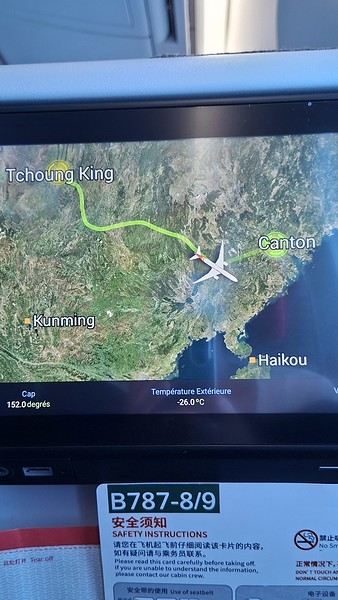
During my first two trips to China, we paid for everything in cash, but this time, we’re going all-in on Alipay and WeChat. I still brought the leftover change from previous trips—it might come in handy. At the metro station, they showed us a QR code to buy tickets via WeChat. There were probably machines and even a ticket counter, but we didn’t see them, and buying via WeChat was pretty simple. 8 yuan to Changshu Lu, which is 22 stops. So far, so good. Then, we had to find the hotel, which wasn’t on Google Maps, Maps.me, or Amap... Easy 😎! We found it without too much hassle, though. Dropped off our stuff and went out to eat. 55 yuan for two claypots with fish/eel, rice, cabbage, and purple eggplant. When we left, it was pouring. We grabbed our umbrellas and set off to explore the neighborhood: Enning Road (we’ll come back later to check out a specific spot), Shangxiajiu (the pedestrian shopping street), Baohua Road... The area is pretty diverse—one street to the next, it’s like stepping into a different world.

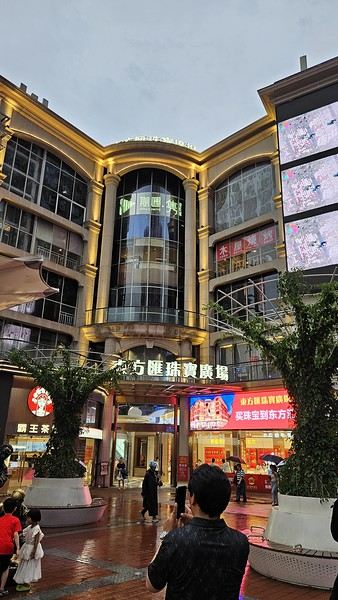
There weren’t many people around, probably because of the rain. We grabbed a quick street food dinner and went to bed—we were exhausted. We struggled to stay awake until 11 PM to adjust to the time change as quickly as possible. There’s a 6-hour time difference.
There wasn’t much room for improvisation on this trip—everything was planned in advance. Since August is peak season, I decided to book train tickets early, and once that was set, I reserved all the accommodations too. I got everything on Trip.com.
I bought the flight tickets back in March from Hainan Airlines. They were super expensive, but with these travel dates, I couldn’t exactly dream of a bargain!
I picked up e-SIMs valid for a month from Free just before departure: 10 € for the e-SIM + 19.90 € for a one-month plan with 35 GB of data abroad.
No need for a VPN with these e-SIMs, but D. still got one—a multi-device plan for 5 € with a discount from Let’s VPN, valid for a month. It was for evenings at the hotel on Wi-Fi to avoid burning through the 35 GB with video.
I downloaded Alipay, WeChat, Amap (Baidu Maps), and Trip.com. We also have Google Translate and Maps.me—absolute must-haves.
We’re ready to go!
I’ve been waiting for this day for nearly 15 years!! I travel a lot, but this one—this is MY TRIP 🙂 It’s been postponed so many times: because I wanted to do it with the right person, because I have a Turkish stamp in my passport and heard they don’t issue visas with that, because of COVID... and then China introduced a 30-day visa exemption, and that was the green light! Ugh, they forced us to take our vacation in August this year—far from ideal—but no more delays. Saturday, August 2, 2025: it’s finally the big day!
Days 1 and 2: We got dropped off at Charles de Gaulle at 9:30 AM. I supposedly checked in online, but only for the first flight and without getting the boarding pass... Might as well scrap online check-in in that case. So, we spent over an hour in line at the counter to get them. We didn’t have any checked luggage—just our backpacks as carry-ons—so this was a step we’d never had to deal with before, but whatever, it’s done. No wait at passport control, 5 minutes through security, a quick walk around the terminal, 10 minutes in the boarding area, and it was already time to board. Departure around 12:45 PM, arrival in Chongqing at 4:50 AM. We had a few hours of layover before our next flight. Went through immigration, connecting flight control, and security. Pro tip: check your next flight’s boarding gate right after immigration. We never saw it displayed again anywhere in the terminal.
The Free e-SIMs work—phew!
Took off at 9:30 AM, arrived in Guangzhou (Canton) at 11:20 AM in the rain. I love how Chongqing is translated as "Tchoung King" on the screens in the plane—very French!
During my first two trips to China, we paid for everything in cash, but this time, we’re going all-in on Alipay and WeChat. I still brought the leftover change from previous trips—it might come in handy. At the metro station, they showed us a QR code to buy tickets via WeChat. There were probably machines and even a ticket counter, but we didn’t see them, and buying via WeChat was pretty simple. 8 yuan to Changshu Lu, which is 22 stops. So far, so good. Then, we had to find the hotel, which wasn’t on Google Maps, Maps.me, or Amap... Easy 😎! We found it without too much hassle, though. Dropped off our stuff and went out to eat. 55 yuan for two claypots with fish/eel, rice, cabbage, and purple eggplant. When we left, it was pouring. We grabbed our umbrellas and set off to explore the neighborhood: Enning Road (we’ll come back later to check out a specific spot), Shangxiajiu (the pedestrian shopping street), Baohua Road... The area is pretty diverse—one street to the next, it’s like stepping into a different world.
There weren’t many people around, probably because of the rain. We grabbed a quick street food dinner and went to bed—we were exhausted. We struggled to stay awake until 11 PM to adjust to the time change as quickly as possible. There’s a 6-hour time difference.
Booking a train via the IRCTC website
Hi there,
I can’t seem to complete the payment for my trip on the IRCTC (Indian Railways) site. No matter which payment method I choose, my Visa card isn’t accepted. Has anyone here managed to do it, and if so, could you share the method you used? Thanks in advance! Charlie
I can’t seem to complete the payment for my trip on the IRCTC (Indian Railways) site. No matter which payment method I choose, my Visa card isn’t accepted. Has anyone here managed to do it, and if so, could you share the method you used? Thanks in advance! Charlie
Bangkok, Chiang Mai, Krabi Itinerary
Hi everyone!
I’m reaching out because we’re planning a trip to Thailand next year (around March/April), and we’d like to visit Chiang Mai and then Krabi, plus a few islands near Krabi.
We’ve been to Thailand before, 10 years ago, and this time, we’d just like to focus on 5 days in Chiang Mai and 10–12 days in the Krabi area.
I’ll admit, I’m really struggling to pick an island near Krabi.
We hated Phi Phi: dirty, noisy, and the food was gross… such a letdown!
Which island would you recommend for snorkeling, nature walks, and beautiful beaches?
Maybe we could also make a stop between Chiang Mai and Krabi—perhaps Sukhothai?
Is it easy to travel between these three cities?
Thanks so much for your help! 🙂
Package for 3 culinary experiences with Costa Cruises
hi,
I’m going on a cruise on the Costa TOSCANA in October, and I’ll be celebrating my birthday there.
I wanted to make it special and try ARCHIPELAGO for the first time.
And also go back to Teppanyaki (I really like their menu and the atmosphere).
I see there’s a package for 3 culinary experiences at 88 €.
According to the description, you can go to the specialty restaurants 3 times.
That price seems really low to me, since Archipelago alone costs around 55 €... and with this package, you could go 3 times?
Plus, there’s another package next to it: 1 Archipelago and 1 Teppanyaki (without specifying the menu) for 80 €.
Has anyone already tried the 3-experience package?
What did you think?
Thanks for your feedback