Results for "Guéret+|+127"
10856 results found.
Langtang – Trekking in the Rain
We did the Langtang trek (hike) from September 10th to 17th, with the first and last days being the trip from Kathmandu and back—so 6 days of actual walking. It’s a fairly well-known trek but certainly not as famous or crowded as those in the Annapurna or Everest regions, which is why we chose it.
In theory, it’s mandatory to have a guide for this trek. In reality, it seems there are ways to bypass the regulations: we met at least two people hiking without a guide—a South Korean, a New Zealander, and possibly also a couple of English women and an American couple, though we’re not sure if they had a guide.
The agency we booked with had told us it was an affordable trek for relatively older people in good shape—which is our case (I’m 72 myself). I have to say upfront that we found it quite challenging, maybe because we didn’t have good weather—it was the end of the monsoon season. To be clear, no matter your fitness level, I’d say doing this trek in the middle of the monsoon season would be suicidal.
Day 1 – Journey from Kathmandu to Syapru Besi
On Monday, September 8th, there had been violent protests in Kathmandu against the government, which had, among other things, blocked access to social media and been accused of nepotism and corruption. There were 19 deaths. The situation was very tense on the day of our departure, Wednesday the 10th. The agency warned us that public transport was very unreliable. So, we decided to take a jeep, at an additional cost of $100 ($160 minus what was already budgeted for the bus).
We left a little before 7 a.m. and it took us a good hour just to reach the outskirts of Kathmandu. Along the way, we saw several houses and vehicles set on fire by protesters.
The road to Syapru Besi is only 120 km, but it’s frankly awful. It’s always narrow, winds through endless mountains, and the shoulders range from bad to confusing to nonexistent. Several sections are just dirt tracks. We didn’t regret opting for the jeep, as we could stop several times at our convenience—if only to let Y (my Thai partner) throw up everything she had. She’d taken her usual motion sickness medication, but the constant turns, accelerations, and braking eventually made her terribly carsick.
In Nuwakot, we stopped for breakfast at a nice little restaurant, Jimbu. It was around 8:30 a.m., and we’d barely covered 60 km. The restaurant has a lovely garden overlooking the Trishuli Ganga, the river flowing down from Syapru Besi. First photo: the river in the bottom right corner, mist and clouds over the mountain on the other side.
An hour later, my second photo: the hills along the Trishuli Ganga. You can see the different crops—lush green rice paddies in the lower right and corn, already yellowed and likely harvested, in the foreground on the left. And of course, the mist and clouds through which you can glimpse the mountain on the other side of the river.
The Two of Us in Istanbul: A Turkish Blue Round
Hello everyone,
I’m not really a regular contributor to VoyageForum, but every time Kate and I travel, she encourages me to write a travel journal and publish it. And I must admit, it’s a very enjoyable intellectual exercise, though not always easy. As a VF contributor whose journals I’ve read once said, this retrospective work not only helps preserve memories but also provides a fruitful moment of introspection by bringing back emotions and feelings.
Kate and I spent a week in Istanbul. For her, who had already visited, it was a return; for me, it was a discovery.
As we’ve now made a habit of, I write the texts, and she posts her photos. We hope this illustrated story, crafted together, will revive beautiful sensations for those who know the city and inspire others to discover it. Here we go!
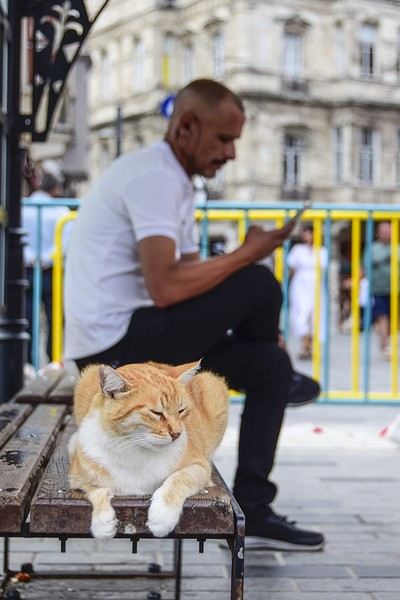
I’m not really a regular contributor to VoyageForum, but every time Kate and I travel, she encourages me to write a travel journal and publish it. And I must admit, it’s a very enjoyable intellectual exercise, though not always easy. As a VF contributor whose journals I’ve read once said, this retrospective work not only helps preserve memories but also provides a fruitful moment of introspection by bringing back emotions and feelings.
Kate and I spent a week in Istanbul. For her, who had already visited, it was a return; for me, it was a discovery.
As we’ve now made a habit of, I write the texts, and she posts her photos. We hope this illustrated story, crafted together, will revive beautiful sensations for those who know the city and inspire others to discover it. Here we go!
Hitchhiking in the 70s-80s
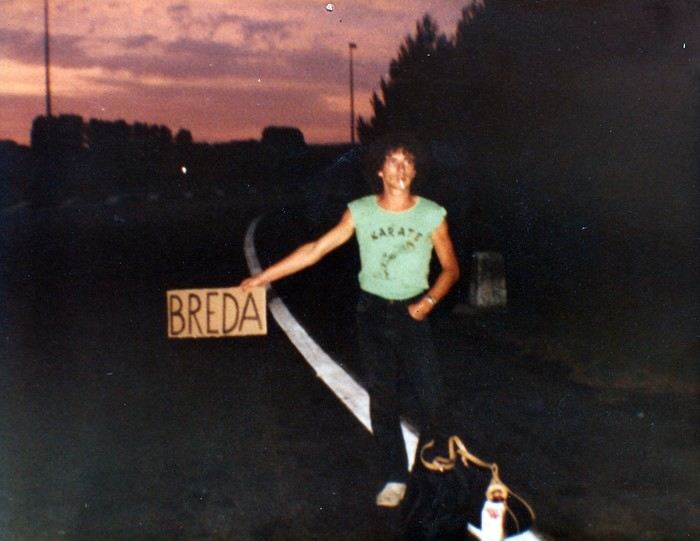
“Hey, your Marker... - My Marker? - The one you used to make hitchhiking signs.”
The marker in question is sitting proudly on the kitchen table. Marielle found it at the bottom of a moving box.
I’ve been meaning to tell the long story of my love affair with hitchhiking for years. Here we go.
To be honest, I’m not quite sure when it started. My earliest memory goes back to a fair with a bike race in my maternal grandparents’ village. I was with my cousin, my little sister, and three girl cousins. There were six of us, ages ranging from six or seven to thirteen or fourteen. Our parents stayed at the fair, and we’d had enough. So we decided to walk home. Only it was four kilometers away. So we hitchhiked. A guy driving an old car picked us all up and dropped us off at the farm. He probably found it amusing to see us thumbing a ride by the side of the road, but maybe it also worried him a bit. With everything you read in the papers...
Around fifteen or sixteen, I started hitchhiking regularly, alone or with a friend, to go to the nearby town. But it was especially when I started boarding school in Orléans that it became more regular. The first year, I’d leave Monday morning and come back Saturday noon by bus. It was an old, uncomfortable bus where we froze in winter. To make matters worse, I often got motion sickness if, as was too often the case, I ended up sitting in the back. In the spring, a high school friend suggested I hitchhike back. It meant a slight detour, but the advantage was taking only national roads.
So that’s how, from the end of tenth grade to twelfth grade, I’d thumb a ride every Saturday on the Pont de Bourgogne. Drivers were used to seeing young people hitchhiking, and it worked pretty well. Our biggest fear? Soldiers! At that time, military service was still mandatory, and on weekends, it wasn’t rare to see them competing with us. They’d keep their uniforms on to go home. That gave people confidence—with everything you read in the papers—and they’d rarely wait more than five minutes. We, with our long hair, were definitely less popular. From time to time, three big red-faced guys in a van coming back from a construction site would flip us off, yelling things like “go get a haircut, you bums!” Those were the good old days.
We still had a good laugh, though. Patrice, the friend I’d hitchhike back from school with on Saturdays, is a musician—I’d later discover he’s an excellent composer. A die-hard Beatles fan, he knows their repertoire by heart and spends his time singing at the top of his lungs while we thumb a ride. One Saturday late morning, we’d been waiting for a while at the exit of Châteauneuf-sur-Loire when a little lady came up to him and asked if he could please sing a little quieter: a baby was sleeping in the house. He put on the most sorry face: “Oh, sorry ma’am, we didn’t realize.” No sooner had the lady gone back inside than he started again. Luckily, a car stopped just then, sparing me the embarrassment of seeing the lady come back out.
Saturday was also the day when the cigarette pack was dangerously low. So before leaving, we’d go buy some “Parisiennes,” the “P4s” as we called them back then. They were slightly thinner cigarettes with a mix of tobacco scraps. Sometimes they tasted like light tobacco, sometimes like dark. Not great, but by the end of the week, our pocket money was gone. They were sold in small packs of four, hence the name P4. We’d only pay 20 centimes. On Saturdays, it was rare for the two of us to manage to scrape together 1.50 F to buy a whole pack of Gauloises...
The last twenty kilometers, I’d usually do alone, Patrice having reached his destination. From time to time, luck would smile on me: an acquaintance would just happen to pass by and stop. One January Saturday, at the exit of Gien, I ran into another guy from Argenton whom I knew a little. That day, the weather was nice, but the temperature was well below zero. It was around noon, and it was the off-peak hour. We were shivering, stamping our feet by the side of the road, when a Citroën “Tube” arrived: it was his father’s boss’s, a mason. They were both sitting in the front, but since they were obese, they had us climb onto the open back. Even though we huddled against the cab to shelter from the wind, the twenty kilometers felt very long, especially since we were only going sixty kilometers an hour. Our hands and cheeks were blue when we finally arrived.
The year I took my baccalaureate, a friend with a 2CV would take me Monday mornings with one or two others we’d pick up in nearby villages. We’d share the gas costs, but it was still cheaper than the bus. And in winter, the bus was my nightmare. You had to get up at five to catch it at six. Not enough sleep, and outside it was freezing or raining—or both. The 2CV was luxury. Plus, Philippe would pick me up at home. On the other hand, since I didn’t have class Saturday mornings—well, I did, but we only had PE the first two hours and nothing after—I’d skip class and slip out right after breakfast to thumb a ride at the Pont de Bourgogne.
Those three high school years were formative in this optional subject that was hitchhiking. Little by little, I learned the rules of the game. First, you shouldn’t walk along the road while thumbing. Cars go too fast and can’t stop easily. Accepting a ride that’s too short is also a no-go. The guy who offers to take you a little way but drops you off at some vague crossroads in the middle of nowhere? No thanks. You need to get dropped off in a town. If it’s a fairly big city, you often have to cross it from one end to the other, but it’s better. At the exit, you have to choose your spot well. Actually, you have to put yourself in the driver’s shoes: they need to see you early enough, not be going too fast, and be able to stop easily without risking an accident. So when leaving a city, it’s better not to go too far. It’s wiser to find a spot where cars go slowly and can stop easily. And preferably near a café. The café is for when you still have a few coins for a coffee and need to warm up. From time to time, you’d run into someone nice who’d make a detour to drop you off at a better spot to start again. Finally, if possible, avoid hitchhiking on Sundays. Cars are packed with whole families who, most of the time, aren’t going far. And then there’s the little worry of those people who rarely leave home: with everything you read in the papers...
During those high school years, it was only short trips, rarely exceeding a hundred kilometers. Later, I aimed bigger, and things were a bit different. In 1973-74, I crossed part of France for the first time on two or three occasions, coming back from the German border or returning to Bordeaux, where we lived briefly. Since there weren’t many highways back then, we took national roads. It was during these trips that I realized it was better to leave in the evening. As I said earlier, Sunday is to be avoided, but on weekdays, there’s another problem: if you leave in the morning, you only make short hops. First, it often takes longer to get going because drivers are people going to work nearby. Which brings us back to those who drop you off in a bad spot, far from everything. There, you have to know how to refuse. You thank the driver for stopping—oh, if only everyone could be like you—while explaining why you’d rather stay put. People don’t take offense, by the way. Those who pick up hitchhikers often hitchhiked themselves when they were in the military or before they had a car. In the late afternoon, you’d often run into salespeople or truckers, in other words, people who drive a lot. At that time, salespeople no longer had appointments and were more relaxed. They wanted to talk about something other than the merits of their products. On the radio, it was time for *Les Grosses Têtes*. You’d also quite often run into small business owners, professionals, or even hippies. The conversations were pleasant and often enriching. A little later in the evening, truckers would take over. They’d already driven a few hundred kilometers, and the depot or customs was still far away. So they’d gladly take a hitchhiker to stay awake at the wheel and chat. The radio with Max Ménier’s show *Les routiers sont sympas*, you’d eventually get tired of it. So a hitchhiker was a change. Others, who’d hit the road at midnight to be at their destination by morning, were nice and offered to let you lie down on the bunk while they drove. When you’d been hitchhiking since six in the evening, freezing in the wind between two vehicles, you weren’t unhappy to take a little nap.
Speaking of Max Ménier, he’d often make announcements for hitchhikers. One evening, I called him. It was getting late, and I still had quite a way to go. No luck: the show had ended for good the day before!
In short, it’s better not to rush, sleep in, and leave after lunch, or better yet, in the late afternoon. Obviously, I’m talking about when you have several hundred kilometers to cover. That’s when you have to play it pro.
First thing, especially at night, but it also applies in the middle of summer when the light is blinding: dress to be seen from far away. I’ll admit I have an advantage over most other hitchhikers: I’m small and don’t scare people. To balance that out, racist drivers often take me for an Arab and are less likely to pick me up, but overall, the balance tips in my favor. Back to the need to be seen: at night, I wear light-colored clothes. In headlights, you can see me from far away.
Second thing: travel light. Forget the big backpack with a frame. Drivers don’t always have room in the trunk or on the back seat, especially if it’s rained and the ground is wet. Plus, it forces them to get out of the car. If they’re nice enough to pick up a hitchhiker, you shouldn’t ask for too much either.
Third thing: bring a cardboard sign and a big marker—like the ones in the photo at the start of this post—to write the name of your destination. In the early 80s, I ran a tourist house in the Cher, but I lived in the Netherlands. In the off-season, it was only open on weekends. On Fridays, I’d leave Holland and return on Mondays. 1200 km round trip. On the way there, in Paris, I’d stand at Porte de la Chapelle. At that spot, the road is very wide, and drivers could stop easily. Obviously, on the sign, I didn’t write Eindhoven, which not everyone knows, and even less Amsterdam because of its seedy reputation. In that case, you’d expect to see a police car stop and two officers in kepis ask for your papers. So as a first destination, I’d write Compiègne. We were well out of Paris, and since it wasn’t too far, a trucker or salesperson was less reluctant to stop. Once past Compiègne, I’d take out my Lille sign. Once in Belgium, it wasn’t really necessary to use a sign anymore, since everyone was going in the same direction. Usually, the guy who picked me up at Porte de la Chapelle would say he wasn’t going far but could take me a little way. Before that, I’d still ask if there was a gas station on the highway where he could drop me off before exiting. While talking, the guy would realize he wasn’t dealing with a dangerous criminal. He’d pretend to check his watch, think for a moment, then say that actually, he was going to Belgium and could take me to the border or a little beyond. To leave Paris on the way back, I’d take the train to Melun, where it was easier to hitchhike than at Porte d’Italie.
Over all those years, I think I was pretty lucky. Or maybe philosophical enough not to imagine a car would stop after a few minutes. An hour’s wait was average. Sure, I sometimes waited three, four, or five hours. Most often at odd hours and in terrible weather. When it doesn’t work, it doesn’t work. But there’s always a moment when things pick up. Sure, when you’re soaked in freezing rain in the early morning after a sleepless night, you’re less philosophical than when I’m writing these lines comfortably at my computer, but it still holds true.
Earlier, I mentioned clothing and the importance of being well-rested before leaving. When you’ve eaten well and just gotten out of the shower, shaved, you’re in a better mood. And somehow, drivers sense it. Or at least, that’s the impression I’ve always had. It’s better to look in shape than disgusted at standing there, half-heartedly thumbing a ride. In short, when I’d start to get fed up with waiting, I’d go into the first café I saw for a coffee. Coming back out, I’d be refreshed, and most of the time, a car would stop within minutes. I’ve often said that when I stood by the side of the road thumbing a ride, I felt a bit like a gambler in front of a slot machine. It was a matter of giving luck a chance. And well, it worked out pretty well.
Then, there are countries where hitchhiking works really well and others where it’s harder. In the 70s-80s, it worked best in Germany and England. In the late afternoon, it wasn’t rare to be invited for tea. Well, that was in England. Tea meant being offered room and board. In Germany, they’d offer you coffee. Once there, they’d first show you the guest room and point out the bathroom before sitting you down in front of a big plate of cold cuts. In the evening, they’d go out in town, and the next morning, they’d usually drop you off at a good spot for hitchhiking. On the other hand, in Mediterranean and Scandinavian countries, you’d better be patient. In Spain or Italy, it’s better to take the train, which was dirt cheap back then. However, if you’re a couple traveling light, it’s already easier in most countries.
In 1982, I went on a trip around Turkey with my girlfriend. We only had two small bags, which was plenty. It was November-December, and we wore our warm, bulky clothes. Leaving Eindhoven at nine in the morning, we arrived in Graz, near the Yugoslav border, at eleven at night. 1300 km in a day! In just four or five vehicles. One to the German border, about fifty kilometers from Eindhoven, the second to Hagen in the Ruhr, the third to Salzburg, and the last to Graz at the Yugoslav border. Record broken. During the night crossing of Yugoslavia, we ran into a trucker close to retirement who lent us the truck’s bunk. So we arrived fresh and rested near Skopje the next morning. We continued to Thessaloniki in northern Greece before taking the train to Istanbul. In Turkey, we traveled a good part of the country by hitchhiking too. With truckers in old, overloaded, slow trucks that climbed hills at fifteen kilometers an hour, but also in cars where five or six people were already crammed in. And every time, we were invited for tea. Once, we were even picked up by a big shot in his Mercedes with a chauffeur. Until then, the average speed was around fifty kilometers an hour. There, we were going two hundred. On a national road, not a nice European highway.
I’ve also hitchhiked in Nepal, from Lumbini, Buddha’s birthplace, to a village on the way to Pokhara. It must have been midday. No bus until the next day. I gave it a try. A small truck overloaded with rice sacks, with two or three young people already perched on top, stopped. I rode on the roof of the cab. At fifty kilometers an hour when it was going well, with a breathtaking view. Coming back from India, I also crossed part of Iran by hitchhiking, from Tehran to the Turkish border. I did this trip with an Austrian I met at the hotel who, like me, had to watch his pennies. We gave it a shot. There was almost no traffic, but to our great surprise, the first car that passed in the area would always stop. They’d just ask for a modest contribution for gas, and it cost next to nothing.
Sometimes, you get scared too. After leaving Turkey in early December 82, we spent about two weeks in the southern Peloponnese harvesting olives. A few days before Christmas, we hitchhiked back to Holland. A girl picked us up in her little Fiat 500. We were driving on a mountain road, and that morning there was a bit of black ice. After crossing a pass, we saw the old Ford Taunus ahead of us at fifty meters start to skid. The driver let out a “heeee!” while grabbing my knees. I reflexively grabbed the wheel. Finally, the Taunus got back on track. And we didn’t swerve. But those few seconds felt very long.
In January 77, while I’d been living in Germany for a few months, I decided to spend a few days in Italy. By hitchhiking, of course. I left in the early afternoon, and by ten at night, I wasn’t far from Frankfurt. I saw a big Mercedes stop. The four or five young people crammed inside were listening to Schlager at full volume. Beer cans littered the floor. They didn’t have a precise destination, and as long as they were going south, that was fine with me. They’d finished their military service that very day and had clearly already celebrated their discharge. The driver was going 160, zigzagging dangerously from one side of the highway to the other. I should have realized he wasn’t entirely sober either. Luckily, there was almost no traffic. Finally, I managed to get dropped off at a gas station just before Frankfurt, relieved. I hope their trip didn’t end tragically.
Another time, coming back from Holland with my wife, we were picked up early in the morning near Senlis by two guys from Lille. They were going to work near Tours and could drop us off at Porte d’Italie. Apparently, they were coworkers but barely knew each other. The driver offered us a beer—at six in the morning, sure!—before opening another can for himself. He was clearly having trouble staying in the right lane. We politely declined, the passenger too. Everyone was tense. Luckily, it was rush hour on the ring road, and we were going slowly. When we got out of the car, the passenger said goodbye with the look of a guy being offered the condemned man’s rum and cigarette.
Finally, there are the annoying remarks from drivers who are either gay when you’re alone or turned on by the sight of your girlfriend when you’re a couple. In those cases, I’d get in the back so the guy wouldn’t feel too confident. And if the conversation got a little too suggestive, we’d deflect until we got dropped off.
And luckily, there are the times, not so rare after all, when you run into really nice people who invite you to eat and sleep at their place and drive you to a good spot the next morning. In Germany and England, that was common. And then there are the big strokes of luck, like during our trip to Turkey when we crossed most of Germany in one car, or that other time when some Germans drove me from the exit of Geneva all the way to the Costa Brava.
Going back to “with everything you read in the papers” and its variant “with everything you see on TV”—and now on the internet—it’s always left me perplexed. Personally, I’ve never heard of hitchhikers assaulting drivers, even if it may have happened. On the other hand, what was most common were hitchhikers being assaulted, especially girls. Anyway, even armed, it seems a bit stupid to assault the driver—wouldn’t that risk causing an accident?
Finally, since that time, I’ve occasionally wanted to hitchhike somewhere far away in France. Most often, too busy with work, it never happened, but the nostalgia hasn’t completely disappeared.
* * *
Other Hitchhikers
And then one day, I... settled down to become a driver myself. Ten years had passed, and you saw fewer and fewer hitchhikers. Or maybe I saw fewer because I had a regular job and wasn’t traveling the same way. And then I understood a few things.
Several times, I was tempted to pick up a hitchhiker, but they didn’t meet the required conditions. They were walking along the road instead of staying at the exit of the previous town. Hard to stop without risking an accident. Or the guy looked really scruffy. Or he was sulking, if not both. Then you think of that famous “with everything you read in the papers.” Not that I was scared, but unfortunately, the few hitchhikers I did pick up later were rarely interesting.
A few years ago, we picked up a young guy at the exit of a small town in Sologne. Not an easy spot for hitchhiking. Bad luck, he was a pretentious little jerk. He was barely 20 or 25 and talked like a bitter old man. He was a waiter in a restaurant. According to him, it was lucky he was there, otherwise the boss would have closed up shop long ago. You’d think he had thirty or forty years of professional experience behind him. As we approached Blois, he started ranting about Arabs, blaming them for all evils. And he laid it on thick. That morning, we were going to a teenager’s funeral who had just committed suicide, so he really got on our nerves, Mr. Know-It-All. Out of anger, I dropped him off next to a shopping center a few kilometers from downtown. Not nice, but it felt good.
Some time ago, we were driving around the Limousin on a Sunday to try out the used Twingo we’d just bought. We picked up a guy in his forties. A German who spoke French well. He started talking about the environment. He was a green Khmer. He got worked up all by himself with his pseudo-eco rant and, after a few kilometers, was almost yelling at us. As we were about to leave the main road for a small one, I dropped him off at a crossroads in the middle of nowhere. Normally, I would have made a little detour to take him to a better spot, but this time, I didn’t feel like doing the... eco-warrior a favor.
On the other hand, I’ve still done my good deed a few times. One June morning, coming back from Orléans, I saw a man in his sixties hitchhiking. The poor guy had had a rough time. He was from Montpellier and was coming back from Caen, where he’d been promised a job. Once there, they bluntly told him the position was already taken, and he had to go back. Except he didn’t have enough money left for the train. He’d spent the night hitchhiking without success. I could only take him as far as Lamotte-Beuvron, where I dropped him off near the fire station. Apparently, there was some vague shelter there or something, but it only opened a few hours later. In the meantime, he settled on the grass in a corner to sleep a little. While he was doing that, I quickly went to the train station to check the price of a ticket to Montpellier. It was within my means. Since he was sound asleep, I slipped the train ticket and 100 francs into his pocket. I couldn’t imagine him continuing to hitchhike all the way to Montpellier. And I bet he didn’t even have a piece of cardboard and a marker!
When we go to Brazil, we usually rent a small car. One day, we were coming back from Paracuru to Fortaleza when we saw a whole family hitchhiking. Two adults and two or three small children. Here near the equator, the sun sets very quickly, and it would soon be night. There was little traffic, and trucks wouldn’t stop because there was no room in the cab. As for the rich people driving big 4x4s, they wouldn’t stoop to picking up the lower classes. The only hope for this kind of family was usually a farmer or artisan who’d let them ride in the back of his pickup. Obviously, they were a bit surprised to see us. Everyone crammed in as best they could in the back of our little car. When we dropped them off, we got a whole string of “Deus lhes abençõe”—God bless you.
Still in Brazil, we were on the road from Barreirinhas to São Luís do Maranhão. About 150 km of deserted road with an isolated mud house here and there. A young woman flagged us down. She was very pregnant and had to get to the clinic twenty or thirty kilometers away to give birth. Someone was supposed to drive her, but the first signs of labor started earlier than expected, and the driver was unavailable. Even driving fast, we weren’t feeling great: it would be just our luck if she gave birth in the car!
Today, we’re in the age of smartphones and carpooling apps. Safety. With everything you see on TV... Three or four years ago, we signed up on a platform. Our first, and only, “client” was a little jerk who didn’t say a word the whole trip. No hello, no goodbye, and certainly no thank you. The next day, we found his Ray-Bans in the car. We didn’t run after him to give them back. Ha!
Off on an adventure to Java (and a bit of Bali)
Hey there, community! Back this weekend, below is my travel journal from my adventure in Indonesia. Enjoy the read!!!
Day 1 - August 10, 2025 New life downloading for three weeks! And for that, Flo and I launched a public tender... A public tender? What’s that got to do with a travel journal???... Well, when you think about it, few destinations tick all the boxes for an August adventure: Meaning, finding a place that’s exotic in the middle of August, not too expensive, not too packed with tourists, warm but not *too* warm, with postcard-perfect landscapes, dreamy beaches, tasty cuisine with a hint of exoticism, friendly and welcoming locals, where you’re free to sleep under the stars among the mosquitos, take transport surrounded by chickens, and even eat from a pig trough if you feel like it—well, turns out it’s not that easy to find! I’d even say, given how thick the list of requirements is, there’s a big risk the tender could be declared unsuccessful for failing to meet just one criterion. Let’s just say the candidates better submit a rock-solid proposal!
After reviewing all the responses and presentations from the candidates, the obvious choice for us is... Indonesia! Except that trying to explore a country as vast as Indonesia and its 17,504 islands in less than five years is a bit like reading the summary of a Proust novel without taking the time to savor each of its 950 pages! Don’t worry, I won’t name them all here. Besides, do they even all have names? No! Only 7,870 have been named—their parents clearly ran out of ideas for the rest. Anyway, our society, which worships the "work more to earn more" mantra, unfortunately limits our adventure time. So we’ll only get to see a small part of Indonesia, and we’ll have to make a tough choice to head for the best of the best in this archipelago of over seventeen thousand islands. Each one has its own selling points: Sumatra, Sulawesi, Java, the Celebes, Bali, Borneo, Papua, Timor, the Moluccas... So many names that smell of adventure... Another tender, another list of requirements, another review of proposals... Drumroll... Splash splash... And the lucky winner is... Ta-da... Java, Bali’s big sister, where I’ve already been eight years ago... Java the programming language. The Java of Broadway. We’re gonna *do* the Java. Java the coffee. And yes, Java is also an island!
This island, four times smaller than France, is home to 136 million people, making it the most populated island in the world! Fun fact: Indonesia, with its 260 million inhabitants, is just shy of the podium for the world’s most populated countries, after the winning trio of India, China, and the United States. And it’s on this island of Java that you’ll find Jakarta, the (soon-to-be-former) capital and main airport of the country, where we’ll soon land after our nineteen-hour flight! Yep, nineteen hours! I mean, Indonesia in general—and Java in particular—is a *tad* farther than going on vacation to Grandma Yoyo’s! Not sure where it is? Easy. Grab a map. Plant your finger on the big island at the bottom right—aka Australia for those who struggle with geography—move it up two centimeters, and bam, welcome to Indonesia!
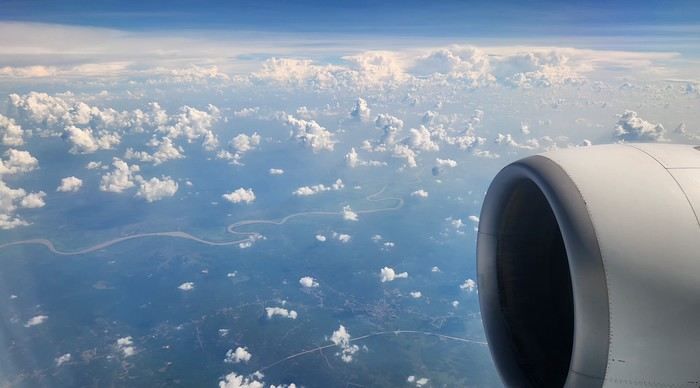
Nice transition, right? Because "Welcome to Indonesia" is exactly what the friendly flight attendant just said to me as we got off the plane! That’s it, our chakras are open, we’ve arrived at our (air)port. Time for rest, pool, cocktails, and a beach with our toes spread out... Wait, if you bought that, you clearly don’t know us yet! Since we still have energy to burn and need to adjust to the flight and time difference, we tackle the long administrative formalities to enter Indonesia, just to earn the right to hop in a 45-minute Grab taxi to the train station. The train station? What train station?... What do you usually do at a train station? Take a train, of course! Off we go for a three-hour train ride to Bandung, where we’ll officially start our adventure tomorrow after our first Indonesian night...
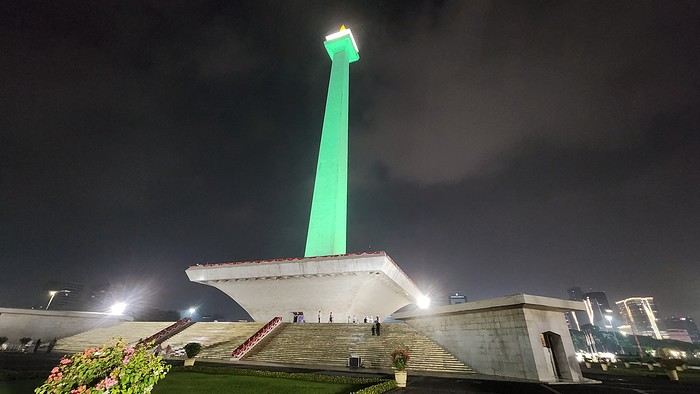
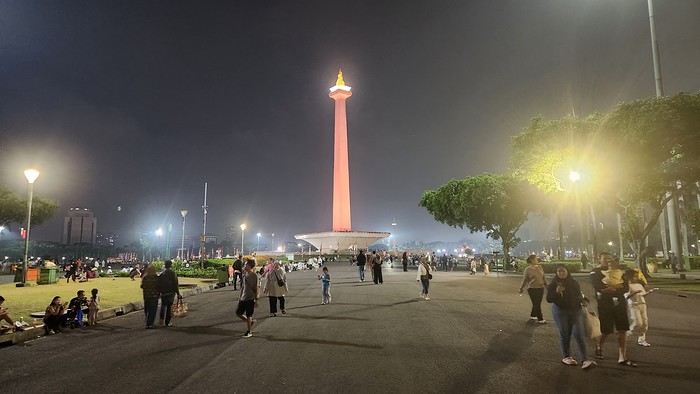
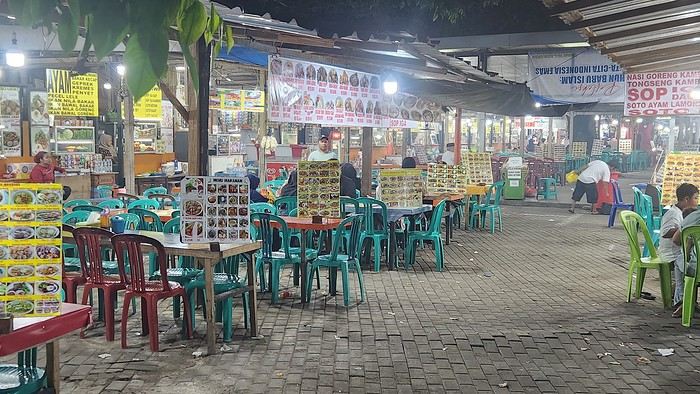
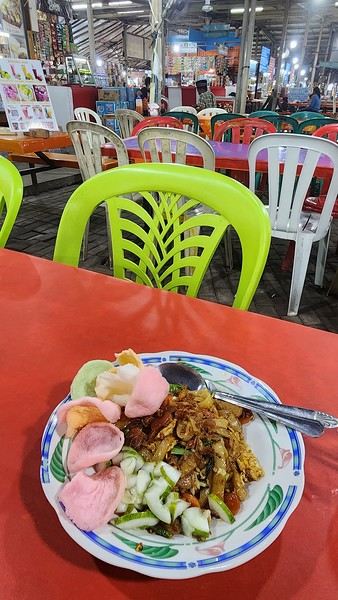
Unfortunately, we were a bit slow off the mark, which meant we missed the 6:25 PM train by two minutes. Oh well, we’ll have to wait until 11 PM. We take the opportunity to stretch our legs in Jakarta, soak up the atmosphere, and enjoy the delicious smells wafting from the *warungs*—those little typical street restaurants. A quick stop at the National Monument, a detour to a night market to devour our first *kwetiaw goreng* and *teh manis* for 60,000 rupiahs (that’s 3 € for two), and just like that, our penalty is lifted, and we’re allowed to hit the road again. Off to Bandung, where we arrive at 2 AM for... a *very* short night...
Day 1 - August 10, 2025 New life downloading for three weeks! And for that, Flo and I launched a public tender... A public tender? What’s that got to do with a travel journal???... Well, when you think about it, few destinations tick all the boxes for an August adventure: Meaning, finding a place that’s exotic in the middle of August, not too expensive, not too packed with tourists, warm but not *too* warm, with postcard-perfect landscapes, dreamy beaches, tasty cuisine with a hint of exoticism, friendly and welcoming locals, where you’re free to sleep under the stars among the mosquitos, take transport surrounded by chickens, and even eat from a pig trough if you feel like it—well, turns out it’s not that easy to find! I’d even say, given how thick the list of requirements is, there’s a big risk the tender could be declared unsuccessful for failing to meet just one criterion. Let’s just say the candidates better submit a rock-solid proposal!
After reviewing all the responses and presentations from the candidates, the obvious choice for us is... Indonesia! Except that trying to explore a country as vast as Indonesia and its 17,504 islands in less than five years is a bit like reading the summary of a Proust novel without taking the time to savor each of its 950 pages! Don’t worry, I won’t name them all here. Besides, do they even all have names? No! Only 7,870 have been named—their parents clearly ran out of ideas for the rest. Anyway, our society, which worships the "work more to earn more" mantra, unfortunately limits our adventure time. So we’ll only get to see a small part of Indonesia, and we’ll have to make a tough choice to head for the best of the best in this archipelago of over seventeen thousand islands. Each one has its own selling points: Sumatra, Sulawesi, Java, the Celebes, Bali, Borneo, Papua, Timor, the Moluccas... So many names that smell of adventure... Another tender, another list of requirements, another review of proposals... Drumroll... Splash splash... And the lucky winner is... Ta-da... Java, Bali’s big sister, where I’ve already been eight years ago... Java the programming language. The Java of Broadway. We’re gonna *do* the Java. Java the coffee. And yes, Java is also an island!
This island, four times smaller than France, is home to 136 million people, making it the most populated island in the world! Fun fact: Indonesia, with its 260 million inhabitants, is just shy of the podium for the world’s most populated countries, after the winning trio of India, China, and the United States. And it’s on this island of Java that you’ll find Jakarta, the (soon-to-be-former) capital and main airport of the country, where we’ll soon land after our nineteen-hour flight! Yep, nineteen hours! I mean, Indonesia in general—and Java in particular—is a *tad* farther than going on vacation to Grandma Yoyo’s! Not sure where it is? Easy. Grab a map. Plant your finger on the big island at the bottom right—aka Australia for those who struggle with geography—move it up two centimeters, and bam, welcome to Indonesia!
Nice transition, right? Because "Welcome to Indonesia" is exactly what the friendly flight attendant just said to me as we got off the plane! That’s it, our chakras are open, we’ve arrived at our (air)port. Time for rest, pool, cocktails, and a beach with our toes spread out... Wait, if you bought that, you clearly don’t know us yet! Since we still have energy to burn and need to adjust to the flight and time difference, we tackle the long administrative formalities to enter Indonesia, just to earn the right to hop in a 45-minute Grab taxi to the train station. The train station? What train station?... What do you usually do at a train station? Take a train, of course! Off we go for a three-hour train ride to Bandung, where we’ll officially start our adventure tomorrow after our first Indonesian night...
Unfortunately, we were a bit slow off the mark, which meant we missed the 6:25 PM train by two minutes. Oh well, we’ll have to wait until 11 PM. We take the opportunity to stretch our legs in Jakarta, soak up the atmosphere, and enjoy the delicious smells wafting from the *warungs*—those little typical street restaurants. A quick stop at the National Monument, a detour to a night market to devour our first *kwetiaw goreng* and *teh manis* for 60,000 rupiahs (that’s 3 € for two), and just like that, our penalty is lifted, and we’re allowed to hit the road again. Off to Bandung, where we arrive at 2 AM for... a *very* short night...
Your recommendations for 20 days in Thailand
Hello,
Our flights are booked, and we’ll arrive in Thailand at the beginning of January.
Originally, we were supposed to spend 14 days there. But after booking the flights and seeing the prices, we’ll now be there for 20 days instead.
Our initial plan was: 2 days in Bangkok 1 day in Ayutthaya 4 days in Chiang Mai 6 days around Krabi
So we have 7 more days to fill. What do you recommend?
An extra day in Bangkok? Adding more days in the north? If so, where? Exploring another region, like Kanchanaburi or Cheow Lan Lake? Traveling north in stages instead of taking the overnight train?
A few extra details about us: For us, vacation isn’t about relaxation—we love walking, exploring, and packed days don’t bother us. Hiking for hours and doing active things is what makes us happy. That said, we also enjoy visiting villages and towns if they’re worth the detour. In Thailand, we’d like to visit temples too. We’re early risers, so our days tend to be long. 🙂 In short, we like to keep things moving during our trips. 😉
Unfortunately, seeing terraced rice fields isn’t possible in January. I read there are rice fields around Sukhothai. Are they green in January?
In the north, do you recommend Doi Inthanon, Huai Nam Dang, or Doi Chiang Dao National Parks? Which one is the most beautiful and best for January?
Yet Another Travel Journal in this (Too) Familiar Rajasthan, But with Family and Kids
Prologue
This journal recounts a trip to Rajasthan that’s already over a year old and that I’ve only now found the chance to write about. The summer of 2024 marked my return to India—my tenth trip—after six long years away since my last solo wanderings in Tamil Nadu in 2018 (the journal of which is published on this site). That absence was partly (but not only) due to the long COVID and post-COVID period, which saw a complete halt and then a major slowdown in global tourism. To top it off, Voyage Forum announced its closure in an end-of-the-world atmosphere. A sad time for our favorite social activity…
A few weeks after returning from Rajasthan, I tried to motivate myself to start writing a journal to publish on a forum claiming to be VF’s successor, which I’d eventually signed up for out of desperation. But I kept hesitating and putting the project off because, for one, I no longer have the time I used to. For another, the vibe wasn’t really taking off on that forum—it was overrun with ads and not very active, contrary to what its host’s name suggested. Despite its good intentions and commendable role as a stopgap, it also turned out to be very impractical to use, especially when you don’t have much time like me. I’ll admit I’d occasionally check back on VF to see if anything was happening. But all the discussions remained frozen in time, stuck in that fateful year, 2020. Then, rumors swirled online about shady reasons behind its closure, leaving little room for hope.
And then, one fine morning, I got a message at work from Marien informing me that VF had reopened. What a huge surprise! Even though the forum’s “end” had played out in a somewhat apocalyptic atmosphere, the memories of passionate and heated discussions, the frank debates, and the useful exchanges that made this site a traveler’s goldmine and a unique hub of conviviality all came rushing back to me like a breath of fresh air. I finally saw a sign and tried to motivate myself to find the time to publish the journal of this tenth trip to India and fifth to Rajasthan. But in the end, I got bogged down in professional and family obligations and never managed to find the time to get started. That’s now fixed, though, because I had two reasons for wanting to do it: I find that looking back on a trip to tell others about it is a highly beneficial introspective exercise. Also, I thought this journal could be useful to other travelers on a few points.
Because, “do we really need yet another journal about Rajasthan?” you might rightly ask! Especially in a time when so many journals about the “Land of Kings” have been published since VF’s return, not to mention the countless stories you can already find online about this region, one of India’s most touristy. And I’d add, why go back to Rajasthan for a fifth time, where I’ve already dragged my feet more than enough—through its forts, deserts, temples, cities, villages, bumpy roads, train stations, tasty street food stalls, cheap guesthouses, and more? Where some might see just another overhyped tourist destination full of the same old *Arabian Nights* clichés, worn to a thread, that I mentioned earlier, when there’s so much else to see in India? Well, first because it’s a magnificent country I never tire of, where I started an academic study and made so many connections. It’s also packed with places where you won’t find a single tourist (right, Marie-Jo?), even in the heart of well-trodden paths and classic itineraries. And most importantly, as I said earlier, things have changed in recent years. First, after six years without traveling far, the urge to go back to India was getting stronger. But this time, no more solo trips (often) or duo adventures (sometimes)—now it’s a team of four that has to come along! And even if you can argue with that, what better place than Rajasthan to introduce India to people who’ve never seen it? To kids you want to amaze? Plus, traveling with your new little family to your favorite country isn’t the same as going solo in often spartan conditions that only affect you. It’s a different challenge, but ultimately probably much harder. So, is it really reasonable to take two kids to India, including a two-year-old baby? That’s one of the main goals of this journal (but not the only one)—to try to answer that question.
As you can tell, it’s not so much the destination but the slightly unusual setup of this trip that, in my opinion, will make this journal interesting. Despite my experience and expertise (yes, I dare say it) in India, there were plenty of questions before we finalized the plan and said, “Alright, let’s go!” The questions were flying for us parents. Is it wise to travel to India with a two-year-old? What would we do (it happened) if the kids got very sick? Would they be able to handle a road trip on Rajasthan’s bumpy, dusty roads using public transport? Could they handle the shock of such a different world—the dirt, poverty, pollution, noise (…and the smell, as they say), the spicy food, monkeys, mosquitoes, snakes, tigers, leopards, and so on? In short, all the clichés that I usually joke about suddenly became potential realities. Another concern: as a mixed Franco-African family (not me, but my partner and her oldest), wouldn’t we risk not always being well received, given what you sometimes hear about that in India? How would Indians react to seeing a mixed-race family, the ultimate taboo in a country of purity and social segregation, which would undoubtedly raise many questions for them? Of course, not everything went as expected… Because, as you know, with India—and what makes it charming for some—there are always complications: sometimes where you don’t expect them… and sometimes where you do. I’ll go into detail about that in the journal to come (not right away) and in the final review (even later). These experiences could be useful to travelers who find themselves in similar situations and have the same questions we did before embarking on such a journey. And maybe it’ll spark the curiosity of those who aren’t concerned and will read yet another Rajasthan journal, but with its own unique twists.
Despite my unchanged constraints, which mean I have little time to write this, I don’t want to rush the story, so I’ll take my time. There will probably be lulls. I hope that won’t stop people from coming to react, debate, share their impressions, or ask for information.
From Southern Shikoku, between land and sea, to the blue waters of Miyakojima and finally the Tokyo metropolis
From Southern Shikoku, between land and sea, to the blue waters of Miyakojima and finally Tokyo’s megacity
Hi everyone,
I have to admit, I really hesitated before deciding to write this travel journal... Writing one takes a lot of time and energy, and since this is my 4th trip, I wondered if it would actually interest anyone other than myself (both for the discovery and the writing). But after a few "Are you going to write a journal?" requests and especially the renewed pleasure from reading other travelers’ travel journals about Japan or elsewhere on this forum or elsewhere, I’ve decided to share this 4th installment in the Land of the Rising Sun here.
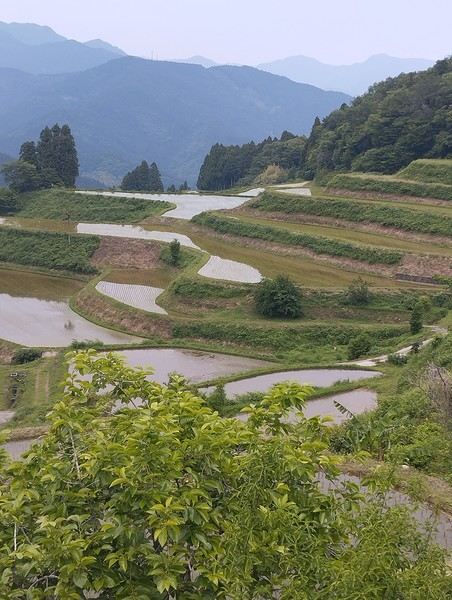
The itinerary: 27 full days, from late May to late June 2025, right in the middle of the rainy season, including:
-->13 days in Shikoku, from Kochi (Kochi Prefecture) to Matsuyama (Ehime Prefecture)
-->7 days in Miyakojima (Okinawa Prefecture)
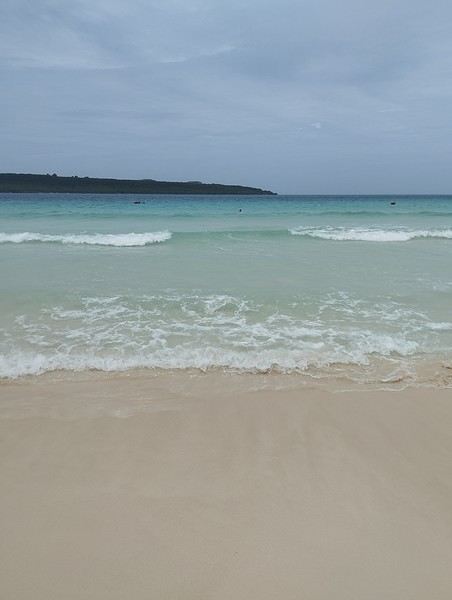
-->7 days in Tokyo
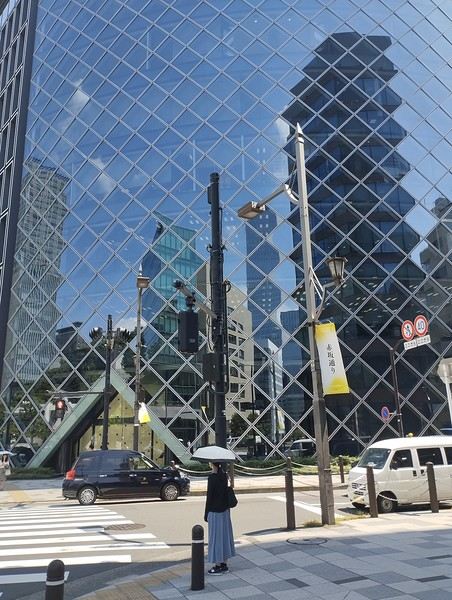
The trip was decided on fairly last-minute this year, as usual.
I regularly check flight prices to track fluctuations for this destination, even without concrete plans. Finding a slightly cheaper direct flight (900 €) than what I’d seen in previous months (around 1,200–1,400 € on average) for a Paris-Tokyo route with Japanese airline ANA was too tempting to resist the urge to return to this enchanting country. After long hesitations between exploring the San’in region (Matsue, Tottori, Yamaguchi) and southern Shikoku, the decision was made—I took the plunge! The tickets are booked: Paris to Kochi with a layover in Tokyo, all with ANA, the airline I’d been dreaming of... for 1,120 € per person. Okay, it’s not cheap, but it’s still better than in 2023.
We leave in 2 weeks!! Now it’s just a matter of getting everything ready!
Intense work ahead in these 2 weeks to:
finalize a more precise itinerary and reach an agreement—yep, because even though we both love Japan, our preferences differ slightly, and we have to choose between exploring new places or taking time to revisit beloved spots... decide how much time to spend in each selected area without rushing while still exploring research places that might interest us and watch videos about Japan book accommodations: yes, it’s possible to do this on the spot as we go, but last year, we noticed that last-minute options were pretty expensive, so we’re booking ahead—even if it means keeping a few options open while we decide or see if better deals pop up later reserve rental cars order yen check the weather regularly and wonder if choosing the *tsuyu* (rainy season) was really a good idea—and whether we’ll be stuck in non-stop rain???
What a tough job, right? Traveling to Japan for a month—such a hard life! Despite this being my 4th trip, the excitement is just as intense as the first time.
The only small downside is that when we booked the flight tickets, there were only a few seats left, so we’re only sitting together on the international return flight. Plus, on the outbound flight, we’ve got the middle seats. Another lingering question: what French-language films will be available? According to the internet, the selection seems limited. Oh well, these are just minor details—it’s almost time to fly!
PS: I’ll be posting slowly and irregularly... so for those interested, be patient or maybe set an alert...
Hi everyone,
I have to admit, I really hesitated before deciding to write this travel journal... Writing one takes a lot of time and energy, and since this is my 4th trip, I wondered if it would actually interest anyone other than myself (both for the discovery and the writing). But after a few "Are you going to write a journal?" requests and especially the renewed pleasure from reading other travelers’ travel journals about Japan or elsewhere on this forum or elsewhere, I’ve decided to share this 4th installment in the Land of the Rising Sun here.
The itinerary: 27 full days, from late May to late June 2025, right in the middle of the rainy season, including:
-->13 days in Shikoku, from Kochi (Kochi Prefecture) to Matsuyama (Ehime Prefecture)
-->7 days in Miyakojima (Okinawa Prefecture)
-->7 days in Tokyo
The trip was decided on fairly last-minute this year, as usual.
I regularly check flight prices to track fluctuations for this destination, even without concrete plans. Finding a slightly cheaper direct flight (900 €) than what I’d seen in previous months (around 1,200–1,400 € on average) for a Paris-Tokyo route with Japanese airline ANA was too tempting to resist the urge to return to this enchanting country. After long hesitations between exploring the San’in region (Matsue, Tottori, Yamaguchi) and southern Shikoku, the decision was made—I took the plunge! The tickets are booked: Paris to Kochi with a layover in Tokyo, all with ANA, the airline I’d been dreaming of... for 1,120 € per person. Okay, it’s not cheap, but it’s still better than in 2023.
We leave in 2 weeks!! Now it’s just a matter of getting everything ready!
Intense work ahead in these 2 weeks to:
finalize a more precise itinerary and reach an agreement—yep, because even though we both love Japan, our preferences differ slightly, and we have to choose between exploring new places or taking time to revisit beloved spots... decide how much time to spend in each selected area without rushing while still exploring research places that might interest us and watch videos about Japan book accommodations: yes, it’s possible to do this on the spot as we go, but last year, we noticed that last-minute options were pretty expensive, so we’re booking ahead—even if it means keeping a few options open while we decide or see if better deals pop up later reserve rental cars order yen check the weather regularly and wonder if choosing the *tsuyu* (rainy season) was really a good idea—and whether we’ll be stuck in non-stop rain???
What a tough job, right? Traveling to Japan for a month—such a hard life! Despite this being my 4th trip, the excitement is just as intense as the first time.
The only small downside is that when we booked the flight tickets, there were only a few seats left, so we’re only sitting together on the international return flight. Plus, on the outbound flight, we’ve got the middle seats. Another lingering question: what French-language films will be available? According to the internet, the selection seems limited. Oh well, these are just minor details—it’s almost time to fly!
PS: I’ll be posting slowly and irregularly... so for those interested, be patient or maybe set an alert...
Bugs on VoyageForum
Hi,
Many of us have noticed that bugs have been making it difficult to navigate the forum lately.
I’ll let Kate and Ticapi explain the issue:
I went to your profile to check out the Thailand travel journal, and when I clicked on it, it brought me back here again. All week, I’ve been dealing with bugs like this—it’s really discouraging from continuing on VF.🙁
I had the same thing happen, and multiple times. For me, it was Montagnard’s latest journal that kept coming up no matter which discussion I clicked on.
Hopefully, a solution will be found soon.🙂
Do travel encounters matter to you?
Hi there,
My name’s Emilie, and my view of travel has changed. I used to travel just to tick off the "places and things to do/see" boxes. But lately, I’ve realized that encounters have become really important to me while traveling. In fact, the people I’ve met and what they’ve brought to my life are now my best travel memories. What do you think? Have you had a similar shift in perspective? Are you more interested in meeting people while traveling now?
To be totally honest, I’m training to become a travel planner (a trip organizer), and I was thinking of focusing on organizing trips that are more centered around encounters. So I’d love to know if this makes sense—if travelers are interested in this kind of experience. Just to be clear, I’m not selling anything; I just want to chat and hear your thoughts.
Have a lovely evening, everyone! :)
Croatia, Montenegro – two victims of overtourism?
Mid-June, two Auvergnats on the starting blocks—off we go to the former Yugoslavia!
We’d already explored some nooks and crannies of northern Croatia back in 2019, so we’re keeping the momentum going by planning a trip to the south of the country and then Montenegro.
On the way back, we’ll drift into Bosnia-Herzegovina just to mix things up a bit!
We’re a little unsure about what to expect in terms of tourist crowds.
Dubrovnik has a reputation for being the hardest-hit city by overtourism, and Kotor and the whole Dalmatian coast aren’t exactly empty...
Luckily, most European countries haven’t started school holidays yet, and some measures seem to have been put in place to limit the flow (like restrictions on the number of cruise ships allowed to dock at the same time).
Maybe we’ll manage to escape the promised hell?
For now, we’re slamming the doors of the Scirocco and heading off to our first stop: northern Italy!
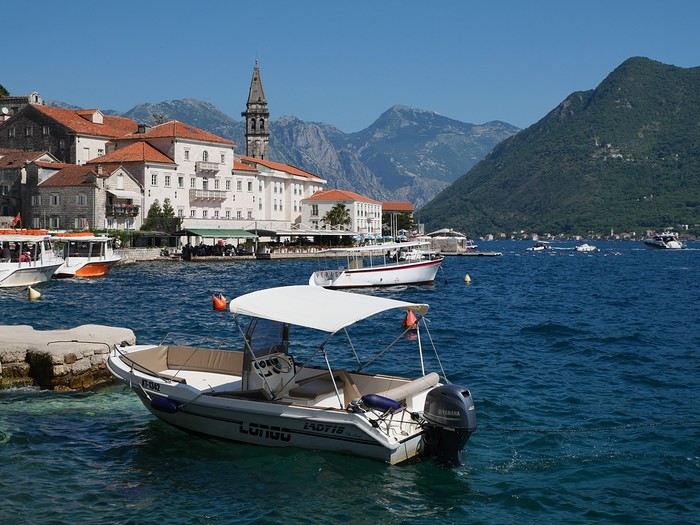
On the way back, we’ll drift into Bosnia-Herzegovina just to mix things up a bit!
We’re a little unsure about what to expect in terms of tourist crowds.
Dubrovnik has a reputation for being the hardest-hit city by overtourism, and Kotor and the whole Dalmatian coast aren’t exactly empty...
Luckily, most European countries haven’t started school holidays yet, and some measures seem to have been put in place to limit the flow (like restrictions on the number of cruise ships allowed to dock at the same time).
Maybe we’ll manage to escape the promised hell?
For now, we’re slamming the doors of the Scirocco and heading off to our first stop: northern Italy!
Wood in all its forms – July 2025 photography contest
Hi everyone,
This month’s contest theme is WOOD. Wood as a plant material—roots, trunks, branches that make up a tree. Dead or alive, splinters and knots. Sawdust too. Firewood, from the woodshed to the hearth. Wood as a crafting material and all the things it can become: from a spoon to a violin, a boat to a stave church, and so much more—way too long to list! 😉
Technical details:
1. Each of you can post up to 3 photos. One photo per message, numbered 1 to 3. Along with the shot, feel free to share a few written details—location, context, anecdote, or photography technique. Photos can be submitted until Tuesday, July 22 at midnight, Milan time.
2. Voting will take place from Wednesday, July 23 at 00:00 until Tuesday, July 29 at midnight. All forum members can vote for their 3 favorite photos, listing the photographer’s name and the photo number in order of preference: 3 points for first place, 2 for second, and 1 for third.
3. Results will be announced on Wednesday, July 30 during the day. In case of a tie, the number of first-place votes will decide. Photos already featured on a podium are not eligible to compete.
The winner will have the special privilege of organizing August’s contest.
This thread is reserved for contest photos. For other wood-themed photos and general discussions, head here.
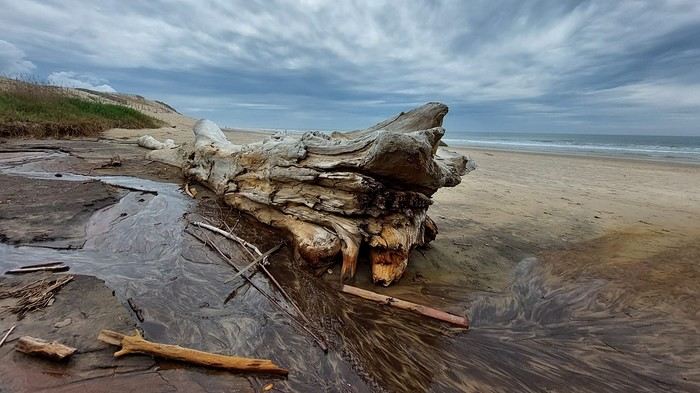
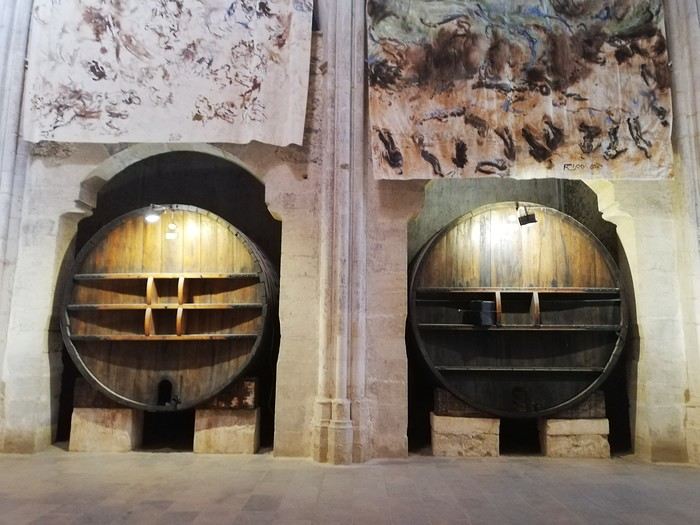
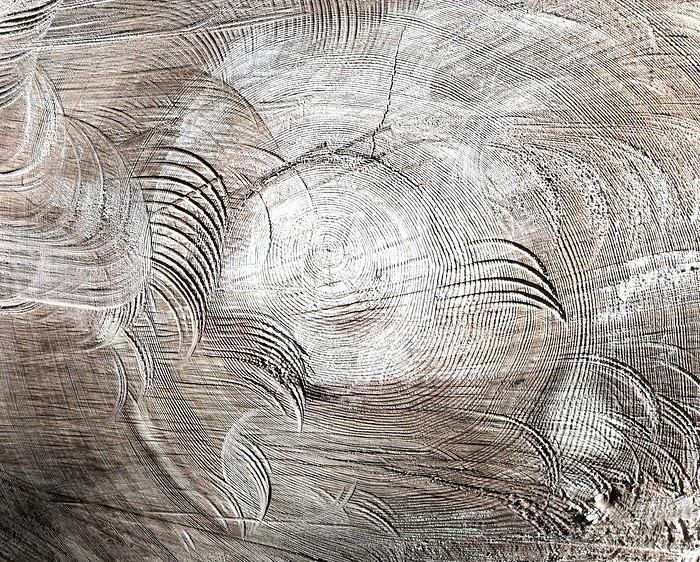
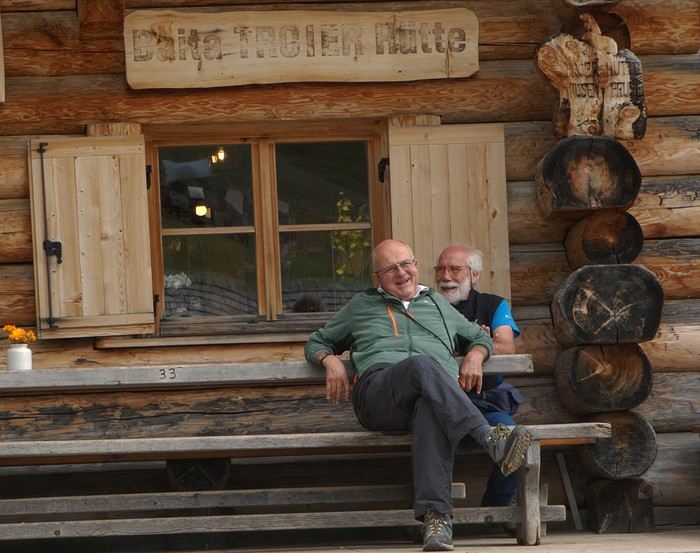
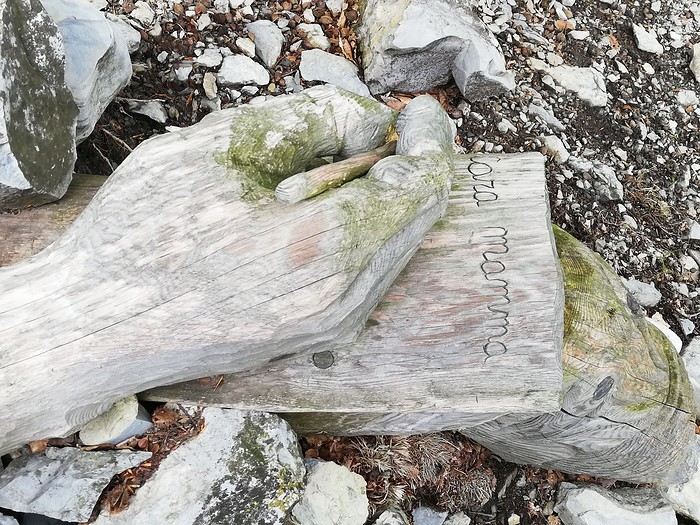

Alright, your turn! 😛
Catherine
This month’s contest theme is WOOD. Wood as a plant material—roots, trunks, branches that make up a tree. Dead or alive, splinters and knots. Sawdust too. Firewood, from the woodshed to the hearth. Wood as a crafting material and all the things it can become: from a spoon to a violin, a boat to a stave church, and so much more—way too long to list! 😉
Technical details:
1. Each of you can post up to 3 photos. One photo per message, numbered 1 to 3. Along with the shot, feel free to share a few written details—location, context, anecdote, or photography technique. Photos can be submitted until Tuesday, July 22 at midnight, Milan time.
2. Voting will take place from Wednesday, July 23 at 00:00 until Tuesday, July 29 at midnight. All forum members can vote for their 3 favorite photos, listing the photographer’s name and the photo number in order of preference: 3 points for first place, 2 for second, and 1 for third.
3. Results will be announced on Wednesday, July 30 during the day. In case of a tie, the number of first-place votes will decide. Photos already featured on a podium are not eligible to compete.
The winner will have the special privilege of organizing August’s contest.
This thread is reserved for contest photos. For other wood-themed photos and general discussions, head here.
Alright, your turn! 😛
Catherine
Vaccines and treatments for Thailand
Hi there,
I’ve already visited quite a few countries across several continents, but I’m pretty new to Asia.
I’m planning a trip to Thailand in October or November, and I wanted to check about health precautions: malaria treatment, vaccinations (hepatitis A or others...). I’ll mostly be in the northern region, around Chiang Mai, where I’ll spend a lot of time in nature and the mountains. Then I’ll head south to Phuket or Krabi and visit Khao Sok National Park. I’ll finish up in Bangkok, with a likely detour to Kanchanaburi.
From what I understand, for a stay of less than 60 days, I don’t need a visa (I’m a French national)? I just need to fill out the TDAC form 3 to 5 days before arrival?
Thanks for your advice! Fred
2 weeks in the Cyclades
Hi everyone!
Blue skies (lots of them), whitewashed villages with steep alleyways, hundreds of churches, and... thousands of stairs? Welcome to the Cyclades! 🙂
We’d been dreaming about this for a while, but in July-August—with the crowds—no way! Now that I can travel outside school holidays, the Cyclades are back on the agenda. And so begins a loooong period of planning and second-guessing, with countless itinerary changes: the Cyclades, yes, but which ones? I was fixated on Folegandros (we won’t be going after all) and really wanted to visit Delos. So, for this first trip, it’ll be: Mykonos (and Delos)-Naxos-Amorgos-Santorini.
Saturday 24/05: Departure from Orly on a Transavia flight, arriving in Mykonos in the late afternoon. We found a hotel that offers free transfers (pretty rare and not insignificant—it’s 25 € each way for just a few kilometers 😠) and at a reasonable price (83 € per night for B&B). Time for dinner already: Greek salad and souvlaki (we’re in Greece, right?)
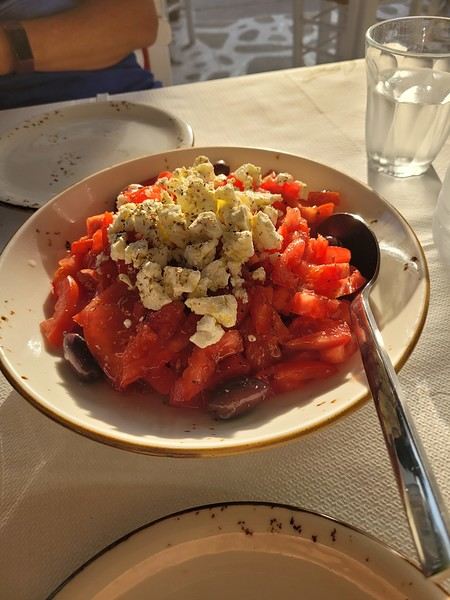 (Okay, this is actually a dakos with Naxos cheese, but I don’t have a photo of a Greek salad 😏).
Blue skies (lots of them), whitewashed villages with steep alleyways, hundreds of churches, and... thousands of stairs? Welcome to the Cyclades! 🙂
We’d been dreaming about this for a while, but in July-August—with the crowds—no way! Now that I can travel outside school holidays, the Cyclades are back on the agenda. And so begins a loooong period of planning and second-guessing, with countless itinerary changes: the Cyclades, yes, but which ones? I was fixated on Folegandros (we won’t be going after all) and really wanted to visit Delos. So, for this first trip, it’ll be: Mykonos (and Delos)-Naxos-Amorgos-Santorini.
Saturday 24/05: Departure from Orly on a Transavia flight, arriving in Mykonos in the late afternoon. We found a hotel that offers free transfers (pretty rare and not insignificant—it’s 25 € each way for just a few kilometers 😠) and at a reasonable price (83 € per night for B&B). Time for dinner already: Greek salad and souvlaki (we’re in Greece, right?)
(Okay, this is actually a dakos with Naxos cheese, but I don’t have a photo of a Greek salad 😏).Louisiana - Mississippi - Tennessee - Arkansas - April 2024
The context:
The urge to return to the USA, to explore a new part of the country. I don’t need much convincing to go back to Uncle Sam’s land. My wife’s on board too.
So, off we go for my 9th trip to the USA! (I didn’t take notes, so this is from memory)
Day 1: The departure: Flight with two layovers. I usually avoid layovers in the US before the final destination because of immigration. This time, my flight was Lyon/Munich, then Munich/Chicago, and finally Chicago/New Orleans. The layover in Chicago was 3 hours, and since I’d been through this airport twice before and found it super efficient both times, I wasn’t too worried when I booked my tickets—especially with Lufthansa. Unfortunately, there were several flight changes before departure, the last one leaving us with only a 2h14 layover in Chicago. I called Lufthansa to check if that would be enough, and they told me immigration in Chicago takes about an hour and 45 minutes (according to their calculations). So, I left feeling confident. A 15-minute delay leaving Lyon, then a 1-hour delay leaving Munich—now I’m starting to worry. When we arrived in Chicago, we rushed, cut in line, and made it to immigration. And then—an impossible queue. Game over, we missed our last flight. Of course, Lufthansa rebooked us for the next morning, arriving around 10 AM, and booked us a hotel. I found someone to call Alamo in New Orleans to make sure my rental car would still be there. Everything’s sorted—except our luggage, which we have no idea where it is! My little worry is that we land at 9:45 AM the next morning, and we’ve booked a tour at 11 AM at Laura Plantation, which is about an hour’s drive away! Wait and see…
The +: We're back in the USA The -: Once again, flight delays
Uzbekistan - Finally made it - Summer 2022
Another trip planned during Covid. Actually, for 2020, I had three trips booked, with tickets purchased and everything.
This one to Uzbekistan was planned for April 2020. We postponed it to April 2021, but it was canceled again, and we couldn’t reschedule for April 2022 because our friends who were coming with us were busy. So, we chose summer, knowing the temperatures would likely be very high.
We left as a group of five: a couple we usually travel with and one of their friends, whom I knew. She was traveling alone and had dreamed of this trip but didn’t want to go by herself.
For organization, we went through an agency to handle the train tickets and our trip to the Aral Sea. It’s not my usual style, but back in 2020, we were already in touch with them, and they were very understanding during the two cancellations. It wasn’t easy, given the economic crisis Covid caused, especially in Uzbekistan.
Again, I’m writing this travel journal from memory since I didn’t take any notes. (It’s good to give your brain a workout now and then!)
Day 1: Off to Tashkent
We flew in the afternoon to Istanbul, had a 2-hour-15-minute layover in Turkey, and then took an overnight flight to arrive early in the morning in Tashkent. Problem (again): just before taking off from Saint-Exupéry, the plane had an issue with the landing gear. We waited two hours, and after a few hammer and wrench adjustments, we finally took off. Of course, by the time we arrived in Istanbul, it was a mad dash through the airport to catch our connecting flight. We landed at 7:30 AM in Tashkent, and of the five suitcases in our little group, two were missing (one of ours and the solo traveler’s). Big problem because we were leaving at 2:30 PM by train for the Aral Sea, and we wouldn’t be near an airport again for three days. Plus, at the small airport in the Uzbek capital, no one spoke English (or French, or the Ardèche dialect). Fortunately, we had booked a guide for a quick morning tour of the capital. We had seven hours to kill, and it seemed smart to do it this way (and yes, sometimes we do think ahead). With him speaking English and, more importantly, Uzbek, the delivery of our suitcases was arranged.
So, we set off to explore the capital. It’s very Soviet in design—wide avenues and ugly buildings.
We visited the Khasti Imam historical complex (first name to pronounce at your own risk—there will be plenty more during the trip). Lots of "oohs" and "aahs" about how beautiful it was, but in the end, compared to what we saw later, it was really just small potatoes.
We checked out Chorsu Bazaar, the city’s large covered market. The guide was friendly and gave us plenty of tips for the rest of the trip. He suggested a restaurant, which we accepted, so we could get familiar with local customs. The good thing was, it didn’t seem like a tourist trap.
Next, we headed to the train station because our train was at 2:30 PM. The guide left us, and then another problem arose. While going through security, one of the staff made it clear that our train was canceled and our ticket needed to be changed to the train leaving around 8:20 PM. Heatwave moment (it was 38°C). Our issue was that we were supposed to arrive in Nukus (our destination) at 6:00 AM and take a minibus for a round trip to Moynaq and the Aral Sea (four hours each way). The plan was to spend 2-3 hours there and return, so a 10-11-hour timeline. Leaving at 6:00 AM made it doable, but with the train now leaving at 8:20 PM, we’d arrive in Nukus at noon, which messed up the rest of the plan.
I was fuming at the agency (I really don’t like using agencies), so I called the local contact, who quickly sent our guide back (because trying to communicate, change tickets, and get information was tough).
I asked the manager to find us flight tickets to make up for the delay, but nothing—zilch—was possible. We were stuck! My buddy and I were determined to get to Moynaq, but the women in the group were less motivated.
No choice but to board the train for an overnight journey. We had a cabin for two (and our friend had one to herself). Big scare at first—no AC, and it felt like 150°. They told us it would work once the train started moving, which it did. A frugal meal in the dining car (spaghetti with meat—the only dish on offer) and we had a good night’s sleep.
The +: Finally, we’re here! The -: A lot of hassles to start the trip
Discovering Assam and Nagaland 2025
Before I begin, I’d like to thank Michèle Buisson and her "Misha’s travel journals," which really helped me plan this trip. It’s tough to find information about this part of India, which is quite different from the "more traditional India." I’m so grateful to her for introducing me to a family who hosted me for 4 nights and 3 days. I can’t wait to return the favor and welcome you all to my place in early July!
Thursday, March 20th. The alarm goes off super early, but I’m already awake—I was too worried I’d sleep through it. I leave the house at 4:00 AM. The rain has stopped, and at this hour, there aren’t many trucks on the road. I arrive at Barcelona Airport easily by 6:20 AM, let the valet know I’m there, and he quickly picks up my car. This time, I’m flying with Etihad Airways again. I booked the ticket during my trip to Cambodia: Barcelona/Kolkata, Delhi/Barcelona for 567 €. At that price, I didn’t hesitate for long—I knew I had to take it. And I’m glad I did because, by the time I returned, the price had gone up to 700 €. I can already hear the reactions: "Wow, how’d you get a ticket for that price? What site did you use? You’re amazing, MarieJo!" One thing’s for sure—I’m really happy with this deal. The flights from Barcelona to Abu Dhabi and Abu Dhabi to Kolkata go smoothly, and we arrive on time at 2:55 AM. There aren’t many people at immigration, so I get through quickly. My luggage isn’t on the carousel yet. After collecting my bag, I check in for my next flight with IndiGo, a 5:40 AM flight to Guwahati, arriving at 7:00 AM. I’m starting to feel pretty tired, so I take a taxi from the airport to Gruham Sojourn Homestay. The house is upstairs, and the neighborhood seems quiet, with restaurants lining the street. The room won’t be ready until 10:00 AM, so I rest on the bench in the meantime. Once in the room, I take a shower—it really helps me feel refreshed. I need to exchange some euros, so I look up a nearby exchange bureau on Google and head out to find it. I locate it easily, and the staff are super friendly. I get a great rate (1 € = 90 INR). I wander around the neighborhood. The train station isn’t far, and small markets line the streets. I head back to my area, walking along the main avenue. About 500 meters from my street, I discover a museum. The visit is fascinating—I see the famous Majuli masks, among other things.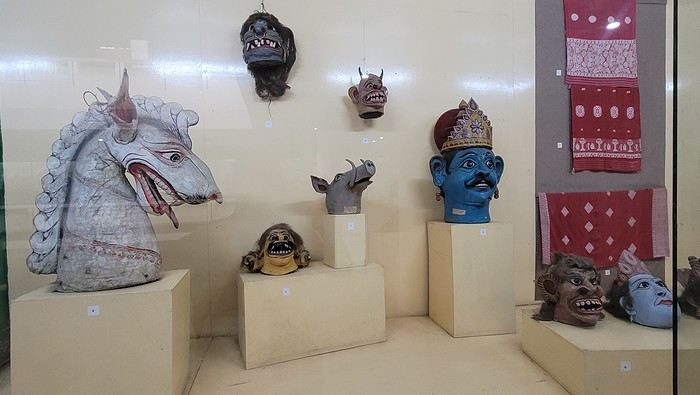

I’m not far from the Brahmaputra River, and the temptation to visit is too strong to resist. I’d hoped to find a promenade along the river, but that doesn’t exist here. I walk back calmly and notice several restaurants in my street. On the doorstep of my accommodation, I spot a pastry shop with cakes that look more like the ones we have in France than the typical ones here in India. A visit is a must, and I’m not disappointed!
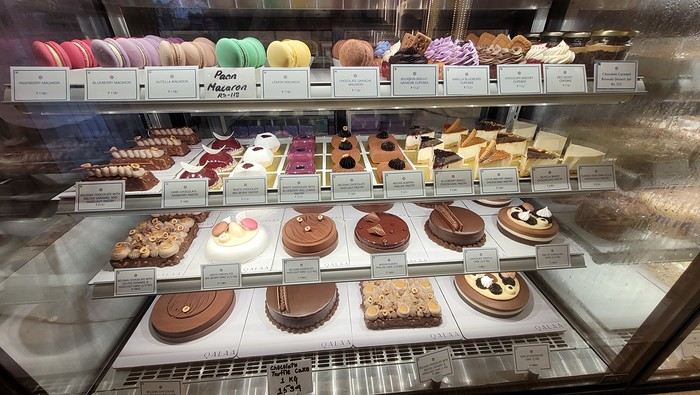
Tonight, I’m dining at a restaurant in the street. The menu is a bit disappointing—burgers, pizzas, pasta—nothing very Indian. So, I’ll go with tomato pasta.
Thursday, March 20th. The alarm goes off super early, but I’m already awake—I was too worried I’d sleep through it. I leave the house at 4:00 AM. The rain has stopped, and at this hour, there aren’t many trucks on the road. I arrive at Barcelona Airport easily by 6:20 AM, let the valet know I’m there, and he quickly picks up my car. This time, I’m flying with Etihad Airways again. I booked the ticket during my trip to Cambodia: Barcelona/Kolkata, Delhi/Barcelona for 567 €. At that price, I didn’t hesitate for long—I knew I had to take it. And I’m glad I did because, by the time I returned, the price had gone up to 700 €. I can already hear the reactions: "Wow, how’d you get a ticket for that price? What site did you use? You’re amazing, MarieJo!" One thing’s for sure—I’m really happy with this deal. The flights from Barcelona to Abu Dhabi and Abu Dhabi to Kolkata go smoothly, and we arrive on time at 2:55 AM. There aren’t many people at immigration, so I get through quickly. My luggage isn’t on the carousel yet. After collecting my bag, I check in for my next flight with IndiGo, a 5:40 AM flight to Guwahati, arriving at 7:00 AM. I’m starting to feel pretty tired, so I take a taxi from the airport to Gruham Sojourn Homestay. The house is upstairs, and the neighborhood seems quiet, with restaurants lining the street. The room won’t be ready until 10:00 AM, so I rest on the bench in the meantime. Once in the room, I take a shower—it really helps me feel refreshed. I need to exchange some euros, so I look up a nearby exchange bureau on Google and head out to find it. I locate it easily, and the staff are super friendly. I get a great rate (1 € = 90 INR). I wander around the neighborhood. The train station isn’t far, and small markets line the streets. I head back to my area, walking along the main avenue. About 500 meters from my street, I discover a museum. The visit is fascinating—I see the famous Majuli masks, among other things.
I’m not far from the Brahmaputra River, and the temptation to visit is too strong to resist. I’d hoped to find a promenade along the river, but that doesn’t exist here. I walk back calmly and notice several restaurants in my street. On the doorstep of my accommodation, I spot a pastry shop with cakes that look more like the ones we have in France than the typical ones here in India. A visit is a must, and I’m not disappointed!
Tonight, I’m dining at a restaurant in the street. The menu is a bit disappointing—burgers, pizzas, pasta—nothing very Indian. So, I’ll go with tomato pasta.
Aloha State: Hawaii February 2025
Alright, I'm diving into this Hawaiian travel journal!
I hope lots of you will follow along because the destination is absolutely charming. 🙂
Just a heads-up—I might take a while to finish it.
The trip took place from February 20th to March 3rd, 2025 (11 days total, with 9 days on-site). It was a trip with my friend Christelle, with whom I’ve already traveled to Iceland and Morocco in recent years. We’re totally on the same wavelength, with the same expectations and desires, which makes things a lot easier (and, as a bonus, it helps cut down the final bill). Being the generous soul I am, I asked Christelle which country she wanted to visit. Her answer: Asia, since I’ve never been, or Namibia... Hawaii is basically the same thing, right?!! All thanks to the search comparator—I stumbled upon round-trip tickets from Paris to Honolulu for 580 € per person during school holidays, with a layover in Canada (I don’t get to choose my vacation dates). We jumped on it on August 28th (didn’t take much convincing). For info, I always check flight tickets during the last week of August or the first half of September because there are always amazing deals.
Nine days on-site is short, so we had to make some tough choices for the islands we’d visit (I’m only listing the main ones): - Oahu: the most urbanized but also home to Honolulu, Pearl Harbor, and some stunning beaches.
Kauai: the Garden Isle. It’s the island from *Jurassic Park*, with lush vegetation—so it’s pretty rainy. Big Island: volcanoes, volcanoes, and more, but also things like night snorkeling with manta rays. Maui: very touristy, with a magnificent volcano, the Road to Hana, and the ultimate spot for whale watching (and we were there right in the middle of whale season).
We limited ourselves to two islands to avoid rushing, and in the end, we picked Kauai (non-negotiable) and Oahu (which saved us an extra domestic flight and, since we were there in winter, let us experience the BIG WAVES on the North Shore). We would’ve loved to visit Big Island, but we’d already seen volcanoes in Iceland, and the island is huge—we just didn’t have enough time. Maui was recently hit by a major wildfire and is also the most expensive island (along with Kauai). We were really hoping to see humpback whales (my favorite animal) on both Oahu and Kauai. Hawaii is far, and it’s worth the effort. The journey went smoothly. I took a 40-minute bus ride and a 1h32 RER trip just to get to Roissy, then a 9h15 flight to Calgary, with a two-hour layover before a 6h45 flight to Honolulu. 11 hours of time difference, arriving at 10 PM local time. And you know what? (spoiler alert) I’d do it a thousand times if I got the chance.
Alright, let’s go—here we go!

The trip took place from February 20th to March 3rd, 2025 (11 days total, with 9 days on-site). It was a trip with my friend Christelle, with whom I’ve already traveled to Iceland and Morocco in recent years. We’re totally on the same wavelength, with the same expectations and desires, which makes things a lot easier (and, as a bonus, it helps cut down the final bill). Being the generous soul I am, I asked Christelle which country she wanted to visit. Her answer: Asia, since I’ve never been, or Namibia... Hawaii is basically the same thing, right?!! All thanks to the search comparator—I stumbled upon round-trip tickets from Paris to Honolulu for 580 € per person during school holidays, with a layover in Canada (I don’t get to choose my vacation dates). We jumped on it on August 28th (didn’t take much convincing). For info, I always check flight tickets during the last week of August or the first half of September because there are always amazing deals.
Nine days on-site is short, so we had to make some tough choices for the islands we’d visit (I’m only listing the main ones): - Oahu: the most urbanized but also home to Honolulu, Pearl Harbor, and some stunning beaches.
Kauai: the Garden Isle. It’s the island from *Jurassic Park*, with lush vegetation—so it’s pretty rainy. Big Island: volcanoes, volcanoes, and more, but also things like night snorkeling with manta rays. Maui: very touristy, with a magnificent volcano, the Road to Hana, and the ultimate spot for whale watching (and we were there right in the middle of whale season).
We limited ourselves to two islands to avoid rushing, and in the end, we picked Kauai (non-negotiable) and Oahu (which saved us an extra domestic flight and, since we were there in winter, let us experience the BIG WAVES on the North Shore). We would’ve loved to visit Big Island, but we’d already seen volcanoes in Iceland, and the island is huge—we just didn’t have enough time. Maui was recently hit by a major wildfire and is also the most expensive island (along with Kauai). We were really hoping to see humpback whales (my favorite animal) on both Oahu and Kauai. Hawaii is far, and it’s worth the effort. The journey went smoothly. I took a 40-minute bus ride and a 1h32 RER trip just to get to Roissy, then a 9h15 flight to Calgary, with a two-hour layover before a 6h45 flight to Honolulu. 11 hours of time difference, arriving at 10 PM local time. And you know what? (spoiler alert) I’d do it a thousand times if I got the chance.
Alright, let’s go—here we go!
In MIKUMI and SELOUS, Southern Tanzania (June 2024)
Hi everyone,
I’m a newbie to this forum, passionate about wildlife, the landscapes of East Africa, and Tanzania in particular. This June 2024 trip/safari is our 7th visit to Tanzania and our 5th in the south, which has drawn us more than the north ever since we discovered it in 2015.
In 2024, the entrance fees for the reserves and services have gone up again since our last visit. I chose to return first to Mikumi Reserve, which was the very first one we visited in the south. Then, we’ll head to Selous (J. Nyerere N. P.) as usual. Initially, we wanted to spend 2/3 days on Mafia Island at the end of the trip, but it made the total cost too high, so we gave up... We usually go to Ruaha and Selous, but I wanted to mix it up a bit—also to save some money...
As for the timing, June is a new experience for us. I thought it might be interesting to come just after the lodges reopen... hoping for some great wildlife encounters??
The trip starts in Marseille with our first flight on Ethiopian Airlines to Addis Ababa, then continues to Dar es Salaam, where we’ll finally set foot on Tanzanian soil again.
In Addis... "our" A-350.
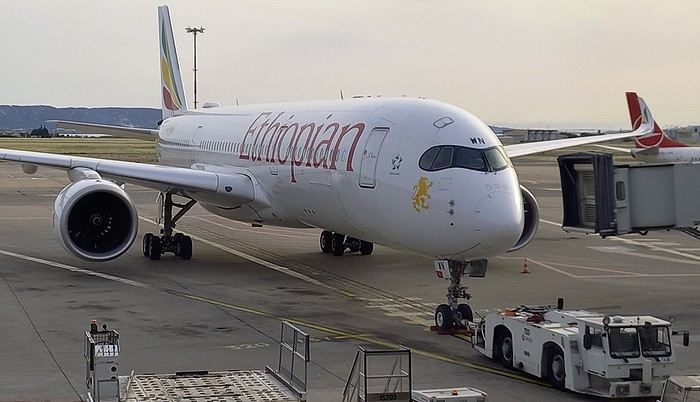
.....
After arriving in Dar, we spent one night at a hotel near the airport. The next morning, we headed to the domestic flights terminal, which hasn’t changed in years.
By mid-morning, we boarded a Cessna 208B Caravan with Safari Air Link, heading to the Kikoboga bush airstrip in Mikumi, which we reached 45 minutes later. Fun fact: the pilot was the same one as on our return flight two years ago.
Welcome on board:
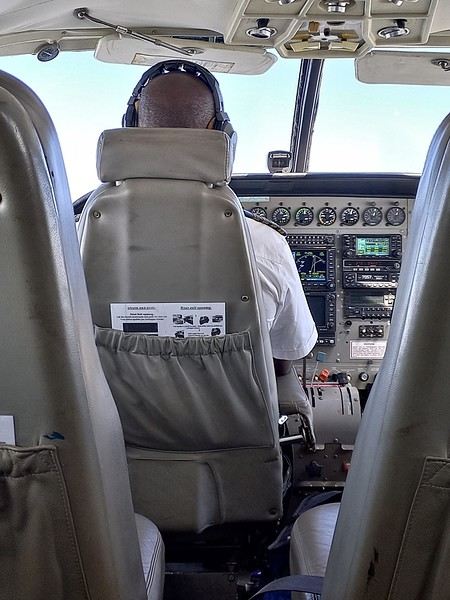
Of course, a driver/guide team from our chosen lodge was waiting for us upon arrival:
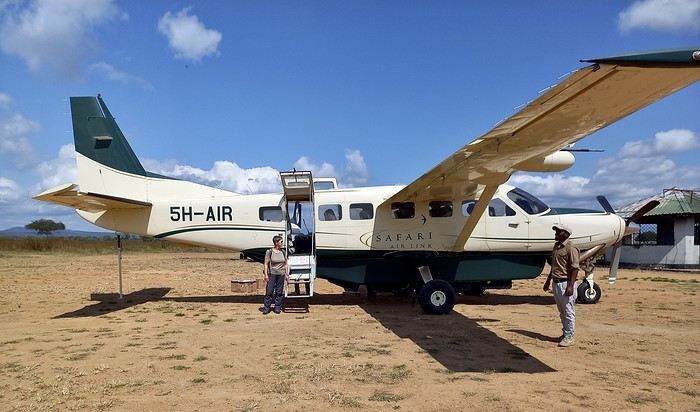
I was surprised to see so many aircraft parked there... even twin-engine Embraer Brasilias?? As a fan of vintage planes, I loved it...
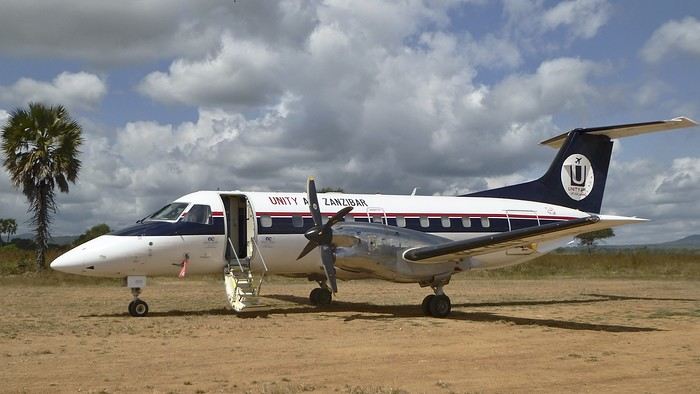
On the other hand, the light was incredibly harsh.....!! Our guides only speak English. We knew that in advance. In the south, it’s very rare to find someone who speaks French. This’ll force us to dig into our high school English memories... from 60 years ago... at least.
It’s noon, and we head toward the lodge. Near the airstrip, next to the Mikumi rangers’ base, there are quite a few herbivores. They find a bit more peace here—the big cats don’t venture this way...
Our first encounter was a group of Masai giraffes.
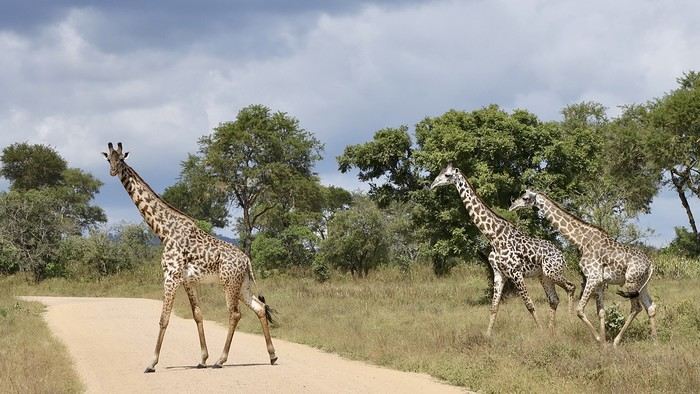
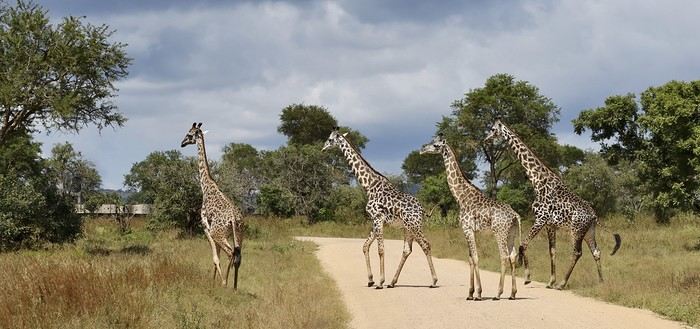
Rarer (for us), a savanna monitor lizard basking in the sun right in the middle of the track...??
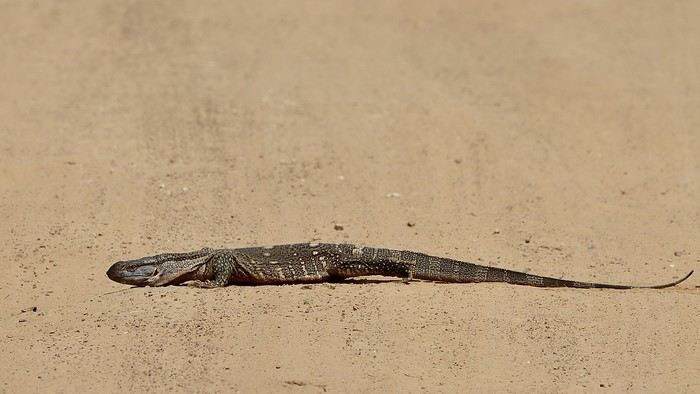
A large gathering of impalas (mostly males) along with a few blue wildebeest:
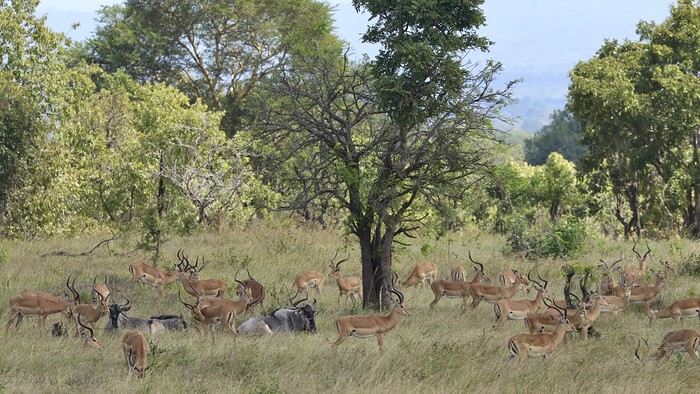

Also unusual: a African crowned hornbill taking a dust bath in the middle of the track...!!
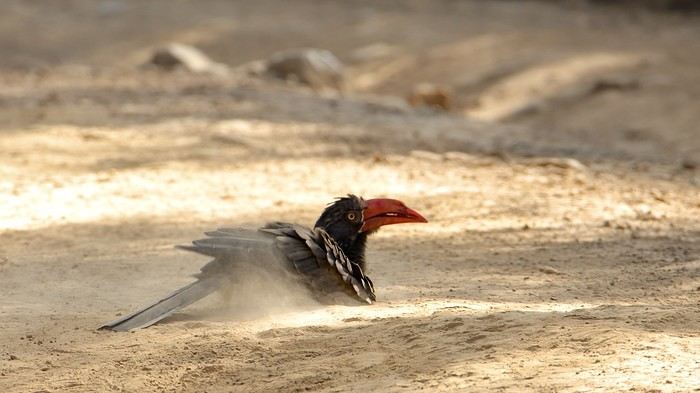
When it comes to identifying mammals or birds, I don’t know everything... so I might make mistakes. Please forgive me. I’m counting on my friend Blesl’s active participation... 😉
...
I’m a newbie to this forum, passionate about wildlife, the landscapes of East Africa, and Tanzania in particular. This June 2024 trip/safari is our 7th visit to Tanzania and our 5th in the south, which has drawn us more than the north ever since we discovered it in 2015.
In 2024, the entrance fees for the reserves and services have gone up again since our last visit. I chose to return first to Mikumi Reserve, which was the very first one we visited in the south. Then, we’ll head to Selous (J. Nyerere N. P.) as usual. Initially, we wanted to spend 2/3 days on Mafia Island at the end of the trip, but it made the total cost too high, so we gave up... We usually go to Ruaha and Selous, but I wanted to mix it up a bit—also to save some money...
As for the timing, June is a new experience for us. I thought it might be interesting to come just after the lodges reopen... hoping for some great wildlife encounters??
The trip starts in Marseille with our first flight on Ethiopian Airlines to Addis Ababa, then continues to Dar es Salaam, where we’ll finally set foot on Tanzanian soil again.
In Addis... "our" A-350.
.....
After arriving in Dar, we spent one night at a hotel near the airport. The next morning, we headed to the domestic flights terminal, which hasn’t changed in years.
By mid-morning, we boarded a Cessna 208B Caravan with Safari Air Link, heading to the Kikoboga bush airstrip in Mikumi, which we reached 45 minutes later. Fun fact: the pilot was the same one as on our return flight two years ago.
Welcome on board:
Of course, a driver/guide team from our chosen lodge was waiting for us upon arrival:
I was surprised to see so many aircraft parked there... even twin-engine Embraer Brasilias?? As a fan of vintage planes, I loved it...
On the other hand, the light was incredibly harsh.....!! Our guides only speak English. We knew that in advance. In the south, it’s very rare to find someone who speaks French. This’ll force us to dig into our high school English memories... from 60 years ago... at least.
It’s noon, and we head toward the lodge. Near the airstrip, next to the Mikumi rangers’ base, there are quite a few herbivores. They find a bit more peace here—the big cats don’t venture this way...
Our first encounter was a group of Masai giraffes.
Rarer (for us), a savanna monitor lizard basking in the sun right in the middle of the track...??
A large gathering of impalas (mostly males) along with a few blue wildebeest:
Also unusual: a African crowned hornbill taking a dust bath in the middle of the track...!!
When it comes to identifying mammals or birds, I don’t know everything... so I might make mistakes. Please forgive me. I’m counting on my friend Blesl’s active participation... 😉
...
What are the criteria that make you choose one destination over another?
Hi there,
The title might be a bit long, but I hope it’s completely understandable!
When it comes to choosing your next trip, what tips the scales in favor of Eritrea over Ibiza?
Why pick Canada over French Polynesia?
The price? A magazine or TV report, a travel journal, an Instagram ad? Ease of travel? Minimal time difference? The country that has the most in common with all the trip participants? Activities? Relaxation? The desire to push your limits?
A photo?
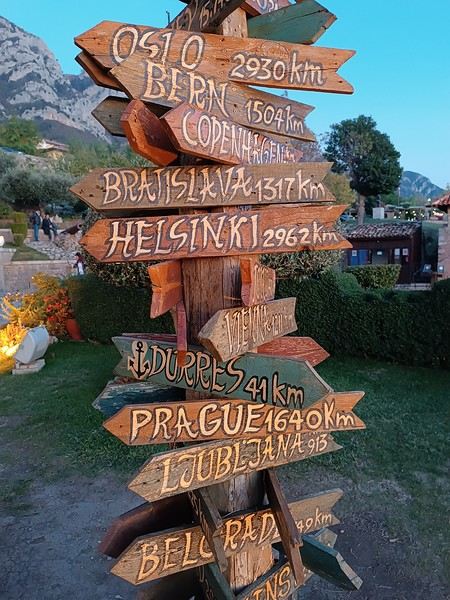
What else, I wonder...
Personally, I often prioritize simple destinations (no administrative hassles), where I’m not at risk (nothing extraordinary like getting kidnapped by Daesh or ending up in a jail cell because the current geopolitics aren’t favorable to my passport, etc.), and where I can drive.
Wide-open natural spaces are more my thing than urban anthills.
Finally, I try not to spend three days on a plane to reach my destination, and I aim for a maximum budget of 3500 € (for 3 weeks) in comfortable conditions—that means charming hotels, good meals, etc.
What about you?🙂
The title might be a bit long, but I hope it’s completely understandable!
When it comes to choosing your next trip, what tips the scales in favor of Eritrea over Ibiza?
Why pick Canada over French Polynesia?
The price? A magazine or TV report, a travel journal, an Instagram ad? Ease of travel? Minimal time difference? The country that has the most in common with all the trip participants? Activities? Relaxation? The desire to push your limits?
A photo?
What else, I wonder...
Personally, I often prioritize simple destinations (no administrative hassles), where I’m not at risk (nothing extraordinary like getting kidnapped by Daesh or ending up in a jail cell because the current geopolitics aren’t favorable to my passport, etc.), and where I can drive.
Wide-open natural spaces are more my thing than urban anthills.
Finally, I try not to spend three days on a plane to reach my destination, and I aim for a maximum budget of 3500 € (for 3 weeks) in comfortable conditions—that means charming hotels, good meals, etc.
What about you?🙂
Back from 4 weeks in northern Laos, November 2023
Hi there,
I’m so glad the VoyageForum is back up. Reading 'Montagnard74’s' Laos trip report (which I read yesterday) made me want to share my own (which I already posted a year ago on another forum).
Here’s a little recap of our 3 weeks in northern Laos, plus a few days in Vientiane.
By the way, we could easily go back to the north—there’s so much to see and do; probably in a few years.
This was our 3rd trip to Laos after having already done:
1st trip in 2012 (3 weeks), a quick overview: Vientiane Vang Vieng Luang Prabang Plain of Jars
2nd trip in 2017 (1 month): Vientiane all the way to the 4,000 Islands via Thakhek, Kong Lor, the Bolaven Plateau, Savannakhet, Pakse...
Our 2023 itinerary (1 month): Vientiane Luang Prabang Muang Ngoi Nong Khiew Luang Namtha Muang Sing Boten Vang Vieng Vientiane
Some general info (2023): For those who’ve already been to Laos: everything has gone up a lot—I think prices have almost doubled for transport, accommodation, meals... everything. But Laos is still a budget-friendly country for us. As a couple, we spent 1,100 € for a month, all included (and we definitely didn’t skimp on massages :)).
Don’t trust the transport signs posted everywhere—at travel agencies, bus terminals, hotels... THEY’RE ALL WRONG (especially the schedules). They haven’t been updated since before Covid.
There are hardly any bikes for rent anymore, but scooters are easy to find everywhere. We switched our mode of transport toward the end of our stay: from bikes to scooters, which let us go farther. In Vientiane, we only saw one bike rental place, near Ong Teu Pagoda.
BCEL bank doesn’t charge a commission on foreign currency exchanges. Using ATMs is expensive due to fees. Outside Laos, Lao kip are basically worthless. There’s so much inflation that I couldn’t find a single bank or exchange office willing to swap the kip we had left. So, don’t exchange too much toward the end of your trip.
Some little tips from our experience (2023): The Muang Koua to Muang Ngoi boat still runs daily. At the dam, you have to get off and take a bus, then get back on the boat.
The boat from Muang Ngoi to Nong Khiew only leaves at 9:30 AM (don’t miss it or you’ll pay a lot for a private boat). From Nong Khiew to Muang Ngoi, there are at least two boats a day.
From Luang Namtha to Muang Sing: 4 to 5 buses a day, the last one leaves around 3:30 PM.
From Luang Namtha or Muang Sing to Nateuy or Boten (to catch the new train): 3 to 5 buses a day.
The new train is really hard to book—it’s often fully booked 48 hours in advance, even the local train (5 hours from Boten to Vientiane instead of 3 hours on the high-speed train). (That makes it tough to travel day by day, which we love... too bad.) For baggage checks: don’t bring anything flammable (sprays...) or sharp. My mosquito repellent (flammable but in a small plastic bottle) got through. Water bottles and a tiny pocketknife are okay. But it seems to depend on the station.
Some guesthouses prefer to be paid in dollars, otherwise the price is much higher.
If you’re entering Laos from Vietnam via Dien Bien Phu, you have to get your visa at the embassy in Hanoi—otherwise, you’ll be refused at the border (no e-visa or visa on arrival).
Apart from Luang Prabang, Vientiane, and Muang Ngoi/Nong Khiew, there are very few tourists.
Some bus prices (in addition to those mentioned in my trip report) (with pick-up) 2023: Luang Prabang to Luang Namtha: 320,000 kip per person, 9h LP to Phonesavan: 250,000 kip per person, 7h LP to Phongsaly: 450,000 kip per person, 13h LP to Huay Xai: 420,000 kip per person, 14h Train Nateuy to Vientiane: 400,000 kip per person LP to Chiang Rai: 780,000 kip per person, 18h LP to Hanoi: 900,000 kip per person, 24h LP to train station: 50,000 kip per person LP to airport: 100,000 kip per person Vientiane from train station: 180,000 kip by taxi
Boats: LP to Pak Beng: 300,000 kip per person, 1 day LP to Houay Xai: 500,000 kip per person, 2 days LP to Pak Ou: 180,000 kip per person, 5h
Questions about excursions around Marrakech
Hi there,
A group of 11 of us will be spending a week in Marrakech in May. I’d love your thoughts and advice on these excursions I’ve shortlisted—or any others I might not have considered:
- Visiting Marrakech: with or without a guide? Is one day enough for the main sights? - Essaouira: Is a day trip a good option? Is the journey scenic? - Ouzoud Waterfalls: Is the place worth the trip? - Agafay Desert: Any recommendations to avoid the tourist crowds? - Imlil Valley and Mount Toubkal: A worthwhile detour?
Of course, I don’t plan to do everything in one week, but your input will help me decide... Thanks in advance! !
Albania in Autumn Colors
A new work assignment means our vacation dates can't stay the same.
We had planned to go to the Canary Islands, but flight prices are skyrocketing with this new holiday schedule.
So, I’m looking for an alternative to Gran Canaria and El Hierro and found two round-trip flights with Wizz Air to Tirana.
398 €, including baggage and seats—perfect!
Plus, the departure and return times are great, which is pretty rare for a low-cost flight!
All that’s left is to rent a car, plan the route, and book accommodations.
With two weeks, we’ll have to make some choices!
Here’s the final itinerary: Shkodra (2 nights), Valbonë (3 nights), Tirana (1 night), Lake Ohrid (1 night), Korçë (1 night), Përmet (1 night), Gjirokastër (1 night), Himarë (2 nights), Berat (2 nights), and Krujë (1 night).
A mix of countryside and small towns, a bit of the Mediterranean, and some mountains!
Late October isn’t the best season, so let’s keep our fingers crossed for the rest...
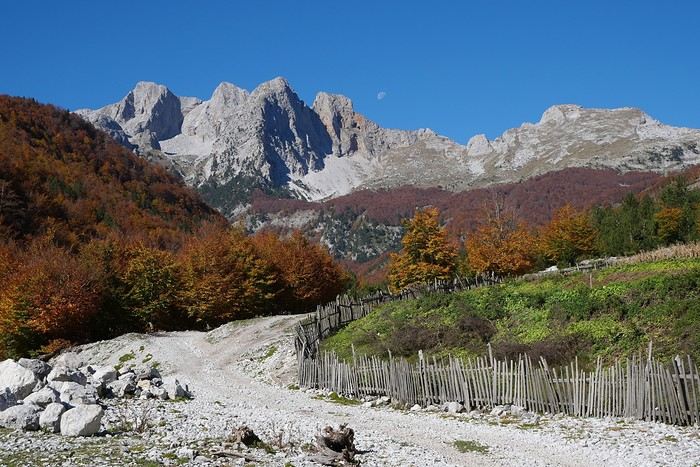
We had planned to go to the Canary Islands, but flight prices are skyrocketing with this new holiday schedule.
So, I’m looking for an alternative to Gran Canaria and El Hierro and found two round-trip flights with Wizz Air to Tirana.
398 €, including baggage and seats—perfect!
Plus, the departure and return times are great, which is pretty rare for a low-cost flight!
All that’s left is to rent a car, plan the route, and book accommodations.
With two weeks, we’ll have to make some choices!
Here’s the final itinerary: Shkodra (2 nights), Valbonë (3 nights), Tirana (1 night), Lake Ohrid (1 night), Korçë (1 night), Përmet (1 night), Gjirokastër (1 night), Himarë (2 nights), Berat (2 nights), and Krujë (1 night).
A mix of countryside and small towns, a bit of the Mediterranean, and some mountains!
Late October isn’t the best season, so let’s keep our fingers crossed for the rest...
Denied boarding due to visa with the wrong date
Today I ended up being denied boarding at CDG. I booked the trip through a physical travel agency with no assistance for the visa application. I applied in plenty of time and got the approval. Except I put the 9th (the day I left France) as the date instead of the 10th, which is the arrival date in India. That’s what caused the denial. I’m guessing I don’t have any recourse? Thanks for your replies.
White as snow, let's chat here!
And nowhere else...😉
Feasibility of 15-day Bulgaria-Istanbul family itinerary
Hi everyone,
This summer, our family (dad, mom, a 17-year-old teen, and an 11-year-old pre-teen) wants to explore Bulgaria and include 4 days in Istanbul during our trip. I’ve got a rough plan, but I’m not sure if it’s doable—here’s what I’m thinking:
Arrival on August 12th in Sofia at 2:00 PM → pick up rental car, visit Sofia. 13th: Sofia → Rila → Sofia 14th: Sofia to Plovdiv, overnight in Plovdiv 15th: Plovdiv to Nessebar (or Sozopol—which is better?) 16th/17th/18th: Exploring the Black Sea coast, based in Sozopol/Nessebar 19th: Bus from Burgas to Istanbul (7-hour trip) 20th-21st-22nd-23rd: Istanbul 24th: Return bus from Istanbul to Burgas. Overnight in Burgas 25th: Burgas → Veliko Tarnovo (Bojentsi) 26th: Veliko Tarnovo to Sofia via Koprivshtitsa 27th: Early flight home
→ In this itinerary, I’ve planned 4 full days in Istanbul. I could reduce it to 3 (since we’ll also spend the evening of the 19th there) and add an extra day to the return trip from Burgas to Sofia, around Veliko Tarnovo/Koprivshtitsa.
My questions: -My 17-year-old son and I are passionate about music, especially klezmer, Romani, and jazz. Any good spots in Sofia, Istanbul, or elsewhere? -Things to do with an 11-year-old kid? -Experiences with the Burgas-Istanbul bus?
Thanks for your feedback!
12 days in Israel, before...
This trip took place in May 2023, a period of calm that later proved precarious.
Day of May 17
Departure from Marseille on El Al (tickets booked by ourselves, while the stay itself was organized by Voyageurs du Monde). Before check-in, six or seven El Al staff members conduct a security check—quite understandable, but they do it in total chaos. They send people to the left, then block them, redirect them to the right, for no apparent reason. Most of the staff don’t speak French, which complicates things. They work at an incomprehensible slow pace, stopping the interview to do something else, then coming back and starting over...
The flight goes smoothly, except for the meal service, which, for a four-hour flight that El Al delayed to lunchtime, is more than basic: a quarter-liter of water and a corned beef sandwich that’s absolutely disgusting and inedible. To get a coffee, you have to queue at the back of the plane. You end up missing Ryanair🙂
Arrival at Ben Gurion goes better than expected—the passport control is fairly quick, as is baggage delivery.
Transfer to the Lily and Bloom hotel, Lilienblaum Street (easy to remember 🙂)
As advised by Voyageurs du Monde, we book a table for the evening at the nearest restaurant, North Abraxas. Good atmosphere and decent food. We get a sense of the price level in Israeli restaurants.
Around us, diners share dishes placed in the middle of the table. Much more convivial than our individual plates!!
Day of May 18
The next morning, we go down for breakfast at 7:30 AM—a late hour, but the setup is slow, with the two servers taking their time. We ask the bartender for a long coffee and a black tea... It must be a complicated order because it takes him over 10 minutes to make it. He serves us with the grace of a dancer. A good breakfast if you’re not in a hurry, followed by a little stroll in the neighborhood, since our meet-up with Patrick Arfi, our guide for the day, isn’t until 10 AM. P. Arfi is a former publishing house director in Paris who has lived in Israel for a long time and has a vast cultural knowledge. After an initial chat, we head toward Jaffa, focusing on the Bauhaus buildings preserved by a clever urban policy that allows high-rise construction while maintaining old architectural ensembles.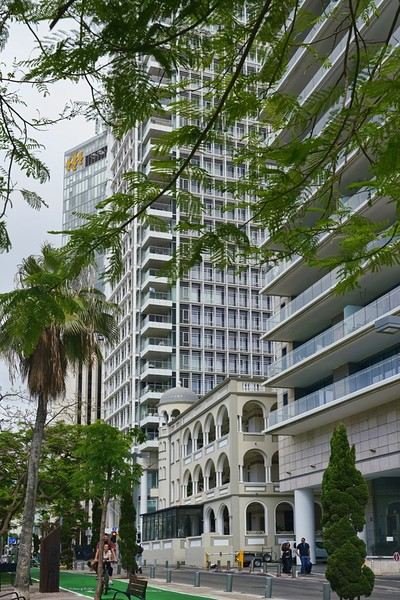
This policy keeps the streets looking more human-scale than the usual high-rise districts in modern cities.
 With the visit to Jaffa, Patrick introduces us to a fascinating slice of history, despite the temperature nearing 38°C. Jaffa, once an independent city, is now a neighborhood of Tel Aviv—a predominantly Muslim area. We notice a few buildings in poor condition. They belong to Palestinian families who left Tel Aviv. Otherwise, the city has been very well restored, apart from these few buildings.
A government agency rents out the ground floors of these buildings, which helps fund part of the security work. They also try to track down the owners and buy back the abandoned properties, but some refuse to sell. The visit is very touristy—most of the people we meet are tourists like us.


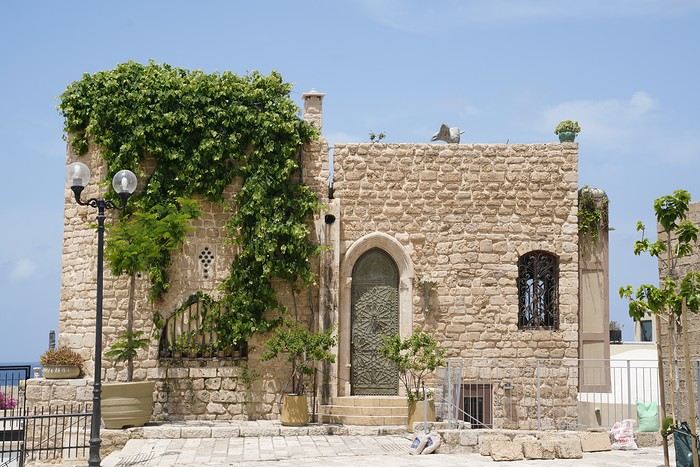
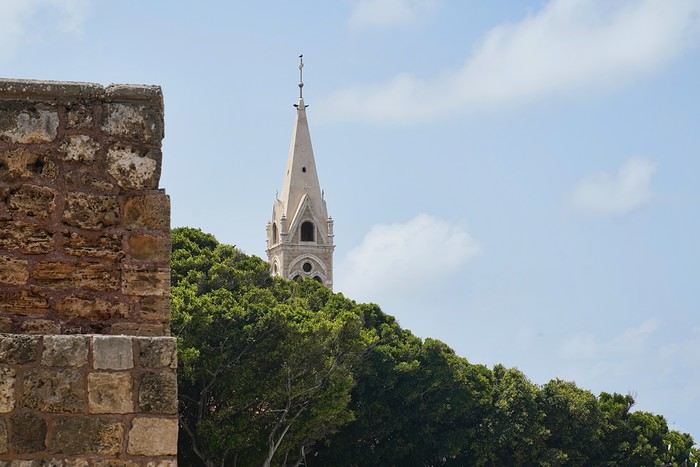
There’s very little local life, except in the lower part of the city. To be continued, as I’ve reached the allowed photo limit.
The next morning, we go down for breakfast at 7:30 AM—a late hour, but the setup is slow, with the two servers taking their time. We ask the bartender for a long coffee and a black tea... It must be a complicated order because it takes him over 10 minutes to make it. He serves us with the grace of a dancer. A good breakfast if you’re not in a hurry, followed by a little stroll in the neighborhood, since our meet-up with Patrick Arfi, our guide for the day, isn’t until 10 AM. P. Arfi is a former publishing house director in Paris who has lived in Israel for a long time and has a vast cultural knowledge. After an initial chat, we head toward Jaffa, focusing on the Bauhaus buildings preserved by a clever urban policy that allows high-rise construction while maintaining old architectural ensembles.
This policy keeps the streets looking more human-scale than the usual high-rise districts in modern cities.
With the visit to Jaffa, Patrick introduces us to a fascinating slice of history, despite the temperature nearing 38°C. Jaffa, once an independent city, is now a neighborhood of Tel Aviv—a predominantly Muslim area. We notice a few buildings in poor condition. They belong to Palestinian families who left Tel Aviv. Otherwise, the city has been very well restored, apart from these few buildings.
A government agency rents out the ground floors of these buildings, which helps fund part of the security work. They also try to track down the owners and buy back the abandoned properties, but some refuse to sell. The visit is very touristy—most of the people we meet are tourists like us.
There’s very little local life, except in the lower part of the city. To be continued, as I’ve reached the allowed photo limit.
The rule of the three unities
"In one place, in one day, a single deed accomplished,
May hold the theater filled until the end."
- Sunday morning, a chilly dawn - The kitchen - Smell of coffee and toast, a jar of honey on the table.
- Tits pecking at sunflower seeds in the transparent feeder stuck to the window.
- France Musique on the radio: Brahms, violin concerto by the lovely Hilary Hahn - Characters: - An old man in a plush dark blue dressing gown - An old woman in a worn-out duck-blue dressing gown. They dance cheek to cheek, the woman’s head resting on the old man’s broad chest. The old man breathes in the tangled hair of the lady. She smiles. Happy. Tomorrow, they’re off on a trip.
Family Road Trip: San Francisco - Portland - San Francisco
Hi there,
We’re planning a family road trip (kids aged 10 and 15) over 23 days between San Francisco and Portland (Northern California and Oregon). It’ll be a loop. We want to take our time with hikes but also enjoy the cities to relax a bit (Portland / SF).
Here’s our itinerary—I’d love your thoughts on the places we’ve picked, suggestions for stops along the way, and whether this route is doable given the distances (especially Tahoe Lake to Crater Lake and Crater Lake to Portland):
Day 1: Arrive in San Francisco midday, head to Yosemite (3 nights). Day 1/2: Yosemite Valley / Glacier Point, etc. Day 3: Tioga Road with a stop at Mono Lake (1 night in Bridgeport). Day 4: Bodie in the morning, then drive to North Lake Tahoe (2 nights in North Lake Tahoe). Day 5: Lake Tahoe. Day 6: Long drive to Crater Lake via Burney Falls? (2 nights in Fort Klamath). Day 7: Crater Lake. Day 8: Drive to Portland via Bend (4 nights in Portland). Days 9–11: Portland + Columbia Gorge. Day 12: Portland to Newport via Highway 101: Cannon Beach/Tillamook (1 night in Newport). Day 13: Newport to Golden Beach via Florence/Oregon Dunes (1 night in Golden Beach). Day 14: Drive to Jedediah Smith Redwood State Park (3 nights near Crescent City). Days 15–16: Redwood National Park (Fern Canyon / Avenue of the Giants, etc.). Day 17: Drive along the coast via Eureka / Fort Bragg (1 night in Willits). Day 18: Drive to San Francisco via Napa Valley (5 nights in SF). Days 19–22: San Francisco. Day 23: Departure.
Everything’s booked but still flexible, so I can adjust if needed.
Thanks in advance!
Slow Travel or the Illusion of Authenticity
“Slow travel” is a concept that some tout as a philosophical revolution in travel. But on closer inspection, it’s nothing more than a marketing repackaging of an age-old practice.
This term is wrapped in an aura of intellectualism. It promises to reinvent the experience of travel by valuing slowness, contemplation, and cultural immersion.
The term “slow travel” claims to bring depth to travel, but it often relies on clichés.
Taking your time, meeting locals, avoiding quick visits—these practices have always existed and are nothing revolutionary.
Before the era of airplanes, high-speed trains, and express stays, traveling necessarily meant taking your time. Pilgrims, merchants, and explorers already practiced a form of “slow travel,” without hashtags or self-proclaimed spiritual guides.
Crossing lands on foot or by horse required total immersion in the landscapes, cultures, and unpredictability of the journey. Yet, no one attributed philosophical intentions to them: it was a necessity.
Slow travel, in its current version, may be less a philosophy than a reflection of the contradictions of an affluent class searching for meaning in a world they help overload.
So-called “slow” travel is presented as a privileged way to understand a culture, but this claim is debatable. A region never represents an entire country.
Immersing yourself in a community doesn’t guarantee a complete or more authentic understanding than any other way of traveling.
Slowness in itself doesn’t guarantee depth or ethics. You can immerse yourself in a place over a weekend, just as you can spend months in a country without grasping its subtleties.
By positioning itself as an antidote to “fast” tourism, slow travel fetishizes a temporality that only makes sense if it’s accompanied by real openness and an effort to integrate.
But this over-intellectualization often masks a desire to belong to a trend or a need to stand out socially.
Behind this posture sometimes lies a whim: the urge to reinvent one’s life elsewhere in an idealized form. But this quest for elsewhere remains fundamentally a way to escape or respond to unease, rather than a true commitment to the cultures visited.
When we talk about “encounters” while traveling, we often forget that these exchanges are facilitated by biased contexts. As a traveler, you’re seen as a temporary visitor, unattached, and that changes the dynamic.
Locals, whether curious or used to tourists, adopt a different stance than they would with a neighbor they see daily.
This interaction is also tinged with asymmetry: the traveler has the luxury of time and availability, while in daily life, personal concerns often take precedence over the desire to connect.
The flip side is that the openness displayed while traveling is often a facade. We boast about chatting with a fisherman or sharing a meal with a local family, but how many of these encounters lead to a real understanding of cultural differences or sincere reflection?
Once home, these moments become anecdotes, social trophies to show off, without fundamentally changing our relationship with others in our daily lives.
By imposing a definition, we push people to adapt their practices to fit an idealized model. This can lead to a paradoxical standardization: “slow travel” becomes a checklist of behaviors (meetings, immersion, slowness).
The “bobos” (bourgeois-bohemians), often in search of meaning in a world saturated with options, believe that giving a name to a practice grants it legitimacy or moral value. But this obsession with framing and theorizing travel only drains it of its spontaneity.
Someone who grew up at the crossroads of multiple cultures, on the other hand, doesn’t feel this need. For them, traveling isn’t a philosophical project but an intrinsic part of their life.
The very concept of “slow travel” can seem absurd: why glorify what’s simply natural?
Why try to turn into an ideology what should be a personal, intimate experience, free from semantic constraints?
Ultimately, this need for labeling, this frantic quest to name every gesture, reveals a society craving simplicity.
Travel, in its purest form, doesn’t need justification or slogans. It doesn’t need slowness or speed: it’s simply lived.
Perhaps the real challenge is to unlearn this Western habit of conceptualizing everything that should simply be felt.
For many, travel is a parenthesis, a temporary break from daily life. But if we reject this distinction between “home” and “elsewhere,” every human life becomes a continuous journey through varied environments.
From this perspective, “slow travel” loses all meaning, because living somewhere—whether for a week or five years—is part of the same experience of adaptation.
So, we ask the fans of marketing slogans: is travel a parenthesis or a journey?
“Slow travel” is often driven by a Western eco-bobo ideology, tinged with post-colonial guilt. This discourse promotes a supposedly virtuous way of traveling while forgetting that these practices remain a privilege.
Far from deconstructing power dynamics, it sometimes reinforces them by glorifying a different kind of consumption, still centered on comfort.
There’s also a condescending side to this rhetoric. By idealizing slowness, slow travel advocates imply that those who travel quickly or on a budget are less “authentic” in their approach.
Yet, isn’t that a form of contempt? Do those who leave for a well-deserved week after months of hard work deserve less consideration?
Concepts like “slow travel” or “sustainable tourism” seem hollow when reduced to marketing slogans or standardized behaviors. They confine travel to preconceived frameworks, stripping it of its spontaneous and unpredictable dimension.
Instead of categorizing, it would be more relevant to recognize the plurality of human experiences without trying to define them.
Slow travel doesn’t invent anything. It simply puts into words—and often slogans—what travel has always been for those who practice it with intention.
Maybe we should stop trying to theorize every movement and simply rediscover travel for what it is: a human experience, sometimes slow, sometimes fast, but always personal.
More info on our site
From Caño Cristales to Tayrona Park
After about 12 hours of flying from Toulouse (via Paris), we landed in Bogotá six years after our first trip to Colombia. This time, our journey will be very different, with only this stop in the Colombian capital in common.
Our travel itinerary
Bogotá / La Macarena (Caño Cristales) / Villa de Leyva / Barichara / San Gil / Girón / Mompox / Ciénaga and the Santa Marta lagoon / Minca / Los Naranjos (Tayrona Park) / Bogotá.
Step 1: Bogotá (and Nemecon)
Bogotá (1/3)
This morning, we had a meet-up with Flora from Aventure Colombia, who helped me organize one of our stops, a few transfers, and tomorrow’s day trip, the program of which I changed at the last minute after deciding to skip the visit to the Salt Cathedral of Zipaquirá. Flora is a kind and lovely person, always available, and she did everything to answer my questions and give me advice.
She’s a local contact I highly recommend. Flora can help you plan your trip, whether you want a fully organized tour or, like us, just need assistance with a specific stop or one or more transfers between cities.
We left Flora after setting a meet-up for our return to Bogotá in a month. As we walked out of her agency, we headed to the wonderful Gold Museum, located just a hundred meters away. I was excited to revisit this amazing museum.
Note: Free entry for those over 60, regardless of nationality. Just show your passport.
Like six years ago, I was amazed by its museography, the beauty of the pieces on display, and that breathtaking shamanic room.
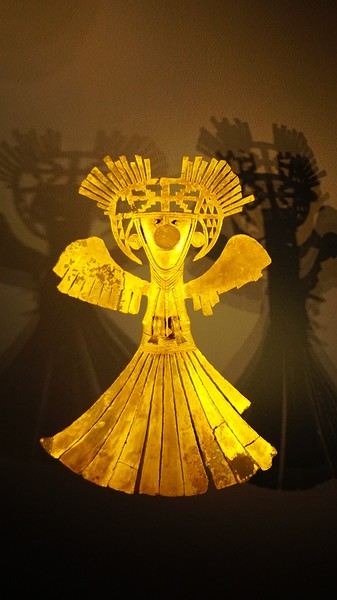
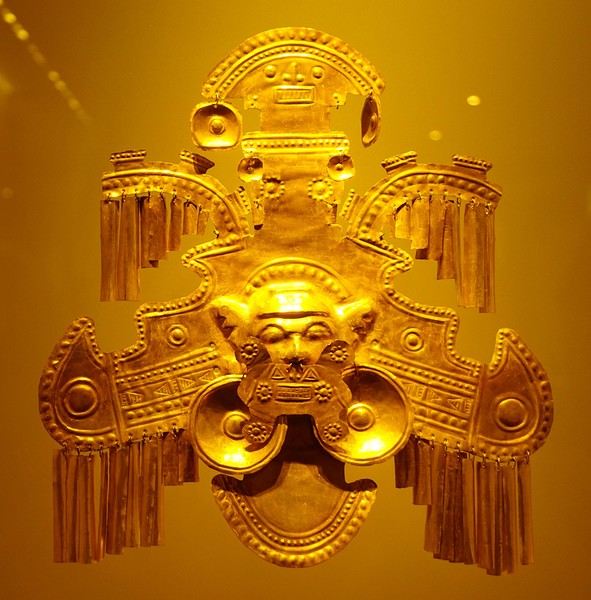
About two hours later, we decided to walk (careful, it’s a climb!) to the Monserrate cable car (3152m). Long wait to buy tickets and board the cable car! Once we arrived, a few raindrops, an impressive panoramic view of Bogotá’s vastness, a quick visit to the basilica (a pilgrimage site for Colombians), a walk through the tourist market, and at the top, plenty of small restaurants where we had our first Colombian meal. After our hearty lunch, we were lucky to see the sun return! No line for the descent. We then headed back to the hotel because Justine wanted to rest and recover from the trip. As for me, I continued my walk. I discovered a really nice craft market recommended by Flora, Pasaje Rivas, returned to Bolívar Square, and wandered through different streets, including the main pedestrian avenue (Calle 7), where there’s always something to see.
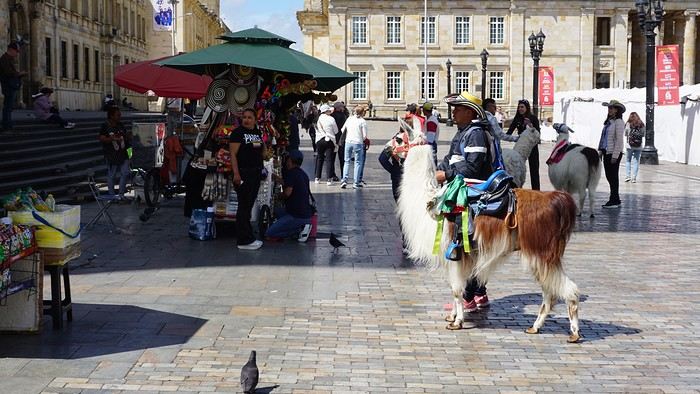
Tomorrow, a change of scenery as we head out for a hike in a small desert (Desierto de Chueca), located about 2 hours from Bogotá in the village of Nemecon. For this outing from Bogotá, with Flora’s help, we booked a car with a driver for the day. Flora also took care of booking the guide (since the site can only be visited with one). Nemecon (2/3) Today, we went to Nemecon to hike about 7.5 km in the ‘Desert of Checua.’ It’s nothing like sandy deserts! Instead, it’s geological formations sculpted by time, wind, and water. After two hours on the road—almost one of them spent navigating traffic jams with cars, trucks, buses, and a continuous flow of motorcycles on either side of our taxi—we reached Nemecon! The village center is really (too?) quiet. We met up with Deisy and headed toward the ‘desert,’ about twenty minutes away on a bumpy dirt road. Once there, a quick briefing, and off we went! Deisy didn’t stop talking (in Spanish) for over 3 hours!!! She told us so much about her region (flower farming, water management, traditions, songs, etc.), the origin of the site, and even mentioned Antonio Banderas, who filmed *The 33* in the village’s salt mine (the story of the survival of 33 Chilean miners after a collapse in their copper and gold mine). One hour of walking to reach the site, one hour to explore it, and one hour to return.
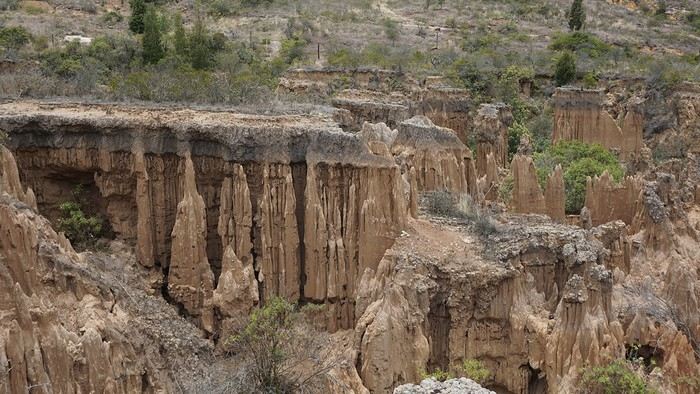
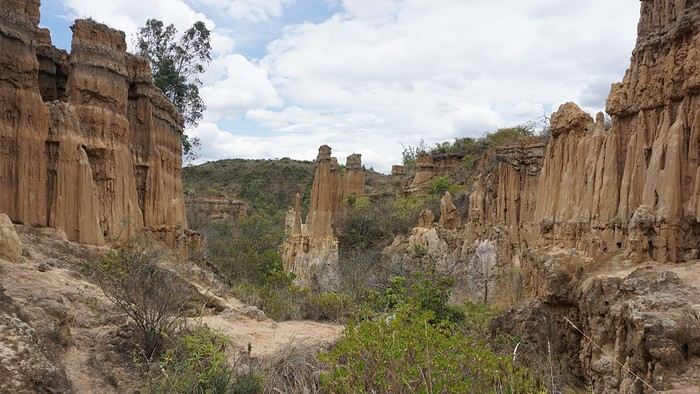
The advantage of this non-stop chatter was that it forced us to brush up on our Spanish at lightning speed. I even wondered if the effort to concentrate wasn’t more exhausting than the physical effort! Especially since on the way back, I got an oral quiz. Deisy wanted to make sure I remembered some of the information she’d given me during the visit: why is this rock white, that one red, and that one black? Back in the village, we had lunch at a restaurant recommended by Deisy before visiting the Nemecon salt mine. Before entering, a guide spent a good half-hour explaining the origin of the salt and the presence of many fossils in the area. Again, concentrating was tough because all the comments were exclusively in Spanish! An hour and a half wandering through the tunnels with a ‘lovely miner’s helmet’ on our heads!
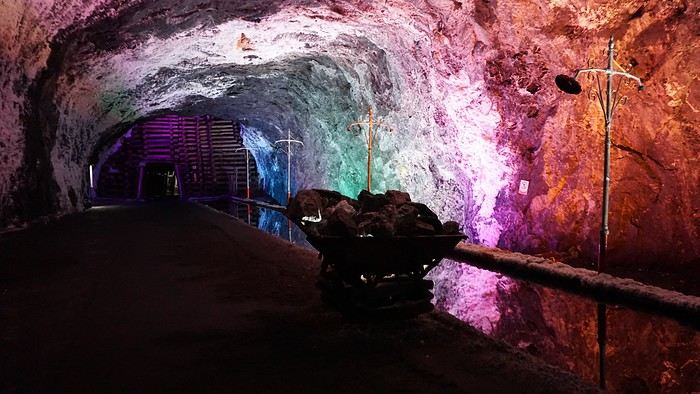
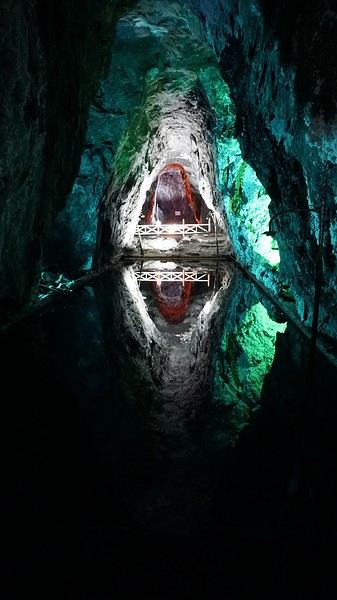
We met our driver at the mine entrance. The return to Bogotá was a bit faster, but traffic in the city center was still heavy! We arrived in front of our hotel between 8:00 and 8:30 PM. It’s been a pretty intense start to the trip! Tonight, our legs are tired. Hopefully, tomorrow will be a bit more relaxed! Bogotá (3/3) We started the day by visiting the Santa Clara Church Museum, located next to the presidential palace. Alejandra (from the local agency ‘Gaia Tours Colombia,’ which organized our stay in Caño Cristales (La Macarena)) had recommended this visit for its rich mural paintings.
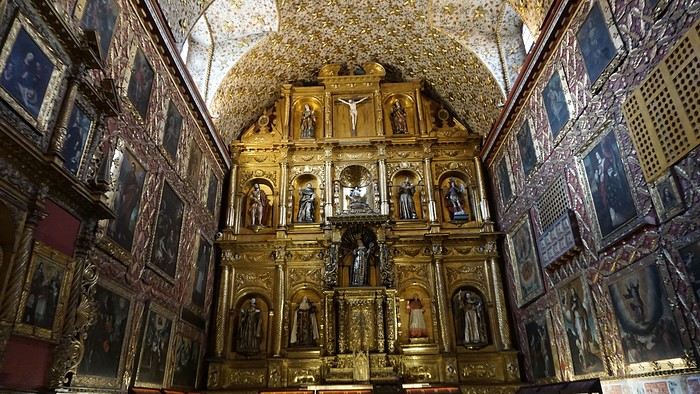
A few hundred meters further, after crossing the Plaza Mayor again, we visited the cultural complex housing the Botero Museum, the Mint Museum, and the Bank of the Republic Art Museum. Note that entry is free for all three museums. Botero Museum: There are fewer works by Botero here than in the Medellín museum, but more paintings and sculptures by other artists, all from Botero’s private collection (donated to Colombia). Mint Museum: We limited ourselves to visiting one room (on Flora’s advice) where three gold and gemstone monstrances and a Christ with a crown of emerald thorns are displayed. Photos are not allowed. Art Museum: We visited two temporary exhibitions. Lunchtime came quickly. We had a good meal at a reasonably priced small restaurant in the La Candelaria micro-district, near the Chorro de Quevedo square. We decided to spend the afternoon wandering the streets and alleys of the historic center to discover local street art.
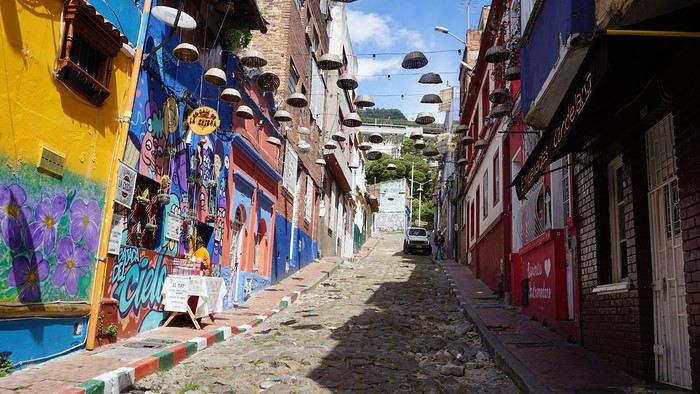
We also passed through very lively pedestrian streets. I also decided to revisit Pasaje Rivas to show Justine all the shops selling more or less artisanal products. Tomorrow morning, we fly to La Macarena at 10:30 AM. Not to dance (you’d be surprised if I told you we were going to take a South American dance class, right?!), but to visit the fabulous Caño Cristales, a river naturally colored by aquatic plants. The planned program includes hiking, horseback riding, canoeing, and swimming among these plants. This site was long inaccessible because the area was controlled by the FARC. Access and tourism development became possible after agreements and amnesty measures between the Colombian government and paramilitary groups. As in other regions, former FARC members have been able to transition into various tourism-related activities.
About two hours later, we decided to walk (careful, it’s a climb!) to the Monserrate cable car (3152m). Long wait to buy tickets and board the cable car! Once we arrived, a few raindrops, an impressive panoramic view of Bogotá’s vastness, a quick visit to the basilica (a pilgrimage site for Colombians), a walk through the tourist market, and at the top, plenty of small restaurants where we had our first Colombian meal. After our hearty lunch, we were lucky to see the sun return! No line for the descent. We then headed back to the hotel because Justine wanted to rest and recover from the trip. As for me, I continued my walk. I discovered a really nice craft market recommended by Flora, Pasaje Rivas, returned to Bolívar Square, and wandered through different streets, including the main pedestrian avenue (Calle 7), where there’s always something to see.
Tomorrow, a change of scenery as we head out for a hike in a small desert (Desierto de Chueca), located about 2 hours from Bogotá in the village of Nemecon. For this outing from Bogotá, with Flora’s help, we booked a car with a driver for the day. Flora also took care of booking the guide (since the site can only be visited with one). Nemecon (2/3) Today, we went to Nemecon to hike about 7.5 km in the ‘Desert of Checua.’ It’s nothing like sandy deserts! Instead, it’s geological formations sculpted by time, wind, and water. After two hours on the road—almost one of them spent navigating traffic jams with cars, trucks, buses, and a continuous flow of motorcycles on either side of our taxi—we reached Nemecon! The village center is really (too?) quiet. We met up with Deisy and headed toward the ‘desert,’ about twenty minutes away on a bumpy dirt road. Once there, a quick briefing, and off we went! Deisy didn’t stop talking (in Spanish) for over 3 hours!!! She told us so much about her region (flower farming, water management, traditions, songs, etc.), the origin of the site, and even mentioned Antonio Banderas, who filmed *The 33* in the village’s salt mine (the story of the survival of 33 Chilean miners after a collapse in their copper and gold mine). One hour of walking to reach the site, one hour to explore it, and one hour to return.
The advantage of this non-stop chatter was that it forced us to brush up on our Spanish at lightning speed. I even wondered if the effort to concentrate wasn’t more exhausting than the physical effort! Especially since on the way back, I got an oral quiz. Deisy wanted to make sure I remembered some of the information she’d given me during the visit: why is this rock white, that one red, and that one black? Back in the village, we had lunch at a restaurant recommended by Deisy before visiting the Nemecon salt mine. Before entering, a guide spent a good half-hour explaining the origin of the salt and the presence of many fossils in the area. Again, concentrating was tough because all the comments were exclusively in Spanish! An hour and a half wandering through the tunnels with a ‘lovely miner’s helmet’ on our heads!
We met our driver at the mine entrance. The return to Bogotá was a bit faster, but traffic in the city center was still heavy! We arrived in front of our hotel between 8:00 and 8:30 PM. It’s been a pretty intense start to the trip! Tonight, our legs are tired. Hopefully, tomorrow will be a bit more relaxed! Bogotá (3/3) We started the day by visiting the Santa Clara Church Museum, located next to the presidential palace. Alejandra (from the local agency ‘Gaia Tours Colombia,’ which organized our stay in Caño Cristales (La Macarena)) had recommended this visit for its rich mural paintings.
A few hundred meters further, after crossing the Plaza Mayor again, we visited the cultural complex housing the Botero Museum, the Mint Museum, and the Bank of the Republic Art Museum. Note that entry is free for all three museums. Botero Museum: There are fewer works by Botero here than in the Medellín museum, but more paintings and sculptures by other artists, all from Botero’s private collection (donated to Colombia). Mint Museum: We limited ourselves to visiting one room (on Flora’s advice) where three gold and gemstone monstrances and a Christ with a crown of emerald thorns are displayed. Photos are not allowed. Art Museum: We visited two temporary exhibitions. Lunchtime came quickly. We had a good meal at a reasonably priced small restaurant in the La Candelaria micro-district, near the Chorro de Quevedo square. We decided to spend the afternoon wandering the streets and alleys of the historic center to discover local street art.
We also passed through very lively pedestrian streets. I also decided to revisit Pasaje Rivas to show Justine all the shops selling more or less artisanal products. Tomorrow morning, we fly to La Macarena at 10:30 AM. Not to dance (you’d be surprised if I told you we were going to take a South American dance class, right?!), but to visit the fabulous Caño Cristales, a river naturally colored by aquatic plants. The planned program includes hiking, horseback riding, canoeing, and swimming among these plants. This site was long inaccessible because the area was controlled by the FARC. Access and tourism development became possible after agreements and amnesty measures between the Colombian government and paramilitary groups. As in other regions, former FARC members have been able to transition into various tourism-related activities.