Results for "Turkish+|+55"
2110 results found.
Billets d'avions pour l'Asie Centrale et achat aller simple sur l'Ouzbekistan English translation pending
Bonjour
Petite question pour ceux qui ont voyagé longue durée en Asie Centrale. Comment peut-on acheter un aller simple sur l'Ouzbékistan. je viens en effet d'aller voir l'agence APM à Paris qui me répond que ce n'est pas possible or je ne compte pas rester en Ouzbékistan mais passer au Kaz, en Chine au népal et finir en Inde.
Si vous avez fait ce genre de voyage comment vous êtes vous débrouillés pour les billets d'avion (je compte rentrer de Dehli ...). Avez-vous été obligé de prendre un AR?
Merci de votre aide
Petite question pour ceux qui ont voyagé longue durée en Asie Centrale. Comment peut-on acheter un aller simple sur l'Ouzbékistan. je viens en effet d'aller voir l'agence APM à Paris qui me répond que ce n'est pas possible or je ne compte pas rester en Ouzbékistan mais passer au Kaz, en Chine au népal et finir en Inde.
Si vous avez fait ce genre de voyage comment vous êtes vous débrouillés pour les billets d'avion (je compte rentrer de Dehli ...). Avez-vous été obligé de prendre un AR?
Merci de votre aide
Partir en Thaïlande avec Uzbekistan Airlines English translation pending
je dois partir rapidement pour bangkok et le seul billet abordable est d'uzbekistan airlines je cherche desesperement des infos sur la compagnie ???!!!
merci d'avance
Inde: trek au Ladakh English translation pending
Bonjour tout le monde,
Je pars au Ladakh fin août et je me pose plusieurs questions ?
1. Pouvez-vous me dire s'il est facile de faire plusieurs petits trek de 2 ou 3 jours en individuel (2 personnes). Est-ce prudent ? J'ai pour l'instant fait 1 seul trek, celui de Jomsom au Népal (10 jours) en décembre. Peut-on se débrouiller avec une carte ?
2. Faut-il emmener sa propre tente ou plutôt la louer là-bas ?
3. Louer une moto dans les environs de Leh, est-ce faisable et à quel prix ?
4. Vaut-il mieux prendre l'avion à l'aller et les bus au retour, ou inversement ?
5. Je pars avec Turkish Airlines. Y-a-t-il quelque chose à dire sur cette compagnie ?
Mes autres questions arriverons plus tard.
Merci d'avance, Gilles
Je pars au Ladakh fin août et je me pose plusieurs questions ?
1. Pouvez-vous me dire s'il est facile de faire plusieurs petits trek de 2 ou 3 jours en individuel (2 personnes). Est-ce prudent ? J'ai pour l'instant fait 1 seul trek, celui de Jomsom au Népal (10 jours) en décembre. Peut-on se débrouiller avec une carte ?
2. Faut-il emmener sa propre tente ou plutôt la louer là-bas ?
3. Louer une moto dans les environs de Leh, est-ce faisable et à quel prix ?
4. Vaut-il mieux prendre l'avion à l'aller et les bus au retour, ou inversement ?
5. Je pars avec Turkish Airlines. Y-a-t-il quelque chose à dire sur cette compagnie ?
Mes autres questions arriverons plus tard.
Merci d'avance, Gilles
Compagnies aériennes à risque? English translation pending
Bonjour à tous,
Connaissez vous le nom des compagnies aeriennes qu'il faut éviter ?
Ou, avez vous des adresses de sites internet qui informent à ce sujet ?
On me propose un vol Paris Los Angeles avec "Air Lingus" interressant mais je ne connais pas du tout cette compagnie et ça m'inquiète un peu ... Avez vous voyagé avec cette compagnie, la connaissez vous?, est est elle de confiance ?
Merci beaucoup pour les réponses que vous pourrez m'apporter et BONNE ANNEE 2005, Pleines de découvertes, A TOUS !
Angela
Connaissez vous le nom des compagnies aeriennes qu'il faut éviter ?
Ou, avez vous des adresses de sites internet qui informent à ce sujet ?
On me propose un vol Paris Los Angeles avec "Air Lingus" interressant mais je ne connais pas du tout cette compagnie et ça m'inquiète un peu ... Avez vous voyagé avec cette compagnie, la connaissez vous?, est est elle de confiance ?
Merci beaucoup pour les réponses que vous pourrez m'apporter et BONNE ANNEE 2005, Pleines de découvertes, A TOUS !
Angela
Acheter un caique turque English translation pending
bonjour a tous,
j ai un rêve concernant les caiques turques... je souhaite en trouver un et le ramener ici à Nice. est ce que quelqu un a des renseignements à ce sujet là ?? lieu de vente, occasions, entendu parler de ...
merci d avance
natali
j ai un rêve concernant les caiques turques... je souhaite en trouver un et le ramener ici à Nice. est ce que quelqu un a des renseignements à ce sujet là ?? lieu de vente, occasions, entendu parler de ...
merci d avance
natali
Vols Paris-Tashkent (Ouzbékistan) English translation pending
Bonjour,
Où avez vous acheté votre billet d'avion Paris-Tashkent ? Quelle compagnie et quel prix ?
Merci d'avance
Où avez vous acheté votre billet d'avion Paris-Tashkent ? Quelle compagnie et quel prix ?
Merci d'avance
Horaires de bus Istanbul English translation pending
Bonjour
qui pourrait me renseigner sur les horaires et les compagnies de bus pour faire Istanbul-Antakya.
J'ai déjà cherché sur les sites des grandes compagnies comme Varan, Ulusoy etc. mais je n'ai rien trouvé. Y a-t-il des bus pour cette destination en fin de journée ?
Merci de votre aide
Mudem
qui pourrait me renseigner sur les horaires et les compagnies de bus pour faire Istanbul-Antakya.
J'ai déjà cherché sur les sites des grandes compagnies comme Varan, Ulusoy etc. mais je n'ai rien trouvé. Y a-t-il des bus pour cette destination en fin de journée ?
Merci de votre aide
Mudem
Conseils sur hôtels en Cappadoce (Turquie) et sur le nord de Chypre English translation pending
Quelqu'un est-il allé en chypre du nord (République Turque de Chypre du Nord) ? Nous souhaitons intégrer cette destination dans le cadre d'un voyage de 3 semaines en Turquie au mois d'août. Le problème c'est que personne ne commercialise çà.
Par ailleurs, toujours dans ce même cadre, nous aimerions passer quelques jours en Cappadoce. On a vu pas mal d'hôtels sympas du style "Museum Hotel" qui ont l'air de bien s'intégrer au paysage. Quels hôtels dans ce style peuvent valoir le coup dans cette zone géographique ?
Merci !
Par ailleurs, toujours dans ce même cadre, nous aimerions passer quelques jours en Cappadoce. On a vu pas mal d'hôtels sympas du style "Museum Hotel" qui ont l'air de bien s'intégrer au paysage. Quels hôtels dans ce style peuvent valoir le coup dans cette zone géographique ?
Merci !
Transports Grèce-Turquie? English translation pending
Salut,
Pdt mes deux semaines de vacances mi mars, nous projetons d'atterrir a Athenes ...et de repartir de Istanbul.
J'aimerai des infos sur les meilleurs moyens de transport et les coins sympas pour s'arreter (Meteores, thrace grecque et Turc). A priori, nous voudrions faire du train entre Athenes - Salonique - Istanbul en s'arretant en route.
Merci de vos conseils 🙂
Pdt mes deux semaines de vacances mi mars, nous projetons d'atterrir a Athenes ...et de repartir de Istanbul.
J'aimerai des infos sur les meilleurs moyens de transport et les coins sympas pour s'arreter (Meteores, thrace grecque et Turc). A priori, nous voudrions faire du train entre Athenes - Salonique - Istanbul en s'arretant en route.
Merci de vos conseils 🙂
3 semaines en Ouzbékistan English translation pending
Je souhaite préparer un voyage d'environ 3 semaines en Ouzbékistan pour l'année prochaine. C'est vrai que je m'y prends tôt, mais j'aime bien glaner le maximun d'infos. Qui a visité ce pays récemment? Est-ce facile de se déplacer? Quel budget faut-il prévoir? Quelles sont les formalités pour le visa? On me dit qu'il n'y a plus besoin du voucher d'invitation... Quelle compagnie aérienne offre le meilleur prix? les agences de voyages ne sont pas au top pour ce genre de destination en vol sec et me proposent que des vols galères avec de multiples changements ou alors à des prix inabordables. Merci pour toutes les infos que vous voudrez bien me communiquer
Summer 2027 - Uzbekistan/Kyrgyzstan Family Trip (19 Nights)
Hello,
Summer 2026 hasn’t even arrived yet, and I’m already thinking about summer 2027! We’re a family with two kids, who will be 9.5 and 4.5 years old next summer (turning 5 at the end of October 2027, actually). We’d love to spend 19 nights in Uzbekistan and Kyrgyzstan—a part of the world that’s completely new to us. We enjoy traveling, do it often, and the kids are used to it (though we still need a bit of organization and comfort!). Here’s the rough outline of our itinerary: Day 1 - Arrival in Tashkent (ideally in the late afternoon). Head to the train station (by taxi?) to take the overnight sleeper train to Urgench (1 night). Day 2 - Khiva (2 nights): Taxi transfer from the station to the city. Visit Itchan Kala, the walls, and sunset. Day 4 - Head to Bukhara (3 nights) by train (about 6 hours). Visit the historic center, domes, and workshops. Day 7 - On to Samarkand (2 nights), but this time with a private driver. Visit Registan, the necropolis, and local crafts. Day 9 - Head to Osh (1 night) in Kyrgyzstan with the private driver, who’ll drop us at the border. Long transition day (including border crossing). If it’s not too late, visit Osh’s market (otherwise, the next morning). Day 10 - Pick up our rental car (4x4 without a driver this time) and drive to Toktogul (2 nights) and the Suusamyr Valley. Day 12 - Head to the Kochkor region (350 km - 4 nights): Tash Rabat, Song-Kul Lake (yurt stay), and Aigliers. Day 16 - Depart for Karakol/Issyk-Kul (250 km - 4 nights): Jeti-Oguz, Altyn Arashan, beaches, and hot springs. Day 20: Fly home. TOTAL = 19 nights What do you think? Budget-wise:
Flight tickets: 3000 € Uzbekistan logistics (accommodation ideally with a pool for the kids and vehicle): 1600 € Kyrgyzstan logistics (accommodation and 4x4 vehicle like a Pajero/Land Cruiser): 1600 € Living & food: 800 € TOTAL: 7000 €
Does this seem reasonable? Not overestimated or underestimated? Thanks for any feedback or tips from your own experiences.
Summer 2026 hasn’t even arrived yet, and I’m already thinking about summer 2027! We’re a family with two kids, who will be 9.5 and 4.5 years old next summer (turning 5 at the end of October 2027, actually). We’d love to spend 19 nights in Uzbekistan and Kyrgyzstan—a part of the world that’s completely new to us. We enjoy traveling, do it often, and the kids are used to it (though we still need a bit of organization and comfort!). Here’s the rough outline of our itinerary: Day 1 - Arrival in Tashkent (ideally in the late afternoon). Head to the train station (by taxi?) to take the overnight sleeper train to Urgench (1 night). Day 2 - Khiva (2 nights): Taxi transfer from the station to the city. Visit Itchan Kala, the walls, and sunset. Day 4 - Head to Bukhara (3 nights) by train (about 6 hours). Visit the historic center, domes, and workshops. Day 7 - On to Samarkand (2 nights), but this time with a private driver. Visit Registan, the necropolis, and local crafts. Day 9 - Head to Osh (1 night) in Kyrgyzstan with the private driver, who’ll drop us at the border. Long transition day (including border crossing). If it’s not too late, visit Osh’s market (otherwise, the next morning). Day 10 - Pick up our rental car (4x4 without a driver this time) and drive to Toktogul (2 nights) and the Suusamyr Valley. Day 12 - Head to the Kochkor region (350 km - 4 nights): Tash Rabat, Song-Kul Lake (yurt stay), and Aigliers. Day 16 - Depart for Karakol/Issyk-Kul (250 km - 4 nights): Jeti-Oguz, Altyn Arashan, beaches, and hot springs. Day 20: Fly home. TOTAL = 19 nights What do you think? Budget-wise:
Flight tickets: 3000 € Uzbekistan logistics (accommodation ideally with a pool for the kids and vehicle): 1600 € Kyrgyzstan logistics (accommodation and 4x4 vehicle like a Pajero/Land Cruiser): 1600 € Living & food: 800 € TOTAL: 7000 €
Does this seem reasonable? Not overestimated or underestimated? Thanks for any feedback or tips from your own experiences.
One-Month Itinerary in September (Amsterdam, Tanzania/Zanzibar, Istanbul) - Budget Optimization
Hi everyone!
I’m planning my dream trip for next September, lasting about a month. Here’s my itinerary:
Amsterdam: 3 days (departing from Montreal) Tanzania: 3-day safari Zanzibar: 6 days Istanbul: 7 days Return to Montreal.
Since my budget is pretty tight, I’m looking for tips and advice to cut costs without sacrificing the experience. Here are my questions:
Multi-destination flights: What’s the best way to book these connections? Is it better to buy a one-way ticket from Montreal to Amsterdam, then a separate internal flight, or use comparison tools for a multi-destination ticket? Budget safari: Do you have recommendations for local agencies or tips to do a 3-day safari (Serengeti/Ngorongoro) at an affordable price (e.g., camping/glamping instead of luxury lodges)? Accommodation in Zanzibar: Which villages or types of lodging are the most budget-friendly and accessible via local transport for these 6 days? Istanbul: Any tips for well-located but cheap accommodation and great food deals?
Amsterdam: 3 days (departing from Montreal) Tanzania: 3-day safari Zanzibar: 6 days Istanbul: 7 days Return to Montreal.
Since my budget is pretty tight, I’m looking for tips and advice to cut costs without sacrificing the experience. Here are my questions:
Multi-destination flights: What’s the best way to book these connections? Is it better to buy a one-way ticket from Montreal to Amsterdam, then a separate internal flight, or use comparison tools for a multi-destination ticket? Budget safari: Do you have recommendations for local agencies or tips to do a 3-day safari (Serengeti/Ngorongoro) at an affordable price (e.g., camping/glamping instead of luxury lodges)? Accommodation in Zanzibar: Which villages or types of lodging are the most budget-friendly and accessible via local transport for these 6 days? Istanbul: Any tips for well-located but cheap accommodation and great food deals?
TUI/New Frontiers Airlines
Hello,
I’m really surprised because in TUI’s new tour packages, the airlines they’re using are of low quality. Before, they used to prioritize major airlines, but now it’s small airlines from small countries—companies with terrible ratings and borderline safety concerns. I even just noticed this note for a Tanzania trip: "We inform you that the domestic flight segment in Tanzania included in your trip is operated by an airline listed on the European Union’s list of air carriers subject to an operating ban within the European Union. This ban only applies to European Union airspace, meaning this airline is not permitted to take off, land, or fly over European airspace. However, this airline is authorized to operate in Tanzania."
This means they’re using airlines on the blacklist!! It’s pretty worrying for safety. What do you all think?
I’m really surprised because in TUI’s new tour packages, the airlines they’re using are of low quality. Before, they used to prioritize major airlines, but now it’s small airlines from small countries—companies with terrible ratings and borderline safety concerns. I even just noticed this note for a Tanzania trip: "We inform you that the domestic flight segment in Tanzania included in your trip is operated by an airline listed on the European Union’s list of air carriers subject to an operating ban within the European Union. This ban only applies to European Union airspace, meaning this airline is not permitted to take off, land, or fly over European airspace. However, this airline is authorized to operate in Tanzania."
This means they’re using airlines on the blacklist!! It’s pretty worrying for safety. What do you all think?
Gran Canaria... a trip that wasn't exactly thrilling
Okay, it wasn’t a total disaster either. Actually, I hesitated before starting this travel journal: is it even worth writing about a holiday that won’t leave an unforgettable memory?
In the end, I went for it (there aren’t many recent travel journals about this destination).
So, read on... or don’t .
Every time we’ve been to the Canary Islands, it’s been by default (basically: where can we go in winter or early spring when we only have a week—so not too far, not too much jet lag, but with decent weather?).
This time, we had two weeks, but the winter plan kept changing: first Thailand (dropped for personal reasons), then Martinique (dropped because of work leave dates that weren’t up to me), and finally, the Canary Islands.
We’ve already been to Tenerife (which we really liked) and Lanzarote (which we liked a little less). This year, two options: Gran Canaria or one of the smaller islands west of Tenerife (La Palma, or even La Gomera or El Hierro). We chose Gran Canaria... not sure it was the right call! Whose fault is it? Storm Thérèse’s! Yes, Storm Thérèse followed us on arrival, and its effects lasted quite a while. We had to adapt, cancel visits, change activities...
But even without Thérèse...
Saturday 21/03 Departure from Orly at 6:10 AM with Transavia. The plane took off on time and landed a little early, tossed around by strong winds before touching down. It had just rained, but it was (almost) no longer raining.
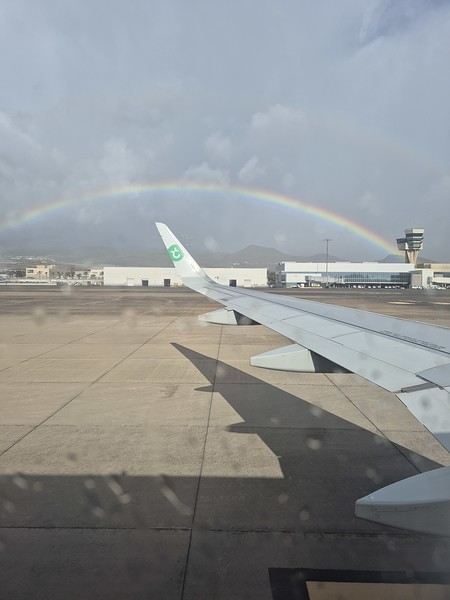
We quickly picked up our luggage and then the car at the Cicar counter. We got a Seat Arona instead of the Corsa we’d booked. Well, while the driving position didn’t feel great at first (I got used to it), the engine’s smoothness and power were much appreciated on the island’s winding and sometimes steep roads.
It was only 10 AM, and we couldn’t theoretically check into our accommodation until 3 PM (the owner promised to message me if it was ready earlier). So, we headed to the (big) *Jardín Botánico Viera y Clavijo*, where we planned to spend a few hours. We found a huge parking lot... empty. The passenger in the car in front of us (yes, we weren’t the only ones at the closed gate—there was a car in front and one behind) went to ask for info: it was closed due to the storm 😕. So, we calmly headed toward Puerto de las Nieves, on the northwest coast of the island.
The plan: go to a restaurant, visit the village, and do some shopping while waiting for early afternoon. As soon as we got out of the car, it started raining... we took shelter under the awning of a shop, waiting for it to pass. But the rain turned into a downpour, and within minutes, awning or not, Gore-Tex or not, we were soaked!
Since we were already wet, we might as well go to the restaurant—they weren’t far! But here’s the thing: contrary to what Google Maps said, they all opened at 1 PM, not noon! Back to the car, wading through 5 cm of water because all the village streets were flooded . The rain let up, we did some shopping, went to eat, and I got a message from the owner saying the accommodation was ready 🙂.
So, off we went to La Suerte, a few kilometers north of Agaete. The downside of the place, especially with luggage, is that you have to climb several flights of stairs via an outdoor staircase (after parking more or less far away on a steep street) to get there 😛). Of course, on the way from the car to the apartment, it started pouring again—the bags got soaked! Enough rain for today! We settled in quietly, and by late afternoon, we could (finally!) go admire the view from the terrace.
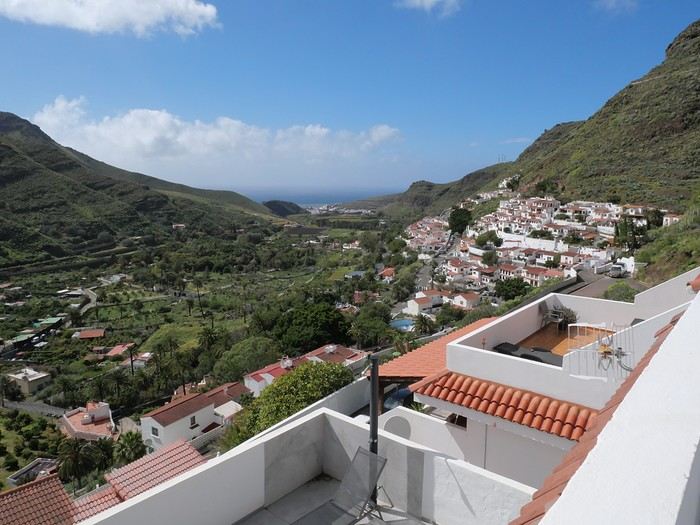
Every time we’ve been to the Canary Islands, it’s been by default (basically: where can we go in winter or early spring when we only have a week—so not too far, not too much jet lag, but with decent weather?).
This time, we had two weeks, but the winter plan kept changing: first Thailand (dropped for personal reasons), then Martinique (dropped because of work leave dates that weren’t up to me), and finally, the Canary Islands.
We’ve already been to Tenerife (which we really liked) and Lanzarote (which we liked a little less). This year, two options: Gran Canaria or one of the smaller islands west of Tenerife (La Palma, or even La Gomera or El Hierro). We chose Gran Canaria... not sure it was the right call! Whose fault is it? Storm Thérèse’s! Yes, Storm Thérèse followed us on arrival, and its effects lasted quite a while. We had to adapt, cancel visits, change activities...
But even without Thérèse...
Saturday 21/03 Departure from Orly at 6:10 AM with Transavia. The plane took off on time and landed a little early, tossed around by strong winds before touching down. It had just rained, but it was (almost) no longer raining.
We quickly picked up our luggage and then the car at the Cicar counter. We got a Seat Arona instead of the Corsa we’d booked. Well, while the driving position didn’t feel great at first (I got used to it), the engine’s smoothness and power were much appreciated on the island’s winding and sometimes steep roads.
It was only 10 AM, and we couldn’t theoretically check into our accommodation until 3 PM (the owner promised to message me if it was ready earlier). So, we headed to the (big) *Jardín Botánico Viera y Clavijo*, where we planned to spend a few hours. We found a huge parking lot... empty. The passenger in the car in front of us (yes, we weren’t the only ones at the closed gate—there was a car in front and one behind) went to ask for info: it was closed due to the storm 😕. So, we calmly headed toward Puerto de las Nieves, on the northwest coast of the island.
The plan: go to a restaurant, visit the village, and do some shopping while waiting for early afternoon. As soon as we got out of the car, it started raining... we took shelter under the awning of a shop, waiting for it to pass. But the rain turned into a downpour, and within minutes, awning or not, Gore-Tex or not, we were soaked!
Since we were already wet, we might as well go to the restaurant—they weren’t far! But here’s the thing: contrary to what Google Maps said, they all opened at 1 PM, not noon! Back to the car, wading through 5 cm of water because all the village streets were flooded . The rain let up, we did some shopping, went to eat, and I got a message from the owner saying the accommodation was ready 🙂.
So, off we went to La Suerte, a few kilometers north of Agaete. The downside of the place, especially with luggage, is that you have to climb several flights of stairs via an outdoor staircase (after parking more or less far away on a steep street) to get there 😛). Of course, on the way from the car to the apartment, it started pouring again—the bags got soaked! Enough rain for today! We settled in quietly, and by late afternoon, we could (finally!) go admire the view from the terrace.
Naha & Osaka, Japan - June 2025
It’s an understatement to say that Japan is a world apart. All around me, people exclaim: "How lucky you are to be able to go there! I’ve always dreamed of visiting, of finding myself in that culture blending tradition and technology!" Yes, they’re right. Until the moment their dreams become reality and things appear as they truly are, without the filter of fantasized preconceptions. Because in the collective unconscious, Japan indeed seems like a civilization—if not neutral—at least stripped of any social maturation. As if it had emerged all at once from its canonical ages, offering only the best of its traditions, and as if those traditions were undoubtedly the foundation of its extraordinary discipline. Yet, as always, the truth is far more complex. Modern Japan is likely shaped by its millennia-old traditions. But that Japan is also the result of its own uncertainties and contradictions. I’ve always been wary. I’ve never understood why the cleaning women on the platform bow when the train arrives. At some point, too much discipline, too much deference—it makes you smile, it raises questions.
Finally, thanks to F., a dream is coming true! Not the dream of going to Japan—a country I’ve visited more than any other, except for Réunion and the UK—but the dream of completing the fastest round-the-world trip of my career. Indeed, due to the restrictions imposed by the Russians*, the plane flies over the Caucasus and China on the way there; on the return, it gracefully heads toward the Arctic after skirting the Aleutian Islands, Alaska, and Greenland. So, in nearly 26 hours of flight, I complete my 6th round-the-world trip. A round-the-world trip with just one stopover. Or two, if you count our impromptu detour to Okinawa.
(* In response to Western sanctions, Russia closed its airspace to Western airlines on February 28, 2022, except for Air Serbia, Turkish Airlines, Pegasus, and Belavia. This decision adds 2 to 3 hours to flight times and, incidentally, increases operating costs.)
The empire of noise. The empire that dazzles. In Japan, the auditory and visual space is constantly fed. No respite. You have to be strong. Navigating public transport feels like playing the most advanced video game: moving between language barriers and a different organization, the hero tries to ignore the numerous visual and auditory distractions. Mostly auditory, though. Because in Japan, there’s a culture of noise that has undoubtedly inspired our national railways. Everything must be announced. So, here and there, all along the route, we find agents whose sole role is to endlessly repeat safety messages through megaphones more or less suited to the situation. The result is a constant murmur, a kind of tinnitus, a subtle but incessant buzz that fades only at bedtime and returns with a vengeance at first light, when we descend back into the supposedly sterile depths of Osaka’s subway. "To go right, please turn right, kudasaï. When descending the stairs, please mind the steps, kudasaï. To go straight, please take the left corridor, kudasaï." That *kudasaï* ("please" in Japanese), I assure you, has permanently lodged itself in my auditory cells.
Screens are no exception; the brain is constantly stimulated. But paradoxically, passengers massively retreat into their own worlds via their screens. Literally glued to their phones, earbuds firmly in place, people escape into the virtual aisles of a furniture store, a game, a movie... In the train cars, raised voices are rare. The field is clear for announcements and other jingles. Each stop is announced by a little tune unique to each station. Simply incredible.
If we usually judge a country by the welcome its inhabitants offer, in Japan, we’re left wanting. Indeed, the Lost in Translation* spirit doesn’t just apply to verbal exchanges—it applies to everything, especially non-verbal communication. In Japan, me, the slightly North African Corsican, I’m at a loss. I speak loudly, I gesture, in front of a hotel concierge just as lost. Each for our own reasons. Yes, he speaks some English, but we can’t seem to connect. It’s a losing battle trying to find a bit of compassion from a local who’s far from familiar with Western concerns. I try to buy tickets for the World Expo? I run into a systematization as rigid as it is abrupt, which the concierge can’t seem to navigate. While we might still have a shred of common sense, here in Japan, everything is digitized. Soon, no one will be surprised that a QR code becomes essential just to go to the bathroom.
(* Film by Sofia Coppola, released in 2003, which explores isolation, unease, Japanese culture, and language through the experiences of two protagonists.)
In the end, we get that ticket for the Expo. After providing personal information on yet another account created for the occasion, we buy electronic tickets—a QR code, then—to regulate the comings and goings, the souls and aspirations of all these wandering beings scattered across the globe. And it’s probably for the best... Because we’ll be tens of thousands of visitors—100,000 to 150,000 per day—walking the aisles of this enormous improvised amusement park, a kind of delirious superstructure surrounded by the Grand Ring, the largest wooden construction in the world. Inside the park, the pavilions, flagship vessels of their respective countries, compete in ingenuity, proportionate to their GDP, to attract visitors. But you have to wait up to two hours to visit the most popular ones! Fortunately, about a hundred countries can be explored without waiting in shared, more spacious areas. What will I remember from this adventure? The beauty of that wooden structure, despite any environmental or financial considerations—200M € for barely renewable elements; a certain poetry, even magic, in the expression of this event—conversing with Juliette Petit, the splendid representative of Vanuatu, had something indescribable; a close-up experience of Japanese discipline when it came time to return to the subway after that epic evening—thousands upon thousands of people converging at the same time toward a single place without any interruption in the flow.
But my real passion is the countryside. So, I’ll especially remember that brief escape, on the very first day, to the Mino-o waterfall, where the journey itself was already enchanting. Quickly leaving the underground lines, our train speeds through the city’s endless expanse and drops us at the foot of a hill, the abrupt edge of the urban sprawl. The slope was too steep to build anything? We leave behind an impressive hotel, a capitalist eyesore defying the laws of elevation to tackle the climb toward the waterfall. A bucolic walk where the stroller can choose between a paved path or more epic trails. Here and there, stalls, temples, everywhere, a certain serenity. The city’s pulse gives way to a magnificent spectacle magnified by giant sequoias. From the depths of a ravine, we try to glimpse the sky beyond the foliage. Everything is oversized. Here, you can breathe.
***
In reality, Japan has never undertaken any real work of memory. Aside from a few feeble gestures to appease Washington in its choice of Asian partners, one wonders if the Japanese have ever truly grasped the horror they were forced to participate in. While our Judeo-Christian society has more or less assimilated the notions of forgiveness and self-questioning, where does Japanese society stand, juggling a millennia-old Zen philosophy and the unabashed Machiavellianism of an emperor utterly possessed? Is it just me, or does there float in the atmosphere a kind of unease, a malaise, an awkward relationship with reality? For me, bowing to a train as it enters the station is just the result of a poorly directed moral dilemma...
Ah, how distant is the time of sakoku, that closure of the country—both concrete and ideological—that was in vogue for two centuries. Because if no one could enter, no one could leave either! A boon for neighboring countries. But from 1854, following the skirmishes of Commodore Matthew Perry, who demanded Japan’s participation in trade, the country suddenly became aware of the disparities separating it from the West. Bring Japan up to the level of other nations? Industrialization, competition, search for raw materials... Hirohito (1901–1989) emerges on the scene, a bit expansionist and willing to stop at nothing to achieve his goals. Above all, he knew how to use, in his own way, the incredible capacity for self-sacrifice of his people...
We protest, we condemn, we all rally behind an acceptable discourse when it comes to discussing the use of the atomic bomb. Yet, we forget one essential thing: Hiroshima wasn’t enough to make Hirohito yield. While we’re bombarded with anti-fascist elements, as if the sole purpose of school curricula were to prevent us from voting for the National Rally, we completely overlook those events of rare cruelty that took place on the other side of the globe at a time contemporary with Nazi atrocities. Why? Because it was farther away, on the other side of the world? Because we must both condemn the use of nuclear weapons and Nazism? What a dangerous game. Killing civilians is beyond comprehension, everyone agrees on that. But hasn’t Japan ever been guilty of such atrocities? Our empathy is legitimate; it won’t, however, remove from my mind the idea that there was no other solution. Nagasaki is the most telling proof of that.
At least in France, in school textbooks, Hitler will have completely overshadowed the existence of people crueler and more abject than him. Certainly, Adolf was a deeply disturbed man whom events propelled to power. But I’m justified in believing that his approach was probably more humane than that of Joseph Stalin at the height of his art*. And if Hirohito followed the same line as Hitler, in the sense that he represented the superior race, he would apply with conviction what was Stalin’s credo: contempt for his own people when sending them to slaughter, and an even fiercer contempt for the human race when it didn’t have the good fortune to be Japanese. Just look at how China was invaded and by what means millions of Chinese were annihilated, burned, deported, buried alive! Operation Scorched Earth or Three Alls Policy for kill all, burn all, loot all? No comment. Even today, the Japanese are convinced they waged a patriotic war, when clearly, that war served only vague ideological (and certainly economic) interests.
(* "In many ways, Hitler’s National Socialism was far more humane than Communism: it wasn’t unthinkable to speak to the SS or the Gestapo, and dissuading them from sending you to a prison camp wasn’t utopian. To some extent (compared to the Communists), you could still expect a semblance of justice. All those who lived under Hitler and under Communism will tell you: as the front lines shifted, they always managed to end up in Germany, where, though it was a strange place ruled by a madman, life went on. Under Communism, there was no life; totalitarianism was absolute. Probably, Hitler’s conservatism prevented him from fully imitating Bolshevism." Seraphim Rose in The Revolutions of the 19th and 20th Centuries (circa 1970))
In Naha, we visit two strategic sites: the Imperial Navy headquarters and Maeda Escarpment, in Urasoe, better known as Hacksaw Ridge. I love this confrontation with history. In the hand-dug tunnels of the headquarters, we meet Japanese people seeking information. They’re not responsible for this tragedy. Neither are we. I would have liked to tell them that, to hug them, to move on. To finally believe in those peace messages displayed here and there. Yes, it’s curious to read those calls for peace* when no real work of memory** has been undertaken. Two civilizations, two perspectives, a profound misunderstanding. When I analyze the waste of that war—and particularly the waste of those Pacific battles—like Peleliu in autumn 1944 and Okinawa in spring 1945—I can’t bring myself to share in the pathological patriotism that reigns within these walls. There, the room where the last message of Admiral Minoru Ōta was transmitted in Morse, praising the merits of the archipelago’s people. A tangled mix that, yes, is charged with positive emotions but, no, won’t remove from my mind the idea that this people was completely conditioned, completely disconnected from reality. Allying with the Axis powers? Invading the South Pacific? And finding that noble! Everyone sees things through their own lens.
(* Peace Declaration by Denny Tamaki, Governor of Okinawa, June 2020. ** "Recognizing the atrocities committed by one’s country requires a mix of democratic culture and self-confidence that is more the exception than the rule." Dominique Moïsi in Les Échos, April 30, 2015)
Okinawa. 200,000 dead. Stemming from bushido, the way of the warrior, this conditioning reached its peak with the kamikaze philosophy in particular and suicide in general. So, schematically, here’s how things went: as the island was encircled—Peleliu, Iwo Jima, Okinawa—and all hope was lost, the order was given to kill ten American soldiers before taking one’s own life. The deceit of this system, where surrender is synonymous with dishonor, involves creating tunnels and secret pockets where Japanese soldiers hide and from which they emerge. Long before the atomic bomb, the knell of their war had sounded. Hiroshima and Nagasaki are just the result of human pride, of which Hirohito’s reign is the finest example. Why was this henchman of Satan left in place until his death? I don’t understand. While the humiliation inflicted on Germany repeatedly was abject, especially for its people, the absence of any real and pressing accountability for Hirohito in this large-scale carnage he instigated leaves room for the wildest interpretations. As if to underscore my point, Emperor Naruhito visited Okinawa the same day we did, paying his respects to the inhabitants who fell in battle. I looked at the faces in the monorail serving the south of the island. There were elderly people who undoubtedly lost their parents eighty years ago. To what extent can they blame this tragedy on the delusional visions of their leaders?
On Maeda Escarpment, I salute the courage of Desmond Doss, that conscientious objector who fought to serve his country while refusing to ever carry a weapon. There, at the top of a steep ridge, you can see to the north the Allies’ advance, while to the south, the slope is gentler down to Shuri, in front of the headquarters. The underground is a Swiss cheese filled with enemies. Desmond works as a medic. He manages to save 75 wounded from certain death by evacuating them at night from the battlefield using makeshift ropes. Back in Osaka, far from the somewhat dilapidated tropical islands, I rediscover the splendor and grandeur of Japan’s second-largest city. To tell the truth, and this applies to Okinawa too, the density is so insane on this archipelago that you sometimes wonder if it’s not just one giant city spread across the vast territory. Because between Tokyo and Osaka, while there are some mountains and forests, it’s the city that dominates; during rush hour, a rapid train connects the two cities every five minutes. We get lost in rather quiet alleys parallel to the main streets, only to find ourselves in the covered and lively galleries of Dōtonbori. We’re looking for a place to eat—above all, we’re trying to navigate the unlimited options stretching endlessly along the sidewalks. It’s absolutely mind-blowing. And while I introduce F. to a part of history that our Western societies have quickly forgotten, he initiates me into Japanese gastronomy despite my well-known aversion to Asian food. But nothing beats having a master in the field! We feast on okonomiyaki, Japanese pancakes expertly prepared and served on a teppan embedded in our table.
Night falls on Japan, and I still haven’t found the answer. Like in Singapore, one can praise the calm and serenity of human relationships, the delicacy that may just be hypocrisy, the politeness, the discipline. But above all, we notice that in the absence of freedom, in the absence of madness, poetry struggles to take root, boredom looms, as does real madness. Bushido still exists, honor is there and must be preserved. But the youth drowns in electronics and in willingly sterile cults (otaku), unable to discern what’s essential, failing to believe in their dreams. You have to succeed? Young people commit suicide because of school bullying, the slightly older ones because of work-related difficulties or marital problems. Nothing exceptional, we might say—average*—but you’d expect better from a country so well-organized, a country that makes so many Westerners dream. Yes, night falls on Japan. Empire of noise, empire of the senses, a very strange land where you find clean toilets in subway corridors but where the very meaning of life seems stifled by the mirages of technology. Above all, a civilization deprived of a penance that would prove salutary. We’re caught between two waters. Those of a shallow modernity without depth or anchor; those of a past that was majestic but irreparably tainted by the demonic madness of an overly adored emperor.
How can one fully thrive when guilt has no outlet?
(* France and Japan share a common statistic of 17 suicides per 100,000 inhabitants, which, depending on density, means 30 per day in France and 70 in Japan...)
Finally, thanks to F., a dream is coming true! Not the dream of going to Japan—a country I’ve visited more than any other, except for Réunion and the UK—but the dream of completing the fastest round-the-world trip of my career. Indeed, due to the restrictions imposed by the Russians*, the plane flies over the Caucasus and China on the way there; on the return, it gracefully heads toward the Arctic after skirting the Aleutian Islands, Alaska, and Greenland. So, in nearly 26 hours of flight, I complete my 6th round-the-world trip. A round-the-world trip with just one stopover. Or two, if you count our impromptu detour to Okinawa.
(* In response to Western sanctions, Russia closed its airspace to Western airlines on February 28, 2022, except for Air Serbia, Turkish Airlines, Pegasus, and Belavia. This decision adds 2 to 3 hours to flight times and, incidentally, increases operating costs.)
The empire of noise. The empire that dazzles. In Japan, the auditory and visual space is constantly fed. No respite. You have to be strong. Navigating public transport feels like playing the most advanced video game: moving between language barriers and a different organization, the hero tries to ignore the numerous visual and auditory distractions. Mostly auditory, though. Because in Japan, there’s a culture of noise that has undoubtedly inspired our national railways. Everything must be announced. So, here and there, all along the route, we find agents whose sole role is to endlessly repeat safety messages through megaphones more or less suited to the situation. The result is a constant murmur, a kind of tinnitus, a subtle but incessant buzz that fades only at bedtime and returns with a vengeance at first light, when we descend back into the supposedly sterile depths of Osaka’s subway. "To go right, please turn right, kudasaï. When descending the stairs, please mind the steps, kudasaï. To go straight, please take the left corridor, kudasaï." That *kudasaï* ("please" in Japanese), I assure you, has permanently lodged itself in my auditory cells.
Screens are no exception; the brain is constantly stimulated. But paradoxically, passengers massively retreat into their own worlds via their screens. Literally glued to their phones, earbuds firmly in place, people escape into the virtual aisles of a furniture store, a game, a movie... In the train cars, raised voices are rare. The field is clear for announcements and other jingles. Each stop is announced by a little tune unique to each station. Simply incredible.
If we usually judge a country by the welcome its inhabitants offer, in Japan, we’re left wanting. Indeed, the Lost in Translation* spirit doesn’t just apply to verbal exchanges—it applies to everything, especially non-verbal communication. In Japan, me, the slightly North African Corsican, I’m at a loss. I speak loudly, I gesture, in front of a hotel concierge just as lost. Each for our own reasons. Yes, he speaks some English, but we can’t seem to connect. It’s a losing battle trying to find a bit of compassion from a local who’s far from familiar with Western concerns. I try to buy tickets for the World Expo? I run into a systematization as rigid as it is abrupt, which the concierge can’t seem to navigate. While we might still have a shred of common sense, here in Japan, everything is digitized. Soon, no one will be surprised that a QR code becomes essential just to go to the bathroom.
(* Film by Sofia Coppola, released in 2003, which explores isolation, unease, Japanese culture, and language through the experiences of two protagonists.)
In the end, we get that ticket for the Expo. After providing personal information on yet another account created for the occasion, we buy electronic tickets—a QR code, then—to regulate the comings and goings, the souls and aspirations of all these wandering beings scattered across the globe. And it’s probably for the best... Because we’ll be tens of thousands of visitors—100,000 to 150,000 per day—walking the aisles of this enormous improvised amusement park, a kind of delirious superstructure surrounded by the Grand Ring, the largest wooden construction in the world. Inside the park, the pavilions, flagship vessels of their respective countries, compete in ingenuity, proportionate to their GDP, to attract visitors. But you have to wait up to two hours to visit the most popular ones! Fortunately, about a hundred countries can be explored without waiting in shared, more spacious areas. What will I remember from this adventure? The beauty of that wooden structure, despite any environmental or financial considerations—200M € for barely renewable elements; a certain poetry, even magic, in the expression of this event—conversing with Juliette Petit, the splendid representative of Vanuatu, had something indescribable; a close-up experience of Japanese discipline when it came time to return to the subway after that epic evening—thousands upon thousands of people converging at the same time toward a single place without any interruption in the flow.
But my real passion is the countryside. So, I’ll especially remember that brief escape, on the very first day, to the Mino-o waterfall, where the journey itself was already enchanting. Quickly leaving the underground lines, our train speeds through the city’s endless expanse and drops us at the foot of a hill, the abrupt edge of the urban sprawl. The slope was too steep to build anything? We leave behind an impressive hotel, a capitalist eyesore defying the laws of elevation to tackle the climb toward the waterfall. A bucolic walk where the stroller can choose between a paved path or more epic trails. Here and there, stalls, temples, everywhere, a certain serenity. The city’s pulse gives way to a magnificent spectacle magnified by giant sequoias. From the depths of a ravine, we try to glimpse the sky beyond the foliage. Everything is oversized. Here, you can breathe.
***
In reality, Japan has never undertaken any real work of memory. Aside from a few feeble gestures to appease Washington in its choice of Asian partners, one wonders if the Japanese have ever truly grasped the horror they were forced to participate in. While our Judeo-Christian society has more or less assimilated the notions of forgiveness and self-questioning, where does Japanese society stand, juggling a millennia-old Zen philosophy and the unabashed Machiavellianism of an emperor utterly possessed? Is it just me, or does there float in the atmosphere a kind of unease, a malaise, an awkward relationship with reality? For me, bowing to a train as it enters the station is just the result of a poorly directed moral dilemma...
Ah, how distant is the time of sakoku, that closure of the country—both concrete and ideological—that was in vogue for two centuries. Because if no one could enter, no one could leave either! A boon for neighboring countries. But from 1854, following the skirmishes of Commodore Matthew Perry, who demanded Japan’s participation in trade, the country suddenly became aware of the disparities separating it from the West. Bring Japan up to the level of other nations? Industrialization, competition, search for raw materials... Hirohito (1901–1989) emerges on the scene, a bit expansionist and willing to stop at nothing to achieve his goals. Above all, he knew how to use, in his own way, the incredible capacity for self-sacrifice of his people...
We protest, we condemn, we all rally behind an acceptable discourse when it comes to discussing the use of the atomic bomb. Yet, we forget one essential thing: Hiroshima wasn’t enough to make Hirohito yield. While we’re bombarded with anti-fascist elements, as if the sole purpose of school curricula were to prevent us from voting for the National Rally, we completely overlook those events of rare cruelty that took place on the other side of the globe at a time contemporary with Nazi atrocities. Why? Because it was farther away, on the other side of the world? Because we must both condemn the use of nuclear weapons and Nazism? What a dangerous game. Killing civilians is beyond comprehension, everyone agrees on that. But hasn’t Japan ever been guilty of such atrocities? Our empathy is legitimate; it won’t, however, remove from my mind the idea that there was no other solution. Nagasaki is the most telling proof of that.
At least in France, in school textbooks, Hitler will have completely overshadowed the existence of people crueler and more abject than him. Certainly, Adolf was a deeply disturbed man whom events propelled to power. But I’m justified in believing that his approach was probably more humane than that of Joseph Stalin at the height of his art*. And if Hirohito followed the same line as Hitler, in the sense that he represented the superior race, he would apply with conviction what was Stalin’s credo: contempt for his own people when sending them to slaughter, and an even fiercer contempt for the human race when it didn’t have the good fortune to be Japanese. Just look at how China was invaded and by what means millions of Chinese were annihilated, burned, deported, buried alive! Operation Scorched Earth or Three Alls Policy for kill all, burn all, loot all? No comment. Even today, the Japanese are convinced they waged a patriotic war, when clearly, that war served only vague ideological (and certainly economic) interests.
(* "In many ways, Hitler’s National Socialism was far more humane than Communism: it wasn’t unthinkable to speak to the SS or the Gestapo, and dissuading them from sending you to a prison camp wasn’t utopian. To some extent (compared to the Communists), you could still expect a semblance of justice. All those who lived under Hitler and under Communism will tell you: as the front lines shifted, they always managed to end up in Germany, where, though it was a strange place ruled by a madman, life went on. Under Communism, there was no life; totalitarianism was absolute. Probably, Hitler’s conservatism prevented him from fully imitating Bolshevism." Seraphim Rose in The Revolutions of the 19th and 20th Centuries (circa 1970))
In Naha, we visit two strategic sites: the Imperial Navy headquarters and Maeda Escarpment, in Urasoe, better known as Hacksaw Ridge. I love this confrontation with history. In the hand-dug tunnels of the headquarters, we meet Japanese people seeking information. They’re not responsible for this tragedy. Neither are we. I would have liked to tell them that, to hug them, to move on. To finally believe in those peace messages displayed here and there. Yes, it’s curious to read those calls for peace* when no real work of memory** has been undertaken. Two civilizations, two perspectives, a profound misunderstanding. When I analyze the waste of that war—and particularly the waste of those Pacific battles—like Peleliu in autumn 1944 and Okinawa in spring 1945—I can’t bring myself to share in the pathological patriotism that reigns within these walls. There, the room where the last message of Admiral Minoru Ōta was transmitted in Morse, praising the merits of the archipelago’s people. A tangled mix that, yes, is charged with positive emotions but, no, won’t remove from my mind the idea that this people was completely conditioned, completely disconnected from reality. Allying with the Axis powers? Invading the South Pacific? And finding that noble! Everyone sees things through their own lens.
(* Peace Declaration by Denny Tamaki, Governor of Okinawa, June 2020. ** "Recognizing the atrocities committed by one’s country requires a mix of democratic culture and self-confidence that is more the exception than the rule." Dominique Moïsi in Les Échos, April 30, 2015)
Okinawa. 200,000 dead. Stemming from bushido, the way of the warrior, this conditioning reached its peak with the kamikaze philosophy in particular and suicide in general. So, schematically, here’s how things went: as the island was encircled—Peleliu, Iwo Jima, Okinawa—and all hope was lost, the order was given to kill ten American soldiers before taking one’s own life. The deceit of this system, where surrender is synonymous with dishonor, involves creating tunnels and secret pockets where Japanese soldiers hide and from which they emerge. Long before the atomic bomb, the knell of their war had sounded. Hiroshima and Nagasaki are just the result of human pride, of which Hirohito’s reign is the finest example. Why was this henchman of Satan left in place until his death? I don’t understand. While the humiliation inflicted on Germany repeatedly was abject, especially for its people, the absence of any real and pressing accountability for Hirohito in this large-scale carnage he instigated leaves room for the wildest interpretations. As if to underscore my point, Emperor Naruhito visited Okinawa the same day we did, paying his respects to the inhabitants who fell in battle. I looked at the faces in the monorail serving the south of the island. There were elderly people who undoubtedly lost their parents eighty years ago. To what extent can they blame this tragedy on the delusional visions of their leaders?
On Maeda Escarpment, I salute the courage of Desmond Doss, that conscientious objector who fought to serve his country while refusing to ever carry a weapon. There, at the top of a steep ridge, you can see to the north the Allies’ advance, while to the south, the slope is gentler down to Shuri, in front of the headquarters. The underground is a Swiss cheese filled with enemies. Desmond works as a medic. He manages to save 75 wounded from certain death by evacuating them at night from the battlefield using makeshift ropes. Back in Osaka, far from the somewhat dilapidated tropical islands, I rediscover the splendor and grandeur of Japan’s second-largest city. To tell the truth, and this applies to Okinawa too, the density is so insane on this archipelago that you sometimes wonder if it’s not just one giant city spread across the vast territory. Because between Tokyo and Osaka, while there are some mountains and forests, it’s the city that dominates; during rush hour, a rapid train connects the two cities every five minutes. We get lost in rather quiet alleys parallel to the main streets, only to find ourselves in the covered and lively galleries of Dōtonbori. We’re looking for a place to eat—above all, we’re trying to navigate the unlimited options stretching endlessly along the sidewalks. It’s absolutely mind-blowing. And while I introduce F. to a part of history that our Western societies have quickly forgotten, he initiates me into Japanese gastronomy despite my well-known aversion to Asian food. But nothing beats having a master in the field! We feast on okonomiyaki, Japanese pancakes expertly prepared and served on a teppan embedded in our table.
Night falls on Japan, and I still haven’t found the answer. Like in Singapore, one can praise the calm and serenity of human relationships, the delicacy that may just be hypocrisy, the politeness, the discipline. But above all, we notice that in the absence of freedom, in the absence of madness, poetry struggles to take root, boredom looms, as does real madness. Bushido still exists, honor is there and must be preserved. But the youth drowns in electronics and in willingly sterile cults (otaku), unable to discern what’s essential, failing to believe in their dreams. You have to succeed? Young people commit suicide because of school bullying, the slightly older ones because of work-related difficulties or marital problems. Nothing exceptional, we might say—average*—but you’d expect better from a country so well-organized, a country that makes so many Westerners dream. Yes, night falls on Japan. Empire of noise, empire of the senses, a very strange land where you find clean toilets in subway corridors but where the very meaning of life seems stifled by the mirages of technology. Above all, a civilization deprived of a penance that would prove salutary. We’re caught between two waters. Those of a shallow modernity without depth or anchor; those of a past that was majestic but irreparably tainted by the demonic madness of an overly adored emperor.
How can one fully thrive when guilt has no outlet?
(* France and Japan share a common statistic of 17 suicides per 100,000 inhabitants, which, depending on density, means 30 per day in France and 70 in Japan...)
Go Voyages, a company to avoid
Hello everyone,
A message to warn potential customers of "Go Voyages" about my recent experience.
I left from Geneva for Colombo on December 18, 2025, with a round-trip business-class ticket purchased on Go Voyages, with Etihad Airways, and a layover in Abu Dhabi. Access to the business lounge was denied (I have a 7-hour layover both ways), and I had to pay $160 to get in, despite having a business-class boarding pass.
I’m currently in Sri Lanka, and for a month now, I’ve been trying to get an explanation for this refusal and to find out if I’ll be denied access again on my return on March 12, 2026.
After two calls to the priority line of the "Prime" service I subscribed to (a paid subscription, of course), which is supposed to assist me 24/7 during my trip, after about ten emails that only led to being redirected to links like Opodo, then eDreams (an inaccessible site), and then other links that just sent me in circles... it’s absolutely insane, all this just to answer a fairly simple question: why wasn’t I informed about this potential refusal by Etihad when I made my purchase? All Go Voyages would need to do is contact the airline to resolve this quickly... but no!!! After a month, ten emails, the last response was: contact the airline directly!!! Which, of course, redirected me back to Go Voyages!!
Completely unacceptable! The "Prime" service from Go Voyages is a total scam—completely ineffective, with customer service nowhere to be found. My issue isn’t life-or-death, but imagine a more serious situation where you’d need quick assistance... don’t count on "Go Voyages" to help you at all!! You’d likely be pretty disappointed!! My advice: RUN from this agency, which is headquartered in Spain and owns Opodo, eDreams, and Go Voyages.
Issue with flights to Cambodia with a layover in Bangkok
we have flights with Swiss and Lufthansa for January; our flights are still in our booking file. But after reading that the Cambodian ambassador in Paris advised against transiting through Bangkok (which is our case), I reached out to the airlines to potentially change our ticket via Singapore. However, both companies have canceled all flights to Cambodia, regardless of the day or airport. We’ll have our contact on the ground call us on Monday to figure out what to do, especially since no insurance covers war, conflict, etc. If anyone else is in the same situation with an upcoming departure, we can exchange tips
Which airline would you recommend for Dubai?
Hello,
We’re planning a cruise to the UAE/QATAR/OMAN starting from DUBAI, with flights departing from Paris CDG. Which airlines would you recommend for round-trip flights, with or without a layover? We need assistance for check-in and boarding/disembarking (my husband is a mobility-impaired traveler who uses a cane and/or a walker). We’ve done a cruise return from Dubai to Paris CDG before in 2016, with a layover in Istanbul, but we booked the transfer and return flight with COSTA. For our current plan, it would be with Celestyal, which doesn’t offer round-trip flights from Paris to Dubai. Should we book very far in advance, or is a few months before departure enough (4/6 months)? We’re thinking of arriving the day before the ship departs, so we’d need to stay overnight in Dubai—either on the way there or for the return flight, depending on the flight schedules. Could you recommend a hotel not too far from the airport, and how to get to the port from the airport?
Thanks so much for your advice. Have a great Sunday! Mum49
We’re planning a cruise to the UAE/QATAR/OMAN starting from DUBAI, with flights departing from Paris CDG. Which airlines would you recommend for round-trip flights, with or without a layover? We need assistance for check-in and boarding/disembarking (my husband is a mobility-impaired traveler who uses a cane and/or a walker). We’ve done a cruise return from Dubai to Paris CDG before in 2016, with a layover in Istanbul, but we booked the transfer and return flight with COSTA. For our current plan, it would be with Celestyal, which doesn’t offer round-trip flights from Paris to Dubai. Should we book very far in advance, or is a few months before departure enough (4/6 months)? We’re thinking of arriving the day before the ship departs, so we’d need to stay overnight in Dubai—either on the way there or for the return flight, depending on the flight schedules. Could you recommend a hotel not too far from the airport, and how to get to the port from the airport?
Thanks so much for your advice. Have a great Sunday! Mum49
Ways to get the e-Visa for Madagascar
Hi everyone,
I’m planning my trip to Madagascar for the fall and starting to think about getting my visa. After reading through different posts, I’m a bit unsure about the best way to go about it. Is it better to apply for an e-visa (and if so, which official website?) or just queue up on arrival? It seems there are "unofficial"—and therefore fraudulent—sites out there, and that you’ll have to queue either way (which I’m not thrilled about since I’m arriving at 11 PM). What do you think?
Uzbekistan with family in the spring
Hello,
I’ve been dreaming about the Silk Road for a long time and hope to visit Uzbekistan next year with my husband and son (11 years old). Late April to early May.
I’m planning a very classic itinerary: Tashkent - Samarkand - Bukhara - Khiva - Tashkent.
I checked the Uzbekistan Railways website, but it seems you can only book tickets three months in advance?
Otherwise, I’ve seen some people in other discussions suggest booking through Uzrailway. Are these the apps below? Are they reliable?
I really don’t want to go through a travel agency—I’d prefer to organize everything myself—and it seems the only hurdle is booking the trains. I was thinking of taking the train from Tashkent to Samarkand, then to Bukhara, and finally to Khiva, before flying back from Urgench to Tashkent with Uzbekistan Airways (is that a bad idea?🤪). What do you think?
Since we’re traveling with a child, I’d rather book and organize everything in advance to avoid any potential hassles. I tend to plan my trips much more now than I used to😏.
Would you have any great accommodation recommendations (not luxury, but not a youth hostel either)? We prefer places with charm, friendly owners, and a nice setting...
Also, I speak several languages but not Uzbek or Russian🤪... Is English widely spoken these days?
Thanks everyone 🙂
I’ve been dreaming about the Silk Road for a long time and hope to visit Uzbekistan next year with my husband and son (11 years old). Late April to early May.
I’m planning a very classic itinerary: Tashkent - Samarkand - Bukhara - Khiva - Tashkent.
I checked the Uzbekistan Railways website, but it seems you can only book tickets three months in advance?
Otherwise, I’ve seen some people in other discussions suggest booking through Uzrailway. Are these the apps below? Are they reliable?
I really don’t want to go through a travel agency—I’d prefer to organize everything myself—and it seems the only hurdle is booking the trains. I was thinking of taking the train from Tashkent to Samarkand, then to Bukhara, and finally to Khiva, before flying back from Urgench to Tashkent with Uzbekistan Airways (is that a bad idea?🤪). What do you think?
Since we’re traveling with a child, I’d rather book and organize everything in advance to avoid any potential hassles. I tend to plan my trips much more now than I used to😏.
Would you have any great accommodation recommendations (not luxury, but not a youth hostel either)? We prefer places with charm, friendly owners, and a nice setting...
Also, I speak several languages but not Uzbek or Russian🤪... Is English widely spoken these days?
Thanks everyone 🙂
Info on Thai Airways / Air France business class
Direct flights PAR / BKK in business class: AIR FRANCE or THAI AIRWAYS – prices, comfort.
Thanks a bunch!
Which airline for a flight to Cambodia?
Hi,
I’m torn between a few airlines for late March departing from Paris: Vietnam Airlines, Singapore Airlines, and Qatar Airways. Which one is reliable with a comfortable flight?
Air France’s schedule doesn’t work for me.
Thanks for your feedback!
Airlines for Madagascar
It’s been over 10 years since I last went to Madagascar. Back then, I flew Corsair from Paris.
I’m planning to go back in September 2025.
I’ve heard about Air Austral...
Air France: the issue is the flight arrives in the evening at Ivato.
What do you recommend?
Which airlines fly from Paris to Tana?
Thanks for the help!
16-Day Itinerary from Victoria Falls to Johannesburg
Hi everyone,
I’m planning a trip to South Africa / Zimbabwe this summer—4x4 with camping gear... After some reading, I’ve put together this first draft of an itinerary:
D0 Johannesburg - arrive around 11 AM + visit Soweto? D1 Vic Falls - arrive around noon D2 Vic Falls D3 4x4 familiarization + Hwange NP D4 Hwange NP D5 Hwange NP D6 Bulawayo D7 Bulawayo / Matobo NP D8 Mapungubwe D9 Mapungubwe D10 Waterberg D11 Waterval Boven D12 Golden Gate Highlands NP D13 Sentinel Peak D14 Tugela Falls or another hike D15 Additional hike to be determined D16 Return to Johannesburg + drop off 4x4 - flight at 5 PM
Any thoughts on this itinerary? Ideas for improving it?
One alternative would be to visit Gonarezhou Park, which really appeals to me... But that would take more time and change the rest of the route: probably going back through Kruger. And I’m not sure I’d have enough time for the Drakensberg.
I still have other questions... But I’d rather finalize the general itinerary first to sort out the 4x4 rental...
Big thanks to the travel community 😉
I’m planning a trip to South Africa / Zimbabwe this summer—4x4 with camping gear... After some reading, I’ve put together this first draft of an itinerary:
D0 Johannesburg - arrive around 11 AM + visit Soweto? D1 Vic Falls - arrive around noon D2 Vic Falls D3 4x4 familiarization + Hwange NP D4 Hwange NP D5 Hwange NP D6 Bulawayo D7 Bulawayo / Matobo NP D8 Mapungubwe D9 Mapungubwe D10 Waterberg D11 Waterval Boven D12 Golden Gate Highlands NP D13 Sentinel Peak D14 Tugela Falls or another hike D15 Additional hike to be determined D16 Return to Johannesburg + drop off 4x4 - flight at 5 PM
Any thoughts on this itinerary? Ideas for improving it?
One alternative would be to visit Gonarezhou Park, which really appeals to me... But that would take more time and change the rest of the route: probably going back through Kruger. And I’m not sure I’d have enough time for the Drakensberg.
I still have other questions... But I’d rather finalize the general itinerary first to sort out the 4x4 rental...
Big thanks to the travel community 😉
Which airport for visiting Yogyakarta (Java) and Bali?
Hi everyone (hope the forum becomes as active as it used to be),
We’re a group of 4 (2 adults and 2 kids aged 8–10) planning a trip to Indonesia. We’d like to visit (order doesn’t matter):
On Java: - Yogyakarta - Borobudur - Kawah Ijen
- Bali
- Lombok + the Gili Islands
But we’re wondering whether to fly in and out of Denpasar or take a flight to Jakarta and then leave from Denpasar. Unfortunately, we haven’t found any good flight options to Yogyakarta.
Thanks!
We’re a group of 4 (2 adults and 2 kids aged 8–10) planning a trip to Indonesia. We’d like to visit (order doesn’t matter):
On Java: - Yogyakarta - Borobudur - Kawah Ijen
- Bali
- Lombok + the Gili Islands
But we’re wondering whether to fly in and out of Denpasar or take a flight to Jakarta and then leave from Denpasar. Unfortunately, we haven’t found any good flight options to Yogyakarta.
Thanks!
Your thoughts on IndiGo airline
Hi there,
Have you ever traveled with this airline? It seems like they have a real monopoly on some destinations and are also much cheaper.
Thank youuuu.
Have you ever traveled with this airline? It seems like they have a real monopoly on some destinations and are also much cheaper.
Thank youuuu.
Achat d'un billet Barcelone-Denpasar English translation pending
Bonjour,
suite a l'annulation de mon vol Lufthansa Toulouse Denpasar, je souhaite acheter un billet Barcelonne denpasar pour allée 25 octobre 2020 retour 15 fevrier 2021 avec Quatar Airways.
PS: nous sommes 4 mon épouse indonésienne, moi qui ai une KITAS et mes deux enfants.
Pensez vous que je prend un risque de ne pas me faire rembourser le billet si Quatar Airways annule?
Cordialement,
Thomas.
Recherche guide pour visite en voiture du sud de l'île Maurice English translation pending
Bonjour à tous,
n'ayant pas trouvé ce qui me concernait dans le forum, je me permets de vous solliciter pour savoir si quelqu'un pourrait me recommander un guide sympa pour une visite du sud de l'ile , en voiture, avec découverte du Parc des georges de la rivière Noire, Grand bassin, Chamarel, les terres aux 7 couleurs et autres pépites, pour mon mari et moi, la dernière semaine d'octobre.Mais , je recherche un guide local , qui ne nous prendra pas pour des "pigeons" mais privilégiera la découverte des lieux authentiques de cette ile. Quelqu'un a-t-il eu la chance de connaitre ce type de personne et pourrait-il nous en faire profiter?
merci à tous de votre aide.
Gingibus
n'ayant pas trouvé ce qui me concernait dans le forum, je me permets de vous solliciter pour savoir si quelqu'un pourrait me recommander un guide sympa pour une visite du sud de l'ile , en voiture, avec découverte du Parc des georges de la rivière Noire, Grand bassin, Chamarel, les terres aux 7 couleurs et autres pépites, pour mon mari et moi, la dernière semaine d'octobre.Mais , je recherche un guide local , qui ne nous prendra pas pour des "pigeons" mais privilégiera la découverte des lieux authentiques de cette ile. Quelqu'un a-t-il eu la chance de connaitre ce type de personne et pourrait-il nous en faire profiter?
merci à tous de votre aide.
Gingibus
Informations sur Miles Aéroplans Air Canada English translation pending
Bonjour,
Fin 2019 j’avais réservé des billets d’avion avec Air canada directement pour octobre 2020.
Comme nous pensons que les frontières seront encore fermes on aimerait annuler notre réservation.
Air Canada propose de bon de voyage ou bien de convertir en miles aéroplan la valeur des billets. Connaissez vous ce système ? Est ce qu’en convertissant en miles aeroplan on pourra plus tard réserver un vol avec d’autres compagnies ? Y a t’il un limite ?
Qu’en pensez vous ?
Merci par avance.
Ouverture des frontières de la Géorgie le 1er juillet? English translation pending
Bonjour à tous,
La Géorgie a annoncé l'ouverture de ses frontières aux touristes internationaux pour le 1er juillet, il y a un moment déjà, mais depuis : plus de nouvelles. En savez-vous plus ?
On trouve des articles parlant d'une liste de pays à paraître, mais pas grand chose de plus.
Julien
Julien