Results for "Saint-Riquier+|+127"
82388 results found.
Off on an adventure in Réunion!
Week 1 - July 2026
Traveling with just one spare pair of underwear, considering a hot shower a miracle, never staying in the same place too long by sleeping wherever night catches us, taking whatever local, improbable, and rickety transport we can find—this is the DNA of us wanderers. Except this time, the script for our movie is going to be a whole different genre. On paper, the destination doesn’t exactly scream epic adventure: Réunion! And what’s more... we won’t be two, or four, or even ten. We’ll be a solid thirty. All from the same family. Yes, thirty. At this point, it’s not just a trip—it’s a summer camp on the move! Why inflict this on such a peaceful island? Because my brother decided to get married there with his lovely bride. A great idea, you might say... especially when it involves relocating the equivalent of a small Ardennes village 10,000 kilometers from home for three weeks! So who’s stepping up to be the guide and wave the little flag?
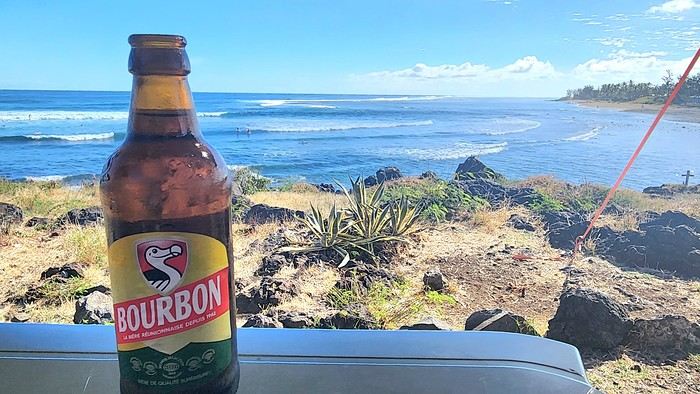
So, for an exceptional trip, exceptional stories! Don’t worry, the debates at the supermarket over whether to choose plain chips or roast chicken chips, the beach picnics washed down with ti’ punch, and other rougail sausages to digest by the pool will only make it into the family archives. Here, I’ll stick to the tales of our beautiful escapes, the ones where we explore the wild corners of this little volcanic rock planted in the middle of the Indian Ocean. So where exactly are we headed?
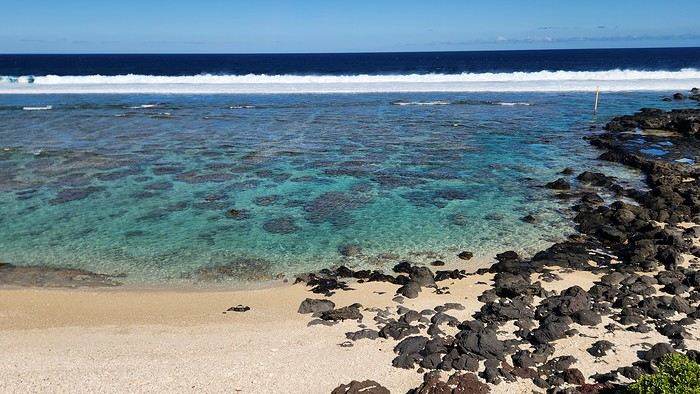
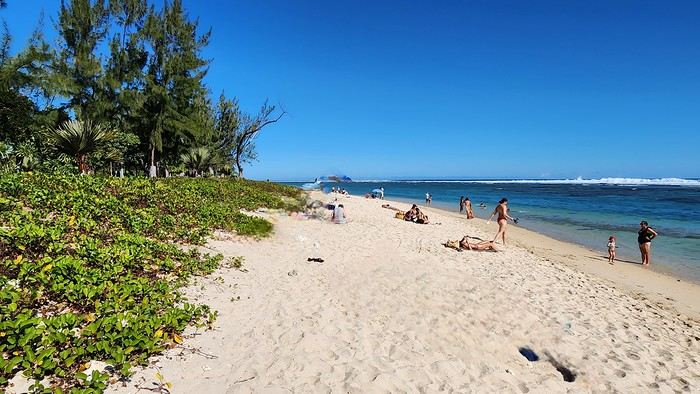
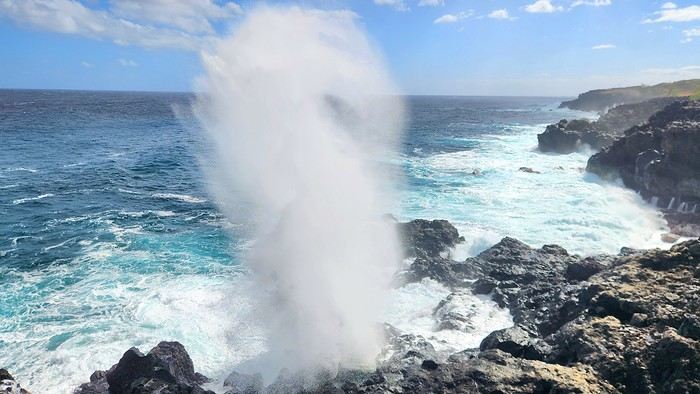
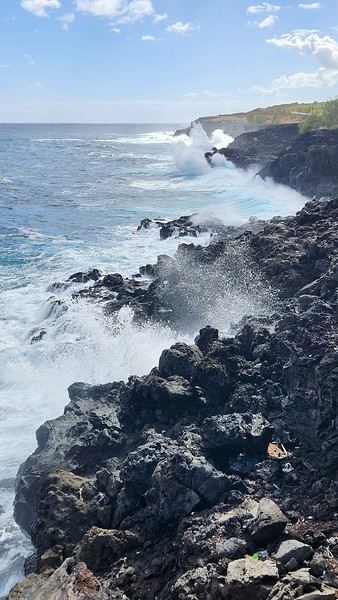
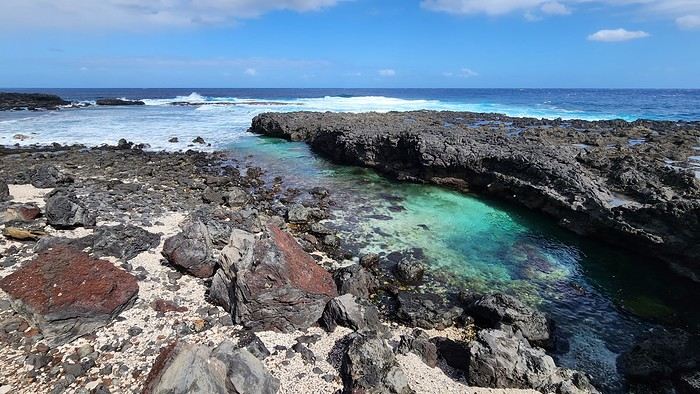
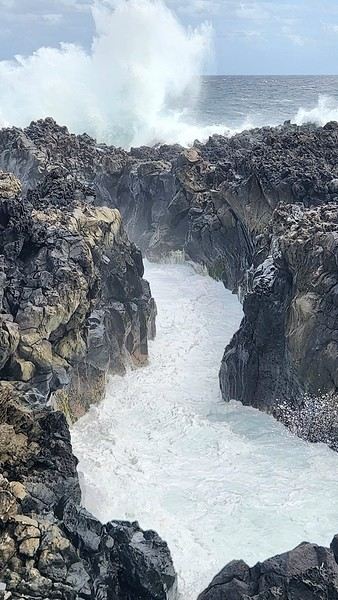
For the first week—the subject of this first installment—we’re taking it easy. We’ll start by rediscovering the coastline, from the Souffleur in Saint-Leu to the Hermitage lagoon, before a little trip to the Cirque de Cilaos and its legendary road with 400 turns, just to get our legs warmed up.
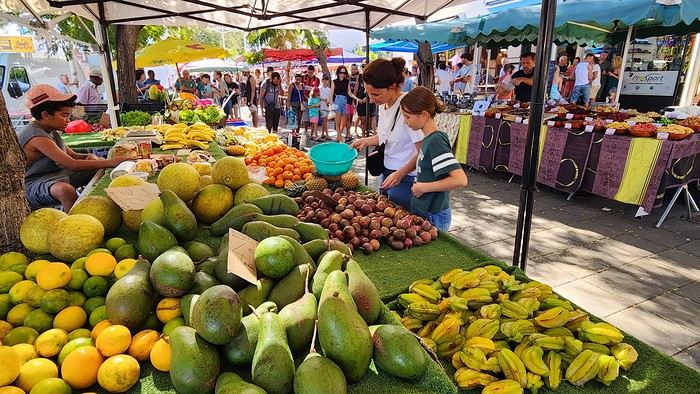
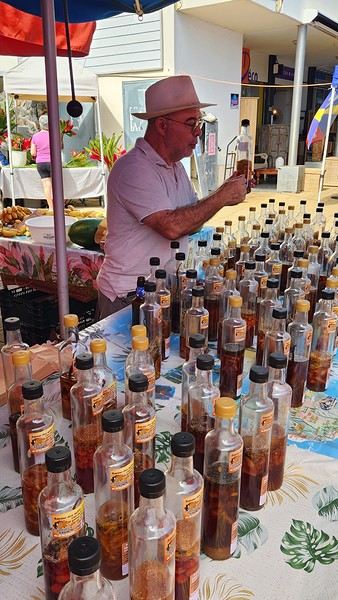
Traveling with just one spare pair of underwear, considering a hot shower a miracle, never staying in the same place too long by sleeping wherever night catches us, taking whatever local, improbable, and rickety transport we can find—this is the DNA of us wanderers. Except this time, the script for our movie is going to be a whole different genre. On paper, the destination doesn’t exactly scream epic adventure: Réunion! And what’s more... we won’t be two, or four, or even ten. We’ll be a solid thirty. All from the same family. Yes, thirty. At this point, it’s not just a trip—it’s a summer camp on the move! Why inflict this on such a peaceful island? Because my brother decided to get married there with his lovely bride. A great idea, you might say... especially when it involves relocating the equivalent of a small Ardennes village 10,000 kilometers from home for three weeks! So who’s stepping up to be the guide and wave the little flag?
So, for an exceptional trip, exceptional stories! Don’t worry, the debates at the supermarket over whether to choose plain chips or roast chicken chips, the beach picnics washed down with ti’ punch, and other rougail sausages to digest by the pool will only make it into the family archives. Here, I’ll stick to the tales of our beautiful escapes, the ones where we explore the wild corners of this little volcanic rock planted in the middle of the Indian Ocean. So where exactly are we headed?
For the first week—the subject of this first installment—we’re taking it easy. We’ll start by rediscovering the coastline, from the Souffleur in Saint-Leu to the Hermitage lagoon, before a little trip to the Cirque de Cilaos and its legendary road with 400 turns, just to get our legs warmed up.
Getting around in the Dominican Republic: is renting a car possible or too risky?
hi there,
I’m heading to the Dominican Republic (Punta Cana) at the end of October for 10 days at an all-inclusive hotel with my wife and kids (ages 8 and 10). Since I’m not a fan of spending entire days at the hotel, I was wondering what the best way(s) to explore the area might be.
Last year, I went to Mexico and rented a car, so I initially thought about doing the same here—but this time, I’d get full-coverage insurance, which I didn’t do in Mexico. After checking a few forums and reviews, though, I’m really second-guessing it because some posts make it sound completely crazy to drive there.
So, I’d love to hear from anyone who’s been there recently and rented a car, as well as the different ways to get around while you’re there.
Thanks everyone! !
One month in Quebec: any tips for a first itinerary without too much driving?
Hello,
I’ve just discovered this forum and I’m looking for your valuable advice. We’re planning to spend a month in Quebec from mid-July to mid-August 2027 with our young adult daughters. Everything looks so beautiful that we’re struggling to decide how to organize our trip beyond our stops in Montreal and Quebec City. We’ll be renting a vehicle to explore the province, but we don’t want to spend our entire vacation racking up kilometers. Do you have any suggestions for an itinerary?
Thank you for sharing your experiences!
Caroline & Matthieu
Thank you for sharing your experiences!
Caroline & Matthieu
From Amman to Jerusalem
I’m reposting here a travel journal originally published on the Routard forum in 2022 during VoyageForum’s hiatus. Without altering its content, I’ll try to streamline it. The few comments on the political situation reflect my feelings at the time and don’t account for events since then! I’d rather avoid debates on the topic. The photos are nothing fancy—just illustrative.
The context: we’re coming out of COVID. We’re looking for a not-too-distant destination, and Jordan has been catching our eye for a while. After some thought, we wonder if we shouldn’t take advantage of the geography to hop over to Israel. After all, Jerusalem is less than 100 km from Amman. Plus, Transavia lets you combine both destinations.
To plan our trip (February 19 to March 4, 2022), we contacted three French-speaking agencies in Amman. Their itinerary proposals were pretty similar, but the prices varied significantly. Given the many positive reviews we read on travel forums and a very attractive rate compared to competitors, we quickly settled on Ahmad Ababseh’s agency. Still, deep down, we had a slight worry—so many glowing reviews seemed a bit over the top, but we took the chance.
During the preparation, which happened in a very short timeframe (less than 10 days), Ahmad didn’t provide detailed roadbooks, and we made do with brief email or phone exchanges. Few details were shared either. We discussed hotels, with Ahmad preferring the ones he knew. We picked our hotel for our arrival in Amman, but before agreeing, Ahmad insisted on inspecting the rooms.
For payment, Ahmad only asked for a 500 € deposit and trusted our word for the balance, which we paid upon arrival. He also committed in writing to refund the full deposit if our trip was canceled due to COVID.
Finally, for the Israeli part, Ahmad contacted an agency in Jerusalem to handle the logistics. He didn’t take a commission.
What itinerary choices around Tromsø in January?
Hello,
We’ve booked our flights to Tromsø from January 9th to 16th, 2027.
Now it’s time to plan our stay, and I’ll admit I’m feeling a bit unsure...
We definitely intend to rent a car, but what route should we take?
Should we book accommodation for the entire stay (7 nights) in Tromsø and do day trips (Sommarøy, Kvaløya, Lyngen, a day in Tromsø, a boat excursion, and then... what else?)? Or spend 3–4 days in Tromsø and hit the road for another 3–4 days somewhere else—but where?
I’d also considered splitting it: 3 days in Tromsø and 3 days in Målselv, so we could explore a different region by car and maybe try some downhill or cross-country skiing.
Is this area interesting beyond skiing?
During a recent trip to Lapland, we already tried dog sledding and snowmobiling, so we’re not planning to repeat those activities. Instead, we’d love to discover the landscapes and Sami culture.
I’d love to hear about your experiences or suggestions to help us plan our trip.
Thanks,
October 2026 Photo Contest: "Stay Covered"!
Hello everyone!
The September contest “Making a Living on the Street” was won by Philippebrg, followed by Xrctn in second place, and I, the happy bronze medal winner, get to organize October’s challenge.
It’s hot—really hot—caliente! Protect yourselves!
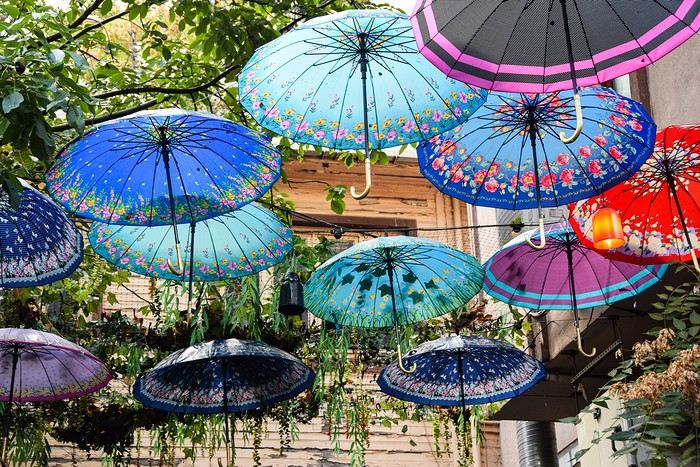
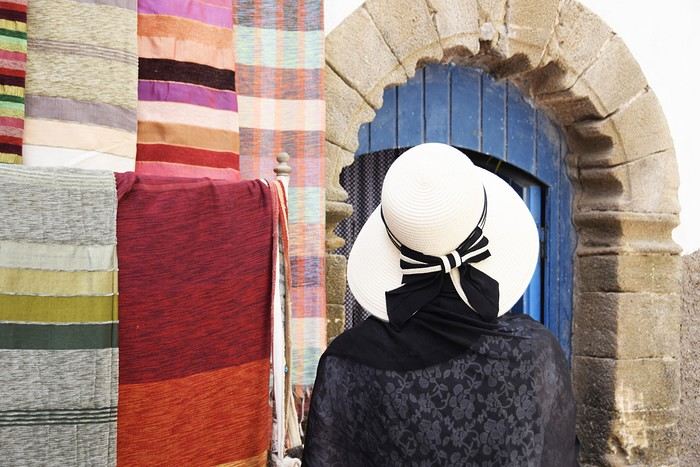
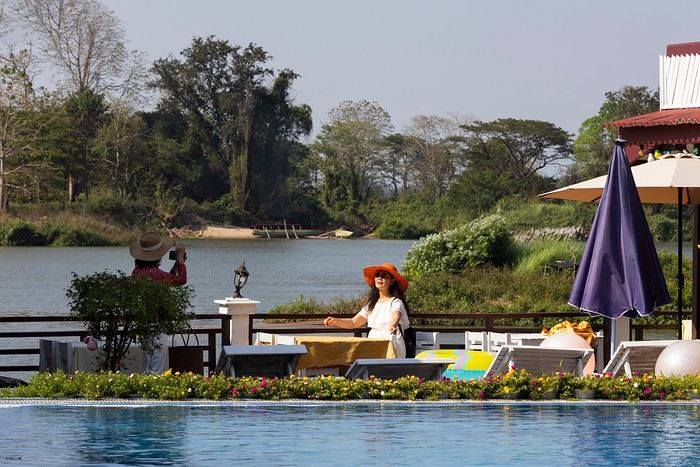
Parasols, umbrellas, sun hats, caps, shemaghs, tents, awnings, curtains, pergolas, sunglasses, sunscreen, trees, bits of cardboard... anything goes to shield yourself from Helios’ rays. Your photo must be taken in a context related to heat (a simple hat out of context won’t cut it).
The rules:
- Photo submissions until Sunday, October 25 at 11:59 PM (Paris time). You can post up to 3 photos, numbered and shared in separate messages, ideally with a short description of the location and the story behind it.
- Voting from Monday, October 26 at 12:01 AM to Saturday, October 31 at 11:59 PM. After the deadline, it’s too late! Please indicate the photo number, the username, and the points awarded: Photo #1 = 3 pts Photo #2 = 2 pts Photo #3 = 1 pt
- All VF members can vote (even those who didn’t submit photos).
- In case of a tie for first place, the winning photo will be the one with the most first-place votes, then second-place votes!
- The lucky winner will earn the admiration of all photo contest participants and the privilege of choosing the theme and organizing November 2026’s photo contest.
For discussions about the theme, check here.
Happy shooting!
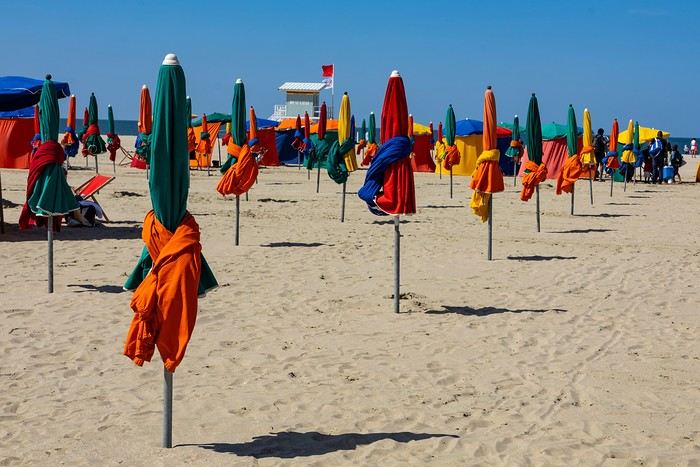
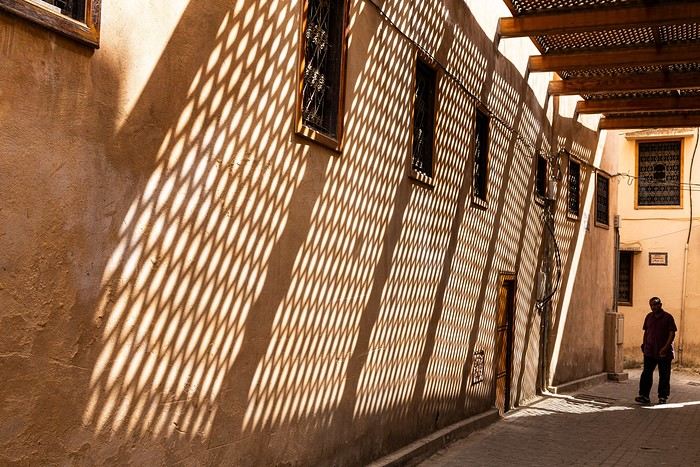
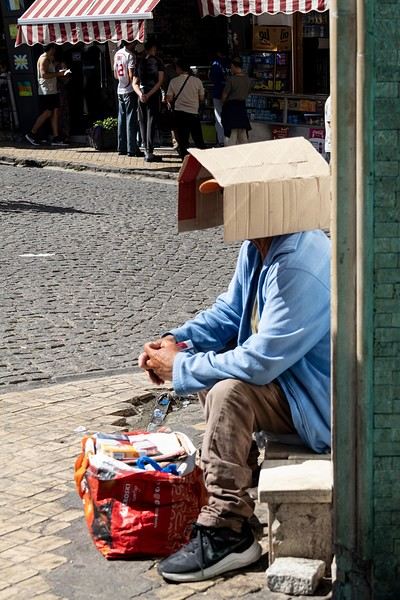
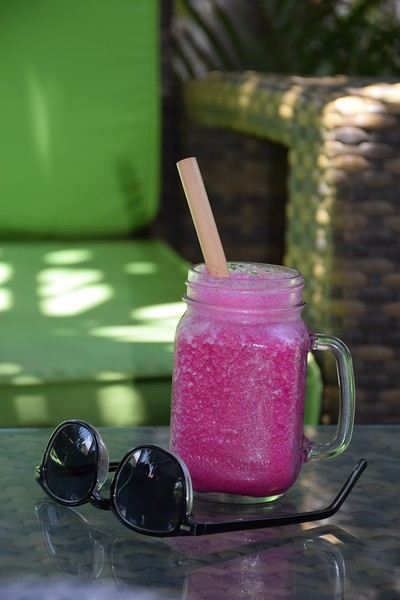
The September contest “Making a Living on the Street” was won by Philippebrg, followed by Xrctn in second place, and I, the happy bronze medal winner, get to organize October’s challenge.
It’s hot—really hot—caliente! Protect yourselves!
Parasols, umbrellas, sun hats, caps, shemaghs, tents, awnings, curtains, pergolas, sunglasses, sunscreen, trees, bits of cardboard... anything goes to shield yourself from Helios’ rays. Your photo must be taken in a context related to heat (a simple hat out of context won’t cut it).
The rules:
- Photo submissions until Sunday, October 25 at 11:59 PM (Paris time). You can post up to 3 photos, numbered and shared in separate messages, ideally with a short description of the location and the story behind it.
- Voting from Monday, October 26 at 12:01 AM to Saturday, October 31 at 11:59 PM. After the deadline, it’s too late! Please indicate the photo number, the username, and the points awarded: Photo #1 = 3 pts Photo #2 = 2 pts Photo #3 = 1 pt
- All VF members can vote (even those who didn’t submit photos).
- In case of a tie for first place, the winning photo will be the one with the most first-place votes, then second-place votes!
- The lucky winner will earn the admiration of all photo contest participants and the privilege of choosing the theme and organizing November 2026’s photo contest.
For discussions about the theme, check here.
Happy shooting!
Hesitating Between Two US Road Trips
Hey everyone, I’m torn between two 6-night destinations: New York City first, then a 15-day route:
New York City–Adirondacks
Adirondacks–Finger Lakes
Finger Lakes–Niagara Falls
Niagara Falls–Cleveland
Cleveland–Detroit
Detroit–Holland
Holland–Chicago
OR: New York City–Pittsburgh Pittsburgh–Lexington Lexington–Gatlinburg Gatlinburg–Great Smoky Mountains Great Smoky Mountains–Pigeon Forge Pigeon Forge–Gatlinburg Gatlinburg–Asheville Asheville–Roanoke Roanoke–Charlottesville Charlottesville–Lancaster Lancaster–Hudson Valley
OR: New York City–Pittsburgh Pittsburgh–Lexington Lexington–Gatlinburg Gatlinburg–Great Smoky Mountains Great Smoky Mountains–Pigeon Forge Pigeon Forge–Gatlinburg Gatlinburg–Asheville Asheville–Roanoke Roanoke–Charlottesville Charlottesville–Lancaster Lancaster–Hudson Valley
A little trip to Belgium
Introduction:
As has become a habit, I’ve organized a trip for late October—a surprise trip for my poor wife, who follows along without saying much (or almost nothing).
She knows she’s going away, when, but not where!
Our friends and family keep bombarding me with questions to get the info, but I’m holding strong.
The guesses are flying, the best one being, “Knowing him, he’s definitely heading somewhere sunny, even if all the southern destinations have already been done for a short stay.”
It makes me laugh because there are still a few places I haven’t discovered yet.
So yes, choosing to go to Belgium at the end of October—especially for someone as sensitive to the cold as I am—is bold.
I’m not quite at Philippe Abrams’ level, but still, heading *Noooorth* from me is pretty daring.
So, contrary to my friends’ predictions, I’m not flying south but taking my car, turning the wheel north, and off we go!
Day 1: The outbound trip When I say I’m not flying, it’s only half true because we’re leaving the day French media—with their signature doom-and-gloom—announce a terrible storm. While Storm Austen is indeed forecasted, the Belgians are reporting it as the first storm of the year with a bit more restraint. The drive won’t be entirely smooth as we reach the Hauts-de-France region: the wind is strong, the rain is heavy, but it’s not the apocalypse. Just drive carefully and slow down—sounds like a road safety message! We left Lyon at 8 AM and arrived in Bruges at 4 PM, “...and that’s even with the trucks at the entrance to Angoulême!” What’s he talking about—going through Angoulême? French cinephiles will get the reference. We got a warm welcome at our B&B, and since it was barely drizzling, we took a quick stroll around town to stretch our legs. Headed to the Markt, visited the Prinsenhof, the Palace of the Dukes of Flanders. We actually went in because it started pouring. It’s free, a first taste of Flemish culture, and it’s great.
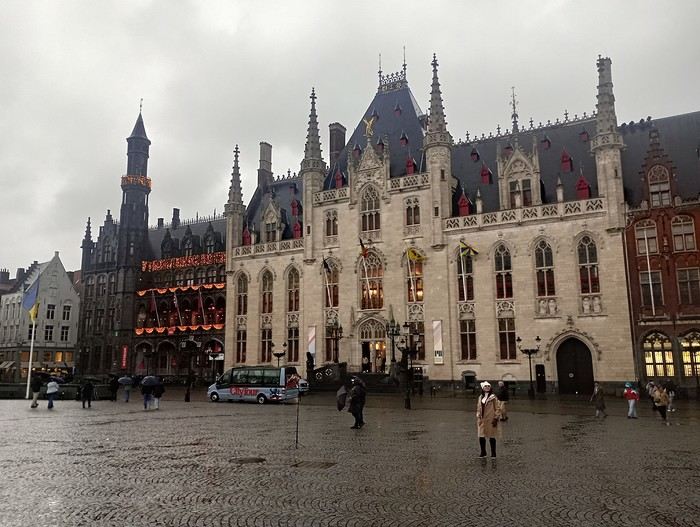
A little tired, we headed back to our B&B, mostly because the heavy rain forced us to. We got soaked (some people must be laughing). After drying off, we went to the nearest restaurant, Parazzar, typically Bruges-style, and my wife tried her first beer. Personally, I don’t like beer—*What the heck was I thinking?*—so I had a red wine, a Tinto, which would’ve been local back in Charles V’s time. First fries—because I *love* them—and it’s time to call it a night. A good night’s sleep awaits.
The +: We made it! The -: It’s raining, it’s windy, it’s wet—party at the...
Day 1: The outbound trip When I say I’m not flying, it’s only half true because we’re leaving the day French media—with their signature doom-and-gloom—announce a terrible storm. While Storm Austen is indeed forecasted, the Belgians are reporting it as the first storm of the year with a bit more restraint. The drive won’t be entirely smooth as we reach the Hauts-de-France region: the wind is strong, the rain is heavy, but it’s not the apocalypse. Just drive carefully and slow down—sounds like a road safety message! We left Lyon at 8 AM and arrived in Bruges at 4 PM, “...and that’s even with the trucks at the entrance to Angoulême!” What’s he talking about—going through Angoulême? French cinephiles will get the reference. We got a warm welcome at our B&B, and since it was barely drizzling, we took a quick stroll around town to stretch our legs. Headed to the Markt, visited the Prinsenhof, the Palace of the Dukes of Flanders. We actually went in because it started pouring. It’s free, a first taste of Flemish culture, and it’s great.
A little tired, we headed back to our B&B, mostly because the heavy rain forced us to. We got soaked (some people must be laughing). After drying off, we went to the nearest restaurant, Parazzar, typically Bruges-style, and my wife tried her first beer. Personally, I don’t like beer—*What the heck was I thinking?*—so I had a red wine, a Tinto, which would’ve been local back in Charles V’s time. First fries—because I *love* them—and it’s time to call it a night. A good night’s sleep awaits.
The +: We made it! The -: It’s raining, it’s windy, it’s wet—party at the...
Small Urban House – November 2026 Photo Contest Theme
Hi everyone,
The theme for November 2026’s contest is: **“Small Urban House”**
“Urban” means a house built next to other houses in a city, large town, or even a village at a push. So, no “little house on the prairie” or “my cabin in Canada” here!
“Small house” means it’s not very wide or tall. Ideally, it’s a single-story home, or at most two stories—any more and it starts looking like an apartment building.
The key is that this house is part of an urban setting, surrounded by other buildings—whether similar in size or taller—to highlight the contrast between the different structures next to it.
https://www.google.com/maps/@50.8134451,4.3414713,96a,75y,257.03h,104.58t/data=!3m7!1e1!3m5!1sqLM0rcKTlqcVw15ZvIMIbQ!2e0!6shttps:%2F%2Fstreetviewpixels-pa.clients6.google.com%2Fv1%2Fthumbnail%3Fcb_client%3Dmaps_sv.tactile%26w%3D900%26h%3D600%26pitch%3D-14.584468764168719%26panoid%3DqLM0rcKTlqcVw15ZvIMIbQ%26yaw%3D257.0263741294727!7i16384!8i8192?entry=ttu&g_ep=EgoyMDI2MTAyOC4wIKXMDSoASAFQAw%3D%3D.
Practical details:
**Participation** Each VF member can submit up to 3 photos, until Wednesday, 25/11 at 11:59 PM Brussels time. Each photo should be posted in a separate message, with its number (1, 2, or 3). Don’t forget to add a little explanation (comment, location, etc.).
**Voting** Each VF member can vote for the 3 photos they think are the best, based on their own criteria and the theme.
Voting runs from Thursday, 26/11 to Monday, 30/11 at 11:59 PM Brussels time. Results will be announced right after.
Photos will be ranked in order of preference: - 1st place: 3 points - 2nd place: 2 points - 3rd place: 1 point
The winner is the photographer with the most points.
Results will be published on 01/12. In case of a tie, the number of first-place votes will decide. The winner gets the honor of organizing December 2026’s contest!
Photos that have already been nominated (1st, 2nd, or 3rd place) in another contest are not eligible for this one.
This thread is **only** for contest submissions. Any discussions, comments, or chit-chat should go in the November 2026 “Small Urban House” Contest Discussion Thread.
Duane Allman: Master Guitarist and His Journey
Exceptional session musician and virtuoso slide guitarist
On the late afternoon of October 29, 1971, one of the world’s greatest guitarists, Duane Allman, was riding his motorcycle when he swerved to avoid hitting a flatbed truck that had suddenly stopped at an intersection. He ended up crashing into the back of the truck with such force that he was thrown under his bike, which skidded and dragged him for 50 feet (15 meters). The impact caused fatal injuries. Suffering from a collapsed chest, a ruptured coronary artery, and liver damage, Allman was pronounced dead three hours later. He was 24 years old. (adapted from The Guardian, 2026)
Duane Allman is widely regarded as one of the greatest guitarists of all time. He regularly appears in the top 10 rankings of the best guitarists on the planet, sometimes taking second place, just behind Jimi Hendrix.
Allman was an innovator who pushed electric guitar solos to new heights, especially when using a slide made from a Coricidin cough syrup bottle. He played a key role in creating the "Southern Rock" genre with The Allman Brothers Band and was at the heart of what many consider the best live album ever recorded (see below).
Additionally, Allman contributed to countless legendary recordings alongside artists like Wilson Pickett, Aretha Franklin, King Curtis, Boz Scaggs, and many others. He notably appeared on Derek and the Dominos’ cult double album, Layla and Other Assorted Love Songs, widely regarded as Eric Clapton’s masterpiece and one of the greatest rock and blues albums of all time.
These immense achievements would normally be the impressive legacy of a long and eventful career, but astonishingly, Allman accomplished all this in just a few short years—until his untimely death.
The Early Years
Howard Duane Allman was born on November 20, 1946, in Nashville, Tennessee. His brother, Gregory Lenoir (Gregg), was born a little over a year later, on December 8, 1947. In 1959, Gregg took a few guitar lessons, then bought his own guitar in 1960.
That same year, the two brothers attended a B.B. King concert, and Gregg began teaching his older brother the basics of guitar. Duane’s obvious talent allowed him to quickly surpass his younger sibling. Interestingly, both brothers were left-handed but played right-handed.
In July 1961, Duane bought a 1959 red Gibson Les Paul Junior. The two boys continued to practice diligently. During the first half of the 1960s, Duane and Gregg played in several bands, including The Kings, The Uniques, the Y Teens, The Misfits, The Shufflers, the Lindsay Morris Band, The House Rockers, Sweet William & The Stereos, and The Escorts.
In the summer of 1965, The Escorts changed their name to The Allman Joys, and Gregg began singing and playing the organ. Some of their recordings weren’t released until much later, in 1973, on an album titled Early Allman.
At the beginning of 1967, the Allman Joys changed their name to the Almanac, or Allman-Act, and moved to St. Louis, Missouri, where they met the Nitty Gritty Dirt Band and their manager. At his suggestion, the Allman-Act changed their name to the Hour Glass and relocated to Los Angeles. The group disbanded at the end of August 1968. Duane Allman went to Muscle Shoals in September and asked the owner of FAME Studios to hire him as a session musician. Allman eventually played on sessions for Clarence Carter and Wilson Pickett. Later that September, Gregg and Duane Allman reunited in Daytona Beach, Florida.
The Melody Master
It was during the second half of 1968 that Duane Allman discovered slide guitar—using a Coricidin cough syrup bottle as a slide. He studied recordings by blues and jazz greats like Robert Johnson, Elmore James, Muddy Waters, Kenny Burrell, Chuck Berry, and B.B. King, and later those of Jeff Beck and Eric Clapton.
While developing his slide style, Allman listened extensively to blues harmonica, particularly Sonny Boy Williamson’s, and replicated blues harmonica phrases on his slide guitar. He also studied jazz brass sections closely. He looped Miles Davis’ Kind of Blue endlessly.
All these varied influences gave birth to a unique guitar style, both fluid and raw, distinguished by impeccable timing and articulation. This is how Allman became a master of melody. He constructed his melodies and solos like a story, with a beginning, a middle, and an end.
Allman could play fast, but he also often used long phrases, modulating and varying the pitch of notes with exceptional fluidity and subtlety. Using feedback between his pickups and speakers to extend sustain was a key part of his sound. Allman was also an excellent rhythm and acoustic guitarist.
The Birth of the Allman Brothers Band
Allman played on numerous studio sessions, often uncredited since he was just lending a hand, but some of the most notable sessions were with Clarence Carter, Arthur Conley, Ronnie Hawkins, Boz Scaggs, and King Curtis. On November 27, 1968, he convinced Wilson Pickett to record a cover of The Beatles’ Hey Jude. Allman’s solo at the end of the track became legendary.
At the end of March 1968, Allman, seeking greater musical freedom, went to Jacksonville, where he began organizing jam sessions with friends. With Gregg Allman’s later arrival in Jacksonville, the first lineup of the Allman Brothers Band was complete. In addition to the two brothers, it included Dickey Betts on lead guitar, Berry Oakley on bass, and Butch Trucks and Jai Johanny "Jaimoe" Johanson on drums.
This grand lineup, featuring two drummers and two lead guitarists, would define the band’s sound. It resulted from Duane Allman hearing James Brown, the first bandleader to use two drummers, as well as his own studio overdubbing experiences, which created two melodic lines, sometimes doubled.
Southern Rock
The Allman Brothers Band began touring nonstop and built an excellent reputation as a live act. Gregg, too, flourished in his role as lead singer and songwriter. In August, the band went to Atlantic Studios in New York to record their self-titled debut album, released on November 4, 1969.
Despite mixed reviews, the album marked a significant artistic breakthrough and embodied the band’s "Southern Rock" style, blending rock, blues, jazz, and country. The band continued touring and recorded their second album, Idlewild South, over several months in 1970. It was released in September 1970.
Despite the band’s struggles to gain a wide audience, Duane Allman’s reputation as an exceptional guitarist spread worldwide. The Allman Brothers performed in Miami on August 26, while Eric Clapton and Derek and the Dominos were recording an album there. When Clapton learned that the guitarist from Hey Jude was playing in town, he attended the concert. The two guitar legends met after the show, hit it off immediately, and Duane Allman ended up playing on eleven of the fourteen tracks on Layla and Assorted Love Songs, including the title track.
The Most Influential
For the rest of 1970 and much of 1971, the Allman Brothers Band continued their relentless touring schedule. Given the band’s impressive reputation as a live act, releasing a live album was the logical next step: two concerts were recorded on March 12 and 13, 1971, at the Fillmore East in New York, and the barely edited result was released as the double album At Fillmore East. Upon its release on July 6, the album stormed the charts and became the Allman Brothers Band’s most successful record.
Over time, the significance of At Fillmore East grew so much that it is now considered one of the most influential live albums of all time. In 2004, the Library of Congress added it to the National Recording Registry, and it regularly appears in rankings of the greatest albums of all time. In 2020, the British newspaper *The Independent* called it "the greatest live album of them all."
In the fall of 1971, the Allman Brothers Band and Duane Allman were at the peak of their art in every way—until the tragedy of October 29.
A Grace
Everyone expected the Allman Brothers Band to call it quits, but they managed to record a double album in tribute to their fallen member. Eat a Peach was released in February 1972. The album went platinum. This success encouraged the band to continue, and they remained active—with a few brief breaks—until 2014. Gregg Allman wasn’t just a key member of the band; he also had a brilliant solo career until his death in 2017 at the age of 69.
What his younger brother Duane accomplished in his short life remains astonishing, and his guitar playing continues to inspire new generations of guitarists. More than fifty years after his death, his music still transcends time, generations, and cultures. This perfectly illustrates the power of music, and in these troubled times, it might be best to conclude with Allman’s own vision of it:
"There are a lot of different forms of communication, but music is absolutely the purest. You can’t hurt anybody with music. You can maybe offend somebody with songs and words, but you cannot offend anyone with music—it’s just all good. There’s nothing at all that could ever be bad about music. It’s a wonderful thing, a grace."
(https://producelikeapro.com/blog/duane-allman/)
Discography:
1969: The Allman Brothers Band 1970: Idlewild South 1971: Live at Fillmore East (2 LPs) 1972: Eat a Peach (2 LPs) 1973: Brothers and Sisters ........
https://www.youtube.com/watch?v=0y8Q2PATVyI&list=RD0y8Q2PATVyI&start_radio=1 Wilson Pickett & Duane Allman: Hey Jude
https://www.youtube.com/watch?v=Dy0S2-MCfpA&list=OLAK5uy_koM0c6t-qGf4d7KVzIPnEffnoWKaLUaUQ&index=2 Duane Allman: Goin' Down Slow
https://www.youtube.com/watch?v=gSDf2Usd8n4&list=RDEMKoJ1OUR8x83z7RAVG4kw3w&index=7 Duane Allman: Blue Sky
https://www.youtube.com/watch?v=P8oZAeL084Q&list=RDEMKoJ1OUR8x83z7RAVG4kw3w&index=8 The Allman Brothers Band: Mountain Jam (Duane Allman part)
https://www.youtube.com/watch?v=FUvxRjYqjEQ&list=RDFUvxRjYqjEQ&start_radio=1 The Allman Brothers Band: Whipping Post
Celebrity Equinox Cruise Review – October 20 to 30, 2026
Hello,
We just got back a few days ago from our cruise on the Equinox. While our previous cruises had gone more or less as planned, this one was full of setbacks from start to finish.
Here’s the 10-night itinerary: 10/20 Barcelona 10/21 Palma de Mallorca 10/22 at sea 10/23 La Spezia 10/24 Civitavecchia 10/25 Naples 10/26 at sea 10/27 Valletta 10/28 Palermo 10/29 at sea 10/30 Barcelona
The only port we knew a little was Rome, since we’d spent a night there a long time ago.
We booked through Logitravel in June 2026—the V2 balcony cabin was 3,199 € for four people. I’d hesitated to book, and sure enough, it wasn’t a great deal. A month later, in July, the price for the last V2 cabins at the front was 2,744 €, the category above (midship) was 2,953 €, and the one above that (midship with a larger balcony) was 3,117 €. Usually, I book ocean-view cabins, but none were available.
Also, when I booked, I’d chosen select dining (it was listed as available on Celebrity’s site), but when I received the cruise booklet, I discovered we’d been assigned to the second seating. I think it’s pretty poor of Logitravel not to keep us better informed about the change.
At the time of booking, the most convenient option from the north for transportation seemed to be the train there and the Barcelona-Brussels flight back. But if I’d waited until July, I would’ve had a good round-trip deal from Brussels too. I’ll come back to that.
Instead of spending a night in Barcelona, where hotels for four are very expensive, I’d opted to split the trip into two parts: the train to Montpellier the day before departure, then the Montpellier-Barcelona train the next day.
The trip to Montpellier went pretty well, but the first letdown: when we arrived, it was pouring rain, and the department was on orange alert for rain. So much so that the SNCF screens suggested postponing travel if possible and warned of potential train cancellations—right during the 24 hours we were traveling! Needless to say, the trip started off more stressful than anything else.
Our train arrived at Sud de France station, and I’d booked a hotel (Appart’City Saint-Roch, very nice) near Saint-Roch station since our train the next day was leaving from there. Because of the rain, I couldn’t even show the kids a bit of Montpellier. We just went to dinner close to the hotel and went back to sleep, crossing our fingers that our train the next day wouldn’t be canceled. It rained a lot during the night, but by the next morning, it had calmed down a lot. We got an email in the morning from Renfe saying our train would finally leave from Sud de France. So we had to leave the hotel earlier to get to the station. The train was announced with a few minutes’ delay, but it was there, and we eventually arrived in Barcelona without any issues, just a little quarter-hour late.
When we got to the Barcelona station hall, there was a huge "Taxis" sign on the left directing us outside (Peiro Square). There was a line of taxis and a few people waiting, but it moved quickly. It was around 1 PM when we got into a taxi, and we were expected for boarding between 1:30 and 2 PM. We got a very friendly driver who spoke French. The ride cost about 25 €, which was a good deal for four. We dropped off our suitcases at 1:25 PM. There were quite a few people, but it moved fast. Passport check, we were told the rooms would be ready at 2 PM, and we boarded. To be continued: arrival on board
Megacom SIM card, how does it work?
Hi there,
I’ve never bought a SIM card abroad or even used prepaid cards in France...
So I’m wondering how it all works?
You buy a SIM card and pop it into your phone. Okay, so far so good... 😏
But after that?
I can’t find the price of prepaid cards or how they work with MegaCom.
If someone could give me a step-by-step guide... 😊
Thanks! 🙂
June 2026 Theme Thread: Such a Beautiful Landscape
This is where we chat.
June 2026 Photo Contest Theme: Such a Beautiful Landscape
Hello,
It might not be very original, but I see it hasn’t been suggested—or at least not for a very long time. I’d like to invite you to discover the beauty of the great outdoors through landscape photos. Whether they’re desert, sea, countryside, or mountain scenes—with or without other elements (people, buildings, animals, etc.)—they should make us want to dive right in without hesitation.
To participate: Photo submissions until Wednesday, June 24 at 11:59 PM You can post up to 3 photos, numbered and shared in separate messages, along with a short description of the place and the story behind it.
To vote: from Thursday, June 25 at 12:01 AM to Monday, June 29 at 11:59 PM After the deadline, it’s too late!
Please include the photo number, username, and the points awarded: Photo #1 = 3 pts Photo #2 = 2 pts Photo #3 = 1 pt
All VF members can vote (even those who didn’t submit photos). In case of a tie for first place, the winning photo will be the one with the most first-place votes, then second-place votes! The lucky winner will get to organize July 2026’s photo contest.
For discussions about the theme, it’s here: Discussion thread for June 2026’s theme: Such a Beautiful Landscape
Good luck to everyone!
Philippe
Chumphon, Thailand: Doi Tapang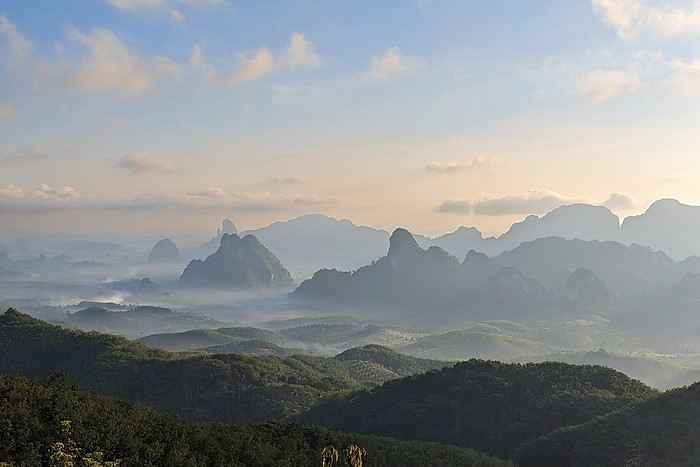
It might not be very original, but I see it hasn’t been suggested—or at least not for a very long time. I’d like to invite you to discover the beauty of the great outdoors through landscape photos. Whether they’re desert, sea, countryside, or mountain scenes—with or without other elements (people, buildings, animals, etc.)—they should make us want to dive right in without hesitation.
To participate: Photo submissions until Wednesday, June 24 at 11:59 PM You can post up to 3 photos, numbered and shared in separate messages, along with a short description of the place and the story behind it.
To vote: from Thursday, June 25 at 12:01 AM to Monday, June 29 at 11:59 PM After the deadline, it’s too late!
Please include the photo number, username, and the points awarded: Photo #1 = 3 pts Photo #2 = 2 pts Photo #3 = 1 pt
All VF members can vote (even those who didn’t submit photos). In case of a tie for first place, the winning photo will be the one with the most first-place votes, then second-place votes! The lucky winner will get to organize July 2026’s photo contest.
For discussions about the theme, it’s here: Discussion thread for June 2026’s theme: Such a Beautiful Landscape
Good luck to everyone!
Philippe
Chumphon, Thailand: Doi Tapang
Africa: A Heartfelt Love for a Continent
“When the Whites came to Africa, we had the land and they had the Bible. They taught us to pray with our eyes closed: when we opened them, the Whites had the land and we had the Bible.” Jomo Kenyatta (p.7)
The Maggi cube, an unchallenged hegemony, and so much more
“The hopeless continent,” headlined The Economist, a British magazine, in July 2000 about Africa. Eleven years later, the same magazine headlined “Africa rising” instead. Images of Africa in the prosperous North constantly oscillate between apocalyptic scenarios and enthusiastic projections. A key issue with such images lies in the generalization they entail. If you look at the continent, considerable contrasts emerge depending on space and time. It’s no surprise that a region of the world encompassing such diverse ecological zones, maintaining such varied ties with other continents, comprising nearly fifty nation-states in sub-Saharan Africa alone, and characterized by a great diversity of languages, belief systems, and historical paths, doesn’t share a single destiny.
And yet, for many people outside Africa, as well as for many Africans, the continent constitutes a single entity, defined by criteria such as skin color, a colonial past, poverty, and the art of survival. Until now, these perspectives were generally accompanied by the idea that Africa had to—or should have—followed a single path together, sometimes called development, sometimes modernization, sometimes liberation, then a market economy. None of these paths delivered on their promises.
The two writers Alain Mabanckou and Abdourahman Waberi—one from Congo, the other raised in Djibouti, both long settled in France and now professors at renowned North American universities (Los Angeles, Washington)—have had enough of pessimistic scenarios: “We are aware that Africa is in the world and the world is in Africa. The same goes for all other continents, as our destinies are inextricably linked for better or worse. We refuse to see Africa as a reservoir of misfortunes or a continent cursed by atavistic misfortune and characterized by ethnic conflicts. [...] It’s this passionate flame we wanted to capture in a book [...] a kind of stroll through African cultures, without any demands, each letter of the alphabet leading us to a notion, a practice, a concept, a moment in history, literature, painting, politics, economics, cuisine, etc.” (p.10-11). Africa, they write, is on the verge of “imposing a signature, a style, a way of being in the world and in relation to the rest of the world.” (p.11) To put words to the continent’s diversity and dynamism, the two authors created a “rambling ABC,” a kind of portrait—or more precisely, a mythography—that lets you see and feel the pulse of a vast continent whose cultural power is unfolding before our eyes. Once marginalized or even mocked, the voice and importance of the Continent in global affairs are now undeniable” (p.11), containing over a hundred entries, mostly concise, written in a relaxed and casual style. The optimistic, even exuberant tone is set from the brief introduction. The duo of authors wants to “sing a love song to the cultures of our continent, to its inhabitants past and present, to its exceptional resources and its spectacular globalization despite a certain pollution that still clouds our skies due to the unmatched duration of dictatorships in some of our regions.” (p.12) In doing so, they don’t want to be too distracted by today’s Afewerki-Biya-Bongo-Déby & Co. ...
Of course, you’ll find tributes to great precursors like Frantz Fanon (“[...] it was a love story and admiration that wasn’t dimmed by the four decades separating his birth from ours. Let’s add that we were born while the native of Fort-de-France had left the world’s stage four years earlier, in the prime of life” p.141), Mongo Beti (“You must read and reread Mongo Beti, a genius who used his fame to support often just causes in Africa, like defending oppressed groups. His place is already in History. His oppressors, like the dictators Ahmadou Ahidjo and Paul Biya, can’t compete in the same category” p.64), the Malian Amadou Hampâté Bâ
(“Posterity remembers him mainly as an tireless defender of African cultures. His plea for the collection and preservation of traditional African knowledge remains a major event for all men and women of good will. One day in 1960, at the UNESCO podium, the native of Bandiagara sounded the alarm: ‘[...] Since we’ve admitted that the humanity of each people is the heritage of all humanity, if African traditions aren’t collected in time and written down, they’ll one day be missing from the universal archives of humanity.’” p.51),
Kwame Nkrumah, “one of the founders of Pan-Africanism, father of Ghana’s independence” (p.239), as well as the historian Cheikh Anta Diop, the writer, poet, and politician Aimé Césaire, and the economist and thinker Samir Amin, but also very warm tributes to certain contemporary African intellectuals like Souleymane Bachir Diagne and Achille Mbembe
(“A few years ago, in dominant economic circles, a rumor often resurfaced, usually disguised as a cold and scientifically proven analysis: Africa is useless. It’s a burden for the rest of the human community. With its 2% share in world trade, it would disappear from stock market radars without anyone noticing. So? Maybe it’ll be pulled up by other continents. Wanting to surpass itself is a crazy bet for Africans, they concluded. Arrogant or clueless, President Nicolas Sarkozy declared before an audience of students and teachers at Cheikh Anta Diop University in Dakar: ‘The African man hasn’t entered history enough [...] He only knows the eternal repetition of time marked by the endless repetition of the same gestures and words.’ That was in 2007. For decades, armed only with reason, an intellectual often steps up to debunk prejudices, lazy readings, and dishonest frameworks used as false fronts by those who, like Nicolas Sarkozy or former journalist Stephen Smith, out of ignorance, contempt, or condescension, distort African reality. This intellectual is none other than the historian and political scientist Achille Mbembe. This heir of Frantz Fanon, Amílcar Cabral, Jean-Marc Ela, and Fabien Eboussi-Boulaga was born in 1957 in Cameroon, in the Bassa region. Marked early by the upheavals of a fratricidal war, Achille Mbembe became the guardian of the memory of martyrs. After brilliant studies in Paris, he went on to teach at the best American universities, but the call of the Continent was stronger than anything else. In Dakar, he once directed CODESRIA (Council for the Development of Social Science Research in Africa) before joining the University of the Witwatersrand in Johannesburg, South Africa. Even though the author of *Critique of Black Reason* (Éditions La Découverte, 2015) spends a few months at Duke University in North Carolina, his observation post remains South Africa. From Johannesburg, Achille Mbembe scrutinizes Africa and the whole world. A lucid observer with an elegant and generous pen, Achille Mbembe knows how to blend big and small history: ‘I was born one day in July, as the month was drawing to a close. It was 1957, in that part of Africa recently named ‘Cameroon,’ a memory of the wonder that seized Portuguese sailors in the 15th century when, sailing up the river near Douala, they couldn’t help but note the presence of a multitude of crustaceans, and named it *Rio dos Camarões*, meaning ‘River of Shrimp.’ I grew up in the shadow of this nameless land, since, in a way, the name it bears is only the product of someone else’s astonishment: a lexical mistake, if you will.’ From this mistake or wound, he made leaven, a springboard to compose a rich work, recognized worldwide. To denounce barriers and barbarians too. But that’s not enough. Among his peers in circles of thought and action, Achille Mbembe passionately and consistently defends human dignity and the beauty of the world. In doing so, he fulfills the mission Frantz Fanon entrusted to him.” (p.227-229),
as well as entries dedicated to lesser-known artists and intellectuals, like the French journalist and activist Rokhaya Diallo, daughter of Senegalese and Gambian parents, or the Ethiopian filmmaker Haile Gerima, who has long lived in the United States. Other names from politics, sports, music, art, and literature: Kofi Annan, p.36; Barack Obama, p.243; Thomas Sankara, p.277; Ousmane Sow, p.285; Yambo Ouologuem, p.250; Léopold Sédar Senghor, p.282; Muhammad Ali, p.30; Nuruddin Farah, p.146; Salif Keita, p.203; Ahmadou Kourouma, p.206; Ngũgĩ wa Thiong’o, p.236; Winnie Mandela, p.224; Kylian Mbappé, p.226 ...
The authors, who resolutely commit to a “mythography” (p.11) of Africa, also pay special attention to local social movements, cultural events, and aspects of daily life. *Y’en a marre*, “which also meant ‘we’re fed up with sitting on our hands’” (p.320-321), emerged about a decade ago in Senegal as a citizen movement of peaceful resistance and symbolizes, the authors emphasize, the fact that African youth are increasingly fed up “with the political circus deployed in Africa since independence, as our parents would say, ‘since the White man left’...” (p.321). A full entry is dedicated to the Maggi bouillon cube, which has flooded African markets for about forty years and enjoys immense popularity (“It’s everywhere in Africa, from Dakar to Djibouti, and from Tangier to Cape Town. It’s in every pot, every stew. Little hands put it in every sauce, every local or adapted dish. An unchallenged hegemony! You’ll find it in diasporas too. The culinary strolls in Paris, in the [...] neighborhood” p.90). Critics blame it not only for impoverishing the aromatic diversity of local dishes but also for being harmful to health. And yet, “he poorest Africans, those who eat only once a day, a few spoonfuls of white beans and a ball of *foufou*, for example, are the most fervent users of the magic cube.” (p.92-93)
For *fonio*, “the new trendy cereal. [...] From the millet family, fonio is probably the oldest cereal cultivated in West Africa, and mainly in its sub-Saharan part, for millennia. [...] Easy to grow, water-efficient, fonio grows everywhere except on clay soils. Long neglected because it was considered the poor man’s crop, fonio is now a source of pride for the farmers who cultivate it and cherish it like the apple of their eye” (p.156-157), the authors immediately offer a detailed recipe, letting the reader know that “e can’t resist sharing this fonio with chicken recipe from Mali with you:
Ingredients: 1 chicken 3 large ripe red tomatoes 4 tbsp tomato paste 4 large onions 1 garlic clove 1/2 cup oil 2 Maggi cubes or salt 2 large carrots 1 turnip 1 large cabbage 2 large potatoes 1 celery stalk 1 packet pre-cooked fonio 4 okra (or okra powder) salt, pepper
Preparation: 1. Prepare the sauce: wash and cut the chicken. Peel the onions, garlic, and vegetables. 2. In a pot, fry the chicken pieces. 3. Dice the onions, tomatoes, carrots, and turnip very small and add them to the pot. 4. Add the tomato paste, salt, and pepper. 5. Simmer for 15 min, then add 2 L of water and the cooked chicken pieces. 6. Simmer for 30 min, then add the crushed garlic and celery, plus the cabbage cut into 4 and the potatoes cut in half. 7. Prepare the fonio: cover it with warm water, let it rest for 15 min, and cook it over low heat. 8. In a small pot, boil the okra and crush them. 9. Mix the crushed okra with the cooked fonio, then salt. Serve hot.” (p.158-159)
The comedy *Black Mic Mac*, released in French theaters in 1986 and addressing France’s increasingly restrictive immigration policy at the time, also gets an entry, as do *Tintin in the Congo*, the popular comic, and *Jip’s Café* (“[...] a little Africa in the heart of Paris, with passersby stopping to admire the ‘ambianceurs’ on the dance floor or attend the cultural events offered by the place” (p.194), an African establishment in Paris that Alain Mabanckou already immortalized in one of his novels.
The duo of authors also tackles thorny subjects like jihadism (p.119), the Rwandan genocide (p.272), the CFA franc (p.82), and dictatorship (p.110). While the two strike the right tone here, many entries leave a slightly bitter taste. Two examples: why doesn’t the text on Barack Obama mention the great disappointment of many people in Africa, who expected more from the African policy of the first U.S. president with African roots than just occasional warm words? Why do the comments on Winnie Mandela gloss over the fact that she was a highly controversial icon of the anti-apartheid movement due to her involvement in kidnappings, acts of torture, and murders of alleged apartheid collaborators? Instead, there’s a compassion that brings tears to the eyes: “She was often reduced to a secondary role, the wife of a great man” or “When victory came, she didn’t taste its fruits. Divorced, isolated. She would never be a ‘first lady’ in an evening gown, posing before a bed of chrysanthemums. They’d keep her far from the circles of power” (p.224-225). At this point, I would’ve liked the authors to take a slightly more critical stance...
That said, these “weaknesses” (if you can call them that) shouldn’t overshadow the book as a whole. It remains an informative, sometimes very entertaining, and often even original work in its own way.
Book information (the original French and the German translation):
Alain Mabanckou/Abdourahman Waberi. Dictionnaire enjoué des cultures africaines. Fayard, 2019. Alain Mabanckou/Abdourahman Waberi. Der Puls Afrikas. Eine Liebeserklärung von A bis Z. Reclam, 2022.
Hery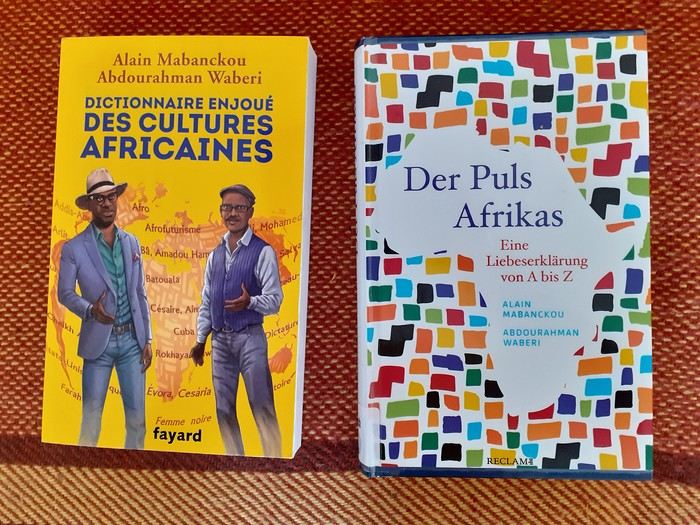
The Maggi cube, an unchallenged hegemony, and so much more
“The hopeless continent,” headlined The Economist, a British magazine, in July 2000 about Africa. Eleven years later, the same magazine headlined “Africa rising” instead. Images of Africa in the prosperous North constantly oscillate between apocalyptic scenarios and enthusiastic projections. A key issue with such images lies in the generalization they entail. If you look at the continent, considerable contrasts emerge depending on space and time. It’s no surprise that a region of the world encompassing such diverse ecological zones, maintaining such varied ties with other continents, comprising nearly fifty nation-states in sub-Saharan Africa alone, and characterized by a great diversity of languages, belief systems, and historical paths, doesn’t share a single destiny.
And yet, for many people outside Africa, as well as for many Africans, the continent constitutes a single entity, defined by criteria such as skin color, a colonial past, poverty, and the art of survival. Until now, these perspectives were generally accompanied by the idea that Africa had to—or should have—followed a single path together, sometimes called development, sometimes modernization, sometimes liberation, then a market economy. None of these paths delivered on their promises.
The two writers Alain Mabanckou and Abdourahman Waberi—one from Congo, the other raised in Djibouti, both long settled in France and now professors at renowned North American universities (Los Angeles, Washington)—have had enough of pessimistic scenarios: “We are aware that Africa is in the world and the world is in Africa. The same goes for all other continents, as our destinies are inextricably linked for better or worse. We refuse to see Africa as a reservoir of misfortunes or a continent cursed by atavistic misfortune and characterized by ethnic conflicts. [...] It’s this passionate flame we wanted to capture in a book [...] a kind of stroll through African cultures, without any demands, each letter of the alphabet leading us to a notion, a practice, a concept, a moment in history, literature, painting, politics, economics, cuisine, etc.” (p.10-11). Africa, they write, is on the verge of “imposing a signature, a style, a way of being in the world and in relation to the rest of the world.” (p.11) To put words to the continent’s diversity and dynamism, the two authors created a “rambling ABC,” a kind of portrait—or more precisely, a mythography—that lets you see and feel the pulse of a vast continent whose cultural power is unfolding before our eyes. Once marginalized or even mocked, the voice and importance of the Continent in global affairs are now undeniable” (p.11), containing over a hundred entries, mostly concise, written in a relaxed and casual style. The optimistic, even exuberant tone is set from the brief introduction. The duo of authors wants to “sing a love song to the cultures of our continent, to its inhabitants past and present, to its exceptional resources and its spectacular globalization despite a certain pollution that still clouds our skies due to the unmatched duration of dictatorships in some of our regions.” (p.12) In doing so, they don’t want to be too distracted by today’s Afewerki-Biya-Bongo-Déby & Co. ...
Of course, you’ll find tributes to great precursors like Frantz Fanon (“[...] it was a love story and admiration that wasn’t dimmed by the four decades separating his birth from ours. Let’s add that we were born while the native of Fort-de-France had left the world’s stage four years earlier, in the prime of life” p.141), Mongo Beti (“You must read and reread Mongo Beti, a genius who used his fame to support often just causes in Africa, like defending oppressed groups. His place is already in History. His oppressors, like the dictators Ahmadou Ahidjo and Paul Biya, can’t compete in the same category” p.64), the Malian Amadou Hampâté Bâ
(“Posterity remembers him mainly as an tireless defender of African cultures. His plea for the collection and preservation of traditional African knowledge remains a major event for all men and women of good will. One day in 1960, at the UNESCO podium, the native of Bandiagara sounded the alarm: ‘[...] Since we’ve admitted that the humanity of each people is the heritage of all humanity, if African traditions aren’t collected in time and written down, they’ll one day be missing from the universal archives of humanity.’” p.51),
Kwame Nkrumah, “one of the founders of Pan-Africanism, father of Ghana’s independence” (p.239), as well as the historian Cheikh Anta Diop, the writer, poet, and politician Aimé Césaire, and the economist and thinker Samir Amin, but also very warm tributes to certain contemporary African intellectuals like Souleymane Bachir Diagne and Achille Mbembe
(“A few years ago, in dominant economic circles, a rumor often resurfaced, usually disguised as a cold and scientifically proven analysis: Africa is useless. It’s a burden for the rest of the human community. With its 2% share in world trade, it would disappear from stock market radars without anyone noticing. So? Maybe it’ll be pulled up by other continents. Wanting to surpass itself is a crazy bet for Africans, they concluded. Arrogant or clueless, President Nicolas Sarkozy declared before an audience of students and teachers at Cheikh Anta Diop University in Dakar: ‘The African man hasn’t entered history enough [...] He only knows the eternal repetition of time marked by the endless repetition of the same gestures and words.’ That was in 2007. For decades, armed only with reason, an intellectual often steps up to debunk prejudices, lazy readings, and dishonest frameworks used as false fronts by those who, like Nicolas Sarkozy or former journalist Stephen Smith, out of ignorance, contempt, or condescension, distort African reality. This intellectual is none other than the historian and political scientist Achille Mbembe. This heir of Frantz Fanon, Amílcar Cabral, Jean-Marc Ela, and Fabien Eboussi-Boulaga was born in 1957 in Cameroon, in the Bassa region. Marked early by the upheavals of a fratricidal war, Achille Mbembe became the guardian of the memory of martyrs. After brilliant studies in Paris, he went on to teach at the best American universities, but the call of the Continent was stronger than anything else. In Dakar, he once directed CODESRIA (Council for the Development of Social Science Research in Africa) before joining the University of the Witwatersrand in Johannesburg, South Africa. Even though the author of *Critique of Black Reason* (Éditions La Découverte, 2015) spends a few months at Duke University in North Carolina, his observation post remains South Africa. From Johannesburg, Achille Mbembe scrutinizes Africa and the whole world. A lucid observer with an elegant and generous pen, Achille Mbembe knows how to blend big and small history: ‘I was born one day in July, as the month was drawing to a close. It was 1957, in that part of Africa recently named ‘Cameroon,’ a memory of the wonder that seized Portuguese sailors in the 15th century when, sailing up the river near Douala, they couldn’t help but note the presence of a multitude of crustaceans, and named it *Rio dos Camarões*, meaning ‘River of Shrimp.’ I grew up in the shadow of this nameless land, since, in a way, the name it bears is only the product of someone else’s astonishment: a lexical mistake, if you will.’ From this mistake or wound, he made leaven, a springboard to compose a rich work, recognized worldwide. To denounce barriers and barbarians too. But that’s not enough. Among his peers in circles of thought and action, Achille Mbembe passionately and consistently defends human dignity and the beauty of the world. In doing so, he fulfills the mission Frantz Fanon entrusted to him.” (p.227-229),
as well as entries dedicated to lesser-known artists and intellectuals, like the French journalist and activist Rokhaya Diallo, daughter of Senegalese and Gambian parents, or the Ethiopian filmmaker Haile Gerima, who has long lived in the United States. Other names from politics, sports, music, art, and literature: Kofi Annan, p.36; Barack Obama, p.243; Thomas Sankara, p.277; Ousmane Sow, p.285; Yambo Ouologuem, p.250; Léopold Sédar Senghor, p.282; Muhammad Ali, p.30; Nuruddin Farah, p.146; Salif Keita, p.203; Ahmadou Kourouma, p.206; Ngũgĩ wa Thiong’o, p.236; Winnie Mandela, p.224; Kylian Mbappé, p.226 ...
The authors, who resolutely commit to a “mythography” (p.11) of Africa, also pay special attention to local social movements, cultural events, and aspects of daily life. *Y’en a marre*, “which also meant ‘we’re fed up with sitting on our hands’” (p.320-321), emerged about a decade ago in Senegal as a citizen movement of peaceful resistance and symbolizes, the authors emphasize, the fact that African youth are increasingly fed up “with the political circus deployed in Africa since independence, as our parents would say, ‘since the White man left’...” (p.321). A full entry is dedicated to the Maggi bouillon cube, which has flooded African markets for about forty years and enjoys immense popularity (“It’s everywhere in Africa, from Dakar to Djibouti, and from Tangier to Cape Town. It’s in every pot, every stew. Little hands put it in every sauce, every local or adapted dish. An unchallenged hegemony! You’ll find it in diasporas too. The culinary strolls in Paris, in the [...] neighborhood” p.90). Critics blame it not only for impoverishing the aromatic diversity of local dishes but also for being harmful to health. And yet, “he poorest Africans, those who eat only once a day, a few spoonfuls of white beans and a ball of *foufou*, for example, are the most fervent users of the magic cube.” (p.92-93)
For *fonio*, “the new trendy cereal. [...] From the millet family, fonio is probably the oldest cereal cultivated in West Africa, and mainly in its sub-Saharan part, for millennia. [...] Easy to grow, water-efficient, fonio grows everywhere except on clay soils. Long neglected because it was considered the poor man’s crop, fonio is now a source of pride for the farmers who cultivate it and cherish it like the apple of their eye” (p.156-157), the authors immediately offer a detailed recipe, letting the reader know that “e can’t resist sharing this fonio with chicken recipe from Mali with you:
Ingredients: 1 chicken 3 large ripe red tomatoes 4 tbsp tomato paste 4 large onions 1 garlic clove 1/2 cup oil 2 Maggi cubes or salt 2 large carrots 1 turnip 1 large cabbage 2 large potatoes 1 celery stalk 1 packet pre-cooked fonio 4 okra (or okra powder) salt, pepper
Preparation: 1. Prepare the sauce: wash and cut the chicken. Peel the onions, garlic, and vegetables. 2. In a pot, fry the chicken pieces. 3. Dice the onions, tomatoes, carrots, and turnip very small and add them to the pot. 4. Add the tomato paste, salt, and pepper. 5. Simmer for 15 min, then add 2 L of water and the cooked chicken pieces. 6. Simmer for 30 min, then add the crushed garlic and celery, plus the cabbage cut into 4 and the potatoes cut in half. 7. Prepare the fonio: cover it with warm water, let it rest for 15 min, and cook it over low heat. 8. In a small pot, boil the okra and crush them. 9. Mix the crushed okra with the cooked fonio, then salt. Serve hot.” (p.158-159)
The comedy *Black Mic Mac*, released in French theaters in 1986 and addressing France’s increasingly restrictive immigration policy at the time, also gets an entry, as do *Tintin in the Congo*, the popular comic, and *Jip’s Café* (“[...] a little Africa in the heart of Paris, with passersby stopping to admire the ‘ambianceurs’ on the dance floor or attend the cultural events offered by the place” (p.194), an African establishment in Paris that Alain Mabanckou already immortalized in one of his novels.
The duo of authors also tackles thorny subjects like jihadism (p.119), the Rwandan genocide (p.272), the CFA franc (p.82), and dictatorship (p.110). While the two strike the right tone here, many entries leave a slightly bitter taste. Two examples: why doesn’t the text on Barack Obama mention the great disappointment of many people in Africa, who expected more from the African policy of the first U.S. president with African roots than just occasional warm words? Why do the comments on Winnie Mandela gloss over the fact that she was a highly controversial icon of the anti-apartheid movement due to her involvement in kidnappings, acts of torture, and murders of alleged apartheid collaborators? Instead, there’s a compassion that brings tears to the eyes: “She was often reduced to a secondary role, the wife of a great man” or “When victory came, she didn’t taste its fruits. Divorced, isolated. She would never be a ‘first lady’ in an evening gown, posing before a bed of chrysanthemums. They’d keep her far from the circles of power” (p.224-225). At this point, I would’ve liked the authors to take a slightly more critical stance...
That said, these “weaknesses” (if you can call them that) shouldn’t overshadow the book as a whole. It remains an informative, sometimes very entertaining, and often even original work in its own way.
Book information (the original French and the German translation):
Alain Mabanckou/Abdourahman Waberi. Dictionnaire enjoué des cultures africaines. Fayard, 2019. Alain Mabanckou/Abdourahman Waberi. Der Puls Afrikas. Eine Liebeserklärung von A bis Z. Reclam, 2022.
Hery
USA Road Trip - November 2023
After staying in Aruba in November 2023, we picked up our camper van, which we had left in a hotel parking lot in Miami, Florida.
This isn’t our first road trip across the United States. Since we’re retired, we took the opportunity to travel along the American West Coast, starting with the Everglades in Florida to visit a few parks where we could spot alligators.
We also made a few stops in Mississippi and Texas to explore the most important cities in those states.
Did you know that Austin is home to the world’s largest urban bat colony? It’s truly impressive to see thousands of them take flight at dusk.
I invite you to keep reading this travel journal and watch the videos that’ll give you a little more insight into these different destinations.
Videos are embedded throughout the summary. Just click on the image to start the video.
To jump to a specific post, here are the relevant links:
FLORIDA:
Big Cypress National Preserve - Ochopee Captain Mitch's Everglades Airboat Tours Marco Island
MISSISSIPPI:
Exploring Biloxi
TEXAS:
Downtown Houston Corpus Christi San Antonio Attractions McNutt Sculpture Garden - San Antonio Mission San José - San Antonio Austin Attractions The World’s Largest Urban Bat Colony - Austin Downtown Fort Worth Attractions Downtown Dallas
Storm in the Canary Islands
15 days across Gran Canaria, El Hierro, and a dash of Tenerife under the storm Thérèse!
The planned itinerary will be slightly disrupted...
(The version without discussions is here)
The planned itinerary will be slightly disrupted...
(The version without discussions is here)
From Avignon to Casamance Without Flying
Hi there,
Last February, I made a trip using "public transport" from France to southern Senegal via Spain, Morocco, Western Sahara, and Mauritania.
It’s a journey of about 5,000 km, where I took trains (as far as Marrakech), ferries (to cross Gibraltar and then to reach Casamance from Dakar), and mostly buses on the long desert straightaways. I hadn’t planned any stops in advance or booked any hotels, except for the very first train to Spain, which left plenty of room for the unexpected. Why travel by land and sea? In recent years, flight-free travel has been gaining popularity. On social media, posts explaining how to cross Europe by train as quickly as possible go viral. Traveling without flying—and making sure people know about it—has become a great way to earn a badge of eco-responsibility: an essential totem for anyone wanting to prove both their dedication to the ecological cause and the wisdom of slow travel. I haven’t flown in years, and this journey to West Africa could easily be filed under "responsible travel." But it wouldn’t be honest to say that: in reality, it wasn’t really my aversion to flying that motivated this long trek. I see overland travel primarily as a way to experience the world’s geography at a grounded, earthly pace—the pace of the locals. Besides, I’ll be flying back, which disqualifies any claim to being a model of sustainability. So no eco-badge, and no adventurer’s badge either: you won’t find any heroic tales of camel rides in lost lands or mineral train wagons in this account (popular with influencers, the Mauritania iron ore train now attracts tourists from all over the world, turning "the experience" into something you "have to do at least once in your life"). This five-part story, written on the road, has no other ambition than to recount a journey through places and people, and to share the thoughts they inspire in me. As simply and, I hope, as humbly as possible.
I’m posting the episodes here, which you can also find on my blog (with more photos) at the following links:
Episode 1: Spain, from Avignon to Algeciras
Episode 2: Morocco, from Tangier to Tarfaya
Episode 3: Western Sahara, from Tarfaya to Guerguerat
Episode 4: Mauritania, from Guerguerat to Nouakchott
Episode 5: Senegal, from Rosso to Saloulou
To help those who might want to make the same trip, I’ve also put together a summary of the route with recommendations—you can read it at the end of the story and on the blog: From France to Senegal Without Flying: Route and Itinerary Recommendations
Happy reading, and safe travels!
Rome: Feedback on my 7-day itinerary
Hello,
We’re heading to Rome from 21/09, arriving in the early afternoon, and returning on 28/09, leaving in the morning. We’ve already booked our flight tickets and our accommodation in the city center: Via Ezio.
I’d love to get your feedback on our itinerary and if there are any visits we should book right now:
Monday 21 afternoon:
Largo di Torre Argentina: a sacred spot for cats.
Tuesday 22:
The Vatican: Vatican Museums and Sistine Chapel in the morning. Afternoon: St. Peter’s Basilica, the dome, and if possible, the necropolis.
Wednesday 23:
Morning: Colosseum, Roman Forum, and Palatine Hill. Afternoon: Trastevere neighborhood and the Monumento a Garibaldi.
Thursday 24:
Piazza Navona, Church of St. Louis of the French, the Pantheon, Campo de’ Fiori, Piazza Venezia, Piazza Santa Maria Maggiore, Trevi Fountain.
Friday 25:
Villa Borghese, Piazza del Popolo, Spanish Steps, Quirinale, Piazza della Repubblica, and Santa Maria degli Angeli.
Saturday 26:
Aventine and Testaccio neighborhoods, the Capuchin Crypt.
Sunday 27:
Ostia.
Monday 28:
Departure.
Are any days too packed, or should we add more visits?
Thanks for your input and help!
Cheers!
Anne
Off on an adventure in Sri Lanka
Day 1 – December 6
Our decision is our decision. And it’s firm and final. Next winter, our plane will spread its great wings toward the island of Ceylon! "Wait a minute... Ceylon... Ceylon... that name rings a bell, but I can’t quite place it on the globe Grandma gave me for Christmas! Ceylon... Oh right, I’ve got it: Ceylon is the name of my tea!" Exactly. But the name on your pretty tea box is also the one used until 1972 for this island nation, a speck on the Indian Ocean at the southern tip of the Indian subcontinent: Sri Lanka!
For this new adventure, I’m exceptionally leaving my Flo behind, cowardly replaced by a double dose of testosterone. To write the book of this journey with me, I’m bringing along my brother, who’s used to this kind of thing, and... a guest star: My model of resilience. My dad! All aboard! Or rather, all aboard our tuk-tuk! Yes, you read that right: A real tuk-tuk, a little colorful rolling box that putters along at two miles an hour. The idea? Well, Sri Lanka and its winding roads overlooking the vastness of lush nature are tailor-made for this kind of vehicle. And since it’s one of only two countries in the world that allow foreigners to rent and drive these mini speedsters, we’ll be crisscrossing the island in our two-square-meter rolling box. Plus, adopting this mode of transport is a surefire way to connect directly with the locals, who’ll surely be curious to see a foreigner driving their iconic vehicle. Not to mention the... let’s say... spicy anecdotes it might generate. I mean, heading into a subtropical zone with my jet-black dad and his unpredictable digestive flora while deliberately choosing the tuk-tuk as our *only* means of transport? That’s the winning combo for an unforgettable adventure! "More seriously, Dad, Sullivan, I’m already loving the idea of living this adventure together, the three of us—brothers and father..."
So, does the intro to this new adventure get your salivary glands going? Yes? Too bad. Because unfortunately, the program handed out by the lady at the entrance has been slightly... let’s say *crumpled*. Some might even say "scrunched up and nearly tossed in the trash." First, six days ago, as the countdown echoed in us like a call to adventure, Cyclone Ditwah grabbed Sri Lanka, played with it like a rag doll, and left it battered on the ground. The toll is devastating: over a thousand dead, thousands of homes wiped out by relentless rains, roads and railways swallowed by massive mudslides. A country wounded once again, after the civil war, the 2004 tsunami, and the post-Covid economic crisis.
But as if this weather disaster wasn’t enough to shake our unbreakable adventurer spirit, fate decided to mess with us further by cutting our trio down to two. The victim? My brother, violently turned away because of a simple date on his passport that didn’t match the border officials’ expectations. Return to sender!
So now it’s just the two of us allowed to board the Qatar Airways Airbus A380 for this trip. If he were here, Denis Brognart would say, "And in the end, only one remains!" Except I know you’ll be with us, following our adventures! Right?
Combined trip to the two islands: Mauritius and Réunion
Hi everyone, we’re planning a trip to Réunion for 6 nights and Mauritius for 7 nights in March 2027. I’m starting to look into it now. We’re not hikers, so I’d love to hear your thoughts!
Should we book flights and small hotels separately, or go for a flight-and-stay package? We don’t want to blow our budget (around 2800 € per person). Thanks! Gigi
Should we book flights and small hotels separately, or go for a flight-and-stay package? We don’t want to blow our budget (around 2800 € per person). Thanks! Gigi
A Bold Combo: Southern Peru, Bolivia, and Northern Chile
Hello everyone,
For our latest 3-week family trip (yes, the kids are growing up, and two of them are about to enter the working world), we’re heading to South America! For our first time on this continent, I had planned a classic 3-week loop in Peru.
But since we won’t be returning to this part of the world anytime soon, I thought: why not follow in the footsteps of Franck, aka Bibouns51, who, in 18 days, didn’t just stick to Peru but also added two of the planet’s most stunning landscapes to his itinerary... the Salar de Uyuni in Bolivia and its neighbor, the fabulous Atacama Desert in northern Chile !!
So, I set about the tricky task of limiting the regions we’d visit in Peru to those we considered must-sees, to avoid rushing too much. The visit schedules were optimized, including several comfortable overnight buses that have the huge advantage of letting us hop between regions.
So, we’re off on a somewhat adventurous trip with three domestic flights (two on the first day and one on the last), two overnight buses for quick hops, several car rentals, the services of a few drivers to make the trip more comfortable, and even a tour operator for crossing the Salar...
Our main concern is altitude sickness, and we’re bringing Diamox, aspirin, etc., just in case.
Our second worry before departure was not even getting off the ground... Yes, for once, we’re leaving from France—Marseille, to be exact. The week before our departure, with the surprise air traffic controllers’ strike, I remembered why we usually prefer to leave from abroad, like Turin or Barcelona... In the end, it wasn’t the air traffic controllers who made us nervous but the early July wildfires that paralyzed the airport a few days before our departure. Fortunately, the fires were quickly brought under control, and on the big day, everything was smooth sailing!
Detailed itinerary (which changed on Day 1 due to departure hiccups): Day 0: Flight Marseille - Madrid - Lima PERU Theoretical and abandoned Day 1: Flight Lima - Cuzco and visit Cuzco (Puka Pukara, Tambomachay, Cristo Blanco Observatory, Sacsayhuaman sunset) - Night in Cuzco Day 2: Taxi -> Chinchero - Moray - Maras Salt Mines - Ollantaytambo - Train to Aguas Calientes Day 3: Machu Picchu - Return train to Ollantaytambo Day 4: 2-day taxi -> Pisac - Tipon - Andahuaylillas - Huaro - Night in San Pedro Day 5: Palcoyo - Checacupe - Vinicunca - Return and night in Cuzco Day 6: Day in Cuzco (catch-up on Sacsayhuaman, San Blas district, Temple of the Sun) - Overnight bus to Arequipa Day 7: Rental car -> On the road to Colca Canyon, night in Cabanaconde Day 8: Descent to the bottom of Colca Canyon, night at Oasis Sangalle Day 9: Ascent from the canyon - Maca - Chivay - Return and night in Arequipa Day 10: Visit Arequipa (Santa Catalina Convent, La Recoleta Church and Monastery, La Compañía Church, Cathedral) - Overnight bus to Puno Day 11: Lake Titicaca - Night in Puno BOLIVIA Day 12: Shared taxi -> Road to La Paz, visit downtown La Paz - Night 1 in La Paz Day 13: Moon Valley and Las Animas Valley - Night 2 in La Paz Day 14: Day in La Paz - Night 3 in La Paz Day 15: Flight to Uyuni - Day 1 of Salar de Uyuni tour - Night at the edge of the Salar Day 16: Crossing the Lipez region and lagoons - Night near Laguna Colorada Day 17: Sol de Mañana CHILE Day 17 cont.: Pre-booked transfer to SPDA - 4x4 rental - Pukara de Quitor - Stargazing tour - Night 1 in SPDA Day 18: Death Valley and Moon Valley - Night 2 in SPDA Day 19: Miscanti and Miniques Lagoons, Salar de Aguas Calientes and its Piedra Roja, Tebenquiche Lagoon and Quebrada del Diablo - Night 3 in SPDA Day 20: Rainbow Valley and swim in the Puritama River - Night 4 in SPDA Day 21: Tebenquiche Lagoon - Bus to Calama - Flight to Santiago Day 22: Return Santiago - Madrid - Marseille
Day 0 - 11/07: Destination Lima
Our first flight from Marseille went smoothly to our Iberia layover in Madrid.
In Madrid, just after getting off the plane around 8 PM, and as we were walking through the terminal, we got a rude awakening!!
We saw the word "Cancelled" next to our flight number on the display boards. Thinking it must be a glitch, we checked another screen, but the system was stubborn, and the same dreaded word appeared !
So, we headed to the Iberia counter, where an agent confirmed that our Friday evening flight was canceled and rescheduled for the next morning. The reason? A breakdown and no replacement plane, even though we were in Madrid, Iberia’s home base!
To make matters worse, I remembered our super-tight schedule, planned to the minute, with no buffer day in Lima. Since I’m a bit phobic of megacities and hadn’t found anything appealing in the Peruvian capital in our guidebooks, we’d planned to leave Lima as soon as possible for Cusco, the heart of the Sacred Valley, to spend our first day there.
Bad idea, because we already knew the 4-hour buffer wouldn’t be enough, and we’d miss the domestic flight, which was, of course, non-refundable and non-changeable. So, we had to call LATAM from Madrid to find another flight for Saturday evening and negotiate a rate to recover some of our initial outlay.
After an hour on the phone with customer service, several endless holds, and three failed attempts to dictate our credit card number over the phone to a Spaniard speaking English with a thick accent, we finally managed to confirm the transaction, securing our new flight tickets for a moderate extra cost of just 150 € total.
At first, we were pretty bummed about losing a day and incurring extra fees to reschedule the domestic flight, but then, when we learned from an Iberia customer service rep that we’d receive the max compensation of 600 € per traveler, we even ended up grinning... because 3000 € in refunds for only losing the first day in Cusco? We’d sign up for that 10 times over!!
Iberia then took care of us, putting us up in a hotel where we had dinner before a short 5-hour night and an early morning departure. I took the opportunity to improvise a quick day of sightseeing in Lima, focusing on the Barranco and Miraflores districts.
Your thoughts on Senegal from Canada
Hello from Quebec,
I’m a French-Canadian from Montreal. I’d love to go to Senegal during the Quebec winter to shorten this long season. Two people told me it’s not worth spending a lot of money to get there from Canada because there’s not much to discover. But I’m still skeptical. I’d love to read real testimonials from travelers who’ve been there, with as much info as possible. Thanks
March 2026 Photo Contest Theme: Metal, Metallic
The 139th edition of this contest is now open, and this month’s theme is:
« Metal, Metallic».
From ore to rockets, wire to the Eiffel Tower—or in a pinch, even a self-portrait at the bottom of a spoon—the theme is broad enough that you should be able to come up with at least three ideas pretty easily! Sure, things might get tricky when it’s time to vote, but that could just be a sign of a successful contest, right?! But we’re not there yet.
Contest rules: You can post up to three photos, each in a separate message, clearly indicating their number (1, 2, or 3) along with the location where the photo was taken. Any explanations about your photos are welcome.
You’ll vote for three photos, clearly stating the name of the participant you’ve chosen, followed by the photo number. The first photo in your vote will receive three points, the second two points, and the third one point.
The winner will be the person whose photo earns the most points. In case of a tie, the winner will be the one with the most first-place votes—or, if still tied, the most second-place votes. Finally, if it’s a perfect tie, the winner will be the one who reached their score first. The winner will then have the pleasure of choosing the theme for the April 2026 contest and organizing it. Ties for any position other than first won’t be broken. Lastly, you don’t need to participate in the contest to vote. However, participants (and I hope there’ll be lots of you!) are strongly encouraged to vote!
Please only post contest photos in this thread, and starting Thursday, March 26 (00:01 Paris time), only votes.
Key dates: You can submit your photos starting today, Tuesday, March 3, 2026, until Wednesday, March 25, 2026 (23:59 Paris time). Voting will begin the minute after and end on Monday, March 30 (23:59 Paris time). Results will be announced on Tuesday, March 31, 2026 ... if all goes well!
A discussion thread for this contest is open HERE: The photorama can be found HERE
From the Awakening to Travel to Morocco in the 90s
As I’ve mentioned elsewhere, I inherited my love of travel from my parents and some of my grandparents. A strong passion, but one that was unfortunately limited by our family’s modest resources. Back then, living in northern Alsace, a simple trip to the southern part of the region—with the Wine Route as our destination—felt like an extraordinary journey to a land of plenty for the little boy I was in the late 60s and early 70s.
Everything seemed so huge when you were still just a kid.
Back then, I was overwhelmed by countless sensations—I was already highly sensitive, with a keen mind and a nose and taste buds that were developing like a pro’s. Which, as I’d later realize, wasn’t always an advantage.
Those magical days always began with a gentle late-spring or midsummer morning. The interior of the white Peugeot 404, license plate 210 LZ 67, had already soaked up the sun before the engine purred to life, and the cabin gave off a scent I could still recognize today—a fragrance I found so pleasant. Back then, I had no idea it was just the smell of warm plastic from the car’s interior. Yes, the scents of the 404 on sunny days became my madeleine de Proust... What’s more, the whole family was unusually cheerful because those moments of relaxation and leisure were rare. Everyone worked, and no one had an easy job or was well paid. Without the *Trente Glorieuses*, these experiences might never have happened.
Once we crossed the canton’s borders, I felt like I was light-years away from my everyday surroundings, and every kilometer plunged me deeper into *terra incognita*. It was thrilling. Far from my so-called "medium-sized" town, wheat fields, cornfields, and cabbage patches stretched out, punctuated by tall poles connected by long wires and topped with vegetation—like giant clotheslines without laundry, where magical beanstalks might grow to touch the sky. Back then, I was still far from tasting their product, which was simply beer. At the time, there was still a significant local hop production. Fun fact: it wasn’t until 2002 that Anglo-Saxon scientists proved hops and cannabis belong to the same biological family.
After the fields, the landscape took another step up as it rolled past the little boy’s eyes, often glued to the windows. First came modest hills, then a succession of rolling slopes that soon formed an unbroken chain. Their 700 meters in altitude felt like Himalayan peaks to me—impressive, inert giants, a whole new world. Gazing at them, an intense emotion welled up somewhere between my stomach and lungs, nearly taking my breath away. What mysteries, what treasures did these heights hold? And then there were the cherries on top—the crowning touch that made the scene even more magical: proud, majestic castles perched on the summits like impassive sentinels. Monuments from the past, yet firmly rooted in the present on their rocky spurs. The little boy’s eyes sparkled—he’d been given a castle for Christmas, complete with battlements, towers, a drawbridge, and fully armed knights. He’d watched and lived *Ivanhoe* on the only French TV channel that existed back then.
Only once did my paternal grandfather join us on one of these trips. A tall, intelligent man with a face that could shift from stern to mischievous, clearly full of humor and charisma. Sadly, his relationship with alcohol had taken a toll on his life and, by extension, those of his loved ones. He had a strong personality—if his boss crossed the line, he wouldn’t hesitate to punch him, which meant he went through a lot of different jobs. Back then, you could quit one job and easily find another. It was quite something to see him in his final stages, hallucinating pink elephants and even drinking perfume when he had nothing else left. The last time I saw him, he’d slipped away from the doctors and nurses while hospitalized in pretty bad shape—at least, I assume his liver was the issue. We were sitting down for a family lunch when the door burst open, and there he stood in his pajamas, eyes twinkling with mischief, clearly pleased with the dramatic entrance. That theatrical moment didn’t spare us from burying him a few months later at the age of 71. One day, my mother told me the family doctor had quietly remarked that it was a shame—with his robust constitution, he could’ve lived to be a hundred. Yes, the family doctor—this was the man who’d come treat you any day, at almost any hour, just for a phone call. It really existed, it’s not a myth!
That day, his wife—my paternal grandmother—was also along for the ride. Everyone agreed that Jeannette was a good woman. She worked as a waitress at *Le Tigre*, the biggest brasserie in town, right in the center. Most customers preferred to be served by her, including local dignitaries and even the mayor. As a kid, I didn’t find her very fun, open, or warm—she seemed a bit stern. Back then, women in their fifties already had the face and build of grandmothers. Same went for men, don’t get me wrong. I had no idea about the struggles she faced because of her husband. I didn’t know that 30 years earlier, she’d had to flee Alsace while pregnant, under threat from Nazi fighter-bombers. I didn’t know she’d had several miscarriages, and that my father—her only surviving child, born prematurely in March 1940 at the other end of France—weighed less than a kilo at birth and was so tiny he could fit in a shoebox. Hard to imagine he’d grow into a strapping man nearly 1.80 meters tall, tipping the scales at 100 kilos. When you come back from summer camp in early August and ask why she didn’t pick you up with your parents, and they gently tell you she’s "in heaven," you don’t realize she passed away at 54 after suffering greatly from stomach cancer that had spread.
Back to that family outing, that enchanted parenthesis. I even remembered where we’d had lunch when I passed through Dambach-la-Ville decades later. One of those charming, flower-filled towns Alsace produces in abundance—and preserves so well. This one sits high on a hill, and I was a bit stunned on the parking lot because the view stretched far, revealing the Alsace plain below—its fields, villages, hills, and forests. The world seemed so vast and enticing that day, even though I was only glimpsing a tiny fraction of it.
The region was already very touristy, but I wouldn’t notice the downsides until much later. That Sunday noon, I discovered a large restaurant filled with diners. I can still see the enormous piece of meat they served me, decorated with a little wooden skewer topped with a flag. I kept that one for a long time. Those were the golden days of rich, flowing, thick sauces—so flavorful—and the era of the world’s best fries, made on the spot with the best potatoes. To top it off, I was *exceptionally* allowed a small bottle of apple juice, Orangina, or—even better if possible—Sinalco. Yes, Sinalco—like Orangina, but better. A brand that must’ve disappeared in the 70s, but why, and what a shame! Since then, Orangina’s little bubbles have taken the brand to the other side of the planet—it’s now Japanese.
Year after year, I’d eagerly await that ecstatic moment when the most beautiful castle in Alsace, the Haut-Koenigsbourg, appeared in my field of vision. The perfect model, the archetype that blended into the landscape at the height of a child’s dreams. The trip home always felt like a reality check—less jarring than an alarm clock, but more diffuse and melancholic. From then on, there was only one wish: *When do we leave again?*
Those magical days always began with a gentle late-spring or midsummer morning. The interior of the white Peugeot 404, license plate 210 LZ 67, had already soaked up the sun before the engine purred to life, and the cabin gave off a scent I could still recognize today—a fragrance I found so pleasant. Back then, I had no idea it was just the smell of warm plastic from the car’s interior. Yes, the scents of the 404 on sunny days became my madeleine de Proust... What’s more, the whole family was unusually cheerful because those moments of relaxation and leisure were rare. Everyone worked, and no one had an easy job or was well paid. Without the *Trente Glorieuses*, these experiences might never have happened.
Once we crossed the canton’s borders, I felt like I was light-years away from my everyday surroundings, and every kilometer plunged me deeper into *terra incognita*. It was thrilling. Far from my so-called "medium-sized" town, wheat fields, cornfields, and cabbage patches stretched out, punctuated by tall poles connected by long wires and topped with vegetation—like giant clotheslines without laundry, where magical beanstalks might grow to touch the sky. Back then, I was still far from tasting their product, which was simply beer. At the time, there was still a significant local hop production. Fun fact: it wasn’t until 2002 that Anglo-Saxon scientists proved hops and cannabis belong to the same biological family.
After the fields, the landscape took another step up as it rolled past the little boy’s eyes, often glued to the windows. First came modest hills, then a succession of rolling slopes that soon formed an unbroken chain. Their 700 meters in altitude felt like Himalayan peaks to me—impressive, inert giants, a whole new world. Gazing at them, an intense emotion welled up somewhere between my stomach and lungs, nearly taking my breath away. What mysteries, what treasures did these heights hold? And then there were the cherries on top—the crowning touch that made the scene even more magical: proud, majestic castles perched on the summits like impassive sentinels. Monuments from the past, yet firmly rooted in the present on their rocky spurs. The little boy’s eyes sparkled—he’d been given a castle for Christmas, complete with battlements, towers, a drawbridge, and fully armed knights. He’d watched and lived *Ivanhoe* on the only French TV channel that existed back then.
Only once did my paternal grandfather join us on one of these trips. A tall, intelligent man with a face that could shift from stern to mischievous, clearly full of humor and charisma. Sadly, his relationship with alcohol had taken a toll on his life and, by extension, those of his loved ones. He had a strong personality—if his boss crossed the line, he wouldn’t hesitate to punch him, which meant he went through a lot of different jobs. Back then, you could quit one job and easily find another. It was quite something to see him in his final stages, hallucinating pink elephants and even drinking perfume when he had nothing else left. The last time I saw him, he’d slipped away from the doctors and nurses while hospitalized in pretty bad shape—at least, I assume his liver was the issue. We were sitting down for a family lunch when the door burst open, and there he stood in his pajamas, eyes twinkling with mischief, clearly pleased with the dramatic entrance. That theatrical moment didn’t spare us from burying him a few months later at the age of 71. One day, my mother told me the family doctor had quietly remarked that it was a shame—with his robust constitution, he could’ve lived to be a hundred. Yes, the family doctor—this was the man who’d come treat you any day, at almost any hour, just for a phone call. It really existed, it’s not a myth!
That day, his wife—my paternal grandmother—was also along for the ride. Everyone agreed that Jeannette was a good woman. She worked as a waitress at *Le Tigre*, the biggest brasserie in town, right in the center. Most customers preferred to be served by her, including local dignitaries and even the mayor. As a kid, I didn’t find her very fun, open, or warm—she seemed a bit stern. Back then, women in their fifties already had the face and build of grandmothers. Same went for men, don’t get me wrong. I had no idea about the struggles she faced because of her husband. I didn’t know that 30 years earlier, she’d had to flee Alsace while pregnant, under threat from Nazi fighter-bombers. I didn’t know she’d had several miscarriages, and that my father—her only surviving child, born prematurely in March 1940 at the other end of France—weighed less than a kilo at birth and was so tiny he could fit in a shoebox. Hard to imagine he’d grow into a strapping man nearly 1.80 meters tall, tipping the scales at 100 kilos. When you come back from summer camp in early August and ask why she didn’t pick you up with your parents, and they gently tell you she’s "in heaven," you don’t realize she passed away at 54 after suffering greatly from stomach cancer that had spread.
Back to that family outing, that enchanted parenthesis. I even remembered where we’d had lunch when I passed through Dambach-la-Ville decades later. One of those charming, flower-filled towns Alsace produces in abundance—and preserves so well. This one sits high on a hill, and I was a bit stunned on the parking lot because the view stretched far, revealing the Alsace plain below—its fields, villages, hills, and forests. The world seemed so vast and enticing that day, even though I was only glimpsing a tiny fraction of it.
The region was already very touristy, but I wouldn’t notice the downsides until much later. That Sunday noon, I discovered a large restaurant filled with diners. I can still see the enormous piece of meat they served me, decorated with a little wooden skewer topped with a flag. I kept that one for a long time. Those were the golden days of rich, flowing, thick sauces—so flavorful—and the era of the world’s best fries, made on the spot with the best potatoes. To top it off, I was *exceptionally* allowed a small bottle of apple juice, Orangina, or—even better if possible—Sinalco. Yes, Sinalco—like Orangina, but better. A brand that must’ve disappeared in the 70s, but why, and what a shame! Since then, Orangina’s little bubbles have taken the brand to the other side of the planet—it’s now Japanese.
Year after year, I’d eagerly await that ecstatic moment when the most beautiful castle in Alsace, the Haut-Koenigsbourg, appeared in my field of vision. The perfect model, the archetype that blended into the landscape at the height of a child’s dreams. The trip home always felt like a reality check—less jarring than an alarm clock, but more diffuse and melancholic. From then on, there was only one wish: *When do we leave again?*
Societal Evolution
Hello everyone,
It’s something we often notice in this forum—and many others—this behavioral shift.
A long-time member, or even a new one, asks a question. They get one or more answers, some brief, some detailed, and then... nothing???
Not even a simple thank you!!!
From what I’ve gathered, if the answers don’t align with what they wanted to hear, it seems natural for the asker to just disappear!! 😕 Unless—(and I fear this is the case)—basic politeness is no longer part of our society????
Please forgive my little rant.
Wishing everyone all the best. Cheers,
Puma2A

...
It’s something we often notice in this forum—and many others—this behavioral shift.
A long-time member, or even a new one, asks a question. They get one or more answers, some brief, some detailed, and then... nothing???
Not even a simple thank you!!!
From what I’ve gathered, if the answers don’t align with what they wanted to hear, it seems natural for the asker to just disappear!! 😕 Unless—(and I fear this is the case)—basic politeness is no longer part of our society????
Please forgive my little rant.
Wishing everyone all the best. Cheers,
Puma2A
...
2-Month South Africa Itinerary
Hi,
We’re a young couple planning to travel to South Africa after spending about three weeks in Namibia. We’ll arrive in Cape Town around mid-December, with no fixed travel duration (though our budget will eventually set a limit).
After browsing through the forum, we’ve realized the country is packed with incredible spots, which makes choosing an itinerary tough. We’re looking for stunning landscapes, hikes, and so on. So, we’d love to hear your thoughts and experiences.
When we arrive in Cape Town, we’d like to settle in and take it easy until New Year’s, exploring at a relaxed pace. We know this period coincides with South African holidays—does that make finding accommodations (availability/prices) more difficult? Do you think it’s possible to stay in a nice place for about 15 days without aiming for the most upscale neighborhoods? Maybe somewhere a bit outside Cape Town, like Fish Hoek, and just visit the city occasionally.
After that, we’ll have plenty of time (about 2 to 2.5 months) to explore the country. We’d like to take our time. In your opinion, is it better to focus on the Cape Town region, or is it reasonable to consider more distant areas like the Drakensberg or Blyde River Canyon? Can everything be done by car if we take our time, or are domestic flights sometimes more practical?
Budget-wise, how much do car rentals cost? For accommodations, we usually look at Airbnb—are they affordable in South Africa? What’s the average nightly rate outside the biggest cities? Are there other platforms you’d recommend for saving on lodging?
Finally, regarding safety, are there any regions to avoid besides Johannesburg?
We know this is a lot of questions, but we’re still in the early planning stages!
Thanks in advance for your advice!
Gosuslugi with biometrics: for SIM cards and banks, among others.
Gosuslugi / Госуслуги is the Russian administrative portal. EBS / ЕБС is the unified biometric system.
Since 2025, foreigners (residents or not) must have a biometric profile in addition to a Gosuslugi profile to obtain SIM cards and open a bank account.
Administrative services are mostly centralized in MFCs, МФЦ (Multi-Functional Center), nicknamed "My Documents" Мои документы.
A non-resident foreigner can register with the pension fund, which provides a social security number, SNILS / СНИЛС. To do this, you must present your passport and a notarized translation at an MFC. The SNILS can be issued on the spot or within a maximum of five days. If not issued immediately, you receive a receipt, and the deadline is communicated by the administrative agent. You return to the MFC after the deadline to collect the certificate with the SNILS.
Once the SNILS is obtained, you revisit an MFC counter to register on the Gosuslugi portal. You must present your passport and notarized translation again, along with a phone number and email. The Gosuslugi portal authenticates users with three pieces of data: SNILS, email or phone number, and password. The agent creates the profile and completes the initial email and SMS confirmations on your phone.
After the Gosuslugi profile is active, you register on the biometric portal. If last year’s law centralization measures are fully implemented, you can do this at any MFC; otherwise, you go to a SBERBANK (or VTB) branch. Again, as always for foreigners, you must present your passport with its translation and show your open Gosuslugi profile on your phone. The employee records your voice (reading a series of numbers) and takes a photo of your face.
After that, you can go to a telecom agency to buy a SIM card. The staff will take your passport details with the translation and your Gosuslugi profile info. Then, they’ll take a photo with their webcam, which is verified by the online EBS biometric portal. However, procedures may vary depending on the provider (Megafon, MTS, Beeline), and some employees may not be familiar with the process.
Potential delays can be caused by network maintenance or slowdowns due to peaks in administrative activity.
I’ll illustrate this process as I experienced it in February and April 2025 in the next post. Just need to gather the photos I took on the spot.
What choices to make for 2 weeks in March in Athens and the Cyclades?
We’ve only been to Crete in Greece before, so this trip is new to us—but planning the itinerary isn’t easy because we have to make choices. We’d love to hear from those in the know about the following plan:
Day 1: flight to Athens, then flight to Milos
3 days in Milos,
4 days in Sifnos,
3 days in Paros,
Final 3 days in Athens.
Should we book ferry tickets between the islands in March in advance, or can we wait until the last minute?
Same question for accommodations on these different islands.
Finally, on the 3 islands we’ve chosen, is renting a car essential, or are the buses enough?
Thanks for your help!
From Nan to Chiang Rai: itinerary ideas?
Hi, just a quick note mainly for Samsong, even if he’s still giving me the silent treatment.
I’ve been in Nan since yesterday and... I love it! So thanks, Thierry. It’s exactly the kind of place I’d been dreaming of... Even if communication is a bit tough, it’s not impossible. They don’t even know the most basic English words! Everyone laughs and they’re the first to pull out their phones to... translate. They’re even quicker on the uptake than I am.
And then there’s the time I say Nan (pronounced "Nane"). They don’t understand me. After a while (sometimes a long one), they reply: "Ah, Nan?" (pronounced "Nane") 😵🤳😃
The town is exactly how you described it back in 2022. Though I’m surprised to find so many trendy, slightly intellectual "Cafés." Apparently, coffee—excellent everywhere—is king in Nan. It feels like a university town. And it seems pretty lively at night! But for now, I’m going to bed early. I caught a nasty cold, which didn’t stop me from walking 12 km this morning. But I came back to my accommodation by 3 PM (gorgeous and luxurious with top-notch service for 800 baht—even a cute local welcome gift this morning, plus other unexpected touches like a bottle of honey and chrysanthemum flowers for tea. The lady must’ve guessed I was coming down with something yesterday). I thought about going out for dinner but didn’t have the energy. I think I’ve got at least 39°C fever...
Anyway, I’m sending you this message, Thierry, because you mentioned a daily bus to Chiang Rai, so I didn’t look into it. But now it’s a real problem—no buses to Chiang Rai, only taxis. At least 2,500 baht for the cheapest one! I’ll check the bus station directly tomorrow. Online, it’s all taxis, no buses. I’d like to explore the countryside/mountains if I can find an affordable driver. Any ideas for destinations or itineraries? Thanks.